Connect with us
DAPA Banner
DAPA Coin
DAPA
COIN PAYMENT ASSET
PRIVACY · BLOCKDAG · HOMOMORPHIC ENCRYPTION · RUST
ElGamal Encrypted MINE DAPA
🚫 GENESIS SOLD OUT
DAPAPAY COMING

Business

M5 junction upgrade expected to unlock 20,000 homes by 2029

Published

on

Business Live

The major Gloucestershire infrastructure project began this year and is expected to boost the region’s economic potential

Part of the M5 junction 10 improvements site. FREE TO USE FOR ALL PARTNERS. CREDIT: Carmelo Garcia

Part of the M5 junction 10 improvements site(Image: Local Democracy Reporting Service / Carmelo Garcia)

The major upgrade to junction 10 of the M5, which is regarded as crucial for unlocking Gloucestershire’s economic prospects, is anticipated to reach completion in 2029. Work on the £372m project, which will span an area equivalent to more than 260 football pitches, started this year with archaeological excavations and the construction of bat roosts.

Advertisement

On completion, the road enhancements will open up land for 20,000 homes and support the Golden Valley development and National Cyber Innovation Centre, which are projected to generate approximately 12,000 jobs west of Cheltenham.

The road improvements will include the creation of a new junction offering access in all directions on and off the motorway. The scheme also encompasses widening the A4019 Tewkesbury Road and a new link road to the B4634 in west Cheltenham, alongside cycle paths, walkways and flood mitigation measures.

The improvements are intended to unlock access to planned housing, including the approved 4,115 homes and 60 acres of employment land at Elms Park and employment development sites on the outskirts of the spa town.

Gloucestershire County Council’s economic development, planning and infrastructure chief Julian Tooke (LD, Pittville and St Paul’s) previously said the scheme will serve as a “catalyst for transformational growth” between Birmingham and Bristol.

Advertisement

He believes the additional Government funding has marked a turning point for the county. Shire Hall leader Lisa Spivey (LD, South Cerney) described the project as central to their growth strategy along the M5 corridor.

“It’s great to see all the councils and MPs come together to support the project,” she said, explaining the scheme was enabled by crucial funding from Homes England.

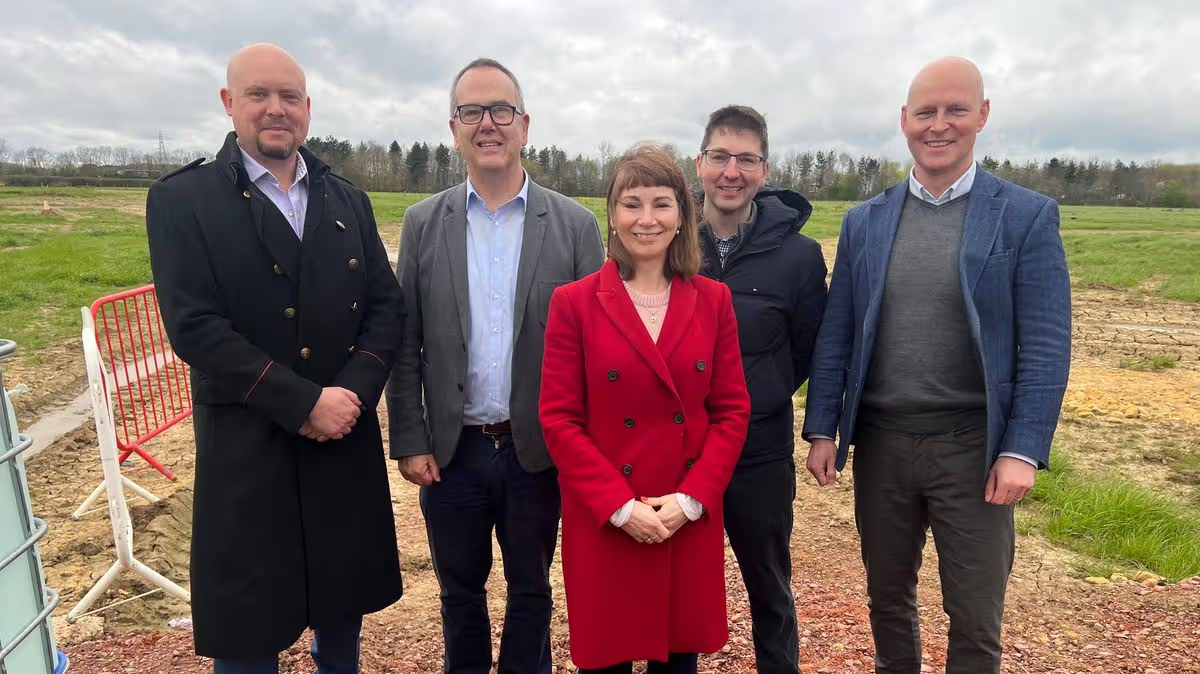
From Left Tewkesbury Mp Cameron Thomas, Infrastructure Cabinet Member Julian Tooke, County Council Leader Lisa Spivey, Tewkesbury Borough Council Leader Richard Stanley And Cheltenham Mp Max Wilkinson at the M5 junction 10 improvements site. FREE TO

From Left: Tewkesbury MP Cameron Thomas, Infrastructure Cabinet Member Julian Tooke, County Council Leader Lisa Spivey, Tewkesbury Bororough Council Leader Richard Stanley and Cheltenham MP Max Wilkinson at the M5 junction 10 improvements site(Image: Local Democracy Reporting Service)

Cllr Spivey said there were genuine concerns about the project’s viability before the Government confirmed earlier this year that Gloucestershire would receive the funding.

Cheltenham MP Max Wilkinson said it was a relief to finally witness progress at the site, as the shortcomings at junction 10 have been a persistent frustration for residents.

Advertisement

“After so many years of campaigning, it’s a relief to finally see progress – not least because the upgrade will unleash the full potential of the Golden Valley development,” he said.

“That will bring billions of pounds of investment to our town, generating thousands of good jobs in cyber and tech and building on the expertise we already have at GCHQ and our thriving cyber ecosystem.”

Meanwhile, Tewkesbury MP Cameron Thomas praised those involved in the project and the Government officials who have opted to invest in Gloucestershire.

“The Golden Valley Project represents the culmination of ten years of planning and negotiation, and is a credit to the collaborative work of government and industry,” the Liberal Democrat said.

Advertisement

“Keeping with Gloucestershire’s engineering and cyber tech heritage, this strategic development will create highly technical employment opportunities for skilled professionals from across the West Midlands and South West, alongside thousands of affordable homes and infrastructure.”


Continue Reading
Click to comment

You must be logged in to post a comment Login

Leave a Reply

Business

Waldencast agrees to sell Obagi Medical for up to $460 million

Published

on


Waldencast agrees to sell Obagi Medical for up to $460 million

Continue Reading

Business

Taysha Gene Therapies: Shortened Timeline Increases The Potential

Published

on

Taysha Gene Therapies: Shortened Timeline Increases The Potential

Taysha Gene Therapies: Shortened Timeline Increases The Potential

Continue Reading

Business

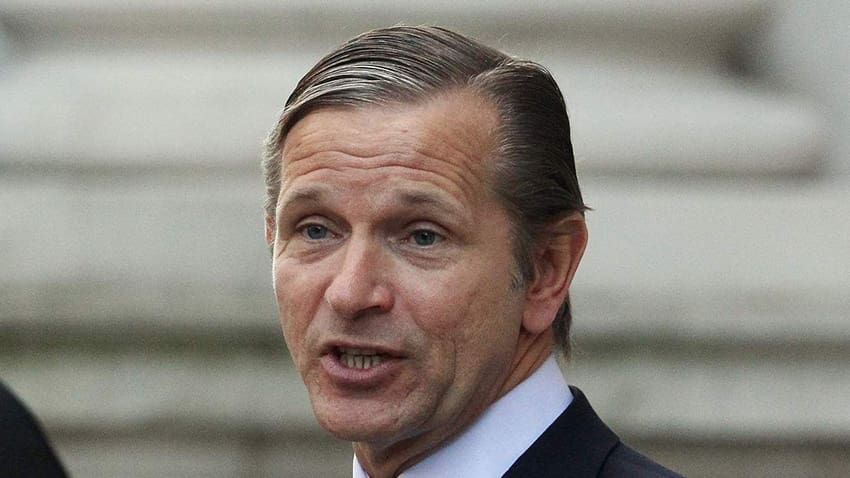
Marc Bolland Appointed by Government to Tackle UK Youth Unemployment Crisis

Published

on

Marc Bolland Appointed by Government to Tackle UK Youth Unemployment Crisis

Whitehall has turned to one of the City’s most seasoned retail chiefs in an attempt to head off what ministers are now privately describing as the most acute youth unemployment crisis in more than a decade.

Marc Bolland, the former chief executive of Marks & Spencer, has been drafted in by the government to corral Britain’s biggest employers behind a renewed push to get young people into work, following an excoriating review by the former Labour cabinet minister Alan Milburn that warned the country risked sacrificing a generation to worklessness.

Milburn’s interim report, published this week, found that one in six 16- to 24-year-olds will be out of work, education or training within five years unless ministers act decisively. The figure currently stands at one in eight. Official data has already pushed the cohort of so-called NEETs above the one-million mark, the highest level in more than 12 years, and Milburn warned of a “generational fault line” opening up beneath the labour market.

“The problem is that for too many young people, opportunities are not growing, they’re shrinking,” Milburn wrote. His review found that six in ten NEETs have never held a job, yet 84 per cent of those surveyed said they wanted to work or train, a finding that has galvanised support inside Number 11 for a more interventionist approach.

Bolland, who also ran Morrisons and served as chief operating officer at Heineken, will report to Work and Pensions Secretary Pat McFadden and take up the role of Lead Non-Executive Director at the Department for Work and Pensions. His brief, confirmed by the government, is to convene chief executives across sectors and to advise ministers on how to respond to Milburn’s findings.

Advertisement

It is familiar territory. In 2012, in the wake of the previous summer’s riots, Bolland founded Movement to Work, the employer-led charity that has since helped more than 200,000 disadvantaged young people into employment. That track record, built on persuading rival boardrooms to pool resources rather than wait for state schemes, is precisely what ministers hope he can replicate at scale.

“I believe the government is serious about tackling this generational crisis of youth unemployment,” Bolland said on his appointment, “and I know that working hand-in-hand with business to support young people gives them the best possible chance of success.”

Alongside Bolland’s appointment, the government has secured commitments from some of the UK’s largest employers to back 300,000 work experience and training placements over the next three years. McDonald’s was first off the blocks earlier this year with 2,500 paid work experience placements, and Whitehall is now banking on a long tail of mid-market and SME employers following suit.

The push dovetails with the Treasury’s £725m package of apprenticeship reforms, which is expected to create 50,000 new roles and introduce shorter, more flexible training routes from April. Together, the measures represent the most concerted attempt to rebuild the rungs of the working ladder since the Coalition’s apprenticeship drive of the early 2010s.

Advertisement

Whether it works will depend in no small part on whether Bolland can persuade boardrooms that the cost of a placement now is cheaper than the cost of a hollowed-out talent pipeline later. As Milburn put it in his own assessment of the review’s findings, for every £1 the state spent on employment support for young people in 2024/25, roughly £25 went on benefits. That, more than any speech from the Despatch Box, is the number business will be asked to help shift.


Jamie Young

Jamie Young

Jamie is Senior Reporter at Business Matters, bringing over a decade of experience in UK SME business reporting.
Jamie holds a degree in Business Administration and regularly participates in industry conferences and workshops.

When not reporting on the latest business developments, Jamie is passionate about mentoring up-and-coming journalists and entrepreneurs to inspire the next generation of business leaders.

Advertisement
Continue Reading

Business

Hinkley Point C nuclear plant announces ‘tremendous’ milestone

Published

on

Business Live

French energy giant EDF said it had taken ‘months of planning and close coordination’

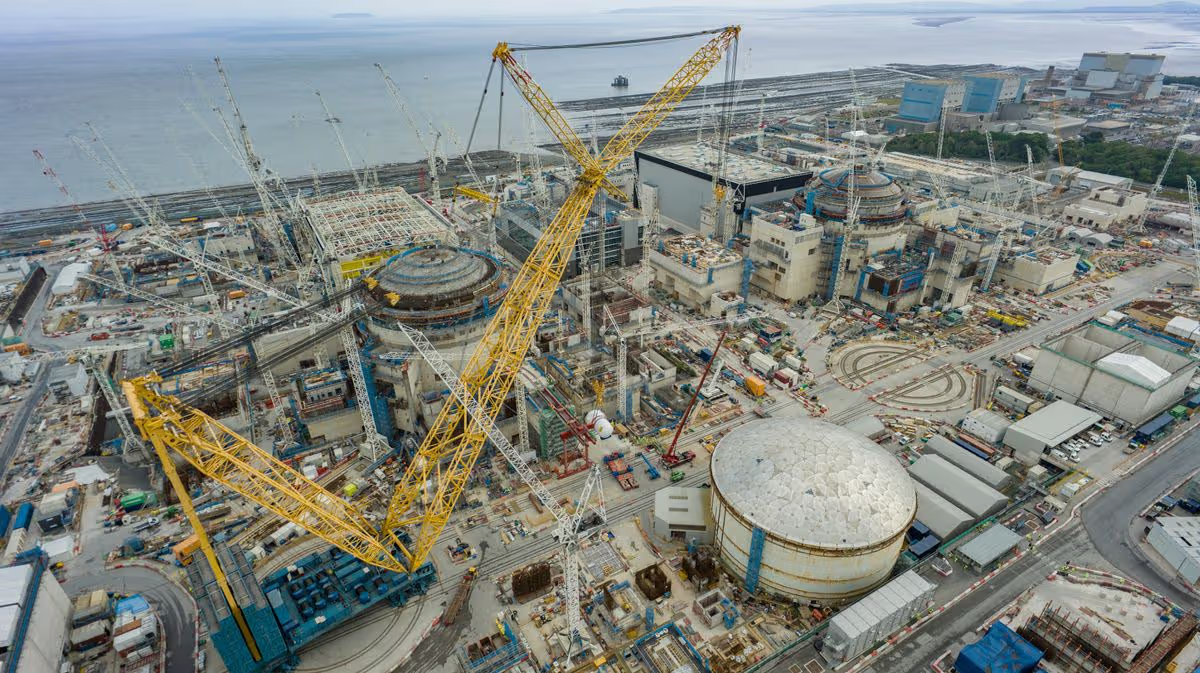
Hinkley Point C power station in Bridgwater, Somerset

Hinkley Point C power station in Bridgwater, Somerset(Image: Hinkley Point C)

A huge crane has installed the second reactor at Hinkley Point C nuclear power station in a milestone described as “tremendous” by EDF.

The reactor was shipped from from France to Avonmouth Docks in Bristol before arriving in Somerset by barge earlier this year, with the final four miles to the Bridgwater site on a transporter.

Advertisement

Now French-owned energy giant EDF says it has used a crane – named ‘Big Carl’ – to lift the 500-tonne cylinder into place before its precision installation inside the reactor building.

Simon Parsons, Hinkley Point C’s delivery director, said: “This marks a tremendous achievement by the entire team and one that has taken months of planning and close coordination between the 10 main contractors involved.”

Once inside the reactor building, the 13-metre-long vessel was lifted and rotated into a vertical position by the large internal crane and lowered onto a support ring with just 40mm clearance on either side.

Mr Parsons said Hinkley had not used a “cut and paste” approach but had taken lessons from the first reactor’s installation in 2023 to save time, money and disruption to the site.

Advertisement

“Importantly, we are also applying those lessons to put Unit 2 well ahead of the first unit’s position at the equivalent stage, with more materials in place and more work achieved,” he said.

The Unit 2 reactor building is further ahead than at the same stage for Unit 1, EDF said, with more equipment installed, as well as more structural steel work and the outer containment layer already in place.

Big Carl lifts Hinkley Point C's second nuclear reactor into place

Big Carl lifts Hinkley Point C’s second nuclear reactor into place(Image: Hinkley Point C)

The reactor pressure vessel uses nuclear fission to make heat and steam for the world’s largest turbines, the Arabelle.

The announcement comes just months after it was revealed Britain’s first new nuclear station in a generation would face further delays at a cost of some €2.5bn to EDF, which is responsible for the project.

Advertisement

Hinkley Point C is set to provide six million UK homes with zero-carbon electricity when it is up and running but the project has been plagued by cost overruns and delays since it received government approval in 2016.

EDF said in February the first reactor at Hinkley Point C would start operating in 2030 – a year later than expected and nearly 13 years since work began on the scheme.

The delay is expected to take the cost of the project up to £35bn – far more than the original estimate of £18bn when the scheme was green lit. But, in reality, the final price tag could be far higher once inflation is considered as the French-owned energy firm has outlined its estimates in 2015 prices.

Advertisement
Continue Reading

Business

Stocks to Watch: Nvidia, Qualcomm, easyJet

Published

on

Nvidia CEO Jensen Huang at a conference today

Stocks to Watch: Nvidia, Qualcomm, easyJet

Continue Reading

Business

Royal Mail misses first-class target as Ofcom prepares probe

Published

on

Royal Mail misses first-class target as Ofcom prepares probe

Britain’s letter writers, and the small businesses that still depend on the post for invoices, contracts and statutory notices, are paying the price for another year of underperformance at Royal Mail.

Just 75.7% of first-class mail was delivered on time in the 12 months to the end of March, the postal operator confirmed on Friday, a country mile from its 93% regulatory target and the first full-year snapshot of life under Czech billionaire Daniel Kretinsky’s EP Group, which completed its £3.6bn takeover last spring.

Performance has actually slipped since the company’s final year on the London Stock Exchange, when 76.9% of first-class and 92.2% of second-class letters arrived on time. The new figures show only 90.2% of second-class post landed within three working days, against a target of 98.5%.

The communications regulator described itself as “very concerned” by the figures. Business Matters understands Ofcom is preparing to open a formal investigation into Royal Mail’s performance as soon as next week – a move that would almost certainly lead to a further multi-million-pound fine on top of the £21m penalty imposed last October, the third-largest in the watchdog’s history.

It is six years since Royal Mail last hit its second-class target and a decade since it cleared the bar on first-class. The slump that began during the pandemic has stubbornly refused to reverse.

Advertisement

Chief operating officer Jamie Stephenson struck a contrite tone, insisting the business is on course to meet new, softer targets of 90% for first-class and 95% for second-class by this time next year.

“We’re putting significant investment into improving reliability and reaching these new delivery targets, but delivering lasting change across a network of this scale takes time,” he said.

The company is ploughing £500m into its five-year improvement plan, which includes offering part-time posties longer hours and scrapping second-class Saturday deliveries – a structural overhaul agreed with Ofcom and rolled out from April.

For Britain’s 5.5 million small businesses, however, the patience required is wearing thin. SMEs remain disproportionately reliant on physical mail for cheques, payment reminders, HMRC correspondence and signed agreements. Slow post means delayed cash flow, missed deadlines and, in the worst cases, penalties from regulators whose own letters arrive late.

Advertisement

Tom MacInnes, policy director at Citizens Advice, was withering in his assessment. Poor performance at Royal Mail, he said, was “business as usual”.

“What’s worse, Royal Mail claims people will have to wait another year until it can meet its new, lower delivery targets,” he added.

In February, postal workers told the BBC that letters had been sitting undelivered in depots for weeks because staff had been instructed to prioritise parcels, which carry fatter margins. Mr Kretinsky was hauled before MPs on the Business and Trade Committee in March, where he said he was “deeply sorry for any letter that arrives late” but flatly denied that parcels were being put ahead of letters. As the House of Commons Library has documented, letter volumes have collapsed from 20 billion items in 2004-05 to around 6.6 billion last year, putting the universal service economics under unprecedented strain.

Ofcom has already eased Royal Mail’s regulatory burden. Since April, the operator has been measured against the lower targets of 90% next-day delivery for first-class and 95% three-day delivery for second-class. The regulator argued the previous benchmarks were “more stretching” than in comparable European countries and would “carry higher costs which would need to be recovered through higher prices” – an unwelcome trade-off for any SME owner who has watched a first-class stamp climb to £1.70.

Advertisement

Whether £500m and a slacker rulebook can finally turn around an institution that has failed its own customers for the best part of a decade is the question now landing on Mr Kretinsky’s desk. On the evidence of Friday’s numbers, the answer is not yet in the post.


Jamie Young

Jamie Young

Jamie is Senior Reporter at Business Matters, bringing over a decade of experience in UK SME business reporting.
Jamie holds a degree in Business Administration and regularly participates in industry conferences and workshops.

When not reporting on the latest business developments, Jamie is passionate about mentoring up-and-coming journalists and entrepreneurs to inspire the next generation of business leaders.

Advertisement
Continue Reading

Business

BofA raises Icon stock price target to $125 on booking trends

Published

on


BofA raises Icon stock price target to $125 on booking trends

Continue Reading

Business

Explained: NSE extends F&O trading by 10 minutes. What changes for traders?

Published

on

Explained: NSE extends F&O trading by 10 minutes. What changes for traders?
The National Stock Exchange (NSE) has announced a significant change to trading hours in the equity derivatives segment with the introduction of the Closing Auction Session (CAS) framework.

Starting August 3, 2026, the normal market closing time for equity derivatives will be extended by 10 minutes to 3:40 pm from the current 3:30 pm. While the extension is noteworthy, the bigger change lies in how closing prices for eligible securities will be determined.

The move aims to ensure a smoother transition between the cash and derivatives markets at the end of the trading day while maintaining consistency in the pricing framework across segments.

What is the closing auction session?

The CAS is a structured trading window held at the end of the trading day. During this period, market participants place buy and sell orders to determine a single closing price for a security through an auction-based mechanism.

Advertisement

Unlike the current system where prices evolve through normal trading until market close, the auction process discovers a fair closing price based on orders entered during the designated session.
According to the exchange, CAS will initially apply only to securities in the cash segment that have derivative contracts available. The framework will roll out in phases, and any future expansion will be subject to SEBI guidance and separate operational instructions from the exchange.

Why are derivatives trading hours being extended?

Although CAS applies only to the equity segment, NSE decided to extend trading hours in the derivatives segment to ensure both markets remain aligned during the closing process.

The exchange also clarified that the price bands and pre-trade risk control measures introduced as part of CAS in the cash market will be mirrored in the derivatives segment. This is intended to maintain consistency between the two segments during the closing phase of trading.

How will the closing auction session work?

The CAS will run for 20 minutes, from 3:15 pm to 3:35 pm. The process will begin with a transition phase between 3:15 pm and 3:20 pm, during which the reference price will be calculated using the volume-weighted average price (VWAP) of trades executed between 3:00 pm and 3:15 pm.

Between 3:20 pm and 3:25 pm, participants will be able to enter both market and limit orders. From 3:25 pm to 3:30 pm, only limit orders will be permitted. During this period, market orders cannot be modified or cancelled.

Advertisement

The order entry session will close randomly at any point between 3:28 pm and 3:30 pm, after which the auction process will determine the final closing price.

How will closing prices be calculated?

One key point highlighted by NSE is that there will be no change in the methodology used to calculate closing prices of derivative contracts. The volume-weighted average price (VWAP) used for derivatives closing price calculation will continue to be based on trades executed during the final 30 minutes of trading. However, because market hours are being extended, that 30-minute window will now shift to 3:10 pm-3:40 pm instead of the current 3:00 pm-3:30 pm.

For securities eligible for CAS, the closing price in the cash segment will be determined through the auction process.

Ashish Nanda, President and Digital Business Head at Kotak Securities summed up the shift by noting that the market is moving from a “continuous trading close” to an “auction discovered close”.

Advertisement

Under the current framework, closing prices are derived from the VWAP of trades executed between 3:00 pm and 3:30 pm. Under the new framework, closing prices for F&O-eligible stocks will effectively be linked to a 20-minute auction process running from 3:15 pm to 3:35 pm.

What happens if a stock is removed from F&O?

NSE clarified that eligibility for CAS is linked to the presence of derivatives on the stock. If a security is excluded from the equity derivatives segment on both exchanges, it will no longer be eligible for the CAS.

In such cases, the closing price will revert to the existing methodology and be determined using the VWAP of trades executed during the last 30 minutes of trading. However, if the security continues to be part of the derivatives segment on at least one exchange, it will remain eligible for CAS.

What happens to pending orders?

The exchange outlined operational changes relating to order management. All unexecuted special orders, including stop-loss orders and disclosed quantity orders, will be cancelled. Pending orders that fall outside the revised price band will also be cancelled automatically, and members will receive appropriate cancellation notifications.

Advertisement

Why does this matter for traders?

For many market participants, the biggest implication is that the final closing price may no longer mirror the last traded price visible on trading screens at 3:30 pm.

According to Ashish Nanda, this could require adjustments to trading strategies, particularly for option writers and arbitrageurs who rely heavily on closing prices for valuation, settlement and hedging decisions.

While the derivatives market will remain open until 3:40 pm, the broader shift is not simply about extending trading by 10 minutes. It marks a change in how closing prices for eligible securities are discovered, with the exchange moving toward an auction-based mechanism designed to determine a single closing price at the end of the trading day.

What happens to existing market timings?

Apart from the revised closing time, most trading schedules remain unchanged. The pre-open session in the derivatives segment will continue to begin at 9:00 am and the normal trading session will continue to start at 9:15 am. Similarly, the trade modification window will remain unchanged and continue until 4:15 pm.

Advertisement

(Disclaimer: Recommendations, suggestions, views and opinions given by the experts are their own. These do not represent the views of The Economic Times)

Continue Reading

Business

Q4 earnings review: Motilal Oswal highlights broad-based beat on estimates, lists 6 sectors that exceeded expectations

Published

on

Q4 earnings review: Motilal Oswal highlights broad-based beat on estimates, lists 6 sectors that exceeded expectations
As markets wrap up the Q4 results season for the financial year 2026, Motilal Oswal highlighted that Indian corporate earnings showcased widespread outperformance across aggregates, with commodity strength driving the broad-based beat to estimates.

In its latest Indian strategy report, Motilal Oswal Financial Services said that aggregate earnings of the companies under its coverage grew 16% year-on-year, beating its estimate of 8% growth in the January-March quarter of FY26. According to the domestic brokerage, the better-than-expected earnings growth was powered by BFSI (profit grew 18% YoY vs. brokerage’s estimate of 11%) and supported by metals (profit surged 50% YoY vs. brokerage’s estimate of 24%) and OMCs (profit jumped 62% YoY vs. brokerage’s estimate of 7% growth). Further, technology (+13% YoY), telecom (+8.4x YoY), and automobiles (+13% YoY vs. brokerage’s estimate of 6% decline) propelled earnings, Motilal added.

On the other hand, aggregate earnings growth was dragged by oil & gas (excluding OMCs), which posted a profit dip of 10% YoY vs. Motilal’s estimate of 1% growth.

The Nifty 50 companies delivered 4% YoY growth in net profit, beating Motilal’s estimate of 2% growth. The domestic brokerage, however, noted that Nifty reported a single-digit earnings growth for the eighth consecutive quarter, the first time since the pandemic (June 2020).

Advertisement

“Barring Reliance Industries, which posted a profit dip of 13% YoY, and Interglobe Aviation, which posted a loss of Rs 24 billion vs. a profit of Rs 30.7 billion YoY, the Nifty Universe posted a 9% YoY earnings growth. Five Nifty companies – Bharti Airtel, JSW Steel, HDFC Bank, Infosys, and TCS – contributed 75% of the incremental YoY accretion in earnings. Conversely, Reliance Industries, Interglobe Aviation, Adani Enterprises, Power Grid, Dr Reddy’s, Cipla, Tata Motors PV, Sun Pharma, and Maruti Suzuki dragged down earnings. Within the Nifty, 15 companies reported lower-than-expected profits, while 18 posted a beat, and 17 registered in-line results,” Motilal added.


Also read:
IndiGo soars 5% after Q4 results. What Goldman Sachs, Jefferies and others are saying

Largecaps, midcaps beat estimates, smallcaps post in-line earnings

The domestic brokerage noted that among the companies under its coverage, around 90 largecap companies on average posted an earnings growth of 12% YoY. Around 101 midcap companies, meanwhile, showed improvement and delivered earnings growth of 36% YoY (vs. the brokerage’s estimate of 25%).
“Multiple mid-cap sectors, such as BFSI, metals, OMCs, and healthcare, lifted the overall performance. These sectors contributed ~89% of the incremental YoY accretion in earnings. In contrast, smallcaps (168 companies) delivered in-line performance, with earnings rising 19% YoY (our estimate of +18%). Within small-caps, 68% of the coverage universe exceeded/met our estimates. Conversely, within the large-cap/mid-cap universes, 74%/73% of the companies exceeded/met our estimates,” Motilal Oswal said.
It noted that Nifty EPS for FY26 stood at Rs 1,065 per share, marking a second consecutive year of single-digit growth. It cut its Nifty EPS estimate for FY27 by 0.9% to Rs 1,235 per share, led by SBI, Reliance Industries, JSW Steel, ONGC, and Coal India. “Earnings estimates of the MOFSL Universe were cut by 1.3% for FY27, fueled by PSU Bank, Oil & Gas, Healthcare, Telecom, and Technology. The MOFSL large-cap universe reported an earnings cut of 0.9%, while the mid-cap universe recorded a downgrade of 2.2%, and the MOFSL small-cap universe posted a downgrade of 2.8% for FY27,” it added.

Q4 earnings season fared better than expectations

Motilal concluded by saying that the Q4 earnings season fared better than expectations, but forward earnings revisions continue to exhibit weakness. Following India’s sharp underperformance in FY26 and record FII outflows, a favorable base has likely been set for Indian equities, it said, adding that in the near term, however, the market will remain hostage to volatile developments arising from the West Asian crisis.
“Higher commodity prices will be the key monitorables, as a prolonged elevated level could affect India’s macro parameters and engender a tight monetary policy stance. Our model portfolio broadly reflects our preference for growth visibility, structural domestic growth plays, and select global value names. We firmly believe that this is a bottom-up market, despite India witnessing both time and price corrections relative to EM peers. Our key overweight sectors are Autos, PSU Banks, Diversified Financials, Manufacturing & Industrials, Consumer Discretionary, and New-age platforms. In contrast, we are underweight on Oil & Gas, Private Banks, Metals, Consumer Staples, IT, and Commodities/Utilities,” the brokerage said.

Also read: PSU bank stocks vs private banks in FY27: The valuation trap you need to avoid

Advertisement

Motilal Oswal’s top picks

It listed Bharti Airtel, State Bank of India (SBI), ICICI Bank, Mahindra & Mahindra (M&M), Titan, Bharat Electronics (BEL), Eternal, Tata Steel, Infosys and IndiGo as its top Nifty 50 picks, while non-Nifty 50 picks included TVS Motor Company, ICICI Prudential AMC, Groww, Indian Hotels, AU Small Finance, Dixon Tech, Lenskart, Waaree Energies, Coforge, Radico Khaitan and Delhivery.

(Disclaimer: Recommendations, suggestions, views and opinions given by the experts are their own. These do not represent the views of The Economic Times)

Continue Reading

Business

Cristiano Ronaldo at 2030 World Cup Would Be ‘Huge Surprise’

Published

on

Cristiano Ronaldo

LISBON — Portuguese Football Federation president Pedro Proenca has cast doubt on the possibility of Cristiano Ronaldo playing at the 2030 World Cup, stating that it would require a “huge surprise” physiologically for the 41-year-old superstar to feature at age 45 when Portugal co-hosts the tournament.

Proenca, speaking at the Bola Branca Conference, acknowledged Ronaldo’s extraordinary career and enduring link to the national team but emphasized biological realities as the primary barrier to a sixth World Cup appearance. The five-time Ballon d’Or winner remains Portugal’s all-time leading scorer and a central figure for the Selecao, but questions about his long-term playing future continue to grow.

“I’ll say that, physiologically, a huge surprise would have to happen for him to be in another World Cup,” Proenca said. He added that any participation in the European Championship would depend on the coach at the time, Ronaldo’s form and various technical factors.

The comments reflect a pragmatic approach from Portuguese football’s governing body as it prepares for the 2030 World Cup, which Portugal will co-host alongside Spain and Morocco. While Ronaldo has defied age-related expectations throughout his career, Proenca suggested that expecting him to compete at the highest level in 2030 would be unrealistic without exceptional circumstances.

Advertisement

Ronaldo’s Enduring Legacy

Despite the tempered expectations for on-field participation, Proenca made clear that Ronaldo’s connection to Portuguese football will remain permanent. The forward’s global brand, marketability and contributions to the sport have elevated the profile of the national team significantly.

“Cristiano Ronaldo will be whatever he wants to be in Portuguese football,” Proenca stated. “It’s an absolutely extraordinary case, not only in terms of notoriety, capacity, and brand mobilization. Sporting-wise, I dare say it’s a unique case of talent development in Portuguese football.”

This assurance suggests that once Ronaldo decides to retire from playing, the federation envisions a significant ongoing role for him, potentially in ambassadorial, coaching, or advisory capacities. Ronaldo’s influence extends far beyond the pitch, with his presence helping secure sponsorships, boost youth development programs and maintain international interest in the Portuguese team.

Planning for the Post-Ronaldo Era

Proenca emphasized that the federation is proactively preparing for life after Ronaldo’s playing career without treating it as a crisis. The organization has diversified its revenue streams and partnerships to reduce dependence on any single player or sponsor.

Advertisement

“The Portuguese Football Federation has always been preparing its present and its future, in terms of revenue, so as not to depend on participating in international competitions solely on one or two sponsors and one or two players,” he explained.

This forward-thinking approach aims to ensure stability regardless of who wears the national team jersey. Portugal has produced several talented young players in recent years, and the federation is focused on creating a sustainable pipeline of talent to maintain competitive success.

Ronaldo’s Current Standing

At 41, Ronaldo continues to perform at a high level with Al-Nassr in Saudi Arabia and for Portugal. He was instrumental in Portugal’s Nations League success and remains a key goal threat in qualifying matches. However, the physical demands of elite international football at an advanced age present increasing challenges.

Ronaldo has repeatedly expressed his desire to play at the 2030 World Cup on home soil, viewing it as a potential fairytale ending to his international career. His dedication to fitness and recovery is legendary, but Proenca’s comments highlight the scientific limits that even the greatest athletes eventually face.

Advertisement

Broader Implications for Portugal

The 2030 World Cup represents a monumental opportunity for Portuguese football. As co-hosts, the country will benefit from infrastructure development, increased global visibility and economic gains. Ensuring a competitive national team during the tournament is a priority, but the federation appears committed to building depth rather than relying solely on Ronaldo’s star power.

Younger talents such as Rafael Leao, Bruno Fernandes and Joao Felix are expected to form the core of the team in the coming years. The transition from the Ronaldo era will require careful management to maintain fan enthusiasm and competitive performance.

Ronaldo’s Global Impact

Regardless of his playing status in 2030, Ronaldo’s legacy as one of football’s greatest players is secure. His record-breaking goal tallies, Champions League successes and influence on the sport’s commercialization have reshaped modern football. In Portugal, he remains a national icon whose achievements inspire generations of young players.

The federation’s willingness to offer Ronaldo any role he desires post-retirement recognizes both his sporting contributions and his value as a global ambassador. This approach could help ensure a smooth transition while preserving the emotional connection between Ronaldo and Portuguese supporters.

Advertisement

As the 2030 World Cup draws closer, discussions about Ronaldo’s future will intensify. For now, Proenca’s comments provide a realistic framework for expectations while celebrating Ronaldo’s unparalleled contributions to Portuguese football.

The coming years will reveal whether Ronaldo can continue defying age expectations or if 2030 will mark the beginning of his next chapter in a non-playing capacity. Whatever the outcome, his place in football history and Portuguese sporting culture remains firmly established.

Continue Reading

Trending

Copyright © 2025