Connect with us
DAPA Banner
DAPA Coin
DAPA
COIN PAYMENT ASSET
PRIVACY · BLOCKDAG · HOMOMORPHIC ENCRYPTION · RUST
ElGamal Encrypted MINE DAPA
🚫 GENESIS SOLD OUT
DAPAPAY COMING

Business

M5 junction upgrade expected to unlock 20,000 homes by 2029

Published

on

Business Live

The major Gloucestershire infrastructure project began this year and is expected to boost the region’s economic potential

Part of the M5 junction 10 improvements site. FREE TO USE FOR ALL PARTNERS. CREDIT: Carmelo Garcia

Part of the M5 junction 10 improvements site(Image: Local Democracy Reporting Service / Carmelo Garcia)

The major upgrade to junction 10 of the M5, which is regarded as crucial for unlocking Gloucestershire’s economic prospects, is anticipated to reach completion in 2029. Work on the £372m project, which will span an area equivalent to more than 260 football pitches, started this year with archaeological excavations and the construction of bat roosts.

Advertisement

On completion, the road enhancements will open up land for 20,000 homes and support the Golden Valley development and National Cyber Innovation Centre, which are projected to generate approximately 12,000 jobs west of Cheltenham.

The road improvements will include the creation of a new junction offering access in all directions on and off the motorway. The scheme also encompasses widening the A4019 Tewkesbury Road and a new link road to the B4634 in west Cheltenham, alongside cycle paths, walkways and flood mitigation measures.

The improvements are intended to unlock access to planned housing, including the approved 4,115 homes and 60 acres of employment land at Elms Park and employment development sites on the outskirts of the spa town.

Gloucestershire County Council’s economic development, planning and infrastructure chief Julian Tooke (LD, Pittville and St Paul’s) previously said the scheme will serve as a “catalyst for transformational growth” between Birmingham and Bristol.

Advertisement

He believes the additional Government funding has marked a turning point for the county. Shire Hall leader Lisa Spivey (LD, South Cerney) described the project as central to their growth strategy along the M5 corridor.

“It’s great to see all the councils and MPs come together to support the project,” she said, explaining the scheme was enabled by crucial funding from Homes England.

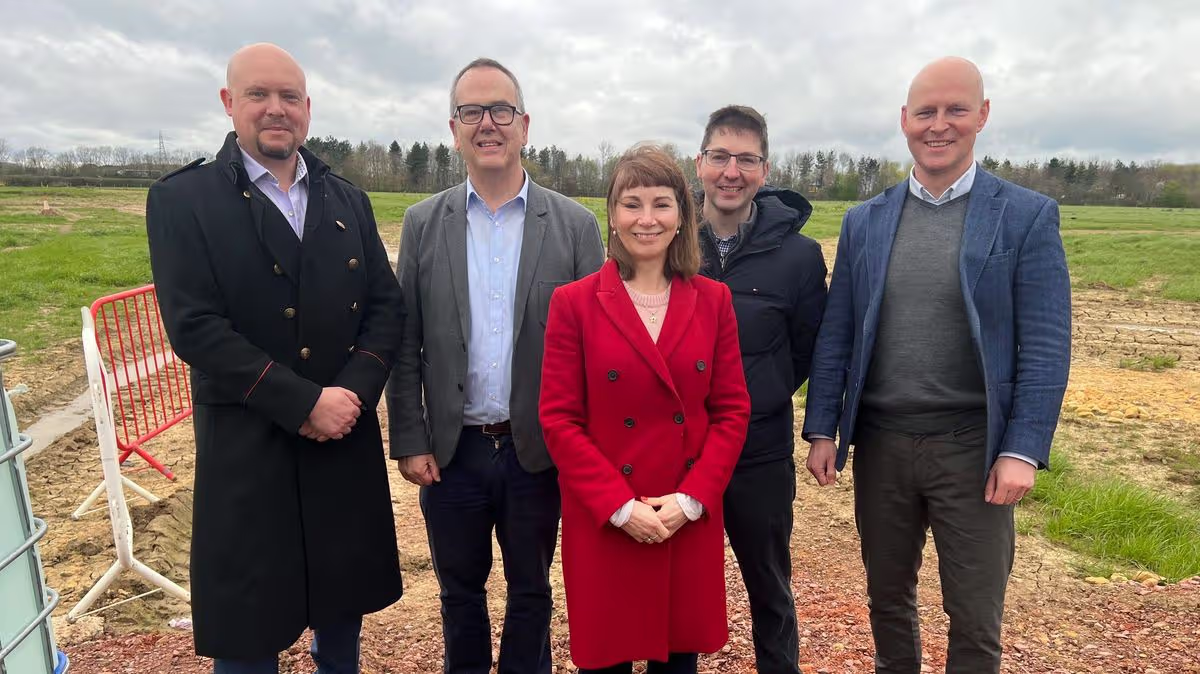
From Left Tewkesbury Mp Cameron Thomas, Infrastructure Cabinet Member Julian Tooke, County Council Leader Lisa Spivey, Tewkesbury Borough Council Leader Richard Stanley And Cheltenham Mp Max Wilkinson at the M5 junction 10 improvements site. FREE TO

From Left: Tewkesbury MP Cameron Thomas, Infrastructure Cabinet Member Julian Tooke, County Council Leader Lisa Spivey, Tewkesbury Bororough Council Leader Richard Stanley and Cheltenham MP Max Wilkinson at the M5 junction 10 improvements site(Image: Local Democracy Reporting Service)

Cllr Spivey said there were genuine concerns about the project’s viability before the Government confirmed earlier this year that Gloucestershire would receive the funding.

Cheltenham MP Max Wilkinson said it was a relief to finally witness progress at the site, as the shortcomings at junction 10 have been a persistent frustration for residents.

Advertisement

“After so many years of campaigning, it’s a relief to finally see progress – not least because the upgrade will unleash the full potential of the Golden Valley development,” he said.

“That will bring billions of pounds of investment to our town, generating thousands of good jobs in cyber and tech and building on the expertise we already have at GCHQ and our thriving cyber ecosystem.”

Meanwhile, Tewkesbury MP Cameron Thomas praised those involved in the project and the Government officials who have opted to invest in Gloucestershire.

“The Golden Valley Project represents the culmination of ten years of planning and negotiation, and is a credit to the collaborative work of government and industry,” the Liberal Democrat said.

Advertisement

“Keeping with Gloucestershire’s engineering and cyber tech heritage, this strategic development will create highly technical employment opportunities for skilled professionals from across the West Midlands and South West, alongside thousands of affordable homes and infrastructure.”


Continue Reading
Click to comment

You must be logged in to post a comment Login

Leave a Reply

Business

Established Star Holds Edge in Global Reach

Published

on

Selena Gomez

NEW YORK — Selena Gomez maintains a slight overall popularity advantage over Olivia Rodrigo in 2026, driven by her massive social media following and long-term global brand presence, though the younger singer-songwriter leads in current streaming momentum and younger demographic appeal.

As of late May 2026, Gomez boasts approximately 54.4 million Spotify followers and around 44 million monthly listeners, alongside more than 406 million Instagram followers. Rodrigo trails slightly on Spotify with about 53.8 million followers but shows stronger recent streaming numbers, reaching peaks above 60 million monthly listeners following the release of her 2026 single “drop dead.”

The comparison highlights two different phases of stardom. Gomez, 33, represents sustained mainstream success across music, acting, producing and beauty entrepreneurship with Rare Beauty. Rodrigo, 23, embodies the Gen Z pop-punk wave with raw emotional songwriting and rapid chart dominance.

Social Media Dominance

Gomez’s Instagram following of over 406 million remains one of the largest in the world, giving her unmatched reach for brand partnerships and cultural influence. This massive audience allows consistent engagement even during periods of lower musical output. Her Rare Beauty brand and mental health advocacy through Wondermind further cement her as a lifestyle figure beyond entertainment.

Advertisement

Rodrigo has built a dedicated and highly engaged following, particularly among teenagers and young adults. While her Instagram numbers are substantial, they lag behind Gomez’s. However, her fanbase demonstrates intense loyalty, driving strong first-week streams and social media trends with each release.

Streaming and Music Metrics

Rodrigo has shown explosive streaming power in 2026. Her single “drop dead” achieved one of the biggest debuts by a female artist on Spotify’s global chart, with strong daily numbers that frequently push her monthly listeners above Gomez’s in recent weeks. Her catalog continues to perform well, especially tracks from “Sour” and “Guts.”

Gomez maintains steady catalog streams, recently surpassing 29 billion total Spotify streams across her career. Her music benefits from long-term familiarity and placement in playlists, films and television. However, she has released less new music in recent years compared to Rodrigo’s more frequent output.

Broader Cultural Impact

Gomez’s influence extends into acting with roles in “Only Murders in the Building” and producing credits. Her openness about mental health and lupus has built genuine admiration across age groups. Public perception data shows high fame recognition, with strong positive sentiment in many markets.

Advertisement

Rodrigo’s impact centers on musical innovation and emotional authenticity. Her songs frequently top charts and spark cultural conversations about heartbreak, anxiety and female empowerment. She has quickly become a voice for her generation, winning multiple Grammy awards and earning critical praise for her songwriting.

Demographic Appeal

Gomez enjoys broader, multi-generational appeal. Her fans span from teenagers discovering her Disney-era work to adults who follow her evolution. This cross-demographic strength gives her an edge in overall popularity metrics and brand collaborations.

Rodrigo dominates among Gen Z and younger millennials. Her relatability and social media-savvy approach create intense but more concentrated fandom. This demographic focus translates into powerful streaming numbers and sold-out tours but may limit broader mainstream penetration compared to Gomez.

Market and Industry Views

Industry analysts note that Gomez’s diversified career provides more stability. Her business ventures generate significant revenue and keep her relevant even without constant musical releases. Rodrigo’s trajectory remains music-first, with potential for even greater heights if she sustains her current creative momentum.

Advertisement

Both artists maintain strong touring careers. Gomez’s past tours have drawn massive crowds, while Rodrigo’s arena shows sell out quickly due to passionate fan demand. Merchandise and sponsorship deals further highlight their commercial value.

Global Reach Comparison

Gomez holds stronger appeal in Latin America and parts of Asia due to her heritage and long career. Rodrigo has rapidly expanded internationally, particularly in English-speaking markets and Europe. Both benefit from strong support in the United States, where they frequently trend on social platforms.

Search interest and brand value studies consistently rank Gomez higher in overall recognition, while Rodrigo often leads in “buzz” or current cultural conversation metrics, especially following new releases.

Future Outlook

As 2026 progresses, the comparison may shift depending on upcoming projects. Gomez has hinted at new music and continued acting work, while Rodrigo’s recent singles suggest sustained activity. Both artists are expected to remain major forces in entertainment for years to come.

Advertisement

Their different career stages make direct comparison complex. Gomez represents established, multifaceted stardom with exceptional longevity. Rodrigo exemplifies breakout success and generational resonance with potential for long-term dominance.

Ultimately, Selena Gomez currently holds a modest edge in overall popularity due to broader reach and sustained presence. However, Olivia Rodrigo’s current momentum and connection with younger audiences make her a formidable and fast-rising competitor in the pop landscape.

The entertainment industry benefits from both artists’ contributions. Their success stories highlight different paths to stardom in the modern digital era, from Gomez’s gradual evolution to Rodrigo’s explosive breakthrough. As metrics evolve throughout 2026, their influence on music and culture remains undeniable.

Advertisement
Continue Reading

Business

Nvidia announces new AI chip for personal computers

Published

on

Nvidia announces new AI chip for personal computers

The technology giant’s boss Jensen Huang called the move the “reinvention of the computer”.

Continue Reading

Business

Nvidia RTX Spark: New AI Superchip Unveiled at Computex 2026

Published

on

Nvidia RTX Spark: New AI Superchip Unveiled at Computex 2026

Nvidia has fired its loudest shot yet at the personal computing market, unveiling a new superchip that chief executive Jensen Huang says will turn the humble Windows PC into a “teammate” capable of running personal artificial intelligence agents.

Speaking on Monday at a keynote ahead of the Computex technology show in Taipei, Mr Huang likened the moment to the arrival of the smartphone. “This reinvention of the computer is as big of a deal as the reinvention of the phone into what we now know as the smartphone,” he told delegates as he lifted the lid on the RTX Spark.

The chip, which Nvidia describes as a “superchip for the era of personal AI agents”, will sit at the heart of a new generation of Windows machines from Asus, Dell, HP, Lenovo, Microsoft Surface and MSI when they reach shelves this autumn. Acer and Gigabyte are expected to follow with their own models shortly afterwards. According to Nvidia’s own briefing notes, Spark pairs a Blackwell GPU with an Arm CPU and up to 128GB of unified memory, delivering roughly one petaflop of AI performance on the desk.

For Britain’s small and medium-sized businesses, the implications are significant. On-device AI promises to run drafting, scheduling, customer-service triage and basic analytics without sending sensitive data into the cloud, a development that chimes with the productivity story Business Matters has been tracking in our recent coverage of small businesses embracing AI for quick productivity wins. It also raises the bar for the next hardware refresh, with finance directors now needing to weigh AI-capable specifications alongside the usual considerations of price and support.

The move puts Nvidia squarely in the path of Apple and Intel in a consumer PC market that has been searching for a story to tell since the post-pandemic slump. With an estimated stock-market value north of $5 trillion (£3.7 trillion), a milestone first reported in detail by CNN Business, Nvidia has both the firepower and the brand recognition to disrupt the established order on the high street as well as in the data centre.

Advertisement

The announcement was not without geopolitical noise. On Sunday, the US Department of Commerce moved to close a loophole that had allowed the most advanced Nvidia hardware, including its Blackwell processors, to reach subsidiaries of Chinese firms operating outside the mainland. Washington’s broader campaign to keep cutting-edge silicon out of Chinese hands has been a recurring drag on Nvidia’s growth narrative, even as demand elsewhere remains ferocious.

For UK owner-managers, the strategic question is no longer whether AI belongs in the workplace, but where it should live. As we noted in our analysis of why AI and green tech are vital to SME growth, the businesses that move first on practical, on-the-ground deployment tend to widen the gap on those that wait. That trend is already showing up in the lending figures, with our recent report on UK SME lending climbing to £17.5bn on the back of AI-led growth suggesting balance sheets are being shaped around the technology, not the other way round. Spark, if it delivers on Mr Huang’s billing, may finally make the case for putting that intelligence on the desk rather than in the cloud.

Whether it really represents a “smartphone moment” will depend less on the silicon and more on the software that ships with it. But after a decade in which the PC has felt increasingly like a commodity, Nvidia has at least given the industry something fresh to argue about.


Jamie Young

Jamie Young

Jamie is Senior Reporter at Business Matters, bringing over a decade of experience in UK SME business reporting.
Jamie holds a degree in Business Administration and regularly participates in industry conferences and workshops.

When not reporting on the latest business developments, Jamie is passionate about mentoring up-and-coming journalists and entrepreneurs to inspire the next generation of business leaders.

Advertisement

Continue Reading

Business

Williams-Sonoma, Inc. (WSM) Q1 2026 Earnings Call Transcript

Published

on

OneWater Marine Inc. (ONEW) Q1 2026 Earnings Call Transcript

Williams-Sonoma, Inc. (WSM) Q1 2026 Earnings Call May 21, 2026 10:00 AM EDT

Company Participants

Jeremy Brooks – Senior VP, Chief Accounting Officer & Head of IR
Laura Alber – President, CEO & Director
Jeff Howie – Executive VP & CFO
Sameer Hassan – Chief Technology & Digital Officer

Advertisement

Conference Call Participants

Katharine McShane – Goldman Sachs Group, Inc., Research Division
Seth Sigman – Barclays Bank PLC, Research Division
Charles Grom – Gordon Haskett Research Advisors
Jonathan Matuszewski – Jefferies LLC, Research Division
Christopher Horvers – JPMorgan Chase & Co, Research Division
Peter Benedict – Robert W. Baird & Co. Incorporated, Research Division
Cristina Fernandez – Telsey Advisory Group LLC

Presentation

Advertisement

Operator

Welcome to the Williams-Sonoma, Inc. First Quarter 2026 Earnings Conference Call. [Operator Instructions] I would now like to turn the call over to Jeremy Brooks, Chief Accounting Officer and Head of Investor Relations. Please go ahead.

Jeremy Brooks
Senior VP, Chief Accounting Officer & Head of IR

Advertisement

Good morning, and thank you for joining our first quarter earnings call. Before we get started, I’d like to remind you that during this call, we will make forward-looking statements with respect to future events and financial performance, including our annual guidance for fiscal ’26 and our long-term outlook. We believe these statements reflect our best estimates. However, we cannot make any assurances these statements will materialize. And actual results may differ significantly from our expectations. The company undertakes no obligation to publicly update or revise any of these statements to reflect events or circumstances that may arise after today’s call.

Additionally, we will refer to certain non-GAAP financial measures. These measures should not be considered replacements for and should be read together with our GAAP results. This call should also be considered in conjunction with our filings with the SEC. Finally, a replay of the call will be available on our Investor

Advertisement
Continue Reading

Business

Pumpfields regeneration: 7,000 new homes proposed for Liverpool city centre

Published

on

Business Live

Cabinet set to approve vision to transform area near north docks

Vauxhall Road could be reimagined (Levitt Bernstein)

Vauxhall Road could be reimagined under the council’s plans

Ambitious proposals to establish a thriving new Liverpool city centre district comprising more than 7,000 homes are set for approval this week. Liverpool City Council is seeking to regenerate the Pumpfields and Limekilns areas, near the city’s north docks.

Advertisement

The objective is to unlock the area’s full potential by transforming derelict plots and vacant buildings near the city centre into a significant new neighbourhood over the coming two decades.

The local authority stated that the vision will reimagine the area as a “highly sustainable extension of the city centre”, supporting thousands of new homes, jobs, learning opportunities, green spaces and cultural activity.

The proposals, the council states, “will breathe life into an area with significant opportunities for growth, and will play a pivotal role in connecting the city centre with the north of the city”.

Spanning the city centre, waterfront and north Liverpool, the site is being positioned as a cornerstone of the city’s future expansion — with new walking and cycling routes, public squares and improved streets all in the pipeline, reports the Liverpool Echo.

Advertisement

Historic warehouse buildings along Blackstock Street could also be brought back into active use as part of the broader regeneration drive, with Canal Square serving as a key civic hub and Kingsway Park forming a linear green corridor linking the area to the waterfront.

City leaders say the scheme will forge a single, cohesive district and deliver “comprehensive change in a way that is inclusive, resilient and respectful” of the area’s distinctive character. The masterplan has already been informed by consultations with residents and businesses, and if given the green light by the council’s cabinet this week, will shape future planning applications.

Cllr Nick Small, cabinet member for growth and economy, said: “This is one of the biggest opportunities we have to reshape the north of the city and make sure it plays a full role in Liverpool’s future.

An artist's impression of how the Pumpfield neighbourhood could look

An artist’s impression of how the proposed Pumpfield neighbourhood could look

“For too long, large parts of Pumpfields and Limekilns have been underused, but this plan sets out how we can transform it into a thriving, well-connected neighbourhood with thousands of new homes, new jobs and high-quality public spaces.

Advertisement

“Crucially, this isn’t about one-off developments – it’s about making sure everything is planned properly, with better streets, more green space and stronger links into the city centre, waterfront and surrounding communities.

“It’s a long-term vision that provides certainty for investors and will help us deliver the homes the city needs, while creating a place people actually want to live, work and spend time in.”

To find all the planning applications, traffic diversions, road layout changes, alcohol licence applications and more in your community, visit the Public Notices Portal.

Advertisement
Continue Reading

Business

Ross Stores, Inc. (ROST) Q1 2026 Earnings Call Transcript

Published

on

OneWater Marine Inc. (ONEW) Q1 2026 Earnings Call Transcript

Ross Stores, Inc. (ROST) Q1 2026 Earnings Call May 21, 2026 4:15 PM EDT

Company Participants

James Conroy – CEO & Director
William Sheehan – Executive VP & CFO
Michael Hartshorn – Group President, COO & Director

Advertisement

Conference Call Participants

Matthew Boss – JPMorgan Chase & Co, Research Division
Lorraine Maikis – BofA Securities, Research Division
Tracy Kogan – Citigroup Inc., Research Division
Corey Tarlowe – Jefferies LLC, Research Division
Michael Binetti – Evercore ISI Institutional Equities, Research Division
Charles Grom – Gordon Haskett Research Advisors
Brooke Roach – Goldman Sachs Group, Inc., Research Division
Mark Altschwager – Robert W. Baird & Co. Incorporated, Research Division
Dana Telsey – Telsey Advisory Group LLC
Simeon Siegel – Guggenheim Securities, LLC, Research Division
Krisztina Katai – Deutsche Bank AG, Research Division
Aneesha Sherman – Bernstein Institutional Services LLC, Research Division
Marni Shapiro – The Retail Tracker
Dylan Carden – William Blair & Company L.L.C., Research Division

Presentation

Advertisement

Operator

Good afternoon, and welcome to the Ross Stores First Quarter 2026 Earnings Release Conference Call. [Operator Instructions]

Before we get started, on behalf of Ross Stores, I would like to note that the comments made on this call will contain forward-looking statements regarding expectations about future growth and financial results, including sales and earnings forecasts, new store openings and other matters that are based on the company’s current forecast of aspects of its future business. These forward-looking statements are subject to risks and uncertainties that could cause actual results to differ materially from historical performance or current expectations. Risk factors are included in today’s press release and the company’s fiscal 2025 Form 10-K and fiscal 2026 Form 8-Ks on file with the SEC.

And now I’d like to turn the call over to Jim Conroy, Chief Executive Officer.

Advertisement

James Conroy
CEO & Director

Thank you, John, and good afternoon, everyone. Joining me on our call today are Michael Hartshorn, Group President and

Advertisement
Continue Reading

Business

Durham chipmaker scaling UK challenge to Asia and US

Published

on

Durham chipmaker scaling UK challenge to Asia and US

Backed by the National Wealth Fund, the British Business Bank and M&G, Pragmatic Semiconductor is using a modular, low-capital model to scale flexible chip production at a pace Asia and the US would struggle to match.

On the Meadowfield industrial estate outside Durham, a 55,000 sq ft warehouse that spent a decade gathering dust, and the droppings of nesting seagulls, has been transformed into one of the more intriguing bets in British manufacturing. The gulls have been seen off by a hawk called Buzz; the drains have been cleared; and inside what was once a PVC piping factory, the UK’s most ambitious volume chipmaker is now in full production.

Pragmatic Semiconductor is twelve months into shipping its first commercial orders, the culmination of 14 years of work that began as a Cambridge science project. By year-end, the company expects billions of its ultra-thin, 300mm flexible chips to be leaving the Durham site bound for customers in pharmaceuticals, consumer electronics and fast-moving consumer goods. At that point, management believes Pragmatic will be the UK’s largest semiconductor manufacturer by volume.

The timing is pointed. The European Commission is this week expected to publish a refreshed Chips Act, the latest leg of Brussels’ attempt to wean the bloc off American and Asian silicon by backing home-grown semiconductor capacity. Westminster, too, has put domestic chipmaking near the top of its modern industrial strategy, with advanced manufacturing earmarked as a sector in which Britain has what ministers call a “genuine right to win”.

A different kind of chip, and a different kind of fab

Pragmatic’s edge is that it does not play the same game as TSMC, Samsung or Intel. Its proprietary thin-film transistor technology dispenses with silicon altogether, producing FlexICs, flexible integrated circuits, capable of tracking individual items through complex supply chains and giving consumers verifiable provenance in a way QR codes simply cannot. A bottle of wine can carry its full origin story; a packet of medication bought on Temu or Amazon can be authenticated as the real thing rather than a counterfeit. In time, the chips will power continuous glucose monitors and other slim, flexible medical devices used in the prevention of type-2 diabetes.

Advertisement

The contrast with the conventional fab model is just as striking. Where a Taiwanese or Korean facility can cost tens of billions and take months to push a wafer through its production cycle, Pragmatic’s modular plant requires materially less capital and turns chips out in days. Inside the 30-by-20-metre clean room, robots glide along ceiling tracks shuttling glass-backed substrates between a metal-oxide deposition machine, a photolithography rig that imposes the circuit image, and an etching station that chemically carves out each layer. The finished wafers, each carrying up to 50,000 chips, pass to an assembly room where they are diced and bonded to antenna-bearing circuits. The result emerges from the line looking, disarmingly, like a translucent roll of snowflake-patterned Christmas paper.

An IPO in the cross-hairs

Chief executive David Moore, who relocated from Idaho-headquartered Micron in 2023, is unambiguous about ambition. “Our goal is to be one of the largest semiconductor companies in the world,” he says. Pragmatic’s “north star”, he adds, is “a potential IPO”.

In June he is in Europe and China to meet customers, before turning to the US in July. The reception, he says, is warm. “We engage with the CEOs and chairmen of those customers. They see it as something very strategic and don’t look at us as some outlier UK-based semiconductor company. They see us as a world leader in FlexIC technology. It is now all about orders and shipping.”

Moore is, however, careful to temper near-term expectations. Each new fabrication facility, even with Pragmatic’s simplified processes, will take 12 to 14 months to bring online. The Durham site has space for seven more lines, equating to “capacity for tens of billions of ICs per year”. Significant revenues are expected this year for the first time, with a “milestone-based” path to gross margin, break-even and ultimately free cashflow.

Advertisement

Capital, and the british industrial strategy in action

The funding base behind that journey is unusually domestic. Pragmatic’s December 2023 raise remains the largest semiconductor venture round in European history, with around 70 per cent of the £162 million coming from UK pools of capital, the National Wealth Fund, the British Business Bank, the public/private Northern Gritstone fund and M&G’s Catalyst fund among them. A subsequent extension lifted the round to £179 million. It is precisely the sort of patient, blended-capital deployment that ministers have been pointing to as evidence the £1bn government commitment to the UK microchip industry is starting to bite, alongside earlier schemes that supported a wave of British chip start-ups.

In March 2024, HRH The Princess Royal formally opened Pragmatic Park, home to the UK’s first 300mm wafer fab, with the company committing to 500 highly skilled new jobs over five years.

Ciaran Mulligan, chief investment officer at M&G Life, who oversees £188 billion of client assets, says the case for institutional money is straightforward. “Our scale enables us to invest into private companies, opening up opportunities you simply don’t see in public markets. By sourcing these investments directly through our asset management teams, we can back businesses that are growing, creating jobs and driving innovation.”

The team behind the technology

Founded in Cambridge in 2010 by Richard Price and Scott White, Pragmatic has worked with the Centre for Process Innovation in Sedgefield, County Durham, since 2012. Its workforce now stands at 350, weighted heavily towards PhD-level researchers across the Sedgefield, Durham and Cambridge sites. The chair is Peter Herweck, the former chief executive of Schneider Electric and, before that, of the FTSE 100 software group Aveva, which Schneider bought for £9.5 billion in 2023. The board also includes former Intel chief engineering officer Murthy Renduchintala.

Advertisement

Talent retention in the North East is a quietly significant part of the story. Heather Flint, 31, moved from Lincoln to study in Newcastle, stayed on for a PhD in physical chemistry, her research was on translucent solar cells designed to be embedded in windows, and was contemplating a move south to Cambridge or overseas when she came across Pragmatic. “Staying up north was quite important to me. I just love it,” she says. The R&D team built a role around her. Three years and three promotions later, she has moved from device development to lead design scientist and now into project management. “There is something new every day.”

The company actively recruits postgraduates into its research and technical roles and apprentices into technician roles. Its youngest team member, based in Cambridge, is 21. “In the evening he builds robots for fun,” a spokeswoman noted.

The bigger picture

Whether Pragmatic ultimately lists in London, New York or both will be one of the more closely watched decisions in British technology over the next 24 months. What is already clear is that, by combining a genuinely novel product, a capital-light manufacturing model and an unusually British shareholder register, the company has handed Westminster a rare worked example of its industrial strategy actually working — and quietly assembled the sort of platform from which a UK national champion could, plausibly, take on the giants of Hsinchu, Pyeongtaek and Phoenix.


Amy Ingham

Amy is a newly qualified journalist specialising in business journalism at Business Matters with responsibility for news content for what is now the UK’s largest print and online source of current business news.

Advertisement

Continue Reading

Business

Solution for Puzzle #1808 Delights Food Lovers Worldwide

Published

on

Nancy Guthrie

NEW YORK — Wordle players tackling The New York Times’ popular daily puzzle on Monday, June 1, 2026, were greeted with a spicy challenge as the solution for puzzle No. 1808 was revealed as “CHILI.”

The five-letter word, referring to both a type of hot pepper and the popular stew dish, offered a flavorful twist to kick off the new month. Solvers who started with common openers containing multiple vowels quickly narrowed down possibilities, though the repeated “I” and less common “H” placement tested many players’ strategies.

According to Webster’s New World College Dictionary, “chili” refers to “the dried pod of red pepper, a very hot seasoning” or “a highly seasoned stew of meat, chili powder or peppers, and often beans.” The dual meaning added an extra layer of satisfaction for those arriving at the answer through food-related associations.

Puzzle Difficulty and Player Performance

The New York Times reported that today’s puzzle took testers an average of roughly 4.2 guesses, classifying it as moderately challenging. Many players shared grids showing success in three to five attempts, with starting words like “SLATE,” “CRANE” or “AUDIO” proving particularly effective by testing key vowels and common consonants early.

Advertisement

The repeated “I” required careful management of duplicate letters, a common stumbling block. Green and yellow feedback on the second or third guess often pointed solvers toward the food or spice category, helping them converge on the correct solution.

Social media platforms buzzed with reactions throughout the day. Players celebrated the culinary theme, with some noting it paired perfectly with Memorial Day weekend barbecues and summer cooking inspiration. In Seoul and other international markets, discussions highlighted how Wordle continues bridging cultural gaps through shared vocabulary challenges.

Enduring Popularity of Wordle

Since its acquisition by The New York Times in 2022, Wordle has maintained strong daily engagement. The game’s straightforward rules — guess a five-letter word in six attempts with color-coded hints — create an accessible yet addictive experience. Green tiles mark correct letters in the right position, yellow indicates correct letters in the wrong spot, and gray eliminates letters.

Puzzle No. 1808 followed Sunday’s solution “ETUDE,” continuing a pattern of varied vocabulary that mixes everyday words with more specialized terms. This balance keeps the game fresh while expanding players’ lexicons over time.

Advertisement

The daily reset at midnight local time fosters a global community where solvers share results using the familiar grid of colored squares. Streaks, statistics and hard mode challenges add layers for dedicated players seeking extra difficulty.

Strategic Insights for Today’s Puzzle

Effective approaches for Monday’s Wordle included prioritizing words with “C” and “H” combinations or testing common food-related terms. Players who guessed “CHILL” early often received useful feedback on the double “L” versus the correct double “I” structure.

Hints circulating on gaming sites included subtle references to spicy food or a hot seasoning, helping those stuck without spoiling the full answer. The word’s structure — consonant, consonant, vowel, consonant, vowel — rewarded systematic elimination strategies.

For future puzzles, experts recommend maintaining a balance between vowel testing and consonant exploration. Avoiding repeated eliminated letters and leveraging information from each guess maximizes success rates.

Advertisement

Cultural and Educational Value

“CHILI” as a solution rewarded players with knowledge of cuisine, botany and everyday language. In regions with strong culinary traditions involving peppers and stews, the answer resonated particularly well. The puzzle gently educates while entertaining, aligning with Wordle’s reputation for accessible learning.

In South Korea, where English practice through games remains popular, Monday’s solution offered a practical vocabulary boost related to global foods. Families and friends often compete to solve fastest, turning the daily puzzle into a social activity.

Historical Context and Game Evolution

Wordle’s journey from a simple side project by Josh Wardle to a cultural phenomenon continues in 2026. With thousands of puzzles published, the NYT Games team carefully selects words to ensure fairness, variety and appropriate difficulty.

Past June 1 solutions have ranged widely, demonstrating the game’s broad dictionary scope. Players track personal statistics, including win percentages and average guesses, fostering long-term engagement.

Advertisement

The game’s influence extends beyond entertainment. Educators note its benefits for vocabulary building, pattern recognition and resilience. Its free availability with optional NYT subscription features has helped sustain popularity years after the initial viral surge.

Tips for Consistent Wordle Success

  • Begin with words containing multiple vowels and frequent consonants.
  • Use each guess to eliminate multiple possibilities efficiently.
  • Consider common letter patterns and word families.
  • In hard mode, apply known correct letters immediately.
  • Track personal patterns to refine starting word choices.

Monday’s puzzle highlighted the value of thematic thinking. Players unfamiliar with the word may have reached it through process of elimination, reinforcing Wordle’s gentle learning curve.

Global Community and Shared Experience

Wordle creates daily connection points across time zones. Whether solved during morning commutes in Seoul or evening routines in New York, the puzzle unites millions through collective curiosity.

Online forums and social groups dedicated to Wordle saw increased activity with discussions about strategy, near-misses and celebrations of perfect solves. The food-related answer inspired lighthearted sharing of chili recipes and summer cooking ideas.

As artificial intelligence influences many digital experiences, Wordle’s human-curated simplicity stands out. Each puzzle undergoes review to maintain solvability without excessive obscurity.

Advertisement

Looking Forward

Tuesday’s puzzle awaits with another fresh challenge. Wordle’s predictable daily rhythm combined with surprising vocabulary keeps players returning. The game continues evolving with occasional variants while preserving its core appeal.

For those who solved “CHILI” efficiently, the satisfaction came from connecting linguistic clues with cultural knowledge. Even those requiring more attempts appreciated the puzzle’s fair construction and relatable theme.

The New York Times Games team maintains high standards for quality and inclusivity. Wordle’s success lies in its ability to deliver small daily victories that accumulate into lasting habits and shared joy.

As players reset their streaks and share green-heavy grids, the community thrives. Monday’s spicy solution added flavor to the ongoing Wordle story, reminding solvers that even simple games can bring people together through common challenges and triumphs.

Advertisement
Continue Reading

Business

Red Cat Priming For Drone Leadership

Published

on

Red Cat Priming For Drone Leadership

Red Cat Priming For Drone Leadership

Continue Reading

Business

Technical indicators signal caution despite historically positive June performance: Rupak De

Published

on

Technical indicators signal caution despite historically positive June performance: Rupak De
As investors enter June with hopes of seasonal strength, technical indicators are flashing warning signs that could challenge historical market trends. While June has traditionally been a positive month for Indian equities, the current geopolitical backdrop and weakening chart patterns suggest that volatility may remain elevated in the weeks ahead.

Speaking to ET Now, Rupak De, Sr Tech Analyst, LKP Securities highlighted that although June has generally delivered gains for the Nifty over the last decade, the market’s current setup appears less encouraging.

According to De, the last three Junes have ended in positive territory, and most June performances over the past 10 years have generated gains, with average returns of around 1.5%. However, he noted that historical patterns also show that after every three positive Junes, the market has often witnessed a negative June.

“So, the last three Junes have been positive if we look at the last 10 years’ data. Overall, the performance of June has been positive in most cases, but the overall return has been around 1.5%. And if we look at the overall 10-year trend, after every three positive Junes, there has been a negative June. So, I expect the market to remain volatile. Maybe this time June may be weak, and Nifty might give a negative return in June.”

Advertisement

Consolidation Breakdown Raises Near-Term Concerns

Beyond seasonal trends, De pointed to fresh technical weakness that emerged at the start of the month. He observed that the Nifty has broken below a rising trendline on the daily chart, a development that typically signals weakening momentum and increases the risk of further downside.
The breakdown, coupled with prevailing geopolitical uncertainties, has contributed to a cautious outlook for the benchmark index.
“When we are starting June, we have negative data. Today, Nifty has given a consolidation breakdown and has fallen below a rising trendline on the daily time frame. The sentiment looks bearish for the short term, and I expect the bearish sentiment to continue in the next few weeks as well.”

Key Levels to Watch on Nifty
From a technical perspective, De identified important support and resistance zones that traders should closely monitor.

According to him, Nifty has immediate support around the 23,250 mark. A breach of this level could open the door for a deeper correction towards 22,700. On the upside, the 24,000 level remains a significant hurdle that needs to be crossed before sentiment improves materially.

“On the lower end, Nifty has support at 23,250. Below that, it might correct further towards 22,700. So overall, sentiment looks bearish. On the higher end, resistance is there at 24,000. Till the time it remains below 24,000, bearish sentiment might prevail in the market.”

Bank Nifty Also Showing Signs of Weakness
The cautious outlook is not limited to the broader market. De believes the banking index is also displaying technical weakness after failing to sustain above a key moving average resistance level.

Advertisement

Bank Nifty encountered resistance near its 50-day exponential moving average during the week and eventually closed below that level, reinforcing the bearish undertone.

“Next week, I expect overall bearishness. If we consider Bank Nifty, Bank Nifty is looking a bit bearish. During this week, it faced resistance around the 50-day exponential moving average, and it closed below it. The near-term sentiment for the banking index is also looking a bit bearish.”

Critical Support and Resistance for Bank Nifty
For Bank Nifty, De sees 53,000 as a crucial support level. Any sustained move below this mark could trigger additional downside pressure. On the upside, 54,700 remains a strong resistance zone that traders should keep an eye on.

“On the lower end, we have support at 53,000, and below that it might correct further. Whereas on the higher end, we have a very good resistance at 54,700. Till the time Bank Nifty remains below 54,700, sentiment is likely to remain bearish for Bank Nifty.”

Advertisement

Outlook
While historical seasonality has generally favored bulls during June, technical indicators currently suggest a more cautious approach. With Nifty and Bank Nifty both trading below important resistance levels and broader uncertainty weighing on sentiment, market participants may need to brace for heightened volatility and the possibility of a weaker-than-usual June performance.

Continue Reading

Trending

Copyright © 2025