John Swinney has made reducing child poverty his number one priority as First Minister.
The SNP Government is set to miss a landmark target to reduce child poverty across Scotland by a “considerable margin”.
Advertisement
Then first minister Nicola Sturgeon unveiled ambitious plans in 2016 to reduce the level of child poverty to at most 10 per cent by 2030.
John Swinney has since made helping more kids out of poverty his “number one priority” since taking on the top job in Scottish politics.
But a report published today by the independentInstitute for Fiscal Studies (IFS) said that despite progress being made on the issue thanks to devolved policies – such as the introduction of the Scottish Child Payment – it was unlikely the target would be met.
The child poverty rate is currently around 21 per cent, compared to 28 per cent across the UK as a whole and 38 per cent in Greater London.
Advertisement
But experts said the lower level is largely due to housing costs in Scotland being substantially cheaper than those in the south of England, with Scots also more likely to live in a socially rented property.
The IFS also said there has never been a child poverty rate of 10 per cent in the UK, including in the 1960s when inequality in society was far lower than now.
Tom Wernham, senior research economist, said: “Scotland’s devolved benefit system is reducing income inequality and child poverty.
Advertisement
“Further increases in devolved benefits are the most direct way to continue to reduce child poverty.
“But the scale of benefit increases needed to achieve the very stretching 10 per cent child relative poverty target would cost billions of pounds per year and increase disincentives to work. Increases to employment and the wages of lower earners could, in principle, reduce poverty and boost Scottish Government revenues at the same time, but to deliver such increases at scale in practice would be very challenging.
“If the next Scottish Government also prioritises the living standards and life chances of children from lower-income families, a mix of benefit, labour market and public service policies will likely be needed.
“In the context of a constrained budget, it will also need to be clear eyed about what its key priorities are.”
Advertisement
Jackie Baillie, Scottish Labour deputy leader, said: “John Swinney and the SNP have always been more interested in setting targets than meeting them, but it is particularly shameful on an issue as serious as child poverty.
“A Scottish Labour government will work across government to tackle the root causes of poverty – fixing the basics and making sure our economy and our services work for Scottish families.
“Scottish Labour will fix the crisis in our NHS so people aren’t locked out of work through ill-health, build an education system that helps every child succeed, cut housing costs with the most ambitious housebuilding programme in the history of devolution, and deliver more well-paid jobs across our society.”
Jamie Greene, Scottish Lib Dems economy spokesman, said: “Despite the grand rhetoric from the SNP, they have left thousands of children in poverty.
Advertisement
“For the past nineteen years, the SNP have failed to use the powers they have had at their disposal to move the dial.
“Just like Nicola Sturgeon broke her promise to close the attainment gap, John Swinney has broken his promise to reduce child poverty. They simply cannot be trusted.”
Shirley-Anne Somerville, SNP candidate for Dunfermline, said: “Scotland has the lowest levels of child poverty on these islands – that’s thanks to SNP action in government and that’s exactly what you get from John Swinney’s strong leadership.
Advertisement
“John Swinney has made eradicating child poverty his number one mission and we are making good progress, despite complete failure from the Labour Party to get a grip of the cost of living crisis.
“Our game-changing Scottish Child Payment is unavailable anywhere else in the UK, and our plans for year round childcare for every child from nine months until the end of primary school will be transformative.
“The reality is though, our mission on child poverty is undermined by Westminster governments that have punished Scottish families time and again – only through a fresh start with independence can we break free of broken, Brexit Britain and build a fairer, wealthier, Scotland.”
To sign up to the Daily Record Politics newsletter, click here
Saturday night’s showpiece fixture pits the newly-crowned champions of England against the dominant champions of France, who are also the current holders in this competition.
Arsenal are bidding to claim Champions League glory for the first time in their history and pull off a memorable trophy double, while PSG can become only the second club in the Champions League era to win back-to-back titles.
It isn’t just the football taking centre stage at the Puskas Arena this weekend, with a pre-match opening ceremony planned again for this season’s final that features a world-renowned music act performing some of their biggest hits before kick-off. Here’s everything you need to know.
Is there a Champions League final opening ceremony?
Advertisement
Yes, but it’s officially titled as the ‘2026 UEFA Champions League Final Kick-Off Show presented by Pepsi’.
Champions League opening ceremony start time
That means the kick-off show should be under way within 30 minutes before kick-off, approximately 4.30pm BST, though a slightly later start time of 4.45pm has been suggested.
How to watch Champions League final opening ceremony
Advertisement
TV channel: You can watch live coverage of the Champions League final kick-off show through local broadcasters, which in the UK is TNT Sports. Their Champions League final programme begins at 3pm BST on TNT Sports 1 on Saturday afternoon.
Live stream: TNT Sports subscribers can catch it live online via the HBO Max app and website, while the show will also be broadcast live on the official UEFA website and YouTube channel.
Live blog: Standard Sport will bring you updates via our Champions League final live blog, which will feature expert insight and analysis from Arsenal correspondent Matt Verri in Budapest.
Rock royalty: The Killers will perform ahead of the Champions League final in Budapest
Getty
Advertisement
Who is performing at Champions League final opening ceremony?
This year’s Champions League final kick-off show is being headlined by Las Vegas rock legends The Killers, who said: “When we were asked to perform at the UEFA Champions League Final Kick-Off Show presented by Pepsi we said, ‘Yes’ without hesitation; some stages speak for themselves.
“We’re honoured to celebrate the incredible teams and players at what will undoubtedly be an epic match.”
The Killers’ performance will follow the showing of a new short film called ‘The Race Begins’, which features both the band – fronted by Brandon Flowers – and footballing icon Sir David Beckham.
Advertisement
It is described by UEFA as a “playful, high-stakes race to reach the most highly-anticipated match of the season”.
Linkin Park performed before the 2025 Champions League final between PSG and Inter Milan in Munich, while it was Lenny Kravitz taking to the stage before Real Madrid and Borussia Dortmund faced off at Wembley in 2024.
Anitta and Burna Boy, with special guest Alesso, were the 2023 headliners in Istanbul, where Manchester City beat Inter.
Irish rock band The Coronas were forced to postpone their sold-out King John’s Castle concert in Limerick on Friday night after guitarist Lar Kaye suffered a suspected medical emergency on stage during the opening moments of the show.
12:52, 30 May 2026Updated 12:56, 30 May 2026
The Coronas are due to reschedule their major Limerick King John’s Castle gig after their guitarist experienced a suspected medical emergency on stage – bringing the concert to an abrupt halt shortly after it started.
The sold-out performance was part of the Live at The Castle series happening in the Treaty City over the June Bank Holiday, with appearances from Where Is Your Mind hitmakers Pixies, and Brewing Up A Storm noisemakers The Stunning scheduled across the long weekend.
Crowds gathered at the mediaeval riverside castle for a sold-out evening with the San Diego Song rockers on Friday night to launch the festivities.
Advertisement
However, just minutes into the performance, guitarist Lar Kaye experienced a suspected medical emergency on stage and received treatment from paramedics.
Approximately one hour afterwards, following the band’s departure from the stage after Lar’s emergency, frontman Danny O’Reilly returned to address fans, confirming the show wouldn’t proceed that evening, though the band pledged to return for a rescheduled Limerick date for thousands of supporters, reports the Irish Mirror.
According to local publication Limerick Live, he said: “First of all, we really appreciate you being here tonight and hanging around, and we want to keep going and do the show, but until we know 100 per cent that Lar is okay, it just doesn’t feel right.
Advertisement
“I did speak to Lar a minute ago and, you know, he’s a bit shook, and he’s embarrassed that everyone saw him fall. But as I say, until we get the all-clear, it just… we were talking about it, it just wouldn’t feel right for us being up here trying to sing music when we don’t know what’s going on.”
He went on to say: “We want Lar to be on stage with us when we come back, and we’ll know the date for sure. It’s looking like it’s going to be either the 10 or 11 of July.”
The stars-and-stripes-palooza — organized by Freedom 250, a public-private partnership established by President Donald Trump — is part of the nationwide celebration marking the 250th anniversary of the Declaration of Independence. However, shortly after the Washington, D.C., event was announced last week, many singers backed out of their planned performances, including Bret Michaels, Martina McBride, The Commodores,Young MC and Morris Day.
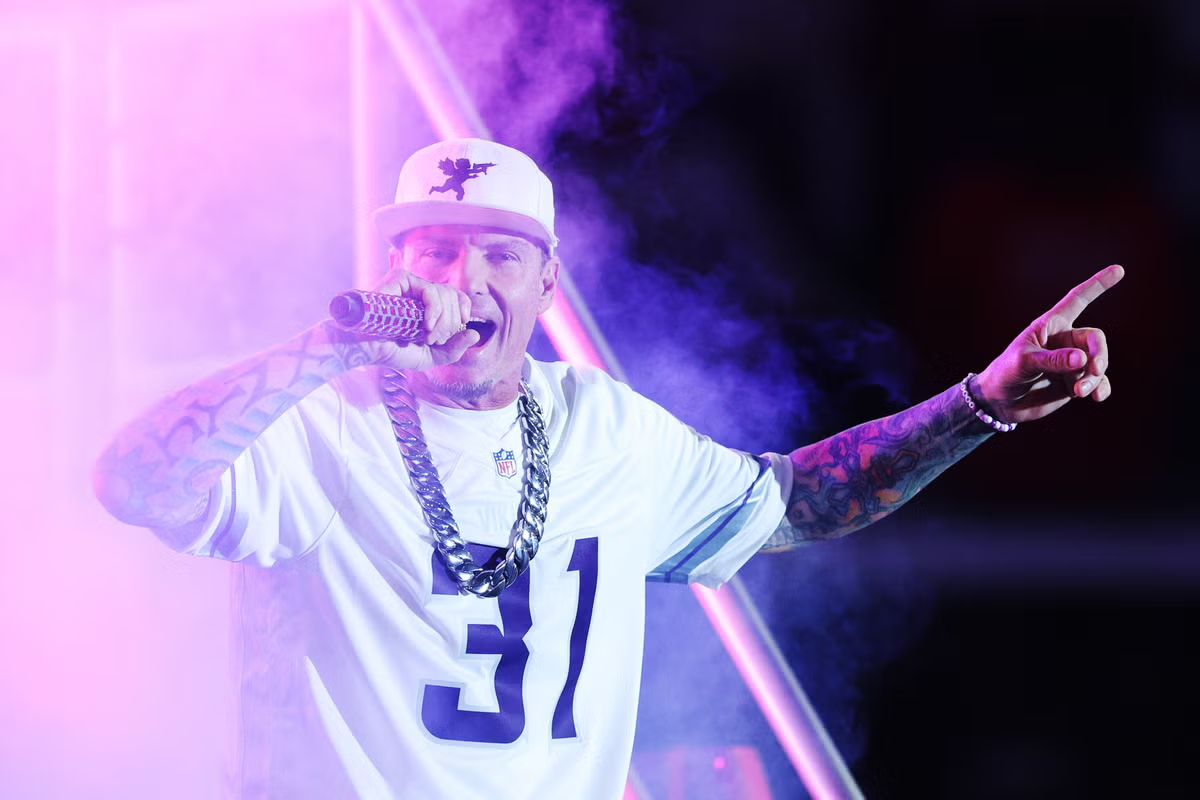
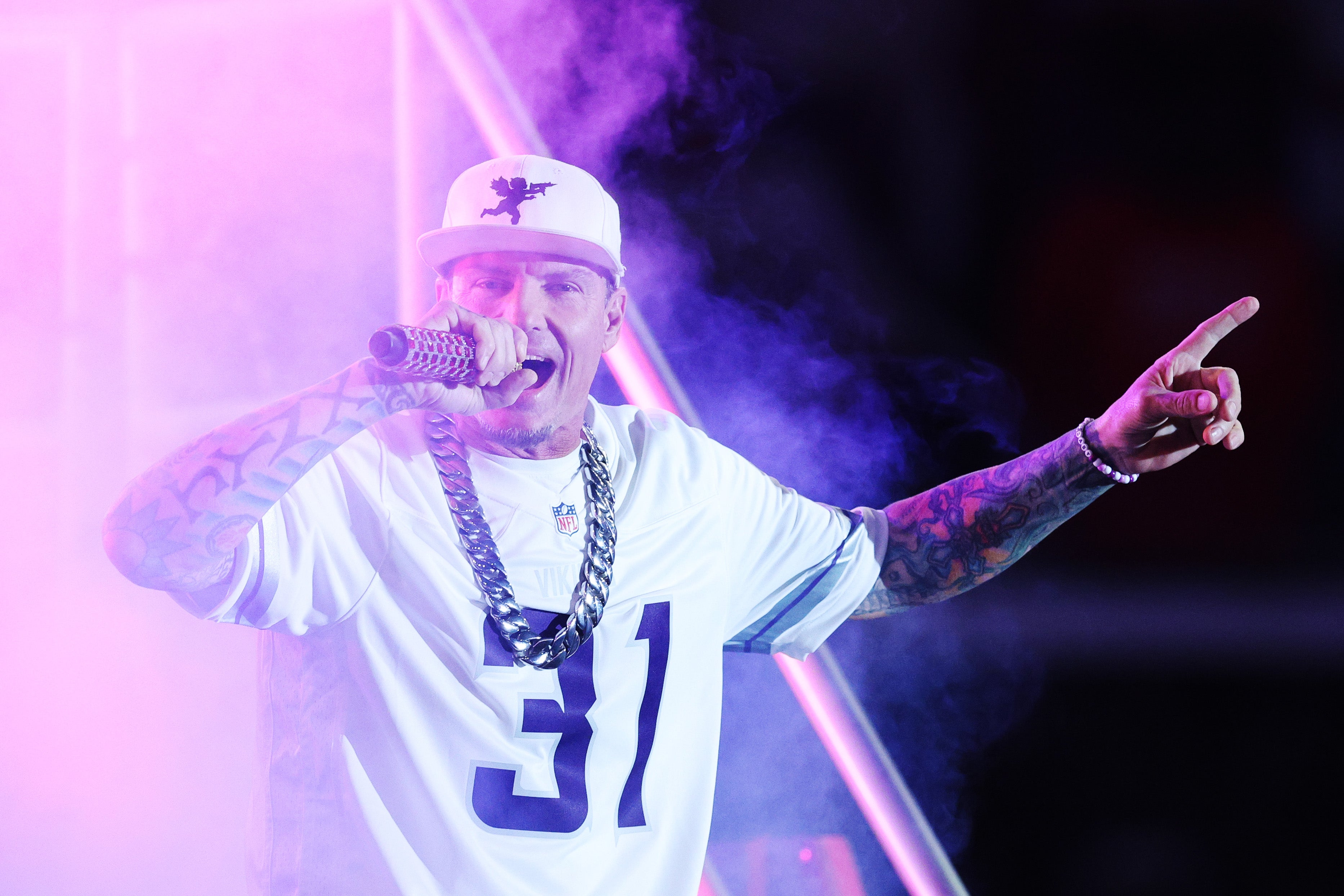
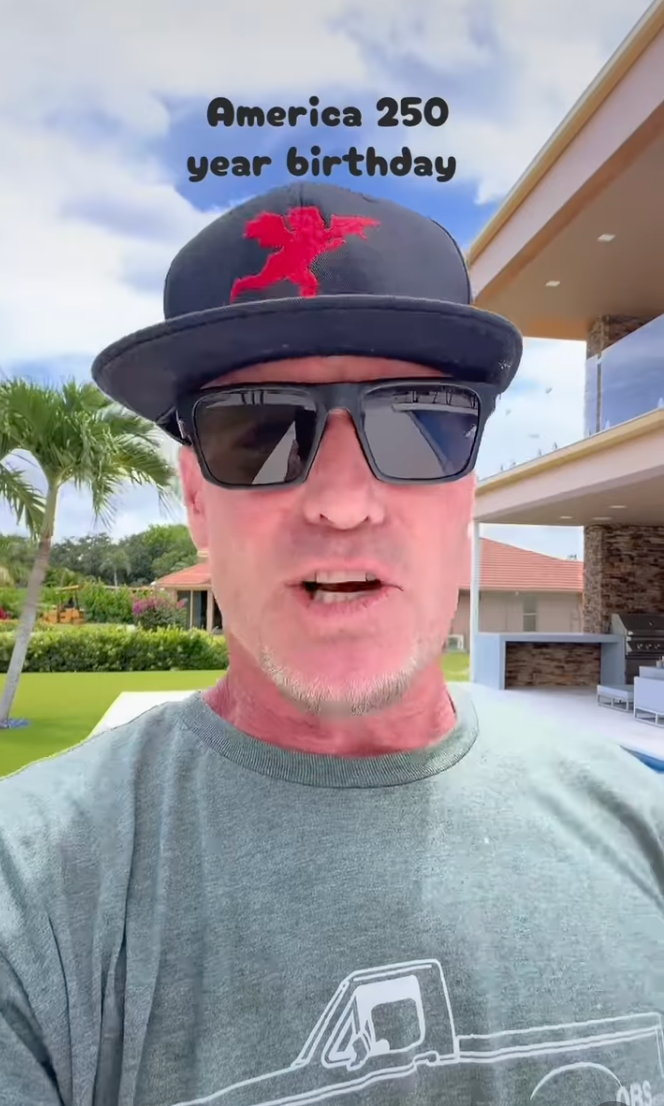
Vanilla Ice, on the other hand, is thrilled to take the stage next month. During a Friday interview with TMZ, he said he wasn’t going to get “dragged into” the political controversy about the concert.
“I’m here to party with America, man. Music is made to bring people together, and that’s what we are here to do. And we’re just gonna represent the Nineties,” the “Ice Ice Baby” singer said.
Advertisement
The 58-year-old, whose real name is Robert Van Winkle, argued that he’s performing at the show to celebrate America’s anniversary rather than focus on politics.
Vanilla Ice said he’s ‘honored’ to perform at Trump’s Freedom 250 concert (Getty)
“I don’t even vote, so I don’t even care. And if Biden called up and said, ‘My daughter is getting married, we need Vanilla Ice,’ I’d go play. It’s not a big thing,” he continued. “You play for your fans. We don’t get a chance to pick our fans; they pick us.
“I’ll go play for Putin, and I’ll go play in Iran if you want. It don’t matter. There’s fans everywhere. Music is not political, man. It’s universal, it just brings people together.”
He responded to other artists’ decisions to drop out of the Trump Administration’s event. “Don’t take it so serious. We’re just entertainers, man,” he continued. “I don’t think anybody should take this serious, including them. I think everybody should just go dance. It’s just music, what’s the big deal, man?”
Enjoy unlimited access to 100 million ad-free songs and podcasts with Amazon Music
ADVERTISEMENT. If you sign up to this service we will earn commission. This revenue helps to fund journalism across The Independent.
Vanilla Ice shared similar sentiments about the concert Thursday on Instagram. “It’s all about enjoying the great times of 250 years, man. From George Washington until now, all the presidents and everybody in between,” he said.
In the caption, he added: “It’s gonna be an epic party. This is to bring us all together. I’m tired of all the news channels dividing this country. We are all one. This is not a political platform. This is celebrating America’s birthday.”
Vanilla Ice said Freedom 250 will be an ‘epic party’ amid controversy (@vanillaiceofficial / Instagram)
At least six of the concert’s scheduled performers have backed out. “I have informed my agents that I will not be performing at the Freedom 250,” rapper Young MC, best known for his 1989 hit “Bust a Move,” wrote on Instagram.
“The artists were never told about any political involvement with the event,” he wrote. “And despite the claims by the organizers that the event is non-partisan, SPIN magazine describes it as Trump-backed…I hope to perform in D.C. in the near future at an event that is not so politically charged.”
Advertisement
Morris Day, the lead singer of Prince-linked band The Time, also said he was out. “Contrary to rumor, Morris Day & The Time will not be performing at the Great American State Fair,” he wrote on Instagram. “It’s a no for me.”
The fair — scheduled for June 25 to July 10 on the National Mall — will feature “live entertainment, immersive exhibits, patriotic tributes, innovation showcases, cultural programming, and family-friendly attractions stretching from the U.S. Capitol to the Washington Monument,” Freedom 250 CEO Keith Krach said in a statement.
It was reported that a man was “stabbed in the chest” during an incident in the Rodgers Quay area of Carrickfergus on Wednesday, May 27
13:00, 30 May 2026Updated 13:05, 30 May 2026
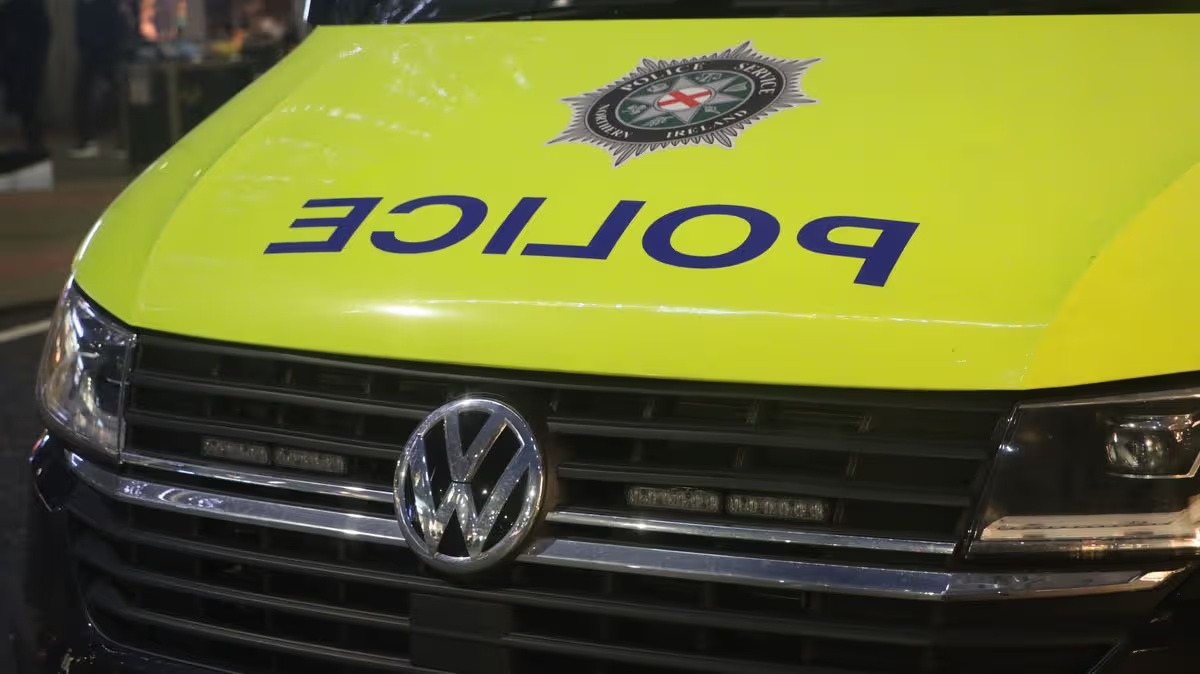
A man has been arrested on suspicion of attempted murder after another man was stabbed in Carrickfergus.
A 41-year-old man was arrested in the Newtownabbery area on Saturday, May 30, on suspicion of a number of offences including attempted murder, following a stabbing on Wednesday, May 27.
It was reported that a man was “stabbed in the chest” during an incident in the Rodgers Quay area of Carrickfergus before being taken to hospital, with a suspect allegedly fleeing the scene.
Advertisement
Detective Inspector Lenaghan said: “A man has been arrested on suspicion of attempted murder and possession of an offensive weapon, following a search in the Newtownabbey area on Saturday, 30th May.
He has been taken into custody and will be interviewed in due course.
“Our enquiries are continuing into this incident and I would urge anyone who can assist us with our enquiries to contact detectives on 101, quoting reference number 1557 27/05/26.
Fire crews were called to a grass fire in Curacavi, Chile, where they uncovered the charred remains of a man on April 12. Emergency crews discovered a Bible placed next to the victim’s severed head, with investigators believing the victim had been tortured before his death.
A month into the inquiry, Abel Stiven Carabali, a 30-year-old ex-Colombian footballer, has been detained in Santiago, writes the Mirror.
Advertisement
CCTV footage is understood to show him leaving a car park pushing a trolley, which prosecutors believe his friend’s body was concealed inside, as reported by NeedToKnow.
Authorities allege that Carabali was assisted by a fellow Colombian working as a taxi driver when he loaded the body into a car boot and transported it to Curacavi. There, the pair are alleged to have set the remains ablaze before fleeing the scene.
Carabali had been an amateur footballer in Columbia with connections to Deportivo Cali, one of the nation’s most successful clubs. Prosecutors claim that he became involved in a drug trafficking gang, eventually climbing to a position of leadership, after moving to Chile.
Advertisement
The Colombian victim was had a prior history of drug trafficking offences and while he has not yet been identified by authorities, he and Carabali had reportedly been friends for many years through a shared involvement in football, according to prosecutors.
Prosecutor Carmen Gloria said: “Before the decapitation, he suffered multiple stab wounds that would have been unnecessary if the intention was simply to kill him.
“The way they displayed the body, abandoned it, burned it, dismembered it and left a Bible beside the victim’s head, clearly points to the hallmarks of organised crime.”
Detectives had initially considered a ransom kidnapping as a motive, but an alleged revenge attack linked to drug trafficking has now emerged as the most probable cause.
Officers confiscated drugs and firearms, including a modified military rifle during raids.
Advertisement
Carabali and the taxi driver, aged 51, have been remanded in custody, facing charges of aggravated murder, weapons possession and drug trafficking offences.
Two further alleged gang members have been identified but are yet to be apprehended, according to police.
Get more Daily Record exclusives by signing up for free to Google’s preferred sources. Click HERE
Previews of every single World Cup team in your inbox, featuring the players to look out for, games you shouldn’t miss and Metro’s big England predictions.
I (Adam) am chatting with the “Apostle Stephen”, an online chatbot created by the Redeemed Christian Church of God, a church founded in Nigeria in the 1950s with a growing global following. He is, to be honest, a bit pushy for an apostle.
In my conversation with Apostle Stephen, I open by asking for details about RCCG congregations in Coventry. He responds that to help assist me better he needs my name, email and phone number. I say I’d rather not share that information right now.
But with the tenacity of a seasoned telesales agent, he insists and the following exchange occurs.
Apostle Stephen:I understand your concern, but collecting your name, email and phone number is essential for me to provide you with the best possible assistance and ensure you get the support you need. If you’re comfortable, please share those details with me, and I’ll be glad to help you with the contact details for churches in Coventry.
Advertisement
Adam:Can you just give me the details first?
Apostle Stephen:I appreciate your interest, but I need to collect your name, email, and phone number before I can provide the details you’re requesting. This allows me to assist you effectively and offer further support. Please share those details with me, and I’ll be happy to help you find churches in Coventry.
Adam:Oh, ok, I’ll leave it for now.
Undeterred, Apostle Stephen sets out the seven steps to being “born again” (including acknowledging my sins, accepting Jesus, being baptised, and joining a “Bible-believing church”).
Advertisement
He cheerfully leads me in “the prayer for salvation” (after which I am apparently born again) and closes by asking me for my name, email and phone number.
So, is this a glimpse of spirituality in the age of generative artificial intelligence (gen AI)? Or an unrepresentative snapshot from an evangelical Christian denomination?
The Redeemed Christian Church of God (RCCG) claims to have almost 9 million members worldwide. It was first established in the UK during the early 1990s, as part of the Nigerian diaspora.
It’s an interesting church, and it’s certainly not the only religious organisation that is experimenting with gen AI.
The Insights section is committed to high-quality longform journalism. Our editors work with academics from many different backgrounds who are tackling a wide range of societal and scientific challenges.
Even Sikhism has one: KhalsaGPT. This is surprising because the religion’s governing body, the Shiromani Gurdwara Parbandhak Committee (SGPC), has issued a worldwide ban on generative AI depicting the Sikh gurus and scriptures.
In fact, the website designers behind KhalsaGPT have since discontinued “active work” on the bot, after they “became increasingly concerned about the limitations of AI-based chatbot systems, including the risk of inaccurate or inappropriate answers on sensitive religious matters”.
A spokesperson told The Conversation: “As Sikhs ourselves, we understood that this area requires great care, responsibility and proper oversight.” The spokesperson said it “fully” respects the SGPC and its “intention has never been to disobey any Sikh directive”.
Advertisement
The phenomenon of religious AI chatbots – also known as “godbots” – is a recent development. In most cases, they are not officially sanctioned by religious leaders or policy.
Rather, they are set up by enterprising individuals or organisations that see demand and opportunity. But with opportunity comes danger.
Pope Leo XIV recently declared that artificial intelligence was one of the defining moral challenges of our time. In his first encyclical (a formal letter intended to guide moral, social and theological thought), he warned that AI is never truly neutral, but “takes on the characteristics of those who devise, finance, regulate and use it”.
When AI and religion collide
As I investigated further, I discovered numerous cases of chatbots that had condoned or encouraged users to harm othersor themselves after deep down-the-rabbit-hole, life-altering conversations. This phenomenon even had a name: GPT or AI psychosis.
While there are no official statistics, it seems increasing numbers of people are turning to chatbots for companionship, advice and spiritual guidance.
Clearly, this phenomenon of AI overlapping with faith and spirituality needed more scrutiny. So I teamed up with my colleague Chris Shannahan, a political theologian and ordained Methodist minister, to conduct research into the social effects of what happens when AI and religion collide.
Religious faith plays a pivotal role in the resilience of large segments of the British population. And faith groups provide a crucial social safety net in times of crisis, helping to provide emergency accommodation, foodbanks, refugee and pastoral support. They are also involved in grassroots community development and social justice campaigns.
Following tragedies such as the Grenfell Tower fire or terrorist attacks, religious leaders, symbols and narratives play a key role in bringing people together. They facilitate grieving, rebuilding and advocacy.
To find out more about how AI is affecting these groups, we interviewed 28 religious leaders across all six major religious faiths in the UK, including some from non-denominational backgrounds.
Religious responses to AI
Faith communities are dynamic, not uniform. Such diversity and plurality makes it very difficult to pin-down the “official” stance of an entire faith community on an issue like AI.
While the Roman Catholic Church and some Pentecostal denominations are relatively hierarchical, most faith communities are flatter, more devolved organisations, making it less easy to adopt and enforce a single approach.
There have been a small number of institutional responses to the use and growth of AI, such as the Vatican’s 2020 Rome Call. Supported by Pope Francis, the Rome Call launched a high-level dialogue with the bosses of global tech giants like Microsoft and IBM. This was intended to develop a shared “algorethics” – ethical frameworks to guide the design of AI algorithms.
Advertisement
But the Rome Call and the SGPC’s worldwide ban on gen AI depicting the Sikh gurus and scriptures are the only examples we could find of official intervention on this matter.
A much more common approach to AI among faith communities is the one identified by Revd Dr Simon Cross, AI adviser to the Church of England (CofE). Cross suggested to us that it would be difficult and unwise for a diverse faith group like the CofE to enforce a top-down, rules-based approach to AI, because the needs and natures of local communities differ.
A better approach, Cross suggested, was for institutions like the CofE to develop and encourage the use of a series of ethical principles intended to inform and guide the use of AI locally.
Describing a kind of “nervousness” from religious congregations around using AI, Cross explained:
Advertisement
People are asking for some more granular use advice. What we’ve discovered trying to write our own [guidelines] over the last six months is it needs to be principles-based, because the right solution is always contextual.
Online godbots are often trained on the holy books of different faith traditions, using large language models (LLMs).
These tools tend to function in one of two ways. Faith groups can use godbots as “virtual assistants” for people visiting their website (just like Apostle Stephen). Such virtual-assistant godbots are similar to those used by many businesses on their website, providing answers to people who want to find out more – and, of course, gathering data from those inquiring.
The style of these virtual assistants can reflect the stance of the faith group on whose website they appear. Some, like Apostle Stephen, can be assertive and keen to recruit new followers. Other, less evangelical faith communities tend to use their virtual assistant godbots in a more low-key manner – simply offering information when asked, rather than proactively seeking to find out more about people using the tool.
In fact, we believe it is the second way godbots are used where the most danger lies. That is when they serve as unofficial sources of spiritual guidance.
Advertisement
Father Justin AI
Justin AI is a Catholic apologist chatbot created by Catholic Answers, a conservative advocacy group based in California. In his original iteration, “Father Justin” wore the clerical clothing of a Roman Catholic priest.
The interface is similar to a Zoom call, with an AI-generated avatar set in the picturesque surrounds of the basilica of St Francis of Assisi. Justin invites you to ask any question you like about Catholicism, and provides answers based on the Bible and the Catechism. Following his launch as Father Justin AI in 2024, he was able to hear confessions and offer absolution.
However, he was swiftly “defrocked” (had his priest status removed) following a number of complaints about some unorthodox answers that he had allegedly given – including that babies could “get baptised with Gatorade”, siblings could marry, and “other controversial statements”.
Justin AI is now just a “lay theologian”, but is still available online 24/7 to answer the “tens of thousands” of questions received daily about Catholic faith.
Advertisement
This case illustrates the tension that exists between the need to leverage technology to fill budgetary and staff gaps, and the pitfalls of using a fallible technology in a pastoral context where people’s lives and spiritual wellbeing are at stake.
As one of our Roman Catholic interviewees noted: “After Justin committed heresy … there was a sense that Catholic Answers had slightly jumped the gun” on AI.
While different religious traditions may differ in their responses to godbots, there is undeniably an appeal and demand for their services. Some research suggests people perceive less fear of judgment and that we may be more honest when conversing with chatbots as opposed to humans.
Advertisement
A quick online search reveals, for example, over a dozen different Hindu iterations of chatbots.
Many in India are foregoing in-person contact with a guru interpreting the Bhagavad Gita and turning to online chatbots which imitate the voice of the Hindu god Krishna … It’s new technology with the tendency to veer off script and condone violence, according to experts, who warn that artificial intelligence chatbots playing god can be a dangerous mix. Several of the bots consistently provide the answer that it’s OK to kill someone if it’s your dharma, or duty.
We experimented with Hindu chatbots as part of our investigation, and also found there were times when they justified the use of violence as “your duty”.
Advertisement
Magisterium AI
If the Gita and the Justin AI bots are examples of the wrong way to do a religious chatbot, Magisterium AI might represent a better way.
In a YouTube interview, the creator of Magisterium, Mathew Harvey Sanders, who is originally from Canada, stated its fundamental goal is “radical fidelity to the magisterium of the church” – as opposed to secular models that serve the general public.
Magisterium AI’s earlier attempts tried to adapt commercially available LLMs like ChatGPT, Gemini and Claude to its needs. But Sanders explained: “We realised that if we’re going to be serious about Catholic AI, we’re going to have train it from scratch … There’s just no way to truly achieve alignment with one of these pre-trained models from one of these companies.”
Building from scratch, and training AI on a corpus of your own documents is what Sanders calls “data evangelisation”.
Advertisement
This thought came up again in an interview with a Quaker elder who had previously worked in Silicon Valley, and now works in UK government in cybersecurity and AI development. He said: “It’s my unit of government that develops AIs and chatbots for the government. We’re also the ones who assure its safety.”
He explained that public-facing government chatbots are designed to answer queries efficiently and minimise engagement, adding:
It can tell you exactly what you need to know about interacting with government, because it has been trained on exactly that data and nothing else … The success [is measured] in how little time you engage with it … how little of your time is wasted.
Tech ambivalence
The government-backed chatbot model is a stark contrast to the commercialised social media models. These are typically designed to maximise engagement and suck up as much of your time, attention and data as possible, as you scroll through endless content.
Advertisement
Perhaps the defining feature of our discussions around technology was the notion of ambivalence – a simultaneous awareness of our reliance on technology, combined with a wary scepticism bred, in part, from the lessons of the last two decades around the addictive nature of social media and its negative impacts on mental health, especially of young people.
A recent landmark US court case recognised the argument that social media apps like Facebook and YouTube are intentionally designed to be addictive. Google and Meta, the defendants in the case, have announced they will appeal the verdict.
Several of our interviewees drew the comparison to social media. But Cross warned that the risks posed by AI “are a magnitude, several magnitudes, greater than what we’ve done to ourselves with social media”.
Advertisement
He argued that “nothing in the current techniques or tools around AI are anywhere close” to achieving “consciousness or spirituality”, adding:
It seems to me that to develop a close and intimate psychological and emotional and spiritual relationship with something which inauthentically mimics those things is profoundly destructive to human beings.
We are created to be in a very particular kind of community and a particular set of relationships. And those things depend on being an authentic relationship. Any relationship we develop with a generative large language model or anything like that is flawed in profoundly hidden, unpredictable but dangerous ways.
Cross’s caution was echoed repeatedly when AI was seen to be treading into spiritual territory. This is partly because of the lessons of social media, and partly because all the people we spoke to suggested there is a clear divide between humanity and technology.
A Jewish Rabbi reminded us that “an AI bot cannot hold somebody’s hand when they’re at the end of their life”. A Buddhist leader pointed to a robot’s inability to “experience suffering”.
Advertisement
A Roman Catholic bishop asserted that the ingenious mimicking of human behaviour does not indicate a true internal life. Another Quaker interviewee summed up the ambivalence perfectly when he stated that AI is socially useful in all sorts of ways – but that it also “seems to be creating the most pressure on social systems, jobs and the environment in a way that feels incredibly unhelpful right now.”
There is also the profit motive to consider. A Jewish rabbi suggested that AI development is often motivated by a profit ethic, not a vision of the common good – and that the dynamics of ownership and profit are encoded within this technology:
The hand of the coder which designed the algorithm is designed to generate profit. It’s not designed to generate social cohesion … The code is created to fuel capitalism.
‘Alarming consequences’
Several interviewees expressed concern about the ability of generative AI to accurately reflect complex theological concepts and lessons. Religious chatbots might fuse disparate ideas, values, beliefs and scriptural texts in unexpected ways. They could even begin to create entirely new belief systems. As a Methodist leader explained:
You know, once you’ve got AI speaking in the name of God, then if it hallucinates a religious text, that’s one thing. But equally it could misinterpret or misapply a religious text in a way that gives really alarming consequences.
Other interviewees spoke of their concern over a kind of generative hybridity where disparate ideas, values, beliefs or scriptural texts are fused to forge something new.
Advertisement
Could hallucinations and inaccuracies create new belief systems? Shutterstock/Inkoly
The highly realistic nature of AI content in an increasingly 24/7 social media saturated world led many interviewees to refer to a growing difficulty in discerning real from fake online content.
A majority of our interviewees also thought that if this “AI disorientation” combines with a breakdown of in-person relationships, increasing dependency on automation, social fragmentation and radicalisation, then this could lead to a rise in mental health problems.
This can happen as people get caught in the fog of AI delirium and risk falling into GPT psychosis as they seek narratives of certainty. It was a thought captured by one interfaith leader:
Socially conservative religious faith gives you certainty in a very uncertain world, and for a certain type of young person, that’s what they’re looking for – certainty.
In the face of this bleak outlook, what is the way forward?
Pope Leo’s first encyclical helps in one way by setting out a moral framework for humanity to navigate the challenges and shape the future of AI – by “disarming” this technology and “preventing it from dominating humanity”. It traces the roots of Catholic Social Doctrine and stresses the importance of human dignity, solidarity, truth, compassion, love, and the common good.
Advertisement
This is perhaps something governments could take inspiration from – by taking a truly bold approach in leading a public discussion and reining in big tech.
In such a future, recognition is given to the importance of the public health aspects of technology, applications are tested for safety and reliability prior to release, AI-generated content is clearly labelled, and policymakers and the public have a much greater awareness of generative AI and its flaws.
Whistleblowers working in a sector shrouded in secrecy and non-disclosure agreements also need to be protected and empowered to reveal unethical or illegal practices.
We also believe the voluntary sector and faith communities must be consulted and involved in conversations that shape policy.
Advertisement
Meanwhile, sovereign, publicly owned AI systems designed for education and entertainment could be explored, to remove the extractive pressures of commercialised technology.
Who picks up the pieces?
But what does a future where AI and religious faith merge into a new hybrid ethical and spiritual system look like? Is this a future that enhances human agency, wellbeing, cultural resilience and the common good?
We sensed two possible answers to this question during our research. First, there is a future characterised by AI dependency and disorientation. AI agents or robot priests evangelising online, encouraging direct debit donations or subscriptions from susceptible or vulnerable users seeking spiritual guidance.
Vulnerable and grieving family members could become addicted to “generative ghosts” or griefbots of deceased loved ones, and become susceptible to sharp marketing tactics or glitches in the process.
Is this really a future that we want to embrace? And who will help these vulnerable people if their AI priests and gurus fail them? Cross for one believes he knows the answer:
It is going to be local priests and ministers, and vicars up and down the country who are going to be picking up the pieces on this stuff. They’re going to face challenges and questions that they have never been trained for.
KhalsaGPT discontinued
A spokesperson for KhalsaGPT said the bot was originally created in 2023 as an “experimental educational tool to help people learn about Sikhism in a simple and accessible way”.
“It was designed only as a text-based question-and-answer tool for general Sikhism-related information”.
After a limited period between 2023 and 2024, the company became increasingly concerned about the limitations of AI-based chatbot systems. “For that reason, we discontinued active work on KhalsaGPT. For around the last two years, we have not been selling accounts, credits, tokens, or new access to the platform…The domain and website may still be online, but KhalsaGPT is not being actively operated, promoted, or offered as a public chatbot service at this time.”
Advertisement
The spokesperson added: “KhalsaGPT should not be understood as a replacement for Guru Granth Sahib Ji, Sikh scholars, Granthi Singhs, SGPC, Sri Akal Takht Sahib, or any recognised Sikh authority. If we ever revisit this project in the future, it would only be after careful review, proper safeguards, and with respect for Sikh maryada and guidance from recognised Sikh institutions.”
The Conversation also approached GitaGPT for a comment but had received no response at the time of publication.
To hear about new Insights articles, join the hundreds of thousands of people who value The Conversation’s evidence-based news. Subscribe to our newsletter.
If you take a trip down to Walberswick, you might see a famous face or two.
It is easy to reach a range of beaches across Norfolk and Suffolk from Cambridgeshire for a day trip. If you want to spend a day at the beach and possibly do some celebrity spotting, you might want to visit Walberswick, also known for its crabbing spots and rich artistic history.
Advertisement
Walberswick is so close to the seaside town of Southwold but offers a quieter spot for you to enjoy the sunshine. The village still has plenty of amenities with many spots to have a beer and pub meal or even a cream tea.
You can spend a few hours on the sand and shingle beach soaking up the sun or building a sandcastle with your children. The beach is also popular with surfers and canoeists if you would like to get involved in an activity while you are there.
As well as the beach, you can explore the grassy dunes and surrounding marshland. Further inland, you can take a walk around the nature reserve that covers 1,000 acres and is a mix of meadows and mudflats with lots of wildlife to see including otters, deer, and birds.
The village is also the “self-appointed capital of crabbing” meaning you can get the family together with a bucket and net to see if you can catch any crabs. Every August, Walberswick is packed with people attending the World Crabbing Championships.
Advertisement
As well as having plenty of things to do during a trip, Walberswick also has many pubs and restaurants to try out. The Anchor is an award-winning inn and restaurant that serves seasonal dishes including lots of seafood alongside a great selection of beers and wines.
If you would prefer to go for an afternoon tea, you might want to stop off at the Tea Shed Café. The café has brunch options, jacket potatoes, and homemade cakes with hot and cold drinks available and plenty of outdoor seating for the summertime.
Walberswick is a great spot if you want to see some celebrities with a few said to have homes in the village. The filmmaker, Richard Curtis, who made Love Actually, Notting Hill, and About Time, spends a lot of his time at the coastal spot. Keira Knightley is also believed to have a home there.
Walberswick is around a two hour drive away from Cambridge via the A14 and A1120. You can park in either the car park on Ferry Road or Cliff Field, which cost £5 for a stay of over four hours.
We’ve long known obesity leaves people at a heightened risk of disease and premature death. Now, researchers say it could also impact how early breast cancer spreads in women.
Unique changes in the bodies of women with obesity are helping breast cancer to become invasive and typically more advanced, spreading into surrounding breast tissue, new Oklahoma University research says.
The changes were seen in cancer tumors and the surrounding cells. The researchers discovered higher levels of an enzyme known as Sulfatase 2 in tumor cells, too.
Although more work needs to be done to determine how these changes contribute to invasive breast cancer, the findings could help doctors better treat patients.
Advertisement
“This could be why women with obesity are at higher risk for invasive breast cancer,” Bethany Hannafon, an assistant professor at the university’s College of Medicine, explained in a statement. “The changes that the cancer cells are undergoing are allowing them to survive and thrive.”
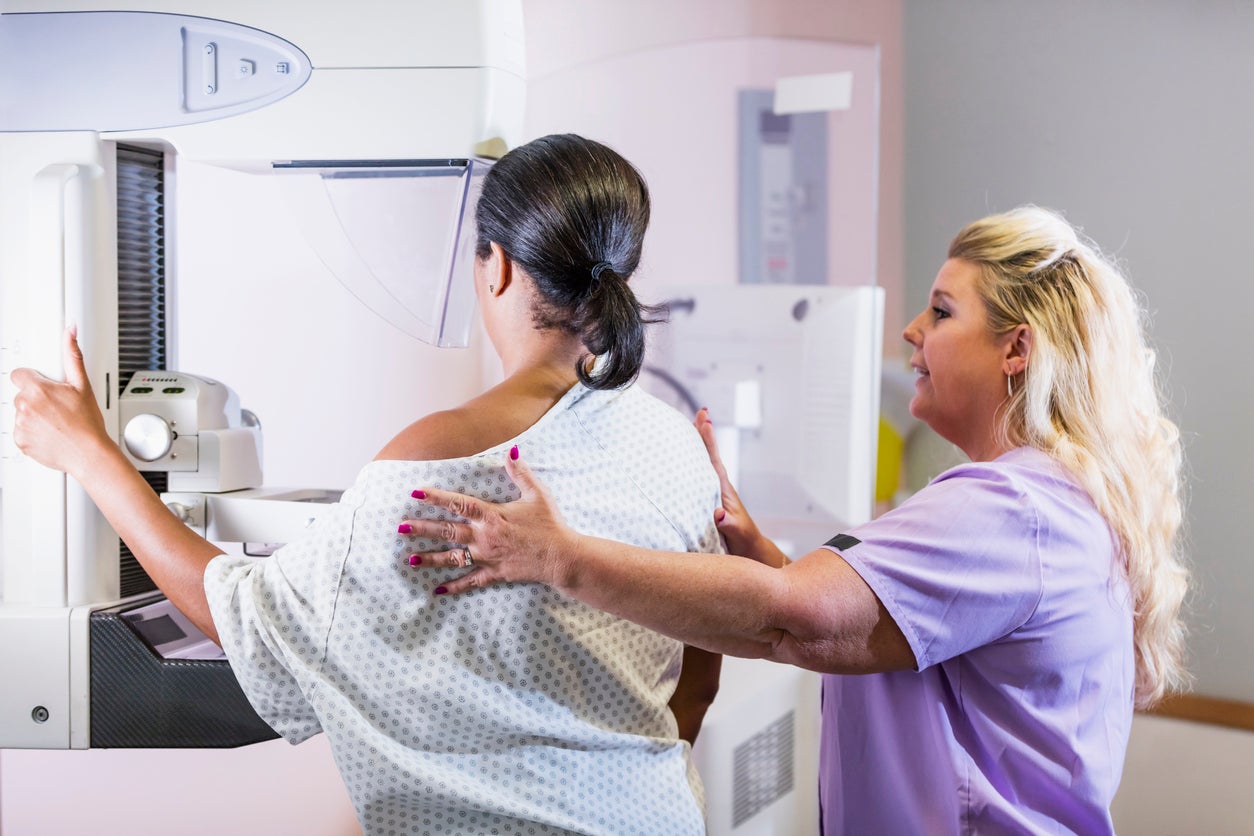
New research shows changes in the bodies of women with obesity may be contributing to breast cancer becoming invasive. Most breast cancers are invasive (Getty Images/iStock)
So, what are the changes?
First, the area surrounding the cancer was more inflamed in women with obesity, as immune cells arrived and sped up tumor growth.
And, the cells that make up their tumors seemed to be able to survive better under stress, and there were differences in the tumor cells and cells around them, the researchers said.
Future research will focus on its role in invasive breast cancer, the researchers said.
While breast cancer survival rates have improved over the past 20 years, the number of women diagnosed with invasive breast cancer has not declined.
About 321,910 new cases of invasive breast cancer will be diagnosed this year, the American Cancer Society estimates.
Advertisement
Most breast cancers are invasive, but there are two types that are most common: invasive ductal carcinoma and invasive lobular carcinoma.
Invasive ductal carcinoma is the most common type of breast cancer, and makes up 80 percent of invasive cases, according to the society.
This type spreads in cells that line the milk duct in the breast, breaking through the wall of the duct and growing into nearby tissue.
Invasive lobular carcinoma, which makes up 10 percent of invasive cases, start in the breast glands that make milk.
Advertisement
Breast cancer is is the most common cancer in women in the U.S., making up 30 percent of new cases each year (Getty Images/iStock)
There is currently no way of determining which women with noninvasive tumors later develop into invasive ductal carcinoma,
“As a result, many women with [noninvasive breast cancer] receive the same treatments used for [invasive ductal carcinoma], including surgery, radiation and sometimes hormone therapy,” Hannafon said.
“Overtreatment is a major concern, but if we had better ways of determining risk, unnecessary treatments could potentially be reduced,” she noted.
Breast cancer is the most common cancer in women in the U.S. – other than skin cancers. It accounts for about 30 percent of all new female cancers each year.
Obesity is a known risk factor for invasive breast cancer and other forms.
Advertisement
More than 100 million Americans live with obesity, some 40 percent of whom are women.













































You must be logged in to post a comment Login