Connect with us
DAPA Banner

Tech

Qwen3-Coder-Next offers vibe coders a powerful open source, ultra-sparse model with 10x higher throughput for repo tasks

Published

on

Chinese e-commerce giant Alibaba’s Qwen team of AI researchers has emerged in the last year as one of the global leaders of open source AI development, releasing a host of powerful large language models and specialized multimodal models that approach, and in some cases, surpass the performance of the proprietary U.S. leaders such as OpenAI, Anthropic, Google and xAI.

Now the Qwen team is back again this week with a compelling release that matches the “vibe coding” frenzy that has arisen in recent months: Qwen3-Coder-Next, a specialized 80-billion-parameter model designed to deliver elite agentic performance within a lightweight active footprint.

It’s been released on a permissive Apache 2.0 license, enabling commercial usage by large enterprises and indie developers alike, with the model weights available on Hugging Face in four variants and a technical report describing some of its training approach and innovations.

The release marks a major escalation in the global arms race for the ultimate coding assistant, following a week that has seen the space explode with new entrants. From the massive efficiency gains of Anthropic’s Claude Code harness to the high-profile launch of the OpenAI Codex app and the rapid community adoption of open-source frameworks like OpenClaw, the competitive landscape has never been more crowded.

Advertisement

In this high-stakes environment, Alibaba isn’t just keeping pace — it is attempting to set a new standard for open-weight intelligence.

For LLM decision-makers, Qwen3-Coder-Next represents a fundamental shift in the economics of AI engineering. While the model houses 80 billion total parameters, it utilizes an ultra-sparse Mixture-of-Experts (MoE) architecture that activates only 3 billion parameters per forward pass.

This design allows it to deliver reasoning capabilities that rival massive proprietary systems while maintaining the low deployment costs and high throughput of a lightweight local model.

Solving the long-context bottleneck

The core technical breakthrough behind Qwen3-Coder-Next is a hybrid architecture designed specifically to circumvent the quadratic scaling issues that plague traditional Transformers.

Advertisement

As context windows expand — and this model supports a massive 262,144 tokens — traditional attention mechanisms become computationally prohibitive.

Standard Transformers suffer from a “memory wall” where the cost of processing context grows quadratically with sequence length. Qwen addresses this by combining Gated DeltaNet with Gated Attention.

Gated DeltaNet acts as a linear-complexity alternative to standard softmax attention. It allows the model to maintain state across its quarter-million-token window without the exponential latency penalties typical of long-horizon reasoning.

When paired with the ultra-sparse MoE, the result is a theoretical 10x higher throughput for repository-level tasks compared to dense models of similar total capacity.

Advertisement

This architecture ensures an agent can “read” an entire Python library or complex JavaScript framework and respond with the speed of a 3B model, yet with the structural understanding of an 80B system.

To prevent context hallucination during training, the team utilized Best-Fit Packing (BFP), a strategy that maintains efficiency without the truncation errors found in traditional document concatenation.

Trained to be agent-first

The “Next” in the model’s nomenclature refers to a fundamental pivot in training methodology. Historically, coding models were trained on static code-text pairs—essentially a “read-only” education. Qwen3-Coder-Next was instead developed through a massive “agentic training” pipeline.

The technical report details a synthesis pipeline that produced 800,000 verifiable coding tasks. These were not mere snippets; they were real-world bug-fixing scenarios mined from GitHub pull requests and paired with fully executable environments.

Advertisement

The training infrastructure, known as MegaFlow, is a cloud-native orchestration system based on Alibaba Cloud Kubernetes. In MegaFlow, each agentic task is expressed as a three-stage workflow: agent rollout, evaluation, and post-processing. During rollout, the model interacts with a live containerized environment.

If it generates code that fails a unit test or crashes a container, it receives immediate feedback through mid-training and reinforcement learning. This “closed-loop” education allows the model to learn from environment feedback, teaching it to recover from faults and refine solutions in real-time.

Product specifications include:

  • Support for 370 Programming Languages: An expansion from 92 in previous versions.

  • XML-Style Tool Calling: A new qwen3_coder format designed for string-heavy arguments, allowing the model to emit long code snippets without the nested quoting and escaping overhead typical of JSON.

  • Repository-Level Focus: Mid-training was expanded to approximately 600B tokens of repository-level data, proving more impactful for cross-file dependency logic than file-level datasets alone.

Specialization via expert models

A key differentiator in the Qwen3-Coder-Next pipeline is its use of specialized Expert Models. Rather than training one generalist model for all tasks, the team developed domain-specific experts for Web Development and User Experience (UX).

Advertisement

The Web Development Expert targets full-stack tasks like UI construction and component composition. All code samples were rendered in a Playwright-controlled Chromium environment.

For React samples, a Vite server was deployed to ensure all dependencies were correctly initialized. A Vision-Language Model (VLM) then judged the rendered pages for layout integrity and UI quality.

The User Experience Expert was optimized for tool-call format adherence across diverse CLI/IDE scaffolds such as Cline and OpenCode. The team found that training on diverse tool chat templates significantly improved the model’s robustness to unseen schemas at deployment time.

Once these experts achieved peak performance, their capabilities were distilled back into the single 80B/3B MoE model. This ensures the lightweight deployment version retains the nuanced knowledge of much larger teacher models.

Advertisement

Punching up on benchmarks while offering high security

The results of this specialized training are evident in the model’s competitive standing against industry giants. In benchmark evaluations conducted using the SWE-Agent scaffold, Qwen3-Coder-Next demonstrated exceptional efficiency relative to its active parameter count.

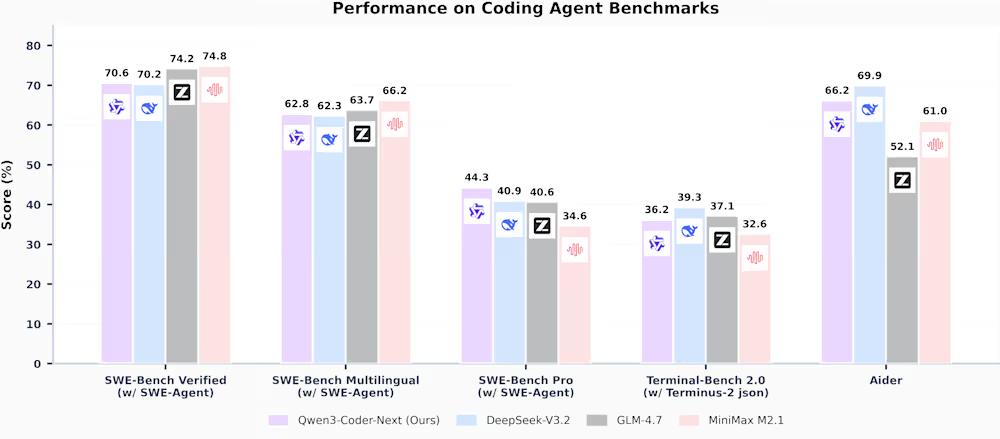
On SWE-Bench Verified, the model achieved a score of 70.6%. This performance is notably competitive when placed alongside significantly larger models; it outpaces DeepSeek-V3.2, which scores 70.2%, and trails only slightly behind the 74.2% score of GLM-4.7.

Qwen3-Coder-Next benchmarks

Qwen3-Coder-Next benchmarks. Credit: Alibaba Qwen

Crucially, the model demonstrates robust inherent security awareness. On SecCodeBench, which evaluates a model’s ability to repair vulnerabilities, Qwen3-Coder-Next outperformed Claude-Opus-4.5 in code generation scenarios (61.2% vs. 52.5%).

Advertisement
Qwen3-Coder-Next SecCodeBench benchmark results comparison table

Qwen3-Coder-Next SecCodeBench benchmark results comparison table. Credit: Alibaba Qwen

Notably, it maintained high scores even when provided with no security hints, indicating it has learned to anticipate common security pitfalls during its 800k-task agentic training phase.

In multilingual multilingual security evaluations, the model also demonstrated a competitive balance between functional and secure code generation, outperforming both DeepSeek-V3.2 and GLM-4.7 on the CWEval benchmark with a func-sec@1 score of 56.32%.

Challenging the proprietary giants

The release represents the most significant challenge to the dominance of closed-source coding models in 2026. By proving that a model with only 3B active parameters can navigate the complexities of real-world software engineering as effectively as a “giant,” Alibaba has effectively democratized agentic coding.

Advertisement

The “aha!” moment for the industry is the realization that context length and throughput are the two most important levers for agentic success.

A model that can process 262k tokens of a repository in seconds and verify its own work in a Docker container is fundamentally more useful than a larger model that is too slow or expensive to iterate.

As the Qwen team concludes in their report: “Scaling agentic training, rather than model size alone, is a key driver for advancing real-world coding agent capability”. With Qwen3-Coder-Next, the era of the “mammoth” coding model may be coming to an end, replaced by ultra-fast, sparse experts that can think as deeply as they can run.

Source link

Advertisement
Continue Reading
Click to comment

You must be logged in to post a comment Login

Leave a Reply

Tech

Game Cube Hot Tub Animation Brought Into Real World

Published

on

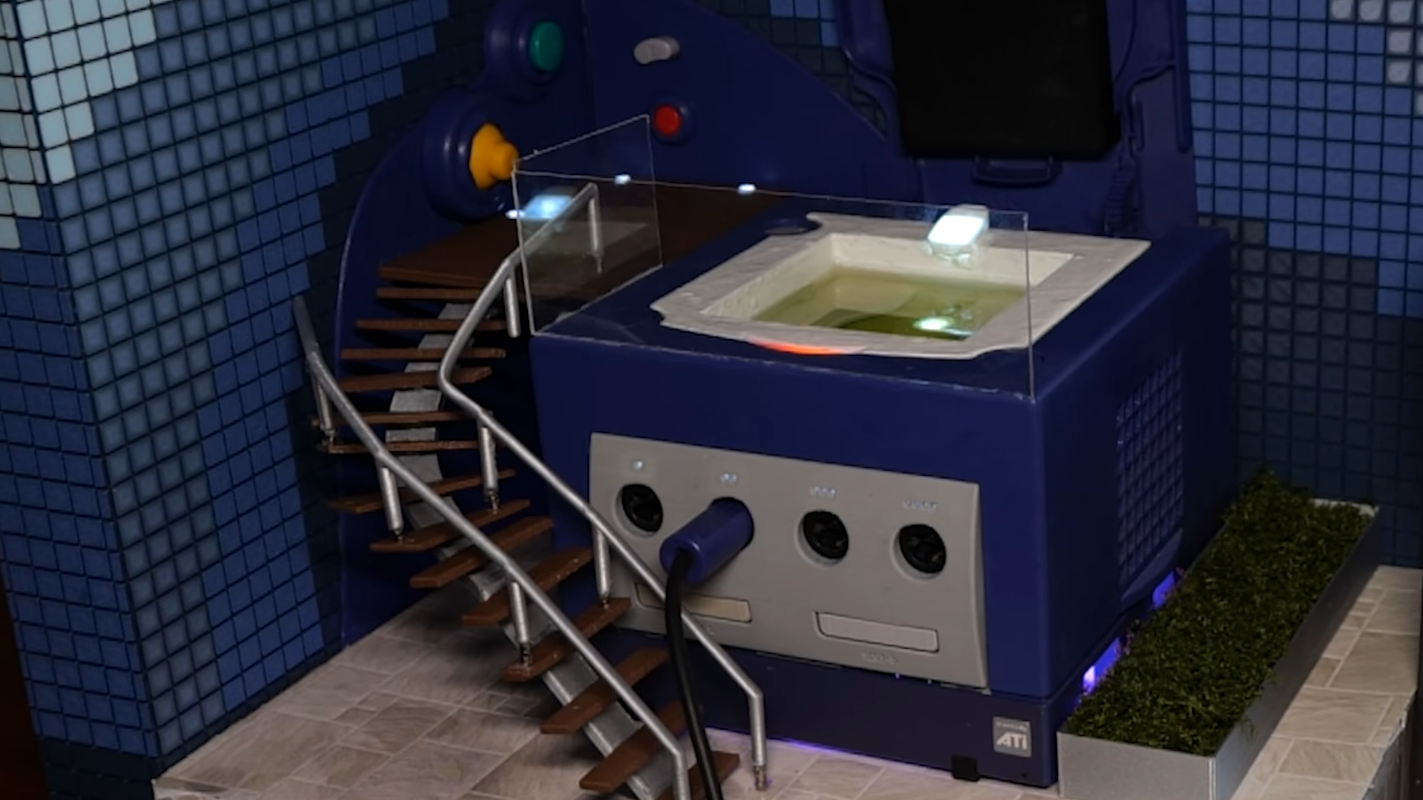
Unlike the current era where most consumer electronics are black rectangles, or the early 90s where most consumer electronics were black rectangles, we got a brief glimmer of color, light, and hope in the 2000s. Cell phones had all kinds of shapes and sizes, laptops came in bright colors, and even video game consoles got in on the fun. The Nintendo GameCube not only featured its namesake shape but came in several vibrant colors, most famously a bright purple. In fact, its design was such a hit that it continues to inspire artists and console modders alike. An animator named [kidd.gorgeous] recently envisioned a GameCube as a hot tub, and [BigRig Creates] set out to make this animation a reality.

Of course, this won’t be a life-sized hot tub capable of holding a human, but [BigRig Creates] did want it to be a usable, playable Game Cube with all of the features from the animation present in the final version. Since the lid won’t be operational with a hot tub model on the top lest all of the water spill out every time a game is changed, he’s modified it with some modern tools to hold his games inside the console itself. With the case open he’s also added the LED accent lighting featured in the animation as well as added the 3D-printed hot tub to the top. The hot tub is filled with mineral oil for electronics safety, and has a small pump built in to give the appearance of a working hot tub.

The buttons around the outside are functional as well, toggling the various lighting features and hot tub operation. And of course, the console diorama is fully playable, with the staircase railing able to easily detach in order to access the leftmost controller ports. It’s a faithful adaptation of the original animation, and [BigRig Creates] has a few games on queue that are properly themed for the new hot tub addition like Wave Race 64, Super Mario Sunshine, and Pool Paradise.

Advertisement

Source link

Advertisement
Continue Reading

Tech

Red Bull Pilot Successfully Lands and Takes Off from Moving Train in Single Session

Published

on

Red Bull Dario Costa Pilot Land Take Off Moving Train
Red Bull pilot Dario Costa lets go of the controls on his trusty Zivko Edge 540 and watches the cargo train thunder into the distance at an incredible 120 km/h (75 mph). On February 15th, 2026, near the Turkish town of Afyonkarahisar, Costa does the unthinkable by landing on the last container, riding out a tumultuous stretch of turbulent air, and powering back out in a single smooth move. No one had ever accomplished the feat of landing and taking off from a moving train in one go.


The pilot had established a reputation as one of the greatest in the field after years of competing in aerobatic competitions and setting records, one of which was threading through tunnels at breakneck speeds. He got the idea during a trip to Turkey in 2024, when he noticed a freight train rumbling alongside the road. He’d been thinking about pulling off this trick for years, but it wasn’t until he shared his concept with his team that things began to happen. With the assistance of engineers and fellow pilots, they began sketching out the physics, calculating relative velocity, wind currents generated by each train car, and the extremely little window of opportunity they had to work with, a straight 2.5km piece of track.

Sale


DJI Neo, Mini Drone with 4K UHD Camera for Adults, 135g Self Flying Drone that Follows You, Palm Takeoff…
  • Due to platform compatibility issue, the DJI Fly app has been removed from Google Play. DJI Neo must be activated in the DJI Fly App, to ensure a…
  • Lightweight and Regulation Friendly – At just 135g, this drone with camera for adults 4K may be even lighter than your phone and does not require FAA…
  • Palm Takeoff & Landing, Go Controller-Free [1] – Neo takes off from your hand with just a push of a button. The safe and easy operation of this drone…

Red Bull Dario Costa Pilot Land Take Off Moving Train
Real-life tests were out, so they opted for simulations and ground rehearsals instead. Eventually, the team decided on the ideal opportunity to try it: a three-day visit in Pula, Croatia, where Rimac Automobili generously provided one of their Nevera R hypercars as a mobile platform. Drivers would accelerate to match the train’s pace, while Costa practiced landing approaches from above. To make it even more realistic, the automobile would move forward and backward to replicate the gusts of air generated by passing the train containers. That drill session taught Costa when to line up his plane and how to react to any sudden changes in lift. Every time he landed, the plane would briefly hover over the surface before pulling away again.

Red Bull Dario Costa Pilot Land Take Off Moving Train
On the day of the stunt, the train chugged down its intended route with smoothness, while Costa circled above for a time before lining up behind it. He throttles back from cruising speed to a crawl, slowing to just a whisker above stall speed (87 km/h). The problem was that his plane’s nose was in the way, so he didn’t notice the container until he was around 200m away from impact. From that point forward, he is flying blind, relying on last-ditch radio calls from his ground spotters for assistance.

Red Bull Dario Costa Pilot Land Take Off Moving Train
The wheels had barely bounced on the container’s surface before the turbulent air from the train’s forward motion slammed down on him like a warning sign, wings flailing in all directions. The air just over the platform slowed practically to a crawl, forcing Costa to maintain the plane’s speed at 47 knots, barely 2 knots above stall, due to the narrow margin. He was constantly fussing with the rudder and ailerons to keep it level, and it didn’t help that he was peering down at the mere centimetres that separated it from the sides. The entire landing-to-takeoff procedure took 50 seconds, exacerbated by looming trees at the end of the track glaring back at him.

Red Bull Dario Costa Pilot Land Take Off Moving Train
Costa had just enough time to gather his breath and take stock before the next part of the act, when he yanked the stick back, sent the nose straight up, and the ground and cliff edge vanished from sight as the Edge 540 rocketed off the edge at a wild angle. The engine’s 400 horsepower propelled the plane into the air like a rocket.
[Source]

Advertisement

Source link

Continue Reading

Tech

Salesforce launches Headless 360 to turn its entire platform into infrastructure for AI agents

Published

on

Salesforce on Wednesday unveiled the most ambitious architectural transformation in its 27-year history, introducing “Headless 360” — a sweeping initiative that exposes every capability in its platform as an API, MCP tool, or CLI command so AI agents can operate the entire system without ever opening a browser.

The announcement, made at the company’s annual TDX developer conference in San Francisco, ships more than 100 new tools and skills immediately available to developers. It marks a decisive response to the existential question hanging over enterprise software: In a world where AI agents can reason, plan, and execute, does a company still need a CRM with a graphical interface?

Salesforce’s answer: No — and that’s exactly the point.

“We made a decision two and a half years ago: Rebuild Salesforce for agents,” the company said in its announcement. “Instead of burying capabilities behind a UI, expose them so the entire platform will be programmable and accessible from anywhere.”

Advertisement

The timing is anything but coincidental. Salesforce finds itself navigating one of the most turbulent periods in enterprise software history — a sector-wide sell-off that has pushed the iShares Expanded Tech-Software Sector ETF down roughly 28% from its September peak. The fear driving the decline: that AI, particularly large language models from Anthropic, OpenAI, and others, could render traditional SaaS business models obsolete.

Jayesh Govindarjan, EVP of Salesforce and one of the key architects behind the Headless 360 initiative, described the announcement as rooted not in marketing theory but in hard-won lessons from deploying agents with thousands of enterprise customers.

“The problem that emerged is the lifecycle of building an agentic system for every one of our customers on any stack, whether it’s ours or somebody else’s,” Govindarjan told VentureBeat in an exclusive interview. “The challenge that they face is very much the software development challenge. How do I build an agent? That’s only step one.”

More than 100 new tools give coding agents full access to the Salesforce platform for the first time

Salesforce Headless 360 rests on three pillars that collectively represent the company’s attempt to redefine what an enterprise platform looks like in the agentic era.

Advertisement

The first pillar — build any way you want — delivers more than 60 new MCP (Model Context Protocol) tools and 30-plus preconfigured coding skills that give external coding agents like Claude Code, Cursor, Codex, and Windsurf complete, live access to a customer’s entire Salesforce org, including data, workflows, and business logic. Developers no longer need to work inside Salesforce’s own IDE. They can direct AI coding agents from any terminal to build, deploy, and manage Salesforce applications.

Agentforce Vibes 2.0, the company’s own native development environment, now includes what it calls an “open agent harness” supporting both the Anthropic agent SDK and the OpenAI agents SDK. As demonstrated during the keynote, developers can choose between Claude Code and OpenAI agents depending on the task, with the harness dynamically adjusting available capabilities based on the selected agent. The environment also adds multi-model support, including Claude Sonnet and GPT-5, along with full org awareness from the start.

A significant technical addition is native React support on the Salesforce platform. During the keynote demo, presenters built a fully functional partner service application using React — not Salesforce’s own Lightning framework — that connected to org metadata via GraphQL while inheriting all platform security primitives. This opens up dramatically more expressive front-end possibilities for developers who want complete control over the visual layer.

The second pillar — deploy on any surface — centers on the new Agentforce Experience Layer, which separates what an agent does from how it appears, rendering rich interactive components natively across Slack, mobile apps, Microsoft Teams, ChatGPT, Claude, Gemini, and any client supporting MCP apps. During the keynote, presenters defined an experience once and deployed it across six different surfaces without writing surface-specific code. The philosophical shift is significant: rather than pulling customers into a Salesforce UI, enterprises push branded, interactive agent experiences into whatever workspace their customers already inhabit.

Advertisement

The third pillar — build agents you can trust at scale — introduces an entirely new suite of lifecycle management tools spanning testing, evaluation, experimentation, observation, and orchestration. Agent Script, the company’s new domain-specific language for defining agent behavior deterministically, is now generally available and open-sourced. A new Testing Center surfaces logic gaps and policy violations before deployment. Custom Scoring Evals let enterprises define what “good” looks like for their specific use case. And a new A/B Testing API enables running multiple agent versions against real traffic simultaneously.

Why enterprise customers kept breaking their own AI agents — and how Salesforce redesigned its tooling in response

Perhaps the most technically significant — and candid — portion of VentureBeat’s interview with Govindarjan addressed the fundamental engineering tension at the heart of enterprise AI: agents are probabilistic systems, but enterprises demand deterministic outcomes.

Govindarjan explained that early Agentforce customers, after getting agents into production through “sheer hard work,” discovered a painful reality. “They were afraid to make changes to these agents, because the whole system was brittle,” he said. “You make one change and you don’t know whether it’s going to work 100% of the time. All the testing you did needs to be redone.”

This brittleness problem drove the creation of Agent Script, which Govindarjan described as a programming language that “brings together the determinism that’s in programming languages with the inherent flexibility in probabilistic systems that LLMs provide.” The language functions as a single flat file — versionable, auditable — that defines a state machine governing how an agent behaves. Within that machine, enterprises specify which steps must follow explicit business logic and which can reason freely using LLM capabilities.

Advertisement

Salesforce open-sourced Agent Script this week, and Govindarjan noted that Claude Code can already generate it natively because of its clean documentation. The approach stands in sharp contrast to the “vibe coding” movement gaining traction elsewhere in the industry. As the Wall Street Journal recently reported, some companies are now attempting to vibe-code entire CRM replacements — a trend Salesforce’s Headless 360 directly addresses by making its own platform the most agent-friendly substrate available.

Govindarjan described the tooling as a product of Salesforce’s own internal practice. “We needed these tools to make our customers successful. Then our FDEs needed them. We hardened them, and then we gave them to our customers,” he told VentureBeat. In other words, Salesforce productized its own pain.

Inside the two competing AI agent architectures Salesforce says every enterprise will need

Govindarjan drew a revealing distinction between two fundamentally different agentic architectures emerging in the enterprise — one for customer-facing interactions and one he linked to what he called the “Ralph Wiggum loop.”

Customer-facing agents — those deployed to interact with end customers for sales or service — demand tight deterministic control. “Before customers are willing to put these agents in front of their customers, they want to make sure that it follows a certain paradigm — a certain brand set of rules,” Govindarjan told VentureBeat. Agent Script encodes these as a static graph — a defined funnel of steps with LLM reasoning embedded within each step.

Advertisement

The “Ralph Wiggum loop,” by contrast, represents the opposite end of the spectrum: a dynamic graph that unrolls at runtime, where the agent autonomously decides its next step based on what it learned in the previous step, killing dead-end paths and spawning new ones until the task is complete. This architecture, Govindarjan said, manifests primarily in employee-facing scenarios — developers using coding agents, salespeople running deep research loops, marketers generating campaign materials — where an expert human reviews the output before it ships.

“Ralph Wiggum loops are great for employee-facing because employees are, in essence, experts at something,” Govindarjan explained. “Developers are experts at development, salespeople are experts at sales.”

The critical technical insight: both architectures run on the same underlying platform and the same graph engine. “This is a dynamic graph. This is a static graph,” he said. “It’s all a graph underneath.” That unified runtime — spanning the spectrum from tightly controlled customer interactions to free-form autonomous loops — may be Salesforce’s most important technical bet, sparing enterprises from maintaining separate platforms for different agent modalities.

Salesforce hedges its bets on MCP while opening its ecosystem to every major AI model and tool

Salesforce’s embrace of openness at TDX was striking. The platform now integrates with OpenAI, Anthropic, Google Gemini, Meta’s LLaMA, and Mistral AI models. The open agent harness supports third-party agent SDKs. MCP tools work from any coding environment. And the new AgentExchange marketplace unifies 10,000 Salesforce apps, 2,600-plus Slack apps, and 1,000-plus Agentforce agents, tools, and MCP servers from partners including Google, Docusign, and Notion, backed by a new $50 million AgentExchange Builders Initiative.

Advertisement

Yet Govindarjan offered a surprisingly candid assessment of MCP itself — the protocol Anthropic created that has become a de facto standard for agent-tool communication.

“To be very honest, not at all sure” that MCP will remain the standard, he told VentureBeat. “When MCP first came along as a protocol, a lot of us engineers felt that it was a wrapper on top of a really well-written CLI — which now it is. A lot of people are saying that maybe CLI is just as good, if not better.”

His approach: pragmatic flexibility. “We’re not wedded to one or the other. We just use the best, and often we will offer all three. We offer an API, we offer a CLI, we offer an MCP.” This hedging explains the “Headless 360” naming itself — rather than betting on a single protocol, Salesforce exposes every capability across all three access patterns, insulating itself against protocol shifts.

Engine, the B2B travel management company featured prominently in the keynote demos, offered a real-world proof point for the open ecosystem approach. The company built its customer service agent, Ava, in 12 days using Agentforce and now handles 50% of customer cases autonomously. Engine runs five agents across customer-facing and employee-facing functions, with Data 360 at the heart of its infrastructure and Slack as its primary workspace. “CSAT goes up, costs to deliver go down. Customers are happier. We’re getting them answers faster. What’s the trade off? There’s no trade off,” an Engine executive said during the keynote.

Advertisement

Underpinning all of it is a shift in how Salesforce gets paid. The company is moving from per-seat licensing to consumption-based pricing for Agentforce — a transition Govindarjan described as “a business model change and innovation for us.” It’s a tacit acknowledgment that when agents, not humans, are doing the work, charging per user no longer makes sense.

Salesforce isn’t defending the old model — it’s dismantling it and betting the company on what comes next

Govindarjan framed the company’s evolution in architectural terms. Salesforce has organized its platform around four layers: a system of context (Data 360), a system of work (Customer 360 apps), a system of agency (Agentforce), and a system of engagement (Slack and other surfaces). Headless 360 opens every layer via programmable endpoints.

“What you saw today, what we’re doing now, is we’re opening up every single layer, right, with MCP tools, so we can go build the agentic experiences that are needed,” Govindarjan told VentureBeat. “I think you’re seeing a company transforming itself.”

Whether that transformation succeeds will depend on execution across thousands of customer deployments, the staying power of MCP and related protocols, and the fundamental question of whether incumbent enterprise platforms can move fast enough to remain relevant when AI agents can increasingly build new systems from scratch. The software sector’s bear market, the financial pressures bearing down on the entire industry, and the breathtaking pace of LLM improvement all conspire to make this one of the highest-stakes bets in enterprise technology.

Advertisement

But there is an irony embedded in Salesforce’s predicament that Headless 360 makes explicit. The very AI capabilities that threaten to displace traditional software are the same capabilities that Salesforce now harnesses to rebuild itself. Every coding agent that could theoretically replace a CRM is now, through Headless 360, a coding agent that builds on top of one. The company is not arguing that agents won’t change the game. It’s arguing that decades of accumulated enterprise data, workflows, trust layers, and institutional logic give it something no coding agent can generate from a blank prompt.

As Benioff declared on CNBC’s Mad Money in March: “The software industry is still alive, well and growing.” Headless 360 is his company’s most forceful attempt to prove him right — by tearing down the walls of the very platform that made Salesforce famous and inviting every agent in the world to walk through the front door.

Parker Harris, Salesforce’s co-founder, captured the bet most succinctly in a question he posed last month: “Why should you ever log into Salesforce again?”

If Headless 360 works as designed, the answer is: You shouldn’t have to. And that, Salesforce is wagering, is precisely what will keep you paying for it.

Advertisement

Source link

Continue Reading

Tech

Best iPhone 17 Cases of 2026

Published

on

MagSafe support

Most but not all iPhone 17 Series cases have MagSafe support (the metal ring built into the case). I generally encourage people to make sure they get a MagSafe-enabled case because of the number of MagSafe accessories on the market, some of them quite useful. In the past, you could save $5 to $10 by getting a case that left off the Magsafe ring, but, as I said, the vast majority of iPhone 17 Series cases are MagSafe-enabled.

Thickness

Some people like minimal cases that add little to no bulk to their iPhones, but the majority of people are looking for a case that offers good protection — or even maximum protection. I tell people to find a case that’s not too thick — and maybe even pretty slim — that offers at least 6-foot drop protection (and good corner protection).

Clear case

Clear cases are popular because they show off your phone (and its color). Clear cases, especially cheaper ones, can become less clear over time and slowly start to yellow. Many case makers now add UV protection to their clear cases to prevent yellowing. 

Advertisement

Source link

Continue Reading

Tech

Solidroad raises $25m as demand for QA product sparks fresh hiring

Published

on

Hiring has already begun and will continue ‘over the coming months’, founder Mark Hughes tells SiliconRepublic.com.

Y Combinator-backed and Irish-founded start-up Solidroad has announced a $25m Series A round led by UK investment firm Hedosophia.

The San Francisco-headquartered start-up offers companies an AI-powered quality assurance and training platform that reviews customer interactions to locate improvement points. This data can also be repurposed to create training simulations.

“Companies handle hundreds of thousands of customer conversations every day, but most can’t tell how well those interactions are actually going. Metrics like response times or ticket volumes don’t capture the actual quality of the experience,” co-founder and CEO Mark Hughes told SiliconRepublic.com.

Advertisement

As AI takes on routine requests, escalated conversations that reach humans tend to be complex and emotionally charged, Hughes noted. This raises the bar needed for human agents, putting pressure on coaching.

“We provide an independent quality layer across every customer interaction, so companies can evaluate performance consistently against their own standards.”

The new funding, as well as a $6.5m seed round in June last year, will help the start-up expand its teams across Dublin and San Francisco.

“We’re really focused on scaling … to meet a clear shift in the market,” said Hughes. Solidroad currently employs 20. The next wave of hiring has begun and will continue “over the coming months”.

Advertisement

“As demand grows from enterprises looking for better visibility and control over both human and AI-led customer interactions, expanding our team is critical to meeting that need and continuing to raise the quality bar across the industry,” the CEO said.

In 2025, the then two-year-old start-up said it had around 50 customers, a number which has since grown a “ton”, according to the CEO. Solidroad works with the likes of Crypto.com, Ryanair and Oura.

“Across all of our customers, we typically see a 20pc increase in quality assurance coverage and 90pc reduction in manual review time,” Hughes said.

Hughes previously founded Gradguide, a coaching and mentorship network for college graduates, in 2019. The company raised $2m before being acquired in 2022. Co-founder Patrick Finlay previously co-founded Monaru, which helped product and marketing teams build in-app experiences.

Advertisement

Solidroad, founded by the two in 2023, joined the Y Combinator accelerator as part of its winter 2025 cohort. Finlay’s previous venture was a part of a previous edition of the accelerator.

Hughes said his biggest lesson take-away as a founder was “learning the difference between a product people find interesting and one they actually need”.

On his experience at Y Combinator, he said: “I also quickly learned how to differentiate between what will actually make an impact versus what’s just a trend.”

Don’t miss out on the knowledge you need to succeed. Sign up for the Daily Brief, Silicon Republic’s digest of need-to-know sci-tech news.

Advertisement

Source link

Continue Reading

Tech

New leaders, new fund: Sequoia has raised $7B to expand its AI bets

Published

on

Few venture firms have bet more aggressively on AI than Sequoia Capital, and it isn’t slowing down.

The Silicon Valley stalwart has raised roughly $7 billion for a new fund, according to Bloomberg. Sequoia declined TechCrunch’s request for comment. The money will go toward what the firm calls its “expansion strategy” — essentially its late-stage investing arm, focused on the U.S. and Europe — and it’s nearly double Sequoia’s last comparable fund, a $3.4 billion vehicle raised in 2022.

That growth in fund size reflects something bigger: late-stage investing has taken on an entirely new meaning in the AI era. Companies can now scale at a speed and cost that would have been unimaginable a decade ago, and the firms backing them have to keep pace.

The money signals where Sequoia sees the future: deeply embedded in AI, from the giants building the underlying technology to the startups putting it to work. The firm has backed two of the most prominent players in the AI race — OpenAI originally and, more recently, Anthropic — both of which are reportedly eyeing public listings in 2026. The development that could mean a significant payday for the firm.

Advertisement

Sequoia isn’t only swinging for the foundational AI heavyweights, however. It has also placed bets on other buzzy startups, including Physical Intelligence, the Bay Area robotics startup, and Factory, which builds AI agents for enterprise engineering teams.

The fundraise is also the first major capital raise under Sequoia’s new leadership, with Alfred Lin and Pat Grady now serving as co-stewards of the 54-year-old firm.

Techcrunch event

San Francisco, CA
|
October 13-15, 2026

Advertisement

Source link

Advertisement
Continue Reading

Tech

Opera Adds Browser Connector Feature to Integrate AI Chatbots Into Browsers

Published

on

Opera announced Thursday a new tool that allows people using its browsers to add more AI chatbots to their browsing experience.

The free feature, called Browser Connector, works with Opera One and Opera GX and lets you integrate AI tools such as OpenAI’s ChatGPT and Anthropic’s Claude into live browsing sessions using Model Context Protocol. The protocol, known as MCP, is an open standard developed by Anthropic that enables a secure two-way connection between AI models, external data sources and tools such as search engines.

Advertisement
AI Atlas

(Disclosure: Ziff Davis, CNET’s parent company, in 2025 filed a lawsuit against OpenAI, alleging it infringed Ziff Davis copyrights in training and operating its AI systems.)  

Last month, Opera introduced MCP compatibility to Opera Neon, its subscription-based agentic AI browser. Opera says the new feature will allow your AI of choice to provide real-time context of open tabs and active content.

“With Browser Connector, Opera ensures users aren’t bound to a single company’s ecosystem, but are instead free to combine the best tools for their specific needs,” Mohamed Salah, senior director of product at Opera, said in a statement.

To enable the Browser Connector feature, which is now available in Opera’s Early Bird mode, head to Settings in the browser, search for “AI Services” and install it. Then connect ChatGPT or Claude to the feature.

Advertisement

Source link

Continue Reading

Tech

This LEGO Coffee Factory Responds to Smartphone Orders with Perfect Timing

Published

on

LEGO Coffee Factory Machine Build Keurig
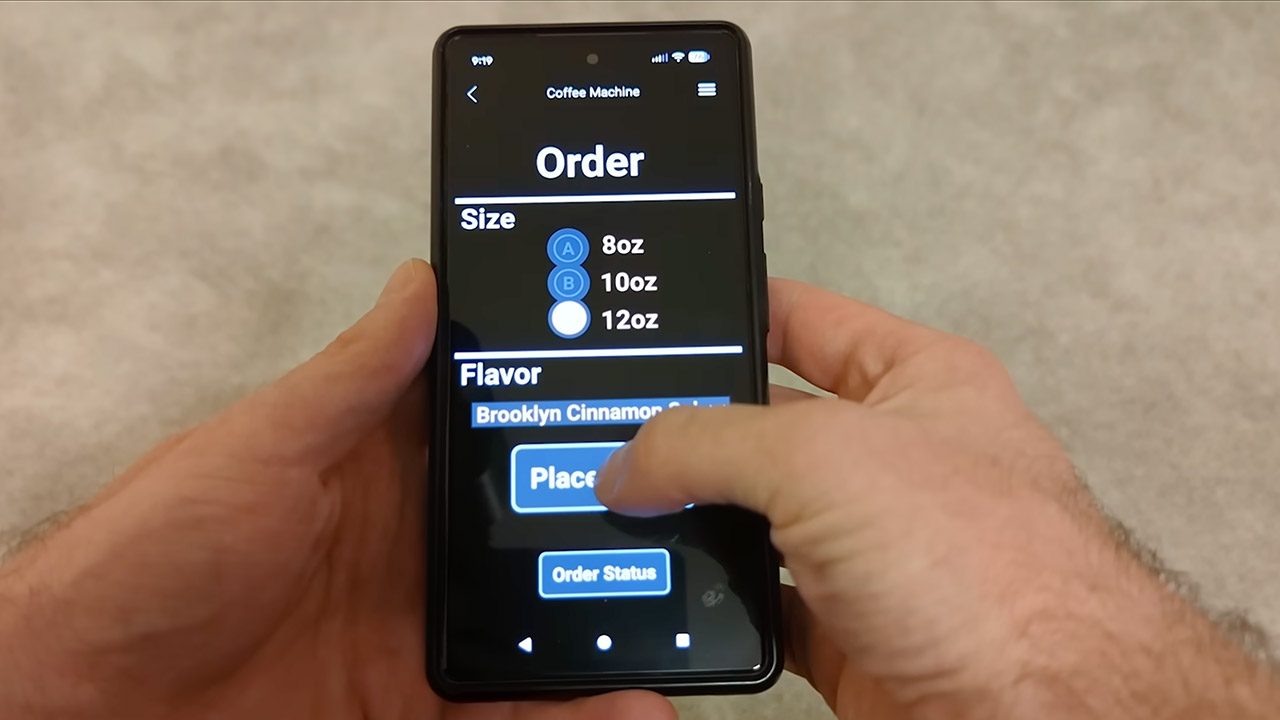
Brick Machines has built a really cool LEGO Coffee Factory that does all of the hard work for you when it comes to brewing your morning coffee. Simply open the app on your phone, choose a drink, and press the button; the machine will handle the rest.


You can manage the entire process with a simple app on your smartphone. Simply select your drink, which starts the entire process from the machine, and then sit back and wait for your coffee to arrive. There is no fumbling around and no laborious processes to worry about. The goal is to transform what would otherwise be a hassle into a relatively painless transaction between you and the gadget.

LEGO Coffee Factory Machine Build Keurig
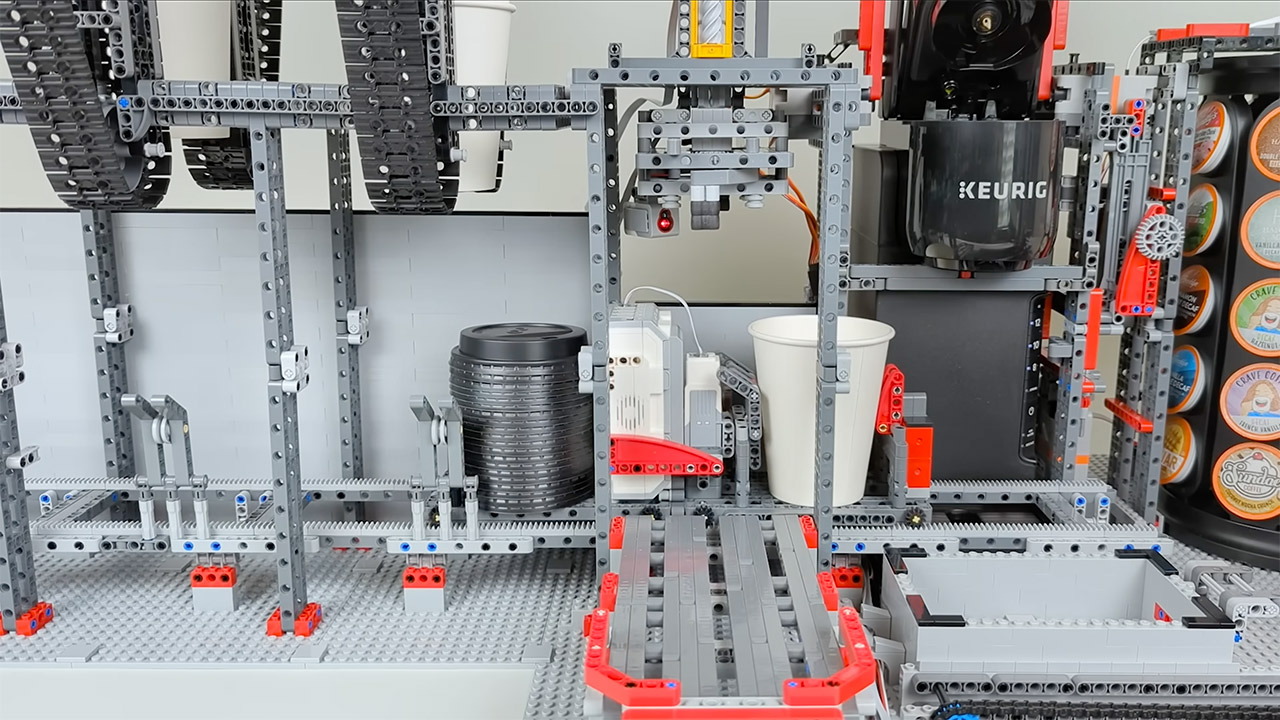
A normal Keurig unit serves as the main brains of the operation within the LEGO chassis. The rest of the design is based on it, with LEGO components added to enhance the movement and control options. The LEGO Technic beams and Mindstorms parts provide the necessary power and intelligence to the entire system. The motors turn the gears, which turn the arms and platforms smoothly at the appropriate time. The sensors constantly monitor everything to ensure that nothing is out of order. The end result looks and feels like a little factory line producing a single cup of coffee.

LEGO Coffee Factory Machine Build Keurig
Custom Pybricks code is used to communicate between the app and the machine. It establishes a direct link between your phone and the machine, which then executes the necessary commands. As you’d anticipate, some more electronics have been included to ensure that the timing and communication are perfect, and that each stage operates well. A few 3D printed parts were also used to fill in gaps when ordinary LEGO parts were insufficient.

LEGO Coffee Factory Machine Build Keurig
Mechanisms first place an empty cup beneath the spout. The rails then move the cup into position so that it precisely aligns with the flow of liquid, all in a flash and without spilling a drop before the brewing process begins. Next, a pod is removed from storage and inserted into the Keurig. The arms open the lid, guide the pod inside, and then securely close it. The motion is really smooth and coordinated, so the pod is ready quickly.

LEGO Coffee Factory Machine Build Keurig
Once the arms are built, the brewing procedure begins. Water begins to heat and flow through the pod, filling the waiting cup. The machine monitors the progress until the cup is filled to the brim with the ideal serving. Steam begins to rise as the liquid settles and the aroma spreads. Following that, the used pod must be disposed of, and the machine handles this effortlessly as well, with another set of arms opening the lid, lifting the old pod, and whisking it away to a collection receptacle on the side.
[Source]

Source link

Advertisement
Continue Reading

Tech

Recently leaked Windows zero-days now exploited in attacks

Published

on

Windows

Threat actors are exploiting three recently disclosed Windows security vulnerabilities in attacks aimed at gaining SYSTEM or elevated administrator permissions.

Since the start of the month, a security researcher known as “Chaotic Eclipse” or “Nightmare-Eclipse” has published proof-of-concept exploit code for all three security issues in protest to how Microsoft’s Security Response Center (MSRC) handled the disclosure process.

Two of the vulnerabilities (dubbed BlueHammer and RedSun) are Microsoft Defender local privilege escalation (LPE) flaws, while the third (known as UnDefend) can be exploited as a standard user to block Microsoft Defender definition updates.

Wiz

At the time of the leak, the security flaws these exploits targeted were considered zero-days by Microsoft’s definition, since they had no official patches or updates to address them.

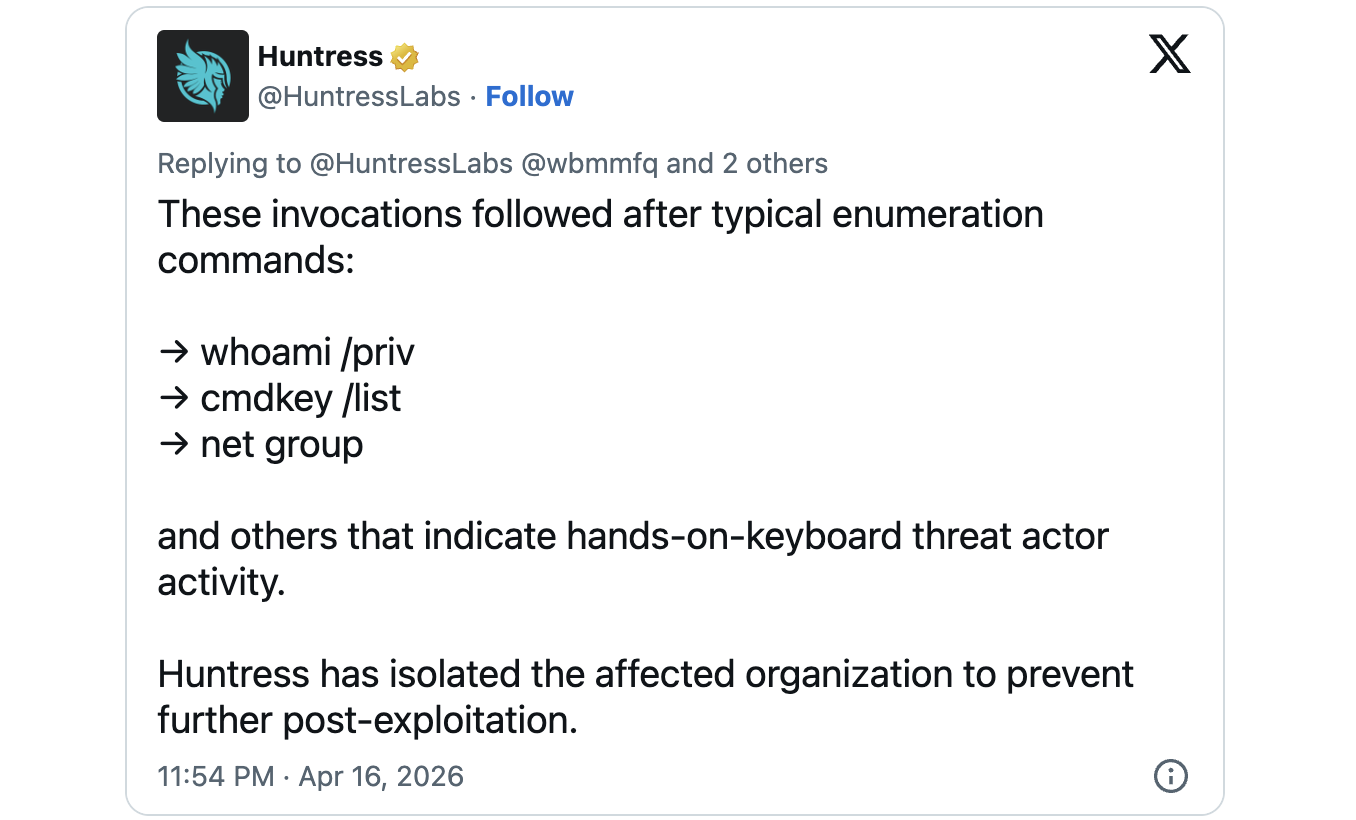
On Thursday, Huntress Labs security researchers reported seeing all three zero-day exploits deployed in the wild, with the BlueHammer vulnerability being exploited since April 10.

Advertisement

They also spotted UnDefend and RedSun exploits on a Windows device that was breached using a compromised SSLVPN user, in attacks showing evidence of “hands-on-keyboard threat actor activity.”

“The Huntress SOC is observing the use of Nightmare-Eclipse’s BlueHammer, RedSun, and UnDefend exploitation techniques,” the researchers said.

Huntress Labs tweet

​Two zero-days still waiting for a patch

While Microsoft is now tracking the BlueHammer vulnerability as CVE-2026-33825 and has patched it in the April 2026 security updates, the other two flaws remain unaddressed.

As BleepingComputer previously reported, attackers can use the RedSun exploit to gain SYSTEM privileges on Windows 10, Windows 11, and Windows Server 2019 and later systems when Windows Defender is enabled, even after applying the April Patch Tuesday patches.

Advertisement

“When Windows Defender realizes that a malicious file has a cloud tag, for whatever stupid and hilarious reason, the antivirus that’s supposed to protect decides that it is a good idea to just rewrite the file it found again to it’s original location,” the researcher explained. “The PoC abuses this behaviour to overwrite system files and gain administrative privileges.”

“Microsoft has a customer commitment to investigate reported security issues and update impacted devices to protect customers as soon as possible,” a Microsoft spokesperson told BleepingComputer earlier this week when contacted for more information on the disclosure issues reported by the anonymous researcher.

“We also support coordinated vulnerability disclosure, a widely adopted industry practice that helps ensure issues are carefully investigated and addressed before public disclosure, supporting both customer protection and the security research community.”

AI chained four zero-days into one exploit that bypassed both renderer and OS sandboxes. A wave of new exploits is coming.

At the Autonomous Validation Summit (May 12 & 14), see how autonomous, context-rich validation finds what’s exploitable, proves controls hold, and closes the remediation loop.

Advertisement

Source link

Continue Reading

Tech

I test coffee machines for a living and I can’t recommend this De’Longhi model at half price highly enough

Published

on

If you’ve been considering adding a coffee machine to your kitchen, or upgrading an old one, you’re not exactly short of options. Yet, if all you want is an easy route to a cafe-quality caffeine hit, then only a fully-automatic coffee machine will do — and you can now save a huge 50% on a De’Longhi model that is among the best coffee machines we’ve ever tested.

The De’Longhi Eletta Explore really is a do-it-all machine, capable of making both hot and cold coffee-based drinks, including those with milk, at the touch of a few buttons — and it’s now available for AU$999 (down from AU$1,999) at Amazon for a limited time.

best coffee machines in Australia. It is simply brimming with features, including Wi-Fi connectivity, allowing you to control the machine from your phone — this includes brewing drinks, but you’ll need to make sure there’s a cup underneath the spout before you do!

Advertisement

As we said in our De’Longhi Eletta Explore review, “The Eletta Explore made delicious, well-balanced espresso with a well-formed crema and plenty of body.” We were also impressed with the foam created using the LatteCrema system, whether making hot or cold drinks. One thing to note, however, is that separate milk carafes are required for hot and cold drinks, so you’ll need to manually swap them if you’re making a variety of drinks.

Ultimately, no matter your coffee order, the De’Longhi Eletta Explore will be able to make it. And now it’s half price, it will recoup its money back and more in no time.

Amazon has also discounted the De’Longhi Magnifica Evo by 40%, now AU$599. This is an older machine, and is quite large, but is still highly capable and can brew a wonderful espresso. There’s no touchscreen display, and it isn’t able to make as many coffee-based drinks as the Eletta Explore, but if your preference is for a simple cappuccino, flat white or long black, it’s ideal. You can read our full De’Longhi Magnifica Evo review for more information.

Advertisement

Finally, for a more simple espresso machine, there’s the Stilosa. Now just AU$116 (down from AU$149), this simple manual espresso machine with a steam wand is a fine option if you’re not interested in features like cold brewing and automatic milk frothing.

Not too keen on my picks? View a wider selection of manual, semi-automatic and fully-automatic espresso machines at Amazon.

Source link

Continue Reading

Trending

Copyright © 2025