
Crypto World
JPMorgan CEO Jamie Dimon annual letter cites risks in geopolitics, AI, private markets


Jamie Dimon, Chairman and CEO, JPMorganChase, speaks during the Reagan National Defense Forum at the Ronald Reagan Presidential Library in Simi Valley, California, U.S. December 6, 2025.
Jonathan Alcorn | Reuters
JPMorgan Chase CEO Jamie Dimon is calling for a broad recommitment to American ideals as his bank navigates geopolitical uncertainty, a teetering economy and the revolutionary impact of artificial intelligence.
Dimon in his annual letter to shareholders, published Monday, noted the country’s 250th anniversary as “the perfect time to rededicate ourselves to the values that made this great nation of ours — freedom, liberty and opportunity.”
“The challenges we all face are significant. The list is long but at the top are the terrible ongoing war and violence in Ukraine, the current war in Iran and the broader hostilities in the Middle East, terrorist activity and growing geopolitical tensions, importantly with China,” Dimon said. “Even in troubled times, we have confidence that America do what it has always done — look to the values that have defined our singular nation and sustained our leadership of the free world.”
Dimon, the longtime leader of the world’s largest bank by market cap, is among the most outspoken of U.S. corporate leaders. His annual letter offers not only a matter of record for his firm’s performance, but also sweeping perspectives on the global state of affairs.
In Monday’s letter, Dimon noted headwinds including global conflicts, persistent inflation, private market upheaval and what he called “poor bank regulations.”
Dimon said that while regulations like those put in place after the 2008 financial crisis “accomplished some good things … they also created a fragmented, slow-moving system with expensive, overlapping and excessive rules and regulations — some of which made the financial system weaker and reduced productive lending.”
He specifically cited negative consequences of capital and liquidity requirements, the current construction of the Federal Reserve’s stress test and a “badly handled” process at the Federal Deposit Insurance Corporation.
Dimon also said JPMorgan’s reaction to revised proposals for Basel 3 Endgame and a global systemically important bank (GSIB) surcharge — issued by U.S. regulators last month — were “mixed.”
“While it was good to see that the recent proposals for the Basel 3 Endgame (B3E) and GSIB attempted to reduce the increase in required capital from the 2023 proposals, there are still some aspects that are frankly nonsensical,” Dimon said.
The CEO said the aggregate proposed surcharges of about 5%, the bank would need to hold “as much as 50% more capital across the vast majority of loans to U.S. consumers and businesses when compared with a large non-GSIB bank for the same set of loans.”
“Frankly, it’s not right, and it’s un-American,” he said.
On trade and geopolitics
Dimon identified geopolitical tensions as the primary risk facing his bank, namely the wars in Ukraine and Iran and their impacts on commodities and global markets — deeming war “the realm of uncertainty.”
“The outcome of current geopolitical events may very well be the defining factor in how the future global economic order unfolds,” he said. “Then again, it may not.”
He also cited a “realignment of economic relations in the world” brought on by U.S. trade policy. U.S. President Donald Trump has made tariffs a signature policy of his second term in office, introducing higher duties on dozens of trade partners and import categories.
“The trade battles are clearly not over, and it should be expected that many nations are analyzing how and with whom they should create trade arrangements,” Dimon said. “While some of this is necessary for national security and resiliency, which are paramount, it is hard to figure out what the long-term effects will be.”
On private markets
Dimon also spoke to recent upheaval in the private markets, as fears around loans made to software firms spur massive redemption requests at private credit funds.
“By and large, private credit does not tend to have great transparency or rigorous valuation ‘marks’ of their loans — this increases the chance that people will sell if they think the environment will get worse — even if actual realized losses barely change,” Dimon said.
The executive added that actual losses are already higher than they should be relative to the environment.
“However this plays out, it should be expected that at some point insurance regulators will insist on more rigorous ratings or markdowns, which will likely lead to demands for more capital,” he said.
On AI
Dimon reiterated Monday that the pace of AI adoption is unlike any technology that came before it. He said while its implementation will be “transformational,” it remains to be seen how the AI revolution will unfold.
“Overall, the investment in AI is not a speculative bubble; rather, it will deliver significant benefits. However, at this time, we cannot predict the ultimate winners and losers in AI- related industries,” Dimon said.
“We will not put our heads in the sand. We will deploy AI, as we deploy all technology, to do a better job for our customers (and employees),” he wrote.
JPMorgan has been at the forefront of Wall Street firms introducing AI at every level of its business. Last year, JPMorgan Chief Analytics Officer Derek Waldron gave CNBC an early demonstration into how it’s using agentic AI to speed up work and improve results for customers and shareholders.
In February, Dimon said AI was reshaping JPMorgan’s workforce and that the bank had “huge redeployment plans” for employees.
“We have focused on some of the ‘known and predictable’ and some of the ‘known unknown’ events,” he said. “But huge technological shifts like AI always have second- and third-order effects as well that can deeply impact society. … We should be monitoring for this kind of transformation, too.”
— CNBC’s Leslie Picker and Ritika Shah contributed to this report.

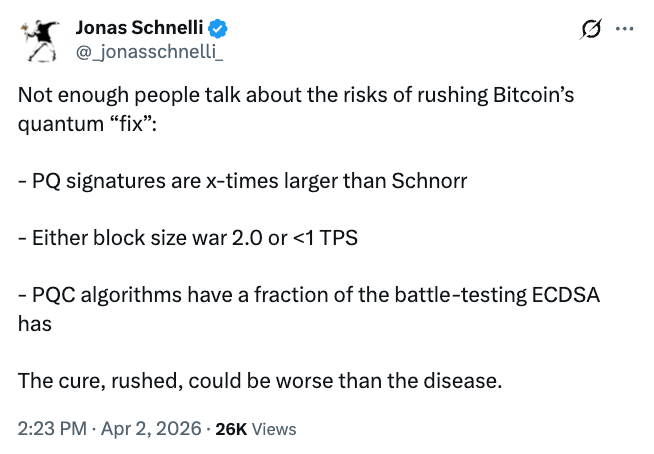
Rushed quantum fixes for Bitcoin could introduce new risks, Samson Mow warned in response to calls from Coinbase executives for faster action.
Mow, a Bitcoin advocate and Jan3 founder, took to X on Saturday to address comments from Coinbase CEO Brian Armstrong and chief security officer Philip Martin, who urged the industry to begin preparing for quantum computing threats sooner rather than later.
He said that while post-quantum (PQ) cryptography could secure Bitcoin (BTC) against future quantum computers, rushing implementation may create new vulnerabilities such as compatibility issues and reduced network efficiency due to larger signature sizes.
“Simply put: make Bitcoin safe against quantum computers just to get pwned by normal computers,” Mow said, adding that a poorly timed transition could weaken Bitcoin against today’s threats before addressing future ones.
The exchange reflects a growing debate over how to future-proof Bitcoin, as new research from Google and Caltech reignited concerns about progress in quantum computing.
Why Mow is pushing back and how it ties to the block size wars
One of Mow’s biggest concerns about rushing a quantum fix for Bitcoin is the potential impact on performance, particularly block size, or the amount of transaction data that can fit into a single block.
“PQ signatures will likely be 10-125x larger than current ones, and massively reduce throughput,” Mow said, citing former Bitcoin developer Jonas Schnelli.

The signature issue could potentially pave the way for “Blocksize Wars 2.0,” Mow continued.
Bitcoin’s block size wars began around 2015 and peaked in 2017, when the community split over whether to increase the block size to handle more transactions.
Related: Circle unveils quantum-resistant roadmap for its layer-1 blockchain Arc
That dispute raised concerns about decentralization, network security and who controls Bitcoin’s future, ultimately leading to alternative scaling solutions rather than a simple increase in block size.
Despite arguing against rushing a transition to post-quantum cryptography for Bitcoin, Mow said work on potential solutions should continue.
“Given that quantum computers don’t actually exist and likely won’t exist for another 10-20 years, the worst possible course of action is to rush a fix,” he said. “That’s not to say work shouldn’t be done to prepare, and there is already much work being done.”
Magazine: Nobody knows if quantum secure cryptography will even work


The United States, Iran, and a group of regional mediators are weighing terms for a temporary ceasefire that could extend into a permanent resolution, according to U.S., Israeli, and regional sources familiar with the discussions.
Summary
- U.S., Iran, and regional mediators are discussing a two-phase ceasefire plan, though chances of a near-term deal remain limited.
- Pakistan has proposed an “Islamabad Accord” to reopen the Strait of Hormuz and prevent further escalation.
An Axios report said prospects for a partial deal within the next 48 hours remain limited. Still, officials described the effort as the final opportunity to avoid a sharp escalation that could involve strikes on Iranian civilian infrastructure and retaliatory attacks on energy and water facilities across Gulf states.
Separately, a source familiar with the negotiations said both Washington and Tehran have received a proposal that could halt hostilities as early as Monday while reopening the Strait of Hormuz. The plan, drafted by Pakistan and shared overnight, outlines a two-step process beginning with an immediate ceasefire followed by negotiations toward a comprehensive settlement.
“All elements need to be agreed today,” the source said, noting that the initial understanding would take the form of a memorandum of understanding finalised electronically through Pakistan, which has emerged as the sole communication channel.
Pakistan’s army chief, Asim Munir, has been in continuous contact “all night long” with JD Vance, envoy Steve Witkoff, and Iranian Foreign Minister Abbas Araqchi, the source added.
Under the framework, a ceasefire would take effect immediately and allow shipping to resume through the strait, with a 15 to 20-day window to finalise a broader agreement. The proposal, informally referred to as the “Islamabad Accord,” also envisions a regional framework governing the waterway, with final in-person talks expected in Islamabad.
The continued blockade of the Strait of Hormuz has pushed global oil prices higher.
Donald Trump has repeatedly issued deadlines for Iran to reopen the passage or face military action targeting its energy infrastructure. In a recent Truth Social post, he extended the deadline to Tuesday and warned Iran would be “living in hell” if it failed to comply.
Despite mounting diplomatic pressure, Tehran has yet to signal acceptance of the proposed ceasefire. Iranian officials have said any agreement must include guarantees against future attacks by the U.S. and Israel. They also confirmed receiving messages from mediators, including Pakistan, Turkey, and Egypt, supporting a temporary 45-day truce to allow further negotiations.
The draft agreement is expected to include commitments from Iran not to pursue nuclear weapons in exchange for sanctions relief and access to frozen assets. However, officials said no formal commitment has been secured so far.
Iran’s leadership has maintained a defiant stance, warning it would respond “in kind” to any attack on its infrastructure, while also considering measures such as transit tolls before reopening the strait.
How will the crypto market react to potential de-escalation?
Although no agreement has been finalised at press time, risk assets have started to recover. The total crypto market cap has risen around 3.4% to $2.47 trillion, with Bitcoin (BTC) attempting to reclaim the $70,000 level. Ethereum (ETH), XRP (XRP), and other major crypto tokens have posted gains in the 3% to 6% range.
The move suggests traders may already be positioning for a potential de-escalation and the reopening of the Strait of Hormuz, which could stabilise energy markets and ease inflation pressures.
Traditional markets, however, presented a mixed picture. Asian equities were mostly lower, with the Nikkei 225 standing out as an exception, while gold and silver traded in a narrow range as investors balanced uncertainty with selective risk exposure.
A confirmed ceasefire could support both crypto and global equities by easing oil prices and improving expectations for monetary policy. Lower energy costs tend to reduce inflation pressures, which could increase the likelihood of a more accommodative stance from the Federal Reserve.
Failure to reach an agreement carries the opposite risk. An escalation involving direct strikes on Iranian infrastructure and retaliation across the region could trigger a sharp shift toward safe-haven assets, putting pressure on cryptocurrencies as capital moves into the dollar and traditional defensive plays.
Disclosure: This article does not represent investment advice. The content and materials featured on this page are for educational purposes only.


Apple has pulled Jack Dorsey Bitchat from the App Store in China at the request of the Cyberspace Administration of China, which cited violations of internet service regulations.
The removal, confirmed by Dorsey via an X post on April 6, 2026, extends to TestFlight beta access, cutting off the app’s official distribution channel in the country entirely.
The real story isn’t the takedown itself. It’s that Bitchat operates exclusively over Bluetooth Low Energy mesh networks with zero internet dependency – and Beijing still moved to excise it, signaling that China’s censorship infrastructure is now targeting communication layers that don’t touch the internet at all.
- What Happened: Apple removed Bitchat from China’s App Store in February 2026 and suspended TestFlight beta access at the Cyberspace Administration of China’s request.
- The Regulatory Hook: The CAC cited Article 3 of its 2018 regulations governing services with public opinion or social mobilization capabilities, requiring a security assessment before launch.
- How Bitchat Works: The app runs entirely over Bluetooth Low Energy mesh networks, relaying messages and Bitcoin transaction data device-to-device up to 100 meters per hop – no Wi-Fi, no cellular, no servers.
- Existing Installs Unaffected: Devices already running Bitchat in China continue to operate normally; the app requires no App Store access or server check-ins post-install.
- Global Protest Utility: Bitchat has surged in download volume during internet shutdowns in Madagascar, Uganda, Nepal, Indonesia, and Iran in recent months.
- What to Watch: Android sideloading activity in China and whether the CAC moves against similar BLE-based communication apps amid its expanding 2026 enforcement wave.
Discover: The Best Crypto to Buy Right Now
What Beijing’s CAC Actually Did – and Why Jack Dorsey Bluetooth App Threatened the Firewall
The Cyberspace Administration of China‘s authority here derives from regulations that came into force in November 2018, targeting any online service capable of influencing public opinion or enabling social mobilization.
Under those provisions, covered apps must complete a state security assessment before launch and bear legal responsibility for the assessment results.
Bitchat’s architecture makes the CAC’s move notable. The app never touches China’s internet infrastructure – it hops Bluetooth signals between devices, each hop covering up to 100 meters, with no central server, no user accounts, and no phone number requirements.
Beijing’s decision to pursue removal through Apple rather than a network-level block exposes the limits of the Great Firewall against offline mesh protocols: when you can’t intercept the traffic, you target the distribution point.
Apple’s compliance was swift and unambiguous. The app review team told Dorsey directly that all App Store titles must conform to local legal requirements in each market – and that apps facilitating behavior construed as criminal or reckless under local law face rejection.
That framing puts Apple’s role in sharp relief: the company functions as a de facto enforcement arm for any government with sufficient regulatory leverage over its App Store.
Community observers on Binance Square drew the structural conclusion immediately, with posts arguing that Apple’s compliance “shows Big Tech’s vulnerability to state pressure, pushing devs toward fully sideloaded alternatives.”
The observation tracks – but it also understates the problem. Sideloading requires a device already in hand. The App Store removal blocks new installs at the point of acquisition, which is precisely where censorship regimes focus their leverage.
Explore: The Best Pre-Launch Token Sales With Asymmetric Upside Potential
The post Apple Removes Jack Dorsey Bitchat App from China at Beijing’s Request appeared first on Cryptonews.
Marc Andreessen said artificial intelligence will spark a “massive jobs boom,” dismissing fears of widespread job losses as “all fake” in a Sunday post on X.
His optimism contrasts with a March US jobs report showing unemployment holding steady at 4.3%, while the number of people unemployed for 27 weeks or more rose by 322,000 over the past year.
Andreesen shared a Business Insider report showing a sharp rise in tech job openings in 2026, with more than 67,000 software engineering roles, a twofold increase from 2023, and argued that employers had recovered from post-pandemic hiring corrections and the interest rate spike.
“The ‘AI job loss’ narratives are all fake,” he wrote. “AI = massive ramp in productivity = massive ramp in demand = massive jobs boom. Watch.”
Andreessen is one of Silicon Valley’s most influential investors, a co-founder of Netscape and venture firm Andreessen Horowitz. He is also a major backer of US crypto and AI companies.
Job losses in tech pile up
On the ground, the reality is somewhat different. On Feb. 26, Jack Dorsey’s Block cut 40% of its staff as the company accelerated its use of AI, including experiments with agents to take over parts of middle management.
Related: Dorsey shares AI-integrated workplace vision weeks after Block’s 40% staff cut
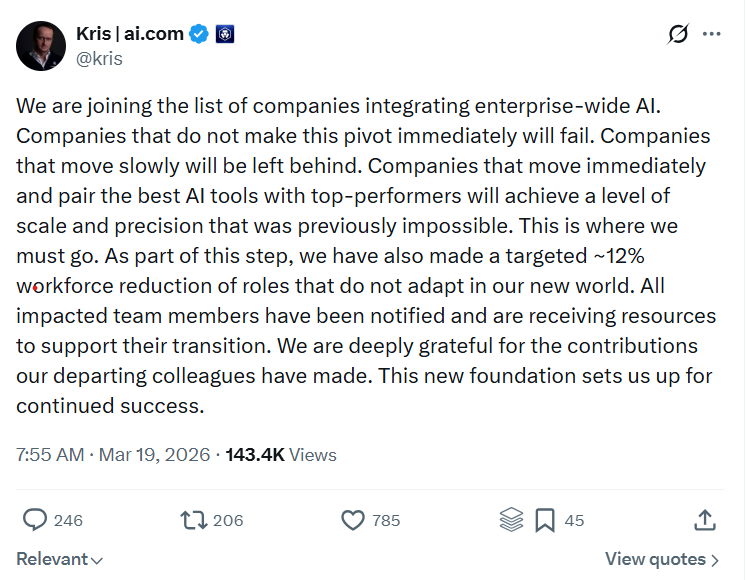
On March 19, crypto exchange Crypto.com announced a 12% workforce reduction due to AI integrations, warning that companies “that do not make this pivot immediately will fail.”

AI-driven pivots by companies are also impacting employment.
Oracle reportedly cut up to 30,000 jobs recently, citing “broader organizational change,” as it pushes to build AI data centers.
MARA, which has been repurposing its Bitcoin mining infrastructure for AI, has reportedly reduced its staff by 15%.
Andreessen’s comments meet with skepticism
That backdrop helps explain the online backlash Andreessen received.
“Tell that to the average lower middle class American who can’t find a job or the consumer who can’t get decent customer service,” crypto influencer WendyO replied.
Tory Green, co-founder at io.net argued Andreessen could be proved right on net job creation, but only if AI tools are broadly accessible and not captured by a handful of platforms.
AI Eye: 9 weirdest AI stories from 2025

There was a time when “earning” meant showing up.
Clock in. Do the work. Get paid.
That model is quietly being rewritten.
Not by corporations. Not by governments.
But by code.
The Shift No One Is Talking About
In traditional economics, labor and capital are separate forces:
- Labor = effort, time, skill
- Capital = money, assets, tools
You worked for capital. Capital didn’t work for you.
DeFi flips that.
Now your capital:
- Provides liquidity
- Secures networks
- Arbitrages inefficiencies
- Rebalances positions
- Optimizes yield across protocols
That’s not passive.
That’s functionally labor.
Yield Farming = Outsourced Work
Let’s call it what it is.
Yield farming isn’t just “earning interest.”
It’s:
- Acting as a market maker
- Acting as a lender
- Acting as a validator (indirectly)
- Acting as a trader via automated strategies
Instead of hiring humans, protocols use your capital as the worker.
Is your USDC in a liquidity pool?
That’s filling trades 24/7.
Your ETH in staking?
That’s helping secure consensus.
Your funds in an arbitrage vault?
That’s scanning price inefficiencies faster than any human ever could.
No breaks. No emotions. No sleep.
Capital as a Full-Time Employee
Here’s the uncomfortable realization:
Your money might already be working harder than you are.
In DeFi, capital doesn’t sit idle:
- It compounds
- It reallocates
- It executes strategies automatically
And unlike human labor:
- It scales instantly
- It operates globally
- It doesn’t burn out
We’re watching the birth of something new:
Synthetic labor.
From “Work → Earn” to “Deploy → Earn”
The old formula:
Work → Earn money → Save → Invest
The new formula:
Deploy capital → Earn like labor → Reinvest → Compound
This changes everything.
Because now:
- Income is no longer tied to time
- Productivity is no longer tied to effort
- Output is no longer tied to human limits
If your capital is positioned correctly, it behaves like:
- A trader
- A banker
- A liquidity provider
All at once.
The Uneven Playing Field
Here’s where things get real.
If capital becomes labor, then:
- People with more capital = more “workers”
- People without capital = left selling time
This amplifies inequality.
Because:
- One person can deploy $1M across strategies
- Another can only deploy $100
Both access the same protocols.
But only one owns a fleet of synthetic workers
The Rise of Capital Efficiency Wars
Protocols are already competing for your capital:
- Higher APYs
- Token incentives
- Better risk-adjusted returns
Why?
Because capital is labor supply in DeFi.
More capital = deeper liquidity = better markets = stronger protocol
We’re entering a phase where protocols don’t just attract users.
They recruit workers made of capital.
The Psychological Flip
This is where most people lag.
They still think:
“I need to work harder to earn more.”
But the real question is:
“Is my capital working at all?”
Because idle money in a bank account is:
- Not securing anything
- Not providing liquidity
- Not capturing inefficiencies
In DeFi terms, it’s unemployed.
Risks: Not All “Workers” Are Safe
Let’s not romanticize it.
Synthetic labor comes with real risks:
- Smart contract exploits
- Impermanent loss
- Protocol collapse
- Incentive rug pulls
Your “worker” can:
- Underperform
- Lose capital
- Get wiped out entirely
Unlike human labor, there are no labor laws here.
Where This Is Heading
Zoom out.
If capital becomes programmable labor:
- DAOs become employers
- Protocols become economic machines
- Users become capital allocators instead of workers
The long-term implication?
We’re heading toward a system where:
- Work is optional (for some)
- Capital allocation is the primary skill
- Financial literacy becomes survival
Final Thought
DeFi didn’t just create new ways to earn.
It quietly redefined what “earning” even means.
You’re no longer just a worker.
You’re a manager of workers.
The twist?
Your workers are made of capital.
And they never sleep.
REQUEST AN ARTICLE
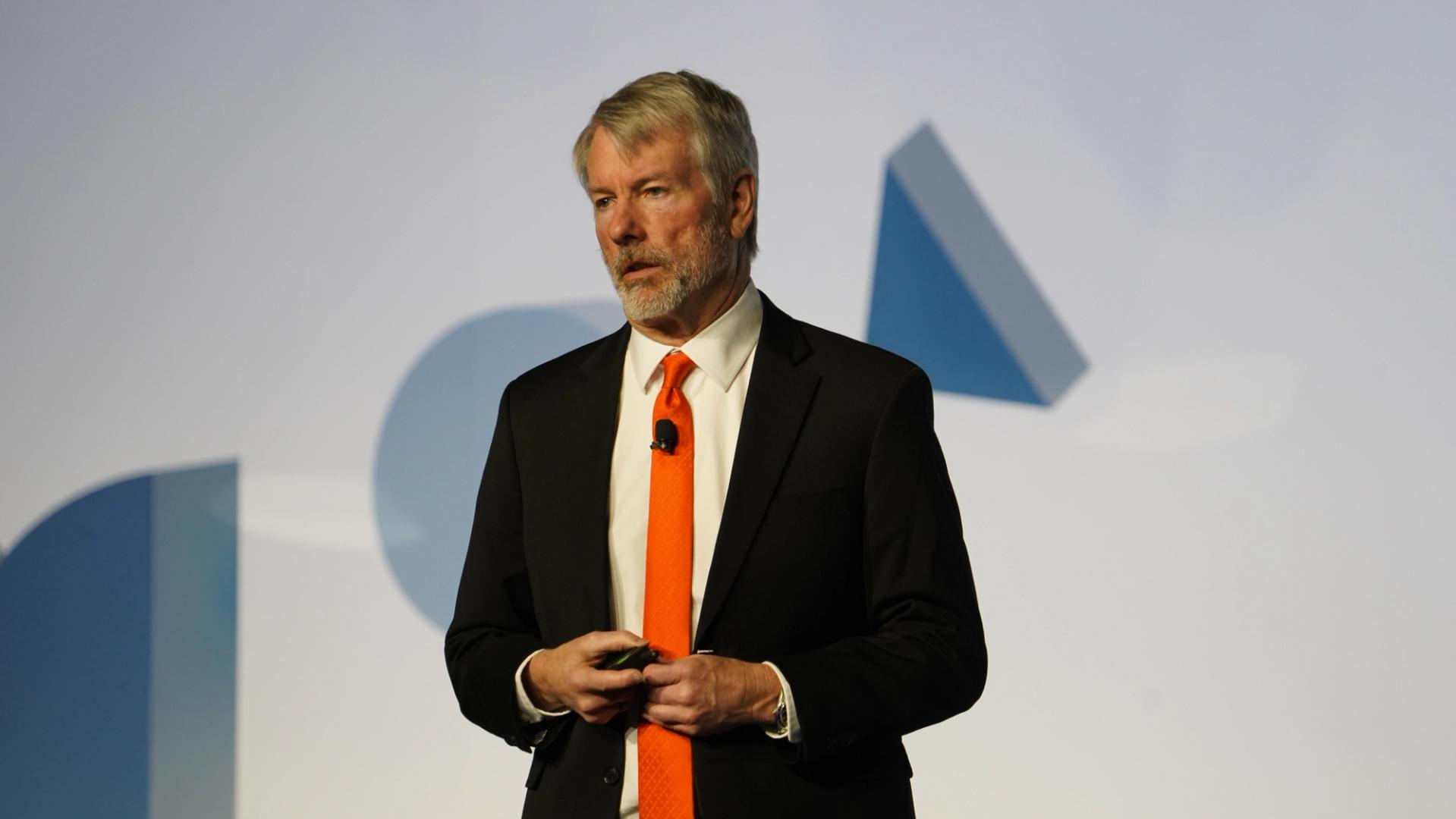
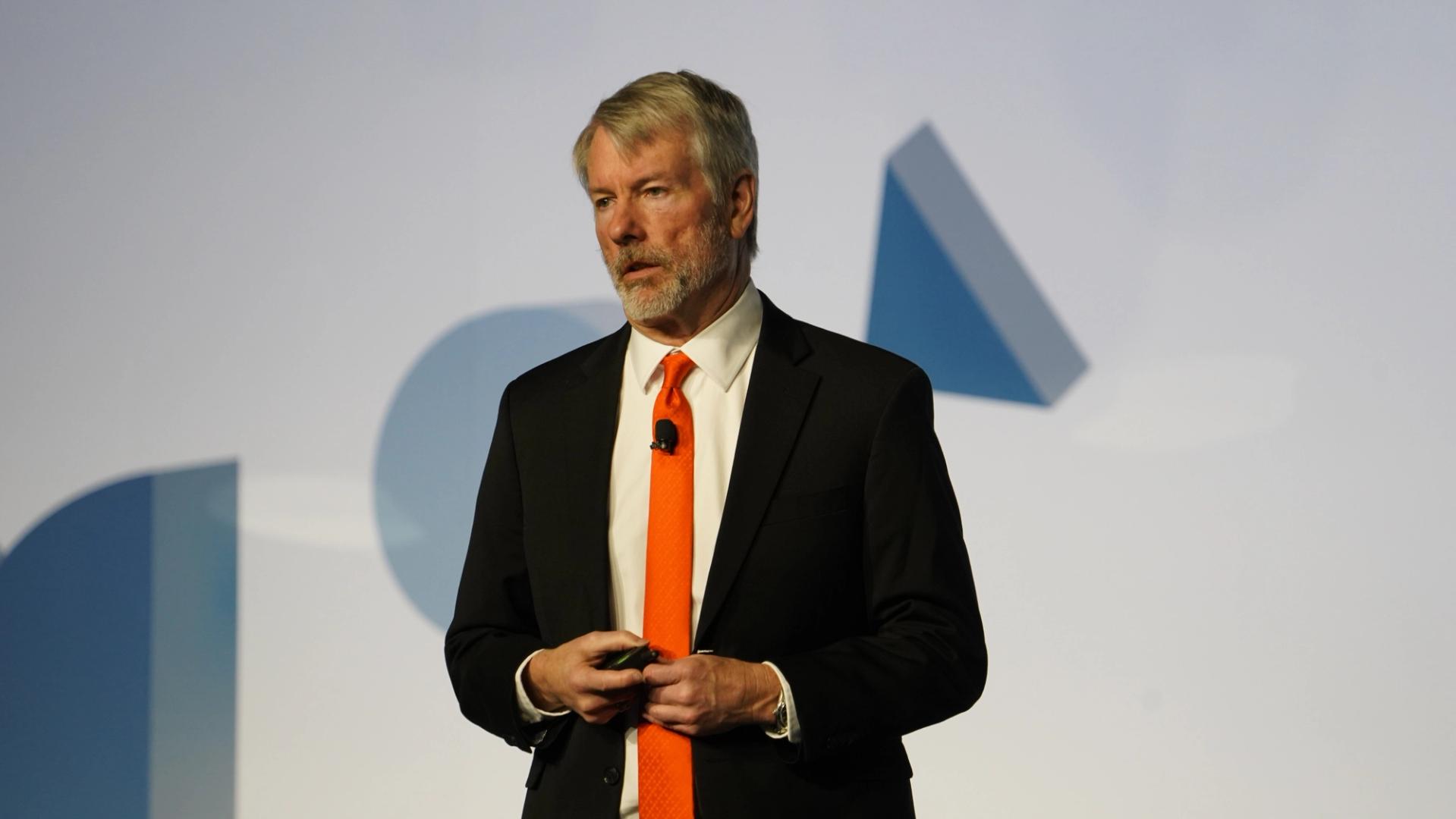
Michael Saylor’s Strategy (MSTR) added 4,871 bitcoin to its treasury over the past week at an average price of roughly $67,718 per coin, spending approximately $329.9 million, according to a Monday filing.
The purchase brings total holdings to 766,970 BTC acquired for $58.02 billion at an all-in average cost basis of $75,644. At bitcoin’s current price near $69,120, the entire position is underwater by roughly 8%, or about $5 billion in unrealized losses on paper.
Last week’s purchases were mostly funded through $227.3 million in sales of the company’s STRC preferred stock. The remainder was funded with $72 million of sales of common stock.
A CryptoQuant report last week flagged Strategy’s 30-day accumulation at roughly 44,000 BTC through late March, making it one of only two institutional channels absorbing supply at scale alongside spot ETFs, which purchased approximately 50,000 BTC over the same period.
At 766,970 BTC, Strategy holds roughly 3.8% of bitcoin’s total circulating supply of 20.01 million coins and remains by far the largest corporate holder of the asset.


Disclosure: This article does not represent investment advice. The content and materials featured on this page are for educational purposes only.
Investors shift from spot trading to automated income strategies as platforms like NOW DeFi gain attention.
Summary
- Retail crypto investors shift from spot trading to passive income models like cloud mining amid market volatility
- NOW DeFi promotes automated quantum cloud mining, offering hands-free strategies and daily yield generation
- AI-driven mining platforms gain traction as users seek stable returns over speculative “buy and hold” strategies
Still obsessively checking charts, praying for XRP or BTC to pump? While ordinary retail investors are paralyzed by market volatility and holding idle bags, a massive wealth shift is happening right under their noses.
The smartest crypto holders have completely stopped trading spot. Instead, they are plugging their idle digital assets into NOW DeFi, a game-changing Quantum Cloud Mining platform, and unlocking staggering passive income of up to $12,777 every single day. The era of “buy and hope” is dead; the era of automated, high-yield cash flow is here.
Why are holders flocking to quantum cloud mining?
For years, generating real wealth in crypto required expensive mining rigs, cheap electricity, or high-risk day trading. NOW DeFi’s Quantum Cloud Mining has democratized the industry. It utilizes AI-driven quantum algorithms to instantly allocate computing power across global, green-energy data centers.
There is no need to buy any hardware. Simply lease institutional-grade ASIC hashrate, and the algorithm automatically targets the most profitable blockchain networks. Whether the spot market is pumping or crashing, the hashrate is actively minting new assets, securing guaranteed, predictable profits 24/7.
The NOW DeFi edge: Why smart money trusts the protocol
The mass migration to NOW DeFi isn’t a coincidence. The platform has architected an elite, automated wealth-building ecosystem designed to eliminate retail pain points while maximizing institutional-grade returns:
- $22 Instant Welcome Bonus: To accelerate onboarding, NOW DeFi offers an immediate $22 cash reward upon registration, allowing users to kickstart their yield generation instantly.
- 100% Hands-Free Automation: Users no longer need to monitor crashing charts. By purchasing a strategy package, yields are automatically calculated and credited every 24 hours.
- Ultimate Liquidity & Flexible Withdrawals: Capital efficiency is paramount. Once the account balance reaches a minimum of $100, users can withdraw directly to their personal crypto wallets or reinvest for compound growth.
- Fort Knox-Level Security: In an era of rampant exploits, user capital is fortified by industry-leading McAfee® and Cloudflare® dual-layer protection, alongside third-party custody solutions.
- The Global Safe-Haven Consensus: The protocol is already trusted by over 10 million smart investors across 198+ countries and regions who have chosen guaranteed yields over market anxiety.
- Seamless Multi-Asset Integration: The platform directly supports and settles in top-tier assets, including XRP, BTC, ETH, SOL, DOGE, USDC, USDT, BNB, and BCH.
- Zero Hidden Fees: The yield models operate with absolute transparency. There are no hidden maintenance fees or surprise charges.
Following the smart money: How to execute the strategy
For retail holders looking to replicate this institutional strategy and stop the bleeding in their spot portfolios, the execution process has been streamlined into three steps:
- Create an Account: Visit the official NOW DeFi platform or download the app to register and claim the $22 bonus.
- Deploy Capital: Choose a Quantum Contract that aligns with capital size and preferred digital asset.
- Automate & Earn: Once activated, the quantum matrix operates 24/7, depositing net profits directly into a wallet for daily withdrawal.
The yield matrix: Inside the data
Below is the transparent breakdown of the Quantum Cloud Mining contracts currently absorbing the massive influx of retail and institutional capital:
Strategy Model
Target Asset
Capital Required
Term
Daily ROI
Total Net Profit
Micro Hashrate
USDC / USDT
$100
2 Days
$4.00
$8.00
XRP Momentum
XRP
$1,200
10 Days
$14.16
$141.60
Digital Gold Miner
BTC
$5,000
20 Days
$67.50
$1,350.00
High-Frequency Alt
SOL / ETH
$15,000
35 Days
$240.00
$8,400.00
Institutional Matrix
Multi-Asset
$50,000
40 Days
$870.00
$34,800.00
Quantum Apex
Hyd Max
$890,000
45 Days
$12,777.00
$574,965.00
About NOW DeFi
NOW DeFi is a globally compliant web3 wealth management and decentralized hashrate platform. By bridging rigorous traditional finance logic with cutting-edge blockchain technology, NOW DeFi provides institutional-grade Quantum Cloud Mining solutions to millions of users worldwide. Committed to transparency, security, and consistent yield generation, NOW DeFi is redefining how digital assets are preserved and grown in the modern era.
Conclusion
The on-chain data speaks for itself. While retail traders continue to gamble in the highly volatile spot market, the industry’s smartest capital has already taken shelter in decentralized hashrate protocols to lock in absolute returns. Do not let digital assets sit idle and depreciate in a highly uncertain market. Reallocate XRP, BTC, and USDC to NOW DeFi today, leverage top-tier quantum algorithmic strategies, and secure a financial future.
For more information and to start generating daily automated yields instantly, please click here to visit the NOW DeFi official website or download the official application.
Email: [email protected]
Disclosure: This content is provided by a third party. Neither crypto.news nor the author of this article endorses any product mentioned on this page. Users should conduct their own research before taking any action related to the company.
Crypto World
IRGC Issues Destruction Warning Against UAE’s $30B Stargate AI Facility Backed by Tech Giants

Key Highlights
- Iranian Revolutionary Guard published threatening video on April 3 targeting Abu Dhabi’s $30B Stargate artificial intelligence facility
- Warning specifically conditions destruction on potential U.S. military action against Iran’s electrical infrastructure
- Major technology partners include OpenAI, Microsoft, Nvidia, Oracle, SoftBank, and additional firms
- Oracle’s Dubai data center sustained damage from Iranian missile fragments on April 2
- Financial markets show varied responses; Nvidia (NVDA) maintains top-tier 10 analyst Smart Score
The Islamic Revolutionary Guard Corps of Iran has issued a destruction warning against the $30 billion Stargate artificial intelligence data center currently under development in Abu Dhabi. This threat emerged through a video published on April 3, 2026, subsequently circulated by the Tehran Times via X.com.
Brigadier General Ebrahim Zolfaghari, serving as spokesperson, declared that “complete and utter annihilation” would be executed should the United States conduct military strikes against Iranian electrical generation facilities. The Revolutionary Guard specified that every U.S.-affiliated information and communications technology enterprise operating throughout the region would constitute “legitimate targets.”
The released footage demonstrated a Google Maps-style geographic progression, zooming into the Stargate complex’s waterfront position within the United Arab Emirates. The presentation transitioned to simulated night-vision imagery, exposing the comprehensive site configuration. Revolutionary Guard officials incorporated photographs of OpenAI’s Chief Executive Sam Altman alongside Nvidia’s CEO Jensen Huang throughout the video content.
Stargate’s official launch occurred in May 2025 through an agreement involving President Donald Trump. The initiative represents what’s planned as the most expansive AI data center development located beyond United States borders.
The undertaking enjoys financial and technical backing from prominent global technology corporations. OpenAI and Microsoft are developing the artificial intelligence platforms. Nvidia and SoftBank are contributing semiconductor technology and capital investment. Oracle and Cisco are managing cloud computing and networking systems. Abu Dhabi’s MGX serves as an additional primary backer.
Regional Technology Assets Experience Actual Damage
This threatening message follows confirmed physical damage reported across the area. On April 2, 2026, fragments from a neutralized Iranian missile impacted an Oracle data facility in Dubai, causing structural damage to the building’s exterior.
Amazon Web Services documented electrical supply interruptions at one of its regional installations following comparable attack incidents. The UAE Ministry of Defence reports successfully intercepting over 500 missiles and 2,100 unmanned aerial vehicles launched from Iranian territory since February 2026.
While the Stargate facility remains in its construction phase, these nearby incidents demonstrate that technological infrastructure throughout the UAE is experiencing direct impact from the ongoing conflict.
The Revolutionary Guard’s video content explicitly challenged Google’s privacy measures, asserting “nothing stays hidden from our sight, though hidden by Google.” This statement referenced the facility’s location being obscured on publicly accessible mapping platforms.
Financial Market Response
Notwithstanding the explicit threat directed at the development, Nvidia maintains its optimal Smart Score of 10 based on comprehensive analyst agreement. Among the consortium companies, only Cisco demonstrated positive stock movement during the previous month, registering a 0.48% increase.
Microsoft and Nvidia both continue displaying robust upward price targets according to analyst projections. Investment professionals appear to be interpreting the circumstances as a geographically confined geopolitical development at this stage.
OpenAI declined to provide commentary in response to Seeking Alpha’s inquiry at publication time.
The most recently verified incident remains the April 2 missile debris impact on Oracle’s Dubai data center facility.


Views Don’t Matter Anymore. Ownership Does.
For the last 15 years, the internet has run on a simple trade:
You give attention.
Platforms make money.
Every scroll, like, and click feeds an algorithm designed to extract one thing—your time. And while creators and users generate the value, platforms capture almost all of it.
That model is breaking.
Quietly, but decisively.
We’re moving from an attention economy to an ownership economy—and tokenization is the catalyst.
The Problem: Attention Is Extractive by Design
Traditional platforms don’t reward value—they reward engagement loops.
- Viral content beats meaningful content
- Clickbait beats substance
- Algorithms decide visibility, not creators
You don’t own your audience.
You don’t own your data.
You don’t even control distribution.
Even worse?
Creators are stuck in a system where:
- Monetization is gated (ads, sponsorships)
- Income is unpredictable
- Platforms can change rules overnight
You’re building on rented land.
The Shift: From Clicks → Ownership
Web3 flips the model.
Instead of extracting value from attention, it distributes value through ownership.
Tokens change everything because they turn users into participants, not products.
Now:
- Users can earn from the networks they contribute to
- Creators can own their communities directly
- Value flows back to the people generating it
This isn’t just monetization—it’s alignment.
Why Tokenized Value Is So Powerful
Tokens don’t just pay you—they represent your stake in a system.
That means:
1. Participation = Ownership
Providing liquidity, curating content, or even just being early can earn you a share of the network.
Your activity becomes capital.
2. Communities Become Economies
Instead of followers, you get stakeholders.
People aren’t just watching—they’re invested in growth.
That changes behavior:
- Less passive scrolling
- More meaningful contribution
- Stronger network effects
3. Value Is Transparent and Programmable
Smart contracts automate reward distribution.
No middlemen. No hidden rules.
If you add value, you get paid. Simple.
The Death of “Going Viral”
In the attention economy, success looks like this:
Millions of views. Minimal ownership.
In the tokenized economy, success looks like:
Smaller audience. Higher alignment. Real upside.
Virality becomes less important than economic participation.
Because:
- 1,000 aligned holders > 1,000,000 passive viewers
- A community that earns together stays together
The Next TikTok Won’t Sell Your Attention—It’ll Pay You
Imagine a platform where:
- You earn tokens for engagement
- Creators share upside with their audience
- Early users benefit from growth
- Algorithms are transparent—or even community-governed
This isn’t theoretical. It’s already happening in early forms across DeFi, social tokens, and on-chain platforms.
The difference?
These platforms don’t treat users as inventory.
They treat them as owners.
The Bigger Picture: Capital Becomes Labor
Here’s where it gets interesting.
In this new model:
- Your capital works like labor
- Your activity earns equity
- Your participation compounds over time
We’re moving from:
Work → Earn money
to:
Participate → Accumulate ownership
That’s a fundamental shift in how value is created and distributed online.
Final Thought
The attention economy isn’t dying because people stopped scrolling.
It’s dying because people are starting to realize:
They were never being paid what they’re worth.
The next phase of the internet isn’t about capturing attention.
It’s about rewarding contributions.
And in that world?
Views don’t matter.
Ownership does.
REQUEST AN ARTICLE
The crypto market will welcome tokens worth more than $899.3 million in the second week of April 2025. Major projects, including Aptos (APT), Babylon (BABY), and Linea (LINEA), will release significant new token supplies.
These unlocks could introduce market volatility and influence short-term price movements. So, here’s a breakdown of what to watch.
1. Aptos (APT)
- Unlock Date: April 12
- Number of Tokens to be Unlocked: 11.31 million APT
- Released Supply: 1.66 billion APT
- Total supply: 2.59 billion APT (Y2035)
Aptos is a Layer-1 blockchain platform designed for scalability, security, and efficiency in decentralized applications (dApps) and Web3 ecosystems. It utilizes the Move programming language to enable high-throughput transactions and smart contract execution.
Aptos will release 11.31 million tokens on April 12. The tokens are worth $9.65 million. It represents 0.68% of the released supply.
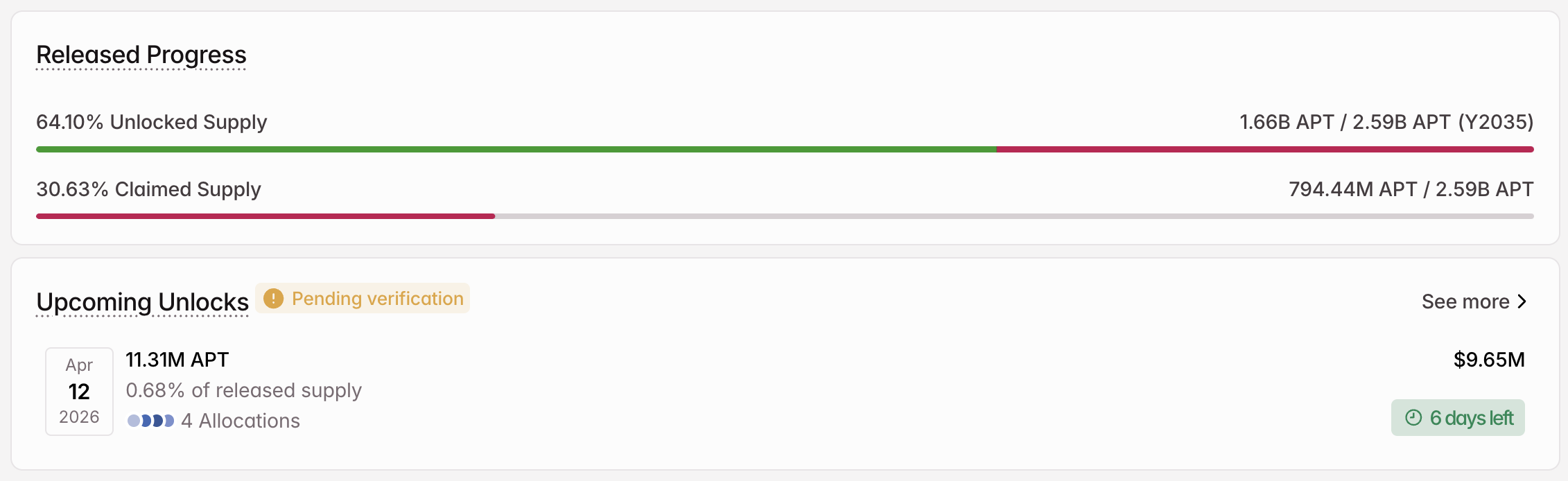
The team will award 3.96 million APT to core contributors. The community and investors will get 3.21 million and 2.81 million tokens, respectively. Additionally, Aptos will allocate 1.33 million tokens to the foundation.
2. Babylon (BABY)
- Unlock Date: April 10
- Number of Tokens to be Unlocked: 612.5 million BABY
- Released Supply: 1.62 billion BABY
- Total supply: 10 billion BABY (Y2035)
Babylon is a decentralized protocol that enables native Bitcoin (BTC) staking to secure Proof-of-Stake blockchains. It turns idle BTC into a productive asset without custodians or bridges. BABY is the native token of the network.
The altcoin serves three core functions: paying transaction fees, participating in on-chain governance, and dual-staking alongside BTC to secure the network.
On April 10, the network will unlock 612.5 million coins. The altcoins are worth $7.56 million. In addition, the unlocked tokens account for 37.77% of the released supply.
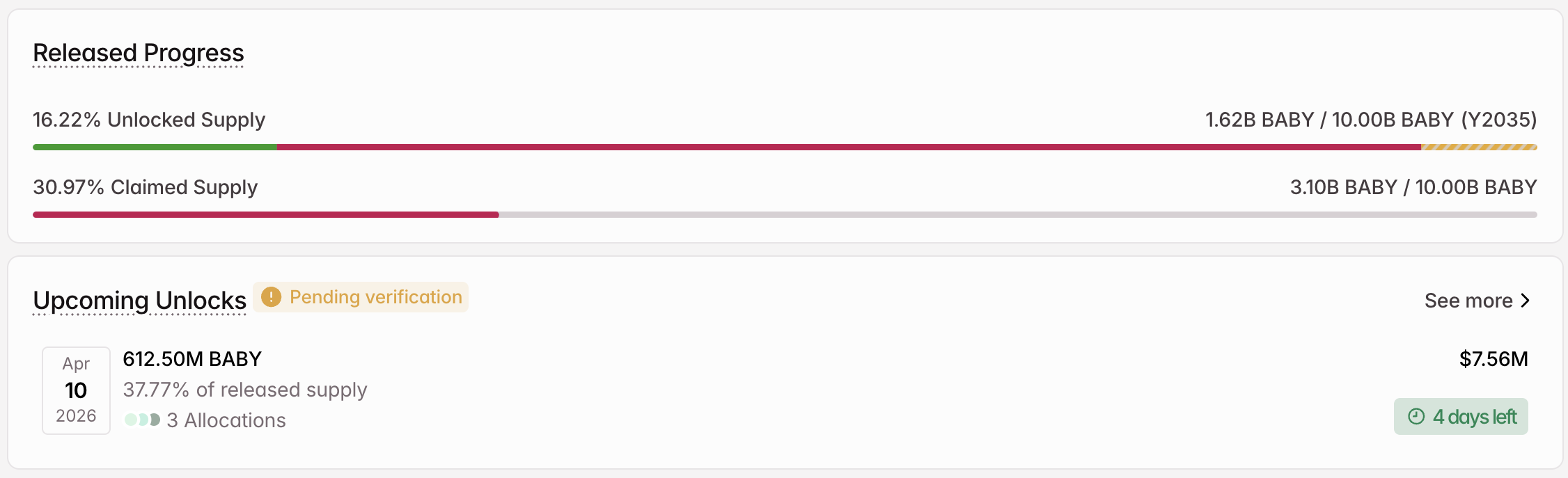
Babylon will split the supply three ways. Early private-round investors will receive 381.25 million tokens. The team will get 187.5 million BABY. Lastly, Babylon will direct 43.75 million tokens to advisors.
3. Linea (LINEA)
- Unlock Date: April 10
- Number of Tokens to be Unlocked: 1.38 billion LINEA
- Released Supply: 25.92 billion LINEA
- Total supply: 72.01 billion LINEA
Linea is a zkEVM Layer-2 scaling solution for Ethereum (ETH). The network provides fast, low-cost transactions while maintaining compatibility with Ethereum tools and security.
The network will unlock 1.38 billion tokens, valued at approximately $4.68 million, on April 10. The upcoming unlock represents 5.32% of the released supply
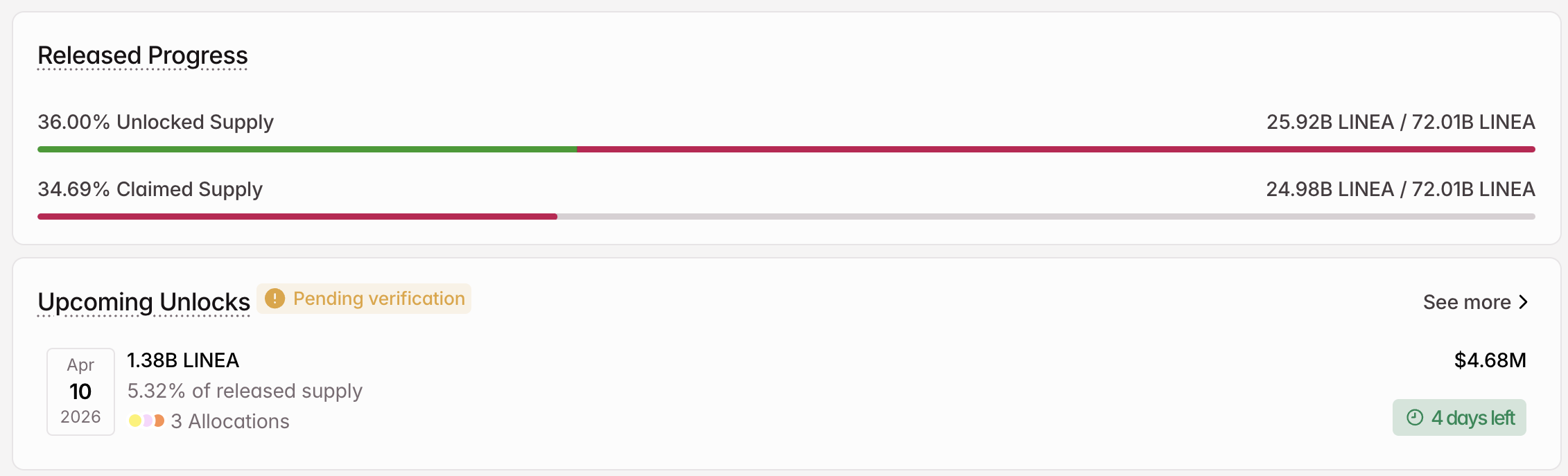
Linea will keep 600.08 million tokens for long-term alignment, and 480.07 million LINEA for Ignition. The team will allocate the remaining 300.04 million tokens for future airdrops.
In addition to these, other prominent unlocks that investors can look out for in the second week of April include RedStone (RED), BounceBit (BB), Movement (MOVE), and more.
The post 3 Token Unlocks to Watch in the Second Week of April 2026 appeared first on BeInCrypto.
Our Staff Predicts the Vikings’ SECOND Draft Pick

#antique #coin #reseller #gold #business #money #jewelry #coincollecting #ytshorts

Fun for all the family at K-Woodlands this Easter


-

 NewsBeat4 days ago
Steven Gerrard disagrees with Gary Neville over ‘shock’ Chelsea and Arsenal claim | Football
-

 Business4 days ago
No Jackpot Winner and $194 Million Prize Rolls Over
-

 Fashion3 days ago
Weekend Open Thread: Spanx – Corporette.com
-
Entertainment7 days ago
Fans slam 'heartbreaking' Barbie Dream Fest convention debacle with 'cardboard cutout' experience
-

 Crypto World5 days ago
Gold Price Prediction: Worst Month in 17 Years fo Save Haven Rock
-

 Business14 hours ago
Three Gulf funds agree to back Paramount’s $81 billion takeover of Warner, WSJ reports
-
Crypto World6 days ago
Dems press CFTC, ethics board on prediction-market insider trades
-

 Sports2 days ago
India men’s 4x400m and mixed 4x100m relay teams register big progress | Other Sports News
-

 Business4 days ago
Login and Checkout Issues Spark Merchant Frustration
-

 Tech7 days ago
Apple will hide your email address from apps and websites, but not cops
-

 Tech6 days ago
EE TV is using AI to help you find something to watch
-

 Sports6 days ago
Tallest college basketball player ever, standing at 7-foot-9, entering transfer portal
-

 Politics7 days ago
Should Trump Be Scared Strait?
-
Tech6 days ago
Daily Deal: StackSkills Premium Annual Pass
-

 Tech6 days ago
Flipsnack and the shift toward motion-first business content with living visuals
-

 Sports7 days ago
Women’s hockey camp eyes fitness boost, tactics ahead of WC 2026 campaign | Other Sports News
-

 Crypto World7 days ago
U.S. rule change may open trillions in 401(k) funds to crypto
-

 Tech6 days ago
How to back up your iPhone & iPad to your Mac before something goes wrong
-

 Politics7 days ago
BBC slammed for ignoring author of The Fraud
-

 Tech7 days ago
This is a 3D-Printed Macintosh That Apple Never Built
You must be logged in to post a comment Login