
Business
IRGC Intelligence Chief Majid Khademi Killed in Israeli Airstrike on Tehran


TEHRAN, Iran — Maj. Gen. Majid Khademi, head of intelligence for Iran’s Islamic Revolutionary Guard Corps, was killed early Monday in an Israeli airstrike on Tehran, Iranian state media and the IRGC announced, marking another major blow to the paramilitary force amid ongoing U.S.-Israeli military operations against Iran.

The IRGC confirmed Khademi’s death in a statement carried by Iranian outlets including Tasnim and Sepah News, describing the incident as a “criminal terrorist attack by the American-Zionist enemy” at dawn. Israeli Defense Minister Israel Katz and the Israel Defense Forces quickly claimed responsibility, with Katz stating the strike eliminated “one of those directly responsible for these war crimes” and one of the three most senior officials in the organization.
Khademi, who assumed the role in June 2025 after his predecessor Brig. Gen. Mohammad Kazemi was killed in earlier Israeli strikes during the initial phase of the 2025-2026 conflict, had served in the IRGC’s intelligence organization for nearly five years. Iranian sources portrayed him as a “powerful and educated” figure central to countering foreign infiltration and protecting the Guard from external threats.
The strike occurred as U.S.-Israeli airstrikes continue to target Iranian military infrastructure more than a month into intensified operations that began in late February 2026. Iranian state media reported explosions in the capital, with the attack focusing on IRGC facilities. No immediate details were released on the exact location within Tehran or whether additional casualties occurred in the strike.
This latest assassination fits a pattern of high-profile targeting of Iranian leadership. Since the escalation, Israel and the U.S. have claimed responsibility for eliminating numerous senior figures, including former Supreme Leader Ayatollah Ali Khamenei, IRGC Commander-in-Chief Hossein Salami, Intelligence Minister Esmail Khatib, National Security Council Secretary Ali Larijani, Basij commander Gholamreza Soleimani and naval commander Alireza Tangsiri. Over 1,000 IRGC and security officials have reportedly been killed in the broader campaign, according to Israeli sources.
Israeli Prime Minister Benjamin Netanyahu hailed the operation, vowing to continue the war “with full force” and stating that Israel would keep hunting down regime leaders responsible for attacks on civilians. “The IRGC fires at civilians – and we eliminate the heads of the terrorists,” Katz added in his confirmation.
Iran has vowed retaliation for each high-profile killing. The IRGC and state officials have accused the U.S. and Israel of seeking regime change through targeted assassinations and infrastructure strikes. Tehran has responded with missile and drone attacks on Israeli targets, as well as reported strikes on Gulf energy sites and other regional assets. Mediators are reportedly pushing a 45-day ceasefire proposal that includes reopening the Strait of Hormuz, a critical waterway for global oil shipments that Iran has threatened to disrupt.
Khademi’s death comes at a sensitive moment for the IRGC, which has seen its command structure repeatedly disrupted. The organization, designated a terrorist group by the U.S. and several allies, oversees Iran’s ballistic missile program, regional proxy militias and internal security apparatus. Intelligence functions under the IRGC have focused on counterintelligence, monitoring perceived domestic threats and supporting overseas operations.
Analysts note that repeated decapitation strikes could impair operational coordination in the short term, though the IRGC’s decentralized structure and deep bench of ideologically committed officers may allow rapid replacements. Iranian officials have repeatedly stated that missile production and defensive capabilities continue despite losses.
The broader conflict erupted after years of shadow warfare, proxy clashes and failed nuclear negotiations. Israel has long viewed Iran’s nuclear program, ballistic missiles and support for groups like Hezbollah, Hamas and the Houthis as existential threats. Tehran accuses Israel and the U.S. of aggression aimed at destabilizing the Islamic Republic.
U.S. involvement has intensified under the current administration, with joint operations targeting Iranian military sites. President Donald Trump has issued strong statements on the conflict, including threats of further escalation if Iran does not agree to terms on its nuclear program and regional behavior.
Casualties on both sides have mounted. Iranian reports emphasize civilian and military deaths from Israeli strikes on cities including Tehran, Isfahan and other provinces. Israel has reported damage from Iranian missile barrages, though its air defenses have intercepted many incoming threats.
International reactions have been divided. Western allies have largely supported Israel’s right to defend itself, while Russia, China and some Global South nations have condemned the strikes as violations of sovereignty. Calls for de-escalation have grown, with diplomatic efforts focusing on preventing a wider regional war that could draw in more actors and disrupt global energy markets.
Within Iran, the deaths of successive leaders have tested public morale and regime stability. State media has framed the fallen officials as martyrs, organizing funerals and rallies to rally support. However, reports of internal discontent and economic strain from sanctions and conflict have surfaced, though heavily censored.
Khademi is the latest in a line of IRGC intelligence leaders targeted. His predecessor Kazemi and deputy were killed in June 2025 strikes on Tehran, part of what Israel described as Operation Rising Lion or similar campaigns aimed at degrading Iran’s capabilities.
Military experts suggest the precision of the latest strike indicates advanced Israeli intelligence and possibly assistance from regional partners or cyber capabilities that enabled real-time targeting in the heart of Tehran. Iran has accused Israel of using infiltrators and advanced weaponry, claims Israel neither confirms nor denies.
As the conflict enters its next phase, questions remain about succession within the IRGC intelligence organization. Iranian media has not yet named a replacement, but the Guard has historically promoted from within to maintain continuity.
The strike also highlights vulnerabilities in Iran’s air defenses despite years of investment in Russian and domestic systems. Repeated successful penetrations of Tehran airspace have raised concerns about the effectiveness of layered protections around key sites and leaders.
For ordinary Iranians, the ongoing war has brought blackouts, fuel shortages and fear of further escalation. Many have fled urban centers or stocked up on essentials amid uncertainty.
Diplomats warn that each high-value target eliminated risks provoking more desperate Iranian responses, potentially including asymmetric attacks through proxies or attempts to close key maritime chokepoints.
Israel maintains that its campaign aims to eliminate threats rather than pursue full regime change, though some officials have spoken more ambitiously about reshaping the regional balance of power.
With no immediate ceasefire in sight despite mediation proposals, the killing of Majid Khademi is likely to intensify the cycle of strikes and counterstrikes. Both sides appear prepared for prolonged confrontation, even as the human and economic costs rise.
The IRGC has pledged that Khademi’s “martyrdom” will not go unanswered, signaling potential new retaliatory actions in the coming days. Israeli officials, meanwhile, have reiterated their commitment to continue operations until strategic objectives are met.
This latest development underscores the high-stakes nature of the U.S.-Israeli campaign against Iran’s military leadership and the challenges of achieving lasting deterrence in one of the world’s most volatile regions.


Franklin Templeton reports $1.68 trillion AUM with $5B inflows
Business
Alphabet Stock Rises Modestly as Analysts Affirm GOOG as Long-Term Buy on AI and Cloud Strength
NEW YORK — Alphabet Inc. shares edged higher Monday, with Class C stock (GOOG) trading near $296.60 after gaining $2.14 or 0.73% in afternoon trading, as Wall Street largely reinforced its bullish long-term outlook despite heavy 2026 capital spending plans for artificial intelligence infrastructure.

The Google parent company’s stock has faced volatility in early 2026, pulling back from peaks near $349 earlier in the year amid concerns over elevated AI-related expenditures. Yet the consensus among more than 40 analysts remains strongly positive, with an average 12-month price target around $345 to $367, implying 16% to 24% upside from current levels near $296. High-end targets reach $420, while the overwhelming majority rate the stock a “Buy” or “Strong Buy.”
Alphabet’s fourth-quarter 2025 results, released in early February 2026, underscored underlying momentum. Revenue climbed 18% to $113.83 billion, beating expectations, while adjusted earnings per share rose to $2.82. Google Cloud delivered standout performance, with revenue surging 48% to $17.7 billion — outpacing some rivals — and the segment’s backlog expanding 55% to $240 billion, signaling robust enterprise demand for AI-powered infrastructure and services.
CEO Sundar Pichai highlighted Gemini model advancements, noting the app had surpassed 750 million monthly active users and that API processing exceeded 10 billion tokens per minute. Search remained a high-margin powerhouse, generating steady advertising revenue that continues to fund ambitious AI bets. YouTube advertising and subscriptions also contributed meaningfully, pushing annual YouTube revenue above $60 billion.
The headline that initially pressured shares was Alphabet’s aggressive 2026 capital expenditure guidance of $175 billion to $185 billion — roughly double the $91.4 billion spent in 2025 and well above prior analyst expectations around $120 billion. Executives framed the surge as essential to scale AI compute capacity, data centers and cloud capabilities to meet exploding customer demand and maintain leadership in the rapidly evolving generative AI landscape.
While the spending outlook sparked short-term investor caution over potential near-term margin compression and free cash flow impacts, many analysts quickly characterized it as a necessary investment in Alphabet’s competitive moat. Google Cloud’s improving profitability and accelerating revenue growth provided early validation that heavy infrastructure outlays can translate into sustainable returns.
Longer-term forecasts remain optimistic. Some projections see the stock reaching $380 by the end of 2026 and climbing significantly higher by 2030, supported by double-digit annual earnings growth. Analysts point to multiple growth levers: continued dominance in global search with roughly 90% market share, expanding AI integration across Search, Workspace and consumer products, and Google Cloud’s emergence as a credible challenger to Amazon Web Services and Microsoft Azure in AI-optimized solutions.
Valuation sits at roughly 25-28 times forward earnings, a premium many argue is justified by Alphabet’s data advantages, vast talent pool and integrated ecosystem spanning hardware, software and infrastructure. The balance sheet remains exceptionally strong, with substantial cash reserves enabling both aggressive investments and shareholder returns via buybacks. The company’s tiny dividend offers modest income alongside growth potential.
Risks include ongoing antitrust litigation, regulatory scrutiny in Europe and elsewhere on advertising and data practices, and intensifying competition in AI from OpenAI, Anthropic, Microsoft and custom chip efforts by hyperscalers. Elevated interest rates or an economic slowdown could also temper advertising budgets, though Alphabet’s diversified revenue mix provides some buffer.
Institutional confidence appears solid, with continued accumulation in options and equity positions. The stock’s role as a core AI trade keeps it prominent in growth-oriented portfolios. For long-term investors, the debate often centers on whether current prices represent a buying opportunity after the year-to-date pullback or if near-term spending cycles warrant caution.
Most Wall Street voices lean bullish. Firms such as J.P. Morgan have maintained “Buy” ratings with targets near $395, citing resilient core advertising, cloud momentum and AI monetization potential. Recent commentary described Alphabet as “still a best idea” for growth investors, noting that heavy capex today positions the company for exponential returns as AI adoption accelerates across enterprises and consumers.
Fiscal first-quarter 2026 results, expected in late April, will be closely watched for updates on cloud acceleration, Gemini adoption metrics, AI feature contributions to Search and any refinements to capex execution or efficiency gains. Commentary on competitive dynamics and regulatory matters will also draw attention.
In the broader context, Alphabet exemplifies the opportunities and trade-offs in the AI era. Its scale allows massive infrastructure bets that smaller players cannot match, while its advertising engine generates the cash flow to sustain those investments. The company’s early integration of generative AI into everyday products positions it to capture new revenue streams as businesses and users increasingly rely on these tools.
Monday’s modest gain reflected renewed buying interest amid broader market optimism over potential geopolitical stabilization and sector rotation. With the Nasdaq also advancing, investors appeared selective in favoring names with clear AI exposure and strong fundamentals like Alphabet.
For retail investors considering a long-term position, the consensus view supports yes — provided a multi-year horizon and tolerance for volatility tied to spending cycles, macro events or regulatory developments. Diversification remains prudent, as even dominant tech names carry execution and competitive risks.
Alphabet’s track record of innovation — from search dominance to Android, YouTube, cloud and now multimodal AI — bolsters the case for adaptability and sustained leadership. With Google Cloud gaining traction and Gemini expanding its reach, many analysts see the company as well-positioned for the next phase of technological transformation.
As trading continued Monday afternoon, GOOG held its gains, underscoring sustained market faith in Alphabet’s strategic direction. Wall Street’s price targets and ratings suggest that for patient investors, the stock remains a compelling long-term opportunity in the digital economy, even as the company navigates the capital-intensive demands of the AI race.

Wolf Report is a senior analyst and private portfolio manager with over 10 years of generating value ideas in European and North American markets.He covers the markets of Scandinavia, Germany, France, UK, Italy, Spain, Portugal and Eastern Europe in search of reasonably valued stock ideas.
Analyst’s Disclosure: I/we have no stock, option or similar derivative position in any of the companies mentioned, and no plans to initiate any such positions within the next 72 hours. I wrote this article myself, and it expresses my own opinions. I am not receiving compensation for it (other than from Seeking Alpha). I have no business relationship with any company whose stock is mentioned in this article.
While this article may sound like financial advice, please observe that the author is not a CFA or in any way licensed to give financial advice. It may be structured as such, but it is not financial advice. Investors are required and expected to do their own due diligence and research prior to any investment.
Short-term trading, options trading/investment and futures trading are potentially extremely risky investment styles. They generally are not appropriate for someone with limited capital, limited investment experience, or a lack of understanding for the necessary risk tolerance involved.
I own the European/Scandinavian tickers (not the ADRs) of all European/Scandinavian companies listed in my articles. I own the Canadian tickers of all Canadian stocks I write about.
Please note that investing in European/Non-US stocks comes with withholding tax risks specific to the company’s domicile as well as your personal situation. Investors should always consult a tax professional as to the overall impact of dividend withholding taxes and ways to mitigate these.
Seeking Alpha’s Disclosure: Past performance is no guarantee of future results. No recommendation or advice is being given as to whether any investment is suitable for a particular investor. Any views or opinions expressed above may not reflect those of Seeking Alpha as a whole. Seeking Alpha is not a licensed securities dealer, broker or US investment adviser or investment bank. Our analysts are third party authors that include both professional investors and individual investors who may not be licensed or certified by any institute or regulatory body.

Mideast Shock Fuels Investing Themes

Financial influencer Taylor Price joins ‘Varney & Co.’ to break down how shifting your mindset can help Americans grow wealth and achieve the American Dream.
Americans are concerned with the rising cost of healthcare along with surging health insurance premiums.
A Gallup poll released last week found that healthcare is the top domestic issue facing Americans among 16 policy areas included in the survey, with 61% saying they worry a great deal about healthcare access and affordability.
Healthcare topping the list of domestic concerns represents a resurgence in the issue’s prominence, as the last time it was the foremost issue in voters’ minds was 2020 – a position it held dating back to 2015. It was roughly tied with the economy in 2025, but now leads by 10 points.
Those findings are similar to those of a recent Fox News poll, which found that 81% of voters are either “extremely” or “very” concerned about healthcare, a figure which trailed only inflation and high prices, while 86% of voters were concerned about inflation and high prices.
OBAMACARE ENROLLMENT FELL BY MORE THAN 1M ENROLLEES FOR 2026
FOX Business’ Gerri Willis reports on a Gallup poll showing 61% of Americans are greatly concerned about rising healthcare costs, surpassing worries about the economy and inflation.
The poll found that healthcare was a concern for a majority of voters across political groups, with 89% of Democrats, 80% of Independents and 72% of Republicans saying they were either “extremely” or “very concerned” about healthcare.
Healthcare concerns were also widespread across age groups: 77% of respondents under age 45 and 83% of those over age 45 were extremely or very concerned about healthcare – views that were shared by 86% of those aged 65 and up.
OBAMACARE PRICES ARE SET TO SPIKE – HERE’S WHY
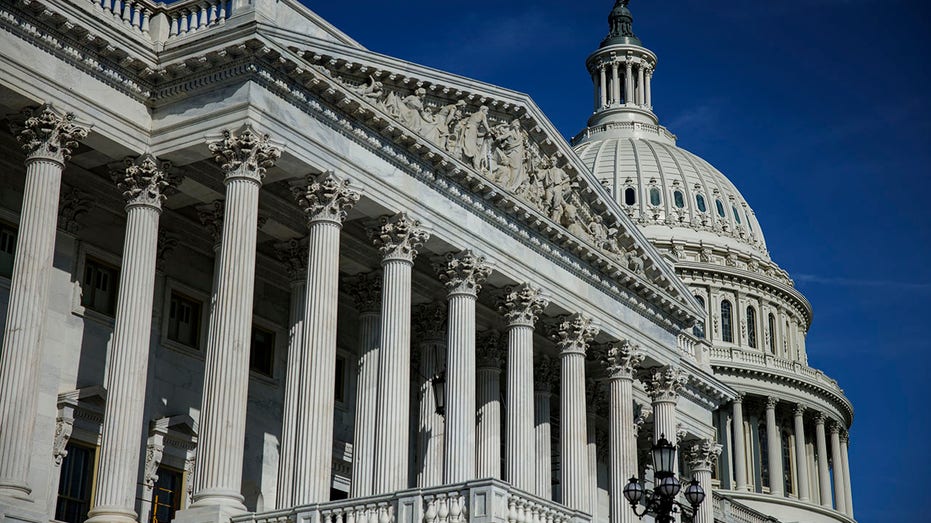
Congress allowed the enhanced premium tax credit to expire at the end of 2025. (Samuel Corum/Getty Images)
American consumers have faced rising health insurance premiums in recent years, with prices jumping this year due to the end of an extra subsidy for consumers.
Health insurance under the Affordable Care Act, also known as Obamacare, is subsidized through a premium tax credit available to lower- and some middle-income households. During the COVID-19 pandemic, Congress added another subsidy on top of the baseline subsidy.
However, the Trump administration and Congress allowed the pandemic-era enhanced subsidy to expire at the end of last year, which has pushed premiums higher.
TREASURY DEPARTMENT ANNOUNCES EXPANDED HSA TAX BENEFITS UNDER TRUMP LAW

Health insurance subsidies are smaller in the 2026 plan year after enhanced premium tax credits were allowed to expire, leaving just the baseline tax credit. (Getty Images)
An analysis by the Kaiser Family Foundation (KFF), a nonprofit group focused on national healthcare policy, estimated last year that the expiration of the enhanced premium tax credits would cause annual out-of-pocket premium payments to rise by over $1,000 this year – jumping 114% from $888 in 2025 to $1,904 in 2026.
Health insurance companies have also been raising premiums for non-Obamacare plans for years, which experts have attributed to higher healthcare costs.
Data from the Centers for Medicare and Medicaid (CMS) shows that consumers have shifted into lower-cost health insurance plans in the 2026 open enrollment period compared with the prior year.
GET FOX BUSINESS ON THE GO BY CLICKING HERE
The CMS data shows that in 2025, 56% of enrollees were in silver tier plans while 30% were in bronze plans. By contrast, the data for 2026 shows 40% of enrollees in bronze plans and 43% in silver. The share of enrollees in gold tier plans also rose from 13% in 2025 to 17% this year.


Long Player believes oil and gas is a boom-bust, cyclical industry. It takes patience, and it certainly helps to have experience. He has been focusing on this industry for years. He is a retired CPA, and holds an MBA and MA.
He leads the investing group Oil & Gas Value Research. He looks for under-followed oil companies and out-of-favor midstream companies that offer compelling opportunities. The group includes an active chat room in which Oil & Gas investors discuss recent information and share ideas. Learn more.
Analyst’s Disclosure: I/we have a beneficial long position in the shares of XOM CVX either through stock ownership, options, or other derivatives. I wrote this article myself, and it expresses my own opinions. I am not receiving compensation for it (other than from Seeking Alpha). I have no business relationship with any company whose stock is mentioned in this article.
Disclaimer: I am not an investment advisor, and this article is not meant to be a recommendation for the purchase or sale of stock. Investors are advised to review all company documents and press releases to see if the company fits its own investment qualifications.
Seeking Alpha’s Disclosure: Past performance is no guarantee of future results. No recommendation or advice is being given as to whether any investment is suitable for a particular investor. Any views or opinions expressed above may not reflect those of Seeking Alpha as a whole. Seeking Alpha is not a licensed securities dealer, broker or US investment adviser or investment bank. Our analysts are third party authors that include both professional investors and individual investors who may not be licensed or certified by any institute or regulatory body.
Business
GameStop Shares Dip Slightly as Ryan Cohen Acquisition Buzz Keeps Meme Stock Volatile in 2026
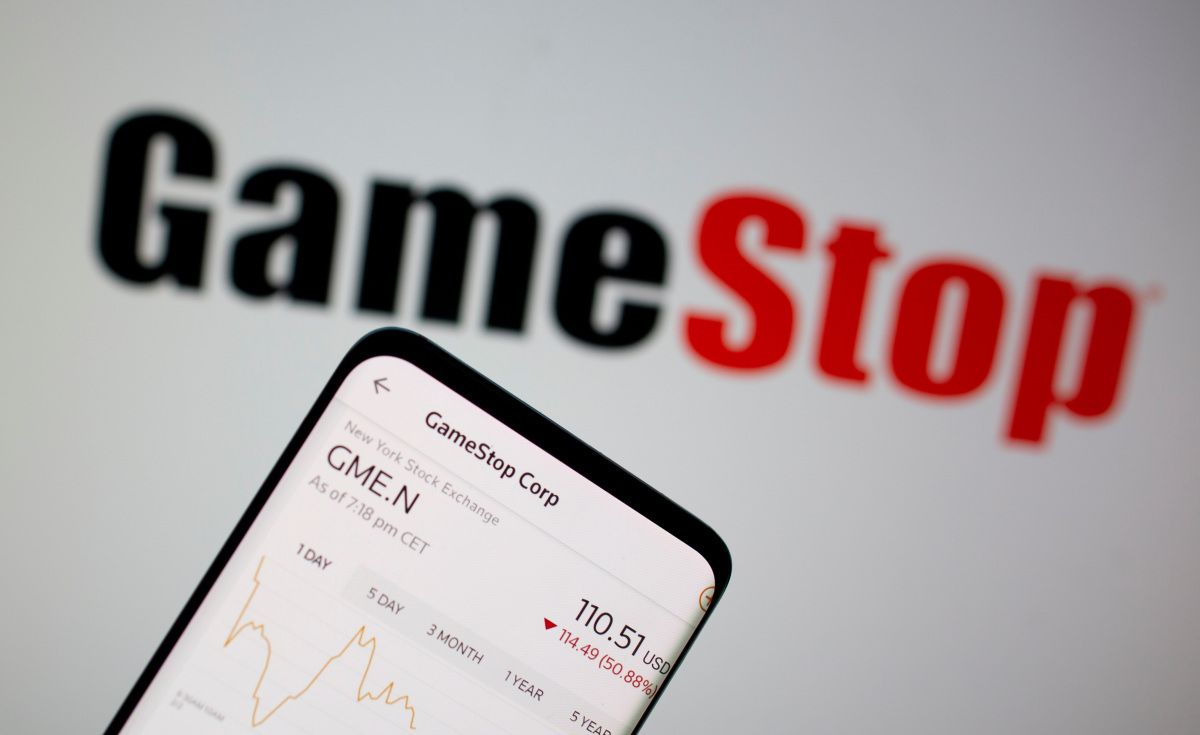
NEW YORK — GameStop Corp. shares traded near $23.12 in afternoon action Monday, down $0.24 or 1.01%, as the video game retailer continued to draw intense investor attention amid speculation over CEO Ryan Cohen’s plans for a major acquisition and the company’s massive cash reserves.

The stock has shown resilience in early 2026, up roughly 15-20% year-to-date despite ongoing declines in core retail sales. Trading remained relatively light on the post-holiday Monday, with volume below recent averages, reflecting the meme stock’s sensitivity to news flow rather than broad market moves.
GameStop’s transformation under Cohen has shifted focus from traditional brick-and-mortar video game sales to a potential holding company model. The company ended fiscal 2025 with a “fortress” balance sheet boasting approximately $8.83 billion in cash and equivalents, providing significant dry powder for strategic moves.
In late March 2026, GameStop reported fourth-quarter and full-year results. Net sales for the fourth quarter fell to $1.104 billion from $1.283 billion a year earlier, missing some expectations. However, gross profit rose 6.4% to $386.8 million, operating income increased to $135.2 million, and adjusted net income showed strength. For the full fiscal year, net income reached $418.4 million compared with $131.3 million previously.
Cohen, who also serves as chairman, has signaled ambitious plans. In interviews, he described pursuing a “very, very, very big” acquisition of a larger consumer or retail company that could prove “transformational.” Analysts and investors speculate the deal could deploy a substantial portion of the cash pile and aim to elevate GameStop’s market value toward $100 billion over time.
The board granted Cohen a landmark performance-based stock option award in January 2026 — entirely “at-risk” compensation tied to ambitious market capitalization targets starting at $20 billion and scaling up to $100 billion. Cohen has put his own capital behind the vision, purchasing additional shares in early 2026, including blocks worth millions at average prices around $21.
Short interest and retail investor enthusiasm remain key drivers of volatility. While the intense 2021 short squeeze has cooled, GME continues to rank among meme stocks with dedicated online followings. Year-to-date performance has outpaced several other former meme names, fueled by acquisition rumors and Cohen’s conviction signals.
Core retail operations face ongoing challenges. Revenue has declined as consumers shift toward digital downloads and new console cycles mature. The company has reduced its physical store footprint while exploring e-commerce, collectibles and potential new ventures. Bitcoin holdings have also been noted as a diversifying asset on the balance sheet.
Wall Street coverage remains limited and mixed. Some analysts maintain “Hold” ratings with price targets near $26, citing the cash hoard and optionality from Cohen’s strategy. Others highlight risks: declining sales trends, execution challenges in any large acquisition, and the stock’s history of sharp swings driven by sentiment rather than fundamentals.
Options activity shows mixed sentiment, with notable interest in both calls and puts reflecting uncertainty over the next catalyst. The 52-week range has spanned roughly $19.93 to $35.81, underscoring persistent volatility.
Supporters view Cohen’s Chewy background and activist roots as assets for reinventing GameStop beyond gaming retail. Critics argue the company risks overpaying in a deal or failing to stem core business erosion while chasing growth. Regulatory notes include a recent FTC settlement related to reporting matters.
As of early April 2026, no specific acquisition target has been confirmed. Cohen has canceled some interviews citing inability to discuss “monumental” plans, adding to speculation. A special shareholder meeting expected around March or April was anticipated to address aspects of the performance award.
For long-term holders from the pre-2021 era, the stock remains dramatically higher than levels a decade ago, though far below 2021 peaks near $86 (split-adjusted). Recent performance has been more measured, with sideways trading punctuated by rumor-driven spikes.
GameStop’s story continues to captivate retail investors on platforms where community sentiment can influence short-term price action. The combination of a strong balance sheet, activist-style leadership and legacy brand keeps it on watchlists despite shrinking traditional revenue.
Looking ahead, investors await any updates on acquisition talks, first-quarter results later in 2026, and progress on strategic initiatives. Cohen’s all-at-risk compensation structure aligns his incentives closely with significant value creation, raising stakes for the coming months.
The broader market environment, including interest rates, consumer spending and tech/AI trends, could indirectly affect any pivot GameStop attempts. For now, the stock trades as a high-conviction, high-risk name where news on Cohen’s “big” plans could trigger sharp moves in either direction.
GameStop, founded in 1984 and headquartered in Grapevine, Texas, operates hundreds of stores across the U.S. and internationally, selling video games, consoles, accessories and collectibles. Under Cohen since 2021, it has raised capital, strengthened its balance sheet and reduced debt while exploring diversification.
Monday’s modest decline occurred against a backdrop of broader market caution, with the S&P 500 showing limited movement. GME’s price action remains largely detached from traditional retail metrics, driven instead by narrative and anticipation.
As April trading continues, all eyes remain on Grapevine for the next chapter in GameStop’s evolution from meme stock darling to potential diversified powerhouse — or the risks that come with such ambition.


Terry Chrisomalis is a private investor in the Biotech sector with years of experience utilizing his Applied Science background to generate long term value from Healthcare. He is the author of the investing group Biotech Analysis Central which contains a library of 600+ Biotech investing articles, a model portfolio of 10+ small and mid-cap stocks with deep analysis for each, live chat, and a range of analysis and news reports to help Healthcare investors make informed decisions.
Analyst’s Disclosure: I/we have no stock, option or similar derivative position in any of the companies mentioned, and no plans to initiate any such positions within the next 72 hours. I wrote this article myself, and it expresses my own opinions. I am not receiving compensation for it (other than from Seeking Alpha). I have no business relationship with any company whose stock is mentioned in this article.
Seeking Alpha’s Disclosure: Past performance is no guarantee of future results. No recommendation or advice is being given as to whether any investment is suitable for a particular investor. Any views or opinions expressed above may not reflect those of Seeking Alpha as a whole. Seeking Alpha is not a licensed securities dealer, broker or US investment adviser or investment bank. Our analysts are third party authors that include both professional investors and individual investors who may not be licensed or certified by any institute or regulatory body.

Other writing on Substack: https://yieldstrategies.substack.com/I am currently focused on income investing through either common shares, preferred shares, or bonds. I will occasionally break away and write about the economy at large or a special situation involving a company I’ve been researching in. I target two articles per week for publication on Monday and Tuesday.About My Background: Bachelors in history/political science, Masters in Business Administration with a specialization in Finance and Economics. I enjoy numbers. I have been investing since 2000. Professionally, I am the CEO of an independent living retirement community in Illinois.
Analyst’s Disclosure: I/we have no stock, option or similar derivative position in any of the companies mentioned, and no plans to initiate any such positions within the next 72 hours. I wrote this article myself, and it expresses my own opinions. I am not receiving compensation for it (other than from Seeking Alpha). I have no business relationship with any company whose stock is mentioned in this article.
Seeking Alpha’s Disclosure: Past performance is no guarantee of future results. No recommendation or advice is being given as to whether any investment is suitable for a particular investor. Any views or opinions expressed above may not reflect those of Seeking Alpha as a whole. Seeking Alpha is not a licensed securities dealer, broker or US investment adviser or investment bank. Our analysts are third party authors that include both professional investors and individual investors who may not be licensed or certified by any institute or regulatory body.

CBS to sell late-night hours to Byron Allen as Colbert show ends

19 Injured at Louisiana Parade After Driver Plows Into Crowd

Ripple XRP News – SWIFT JUST HANDED RIPPLE THE KEYS TO 11,500 BANKS!!!

Ancestry digitises 16 million historical Yorkshire records


-

 NewsBeat4 days ago
Steven Gerrard disagrees with Gary Neville over ‘shock’ Chelsea and Arsenal claim | Football
-

 Business4 days ago
No Jackpot Winner and $194 Million Prize Rolls Over
-

 Fashion3 days ago
Weekend Open Thread: Spanx – Corporette.com
-

 Crypto World5 days ago
Gold Price Prediction: Worst Month in 17 Years fo Save Haven Rock
-

 Business21 hours ago
Three Gulf funds agree to back Paramount’s $81 billion takeover of Warner, WSJ reports
-
Crypto World6 days ago
Dems press CFTC, ethics board on prediction-market insider trades
-

 Sports2 days ago
India men’s 4x400m and mixed 4x100m relay teams register big progress | Other Sports News
-

 Business5 days ago
Login and Checkout Issues Spark Merchant Frustration
-

 Tech7 days ago
EE TV is using AI to help you find something to watch
-

 Sports6 days ago
Tallest college basketball player ever, standing at 7-foot-9, entering transfer portal
-
Tech7 days ago
Daily Deal: StackSkills Premium Annual Pass
-

 Tech7 days ago
Flipsnack and the shift toward motion-first business content with living visuals
-

 Sports7 days ago
Women’s hockey camp eyes fitness boost, tactics ahead of WC 2026 campaign | Other Sports News
-

 Crypto World7 days ago
U.S. rule change may open trillions in 401(k) funds to crypto
-

 Tech6 days ago
How to back up your iPhone & iPad to your Mac before something goes wrong
-

 Politics7 days ago
Usha Vance: Disney Hats Over MAGA Caps?
-
Crypto World7 days ago
Valinor raises $25m to put private credit on-chain
-

 Business7 days ago
Functional benefits brewing in coffee innovation
-

 Tech7 days ago
What Are The Biggest Limitations Of Supercomputers?
-

 Crypto World6 days ago
Bitcoin enters the public bond market as Moody’s gives a first-of-its-kind crypto deal a rating
You must be logged in to post a comment Login