
Crypto World
XRP Price Prediction: XRP Price After Ripple Signs Mastercard While Whales Invest Heavy In Pepeto Now

Ripple just locked in a deal with Mastercard, and XRP barely moved. The token sits at $1.35, down 64% from its $3.65 high, while the xrp price prediction crowd waits for a bounce that keeps stalling at the same ceiling.
That gap between what Ripple does behind the scenes and what XRP holders actually see in their wallets is the question that makes you rethink where the real returns come from.
There is another project that is currently attracting huge whale capital, Pepeto pulled in $8.84M faster than any meme token this year, and the xrp price prediction numbers show exactly why money keeps moving into this presale instead.
Ripple signed a deal with Mastercard to bring cross-border payment tools to the card giant’s network, as Motley Fool reported on April 3. XRP jumped to $1.37 on the news and gave it all back within days.
24/7 Wall Street reports XRP ETFs lost $31 million in March while total assets dropped from $1.24 billion to $947 million. XRP trades at $1.35 on April 6 according to CoinMarketCap, down 64% from $3.65 with Fear and Greed at 13. The big names signed the deals. The xrp price prediction still has not followed.
Where the XRP Outlook and the Pepeto Presale Tell Two Different Stories
Pepeto: The Play That XRP’s Market Cap Cannot Give You
The xrp price prediction talk keeps holders glued to whether $1.30 holds or cracks, but Pepeto is where the whale wallets hunting for big multiples are sending money right now, and the tools behind the presale make the reason obvious.
What would XRP look like if zero-fee trading was baked into the token instead of relying on outside partners? Pepeto closes that gap. PepetoSwap runs every swap at zero cost so your buy price stays clean, and the token scanner reads each contract before you commit so the danger hits your screen before it hits your bag.
Think about holding XRP before the SEC case ended in August 2025, when it traded under $0.50 and nobody thought it would clear. The wallets that stacked during that panic turned small buys into a 7x within months. Every holder who caught that move says the same thing: they nearly walked away and they wish they had bought more.
Pepeto sits in that exact kind of moment today. Over $8.84M pulled in at $0.0000001862 during Fear and Greed at 13, built by the Pepe cofounder with an ex-Binance dev lead who put the exchange together, and every contract cleared by SolidProof before the first dollar went in. Staking at 187% APY grows your bag while the listing gets closer. The big wallets loading this presale watched XRP levels before the ruling dropped, and they can see what the Binance listing does to this kind of entry.
XRP Price Prediction: Where Does XRP Go From $1.35?
XRP trades at $1.35 on April 6, sitting 64% under its $3.65 peak even after the SEC commodity tag and a new Mastercard partnership according to CoinMarketCap.
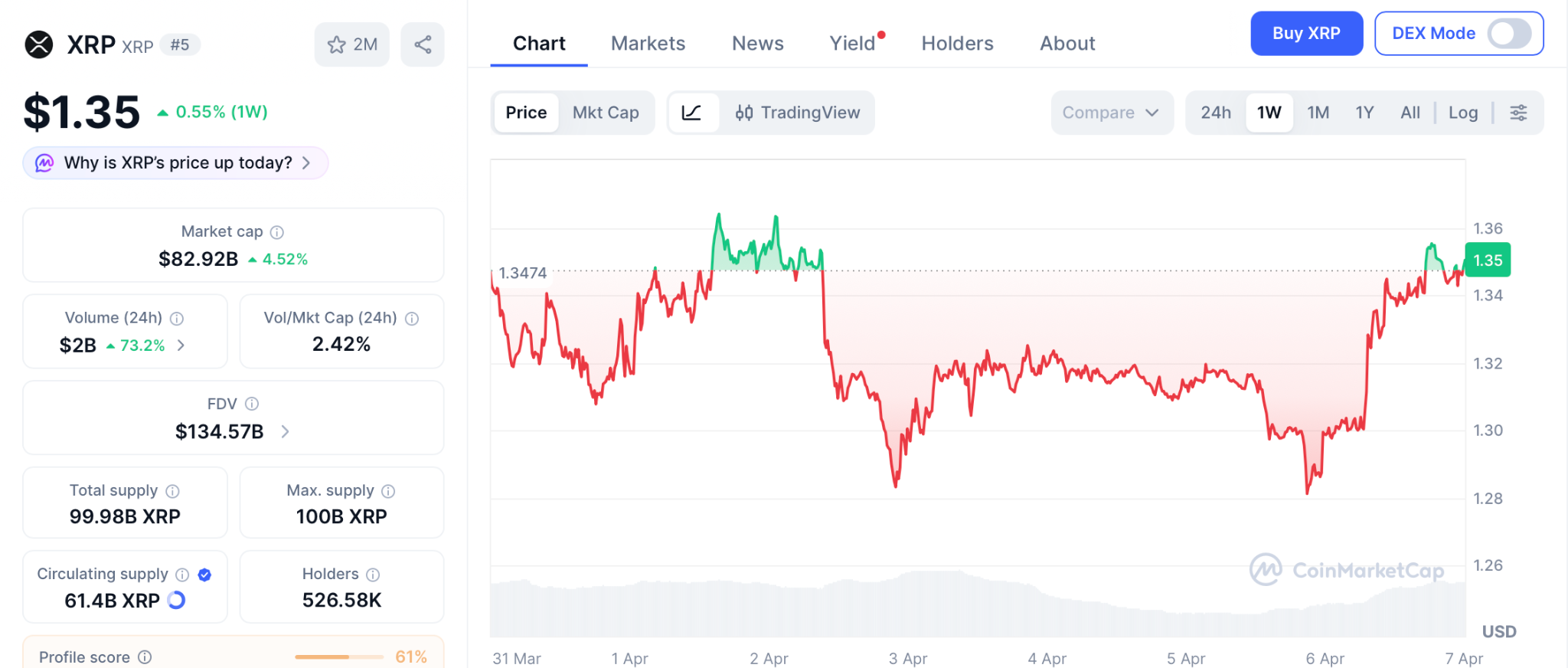
Standard Chartered dropped its target from $8 down to $2.80. The $1.28 floor has held every dip, with 24/7 Wall Street reporting heavy buying at that zone. The 50-day moving average at $1.38 acts as the first cap. Clearing it opens $1.60 and then a shot at $2.80. Losing $1.28 drops the path toward $1.11.
The xrp price prediction reality from an $82 billion market cap means even a 3x takes the kind of new money that arrives over quarters, and that limit is why wallets keep turning to presale plays where a single listing hands you what XRP takes years to produce.
Conclusion
The xrp price prediction and Ripple’s Mastercard deal both tell you the same thing: a token with an $82 billion cap where every rally hits a wall of sellers cannot hand you the kind of gains that reshape your future, and Pepeto is where the numbers still add up.
The XRP holders who stacked under $0.50 before the SEC ruling all repeat the same line: they nearly passed and they wish they had gone heavier. That pattern is now playing out with Pepeto at $8.84M raised during Fear 13 and a Binance listing ahead.
The Pepeto official website still has presale pricing live, and buying while fear keeps the crowd away is exactly what those early XRP wallets did to build what they have now. Passing on this presale could be the one choice you think about for the rest of the cycle.
Click To Visit Pepeto Website To Enter The Presale

FAQs
What xrp price prediction levels matter after the Mastercard deal?
Support holds at $1.28 with the 50-day moving average at $1.38 as the nearest cap and $1.60 above that. Pepeto at $0.0000001862 offers presale pricing with a Binance listing closing in through the Pepeto official website.
Can the xrp price prediction match the returns Pepeto presale holders expect?
XRP needs years for a 3x from its $82 billion cap. Pepeto reaches those multiples in one listing event from current presale pricing at $0.0000001862 with 187% APY staking adding to positions daily.
Disclaimer: This is a Press Release provided by a third party who is responsible for the content. Please conduct your own research before taking any action based on the content.



South Korea’s financial regulator has ordered all crypto exchanges to verify user asset balances every five minutes, following a massive overpayment incident that shook market confidence earlier this year.
One botched reward payout exposed systemic cracks across the entire industry.
What Triggered the Rules
In February, Bithumb accidentally sent 2,000 BTC per person instead of 2,000 Korean won ($1.40) during a promotional event. The error amounted to roughly $42 billion in misallocated crypto. The Financial Services Commission (FSC) launched emergency inspections across all five major Korean exchanges immediately after. What they found went far beyond a single human mistake.
Most exchanges were only reconciling their books once every 24 hours. Three had no automatic kill switch to halt trading when discrepancies appeared. Four lacked multi-step approval systems for high-risk manual transactions. Two exchanges hadn’t even separated their general accounts from high-risk transaction accounts — a basic safeguard.
What Exchanges Must Now Do
The FSC announced a three-pillar reform package on April 6. Exchanges must run automated balance checks every five minutes, with alerts and automatic trading halts triggered by major mismatches. Monthly external audits replace the previous quarterly schedule, and public disclosures must now include asset-by-asset blockchain holdings rather than a simple coverage ratio.
For manual, high-risk transactions such as event payouts, exchanges must use separate accounts, deploy validity-check systems that automatically reject mismatched inputs, and require cross-verification by a third party before execution.
The FSC will also require exchanges to appoint dedicated risk management officers and establish risk management committees — standards already expected of traditional financial firms. Compliance checks move from annual to twice-yearly, with results reported to regulators.
DAXA, the industry body, will complete self-regulatory amendments this month, with systems built out by May. Key provisions will feed into Korea’s forthcoming second-phase Digital Asset Act.
The post Every 5 Minutes: Korea’s New Rule for Crypto Exchanges appeared first on BeInCrypto.
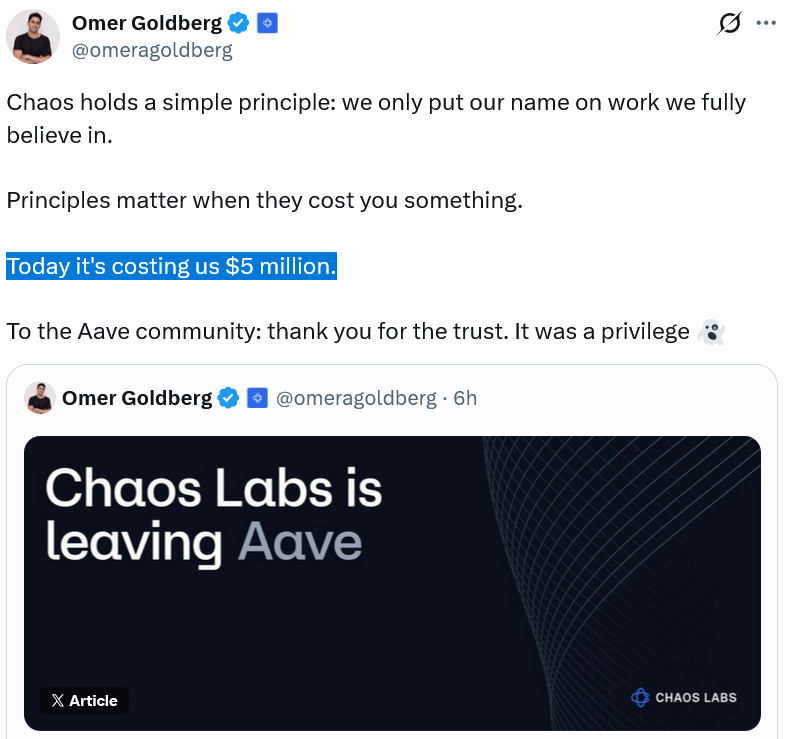
Chaos Labs has parted ways with the Aave ecosystem after serving as the crypto lending protocol’s main risk service provider for three years, citing a budget dispute and disagreements over how Aave should manage risk.
“This decision was not made in haste,” Chaos Labs founder Omer Goldberg said in a post to X on Monday. “We worked in good faith with DAO contributors. Aave Labs was professional and supported increasing our budget to $5m to retain us. However, we are leaving because the engagement no longer reflects how we believe risk should be managed.”

Aave Labs CEO Stani Kulechov said that Chaos didn’t depart on bad terms, but claimed that Chaos pitched a proposal seeking to become the sole risk provider and thus force out other partners — a compromise Aave wasn’t willing to accept.
Chaos played a key role in Aave’s back-end infrastructure, from pricing loans and managing risk in the Aave V2 and V3 markets since November 2022, during which Aave’s total value locked rose fivefold to $26 billion.
Risk has been a major talking point in the Aave community after a user lost $50 million in a trade while interacting with Aave’s interface on March 12. The following week, Aave said it would introduce an “Aave Shield” protection feature to deter users from high-risk trades.
As for Chaos’ departure, Goldberg said there became an increasing misalignment over how the parties thought risk should be managed. He noted that some Aave contributors had left, raising its workload, while also arguing that Aave V4’s expanded functionality introduced additional operational and legal risks that fell on Chaos’ shoulders.
“While Aave Labs is optimistic about a swift migration to V4, history suggests these transitions take months and even years,” Goldberg said. “Until V4 fully absorbs V3’s markets and liquidity, both systems need to be operated and managed simultaneously. The workload during the transition doesn’t halve. It doubles.”
Weighing the risk of a protocol failure, Goldberg said, “There is no regulatory framework, no safe harbor, and no settled law that answers the question of what a risk manager or curator owes when a protocol fails. If things work, the work is invisible. If things break, the blame is not.”
As such, “We are walking away from a $5 million engagement,” Goldberg said.
Chaos wanted Aave to boot LlamaRisk, Chainlink: Kulechov
Aave Labs CEO Stani Kulechov told a slightly different story, stating that Chaos wanted to be the sole risk manager and use its price oracles instead of Chainlink’s.
Following that request would have forced Aave to push out its other risk protocol partner, LlamaRisk, and thus abandon its two-layer economic risk model.
Related: DeFi lender Aave launches on OKX’s Ethereum L2, X Layer
Kulechov added Aave was unwilling to integrate Chaos-built price oracles, citing Aave’s “track record” with Chainlink’s services, which its “users are currently more comfortable with at scale.”
He also said Chaos was already “exploring winding down its risk consultancy services,” and that Aave had offered to double its payment to $5 million to retain them.
Cointelegraph reached out to Chaos Labs for comment.
Kulechov noted that Chaos’ departure hasn’t disrupted the Aave protocol, its smart contracts, token listings or network integrations.
Moving forward, Aave said it “will work closely with LlamaRisk to ensure a smooth transition” and maintain its two-layer economic risk model.

Chaos’ departure comes amid a protocol-wide feud over how much funding and revenue control Aave Labs should receive versus Aave’s decentralized autonomous organization.
Despite the internal issues, Aave crossed the $1 trillion mark in cumulative lending volume in late February, marking a first in the DeFi industry.
Magazine: Animoca teams up with Ava Labs, Shrapnel on Steam: Web3 Gamer
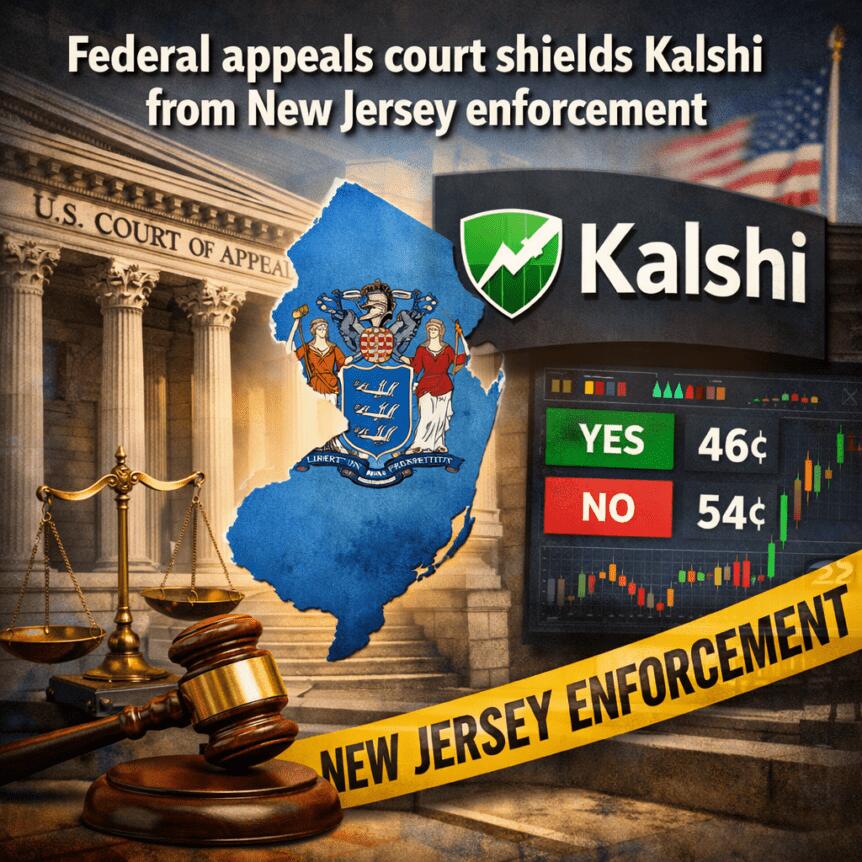
A U.S. Court of Appeals for the Third Circuit handed Kalshi, a prediction‑market platform, a notable victory by ruling 2-1 against New Jersey’s enforcement action over the company’s sports‑event contracts. The decision reinforces Kalshi’s argument that federal commodities law preempts state gambling statutes, potentially setting up a clash that could reach the Supreme Court and redefine how prediction markets are regulated in the United States.
The appellate panel affirmed a lower court finding that Kalshi operates as a designated contract market under the exclusive jurisdiction of the Commodity Futures Trading Commission (CFTC). In practical terms, the court suggested that allowing state authorities to police Kalshi’s products would interfere with federal oversight and create a patchwork regulatory regime that Congress aimed to replace with centralized federal authority.
“Allowing New Jersey to enforce its gambling laws and state constitution would create an obstacle to executing the Act because such state enforcement would prohibit Kalshi, which operates a licensed designated contract market under the exclusive jurisdiction of the CFTC, from offering its sports-related event contracts in New Jersey,” wrote Circuit Judge David J. Porter. “This state regulation is exactly the patchwork that Congress replaced wholecloth by creating the CFTC.”
The ruling arrived amid ongoing friction at the state level around prediction markets and sports betting. Just days earlier, a Nevada judge extended Kalshi’s ban on offering event‑based contracts, underscoring how state actions can diverge from federal strategy. The divergent state rulings have spurred debate about whether the Supreme Court should step in to clarify the authority boundaries between state gaming regulators and federal market overseers, particularly after the high court’s 2018 decision that opened the door for states to legalize and regulate sports betting.
In a dissent attached to the Third Circuit opinion, Circuit Judge Jane Roth warned that the majority’s framework could obscure the central question: whether sports‑event contracts are swaps and thus fall under federal regulation. Roth described Kalshi’s actions as a “performative sleight” aimed at masking the fact that Kalshi’s products function similarly to traditional sports gambling, suggesting the decision could have sweeping implications that deserve closer scrutiny.
Key takeaways
- The Third Circuit ruling in Kalshi’s favor reinforces federal preemption of state gambling laws where prediction-market contracts are concerned, upholding CFTC’s exclusive jurisdiction over such products.
- A timely dissent warns that the decision might oversimplify a complex overlap between swap regulation and sports betting, signaling potential future court battles.
- The decision lands against a backdrop of ongoing state actions, including a Nevada extension of Kalshi’s ban on event‑based contracts, illustrating a fragmented regulatory landscape.
- Following the ruling, the CFTC has continued to push its interpretation of authority, signaling a broader regulatory push that could influence the trajectory of prediction markets nationwide.
- The evolving legal framework may eventually force a clarifying ruling from the Supreme Court, with broad implications for platforms, users, and developers in the prediction‑market ecosystem.
Regulatory momentum and what it means for markets
At the center of the dispute is the CFTC’s stance that its jurisdiction over “swaps” and related contracts extends to sports and other event-based products offered on platforms like Kalshi. CFTC Chair Michael Selig has positioned prediction markets as a core priority since assuming the role, arguing that the agency’s jurisdiction is broad enough to cover event contracts tied to sports, politics, agriculture, and beyond. In recent months, Selig has opened a proposed rulemaking process to public comment and filed an amicus brief in a Ninth Circuit case connected to state gaming authorities, underscoring the agency’s willingness to push a federal approach to regulation.
Public remarks from Selig emphasize a view of regulation that focuses on the nature of contracts rather than the specific topic. “Our definition of commodity and statute is very broad,” he said at a policy summit, noting that the framework encompasses a wide array of event contracts—from sports to elections and commodities like grains. He also highlighted that regulators seek to carve out exceptions for contracts that are readily susceptible to manipulation, signaling a nuanced approach to what qualifies as a permissible prediction market product.
The CFTC’s posture has included legal action aimed at curbing what it sees as unlawful attempts by states to regulate prediction markets. The agency has pursued litigation against several states and authorities that it argues are overstepping or attempting to regulate these markets outside federal boundaries. The combined legal pressure from the CFTC—alongside the Third Circuit ruling in Kalshi’s favor—illustrates a broader strategic push to define a single federal framework for prediction markets in the U.S. economy.
What’s next for Kalshi and the broader ecosystem
Kalshi’s victory in the Third Circuit strengthens the platform as it navigates a challenging regulatory environment. Yet the path forward remains unsettled. State authorities remain active on this issue, and others could join the fray as more cases unfold and regulators refine their positions. The Nevada extension of Kalshi’s ban, in particular, serves as a reminder that state-level actions can persist alongside federal efforts, potentially creating a multi-front regulatory dynamic that platforms must navigate.
For investors, traders, and developers following Kalshi and prediction markets, the key questions revolve around regulatory clarity and market access. If the Supreme Court ultimately weighs in, the decision could set a nationwide precedent on whether federal law preempts state gambling regulations for prediction markets and how such markets should be supervised. In the meantime, market participants should monitor both federal regulatory developments—especially any new rulemakings from the CFTC—and state court outcomes, as these will shape product design, licensing strategies, and user protections across platforms.
Kalshi’s leadership has framed the Third Circuit decision as a major win for the industry and its millions of users. As the legal battle unfolds, the industry will be watching how a potential Supreme Court review could recalibrate the balance between state innovation and federal oversight in the fast-evolving world of prediction markets.
Readers should keep an eye on forthcoming court dockets and regulatory updates, as the next few months could yield important milestones that either reinforce the federal framework or push the conversation toward a broader reexamination of how prediction markets are regulated in the United States.
The crypto news today is turning bullish fast. Polygon now processes $730 billion in yearly stablecoin volume and just locked in Mastercard for on-chain payments, but even that kind of adoption only delivers small gains from a token sitting near its all-time low. TAO gained over 100% in March as money rotated into AI plays.
The name showing up everywhere right now is Pepeto, where a full exchange runs live with a Binance listing on the way, and $8.8 million in presale capital keeps growing. Forecasters point to 100x once trading opens, and the tools are already working for everyone who got in early.
Jack Dorsey’s Block launched BTCday on April 6, a Bitcoin faucet that gives away free BTC to new users as a way to push adoption across its Bitkey and Cash App products according to CoinDesk. Block already holds 8,883 BTC worth $594 million on its balance sheet.
When a company sitting on $594 million in Bitcoin starts giving it away to onboard new users, the bullish signal is impossible to miss. Money is flowing toward crypto projects that actually work, and the ones still at presale pricing are where the biggest gains in every cycle get made.
Top Crypto News Today Tokens: Pepeto, Polygon, and TAO Compared
Pepeto: The Live Exchange Driving 100x in the Crypto News Today Spotlight
Block is giving away free Bitcoin because adoption is the game now, and the projects that already have working tools are the ones that catch the wave. Pepeto runs a full exchange where traders swap, bridge, and screen tokens at zero cost, and that kind of daily utility is why forecasters tag it as a 100x entry and the hottest presale of the cycle.
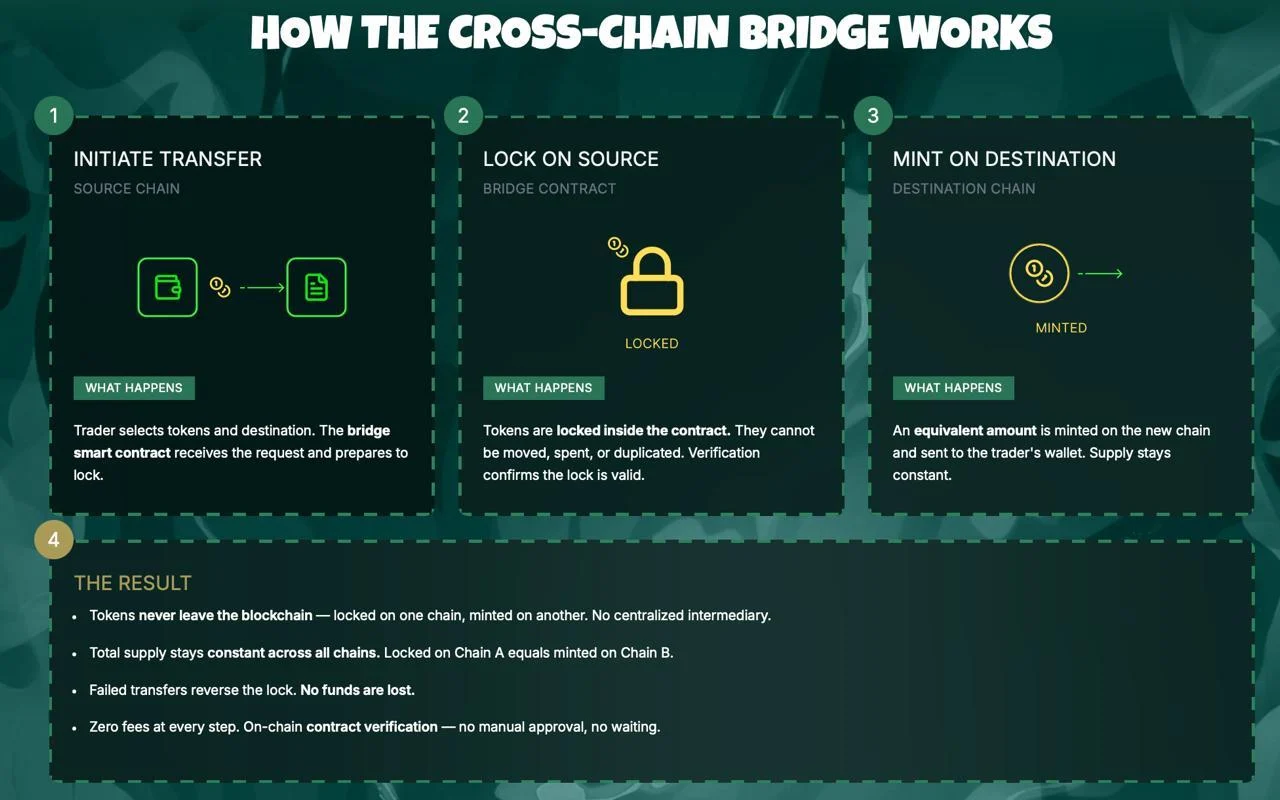
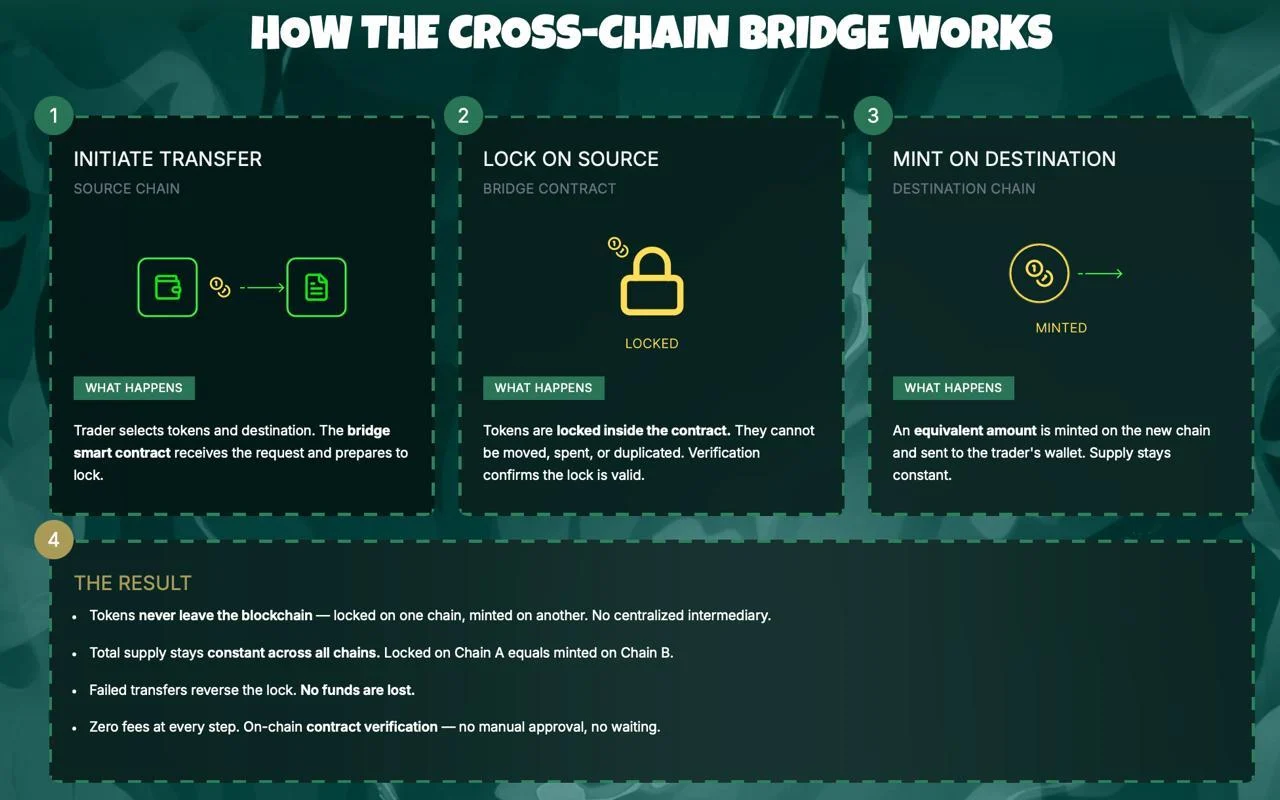
Every trade on PepetoSwap costs zero, every cross-chain transfer through the bridge arrives at full value across Ethereum, BNB Chain, and Solana, and the contract screener grades every token before your wallet touches it, catching the traps that drain portfolios during volatile stretches.
The Pepe cofounder who built an $11 billion token with zero products behind it designed this exchange with a Binance veteran, and SolidProof audited every contract before the presale opened. Staking at 187% APY compounds holdings daily as listing day approaches.
At $0.0000001862 with $8.8 million raised during extreme fear, forecasters target 100x because a functioning exchange from the Pepe founder with a confirmed Binance listing is a setup this cycle has only produced once. Every wallet inside before listing day banks what latecomers spend a multiple to get after trading opens.
Polygon (POL): Polygon Handles $730B in Stablecoin Volume but Returns Stay Modest
POL trades at $0.092 per CoinMarketCap, sitting near its all-time low as Mastercard integrates Polygon for on-chain payments and the Gigagas roadmap targets 100,000 transactions per second.
At a sub-billion market cap, a recovery toward $0.20 gives roughly 2x over months. Solid infrastructure with big-name partnerships, but presale exchanges with confirmed listings are where 100x math actually works.
Bittensor (TAO): TAO Rallied 100% in March but the Big Multiples Are Behind It
TAO trades near $320 per CoinMarketCap, up over 100% in March as AI capital poured in. Grayscale filed for a Bittensor Trust, and targets reach $700, a solid 2x from here.
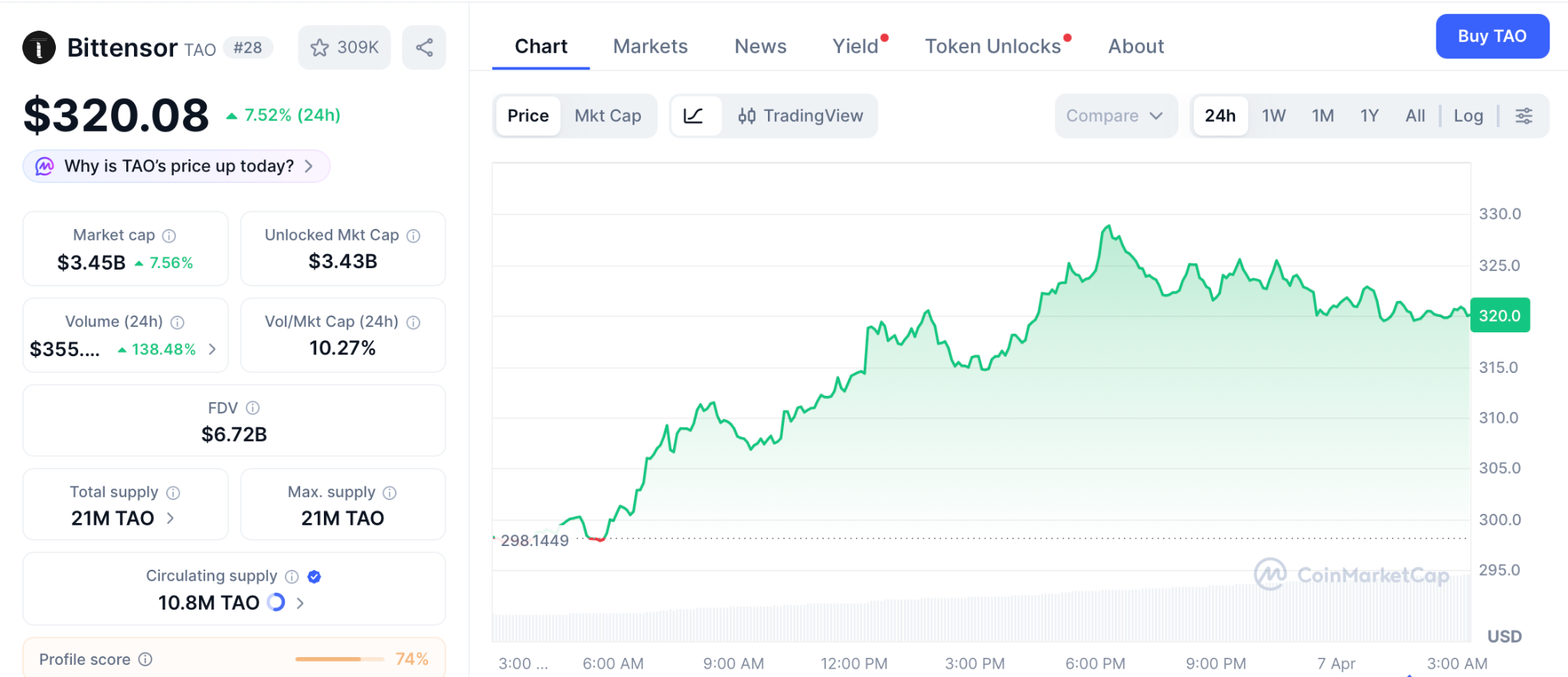
Strong AI growth, but the presale gap is where cycle-defining multiples get made. Pepeto offers the math that TAO at a $3 billion cap will not produce from this level.
Conclusion
Block just started giving away Bitcoin to push adoption, Polygon just locked in Mastercard, and TAO just landed a Grayscale filing. The crypto news today is bullish across the board, but the investors who turned $1,000 into six figures on early AAVE or early Pepe all did the same thing: they found a working project at presale pricing and moved before the listing changed the math.
The Pepeto official website is where the presale is still open. Get in before the Binance listing reprices everything, because projects that combine meme momentum, live tools, and a confirmed listing never stay at ground floor pricing once trading begins.
Click To Visit Pepeto Website To Enter The Presale

FAQs
What is the strongest pick in the crypto news today for 100x returns in 2026?
Pepeto is the strongest 100x pick in the crypto news today because it runs a live zero-fee exchange with a contract screener, a cross-chain bridge, and a confirmed Binance listing, all audited by SolidProof. The presale sits at $0.0000001862 with $8.8 million raised while Polygon and TAO offer under 2x from their current caps.
Why does the crypto news today point to Pepeto over Polygon and TAO for growth?
Pepeto delivers presale-to-listing distance that Polygon at $0.092 and TAO at $320 cannot produce from their existing valuations. The Pepe founder’s $11 billion track record, 187% APY staking, and a Binance listing on a confirmed timeline make it the highest-upside entry covered in the crypto news today.
Disclaimer: This is a Press Release provided by a third party who is responsible for the content. Please conduct your own research before taking any action based on the content.
Zcash price has rallied over 20% in the past month, surpassing the $250 mark. Is the token set for higher gains as it has confirmed a bullish setup, while adoption for its shielded transactions continues to expand across the ecosystem?
Summary
- Zcash price rose over 20% in a month, crossing $250 amid rising demand for shielded transactions.
- Zcash Open Development Lab secured $25 million in funding from Paradigm and a16z crypto to expand ecosystem tools.
- Shielded pool holdings hit a record $5.17 billion, signaling increased adoption of Zcash’s privacy features.
Zcash (ZEC) price rallied due to multiple fundamental and technical drivers that converged to create a perfect storm for the asset.
Zcash rallied as it secured fresh backing from institutions. Notably, the Zcash Open Development Lab, a key contributor to the network’s development, announced securing over $25 million in seed funding from venture firms including Paradigm and a16z crypto on March 27, 2026. The funding will support the development of the Zodl wallet alongside other privacy-focused financial tools on the Zcash ecosystem.
Additionally, the total amount of ZEC held in shielded pools has hit a new record high of $5.17 billion at press time, a figure that equals over 31% of the total circulating supply.
A jump in shielded liquidity suggests that a greater number of holders are now using the core privacy features of Zcash, which translates to genuine utility and more demand for the token.
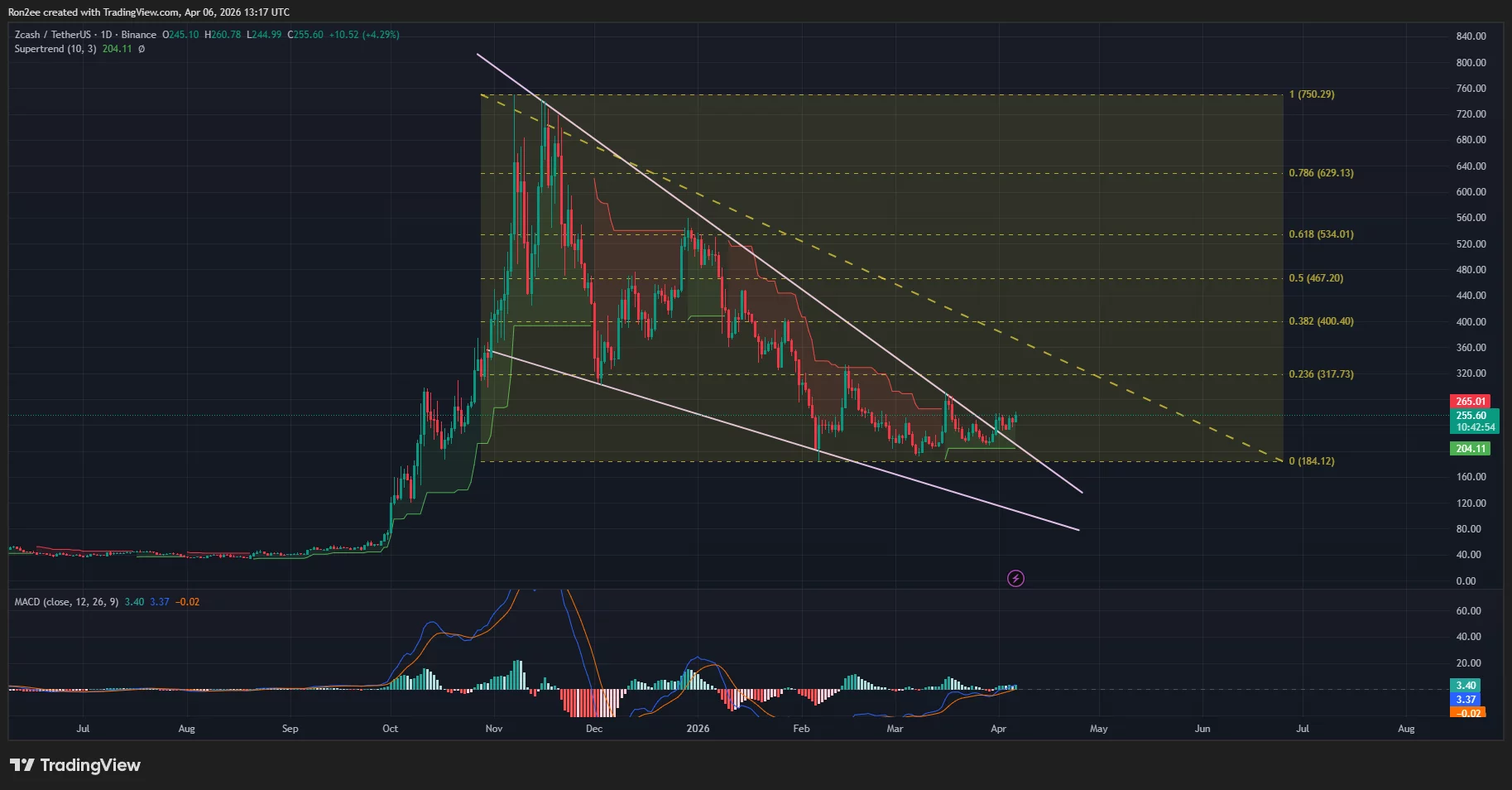
On the daily chart, Zcash price has confirmed a falling wedge pattern formed of two converging and descending trendlines. Breakouts from such patterns have historically sustained upside for the related assets over the following sessions, suggesting that the current momentum is more than just a temporary spike.
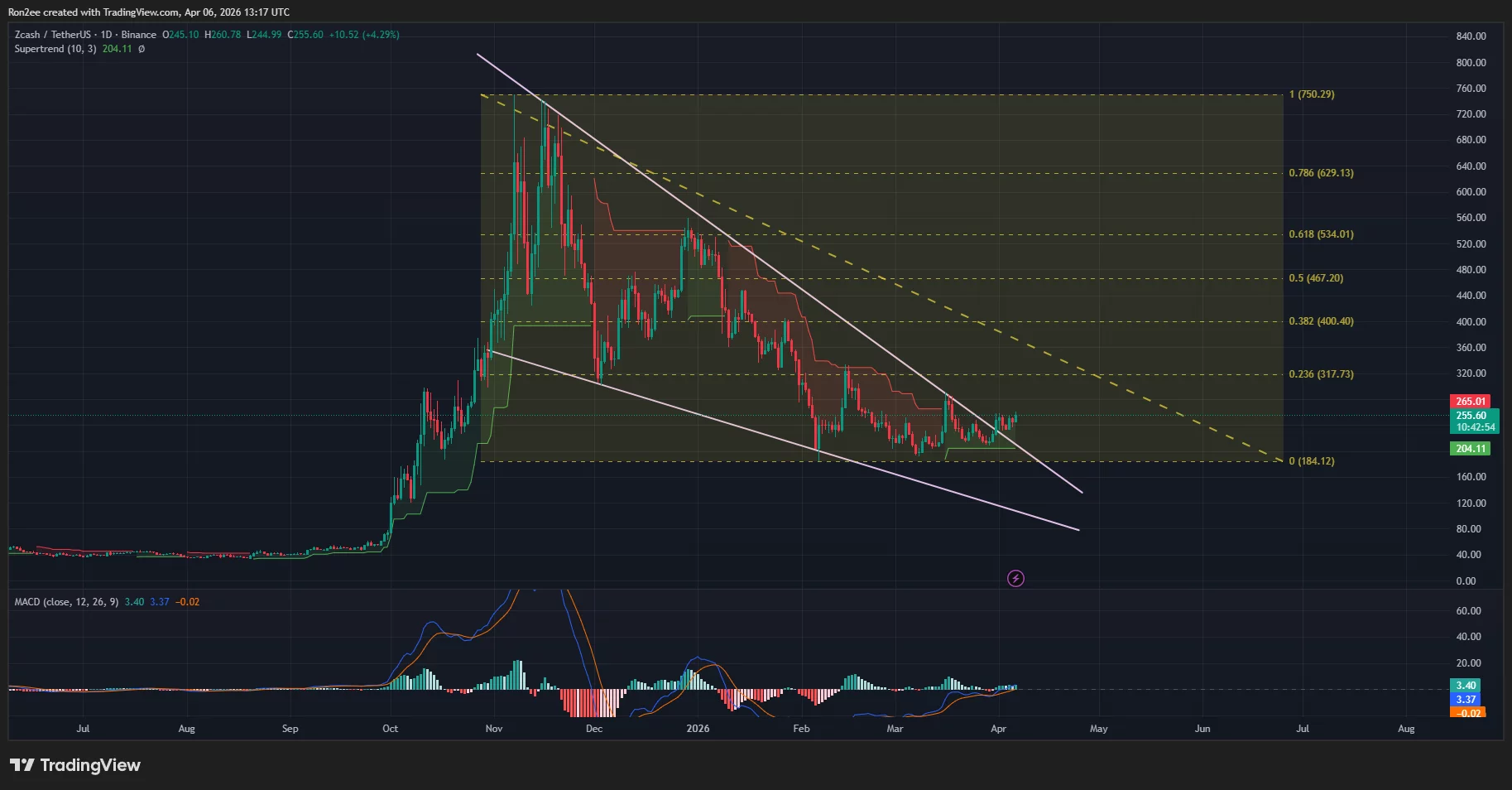
In Zcash’s case, the rally could potentially extend to $400, which aligns with the 38.2% Fibonacci retracement level.
Technical indicators appear to be favoring the bulls at the time of writing. The MACD lines were pointing upwards while the Supertrend flashed green, both indicating that the path of least resistance remains to the upside. These signals often attract momentum traders who look for confirmed trend reversals to enter new positions.
However, it should be noted that the Zcash rally could face some resistance at $317, a major resistance and support level that has historically acted as a pivot point Zcash price.
Disclosure: This article does not represent investment advice. The content and materials featured on this page are for educational purposes only.
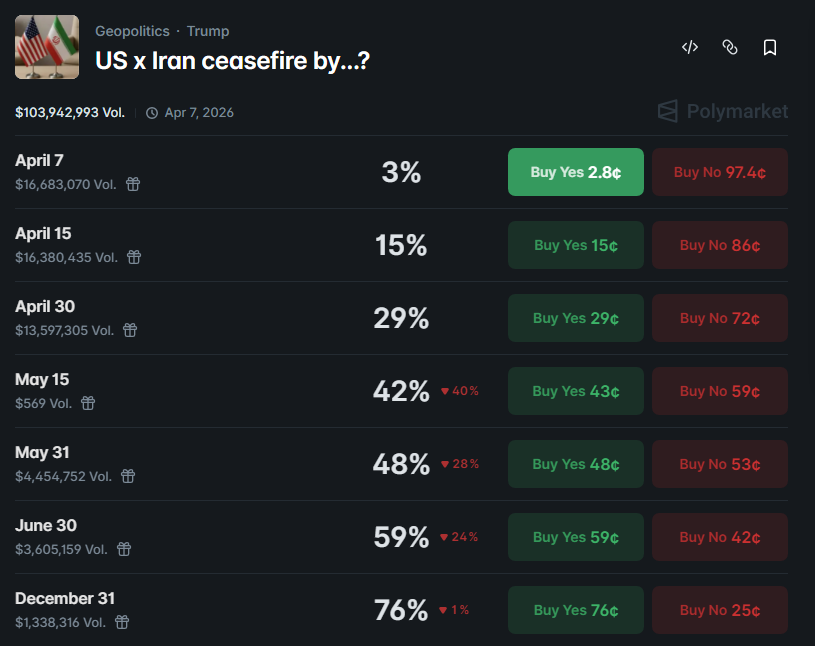
Polymarket traders are giving Trump’s Iran ceasefire deadline just a 3% chance of success, based on over $103 million in live trading volume. That single number captures everything about where market sentiment stands right now.
The numbers send a clear message: the crowd sees no deal arriving on Trump’s timeline.
The Crowd Has Already Decided: No Deal Tuesday
Iran rejected a 45-day ceasefire proposal brokered primarily by Pakistan, with Egypt and Turkey also involved as mediators. Tehran countered with its own 10-point plan, demanding a permanent end to the war instead. Trump dismissed the Iranian response as insufficient and insisted that his Tuesday deadline was final.
Polymarket’s probability curve shows ceasefire odds rising only slowly across future dates. Traders put the chances at 15% by April 15 and 29% by the end of April. The window stretches to 59% by June 30 and 76% by the end of December.
A separate Polymarket contract on Strait of Hormuz shipping paints an equally grim picture. That market assigns just 14% odds to traffic returning to normal levels by April 30. The contract has dropped more than 51 percentage points since it first opened for trading.
Oil Shock Meets Crypto: The Bill Is Coming Due
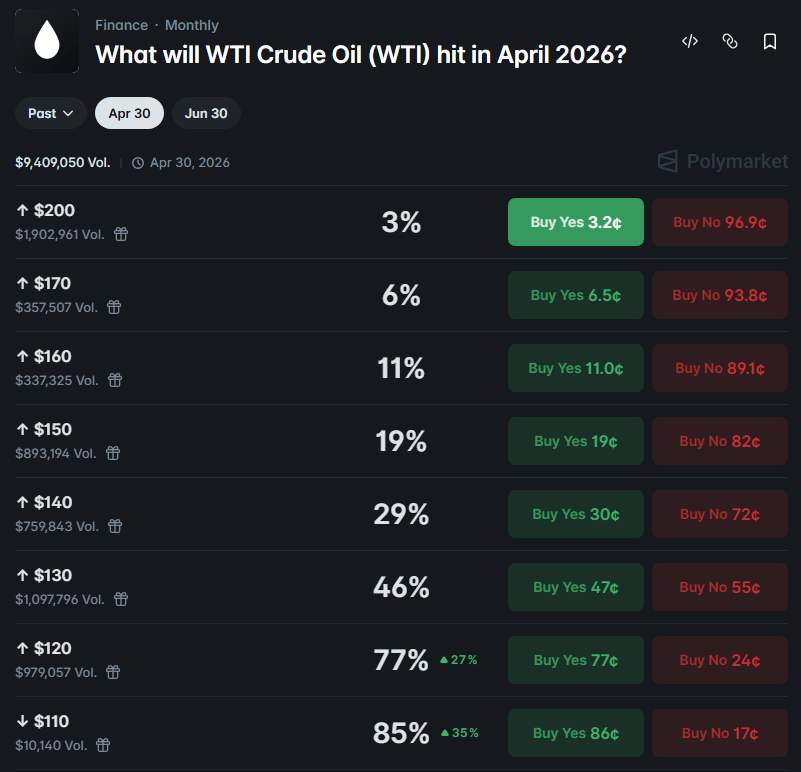
The ongoing war has pushed oil prices sharply higher as the strait remains effectively shut to normal traffic. Polymarket’s separate “Will WTI hit $120 in April?” contract now sits at 77%, a stark reflection of how traders see the energy crunch playing out. Both markets together paint a picture of a world where the war drags on, and oil stays expensive.
Polymarket’s crowd is betting that Tuesday’s deadline will pass without any breakthrough agreement. The ceasefire contract’s 3% odds have barely moved even as mediators worked through the weekend. Until that number shifts decisively, prediction markets say the conflict has much further to run.
The post Polymarket Gives Trump’s Iran Deadline Only a 3% Chance appeared first on BeInCrypto.

Disclosure: This article does not represent investment advice. The content and materials featured on this page are for educational purposes only.
Investors eye presales as capital shifts to early-stage projects like DOGEBALL, targeting high-growth potential.
Summary
- DOGEBALL presale 2026 offers early access to DOGECHAIN, a Layer 2 blockchain with 2-sec blocks and near-zero fees
- Early buyers can use code DB25 for a 25% bonus, capturing massive upside before Q1 2026 altcoin rally
- DOGEBALL pairs viral meme utility with high-speed gaming blockchain, aiming for 50x–100x returns in 2026 presale
Waking up to a sea of green candles is the dream of every trader, but the real “overnight” successes are actually authored months in advance during quiet presale windows.
While the majority of the market is currently distracted by high-cap coins fighting for 5% gains, savvy capital is flowing into early-stage infrastructure projects that offer a clear path to 50x or 100x returns. The window for the next 100x crypto presale is currently open with DOGEBALL (DOGEBALL), a project that pairs viral meme appeal with a high-performance Layer 2 blockchain.

For those who have ever looked at a price chart and wished they had a time machine to go back to the ICO stages of the world’s most successful tokens are currently standing at a similar crossroads.
The next 100x crypto presale isn’t just about finding a lucky ticker symbol; it is about identifying projects with “Stage 1” pricing and “Tier 1” utility. DOGEBALL has already raised over $180,000, signaling that the smart money has identified its $0.015 launch price as a massive arbitrage opportunity compared to the current $0.0004 entry point.
From $0.29 to millions: The Massive ROI lessons from Polkadot
Polkadot (DOT) remains the ultimate case study for why early participation in the next 100x crypto presale is the most effective wealth-building strategy in this industry. During its initial offering, DOT was available for just $0.29, a price that many “safe” investors ignored because the technology seemed unproven. Those who recognized the necessity of its interoperability protocol saw their modest investments transform into life-changing portfolios as the token multiplied by more than 180x at its peak valuation.
The psychological barrier of “being too late” often stops people from entering the market, but the crypto ecosystem consistently produces new cycles of innovation. The good news for those who missed the Polkadot surge is that 2026 has introduced a fresh opportunity with even higher utility. By identifying the next 100x crypto presale like DOGEBALL now, you are positioning yourself at the same foundational level that turned early DOT buyers into crypto millionaires before the rest of the world caught on.
Why the DOGEBALL crypto presale 2026 is outperforming competitors
The DOGEBALL crypto presale 2026 stands apart because it is the native utility token for DOGECHAIN, a custom-built Ethereum Layer 2 blockchain. Unlike standard meme projects that exist only on paper, DOGECHAIN is a functional, testable environment designed specifically to handle high-frequency gaming transactions with near-zero fees. This isn’t just a token; it is a proprietary piece of technology that offers lightning-fast 2-second block times and full EVM compatibility for developers.
Investors are flocking to this DOGEBALL crypto presale 2026 because it solves the “utility gap” found in most low-cap coins. With an integrated online game and a massive $1m prize pool already active, the token has immediate demand. The presale is strategically capped at just four months, running from January 2nd to May 2nd, 2026. This aggressive timeline ensures that the community stays engaged and the project launches exactly when the Q1 altcoin bull run is expected to hit its peak velocity.
Calculate 50x gain and secure a 25% bonus today
The mathematics behind the next 100x crypto presale is incredibly compelling for early participants. Someone who secures DOGEBALL at the current Stage 2 price of $0.0004 is locking in a 3,650% increase based solely on the $0.015 listing price. This does not even account for the post-launch “moon” potential as the token hits major exchanges. By acting now, you are essentially buying an asset at a fraction of its intended market value before the general public is allowed to trade it.
To maximize the position, they can use the limited-time bonus code DB25 during their purchase to receive an instant 25% boost in their token count. This means for every 1,000 tokens someone buys, they get an extra 250 for free, significantly lowering their risk and increasing their upside. As the project nears its $490k Stage 3 milestone, the price will increase again, making today the most profitable time to enter the next 100x crypto presale ecosystem.
How to join the Dogeball crypto presale 2026 in three steps
Joining the DOGEBALL crypto presale 2026 is a seamless process designed for both veteran traders and newcomers. First, visit the official website and connect a preferred digital wallet, such as MetaMask or Trust Wallet. The platform is highly flexible, accepting a wide range of currencies, including ETH, USDT, BNB, SOL, and even direct Credit or Debit card payments for those who prefer to buy with fiat.
Once a wallet is connected, simply enter the amount to invest and remember to input the code DB25 in the bonus field. This ensures that 25% extra DOGEBALL tokens are immediately obtained. After confirming the transaction, tokens will be visible on the dashboard. Take advantage of the 80% APY staking rewards during the presale period to allow the bag of this next 100x crypto presale to grow passively while waiting for the May 2nd launch.

The final countdown to the Dogeball crypto presale launch
As we conclude this analysis of the next 100x crypto presale, it is clear that DOGEBALL is the most structured opportunity of 2026. We have discussed the historical success of Polkadot, the unique Layer 2 technology powering DOGECHAIN, and the massive 100% “Buyer of the Week” bonuses that have already sparked intense competition among whales. This project isn’t just selling a dream; it is delivering a fully audited, high-utility ecosystem that is ready for mass adoption.
The DOGEBALL crypto presale 2026 represents the perfect convergence of memecoin viral energy and serious blockchain infrastructure. With only a few weeks remaining in the 4-month window, the time for hesitation has passed. Use the bonus code DB25 today to secure 25% extra tokens and hold a significant stake before the token lists at $0.015. Don’t let this be another “what if” story; make DOGEBALL a ticket to the 2026 bull run.
For more information, visit the official website, Telegram, and X.
FAQs for the next 100x crypto presale
What is the next 100x crypto presale to buy right now?
DOGEBALL (DOGEBALL) is currently the next 100x crypto presale to watch because of its proprietary Layer 2 blockchain and its planned 50x jump from Stage 1 pricing to its $0.015 listing price. The project offers real gaming utility and a verified audit.
Which crypto will give 100x in 2026 for early investors?
Many analysts believe the next 100x crypto presale will be DOGEBALL due to its 80% staking rewards and its position as the first ETH L2 built specifically for gaming. The short 4-month presale window also creates rapid momentum for a successful market launch.
What makes a crypto presale successful in the long term?
A successful next 100x crypto presale requires real utility, which DOGEBALL provides through its $1m gaming prize pool and zero-tax DOGECHAIN. Unlike temporary hype projects, DOGEBALL has a long-term roadmap including CEX listings and corporate gaming partnerships.
Disclosure: This content is provided by a third party. Neither crypto.news nor the author of this article endorses any product mentioned on this page. Users should conduct their own research before taking any action related to the company.


Resolv Labs burns 36.7m hacked USR after a key compromise let an attacker mint 80m unbacked tokens and dump $24.5m in ETH, leaving a $34m hole in the protocol.
Summary
- Resolv Labs used a contract upgrade to burn 36.73m USR from the attacker’s address after March’s minting exploit.
- The attacker created 80m unbacked USR with under $200k in collateral and dumped 34m USR for about 11,409 ETH (~$24.48m).
- The episode spotlights DeFi key management failures as Resolv faces an estimated $34m net loss despite claiming its collateral pool is intact.
Resolv Labs has destroyed 36.73 million USR stablecoins previously controlled by an attacker, using a contract upgrade to claw back part of the haul from a March exploit that printed 80 million unbacked tokens and left the protocol nursing an estimated $34 million loss. According to on-chain analyst Yu Jin, “about 1 hour ago, Resolv Labs destroyed 36.73 million USR held by the hacker through a contract upgrade,” after the exploiter had already liquidated roughly 34 million USR for 11,409 ETH (about $24.48 million) now parked at address 0x8ED…81C. In total, Resolv’s team has removed about 46 million USR from the attacker’s address, but the value extracted in ETH leaves the protocol facing a real economic hit of around $34 million.
The incident stems from a critical failure in Resolv’s USR minting flow that allowed a single attacker, using less than $200,000 in initial collateral, to generate 80 million uncollateralized USR and dump them across DeFi liquidity pools. Chainalysis described it as a case where “an attacker was able to mint tens of millions of Resolv’s unbacked stablecoins (USR) and extract roughly $23 million in value,” highlighting how a compromised service key in a two-step off-chain minting process can cascade into systemic losses. In its earlier coverage, crypto.news reported that USR “lost its peg after an attacker minted millions of unbacked tokens,” forcing Resolv Labs to pause operations and roll out a recovery plan as the stablecoin crashed as low as $0.14 before partially rebounding.
DeFi reacts as USR exploit ripples through markets
The USR exploit has become a case study in DeFi key management risk, drawing comparisons with other recent stablecoin failures and lending-market contagion. In a post-mortem, Resolv Labs stressed that its collateral pool “remains intact” despite the exploit-driven mint of 80 million USR, even as liquidity providers and leveraged users across integrated protocols absorbed price slippage and forced unwinds. Earlier analysis of the crash showed USR at one point trading near $0.23–$0.27, with on-chain data firms estimating attacker profits between $23 million and $25 million as the token depegged on Curve and other pools.
The partial burn of 36.73 million USR via contract upgrade underscores how privileged controls can both enable and mitigate catastrophic failures in nominally decentralized systems. For traders watching Resolv and its governance token RESOLV, which previously saw volatile swings after exchange listings and buybacks, the episode revives long‑standing questions over whether yield-bearing stablecoins can scale without introducing single points of failure. As crypto.news noted in a prior story on the USR depeg, DeFi protocols with composable stablecoins now face renewed pressure to harden minting logic, rotate keys, and treat backend infrastructure with the same rigor as audited smart contracts.


Chaos Labs is ending its three‑year Aave mandate after a $27m oracle fiasco, deep governance infighting, and mounting fears over who is legally liable when DeFi risk breaks.
Summary
- Chaos Labs is terminating its Aave mandate after three years, citing a fundamental dispute over how the $27 billion lending protocol should manage risk.
- The move follows high‑profile exits by Aave Chan Initiative and BGD Labs, deepening governance turmoil at DeFi’s largest money market.
- Chaos also flags undefined legal liability for DeFi risk managers after recent oracle failures triggered tens of millions of dollars in erroneous liquidations on Aave.
Chaos Labs, the risk firm that has “priced every loan initiated on Aave and managed risk across all Aave V2 and V3 markets and networks” since late 2022, is walking away from the protocol after concluding “the engagement no longer reflects how we believe risk should be managed.” In an announcement echoed by BSCN on X, the company said Monday it is “proactively terminating its engagement with DeFi’s largest lending protocol @aave, citing a fundamental disagreement over how risk should be managed,” and warning that DeFi risk managers currently operate without a clear regulatory framework or safe harbor if something breaks.
The departure lands as Aave, which has processed roughly $3.33 trillion in cumulative deposits and nearly $1 trillion in loans and recently crossed $50 billion in total value locked, faces mounting internal and external scrutiny over governance, risk, and legal exposure.
Chaos is the third core contributor to step back from Aave in recent months, after governance shop Aave Chan Initiative and core technical team BGD Labs each disclosed plans to end their mandates amid disputes over power, budgets and roadmap control inside the DAO. ACI founder Marc Zeller framed his own exit as the product of a protracted power struggle, warning that a recent vote handed Aave Labs “the largest budget in DAO history,” while BGD told tokenholders “we will not be seeking a renewal and will cease our contribution to Aave” once its contract expires. These fractures are emerging even as Aave continues to command roughly 30–40% of the DeFi lending market and nearly a quarter of sector TVL, underscoring how governance tensions can flare precisely when protocols reach systemically important scale.
Chaos Labs’ break with Aave follows a series of oracle and risk‑engine incidents that have already driven uncomfortable questions about who is accountable when automated risk systems misfire. In March, a misconfigured Chaos Labs oracle on Aave caused erroneous liquidations of around $26.9 million in positions using staked Ether collateral, after the CAPO risk agent reported an inaccurately low price ratio and pushed several accounts below their health‑factor thresholds. A separate post‑mortem and external coverage estimated roughly $27 million in forced liquidations triggered when wrapped staked Ether was undervalued by about 2.85%, affecting at least 34 high‑leverage positions before parameters were manually corrected. Chaos Labs and Aave have emphasized that no bad debt was incurred and that affected users would be reimbursed, but the episode illustrates the legal gray zone the firm now highlights: risk managers are making protocol‑wide decisions that can move tens of millions of dollars in seconds, yet operate without explicit regulatory safe harbor or clearly defined liability regimes if those decisions go wrong.
The exits of Chaos Labs, ACI and BGD Labs leave Aave’s DAO with fewer seasoned operators just as the protocol rolls out its next‑generation v4 architecture and pushes deeper into institutional‑grade features. Aave’s total value locked sits in the tens of billions of dollars and the protocol has grown its TVL by more than 50% in certain recent quarters, outpacing the broader DeFi sector and making its risk governance choices a live concern for markets well beyond crypto‑native users. With multiple core contributors now publicly criticizing governance dynamics and risk alignment, Aave’s community will be forced to answer the question Chaos Labs has implicitly posed: who, exactly, bears responsibility when decentralized risk systems break at scale?
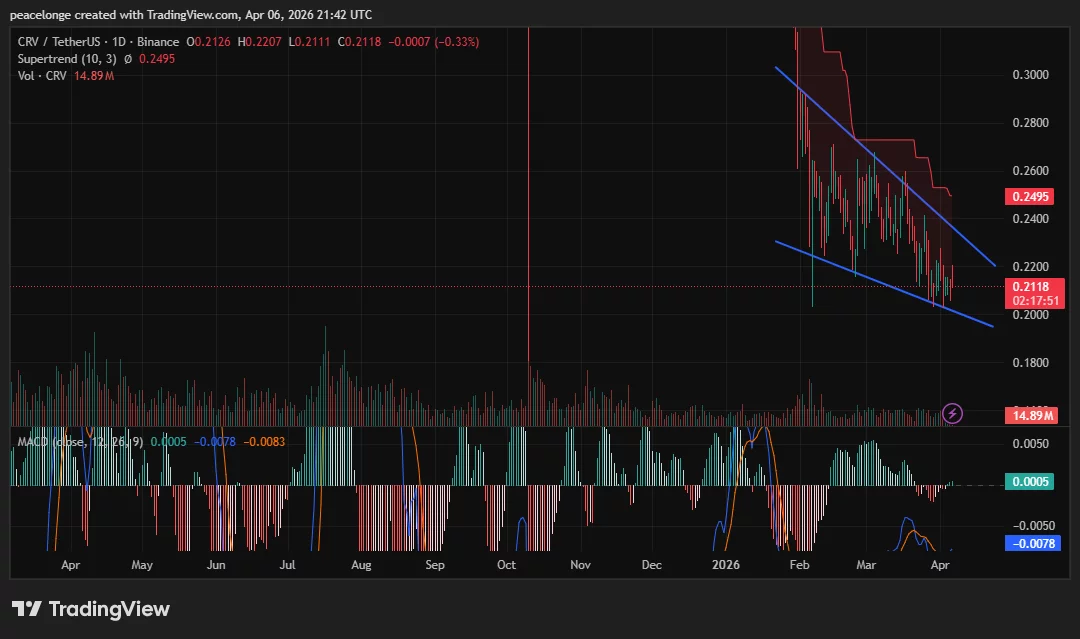
CRV price has been grinding lower since late 2025, and the Curve DAO token is now pressing against the lower boundary of a descending channel that has defined its price action for months. The $0.20 level is within reach, and the chart is setting up a clear binary outcome: hold and recover, or break into uncharted territory.
Summary
- CRV price is at $0.2118 on April 6, approaching the lower boundary of a descending channel in place since late 2025, with the $0.20 psychological level as the key downside reference.
- The daily Supertrend at $0.2495 confirms the bearish trend, though the MACD line at 0.0005 has crossed marginally above the signal at -0.0078, a tentative early stabilisation signal.
- A daily close below the channel lower bound near $0.21 exposes $0.20, while a recovery above the Supertrend at $0.2495 is required to shift the bias toward neutral.
Curve DAO (CRV) price is trading at $0.2118 on April 6, down 8.10% over the prior 24 hours, as the Curve DAO token continues to lose ground within a descending channel that has defined its structure since late 2025. The token is pressing against the lower boundary of that channel, with $0.20 now the critical downside reference for traders watching the DeFi sector’s largest decentralised exchange protocol.
On the daily chart, CRV has been contained within a descending channel since late 2025, with the upper trendline aligning with the Supertrend at $0.2495 and acting as rolling bearish resistance. The lower channel boundary is converging on price near $0.20, leaving a narrowing range that typically precedes a more directional move. The daily MACD shows the MACD line at 0.0005 crossing marginally above the signal at -0.0078, a tentative early stabilisation signal, though volume has not produced any spike that would confirm genuine accumulation behind that reading.
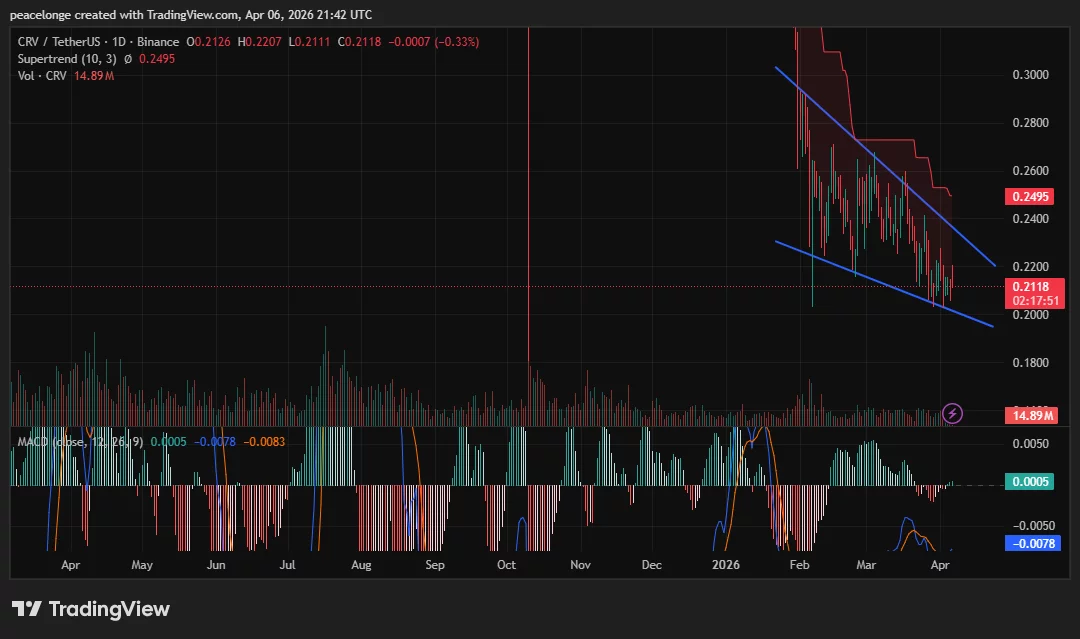
On the 4H chart, a descending wedge pattern has formed between two converging trendlines, with the lower bound at the Supertrend support of $0.2071 and the upper bound at $0.2224. A descending wedge is technically a bullish reversal pattern, though the 4H MACD at 0.0004 is essentially flat, providing no directional confirmation at this timeframe.
A March 2 flash loan exploit on the sDOLA-crvUSD Curve LlamaLend pool, involving an improper oracle configuration that temporarily distorted pool pricing, has continued to weigh on market sentiment. Curve Finance confirmed its core protocol contracts were unaffected, but the incident left a residual risk premium in CRV pricing that has not yet fully cleared.
Key Levels: $0.2071 Holds First, $0.20 Below, $0.2495 Above
The 4H Supertrend at $0.2071 is the immediate support. A four-hour close below that level exposes the $0.20 psychological level, which aligns with the projected daily channel lower boundary. A daily close below $0.20 would represent a significant breakdown, with $0.18, the token’s lowest level from August 2024 per TradingView data, as the next structural reference below. That $0.18 level is the bear case extended target and the point at which the current thesis would require reassessment.
On the upside, the $0.2224 level is the upper bound of the 4H descending wedge and the first resistance to clear. The daily Supertrend at $0.2495 is the key level that must be reclaimed to challenge the broader downtrend. A confirmed daily close above $0.2495 would be the first credible signal the descending channel is being genuinely challenged.
Derivatives Data Confirms Cautious Positioning
According to CoinGlass data, CRV futures open interest declined 11.47% to $74.45 million as of late March, while the OI-weighted funding rate of 0.0067% signals marginally net-long positioning despite the price slide. A market analyst noted in a March 30 analysis that the current phase reflects “accumulation, not decline,” but added that a confirmed bullish reversal would only materialise on a move back toward the $0.30 to $0.32 range. That remains a significant distance from current price, and the technical structure has not yet provided the confirmation that view requires.
If $0.2071 gives way on the 4H chart, a test of $0.20 looks probable. A close above $0.2495 on the daily would be the first real sign the descending channel structure is being challenged.

Northern Echo readers pictures of Durham Easter Egg Run 2026

Core Lithium awards mining contract to NRW for Finniss restart

The Masters: McKibbin enjoying ‘surreal’ start to his first Masters week


-

 NewsBeat4 days ago
Steven Gerrard disagrees with Gary Neville over ‘shock’ Chelsea and Arsenal claim | Football
-

 Business4 days ago
No Jackpot Winner and $194 Million Prize Rolls Over
-

 Fashion3 days ago
Weekend Open Thread: Spanx – Corporette.com
-

 Crypto World5 days ago
Gold Price Prediction: Worst Month in 17 Years fo Save Haven Rock
-

 Business1 day ago
Three Gulf funds agree to back Paramount’s $81 billion takeover of Warner, WSJ reports
-
Crypto World7 days ago
Dems press CFTC, ethics board on prediction-market insider trades
-

 Sports2 days ago
India men’s 4x400m and mixed 4x100m relay teams register big progress | Other Sports News
-

 Business5 days ago
Login and Checkout Issues Spark Merchant Frustration
-

 Tech7 days ago
EE TV is using AI to help you find something to watch
-

 Sports6 days ago
Tallest college basketball player ever, standing at 7-foot-9, entering transfer portal
-
Tech7 days ago
Daily Deal: StackSkills Premium Annual Pass
-

 Tech7 days ago
Flipsnack and the shift toward motion-first business content with living visuals
-

 Tech7 days ago
How to back up your iPhone & iPad to your Mac before something goes wrong
-

 Business3 days ago
Expert Picks for Every Need
-
Crypto World7 days ago
Valinor raises $25m to put private credit on-chain
-

 Tech7 days ago
What Are The Biggest Limitations Of Supercomputers?
-

 Crypto World6 days ago
Bitcoin enters the public bond market as Moody’s gives a first-of-its-kind crypto deal a rating
-
Crypto World6 days ago
Bitcoin stalls below key resistance as technical signals skew bearish
-

 Politics7 days ago
Transform Your Space with Stunning Small Works
-

 Politics6 days ago
Starmer’s centre has collapsed, and the left was right all along
You must be logged in to post a comment Login