
Crypto World
Gemini said Crypto markets surge following two-week ceasefire announcement: Crypto Markets Today

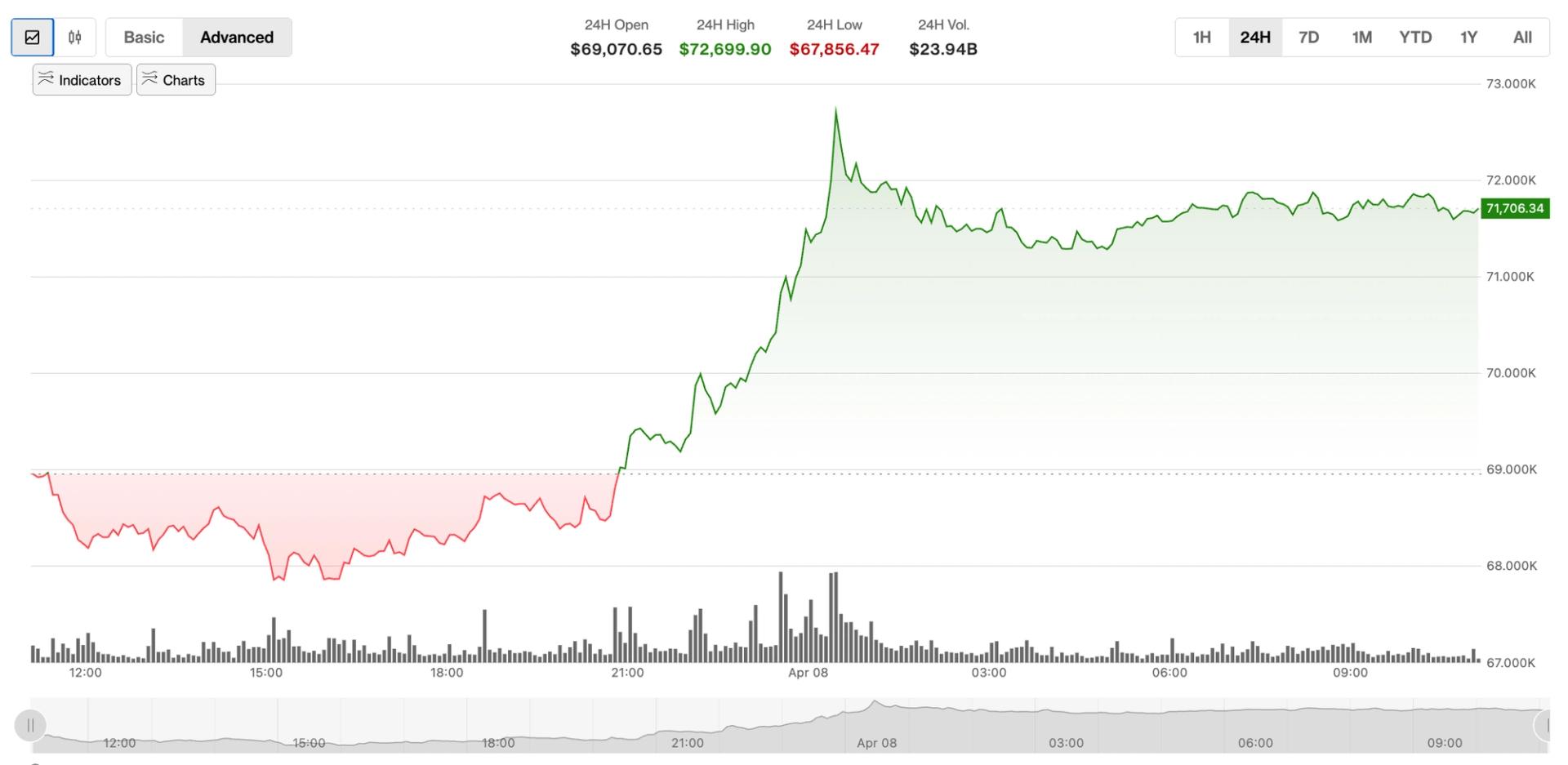
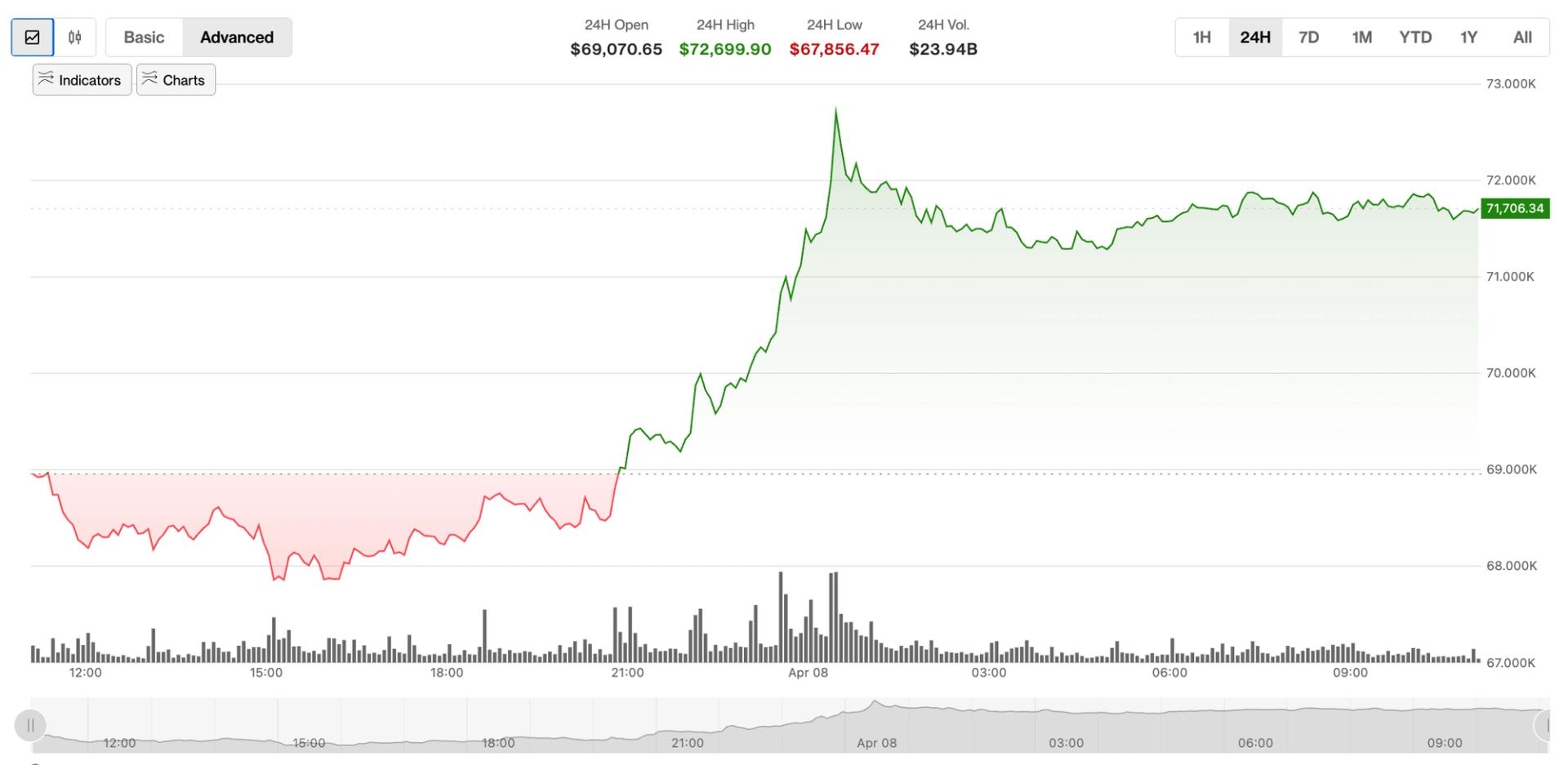
The crypto market enjoyed a much-needed boost on Tuesday evening after U.S. president Donald Trump announced a two-week ceasefire in Iran.
Bitcoin spiked to around $72,700 after settling in the $71,800 region, ether (ETH), meanwhile, is changing hands at $2,250 after posting a 6% gain in the past 24 hours.
The market remains trapped in the same range it has been since early February despite the overnight rise. Bitcoin will need to trade above $75,000 to confirm a breakout, while a rejection here could signal a move back to around $65,000.
Traders will be waiting cautiously for the ceasefire to end in a fortnight’s time to see whether a deal can be reached or the conflict will start up again.
Oil dipped heavily following the the news, with brent crude now trading at $94 per barrel, down from Tuesday’s high of $114.
Derivatives positioning
- Nearly $600 million in crypto futures bets have been liquidated for margin shortages in 24 hours. Bearish short positions account for over $420 million fo the tally, which shows that leveraged was skewed bearish likely anticipating intensification of military conflict between the U.S. and Israel. However, the ceasefire announcement caught the bears on the wrong side of the market.
- Still, cumulative open interest in crypto futures has increased by 7% to $114.26 billion, the highest since March 17, indicating renewed capital inflows.
- Ether open interest (OI) up 6% to 14.22 million ETH, the highest since March 29. This plus positive perp funding rates (longs paying shorts) and a positive 24-hour cumulative volume delta (CVD) scream traders bidding hard for upside.
- Bitcoin’s market displays a similar profile, with OI rising 1% alongside bullish funding rates and CVD.
- ZEC stands out with annualized perpetual funding rates at minus 56%. It shows that traders are aggressively chasing bearish short positions.
- Bitcoin’s 30-day implied volatility index, BVIV, continues to slide and has dropped to 46%, the lowest since Jan. 31. This signals market calm and bolsters the bullish case for spot prices.
- Ether’s 30-day implied volatility continues to fall as well, but remains slightly elevated relative to bitcoin.
- On Deribit, the relative richness of bitcoin and ether puts keeps narrowing versus calls, as the U.S.-Iran ceasefire clears the way for bullish spot price action.
- Block flows featured demand for ether strangles, a volatility-focused strategy.
Token talk
- Portions of the altcoin market outperformed bitcoin and its peers on Wednesday, with the likes of zcash (ZEC) posted a 23% move to the upside while layer 1 token monad (MON) increased by more than 15%.
- There were also notable gains for layer zero (ZRO) and ethena (ENA), which surged by 14% apiece to snap recent downtrends.
- AI tokens also performed well as NEAR, RENDER and TAO near double-digit gains.
- The bitcoin-dominant CoinDesk 20 (CD20) index is up by 4.9% in the past 24 hours, being beaten by the DeFi Select Index (DFX) and the CoinDesk Computing Select Index (CPUS), which are up by 7% each.
- The CoinDesk Overnight Rate (CDOR), which tracks lending and borrowing rates on Aave, continued its uptrend on Wednesday, hitting 3.51%, up from March 8’s total of 2.8%.

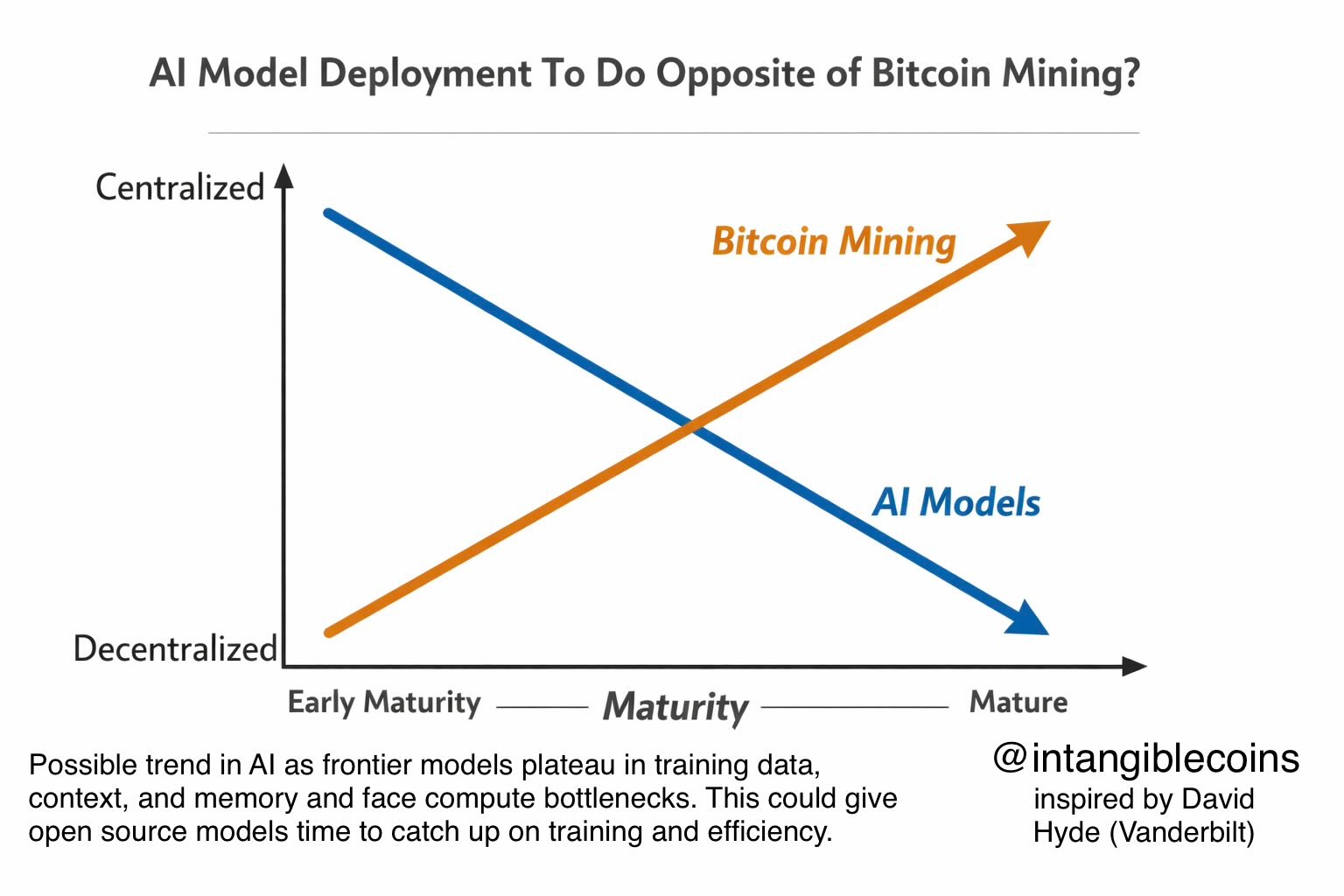
Bitcoin mining runs the risk of becoming more centralized as time goes on, while artificial intelligence could be moving in the opposite direction, according to Galaxy Research head Alex Thorn.
Thorn said that while Bitcoin mining began decentralized, with users mining Bitcoin on their personal computers, it has since become far more centralized, requiring ASIC miners or industrial-scale farms.
“AI may follow the opposite path,” Thorn said, explaining that AI began in centralized clusters but could decentralize as open-source models close the gap.
“If local models keep getting smaller, cheaper, and more efficient, AI may become increasingly personal and on-device.”
The divergence strikes at the heart of crypto’s core promise: decentralization. If Bitcoin mining were to continue down a path of centralization, it could begin to raise concerns about the network’s long-term resilience.

Edge AI market to grow 300% in the next eight years
Edge AI computing refers to the deployment and running of AI models directly on local devices or “at the edge” of the network, rather than sending all data to centralized cloud servers or massive data centers for processing.
The global AI edge market is anticipated to grow from about $25 billion in 2025 to a projected $119 billion by 2033, according to Grand View Research.
Related: Researchers discover malicious AI agent routers that can steal crypto
The edge market is experiencing significant growth driven by the “rapid expansion of IoT (Internet of Things) and connected devices,” stated GVR.
This increases the demand for real-time and low-latency data processing, growing the adoption of AI-enabled automation across industries, and “rising focus on data privacy and localized intelligence at the network edge,” GVR added.

Bitcoin mining is decentralizing geographically
Crypto exchange KuCoin reported on Friday that Bitcoin mining has become increasingly unviable in the United States as the cost to mine a single BTC has surpassed $100,000 in some regions due to surging energy costs.
This is resulting in a geographic migration with hash rate actively moving toward the “Global South,” with Paraguay and Ethiopia emerging as the leading destinations due to surplus hydroelectric power.
This could help to decentralize mining, at least from a geographical perspective.
“This decentralization of mining power across different continents enhances the security of the network by making it less vulnerable to any single country’s political or environmental shocks,” it stated.
Magazine: Bitcoin quantum-safe without upgrade? CZ’s 2031 crypto vision: Hodler’s Digest

Bitcoin (BTC) held $70,000 at the weekly close as markets reacted to a breakdown in US-Iran negotiations and escalating tensions around the Strait of Hormuz.
-
A breakdown in US-Iran negotiations sends oil surging above $100 per barrel, with the Strait of Hormuz now blockaded.
-
US PPI inflation data is due amid signs that the oil crisis is far from the only driver of price increases.
-
Bitcoin manages a weekly close above $70,000, but a trader says new lows remain on the roadmap.
-
Profit-taking is what keeps Bitcoin unable to hold the $70,000 mark for long, analysis confirms.
-
Overall sell-side pressure is easing, while long-term holders boost BTC exposure on Binance.
Iran breakdown sends oil above $100
The US-Iran war is once again the main topic of debate among market participants after the sudden breakdown in negotiations over the weekend.
On Sunday, US President Donald Trump announced sweeping measures to blockade the Strait of Hormuz with an eye to controlling oil transport in the future.
In one of several posts on Truth Social, Trump wrote that “at some point, we will reach an ‘ALL BEING ALLOWED TO GO IN, ALL BEING ALLOWED TO GO OUT’ basis” on Hormuz.
“It appears that Trump’s long-term plan is to blockade Hormuz, gain control, then begin letting traffic flow freely,” trading resource The Kobeissi Letter commented in a response on X.
“However, if this is possible to fully obtain, it will be a long process that would further restrict the flow of traffic for at least another 2 months, according to our analysis.”

Fears immediately focused on markets’ reaction, but this ended up tempered, with S&P 500 futures losing around 0.6%. Oil, however, gained rapidly, trading near $105 per barrel after 8% daily upside.

Kobeissi added that in the absence of diplomacy, Hormuz now appeared to be the US’ “top priority” going forward.
“We expect a volatile week ahead,” it added.
US PPI due as analysis warns of inflation contagion
As Cointelegraph reported, oil prices have a pronounced impact on US inflation gauges, notably the Consumer Price Index (CPI), which was released last week.
The coming days will see the March print of the Producer Price Index (PPI), this also set to reflect the start of the war.
Commenting, trading resource Mosaic Asset Company warned that recent inflation data was already pointing to catalysts beyond the conflict.
“While headlines coming out of the Middle East are capturing investor attention, a pair of consumer inflation reports released last week continues showing upward pressure on prices,” it wrote in the latest edition of its regular newsletter, “The Market Mosaic.”
Mosaic flagged both CPI and Federal Reserve’s “preferred” measure, the Personal Consumption Expenditures (PCE) index, the latest update for which was released on April 9.
PCE revealed “more recent annualized rates over the past three and six months are accelerating higher.”
“That shows inflation pressures outside of what’s expected following war in the Middle East and impact on energy prices,” Mosaic added.

As a result, the Fed may end up enacting “tighter” monetary policy, keeping interest rates steady or even raising them, despite repeated demands by Trump and other officials to do the opposite.
The latest data from CME Group’s FedWatch Tool shows that markets already see no rate cuts coming before the second half of 2027.

Bitcoin often exhibits volatile reactions to US inflation reports, particularly when those differ considerably from expected values.
Trader: Bitcoin price needs “one more low”
Bitcoin managed to avoid major losses on the back of the latest geopolitical setback, wicking to near $70,500, per data from TradingView.
The weekly close at around $70,850 thus preserved key price levels in the form of the 200-week exponential moving average (EMA) trend line and the old 2021 all-time high.

With the spot trading range still narrowing, trader Roman said that a true high-time frame (HTF) trend flip required another BTC price correction.
$BTC 1W
We are here – compared to 2022.
This is not the bottom. pic.twitter.com/It6OGj1BX5
— Roman (@Roman_Trading) April 12, 2026
“Why haven’t we bottomed yet? Because AT LEAST 1 more low would give us reversal signals on HTF,” he told X followers in a post on Sunday.
Roman has long been among those calling for deeper long-term lows for BTC/USD, with his targets circling the $50,000 mark.
One of the prerequisites for abandoning the bear market, he said, was a bullish divergence on the relative strength index (RSI) versus price.
“RSI bull divs, bear momentum loss, likely see volume start to shift, & possible reversal pattern. All things we saw at the 2022 bottom,” he added.

As Cointelegraph reported, RSI is already beginning to offer key bullish signals, with another trader saying that the indicator was copying the end of the 2022 bear market “nearly perfectly.”
Profit taking caps BTC price upside
Macro events aside, Bitcoin continues to suffer from a familiar problem on short time frames, analysis says.
In an X post at the weekend, onchain analytics platform Glassnode said that each time BTC/USD passes $70,000, the urge to take profit among traders results in the rally quickly fizzling.
“Another bounce to >$70k range was exhausted by >$20M/Hour profit realization,” it confirmed.
The phenomenon was recorded last week after Bitcoin made multiple attempts to flip the $70,000 to support.
“As price probed the $70K region, Realized Profit/hour spiked above $20M, signalling a local exhaustion,” Glassnode wrote at the time.
“A pattern consistent since February 2026: Every approach to the $70k–$80K band meets thin liquidity and profit-taking pressure, capping the bounce.”

Sellers ease off as “calmer phase” enters
Talk of Bitcoin “short squeezes” getting easier has surfaced among analysts recently amid increasing signs of seller exhaustion.
Related: Bitcoin analysis sees $55K BTC price ‘iron bottom’ by December 2026
In its latest commentary, onchain analytics platform CryptoQuant added evidence to support the theory that bulls could retake control of the market at current levels.
“Bitcoin’s short-term holder pressure on Binance has entered a calmer phase,” contributor Amr Taha reported in one of its “Quicktake” blog posts on Monday.
Taha referred to more recent Bitcoin investor cohorts hodling coins for up to six months without selling.
“The 7-day standard deviation of realized profit/loss pressure fell to 217, marking its lowest reading since February, compared with the previous low of 277,” he reported about their profit/loss ratio.
“The move signals that short-term holders are sending coins to Binance with less aggressive profit-taking and less panic-driven loss realization, reducing near-term distribution pressure on the market.”

A further post additionally revealed rising demand for BTC on major global exchange Binance.
“Bitcoin is showing a healthier holding structure as whale transfer pressure to Binance continues to ease while long-term holder demand strengthens,” Taha added.
The increase in long-term holders’ realized cap — the combined value of their BTC holdings when they last moved — passed the $50 billion mark for the first time in nearly a year this week.

This article is produced in accordance with Cointelegraph’s Editorial Policy and is intended for informational purposes only. It does not constitute investment advice or recommendations. All investments and trades carry risk; readers are encouraged to conduct independent research before making any decisions. Cointelegraph makes no guarantees regarding the accuracy or completeness of the information presented, including forward-looking statements, and will not be liable for any loss or damage arising from reliance on this content.

Key Highlights
- On April 10, 2026, Principal Financial Officer Snizhana P. Quan exercised options and sold 20,000 shares of Lightwave Logic, netting approximately $207,000 at $10.36 per share.
- The transaction reduced her direct stake by 26.3%, though she maintains ownership of 51,125 shares plus 55,000 unexercised options.
- Shares of LWLG have skyrocketed 939% in the trailing twelve months, propelling market capitalization to $1.58 billion.
- Annual revenue from licensing reached only $106,855 in 2025, while the company recorded a net loss exceeding $20.3 million.
- Recent strategic milestones include a collaboration agreement with Tower Semiconductor and integration into the GDSFactory design platform.
Over the past year, Lightwave Logic (LWLG) has emerged as one of the market’s most explosive performers, with shares rocketing upward by 939%. Against this backdrop, a key financial executive has monetized a portion of her equity stake.
Snizhana P. Quan, serving as the company’s Principal Financial Officer, completed a same-day exercise-and-sale transaction on April 10, 2026, involving 20,000 employee stock options. The shares were sold at a weighted average of $10.36 each, producing proceeds of approximately $207,000.
LWLG shares settled at $10.60 when the market closed that day.
This form of transaction—exercising options and immediately selling the underlying stock—is common among corporate officers. It generally serves liquidity needs or addresses tax obligations associated with equity compensation, rather than signaling pessimism about future prospects.
Quan transitioned from her previous position as corporate controller to the PFO role in January 2026. After completing this sale, she continues to own 51,125 shares outright, along with 4,800 shares held indirectly via a domestic partner.
Additionally, she holds 55,000 vested stock options that remain unexercised, preserving substantial economic exposure to the company’s performance.
SEC disclosures reveal that Director Craig Ciesla executed similar option exercises and share sales during the same period. Both insiders acted following a secondary offering and the stock’s extraordinary price appreciation.
The Financial Reality Behind the Valuation
While the stock price has soared, Lightwave Logic’s actual revenue generation remains extremely limited. For the full year 2025, the company recognized merely $106,855 from licensing and royalty streams. Net losses for the period totaled $20.3 million.
A year ago, the company’s market capitalization hovered below $150 million. Today, it commands a valuation of $1.58 billion.
The disparity between market value and revenue generation is substantial. The firm ended 2025 holding $69 million in cash reserves, providing a multi-year financial cushion based on current operating expenditures. However, meaningful product-based income has yet to materialize.
Strategic Foundry Collaborations Provide Development Momentum
From a technology standpoint, Lightwave Logic has executed two significant initiatives drawing investor attention. The company successfully embedded its electro-optic polymer solution into the GDSFactory process design kit and established a formal development partnership with Tower Semiconductor (TSEM).
These advances carry weight because they streamline the path for prospective clients to incorporate LWLG’s polymer technology within established foundry manufacturing flows.
The firm is positioning itself to serve data center and artificial intelligence interconnect applications, where appetite for enhanced optical component performance continues expanding. Embedding its materials within standard foundry processes represents a critical milestone toward achieving commercial-scale adoption.
Valuation estimates from the Simply Wall St community span a remarkably broad range—from approximately $0.02 to $14.50 per share—underscoring the polarized views among market participants.
At market close on April 10, 2026, LWLG was changing hands at $10.60 per share.

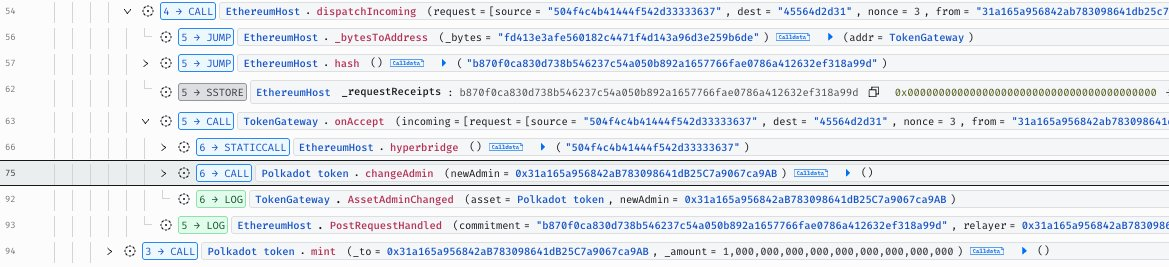
A hacker exploited the Polkadot-based cross-chain interoperability protocol Hyperbridge, netting about $237,000 and raising renewed security concerns about blockchain bridge infrastructure.
An attacker minted 1 billion bridged Polkadot (DOT) tokens in a single transaction on Hyperbridge, according to blockchain data shared by cybersecurity platform CertiK. The exploit only affected DOT on Ethereum that was bridged through Hyperbridge, while native DOT tokens and the wider Polkadot ecosystem remain unaffected, Polkadot noted in a Monday X post.
CertiK said the hacker managed to mint the tokens after he “slipped through a forged message to change the admin of Polkadot token contract on Ethereum.” Limited liquidity in the bridged DOT pool capped the proceeds at 108.2 Ether (ETH), worth around $237,000.
Hyperbridge pauses operations after exploit
Hyperbridge paused operations after the attack while the team worked on an upgrade, with contributor Web3 Philosopher saying the initial diagnosis pointed to a malicious proof that fooled the protocol’s Merkle tree verifier.
The exploit is notable because Hyperbridge has marketed itself as a proof-based interoperability layer built to deliver “full node security” for crosschain bridges. The incident also follows Aethir’s disclosure last week that it had contained a separate bridge exploit and kept user losses below $90,000.
Cybersecurity research company Blocksec Falcon said the likely root cause of the exploit was a Merkle Mountain Range (MMR) proof replay vulnerability caused by missing proof-to-request binding, though the final root cause has not yet been confirmed by the protocol.

The native DOT token briefly dipped to a daily low of $1.16 on Monday, before recovering to trade above $1.19 at the time of writing, according to CoinGecko.

Hackers exploit SubQuery network for $130,000
Security incidents continue to hit crypto protocols despite a sharp year-over-year drop in DeFi exploit losses.
Related: New AI cybercrime tool targets crypto, bank KYC systems via deepfakes
On Sunday, the data indexing protocol SubQuery Network was also exploited for around $130,000 due to missing access control data that exposed the code written over two years ago.
The vulnerability enabled the attacker to set his own contract as the withdrawal target for staking rewards, blockchain security auditor Pashov said in a Sunday X post.

Hackers stole over $168 million from 34 decentralized finance (DeFi) protocols in the first quarter of 2026, marking a significant decline from the $1.58 billion stolen in the first quarter of 2025, when the record $1.4 billion Bybit hack occurred.
Cointelegraph has contacted Hyperbridge for comment on the root cause of the exploit.
Magazine: Meet the onchain crypto detectives fighting crime better than the cops
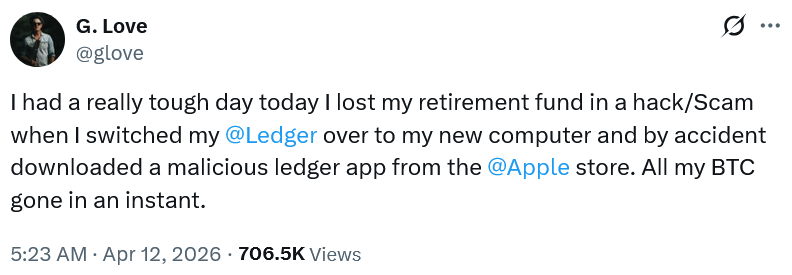
Blockchain sleuth ZachXBT said Garrett Dutton’s 5.9 Bitcoin has already been sent to deposit addresses associated with KuCoin.
Garrett Dutton, an American musician better known as “G. Love,” said he lost $420,000 worth of Bitcoin after installing a malicious app impersonating the self-custody crypto app Ledger Live from Apple’s App Store and entering his seed phrase.
“I had a really tough day,” Dutton told his 67,500 followers in a post on X on Saturday, adding that he lost his 5.9 Bitcoin (BTC) stash “in an instant” after spending about 10 years accumulating the coins to secure his retirement.

In a follow-up post, crypto sleuth ZachXBT said that Dutton’s Bitcoin has been sent to deposit addresses linked to the crypto exchange KuCoin across nine transactions. KuCoin replied to the post with a statement typically addressed to customers.
The incident highlights a continued problem that bad actors have posed in the crypto industry. On Tuesday, the US Federal Bureau of Investigation reported that Americans lost over $11 billion from crypto-related incidents in 2025, up from the $9 billion recorded the previous year.
Related: Hong Kong retiree loses $840K in triple ‘crypto expert’ scam
Dutton said he was tricked into sharing his seed phrase after downloading the malicious software on his new Apple MacBook Neo but didn’t share which link he used.
“I been in the crypto circus since 2017. Today they caught me off guard. It was my own damn fault for not being more diligent. But let it serve as a warning. There’s so many scams,” he added.
Cointelegraph was unable to find the fake Ledger app on Apple’s App Store at the time of writing. Cointelegraph reached out to Apple for comment but did not receive an immediate response.
Fake Ledger apps have appeared on Microsoft’s store
Scammers have been adopting this fake Ledger app strategy since at least 2023.
That year, almost $600,000 worth of Bitcoin was stolen from several users who downloaded a fake Ledger Live application from Microsoft’s app store.
Microsoft admitted that the malicious app had bypassed its review process and took it down shortly after.
Magazine: Asia Express: Phantom Bitcoin checks, China tracks tax on blockchain


Disclosure: This article does not represent investment advice. The content and materials featured on this page are for educational purposes only.
Quantum AI trading bots gain traction in 2026 as investors seek advanced automation for passive income.
Summary
- Quantum AI trading bots gain traction in 2026, offering faster, data-driven automated trading
- BitsStrategy combines quantum computing and AI to enhance trade accuracy across crypto and stocks
- Investors adopt quantum AI tools for hands-free trading and optimized passive income strategies
In 2026, quantum AI trading bots are emerging as a game-changer for anyone looking to earn passive income from trading. These bots leverage the power of quantum computing and artificial intelligence to execute trades more efficiently and accurately than ever before.
They can analyze massive datasets, recognize complex patterns, and make trading decisions in real time, all while operating 24/7. Whether someone is a beginner or an experienced trader, quantum AI bots can help them automate their trading strategies and optimize their profits.
In this article, we will explore the 6 best quantum AI trading bots for 2026 that can help anyone start earning passive income with minimal effort.
1. BitsStrategy: Leading quantum AI bot for automated trading
Overview:
BitsStrategy is one of the top-rated quantum AI trading platforms for 2026. It combines quantum computing with artificial intelligence to enhance the decision-making process and deliver better results. BitsStrategy analyzes market data in real-time, enabling traders to take advantage of opportunities quickly, ensuring higher accuracy in their trades.
Why Choose BitsStrategy?
- Advanced Quantum AI for faster data processing and improved trade execution.
- Fully automated trading with minimal setup.
- Compatible with both cryptocurrency and stock markets.
- Offers customizable risk management features to optimize profits.
Best For:
- Traders looking for an easy-to-use, hands-off trading experience.
- Those interested in both crypto and stock market trading.
Click to register and receive a free $10 real reward!
2. CryptoHopper: Quantum AI for smarter trading decisions
Overview:
CryptoHopper is an AI-powered trading bot that integrates quantum computing for enhanced precision. This platform provides traders with real-time market analysis and quick decision-making, optimizing trading strategies for both novice and expert users. CryptoHopper is especially favored by crypto traders due to its easy-to-use interface and powerful AI.
Why Choose CryptoHopper?
- Quantum AI-enhanced predictions for more informed trade decisions.
- Customizable trading strategies based on individual goals.
- Integrates with popular exchanges like Binance and Kraken.
- Provides a free trial to test the platform’s features.
Best For:
- Crypto traders looking for a precise and customizable trading experience.
- Beginners who want to explore automated trading with minimal setup.
3. 3Commas: Quantum AI with risk management tools
Overview:
3Commas is a popular trading platform that integrates quantum AI to improve trading accuracy and reduce risks. It offers powerful automation tools, including smart trading terminals, portfolio management, and customizable risk management features. 3Commas allows users to backtest trading strategies, ensuring they are optimized for real market conditions.
Why Choose 3Commas?
- Quantum AI-driven strategies for faster and smarter trading decisions.
- Customizable risk management tools to minimize losses.
- Multi-exchange support, enabling traders to trade across different platforms.
- Offers a free plan with access to basic features.
Best For:
- Traders who want both automation and control over their strategies.
- Those seeking risk management features for better protection of their capital.
4. Pionex: Free quantum AI bots for arbitrage and grid trading
Overview:
Pionex is an all-in-one trading platform that offers 16 free bots, including grid trading and arbitrage strategies, powered by quantum AI. These bots analyze market trends and execute trades efficiently, allowing traders to benefit from various trading opportunities without constantly monitoring the market.
Why Choose Pionex?
- 16 free bots with quantum AI for automated arbitrage and grid trading.
- High liquidity and quick trade execution.
- Built-in risk management features to protect investments.
- Easy-to-use interface, ideal for beginners.
Best For:
- Beginner traders looking for simple and automated trading bots.
- Those interested in leveraging grid trading and arbitrage strategies.
5. Coinrule: AI-based quantum trading for custom strategies
Overview:
Coinrule is a no-code trading bot that allows users to create their own trading rules using quantum AI technology. Whether someone is new to trading or a professional, Coinrule offers a customizable platform that lets them set up automated strategies based on their personal trading goals.
Why Choose Coinrule?
- Quantum AI-powered rule-based trading with no coding required.
- Integrates with major exchanges like Binance and Coinbase.
- Free tier with basic features to help beginners get started.
- Ability to backtest custom strategies for optimal performance.
Best For:
- Beginners who want to create personalized trading strategies without coding.
- Intermediate traders who want to customize their automated trading experience.
6. Trality: Algorithmic trading with quantum AI power
Overview:
Trality is an algorithmic trading platform that uses quantum AI to help traders design, backtest, and deploy their strategies. Trality stands out due to its emphasis on both ease of use and advanced functionality, making it suitable for both newcomers and experienced traders.
Why Choose Trality?
- Quantum AI-powered trading algorithms for smarter market decisions.
- Ability to backtest strategies before going live, reducing risk.
- Python-based programming for experienced traders to create custom algorithms.
- Free plan with basic tools for new users.
Best For:
- Advanced traders who want to create custom algorithms with Python.
- Those who value strategy backtesting and data-driven decisions.
How Quantum AI trading bots can help anyone earn passive income
Using quantum AI trading bots to generate passive income is becoming increasingly popular in 2026. These bots work 24/7, automatically executing trades, optimizing strategies, and reducing the need for constant monitoring. Quantum AI trading bots analyze market data at incredible speeds, helping traders make faster and more accurate decisions.
For those looking to earn passive income, these bots offer a hands-off trading experience. By setting the bot up with a desired strategy and risk tolerance, anyone can let it run while the AI takes care of the rest. However, it’s important to note that while these bots can optimize trades, the inherent risks of the financial markets still apply. Using proper risk management tools, such as stop-loss orders, is essential for minimizing potential losses.
Conclusion: Start earning passive income with quantum AI trading bots
The future of trading is here, and quantum AI trading bots are at the forefront of this revolution. By leveraging quantum computing and AI, these bots provide faster decision-making, better trade optimization, and more accurate market predictions. Whether someone is a seasoned investor or just starting out, these 6 best quantum AI trading bots in 2026 can help them automate their trading and earn passive income with minimal effort.
Disclosure: This content is provided by a third party. Neither crypto.news nor the author of this article endorses any product mentioned on this page. Users should conduct their own research before taking any action related to the company.
Crypto World
International Business Machines (IBM) Stock Tumbles 22% as Citi Analyst Sets $285 Price Target

Key Takeaways
- International Business Machines shares have plummeted nearly 22% in 2026, marking the company’s steepest year-opening decline since 2002.
- Citi Research’s Fatima Boolani launched coverage with a Buy recommendation and set a $285 price objective.
- The company reached a $17 million settlement agreement with the Department of Justice regarding diversity program allegations.
- This DOJ resolution represents the inaugural case from its “Civil Rights Fraud Initiative,” established in the prior year.
- The tech giant’s quantum computing strategy targets delivery of its most advanced system in 2029.
Shares of International Business Machines have experienced a brutal 2026, plunging nearly 22% since January 1st. This performance represents the company’s most challenging year opening since 2002, when the stock tumbled 26% during the identical timeframe. The decline reflects a widespread software sector selloff that has pressured technology stocks universally.
International Business Machines Corporation, IBM
Yet the downturn hasn’t deterred Citi Research’s Fatima Boolani from taking a contrarian stance. This past Friday, she launched coverage on the tech veteran with a Buy recommendation and established a $285 price objective — suggesting approximately 23% appreciation potential from present valuations. Shares were changing hands at $231.25 during that session, declining 2.5% intraday.
Boolani’s investment thesis revolves around IBM’s demonstrated capacity for enduring — and transforming through — transformative technology cycles. From tabulating machines through desktop computing to information technology consulting, the corporation has completely restructured its business model multiple times. This legacy, she contends, demonstrates an “uncanny ability” to maintain market relevance throughout successive technological disruptions.
Enterprise Loyalty and Artificial Intelligence Strategy
This resilience manifests clearly in the company’s client retention patterns. Evercore ISI’s Amit Daryanani highlighted a comparable observation during the previous month, emphasizing that IBM’s enterprise customers have maintained their relationships despite numerous opportunities to transition away from legacy mainframe platforms. This retention characteristic proves difficult to quantify — yet carries substantial weight.
Currently, the company’s product ecosystem encompasses database platforms, development frameworks, and hybrid computing architectures. Boolani views this positioning as an optimal substrate for artificial intelligence implementation, maintaining that enterprise-grade AI solutions will necessarily integrate with established IT infrastructure — precisely IBM’s operational territory.
She additionally dismissed concerns that AI-first startups could displace established enterprise software providers like International Business Machines. The corporation’s extensive consulting partnerships with Fortune 500 organizations provide “competitive insulation,” according to her analysis. Furthermore, those emerging AI vendors might leverage IBM as a gateway for enterprise market penetration.
The company’s capital expenditure requirements remain below cloud hyperscale competitors, which Boolani argues warrants a more favorable free cash flow valuation multiple. She characterized the stock’s underperformance relative to the broader megacap technology cohort as “punitive,” particularly considering the margin expansion she anticipates.
$17 Million Diversity Program Resolution
As Wall Street analysts constructed their bullish arguments, the company simultaneously concluded a regulatory matter with federal authorities. International Business Machines agreed to remit $17 million to resolve a Department of Justice investigation examining its diversity, equity and inclusion initiatives.
This resolution marks the inaugural settlement stemming from the DOJ’s “Civil Rights Fraud Initiative,” a division created last year to scrutinize DEI programs through civil anti-fraud legislation. Federal prosecutors claimed the company employed a “diversity modifier” that connected executive compensation to achieving demographic benchmarks.
The tech company rejected any wrongdoing allegations. The settlement document explicitly clarifies that it constitutes “neither an admission of liability by IBM nor a concession by the United States that its claims are not well-founded.”
Company representatives confirmed they have already discontinued or restructured the programs under examination.
Regarding longer-term strategic initiatives, the corporation’s quantum computing development roadmap continues generating investor interest. Management remains committed to launching its most sophisticated quantum platform in 2029. Boolani characterized this capability as an “important call option” for growth-oriented investors, observing that the company’s established government sector relationships provide a robust foundation in this emerging technology domain.


The crypto market cap fell below the $2.5 trillion mark on Monday after the U.S. officially moved to impose a maritime blockade on Iranian traffic through the strategic Strait of Hormuz.
Summary
- Crypto market cap dropped below $2.5 trillion after the U.S. imposed a maritime blockade on Iranian traffic through the Strait of Hormuz, escalating geopolitical tensions.
- Oil prices surged above $100 while global markets, including equities and even traditional safe havens, faced pressure as investors moved to cash amid rising uncertainty.
- Ongoing tensions and upcoming U.S. PPI data could drive further downside in crypto if inflation remains elevated and keeps Fed policy tighter for longer.
According to recent reports, the U.S. Central Command confirmed through a Navy official that it had begun a blockade of all maritime traffic entering and exiting Iranian ports starting at 10 a.m. ET today.
As noted by the U.S. President in a recent Truth Social post, the U.S. Navy would seek and interdict any vessel in international waters that has paid a transit toll to Iran in the Strait of Hormuz. According to the administration, such payments are characterized as world extortion.
Along with the blockade, the U.S. Navy has deployed destroyers to the Strait to begin clearing naval mines allegedly laid by Iran to ensure a safe pathway for non-Iranian commercial traffic.
It should be noted that, unlike a total closure, the U.S. stated it would still permit freedom of navigation for vessels traveling strictly between non-Iranian ports. Hence, the move is an effective attempt to isolate Iran economically while keeping global energy lanes open for allies.
This escalation follows after diplomatic efforts to resolve ongoing tensions failed in Islamabad last week. These talks collapsed specifically over the Iranian government’s persistence in sticking to its long-term nuclear program.
Shortly following the recent report, oil prices spiked back above $100 on fears that rising energy costs and renewed inflation could hurt the global economy. West Texas Intermediate crude oil rose over 8% to $104.6, while Brent crude climbed back to $102.7.
The downturn was not confined to the crypto market alone. Notably, even traditional safe-haven assets such as gold and silver fell slightly on the day as investors scrambled for liquidity, while Asian indices such as Japan’s Nikkei 225 and the Hang Seng closed significantly lower at the end of their sessions.
The crypto market will likely continue to struggle from escalating tensions between the U.S. and Iran, especially as the situation in the Strait of Hormuz remains volatile.
With a shaky so-called ceasefire between the two nations further strained by Iran’s defiance, risk on assets such as cryptocurrencies could continue to lose their appeal to investors as they pivot towards safer alternatives such as U.S. bonds and gold as a defensive hedge.
Against this backdrop, the U.S. PPI is set to be released tomorrow, Tuesday, at 8:30 a.m. ET. The market estimates the headline producer price index to rise by 1.2% on a monthly basis.
A stronger-than-expected PPI reading can embolden the Fed to maintain high interest rates for longer and hence place further downward pressure on crypto prices, while any sign of cooling could provide some much-needed relief to the struggling crypto sector.
Disclosure: This article does not represent investment advice. The content and materials featured on this page are for educational purposes only.
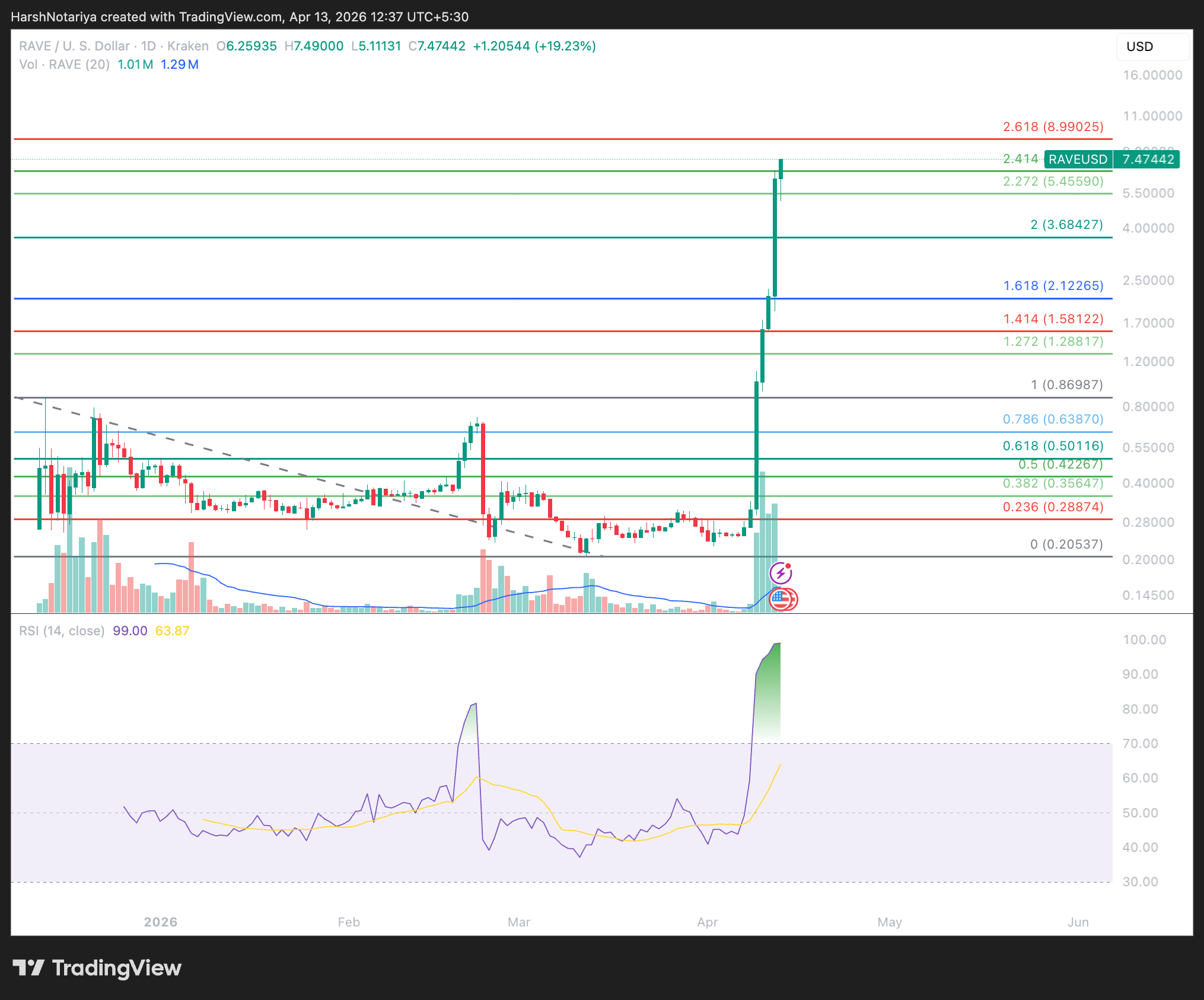
Three altcoins are flashing critical technical setups heading into the third week of April 2026. RaveDAO (RAVE), Polkadot (DOT), and Official Trump (TRUMP) each face pivotal price levels that could define short-term direction.
RAVE continues its parabolic rally with a 185% daily surge. Meanwhile, DOT struggles after a bridge exploit sent the token near all-time lows. TRUMP tests double bottom support ahead of a key holder event.
RAVE Fibonacci Extensions Point Toward $9.00 Target
RaveDAO has been one of the most explosive movers in crypto this month. The token is currently trading at $7.47, reflecting a 185% gain in the past 24 hours alone. This rally extends a larger parabolic move that has delivered gains of over 3,500% from recent lows.
The structure of the advance suggests ordered, Fib-aware positioning rather than random price action. Key Fibonacci extension levels have acted as a staircase throughout the move. The 2.272 extension at $5.45 held as intraday support.
The next major target sits at the 2.618 Fibonacci extension near $8.99. That level aligns closely with the psychological $9.00 zone. With the current price at $7.47, the gap to that target is roughly 18%.
Breakout candles carried significantly elevated volume. The current daily candle shows no signs of exhaustion wicks or upper shadow rejections. The candle body remains full, closing near its high.
Want more token insights like this? Sign up for Editor Harsh Notariya’s Daily Crypto Newsletter here.
However, manipulation concerns have emerged alongside the rally. Certain wallets reportedly deposited 18.58 million RAVE tokens onto Bitget roughly 10 hours before the pump began. The token’s low circulating supply of approximately 239 million out of a 1 billion maximum amplifies concentrated buying pressure.
On the downside, a daily close below $5.45 would crack the parabolic structure. A break below $3.68 would fully invalidate the bullish case and open the door toward $2.12.
A correction is likely due, as the RSI remains extremely overheated at 99.
DOT Falls Near All-Time Lows After Bridge Exploit
Polkadot is trading at $1.18, down 8% from Sunday’s highs. The decline follows a Hyperbridge gateway exploit that allowed an attacker to mint 1 billion bridged DOT tokens on Ethereum.
The attacker used a forged cross-chain message to change the admin of Polkadot’s token contract on Ethereum. They then minted the full supply and dumped it in a single transaction. The operation netted approximately 108.2 ETH, worth roughly $237,000.
Limited liquidity for the bridged asset capped the attacker’s profit. The exploit did not compromise Polkadot’s native relay chain or the DOT token on its own network. It targeted only the wrapped DOT representation on Ethereum.
Despite this distinction, major South Korean exchanges Upbit and Bithumb suspended DOT deposits and withdrawals as a precaution. The move added further selling pressure to an already weakened token.
DOT now trades dangerously close to its all-time low of $1.10. The token needs to reclaim the $1.22 level to stabilize. A positive development around the exploit response or network security could help restore confidence.
If DOT establishes above $1.22, it could then challenge the resistance at $1.33.
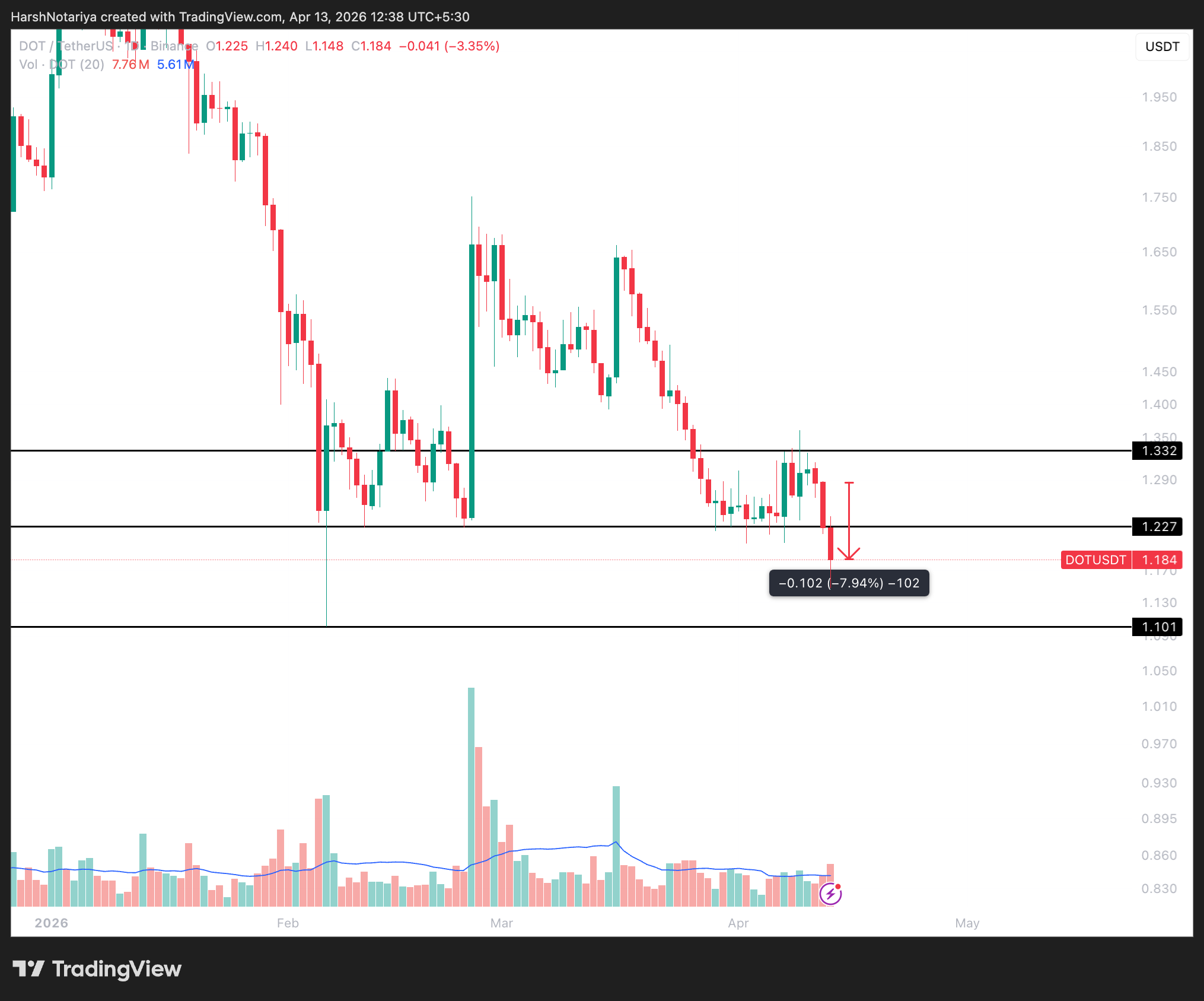
A failure to hold current levels would likely push the price toward $1.10. It could potentially fall even further below that floor.
TRUMP Price Tests Double Bottom at $2.78
Official Trump is trading at $2.81, roughly flat over the past 24 hours. The token sits near a critical support level that may form the base of a double bottom pattern.
The upcoming Mar-a-Lago crypto and business conference scheduled for April 25 has drawn attention to the token. The event offers the top 297 holders a seat at the gathering. The 29 largest whales receive VIP access to the president directly. A qualification snapshot was taken on April 10.
TRUMP needs to hold $2.78 to maintain the double bottom structure. If buyers defend that level, a breakout above the neckline at $3.08 could trigger a rally toward $3.34. That target aligns with the 0.618 Fibonacci retracement level and would represent a 19% gain from the current price.
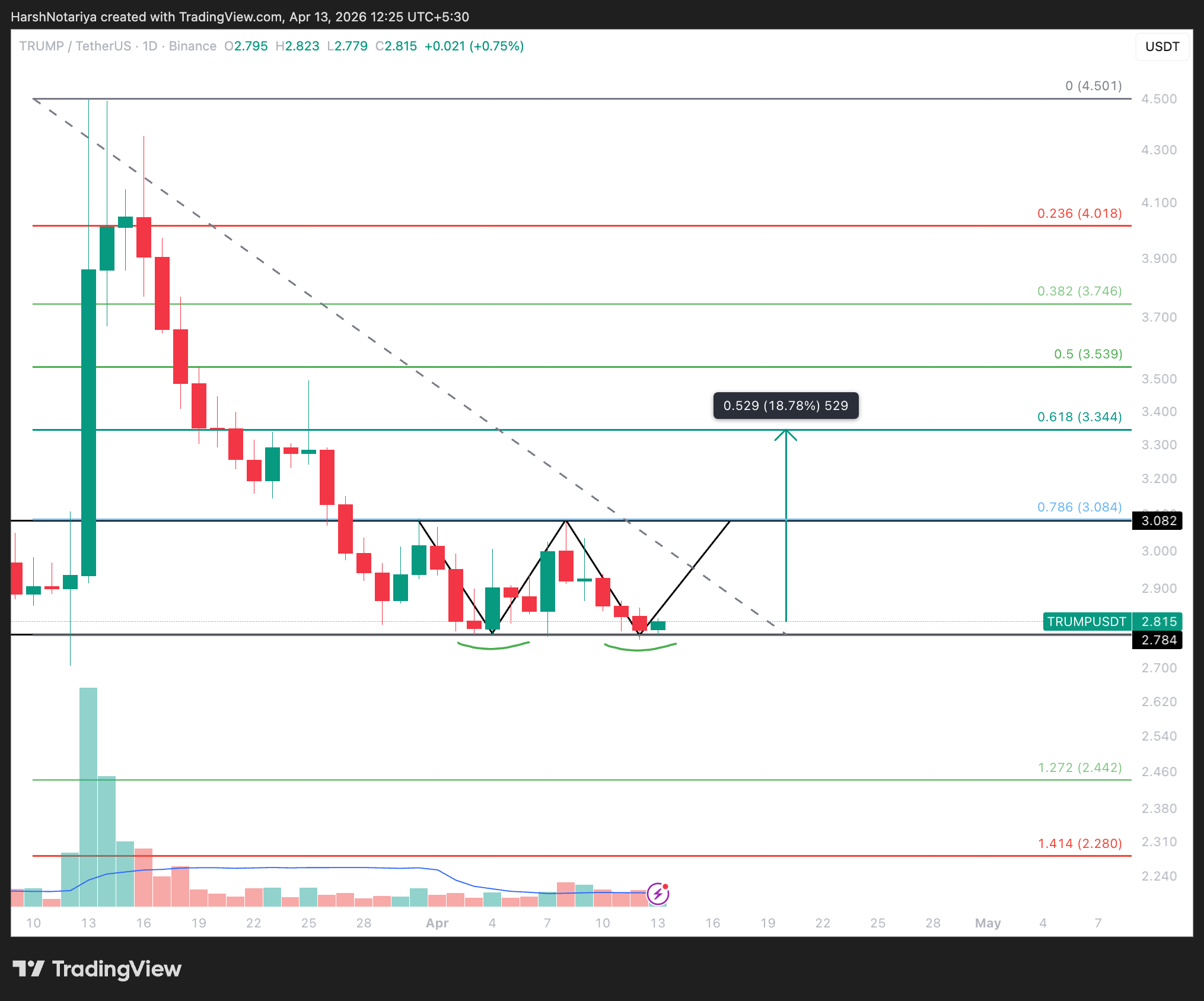
The bearish scenario emerges if the $2.78 support fails. A breakdown there would send TRUMP toward its all-time low. New lows near $2.44, the 1.272 Fibonacci extension level, could follow. The token remains roughly 96% below its all-time high of $73.43 set in January 2025.
The April 25 holder event can no longer generate significant demand, since the snapshot has already been taken. However, any positive catalyst from the event remains the key variable for TRUMP’s price action.
The post 3 Altcoins to Watch for the 3rd Week of April 2026 appeared first on BeInCrypto.


Bitcoin and artificial intelligence appear to be moving in opposite directions regarding how their power is distributed.
Summary
- Bitcoin mining is increasingly shifting toward industrial-scale operations while AI development begins to move toward smaller and more personal device applications.
- The edge AI market is projected to reach 119 billion dollars by 2033 as localized data processing and privacy needs drive a 300 percent growth rate.
- High energy costs in the United States are pushing Bitcoin hash rates toward the Global South, with Ethiopia and Paraguay emerging as major hubs for hydroelectric mining.
Galaxy Research head Alex Thorn pointed out on Sunday that Bitcoin mining, which started on simple home computers, now mostly happens in massive industrial warehouses using specialized gear. AI, however, may take the reverse route.
While AI currently lives in giant, restricted data centers, Thorn believes open-source progress is closing the gap as major models hit limits in memory and data.
“If local models keep getting smaller, cheaper, and more efficient, AI may become increasingly personal and on-device,” he noted.
Localized computing on the rise
Grand View Research estimates the global market for “Edge AI”—technology that runs locally on gadgets rather than through a central cloud—will reach $119 billion by 2033.
This represents a jump from roughly $25 billion expected in 2025. The growth stems from the explosion of connected devices and a need for instant data processing that does not rely on a distant server.
Market analysts at GVR attributed this momentum to the expansion of the Internet of Things (IoT). Industry trends show a “rising focus on data privacy and localized intelligence at the network edge,” which allows companies to automate tasks without sending sensitive information to a central hub.
Mining moves to the Global South
A separate report from the crypto exchange KuCoin on Friday showed that while Bitcoin hardware is harder for individuals to own, the locations of these machines are spreading out globally.
High electricity prices in the United States have made mining unprofitable in certain regions, with costs to produce a single coin sometimes exceeding $100,000.
Operators are now seeking cheaper energy in places like Ethiopia and Paraguay, where hydroelectric power is plentiful. Such a move helps protect the network by ensuring it isn’t tied to the politics or power grids of just one or two nations.
According to KuCoin, “this decentralization of mining power across different continents enhances the security of the network by making it less vulnerable to any single country’s political or environmental shocks.”

Uncertainty over Hogwarts Express steam train opening as season delayed due to safety upgrades

The Best Action Franchise Since John Wick Is Taking Over the World

Pope Leo XIV defies Trump over Iran war, citing Gospel


-

 Politics3 days ago
US brings back mandatory military draft registration
-

 Fashion3 days ago
Weekend Open Thread: Veronica Beard
-
 Sports3 days ago
Man United discover Nico Schlotterbeck transfer fee as defender reaches Dortmund agreement
-

 Tech6 days ago
How Long Can You Drive With Expired Registration? What Florida Law Says
-

 Politics19 hours ago
World Cup exit makes Italy enter crisis mode
-

 Crypto World4 days ago
Canary Capital Files SEC Registration for PEPE ETF
-

 Fashion7 days ago
Massimo Dutti Offers Inspiration for Your Summer Mood Board
-

 Business3 days ago
Tesla Model Y Tops China Auto Sales in March 2026 With 39,827 Registrations, Beating Cheaper EVs and Gas Cars
-

 Politics3 days ago
Malcolm In The Middle OG Turned Down ‘Buckets Of Money’ To Appear In Reboot
-

 Fashion6 days ago
Let’s Discuss: DEI in 2026
-

 Crypto World5 days ago
Bitcoin recovers as US and Iran Agree a Ceasefire Deal
-
 NewsBeat12 hours ago
Pep Guardiola and Gary Neville agree over Arsenal title problem that benefits Man City
-

 Business3 days ago
OpenAI Halts Stargate UK Data Centre Project Over Energy Costs and Copyright Row
-

 Business2 days ago
Ireland Fuel Protests Enter Day 5 as Blockades Spark Shortages and Government Prepares Support Package
-

 Politics3 days ago
LBC Presenter Mocks Trump Over Iran War Failures
-

 Crypto World2 days ago
Federal judge blocks Arizona from bringing criminal charges against Kalshi
-

 Tech3 days ago
A version of Windows 10 released a decade ago is now eligible for additional security patches
-

 Tech7 days ago
What is the release date for The Boys season 5 episodes 1 to 2 on Prime Video?
-
 NewsBeat1 day ago
JD Vance announces ‘no agreement’ with Iran over nuclear weapons fear
-
Sports2 days ago
1st-Round WR Enters Vikings Mock Draft Orbit
You must be logged in to post a comment Login