

Data quality has always been an afterthought. Teams spend months instrumenting a feature, building pipelines, and standing up dashboards, and only when a stakeholder flags a suspicious number does anyone ask whether the underlying data is actually correct. By that point, the cost of fixing it has multiplied several times over.
This is not a niche problem. It plays out across engineering organizations of every size, and the consequences range from wasted compute cycles to leadership losing trust in the data team entirely. Most of these failures are preventable if you treat data quality as a first-class concern from day one rather than a cleanup task for later.
How a typical data project unfolds
Before diagnosing the problem, it helps to walk through how most data engineering projects get started. It usually begins with a cross-functional discussion around a new feature being launched and what metrics stakeholders want to track. The data team works with data scientists and analysts to define the key metrics. Engineering figures out what can actually be instrumented and where the constraints are. A data engineer then translates all of this into a logging specification that describes exactly what events to capture, what fields to include, and why each one matters.
That logging spec becomes the contract everyone references. Downstream consumers rely on it. When it works as intended, the whole system hums along well.
Advertisement
Before data reaches production, there is typically a validation phase in dev and staging environments. Engineers walk through key interaction flows, confirm the right events are firing with the right fields, fix what is broken, and repeat the cycle until everything checks out. It is time consuming but it is supposed to be the safety net.
Once data goes live and the ETL pipelines are running, most teams operate under an implicit assumption that the data contract agreed upon during instrumentation will hold. It rarely does, not permanently.
Here is a common scenario. Your pipeline expects an event to fire when a user completes a specific action. Months later, a server side change alters the timing so the event now fires at an earlier stage in the flow with a different value in a key field. No one flags it as a data impacting change. The pipeline keeps running and the numbers keep flowing into dashboards.
Weeks or months pass before anyone notices the metrics look flat. A data scientist digs in, traces it back, and confirms the root cause. Now the team is looking at a full remediation effort: updating ETL logic, backfilling affected partitions across aggregate tables and reporting layers, and having an uncomfortable conversation with stakeholders about how long the numbers have been off.
Advertisement
The compounding cost of that single missed change includes engineering time on analysis, effort on codebase updates, compute resources for backfills, and most damagingly, eroded trust in the data team. Once stakeholders have been burned by bad numbers a couple of times, they start questioning everything. That loss of confidence is hard to rebuild.
This pattern is especially common in large systems with many independent microservices, each evolving on its own release cycle. There is no single point of failure, just a slow drift between what the pipeline expects and what the data actually contains.
Why validation cannot stop at staging
The core issue is that data validation is treated as a one-time gate rather than an ongoing process. Staging validation is important but it only verifies the state of the system at a single point in time. Production is a moving target.
What is needed is data quality enforcement at every layer of the pipeline, from the point data is produced, through transport, and all the way into the processed tables your consumers depend on. The modern data tooling ecosystem has matured enough to make this practical.
Advertisement
Enforcing quality at the source
The first line of defense is the data contract at the producer level. When a strict schema is enforced at the point of emission with typed fields and defined structure, a breaking change fails immediately rather than silently propagating downstream. Schema registries, commonly used with streaming platforms like Apache Kafka, serialize data against a schema before it is transported and validate it again on deserialization. Forward and backward compatibility checks ensure that schema evolution does not silently break consuming pipelines.
Avro formatted schemas stored in a schema registry are a widely adopted pattern for exactly this reason. They create an explicit, versioned contract between producers and consumers that is enforced at runtime and not just documented in a spec file that may or may not be read.
Write, audit, publish: A quality gate in the pipeline
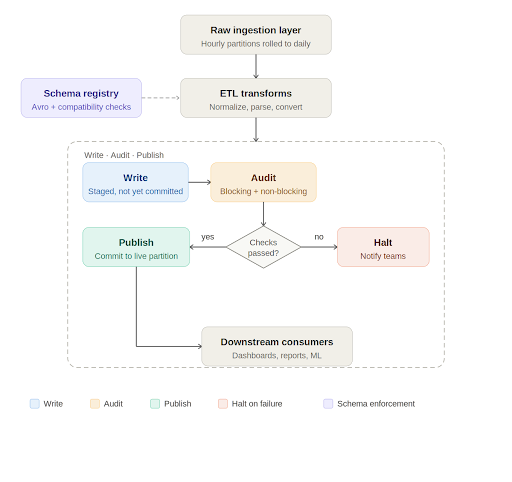
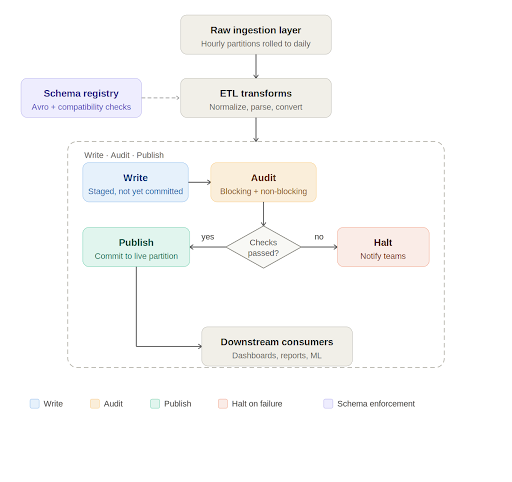
At the processing layer, Apache Iceberg has introduced a useful pattern for data quality enforcement called Write-Audit-Publish, or WAP. Iceberg operates on a file metadata model where every write is tracked as a commit. The WAP workflow takes advantage of this to introduce an audit step before data is declared production ready.
Advertisement
In practice, the daily pipeline works like this. Raw data lands in an ingestion layer, typically rolled up from smaller time window partitions into a full daily partition. The ETL job picks up this data, runs transformations such as normalizations, timezone conversions, and default value handling, and writes to an Iceberg table. If WAP is enabled on that table, the write is staged with its own commit identifier rather than being immediately committed to the live partition.
At this point, automated data quality checks run against the staged data. These checks fall into two categories. Blocking checks are critical validations such as missing required columns, null values in non-nullable fields, and enum values outside expected ranges. If a blocking check fails, the pipeline halts, the relevant teams are notified, and downstream consumers are informed that the data for that partition is not yet available. Non-blocking checks catch issues that are meaningful but not severe enough to stop the pipeline. They generate alerts for the engineering team to investigate and may trigger targeted backfills for a small number of recent partitions.
Only when all checks pass does the pipeline commit the data to the live table and mark the job as successful. Consumers get data that has been explicitly validated, not just processed.
Data quality as engineering practice, not a cleanup project
There is a broader point embedded in all of this. Data quality cannot be something the team circles back to after the pipeline is built. It needs to be designed into the system from the start and treated with the same discipline as any other part of the engineering stack.
Advertisement
With modern code generation tools making it cheaper than ever to stand up a new pipeline, it is tempting to move fast and validate later. But the maintenance burden of an untested pipeline, especially one feeding dashboards used by product, business, and leadership teams, is significant. A pipeline that runs every day and silently produces wrong numbers is worse than one that fails loudly.
The goal is for data engineers to be producers of trustworthy, well documented data artifacts. That means enforcing contracts at the source, validating at every stage of transport and transformation, and treating quality checks as a permanent part of the pipeline rather than a one time gate at launch.
When stakeholders ask whether the numbers are right, the answer should not be that we think so. It should be backed by an auditable, automated process that catches problems before anyone outside the data team ever sees them.
Some might say the venerable Z80 doesn’t need another operating system, but [Scott Baker] obviously disagrees. He has come up with a brand new, from scratch OS called NostOS for the Z80-based RC2014 homebrew retrocomputer. [Scott] describes it as CP/M-like, but it’s not CP/M– in fact, it’s totally incompatible with CP/M–and has a few tricks of its own up its sleeve.
As you might expect of an operating system for this vintage of hardware, it is “rommable” — that is, designed to run from read-only-memory, and fit inside 64kB. It of course supports banking memory to go higher than that 16 bit limit, and natively supports common serial devices, along with the good old WD37C65 floppy controller to get some spinning rust into the game. Of course if you don’t have floppies you can plug in a compact flash card– try that with CP/M– or, interestingly Intel Bubble Memory. [Scott] has a soft-spot for bubble memory, which at one point seemed poised to replace both hard drives and RAM at the same time. We also appreciate that he included drivers for vacuum fluorescent displays, another forgotten but very cool technology. Back in the day, this operating system would have enabled a very cool little computer, especially when you take his implementation of text-to-speech with the SP0256A-AL2 chip. Fancy a game of talking Zork? Yes, he ported Zork, and yes, it talks.
The whole thing is, of course, open-source, and available on [Scott]’s GitHub. Unlike too many open-source projects, the documentation is top-notch, to the point that we could picture getting it in a three-ring binder with a 5 1/4 floppy on the inside cover. If you like video, we’ve embedded [Scott]’s walkthrough but his blog and the docs on GitHub have everything there and more if you’re not into rapidly-flickering-pixels as an information exchange medium.
[Scott] isn’t wedded to Zilog, for the record; this OS should run on an Intel 8080, perhaps like the one in the Prompt 80 he restored last year.
Treasury Secretary Scott Bessent and Federal Reserve Chair Jerome Powell summoned bank executives for a meeting this week where they encouraged the executives to use Anthropic’s new Mythos model to detect vulnerabilities, according to Bloomberg.
Indeed, while JPMorgan Chase was the only bank listed as one of the initial partner organizations with access to the model, Goldman Sachs, Citigroup, Bank of America, and Morgan Stanley are reportedly testing Mythos as well.
Anthropic announced the model this week but said it would be limiting access for now, in part because Mythos — despite not being trained specifically for cybersecurity — is too good at finding security vulnerabilities. (Others suggested this was hype or simply a smart enterprise sales strategy.)
In short:OpenAI launched a new $100 per month Pro plan for ChatGPT on 9 April 2026, inserting a new tier between the existing $20 Plus plan and the $200 Pro plan and directly targeting Anthropic’s Claude Max, which is also priced at $100 per month. The new plan offers five times more Codex usage than Plus, access to the same model suite as the $200 tier, and a launch promotion that temporarily doubles that advantage: through 31 May 2026, subscribers get ten times the Codex usage of Plus. The move follows Codex crossing three million weekly users on 8 April, a growth rate the company describes as a 5x increase in three months.
What the $100 plan includes, and where it sits in ChatGPT’s pricing structure
The new plan is the sixth pricing tier in ChatGPT’s current structure, which now runs from a free account with advertising, through a $8 per month Go plan, the $20 per month Plus plan, to two versions of Pro at $100 and $200 per month, a $25 per user per month Business plan, and custom-priced Enterprise contracts. The $100 Pro plan sits directly between Plus and the existing $200 Pro tier, offering five times the Codex usage of Plus and targeting what OpenAI describes as “longer, high-effort Codex sessions” that Plus subscribers hit the ceiling on. The $200 Pro plan, by comparison, provides 20 times the Codex usage of Plus, making it four times more Codex-intensive than the new $100 tier.
Despite the difference in usage limits, both Pro tiers give access to the same model suite: the exclusive GPT-5.4 Pro model, unlimited use of GPT-5.4 Instant and GPT-5.4 Thinking, and all other features available on the $200 plan. The differentiation between the two tiers is usage volume, not capability. As a launch promotion, subscribers to the new $100 plan will receive ten times the Codex usage of Plus through 31 May 2026; after that date, the standard five times limit applies. OpenAI also announced a rebalancing of the Plus plan’s Codex allocation alongside the new tier, shifting Plus towards steadier day-to-day usage rather than allowing the longer burst sessions that the $100 plan is intended to serve.
Codex demand: the numbers that prompted the new tier
On 8 April 2026, the day before the $100 plan was announced, Sam Altman posted on X that OpenAI was resetting Codex’s usage limits across all plans “to celebrate 3M weekly codex users,” and committed to repeating the reset for every additional million users until Codex reaches ten million weekly users. Thibault Sottiaux, who leads the Codex product, stated: “Three million people are now using Codex weekly, up from two million a little under a month ago.” OpenAI described the growth trajectory as a 5x increase in the preceding three months, with 70% month-over-month user growth.
Advertisement
The 💜 of EU tech
The latest rumblings from the EU tech scene, a story from our wise ol’ founder Boris, and some questionable AI art. It’s free, every week, in your inbox. Sign up now!
The scale of that growth reflects a shift in how developers are using AI coding tools.OpenAI rolled out a dedicated Codex app for macOS in February 2026, designed to move beyond line-by-line code generation into what the company called agentic, multi-task coding workflows: orchestrating multiple agents in parallel, running background jobs, and handling instructions that span hours rather than seconds. That architecture, with its longer-running sessions and heavier compute demands, is precisely the usage pattern that the $100 plan is priced to capture. A Plus subscriber who uses Codex for extended autonomous engineering tasks hits usage limits well before their billing cycle ends; the $100 plan is designed to be the next logical tier rather than a jump to $200.
The Claude Max comparison
OpenAI made no attempt to obscure the competitive framing. The new plan is priced identically to Anthropic’s Claude Max 5x tier, which also costs $100 per month and includes elevated limits for Claude Code, Anthropic’s terminal-based agentic coding product. Claude Code has become the fastest-growing part of Anthropic’s commercial portfolio, with an estimated $2.5 billion in annualised revenue by early 2026, and Anthropic has been constructing a developer ecosystem around it:Anthropic launched a marketplace for Claude-powered enterprise software in March 2026, with launch partners including Snowflake, Harvey, and Replit, connecting enterprise buyers with third-party applications built on Claude.
Advertisement
The competitive dynamic sharpened further in the week before OpenAI’s announcement. On 4 April 2026,Anthropic banned third-party agents from Claude Pro and Max subscriptions, preventing subscribers from routing their plan’s usage limits through external frameworks such as OpenClaw; users wanting to continue using those tools must now pay separately under a new per-session “extra usage” system. OpenAI’s announcement went in the opposite direction, increasing Codex availability at the $100 price point and doubling it temporarily to mark the launch. The contrast, at the identical price, was visible enough that most coverage described the new plan as a direct response to Anthropic’s developer subscriber base.
What OpenAI’s pricing move signals
The new tier arrives during a period of accelerating commercial momentum for OpenAI.OpenAI’s $122 billion raise at an $852 billion valuation, completed in March 2026, was led by SoftBank, NVIDIA, and Amazon, and included $3 billion from individual retail investors, a structure that many analysts read as groundwork for an IPO expected as early as the fourth quarter of 2026. The company is generating $2 billion in revenue per month and has more than 50 million paid subscribers across its plans. The $100 plan is part of a deliberate effort to fill the pricing gap between $20 and $200 that had, until now, left a large segment of heavy but not enterprise-grade users without a compelling upgrade path.
The model powering the Pro tiers,GPT-5.4, which launched in March 2026 and introduced native computer usedirectly into Codex and the API, is the clearest statement of where OpenAI sees the next phase of developer adoption going: not prompting, but autonomous agents operating software, navigating file systems, and running multi-step workflows across applications for hours at a time. The $100 plan is the pricing expression of that bet. Whether it moves enough developers at the $100 Claude Max price point to make a measurable difference in Anthropic’s subscriber base will be visible in both companies’ next quarterly metrics.

Marshals, a new Yellowstone spinoff starring Luke Grimes as Kayce Dutton, is airing on CBS right now. You can also tune in with Paramount Plus. The Yellowstone sequel series sees Grimes’ former Navy SEAL join an elite unit of US Marshals to bring range justice to Montana, according to a synopsis from CBS.
The show includes Yellowstone actors Gil Birmingham as Thomas Rainwater, Mo Brings Plenty as Mo and Brecken Merrill as Tate. Spencer Hudnut is the showrunner of Marshals — formerly known as Y: Marshals — and Taylor Sheridan is an executive producer.
Advertisement
When to watch new Marshals episodes on Paramount Plus
Episode 7 of Marshals airs on CBS on Sunday, April 12. Viewing options for Paramount Plus customers vary by subscription tier. You can watch the episode live if you have Paramount Plus Premium, which includes your local CBS station. If you subscribe to Paramount Plus Essential, you can watch the installment on demand the following Monday, but not live on Sunday.
Here’s a release schedule for the next two episodes of Marshals.
Episode 7, Family Business: Premieres on CBS/Paramount Plus Premium on April 12 at 8 p.m. ET/8 p.m. PT/7 p.m. CT. Streams on Paramount Plus Essential on April 13.
Episode 8, Blowback: Premieres on CBS/Paramount Plus Premium on April 19 at 8 p.m. ET/8 p.m. PT/7 p.m. CT. Streams on Paramount Plus Essential on April 20.
You can also watch CBS and the seventh episode of Marshals without cable with a live TV streaming service such as YouTube TV, Hulu Plus Live TV or the DirecTV MyNews skinny bundle. In addition to offering a lower-cost option, Paramount Plus lets you watch the other two Yellowstone spinoffs: the prequels 1883 and 1923.
After a price increase in early 2026, the ad-supported Essential version runs $9 per month or $90 per year. The ad-free Premium version runs $14 per month or $140 per year. Paying more for Premium gives you downloads, the ability to watch more Showtime programming than Essential and access to your live, local CBS station.
In this week’s “Sunday Reboot,” a storage upgrade for the MacBook Neo, an excuse to buy many Mac minis, and the iPhones come back to Earth with a late congratulatory message.
Image credits: NASA/Overcast
Sunday Reboot is a weekly column covering some of the lighter stories within the Apple reality distortion field from the past seven days. All to get the next week underway with a good first step. This week, researchers managed to get around Apple Intelligence security measures using prompt injection techniques, a repairability report panned Apple’s hardware again, and Apple’s lawsuit with Epic Games over the App Store continued to roll on. There was also a bug found to break Mac networking every 49 days, 17 hours, two minutes, and 47 seconds. Continue Reading on AppleInsider | Discuss on our Forums
Tesla finally received approval on April 10 from the Dutch vehicle regulator, the RDW, for its Full Self-Driving Supervised system to be used on European roads. They were the first to receive approval for this advanced technology across Europe, marking a significant milestone for the company. This means that the program has been cleared to run on public roads in the Netherlands, and the distribution began the next day, April 11, for a limited number of early testers who had been patiently waiting.
Drivers with Hardware 4 (HW4) computers in their vehicles received an upgrade to version 2026.3.6, which included the European-tuned build of FSD 14.2.2.5. Before turning on the system, drivers must complete a fast tutorial followed by a mini test within the car interface. Once that’s done, they can take their hands off the wheel under appropriate situations, and cameras will watch their eyes to see if they’re paying attention. If they become distracted, the system will begin to display visual alarms, followed by sounds and vibrations if they do not return to it, and if all else fails, the car will slow down and come to a safe stop on its own.
COLLECTIBLE MODEL CAR KIT – Embark on a nostalgic journey with the LEGO Icons Ford Model T (11376) building set for adults ages 18 and up
VINTAGE CAR DISPLAY PIECE – Recreate the iconic 1910s automobile with gleaming black bodywork, golden accents, a foldback fabric roof and tall…
AUTHENTIC MODEL T FUNCTIONS – Fold back the model car’s roof, fold down the split windshield, lift the hood from both sides to see the engine, turn…
Overall, this was the product of 18 months of testing, which included more than 1.5 million kilometers of driving on European highways, as well as numerous controlled scenarios on closed tracks. Before approving the system, regulators reviewed almost 400 compliance points. The RDW pronounced it a beneficial addition to road safety, but stressed that drivers must remain in the driver’s seat and ready to take over at any time.
The European version of the software is substantially different from the one accessible in the United States. This is primarily due to the way regulators work here, which requires them to do pre-market checks, as opposed to their US counterparts’ self-certification strategy. As a result, the Dutch construction is more cautious and limits some of the more aggressive driving characteristics available elsewhere. Automatic turns at junctions and navigation-based lane changes are still accessible, but several parking-lot summoning capabilities found in the United States are not available in the Netherlands.
Advertisement
Subscribers will pay 99 euros per month to receive the system, or 49 euros per month if they already have Enhanced Autopilot. Alternatively, they can purchase it outright for 7,500 euros. Tesla claims that the system leverages billions of kilometers of real-world data collected worldwide, and Elon Musk has just stated that the RDW review process was particularly rigorous.
The Dutch approval is now a one-time occurrence, although it has a provisional validity period of at least 36 months. It means that other European states can adopt it on their own, and authorities in Germany, France, and Italy are expected to do so within the next 4 to 8 weeks. Tesla’s goal is to have the system more widely accepted across the EU by the summer, allowing millions of drivers to use it without having to repeat the testing procedure in each nation. [Source]
Apple may be late to the smart glasses market, but it could be covering all its bases with up to four potential styles for its upcoming product. According to Bloomberg‘s Mark Gurman, Apple could launch some or all of the four styles it’s currently testing for its smart glasses.
Gurman reported Apple is testing out a large rectangular frame that’s comparable to Ray-Ban Wayfarers, a slimmer rectangular design like the glasses that Apple CEO Tim Cook wears, a larger oval or circular frame and a smaller oval or circle option. Apple is also working on a range of colors, including black, ocean blue and light brown, according to Bloomberg.
Internally code-named N50 for now, Apple’s upcoming smart glasses will compete directly with the second-gen Ray-Ban Meta model. While similar, Apple might be differentiating its design with “vertically oriented oval lenses with surrounding lights,” according to the report. Like Meta’s smart glasses, Apple’s upcoming product will capture photos and videos, but is meant to better sync with an iPhone, allowing users to take advantage of Apple’s ecosystem for editing, sharing, phone calls, notifications, music and even its voice assistant, according to Gurman. The release of Apple’s smart glasses could even coincide with the upcoming improved Siri that should arrive with iOS 27.
Gurman reported that Apple could reveal its smart glasses as soon as the end of 2026 or early 2027, followed by an official release sometime in 2027. As for the competition, Meta released its latest model that’s better suited for prescription lenses and offers a more customizable fit.
Apple didn’t position its most affordable MacBook as a gaming machine. The MacBook Neo, a budget-leaning laptop that runs on Apple’s A18 Pro chip, the same chip that powers the iPhone 16 Pro models, has been put through a Windows 11 gaming test for YouTuber ETA Prime.

Turns out, the results are genuinely surprising. Using Parallels Desktop, a virtualization app (paid) with 3D hardware acceleration, the channel ran Windows 11 ARM directly on the Neo’s 8GB RAM (allocating 5GB to the virtual environment), and it did better than most people would think it would.
What games actually ran well?
Dirt 3 held 75 fps at 1200p on high settings, while Portal 2 cleared 100 fps on medium settings. Skyrim, on the other hand, maintained roughly 60 fps at 1200p resolution on medium graphics settings, while Marvel Cosmic Invasion averaged around 60 fps at the maximum resolution.
Advertisement
What helped performance was games running as native Windows-on-ARM applications. However, GTA V was among the notable stumbles, as the frame rates through the Parelles weren’t playable at all. However, according to Notebookcheck, the game runs acceptably via Crossover.
MacBook NeoApple
Why does this matter for everyday MacBook Neo users?
For users who work on their Mac but occasionally enjoy playing Windows-only games, MacBook Neo’s ability to run native titles via the Parallels app comes as good news. The cost? Parallels Desktop’s Standard tier costs $99.99 per year, which could add to your weekend leisure sessions.
Anyways, the bigger takeaway is that the MacBook Neo, even with 8GB of RAM (highlighted as a constraint in the video), can run low-to-mid-range Windows games. It also changes the notion around budget Apple hardware being primarily for productivity-based tasks.
Summer heat makes any travel difficult, especially if you’re transporting groceries and / or cold drinks. Drivers are frequently forced to rely on old, simple coolers with ice that melts faster than a popsicle on a hot day, leaving everything wet by the time they reach. That’s where the BougeRV 23-quart unit, priced at $159.97 (was $189.99), comes in, a more practical solution that plugs directly into your car’s normal 12V socket and keeps items perfectly chilled without any of the fuss.
The unit is 22 inches long and weighs just more than 21 pounds, so it can fit into even the smallest trunks or backseats. It also has a built-in handle, making it simple to pull out at a rest break or transport home after a long shopping excursion. Inside, there’s enough space for a couple days’ worth of food or a full load of drinks and snacks for a family road trip.
What You Get: The CR22 12V refrigerator comes with a 2-year Tech Support. If you have any questions about the product, please REACH OUT TO BougeRV, as…
Fast Cooling Down to 32℉: With Compressor refrigeration technology, this 12v car refrigerator could achieve 15 min fast cooling from 77℉ to…
45W Low Power Consumption: With ECO energy saving mode, this 23 Qt portable refrigerator’s operating power is less than 36W. Even running on MAX…
It’s powered by a 12-volt socket, which is found in practically every modern automobile, and there are alternatives for residential outlets or even solar power if you are parked for an extended period of time. The compressor system kicks in quickly, about 15 minutes, and maintains a consistent temperature between 8 degrees below zero and 50 degrees Fahrenheit, allowing you to choose between fridge and freezer mode as needed.
Advertisement
The portable fridge uses very little energy (around 36 watts in environment mode), and the smart cycling keeps your daily power consumption under one kilowatt-hour even on the warmest days. To be on the safe side, there’s a built-in battery monitor that will turn it off before it consumes your vehicle’s battery, so you don’t have to worry about that.
People who have used it on road trips note that it works effectively, keeping perishables from spoiling without having to constantly add ice, and it absorbs bumps in the road well, even while traveling at a 30-degree angle. If you’re only running to the store for a quick shopping trip, the fridge will keep running until you return home, even if you get stopped in traffic.
FCC rules block new foreign routers while old, vulnerable ones stay in homes longer
ISP customers cannot upgrade routers even when security risks become widely known
Router approvals now depend on waivers that may slow down nationwide replacements
The Federal Communications Commission (FCC) has issued new rules intended to address security risks posed by routers produced outside the United States.
The new FCC rules require all new models of non-US-produced routers obtain a waiver before they can be sold to American consumers.
Article continues below
Advertisement
Waiver requirement adds pressure
However this creates a direct problem for the 71% of American households that receive their routers from internet service providers rather than buying their own equipment.
Those consumers cannot simply go to a store and purchase a compliant router when rules change, because the hardware in their homes belongs to the ISP.
Advertisement
Internet service providers operate on tight margins and typically replace customer routers only when necessary — especially for small business router needs amid rising costs
“To our knowledge consumer-grade Wi-Fi routers available in the U.S. are manufactured nearly exclusively in China, Taiwan, and Vietnam,” said Claus Hetting, CEO of Wi-Fi NOW.
Sign up to the TechRadar Pro newsletter to get all the top news, opinion, features and guidance your business needs to succeed!
“Foreign manufacturing cannot easily be relocated since it is typically based on long-term contracts with foreign manufacturing entities. Such contracts will be costly to terminate.”
Advertisement
Under the new FCC rules, ISPs must source compliant hardware for their millions of subscribers, but the supply chain for US-made Wi-Fi routers does not currently exist.
Without compliant hardware to purchase, ISPs have little incentive to retire the routers already deployed in customers’ homes.
“It is not possible to build a consumer router based entirely on U.S. components; that part of the supply chain doesn’t exist in the United States,” added analyst Avi Greengart of Techsponential.
Advertisement
Figures from Ookla claim roughly 28% of Speedtest results in the US came from devices connected via Wi-Fi 5, while approximately 7% used Wi-Fi 4 or older.
These older standards typically lack the advanced security protocols of newer Wi-Fi generations, leaving them more exposed to the very threats the FCC aims to address — particularly for high-demand gaming router setups.
The rules could paradoxically slow adoption of newer technologies like Wi-Fi 6E and Wi-Fi 7, because ISPs facing compliance headaches may simply delay all router upgrades rather than navigate the waiver process for foreign-made equipment.
The FCC’s intention to secure American networks is clear, but the practical effect on several households could be the opposite of what it intends to do.
Advertisement
Until the waiver process proves workable or domestic manufacturing materializes, these households may remain stuck with the same outdated, potentially insecure routers.
The rules assume that restricting foreign-made equipment will improve security, but leaving old hardware in place longer may actually increase the high risk the FCC is trying to eliminate.
You must be logged in to post a comment Login