

Crypto World
WLFI threatens Justin Sun after he accuses project of deceptive DeFi dealings

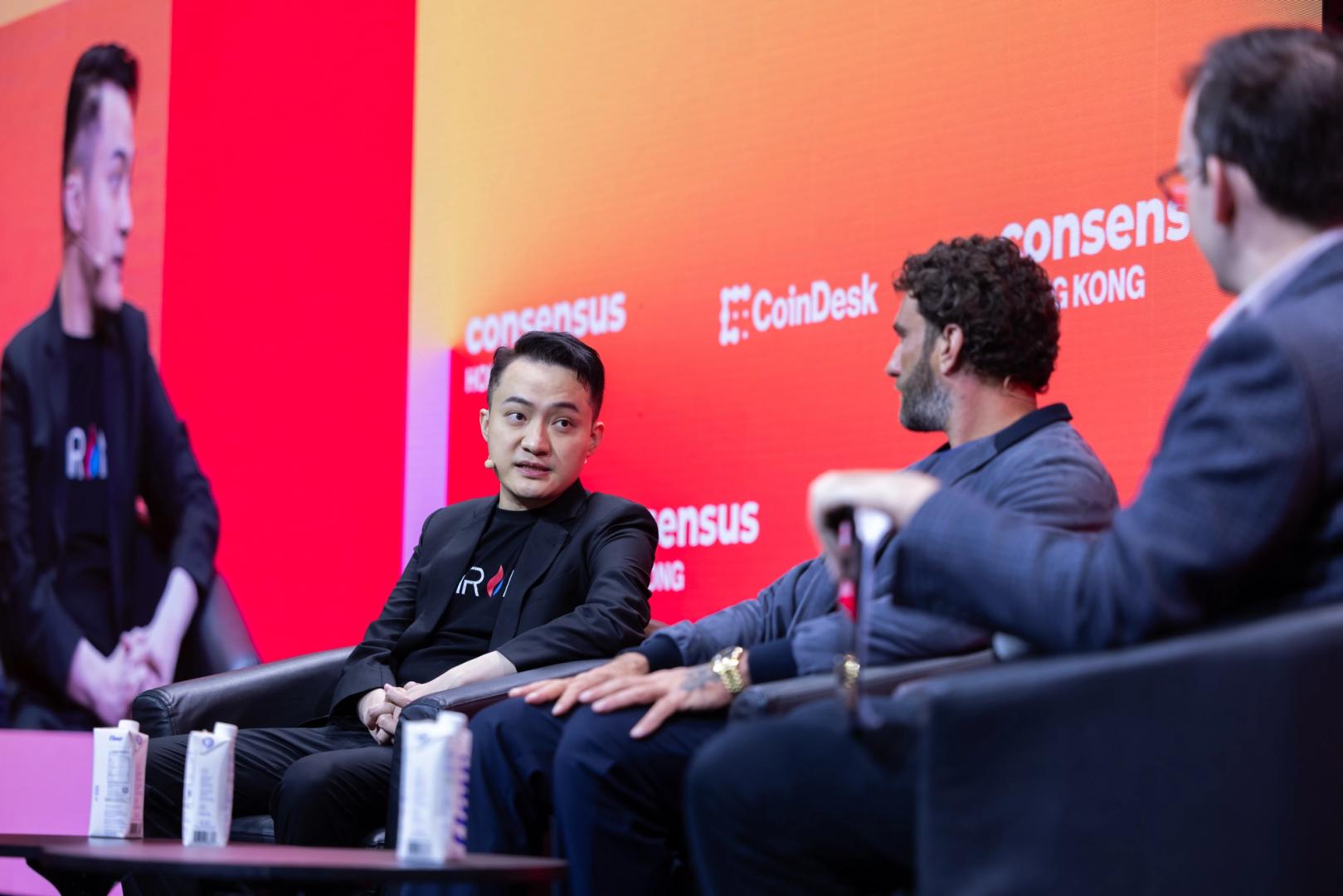
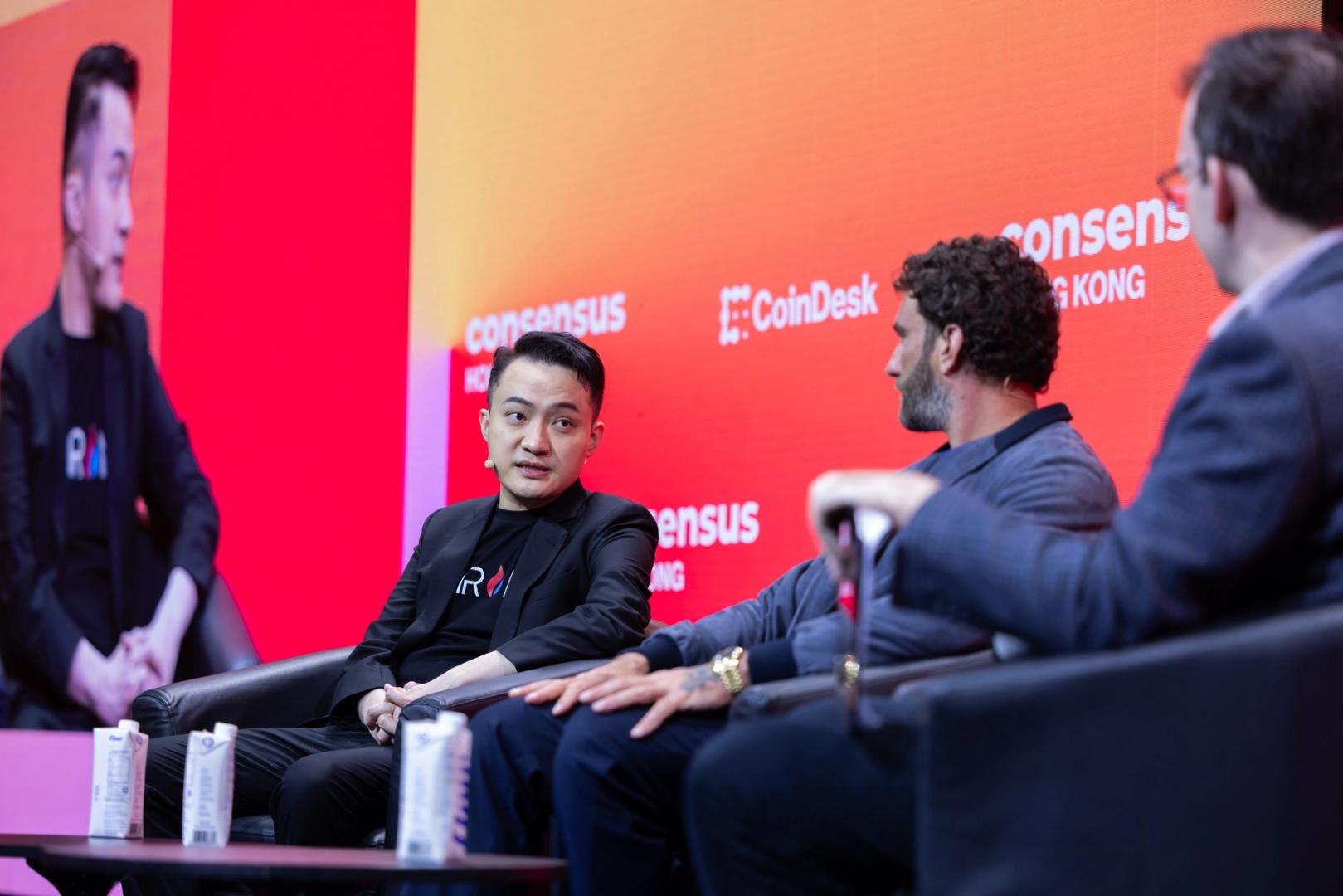
escalated its dispute with Justin Sun into a potential legal fight late Sunday, as tensions over its recent loan to a connected DeFi project spilled into public confrontation.
“Does anyone still believe @justinsuntron?” the project wrote on X. “We have the contracts. We have the evidence. We have the truth. See you in court pal.”
Does anyone still believe @justinsuntron ?
Justin’s favorite move is playing the victim while making baseless allegations to cover up his own misconduct.
Same playbook, different target. WLFI isn’t the first.
We have the contracts. We have the evidence. We have the truth.
See…
— WLFI (@worldlibertyfi) April 12, 2026
The legal threat came after Sun accused the Donald Trump-linked WLFI team of treating its users as personal ATMs after the latter deposited 5 billion WLFI tokens as collateral on the DeFi lending platform Dolomite to.borrow about $75 million in stablecoins.
“Every action taken by the WLFI team to extract fees from users and to treat the crypto community as a personal ATM is illegitimate,” Sun wrote on Sunday.
In September, Sun had his WLFI tokens frozen with the project alleging the Tron founder attempted to sell the tokens to cash out early. Sun denied the allegations, and on-chain data backs him up.
“Whoever is hiding behind this official account, step forward and identify yourself,” Sun wrote back to WLFI.
Whoever is hiding behind this official account, step forward and identify yourself. Every action taken by the WLFI team to secretly implant backdoor controls over user assets, to freeze investor funds without disclosure or due process, and to treat the crypto community as a…
— H.E. Justin Sun 👨🚀 🌞 (@justinsuntron) April 12, 2026
“As the largest investor in this project, I demand that those responsible come forward by name, instead of hiding in the shadows,” he continued.
The clash marks a sharp escalation in a feud between WLFI and one of its earliest backers, shifting the dispute from governance and capital use into open legal territory.
This animosity between the two is a start contrast from last year, where WLFI credited Sun at Consensus Hong Kong with helping lift the project out of a slow start.
“This guy,” WLFI co-founder Zak Folkman said on stage at Consensus, “saw that regardless of the outcome, this project is a monumental move forward for the entire crypto community.”


Key Takeaways
- Shares of HPE surged 12.64% to $43.04 on Friday, capping an impressive ~80% gain year-to-date before Tuesday’s fiscal Q2 2026 earnings release
- Analysts project Q2 earnings per share of $0.54 versus $0.38 in the prior-year period, with management guiding revenue between $9.6B and $10.0B
- Last quarter saw Networking revenue explode 152% (aided by Juniper Networks acquisition), now contributing over 50% of total operating profit
- The company began Q2 carrying a record $5.0 billion backlog in AI Systems; supply chain bottlenecks pose key execution challenges
- While the consensus rating is Moderate Buy, the mean analyst price target of $33 suggests potential downside of ~23% from current levels
Hewlett Packard Enterprise (HPE) enters its fiscal second quarter 2026 earnings announcement riding significant momentum. Shares closed at $43.04 Friday following a 12.64% single-day gain, then advanced to $44.31 during extended trading.
Hewlett Packard Enterprise Company, HPE
This performance translates to approximately 80% appreciation since the start of the year — positioning HPE among the top performers in enterprise technology for 2025.
The company releases quarterly results after Tuesday’s closing bell. Consensus estimates call for earnings of $0.54 per share, representing growth from $0.38 reported in last year’s comparable quarter. Management’s revenue guidance ranges from $9.6 billion to $10.0 billion.
The Street’s EPS forecast aligns with the upper end of HPE’s own projected range of $0.51 to $0.55 — establishing high expectations with minimal cushion.
Previous quarter delivered strong performance
The fiscal first quarter provided substantial positive catalysts for investors. HPE delivered revenue of $9.3 billion, marking 18% year-over-year expansion, while achieving record non-GAAP earnings per share of $0.65. The company generated $708 million in free cash flow.
Networking emerged as the clear winner among business segments. This division posted 152% reported revenue growth, substantially boosted by the completed Juniper Networks acquisition. Networking now accounts for approximately 30% of total company revenue and exceeds half of consolidated operating profit.
This fundamental shift in HPE’s business composition has fueled much of the bullish investor sentiment throughout 2025.
AI pipeline strength meets supply constraints
HPE carried a record $5.0 billion AI Systems backlog into the second quarter. The company secured $1.2 billion in new AI Systems orders during the first quarter alone.
Market participants will scrutinize conversion rates from backlog to recognized revenue. Leadership has established a goal of $1.7 billion to $1.9 billion in cumulative networks-for-AI bookings through fiscal year-end 2026.
On the challenge front, HPE has identified memory component and NAND flash shortages as persistent headwinds. These supply limitations can restrict shipment volumes and elevate input costs. The company previously reduced its Cloud & AI revenue growth projection to mid- to high-single digits, with segment operating margin expectations in the 7% to 9% range.
Wall Street targets trail share price significantly
Among 11 covering analysts, HPE holds a Moderate Buy rating — comprising eight Buy recommendations, three Hold ratings, and zero Sell calls. However, the average price target stands at $33, indicating approximately 23% potential downside from current trading levels.
Wells Fargo and Morgan Stanley maintain neutral Hold stances, assigning targets of $26 and $25–$33 respectively. Evercore ISI, J.P. Morgan, and Citi express greater optimism with Buy ratings, though even their price objectives hover near or beneath the present stock price.
This creates a compelling scenario heading into Tuesday’s announcement. Meeting consensus expectations alone may prove insufficient to extend the rally — investors will likely demand raised full-year guidance from management to sustain upward momentum.
Shares ended Friday’s regular session at $43.04, gaining 12.64%, before climbing to $44.31 in after-hours activity.


Key Takeaways
- Situational Awareness LP, managed by Leopold Aschenbrenner, disclosed a fresh stake in HIVE during Q1 2026, acquiring approximately 3.4 million shares.
- BUZZ HPC, a HIVE subsidiary, revealed plans on May 18 for a 320 MW AI “gigafactory” located in the Greater Toronto Area, supported by a $58M land purchase and estimated CAD $3.5B in total capital needs.
- Shares jumped 34% on announcement day and eventually rose more than 50% from April’s lows to approximately $4.10.
- Cantor Fitzgerald upgraded its price target to $4.60 from $3 while maintaining an Overweight rating; Northland Securities initiated coverage with a Buy rating.
- Consensus among eight analysts stands at Strong Buy, with an average price target of $6.75—representing approximately 51% potential upside from current trading levels; the street-high target reaches $10.
HIVE Digital Technologies (HIVE) has experienced significant momentum in recent weeks. Between institutional interest from a prominent hedge fund, a transformative infrastructure announcement, and a substantial stock price rally, the company has captured considerable market attention.
HIVE Digital Technologies Ltd., HIVE
On May 18, BUZZ HPC—a subsidiary of HIVE—announced ambitious plans to develop a 320-megawatt AI gigafactory situated in the Greater Toronto Area. To facilitate this massive undertaking, the company secured approximately 25 acres of land through a $58 million acquisition.
When fully operational, this facility is designed to accommodate over 100,000 GPUs. Total capital requirements are estimated at CAD $3.5 billion, with the company targeting a launch during the latter half of 2027.
Investors responded swiftly and decisively. HIVE stock surged 34% by mid-morning trading on May 18, subsequently reaching $3.92—representing approximately 45% appreciation from the May 15 closing price of $2.69.
The upward trajectory continued throughout the following sessions. By May 22, shares settled near $4.10, completing a rally exceeding 50% from April’s trough levels in the $2.24–$2.50 range.
Wall Street Analysts Respond
The Toronto gigafactory announcement prompted immediate reactions from the analyst community. On May 19, Cantor Fitzgerald elevated its price target on HIVE to $4.60 from a previous $3 while reaffirming its Overweight rating.
Analyst Brett Knoblauch highlighted anticipated compute capacity shortages throughout 2026 and 2027 as fundamental catalysts supporting demand for HIVE’s infrastructure capabilities. Importantly, he emphasized that the updated target doesn’t completely incorporate the 320 MW expansion—suggesting additional upside potential remains unaccounted for.
Northland Securities initiated coverage with a Buy rating on the same date.
Among the eight analysts tracking HIVE, the consensus recommendation stands firmly at Strong Buy. The mean price target reaches $6.75, indicating approximately 51% upside potential from present levels. The most optimistic forecast on Wall Street stands at $10.
Institutional Capital Flows
From an institutional perspective, Leopold Aschenbrenner’s Situational Awareness LP revealed a newly established position in HIVE through its Q1 2026 13F regulatory filing. The holding encompasses nearly 3.4 million shares.
Aschenbrenner, a former OpenAI researcher who founded Situational Awareness LP, has become recognized for his strategic focus on AI infrastructure as a compelling long-term investment opportunity.
HIVE’s GPU cloud infrastructure continues expanding toward 11,000 active units. Company leadership has established an Annual Recurring Revenue target of $225 million specifically from high-performance computing operations.
The BUZZ HPC division represents a cornerstone of the investment thesis. This strategic pivot reduces HIVE’s historical dependence on cryptocurrency operations while establishing a more predictable, recurring revenue framework anchored in enterprise AI compute requirements.
HIVE maintains data center facilities across Canada, Sweden, and Paraguay. The company’s shares trade on both the Nasdaq and TSX exchanges under the HIVE ticker symbol.
Full fiscal year 2026 financial results are scheduled for release on June 1, followed by a management earnings call on June 2.
The cryptocurrency market continues into the weekend on a calmer note following what was surely a rather volatile week of trading.
Bitcoin’s price is attempting to stabilize near an important short-term resistance area, while some altcoins are outperforming sharply, led by Worldcoin’s double-digit daily surge.
BTC Pushes Toward $74,000
Bitcoin has remained relatively calm during the weekend trading session after a volatile few days. The cryptocurrency is still fighting to press above an important short-term resistance level.
BTC’s price trades slightly below $74K at the time of this writing, gaining roughly 0.5% over the past 24 hours. It’s evident that buyers are trying to recover some ground following the market-wide pullback that took place last week.
The most recent price action comes as the broader cryptocurrency market stabilizes, with total capitalization hovering around $2.58 trillion, according to CoinGecko. Bitcoin’s dominance remains above 57%. However, the momentum remains fragile, as traders continue to watch macro headlines, with Trump saying they are under no deadline to strike a deal with Iran, meaning uncertainty is likely to continue for the time being.

Worldcoin (WLD) Leads Altcoin Gainers
The altcoin market saw mixed results over the past 24 hours, although several large-cap names posted strong daily moves.
Worldcoin (WLD), the Sam Altman-linked project, stole the show after increasing by about 11% to jump around $0.33. Other top gainers from the top 100 cryptocurrencies by total market cap include Venice Token (VVV), Humanity (H), and Midnight, all of which post notable advances.
BNB and TOn also sttod out among the larger-cap assets with gains of more than 7%.
On the flipside, Monero’s XMR was the weakest top-100 performer, dropping by roughly 8%, while most other major altcoins saw more modest moves.

The post Sam Altman-Backed Crypto Explodes 10% Today as Bitcoin Eyes $74K: Weekend Watch appeared first on CryptoPotato.
Crypto World
Hims & Hers Health (HIMS) Stock Surges 6.8% Following Board Member’s $1.2 Million Share Purchase

Key Takeaways
- David Wells, board member, acquired 48,400 shares of HIMS worth approximately $1.2 million — marking his first market purchase in almost five years.
- The transaction triggered a 6.8% surge in HIMS stock price, reaching $25.46 the next trading session.
- Year-to-date, HIMS has declined over 21% in 2026, significantly trailing the S&P 500’s 9.9% advance.
- Shares plummeted more than 14% in early May following disappointing first-quarter earnings.
- The telehealth company is transitioning away from compounded GLP-1 medications as major pharmaceutical companies regain dominance.
David Wells, a board member at Hims & Hers Health (HIMS), acquired 48,400 shares this Tuesday, paying between $24.19 and $24.25 per share in a transaction totaling approximately $1.2 million. This purchase increased his holdings to 224,400 shares and represents his first acquisition on the open market since August 2021.
Hims & Hers Health, Inc., HIMS
The market responded positively to the announcement. HIMS stock surged approximately 6.8% to reach $25.46 during the trading session following the filing disclosure, with market participants interpreting the insider transaction as a bullish signal.
Wells, who previously held the position of Chief Financial Officer at Netflix and joined the Hims board in 2020, had exclusively been divesting shares in recent periods — disposing of 260,000 shares during February 2024 and an additional 40,000 in November of that year. His decision to switch from seller to buyer after nearly half a decade caught the attention of market observers.
Challenges Facing HIMS in 2026
Shares of HIMS have tumbled more than 21% year-to-date, dramatically underperforming the S&P 500’s 9.9% appreciation. This performance gap highlights the company’s current difficulties.
Earlier this month, the stock experienced a sharp 14% decline following the release of first-quarter financial results that fell short of analyst projections. The telehealth provider reported a quarterly deficit and revenues that failed to meet Wall Street’s forecasts — disappointing outcomes for stakeholders.
A major headwind for investors has been the evolution of the company’s GLP-1 medication segment. During periods when branded weight-loss pharmaceuticals from Novo Nordisk and Eli Lilly faced supply constraints, Hims experienced rapid expansion by providing more affordable compounded alternatives. However, with supply chains now normalized, these pharmaceutical giants are recapturing their market position.
Strategic Realignment From Compounded GLP-1 Products
This past March, Hims announced a partnership to distribute Novo’s branded weight-loss pharmaceutical products directly via its digital platform, substituting the compounded formulations it had previously provided. Subsequently, in April, the company expanded its platform capabilities to enable healthcare providers to issue prescriptions fulfilled through independent pharmacy networks, including LillyDirect.
This represents a substantial strategic transformation. Compounded GLP-1 treatments had evolved into a fundamental component of how Hims differentiated itself to consumers and the investment community. Sustaining revenue momentum while navigating this transition represents the company’s current operational hurdle.
Separately, Wells was granted 957 restricted stock units on May 20, consistent with routine director compensation structures.
As of Wednesday’s market close, HIMS was valued at $25.46, reflecting a 6.8% gain on the day the purchase disclosure became public.


Alephium’s (ALPH) TokenBridge was drained of approximately $815,000 after an attacker exploited a flaw that allowed forged messages to pass through the protocol’s guardian network and authorize fraudulent token transfers.
The Alephium team confirmed that blockchain security firm Blockaid was the first to detect the exploit. The Security Alliance’s SEAL_911 emergency response unit also provided assistance and responsiveness throughout the subsequent investigation.
Exploit Drains $815,000 in Under 7 Minutes
The attacker moved funds from the Alephium TokenBridge on both Ethereum and BNB Chain in roughly seven minutes. On Ethereum, losses included 200,967 Tether (USDT), 17,594 USD Coin (USDC), 5.18 Wrapped Ether (WETH), and 0.335 Wrapped Bitcoin (WBTC).
An additional 36,750 USDT and 24.386 Wrapped BNB were removed from the BNB Chain side of the bridge. The attacker also minted 13.76 million unbacked wrapped ALPH and transferred them directly to their wallet.
Alephium shut down the bridge and stated that it is exploring all options to make affected users whole.
The incident adds to a worsening picture for cross-chain infrastructure in 2026. April crypto hack losses reached $606 million, and the May DeFi hack tally has continued to climb heading into June.
A CrossCurve bridge exploit and a Hyperbridge exploit, both revised to $2.5 million, also contributed to the year’s total.
Forged Messages, Not Stolen Keys
Developers built the Alephium TokenBridge on a fork of the Wormhole protocol, which relies on a guardian network to validate cross-chain messages. A quorum of guardians must sign off on any transfer, making the ability to inject fraudulent messages a high-impact vulnerability.
Initial reports attributed the breach to compromised guardian private keys, drawing comparisons to the Gravity Bridge key compromise that cost $5.4 million earlier in 2026. Alephium’s post-incident update contradicts that framing.
“The exploit does not appear to have involved a compromise of guardian private keys. Instead, it appears to have involved an exploit that allowed forged malicious events/messages to be observed and signed by guardians,” says Alephium
The distinction matters. A key compromise point to an operational failure, while a forged-message attack indicates a flaw in how the bridge validated incoming data before presenting it to guardians.
A similar dynamic emerged in the Polkadot bridge exploit, where the attacker fraudulently validated transactions and minted unbacked tokens. Alephium said a full technical postmortem from its team is forthcoming.
The post Fake Bridge Messages Let Hacker Drain $815,000 From Alephium appeared first on BeInCrypto.
Crypto World
GlobalFoundries (GFS) Stock: CFO Maps Out 40% Margin Plan as Silicon Photonics Revenue Targets $1B

Key Highlights
- The chipmaker is pursuing gross margin objectives of 30% by 2026, 40% by late 2028, and 45% over the longer term, supported by improved product mix, technology services expansion, and operational efficiency gains.
- The company has identified silicon photonics as a critical growth vertical, establishing a $1B revenue run rate target for late 2028 and eyeing $2B in the extended timeframe, primarily driven by data center applications.
- Investment in capital expenditures is climbing to $1.3B–$1.4B for the current year, representing a significant increase from the historical net CapEx range of 7–10% of total revenue.
- Michael Hogan, Chief Strategy Officer, divested 2,800 shares at $82.88 per share on May 27, generating proceeds of $232,064, executed through a Rule 10b5-1 trading arrangement.
- The semiconductor manufacturer exceeded Q1 2026 projections with earnings per share of $0.40 versus consensus estimates of $0.35, alongside revenue of $1.63B, and announced a $0.12 quarterly dividend payment.
GlobalFoundries (GFS) stock was changing hands at $79.40, reflecting a decline of approximately 1.5%, during the reporting period. The equity has fluctuated between $31.51 and $92.55 throughout the trailing twelve months — a trading range that illustrates significant volatility.
CFO Sam Franklin presented a comprehensive margin expansion strategy during a TD Cowen investor conference earlier this week. The semiconductor foundry is establishing an exit gross margin benchmark of approximately 30% in 2026, advancing to 40% by the conclusion of 2028, with an ultimate objective of reaching 45%.
According to Franklin, the approximately 10 percentage point expansion anticipated between 2026 and 2028 derives from four fundamental pillars: enhanced product mix, expanded technology services, improved manufacturing efficiency, and operational scale. Product mix optimization alone is projected to deliver roughly five margin points, Franklin indicated.
The communications infrastructure and data center business segments experienced growth just below 30% in the prior year and approximately 32% during Q1 2026. Franklin anticipates this division will expand in the high-30% range throughout the complete fiscal year.
Technology services — which have historically represented 8–10% of total revenue — exceeded 13% in Q1 and are projected to stabilize between 12–14% over the long term. The company’s acquisition of MIPS combined with the in-progress transaction for Synopsys’ ARC IP portfolio represent strategic moves into RISC-V technology capabilities.
Silicon Photonics Emerges as Strategic Priority
Franklin described a two-phase approach to silicon photonics market development. The initial phase centers on pluggable optical transceivers, where GlobalFoundries claims it maintains a competitive advantage following its AMF acquisition completed last year.
The subsequent phase involves co-packaged optics technology, with an anticipated market inflection point occurring in late 2028 extending into 2029. The semiconductor foundry has established a $1B silicon photonics revenue target for the 2028 exit, with a $2B objective over an extended horizon.
Franklin emphasized that GlobalFoundries and TSMC represent the only manufacturers with “fully fledged” co-packaged optics platforms currently achieving tape-out status in the marketplace. The company documented two tape-outs utilizing its co-packaged optics platform during Q1 exclusively.
Capital investment is being elevated to $1.3B–$1.4B for the current fiscal year, constituting 15–20% of revenue — a substantial increase from the 7–10% allocation in prior years. Franklin clarified that silicon photonics represents a significant beneficiary of this capital allocation, though not the exclusive recipient. FDX technologies and silicon germanium solutions for data center transimpedance amplifier drivers also received capital allocation emphasis.
Regarding satellite communications, low Earth orbit revenue is projected to reach approximately $100M in 2025, escalating from virtually zero in 2024. The manufacturer also referenced a $375M CHIPS R&D funding award connected to quantum computing initiatives as validation of its position in emerging technology sectors.
Executive Stock Transaction and Shareholder Returns
On May 27, Chief Strategy Officer Michael Hogan executed a sale of 2,800 GFS shares at an average price of $82.88, generating total proceeds of $232,064. The stock disposal was conducted pursuant to a pre-established Rule 10b5-1 trading framework. Hogan has completed multiple transactions dating back to March, with execution prices spanning from $43.25 to $82.88.
GlobalFoundries has also announced a quarterly dividend distribution of $0.12 per share, scheduled for payment on July 14, with a shareholder record date of June 24. The board of directors authorized $500M in share repurchase authority at the beginning of the year, with approximately $400M already executed.
Wall Street consensus currently includes eight analysts rating GFS as a Buy, eleven maintaining a Hold recommendation, and one issuing a Sell rating. The average analyst price target stands at $69.88.

Key Takeaways
- Nvidia and Microsoft are set to introduce Windows PCs featuring Nvidia processors as early as next week.
- The announcement coincides with Taiwan’s Computex trade show and Microsoft’s Build developer conference in San Francisco.
- Dell and Microsoft’s Surface lineup are anticipated to be among the initial manufacturers offering these Nvidia-based systems.
- Microsoft plans to introduce software enabling AI agents to execute tasks locally on Windows platforms.
- NVDA shares finished Friday’s session at $211.14, declining 1.45%.
A partnership between Nvidia and Microsoft is poised to introduce Windows-based PCs utilizing Nvidia processors as the core processing unit as soon as next week, based on reporting from Axios.
The reveal is timed to coincide with two prominent industry gatherings: Taiwan’s Computex technology exhibition and Microsoft’s Build developer summit taking place in San Francisco.
Microsoft’s flagship Surface product range is anticipated to lead the charge in adopting this Nvidia-based technology. Dell has also been identified as an initial manufacturing partner for this initiative.
NVDA concluded Friday’s trading at $211.14, representing a 1.45% decrease.
Nvidia Expands Into Personal Computing Processors
The personal computer processor landscape has traditionally been controlled by Intel and AMD, though Qualcomm has recently gained traction with Arm-architecture chips designed for Windows notebooks.
Nvidia’s entrance into this sector introduces another formidable competitor to an already crowded marketplace. Apple’s M-series silicon has already established impressive benchmarks for battery longevity and on-device AI performance across its MacBook product family.
This reported Nvidia initiative emerges as Microsoft seeks processors capable of delivering enhanced on-device AI functionality combined with superior power efficiency.
Microsoft is simultaneously preparing to launch software that allows AI agents to perform operations directly on Windows devices, eliminating dependence on cloud-based processing.
This development connects the hardware introduction to a larger industry movement toward localized AI computation on portable and desktop computers.
Financial Analysis and Valuation
Nvidia’s present trading price of $211.14 remains significantly beneath its GF Value calculation of $334.32, indicating a possible undervaluation of approximately 36.8%, based on GuruFocus analytics.
The company’s P/E ratio currently registers at 32.33x, considerably lower than its five-year median of 60.92x, demonstrating a reduced valuation compared to historical norms.
GuruFocus assigns NVDA a GF Score of 96 out of 100, with outstanding ratings in profitability, growth trajectory, and market momentum.
The financial strength metric receives a 9 out of 10 rating. The primary weakness appears in valuation, scoring 4 out of 10, with GuruFocus identifying it as a “Possible Value Trap.”
Insider transaction data from the previous three months reveals $163.9 million in stock sales by company insiders, a metric investors should monitor.
Nvidia currently commands a leading market position in data center AI acceleration hardware. Expanding into the Windows PC segment would establish a new revenue channel within its hardware portfolio.
The upcoming Computex and Build conferences are anticipated to provide additional information regarding device specifications and supporting software infrastructure.


Robert Kiyosaki has urged investors to rely on education and careful thinking as Bitcoin faces another price correction.
Summary
- Robert Kiyosaki warned investors not to follow market hype blindly during Bitcoin’s latest correction.
- He said education remains the key asset, even when buying Bitcoin, gold or silver.
- Bitcoin’s weak chart setup keeps traders cautious as support and recovery levels remain under pressure.
Robert Kiyosaki says education comes before assets
The Rich Dad Poor Dad author said investors should not follow market hype without understanding what they are buying. His warning came as Bitcoin continued to trade under pressure after a recent pullback.
Kiyosaki said even assets often viewed as safe can still cost investors money if they buy at the wrong time or without a clear plan. He has long supported Bitcoin, Ethereum, gold and silver, but his latest comments focused more on financial education than price targets.
He told followers not to “drink financial planners’ Kool-Aid” when they describe U.S. government bonds as safe. He also said, “There is nothing safe…from stupidity.”
Kiyosaki added that the most important asset is not Bitcoin, gold or silver. He said, “Always remember your greatest asset lies between your right ear and left ear.”
Bitcoin price correction tests investor discipline
Bitcoin’s latest correction has brought more caution back to the market. The asset recently traded near $73,700 after a three-day slide, with analysts watching whether buyers can hold key support.
Earlier reports showed that Bitcoin stabilized near $73,000 after geopolitical tensions, ETF outflows and leveraged liquidations weighed on market sentiment. The same analysis said bearish chart signals still pointed to risk of further losses.
Kiyosaki’s message fits that backdrop. He has often told investors to buy scarce assets during market fear, but he also warned that buying only because others are excited can create losses.
That makes his latest warning different from his usual bullish Bitcoin posts. He still favors hard assets, but he says investors must understand cash flow, risk and timing before entering the market.
Bonds, gold and silver remain in focus
Kiyosaki also urged investors to watch global cash flows. He pointed to major holders such as Japan and China reducing exposure to U.S. bonds while increasing interest in gold and silver.
He has often criticized U.S. bonds, fiat currency and retirement products tied to traditional markets. In his view, inflation and rising government debt continue to reduce purchasing power.
As previously reported by crypto.news, Kiyosaki recently said Bitcoin and Ethereum may outlast old retirement plans. That report also noted that critics question his timing because some of his past crash calls did not happen within the periods he suggested.
Kiyosaki remains calm during Bitcoin and Ethereum price swings. He has argued that national debt and dollar weakness matter more than short-term market moves.
Alternative asset warning remains balanced
Kiyosaki continues to hold a long-term preference for Bitcoin, Ethereum, gold, silver, oil and cattle. He has also said he does not own a 401k or IRA and avoids publicly traded stocks and bonds.
However, he has also said he is not a financial advisor. He told followers that he shares what he is buying and why, but each person must decide with their own advisers.
That point matters because his forecasts are often aggressive. In March, he predicted Bitcoin could reach $750,000 and Ethereum could reach $95,000 after a major crash.
For now, his latest message is more cautious. It tells investors to avoid blind trust in any asset class, including Bitcoin.
The main message is simple. Bitcoin, gold and silver may attract buyers during inflation fears and market stress, but investors still need knowledge, patience and a clear plan before buying.
Ethereum remains under pressure across higher and lower timeframes after failing to reclaim key resistance levels.
The asset has broken below a multi-month bullish structure on the daily chart while continuing to trade inside a descending channel on the 4-hour timeframe.
Meanwhile, sentiment data suggests that aggressive buyers remain largely absent.
Ethereum Price Analysis: The Daily Chart
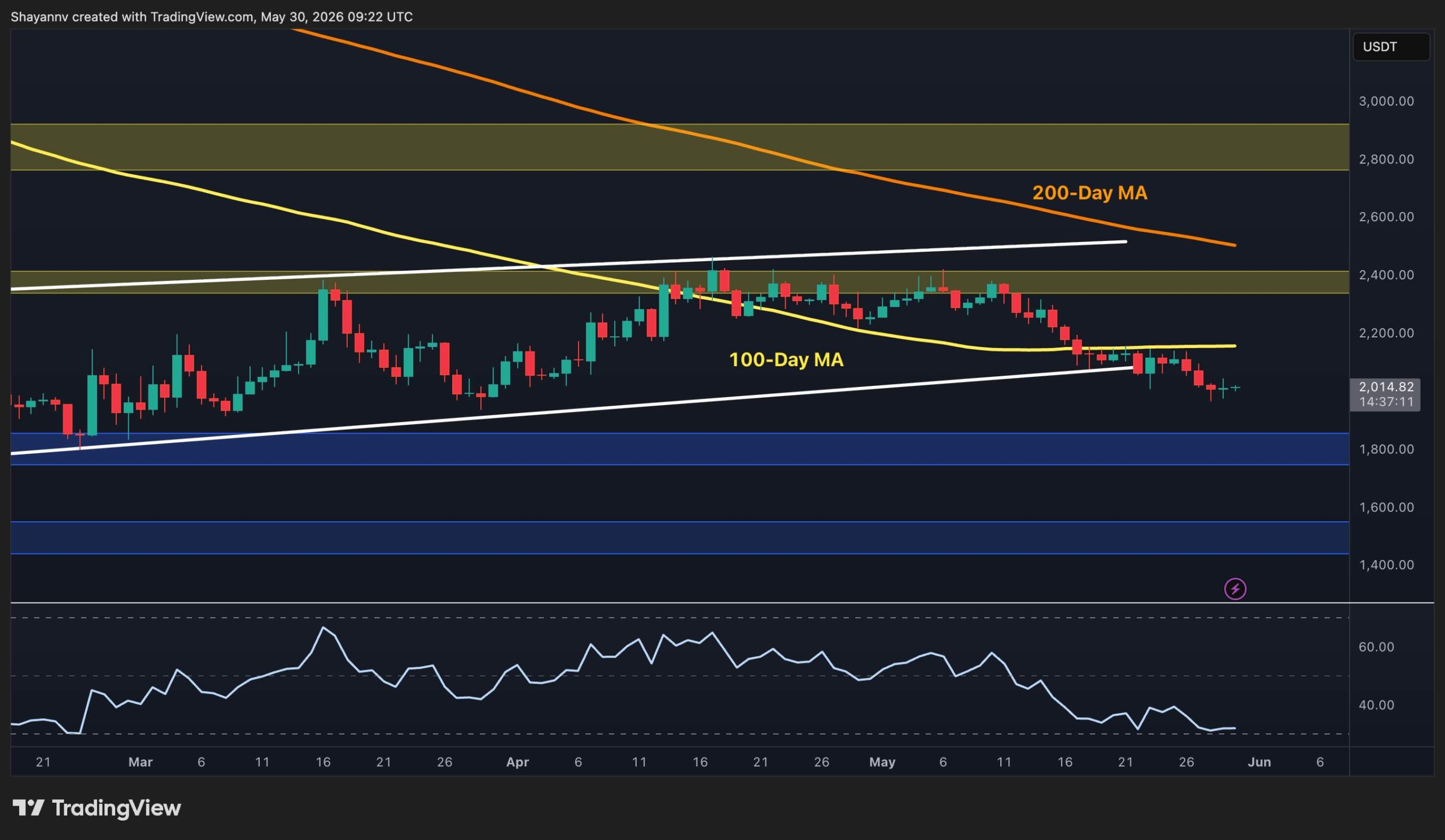
On the daily timeframe, ETH has decisively broken below the large ascending triangle structure that had developed between February and May. The move occurred after multiple rejections from the $2.4K resistance zone, which coincides with a major horizontal supply area and the former breakout region.
The bearish move has also pushed the price below the 100-day moving average, which is currently around $2.2K. More importantly, ETH remains significantly below the declining 200-day moving average near $2.5K. This indicates that the broader trend continues to favor sellers.
The recent rejection from the $2.4K zone confirms it as the primary resistance area. As long as ETH remains below this region, any recovery attempt may be viewed as a corrective bounce rather than a trend reversal.
On the downside, the next major support lies around the $1.8K zone, highlighted by the blue demand area and the February swing low. A daily close below the current $2K psychological support could increase the probability of a move toward that region.
Momentum indicators also remain weak. The RSI is hovering near oversold territory, which reflects persistent bearish momentum despite the recent stabilization around $2K.
ETH/USDT 4-Hour Chart
The 4-hour chart presents a clear descending channel that has guided price action lower throughout May. ETH has been moving toward the lower boundary of the channel again after failing to sustain any meaningful recovery from the mid-range resistance area.
The price is currently trading around $2K, which is a significant demand zone for the market. This area has produced a modest reaction so far, but buyers have yet to generate a convincing reversal signal.
The first resistance level is the descending channel’s upper boundary and the horizontal supply zone, which sits around $2.15K. Above that, the major resistance remains at $2.25K, followed by the upper supply zone near $2.4K.
A breakout above the descending channel could trigger a short-term relief rally toward the $2.15K and $2.25K regions. However, as long as the channel structure remains intact, the path of least resistance appears tilted to the downside.
Conversely, losing the $2K support zone would expose the channel’s lower extension and increase the likelihood of a deeper correction toward the $1.8K area identified on the daily chart.

Sentiment Analysis
The Ethereum Taker Buy Sell Ratio offers additional insight into current market sentiment. This metric measures the balance between aggressive buyers and aggressive sellers across exchanges. Readings above 1 indicate buyer dominance, while values below 1 suggest that market sell orders are outweighing buy orders.
The chart shows a persistent decline in the ratio over recent months, with the metric currently near 0.98 and below the neutral 1.0 threshold. This indicates that sellers continue to dominate order flow despite ETH’s prolonged correction.
For a sustainable recovery to develop, traders would likely need to see the Taker Buy Sell Ratio reclaim and hold above 1. Until that occurs, order flow suggests that bullish momentum remains limited and that rallies may continue to face significant selling pressure.

The post Ethereum Price Analysis: ETH Risks Deeper Drop as $2K Support Comes Under Pressure appeared first on CryptoPotato.
Ripple CTO Emeritus David Schwartz has outlined how the XRP Ledger could respond if a state-level attack targeted validators, node operators or core network infrastructure.
Summary
- David Schwartz said XRPL could adapt if state pressure targeted validators or network operators.
- The plan points to Tor, I2P and reserve nodes as possible tools during extreme attacks.
- The debate follows recent XRPL upgrade, validator and decentralization discussions across the ecosystem.
Schwartz made the comments during a discussion about whether a blockchain can survive pressure from an authoritarian state. The question focused on what would happen if authorities started raiding nodes or forcing operators offline.
He said intelligence services could create short-term disruption. However, he argued that long-term control would be harder because the XRP Ledger software, validator set and network structure can change when needed.
The idea has been described as a “Doomsday” approach for XRPL. It would not be a normal operating mode. Instead, it would act as an emergency path if the network faced direct physical or legal attacks.
Schwartz’s position centers on one point: a public blockchain can change its rules if users, developers and operators agree that survival requires it.
Tor and I2P enter XRPL discussion
The proposed emergency setup would use privacy networks such as Tor and I2P to hide parts of XRPL’s consensus coordination. These tools could make it harder for authorities to identify and target operators.
In that model, high-performance nodes would continue to process transactions. If attackers seized or disabled some nodes, reserve infrastructure could replace them.
A second, lighter layer would help manage trusted validator lists. That layer would operate only when needed and could use anonymous routing to reduce exposure.
The goal would be to keep consensus alive while lowering the chance that one government could identify all key participants at once.
XRPL validator design remains the core issue
XRPL uses a Unique Node List model. Each server follows validators it trusts not to collude. This differs from proof-of-work and proof-of-stake systems, where mining power or token stake often drives network security.
As previously reported by crypto.news, Schwartz recently said XRPL has more events that are “technically hard forks” than many older public blockchains. He linked that pattern to the network’s upgrade model and its use of smart transactors.
Separate coverage also detailed XRPL’s Negative UNL tool. That mechanism allows the network to keep operating when trusted validators go offline or fail to perform properly.
Those features matter in the current debate because Schwartz’s emergency scenario depends on XRPL being able to replace or ignore damaged infrastructure without halting the network.
Governance debate grows around XRP
The comments come as XRPL continues to update its infrastructure. The recent 3.1.3 upgrade included fixes for NFTs, Permissioned Domains, Vaults and the Lending Protocol.
Schwartz has also addressed asset-control questions around Ripple’s RLUSD stablecoin. As reported by crypto.news, he said RLUSD can support settlement use cases but is not neutral because Ripple can freeze and claw back tokens under legal direction.
That contrast adds context to the XRPL discussion. XRP itself does not rely on an issuer that can freeze balances in the same way as a stablecoin. However, XRPL still depends on software, validators and user agreement.
Schwartz’s “Doomsday” comments do not mean XRPL faces an active state attack. They show how one of its key architects thinks the network could react under extreme pressure.

French police detain hundreds in violent clashes after Champions League win

Solution for May 31, 2026 Puzzle #1807 Sparks Musical Puzzle Discussions
Hewlett Packard Enterprise (HPE) Stock Surges 80% Ahead of Tuesday’s Q2 Earnings


-

 Business7 days ago
NYT Strands Answers May 24 2026 Revealed for Puzzle No. 812 Theme Summer Essentials
-

 NewsBeat4 days ago
Israel says it has killed new Hamas military leader in Gaza City airstrikes
-

 Tech4 days ago
NASA taps Blue Origin to deliver lunar rovers for Moon Base initiative
-

 Politics6 days ago
Bridgerton Season 5: Cast, Release Date And Everything We Know So Far
-

 News Videos4 days ago
XRP *JUST* SUCCEEDED!!!! CLARITY ACT EXPOSED!!! (SHE EXPOSED IT)
-

 Sports5 days ago
2026 NBA Finals schedule, odds: Knicks await Thunder or Spurs after winning East
-
 Crypto World5 days ago
Micron Crosses $1 Trillion Market Cap as AI Demand Reshapes Memory Sector
-

 Business4 days ago
Selena Gomez Reportedly Upset Over Benny Blanco’s Comments on Her ‘Terrible’ Diet
-
Crypto World7 days ago
Brian Armstrong Outlines Crypto Vision for the Future Financial System
-

 News Videos2 days ago
This is BROKEN! INSANE 5x MONEY CAR WASH WEEK! The NEW GTA Online UPDATE Today! (GTA5 New Update)
-

 Business6 days ago
BTS Sells Out Four Las Vegas Shows at Allegiant Stadium for ARIRANG World Tour
-
 Tech5 days ago
China assigns ID codes to 28,000+ humanoid robots
-
 NewsBeat6 days ago
Hottest May day ever as London hits 34.8C in 2C leap from previous records
-

 Tech6 days ago
Microsoft’s quiet Claude Code retreat and the real cost of enterprise AI
-

 Tech2 days ago
Waymo dominates autonomous vehicle registrations as Tesla trails behind
-

 Business6 days ago
Nikkei 225 Surges Past 65,000 for First Time as Iran Peace Hopes Fuel Record Rally
-
Tech4 days ago
The Samsung pay deal is the moment Korean unions changed register
-

 Tech6 days ago
Westone Audio and Etymotic Acquired by Fidelity Collective in Major IEM Market Move
-
 Entertainment5 days ago
‘Breaking Bad’ Star’s Easy-to-Binge 6-Part Crime Series Spin-Off Is Finally Heading to Free Streaming
-

 NewsBeat6 days ago
Crowds find riverside shade in York as temperatures soar
You must be logged in to post a comment Login