

Business
Sibanye Stillwater: The South Africa Discount


Meteor fireball triggered loud boom across New England, NASA confirms

Will private credit infect public markets?
Business
5 equity mutual funds offer up to 24% annualised return on SIP investments in 10 years. Check details

Five equity mutual funds, led by small-cap schemes, have delivered strong SIP returns over the past decade, with some exceeding 20% annually. The data highlights the potential of disciplined long-term investing, while reinforcing that investors should align fund selection with risk appetite, goals and investment horizon rather than past performance alone.
Equity mutual funds witnessed a weak May, with the worst-performing schemes losing up to 7%. International and sectoral funds dominated the laggards’ list, led by HSBC Brazil Fund. Several consumption, FMCG, energy and PSU-focused schemes also posted negative returns, reflecting pockets of weakness across specific market segments.
Business
D-Wave Quantum Still Lags Behind The Industry Average, But Pessimism Is Somewhat Bloviated Post Q1 2026 Revenue Drop

D-Wave Quantum Still Lags Behind The Industry Average, But Pessimism Is Somewhat Bloviated Post Q1 2026 Revenue Drop

Carnival: Calm Waters Despite Fuel Price Headwinds
Business
Bonus issues, dividends and more: Reliance Industries, Trent among 20 stocks turning ex-date this week

Investors must hold shares of these companies in their demat accounts on the record date to be eligible for the respective corporate actions. The list remains tentative, as more companies may announce record dates for dividends, bonus issues and stock splits during the week.
Colgate Palmolive (India) and Epigral shares will turn ex-record dates for interim dividend of Rs 24 and final dividend of Rs 5, respectively, on Monday, kickstarting the week full of corporate actions. On Tuesday, the shares of Setco Automotive will turn ex-record date for an interim dividend of Rs 13 per share.
Anand Rathi Wealth bonus issue record date
Anand Rathi Wealth’s board last month approved a bonus issue of shares in the ratio of 1:1 by capitalising its reserves. Anand Rathi Wealth said that it will issue one new fully paid-up equity share with a face value of Rs 5 for every existing fully paid-up equity share held by the eligible shareholders as on the record date, which is fixed on June 3 (Wednesday).

Ashok Leyland dividend record date
Ashok Leyland on May 28 released its Q4 results, and announced a second interim dividend of Rs 2.5 per share with a face value of Re 1 each for the financial year 2026. The dividend would be paid on or before June 26. The record date to determine the eligibility of shareholders set to receive the payment has been fixed on June 3 (Wednesday). The company said that there will not be any final dividend for the financial year 2026.
Additionally, the shares of Foseco India, Monarch Surveyors and Engineering Consultants, and Navneet Education will also turn ex-record dates on Wednesday for their respective dividends worth Rs 25, Rs 1.6 and Rs 1.5 per share. Trent bonus issue record date
Zudio and Westside-parent Trent shares will turn ex-record date on June 4 for its first-ever bonus issue, offering shares in a 1:2 ratio to more than five lakh shareholders. Earlier in April, the Tata Group-company had announced the 1:2 bonus issue along with Rs 6 dividend and Q4 results. The Tata Group company said that it will issue one bonus share for every two shares owned as on the record date. Around 17.77 crore shares with a face value of Re 1 each will be issued as part of the offer.
The shares of Rallies India meanwhile will turn ex-record date for Rs 3 final dividend on Thursday (June 4).
Reliance Industries dividend record date
Reliance Industries (RIL) has fixed June 5 (Friday) as the record date for determining shareholders eligible to receive dividend for FY26. The company’s board had earlier recommended a dividend of Rs 6 per share for the financial year ended March 2026. The dividend, if approved at the AGM, will be paid within seven days of the meeting.
Bank of Baroda also will turn ex-record date for its final dividend of Rs 8.5 per share on Friday, along with Cipla (Rs 13), ICICI Prudential Life Insurance Company (Rs 1.65), JSW Energy (Rs 2), Archaen Chemical Industries (Rs 2.5), HDFC Asset Management Company (Rs 54), Ponni Sugars (Rs 5) and Qgo Finance (Rs 0.15).
E2E Networks meanwhile will undergo its stock split on Friday.
(Disclaimer: Recommendations, suggestions, views and opinions given by the experts are their own. These do not represent the views of The Economic Times)
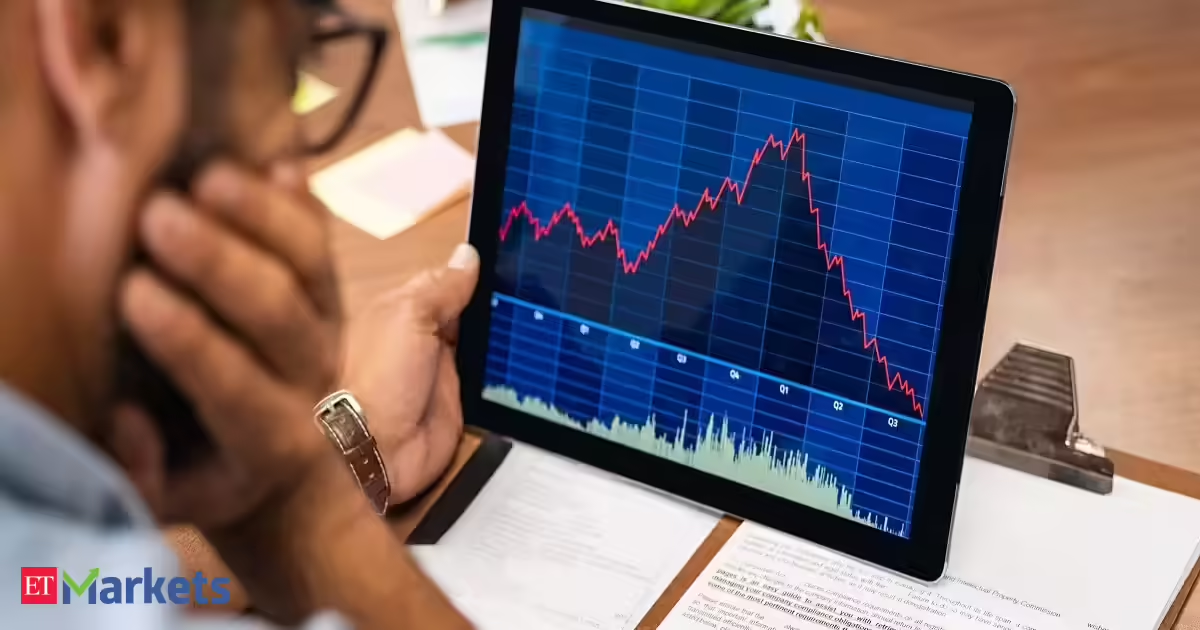
This statement is not cynicism, it is a warning about human behaviour, crowd psychology, and the emotional traps embedded in investing.
The Market Is Not Designed to Be Easy
Markets are driven by millions of participants reacting to news, fear, greed, liquidity, and macroeconomic shifts. Prices rarely reflect just “value”; they reflect expectations about the future, and expectations constantly change.
This creates a system where:
- Good news is often already priced in
- Bad news arrives when optimism is highest
- Volatility increases precisely when conviction is strongest
Baruch understood that the market does not reward intelligence alone, it rewards discipline, patience, and emotional control.
Why Most Investors Fail at TimingOne of Baruch’s strongest warnings was against market timing. He believed that trying to perfectly buy at the bottom and sell at the top is not just difficult, it is impossible.
In reality:
- Bottoms are clear only in hindsight
- Tops feel like the beginning of more gains
- Emotional bias leads investors to act late
This is why many investors buy in euphoria and sell in panic, exactly the opposite of what creates wealth.
The Danger of “Tips” and Noise
Baruch was deeply sceptical of stock tips and so-called “inside information”. He warned that most investors lose money not because they lack information, but because they misuse it.
Key insights:
- Information is abundant, but insight is rare
- Noise often disguises itself as opportunity
- Confidence increases when information is misunderstood
In modern markets, this problem has only intensified with social media, news overload, and instant opinions.
Investing Requires Real Work
Baruch emphasised that investing is not a passive activity. It requires effort, understanding, and attention.
He suggested investors should:
- Study companies thoroughly
- Understand earnings, management, and industry trends
- Continuously update their assumptions
Successful investing is not about guessing, it is about understanding businesses deeply enough to withstand uncertainty.
Losses Are Part of the Process
Another powerful Baruch lesson is about accepting mistakes quickly.
Many investors:
- Hold losing positions too long
- Hope for recovery instead of reassessing facts
- Let ego override logic
Baruch’s approach was simple: if the investment thesis breaks, exit without emotional attachment. Capital preservation is more important than being right.
Cash Is Not Idle, It Is Opportunity
Baruch also advised keeping part of your portfolio in cash. In a market driven by cycles, liquidity is not wasted capital, it is optionality.
Cash allows investors to:
- Act during corrections
- Avoid forced selling
- Wait for better opportunities
In his view, being fully invested at all times is not discipline, it is risk.
Focus Beats Over-Diversification
While diversification is important, Baruch warned against over-spreading investments. Too many holdings dilute attention and reduce understanding.
Instead, he believed in:
- Fewer, well-understood investments
- Continuous monitoring
- Deep knowledge over broad exposure
Quality of understanding matters more than the quantity of holdings.
The Real Edge in Markets
Baruch’s wisdom ultimately points to one truth:
The stock market does not beat you with complexity, it beats you with your own behaviour.
The real edge is not prediction, but discipline:
- Avoid emotional decisions
- Ignore noise and hype
- Accept uncertainty
- Think long term
- Act with patience, not impulse
In a world where everyone is trying to outsmart the market, Baruch’s message remains timeless: the market rewards those who stay rational when others cannot.
Business
Market Outlook: US-Iran talks, crude oil among 5 factors to drive D-St in first week of June

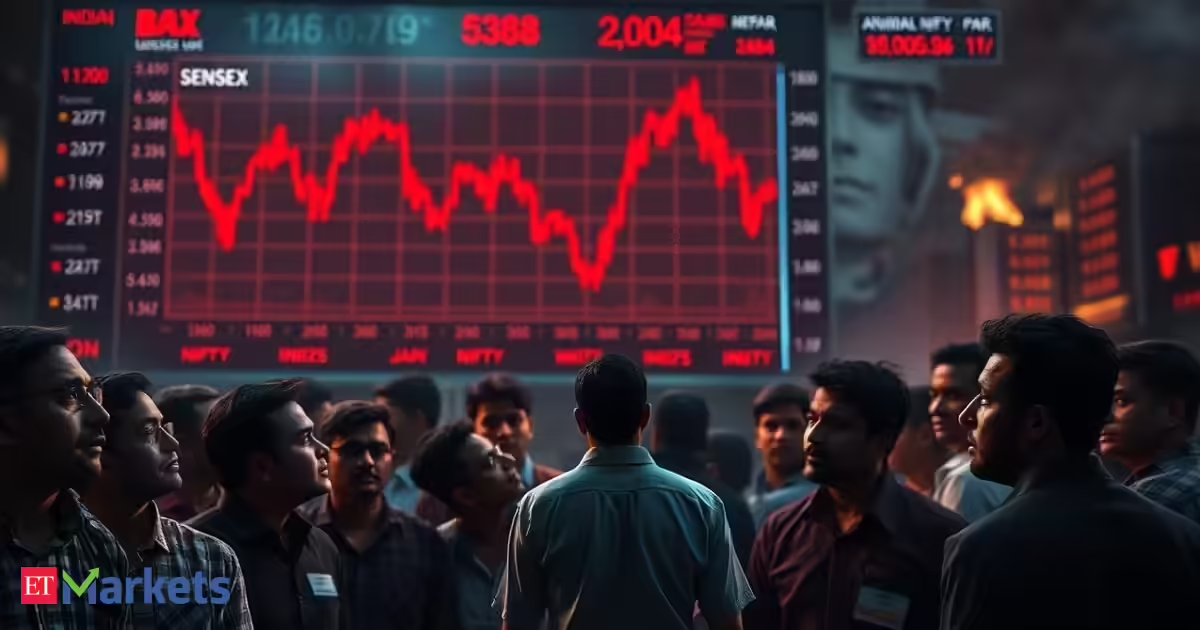
The Indian stock market witnessed a sharp selloff on Friday afternoon, with the Sensex and Nifty falling over 1% as passive fund flows linked to the MSCI index reshuffle weighed on sentiment. Sensex dropped over 1,092 points to 74,776 while Nifty 50 crashed nearly 359 points to 23,547. The sharp losses wiped off nearly Rs 6 lakh crore from the total market capitalisation of all companies listed on BSE, pulling it down to Rs 465 lakh crore.
Iran war tensions simmer
Fresh tensions continue to cloud efforts to sustain a fragile truce in West Asia. US Defence Secretary Pete Hegseth said Washington is prepared to resume strikes on Iran if nuclear talks fail, while reiterating President Donald Trump’s preference for a diplomatic agreement that prevents Tehran from acquiring nuclear weapons.Meanwhile, Iran is moving to formalise its control over the Strait of Hormuz, with lawmakers expected to vote on legislation governing the strategic waterway. Iranian military officials have warned that vessels must follow routes designated by Tehran and obtain permission from the IRGC Navy to transit the strait.
Will oil fall further?
Oil prices plunged to their lowest levels in seven weeks, easing concerns over energy-led inflation after reports suggested the United States, Israel and Iran were moving closer to a long-awaited peace agreement.
However, despite signals that an agreement may be near, Washington and Tehran continue to differ on key aspects of the proposed deal. The decline came as hopes of a breakthrough in the three-month U.S.-Iran conflict strengthened expectations that the Strait of Hormuz could reopen fully. The strategic waterway handles around one-fifth of global oil and gas shipments, and any easing of disruptions could improve supply flows.FII worries
Foreign portfolio investors (FPIs) emerged as heavy sellers in Indian equities on Friday, pulling out a net Rs 20,637 crore in a single session, to record one of the sharpest single-day selloffs in recent years, as markets grappled with the impact of the latest MSCI index rebalancing.
Foreign institutional investors (FIIs) have withdrawn a hefty $53 billion from Indian equities since late 2024, putting pressure on several large-cap stocks even as domestic institutional investors emerge as the market’s primary support, according to Jefferies. The sustained selling has taken a toll on market performance. MSCI India has fallen around 8% between September 2024 and May 2026, underperforming the MSCI Emerging Markets index by 67 percentage points in dollar terms.
Can the rupee strengthen?
Rupee rose 53 paise to close at 95.05 against the US dollar, as against the previous closing level of 95.69. The Indian currency recorded its best single-day gain since April 2.
Ponmudi R, CEO of Enrich Money, said the USD/INR pair is currently trading below the Rs 95 mark, retreating from the week’s high near Rs 95.9 and helping the rupee end the week with a net appreciation. The pair remains close to the lower boundary of its long-term ascending trendline, indicating a gradual easing in dollar strength amid improving global risk sentiment.
From a technical standpoint, the weekly chart has formed a shooting star pattern, signalling rejection at higher levels and suggesting bearish momentum could build in the near term. Immediate resistance is seen around Rs 95.2, and a sustained move above this level could pave the way for a recovery towards the Rs 95.4–Rs 95.6 range.
Weak set up
From a technical standpoint, Nifty continues to trade below all its key moving averages. More importantly, these moving averages have flattened out, indicating the absence of a strong trend. The daily RSI remains in a sideways zone as per the RSI Range Shift framework, while the daily Stochastic oscillator is also moving within a narrow band, says Sudeep Shah, Head of Technical and Derivatives Research at SBI Securities.
Adding to this, the trend strength indicator, Daily ADX, is placed at near 15 level and continues to decline, suggesting a lack of directional momentum in the index. While these indicators point towards a lack of trend, Friday’s late sell-off has injected fresh uncertainty into the market setup.
Markets are expected to remain highly sensitive to geopolitical and macroeconomic developments in the coming week, with investor attention firmly focused on the evolving U.S.–Iran negotiations, broader diplomatic developments in the Middle East and the trajectory of crude oil prices.
While expectations of a potential agreement have helped improve risk sentiment and drive a sharp correction in energy prices, investors remain cautious as a definitive breakthrough has yet to materialise.
(Disclaimer: Recommendations, suggestions, views and opinions given by the experts are their own. These do not represent the views of The Economic Times)
Where We Are
The rupee has depreciated against the dollar at a compound annual rate of approximately 5% since the 1991 liberalisation. The journey reads like a one-way ladder: Rs 3.30 at independence in 1947, Rs 17 before liberalisation, Rs 46 by 2000, Rs 75 in 2020, Rs 97 today. While the RBI has managed the pace of depreciation effectively, there has not been a sustained reversal along that path.
The current stress has a specific character worth noting. The rupee has weakened 12% over the last 12 months. The DXY dollar index, by contrast, fell 9.4% through all of 2025. That is rupee-specific stress, and it points directly to the forces underneath.
Three Catalysts, None Short-Lived
The first is oil. India imports 88% of its crude requirement, and Brent crude ranged between $97 and $110 per barrel in May 2026, spiking above $110 precisely when the rupee hit its record low. Every dollar increase in the oil price widens the import bill, adds to current account pressure, and increases structural demand for dollars. The RBI cannot drill its way out of this.
The second is capital flows. Foreign portfolio investors have pulled Rs 2.2 lakh crore from Indian equities in 2026 alone, the worst outflow year since FPI investing in Indian equities was first permitted in 1992. When foreign capital exits, it exits in dollars. Dollar supply in the market falls, demand rises, and the rupee weakens. The mechanism is direct and the numbers are not small.The third is the inflation differential. India’s CPI has run structurally above US CPI over any five-year or longer horizon, and purchasing power parity adjustments work quietly but persistently in the background. The approximately 5% annual depreciation since 1991 is not coincidental to this differential. It is mechanical.
None of these catalysts resolve quickly. Oil dependence is a decade-long infrastructure challenge. FPI flows depend on global risk appetite and relative valuations that will remain volatile. The inflation differential compresses only when India’s supply-side productivity gains structurally outpace the US over a sustained period. The RBI Governor has stated the bank will do “whatever is required” for orderly markets and that the rupee appears undervalued.
But rate hikes to defend the currency are not on the agenda. The tools available to the central bank are narrower than the structural forces pressing against it.
What This Means for Portfolio Construction
A dollar-denominated asset earns on two levels for an Indian investor: the USD return of the underlying, and rupee depreciation layered on top. At the 10-year average depreciation rate of 3.4%, a flat-returning US asset still delivers a 1.4x return in INR over a decade, purely from currency. At the long-run 5% rate, currency alone roughly doubles the INR value of any dollar asset over 20 years. The dollar has strengthened against the rupee on a net basis for 34 years. The currency tailwind is built into the asset class.
Sure, the Nifty 50 TRI delivered 14.6% CAGR in INR terms for the decade ending 2023, a strong number on any measure. The S&P 500 in INR delivered approximately 15-16% annualised over the same 10-year window, per reconstructed data combining S&P 500 USD returns with RBI exchange rate data. Comparable headline returns, but with uncorrelated drivers. When oil spikes and FPI outflows hit simultaneously, a domestic-only portfolio absorbs the equity market impact and the currency erosion at the same time. A portfolio with dollar exposure absorbs the equity impact but earns on the currency move. Those are meaningfully different risk profiles wearing similar return numbers.
A 20 to 30% allocation to US equities through the LRS route, built over time via low-cost index ETFs and direct stocks accessible through platforms like Appreciate, is a structural response to a structural reality: the rupee has weakened at approximately 5% annually for 34 years, three catalysts sustain that pressure today, and a portfolio concentrated entirely in one currency carries a risk the data has been pricing in for decades.
(The author, Subho Moulik is Founder & CEO at Appreciate)
(Disclaimer: Recommendations, suggestions, views and opinions given by the experts are their own. These do not represent the views of The Economic Times.)

PNVF puts focus on national team programs after FIVB suspension

Apple’s software chief: Who is Craig Federighi?

Here’s How Figs Are Really Made


-

 Business7 days ago
NYT Strands Answers May 24 2026 Revealed for Puzzle No. 812 Theme Summer Essentials
-

 NewsBeat4 days ago
Israel says it has killed new Hamas military leader in Gaza City airstrikes
-

 Politics6 days ago
Bridgerton Season 5: Cast, Release Date And Everything We Know So Far
-

 Business4 days ago
Selena Gomez Reportedly Upset Over Benny Blanco’s Comments on Her ‘Terrible’ Diet
-
 Crypto World4 days ago
Micron Crosses $1 Trillion Market Cap as AI Demand Reshapes Memory Sector
-

 News Videos4 days ago
XRP *JUST* SUCCEEDED!!!! CLARITY ACT EXPOSED!!! (SHE EXPOSED IT)
-

 Business6 days ago
BTS Sells Out Four Las Vegas Shows at Allegiant Stadium for ARIRANG World Tour
-

 Tech6 days ago
Microsoft’s quiet Claude Code retreat and the real cost of enterprise AI
-
 Tech5 days ago
China assigns ID codes to 28,000+ humanoid robots
-
Crypto World6 days ago
Brian Armstrong Outlines Crypto Vision for the Future Financial System
-
 NewsBeat5 days ago
Hottest May day ever as London hits 34.8C in 2C leap from previous records
-

 Tech2 days ago
Waymo dominates autonomous vehicle registrations as Tesla trails behind
-

 News Videos2 days ago
This is BROKEN! INSANE 5x MONEY CAR WASH WEEK! The NEW GTA Online UPDATE Today! (GTA5 New Update)
-
Tech4 days ago
The Samsung pay deal is the moment Korean unions changed register
-

 Tech4 days ago
NASA taps Blue Origin to deliver lunar rovers for Moon Base initiative
-

 Tech6 days ago
Westone Audio and Etymotic Acquired by Fidelity Collective in Major IEM Market Move
-

 Business5 days ago
Nikkei 225 Surges Past 65,000 for First Time as Iran Peace Hopes Fuel Record Rally
-
 Entertainment5 days ago
‘Breaking Bad’ Star’s Easy-to-Binge 6-Part Crime Series Spin-Off Is Finally Heading to Free Streaming
-

 Tech4 days ago
Millions of AI agents imperiled by critical vulnerability in open source package
-
Crypto World4 days ago
SpaceX’s $2 Trillion IPO: Why Tech Giants Nvidia (NVDA), Apple (AAPL), and Microsoft (MSFT) May Face Pressure
You must be logged in to post a comment Login