
Crypto World
Traders pivot ADA to BFX, one of the leading crypto presales to buy now


Disclosure: This article does not represent investment advice. The content and materials featured on this page are for educational purposes only.
Cardano holds attention as investors rotate toward early-stage crypto presales like BlockchainFX.
Summary
- Cardano (ADA) trends shift as investors explore utility-driven crypto opportunities like BlockchainFX
- BlockchainFX (BFX) gains traction as a multi-asset Super App enabling trading across crypto, stocks, gold, and forex
- BFX presale attracts 23k+ users with revenue-sharing model and exposure to global forex and crypto markets
How many people ignore the signs of a massive crypto shift and fail to invest at the right time? Watching others turn small change into life-changing wealth while someone sits on the sidelines is a cycle that needs to end.
Finding the best crypto presale to buy now is the only way to secure a spot before the next big breakout.

The market currently watches the Cardano (ADA) price news as traders search for more utility and faster growth. This shift has led thousands to BlockchainFX (BFX), a project bridging the gap between digital assets and global finance. It is currently the best crypto presale to buy now for anyone wanting more than just another meme token.
BlockchainFX: The bridge to global wealth and the best crypto presale to buy now
BlockchainFX is not just a trading platform; it is a licensed multi-asset Super App. It solves the massive problem of switching between different brokers for different assets. Community members can trade 500+ assets, including crypto, stocks, gold, and forex, from a single web3 interface. This unified approach is exactly why the BFX crypto presale 2026 is moving at light speed.
The platform offers a revenue-sharing model that turns participants into stakeholders. Instead of keeping all the money, BlockchainFX redistributes up to 70% of platform fees back to those who stake their tokens. This includes 50% paid daily in USDT and BFX, plus a 20% buyback and burn strategy to keep the supply tight.
Why early adopters are rushing in
The project is backed by a team with 25 years of experience across fintech and web3. This deep expertise has already attracted 23,300+ participants who see the massive gap in the market. While crypto volume is only $89B daily, the Forex market handles $7.5 trillion. BlockchainFX is positioned to capture that 99% gap that standard exchanges like Uniswap don’t touch.
Feature
BlockchainFX Advantage
Total Assets
500+ (Crypto, Forex, Stocks, Bonds, ETFs)
Founder’s Perk
Limited Edition 18K Gold or Metal Visa Cards
Trading Credits
Up to $25,000 in free credits for high tiers
Daily Rewards
Staking yield paid in USDT and BFX
Massive presale figures and growth potential
The BFX crypto presale 2026 has already raised over $14.24M. The current price is $0.035, but the price increases as milestones are hit because demand is outstripping the fixed supply. The confirmed launch price is $0.05, which creates a built-in profit for anyone getting in today. By using the bonus code LAUNCH50, early buyers get an extra 50% BFX tokens instantly.
- Raised: $14.24 million+ (Rising toward $15M launch)
- Current Price: $0.035 (Entry floor)
- Launch Price: $0.05 (Guaranteed upside)
- Participants: 23,300+ (Rapidly growing community)
- Bonus Code: LAUNCH50 (Claim 50% extra tokens)
$500,000 community giveaway
To keep the momentum high, a $500,000 giveaway is rewarding the community with BFX tokens.
- 1st Place: $120,000 in $BFX
- 2nd Place: $80,000 in $BFX
- 3rd Place: $60,000 in $BFX
- 4th-10th: Prizes ranging from $50,000 to $15,000
Big announcement: The 15m rule and bonus code LAUNCH50
The excitement is peaking because BlockchainFX is just a tiny fraction away from the $15M mark. The team announced that once the presale hits 15M, the project will officially launch on public exchanges. This means the chance to use the LAUNCH50 code to get 50% extra tokens is almost over. This is the final call to grab the lowest price before the “Founder’s Club” benefits disappear forever.
Missing the Cardano price news millionaire run
Think back to the Cardano ICO price of only $0.0024. Most people laughed at it or said it would never work, but those who saw the potential became millionaires as it multiplied by over 1,000x. It was a massive wealth transfer that changed lives for those who were brave enough to get in at the right time.
For those who missed that boat, it is easy to feel like they are too late for crypto success. However, the market is constantly birthing new leaders. Missing out on the past is a lesson, not a life sentence. The real tragedy is seeing a new powerhouse like BFX and making the same mistake twice by hesitating.
Is the BlockchainFX presale the best crypto presale to buy now?
The fast start and massive utility of this platform make it the clear winner for anyone seeking real gains. With the current BlockchainFX presale price at just $0.035, the path to the $0.05 launch is wide open. Early adopters can also stack referral rewards and use the LAUNCH50 bonus code to maximize their position before the 15M launch trigger.
Don’t let this be another story about another missed opportunity. Visit the BlockchainFX presale right now to secure tokens and a piece of a $7.5T market opportunity. The clock is ticking toward the $15M milestone, and once it hits, these prices and the 50% bonus are gone for good.
For more information, visit the official website, X, and Telegram.
Disclosure: This content is provided by a third party. Neither crypto.news nor the author of this article endorses any product mentioned on this page. Users should conduct their own research before taking any action related to the company.



ECB chief economist Philip Lane warned the central bank could still raise interest rates if inflation’s impact lasts longer than expected, keeping tightening risks alive even after March’s pause.
Summary
- ECB’s Philip Lane says rates could rise if inflation’s impact lasts longer.ecb.
- Comments reinforce data‑dependent stance after March decision to hold rates.ecb.
- Markets already pricing in up to three hikes this year amid energy risks.
European Central Bank chief economist Philip Lane has warned that interest rates may yet rise if inflation in the euro area proves more persistent than policymakers currently expect, keeping the door open to further tightening even after the ECB held borrowing costs steady in March.
According to Jinshi’s summary of Lane’s latest remarks, the Governing Council member said that “if the impact of inflation lasts for a longer period, the European Central Bank will consider raising interest rates,” underlining that the fight against above‑target price growth is not over.
His comments echo recent guidance from ECB President Christine Lagarde, who told the Financial Times that “if we expect inflation to deviate significantly and persistently from target, the response must be appropriately forceful or persistent,” signalling that rate hikes remain on the table if price pressures re‑accelerate.
In its March policy decision, the ECB left its three key interest rates unchanged and reiterated that it is “determined to ensure that inflation stabilises at the 2% target in the medium term,” while acknowledging that the conflict in the Middle East has created upside risks for inflation via higher energy costs.
The central bank’s latest projections see headline inflation averaging 2.6% in 2026 and hovering around 2% in 2027 and 2028, but officials including Lane have flagged that wage dynamics and firms’ price‑setting plans will be watched closely at “every meeting” to judge whether those forecasts remain credible.
Lagarde has also stressed that “self‑reinforcing mechanisms” could take hold if inflation expectations drift away from the target, warning that the risk of de‑anchoring would “become acute” without a sufficiently firm response, a stance that has kept markets wary of declaring the hiking cycle definitively over.
Traders in money markets currently price in two to three ECB rate increases by year‑end, which would lift the main policy rate toward a range of roughly 2.50% to 2.75%, with the timing seen as highly sensitive to incoming inflation prints and developments in energy markets.
For crypto investors, Lane’s signal that rates could still rise if inflation lingers adds another macro variable to watch alongside the European inflation data and central bank communications that crypto.news has tracked in previous coverage of ECB decisions and their spillover into Bitcoin and Ethereum markets.


Binance founder Changpeng Zhao (CZ) dedicated a considerable portion of his autobiography, Freedom of Money, to talking about somebody called Wei Zhou.
Indeed, Zhao is this fifth most mentioned person in the book, tied with Sam Bankman-Fried (SBF) with 23 mentions. But who is he?
Zhao joined Binance from Goldman Sachs in 2018 as its first chief financial officer (CFO).
He’d previously shepherded two companies through NYSE and NASDAQ IPOs, and in Binance’s eyes, he brought institutional credibility that the then-one-year-old crypto exchange desperately needed.
Zhou is now CEO of Coins.ph, a Philippines-based crypto wallet and exchange that he acquired from Indonesian super-app Gojek in 2022 for roughly $200 million.
He also advises Old Fashion Research, a blockchain fund run by former Binance executives, as well as serving as vice chairman of the gay dating app Grindr.
Wei Zhou : From CZ’s first CFO to his nemesis
CZ used Freedom of Money, written largely during his time in prison and published on April 8, to paint Zhao as an unreliable subordinate-turned-antagonist.
Specifically, it frames his tenure around two grievances.
The first involves Zhao’s role in Binance’s FTX investment.
FTX launched in May 2019 and within months, SBF approached Binance for investment. Zhao championed the deal, yet CZ claims that he initially declined.
However, by late 2019, FTX lowered its valuation and sweetened the offer with a Binance Coin (BNB) for FTX token (FTT) token swap. Binance agreed, taking a 20% stake in SBF’s company that would implode three years later.
Fortunately for CZ, Binance was able to sell its FTX equity, before FTX went bankrupt.
Fintech Alliance Philippines and Binance
CZ also complained about Zhao’s role in Binance’s Philippine expansion.
In September 2022, Zhao wrote to the chairman of Fintech Alliance Philippines, questioning a blockchain education partnership between the Alliance and Binance.
The letter, which a Philippine crypto publication published in full, called Binance an unregistered virtual asset service provider.
Zhao claimed that Coins.ph was “astounded” by the Binance-Alliance collaboration, an assertion that CZ frames as an underhanded attempt to block Binance from the Philippine market.
Unsurprisingly, Zhao denied the framing and told reporters, “We did not block Binance from joining. We asked to be involved in blockchain education initiatives of Fintech Alliance Philippines.”
Partial financials for his CFO
Basically, CZ’s memoir casts Zhou as a disloyal insider. However, other reports tell a different story about who kept whom in the dark.
Reuters reported in December 2022 that Zhao never had access to Binance’s full financial accounts during his tenure as CFO of nearly three years. Reuters says that two former colleagues confirmed that claim.
It also claimed the world’s largest crypto exchange ran its finances as a “black box” obscured from even its own CFO.
Zhao wasn’t the only executive to discover CZ’s centralized grip over Binance.
Binance.US, launched in 2019 while Zhao still served as global CFO, was meant to operate independently.
However, its first CEO, Catherine Coley, was replaced without explanation. Her successor, former US Comptroller of the Currency Brian Brooks, lasted less than four months.
Brooks later testified concerningly that he realized CZ ran the US entity, not him.
The SEC would eventually allege that Binance.US was a sham, controlled behind the scenes by CZ while publicly claiming independence.
Zhao left Binance in June 2021, the same summer Brooks walked out of Binance.US. Binance cited personal reasons for both departures.
Read more: How the battle between Binance and FTX went from bad to worse
Binance Avengers
After leaving, Zhao created a private group that CZ’s memoir called the “Binance Avengers.” It gathered disgruntled former employees to criticize the exchange.
CZ’s book claims some members later lost money after transferring assets to FTX.
The Binance supremo also places Zhao on an informal enemies list alongside SBF and OKX founder Star Xu. As Protos reported, the CZ-Xu grudge escalated to a $1 billion bet within days of the book’s release.
Got a tip? Send us an email securely via Protos Leaks. For more informed news, follow us on X, Bluesky, and Google News, or subscribe to our YouTube channel.

TLDR
- XRP rose to $1.37 after gaining 3.83% and ending a three-day decline.
- XRP Futures net inflows surged 294% to $46.15 million within 24 hours.
- Derivatives data showed steady inflows across 4-hour, eight-hour, and 12-hour timeframes.
- Short liquidations reached $1.59 million over 24 hours and made up 88% of total liquidations.
- Spot exchange data showed a $10.07 million net outflow as holders moved XRP off exchanges.
XRP climbed to $1.37 after posting a 3.83% intraday gain on Monday, reversing three days of declines. At the same time, derivatives data showed futures net inflows surged 294% to $46.15 million within 24 hours. The combined price recovery and leverage increase signaled renewed trader participation.
XRP Futures Record $46M Daily Inflows as Leverage Builds
XRP Futures activity accelerated as traders reopened leveraged positions across major exchanges. Data from Coinglass showed 24-hour net inflows reached $46.15 million, reflecting a 294.78% increase. Meanwhile, four-hour data recorded $71.16 million in inflows and a net increase of $753,280. Over eight hours, inflows totaled $111.03 million, while outflows hit $106.32 million, leaving a $4.71 million net gain.
In the 12-hour window, inflows reached $286.18 million against $277.18 million in outflows. This pattern confirmed steady positioning by derivatives traders. Rising participation often increases short-term volatility, and current figures showed active positioning across multiple timeframes. XRP traded at $1.37 at press time after Monday’s upward move.
Liquidations and Spot Outflows Shape Current XRP Structure
Liquidation data reflected pressure on bearish positions as prices moved higher. In the last 12 hours, total liquidations reached $328,110, including $70,870 from longs and $257,250 from shorts. Over 24 hours, total liquidations climbed to $1.79 million, with $1.59 million from short positions. Shorts accounted for 88% of total liquidations during that period.
At the same time, spot exchange flows showed net withdrawals. In the eight-hour timeframe, inflows stood at $27.34 million, while outflows reached $26.45 million, producing a $893,470 net inflow. However, in 12 hours, inflows totaled $62.99 million, and outflows climbed to $67.40 million, leaving a $4.42 million net outflow.
Across 24 hours, inflows reached $131.03 million, while outflows exceeded that at $141.10 million. This resulted in a $10.07 million net outflow and a -203.62% net change. Exchange withdrawals indicated that holders moved tokens off trading platforms during the rebound.
Market data showed that liquidations occurred alongside tightening exchange balances. The price structure shifted as short positions closed and futures inflows expanded. XRP continued to trade near $1.37 as derivatives and spot metrics reflected active market participation.



The Arbitrum-native exchange launched precious metals perpetuals as onchain commodity trading gains momentum across DeFi.
Decentralized perpetual exchange GMX has launched 24/7 gold and silver markets on Arbitrum, drawing more than $10 million in trading volume on the first day, the protocol announced on X.
The new XAU/USD and XAG/USD markets are synthetic perpetuals settled onchain using WETH-USDC liquidity. Pricing is secured through Chainlink Data Streams, the same oracle infrastructure that underpins GMX’s existing perp markets, according to a blog post from the exchange.
“We’re excited to see GMX adopt Chainlink to power its newly launched gold and silver perpetual markets,” said Johann Eid, Chief Business Officer at Chainlink Labs. “This is how we enter a new era where the world’s largest commodities are traded onchain at a massive scale.”
The launch comes at a turbulent moment for precious metals. Gold climbed above $4,800 per ounce on Tuesday, rebounding from prior losses as the U.S. and Iran signaled their willingness to resume ceasefire negotiations.
GMX said gold and silver represent the starting point for a broader push into real-world asset (RWA) derivatives, with additional commodities and asset classes under evaluation. Both pools are included in the protocol’s GLV [ETH-USDC] vault, allowing liquidity providers to earn fee revenue as demand scales. Traders on Base, BNB Chain, and Ethereum mainnet can also access the markets via GMX’s multichain infrastructure.
The move places GMX alongside a growing roster of DeFi protocols racing to bring traditional asset exposure onchain. Hyperliquid’s permissionless HIP-3 markets have seen commodity perpetuals, particularly oil, dominate trading activity in recent months.
The broader tokenized commodities sector has expanded rapidly. Tokenized gold surpassed $4 billion in market value in January and is now approaching $5 billion, led by Tether Gold and Paxos Gold. New entrants like Theo have launched yield-bearing tokenized gold products, while the World Gold Council has proposed shared infrastructure to lower barriers to entry and improve fungibility across digital gold products.
The growth underscores demand for permissionless precious metals exposure, particularly as geopolitical uncertainty continues to drive interest in safe-haven assets traded outside traditional market hours.
This article was written with the assistance of AI workflows. All our stories are curated, edited and fact-checked by a human.
TLDR
- Solana recorded $1.1 trillion in total economic activity during the first quarter of 2026.
- Artemis data confirmed that this marks the first time Solana crossed the $1 trillion level in a single quarter.
- The network posted a 6,558.6% increase in economic activity compared to the previous quarter.
- On-chain usage accelerated sharply in late 2025 and continued rising into early 2026.
- The quarterly total reflects the highest value of transactions and economic interactions ever recorded on Solana.
Solana recorded $1.1 trillion in total economic activity during the first quarter of 2026, according to Artemis data released Tuesday, April 14. The figure marks the first time the blockchain has crossed the $1 trillion threshold within a single quarter. The surge follows a sharp rebound in on-chain usage after months of market volatility.
Solana Posts $1.1 Trillion in Quarterly Economic Activity
Artemis reported that Solana processed $1.1 trillion in total economic activity in Q1 2026. The data shows that this is the highest quarterly figure ever recorded on the network. As a result, Solana achieved a new all-time high in total value of transactions and economic interactions.
The charts from Artemis highlighted a 6,558.6% increase in economic activity compared to the previous quarter. This rapid growth pushed Solana beyond the $1 trillion milestone for the first time. Artemis stated that the spike reflects a sharp rise in on-chain usage across the network.
On-Chain Usage Surges as Network Rebounds
The Artemis charts showed that Solana’s on-chain usage accelerated sharply in late 2025. Activity continued to expand into early 2026 as transaction volumes increased. As a result, the network regained strong momentum after extended volatility through 2024 and mid-2025.
Data indicate that higher transaction throughput supported the growth in total economic activity. Increased participation in decentralized finance protocols also contributed to the surge. In parallel, staking activity on Solana expanded during the same period.
The quarterly total includes all recorded transactions and economic interactions on the blockchain. This covers transfers, decentralized finance operations, and other on-chain activities. Consequently, the combined value reached its highest level in the network’s history.
Artemis confirmed the figures on April 14 through its published dataset. The report identified Q1 2026 as the strongest quarter by economic output for Solana. The milestone comes as broader crypto markets regain upward momentum.
Market data shows that Solana experienced fluctuating activity throughout 2024 and mid-2025. However, usage levels began rising again in late 2025 and continued into 2026. Therefore, the latest quarterly figure reflects a sustained rebound in network engagement.
The reported 6,558.6% increase represents quarter-over-quarter growth in economic activity. This growth rate ranks among the highest recorded by the network to date. As such, the data places Q1 2026 at a new peak for Solana.
The $1.1 trillion total captures the aggregate value of all economic transactions processed during the quarter. Artemis compiled the data using on-chain metrics and transaction tracking tools. The figures became publicly available on Tuesday, April 14, 2026.
Crypto World
CoinStats Launches AI Agent Claiming to Outperform ChatGPT, Gemini and Claude in Crypto Research Benchmark
Crypto tracker app CoinStats has launched a new AI-powered research agent, claiming it outperforms leading models from Google, OpenAI, and Anthropic in crypto-focused deep research tasks.
The announcement comes alongside the public beta release of the CoinStats AI Agent, a tool designed specifically for cryptocurrency traders and investors.
Benchmark Results
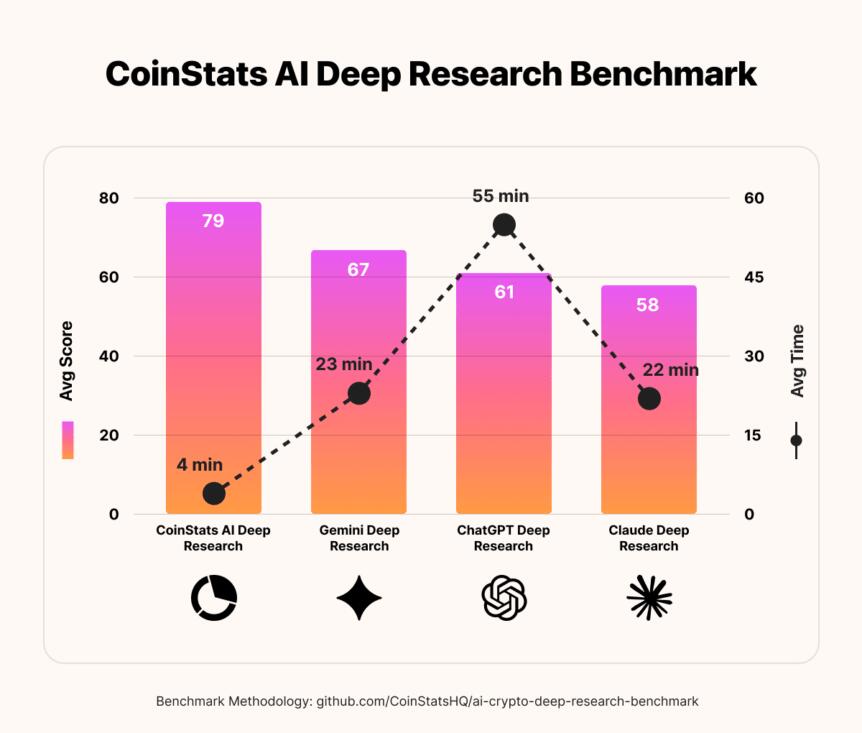
According to CoinStats, its AI Agent achieved a score of 79 out of 100 in an internal benchmark evaluating crypto research quality. In comparison, Gemini Deep Research scored 67, ChatGPT 61, and Claude 58.
Speed was another key differentiator. The CoinStats AI Agent reportedly delivered results in an average of four minutes, while competing tools took significantly longer, with some responses exceeding 50 minutes.
The company noted that the benchmark methodology is open source and available on GitHub, allowing independent verification of the results.
Why a Crypto-Native AI?
CoinStats attributes its performance advantage to its access to specialized data sources.
Unlike general-purpose AI models, which primarily rely on web data, the CoinStats AI Agent integrates multiple streams of crypto-native information, including on-chain data, exchange metrics, derivatives data, and real-time social sentiment.
The system uses a multi-agent architecture, where different agents simultaneously analyze various data sources such as news, blockchain activity, and social media trends. These inputs are then combined into a unified research output.
Key Features
The CoinStats AI Agent is positioned as a research copilot rather than a simple chatbot, offering several advanced capabilities:
- Market Research: Explains price movements by combining news, sentiment, and on-chain activity
- Onchain Tracking: Analyzes wallets, token flows, and blockchain activity across 120+ networks, powered in part by the CoinStats Crypto API
- Social Sentiment Analysis: Tracks narratives and influencer activity in real time
- Portfolio Analysis: Provides insights based on a user’s actual holdings
- Backtesting: Simulates trading strategies using historical data
- Code Execution: Performs advanced calculations and custom analysis on demand
The platform also generates visual outputs such as charts and tables, enhancing usability for traders.
Multiple Modes
The AI Agent operates across different modes, including:
- Deep Research: Multi-step analysis across multiple data sources
- Backtesting: Historical simulation of strategies
- Fast Mode: Quick answers for simple queries
- Private Mode: Encrypted processing via decentralized infrastructure, powered by Venice AI
Availability
CoinStats AI Agent is currently available in public beta for Degen and Premium users on web, iOS, and Android.
CoinStats, a crypto portfolio tracking platform founded by Narek Gevorgyan, is positioning this launch as part of its broader move into AI-powered analytics.
A Growing Trend in Vertical AI
While the results highlight strong performance in crypto-specific tasks, they are based on internal testing and may vary depending on use cases.
The launch reflects a broader trend in the AI industry, where specialized, domain-focused tools are emerging to compete with general-purpose models in niche areas such as finance and cryptocurrency research.

- Ethereum briefly rallied to $2,400 on Trump-Iran ceasefire optimism and easing oil fears.
- Sentiment lifted risk assets, with BTC leading the charge with prices rising above $75k.
- ETH price outlook includes an ascending channel and bullish RSI.
Ethereum price extended gains on Tuesday, briefly touching highs above $2,400 as Bitcoin and broader cryptocurrency markets surged on optimism surrounding potential diplomatic progress in US-Iran negotiations.
As President Donald Trump’s comments on advancing talks following a recent two-week ceasefire fueled investor sentiment, risk assets, including equities, climbed while oil prices retreated.
This confluence of geopolitical hope and easing inflation concerns marked a pivotal moment for digital assets, with Bitcoin leading the charge past key psychological thresholds.
Ethereum hits highs of $2,360 as Bitcoin surges above $75,000
ETH extended its impressive rally on Tuesday, pushing decisively above $2,300 after breaking from lows of $2,270 overnight from Monday.
This marked the cryptocurrency’s highest level in over two months.
Santiment notes that open interest in BTC and ETH has jumped 59% and 45%, respectively, in seven weeks.
🥳 Bitcoin ($76,070) & Ethereum ($2,395) have both hit their highest market values since the beginning of February. This rebound is coming with increased optimism, as margin & leveraged positions are being created rapidly.
📈 $BTC: +59% Open Interest in 7 weeks
📈 $ETH: +45%… pic.twitter.com/VgevsGwMz1— Santiment (@santimentfeed) April 14, 2026
Bitcoin rose from around $74,000 to above $76,000 before paring gains to around $75,500 as of writing. Goldman Sachs filing for a Bitcoin ETF boosted sentiment.
The uptick in Bitcoin and Ethereum also closely tracked gains across US stock benchmarks, which rallied sharply after cooler-than-expected US producer price data eased inflation concerns. The report boosted risk appetite, drawing capital into high-beta assets such as cryptocurrencies.
Wall Street’s positive momentum provided an additional tailwind, with institutional investors appearing to rotate into Bitcoin amid perceptions of it as a hedge against fiat uncertainty.
On the geopolitical front, President Donald Trump’s remarks about pursuing further discussions with Iran—potentially building on last week’s fragile two-week ceasefire—served as an immediate catalyst.
Markets have interpreted this as a step toward a longer-term truce, reducing fears of escalation in the Middle East. As a result, oil prices have fallen below $100 per barrel, easing pressure on global energy costs and supporting gains in both equities and cryptocurrencies.
However, caution persists around the Strait of Hormuz, a critical chokepoint for global oil shipments.
Investors are awaiting clearer signals on operational stability in the region, as any disruption could quickly reverse the current risk-on sentiment.
For now, Bitcoin’s momentum highlights its sensitivity to interconnected global developments, with trading volumes rising as bulls test fresh highs.
Ethereum price forecast
Ethereum price has formed an ascending channel since early April, with prices respecting the 50-day exponential moving average (EMA) as dynamic support near $2,176.
This level, coupled with the rising trendline of a potential triangle pattern, forms a robust foundation that bulls are defending vigorously. Buyers are now looking to turn the 100-day EMA ($2,356) into major support.

Among the key bullish indicators is the Relative Strength Index (RSI) on the daily timeframe, which has climbed above 62. The RSI has yet to enter the overbought territory, signaling strong momentum without immediate exhaustion.
Potential resistance looms at $2,800 and $3,370, which have acted as prior support and highs from January 2026.
Conversely, failure here might trigger profit-taking, testing support at $2,000 and likely lower at $1,800.
Crypto World
David Einhorn signals caution as his hedge fund Greenlight prioritizes capital protection

David Einhorn, President at Greenlight Capital, speaking at the 14th CNBC Delivering Alpha Investor Summit in New York City on Nov. 13, 2024.
Adam Jeffery | CNBC
Hedge fund manager David Einhorn said he is focusing on capital protection as markets rally on geopolitical optimism, warning that investors may be underestimating potential downside risks.
“It probably won’t surprise anyone that we are again putting capital preservation at the top of our priorities,” Einhorn said in his latest investor letter dated Monday and obtained by CNBC. “With so little downside priced in, we are willing to risk missing out on a possible recovery to position ourselves to play more offense, should one of the downside scenarios materialize.”
U.S. stocks have rebounded violently with the S&P 500 entirely erasing the losses suffered since the Iran war began. The market is building on the recent gains this week even after U.S.-Iran negotiations over the weekend broke down, as investors remained optimistic that a deal between the two countries was still possible.

S&P 500 year to date
Greenlight’s funds returned 6.5% in the first quarter, outperforming the S&P 500’s 4.4% decline. Still, Einhorn said the firm has kept relatively low gross and net exposure, reflecting caution about valuations and the broader macro backdrop.
“Even the most cautious are investing with a Sammy Hagar inspired mentality: one foot on the brake and one on the gas,” he said in the letter. “Nobody wants to miss the V- or even the checkmark-shaped recovery.”
As the conflict began, Greenlight was already running with relatively low exposure, citing what it viewed as stretched valuations. Einhorn said Greenlight has made few adjustments, trading around index hedges and adding a long position in October oil futures. That bet has risen only modestly, as markets largely expect any supply disruption to be temporary.
Performance in the quarter was driven by gains in gold, Acadia Healthcare, DHT Holdings and Core Natural Resources, according to the letter. Greenlight also initiated a medium-sized position in Versant Media Group and smaller stakes in Crocs and SLM Corp.
Disclosure: Versant Media is the parent company of CNBC.


Bitcoin mining operations in the US are absorbing a 47 percent increase in deployment costs after Section 232 tariffs on steel, aluminum, and copper stacked on top of an existing 21.6 percent duty on ASIC miners from Southeast Asia, pushing competitive advantage toward mining operations in Kazakhstan, Russia, and other tariff-exempt jurisdictions.
Summary
- A flagship Antminer S21 XP now carries roughly $1,600 in Section 232 metals duties on top of the existing 21.6 percent ASIC reciprocal tariff, bringing the combined tariff burden to approximately 47 percent before any other import fees apply.
- Mining containers, the steel structures with copper wiring and aluminum ventilation that house industrial deployments, have jumped $10,000 to $25,000 in cost per unit, compounding the hardware tariff impact for any operation scaling new capacity.
- All-in production costs for publicly listed US miners already averaged approximately $74,600 per bitcoin in late March before the Section 232 tariffs took effect on April 6, meaning the tariff-driven increase could push breakeven costs closer to $82,000 to $85,000.
The Section 232 proclamation signed April 2 raised tariffs to 50 percent on products made entirely from steel, aluminum, and copper, and 25 percent on derivative products containing substantial metal content. Mining rigs qualify as derivative products, adding 25 percent to the full customs value of each unit on top of the pre-existing 21.6 percent Southeast Asia ASIC tariff. The tariffs took effect April 6, meaning every hardware order placed after that date is subject to the combined burden. Large miners who stocked inventory ahead of the tariffs, including Marathon Digital, Riot Platforms, and CleanSpark, are partially insulated for now, but each future hardware upgrade cycle becomes relatively more expensive compared to offshore competitors.
The United States controls roughly 38 percent of global bitcoin hash rate. That position was built over four years after China banned mining in 2021, and it may now begin eroding under tariff pressure rather than a direct ban. A US miner replacing hardware with S21 XPs pays approximately 47 percent more than a competitor in Kazakhstan or Russia buying the same machines with zero tariff exposure. Hashprice, the daily revenue per terahash, is already near historical lows. Miners cannot absorb a 47 percent hardware cost increase without either raising capital, cutting expansion, or waiting for bitcoin to move higher.
What Miners Are Doing in Response
Large publicly listed miners with pre-tariff inventory are continuing operations without immediate impact. Bitmain opened its first US assembly line in January 2026 and MicroBT operates a plant since 2023, but these represent a fraction of total production. US-assembled rigs still carry tariffs on aluminum and copper components. Senators Cassidy and Lummis introduced the Mined in America Act in late March, which would create federal subsidies and tax incentives for domestic miners, but no vote date has been set.
What the Tariff Impact Means for Network Security
If hardware cost differentials persist across two to three upgrade cycles, meaningful hash rate could shift away from the US toward tariff-free jurisdictions. That would reduce the US share of bitcoin’s security model and concentrate hash rate in countries with weaker property rights and less regulatory transparency. The network crossed 1,000 exahashes per second in early 2026 with the US as the anchor, and sustaining that anchor becomes harder with each tariff cycle that makes domestic expansion more expensive than offshore alternatives.
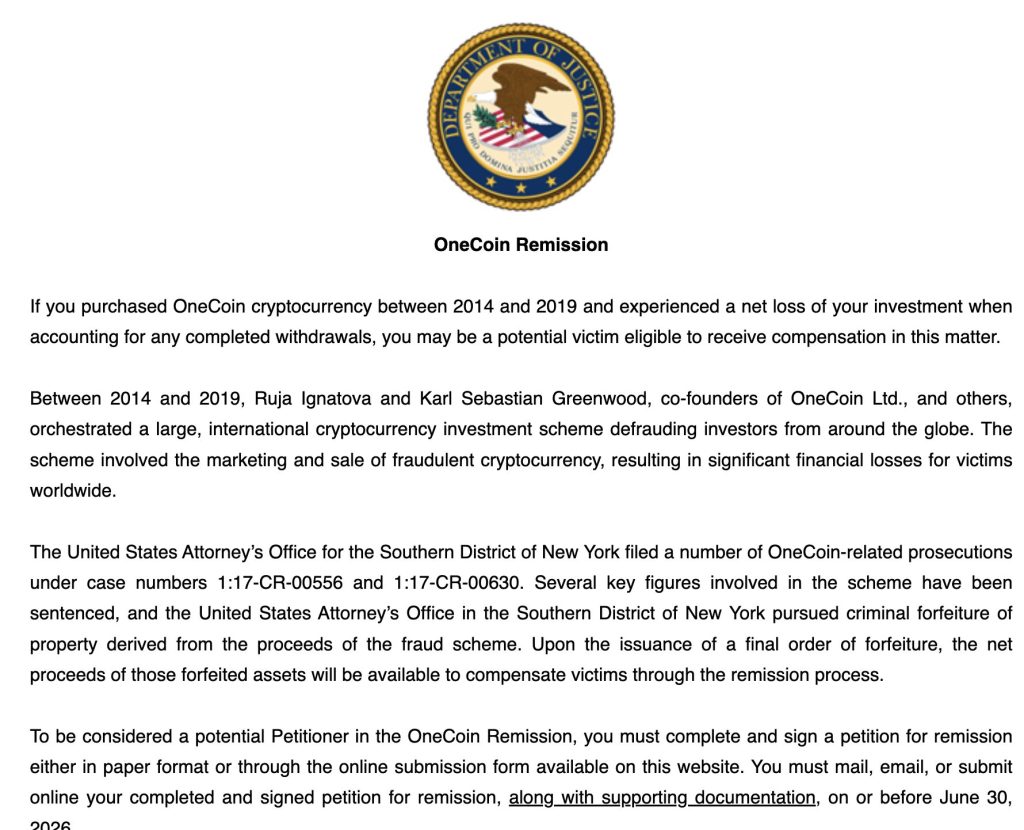
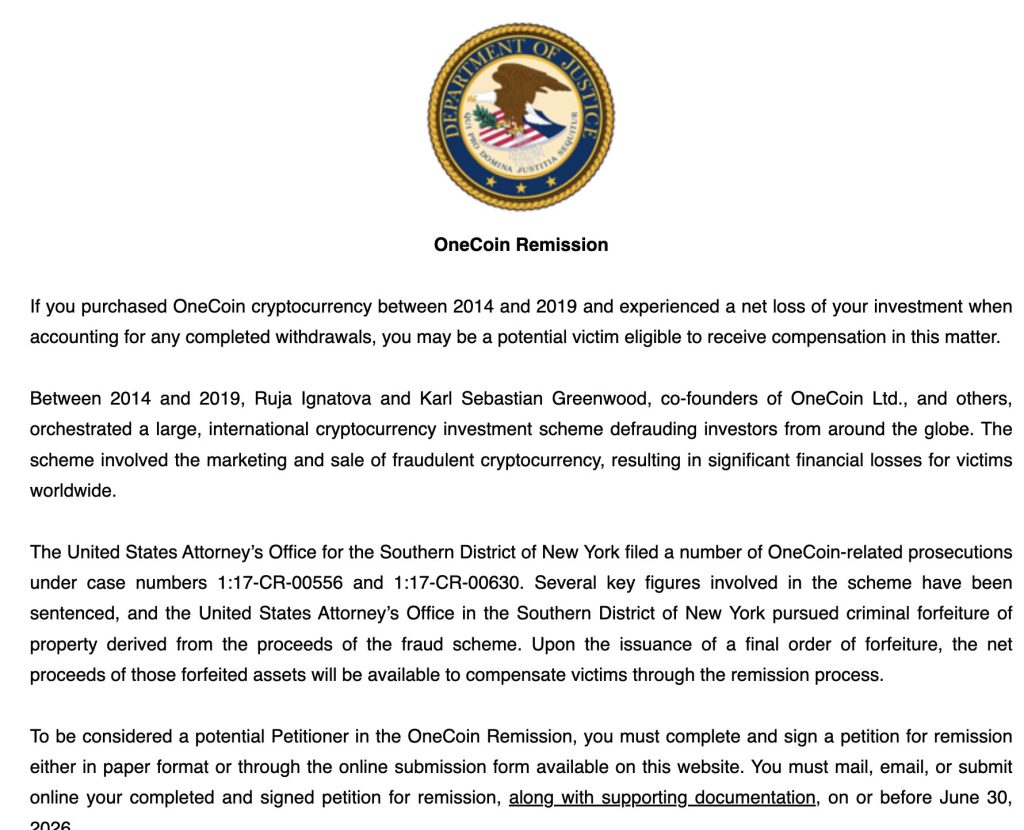
The Department of Justice has opened a formal compensation claims portal for victims of OneCoin, the $4 billion Ponzi scheme that defrauded approximately 3.5 million investors across 175 countries between 2014 and 2019.
More than $40 million in restitution, sourced from asset forfeiture proceedings that swept up proceeds tied to co-conspirators, including Konstantin Ignatov, is now available for verified claimants. The portal is live. The deadline is June 30, 2026.
The question is how many of the scheme’s millions of victims will actually be able to access it, and what fraction of their losses they’ll recover when they do.
- Portal Launch: The DOJ has officially opened a compensation claims process for OneCoin fraud victims, marking the first formal restitution distribution in the case.
- Eligible Victims: Investors defrauded by the OneCoin scheme – including U.S. residents from the Southern District of New York – may file claims to recover verified losses.
- Claims Deadline: Eligible victims must submit claims by June 30, 2026; late submissions are not expected to be considered.
- Asset Source: The $40 million-plus fund derives from criminal asset forfeiture proceedings against proceeds seized from key OneCoin conspirators, including those linked to Konstantin Ignatov.
- Process Overview: Claimants must document their losses and submit through the DOJ portal; restitution amounts will be prorated against total verified claims.
- What to Watch: Ruja Ignatova remains a fugitive on the FBI’s Ten Most Wanted List – billions in unrecovered assets mean the $40 million pool represents roughly 1% of total investor losses.
Discover: The best crypto to diversify your portfolio with
What the DOJ’s OneCoin Claims Portal Actually Does – and What $40 Million Against $4 Billion Means
The DOJ has made available more than $40 million in restitution derived from criminal asset forfeiture, assets seized from conspirators prosecuted in the case, including proceeds linked to Konstantin Ignatov, Ruja Ignatova’s brother, who was arrested at Los Angeles International Airport in 2019 and subsequently pleaded guilty to wire fraud and money laundering charges.
The mechanics work like this: victims file documented claims through the portal, the DOJ verifies losses against available case records, and recovered funds are distributed on a prorated basis relative to total verified claims.
If aggregate verified losses across all claimants exceed $40 million, which is essentially guaranteed given the scheme’s $4 billion total damage, every claimant receives a fraction of their documented loss, not a full recovery.
That’s not a reimbursement. That’s a partial distribution from a forfeiture estate. The DOJ’s asset forfeiture process in crypto fraud cases has grown more sophisticated, but it remains structurally constrained by what investigators can seize versus what was originally stolen, a gap that exploit and fraud cases across the crypto industry consistently expose as the core problem with post-hoc recovery.
Co-founder Karl Sebastian Greenwood was sentenced to 20 years in prison for his role in orchestrating the scheme. The primary architect, Ruja Ignatova, “the Cryptoqueen” – was added to the FBI’s Ten Most Wanted List in June 2022 and remains at large.
The bulk of unrecovered OneCoin proceeds almost certainly moved through jurisdictions outside U.S. enforcement reach. What the DOJ has recovered and forfeited is real. What it represents against total losses is approximately one cent per dollar stolen.
Discover: The best pre-launch token sales
The post DOJ Opens $4 Billion OneCoin Claims Portal for Scammed Investors appeared first on Cryptonews.

Will Andoni Iraola’s Bournemouth departure speed up the managerial merry-go-round?

Oracle Stock Buy or Sell in 2026? Analysts See 50-60% Upside as AI Cloud Boom Offsets Volatile Start

ECB’s Lane says persistent inflation could still force rate hikes


-

 Politics4 days ago
US brings back mandatory military draft registration
-
 Sports4 days ago
Man United discover Nico Schlotterbeck transfer fee as defender reaches Dortmund agreement
-

 Fashion4 days ago
Weekend Open Thread: Veronica Beard
-

 Tech7 days ago
How Long Can You Drive With Expired Registration? What Florida Law Says
-

 Politics5 days ago
Malcolm In The Middle OG Turned Down ‘Buckets Of Money’ To Appear In Reboot
-

 Politics2 days ago
World Cup exit makes Italy enter crisis mode
-

 Crypto World5 days ago
Canary Capital Files SEC Registration for PEPE ETF
-

 Business4 days ago
Tesla Model Y Tops China Auto Sales in March 2026 With 39,827 Registrations, Beating Cheaper EVs and Gas Cars
-

 Crypto World1 day ago
The SEC Conditionalises DeFi Platforms to Be Avoided for Broker Registration
-

 Crypto World21 hours ago
SEC Signals Exemption for Crypto Interfaces From Broker Registration
-

 Crypto World6 days ago
Bitcoin recovers as US and Iran Agree a Ceasefire Deal
-
 NewsBeat2 days ago
Pep Guardiola and Gary Neville agree over Arsenal title problem that benefits Man City
-

 Business4 days ago
OpenAI Halts Stargate UK Data Centre Project Over Energy Costs and Copyright Row
-

 Business3 days ago
Ireland Fuel Protests Enter Day 5 as Blockades Spark Shortages and Government Prepares Support Package
-

 Politics5 days ago
LBC Presenter Mocks Trump Over Iran War Failures
-

 Crypto World4 days ago
Federal judge blocks Arizona from bringing criminal charges against Kalshi
-
 NewsBeat3 days ago
JD Vance announces ‘no agreement’ with Iran over nuclear weapons fear
-

 Tech5 days ago
A version of Windows 10 released a decade ago is now eligible for additional security patches
-

 Business4 days ago
IMF retains floor for precautionary balances at SDR 20 billion
-

 Crypto World14 hours ago
SEC Proposes Certain Crypto Interfaces Don’t Need to Register as Brokers
You must be logged in to post a comment Login