Living in Bath between 2006 and 2011, outside of the antique rivalry of two frankly middling buns, food only played a supporting role to the tourism economy. Chain restaurants took the Wetherspoons approach, attempting to obscure their hegemony by cloaking it within the character of the city’s period architecture, as if it might elevate what’s inside by osmosis. However, a decade later, one name would crop up repeatedly, becoming an attraction in its own right. This is Landrace.
Cardiff are at a critical juncture in the race to reach the United Rugby Championship play-offs and face a tricky trip to Llanelli to face the Scarlets this afternoon.
Corniel van Zyl’s side are currently eighth in the URC table and need to win at Parc y Scarlets to strengthen their chances of reaching the play-offs with four matches remaining.
The Scarlets are out of the play-off race but want to finish their campaign on a high, while also laying the foundations for what they hope will be a better 2026/27 season.
Advertisement
Van Zyl has made seven changes to his Cardiff matchday squad with second-row Josh McNally, George Nott and scrum-half Johan Mulder returning from injury to start. Wales duo Alex Mann and James Botham combine on the flanks with Alun Lawrence pulling on the number eight jersey.
The Scarlets have been boosted by the return to fitness of Wales internationals Ryan Elias, Taine Plumtree and Eddie James who are all starting.
This game is only live on Premier Sports with kick-off at 5.30pm. You can follow live updates below
It had dawned on me, for the first time in my life, that one day my parents would pass away (Picture: Emma Werner)
‘Mum, I am worried you’re going to die’
It was Christmas 1999, and in the midst of the vicious round of chemotherapy my mother was undergoing, my parents took my sister and I to a ski resort.
If my mum was surprised at the question her five-year-old daughter had asked, she didn’t show it.
She’d taken ill two days earlier, soon after we arrived, and had been rushed to a doctor nearby. When she returned the following night, it had dawned on me, for the first time in my life, that one day my parents would pass away.
Advertisement
She calmed me down and said not to worry and to enjoy the rest of the holiday.
But a few days later, thoughts of my mother’s health came back to haunt me. It mingled with guilt.
Thinking I’d burdened her with my own fears was mortifying.
I have flashes of her skinny figure in a vast double bed taller than myself (Picture: Emma Werner)
I felt pathetic and never mentioned the incident again. But the feeling that I should know how to deal calmly – before I had even learnt how to read – persisted.
The shame hung over me for many years to come.
Advertisement
My mother was in her early thirties when she was diagnosed with breast cancer. She had no genetic predisposition, no family history; the chances of her getting sick were laughably small.
I didn’t understand what was happening then, but I know she underwent surgery and chemotherapy early on. I have flashes of her skinny figure in a vast double bed taller than myself.
She went into remission in 1997, but then in 1999 it returned, this time in her right hip.
For the next twelve years, cancer hovered over our heads.
Advertisement
I hated myself for hating her appearance (Picture: Emma Werner)
I went about my life as normally as I could. I went to school, I sang in a choir, I took violin lessons – all the while trying to convince myself that things would get better.
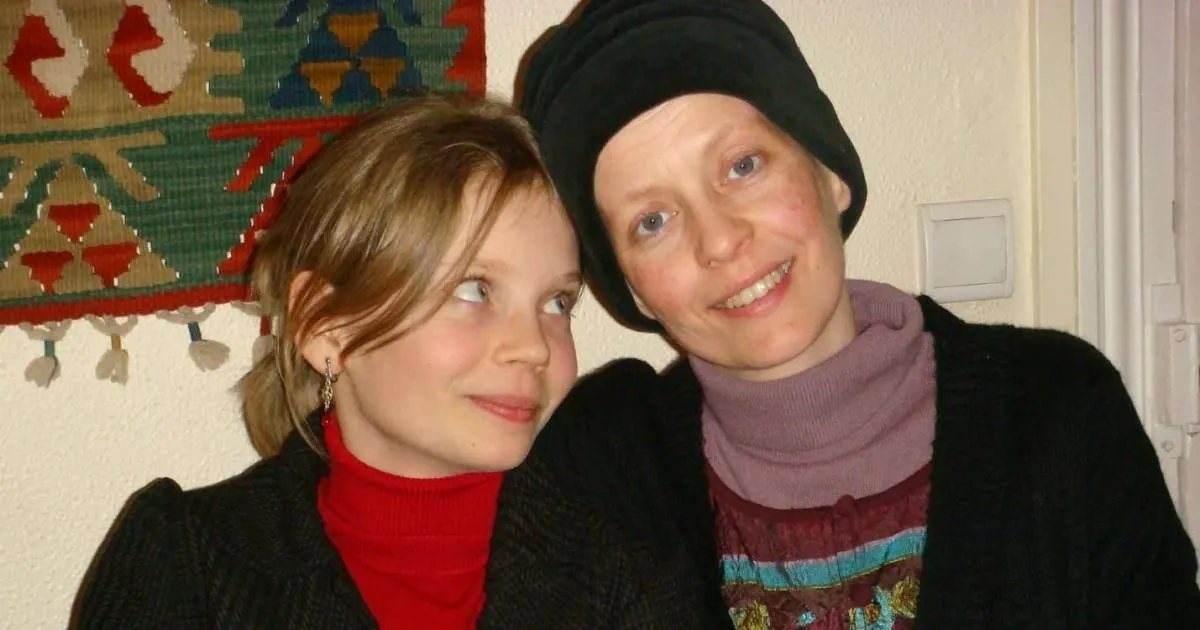
But there were still times where the horrors of my reality burst through my naive ignorance, and I failed to cope. Like the time mum lost her hair – I’ll never forget the way I was unable to mask my reaction. She looked so small. So ill. All I could see was her cancer.
I hated myself for hating her appearance, and agonised over the split second in which she may have seen the shock in my eyes. I was 13.
Or the following year, when my mother asked me to pick up the results of a blood test for her, too anxious to see what they might show.
For a long time after her passing my guilt remained (Picture: Emma Werner)
Unfolding the piece of paper in the waiting room, I broke down at the verdict. Despite all the pain and the treatments, she was still dying. And yet, she had to comfort me, again.
Suddenly I was five again, unable to cope and make her better. Looking to her for solace on what must have been one of the worst days of her life.
Advertisement
A month prior to her death, when I was 16, I went on a trip to Vienna with an orchestra I played in. The doctors had found some nodules had metastasised, so I should have known time was fast running out.
Celebrating Halloween in various bars of the city, cancer seemed far away – but reality came crashing down the same hour I got back. My father came to pick me up from the coach station on the way to collect my mother up from a therapist appointment.
Breast cancer symptoms
The first symptom of breast cancer that most women notice is a lump or an area of thickened tissue in their breast.
You should see a GP if you notice any of the following:
Advertisement
a new lump or area of thickened tissue in either breast that was not there before
a change in the size or shape of one or both breasts
a discharge of fluid from either of your nipples
a lump or swelling in either of your armpits
a change in the look or feel of your skin, such as puckering or dimpling, a rash or redness
a rash (like eczema), crusting, scaly or itchy skin or redness on or around your nipple
a change in the appearance of your nipple, such as becoming sunken into your breast
She climbed into the car and burst into tears. ‘I am not afraid anymore,’ she told my dad. It wasn’t until two weeks later when my father sent me to stay with my grandparents to shield me from the excruciating final moments, that I understood we had reached the end.
For a long time after her passing my guilt remained.
Advertisement
In the gaping hole she left behind, I found solace in biology textbooks. I relished learning anything to do with cancer – it was like a comforting, logical voice making sense of it all.
Biology gave me another, more unexpected source of healing. I took an internship supervised by a scientist researching cancer in Tasmanian devils. Months later, thescientist met my dad, who’d wanted to thank her for taking good care of me.
They married some years later. And so, in a strange turn of events, after cancer took my mother, it gave me a younger sister, Flora.
It has been 15 years now sinceshe died.
Advertisement
Flora has just celebrated her seventh birthday. When I was that age, my mother was already on the edge of her second relapse.
Flora has just celebrated her seventh birthday (Picture: Emma Werner)
A couple of years ago, Flora became inconsolable after breaking a small plate. More recently, she cried after struggling to memorise a multiplication table. Just last week, she refused to read a book because a character’s misfortune was too upsetting.
As I comfort her each time, faced with the reality of a child’s emotional landscape, I finally see the sad absurdity of the remorse and guilt I’d been carrying with me.
Sometimes in her eyes, I recognise a carefree innocence I’d once felt, before I traded it for self-reproach. I cannot change how I grew up, nor, as I assured my mother on her deathbed and many times in dreams, would I have wanted to.
But it took over a decade and the arrival of Flora, to realise that I was a just kid who did not know how young she was.
Advertisement
I did my best in the worst of scenarios. One day, I will accept that.
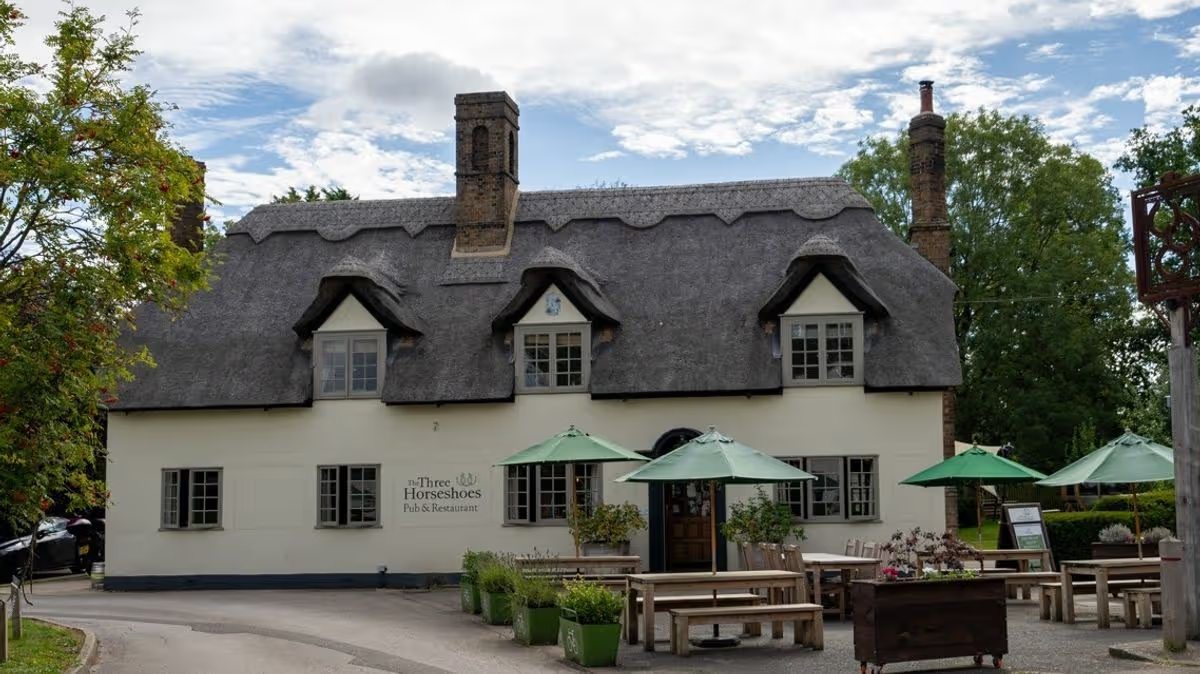
The pub is located in a village set in open countryside ideal for the warmer months ahead
Those who live in Cambridge may often find that they choose not to venture far from the city, since there are plenty of great meal spots dotted around. Around 15 minutes from Cambridge by car, nestled in the countryside, is the quaint village of Madingley, home to The Three Horseshoes.
Advertisement
The Three Horseshoes is an award-winning pub which was voted Cambridgeshire Dining Pub of the Year in 2018 and holds two AA Rosettes. It features a garden with plentiful space, two dining pods, and a fully enclosed, heated garden room that sits at the back of its dining room.
The dining pods are fully enclosed with heating and pretty lights and the garden is spacious and picturesque. Described by the pub’s website as a ‘romantic’, Madingley is a beautiful countryside spot.
Offering a rustic and charming appeal, the thatched country pub has earned a positive reputation online. One person described the pub as having a “cosy atmosphere” on Google and another said it was the “best Sunday roast” they have had around Cambridge.
The Three Horseshoes has a unique wine list focusing on the Langeudoc-Roussillon region of France, where the team pride itself on visiting and meeting wine makers many times. It also offers four local real ales and a range of lager and fruity cocktails.
Advertisement
With a modern British and European style for food, the menu offers classics like pie of the day and a 14oz sirloin on the bone to signature dishes like BBQ guineafowl and an aubergine schnitzel dish. A pie of the day sounds like the perfect way to indulge while sunning in their beer garden.
The US President has suggested that change is coming “very soon” for one nation.
Donald Trump has hinted that Cuba could be next on his hit list. The US President previously made offhand comments about “stopping by” Cuba on his way home from Iran.
Advertisement
But in a speech to a conference of Turning Point USA, the group formerly led by slain far-right activist Charlie Kirk, he said change on the island would come “very soon”.
After speaking about US operations on the war in Iran, he turned to Cuba: “Very soon, this great strength will also bring about a day 70 years in waiting. It’s called A New Dawn for Cuba. We’re going to help them out in Cuba.”
He added: “We have a lot of great Cuban Americans. Not too many people in this audience, I don’t think. But you go to Miami, we have people, Cuban Americans, people that were brutally treated, whose families were killed, brutalised, and now watch.”
Cuba’s economy and infrastructure have been in crisis as a result of a US energy blockade following its invasion of Venezuela – their main supplier of oil. The Trump administration has described its government as ineffective and abusive.
Advertisement
In return for easing sanctions, US demands have included an end to political repression, a release of political prisoners and a liberalisation of the island’s ailing economy.
American diplomats recently met with Cuban government officials in the island nation, marking a renewed push for talks even as US Trump has hinted at an invasion. Cuba’s leader said this week that his country is prepared to fight if that should happen.
The Mirror reports that a senior State Department official met with the grandson of retired Cuban leader Raúl Castro last week during the trip, according to a department official, who was not authorised to comment publicly and spoke Friday on condition of anonymity to discuss the sensitive matter.
The official did not say who from the US met with Raúl Guillermo Rodríguez Castro, whose grandfather is believed to play an influential role in the Cuban government despite not holding an official post. A second US official said Secretary of State Marco Rubio was not part of the delegation that visited Havana.
US officials have previously said Rubio, the son of Cuban immigrants and a longtime Cuba hawk, met the younger Castro in the Caribbean island nation of St. Kitts and Nevis in February.
Advertisement
During last week’s diplomatic push, the US delegation urged Cuba to make major changes to its economy and way of governing because it would not let the island nation become a national security threat in the region, the State Department official said. It marked the first US government flight to land in Cuba other than at the US Naval Base at Guantanamo Bay since 2016.
Get more Daily Record exclusives by signing up for free to Google’s preferred sources. Click HERE
The virus causes more than 20,000 babies in the UK to be seriously ill in hospital every year.
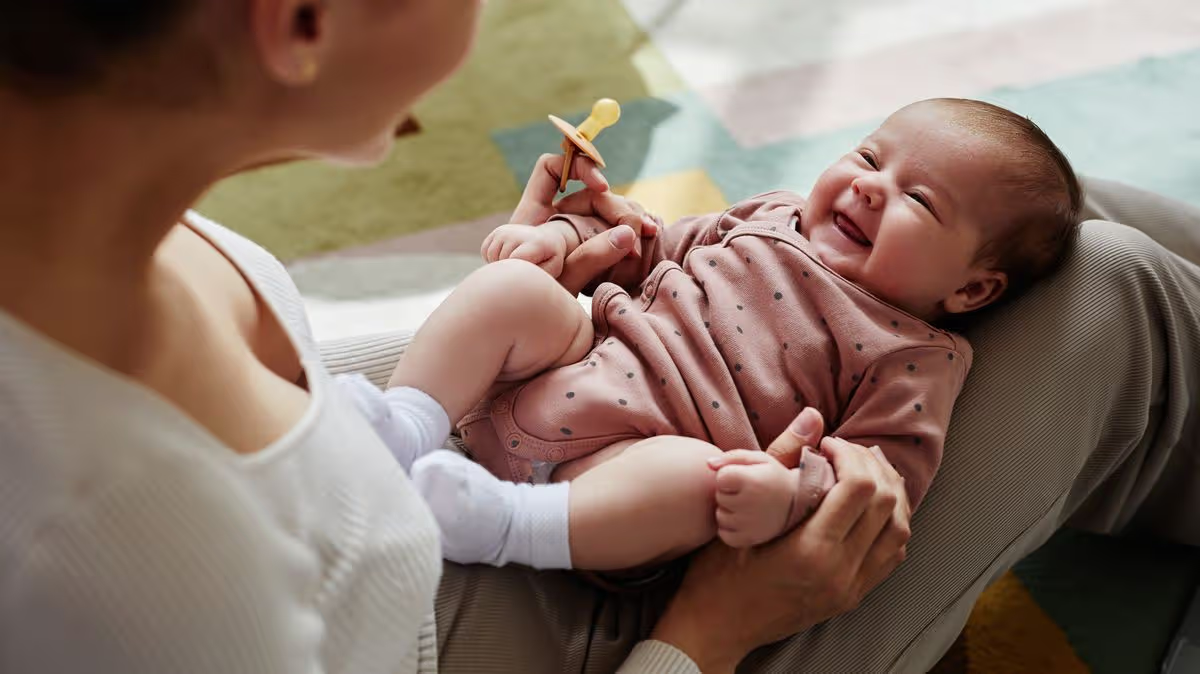
Baby hospital admissions have been seen to plummet in the UK thanks to a vaccine that is given to expecting mothers during pregnancy. This vaccine helps protect newborns from a nasty chest infection that can leave them grasping for breath and unable to feed.
Advertisement
According to new reports from UK health officials, this maternal vaccine has cut hospital admissions for RSV by more than 80 per cent. Since it was launched in 2024, women are offered the vaccine from 28 weeks of pregnancy to help protect their child.
RSV (respiratory syncytial virus) affects many newborns in the first few months of life and causes a chest infection that can lead to the baby becoming seriously ill. Data has shown that this virus has led to more than 20,000 babies in the UK being admitted to hospital each year due to nasty symptoms.
This virus is one of the main reasons babies are admitted to hospital before the age of one, with half of newborns catching RSV. According to the UK Health Security Agency (UKHSA), a new study of the vaccine’s impact shows that it gives “excellent protection” to babies that are the most vulnerable to the virus.
Symptoms of the virus can vary from a mild cold to a life-threatening chest-infection due to inflammation in the lungs. Each year, a small number of babies die from RSV.
Advertisement
The vaccine was first introduced in the UK in 2024 after clinical trials found it would boost a pregnant woman’s immune system enough to pass the protection through the placenta to the baby. This means the babies are born vaccinated from the virus.
The study found that if the vaccine is given at least four weeks before the baby is born then the protection is nearly 85 per cent. However, it does say that some protection is still possible if the jab is given even closer to the due date.
In fact, the study shows that even a two-week gap between vaccination and birth can be long enough to protect babies born earlier than planned, reports the BBC.
Advertisement
However Dr Conall Watson, national programme lead for RSV at the UK Health Security Agency, stresses that getting the vaccine as early as possible will offer the greatest protection for newborns.
He said: “If you’ve got a longer interval between when the vaccine gets given and when the baby is born, then you get even better protection. Get it on time. But if you can’t, do get vaccinated all the way through the third trimester.”
From August 1, 2024, to May 2025, a total of 17,911 doses of the RSV vaccine were administered to pregnant women in Scotland, which is an uptake of 49.1 per cent.
Advertisement
RSV is most common during the winter months, but it can occur at any time of the year. Along with this medication, pregnant women can receive vaccines for the flu and whooping cough through the NHS.
Dr Watson adds: “I would strongly encourage any pregnant woman to discuss it with their midwife, other health professionals, and be ready to have the vaccine at their week 28 appointment, or another vaccine appointment arranged soon after that.”
In the study, which followed nearly 300,000 babies born between September 2024 and March 2025 in England, more than 4,500 babies were admitted to hospital. The vast majority of these cases were of babies whose mothers did not receive the vaccination.
The RSV vaccine can also be given to people aged 75 and over, as well as for those who live in a care home with older adults.
Fergal Mackie, 28, is the founder of Edinburgh-based Metacarpal, which has made waves in the industry for developing fully mechanical prosthetic hands.
A Scot who created a bionic hand after breaking both his wrists in a skateboarding accident has made it onto Forbes’ prestigious list of top young entrepreneurs.
Advertisement
Fergal Mackie, 28, is the founder of Edinburgh-based Metacarpal, which has made waves in the industry for developing fully mechanical prosthetic hands. He has now been named in the Forbes 30 under 30 Europe Science and Healthcare 2026 list.
Mackie has told how his own experience of losing the use of his hands helped shape a life-changing product.
He told BBC Radio Scotland Breakfast: “I couldn’t imagine being named on the list when I started the company six years ago and it was never something on my radar.
“The biggest shock for me was the fact that nearly half of people who use hand or upper-limb prosthetics reject them.
Advertisement
“Over the last 30 years, the industry has focused on robotic hands but it has not had the impact that it would have hoped for on the rejection rates. There is still a massive need that is unfulfilled.”
Mackie, who studied product design engineering at Strathclyde University, was forced to undergo several surgeries after breaking both his wrists and cutting a tendon in his thumb.
During this time he was faced with the frustration of not being able to carry out basic tasks and had to discover new ways to get things done.
Advertisement
He started working with his uni’s prestigious prosthetics department and spoke to amputees and people with limb differences about their experiences.
Surprisingly, the most popular device for those with limb differences is still a hook, which was invented in 1912, with many rejecting robotic hands.
The engineering graduate set up Metacarpal in 2020 in a bid to fill a gap in the market and create a prosthetic hand controlled and powered by body motion. He took on two jobs to help fund the start up, designing the first prototype from his bedroom in Glasgow using a 3D printer.
From there the design evolved and Metacarpal secured funding earlier this year, employing 12 people to successfully launch the GEM – a bionic hand which operates through a cable system connected to a harness, activated by shoulder, arm or elbow movement.
Almost 40 people have received the prosthetic since its launch and it is now selling in the UK, US and Canada.
Advertisement
Mackie only found out he had made the Forbes list when it was published.
He said: “I think it’s a combination of having something out there that is helping people and building a company that is raising money and employing people in Scotland that helped me get on the list.”
Get more Daily Record exclusives by signing up for free to Google’s preferred sources. Click HERE
“A scene will remain in place whilst enquiries are ongoing”
A woman has been left fighting for her life following an incident it Mossley this morning (April 18)
Advertisement
According to Greater Manchester Police, officers were called to Manchester Road following reports of a concern for welfare of a woman shortly after 9.15am. The woman has since been taken to hospital and is said to be in a life-threatening condition.
The force confirmed that there are no suspicious circumstances in relation to this incident, and a scene will remain in place whilst enquiries are ongoing.
A spokesperson for Greater Manchester Police said: “Officers were called to reports of a concern for welfare of a woman on Manchester Road in Mossley at around 9:16am today (Saturday 18 April 2026).
“The woman has been taken to hospital and is in a life-threatening condition. There are no suspicious circumstances in relation to this incident.
Advertisement
“A scene will remain in place whilst enquiries are ongoing.”
Click here to get the biggest stories straight to your inbox in our Daily Newsletter
Lord Robertson’s claim that the UK cannot defend itself with an “ever-expanding” welfare budget has resonated loudly, given his previous positions as a Nato secretary-general and UK defence secretary. Following up on the UK’s 2025 strategic defence review, which he led, Robertson warned that low investment is leaving UK security “in peril”.
The comments have instant appeal in one sense. Defence is indeed awarded a far smaller share of the pie than social protection: 6.5% of total managed expenditure for 2026/27 against 28%, according to estimates.
The UK’s budget deficit is adding to already high public debt, and the IMF has forecast that Britain will be hit harder than other countries by the economic effects of the Iran hostilities. The government is already seeking savings from other departments as it tries to raise defence spending to 2.5% of GDP by 2027.
But the idea of a simple trade-off, with more weapons requiring less welfare, confuses two very different types of public spending.
Advertisement
Defence is part of “final” public expenditure, funding armed forces’ pay and the weapons and equipment they work with. This takes up money that can’t be assigned elsewhere in the budget, and consumes a share of national output when the government spends it.
In contrast, the welfare budget consists mainly of “transfer payments” that shift income between households. Some transfers are made according to assessed need, others also depend on past national insurance contributions. All represent a redistribution of income without any exchange of goods or services, leaving recipients to decide what to do with the money. This allows prices to steer spending away from scarce resources, while some is used to repay debts or clawed back in tax.
Demands on the public purse
As the government’s overall budget is in deficit (to the tune of around 4.5% of national income in 2025/26), it is true that welfare payments compete with other demands on the public purse. But the boost to recipients’ income is still largely offset by taxes collected from better-off households.
In principle, a country could raise its welfare budget to 100% of its GDP, by collecting all the money generated by production as tax and then paying it out to households. It would compromise efficiency, as happened in Europe’s “state socialist” countries before 1989. But such an economy could still function.
Advertisement
In contrast, raising the defence budget even to 3% of GDP – the UK’s target for the next parliament – will cause political and economic strain. This is due to the trade-off against other final expenditures, including healthcare, education and policing – all equally vital for national survival and security.
The UK and other countries with large welfare systems have reformed them with the aim of adding at least as much to output as to demand. Transfer payments are increasingly designed to keep people economically active, moving into new and more productive work. This matching of extra income to extra production keeps the inflation risk low, even if the government is “printing money” to fund some of its transfer payments.
Extra defence spending carries greater inflation risks. Paying for more weapons and military training generates new income and demand for consumer products. At the same time it can divert workers and materials away from civilian production, into military hardware that is intended never to be used.
The Manhattan Project hastened progress in other areas – including civilian nuclear power. EWY Media/Shutterstock
Stronger defence could boost production as much as consumption if, as many advocates claim, it stimulates investment and innovations that other industries can adopt. The Manhattan Project remains a standout example of “mission-oriented” military spending that sped the arrival of new technologies and methods of organisation.
Studies confirm a pick-up in innovation and growth after major increases in military spending. But these tend to focus on the US and trace the improvement to increased research and development (R&D). Growth might be stimulated equally well, making more weapons and more welfare an affordable option, if greater sums went into R&D without a link to war preparations.
Of course, defence can be counted as an even more productive investment if, through effective deterrence, it prevents costly wars that would devastate civil production.
But again, there is an important difference between investing in military hardware and in social protection. The welfare bill is hard to forecast, as it varies with the state of the economy and trends in income and employment. But when transfer payments enable people to recover their health or acquire new skills and return to work – or when they keep pensioners out of poverty – the government gets a rapid return on its investment and reduces longer-term costs.
Advertisement
Investment in more soldiers and equipment may be easier to control in the short term. But it commits the government to maintenance and upgrades over the long term, without which the fighting capacity can soon become non-operational. The UK has a history of cost overshoots and delays keeping tanks and ships out of service. That’s why a Treasury set on cost-effectiveness will always choose butter over guns.
Homelessness charity Centrepoint has confirmed it has no plans to work with Sharon Osbourne in the future after she publicly endorsed a rally organised by right-wing activist Tommy Robinson.
Daniel Bird and Ruairi Scott Byrne
15:08, 18 Apr 2026
Sharon Osbourne has been cut ties with by a charity after publicly backing a rally organised by controversial right-wing figure Tommy Robinson.
Homelessness charity Centrepoint has announced it has “no plans to work together in the future” with Sharon after she openly supported an upcoming demonstration orchestrated by Robinson.
Advertisement
In an online statement, Robinson declared he was organising the march for individuals “who have had enough of migration and mass immigration and the oppression from a tyrannical government”.
The TV star, perhaps most recognised from her time on The X Factor, used her official Instagram profile to write: “See you at the march” under a post advertising the event planned for next month, titled ‘Unite The Kingdom’. The demonstration intends to “bring London to a total standstill”.
Osbourne, whose husband, Black Sabbath icon Ozzy Osbourne, died last July at the age of 76, had previously backed Centrepoint through its Omaze fundraising campaign, offering the public a chance to win a high-end property, reports the Irish Mirror.
A Centrepoint representative made clear: “Sharon supported us on this campaign and, while she is referred to as an ambassador in that context, she was not an official ambassador for Centrepoint.”, reports the Mirror. “We have no plans to work together in the future. Political activity like this runs counter to our values and our long history of supporting young people regardless of their background, religion or ethnicity.
Advertisement
“If we want young people to thrive in this country, then we need to ensure our society continues to allow them to live without fear and to access the opportunities they need to start education or work and leave homelessness behind.”
The Unite the Kingdom rally is due to be held in London on 16 May, spearheaded by right-wing activist Robinson, whose real name is Stephen Yaxley-Lennon. The last demonstration in September drew crowds estimated at between 110,000 and 150,000 attendees.
In recent times, Mrs O has generated growing controversy, including online involvement with anti-immigrant campaigns. Robinson, whose birth name is Stephen Christopher Yaxley-Lennon, co-founded the English Defence League. His 2005 conviction stemmed from assaulting an off-duty police officer.
Another assault conviction followed in 2011, resulting in a suspended sentence for head-butting someone at an EDL rally in Lancashire. That July, Robinson was given a 12-month community rehabilitation order after leading a brawl involving roughly 100 football supporters in Luton during 2010. Two years afterwards, he was imprisoned for passport fraud after attempting to enter America using someone else’s identity. In January 2014, the activist received an 18-month jail term for “conspiring with others to obtain a mortgage by misrepresentation from the Abbey and Halifax banks”. He found himself back behind bars in 2019 following a contempt of court conviction.
Advertisement
A five-year stalking protection order was imposed upon him in 2021 after journalist Lizzie Dearden and her partner, Samuel Partridge, filed a complaint with police. Come May 2025, he walked free halfway through an 18-month sentence he’d been serving for breaching an injunction that barred him from repeating unfounded claims about a Syrian refugee.
Want to see more of the stories you love from Belfast Live? Making us your preferred source on Googlemeans you’ll get more of our exclusives, top stories and must-read content straight away. To add Belfast Live as a preferred source, simply click here.















































You must be logged in to post a comment Login