



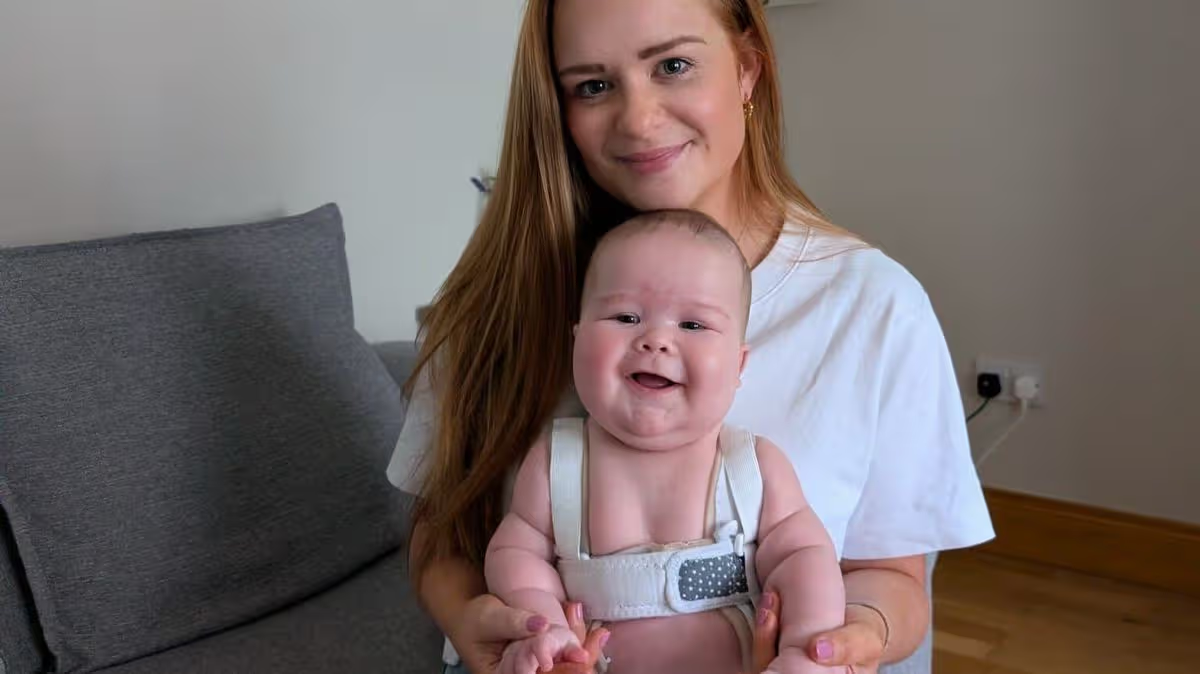
“Research it, look it up, ask the questions, and don’t take no for an answer.”
For months after her children were born, Eileen Brannigan had to be careful about how she held them as they were carefully positioned in harnesses to help their hips develop properly.
When her daughter, Eíbhí, was just 16 weeks old, a routine check with a health visitor found she had an uneven skin roll on her thigh, an indicator for hip dysplasia. However, the health visitor said she wasn’t too concerned, but would refer her just to make sure.
A few weeks later, Eileen received a letter about bringing Eíbhí for a scan, which discovered the little one had a severe hip dislocation and would need to wear a pavlik harness for up to 20 weeks.
READ MORE: How Olivia’s Haven founder turned a lockdown vision into a thriving businessREAD MORE: ‘My son was diagnosed with hearing loss at just 12 weeks old’
When her second child, Connor Óg, was born, he was automatically referred for a scan as the sibling of a child with hip dyslasia. He was also found to have the condition, and was put into a harness at eight weeks old.
The pavlik harness is a soft, fabric orthotic device used to treat developmental dysplasia of the hip (DDH) in infants, usually from birth to six months. The condition means an infant’s hip joint doesn’t fit together properly, ranging from mild instability to full dislocation.
Treatment with the harness means the baby’s hips and knees are held in a bent, slightly spread position to encourage proper socket development. The way in which the harness is adjusted can be tricky, as if it’s too tight it can cause pain, but if too loose it won’t do its job properly.
Speaking to Belfast Live at her home in Co Down, Eileen said she hadn’t heard of the condition before, adding they were very lucky it was picked up.
The 29-year-old said: “My daughter Eíbhí was 16 weeks old and at her review at home, the health visitor was measuring her weight and height. For that, you have to strip the baby right down, and the health visitor does a few hip exercises with her.
“She then noticed an uneven skin roll on Eíbhí’s thigh, she had three on one thigh and two on the other. In her experience, the health visitor said that might suggest a little bit of hip dysplasia, but said she presented fine. She said she wasn’t concerned, but would do a referral.
“Within a few weeks, I received a letter to bring Eíbhí up for a scan and thought nothing of it. Everyone looked at her, every consultant looked at her as she was a wee bit sick when she was first born.
“Everyone told me this child is presenting really fine. Then we went in for our scan, and I was told she had a really severe hip dislocation, and she would immediately be put into a pavlik harness for 12 if not 20 weeks, depending on if she meets her numbers. She ended up doing the whole 20 weeks in the harness.
“I feel very lucky Eíbhí was picked up on a complete whim, otherwise she would have slipped through the net and around the age of two or three, she would have started walking differently than other children. She probably would have had sore hips playing sports, she would have ended up needing surgery.”
Her son was found to have a shallow hip, a less severe condition than her daughter’s dislocation, and remained in a harness for 12 weeks.
Eileen said she wasn’t given much guidance on the condition, and parents she tried speaking to about it had never heard of it before.
“I was a first time mum and didn’t know what I was doing anyway, so to be faced with a baby in a pavlik harness and not have support or guidance, there was nowhere to look up tips and tricks, it was difficult,” she explained.
“There weren’t any other parents really talking about it, I saw a few accounts on TikTok that I looked up, but anyone I spoke to didn’t know anything about it. I was the mum at the mums and toddlers group with the child in the harness, I felt really lonely.
“I felt completely alone, like there was no one I could talk to about it. I was getting a lot of sympathy but I didn’t want that, I wanted other parents to know about hip dysplasia.”
As a way to share her story and raise awareness of DDH to help other parents, Eileen started documenting her day-to-day life on TikTok, sharing aspects of her children’s lives with the condition.
From talking to more people about hip dysplasia, she said many don’t realise how common it is. Mild hip instability affects approximately one in 10 newborns.
Only around one in 100 infants require treatment for DDH, and one in 500 have a completely dislocated hip, with a higher incidence in girls, first-borns, and those with a breech family history.
Eileen said she would like to see automatic referrals for scanning for infants whose family have history with hip issues, to help prevent the condition from going undetected and showing up later in life.
She explained: “I want to raise awareness as there’s a lot of parents out there who don’t know anything about it. Maybe their grandparents had a bad hip, or their uncle is getting hip surgery. Of course you have sports injuries and different things which may mean you need hip surgery, but when it comes to it, not much is shared about it.
“They don’t ask about it during your booking scan when you go in at 12 weeks and are asked all your family history about diabetes, DVTs and heart problems. You’re not asked about DDH, you’re not asked about hip problems. That’s what I just really want to happen.
“I want expectant parents to be aware of this, both antenatally and postnatally. If it’s not discussed antenatally, then once the child is born, a leaflet before you leave the hospital, have you thought about this? Go and get your child checked.
“It’s not easy for consultants and GPs to pick it up just by looking at the child. It does require an ultrasound scan, which is why a lot of babies are falling through the net, so I want people to just be at least aware of it.
“They don’t have to go and get the child scanned, they don’t have to tick the box, but I would like there to be a box there to be ticked if you felt concerned or just wanted that peace of mind in getting your baby scanned.”
Since sharing her story on social media, Eileen said she has had a lot of parents reaching out about the condition.
“I had a mum contact me saying she watched the videos, and noticed her daughter crawling and walking a bit funny, so she got her looked at and she needs hip surgery in a few weeks, and she’s two years old,” she said.
“I had another mum in Derry who was literally given a harness and told to go home, and was given no information. I had to send her a step by step tutorial on taking the harness off and putting it back on, as it’s a skill in itself using it.
“A lot of people are aware of it once they hear about it, it clicks with them and they’re like ‘oh actually I have a bit of a bad hip and I’m 26.’”
As for the advice she would give to parents concerned about the condition, or interested in finding out more, Eileen said: “Research it, look it up, ask the questions, and don’t take no for an answer. Speak to your family and your parents if you can, to any family members who may have had hip problems.
“Just as much as we talk about diabetes in pregnancy, we talk about taking our folic acid, we should be talking about DDH. A simple scan will give the child a proper childhood, a proper adulthood instead of years down the line, being in severe pain due to something that could have easily been detected at birth.
“I think if there’s a family history of DDH or hip dysplasia, it should be an automatic referral. Giving up holding your child for 12 weeks or 20 weeks in my case is definitely worth it, compared to years of pain for them down the line because they don’t have a voice.
“I want to be the voice for them, as well as other children out there who may go undetected. A simple scan is all it takes.”
Symptoms of Developmental Hip Dysplasia (DDH)
Symptoms vary by age, with infants (0-6 months) showing signs of uneven skin folds on thighs or buttocks, limited abduction shown by being unable to move one leg to the side as far as the other during nappy changes, one leg appearing shorter than the other, or a clicking/popping sound in hips.
Toddlers may show signs of a limp, a waddling gait, walking on their toes, or dragging one leg which can be observed while crawling.
If the condition is undiagnosed earlier, it can appear in teenagers and young adults through groin pain often related to activity, a feeling of hip instability or reduced range of motion, or early arthiritis due to chronic misalignment.
For more information on the condition, click here.
Video by Belfast Live videographer Justin Kernoghan.
For all the latest news, visit the Belfast Live homepage here and sign up to our daily newsletter here.











































You must be logged in to post a comment Login