
While bigger screen sizes are becoming more popular, the best 55-inch TV screens offer that sweet spot of size, performance and value.
This list covers all the best 55-inch TVs that we’ve reviewed, from budget 4K TVs to Mini LEDs and OLED TVs. Everything that receives a four-star review is worthy of a best buy addition, so don’t think that a four-star review is necessarily worse than a 4.5 star. In some cases a four-star review might be the best TV for you.
When we review TVs, we base our assessments on measurable, quantifiable data alongside real-world content and impressions. We compare against price rivals where possible, with a focus on picture, sound and features to determine a TV’s value and performance.
If the choices we’ve made don’t float your boat, or you’re looking for a bigger size TV, we have other best buys you can look includes our best cheap TVs, best 4K HDR TVs; best 8K TVs and best OLED TVs.
Best 55-inch TVs at a glance
SQUIRREL_ANCHOR_LIST
Learn more about how we test televisions
Every TV we review is put through the same set of tests to gauge its picture performance, usability, and smart features.
Tests are carried out over several days and are done by eye but supported with technical measurements. Testing by eye involves an expert watching a wide range of material to understand and determine a TV’s performance in fields such as brightness, contrast, motion processing, colour handling and screen uniformity.
We’ll consider the design of the TV in terms of build quality, study the spec sheets and see if the TV’s connections are up to spec, as well as playing video and audio content to ensure that the set handles playback as it claims. We also take note whether a product’s compatible formats and features are in line with industry trends or not to gauge whether it’s relevant for you.
Comparison to other related and similarly priced products is also important, to see if it’s missing any vital features and whether it impresses as a whole. After all this, we’ll come to a judgement on how the TV performs as a whole.
If you want to learn more, please visit our detailed page about how we test TVs.
The LG OLED55G5 (G5) is easily one of the best 55-inch, 4K TVs currently on the market. With a vibrant and colourful picture, excellent upscaling and processing capabilities and a surprisingly high brightness, the LG G5 will suit most households.
LG’s TV interface is pretty easy to navigate through, and you can use either the included remote or via LG’s ThinQ smartphone app to do so. However, keep in mind that instead of Freeview Play support, you’ll see LG Channels.
Otherwise, the LG G5 is fitted with a Primary RGB Tandem panel and, unlike other LG models, doesn’t sport any green tint either. Instead, picture quality is realistic and vibrant too. However, where the TV especially impresses is with its brightness, as it can hit a peak of a whopping 4000 nits – no mean feat for an OLED.
Another area where the G5 excels is with upscaling, as 1080p content could genuinely be mistaken for a true 4K image.
Generally speaking, the G5’s audio quality is decent, with dialogue especially sounding clear and natural. However, lower frequencies does bring out some buzzing and it can sometimes lack the energy of other TVs. With this in mind, it might be a good idea to invest in one of the best soundbars.
It may not be quite as bright as alternatives from Samsung or LG, but overall the Sony Bravia 8 is a well-priced option for those seeking great picture quality in a sleek design.
Speaking of its design, at just 37mm with thin bezels, the Bravia 8 adopts a minimalist, slender look. The rear of the screen is also flat, so if you choose to wall-mount it then it’ll sit flush against the wall.
The Bravia 8 runs on Google TV and, unlike other UK Google TV models, Sony’s own includes the likes of BBC iPlayer and ITVX. Plus, Google TV allows you to control the set via its voice assistant.
Unsurprisingly the Bravia 8 is equipped with plenty of premium technologies, including HDR coverage, support for Dolby and DTS. There’s also Netflix Adaptive Calibrated Mode and Prime Video Calibrated Mode which adjusts the screen’s contrast and brightness depending on the room’s environment.
Overall, the Bravia 8 delivers rich and wide-ranged colours, with Sony’s processing drawing out more tones for a more vibrant look. Plus, the TV offers a brilliantly natural and detailed image that we found difficult to fault. Sure, it’s not as bright as some of its competitors, but it’ll fit perfectly into the right room.
Thanks to the XR processor, the Bravia 8 does a great job at upscaling and produces a clear, detailed image without much noticeable noise.
Finally, the Bravia 8’s audio system uses actuators to vibrate the screen and create sound, and is solid at reproducing the ambience of scenes. However, although DTS tracks sound clear and detailed, bass is lacking and there’s not quite as much power as we’d like. You can tinker with the settings, but we’d recommend opting for one of the best soundbars or best cheap soundbars to enhance the quality.
-
Stunningly cinematic picture quality
-
Attractive but also flexible design
-
Warm, detailed and immersive sound
The Sony A95L is a premium QD-OLED TV, and while the asking price is steep compared to most other 55-inch screes on this best list, it boasts stellar picture and sound quality.
The Sony A95L offers fantastically fine shading of colours that look impressively pure, along with excellent levels of sharpness and detail. It’s not the brightest QD-OLED, as it’s beaten by the Samsung S95D, but in its favour is that the Sony is capable of a more cinematic-looking image.
Sony’s Acoustic Surface Audio system delivers an audio performance that’s big and accurate in terms of where effects and dialogue are placed, pushing sound into a room, the woofers add some punch to the low frequencies too.
The A95L’s smarts are delivered by Google TV, and unlike the Philips OLED908, it is covered for the UK’s catch up services which are available as separate apps.
Connectivity covers two HDMI 2.1 inputs with support for eARC, VRR, ALLM, and 4K/120Hz. For PS5 gamers there is the Auto Tone Mapping feature that optimises the HDR performance but with no support for AMD FreeSync or Nvidia G-Sync. Input lag is faster than the A95K at 16.7ms. The addition of Dolby Vision Game mode helps extract more contrast and brightness from supported games.
For a budget TV, the Xiaomi TV F Pro is packed with a surprisingly large selection of features, has a great picture quality and sounds pretty good too. With a 4K QLED panel and support for HDR10, HDR10+ and HLG, you’re looking for a bargain, this is tough one to beat.
While it’s not the brightest around, the Xiaomi TV F Pro’s 400 nits is a better result than the more expensive Samsung Q7F.
Despite no Dolby Vision support, the TV’s colour performance is pretty good with saturated and punchy colours, while black levels look decent enough too. However, we should disclaim the black levels aren’t quite as strong as competitors, and you will need to play around with the settings to get the best picture quality.
One slight issue we noticed is that there’s a slight green tone to Xiaomi’s Movie picture modes. While it’s not prominent enough to be distracting, it’s certainly noticeable when you see another TV next to it.
Upscaling performance is exactly what you’d expect from a TV of this price: fine. It does an admirable job, but some details and colours are lost.
We were especially (pleasantly) surprised by the audio performance on offer here. The sound is big, loud and equipped with plenty of detail. Bass struggles slightly, but not as much as you’d fear. However, with three HDMI inputs, you can easily pair the TV with a soundbar if you so wish.
The Xiaomi TV F Pro runs on Amazon’s Fire TV OS which is pretty intuitive to use. Sure, it has a tendency to push Prime Video titles, and adverts are present, but overall it’s not a terrible system.
We should disclaim that we technically reviewed the 65-inch iteration of the Sony Bravia 5. However, the 55-inch option offers the same specs and naturally has a cheaper RRP of £1199.
That price point is especially noteworthy when you consider you’re getting a Mini LED panel with local dimming – 240 controlled zones to be exact. This, paired with Sony’s acclaimed XR processor, results in the Bravia 5 being an excellent all-rounder.
We’ll dive a bit deeper into its specs. The XR Processor includes XR Triluminos Pro and Live Colour analysis to enhance colour performance and XR Clarity to enhance sharpness and detail, various motion processing options, while the TV supports the likes of HDR10, HLG and Dolby Vision. While there’s no HDR10+ present, there are Netflix, Prime Video and Sony Pictures Core calibrated presets.
Overall, the Bravia 5 has a picture quality that’s remarkably similar to those found on more expensive Sony models, with HDR images looking bright and black levels consistently deep in dark scenes. Brightness and contrast levels are great here too, with colours looking engagingly vivid and expressive.
With a four-speaker system, the Bravia 5 results in a large and detailed soundstage. Plus, with Dolby Atmos and DTS:X, the TV is able to extend beyond the screen’s boundaries too.
Add Sony’s Bravia Cam accessory and the TV will detect where you are in the room and adjust its brightness, sound balance and vocals accordingly too.
Otherwise, Google TV runs the show here and offers access to the likes of BBC iPlayer (which isn’t always a guarantee). When it comes to gaming, the Bravia 5 doesn’t support AMD FreeSync or Nvidia G Sync VRR, although it does support 120Hz.
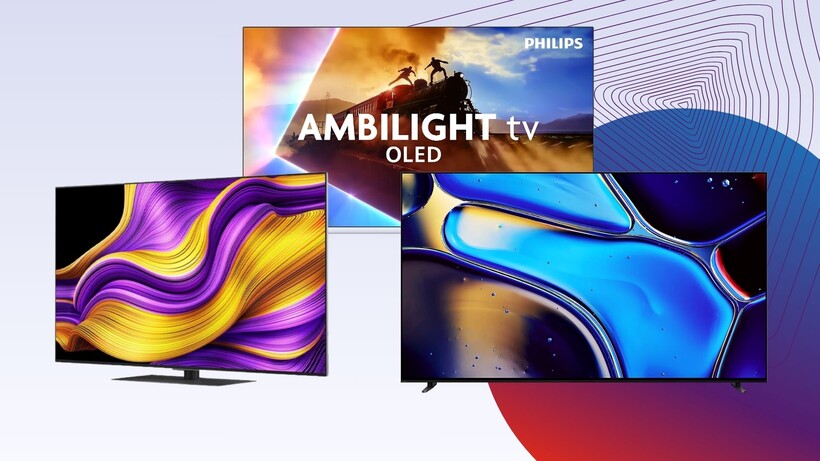
Despite its RRP of £1199, Philips has managed to pack in plenty of premium features and technologies into its 55-inch 55OLED760. We especially like the inclusion of the rear mounted Ambilight LED bulbs which illuminate to match what’s on screen.
The 55OLED760 runs on TitanOS which is a viable alternative to Google TV and includes all the streaming platforms you’d expect such as Netflix, BBC iPlayer and Disney Plus.
Built on an OLED EX panel and driven by a seventh-gen P5 Perfect Picture Engine, the 55OLED760 delivers deep, natural blacks and does an excellent job at upscaling lower-res images too.
Speaking of the P5 processor, alongside its wide range of TV modes (Cinema, Sports and Gaming to name a few), there’s also an AI-driven option to intelligently tune colours to the room conditions.
Overall, we concluded that the 55OLED760 TV offers a consistently impressive picture quality, regardless of what we were watching. Thanks to multi-format HDR support which covers Dolby Vision, HLG and HDR10, any disc or stream you throw at it looks great.
Perhaps surprisingly for a two-channel system, audio quality is strong too. There’s Dolby Atmos and DTS:X decoding built-in, and the set can also function within a wider DTS Play-Fi multiroom system set-up too. The TV can also bitstream audio out over HDMI eARC to compatible external sound systems too.
If you’re looking for an eye-catching TV that offers a surprisingly brilliant picture and audio quality, then the Philips 55OLED760 is a lot of bang for your buck.
-
Fire TV’s emphasis on all-things Amazon
-
Not the most subtle image
-
Odd brightness fluctuations with Dolby Vision
Put simply, the Omni Mini LED is easily Amazon’s best TV to date and, with an RRP of £849/$819, it’s brilliant value too. If you’re cemented in Amazon’s ecosystem, then the Omni Mini LED TV is almost a no-brainer.
Naturally, the Omni Mini LED is fitted with Amazon’s Fire TV OS and Alexa. Fire TV OS can be a bit overwhelming at times, especially as Amazon pushes its own content ahead of literally everything else, but generally it’s fairly easy to get your head around.
In terms of features, the Omni Mini LED is equipped with many technologies you’d expect, from HDR support that covers HDR10, HLG, HDR10+ Adaptive (HDR10+ Gaming) and Dolby Vision IQ, Filmmaker Mode and Dolby Atmos audio too. On the gaming front, there’s Dolby Vision Gaming, ALLM and AMD FreeSync Premium Pro too.
Generally, the Omni Mini LED’s picture is rich and colourful, although it sometimes makes skin tones slightly unnatural while dark performance varies for seemingly unknown reasons. We found, however, that to get the best picture you’ll need to dive into the TV’s settings. For example, we found the Adaptive Light Sensor made images darker while Adaptive Colour and Intelligent HDR made things overly vibrant.
Another thing to note is blooming and black levels get worse at wider angles. While the matte screen does a good job of obscuring background reflections, it’s best to consider where you’re placing the TV.
Sound quality is decent, but you may want to invest in a supporting soundbar to get the most out of the TV. While the low end is weighty, dialogue doesn’t always sound natural and Dolby Atmos soundtracks aren’t quite as sharp.
Anyone wanting a Mini LED TV without the hefty price tag should seriously consider the Amazon Omni Mini LED. Yes, it’s very Amazon-centric, but it’s a great choice for those already in its ecosystem.
Hailed by us as being the “ultimate garden TV”, the Sylvox Pool Pro 2.0 is designed to be visible in bright, sunny conditions.
Naturally, the Sylvox Pool Pro 2.0 is weather-proofed, with an IP55 rating and resistant to temperatures between -30°C to 50°C. While that’s obviously a necessity with an outdoor TV, it does mean that it’s fitted with a hefty metal chassis that weighs 21.8kg (for the 55-inch model).
Speaking of weatherproofing, there’s a panel at the pack which requires a screwdriver to access. If you want to connect external devices, we’d recommend connecting an HDMI cable but wrapping the exposed end in a plastic bag and cable tie to protect it from the elements.
The Sylvox Pool Pro 2.0 has a 2000 nits panel which is, unsurprisingly, much brighter than any of the other models on this list. That’s because brightness is key when viewing a screen outdoors. This high brightness means it can overcome any ambient lighting condition – even sunlight shining directly onto the screen. It’s still better to avoid too much direct sunlight, but it’s still extremely watchable.
You’ll likely need to enter the TV’s settings to tweak the brightness, contrast and hue controls to bring out the best picture. Fortunately, with the Google TV interface, this isn’t difficult to do – however keep in mind that this iteration doesn’t support UK services like BBC iPlayer or ITVX.
Similarly, you’ll probably need to adjust the TV’s audio settings too. Although audio is generally clear and loud, the aforementioned hefty design does make sound feel enclosed. You can opt for a waterproof soundbar to remedy this, although we haven’t reviewed that ourselves yet.
If you spend a lot of time outdoors, and are sick of squinting into a tablet or laptop to watch TV, then the Sylvox Pool Pro 2.0 will be a worthy investment. However, due to the nature of the device, you shouldn’t expect the best TV experience here.
FAQs
What’s the best 55-inch TV under £500?
Out of the models we’ve tested, the TCL Roku would be our choice with its Dolby Vision support, colourful SD performance and fast input lag for gaming.
Test Data
| |
LG OLED55G5 |
Sony Bravia 8 |
Sony XR-55A95L |
Xiaomi TV F Pro |
Sony Bravia 5 |
Philips 55OLED760 |
Amazon Fire TV Omni Mini LED |
Sylvox Pool Pro 2.0 |
| Contrast ratio |
– |
– |
– |
– |
– |
Infinity |
– |
– |
| Input lag (ms) |
13 ms |
12.7 ms |
16.7 ms |
– |
13.2 ms |
13 ms |
13.2 ms |
– |
| Peak brightness (nits) 5% |
– |
463 nits |
– |
381 nits |
– |
– |
797 nits |
– |
| Peak brightness (nits) 2% |
– |
462 nits |
2093 nits |
391 nits |
710 nits |
– |
551 nits |
– |
| Peak brightness (nits) 10% |
– |
430 nits |
1337 nits |
381 nits |
800 nits |
760 nits |
950 nits |
– |
| Peak brightness (nits) 100% |
– |
121 nits |
226 nits |
381 nits |
592 nits |
– |
460 nits |
– |
| Set up TV (timed) |
421 Seconds |
69 Seconds |
– |
108 Seconds |
720 Seconds |
– |
98 Seconds |
– |
Full Specs
| |
LG OLED55G5 Review |
Sony Bravia 8 Review |
Sony XR-55A95L Review |
Xiaomi TV F Pro Review |
Sony Bravia 5 Review |
Philips 55OLED760 Review |
Amazon Fire TV Omni Mini LED Review |
Sylvox Pool Pro 2.0 Review |
| UK RRP |
£2399 |
£2199 |
£2499 |
£379 |
£1399 |
£1199 |
£849 |
£3159 |
| USA RRP |
$2499 |
– |
$2799 |
– |
$1499 |
Unavailable |
$819 |
– |
| EU RRP |
– |
– |
€2779 |
– |
– |
– |
– |
– |
| CA RRP |
– |
– |
CA$3999 |
– |
CA$2099 |
Unavailable |
– |
– |
| AUD RRP |
– |
– |
AU$5295 |
– |
AU$1999 |
Unavailable |
– |
– |
| Manufacturer |
LG |
Sony |
Sony |
Xiaomi |
Sony |
Philips |
Amazon |
Sylvox |
| Quiet Mark Accredited |
– |
– |
– |
– |
– |
– |
– |
– |
| Screen Size |
54.6 inches |
54.6 inches |
54.6 inches |
54.6 inches |
64.5 inches |
54.6 inches |
54.6 inches |
54.6 inches |
| Size (Dimensions) |
1222 x 263 x 742 MM |
1223 x 248 x 786 MM |
1224 x 34 x 707 MM |
1226 x 312 x 770 MM |
1447 x 345 x 862 MM |
x x INCHES |
1230 x 300 x 800 MM |
124.4 x 8.7 x 72.6 CM |
| Size (Dimensions without stand) |
703 x 1222 x 27.2 MM |
706 x 1223 x 37 MM |
x x INCHES |
711 x 1226 x 76 MM |
832 x 1447 x 58 MM |
708 x 1228 x 58 MM |
x x INCHES |
124.4 x 8.7 x 72.6 CM |
| Weight |
22.1 KG |
18 KG |
17.6 KG |
9.2 KG |
24.9 KG |
17.2 KG |
16 KG |
21.8 KG |
| ASIN |
B0F9PFNQJJ |
B0CZTZTQXJ |
B0CBN9YGML |
– |
B0F29KYPN4 |
B0F24VHMK4 |
B0C7SJFB2W |
B0D1GFGQPG |
| Operating System |
webOS 25 |
Google TV |
Google TV |
Fire TV |
Google TV |
Titan OS |
Fire TV |
Google TV |
| Release Date |
2025 |
2024 |
2023 |
2026 |
2025 |
2025 |
2024 |
2024 |
| First Reviewed Date |
– |
– |
16/04/2024 |
– |
– |
– |
– |
08/05/2025 |
| Model Number |
– |
K55XR80 |
XR-55A95L |
– |
– |
55OLED760/12 |
ML55F700 |
Sylvox Pool Pro 2.0 |
| Model Variants |
– |
– |
– |
– |
– |
– |
– |
OT43A2KOGF, OT65A2KOGF, OT75A2KOGF |
| Resolution |
3840 x 2160 |
3840 x 2160 |
3840 x 2160 |
3840 x 2160 |
3840 x 2160 |
3840 x 2160 |
3840 x 2160 |
3840 x 2160 |
| HDR |
Yes |
Yes |
Yes |
Yes |
Yes |
Yes |
Yes |
Yes |
| Types of HDR |
HDR10, HLG, Dolby Vision |
HDR10, HLG, Dolby Vision |
HDR10, HLG, Dolby Vision |
HDR10, HLG, HDR10+ |
HDR10, HLG, Dolby Vision |
HDR10, HLG, Dolby Vision, HDR10+ Adaptive |
HDR10, HLG, HDR10+ Adaptive, Dolby Vision IQ |
HDR10 |
| Refresh Rate TVs |
48 – 165 Hz |
40 – 120 Hz |
40 – 120 Hz |
50 – 60 Hz |
48 – 120 Hz |
48 – 120 Hz |
48 – 144 Hz |
– 60 Hz |
| Ports |
Four HDMI 2.1, three USB, ethernet, optical digital out, CI+, two RF tuners |
Four HDMI, digital audio out, two USB ports, Ethernet, two satellite, RF terrestrial |
Four HDMI, Ethernet, two USB, digital audio out, RF terrestrial, two RF satellite |
Three HDMI, USB, Ethernet, Digital Optical Audio output |
Four HDMI (two with full HDMI 2.1 features), 2 x USB, Ethernet, RF input, optical digital audio output |
Four HDMI 2.1, digital audio output, two USB ports, Ethernet, terrestrial/satellite |
Four HDMI, USB 3.0, a digital optical port, RF antennae, Ethernet and a 3.5mm input |
3x HDMI 2.1 (one eARC), 2x USB, satellite and coax aerial inputs |
| HDMI (2.1) |
eARC, ALLM, VRR, HFR, QMS, QFT |
eARC, ALLM, VRR, HFR, SBTM |
eARC, ALLM, VRR, HFR |
eARC, ALLM |
eARC, VRR, ALLM, 4K/120Hz |
eARC, ALLM, VRR, HFR |
eARC, ALLM, VRR, HFR |
Yes |
| Audio (Power output) |
60 W |
50 W |
60 W |
20 W |
40 W |
20 W |
– |
20 W |
| Connectivity |
Wi-Fi, Bluetooth 5.3, AirPlay 2, Google Cast |
Wi-Fi, AirPlay 2, Google Cast, Bluetooth 5.3 |
Wi-Fi, Chromecast, AirPlay 2, Bluetooth 5.2 |
Mircast, AirPlay 2, Wi-Fi, Bluetooth |
Wi-Fi, Bluetooth 5.3, Apple Airplay 2, Google Cast |
Wi-Fi, Bluetooth |
Wi-Fi 6E, Bluetooth |
Wi-Fi |
| Colours |
– |
– |
– |
Black |
– |
– |
– |
– |
| Display Technology |
OLED |
OLED |
OLED, QLED |
QLED |
Mini LED, VA |
OLED |
Mini LED |
Direct-LED |
The post Best 55-inch TVs 2026: Our favourite Mini-LED, OLED and 4K models appeared first on Trusted Reviews.
Source link























































You must be logged in to post a comment Login