
Crypto World
US Crypto Exchange 2026: AndX Launches on BitGo

BitGo announced that AndX USA LLC has launched its US crypto exchange 2026 entry on top of BitGo’s Crypto-as-a-Service infrastructure, giving the global digital asset platform nationwide operations across all 50 states under an OCC-regulated custody framework backed by $250 million in insurance coverage.
Summary
- AndX, a New York-headquartered AI-native Web3 financial platform that already operates in Turkey, the UAE, India, Brazil, the Philippines, and South Africa.
- The platform runs on BitGo Bank and Trust, National Association, the first federally chartered digital asset trust bank owned by a publicly traded company.
- AndX CEO Viru Raparthi said the partnership enables the company to focus on user-facing innovation including AI-driven trading tools, real-world asset tokenization, and global payment capabilities rather than on core infrastructure.
The US crypto exchange 2026 market is increasingly being built not by companies constructing their own custody and compliance systems from the ground up but by platforms that integrate existing regulated infrastructure through API-driven partnerships. The AndX and BitGo launch is the clearest recent example of that model working at scale.
BitGo’s Crypto-as-a-Service offering provides the technical and regulatory foundation: OCC-regulated custody, transaction monitoring, transfer workflows, and compliance architecture, all delivered through configurable APIs and webhooks. AndX plugs into that stack and focuses its engineering resources on the trading interface, AI-powered tools, and market-facing features that differentiate it with users.
“Crypto platforms shouldn’t have to choose between speed to market and institutional-grade safeguards,” said Frank Wang, BitGo’s managing director and head of fintech. “BitGo’s Crypto-as-a-Service enables partners like AndX to launch and scale secure trading experiences on top of a regulated infrastructure foundation, with API-driven systems designed for reliability, control, and compliance.”
Building a compliant US crypto exchange from scratch requires obtaining money transmission licenses in 46 or more states, navigating a BitLicense application in New York, establishing custody arrangements, hiring compliance and AML staff, and building or procuring surveillance systems, all before a single user trade. For a platform entering the US from an international base, the timeline typically runs 18 to 36 months and requires significant capital.
BitGo’s CaaS model compresses that to the time required for API integration and contract negotiation. BitGo Bank and Trust already holds the regulatory authorizations. Custody insurance of $250 million covers BitGo’s own holdings across the infrastructure, reducing counterparty risk for platform partners. The model has grown alongside the expansion of the US spot ETF market and the incoming CLARITY Act framework, which together are raising the floor of what institutional-grade crypto infrastructure must look like.
What AndX Brings as a Product
AndX describes itself as an AI-native Web3 financial platform combining multi-asset trading, tokenization, cross-border payments, real-time financial intelligence, and what it calls a gamified participation layer into a single ecosystem. It has existing user bases in Turkey, the UAE, India, Brazil, the Philippines, and South Africa.
Raparthi said the company’s goal is to “expand access to financial markets while maintaining the highest standards of security and trust,” framing the BitGo partnership as the mechanism that makes that possible in the US regulatory environment.
Where It Fits in the Market Structure
The AndX launch is one of several moves this week that underscore the consolidation of regulated infrastructure as the competitive moat in the US crypto exchange market. Payward’s acquisition of Bitnomial for up to $550 million this week similarly centered on regulatory licensing and clearing infrastructure rather than user acquisition. As the CLARITY Act moves toward markup, the platforms that arrive at that legislative moment with OCC, CFTC, and state-level regulatory coverage will be structurally advantaged over those that do not, which is exactly what partnerships like AndX and BitGo are designed to provide before the regulatory deadlines arrive.

Crypto World
XRP Price Rise Reignites $3 Target As Cardano Founder Unloads On Bitcoin Maxis and Remittix Nears $30M Raised

XRP has surged back into the spotlight as renewed buying pressure pushes it toward the critical $3 level, while fresh controversy from Cardano’s founder and accelerating momentum behind Remittix’s near-$30M raise signal a rapidly shifting narrative across the crypto market.
That matters because this market is not just about holding the biggest names. It is about deciding whether to stay in already priced-in assets or move early into the next opportunity before the crowd catches up.
XRP is trading around $1.50 after a 4.38% daily gain and a 10.25% rise over the past week. That kind of move is enough to restart the $3 target debate, especially when momentum is showing up across the market rather than in isolation.
The bigger point is that XRP still has room to run if buyers keep defending current levels. It is a credible large-cap asset with real exchange activity and ongoing payments relevance, but that also means the upside is more measured than what early-stage projects can offer.
Bitcoin Still Sets The Tone
Bitcoin is trading near $78,198.67 after a 4.71% gain in 24 hours and a 7.25% move over the last week. The trend is clearly constructive, but the wider intraday range suggests the market is still testing conviction rather than launching into a clean breakout.
That matters because Bitcoin remains the anchor for sentiment across crypto. When BTC is firm, capital tends to move down the risk curve, and that is where stronger narratives can start to outperform.
Cardano’s Debate Keeps Attention On Alternatives
Cardano is trading around $0.2647, up 3.97% on the day and 3.66% over the week. The move is positive, but it is still modest compared with the sharper action in XRP and Bitcoin.
The founder, Charles Hoskinson, went viral this week after a huge rant and criticism of Bitcoin maxis adding fuel to a familiar argument: whether value should stay concentrated in Bitcoin or spread toward networks and projects that promise more direct utility. That debate keeps the market open to new narratives, especially in payments and presale crypto.
Why Remittix Is Drawing More Attention
Remittix is starting to stand out because it is built around a simple use case: send crypto and have it arrive as fiat in a bank account. It uses real-time conversion and local payment networks, which removes a lot of the friction that still defines cross-border payments.
That is a real problem worth solving. Banks, SWIFT rails, and remittance services can be slow, expensive, and layered with intermediaries, especially for freelancers, businesses, and global users who just want money to move cleanly.
This is where the investment case gets stronger. Real-world utility at an early stage is where asymmetric upside usually lives, and Remittix is being treated like a serious presale because it solves a practical problem instead of chasing another abstract blockchain narrative.
The project has also started to collect credibility signals. The presale has raised $30M, the wallet is live on the Apple App Store, and the team is KYC verified. None of that removes risk, because execution and adoption still matter, but it does show the market is paying attention.
Compared with XRP, which is established and credible but slower-moving, Remittix is the more explosive early-stage setup. XRP can still benefit from a stronger recovery, but Remittix has the cleaner upside profile if momentum keeps shifting toward utility-focused crypto.
Conclusion
XRP’s move back toward $1.50 has revived the $3 discussion, and Bitcoin’s strength is keeping the wider market supported. Cardano adds to the broader debate, but the sharper opportunity is starting to shift toward projects with direct use cases and early traction.
Remittix is the one drawing serious attention right now because it sits at the intersection of payments utility and presale upside. If the market is still underpricing that story, waiting too long could mean paying up later.
Click To Discover the future of PayFi with Remittix

FAQs
Why is XRP back in focus?
XRP is trading around $1.50 and has posted a strong weekly gain, which has brought the $3 target back into the conversation.
Is Bitcoin still important for the market?
Yes. Bitcoin remains the main sentiment driver, and its current strength is still helping risk appetite across crypto.
Why is Remittix getting presale attention?
Because it focuses on direct crypto-to-bank payments, which is a practical use case with clearer real-world demand than many typical crypto projects.
Is Remittix riskier than XRP?
Yes, but that is also why the upside case is stronger. XRP is established, while Remittix is still early and has more room for discovery if adoption continues.
Disclaimer: This is a Press Release provided by a third party who is responsible for the content. Please conduct your own research before taking any action based on the content.

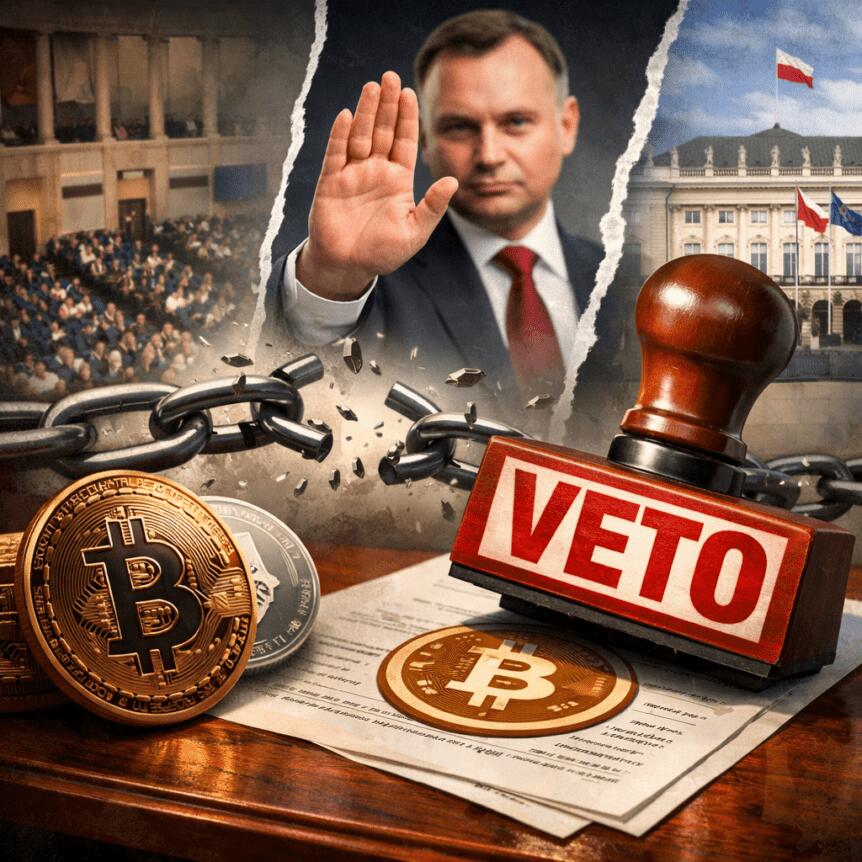
Poland’s parliament again failed to overturn President Karol Nawrocki’s veto on a crypto regulation bill, extending a months-long standoff over how the country should govern digital assets. In a Friday vote, lawmakers did not reach the 263 votes needed to override the president’s veto, with 243 MPs voting against and 191 in support, according to TVP World.
The bill, pushed by Prime Minister Donald Tusk, is designed to align Poland with the European Union’s Markets in Crypto-Assets Regulation (MiCA), the bloc’s overarching framework for issuing and custody of crypto assets. If enacted, the law would mark a significant step for Polish crypto oversight, as Poland remains the only EU member state still not implementing MiCA.
President Nawrocki defended his veto, arguing that the proposed regulation risks overreach, lacks sufficient transparency, and would impose an undue burden on small businesses, the TVP World report noted. In contrast, government officials have warned that delaying rules leaves investors exposed to risk, with Finance Minister Andrzej Domański reportedly describing the absence of clear rules as turning the market into an “El Dorado for fraudsters.”
The ongoing political fight has broader implications for Poland’s crypto ecosystem, including local industry players and foreign firms weighing regulatory certainty against uncertainty in one of Europe’s largest markets. The standoff is playing out as the country’s biggest exchange, Zonda, has found itself at the center of the dispute, amid allegations tied to illicit funding and national security concerns.
Key takeaways
- The latest attempt to override Nawrocki’s veto failed, keeping MiCA-aligned regulation from moving forward in Poland for the moment, with 243 against and 191 in support of the veto override.
- Poland remains the lone EU member yet to implement MiCA, despite repeated government efforts and earlier votes that stalled the bill in 2023 and 2024.
- Officials argue that timely regulation protects investors and consumers, while Nawrocki argues the measure as drafted could hamper business and market transparency.
- Zonda, Poland’s largest crypto exchange, has become a focal point in the political debate, with CEO Przemysław Kral pushing back on accusations and warning of legal action to defend the company’s reputation.
Regulatory friction and the MiCA timeline
The current veto stalemate is the second failed attempt by the government to push the crypto bill through after a similar rejection in December. In that earlier cycle, lawmakers reintroduced a revised version within days, asserting that the changes addressed concerns, though critics argued the document remained largely the same. Nawrocki’s February veto—described at the time as a principled stance against enacting what he called a “wrong law”—kept the regulation from advancing, complicating Poland’s path toward MiCA compliance.
The persistence of the deadlock underscores a wider regulatory divergence within the European Union on how to structure crypto markets. MiCA was designed to provide a standardized EU framework for crypto issuance and custody, reducing uncertainty for issuers, exchanges, and wallets operating across member states. Poland’s repeated resistance to adopting the framework—while other members push to implement it—highlights competing priorities between fostering innovation and imposing safeguards on a nascent industry.
TVP World’s reporting suggests that the government’s stance centers on balancing regulatory clarity with affordability for businesses, while Nawrocki’s position emphasizes risk of over-regulation. The dispute, thus, is not purely technical; it has become a political test of Poland’s alignment with EU policy and its stance on fintech innovation.
The Zonda episode and what it signals for Poland’s crypto debate
Amid the lawmaking fray, Zonda—Poland’s largest crypto exchange—has been drawn into the narrative around regulatory transparency and security. Prime Minister Tusk publicly accused the platform of links to illicit funding, referencing intelligence reports that allegedly connect Zonda’s origins to Russian criminal networks. In response, Zonda’s chief executive, Przemysław Kral, argued that linking the exchange to crime is both unfounded and harmful to Poland’s innovation ecosystem. He said the allegations were an attempt to drag him and Zonda into the political fray and warned of taking legal steps to defend his personal rights.
The controversy has intensified after Kral claimed he does not control access to a crypto wallet reportedly holding about $330 million, an issue tied to the assets of a former CEO who disappeared in 2022. While these matters straddle business and politics, they contribute to a climate of heightened scrutiny for exchanges operating in Poland—a factor regulators will likely weigh as they consider how MiCA-compliant rules would affect licensing, anti-money laundering controls, and exchange accountability.
Analysts see the Zonda episode as emblematic of the tension between fostering a vibrant crypto industry and maintaining rigorous oversight. If MiCA-style regulation advances, Polish exchanges may gain clearer licensing pathways and standardized compliance expectations, potentially offsetting concerns about regulatory burden raised by Nawrocki. Conversely, if the bill stalls again, market participants may push for favorable terms elsewhere or seek licenses in more permissive jurisdictions, delaying Poland’s full integration into the EU’s crypto framework.
Observers should note that this isn’t merely a domestic quarrel; it mirrors a broader debate across Europe about how to integrate digital assets into traditional financial systems. The outcome in Poland will likely influence adjacent markets and could shape how other member states frame enforcement, consumer protections, and cross-border operations for crypto businesses.
Beyond the procedural dynamics, the stalemate has practical implications for investors and users. Delays in implementing a clear regulatory regime can slow product launches, complicate anti-fraud measures, and create uncertainty around licensing and tax treatment. In the near term, market participants will be watching for any signals of a revised draft, a renewed push to bring MiCA into Polish law, or an entirely new regulatory approach that may differ from the EU framework while attempting to maintain compatibility with MiCA’s core principles.
As the political clock ticks, both sides have signaled a willingness to continue the fight. The next steps remain uncertain: will lawmakers attempt another override vote later this year, or will the government pursue a freshly crafted version that could win Nawrocki’s approval? In the meantime, Poland’s crypto sector remains in a cautious holding pattern, awaiting clarity on whether the MiCA pathway will finally become law or whether a longer negotiation will determine Poland’s stance on digital assets for years to come.
For readers watching the evolution of crypto policy in Europe, Poland’s ongoing debate offers a lens into how national regulators negotiate the balance between innovation, consumer protection, and market integrity. As this process unfolds, the industry—through exchanges like Zonda and other market participants—will be closely assessing the regulatory signals that could unlock cross-border opportunities or, alternatively, constrain growth with more stringent controls.

Quick Overview
- Strategy shares soared 11.8% Friday while bitcoin advanced 2.75% after Iran announced plans regarding the Strait of Hormuz
- Market expectations for a Federal Reserve rate reduction this year approached 50% following geopolitical developments
- Vanda Research identified fresh meme stock momentum fueled by social platform activity
- The company submitted a proxy filing proposing to change STRC preferred stock dividend frequency from monthly to twice monthly
- Outstanding notional value for STRC has climbed to $6.4 billion, while volatility dropped to 2.1%
Strategy delivered an impressive performance Friday. The stock surged 11.8% as bitcoin rose approximately 3% to reach $77,400, propelled by a combination of macroeconomic developments, speculative trader interest, and a corporate announcement from the firm.
The cryptocurrency’s upward movement stemmed from announcements originating in Iran. Officials there stated the Strait of Hormuz would be permitted to resume normal operations contingent upon a sustained ceasefire. This development triggered significant activity in U.S. interest rate markets, with Fed Fund futures pricing in approximately 50% probability of a rate reduction before year-end.
Decreasing interest rate projections typically provide support for riskier asset classes, and bitcoin experienced this tailwind.
Vanda Research, a firm monitoring self-directed retail trading activity, also noted emerging indicators of revived meme stock trading patterns. According to the research group, particular equities are experiencing price movements driven primarily by social media attention and speculative trading rather than underlying business fundamentals. Strategy, given its substantial bitcoin treasury, aligns perfectly with this investment theme.
MSTR has established itself as a popular vehicle for gaining bitcoin exposure through conventional stock markets. When cryptocurrency prices shift, MSTR typically responds — frequently with amplified magnitude.
Changes to STRC Dividend Structure
Separate from the market action, Strategy submitted a proxy filing Friday proposing modifications to dividend distribution for its STRC preferred stock series, commonly referred to as “Stretch.”
The proposed amendment would transition payment frequency from monthly intervals to semi-monthly disbursements. Executive Chairman Michael Saylor explained the adjustment aims to “stabilize price, dampen cyclicality, drive liquidity, and grow demand.”
The 11.5% annual dividend yield would stay constant, and Strategy’s aggregate dividend commitments would remain unaltered.
STRC has gained substantial traction among investors. The outstanding notional value expanded to $6.4 billion according to Friday’s regulatory filing.
Declining Volatility and Shareholder Vote
Price volatility for STRC has experienced a dramatic decline — dropping from 13% during the initial eight months following its introduction to merely 2.1% throughout the most recent two-month period. Strategy management anticipates that implementing semi-monthly distributions would further reduce volatility metrics.
Shareholder voting on the proposed modification concludes June 8. Should the measure receive approval, the inaugural semi-monthly distribution is scheduled for July 15.
MSTR concluded Friday’s trading session with an 11.8% gain, while bitcoin traded near $77,400.

TLDR:
- Strategy proposes semi-monthly STRC dividends to stabilize price and reduce cyclical volatility for investors.
- No changes to STRC’s annual dividend rate or total obligations are included in the proposed payment restructuring.
- STRC funds Strategy’s Bitcoin purchases without diluting MSTR common shares through new equity issuance.
- Strategy holds 780,897 BTC worth $60.7 billion as Bitcoin rallies past $78,000 at proposal time.
Strategy has proposed shifting its STRC preferred stock dividends from monthly to semi-monthly payments. The change, outlined in a preliminary proxy filing, aims to stabilize prices and reduce volatility.
No adjustment to the annual dividend rate or total obligations is planned. Shareholders will begin voting on April 28, with a formal meeting scheduled for June 8. The proposal comes as Bitcoin continues rallying past $78,000.
Proposed Change Targets Price Stability and Investor Demand
Strategy formally announced the proposal through its official account, explaining the rationale behind the shift. The company stated that the change is intended to stabilize price, dampen cyclicality, drive liquidity, and grow demand for STRC shares. Currently, STRC trades near $99 per share, making dividend frequency a relevant factor in price behavior.
More frequent payments can reduce the price swings seen between distribution cycles. With semi-monthly dividends, investors receive cash flows on a tighter schedule, which smooths out demand patterns. This structure is particularly attractive to income-focused investors who prefer consistent returns.
The proposal does not alter what shareholders earn on an annual basis. Only the payment schedule changes, from once a month to twice a month. Strategy confirmed that no changes to the annual dividend obligations or dividend rate are part of this proposal.
STRC Supports Bitcoin Strategy Without Diluting MSTR Common Shares
STRC currently plays a key role in how Strategy funds its Bitcoin acquisitions. The preferred stock raises capital through dividend payments rather than issuing new common shares.
This approach protects MSTR shareholders from excessive dilution while sustaining the company’s aggressive Bitcoin buying program.
As of the latest data, Strategy holds 780,897 BTC, valued at approximately $60.7 billion. The company’s Bitcoin strategy remains one of the most closely watched in the corporate world. Adjusting how STRC dividends are paid supports that broader financial structure.
Bitcoin’s continued rally above $78,000 adds context to the timing of this proposal. A stronger Bitcoin market raises the value of Strategy’s holdings and reinforces confidence in STRC as a financing tool. Attracting more investors to STRC at this stage aligns with the company’s long-term capital strategy.
The shareholder vote begins April 28 and runs through the June 8 meeting. If approved, the semi-monthly structure would take effect based on terms outlined in the proxy. The outcome will shape how STRC functions as a capital instrument going forward.
Crypto World
Ethereum Foundation-Backed Program Exposes 100 Nort Korea Operatives Infiltrating Crypto Firms

The Ketman Project, operating under the Ethereum Foundation’s ETH Rangers security program, has in the latest Ethereum news, identified approximately 100 North Korea Crypto IT operatives embedded inside Web3 companies using fabricated identities, the result of a six-month investigation that ended with one of the most detailed public tallies of DPRK insider infiltration in the sector’s history.
The threat model has shifted. Where North Korea’s state-level crypto operations once centered on remote exploits and exchange hacks, the 2025 pattern is coordinated workforce infiltration, operatives passing HR screenings, accessing internal repositories, and sitting inside product teams for months before detection.
- Operatives identified: ~100 DPRK IT workers found using fake identities inside Web3 firms
- Investigation duration: Six months, conducted by the Ketman Project with ETH Rangers support
- Program scope: ETH Rangers funded 17 independent researchers, recovered or froze $5.8M in exploited funds, traced 785+ vulnerabilities, handled 36 incident responses
- DPRK theft scale: $2.02 billion stolen in 2025 alone – a 51% increase from 2024 – pushing cumulative haul to $6.75 billion
- Drift Protocol hack: DPRK-linked attackers executed a $285 million exploit on April 1, 2026, the largest DeFi hack of the year
- Real-world case: Exchange Stabble issued a withdrawal alert after a DPRK IT worker infiltrated its leadership team
- Watch: Investigators are actively tracking Drift exploit proceeds; regulatory scrutiny on DeFi employment vetting expected to intensify
Discover: The best crypto to diversify your portfolio with
Ethereum News: How the ETH Rangers Crypto Investigation Actually Worked – and What 100 North Korea Operatives Really Means
ETH Rangers launched in late 2024 through a partnership between the Ethereum Foundation, Secureum, The Red Guild, and the Security Alliance (SEAL), deploying 17 independent security researchers across a six-month mandate to strengthen the Ethereum ecosystem defenses.
The Ketman Project was one of those funded efforts, and its output went well beyond the typical audit or bug bounty scope.

Identifying 100 operatives means matching fabricated identities to known DPRK tradecraft patterns: inconsistent work histories, communication behaviors suggesting time-zone masking, payment routing through specific intermediaries, and technical fingerprints that recur across unrelated applicants. That’s intelligence work, not just security research.
It requires sustained monitoring across job boards, GitHub activity, hiring pipelines, and behavioral signals inside existing teams.
The broader ETH Rangers program delivered material results beyond the Ketman work: participants recovered or froze over $5.8 million in exploited funds, traced 785+ vulnerabilities and proof-of-concept exploits, ran 36 incident responses, and delivered more than 80 security training sessions.
The ETH Rangers Program has wrapped up and the results speak for themselves: $5.8M+ recovered, 785+ vulnerabilities reported, 100+ DPRK operatives identified, and so much more.
A decentralized defence for a decentralized network.
Read the full recap
— EF Ecosystem Support Program (@EF_ESP) April 16, 2026
Open-source outputs included a DeFi incident analysis platform, a GitHub suspicious account detector, and a client-side DoS testing framework.
That GitHub tool is relevant here. Suspicious account detection is precisely the capability needed to surface DPRK-linked developers operating under cover – accounts with manufactured contribution histories, coordinated activity patterns, or anomalous repository access. The Ketman findings likely drew on exactly this tooling.
What “100 operatives” doesn’t mean: that those individuals were necessarily running exploits in real time. DPRK IT worker infiltration serves multiple functions: revenue generation for the regime through legitimate salaries, intelligence collection on protocols and codebases, and pre-positioning for future attacks.
The immediate financial damage may be limited; the long-term exposure is structural.
Discover: The best pre-launch token sales
The post Ethereum Foundation-Backed Program Exposes 100 Nort Korea Operatives Infiltrating Crypto Firms appeared first on Cryptonews.


Key Highlights
- TSMC delivered Q1 2026 revenue growth of 35.1% year over year, while net income and EPS surged 58.3%
- Netflix released Q1 2026 earnings on April 16, with focus on subscriber metrics and advertising revenue performance
- Nvidia unveiled NVIDIA Ising on April 14, positioning it as the first open AI models optimized for quantum computing applications
- ServiceNow prepares to release Q1 2026 financial results on April 22, with enterprise AI investment trends under scrutiny
- AMD’s Q1 2026 earnings announcement scheduled for May 5 keeps the company on investor radars due to data center and AI chip exposure
Investors tracking growth stocks face a packed calendar this week. A combination of quarterly earnings releases and significant product unveilings across the semiconductor, streaming, and enterprise software sectors is commanding attention.
Five companies have emerged as priority watchlist items: TSMC, Netflix, Nvidia, AMD, and ServiceNow. Each carries immediate catalysts through either financial reporting or strategic product launches.
TSMC
TSMC unveiled first-quarter 2026 financial performance on April 16. The chipmaker posted revenue growth of 35.1% compared to the prior year, accompanied by net income and diluted earnings per share increases of 58.3%.
Taiwan Semiconductor Manufacturing Company Limited, TSM
These figures underscore robust market appetite for cutting-edge semiconductors powering artificial intelligence infrastructure. As the world’s leading contract chipmaker, TSMC’s quarterly performance serves as a barometer for overall semiconductor industry momentum.
Netflix
Netflix delivered its quarterly report on the same day. Market participants scrutinized membership additions, advertising platform performance, and management’s guidance for the remainder of 2026.
The streaming giant has been aggressively developing its advertising-supported subscription option as a primary growth engine. International market penetration represents an additional strategic priority the platform has emphasized throughout the past twelve months.
Nvidia
Two days earlier, Nvidia introduced a breakthrough product named NVIDIA Ising. The technology represents what the company characterizes as the inaugural open AI model architecture specifically engineered to accelerate practical quantum computing deployment.
This launch provides Nvidia with an additional innovation narrative extending beyond its dominant position in graphics processing units. The move demonstrates strategic efforts to establish footholds in emerging computational paradigms.
Already positioned as the cornerstone supplier for AI infrastructure investments, Nvidia’s quantum computing initiative expands its long-range technological vision.
AMD
While AMD’s earnings announcement isn’t scheduled until May 5, the semiconductor manufacturer maintains prominent placement on investor watchlists. Market participants closely monitor every indicator related to AI processor demand, with AMD consistently ranking among the first stocks evaluated.
The company maintains substantial market share in data center operations and AI acceleration hardware. The investment community continues assessing whether AMD can narrow performance and revenue gaps relative to Nvidia’s market leadership.
ServiceNow
ServiceNow’s Q1 2026 financial disclosure arrives on April 22. The enterprise software provider specializes in AI-enhanced workflow automation solutions for major corporations, with the central question being whether enterprise technology budgets continue expanding.
The platform has systematically integrated artificial intelligence capabilities designed to drive higher per-customer spending. A robust quarterly performance would reinforce the thesis that enterprise software maintains its position as a sustainable growth sector.
Closing Analysis
A singular theme connects all five companies commanding attention this week: artificial intelligence. From semiconductor fabrication to model development infrastructure and workflow automation software, AI investment represents the common denominator linking each name.
TSMC’s first-quarter performance has already established an optimistic benchmark for the period, with 35.1% revenue expansion and 58.3% earnings acceleration signaling persistent demand from AI chip consumers. Netflix, ServiceNow, and AMD have yet to report, with AMD’s May 5 release completing the comprehensive picture from this cohort.

TLDR
- American Airlines firmly rejected any interest in pursuing a merger with United Airlines (UAL)
- AAL shares declined more than 1% during after-hours trading after the announcement
- United CEO Scott Kirby allegedly presented the merger concept to White House officials in February
- The potential combination would form the world’s largest airline carrier
- Transportation Secretary Sean Duffy indicated consolidation may happen but would undergo rigorous examination
American Airlines issued a forceful rebuttal on Friday regarding speculation surrounding a possible merger with United Airlines, causing its shares to decline in extended trading hours.
Shares of AAL dropped more than 1% following the company’s public statement clarifying it has no involvement in, nor appetite for, merger discussions with United.
American Airlines Group Inc., AAL
“A merger with United would harm competition and consumers,” American Airlines stated, further noting that such a transaction would contradict “our interpretation of the Administration’s stated priorities.”
The statement followed a Bloomberg news story disclosing that United’s Chief Executive Scott Kirby had proposed merging the two airlines during conversations with high-ranking administration figures, including President Trump, during February.
Kirby previously held the position of President at American Airlines before transitioning to United, where he currently leads as CEO.
The Bloomberg reporting does not confirm whether any official discussions or due diligence processes have been initiated regarding a potential transaction.
Regulatory Hurdles Would Loom Large
Combining AAL and UAL would result in the world’s largest airline by a significant margin.
The two companies collectively command over one-third of domestic U.S. air travel, competing alongside Delta (DAL) and Southwest (LUV).
Industry observers have highlighted that a transaction of this magnitude would inevitably attract substantial regulatory scrutiny and probable resistance from consumer advocacy organizations and competing airlines.
Transportation Secretary Sean Duffy discussed airline industry consolidation earlier in the month during a CNBC interview, suggesting opportunities exist for mergers in the aviation sector.
Duffy mentioned that President Trump typically favors large-scale corporate combinations.
Oversight Would Remain Critical
Nevertheless, Duffy cautioned that any significant airline consolidation would undergo evaluation regarding its effects on airfare pricing and market competition.
He indicated that merging carriers would probably be required to sell off specific operations to avoid creating excessive market dominance.
American Airlines’ public response seemed to acknowledge this regulatory environment, characterizing a United combination as incompatible with antitrust standards.
UAL shares had risen 7.12% earlier during the week, potentially driven by merger-related speculation, while AAL had increased 4.16% during that same timeframe before Friday’s after-hours decline.
As of 6:09 PM ET Friday, AAL had retreated as investors processed the airline’s unequivocal dismissal of the proposed transaction.
Crypto World
Bitcoin Miner Selling Pressure Fades as Record Q1 2026 BTC Outflows Signal a Supply Turning Point
TLDR:
- Publicly listed Bitcoin miners sold over 32,000 BTC in Q1 2026, marking the largest quarterly outflow ever recorded on-chain.
- The 2024 halving cut block rewards to 3.125 BTC while hash rate kept rising, pushing hash price below miner breakeven levels.
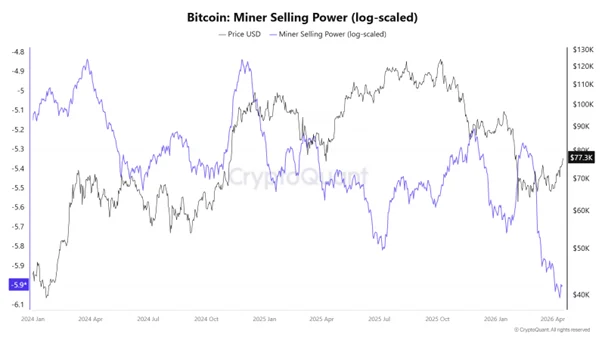
- On-chain Miner Position Index and Miner Selling Power metrics both signal that peak distribution pressure has already passed.
- ETF inflows, institutional demand, and macro conditions are now set to replace miner behavior as the key Bitcoin price drivers.
Bitcoin miner selling pressure is showing signs of easing after one of the most intense distribution periods on record. Publicly listed miners sold over 32,000 BTC in Q1 2026, marking the largest quarterly outflow ever recorded.
WuBlockchain reported the trend, attributing it to post-halving profitability compression and strategic reallocation toward AI infrastructure.
On-chain metrics confirm that miner reserves have been in steady decline, though selling power is now visibly contracting.
Record BTC Outflows Mark a Structural Shift in Mining Economics
The 2024 Bitcoin halving cut block rewards from 6.25 to 3.125 BTC, directly reducing revenue for the entire mining sector. As block rewards shrank, the global hash rate kept rising, placing further pressure on individual miner profitability.
Hash price fell below breakeven for many operators, leaving cash flow management as the only viable short-term priority. Miners across the sector prioritized cash flow, selling BTC to cover operational costs and sustain mining activities.
WuBlockchain shared that Q1 2026 marked the largest miner BTC sell-off on record, flagging the historic outflow volume.
The report noted that this was not panic selling but a deliberate operational and strategic response to market conditions.
Mining companies simultaneously redirected capital toward AI and high-performance computing, adding to the volume of BTC liquidations. This marked a notable shift in miner strategy, moving away from the accumulation approach seen in prior cycles.
On-chain data reinforced this narrative, with miner reserves declining steadily throughout the entire quarter. Net position change remained negative, confirming that miners were consistent sellers rather than accumulators over this period.
However, outflow pace began slowing toward the end of Q1, hinting that peak selling pressure had likely already passed.
Demand Drivers Take Over as Miner Selling Power Fades
Despite the sustained wave of distribution, bitcoin miner selling pressure has entered a phase of clear and measurable decline.
On-chain charts now show the Miner Position Index in negative territory while Miner Selling Power contracts sharply from peaks. This combination points to a market where forced miner supply has already been largely absorbed.
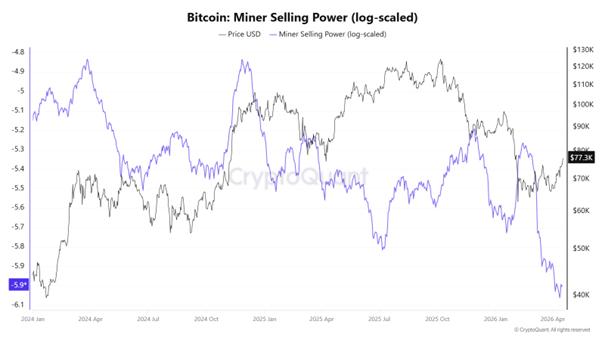
Bitcoin market cycles historically follow a progression from supply expansion into supply exhaustion, then into demand-driven price growth.
The current cycle appears to be transitioning into the exhaustion stage, where available seller volume contracts and buyer dominance increases. Miners are no longer adding to their sales volumes, even as Bitcoin prices remain in consolidation.
Going forward, ETF inflows, institutional participation, and macro conditions are expected to become the primary Bitcoin price drivers.
Bitcoin miner selling pressure is no longer the central force shaping near-term market direction. Capital flows from demand-side participants will likely set the timing and scale of the next major uptrend phase.
In Trump news today, President Trump criticized Pope Leo XIV as “WEAK on Crime, and terrible for Foreign Policy” in a social media post that escalated a days-long public feud with the first American pope, who has repeatedly condemned the US-Israel war on Iran and called Trump’s pre-strike threat to wipe out Iranian civilization “truly unacceptable.”
Summary
- Trump also claimed Pope Leo supports Iran having nuclear weapons, a claim the pope did not make, and said he did not want “a Pope who criticizes the President of the United States,” adding that Leo had not been on anyone’s list to become pope before the conclave.
- Pope Leo fired back from aboard a plane to Algeria: “I have no fear of the Trump administration or speaking out loudly about the message of the Gospel,” and vowed to continue calling for peace regardless of White House pressure.
- The confrontation has drawn rebukes from European leaders including Italian Prime Minister Giorgia Meloni, a Trump ally, who said it is “right and normal” for the pope to call for peace and condemned Trump’s remarks as unacceptable.
Trump news today centers on the most pronounced public rupture between a US president and a sitting pope in modern history, one that began with Leo’s Palm Sunday call for peace during the Iran war and escalated through the week into direct personal attacks exchanged via social media post and press conference.
Leo, born in Chicago and elected in April 2025, has been increasingly direct since the US and Israel launched the Iran campaign. He condemned Trump’s pre-strike rhetoric as attacks against civilian populations that violate international law, urged Americans to contact their congressional representatives, and on Palm Sunday said: “Jesus is the king of peace, who rejects war, whom no one can use to justify war.” Trump and Defense Secretary Pete Hegseth have both invoked God to frame the war in religious terms, which Leo has specifically and repeatedly rejected.
Trump’s escalation began with the Truth Social post calling Leo “WEAK on Crime, and terrible for Foreign Policy.” He told reporters he does not think Leo is doing “a very good job” and said “I’m not a fan of Pope Leo.” He also posted an AI-generated image depicting himself in a Christ-like pose with light emanating from his fingers, which drew criticism from evangelical allies and was later deleted. Trump said he thought the image depicted him as a doctor.
On Tuesday night, Trump posted again: “Will someone please tell Pope Leo that Iran has killed at least 42,000 innocent, completely unarmed, protesters in the last two months.” He claimed Leo was in favor of Iran having nuclear weapons, a position Leo had not stated. He said he did not want a pope who would “say crime is OK in our cities.”
Leo responded on his plane to Algeria, the first stop of an 11-day Africa tour: “I have no fear of the Trump administration or speaking out loudly about the message of the Gospel, which is what I believe I am here to do, what the church is here to do.”
Why the Confrontation Has Escalated
Rome-based Catholic correspondent Elise Ann Allen said Trump appeared to be “feeling threatened that Leo was emerging as a stronger figure on the international scene,” adding that Trump needs to be careful because “it’s the moderate Catholics who got him elected in both elections.”
The feud intersects with the Iran ceasefire expiry on April 22, which crypto markets are watching closely as a binary risk event. A ceasefire extension would likely maintain current risk-on conditions; a breakdown would reintroduce the geopolitical volatility that drove Bitcoin’s initial selloff from its October 2025 highs.
What It Means for the Political Environment
Pope Leo has become a significant voice in the international coalition of actors urging the US to seek a diplomatic resolution. His Africa tour framing of the conflict as part of a pattern of powerful leaders “ravaging the world” adds moral authority pressure to the administration at the same moment it is managing the Iran nuclear talks, the crypto reform legislative agenda, and the midterm electoral environment, where Catholic voters in swing districts remain a decisive constituency.

US Government Now Wants Anthropic’s ‘Mythos’, Preparing for AI Cybersecurity Threats

#trading #cryptotrading #cryptocurrency
Earnings call transcript: ICICI Bank Q4 2026 sees stock rise post-earnings

Why Israel is blocking foreign journalists from entering

Bitcoin: We’re Entering The Most Dangerous Phase

Alan Cumming Brands Baftas Ceremony A ‘Triggering S**tshow’
#trading #cryptotrading #cryptocurrency

robux #bandlab #money #beats #smartphone #music #roblox #greenscreen #memes #cryptocurrency #automob

MASTERCARD AND XRP LEDGER #XRP #XRPCommunity #XRPArmy #Ripple #Crypto #Cryptocurrency #CryptoNews
-
 NewsBeat6 days ago
Pep Guardiola and Gary Neville agree over Arsenal title problem that benefits Man City
-

 Crypto World5 days ago
The SEC Conditionalises DeFi Platforms to Be Avoided for Broker Registration
-

 Politics6 days ago
World Cup exit makes Italy enter crisis mode
-

 Crypto World5 days ago
SEC Signals Exemption for Crypto Interfaces From Broker Registration
-

 Fashion21 hours ago
Weekend Open Thread: Theodora Dress
-

 News Videos3 days ago
Secure crypto trading starts with an FIU-registered
-

 Sports1 day ago
NWFL Suspends Two Players Over Post-Match Clash in Ado-Ekiti
-

 Crypto World4 days ago
SEC Proposes Certain Crypto Interfaces Don’t Need to Register as Brokers
-

 NewsBeat4 days ago
Trump and Pope Leo: Behind their disagreement over Iran war
-

 Business7 days ago
Ireland Fuel Protests Enter Day 5 as Blockades Spark Shortages and Government Prepares Support Package
-

 Politics18 hours ago
Palestine barred from entering Canada for FIFA Congress
-
 NewsBeat6 days ago
JD Vance announces ‘no agreement’ with Iran over nuclear weapons fear
-

 Crypto World16 hours ago
Russia Pushes Bill to Criminalize Unregistered Crypto Services
-
Sports6 days ago
Dexter Lawrence, Stefon Diggs, Trading for De’Von Achane
-

 Crypto World5 days ago
Trump whales load up ahead of Mar-a-Lago luncheon.
-
 Business2 days ago
Creo Medical agree sale of its manufacturing operation
-
Crypto World6 days ago
Sei Network Enters Quiet Reset Phase as On-Chain Metrics Signal a Slowdown in 2026
-

 Sports5 days ago
NWFL opens Pathway for new Clubs ahead of 2026 Season
-
Business5 days ago
Kering slides after Morgan Stanley downgrade, Gucci woes loom
-
 Entertainment5 days ago
Karol G’s ‘Ultra Raunchy’ Coachella Set Gave ‘Satanic Vibes’
You must be logged in to post a comment Login