
Crypto World
$290M Kelp DAO Breach Tied to Lazarus Group and Weak Bridge Security


Key Takeaways
- Approximately $290–293 million was stolen from Kelp DAO following a sophisticated attack on RPC nodes connected to LayerZero’s verification system
- Kelp DAO allegedly disregarded LayerZero’s security recommendations to implement multiple verifiers, operating with only one verifier
- Preliminary evidence points to North Korea’s Lazarus Group as the perpetrators behind this security breach
- Nine DeFi platforms, most notably Aave, experienced cascading damage, with Aave’s total value locked declining by $6 billion
- Moving forward, LayerZero has declared it will refuse to support applications operating with single-verifier configurations
In what represents one of 2026’s most significant decentralized finance security breaches, Kelp DAO suffered losses totaling approximately $290–293 million during a weekend attack. LayerZero, the cross-chain messaging protocol utilized in the incident, has attributed the vulnerability to Kelp’s infrastructure decisions.
Earlier today we identified suspicious cross-chain activity involving rsETH. We have paused rsETH contracts across mainnet and several L2s while we investigate.
We are working with @LayerZero_Core, @unichain, our auditors and top security experts on RCA.
We will keep you…
— Kelp (@KelpDAO) April 18, 2026
The breach focused on Kelp’s rsETH token transfer mechanism across different blockchain networks. Operating with a single-verifier architecture meant only one authority needed to validate cross-chain transfers. According to LayerZero, the company had explicitly cautioned Kelp about this configuration and urged adoption of multiple independent verification sources.
LayerZero: KelpDAO Loses ~$290M in Exploit, Attributed to DPRK’s Lazarus Group
LayerZero reported that on April 18, 2026, KelpDAO suffered an exploit resulting in losses of approximately $290M, preliminarily attributed to DPRK’s Lazarus Group (TraderTraitor). The attack poisoned… pic.twitter.com/mfhQRaC2p9
— Wu Blockchain (@WuBlockchain) April 20, 2026
The hackers infiltrated two remote procedure call nodes—specialized servers enabling software to interact with blockchain data. These legitimate nodes were replaced with compromised versions that delivered fraudulent information to LayerZero’s verification system while maintaining normal appearances to other infrastructure components.
Since LayerZero’s verification process also consulted legitimate external nodes, the attackers launched a distributed denial-of-service campaign to disable those systems. This tactic redirected network traffic through the compromised infrastructure during a 80-minute window from 10:20 a.m. to 11:40 a.m. Pacific Time on Saturday.
When the failover mechanism activated, the malicious nodes transmitted confirmation of a legitimate transaction to the verifier. Kelp’s bridge protocol subsequently released 116,500 rsETH to the attackers’ wallets. The hostile software then eliminated itself, erasing all forensic evidence from the affected servers.
Cascading Impact Throughout DeFi Ecosystem
The stolen rsETH tokens were deployed as collateral across various lending platforms, enabling the attackers to withdraw genuine assets. Aave, the dominant decentralized lending platform, absorbed the most substantial damage.
Aave found itself holding illiquid rsETH collateral while valuable assets such as ETH had already been extracted through borrowing mechanisms. Aave’s native token plummeted approximately 15% within a 24-hour period, while the protocol experienced roughly $6 billion in withdrawals as participants scrambled to remove their funds.
No fewer than nine DeFi applications experienced damage, including Fluid, Compound Finance, SparkLend, and Euler. Cybersecurity firm Cyvers characterized the incident as a “cross-protocol contagion event” extending far beyond a single platform vulnerability.
With preliminary confidence, LayerZero has connected this attack to North Korea’s Lazarus Group, specifically its TraderTraitor division. This same organization was implicated in the $285 million Drift Protocol breach on April 1, indicating Lazarus has extracted over $575 million from decentralized finance within an 18-day period using two distinct attack methodologies.
Security Protocol Adjustments
LayerZero reports no evidence of vulnerability spreading to applications operating with multi-verifier architectures. The company has restored its verification service and announced a permanent policy refusing to process messages for any application utilizing single-verifier configurations.
Curve Finance founder Michael Egorov emphasized that this breach demonstrates the inherent risks of relying on solitary transaction verification sources. He additionally cautioned against utilizing cross-chain infrastructure unless operationally essential.
According to Ledger CTO Charles Guillemet, 2026 will “most likely be the worst year in terms of hacks.” Cryptocurrency-related security breach losses have already surpassed $482 million during Q1 2026.
Kelp has remained silent regarding LayerZero’s version of events and has not addressed why the protocol continued operating with a single-verifier architecture despite receiving explicit security warnings.


March proved to be one of the weakest months for the German index in recent years, though conditions stabilised by mid-April. At present, the DAX (Germany 40 mini on FXOpen) is showing a solid recovery, trading around 24,650. The rebound has been largely driven by gains in Rheinmetall and Infineon, highlighting investor preference for defence and technology stocks amid the current geopolitical backdrop.
The index remains highly sensitive to developments around the Strait of Hormuz. Ongoing reports of blockades and resumptions in shipping continue to fuel uncertainty in energy markets, directly affecting costs for German industry. At the same time, ECB policy remains a limiting factor: the central bank has kept rates at 2.0%, and despite inflation concerns, markets are not pricing in easing before the summer.
Technical picture
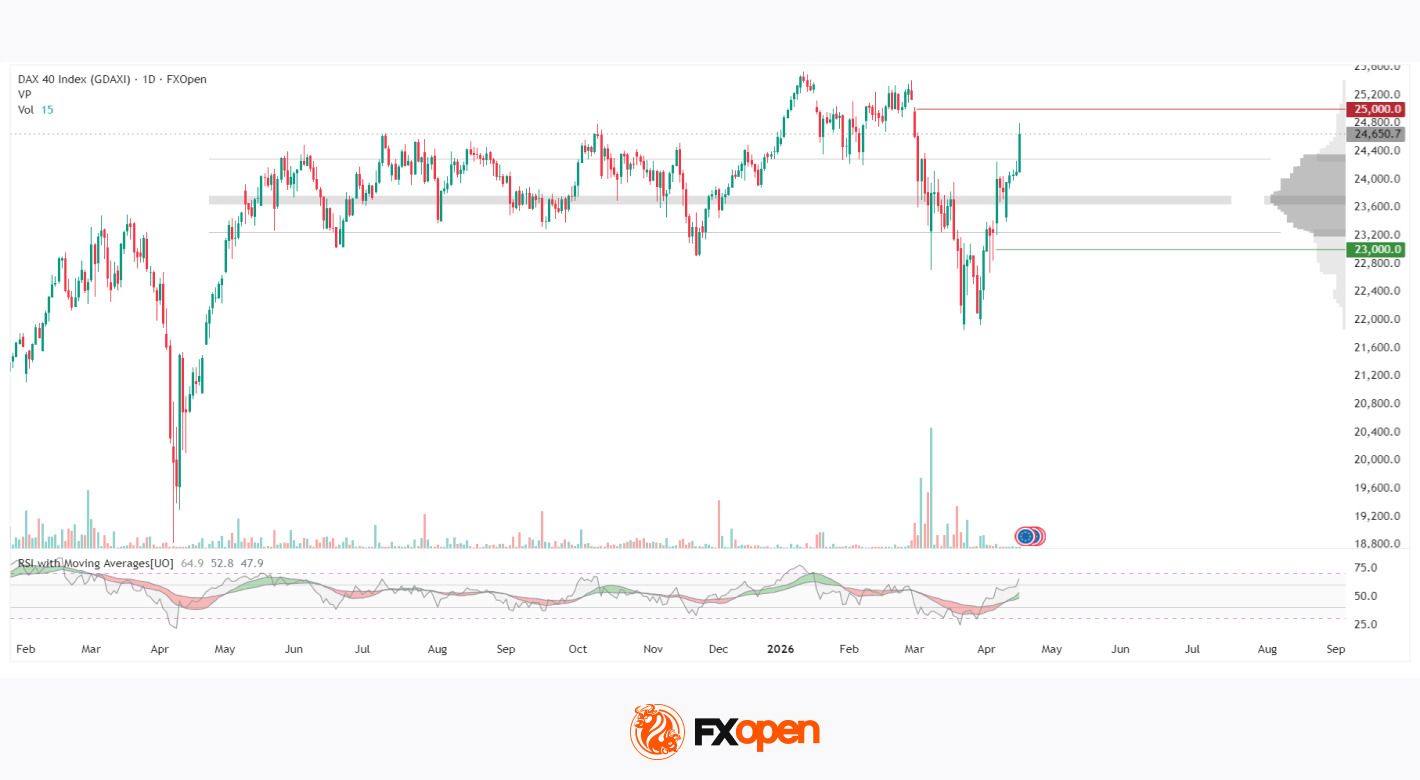
After reaching highs near 25,500 in January 2026, the index entered a sharp correction phase. A gap on 2 March signalled a shift in sentiment, prompting traders to close long positions. On 9 March, an extreme spike in vertical volume was recorded as the market attempted to break below 23,000. The index later tested strong support at 22,000, where heavy buying emerged and a base began to form.
Following the rebound, the price consolidated above the POC zone of 23,500–23,800, which has since turned into support. Volume levels have normalised after the March volatility, suggesting that panic selling has subsided. The RSI indicator confirms improving momentum, rising to 64.9 and holding above its moving averages, pointing to renewed bullish strength. The next key resistance for buyers stands at 25,000.
Summary
Holding above the POC zone has restored a bullish structure, returning control to buyers. The 23,000 level is now shaping up as a strong support area, while RSI with MA signals recovering demand. However, despite the current rebound, the broader fundamental backdrop remains mixed, with geopolitical risks and ECB policy expectations continuing to influence the index’s trajectory.
Crypto World
Bitcoin’s $126,200 Pierce Fades as Bearish Analyst Calls for Red May-June and $60K Target
TLDR:
- Bitcoin pierced $126,200 resistance on Friday and Saturday but failed to hold, signaling a likely pivot high.
- Analyst Aaron Dishner targets $60,000 first, followed by $49,000 and $38,555 if a full bear market unwinds.
- Weekly TBT bullish divergences on BTC and TOTALES are not being treated as confirmed trend-reversal signals yet.
- Ethereum, altcoins, and macro indicators including DXY and S&P futures add further weight to the bearish outlook.
Bitcoin analyst Aaron Dishner is warning of a significant pullback after price briefly pierced the $126,200 resistance level last week.
The move failed to hold, and Dishner, known on X as @MooninPapa, sees the reaction as a pivot high rather than a breakout.
With short-term support giving way across multiple indicators, he expects Bitcoin to move substantially lower through May and June, with firm downside targets already mapped out.
$126,200 Resistance Rejection Sets the Stage for Deeper Losses
Bitcoin pierced overhead resistance at $126,200 across Friday and Saturday but failed to sustain the move. The price reaction that followed has left Dishner unconvinced that bulls have retaken control.
He views the current structure as a pivot high, with the short-term support fan beginning to break down beneath it.
RSI has already completed its expected role within this price cycle, according to Dishner. Any bounce toward the $75,500 area, he noted, looks more like a retest than a recovery. He sees that level as a potential entry point for continued selling pressure rather than a base for renewed upside.
In a post on X, Dishner laid out his broader expectations for the months ahead. He is calling for red conditions through both May and June, with $60,000 as his first major downside target. From there, he sees $49,000 as a realistic follow-through level if selling pressure persists.
If a full bear market unwind plays out, Dishner places $38,555 as his deepest target. Weekly TBT bullish divergences have appeared on Bitcoin and TOTALES, but he is not treating them as trend-change signals.
He pointed out that similar readings have appeared before real bottoms formed in prior cycles, making them unreliable as standalone reversal signals.
Altcoins and Macro Risks Add Further Weight to the Bearish Outlook
Stablecoin dominance continues to support the bearish case heading into the anticipated pullback. The OTHERS index has already been rejected at the top of the cloud, reinforcing the view that broad market weakness remains intact.
Last week’s upper wick into the fast line on Bitcoin looked more like a warning than a confirmed breakout, Dishner noted.
Ethereum confirmed a weekly TBT bullish divergence but has not impressed with its price action. Dishner still sees a move toward $1,000 as a possibility for ETH, given how weak it has been relative to expectations.
The divergence alone, he argued, does not make a case for turning bullish during what he considers a bottom year.
On the macro side, the DXY still looks capable of closing the gap at 99.516, which could add pressure across risk assets.
S&P futures appear overly extended following a sharp reversal, while NK225 looks stretched at current levels. USDJPY remains a key risk factor if dollar strength returns.
Among altcoins, BNB is back at a fast line retest and AAVE may see a short reflex bounce after an exploit-driven flush. CFX and LDO still look like exhaustion rallies, while ZBCN looks heavy ahead of a support break.
Dishner is watching TAO but prefers to wait for Bitcoin to complete its pullback before taking any position.


RaveDAO’s RAVE token fell sharply over the past two days, dropping from $26 to below $1 and extending losses on Monday.
Summary
- RAVE plunged from $26 to under $1 after ZachXBT raised market manipulation concerns publicly Friday.
- ZachXBT said wallets linked to early distribution controlled about 95% of RAVE’s total supply.
- Binance, Bitget, and Gate.io acknowledged probe calls as RaveDAO denied involvement in price action.
Data cited in the report showed the token lost about 95% on Sunday before falling more than 60% again in the following 24 hours.
The decline followed public calls for an investigation by on-chain investigator ZachXBT. On April 18, he asked Binance, Bitget, and Gate.io to review suspected market manipulation tied to RAVE. He first offered a $10,000 bounty for information and later raised it to $25,000 the same day.
ZachXBT said he had contacted RaveDAO co-founder Yemu Xu on April 13 and April 14 about his concerns but did not receive a response before the token collapsed. He later shared findings that linked the project’s early token distribution to a small group of wallets.
According to his review, addresses tied to the initial distribution controlled about 95% of RAVE’s 1 billion token supply. He also flagged activity involving wallets connected to Bitget and Gate.io deposit addresses. ZachXBT said the scale of the sell-off looked unusual when compared with liquidation data across the market.
Meanwhile, Bitget publicly responded to the request for an investigation within hours. Binance and Gate.io also acknowledged the calls later in the day. At the same time, RaveDAO said it had no role in the recent price movement.
In a later update, ZachXBT said a multisig wallet linked to the initial distribution moved about 23 million RAVE, worth around $23 million, to two Bitget deposit addresses. After that transfer, the token’s price dropped below $0.60.
He also wrote that roughly $6 billion in market value was erased while 24-hour liquidations stood near $52 million, which he described as a sign of an unstable market structure.
RaveDAO denies involvement as wider scrutiny grows
RaveDAO issued a public response rejecting claims that it drove the price move. The team said it was ”not engaged in, nor responsible for, recent price action.” It also addressed claims about token control, though it did not confirm the figures mentioned by ZachXBT.
The team added that it aims to act ”sustainably and transparently” as it builds its platform. Meanwhile, ZachXBT said similar price patterns have appeared in other tokens, including SIREN, MYX, COAI, M, PIPPIN, and RIVER. He also said he held no trading position in RAVE and that the bounty for verified information remains open.
At the time of writing, RAVE traded at $0.64 with a 24-hour trading volume of $297.6 million. The token was down 46% over 24 hours, leaving it with a market capitalization of about $161.3 million.
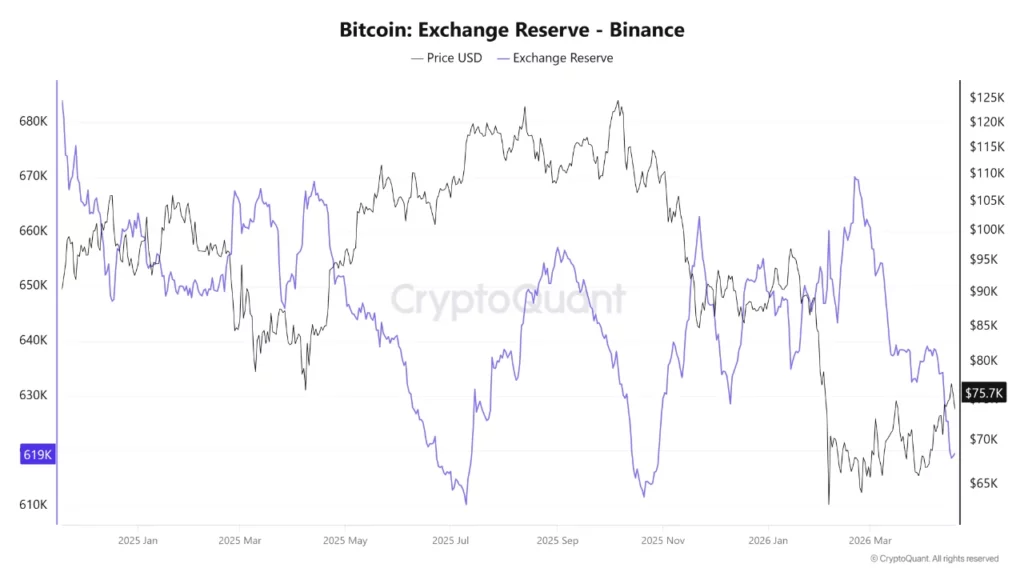
Bitcoin reserves on Binance have dropped to about 619,000 BTC, their lowest level since October 2025, according to CryptoQuant analyst Arab Chain.
Summary
- Binance Bitcoin reserves dropped to about 619,000 BTC, their lowest level since October 2025 this week.
- Spot Bitcoin ETFs added 25,600 BTC last week, lifting total holdings near five-month highs.
- Bitcoin stayed volatile near $74,800 as exchange outflows and ETF buying reshaped available market supply.
The decline points to continued Bitcoin outflows from the exchange after reserves climbed sharply earlier this year.
In February 2026, Binance’s Bitcoin reserves rose to nearly 670,000 BTC, their highest level since 2024. That increase came during a strong market rally and suggested that more investors were moving coins to exchanges, often to sell or lock in profits as prices moved higher.
Since the February peak, reserves have moved lower in a steady trend. The change suggests that investors have shifted from exchange deposits to withdrawals and off-exchange storage. This type of movement usually shows that holders are choosing to keep Bitcoin rather than sell it at current prices.
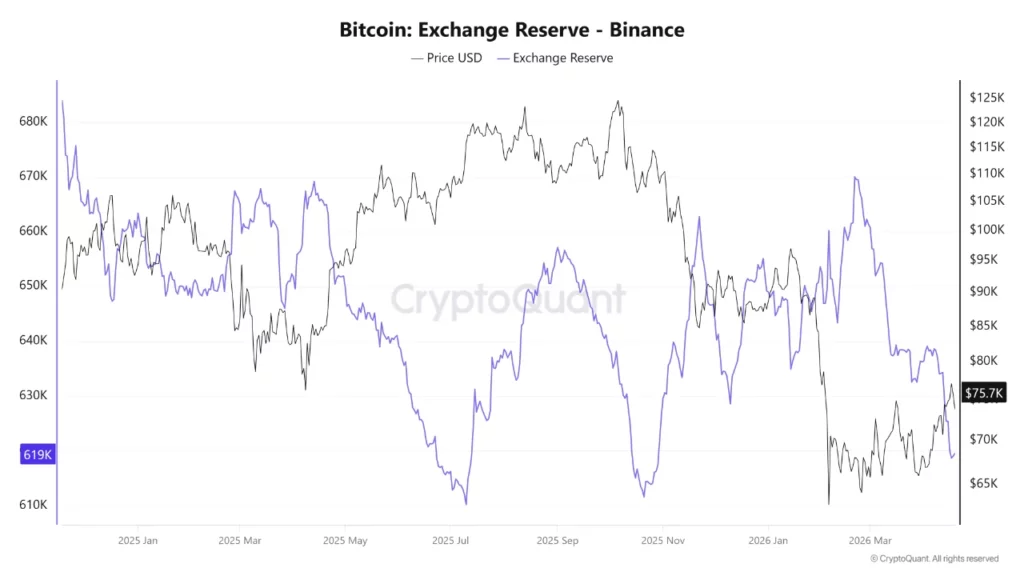
The decline in reserves has happened while Bitcoin has seen sharp price swings. Even with that volatility, fewer coins remain on Binance. The data points to stronger holding behavior as traders move assets into cold storage or other long-term custody options.
At the same time, spot Bitcoin ETFs posted strong accumulation last week. Data showed ETF holdings rose from 1.3141 million BTC on Monday to 1.3397 million BTC by Friday. That means the funds added 25,600 BTC over five trading days.
The latest increase brought ETF balances close to levels last seen in November. It also marked one of the strongest weekly additions in recent months. The combined trend of lower Binance reserves and rising ETF balances suggests that Bitcoin supply is moving away from exchanges and into longer-term investment vehicles.
Bitcoin price stays volatile amid geopolitical pressure
Bitcoin price action remained unstable over the weekend. The asset rose above $78,300 late Friday, its highest level since early February, before falling back to the $75,000 to $76,000 range. The retreat followed renewed tension tied to the US military seizure of an Iranian cargo ship and rising concern over oil routes in the Strait of Hormuz.
Late Sunday, Bitcoin briefly dropped below $74,000 as the market reacted to the latest developments between the US and Iran. The two-week ceasefire that had helped calm markets is due to end on Wednesday.
At press time, Bitcoin traded near $74,800, down slightly over 24 hours but still up 5% over the past week.
Disclosure: This article does not represent investment advice. The content and materials featured on this page are for educational purposes only.
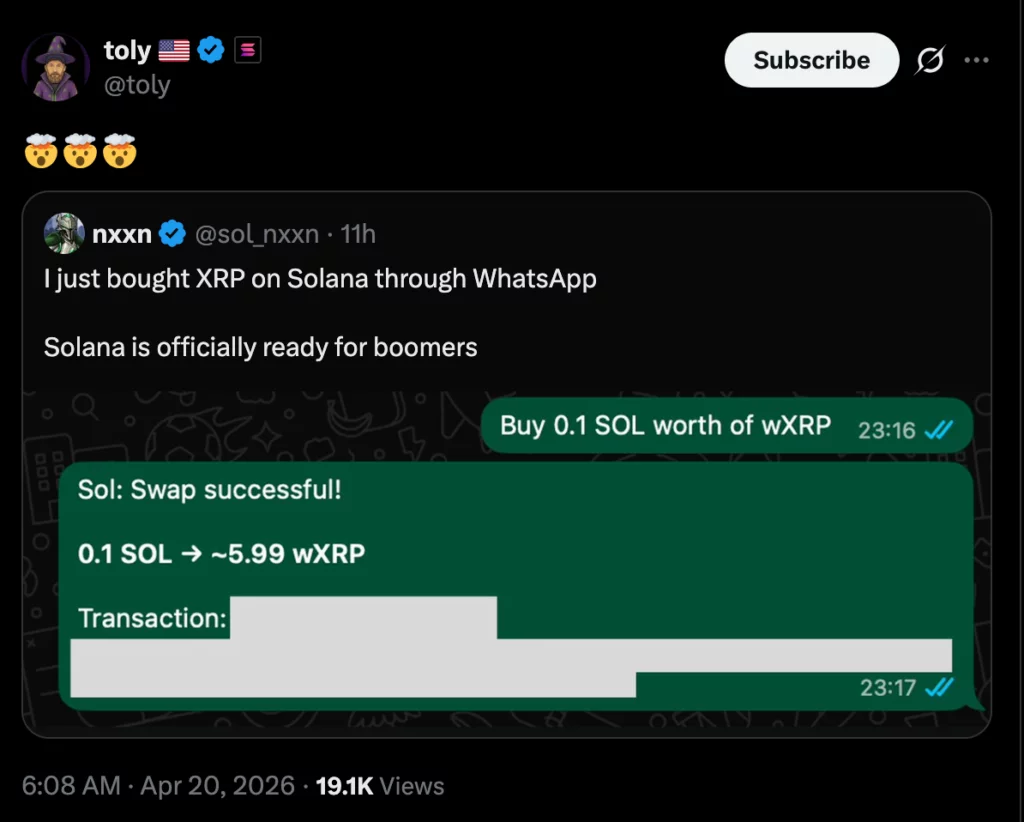
XRP trading through WhatsApp has started after wrapped XRP, known as wXRP, went live on the Solana blockchain.
Summary
- Wrapped XRP launched on Solana, allowing users to swap assets through WhatsApp-linked noncustodial wallet bots directly.
- The setup uses AI bots and Solana DEX aggregators to process text-based crypto trades.
- wXRP now works across Solana DeFi apps, including Raydium, Orca, Kamino, Marginfi, and Backpack.
The setup allows users to swap assets inside the messaging app without leaving the chat window. The move followed the April 17 launch of wXRP on Solana through a partnership involving LayerZero and Hex Trust.
On Solana, wXRP exists as an SPL token, which means it can work with decentralized exchanges, wallets, and other apps built on the network.
A screenshot shared by X user @sol_nxxn showed a WhatsApp chat that swapped 0.1 SOL for about 5.99 wXRP. The user wrote, ”I just bought XRP on Solana through WhatsApp. Solana is officially ready for boomers.”
The trading flow uses AI-powered bots connected to a user’s noncustodial wallet. A person sends a text command such as ”Buy 0.1 SOL worth of wXRP,” and the system reads the request, then routes the trade through a Solana DEX aggregator. This lets the user complete a token swap through a chat-based interface.
Moreover, once wrapped on Solana, XRP can move through the network like other Solana-based tokens. That makes it usable across decentralized finance products that support SPL assets.
The report said wXRP can already be used with Solana platforms such as Raydium and Orca for trading, Kamino and Marginfi for lending and borrowing, and wallets such as Backpack. This gives XRP another route into onchain activity outside its native network and expands where holders can use the asset.
Market attention stays on XRP’s broader setup
The WhatsApp use case arrives as XRP remains in focus across the wider market. Analysts have recently pointed to a symmetrical triangle on XRP’s daily chart, with some watching for a possible 35% move if price breaks out of the pattern.
At the same time, the new Solana route adds a separate market angle centered on access and utility. The combination of broader DeFi use and chat-based trading shows how XRP is being adapted for different platforms.


The aftershocks of the Saturday’s KelpDAO hack are spreading through stablecoin markets in ways that were not immediately obvious.
Int he first 24 hours post the attack, users on Aave borrowed approximately $300 million against their tether deposits of stablecoin tether on the platform, according to Chaos Labs data.
The borrowing spike isn’t a sign of demand; it is a sign users can’t withdraw. With stablecoin pools maxed out, depositors are taking loans against their own funds at a loss just to access liquidity.
Think of it this way: Imagine a bank refusing to process customer fiat deposit withdrawal requests. So, out of desperation, customers take out loans on these deposits. This credit creation isn’t healthy, but a desperate move for liquidity.
“We’re now seeing some negative secondary effects of illiquidity in Aave stablecoin markets,” said monetsupply.eth, the pseudonymous head of strategy at Spark, a rival DeFi lending platform. “Because users can’t withdraw due to 100% utilization, there has been a ~$300 million increase in borrowing with USDT collateral in just the past day since the rsETH exploit.”
To understand how a single exploit on KelpDAO ended up locking every stablecoin exit on Aave simultaneously, you need to understand how the system is supposed to work — and exactly where it broke.
What is Aave and how it’s supposed to work
Aave is a decentralized finance (DeFi) protocol that enables users to lend and borrow cryptocurrencies without intermediaries. Think of it as a bank, except it runs entirely on code on a public blockchain, with no human gatekeepers.
Users deposit assets into lending pools and earn interest. Others borrow from those same pools by posting crypto assets as collateral, which exceeds the loan amount. The system is designed to self-correct automatically through interest rates. When lots of people want to borrow, rates rise, making borrowing more expensive and encouraging lenders to deposit more. When demand falls, rates drop.
The whole system operates on one core assumption: that there is always enough liquidity – enough assets in the pool – for lenders to withdraw their deposits when they want to, and for borrowers to unwind their positions when they need to.
When that assumption breaks down, everything else breaks with it. That’s what happened after the KelpDAO exploit.
rsETH and the KelpDAO exploit
rsETH is a liquid re-staking ether token issued by KelpDAO.
When you stake ether (ETH), you lock it up to help secure the Ethereum network in exchange for a yield, similar to earning interest on a bond. Some protocols issue a liquid staking token (LST) that represents your staked ETH.
Re-staking goes a step further, reusing those already-staked assets to secure additional systems, effectively stacking yield on yield. In return, you receive a receipt token representing your position. rsETH is one such receipt token and it has been widely used as collateral across the DeFi world.
On April 18, an attacker manipulated KelpDAO’s bridge infrastructure into releasing 116,500 rsETH — roughly 18% of the token’s circulating supply, worth approximately $292 million. These fake, unbacked tokens were immediately deposited into lending protocols, mostly Aave, to borrow real ETH and other assets such as wrapped ether (wETH) against them. Fake tokens in, real money out.
“That [borrowed] WETH is gone. The rsETH holding its place in the vaults is worth whatever an unbacked claim is worth — approaching zero on the L2 side, where 20+ chains held bridged rsETH backed by a now-empty mainnet lockbox,” 0xyanshu, a pseudonymous crypto operator known for work around on-chain finance and risk, said.
Aave froze rsETH markets on V3 and V4 within hours, with founder Stani Kulechov affirming the exploit was external and Aave’s contracts were not compromised. That freeze stopped the bleeding. But it also set off the chain reaction that produced the $300 million borrowing surge.
How $300 million in borrowing materialized in a single day
When the exploit news broke, whales and big funds withdrew billions of dollars worth of cryptocurrencies from Aave’s liquidity pools within hours. Because they moved first and in large numbers, their withdrawals drained liquidity pools.
“When the rsETH exploit happened and AAVE incurred bad debt, whales like Justin Sun, MEXC exchange, and others immediately withdrew billions from AAVE,” analyst Duo Nine, said in an explainer. “Initially, the ETH market hit 100% utilization, meaning you could not withdraw your ETH from AAVE.”
This soon spread to USDT and USDC pools, raising their utilization rates to 100%, as over $6 billion in assets left the protocol within hours. Every lending pool holds a fixed amount of assets deposited by users. When every dollar of those assets has been borrowed out, nothing remains for withdrawals.
“That’s because AAVE lost over $6 billion in liquidity in the past 24h,” Duo Nine wrote. “As whales took out their money, USDT and USDC also hit 100% utilization. These markets are now also stuck with money locked.”
This is when the $300 million secondary borrowing surge began.
Trapped USDT and USDC depositors, unable to simply withdraw their money, reached for the only exit still available to them. They began by drawing loans from their locked deposits.
“Some users decided to borrow against USDT/USDC and exit via other markets at a 10-25% loss,” Duo Nine explained. “Basically you borrow GHO/DAI/USDe against your locked USDT/C.” It was not a trading strategy.
It has been a desperate act of borrowing against their own money at a loss, accepting 75 cents on the dollar, just to extract any liquidity from the system at all. Aave allows users to borrow up to 75% of the total loan-to-value (LTV) of their deposited collateral, depending on the asset and its risk parameters.
“With a 75% max LTV, users with stuck USDT deposits can take out up to 3/4 of the value of their Aave position. But this ends up reducing liquidity in other markets, with USDC and USDe markets now at 100% utilization as well,” monetsupply.eth, the pseudonymous head of strategy at Spark, a rival DeFi lending platform, observed.
For anyone watching DeFi from the outside, the message is clear: “Decentralized” does not mean “without risk.”

Coinbase is accelerating its internal use of AI by piloting agents that assist employees with day-to-day work, including integration with Slack and email. The rollout marks another step in the crypto exchange’s broader push to weave artificial intelligence into its operations, a trend unfolding across the tech sector as firms lean on automation to cope with hiring constraints and scale knowledge work.
In a post on X this weekend, Coinbase chief executive Brian Armstrong announced that the company has already deployed two AI agents modeled after former Coinbase executives. He suggested that the number of agents could eventually exceed the company’s human headcount, signaling a future where AI handles a growing share of internal tasks and decision-making. The comments come as Coinbase has publicly foregrounded AI as a strategic lever, including ambitions to push more of the company’s coding work toward AI-assisted workflows.
Coinbase’s AI push sits within a broader industry context where tech giants have been trimming staff while expanding AI capabilities. Armstrong has been explicit about ambitions to automate more workflows, including a notable claim last year that AI could contribute to a substantial portion of the company’s code. The exchange has also highlighted plans to transform its workforce into “AI-Natives,” a goal it described as part of its productivity strategy. In parallel, Coinbase operates the x402 protocol, a framework introduced to enable agentic AI payments on crypto and fiat rails, illustrating how AI agents could move beyond internal use to handle real-world financial transactions.
Key takeaways
- Coinbase is testing AI agents to support internal work processes, with a Slack and email workflow integration as the initial environment.
- The two agents are named Fred and Balaji, each designed with distinct roles reflecting Coinbase’s culture and governance needs.
- Fred serves as a strategic executive agent, while Balaji acts as an “agent of chaos and creativity” to challenge assumptions and spark innovation.
- The initiative aligns with Coinbase’s broader AI strategy, including a push toward an AI-native workforce and the x402 agentic AI payments protocol.
Coinbase’s AI agents: Fred and Balaji
Armstrong introduced the two agents with a nod to Coinbase’s history. Fred, named after co-founder Fred Ehrsam, is envisioned as the company’s strategic executive agent. In practice, Fred is meant to help teams maintain strategic clarity and align priorities, offering executive-level feedback that can guide high-impact decisions. Balaji, modeled after former Coinbase chief technology officer Balaji Srinivasan, is described as the “agent of chaos and creativity.” The intent behind Balaji is to push employees to rethink assumptions, explore unconventional approaches, and catalyze innovative thinking across projects.
The naming of the agents is not just symbolic. It signals Coinbase’s approach to embedding AI into leadership and ideation processes—using AI personas that mirror the company’s own leadership archetypes to guide how the agents prompt, critique, and shape workstreams. The experiment also reflects a broader trend of “agentic” AI, where digital assistants aren’t merely task bots but integral partners in strategic initiatives and experimentation.
From internal pilots to a payments rails ecosystem
Coinbase’s internal AI experiment sits alongside the firm’s ongoing broader AI strategy. In May 2025, Coinbase rolled out the x402 protocol to enable agentic AI payments on both crypto and fiat rails, a development that signals how AI-driven agents could eventually perform real-world financial transactions within a regulated framework. The x402 framework is positioned as a precursor to widespread use of AI agents for financial operations, potentially expanding the scope of automation from internal productivity to customer-facing and partner-facing payments processes.
Armstrong’s public remarks this year have underscored a belief that AI agents will increasingly transact online, with him suggesting that “more AI agents transacting online than humans very soon.” Those views echo similar forecasts from other tech leaders who see AI agents as a new class of actors in the digital economy. Earlier commentary from Circle CEO Jeremy Allaire has — at times — pointed toward billions of AI agents operating on-chain within a few years, highlighting the scale at which such agents could participate in financial ecosystems. While these predictions illustrate a powerful narrative about AI-enabled commerce, they also place Coinbase’s initiative within a wider debate about governance, reliability, and the regulatory considerations surrounding automated agents in finance.
Industry context remains nuanced. While industry leaders have celebrated the potential of AI agents to reduce friction and accelerate decision-making, they have also warned of the challenges involved in aligning AI behavior with corporate goals, maintaining security, and ensuring accountability when AI agents act on behalf of human teams. The emergence of agentic AI in crypto payments—still in its early stages—will likely attract close scrutiny from investors, regulators, and users alike as practical pilots mature and scale.
What to watch next for AI in crypto tooling
Investors and builders should monitor how Coinbase scales its internal AI agent program: whether traditional workflows see measurable productivity gains, how governance and oversight evolve as agents take on more complex tasks, and what new security and compliance controls emerge as agents interact with internal systems. The broader crypto industry will also be watching for how the x402 protocol evolves, and whether other exchanges or crypto companies adopt similar agent-based models for payments, settlement, and governance-related processes.
Beyond Coinbase, the momentum around AI agents in crypto payments raises questions about the mix of internal automation and external-facing capabilities. As major players debate the balance between automation and human oversight, the market will likely see a split between tasks that benefit most from AI-assisted decision-making and those requiring direct human input or regulatory compliance checks. For now, Coinbase’s two-armed experiment with Fred and Balaji signals both the ambition and the caution that define enterprise-grade AI in crypto—an approach that blends internal productivity gains with a longer-term bets on how AI agents could reshape the payments landscape.
Readers should watch for updates on the agents’ performance metrics, any expansion beyond internal Slack and email tasks, and how regulators respond to increasingly autonomous decision-making within crypto infrastructures. As Armstrong and his peers push the envelope on AI-native operations, the coming quarters will test whether the promised productivity gains translate into durable competitive advantages while preserving the trust and safeguards that define responsible crypto innovation.

Key Takeaways
- Following a two-day trading pause, ARK Invest executed significant portfolio adjustments on Friday
- The firm acquired 26,161 Netflix shares valued at approximately $2.5M following a nearly 10% post-earnings decline
- Circle holdings worth $1.21M were liquidated as the company faces legal challenges related to the Drift Protocol incident
- ARK divested $1.36M in Bullish shares while Bitcoin climbed past $76,000
- The firm invested roughly $11.96M in Alamar Biosciences during its Nasdaq debut
Cathie Wood’s ARK Invest resumed active trading Friday, April 17, 2026, following a 48-hour hiatus. The investment firm executed a notable strategic pivot: liquidating cryptocurrency-related equities while accumulating positions in established technology and biotechnology companies.
The firm purchased 26,161 Netflix shares representing approximately $2.5 million in capital. This move came immediately after Netflix disclosed its Q1 financial results, revealing revenue of $12.25 billion alongside profits reaching $5.28 billion — figures that surpassed analyst expectations.
Despite delivering impressive financial metrics, Netflix stock plummeted nearly 10% to settle at $97.31. The decline followed co-founder Reed Hastings’ announcement that he wouldn’t pursue board reelection, coupled with the company’s conservative revenue projections for the remainder of 2026.
ARK’s acquisition indicates confidence that the market overreacted to the news. Netflix continues expanding into live sports broadcasting and advertising initiatives, with revenue projections approaching $3 billion for the current year.
Cryptocurrency-Linked Stock Divestment
Regarding sales activity, ARK liquidated Circle shares totaling $1.21 million. Circle operates as the issuer of USDC, ranking among the most significant stablecoins by total market capitalization.
The company currently confronts a class-action legal proceeding stemming from the Drift Protocol security breach. Plaintiffs allege Circle neglected to freeze compromised assets during the incident, introducing considerable legal exposure for shareholders.
Additionally, ARK disposed of $1.36 million in Bullish stock, despite the shares appreciating approximately 5% that trading session amid declining Middle East tensions.
Bitcoin maintained levels above $76,999 Friday, experiencing temporary upward momentum following reports of the Strait of Hormuz reopening. Crude oil prices declined roughly 10% on this development.
The optimism proved fleeting. By Saturday evening, Iranian officials declared the Strait closed once more, citing a U.S. naval blockade. This reversal underscored persistent geopolitical volatility.
Biotech Investment on Debut Trading Day
ARK acquired 537,463 Alamar Biosciences shares for approximately $11.96 million during the company’s inaugural Nasdaq trading session.
Alamar experienced a remarkable 33% surge during its debut, achieving a market capitalization of $1.53 billion. This transaction demonstrates ARK’s ongoing commitment to emerging biotechnology ventures alongside established technology positions.
Combined cryptocurrency-related divestments totaled $2.57 million spanning Circle and Bullish. Both positions saw reductions despite the broader cryptocurrency market maintaining strength above critical price thresholds.
These transactions illustrate a calculated adjustment in ARK’s Friday holdings — transitioning capital from elevated-risk cryptocurrency exposures toward large-capitalization technology and biotechnology assets amid continued global uncertainty.
ARK’s simultaneous purchases of Netflix and Alamar Biosciences shares represents one of the firm’s most substantial single-session portfolio rebalancing events in recent trading periods.


The National Security Agency is utilizing Anthropic’s most sophisticated AI model, Mythos Preview, despite the Department of Defense labeling the startup a “supply chain risk.”
Summary
- The National Security Agency has secured access to Anthropic’s most advanced AI model despite official Pentagon warnings that the company poses a supply chain risk.
- The Pentagon is currently arguing in court that Anthropic’s tools threaten national security while it simultaneously expands the use of those same tools across military departments.
Two sources told Axios that the NSA has secured access to the high-powered model, which Anthropic has kept under tight wraps due to its potent offensive cyber capabilities.
While the Pentagon officially moved to sever ties with the company in February—even directing its vendors to do the same—internal demand for the technology appears to be overriding that directive.
This friction has led to a legal standoff where military officials are arguing in court that Anthropic’s tools threaten national security, while simultaneously expanding their use of those same tools across various departments.
The standoff over “all lawful purposes”
Renegotiations between the two parties soured earlier this year when the Pentagon demanded the company make its Claude model available for “all lawful purposes.”
Anthropic leadership pushed back, insisting on specific prohibitions against mass domestic surveillance and the development of autonomous weaponry. As a result of this, some Defense officials claimed the company cannot be trusted in critical military scenarios, a characterization Anthropic has denied.
The government’s interest in the model stems largely from its specialized utility. Most of the 40 organizations granted access to Mythos Preview use the tool to scan their own digital environments for exploitable vulnerabilities.
While Anthropic has publicly named only 12 of these partners, including the U.K.’s AI Security Institute, the NSA is reportedly among the undisclosed group of agencies.
Recent efforts to resolve the impasse have moved beyond the Pentagon’s halls. Anthropic CEO Dario Amodei met on Friday with White House Chief of Staff Susie Wiles and Treasury Secretary Scott Bessent to discuss how Mythos could be integrated across other government sectors.
Sources described the meeting as productive, indicating that the administration may look for ways to bypass the Pentagon feud to ensure other departments can utilize the cutting-edge technology.

The Strait of Hormuz is back under Iranian control, Trump is threatening to level Iran’s power grid, and somehow BTC is still standing where altcoins would already be bleeding out. Something in the structure of this market has changed, but the Bitcoin price prediction is still bullish.
The weekend’s flare-up hit hard across traditional assets. Brent crude surged to $88, European natural gas futures spiked as much as 11%, and S&P 500 futures dropped 0.6% after Friday’s record close. Bitcoin’s 0.5% pullback looked almost serene by comparison.
— Jesse Cohen (@JesseCohenInv) April 19, 2026
 Futures are down big after this weekend’s Iran developments.
Dow Futures are down 500 points. pic.twitter.com/ZNDPeEb2Wv
This is now the fourth major Iran-related escalation since the conflict began on February 28, and the pattern is consistent. Each successive crypto sell-off is shallower than the last. Bank of England Deputy Governor Sarah Breeden warned April 18 that the war “heightens combined market stress risks,” yet BTC held above $70,000 throughout.
Discover: The best crypto to diversify your portfolio with
Bitcoin Price Prediction: $80K Still The Target
Bitcoin hit its 2026 low of $63,000 on February before bouncing to $78,000 on the ceasefire talk last week, liquidating $200 million in shorts in the process. The current $74K level sits in the middle of a well-defined five-week range between $73,000 and $78,000.
RSI showed a slightly oversold rebound after the April 1 wick; Chaikin Money Flow data points to active dip-buying despite elevated volatility, the same pattern as Bitcoin’s post-Ukraine invasion consolidation in 2022, with EMA 100 and 200 closing in for a golden cross.
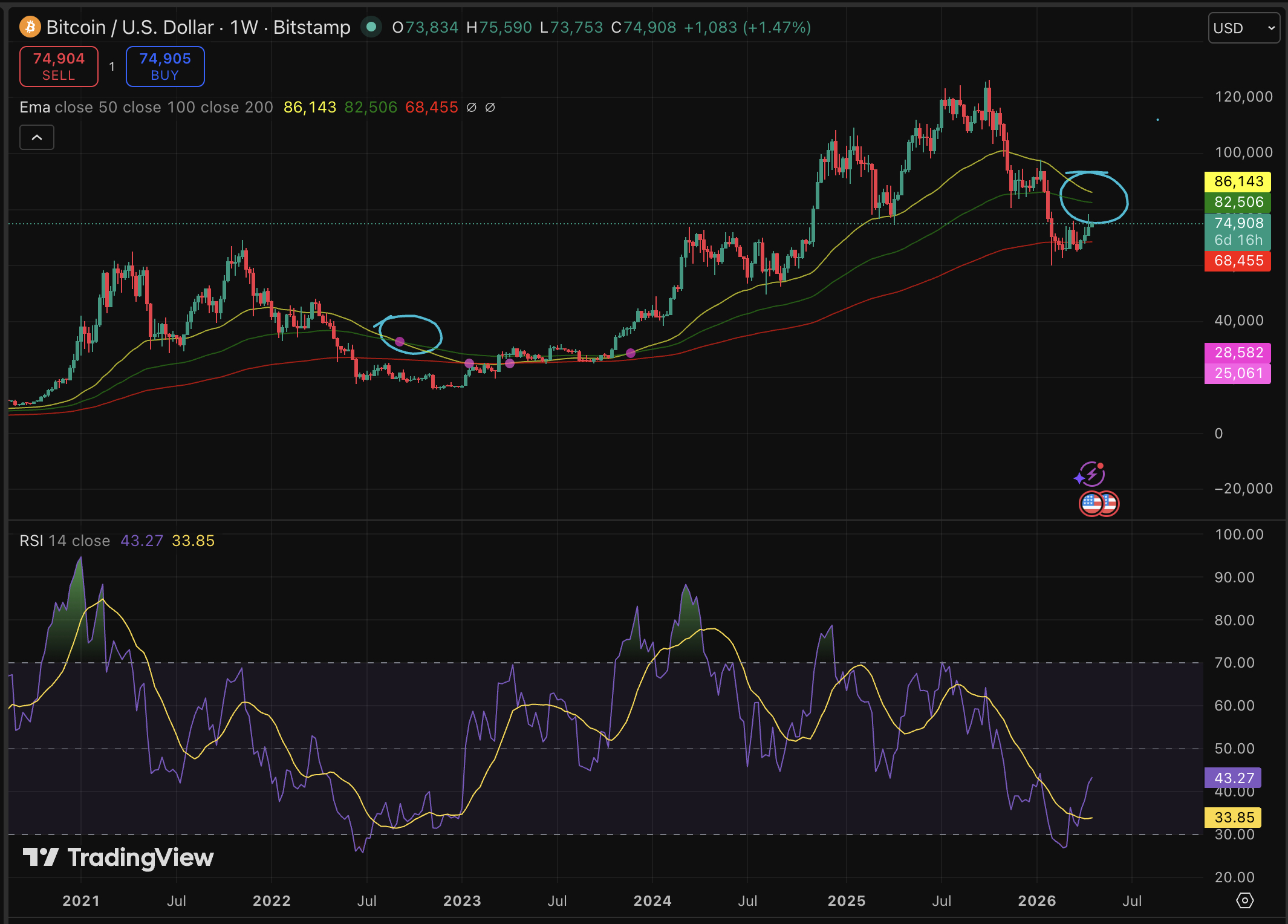
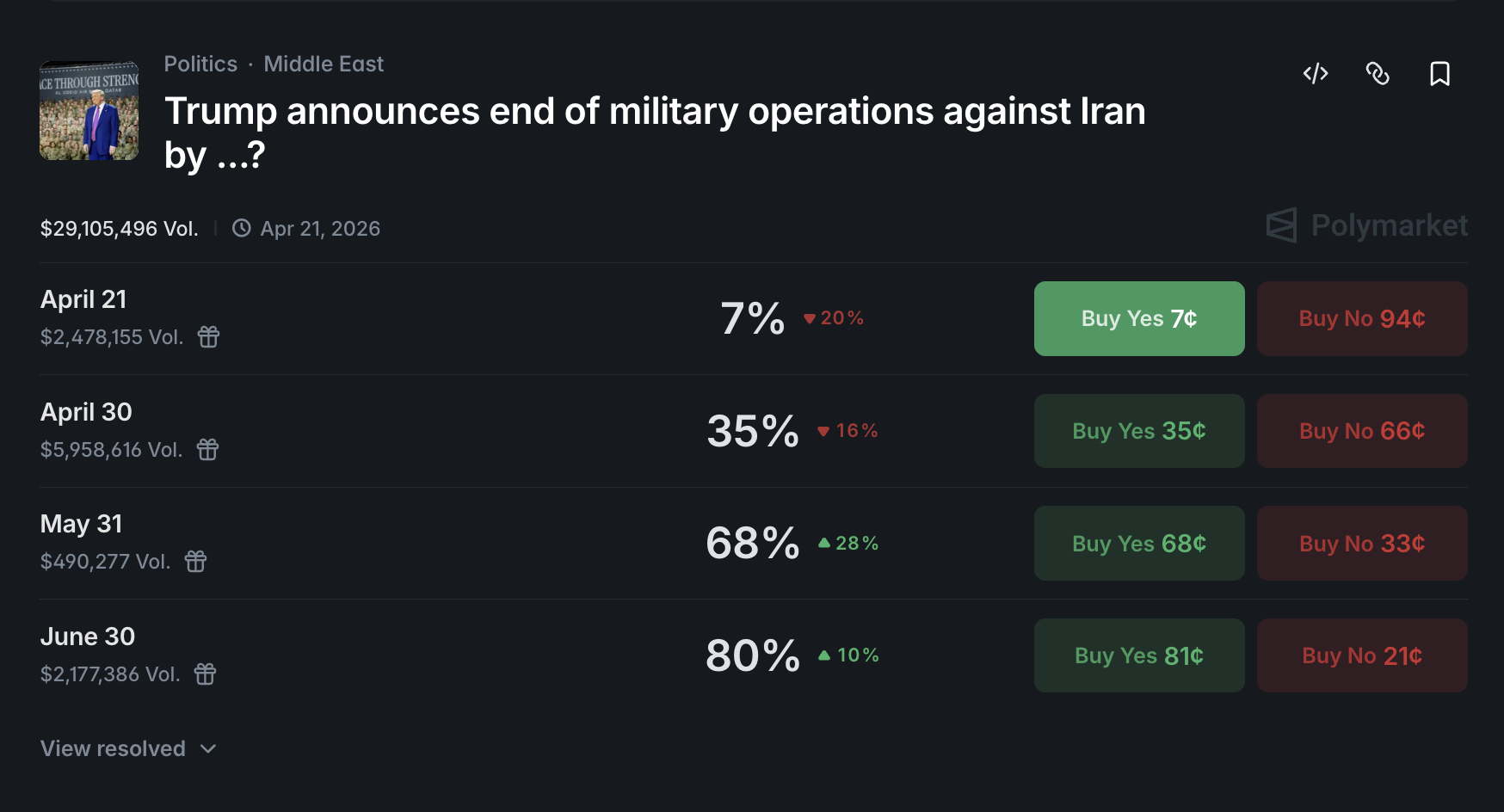
Key support sits higher, after the jump last week, at $73,000. Resistance is clustered at $76,000–$78,000. Polymarket currently prices an 80%+ probability of a deal by the end of June, which sets up a good scenario. Ceasefire confirmed, Strait reopens, then BTC breaks $78,000, targets $80,000–$94,000 range within weeks.
Bernstein maintains a $150,000 year-end 2026 target in a call backed, in part, by MicroStrategy’s purchase of 4,871 BTC ($329.9 million) between April 1–5, right into the conflict’s worst week.
Long-term holders are buying the fear. That doesn’t guarantee a near-term breakout, but it sets a credible demand floor.
Discover: The best pre-launch token sales
Bitcoin Hyper Bullish as BTC Grinds Through War-Risk Consolidation
Bitcoin above $74,000 sounds bullish until you map the resistance. $76,000 is a ceiling that’s been rejected twice already, and a full move to Bernstein’s $150,000 target implies months of sustained catalyst flows like a ceasefire, ETF inflows, and macro easing, all arriving in sequence.
There are a lot of dominoes to be pushed. Those looking for asymmetric upside without waiting for BTC to clear four layers of resistance are increasingly looking at the infrastructure layer being built on top of Bitcoin itself.
Bitcoin Hyper ($HYPER) is positioned at that intersection. It’s built as the first-ever Bitcoin Layer 2 with full Solana Virtual Machine (SVM) integration, bringing sub-second smart contract execution to the Bitcoin ecosystem without sacrificing Bitcoin’s base-layer security.
The pitch is direct: fix Bitcoin’s core limitations of slow transactions, high fees, and zero programmability, while preserving the trust that makes BTC worth building on. The presale has raised $32 million at a current price of $0.0136, with 36% APY staking available.
Hyper offers a real capital stack at a seed-stage price. Dig into the mechanics, because the raised size suggests this isn’t flying under the radar.
The post Bitcoin Price Prediction: Iran War Goes On, Crypto Can’t Catch A Break appeared first on Cryptonews.

Banned director Blumenthal elusive in liquidators' probe

DAX Uptrend at Risk from Fundamentals

21 Best Outdoor Dinnerware And Tablecloth Buys For Spring 2026 Entertaining


-

 Crypto World7 days ago
The SEC Conditionalises DeFi Platforms to Be Avoided for Broker Registration
-

 NewsBeat6 days ago
Trump and Pope Leo: Behind their disagreement over Iran war
-

 Fashion3 days ago
Weekend Open Thread: Theodora Dress
-

 Crypto World6 days ago
SEC Signals Exemption for Crypto Interfaces From Broker Registration
-

 News Videos5 days ago
Secure crypto trading starts with an FIU-registered
-

 Sports3 days ago
NWFL Suspends Two Players Over Post-Match Clash in Ado-Ekiti
-

 Crypto World6 days ago
SEC Proposes Certain Crypto Interfaces Don’t Need to Register as Brokers
-

 Business19 hours ago
Powerball Result April 18, 2026: No Jackpot Winner in Powerball Draw: $75 Million Rolls Over
-

 Crypto World2 days ago
Russia Pushes Bill to Criminalize Unregistered Crypto Services
-

 Politics3 days ago
Palestine barred from entering Canada for FIFA Congress
-
 Business4 days ago
Creo Medical agree sale of its manufacturing operation
-

 Politics1 day ago
Zack Polanski demands ‘council homes not luxury flats for foreign investors’
-
 Entertainment6 days ago
Brand New Day’ Footage Reveals the Devastating Impact of ‘Now Way Home’
-

 Tech5 days ago
Microsoft adds Windows protections for malicious Remote Desktop files
-
 Entertainment6 days ago
Karol G’s ‘Ultra Raunchy’ Coachella Set Gave ‘Satanic Vibes’
-

 Sports7 days ago
Aaron Judge says Yankees need to ‘simplify’ approach amid offensive slump
-

 Entertainment7 days ago
How Babylon 5 Turned Brief Side Story Into Emotional Masterpiece
-

 Tech6 days ago
What was the first ransomware attack to demand payment in Bitcoin?
-

 Tech4 days ago
‘Avatar: Aang, The Last Airbender’ Leaked Online. Some Fans Say Paramount Deserves the Fallout
-

 Crypto World2 days ago
Russia Introduces Bill To Criminalize Unregistered Crypto Services
You must be logged in to post a comment Login