
Tech
Western Electric Revives U.S. Vacuum Tube Manufacturing, Unveils New Amplifier Designs at AXPONA 2026

Western Electric didn’t just show up at AXPONA 2026 with new amplifier designs. It tapped into something a lot of us have been thinking about for years.
I’ve had a thing for tubes since I was a kid, learning the basics with my grandfather before I was ten. Decades later, that interest hasn’t faded. It has just gotten more expensive and harder to justify shelf space. I’ve owned just about every type of tube amplifier you can name and built a few along the way. My wife would argue the collection peaked years ago, but I’m still not walking past a good 6922 or KT88 without at least thinking about it.
The bigger issue hasn’t been the gear. It has been the tubes themselves. Options have thinned out to the point where “choice” often feels like theater. I remember standing in a large musician supply shop staring at five different brands of 12AX7. Different logos, different boxes, different prices. Same factory in Russia. Same tube.
That’s a long way from where things used to be. There was a time when American manufacturing alone offered a deep bench. RCA, GE, Sylvania, Tung Sol. All building serious product, alongside a strong European presence from Mullard, Telefunken, Philips, and others. Today, new production is concentrated in a handful of places: Slovakia, China, Russia, and yes, Rossville, GA, USA. Which is why what Western Electric is doing right now actually matters.
The operation in Rossville, GA, USA belongs to Western Electric, one of the most storied names in American tube manufacturing. For a long stretch, that name carried more history than output. Western Electric was not producing tubes at all. Even now, the lineup coming out of that factory is focused and limited. Two tubes. The 300B and the 308B.
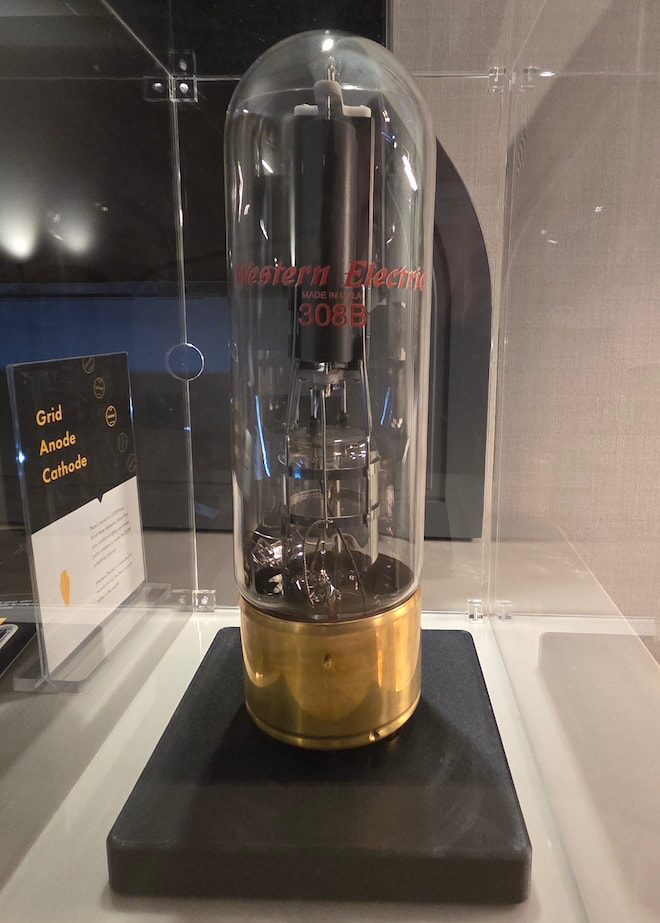
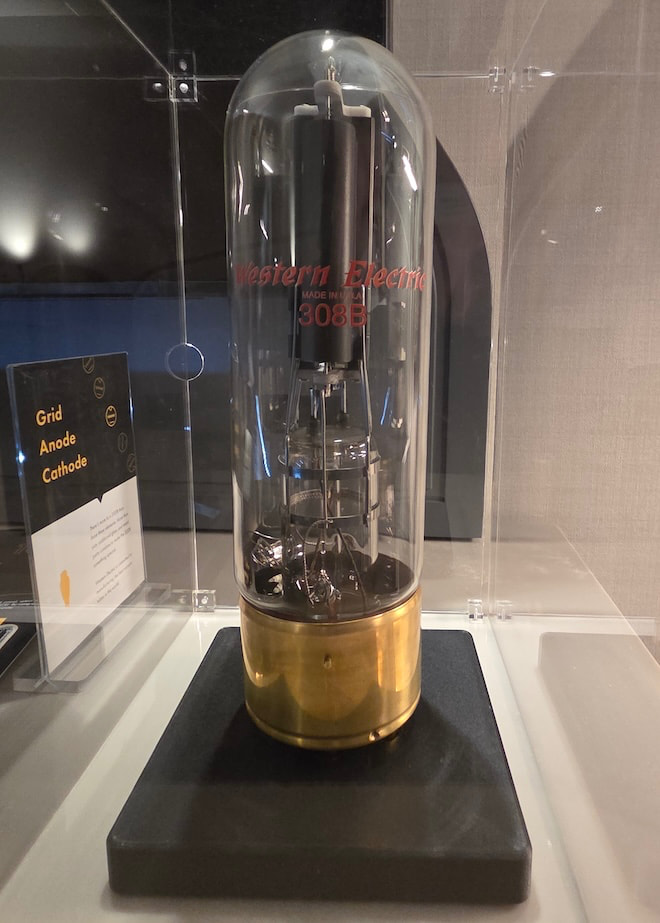
The 300B remains the centerpiece. It powers Western Electric’s Type 91E integrated amplifier and continues to define what the brand does best. The 308B is a different story. Production is being ramped back up to support the new 100E monoblock amplifiers, which signals a broader push beyond a single legacy tube.
Both amplifiers were on display in Western Electric’s room at AXPONA 2026. And yes, they deliver exactly what you think they will. If you have even a passing interest in tubes, this is the kind of gear that stops you mid sentence and makes you reconsider your financial priorities.
The 300B Reality
The 300B has been around since the 1930s and, during the golden age of tubes, it powered everything from PA systems to theater installations and clubs around the world. It wasn’t boutique back then. It was the workhorse.
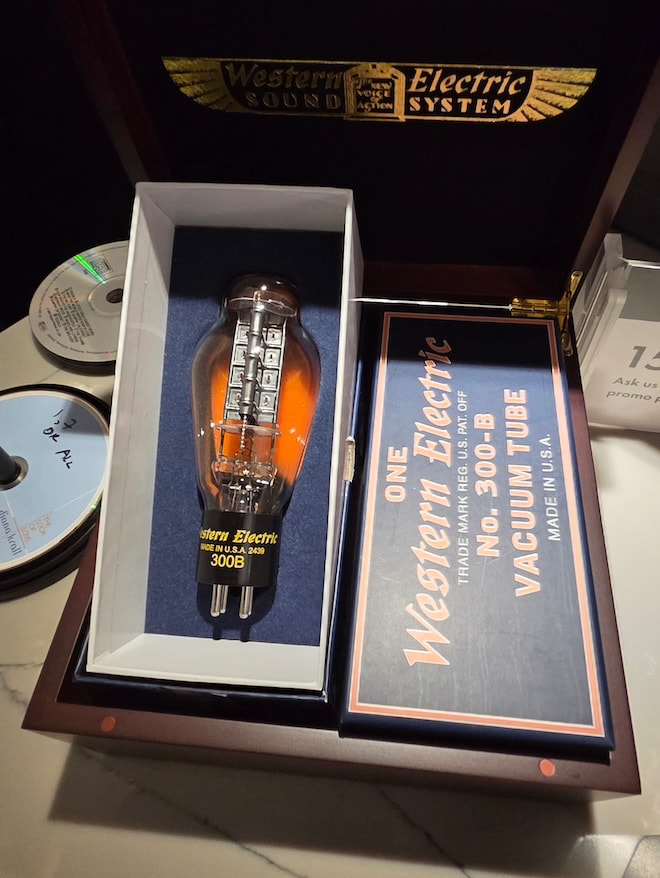
Today, it sits on the other end of the spectrum. Among the most coveted tubes in the new old stock market, with prices that can start just under a thousand dollars and climb into several thousand for early examples. Add the premium for matched pairs or quads and the cost of keeping a 300B amplifier running gets uncomfortable fast. And that’s before you factor in the risk. Most NOS tubes come with little to no warranty. You’re buying history and hoping it holds up.
That’s where Western Electric shifts the conversation. Their current production 300B comes in at $699 each or $1,499 for a matched pair. Still not cheap, but grounded in reality compared to NOS pricing. More importantly, they back it with a five year warranty. That alone changes the math for anyone serious about running a 300B based system long term.
The 308B: Big Glass, Big Power, and Still a Work in Progress
The 308B is not subtle. It stands roughly 14 inches tall and close to 4 inches in diameter. This is the kind of tube that makes everything around it look like it needs to hit the gym.
In Western Electric’s 100E monoblock, a single 308B is rated to deliver 160 watts. That’s more output from one tube than many push pull designs manage with a quad of KT88s. It’s an ambitious play and one that suggests Western Electric is not content to stay in the 300B comfort zone.
Details are still catching up to the product. Pricing and availability have not been finalized, and even the web page listed in the company’s show materials was still under construction the week after AXPONA 2026. That tells you where this sits. Early, promising, and not quite ready for prime time.
91E and 100E: How Western Electric Is Actually Using These Tubes
Western Electric wasn’t just putting tubes on pedestals at AXPONA 2026. They showed how they’re being used across two very different amplifier designs.
The 300B plays two roles here. In the 91E integrated amplifier, it’s the output tube. In the 100E monoblock, it shifts upstream and handles the mid stage. The spotlight in the 100E belongs to the 308B, which drives the final output stage and does the heavy lifting.
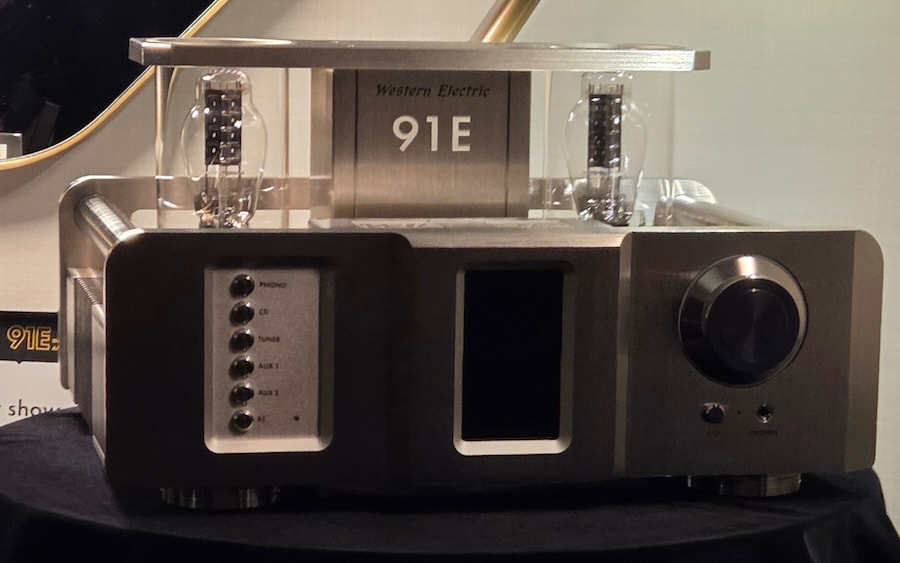
The 91E integrated amplifier, priced at $8,000, uses a pair of 300B tubes to deliver roughly 20 watts per channel. That number will not impress anyone chasing big power, but that’s not the point. Western Electric built flexibility into the design with interchangeable output modules for 4, 8, and 16 ohm loads. That opens the door to a wide range of loudspeakers, although higher sensitivity designs will make the most sense here.
Connectivity is more modern than you might expect. There are moving coil and moving magnet phono stages built-in, along with RCA inputs for a tuner, CD player, and additional analog sources. On the digital side, the 91E includes Bluetooth, USB, and Ethernet, with an ESS DAC handling up to 16-bit/96 kHz for incoming Bluetooth and USB signals.
Outputs include line out and pre out for system integration, plus dual sets of binding posts. It’s a tube integrated that leans into flexibility without pretending to be something it isn’t. No apps, no ecosystem pitch, and definitely not a Class D network amplifier. It just makes music and throws off enough heat to remind you that winter is coming.
100E Monoblocks and A2 Loudspeakers: Open Window Listening
The rest of what Western Electric brought to AXPONA 2026 leans newer, and in some cases, still short on published detail. The 100E monoblocks were impossible to miss. Physically and visually, they owned the room.

Each chassis is built around that 14 inch tall 308B, and yes, it glows in a way that will stop you in your tracks. Subtle is not part of the brief here. Rated at 160 watts per amplifier, the 100E is doing something few tube designs attempt, delivering serious output from a single ended architecture that looks more like industrial art than consumer audio.
Size is part of the story. At roughly 32 inches deep and close to 22 inches wide, these amplifiers are going to dictate the layout of most rooms. Weight is estimated around 160 pounds each, so once they are in place, they are staying there. This is not gear you casually move around on a Saturday afternoon.
The topology is just as unconventional. A 12AT7 handles the input stage, a 300B is used in the mid stage, and the 308B takes over as the output tube. Seeing a 300B in that middle role tells you everything about the scale of this design. Nothing about it is typical.
Heat is not an afterthought either. With plate voltage around 1500 volts and plate dissipation exceeding 220 watts, these amplifiers are going to generate serious thermal output. Ventilation is not optional, especially in smaller rooms.
The 100E is impedance matched to the 91E, so building a complete Western Electric system is straightforward if you are willing to commit. At $75,000 each, the monoblocks sit in a very different bracket than the 91E, and the new A2 loudspeakers at $70,000 per pair make it clear this is a full system play, not just a statement amplifier. You accountant would like a word.
Big System Energy, Small Room Reality
The A2 loudspeakers from Western Electric are a hybrid design built around air motion transformer tweeters and midrange drivers, paired with dual dynamic bass drivers. The goal is broad, even coverage with a 180 degree dispersion pattern. This is meant to fill a room, not lock one listener into a single chair.
That ambition ran into a familiar problem at AXPONA 2026. The hotel room was simply too small. The A2 sounded like it wanted more space, more air, more distance to breathe. Instead, it was confined to a setup that forced it to hold back. This is the kind of speaker that needs a larger ballroom or dedicated listening space to make sense.
Feeding the system was the new WE 203C CD player, priced at $12,000. It served as the primary source for a system that, all in, lands around $310,000 before you even start thinking about cables or adding a turntable.
The Bottom Line
What stuck with me most from Western Electric at AXPONA 2026 wasn’t the big glass. It was the small signal tubes quietly doing their job up front. The 12AX7 in the first stage of the 100E may not draw a crowd, but it matters more than it looks.
Western Electric is ramping up production of the 12AX7 and aiming to expand into other small signal tubes as well. If that includes something like a 6SN7, a lot of people are going to pay attention. This is not a niche development. It’s a structural shift. For the first time in decades, American amplifier manufacturers could have a domestic source for one of the most widely used tubes in both hi fi and instrument amplifiers.
For years, “made in the USA” has come with an asterisk. Chassis, transformers, assembly. Sure. Tubes? Usually sourced from Russia, Slovakia, or China. Bringing small signal tube production back to the U.S. changes that conversation in a real way.
With the factory in Rossville, GA, USA only a few hours from me, there’s a good chance to see this firsthand. And if that happens, it’s worth documenting. People should see how this is being done, not just read about it.
Honestly, if Western Electric had shown nothing but that 12AX7 effort, it still would have been one of the most important rooms at the show.
For more information: westernelectric.com
Related Reading:


Director Jon Favreau says a specialized app let him better frame IMAX shots using a virtual theater environment in Apple Vision Pro. He cites it as one method to cut back on reshoots and reduce costs.

Apple Vision Pro could become a useful tool in filmmaking
Filmmaking has only become more and more expensive even as commercialized tools make the medium more accessible. It’s easier than ever to grab a smartphone and shoot some footage, but reaching Hollywood calibre isn’t so simple.
In an interview conducted by The Town podcast during Cinemacon, Jon Favreau discussed ways that technology was helping reduce costs in filmmaking. One of the tools he mentioned was Apple Vision Pro.
Continue Reading on AppleInsider | Discuss on our Forums
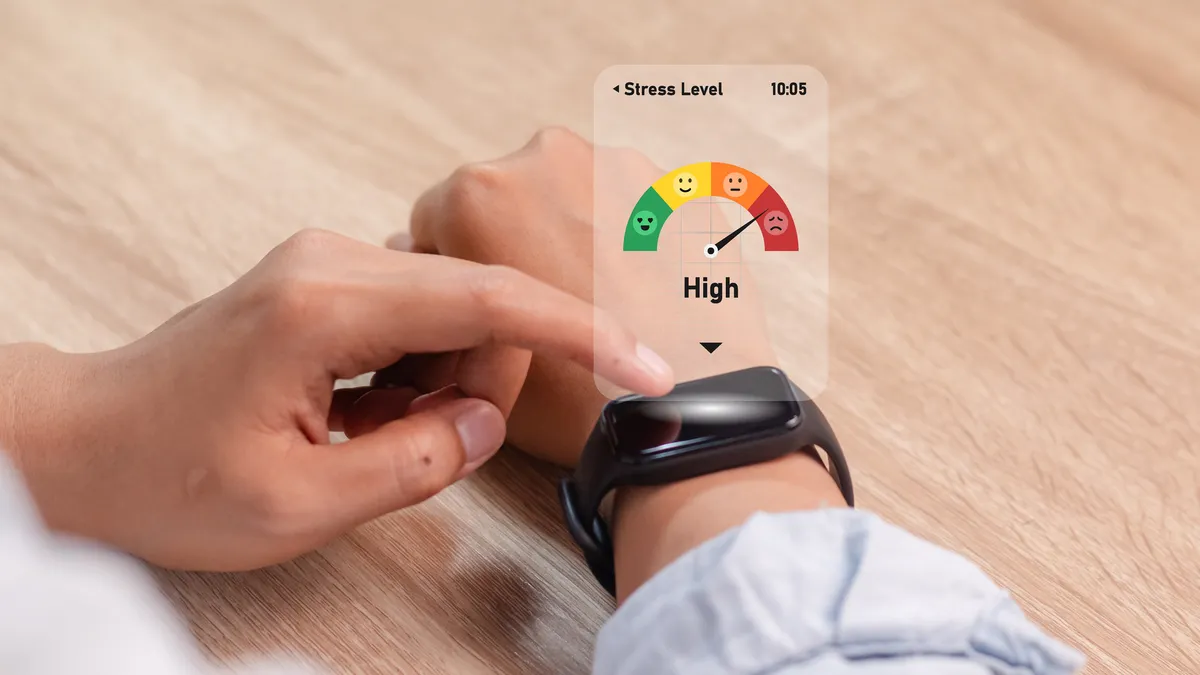
I’m a wellness writer with health anxiety. Also known as hypochondria or illness anxiety disorder, health anxiety is a condition that makes me worry I am or may become ill even when I’m perfectly healthy. One minute, I have a headache, and the next, I think I’ve got a deadly brain tumor.
What’s ironic is that part of my job involves testing health-monitoring wearables, including fitness trackers and smart rings. While I love exploring this technology and do think it can help you learn more about your body, I have to be careful about how I use it so my anxiety isn’t triggered. I know I’m not alone.
“Healthy adults and individuals with pre-existing medical conditions are increasingly using these devices to manage their health,” says Dr. Lindsey Rosman, assistant professor of medicine in the Division of Cardiology and co-director of the Cardiovascular Device and Data Science Lab at the University of North Carolina School of Medicine. “Whether 24/7 access to health information from a wearable actually helps or potentially harms people is really unclear.”
When you add in the ability to search your symptoms online or ask an AI chatbot in your wearable’s app every health question under the sun, it becomes even more difficult to discern between what’s helpful and harmful.
To help myself and others with health anxiety navigate the world of wearables so we can either enjoy using them or know when it’s time to stop, I reached out to experts for their advice.
1. Turn off anxiety-inducing health alerts
Rosman has observed clinically that it can be beneficial to either scale back or turn off the features that make you anxious. This can be especially helpful for people with pre-existing conditions that are already being treated, such as atrial fibrillation (AFib, an irregular heartbeat), as your wearable’s irregular heart rhythm notifications will only make you anxious and can prompt you to see your doctor when it’s not medically necessary.
Plus, certain medications can affect the accuracy of wearable sensors, provoking false alarms.
“We published a case report on a patient who performed over 900 EKGs [electrocardiograms or ECGs, which measure the heart’s electrical activity] on her smartwatch in a single year,” says Rosman. While most of the EKGs were normal, inconclusive alerts fueled her anxiety, leading to multiple ER visits, spousal conflict and the need for therapy to reclaim her daily life. The patient had no psychiatric history prior to getting a smartwatch.
When you get an unexpected health alert on your device, it can understandably cause panic.
Dr. Karen Cassiday, author of Freedom from Health Anxiety and owner and managing director of the Anxiety Treatment Center of Greater Chicago, says that even patients who don’t have health anxiety can find wearables to be intrusive when they get too many alerts. “They discover they want to be less aware of every moment of their body’s functioning,” she says.
Thankfully, most wearable health features can be turned off completely or customized.
For instance, Shyamal Patel, SVP of science at Oura, maker of the Oura Ring, shares that the device’s Personalized Activity Goals allow you to choose to see steps instead of calories, adjust your daily activity goal or hide calories completely, which can be necessary for anyone who finds calorie counting triggering or overly rigid.
2. Avoid compulsively checking your smart device
Referring to a 2024 study she worked on that examined the impact of wearables on the psychological well-being of patients with AFib, Rosman says that about half of the participants were checking their heart rate every day out of habit, not because they felt symptoms.
Cassidy explains that while people with health anxiety may initially find wearables helpful, compulsively checking to make sure their vitals are normal can accidentally become a form of negative reinforcement that further propels the anxiety.
“Often when I work with anxious people, we try to cut back or eliminate the need to compulsively check for reassurance on their wearables, as well as with ChapGPT or other digital ‘doctors,’” says Cassiday.
When people refrain from compulsively checking, wearables can provide useful feedback that counters the false belief that something terrible will happen to their health.
If checking your health metrics causes anxiety, try reducing how often you view them on your device or in its app. Setting an alert to check weekly, at a minimum, could help — especially since it’ll give you a broader picture, making you less likely to hyperfocus on a single data point that seems off.
You should also avoid checking your wearable’s health information right after you wake up or before you go to bed, as this can set the tone for an anxious day or make it harder to fall asleep.
If having a screen on your wrist makes it difficult for you to stop checking, a screenless smart ring or fitness tracker such as the Whoop 5.0 may be a better option, since they rely on apps instead of screens.
A screenless smart ring may help you stop compusively checking your device.
“You choose how much or how little you engage with the app, which gives those who might be anxious about their health the option to limit the amount of time they spend with their data,” says Patel.
3. Focus on trends, not one-off metrics
When I asked both Patel and Dr. Jacqueline Shreibati, head of clinical for platforms and devices at Google, how people who wear their devices can reduce health anxiety, they emphasized the importance of tracking trends — not individual metrics.
“We focus on long-term trends (rather than isolated metrics) to help users maintain a balanced relationship with their data,” says Shreibati. “What being healthy means differs for everyone, and we encourage users to consult their physician if they have any concerns.”
Patel points to the Tags and Trends features in the Oura app. Tags lets you tag lifestyle factors such as travel, alcohol, meditation or late meals, which you can then view in Trends to see how your behavior affects your recovery and sleep over weeks, rather than looking at a single score that may one day seem abnormal.
Instead of viewing a single sleep or stress score, consider looking at that data weekly or monthly.
4. Remember: Your smartwatch can’t replace your doctor
“Most consumer wearables were originally developed as personal wellness devices, which are not required to demonstrate safety and efficacy like traditional medical devices (e.g., a blood pressure cuff or pacemaker),” Rosman explains.
Yet we’ve begun using these wearables to monitor our health, using metrics such as heart rate and rhythm, blood oxygen, stress, sleep and physical activity. Now, some of these devices have medical-grade sensors, software and algorithms approved by the US Food and Drug Administration to detect irregular heart rhythms, hypertension and sleep apnea.
Despite FDA approval, wearables are simply not doctors, and they cannot provide medical diagnoses or treatment. That’s why it’s essential to understand what your device actually measures.
The ECG feature on many smartwatches is just one example of this. FDA-cleared as it may be, a single-lead ECG that only uses one electrode to record your heart’s electrical activity from your wrist is not the same as the 12-lead, hospital-grade ECG a cardiologist would use.
While your wearable’s ECG can surface a potential symptom worth investigating with your doctor, it can’t replace a professional or their medical-grade equipment.
Performing an ECG on your smartwatch is not the same as having that same measurement taken in a doctor’s office.
The gap is even wider for features including stress and sleep scores, which haven’t been clinically validated because there’s no one single gold standard to validate against. These numerical scores are calculated from bodily signals such as heart rate, temperature, movement and heart rate variability, which tend to correlate with your stress and sleep states. But the translation from raw signal to “your stress score is 74” is more of an educated estimate.
“What you’re seeing is a rough indicator of how your nervous system is functioning, not a medical diagnosis,” Rosman emphasizes.
Patel adds that not all physiological stress is inherently negative. “Some forms of short-term physiological stress can be healthy and adaptive,” he says. “That’s why we aim to pair data with in-app context and insights, so members can better understand what they’re seeing rather than receiving that information in a vacuum.”
Nonetheless, when you don’t know exactly what your wearable is measuring, a “bad” stress or sleep score can seem scary when it isn’t necessarily a cause for alarm, but rather a sign that you may want to have a deeper conversation with your doctor.
5. Get a temperature check
Just like you should talk to your doctor before starting a new medication or diet, you should get their thoughts on whether you could benefit from using a wearable.
“Education is probably the most underused tool we have,” Rosman says.
When you don’t know what a healthy heart rate or ECG looks like, one seemingly atypical reading can send you into a panic. That’s why it’s essential to speak with your doctor so you understand your own baseline and if a wearable makes sense for your current health condition.
As a guide, Rosman provides the following questions you can ask your doctor:
- What type of wearable should I use?
- How often should I check this data?
- What are healthy numbers for me?
- What do I do when I get an alert?
- When should I call the clinic or seek emergency care versus waiting?
“A fast heart rate after climbing stairs is not the same as a dangerous arrhythmia, but without that context, a notification can feel terrifying,” Rosman adds. “So much wearable-related anxiety comes not from the data itself, but from not knowing what to do with it.”
6. Know when it’s time to remove that device and get help
When asked when someone should consider parting with their wearable or seeing a professional for health anxiety, Cassiday says that it’s similar to what many notice when they keep checking their smartphone for the next text, TikTok or other digital data.
“If you find yourself interrupting pleasurable activities or your free time to check, or if you feel anxious about not checking, you have a problem,” Cassiday states.
For instance, if you only stop thinking that you’ll have a heart attack when you check your wearable and see your resting heart rate. Or, put simply, if you only feel at peace after someone or something, such as a wearable reassures you that you’re in good health, it’s time to get professional support.
If health anxiety is making it difficult for you to enjoy your life, then it’s time to talk to a professional.
To find help, Cassiday recommends using the resources provided by the Anxiety and Depression Association of America or the International OCD Foundation, as health anxiety can be related to obsessive-compulsive disorder.
7. Consider cognitive behavioral therapy
When you have health anxiety, the gold standard for care is cognitive behavioral therapy. It involves exposure to health-related worries without any form of reassurance and learning to accept the uncertainty that comes with not knowing our future health status, manner of death or time of death.
“People need to learn that all the vague symptoms that trigger their health anxiety are just normal variations of normal body functioning and aging,” Cassiday explains. “They have to reframe the symptoms they notice as nothing to examine, discuss or manage and instead trust the facts of their other evidence of good health.”
CBT can help you live in the present instead of spiraling into the anxiety-inducing “What if?” of the future.
Who should and shouldn’t use health-tracking wearables
Wearables can be great for people who like tracking their fitness to motivate them toward their goals, or for patients and their care teams when medically necessary. Though they usually cost hundreds of dollars, wearables can be less expensive than medical tests. Some are even HSA- or FSA-eligible.
“In AFib specifically, being able to correlate your symptoms with actual rhythm data can be genuinely empowering,” Rosman says. She’s observed that the patients who thrive with wearables are those who use the data as information — not as something to fear — and those who don’t participate in 24/7 surveillance.
In Rosman’s 2024 study, two-thirds of AFib patients said their wearable made them feel safer and more in control. Even so, there is still the risk of unintended consequences.
While they can be beneficial, wearables can also come with risks — especially since there isn’t enough research on the subject.
Just as doctors would never prescribe a medication without knowing the potential benefits, risks and how to manage them, wearables should be no different. “The technology has moved so much faster than the science, and we need the scientific evidence from clinical trials to catch up,” Rosman explains.
Since the evidence isn’t there yet, Rosman is hesitant to say anyone should categorically avoid wearables.
Despite that, people who are highly anxious about their heart or prone to obsessive symptom monitoring should approach with caution. The same goes for those with conditions involving unpredictable, abrupt symptoms, such as paroxysmal AFib and POTS, because the uncertainty of not knowing when the next episode will hit is stressful enough, and constant monitoring can make it worse.
A note on the science (or lack thereof)
Rosman has conducted research on the connection between wearables and anxiety, including a 2025 review describing the psychological effects of wearables on patients with cardiovascular disease and a 2024 study examining their impact on the psychological well-being of patients with AFib.
The 2025 review found that while wearables can help promote healthy behaviors and provide data for diagnosis and treatment, they also pose risks, such as adverse psychological reactions.
In the 2024 study, it was concluded that wearables were connected with higher rates of patients becoming preoccupied with their symptoms, being concerned about their treatments and using both formal and informal health care resources.
On the other hand, a 2021 study that analyzed the 2019 and 2020 US-based Health Information National Trends Survey found that using wearable devices for self-tracking can indirectly reduce psychological distress. Still, misinterpretation of wearable data may cause unnecessary panic and anxiety.
A 2020 qualitative interview study featuring patients with chronic heart disease also found that while wearables’ data may be a resource for self-care, it can create uncertainty, fear and anxiety.
Ultimately, more studies are needed.
“Honestly, we don’t have good scientific evidence in this area yet,” says Rosman. “Despite widespread use, there have been no clinical trials I’m aware of that have looked at the benefits and potential health risks of specific wearable health features.”
Rosman’s team plans to be the first to investigate this in patients with pre-existing heart conditions.
Wearables’ impact on our health care system
When wearables cause health anxiety, they can prompt healthy individuals to schedule unnecessary doctor’s appointments. This places a burden on our health care system, which is already experiencing shortages, making it difficult for people who actually require medical attention to access care.
Rosman’s 2024 study found that those using a wearable sent nearly twice as many patient portal messages to their doctors. Responding to these messages from patients takes time, isn’t reimbursed by insurance and can contribute to burnout.
When health anxiety caused by wearables prompts people to message their doctors, it can put a strain on the health care system.
As a result, Rosman believes we need better systems for managing wearable data in clinical settings before we scale it further: “Wearables are changing how we deliver care in ways we haven’t fully prepared for.”
Wearables can further widen health care inequity due to their cost.
“These devices are expensive, they were mostly designed and tested in young healthy people and they’re marketed toward higher-income consumers,” Rosman explains. “If we’re not thoughtful about access, wearables could actually widen health disparities rather than close them. That’s the opposite of what we want.”
The bottom line
While wearables have their benefits, there are also risks to consider, especially given the limited research on the subject.
If you purchase a wearable and it triggers health anxiety, you don’t have to use every available feature, wear it constantly or continue to wear it at all. Before you even buy that device, you can arm yourself with anxiety-reducing knowledge by getting your doctor’s expert opinion.
However, if health anxiety continues to take over your life, it may be time to remove your wearable and seek professional help.
As for me, writing this piece has been a necessary reminder that, while there’s a lot we can’t control in life, the power is in our hands (or on our wrists or fingers) when it comes to the technology we put on our bodies or invite into our homes. Just like an itchy sweater or a lumpy armchair, we can send the technology that doesn’t serve us packing.


Traffic lights can be tricky, depending on where you go. The response you have to a red light at an intersection in one state may not be the same response you need at an intersection in another state. Turning right on red can even get you a ticket in some U.S. cites. But in Florida, a right turn traffic light may still allow a right turn after stopping. But there’s also a bit more to it than that.
First off, you must come to a complete stop at the red light. If you keep rolling through the turn instead, you could get a ticket. Next, if there are no posted warning signs at the light, Florida law says you can go ahead and turn right once it’s clear to do so. But if you have a sign warning you that there’s no turn on red, then you’re stuck. Stay where you are until you get the green light.
Similarly, if you have a red right arrow, you of course must fully stop then as well. But don’t let the arrow fool you, as it’s not an automatic signal that you can just turn once the way is clear. If there are no signs posted that say otherwise (such as a “No turn on red” sign), you may proceed after determining that it is safe to do so. This is the case whether you’re at an intersection or a crosswalk.
Crosswalks and malfunctioning traffic lights

If you come to a right turn traffic light at a crosswalk in Florida, keep in mind that you are expected to yield to any pedestrians who are crossing. Even if you’ve come to a complete stop and are otherwise allowed to turn, you must wait. If your light turns green and someone is still in the process of crossing, you should wait then as well. Additionally, if you’re at an intersection with sidewalks but no clearly marked crosswalk present, you still have to yield.
However, there could be times you arrive at a right turn traffic light that’s malfunctioning. Maybe it’s blinking, stuck, or completely dead. If this happens, Florida law states that you must treat it as a four-way stop sign. That means you must come to a complete stop and yield right of way to traffic coming from all directions. Of course, you must also yield to any pedestrians crossing in front of you. Once the way clears and you have an open right turn, you’re free to go. Always be cautious when arriving at a light that’s out of order and make sure the intersection is fully clear before you continue.

Meta has found a new source of training data for its AI models: its own employees. The company plans to use data culled from the mouse movements and keystrokes of its own staff in its pursuit to build more capable and efficient artificial intelligence.
The story, which was first reported by Reuters, shows the lengths to which tech companies are going to find new sources of training data — the lifeblood of AI models that helps the programs learn how to more effectively carry out tasks and respond to user queries.
When reached for comment by TechCrunch, a Meta spokesperson provided the following statement: “If we’re building agents to help people complete everyday tasks using computers, our models need real examples of how people actually use them — things like mouse movements, clicking buttons, and navigating dropdown menus. To help, we’re launching an internal tool that will capture these kinds of inputs on certain applications to help us train our models. There are safeguards in place to protect sensitive content, and the data is not used for any other purpose.”
This trend reveals a troublesome privacy dimension of the AI industry. Last week it was reported that old startups are being scavenged for their corporate communications (like Slack archives and Jira tickets), and converted into AI training data.


The Game Pass front page on Microsoft’s website now shows revised pricing for the service’s two most expensive plans. Although delaying the addition of new Call of Duty titles marks a reversal of the company’s earlier strategy, the expanded library introduced during last year’s major price increase remains intact.
Read Entire Article
Source link
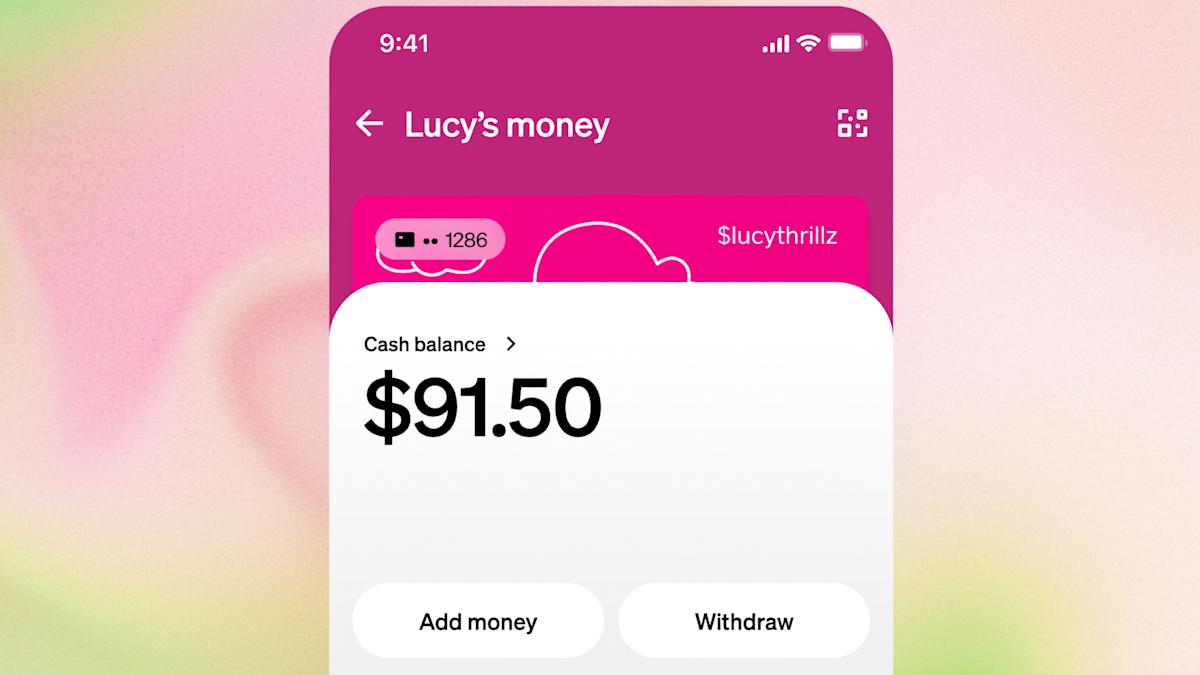
Cash App, the banking and payments app run by Block, has added support for parent-managed kids accounts. The new accounts include key benefits from the service’s normal account, with an eye towards teaching financial literacy to younger users ages 6 to 12. Cash App first allowed teenage users on its platform in 2021.
As part of the “expanded Cash App Families experience,” eligible legal guardians and parents can create managed accounts that offer “a dedicated place on the platform to send allowances, set aside savings, and track spending for their child, kickstarting their path to financial independence,” Cash App says. Adults managing these accounts will be able to set up recurring transfers, see how their child is spending and do things like lock their child’s account to prevent transactions. Kids will get a custom debit card and the ability to receive payments from up to five trusted accounts, though notably they won’t be able to access Cash App itself.
Cash App says managed accounts are designed for kids 6 through 12. Once those kids turn 13, Cash App says parents will be able to choose to convert their account to a “sponsored account” to unlock more features, like the ability to send and receive payments, invest in stocks or trade crypto. Those sponsored accounts are technically still monitored and controlled by a parent or legal guardian, but they do give 13-year-olds more control over how they use their money.
A parent-managed account for kids is not a new idea in the fintech space, though Cash App is trying to reach a younger audience than some of its competitors. Venmo rolled out access to its payment platform to teens between the ages of 13 to 17 in 2023. Separately, both Apple and Google also offer their own kids accounts in Google Wallet and Apple Cash Family.

Florida’s attorney general has launched a criminal investigation into OpenAI over allegations that the accused gunman in a shooting at Florida State University last year used ChatGPT to help plan the attack. OpenAI says the chatbot is “not responsible for this terrible crime” and only provided factual information available from public sources. NPR reports: The Republican attorney general, James Uthmeier, said at a press conference in Tampa on Tuesday that accused gunman Phoenix Ikner consulted ChatGPT for advice before the shooting, including what type of gun to use, what ammunition went with it, and what time to go to campus to encounter more people, according to an initial review of Ikner’s chat logs. “My prosecutors have looked at this and they’ve told me, if it was a person on the other end of that screen, we would be charging them with murder,” Uthmeier said. “We cannot have AI bots that are advising people on how to kill others.”
Uthmeier’s office is issuing subpoenas to OpenAI seeking information about its policies and internal training materials related to user threats of harm and how it cooperates with and reports crimes to law enforcement, dating back to March 2024. At the press conference, Uthmeier acknowledged the investigation is entering into uncharted territory and is uncertain about whether OpenAI has criminal liability. “We are going to look at who knew what, designed what, or should have done what,” he said. “And if it is clear that individuals knew that this type of dangerous behavior might take place, that these types of unfortunate, tragic events might take place, and nevertheless still turned to profit, still allowed this business to operate, then people need to be held accountable.”
[…] Ikner, 21, is facing multiple charges of murder and attempted murder for the April 2025 shooting near the student union on FSU’s Tallahassee campus, where he was a student at the time. His trial is set to begin on Oct. 19. According to court filings, more than 200 AI messages have been entered into evidence in the case.

Anthropic’s buzzy announcement about using AI to improve cybersecurity earlier this month was met with plenty of skepticism. However, Mozilla shared some details that support use of the company’s special Claude Mythos Preview model as a way to protect critical services. Using Mythos helped Mozilla’s team find and patch 271 vulnerabilities in the latest release of the Firefox browser. “So far we’ve found no category or complexity of vulnerability that humans can find that this model can’t,” the foundation said.
The blog post from Mozilla feels like a positive sign for Anthropic’s Project Glasswing. Obviously the AI company would want to put itself in the best possible light while presenting its own initiative, but there’s something encouraging about hearing the benefits from a third party. Mozilla also noted that in its time with Claude Mythos, the AI wasn’t able to turn up any bugs that a human wouldn’t have been able to find, given enough time and resources, which indicates that AI isn’t presently able to do more to crack cybersecurity protections than a person can.
An organizaion successfully using AI for good is certainly a refreshing change of pace in tech news. And for those Firefox users who aren’t personally interested in applying any generative AI in their browsing, Mozilla has given the option to turn it all off for the past several months.
Tech
Google’s new Deep Research and Deep Research Max agents can search the web and your private data
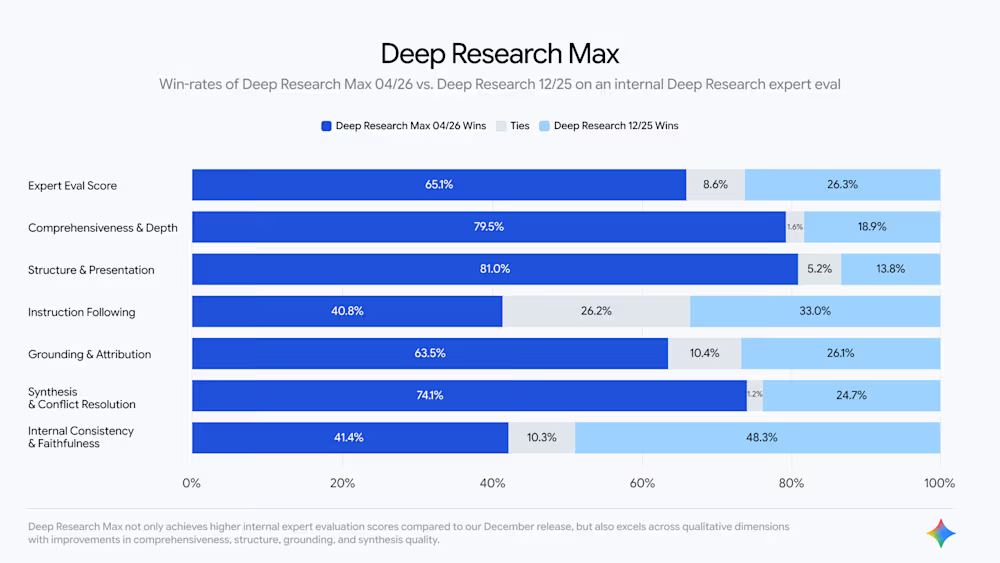
Google on Monday unveiled the most significant upgrade to its autonomous research agent capabilities since the product’s debut, launching two new agents — Deep Research and Deep Research Max — that for the first time allow developers to fuse open web data with proprietary enterprise information through a single API call, produce native charts and infographics inside research reports, and connect to arbitrary third-party data sources through the Model Context Protocol (MCP).
The release, built on Google’s Gemini 3.1 Pro model, marks an inflection point in the rapidly intensifying race to build AI systems that can autonomously conduct the kind of exhaustive, multi-source research that has traditionally consumed hours or days of human analyst time. It also represents Google’s clearest bid yet to position its AI infrastructure as the backbone for enterprise research workflows in finance, life sciences, and market intelligence — industries where the stakes of getting information wrong are extraordinarily high.
“We are launching two powerful updates to Deep Research in the Gemini API, now with better quality, MCP support, and native chart/infographics generation,” Google CEO Sundar Pichai wrote on X. “Use Deep Research when you want speed and efficiency, and use Max when you want the highest quality context gathering & synthesis using extended test-time compute — achieving 93.3% on DeepSearchQA and 54.6% on HLE.”
Both agents are available starting today in public preview via paid tiers of the Gemini API, accessible through the Interactions API that Google first introduced in December 2025.
Why Google built two research agents instead of one
The launch introduces a tiered architecture that reflects a fundamental tension in AI agent design: the tradeoff between speed and thoroughness.
Deep Research, the standard tier, replaces the preview agent Google released in December and is optimized for low-latency, interactive use cases. It delivers what Google describes as significantly reduced latency and cost at higher quality levels compared to its predecessor. The company positions it as ideal for applications where a developer wants to embed research capabilities directly into a user-facing interface — think a financial dashboard that can answer complex analytical questions in near-real time.
Deep Research Max occupies the opposite end of the spectrum. It leverages extended test-time compute — a technique where the model spends more computational cycles iteratively reasoning, searching, and refining its output before delivering a final report. Google designed it for asynchronous, background workflows: the kind of task where an analyst team kicks off a batch of due diligence reports before leaving the office and expects exhaustive, fully sourced analyses waiting for them the next morning.
The Google DeepMind team framed the distinction on X: “Deep Research: Optimized for speed and efficiency. Perfect for interactive apps needing quicker responses. Deep Research Max: It uses extra time to search and reason. Ideal for exhaustive context gathering and tasks happening in the background.”
“Deep Research was our first hosted agent in the API and has gained a ton of traction over the last 3 months, very excited for folks to test out the new agents and all the improvements, this is just the start of our agents journey,” Logan Kilpatrick, who leads developer relations for Google’s AI efforts, wrote on X.
MCP support lets the agents tap into private enterprise data for the first time
Perhaps the most consequential feature in today’s release is the addition of Model Context Protocol support, which transforms Deep Research from a sophisticated web research tool into something more closely resembling a universal data analyst.
MCP , an emerging open standard for connecting AI models to external data sources, allows Deep Research to securely query private databases, internal document repositories, and specialized third-party data services — all without requiring sensitive information to leave its source environment. In practical terms, this means a hedge fund could point Deep Research at its internal deal-flow database and a financial data terminal simultaneously, then ask the agent to synthesize insights from both alongside publicly available information from the web.
Google disclosed that it is actively collaborating with FactSet, S&P, and PitchBook on their MCP server designs, a signal that the company is pursuing deep integration with the data providers that Wall Street and the broader financial services industry already rely on daily. The goal, according to the blog post authored by Google DeepMind product managers Lukas Haas and Srinivas Tadepalli, is to “let shared customers integrate financial data offerings into workflows powered by Deep Research, and to enable them to realize a leap in productivity by gathering context using their exhaustive data universes at lightning speed.”
This addresses one of the most persistent pain points in enterprise AI adoption: the gap between what a model can find on the open internet and what an organization actually needs to make decisions. Until now, bridging that gap required significant custom engineering. MCP support, combined with Deep Research’s autonomous browsing and reasoning capabilities, collapses much of that complexity into a configuration step. Developers can now run Deep Research with Google Search, remote MCP servers, URL Context, Code Execution, and File Search simultaneously — or turn off web access entirely to search exclusively over custom data. The system also accepts multimodal inputs including PDFs, CSVs, images, audio, and video as grounding context.
Native charts and infographics turn AI reports into stakeholder-ready deliverables
The second headline feature — native chart and infographic generation — may sound incremental, but it addresses a practical limitation that has constrained the usefulness of AI-generated research outputs in professional settings.
Previous versions of Deep Research produced text-only reports. Users who needed visualizations had to export the data and build charts themselves, a friction point that undermined the promise of end-to-end automation. The new agents generate high-quality charts and infographics inline within their reports, rendered in HTML or Google’s Nano Banana format, dynamically visualizing complex datasets as part of the analytical narrative.
“The agent generates HTML charts and infographics inline with the report. Not screenshots. Not suggestions to ‘visualize this data.’ Actual rendered charts inside the markdown output,” noted AI commentator Shruti Mishra on X, capturing the practical significance of the change.
For enterprise users — particularly those in finance and consulting who need to produce stakeholder-ready deliverables — this transforms Deep Research from a tool that accelerates the research phase into one that can potentially produce near-final analytical products. Combined with a new collaborative planning feature that lets users review, guide, and refine the agent’s research plan before execution, and real-time streaming of intermediate reasoning steps, the system gives developers granular control over the investigation’s scope while maintaining the transparency that regulated industries demand.
How Deep Research evolved from a consumer chatbot feature to enterprise platform infrastructure
Today’s release crystallizes a strategic narrative Google has been building for months: Deep Research is not merely a consumer feature but a piece of infrastructure that powers multiple Google products and is now being offered to external developers as a platform.
The blog post explicitly notes that when developers build with the Deep Research agent, they tap into “the same autonomous research infrastructure that powers research capabilities within some of Google’s most popular products like Gemini App, NotebookLM, Google Search and Google Finance.” This suggests that the agent available through the API is not a stripped-down version of what Google uses internally but the same system, offered at platform scale.
The journey to this point has been remarkably rapid. Google first introduced Deep Research as a consumer feature in the Gemini app in December 2024, initially powered by Gemini 1.5 Pro. At the time, the company described it as a personal AI research assistant that could save users hours by synthesizing web information in minutes. By March 2025, Google upgraded Deep Research with Gemini 2.0 Flash Thinking Experimental and made it available for anyone to try. Then came the upgrade to Gemini 2.5 Pro Experimental, where Google reported that raters preferred its reports over competing deep research providers by more than a 2-to-1 margin. The December 2025 release was the pivot to developer access, when Google launched the Interactions API and made Deep Research available programmatically for the first time, powered by Gemini 3 Pro and accompanied by the open-source DeepSearchQA benchmark.
The underlying model driving today’s improvements is Gemini 3.1 Pro, which Google released on February 19, 2026. That model represented a significant leap in core reasoning: on ARC-AGI-2, a benchmark evaluating a model’s ability to solve novel logic patterns, 3.1 Pro scored 77.1% — more than double the performance of Gemini 3 Pro. Deep Research Max inherits that reasoning foundation and layers autonomous research behaviors on top of it, achieving 93.3% on DeepSearchQA (up from 66.1% in December) and 54.6% on Humanity’s Last Exam (up from 46.4%).

Google faces a crowded field of competitors building autonomous research agents
Google is not operating in a vacuum. The launch arrives amid intensifying competition in the autonomous research agent space. OpenAI has been developing its own agent capabilities within ChatGPT under the codename Hermes, which includes an agent builder, templates, scheduling, and Slack integration, according to reports circulating on social media. Perplexity has built its business around AI-powered research. And a growing ecosystem of startups is attacking various slices of the automated research workflow.
What distinguishes Google’s approach is the combination of its search infrastructure — which gives Deep Research access to the broadest and most current index of web information available — with the MCP-based connectivity to enterprise data sources. No other company currently offers a research agent that can simultaneously query the open web at Google Search’s scale and navigate proprietary data repositories through a standardized protocol. The pricing structure also signals Google’s intent to drive adoption: according to Sim.ai, which tracks model pricing, the Deep Research agent in the December preview was priced at $2 per million input tokens and $2 per million output tokens with a 1 million token context window — positioning it as cost-competitive for the volume of research output it generates.
Not everyone greeted the announcement with unalloyed enthusiasm, however. Several users on X noted that the new agents are available only through the API, not in the Gemini consumer app. “Not on Gemini app,” observed TestingCatalog News, while another user wrote, “Google keeps punishing Gemini App Pro subscribers for some reason.” Others raised concerns about the presentation of benchmark results, with one user arguing that Google’s charts could be “misleading” in how they represent percentage improvements. These complaints point to a broader tension in Google’s AI strategy: the company is increasingly directing its most advanced capabilities toward developers and enterprise customers who access them through APIs, while consumer-facing products sometimes lag behind.

What Deep Research Max means for finance, biotech, and the future of knowledge work
The practical implications of today’s launch are most immediately felt in industries that depend on exhaustive, multi-source research as a core business function. In financial services, where analysts routinely spend hours assembling due diligence reports from scattered sources — SEC filings, earnings transcripts, market data terminals, internal deal memos — Deep Research Max offers the possibility of automating the initial research phase entirely. The FactSet, S&P, and PitchBook partnerships suggest Google is serious about making this work with the data infrastructure that financial professionals already use.
In life sciences, the blog post notes that Google has collaborated with Axiom Bio, which builds AI systems to predict drug toxicity, and found that Deep Research unlocked new levels of initial research depth across biomedical literature. In market research and consulting, the ability to produce stakeholder-ready reports with embedded visualizations and granular citations could compress project timelines from days to hours.
The key question is whether the quality and reliability of these automated outputs will meet the standards that professionals in these fields demand. Google’s benchmark numbers are impressive, but benchmarks measure performance on standardized tasks — real-world research is messier, more ambiguous, and often requires the kind of judgment that remains difficult to automate. Deep Research and Deep Research Max are available now in public preview via paid tiers of the Gemini API, with availability on Google Cloud for startups and enterprises coming soon.
Eighteen months ago, Deep Research was a feature that helped grad students avoid drowning in browser tabs. Today, Google is betting it can replace the first shift at an investment bank. The distance between those two ambitions — and whether the technology can actually close it — will define whether autonomous research agents become a transformative category of enterprise software or just another AI demo that dazzles on benchmarks and disappoints in the conference room.
SpaceX and AI company Cursor have struck a new partnership that could see the owner of X buy the AI company for $60 billion later this year. “SpaceXAI and @cursor_ai are now working closely together to create the world’s best coding and knowledge work AI,” SpaceX wrote in a post on X.
According to SpaceX, the deal allows for it to either invest $10 billion into the company known for its AI coding tool, or acquire it entirely “later this year” for $60 billion. If an acquisition were to happen, it’s not clear at what point Cursor could officially join the fold of Elon Musk’s rapidly expanding and increasingly enmeshed web of companies. SpaceX bought xAI, the billionaire’s AI company that also controls X, earlier this year. SpaceX is currently getting ready to go public this summer in what will likely be the biggest initial public offering (IPO) in history.
Cursor, which has reportedly been in talks to raise its own $2 billion round of funding, is known for its AI coding tool of the same name that’s become the vibe coding platform of choice for many developers. It allows people to use either its own models or those from other leading AI companies, including OpenAI, Google, Anthropic and xAI.
In a statement, Cursor said its partnership with SpaceX will “accelerate our model training efforts” while addressing infrastructure-related issues that have slowed it down in the past. “We’ve wanted to push our training efforts much further, but we’ve been bottlenecked by compute,” the company said. “With this partnership, our team will leverage xAI’s Colossus infrastructure to dramatically scale up the intelligence of our models for coding and beyond.”
Ciara, West Share Intimate Summer House Moment Without Amanda

Lufthansa Group Cuts 20,000 Short-Haul Flights Due to Jet Fuel Crisis

Canton, ZKsync Clash Over How Blockchains Enforce Rules

Manchester United reach agreement with Casemiro over contract clause amid transfer speculation

Steven Gerrard disagrees with Gary Neville over ‘shock’ Chelsea and Arsenal claim | Football

US brings back mandatory military draft registration


-

 News Videos7 days ago
Secure crypto trading starts with an FIU-registered
-

 Fashion5 days ago
Weekend Open Thread: Theodora Dress
-

 Politics4 days ago
Palestine barred from entering Canada for FIFA Congress
-

 Sports5 days ago
NWFL Suspends Two Players Over Post-Match Clash in Ado-Ekiti
-
Entertainment2 days ago
NBA Analyst Charles Barkley Chimes in on Ice Spice McDonald’s Fiasco
-

 Business3 days ago
Powerball Result April 18, 2026: No Jackpot Winner in Powerball Draw: $75 Million Rolls Over
-

 Politics3 days ago
Zack Polanski demands ‘council homes not luxury flats for foreign investors’
-

 Crypto World4 days ago
Russia Pushes Bill to Criminalize Unregistered Crypto Services
-

 Politics1 day ago
Gary Stevenson delivers timely reminder to register to vote as deadline TODAY
-

 Tech3 days ago
Auto Enthusiast Scores Running Tesla Model 3 for Two Grand and Turns It Into Bare-Bones Go-Kart
-

 Tech6 days ago
‘Avatar: Aang, The Last Airbender’ Leaked Online. Some Fans Say Paramount Deserves the Fallout
-
 Business5 days ago
Creo Medical agree sale of its manufacturing operation
-

 Crypto World4 days ago
Russia Introduces Bill To Criminalize Unregistered Crypto Services
-

 Sports6 days ago
British climbers complete new route in Swiss Alps
-
 Crypto World3 days ago
Kelp DAO rsETH Bridge Hack Drains $292M as DeFi Losses Top $600M in Two Weeks
-

 Sports6 days ago
“Felt Much Better Today”: Josh Hazlewood Opens Up On His Recovery Win Over LSG
-

 Tech6 days ago
Ford EV and tech chief leaving automaker
-

 Business6 days ago
Cheaper Doritos and Lays helps PepsiCo win back struggling snackers
-
 Entertainment6 days ago
Clavicular Says Streaming May Not Work Without Substances
-

 Entertainment6 days ago
Ruby Rose Accuses Katy Perry Of Sexual Assault, Police React
You must be logged in to post a comment Login