With the streaming world turning into a wild, chaotic, fractured mess, there is no better example of how terrible this can all be than with live sports. We’ve already seen all kinds of issues among streaming services when it comes to sports. Buffering live games piss people off. Exclusivity deals worked out among several services for a single league can make finding where a game is being showed a Sherlock-ian experience. Local blackout rules abound and suck for the consumer.
But if there is one thing a streaming service cannot do, it’s got to be buying the exclusive rights to important games and then throwing “technical difficulties” at the viewer. And that’s exactly what happened during part of an overtime period in an NBA playoff game between the Hornets and the Heat. For several minutes at the start of the overtime period, the stream simply cut out.
As reported by ESPN, Prime Video started showing a message that read “technical difficulties” seconds after cutting off the game’s commentator in the middle of a sentence. Viewers missed a Hornets possession that included a score by LaMelo Ball. By the time the stream came back online, 22.1 seconds of playing time had passed, per ESPN, and viewers were dismayed.
“Tell me the game didn’t just cut off?!!? Am I trippin?? WTH,” LeBron James, a Los Angeles Lakers player who previously won two championships with the Heat, said, adding a face-planting emoji, on X.
Prime Video’s fumble is made worse by the fact that the streaming service had exclusive rights to air the game. The only other way to experience the game was in person or by listening to select radio stations.
Advertisement
Imagine someone signed up for Prime because of this deal with the NBA. Sure, that isn’t going to be a huge percentage of the viewership, but it won’t be zero percent of it, either. To have the stream cut out in the opening minutes of overtime is going to be incredibly frustrating.
It’s also worth noting that more traditional broadcasts also have had equipment failures, but they don’t have the resources Amazon has. And, frankly, Amazon’s streaming service doesn’t have the best reputation to begin with.
The latter point is especially concerning because, after four years of this, viewers are still complaining about audio-syncing problems on Prime Video this season. We’ve experienced this firsthand at Ars Technica and have heard commentators announce a completed three-point shot before the stream shows it happening.
“The entire year the audio has been a split second ahead of the video on half of the Amazon games we’ve watched,” Bill Simmons, a former sportswriter and current host of The Bill Simmons Podcast, said in today’s episode: “The three-pointer’s halfway toward the basket. It’s like, ‘BANG! It’s good!’ And you hear the crowd, and it’s, like, the ball hasn’t even gone in yet. How have we not figured this out yet? You guys, [Amazon], have 8 kajillion dollars.”
At some point, the NBA itself is going to have to step in here, because its reputation is going to take a hit along with Amazon’s. The league risks alienating fans that are pissed off that the league foisted broadcast partners that apparently can’t deliver a product of the quality of cable TV, of all entities. And I refuse to believe that these streaming contracts don’t come with contractual requirements for quality of service.
Advertisement
Streaming is both the present and the future. It isn’t going away. Neither are live sports. This has to be figured out and delivered in a way that fans don’t completely miss important parts of games. The alternative is lost fans for the leagues and I can promise you that won’t be stood for.
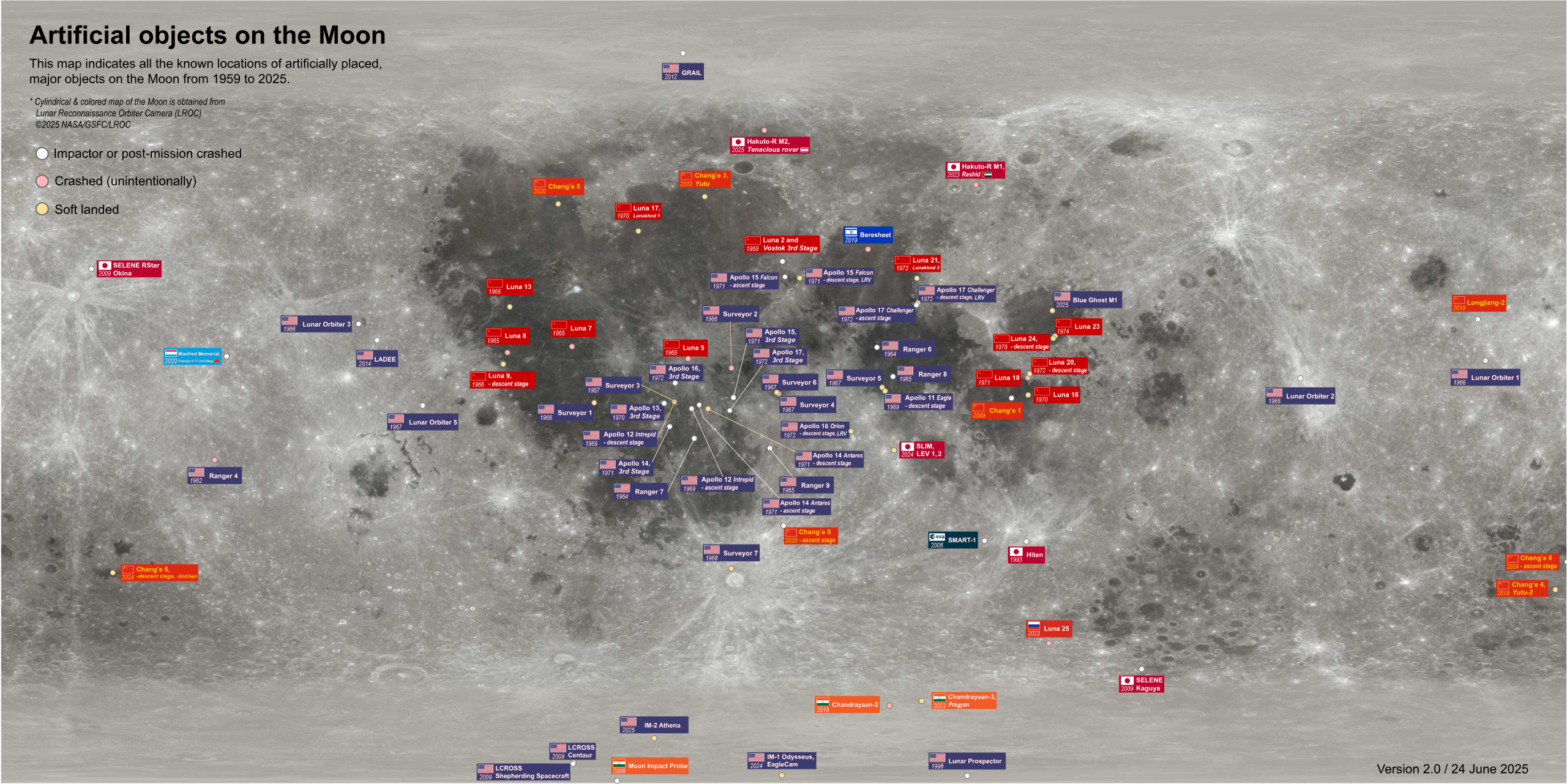
If you read a headline that signs of intelligent life were found on the moon, you might suspect a hoax. But they are there! Humans have dumped a lot of stuff on the moon, both in person and via uncrewed rockets. So after the apocalypse, what strange things will some alien exo-archaeologist find on our only natural satellite?
The Obvious
Of course, we’ve left parts of rockets, probes, and rovers. Only the top part of the Apollo Lunar Excursion Module left the moon. (See for yourself in the Apollo 17 ascent video below.) The bottoms are still there, along with the lunar rovers and a bunch of other science instruments and tools. There are boots and cameras, as you might expect.
But what about the strange things? As of 2012, NASA compiled a list of all known lunar junk that originated on Earth. The list starts with material from the non-Apollo US programs like the Surveyor and Lunar Prospector missions. Next up is the Apollo stuff, which is actually quite a bit: an estimated 400,000 pounds, we’ve heard. This ranges from the entire descent stage and lunar overshoes to urine bags. There are even commemorative patches and a gold olive branch.
After that, the list shows what’s known to be on the surface from the Russian space program, along with objects of Chinese, Indian, Japanese, and European origin.
Advertisement
The Sentimental
An Apollo 1 patch made its way to the moon.
Charles Duke on Apollo 16 left a framed family photo on the Moon’s surface with an inscription on the back. We figure if you go looking for it now, the sun will have bleached it white, but we appreciate the sentiment.
There are several objects meant to commemorate fallen astronauts and cosmonauts, including an Apollo 1 mission patch. You may recall that a fire during training killed all three of Apollo 1’s crew.
Lunar Prospector brought a portion of the ashes of Gene Shoemaker, a geologist who trained Apollo astronauts, to the moon. The capsule of ashes holds a quote from Romeo and Juliet:
And, when he shall die
Take him and cut him out in little stars
Advertisement
And he will make the face of heaven so fine
That all the world will be in love with night,
And pay no worship to the garish sun.
A half-dollar-sized disc has 73 goodwill messages from world leaders.
To date, Shoemaker is the only person who has remains on the moon.
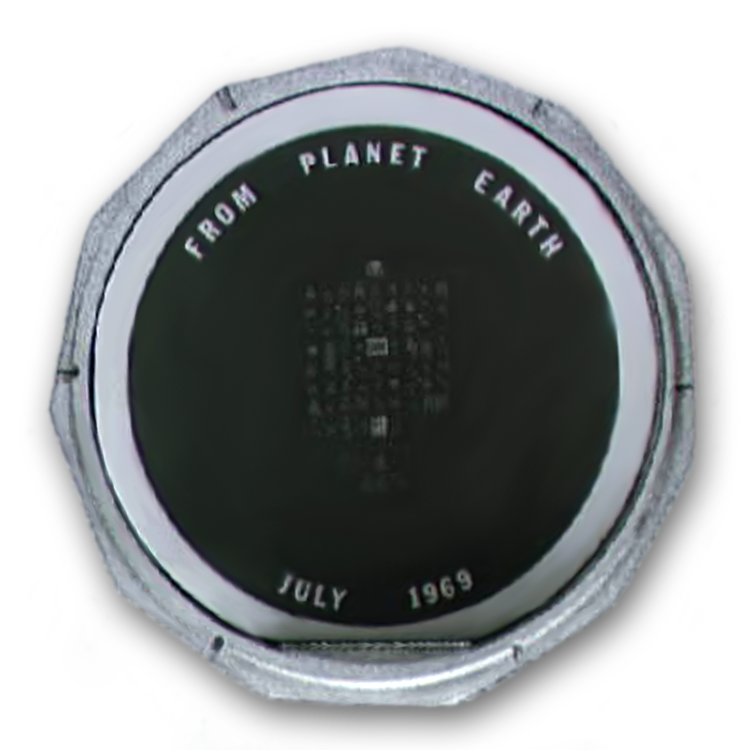
While not exactly sentimental, NASA did send a silicon disc to the moon with Apollo 11 containing goodwill messages from 73 countries. The whole thing is about the size of a US half dollar, so if you want to read the messages, you might be better off reading the associated document.
Advertisement
Making tiny silicon wafers with finely-detailed etchings was pretty high tech in the late 1960s. GCA Corp used a reduction camera to make a negative photomask containing all the letters plus an inscription around its edge at its final size. This mask was given to Sprague, who etched it.
The Odd
One of the strange things on the NASA list is a falcon feather. That was left by Apollo 15’s Davis Scott, who carried out the classic experiment of dropping a feather and a hammer to note that they fell at the same speed, even in the weak gravity of the moon. The feather was from Baggin, the Air Force Academy’s mascot, and remains on the lunar surface today.
Speaking of Baggin, there are 96 bags of human waste sitting up there. Probably best not to bring that up the next time you and your partner are gazing at the romantic moon overhead.
Advertisement
The Unconfirmed
Forrest Myers created a small ceramic wafer with tiny artwork from six artists, like Andy Warhol, titled “Moon Museum.” The tile features six drawings, including a stylized “AW” (Warhol), a line (Robert Rauschenberg), a black square (David Novros), a diagram (John Chamberlain), Mickey Mouse (Claes Oldenburg), and an interlocking design (Myers). Apparently, Novros and Chamberlain were inspired by circuit diagrams of some kind.
Bell Labs created the wafer. However, NASA failed to approve the project, and Myers sought an alternative.
Reportedly, Myers gave the chip to an unnamed Apollo 12 engineer who affixed it to the leg of the lunar module. However, NASA has not confirmed this, so we don’t know for sure if it is up there or not. Perhaps if you get to the neighborhood, you can check it out and let us know?
To the Dump
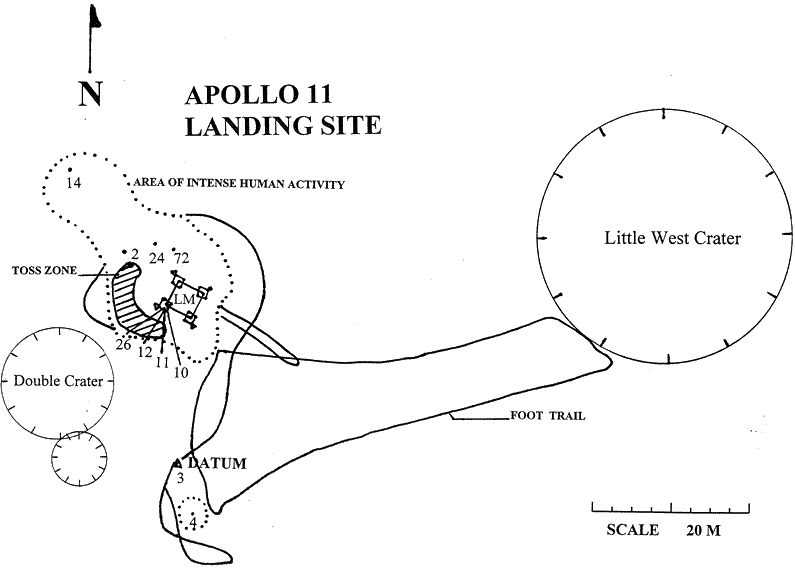
Apollo 11 Landing Site Map from The Lunar Legacy Project (note “toss zone” to the left).
You might wonder why so much stuff was left, but if you think about it, it makes sense. The rockets can only bring back so much stuff. Every camera you leave behind means more moon rocks you can bring home. You can buy a new camera, but you can’t buy more moon rocks.
According to the Lunar Legacy Project, Apollo 11, and presumably the other missions, had designated toss zones. (We guess “dumps” didn’t sound good.)
Advertisement
If you are looking for a more up-to-date list, the Wikipedia article can help fill in the gaps, at least for vehicles. There’s been quite a bit added since the NASA list, including items from the UAE, Israel, and Luxembourg. Plus, there are many new additions from other countries.
With the advent of high-resolution orbital cameras, you can see some of the landing sites better than ever. For example, the video below shows the Apollo 17 site imaged by the Lunar Reconnaissance Orbiter Camera.
Of course, we are on our way back to the moon, and so are other space programs. So there will probably be even more human debris on the moon soon. It is only a matter of time before lunar waste management becomes a hot topic.
An anonymous reader quotes a report from Ars Technica: Framework has been selling and shipping its modular, repairable, upgradable Laptop 13 for five years now, and in that time, it has released six distinct versions of its system board, each using fresh versions of Intel and AMD processors (seven versions, if you count this RISC-V one). The laptop around those components has gradually gotten better, too. Over the years, Framework has added higher-resolution screens in both matte and glossy finishes, a slightly larger battery, and other tweaked components that refine the original design. But so far, all of those parts have been totally interchangeable, and the fundamentals of the Laptop 13 design haven’t changed much.
That changes today with the Framework Laptop 13 Pro, which, despite its name, is less an offshoot of the original Laptop 13 and closer to a ground-up redesign. It includes new Core Ultra Series 3 chips (codenamed Panther Lake), Framework’s first touchscreen, a new black aluminum color option, a larger battery, and other significant changes. And while it sacrifices some component compatibility with the original Laptop 13, displays and motherboards remain interchangeable, so Framework Laptop owners can buy the new Core Ultra board and owners of older Framework Laptop boards can pop one into a Pro to benefit from the new battery and screen. At 1.4kg (about 3 pounds), the Laptop 13 Pro is slightly heavier than the Laptop 13’s 1.3kg, but it still stacks up well against the 14-inch M5 MacBook Pro (1.55kg, or 3.4 pounds).
The Framework Laptop Pro will start at $1,199 for a DIY edition with a Core Ultra 5 325 processor, and no RAM, SSD, or operating system. A prebuilt version with Ubuntu Linux installed will start at $1,499, and Windows 11 will cost another $100 on top of that. A Core Ultra X7 358H version starts at $1,599 for a DIY edition, and a “limited batch” Core Ultra X9 388H version starts at $1,799. A bare motherboard with the Core Ultra 5 325 starts at $449, while a Core Ultra X7 358H board will cost $799. Pre-orders are available now, and begin shipping in June.
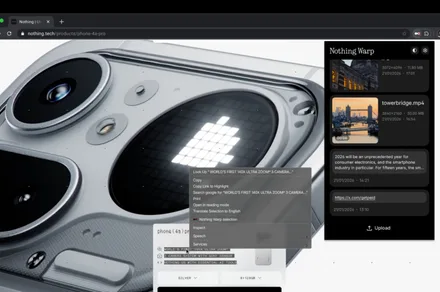
Nothing Warp is back once again, but that’s the only good news. Nothing revived its AirDrop-like file sharing feature after briefly pulling both the Android app and its Chrome extension shortly after launch.
The company has finally revealed that the tool was taken down temporarily so they could “fine-tune” the product after early user feedback and technical evaluations. Nothing also reassured that this wasn’t done over security or privacy concerns, adding that Warp is built on Google’s infrastructure and does not handle user data itself.
What is Warp?
Warp is Nothing’s cross-device file transfer tool for moving files, links, images, and other content between devices signed into the same Google account. It is a great workaround for sharing content across Android and Apple devices, similar to what Samsung and Google offered with their latest flagships. Now that it has returned, though, the setup is a little more awkward than before.
So what’s the catch?
You cannot just grab Warp from Google Play anymore. If you want to use this tool, users now have to visit Nothing’s website or community page and sideload the APK manually, while the Chrome extension has also returned separately. In Nothing’s community thread, company representative Zac says Warp is available in beta for the community and invites users to download the APK and leave feedback on the post.
Advertisement
So while the Warp is technically back, it is not available in the most convenient form. For most people, sideloading an APK is not difficult, but it is still a few extra steps over a normal Play Store install. And judging by replies in the Nothing thread, some users also expressed their uneasiness with this change, since a file-sharing app being distributed outside Google Play naturally raises questions even if the company says there are no privacy or security issues.
As of right now, this is still just a beta product. Users are even asking about Firefox support, whether it works properly outside Chrome, and if features like delete or clear-history controls will improve. So the return is great, but it’s still rough around the edges.
The Oppo Find X9 Ultra is a massive achievement and an absolute powerhouse, combining an elite, versatile camera system with top-tier performance and exceptional battery life. While its size might not suit everyone, it is easily one of the most well-rounded and recommendable phones on the market right now.
Class-leading camera performance
Top-notch 6.8-inch screen
Highly customisable software
Some of the best battery life around
It’s on the thick and heavy side
No built-in magnetic charging
Squirrel Widget
Advertisement
Key Features
Review Price:
£1449
Advertisement
Advanced camera system
The X9 Ultra sports am advanced five-camera array on the rear, including massive sensors and a rare 10x zoom lens.
Advertisement
Huge battery and fast charging
The X9 Ultra keeps on going with a massive 7050mAh battery, and 100W charging delivers a full charge in under an hour.
Advertisement
Stylish camera-inspired design
The X9 Ultra stands out from the crowd with a design inspired by the Hasselblad X2D camera.
Introduction
The Oppo Find X9 Ultra isn’t just another option in a sea of camera-focused flagships; it’s Oppo at its most ambitious.
Advertisement
Sporting a bold camera-inspired design, one of the most capable and versatile camera setups on any smartphone right now and the kind of battery life that makes most rivals look underpowered, the X9 Ultra is a phone that’s built to impress.
But it’s not just a good camera phone – from its gorgeous AMOLED screen and top-tier performance to Oppo’s slickest software yet, the X9 Ultra feels every bit like a true Ultra phone.
Advertisement
I’ve been using the Oppo Find X9 Ultra as my daily smartphone for the past few weeks, and here’s what I’ve learnt.
Advertisement
Design
Hasselblad-inspired design
Relatively thin camera bump
Durable, but thick and weighty
While 2025’s Oppo Find X8 Ultra looked like a regular phone with a massive camera bump, the X9 Ultra is unapologetically camera-inspired – and it looks all the better for it.
Image Credit (Trusted Reviews)
The overarching design is based on that of the Hasselblad X2D camera, one of the best-looking cameras around in my personal opinion. That means the X9 Ultra features a similar two-tone metal-and-vegan-leather finish on the rear, with a dark brown aluminium frame and black leather cutouts.
Advertisement
These not only help match the X2D aesthetic, but also improve the grip without any annoying smudges or fingerprints. It’s a very different feel from the glass-backed flagships most of us are used to, but in the best way. It’s reassuringly solid, and as a bonus, you won’t need to worry about it shattering when you drop it – something I’ve already done a couple of times over the past few weeks.
Image Credit (Trusted Reviews)
However, if you can’t bear to be without the traditional glass-and-metal smartphone feel, it’s also available in a Canyon Orange finish. It’s not quite as vibrant as Apple’s iPhone 17 Pro hue, with a slightly more pastel look, with rippled canyon-like effects on the glass rear panel. It looks nice, and it’s notably thinner than the Tundra Umber finish, but the leather-clad finish is still my favourite.
The camera bump has also been redesigned, sporting a hexagonal shape inside the centrally-placed circular module that Oppo says is inspired by the aperture of professional lenses.
Image Credit (Trusted Reviews)
I’m not sure about the logic, but it certainly looks premium, and the housing is much slimmer than you might expect with the camera tech on offer. It’s a lot slimmer than Vivo’s X300 Ultra’s camera bump, and beats the Xiaomi 17 Ultra too – though not by as much. But more on the fantastic camera tech a little later.
Advertisement
Advertisement
Alongside the regular power and volume rockers on the right side of the phone, you’ll find Oppo’s camera-focused Quick Button – though the placement has been shifted so it’s actually comfortable to use, unlike options from Apple and Honor. It works in much the same way too, with touch sensitivity that lets you swipe to zoom, as well as a two-stop button to lock AE and AF before taking your snap.
Image Credit (Trusted Reviews)
The left side houses the returning Snap Key, primarily used for Oppo’s Mind Space tech, but it can be reprogrammed with a few taps – something I expect most people will do within the first few weeks.
As ever with Oppo’s flagships, the X9 Ultra is durable, featuring a combination of IP68 and IP69 dust and water resistance, along with Oppo’s crystal shield screen protection – though with a pre-applied screen protector out of the box, scratches aren’t something you’ll need to worry about for a while.
If there’s an elephant in the room, it’d be the phone’s overall size and weight. Measuring 9.1mm thick and 236g in its Tundra Umber finish, it’s not exactly the lightest phone on the market – but then again, camera-focused Ultra phones are usually pretty chonky.
Image Credit (Trusted Reviews)
Advertisement
The Xiaomi 17 Ultra is 8.3mm thick and 223g, while the Vivo X300 Ultra is a similar 8.2mm and 232g – but that doesn’t mean it’s not noticeable, even coming from the not-exactly-thin Samsung Galaxy S26 Ultra as I have. It’s not egregiously heavy to the point where you feel fatigued – I’ve got used to it over the past few weeks just fine – and the trade-off in areas like camera and battery life makes this a worthy sacrifice in my mind.
Advertisement
Some of you may disagree, and that’s fine; if weight and thickness are important to you, you’ve got the iPhone Air and Samsung Galaxy S25 Edge to consider.
Screen
Top-notch 6.8-inch AMOLED screen
LTPO-enabled 144Hz refresh rate
Bright, detailed and highly customisable
The Oppo Find X9 Ultra’s 6.8-inch AMOLED screen is an absolute treat for the eyes – but then again, if you’ve been keeping up with Oppo’s latest releases, that’s no real surprise.
Image Credit (Trusted Reviews)
In many ways it’s similar to the Find X9 Pro’s excellent panel, sporting the same QHD+ resolution and an LTPO-enabled 120Hz refresh rate, with the option to boost to 144Hz for extra frames per second when gaming.
Advertisement
It is a smidgen bigger than the 6.7-inch Pro model, however, and its corners are slightly more angular too. They’re still rounded, but the reduced width brings them closer to the Samsung Galaxy S26 Ultra’s screen than to the X9 Pro’s – and as a result, looks and feels that little bit cleaner and more premium. I’ve no idea why, really, but it does.
Image Credit (Trusted Reviews)
As always with Oppo, the bezels are both uniform and vanishingly thin, giving some of the best panels around from Samsung, Honor and co a run for their money, which further adds to that high-end look on offer.
Image Credit (Trusted Reviews)
There’s plenty of screen real estate on offer here as a result, which is great not only when acting as a viewfinder when taking snaps – the main reason you’ll buy this phone – but when scrolling through apps or watching an episode of The Boys on the go, and the vibrant AMOLED tech also lends itself well to colourful games like Archero 2. It’s bright, with a 3600nit peak brightness, vivid, and with that QHD+ resolution, it’s pixel-perfect.
There are plenty of eye-care features here that are pretty standard in high-end Oppo phones, including PWM dimming, viewing distance and eye comfort reminders, and plenty of screen customisation options if you like your screens more or less punchy.
Advertisement
Advertisement
All of this makes for a panel that, really, is almost impossible to fault. It’d be nice to see something like Samsung’s anti-reflective screen coating or even a take on the S26 Ultra’s privacy screen tech, but these are more wishes than something I expected.
Cameras
Advanced five-camera array on the rear
Leading performance across the board
10x periscope lens is a rare treat
Oppo’s Ultra phones have always been about camera tech, but with the X9 Ultra, it has really kicked things up a notch. While there are plenty of flagships with disappointing secondary cameras, it feels like Oppo has given every lens the TLC it needs, creating a camera system you can actually trust in most scenarios.
Image Credit (Trusted Reviews)
That means that, for once, you’re not forced to default to the main camera for the best quality snaps. There are four high-end shooters on the rear, along with a fifth ‘true colour’ camera that keeps the white balance and tones aligned across the lenses. In essence, it means that blue skies and skin tones don’t shift or jump when you zoom in across the various lenses, a level of consistency that’s still pretty rare.
The main camera remains the star, of course, sporting the Lytia 901 sensor boosted to a whopping 200MP. While the 1/1.12-inch sensor is a hair smaller than the 1-inch giants used by the X8 Ultra and competing Xiaomi 17 Ultra, the massive f/1.5 aperture drinks in an incredible amount of light.
Advertisement
Advertisement
That translates to images that feel, for lack of a better word, expensive. There’s a richness to the contrast and a level of detail that looks more natural than over-sharpened, while avoiding the neon-heavy saturation of Samsung devices. Oppo’s refined colour science produces vibrant yet realistic results that can also be tweaked with a range of Hasselblad-approved filters.
The 200MP 3x telephoto is the lens that you’ll be using more often than you first expect, mainly because it uses a massive 1/12.8-inch sensor that’s larger than the main camera in many rival flagships.
Because of that size and the wide f/2.2 aperture, the photo quality is really impressive. There’s a shallow depth of field that makes subjects pop with as creamy, professional bokeh rather than the cut-out look of software portrait modes – though that customisable bokeh is still available if you like. It’s also so pixel-dense that you can crop to 6x and still get a clean 50MP shot that looks optical, and you won’t find much in the way of obvious digital enhancements up until the 10x mark.
Then there’s the return of the 10x periscope. Many brands abandoned 10x because the quality usually wasn’t the best, but Oppo’s version uses an improved 50MP sensor and an f/3.5 aperture that pulls in 306% more light than the Galaxy S23 Ultra – the last phone with a proper 10x zoom.
Advertisement
Advertisement
The inclusion of a reliable 10x zoom lens has really changed the way that I shoot; whereas before I’d stick to around 5x magnification at most to keep images sharp, I no longer have that limitation. The images are crisp and tight, rather than the muddy, digital mess we’ve come to expect at high magnifications, holding on to textures like hair and fabric very well for the most part, even when you push it to 20x or 30x. It certainly makes for a very good concert or football camera.
Even the 50MP ultrawide manages to hold its own against these impressively high-end lenses. With a 1/1.95-inch sensor and an f/2.0 aperture, landscape shots maintain a high level of sharpness right up to the edges without the telltale stretching or distortion you see on many ultrawide lenses. It’s also one of the few ultrawides that doesn’t fall apart the second you step indoors or into a dimly lit restaurant.
When the light drops, the main sensor is still king, but the gap is smaller than ever. The 3x handles dark street scenes with more poise than most phones’ main cameras, and while the 10x snapper needs a light source to really sing, it’s remarkably capable at night, all things considered.
Advertisement
Advertisement
Video is equally polished, offering 4K@60fps Dolby Vision across all lenses, with the main and 3x lenses pushing to 4K@120fps. For pros, the O-Log2 support is great, but for everyone else, the real-time LUT previews and burn-in mean you get a cinematic, finished look the second you hit record.
Ultimately, the Oppo Find X9 Ultra offers a complete pro-level toolkit. It’s a phone where you no longer have to think, “which lens is the good one?” – because they all are. It easily challenges Apple and Google for the best camera phone crown, with only the most elite Chinese Ultra flagships offering any real debate.
Performance
Snapdragon 8 Elite Gen 5 power
Great for gamers and power users
Healthy RAM and storage allocation
Breaking the trend of Oppo’s flagship collection using the (less popular, but just as powerful) MediaTek Dimensity 9500, the X9 Ultra sports the full-fat Snapdragon 8 Elite Gen 5 along with a healthy helping of 12GB of RAM and 512GB of storage.
Image Credit (Trusted Reviews)
Realistically, you’re not going to notice much of a difference processor-wise compared to the MediaTek-powered X9 Pro, but the Snapdragon 8 Elite Gen 5 does take a healthy win in specific areas like ray-traced gaming performance – something it does very well, even with the full QHD+ resolution enabled.
Advertisement
Advertisement
I’ve had absolutely no complaints playing even demanding games like Call of Duty Mobile and the newly released The Division Resurgence with the highest textures enabled. The phone manages to keep relatively cool, even after close to an hour of constant gameplay, and though 3DMark’s stress test benchmark of 50.1% stability doesn’t exactly inspire confidence, that is a very demanding test that most phones struggle with.
Image Credit (Trusted Reviews)
Outside of gaming, the phone performs equally well. The Snapdragon’s power, combined with Oppo’s ColorOS and its rapid animations, means things feel buttery smooth, whether scrolling through TikTok or editing photos in Lightroom.
Everything feels slick and responsive – aside from the camera processing, which, oddly, takes a few seconds to ‘pop’ into its final form after you take a snap, much like you see on cheap phones. Still, that’s a relatively minor complaint, and could well be a bug – I am using pre-release software, after all.
That everyday experience pretty much aligns with benchmark tests, with the X9 Ultra’s Geekbench 6 multi-core CPU test results of 11.019 putting it above even phones like the Galaxy S26 Ultra and OnePlus 15 with the same chipset. The GPU is equally as strong, hitting 50.6fps in the ray-traced Solar Bay test, and with a Geekbench AI score of 25,132, it handles the variety of baked-in AI tools with ease.
Test Data
Oppo Find X9 Ultra
Samsung Galaxy S26 Ultra
Xiaomi 17 Ultra
Apple iPhone 17 Pro
3DMark Solar Bay
50.6
46.9
–
–
3D Mark – Wild Life
6984
7281
–
5400
3D Mark – Wild Life Stress Test
50.1 %
67.6 %
–
–
Geekbench 6 single core
3618
3519
3617
3870
Geekbench 6 multi core
11019
10713
10936
9994
Geekbench 6 GPU
25132
24611
24342
–
Advertisement
Advertisement
It’s safe to say that the Find X9 Ultra will deliver a top-end experience, regardless of whether you’re editing 4K HDR footage you’ve just shot or simply scrolling through apps, and that excess of power means it’ll stay rapid for some time to come.
Software
OxygenOS 16 is a treat to use
Highly customisable software
New AI tools to play with
I’ve already waxed lyrical about Oppo’s ColorOS 16 extensively in my Find X9 Pro review – and it’s safe to say that I’m a fan of what Oppo is doing here.
Image Credit (Trusted Reviews)
I think Oppo’s implementation of Android surpasses even Google’s in some respects, with a far more customisable interface and a stylish lock screen customisation system that closely resembles the iPhone 17 Pro’s. It just looks more visually appealing as a result, with even minor elements like the ability to expand app icons to include shortcuts to specific features, such as navigating home in Google Maps.
It’s a polished, well-designed, user-friendly interface with a minimal learning curve, especially compared to other customised Android skins like Honor’s MagicOS and Xiaomi’s HyperOS.
Advertisement
Image Credit (Trusted Reviews)
With that said, Oppo has introduced a few new features as part of its 16.1 update, not yet available on the rest of the X9 range, that further improve the experience. There are plenty of small elements, like being able to swipe down on your lock screen notifications to switch to a less intrusive capsule design, but the Camera app redesign is probably the most noticeable change.
It’s now, nicely put, very ‘inspired’ by Apple’s updated Camera UI in iOS 26, with fewer icons and buttons clogging up the viewfinder for a much cleaner look well-suited to the point-and-shooters out there. The more advanced options are still there, but they require a few more taps to access – in the default Photo mode, anyway. The Master mode still features a range of on-screen controls for pro-level tweaks on the fly.
Advertisement
Image Credit (Trusted Reviews)
And, it wouldn’t be a 2026 software update without new AI features. The AI Mind Space, where you can store screenshots, photos and voice clips for easy retrieval later, now supports automatic bill logging, allowing you to log expenses, and it also works with physical receipts.
There’s also what Opo is calling the AI Mind Pilot, a new app that uses multiple AI models (Gemini, DeepSeek, and Perplexity for now) to answer your queries simultaneously and can also use context from data stored in the AI Mind Space app. It should allow you to spot any errors between the responses, one of the big problems with AI chatbots right now, though the rollout is limited to the Asian market for now.
Advertisement
Oppo is also joining Samsung and Google in supporting Quick Share with Apple devices, though it isn’t available just yet – according to my testing at least.
Battery life
Massive 7050mAh battery
Easy all-day battery life, and then some
Rapid 100W wired and 50W wireless charging
As we’ve already seen from the likes of the regular Find X9 and the Find X9 Pro, Oppo is putting some seriously big batteries in its latest flagship collection – and that of course continues with the X9 Ultra.
Image Credit (Trusted Reviews)
Though it’s not quite as big as that of its cheaper brethren, at 7050mAh, it’s both 1000mAh bigger than the X8 Ultra and still frankly massive compared to much of the Ultra competition. For context, Samsung sticks with a 5000mAh cell in its big-screen Galaxy S26 Ultra, while the Xiaomi 17 Ultra has a 6000mAh cell and the Vivo X300 Ultra uses a 6,600mAh alternative.
That’s a roundabout way of saying that the Find X9 Ultra has pretty phenomenal battery life, regardless of what you’re up to. I really pushed the X9 Ultra to the limits with optional features like the always-on display, full QHD+ resolution, and all the screen-boosting tech active, and it hasn’t wavered once over the past three weeks of daily use.
Advertisement
Advertisement
It’s a phone that’ll easily get me through less demanding days (usually working from home, with a bit of scrolling in the evenings) with 60-70% battery left in the tank. Even on busier days when I’m taking advantage of the top-end camera system, playing demanding games like The Division Resurgence and chatting away on apps like WhatsApp, the phone rarely dipped beneath the 40% mark after around 18 hours off charge.
Image Credit (Trusted Reviews)
In essence, it’s a phone that’ll just keep on going, even if the battery isn’t quite as big as others in the X9 collection, and even the most demanding users will find it hard to fault. And, with both 100W wired and 50W wireless charging support, it’s pretty rapid on the refill side of things too.
I saw 36% charge in 15 minutes, 67% in half an hour and a full charge in 58 minutes when plugged in – though with the caveat that you’ll need SuperVOOC-branded wired and wireless chargers to hit those top speeds, and neither comes in the box. It is well worth investing in the wired charger at the very least.
There’s no MagSafe-esque magnet system here without the use of a magnetic case, but that’s still relatively new on the Android side of things.
Advertisement
Squirrel Widget
Advertisement
Should you buy it?
You want a great all-rounder with class-leading cameras
Advertisement
The Find X9 Ultra is a great camera phone and then some, sporting a stylish design, fantastic screen, top-notch power and all-day battery life.
Advertisement
You want a thin, lightweight phone
With the Tundra Umber variant measuring in at 9.1mm thick and the Canyon Orange at 8.6mm, it’s a pretty chunky phone.
Advertisement
Final Thoughts
The Oppo Find X9 Ultra is a massive achievement for Oppo, and it’s a phone that’s very hard to find fault with.
It is an absolutely fantastic camera-focused phone with a no-compromise set of lenses that deliver a consistent experience regardless of zoom, with accurate colours and plenty of detail. It’s a versatile setup that works well up to 30x and beyond, with pro-level video features rarely seen on Android.
But to be honest, it’s more than just a great camera phone – it’s a phenomenal phone full stop. That fantastic camera array is backed by a stylish design, a top-notch AMOLED screen, top-end performance, user-friendly and massively customisable hardware, one of the biggest batteries in any phone and rapid charging to boot.
Yes, it’s not as thin and light as some might like, but with so much else going on here, it’s easy to overlook. In fact, it’s one of the easiest phones to recommend right now if you’ve got the cash for it.
Advertisement
How We Test
We test every mobile phone we review thoroughly. We use industry-standard tests to compare features properly and we use the phone as our main device over the review period. We’ll always tell you what we find and we never, ever, accept money to review a product.
Used as a main phone for three weeks
Thorough camera testing in a variety of conditions
Tested and benchmarked using respected industry tests and real-world data
FAQs
Does the Oppo Find X9 Ultra come with a charger?
Despite offering 100W SuperVOOC charging, a charger isn’t supplied in the box.
Is the Oppo Find X9 Ultra water-resistant?
Advertisement
Yes, it offers IP66, IP68 and IP69 dust and water resistance for added peace of mind.
NASA’s Curiosity rover has identified a diverse set of organic molecules on Mars, including a nitrogen-bearing compound similar in structure to DNA precursors. The finding strengthens the case that ancient organic material can survive in the Martian subsurface, though it does not prove past life because the compounds could also come from geology or meteorites. Phys.org reports: The study was led by Amy Williams, Ph.D., a professor of geological sciences at the University of Florida and a scientist on the Curiosity and Perseverance Mars rover missions. Curiosity landed on Mars in 2012 to find evidence that ancient Mars had conditions that could support microbial life billions of years ago; the Perseverance rover, which landed in 2021, was sent to look for signs of any ancient life that might have formed.
Among the 20-plus chemicals identified by the experiment, Curiosity spotted a nitrogen-bearing molecule with a structure similar to DNA precursors — a chemical never before spotted on Mars. The rover also identified benzothiophene, a large, double-ringed, sulfurous chemical often delivered to planets by meteorites. “The same stuff that rained down on Mars from meteorites is what rained down on Earth, and it probably provided the building blocks for life as we know it on our planet,” Williams said. The findings have been published in the journal Nature Communications.
The U.S. power grid was not designed for this moment, when large industrial loads, data centers, renewable buildout, and extreme weather are colliding at scale. Incremental transmission upgrades may no longer be enough to maintain reliability, affordability, and flexibility across regions. This white paper invites engineers, planners, utilities, and policymakers to step back and examine what a more interconnected grid could enable—and what’s at risk if regional systems continue to operate in isolation. It offers a grounded, accessible look at how an Interregional Transmission Overlay could reshape planning assumptions and unlock new options for the decade ahead.
Attorney General James Uthmeier said prosecutors reviewed chat logs showing ChatGPT advised the suspect on weapons, ammunition, and timing. The probe is the first criminal investigation into an AI company over an alleged role in a mass shooting in the US.
Florida Attorney General James Uthmeier announced on Tuesday that the state’s Office of Statewide Prosecution has opened a criminal investigation into OpenAI over the alleged role of its ChatGPT chatbot in the April 2025 mass shooting at Florida State University.
The shooting, which killed two people and injured six others near the student union on FSU’s Tallahassee campus, was carried out by Phoenix Ikner, 21, a student at the university at the time. His trial is set to begin on 19 October 2026. More than 200 AI messages have been entered into evidence in the case.
Uthmeier said an initial review of Ikner’s ChatGPT chat logs showed the suspect had used the tool to seek advice before carrying out the attack, including what type of gun to use, what ammunition was appropriate, what time of day to go to campus to encounter more people, and which locations on campus would have a higher population.
Advertisement
“My prosecutors have looked at this and they’ve told me, if it was a person on the other end of that screen, we would be charging them with murder,” Uthmeier said at a press conference in Tampa.
“ChatGPT offered significant advice to the shooter before he committed such heinous crimes. We cannot have AI bots that are advising people on how to kill others.”
OpenAI has been subpoenaed for information about its policies and internal training materials regarding user threats of harm to others and self-harm, as well as its policies for reporting possible crimes.
The company’s spokesperson Kate Waters said: “Last year’s mass shooting at Florida State University was a tragedy, but ChatGPT is not responsible for this terrible crime.”
Advertisement
OpenAI said it had proactively shared information about the alleged shooter’s account with law enforcement after the shooting and continues to cooperate with authorities. The company has maintained that ChatGPT provided only general, factual responses based on widely available information.
A criminal investigation into an AI company over an alleged role in a mass shooting is, as multiple legal experts have noted, unprecedented in the United States.
Uthmeier had already announced a civil investigation into ChatGPT’s role in the FSU shooting, which is ongoing. Attorneys representing the family of one of the victims have announced plans to sue OpenAI.
The criminal probe is a significant escalation: it opens the question of whether an AI company could be held criminally liable for responses its system generates, a question with no established legal precedent under current US law.
Advertisement
The Florida investigation is part of a broader pattern of legal pressure on AI chatbot companies over alleged contributions to violent incidents.
OpenAI is already facing a lawsuit from the family of a victim critically injured in a mass shooting in British Columbia in February 2026 that killed eight people and injured dozens more, an 18-year-old alleged gunman who had discussed gun violence scenarios with ChatGPT and was banned from the platform months before the shooting, but reportedly evaded detection and created another account.
OpenAI said it had identified and banned the user but did not alert law enforcement at the time. Separately, a wrongful death lawsuit filed against Google in March over the suicide of a Florida man alleges that its Gemini chatbot pushed the man toward planning a mass casualty attack.
OpenAI has said it is working with mental health experts to improve how ChatGPT responds to signs of mental or emotional distress, and that it has taken steps to strengthen its safeguards after the British Columbia case, including changing when it chooses to alert law enforcement about potentially violent activities.
Florida’s attorney general has launched a criminal investigation into OpenAI, alleging that ChatGPT helped plan the mass shooting at Florida State University that killed two people last year.
According to The Washington Post, Attorney General James Uthmeier made the announcement at a news conference on Tuesday, claiming the chatbot gave tactical advice to the suspected shooter. “The chatbot advised the shooter on what type of gun to use, on which ammo went with which gun, on whether or not a gun would be useful at short range,” Uthmeier said.
Office of the Florida Attorney General
He didn’t hold back on the implications either: “If it was a person on the other end of that screen, we would be charging them with murder.” His office has also sent subpoenas to OpenAI, asking the company to explain its policies on how it handles user conversations involving threats of violence.
Is OpenAI responsible for what users do with it?
OpenAI has pushed back firmly. Spokesperson Kate Waters said, “Last year’s mass shooting at Florida State University was a tragedy, but ChatGPT is not responsible for this terrible crime.”
The company claims the ChatGPT provided factual responses to questions that could be found anywhere on the internet and that it did not encourage or promote illegal activity.
Advertisement
Is this just the beginning?
This investigation is part of a growing concern around AI chatbots. OpenAI is already under scrutiny after a separate mass shooting in Canada and multiple lawsuits from families who claim ChatGPT contributed to the deaths of loved ones by suicide.
AI experts point out that chatbots’ guardrails are imperfect. As Carnegie Mellon professor Ramayya Krishnan put it, “The guardrails are not 100 percent effective.”
In a new Gemini feature tied to Google Photos, the company says its AI can tap into your photo library. The goal is to “use actual images of you and your loved ones” when generating AI content. Read Entire Article Source link
Summary: OpenAI has shifted ChatGPT’s advertising from CPM to cost-per-click pricing, with bids between $3 and $5, after the $60 CPM it charged at launch in February eroded to as low as $25 within ten weeks. The move puts OpenAI in direct competition with Google and Meta for performance ad budgets, while Perplexity and Anthropic have positioned themselves as explicitly ad-free alternatives. OpenAI projects $2.5 billion in ad revenue for 2026, scaling to $100 billion by 2030, as the company faces projected losses of $14 billion this year and an $852 billion valuation that investors are already questioning.
OpenAI has shifted ChatGPT’s advertising model from cost-per-thousand impressions to cost-per-click, a change that puts the company in direct competition with Google and Meta for performance advertising budgets ten weeks after it first placed ads inside the chatbot. Advertisers can now set bids between $3 and $5 per click, according to screenshots of OpenAI’s new ads manager, while the minimum spend has been cut from $250,000 to $50,000. The pivot, reported by The Information on 15 April, was driven by a practical problem: the $60 CPM that OpenAI charged at launch in February had eroded to as low as $25 in some cases, making a volume-dependent impressions model unsustainable for a company projecting $14 billion in losses this year.
The ads appear at the bottom of ChatGPT responses, labelled “sponsored” and visually separated from the answer. Product-led queries can include sponsored product cards similar to those on Google Shopping. Users on the free tier and the $8-per-month Go plan see ads. Paid subscribers on the Plus, Pro, Business, Enterprise, and Education tiers do not. OpenAI says advertisers cannot see user conversations, chat history, names, email addresses, or IP addresses, and receive only aggregated performance data showing total views and clicks. Targeting is contextual, matched to the topic of the current conversation, rather than demographic or third-party data.
Advertisement
From experiment to ad platform in ten weeks
The 💜 of EU tech
The latest rumblings from the EU tech scene, a story from our wise ol’ founder Boris, and some questionable AI art. It’s free, every week, in your inbox. Sign up now!
OpenAIfirst introduced advertising into ChatGPTon 9 February with a CPM model, a $200,000 to $250,000 minimum spend, and a roster of early advertisers that included Target, Ford, Adobe, Mrs. Meyer’s, and Expedia. Within two months, the pilot topped $100 million in annualised revenue with several hundred advertisers participating. OpenAI projects $2.5 billion in advertising revenue for 2026, scaling to $11 billion by 2027 and $100 billion by 2030.
The speed of the buildout has been striking. OpenAI hired Shivakumar Venkataraman, a 21-year Google veteran who led Google’s search ads business, as vice president in June 2024. Since February, the company has partnered with StackAdapt for programmatic placement, built a conversion tracking pixel supporting events including lead creation, order creation, and subscription starts, and launched a self-serve ads manager that opened to global advertisers on 15 April. International expansion to Australia, New Zealand, and Canada followed within 48 hours. OpenAI has alsopartnered with Smartly and Criteoto build conversational ad formats that go beyond static placements, connecting to Criteo’s network of 17,000 advertisers.
Advertisement
The CPC shift reflects the reality that impressions-based pricing was already softening. A leaked StackAdapt deck, shared with select buyers on 27 March, offered CPMs as low as $15, a quarter of the launch rate. Cost-per-click pricing ties revenue to demonstrable user engagement rather than passive exposure, aligning OpenAI’s model withhow advertisers already evaluate performanceon Google and Meta. OpenAI is also exploring action-based ad formats designed to drive purchases or app downloads directly from within a conversation.
The Altman pivot
Sam Altman spent two years building a public position against advertising. He called it a “momentary industry” in 2024. At Harvard, he described ads as a “last resort.” He told interviewers that “ads-plus-AI is sort of uniquely unsettling to me” and that he liked “that people pay for ChatGPT and know the answers they’re getting are not influenced by advertisers.” In a Stratechery interview, he said Instagram changed his mind, arguing that its ads “added value” to him.
On 9 February, as ads went live, Altman posted on X: “We are starting to test ads in ChatGPT free and Go tiers. Most importantly, we will not accept money to influence the answer ChatGPT gives you, and we keep your conversations private from advertisers.” Chris Lehane, OpenAI’s vice president of global affairs, defended the move by arguing that advertising helps “expand democratic access” to ChatGPT. In response to Anthropic’s Super Bowl commercials, which ran spots titled “Deception,” “Betrayal,” “Treachery,” and “Violation” with the tagline “Ads are coming to AI. But not to Claude,” Altman argued that Anthropic “serves an expensive product to rich people” while OpenAI needs to bring AI to “billions of people who can’t pay for subscriptions.”
The competitive landscape is splitting
The major AI companies are now pursuing divergent monetisation strategies in a way that would have seemed unlikely a year ago. Google is weaving advertising into 25.5% of AI-generated search results, extending its existing ad infrastructure into AI Overviews. OpenAI is building a parallel ad platform from scratch. And the rest of the market is running the other way.
Advertisement
Perplexity tested sponsored follow-up questions in 2024 and 2025, then abandoned advertising altogether, citing user trust concerns. It is now targeting $500 million in subscription revenue as the explicitly ad-free alternative. Anthropic positioned Claude as ad-free before OpenAI even launched its programme, spent millions on Super Bowl spots attacking ChatGPT’s ad decision, and saw an 11% jump in daily active users and a climb to seventh on the App Store as a result.
The split matters because it tests a foundational question about AI products: whether users treat a chatbot more like a search engine, where ads are tolerated, or more like a therapist, where they are not. An Ipsos survey found that nearly two-thirds of US adults say ads in AI search make them trust the results less. A boycott campaign called QuitGPT has gathered more than 200,000 sign-ups since late January.
The privacy question
The day ads launched, Zoe Hitzig, a researcher at OpenAI, resigned. Writing in the New York Times, she described ChatGPT’s conversation logs as “an archive of human candor that has no precedent” and warned that OpenAI risks following “the same path as Facebook.” Her concern was specific: while advertisers do not see user conversations, OpenAI must process conversation content internally to serve contextually relevant ads. Queries about health conditions, financial distress, relationship problems, and personal struggles are being analysed and categorised by the system to determine which ads to show.
OpenAI says it does not build audience segments based on demographics or third-party data and does not show ads to users it identifies as under 18. It updated its privacy policy to coincide with the ads expansion. But the structural tension remains: the same conversations that users treat as private are the signal that makes the ads work.
Advertisement
Why now
The financial pressure behind the pivot is not subtle. OpenAI generated $13 billion in revenue in 2025, a 236% increase from $3.7 billion in 2024, and is currently producing roughly $2 billion per month. It closed a $122 billion funding round at an$852 billion valuationon 31 March, led by Amazon, Nvidia, and SoftBank. But the company is projected to lose approximately $14 billion in 2026 on compute, research, and infrastructure costs. It does not expect to reach profitability until 2030. Internal targets include an IPO filing in the second half of this year and a 2027 listing at a potential valuation of up to $1 trillion.
Advertising is the fastest path to closing the gap between revenue and expenditure without raising subscription prices or conducting another funding round. The US market for AI search advertising is projected to grow from $1 billion in 2025 to $25.9 billion by 2029, representing 13.6% of all search ad spending. OpenAI’s $2.5 billion target for this year would make it a significant player in that market immediately.
The question is whether cost-per-click changes the calculation for advertisers who found the CPM model expensive and difficult to measure. CNBC reported in March that the test was “moving too slowly to meet the hype” and that OpenAI “can’t prove the ads are working” due to the absence of mature measurement tools. CPC at least gives advertisers a metric they understand: someone clicked. Whether that click leads to a purchase, and whether thebroader disruption of AI searchmakes ChatGPT a necessary advertising channel regardless of its current limitations, will determine whether OpenAI’s advertising ambitions prove as transformative as its AI ones or as fleeting as the CPM rates that collapsed in ten weeks.























































You must be logged in to post a comment Login