LOS ANGELES — With less than two months until the 2026 FIFA World Cup kicks off on American soil, organizers are grappling with unexpectedly sluggish ticket sales for the host nation’s opening match, as high prices appear to be deterring fans from snapping up seats for the United States men’s national team’s June 12 clash against Paraguay at SoFi Stadium.
2026 FIFA World Cup
An internal document dated April 10 and distributed to local organizers showed only 40,934 tickets purchased for the marquee Group D opener, according to a report by The Athletic. That figure lags behind other matches at the same venue, including 50,661 tickets sold for Iran versus New Zealand three days later. SoFi Stadium has a listed World Cup capacity of 69,650, leaving a significant number of seats potentially available just weeks before the tournament begins.
FIFA has not publicly disputed the sales numbers but has declined to provide detailed clarification on whether the figures include hospitality packages or other non-general admission tickets. The governing body announced Tuesday a fresh round of ticket inventory for all 104 matches would go on sale starting Wednesday at 8 a.m. PDT, signaling an effort to boost demand across the board.
When tickets first went on general sale in October following the draw, the U.S.-Paraguay match was priced as the third-most expensive fixture of the entire tournament, behind only the final and one semifinal. Category 1 tickets carried a price tag of $2,730, Category 2 tickets $1,940 and Category 3 tickets $1,120. Those premium prices have remained frozen even as other matches saw adjustments or stronger uptake.
Fans and analysts have pointed to the steep costs as the primary culprit. Many supporters expressed sticker shock on social media and forums, with some opting instead for resale markets where secondary prices have also softened in recent weeks. American Outlaws, the largest U.S. supporters group, voiced frustration over pricing that they say prices out average families and dedicated fans.
Advertisement
The slow sales contrast sharply with the excitement surrounding the expanded 48-team tournament co-hosted by the United States, Canada and Mexico. The U.S. opener was billed as a glamorous curtain-raiser in the glittering SoFi Stadium, home to the NFL’s Los Angeles Rams and Chargers. Yet demand has not matched the hype, raising questions about FIFA’s pricing strategy and a possible miscalculation of the USMNT’s domestic drawing power for a group-stage game against a relatively modest opponent like Paraguay.
Paraguay, ranked outside the top 20 by FIFA, does not bring a large traveling fan base to Los Angeles, further limiting organic demand. In contrast, matches featuring larger diaspora communities or more attractive matchups have moved tickets faster in some host cities.
Broader ticket sales for the 2026 World Cup have shown uneven patterns. While high-profile later-stage games and certain group fixtures with strong international interest have performed well, several opening-round matches — including some not involving host nations — have also lagged. FIFA has responded by launching additional sales phases and introducing new inventory, but critics argue the organization has been reluctant to lower prices on premium categories for high-visibility U.S. games.
The situation highlights ongoing challenges for soccer in the United States. Despite growing popularity of Major League Soccer, the English Premier League and domestic interest in the USMNT during major tournaments, filling massive NFL-caliber venues for every match remains difficult. The USMNT has historically drawn strong crowds for friendlies and Gold Cup games in smaller or mid-sized stadiums, but scaling that enthusiasm to 70,000-seat arenas at premium pricing has proven tougher.
Advertisement
U.S. Soccer Federation officials have expressed confidence that sales will accelerate as the tournament nears and excitement builds. “We’re focused on delivering an unforgettable experience for fans,” a spokesperson said, noting that hospitality and corporate packages may account for some of the discrepancy in reported general sales figures.
Still, the optics are not ideal for a host nation less than 60 days from its opening match. Resale platforms show thousands of tickets listed for the U.S.-Paraguay game, with some Category 1 seats trading below face value in recent days. That secondary market activity suggests FIFA may need to consider further incentives or adjustments to avoid a half-empty stadium for one of the most anticipated games of the group stage.
The pricing controversy is not isolated. Earlier sales phases were marred by website glitches, long virtual queues and frustration over dynamic pricing elements. FIFA has defended its approach by noting that average ticket prices across the tournament remain comparable to or lower than recent World Cups when adjusted for inflation and venue scale. However, the premium positioning of the U.S. opener has drawn particular backlash.
Local organizers in Los Angeles, including representatives from SoFi Stadium and regional tourism bodies, are monitoring the situation closely. A strong turnout for the opener could set a positive tone for the dozens of matches scheduled across California and other U.S. venues. Conversely, visible empty seats could dampen the atmosphere and generate unfavorable headlines as the tournament launches.
Advertisement
The USMNT, under coach Mauricio Pochettino, enters the World Cup with rising expectations after solid performances in recent qualifying and friendlies. Players and staff have avoided commenting directly on ticket sales, focusing instead on on-field preparations. Captain Tyler Adams emphasized the importance of fan support, saying, “Having the home crowd behind us from the first whistle will be massive.”
Paraguay coach has downplayed any advantage from potential lower attendance, calling the match a historic opportunity regardless of the crowd size.
As FIFA pushes the new sales phase, attention turns to whether lower-category tickets or promotional bundles can move the needle. Some analysts suggest that bundling with other group-stage matches or offering family packages could help, though FIFA has given no indication of major price reductions on the flagship U.S. game.
The broader 2026 World Cup ticketing picture remains mixed. Matches in cities with large immigrant communities from participating nations have generally sold better, while neutral or less glamorous fixtures have faced similar headwinds. Overall sales have reached millions of tickets, but the flagship U.S. opener’s performance has stood out as a concern.
Advertisement
With the tournament fast approaching, FIFA faces pressure to fill venues and create the electric atmosphere expected of soccer’s biggest event on home soil for the United States. The coming weeks will reveal whether pent-up demand or last-minute buying surges can close the gap, or if pricing strategy will leave a notable void in SoFi Stadium on June 12.
For now, the slow movement of tickets for the USMNT’s World Cup debut serves as an early test of how effectively the world’s most popular sport can captivate American audiences when ticket costs reach thousands of dollars per seat.
The state government has announced 120 additional hospital beds will be available to the public over the winter flu period, but it’s yet to reveal the cost of the pre-budget commitment.
I ventured into investing in high school in 2011, mainly in REITs, preferred stocks, and high-yield bonds, starting a fascination with markets and the economy that has not faded despite the years. More recently I have been combining long stock positions with covered calls and cash secured puts. I approach investing purely from a fundamental long-term point of view. On Seeking Alpha I mostly cover REITs and financials, with occasional articles on ETFs and other stocks driven by a macro trade idea.
Analyst’s Disclosure: I/we have no stock, option or similar derivative position in any of the companies mentioned, and no plans to initiate any such positions within the next 72 hours. I wrote this article myself, and it expresses my own opinions. I am not receiving compensation for it (other than from Seeking Alpha). I have no business relationship with any company whose stock is mentioned in this article.
Seeking Alpha’s Disclosure: Past performance is no guarantee of future results. No recommendation or advice is being given as to whether any investment is suitable for a particular investor. Any views or opinions expressed above may not reflect those of Seeking Alpha as a whole. Seeking Alpha is not a licensed securities dealer, broker or US investment adviser or investment bank. Our analysts are third party authors that include both professional investors and individual investors who may not be licensed or certified by any institute or regulatory body.
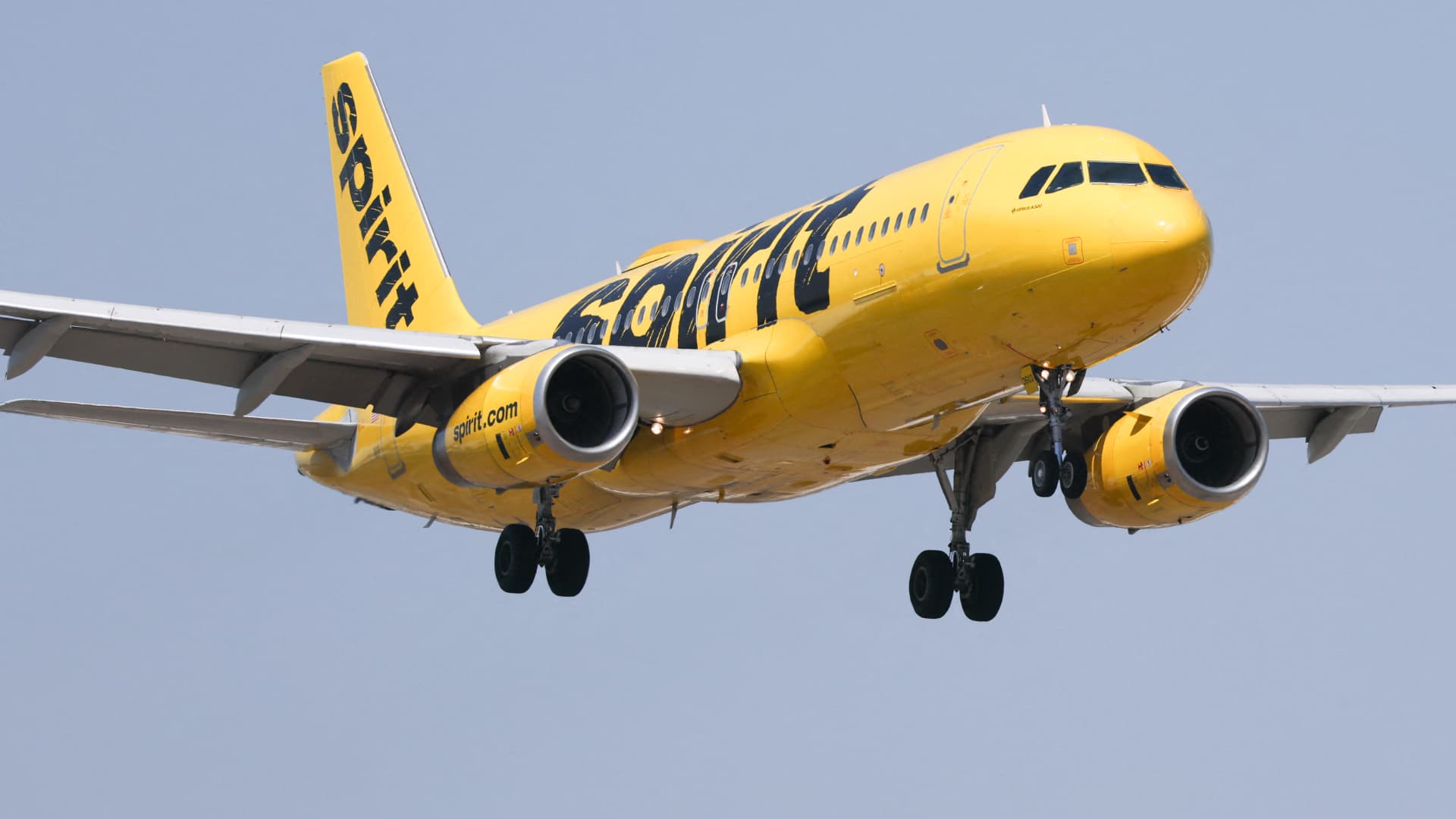
The Trump administration is in advanced talks for a financing package for Spirit Airlines as the carrier is facing the risk of a liquidation, according to a person familiar with the matter.
The iconic discounter Spirit has been challenged for years by rising costs, changing consumer tastes, an engine recall and a court-blocked plan to be acquired by JetBlue Airways two years ago.
“Spirit Airlines would be on a much firmer financial footing had the Biden administration not recklessly blocked the airline’s merger with JetBlue,” White House spokesman Kush Desai said in a statement to CNBC. “The Trump administration continues to monitor the situation and overall health of the U.S. aviation industry that millions of Americans rely on every day for essential travel and their livelihoods.”
Spirit had been facing a potentially imminent liquidation, people familiar with the matter told CNBC last week, speaking on the condition of anonymity to discuss matters that had not yet been made public. The Dania Beach, Florida-based carrier in August filed for its second Chapter 11 bankruptcy in less than a year, after it struggled to increase revenue to cover rising costs.
Advertisement
President Donald Trump hinted at potential government aid on Tuesday, telling CNBC’s “Squawk Box“, “Spirit’s in trouble, and I’d love somebody to buy Spirit. It’s 14,000 jobs, and maybe the federal government should help that one out.”
The terms of the talks weren’t immediately clear and a deal could still fall apart. The Wall Street Journal earlier reported that the talks were in an advanced stage.
“We are hopeful that the government will recognize the needs for emergency funds especially in the current economic environment,” a spokesperson for the Associated of Flight Attendants-CWA, which represents Spirit’s cabin crews, said in a statement. “The last thing our economy needs is tens of thousands more people out of work and the last thing the travelling public needs is fewer choices in air travel.”
The U.S. airline industry accepted more than $50 billion in taxpayer aid to weather the Covid-19 pandemic, which is still its biggest-ever crisis, but those funds weren’t handed to one specific airline. Some of the aid gave the U.S. government stock warrants for airlines.
Advertisement
Airlines also received a government bailout following the Sept. 11, 2001, terrorist attacks, but that money was also for more than one company. The U.S. in 2008-2009 also bailed out the auto industry during the financial crisis and took stakes in manufacturers.
The Trump administration has taken equity stakes in some companies it deemed critical to national security like Intel and USA RareEarth, though Spirit stands out as it is in bankruptcy.
In February, Spirit said it expected to exit bankruptcy in late spring or early summer, telling a U.S. court that it would shrink and focus its planes on high-demand routes and travel periods. Pilot and flight attendant unions had also made concessions, including going on furlough in recent months, in a bid to help Spirit survive.
But jet fuel prices have nearly doubled in some parts of the U.S. since then, further adding to challenges for Spirit and the rest of the airline industry.
Advertisement
As a low-fare airline that also faces competition from larger carriers with their own no-frills, basic economy offerings, it has grown harder for Spirit to cover expenses. Spirit had introduced extra-legroom seats and other premium options to try to cater to higher-spending customers.
Ski trips are usually seen as a break, but that’s not really how they play out. Across both education and business, they tend to take on a different role once you’re actually there.
Whether it’s students on school ski trips in a new environment or teams spending time together outside the office, things don’t work the same way as they usually do. It’s a different kind of experience from what happens in a classroom or a structured work setting.
This guide explores how ski trips are being used in practice, from student development to corporate travel, and why they are increasingly seen as part of long-term growth.
Understanding Why Ski Trips Go Beyond Recreation
Ski trips are often seen as a break from routine, but they are usually shaped by timing rather than choice. School terms and work schedules mean people travel when they can, not when conditions are ideal.
That carries into the experience. Plans shift, conditions change, and unfamiliar surroundings require constant adjustment. Even simple things, like getting around or coordinating with others, become part of the day.
Advertisement
In more structured environments, there is usually a clear plan. On a ski trip, that structure is less defined. Decisions are made more quickly, often without complete information.
The experience is shaped less by the skiing and more by how people manage everything around it.
How School Ski Trips Support Student Development
School trips have always been part of education, but settings like school ski trips tend to change how students move through the experience. Being away from their usual environment shifts expectations. Things feel less structured, and not everything runs to plan.
You start to see it in how students go about the day. They manage their own time, keep track of their things, and make small decisions without much guidance. It’s not always smooth, especially at the start.
Advertisement
Outside the classroom, things shift as well. Students spend more time together in shared spaces, and that changes how they interact. Some take on more responsibility, while others step into roles they wouldn’t usually take on in school. This is often why settings like business trips for schools feel different from the usual environment.
Learning to ski is part of that. Progress isn’t always steady, and mistakes are just part of it. For some, it means sticking with it even when things don’t go right, instead of stepping away.
Key Skills That Carry Into Education and the Workplace
What develops during these trips doesn’t stay limited to the setting itself. The situations students face tend to carry into how they approach other environments.
This often shows up in a few areas:
Advertisement
People end up making decisions on the spot, especially when things aren’t fully planned
Conversations are more direct when everyone’s figuring things out together
There isn’t always a clear structure, so people just manage their time and responsibilities as they go
Progress can be slow at first, so sticking with it matters more than getting it right immediately
These patterns don’t always stand out during the trip itself, but they tend to carry forward into more structured environments over time.
Why Businesses Are Investing in Corporate Ski Trips
Business travel still includes meetings and conferences, but that’s not always what defines the trip anymore. A lot of what happens around it ends up shaping the experience.
In that context, formats like corporate ski trips are becoming more common. They offer something different from structured programmes, not by design alone, but by nature of the environment itself.
Rather than being treated as one-off incentive, these trips are increasingly seen as part of a wider approach to engagement, where the setting plays a role in how teams spend time together.
How Travel Connects Education to the Workplace
The link between education and the workplace is not always direct. What is taught in structured settings does not always reflect how situations unfold in practice.
Advertisement
Experiences outside the classroom begin to narrow that gap. Programmes such as business trips for schools place students in environments that feel closer to real-world settings, where expectations are less defined and outcomes are not always predictable.
That exposure changes how learning is applied. Students move from following instructions to navigating situations more independently, often with less guidance than they are used to.
The gap between education and industry is starting to narrow. It’s not just about formal learning anymore, experience is part of how skills develop.
Travel as a Long-Term Investment in Development
Travel is not always approached as part of development, but its impact tends to build over time. Experiences outside routine often shape how individuals respond to unfamiliar situations later on.
Advertisement
You don’t really notice it at the time. It’s more something that shows up later, like in how people deal with things when plans change or when something doesn’t go the way they expected.
There’s also a shift in how travel is viewed. It’s less about stepping away and more about what carries forward afterwards.
In that sense, travel is no longer just an addition. It has started to sit alongside more traditional approaches, offering a different way of preparing individuals for what comes next.
Iluka Resources says the conflict in the Middle East has accelerated electrification efforts, as its capital expenditure on its under-construction Eneabba rare earths refinery nears $1 billion.
Evolution AB (publ) (EVVTY) Q1 2026 Earnings Call April 22, 2026 3:00 AM EDT
Company Participants
Martin Carlesund – Group Chief Executive Officer Joakim Andersson – Chief Financial Officer
Conference Call Participants
Advertisement
Pravin Gondhale – Barclays Bank PLC, Research Division Georg Attling – Pareto Securities AS, Research Division Nikola Kalanoski – ABG Sundal Collier Holding ASA, Research Division Benjamin Shelley – UBS Investment Bank, Research Division Martin Arnell – DNB Carnegie, Research Division Edward Young – Morgan Stanley, Research Division Karan Puri – JPMorgan Chase & Co, Research Division Andrew Tam – Rothschild & Co Redburn, Research Division Rasmus Engberg – Kepler Cheuvreux, Research Division James Bass – Citigroup Inc., Research Division
Presentation
Operator
Advertisement
Welcome to Evolution Q1 Report 2026 Presentation. [Operator Instructions] Now I will hand the conference over to the speakers, CEO, Martin Carlesund; and CFO, Joakim Andersson. Please go ahead.
Martin Carlesund Group Chief Executive Officer
Good morning, everyone. Welcome to the presentation of interim report for the first quarter of 2026. My name is Martin Carlesund, and I’m the CEO of Evolution. With me, I have our CFO, Joakim Andersson. As always, I will start with some comments on our performance and then hand over to Joakim for a closer look at our financials. After that, I will conclude an outlook, and then we will open up for your questions. Next slide, please.
Advertisement
So let’s start with the financial and operational highlights in the quarter. Net revenues were EUR 513 million, corresponding to a year-on-year decline of 1.5%. EBITDA came in at EUR 335.3 million, corresponding to a margin of 65.4%. The regional development was somewhat mixed in the quarter. Europe is not performing well at the moment, whereas LatAm is having a great momentum. North America continues its steady growth at a slightly higher pace than in Q4. In Asia, we made some further progress on combating cybercrime.
A version of this article first appeared in the CNBC Property Play newsletter with Diana Olick. Property Play covers new and evolving opportunities for the real estate investor, from individuals to venture capitalists, private equity funds, family offices, institutional investors and large public companies. Sign up to receive future editions, straight to your inbox. Life science laboratories, mainly in biotech and biopharma, saw a massive drop in demand last year after the National Institutes of Health was forced to cancel billions of dollars in research grants. NIH funding was cut severely by the federal government. Of the 10 largest life sciences markets tracked by JLL, the aggregate vacancy rate was 27.4% in the first quarter of this year, up from 25.7% during the same period in 2025. Major markets like Boston and the Bay Area had vacancy rates over 30%. The sector, however, is beginning to stabilize. A separate report from CBRE shows venture capital investment in life sciences in the second half of 2025 was the strongest since 2022. In addition, the amount of space under construction is at its lowest since 2017. An October JLL report predicts, “gradual market stabilization driven by supply rationalization rather than dramatic demand recovery.” JLL forecasts that availability rates will decline to approximately 20% by 2030, “assuming continued below-average absorption coupled with significant supply exits through distress sales and adaptive reuse projects.” The market correction in the space, however, has been historic, according to Travis McCready, head of industries leasing advisory at JLL. And the trouble isn’t just funding cuts. McCready characterized the current oversupply situation as a combination of unprecedented construction combined with a fundamental change in how life sciences companies are using real estate. “This entire story and this entire narrative is evolving in real time,” said McCready. “We got really, really good at building that asset class based on the assumption of what type of equipment and enabling technology biotech companies needed, and then came AI and robots.” This is where the opportunity presents itself. McCready projects that close to 19 million square feet of available lab space will shift to other uses by 2030, but the companies and markets that adapt will end up stronger and more competitive. That adaptation comes in the architecture. Gensler, the largest architectural firm in the world, recently completed a year-long, cross-disciplinary research initiative looking at how AI, automation and robotics are reshaping not just lab operations, but real estate strategy itself, from infrastructure requirements and space ratios to the composition of the workforce, according to the company. “It’s transformative,” said Ryley Poblete, global sciences practice area leader at Gensler. “Where we’re going with science, especially with these new tools of automation and AI, is completely changing the way we think about how you would do process.” Poblete pointed to the transformation of the so-called “wet bench” area, where scientists use instruments to conduct experiments. Many of these experiments can now be done with AI or automation, which means as robotics and computers move in, test tubes move out. From a real estate perspective, companies are learning what the new technologies can do and re-evaluating the facilities they have to inform whether a space can be upgraded. “That’s happening in the real estate portfolios of the large clients, the people who have campuses and assets,” said Poblete. The vacancies, according to the Gensler study, are actually masking a quality problem: Much of today’s empty inventory was never truly “Class A” lab space to begin with. Even as it looks like the real estate needs of lab sciences are shrinking, there is a growing discussion about what kind of lab real estate will survive and outperform in the next cycle. “Large biotech companies and even the large chemical companies are evaluating their own infrastructures nowadays to really validate that they will be worthwhile taking it forward, or looking at a consolidation strategy or a new build strategy that brings these pieces together in the right environments,” said Poblete. Gensler is actively looking at older spaces, assessing the increased power and air needs for larger computers that run artificial intelligence. They’re also looking to see if the spaces can be modified to fit robotics. Poblete described it as essentially putting small data centers into laboratory spaces. Of course, they also need to see if the building structure can take the weight of all the new systems. Newer buildings, for the most part, can, but older ones are in question. The spaces are being redesigned for the machines, but there still needs to be some kind of creative lab environment where scientists can validate what the machines are doing. That involves deep focus, Poblete explained, which requires quiet areas, not the open, often noisier workspaces that are more popular in today’s newer offices. Then there is the collaborative process. Scientists are no longer working entirely alone. They’re working with AI researchers, engineers and process designers. “Those people all work together with them now and not separately, and that’s been a big change for the industry, not just from a life science perspective, but from a chemistry perspective,” said Poblete. “They used to all think of themselves as like this, the hero scientists, in a way. Now that whole interdisciplinary science movement is – it’s an essential need for you to work with these partners to create real future endeavors.” Poblete pointed to Genentech as an example. The company is undergoing a major, multi-year buildout of its global headquarters campus in Basel, Switzerland. It is investing more than 3 billion Swiss Francs (close to $4 billion U.S.) in site development, including a new 72-meter research building scheduled for completion in 2029, according to its parent company, Roche , which says the development aims to modernize research facilities and consolidate R & D functions.






















































You must be logged in to post a comment Login