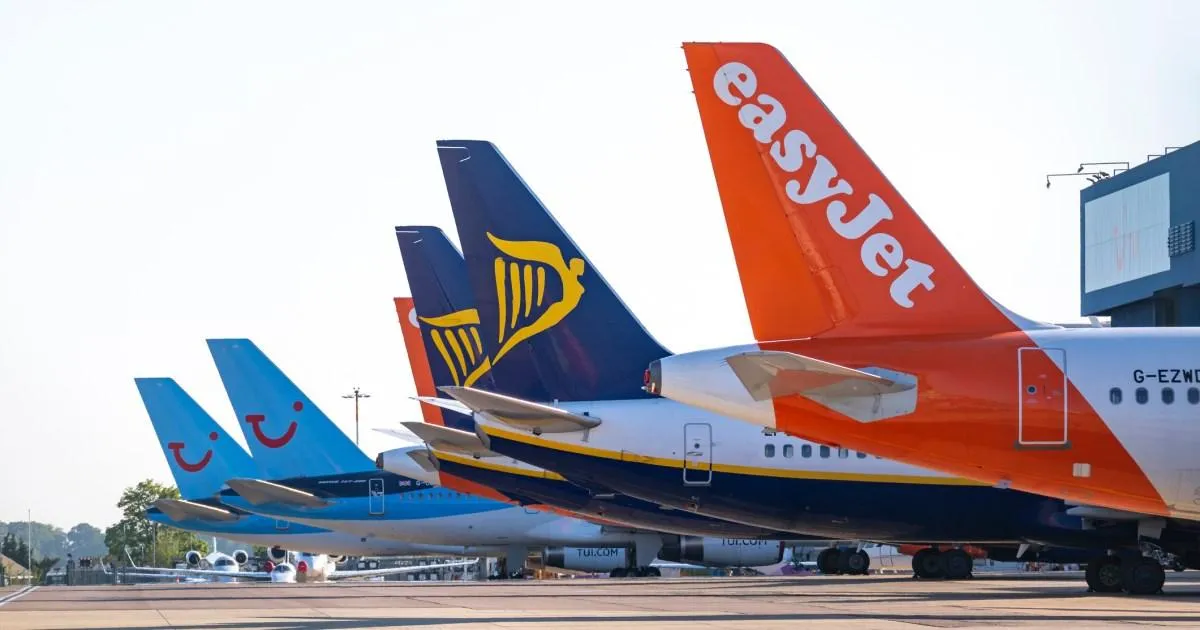
Officials have suggested airlines have just weeks of fuel left (Picture: Getty Images)
As airlines grapple with an ongoing jet fuel crisis, passengers are being hit from both sides: more cancelled flights and higher travel costs.
Carriers around the world are cutting routes and introducing extra charges in an effort to manage soaring fuel prices driven by ongoing conflict in the Middle East.
The Strait of Hormuz, which has effectively been blocked by Iran since February, carries up to 75% of plane fuel exports from the Gulf to Europe.
However, with this route disrupted and supplies running low, costs have skyrocketed from around $85 to $90 (£63 to £67) to as much as $200 (£148) per barrel over the past few weeks.
Advertisement
What is the Strait of Hormuz?
The Strait of Hormuz is 60-mile-wide section of waterway that connects the Gulf with the Arabian Sea, making it one of the most important shipping lanes in the world. With Iran to the north and Oman to the south, during peace time, around 20% of the world’s oil and gas passes through it.
The UN allows countries to exercise control of their territorial seas up to 13.8 miles from their coastlines, and since some portions of the Strait lie entirely in Iran and Oman’s territorial waters, they are allowed to ‘defend’ their countries if needed.
Along with the geography allowing Iran to exert control on the waterway, at its narrowest point, the Strait is just 24 miles across, making it easy for Iran to target vessels passing by.
Advertisement
Last week, head of the International Energy Agency (IEA), Fatih Birol, said Europe has ‘maybe six weeks or so [of] jet fuel left,’ warning passengers to expect cancellations into the summer months.
Best of Metro Deals
Get exclusive discounts with Metro Deals – save on getaways and spa days. Powered by Wowcher
Bannatyne Spa: Spa day for two with treatments, lunch & prosecco — save up to 57% off.
Some airlines have already reduced schedules due to the shortage, while others are increasing fares or hiking baggage fees.
Advertisement
How major airlines operating in the UK have responded
Aegean Airlines
The Greek airline said this week it would raise ticket prices as a result of the spike, although hikes would be limited to around 7% to 8%.
The change will impact new bookings, but the 3.6 million passengers already scheduled to fly over the coming months, and those who hold an Aegean Pass and have bought early-bird packages, will be unaffected.
Like many other carriers, the company has also suspended flights to affected regions until the end of April, including Iraq, Israel, Lebanon, Saudi Arabia, and the UAE.
Aer Lingus
Over 500 flights have been dropped from Aer Lingus’s schedule, although it claims this is due to ‘mandatory maintenance’ on aircraft rather than the fuel crisis.
Advertisement
Air France-KLM
The airline group said it has made ‘price adjustments’ to long-haul ticket prices to address surging costs, with return fares rising by €50 euros (£44) per round trip, while short and medium-haul round trips in economy increasing by €10 (£9).
Last week, the group’s Dutch arm KLM also said it would cancel 160 flights in Europe over the coming month as a result of the fuel shortages.
Customers may face disruption (Picture: Getty Images)
Air India
In March, the Indian carrier began a phased expansion of a fuel surcharge on its domestic and international routes ‘necessitated by the steep rise in jet fuel prices arising from the geopolitical situation in the Gulf.’
All new bookings for flights to and from Europe now incur a $125 (£92) fee, up from $100 (£74) before the conflict began. However, the company noted it will be reviewing surcharges periodically, and may ‘make appropriate adjustments’ as required.
Alaska Airlines
The US airline, which is due to launch its first UK service between Heathrow and Seattle in May, increased checked bag fees for most customers earlier this month.
Advertisement
As of April 11, charges went up by $5 (£3.70) for the first bag and by $10 (£7.40) for the second, while a third piece of luggage will now cost $200 (£148), up from the previous $50 (£37).
American Airlines
Although checked baggage fees have been hiked up to $150 (£111) per bag — meaning the first costs $50 (£37), the second $60 (£44), and the third $200 (£148) — these increased charges only apply to domestic and short-haul international flights, so won’t impact travellers to or from the UK.
British Airways
British Airways owner IAG said in March it did not plan to increase ticket prices in the short to medium-term, as it was well hedged for upcoming shortages, but warned it was still ‘not immune’ to the fuel crisis.
British Airways specifically, however, has made changes to its schedule due to the ‘continuing uncertainty’, and is ‘directly in touch with affected customers to offer them a range of options’.
Advertisement
BA has made changes to its schedule (Picture: Getty Images)
Cathay Pacific
The Hong Kong airline plans to cut about 2% of its scheduled passenger flights from mid-May to late June, while its budget subsidiary HK Express is dropping around 6% of flights.
However, more flights were actually added to London, Paris, and Zurich in March, as airspace closures led to an ‘upsurge’ in demand as passengers ‘prioritised alternative routings’.
In terms of pricing, the carrier said it would hike fuel surcharge by 34% across routes from April 1 and review them every two weeks.
China Eastern Airlines
While the Chinese airline, which offers multiple daily flights between London and Shanghai, has raised fuel surcharges, these currently only apply for domestic trips.
Passengers travelling within China currently face a 60 yuan fee (£6.50) for journeys under 800km, or 120 yuan (£13) for those over 800km.
Advertisement
Delta Air Lines
Delta said at the start of April it would cut capacity by around 3.5% from its original plan, although this would be targeted on red-eye and mid-week flights to ‘reduce unprofitable flying’.
Fees for checked luggage also increased by $10 (£7.40) for first and second bags and a $50 (£37) for the third, with bosses reported to be looking at increasing airfares in the months ahead.
EasyJet
In a recent statement, EasyJet boss Kenton Jarvis said the airline had ‘no concerns’, as it has ‘visibility to the middle of May’ in terms of fuel supply.
But with £25 million in extra fuel costs in March, the CEO added that European consumers should expect higher ticket prices around summer, when existing fuel hedges come to an end.
Advertisement
EasyJet’s fuel costs were up £25 million for March (Picture: Getty Images)
Emirates
Capacity was slashed by Emirates in late February, following widespread regional airspace restrictions impacting its Dubai hub.
The world’s largest long-haul airline and the largest in the Middle East, normally operates more than 3,600 flights per week, but is currently operating to ‘more than 100 destinations’ on a skeleton timetable — roughly 70% of its normal capacity.
Bosses have said it will only ramp up operations when over-flight corridors over Iraq and Iran are reliably reopened, and will ‘develop [its] operational schedule accordingly’.
Fare prices have reportedly gone up too, with a $226 (£167) economy class surcharge added to European trips from April 1, and $623 (£461)for premium cabins
IndiGo
India’s biggest airline — which flies from London and Manchester to destinations across India — introduced new fuel charges on domestic and international flights from March 14.
Advertisement
These fees initially ranged from 425 rupees (£3.35) for domestic flights to 2,300 rupees (£18) for flights to Europe, but have since been pushed up to as much as 10,000 rupees (£79).
IndiGo bosses claimed these surcharges would be monitored and adjusted where necessary, but it aimed to limit the impact on passengers where possible.
Jet2
Following the IEA announcement about impending fuel shortage disruption, a number of Jet2 passengers reached out to the airline for clarity ahead of their bookings.
In response, representatives confirmed ‘all flights are planned to go ahead as normal’, and customers would be contacted directly should this change. To be on the safe side, passengers are advised to check their flight status via the Jet2 website at least 12 hours before departure for the latest updates.
Advertisement
What aspect of the jet fuel crisis affecting airlines concerns you the most?
Increased ticket prices
Flight cancellations
Added fees for baggage and services
Environmental impact of fuel shortages
Advertisement
Sign up to The Getaway Expert, your exclusive seven-day guide to travelling with confidence from Metro’s travel editor, Alice Murphy.
JetBlue Airways
Citing ‘rising operating costs’, the US-based carrier recently hiked baggage prices by between $4 (£3) and $59 (£44) depending on the type of flight and number of checked items.
Advertisement
While JetBlue hasn’t made a statement regarding fare increases, analysis by Deutsche Bank revealed its ticket prices jumped 16% in one week at the start of the month, potentially due to ‘panic buying’ for summer ahead of a predicted surge.
Lufthansa
Earlier this week, Lufthansa released a statement saying 20,000 short-haul flights were being cut from its schedule this summer, blaming the move on the jet fuel crisis and ongoing labour disputes.
The majority of this would be from the airline group’s loss-making short-haul CityLine subsidiary fleet, which was already due to be grounded later in the year.
Lufthansa will also withdraw four older Airbus A340-600 long-haul aircraft at the end of the summer, and reduce short and medium-haul offerings by five aircraft this coming winter, with the cuts representing 1% of the German carrier’s ‘available seat kilometres’ yet saving 40,000 tonnes of fuel between now and October.
Advertisement
Norse Atlantic UK
Low-cost Norwegian airline Norse Atlantic axes its flight route between London Gatwick and Los Angeles this week, citing the ‘global fuel crisis’.
‘We are truly sorry for the inconvenience, and apologise to passengers who have [had] their travel plans changed,’ a spokesperson commented. ‘We will assist disrupted passengers as best we can.’
Qantas
Despite cutting domestic flights, strong interest in Europe-bound travel led the Australian airline to redeploy capacity to hotspots like Paris and Rome.
Ticket prices have also increased in recent weeks, and it warned it may need to take ‘further action’ as the situation unfolds.
Advertisement
Ryanair
At the start of April, a spokesperson for the budget carrier told Metro it could ‘guarantee supply to mid-end May’, although if the conflict continues beyond this date, disruption due to fuel shortages couldn’t be ruled out.
This bolsters previous claims from Ryanair boss Michael O’Leary, who stated the company would likely be forced to cancel between 5% to 10% of its scheduled flights through May, June, and July.
With the airline operateing over 3,600 flights per day, this means approximately 360 daily trips could be impacted if the fuel crisis doesn’t resolve itself.
Ryanair expects fuel supplies to last until mid-May (Picture: Getty Images)
Scandinavian Airlines (SAS)
At least 1,000 flights are expected to have been cancelled by SAS in April, up from a ‘few hundred’ in March.
The majority of journeys affected are domestic routes within Norway however, with CEO Anko van der Werff highlighting that given the airline runs over 800 flights per day, cuts are limited in scale.
Advertisement
SAS, which had already increased flight prices, said that even if it tried to absorb the rising fuel costs, the surge was still ‘a shock that directly hits the airline industry’.
TAP Portugal
Last week, the CEO of the Portuguese Airlines Association (RENA), António Moura Portugal, said the country’s flag carrier, TAP, may ‘need to reduce operations and, eventually, raise prices’.
While analysis claims TAP only has 40% fuel coverage for 2026 (compared to between 62% and 84% for other major airlines) Portugal stressed that it was continuing to monitor the conflict, and is yet to make any ‘definitive statements’.
TUI
TUI Airways — the world’s largest charter airline, flies to over 100 destinations from 17 bases across the UK and Ireland — said it is ‘monitoring’ jet fuel shortages, but is ‘not anticipating any immediate disruption to flight schedules or holiday programmes’ at present.
Advertisement
Turkish Airlines-SunExpress
SunExpress, a joint venture between Turkish Airlines and Lufthansa, is set to impose a temporary fuel surcharge of €10 (£8.69) per passenger.
This will apply to booking for flights between Turkey and Europe, made on or after April 1. for departures on or after May 1
United Airlines
In March, United Airlines’ CEO Scott Kirby said the firm would begin ‘tactically pruning flying that’s temporarily unprofitable in the face of high oil prices’.
The 5% capacity reduction will be focused on less-popular timings like overnight, Tuesdays, Wednesdays and Saturdays, and is expected to extend through at least the second and third quarters of 2026.
Advertisement
United also increased first and second checked bag fees by $10 (£7.40) for customers travelling in the US, Mexico and Canada and Latin America, but international flights are believed to be unaffected.
Virgin Atlantic
The airline is adding fuel surcharges to fares but will still struggle to return to profitability this year, its CEO Corneel Koster told the Financial Times.
Sir Richard Branson’s airline added a fuel surcharge of £50 to economy class tickets, with premium economy increasing by £180 and business class by £360.
Advertisement
‘If the fuel price goes much higher, I think the surcharges may go higher,’ commented CEO Corneel Koster. ‘If they go up in a week and you book in two weeks’ time, you’ll be paying higher.’
The company also recently scrapped flights from London to Riyadh, just a year after the route was launched, citing ‘the latest intelligence, regulatory guidance, demand and operating costs’.
Fuel shortages have led to surcharges for Virgin Atlantic passengers (Picture: Getty Images)
WestJet
In a series of ‘near-team measures’, the Canadian airline this week added a C$60 ($32.50) fuel surcharge to some bookings, and will be consolidating flights on lower-demand routes as well as ‘adjusting the travel period for seasonal offerings’.
A statement on Westjet’s website said capacity was expected to reduce by 1% April, 3% in May and 5.5%t in June, and impacted customers would be provided with reaccommodation options, most within the same day as their original departure.
Wizz Air
Hungarian carrier Wizz Air reported issues due to shortages in three airports in Italy last week, but chief Jozsef Varadi claimed these were ‘all resolved within a day and in some cases within hours.’
Advertisement
A spokesperson for the company, the third-largest European budget airline (after Ryanair and easyJet), stated it was ‘actively monitoring fuel supply,’ and ‘will work with its suppliers to secure the jet fuel available in line with its needs’, keeping customers informed and providing updates as needed.
What to do if your flights are cancelled or disrupted
Chris Harrington, managing director of travel firm hoppa, says the first port of call if your flight is cancelled is to contact the airline.
‘If you are already at the airport, head for the airline’s customer service desk to speak to a member of staff,’ he tells Metro.
‘Acting quickly is essential, as available seats on alternative flights may be limited and only available for a short time. However, other people will be in the same position as you, so if you’re met with long queues, try using the airline’s app or ring the customer service team to find out next steps.’
Advertisement
In most cases, the airline will have to make an alternative plan for you, so ask them to rebook you on a later flight, and let them know if there’s an alternative route (or flight using another airline) that works.
Chris also highlights the importance of buying travel insurance as soon as you book, to ‘protect yourself from circumstances such as cancelled flights’.
Some policies will cover the cost of hotels, airport transfers, alternative flights, and food, which is essential since cancellations due to external factors, such as fuel shortages, are typically classed as ‘extraordinary circumstances’, meaning airlines don’t necessarily have to reimburse directly.
‘If the flight cancellation is due to the actions of the airline, then it’s likely you’ll be entitled to compensation as per ABTA guidelines,’ Chris continues, noting that this amounts to £220 for journeys of 1,500;m or less, and up to £520 for anything over this distance.
Advertisement
‘However, in this case, because the cancellation is caused by extraordinary circumstances outside of the airline’s control, compensation is unlikely to apply.’
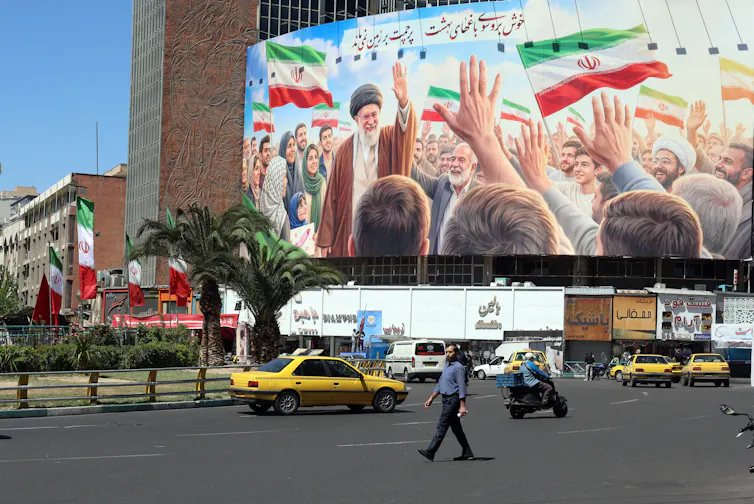
Donald Trump’s deadline for Iran to reopen the Strait of Hormuz or face a renewal of American bombardment was due to expire this week, but was extended at the last moment, this time with no defined time limit. But the risk of renewed escalation remains real, as both sides continue to block traffic through the Strait of Hormuz, one of the world’s most important – and contested – waterways..
Yet, despite hardline rhetoric on both sides, diplomacy has not collapsed. In fact, several plausible off‑ramps exist that could allow Washington and Tehran to cool tensions without either side appearing to capitulate.
Research in conflict resolution suggests that warring parties will be more likely to come to an agreement when both sides can take away what they consider a winning result. Often, this comes in trade-offs between what you are willing to give away in order to gain elsewhere. Nevertheless, it’s axiomatic in conflict resolution that it’s much easier to start a war than to stop it.
The most viable pathway to a settlement remains a reset of the nuclear file broadly along the lines of the 2015 Joint Comprehensive Plan of Action (JCPOA), albeit under a new political brand.
Advertisement
Iranian officials have proposed a staged arrangement that would cap uranium enrichment at 3.67%, well below the level needed for a nuclear weapon. Such an arrangement would return intrusive International Atomic Energy Agency inspections with the prospect of ultimately transferring stocks of higher‑enriched uranium out of the country in exchange for phased sanctions relief.
This would not represent a fundamental concession by Tehran. These were the parameters it accepted 11 years ago under the deal brokered by Barack Obama. But it would significantly lengthen Iran’s nuclear “breakout time” (the time it takes to produce enough weapons-grade uranium). It would also restore transparency that has been steadily eroded since the first Trump administration pulled out of the JCPOA in 2018.
For Washington, such a deal would fall short of longstanding demands for “zero enrichment” – but that position has so far proved unattainable. Even US officials now appear more focused on verifiable constraints than absolute prohibitions, understanding that China recognises the right to enrich uranium as a matter of sovereignty.
A capped and monitored programme would allow the US president to claim that Iran had been forced back under strict controls, while avoiding a further costly regional war. The irony is that this would largely put Iran back into an agreement that Obama agreed and which Trump, with considerable bluster, withdrew from in 2018. This appears to be a stumbling block for the US president.
Advertisement
Donald Trump is reported to be seeking a nuclear deal with Iran which is better for the US than the treaty agreed by Barack Obama. EPA/Daniel Heuer/pool
A second and related off‑ramp concerns the duration rather than the existence of enrichment limits. Recent talks have stalled over US demands for a 20‑year moratorium on enrichment, which Iran has countered with proposals closer to five years. A compromise, such as a seven to ten-year limit with built‑in reviews, would give both sides something to sell domestically. It would represent long‑term risk reduction for Washington and for Tehran it would be a reaffirmation of Iran’s right to a nuclear future.
Time‑limited arrangements have precedent in arms control. They are known as confidence and security building measures and are often used in conflict prevention and resolution to build trust between parties while working towards a resolution. And they may be more politically durable than maximalist demands that are more likely to collapse as political conditions change.
Beyond the nuclear issue, the Strait of Hormuz has emerged as Iran’s most potent source of leverage. Roughly one-fifth of global oil passes through the waterway, and even limited disruption has sent energy prices climbing this year. Former Russian president, Dmitry Medvedev – a close ally of Vladimir Putin – recently described the strait as Iran’s “real nuclear weapon”. It’s a comment that captures how central maritime pressure has become to Tehran’s strategy.
An agreement guaranteeing the strait’s unconditional reopening without harassment, tolls, or threats, would provide immediate economic relief worldwide and give Washington a highly visible diplomatic win.
Advertisement
But Gulf states have expressed concern that such a bargain could end up managing rather than dismantling Iran’s leverage. It would effectively normalise – rather than remove – Iran’s ability to threaten shipping during crises.
Iran has shown it can absorb pressure and play for time. EPA/Abedin Taherkenareh
For neighbouring countries, stabilisation without broader de‑escalation risks entrenching a dangerous precedent. This makes it all the more important that any Hormuz‑focused deal be tied to wider commitments on restraint and established confidence-building measures.
Lowering the stakes
Process matters as much as substance. Increasingly, mediators such as Pakistan, Oman and China appear to favour “sequenced de‑escalation”. This is where limited reciprocal steps, including mutual adherence to ceasefire agreements, shipping guarantees and relaxation of both sides’ maritime blockades, are locked in before negotiations widen to sanctions relief and regional security.
This approach lowers the political stakes of any single concession and reduces the risk that talks collapse under the weight of unresolved disputes. However, this scenario would make it harder for the US administration to define the agreement as a victory.
Similarly, there is the question of political narrative. The US president has vacillated between threats of overwhelming force and signals of fatigue with the conflict. This suggests he has a strong desire for an exit that can be framed as victory.
Advertisement
A narrowly defined agreement that could be rebranded, front‑loaded with Iranian compliance and heavy on enforcement language may prove more acceptable than a comprehensive treaty – even if its substance closely resembles older Obama-era frameworks.
The problem is the Trump administration’s failure to maintain a consistent narrative of what it wants from Iran. This presents a challenge to the established research on conflict resolution. The US president, in particular, has made understanding the US position difficult. In years to come, this crisis may be a useful case study when it comes to exploring conflict resolution theory. But, right now, it makes a settlement very hard to envisage.
York Theatre Royal has announced a new wave of shows for 2026, which also includes a one-off appearance from Michelin-starred chef Tommy Banks.
Tommy Banks will bring Spinning Plates: LIVE! to the Main House for one night only on Friday 17 July at 7.30pm. The show blends live storytelling and immersive cinema, charting the chef’s journey in hospitality across three timelines, from the past 25 years to the opening day of his latest pub. It also explores the pressures facing the industry, including rising costs and closures.
Sean Walsh is heading to York Theatre Royal. (Image: York Theatre Royal)
The following day, Saturday 18 July at 2.30pm, Dinosaur Adventure Live: Danger on T-Rex Mountain takes over the Main House.
The interactive family show invites audiences to join rangers on a mission to save dinosaurs, featuring lifelike creatures, audience participation and a post-show meet-and-greet in the foyer. The production runs for one hour with no interval.
Advertisement
Dinosaur Adventure Live is coming to York Theatre Royal.
Music fans can catch Wilko: Love And Death And Rock ‘N’ Roll from Thursday 10 to Saturday 12 September. Performances are at 7.30pm on 10 and 11 September, with two shows on 12 September at 2.30pm and 7.30pm.
Wilko: Love And Death And Rock ‘N’ Roll from Thursday 10 to Saturday 12 September. (Image: York Theatre Royal)
The play with live music tells the story of Dr Feelgood founder Wilko Johnson, from his terminal cancer diagnosis in 2012 to his unexpected recovery. It arrives in York following runs in London and Hornchurch.
Sean Walsh is heading to York Theatre Royal. (Image: York Theatre Royal)
Comedian Sean Walsh returns on Friday 6 November at 8pm with This Is Torture, a new stand-up show as part of a UK tour. The performance runs for 110 minutes including an interval and is strictly for ages 14 and over.
Priority booking for York Theatre Royal members opened at 1pm on Wednesday 22 April, with general sale scheduled for 1pm on 27 April.
Advertisement
Tickets and further details are available via the York Theatre Royal box office.
A school in the Republic and the German teacher have been in a long-running legal dispute stemming from a request address a student by a new name and the pronoun “they”
Enoch Burke has argued that he should be granted an appeal against a High Court decision that his suspension from a Co Westmeath school was lawful.
Advertisement
In May 2023, Mr Justice Alexander Owens ruled it was lawful for Wilson’s Hospital School to suspend the history and German teacher in 2022.
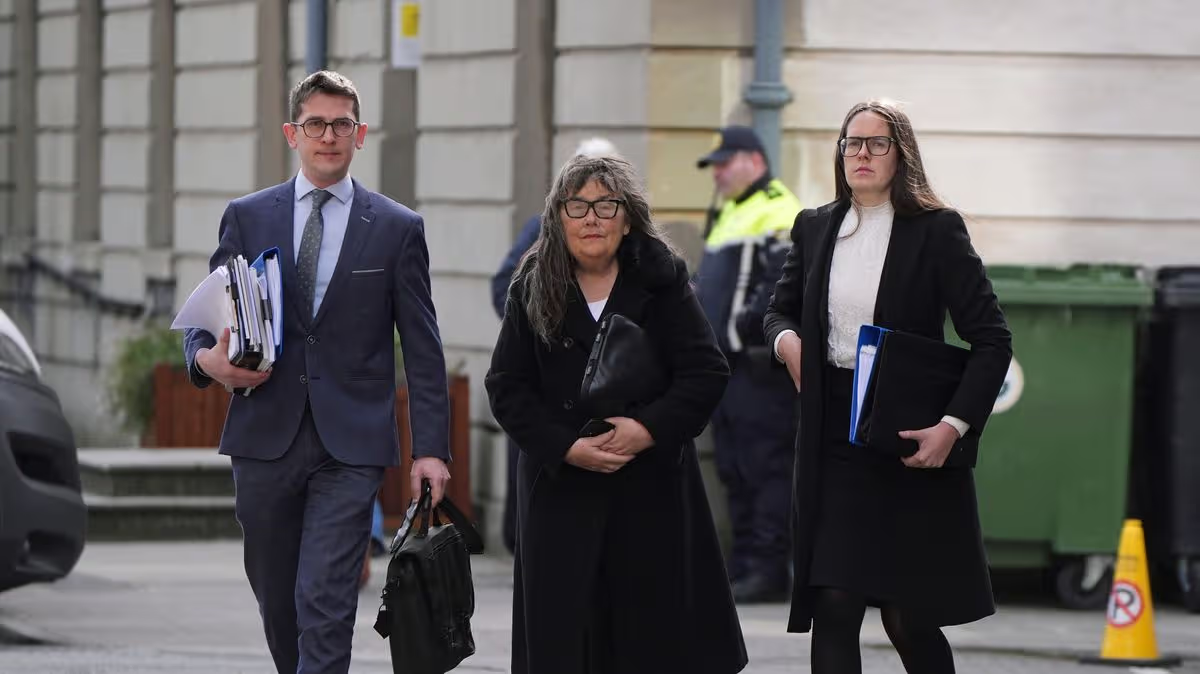
Following the judgment, Mr Burke had 28 days in which to appeal, but on Wednesday, he appeared in front of the three judges of the Court of Appeal to make his case for an extension of time.
The school and Mr Burke have been in a long-running legal dispute stemming from incidents over a request from the former’s then-principal to address a student by a new name and the pronoun “they”.
Mr Burke, an evangelical Christian, argued that his suspension was unlawful and went against his right to express his religious beliefs.
He has spent more than 650 days in jail for contempt of court after repeatedly trespassing at the school.
Addressing the judges on Wednesday, he outlined a number of reasons for seeking an appeal two-and-a-half years after the original judgment.
They included his involvement in a number of legal actions, in which he represented himself, his imprisonment and because he had “lost confidence in the Court of Appeal” following a previous decision.
Advertisement
The barrister representing the school’s board of management, Rosemary Mallon, described the case as “unusual and extraordinary” and said an extension of time to allow an appeal should not be granted.
She said the reasons Mr Burke gave for the delay were “not legitimate or valid reasons” and said there was a “need for finality” in the matter given that over two and a half years had passed since order had been perfected.
Mr Burke said his suspension “was contrary to the constitution and the law” and the court had not properly analysed the grounds for his suspension.
He said Mr Owens’ decision “hinged” on one factor – whether or not Mr Burke complied with the direction of the then-principal to refer to a pupil using they/them pronouns.
“Was that right? Was it just?” he asked
He said “the central fact” of the case has never been disputed, “that I failed to comply with the principal’s instructions”.
However, he said the principal’s request was not valid as constitution and the Equal Status act both refer to males and females, but not they/them pronouns.
Advertisement
He also referred to a statement, given by the Department of Education to the Irish Times in January of this year, which said schools were not legally obliged to use a pupil’s preferred pronouns.
He said the issue at the centre of his appeal was “of manifest public importance”, and relevant “to every teacher, and every school in the country”.
Responding to Mr Burke’s points, Ms Mallon said the decision was not “a declaration as to the lawfulness of the principal’s direction or instruction”, but about “the lawfulness of the decision to suspend”.
She added a worker can be suspended and ultimately not found guilty of gross misconduct, and that the suspension stage is “very different” to the disciplinary stage.
Advertisement
She said during the 2023 hearing, Mr Burke was “disorderly and in persistent contempt of court”, and he was asked to leave the court.
She said he could have made his arguments about the legality of the directions he had been given by the school’s principal, but was not in court.
“He was never precluded in making arguments, he precluded himself,” she said.
She said the reasons Mr Burke gave for the delay were “not legitimate or valid reasons” and said there was a “need for finality” in the matter.
Advertisement
President of the court Ms Justice Caroline Costello said judgment on the matter was reserved, and when asked for a timeline on when a decision might be made, she replied: “We will do it when we can, everybody has different pressures with work.”
Mr Burke was supported by five members of his family during the hearing, his father and mother Sean and Martina, as well as his brother Isaac and sisters Ammi and Jemima.
Brooke Wiggins died in a tragic incident on a rope swing that saw a tree branch snap
A 12‑year‑old girl died just days before her birthday after a rope swing that “should have been removed” months earlier was left hanging from a Surrey tree, an inquest has heard.
Christian Weaver, representing Brooke’s father, Lee Wiggins, explained how, if the inspection had been carried out, any rope swing found on the tree should have been removed, “as per policy”.
Advertisement
A delegation representing Surrey County Council argued that even if the planned inspection had gone ahead, evidence suggests it may not have achieved a “material different outcome”.
In a statement read by assistant coroner Ivor Collett on behalf of Brooke’s mother, Claire Etherington, she was described as a “beautiful, fun, caring and loving girl” who had “the most incredible way of lighting up every room she went into”.
“She was always surrounded by the people who loved her, and it’s easy to see why – she gave so much love back,” her mother said. “Brooke loved dancing, art, singing and taking photographs. She took pride in expressing herself, and “never went anywhere without her eyelashes on”, she said.
“She was a smart girl with so much potential. We will always wonder what she would have gone on to achieve in her life,” Ms Etherington said. She added that she hopes knowing what happened to Brooke will bring “a small sense of closure” and “some understanding”.
In a second statement read by Mr Collett, Brooke’s father told the inquest his daughter was an “amazing young woman”, who was “bright” and “very funny”.
“I am devastated that my baby girl has been taken from me. She packed so much into her short life,” he said.
“Only 12 years old, and now she’s gone forever. When I think of her, I ask myself, ‘why my darling Brooke?’ If only people had done their job properly… the one thing they are paid to do, and did it properly, Brooke would still be here,” Mr Wiggins added.
Advertisement
Speaking at the start of the hearing, Mr Collett said: “This is a particularly sad inquest. Of course, there are no happy inquests, but this is dreadful because it concerns the death of a young child and there’s no escaping that.
“To the family, I am bound to sound, at times, rather cold and distant… (but) I do not take away for a moment the unending pain felt by the family by the loss of their beloved daughter.” The inquest continues.
Ensure our latest stories always appear at the top of your Google Search by making us a Preferred Source. Click here to activate or add us as your Preferred Source in your Google search settings.
New data has revealed the schools in the country with the highest rates of truancy – with two in Greater Manchester in the top 20.
Pupils at state-funded secondaries in Greater Manchester missed the equivalent of around one in 26 days through unauthorised absences in the 2024/25 academic year – a rate of 3.8 percent.
That rate of lost “school sessions”, to use the official term, was above the national average of 3.2% – which itself is almost double that of pre-pandemic levels, when just 1.8% of sessions were lost to unauthorised absences in the 2018/19 academic year.
Click here to get the biggest stories straight to your inbox in our Daily Newsletter
Advertisement
You can use our interactive table to find out the truancy rates at every state-funded secondary school in England.
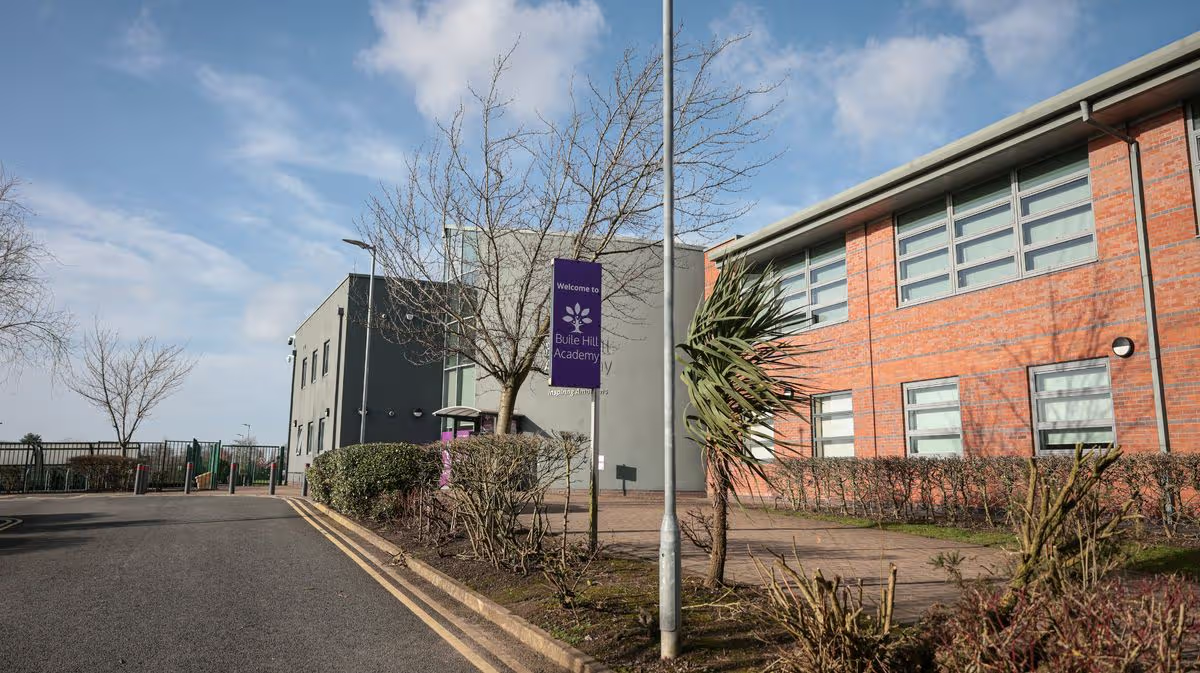
Buile Hill Academy in Salford had the highest rate in Greater Manchester, with more than one in every nine school sessions last year (11.7%) were lost due to unauthorised absences. That saw the school ranked ninth in the whole of England.
When contacted for a comment, the school said: “Buile Hill Academy has undergone rapid and significant improvement since joining Northern Education Trust.
“GCSE performance has risen dramatically: the proportion of students achieving grade 5+ in English and maths has surged from around 16% in 2024 to nearly 50% in 2025. Overall attainment has strengthened too, with English and maths 4+ increasing from 33% to 65.1% and 5+ rising from 16.8% to 49.4%.
Advertisement
“Attendance is also improving, and DfE data now places the academy among the ten most improved schools in the North West. Throughout this transformation, the academy has maintained a clear commitment to being both outcomes‑focused and child‑centred.”
Denton Community Academy in Tameside had the region’s next highest rate of unauthorised absences at 11.2%, ranking 14th in the country. That was followed by Dixons Brooklands Academy in Manchester at 10.8%, and Manchester Enterprise Academy also at 10.8, ranked at 21 and 22.
Advertisement
When contacted for comment, Denton Community Academy said: “Northern Education Trust Denton Community Academy has also undergone a rapid transformation since joining the trust.
“Their results have doubled in a short space of time, with the proportion of students achieving a grade 5 or above in English and maths rising from 26% to 52%.
“Attendance at Denton has also improved and overall absence has reduced. It is important to recognise that attendance is a national issue facing all schools, and describing this simply as ‘truancy’ does not reflect the full picture.
“As with all trust academies, Denton has clear and consistent systems in place, alongside strong pastoral support and works closely with families, to ensure students attend regularly and are well supported.
Advertisement
“These improvements were recognised in the school’s most recent Ofsted letter, which highlighted strengths in education, behaviour and the wider school culture.”
But it was Tameside that had the highest rate of unauthorised absences of any borough last year, with one in every 20 sessions (5.1%) lost to unauthorised absences. That puts Tameside just ahead of Salford (5.0%), Rochdale (4.8%) and Manchester (4.3%).
By contrast, just 1.5% of school sessions at state-funded secondaries in Trafford were lost to unauthorised absences last year. That’s the lowest rate in the county ahead of Wigan (3.2%), Bolton (3.4%) and Stockport (3.5%).
Advertisement
Fir Vale Academy in Sheffield was England’s most truant secondary school last year with 17.1% of sessions missed through truancy. The Co-op Academy in Leeds has the next highest rate in the country with 13.3%, followed by Saint Edmund Arrowsmith Catholic Academy in Knowsley with 13.1%.
That’s followed by The Basildon Upper Academy in Essex at 12.8%, Alsop High School in Liverpool at 12.7%, Leeds East Academy in Leeds at 12.5%, and Aylesbury UTC in Buckinghamshire at 12.3%.
Greater Manchester’s 10 highest rates
9. Buile Hill Academy, Salford: 11.7%
Advertisement
14. Denton Community Academy, Tameside: 11.2%
21. Dixons Brooklands Academy, Manchester: 10.8%
22. Manchester Enterprise Academy, Manchester: 10.8%
Britain’s Got Talent star Amanda Holden has shared a candid revelation about her husband Chris Hughes’ antics, even though the story makes him ‘look really bad’
Radio presenter Amanda Holden has spoken out about wardrobe malfunctions with her Heart FM co-presenter JK, arguing that such embarrassing incidents can occur to both men and women, after JK suggested it was “more of a female thing”.
Advertisement
To illustrate her point, Amanda chose to recount a story involving her husband Chris Hughes.
She said: “This makes my husband look really bad, but it’s very funny. We once went to Center Parcs with our lovely friend.
“This is ages ago and our friend’s dad was bringing his kid out of the pool, he was holding the kid in his arms and Chris pulled his trunks down. He had nowhere to go except walk out of the pool with a baby in his arms.”
When asked whether the friend had sought revenge on Chris, 51, for his antics, Amanda, 55, replied: “No you can’t get Chris back, he does a double knot on his…he’s learnt.”
Advertisement
This is not the first occasion Amanda has opened up about her domestic life with her husband, whom she married in December 2008. Together, the couple have two daughters, Alexa and Hollie.
In a recent interview with The Times, Amanda offered a glimpse into her routine upon arriving home, and how her rescue dogs play a vital role in greeting her at the door.
She said: “I kick off my heels then lie on the floor so the dogs can lick my face. I have two rescues: Rudie, a 14-year-old Yorkshire terrier/Jack Russell cross, and Minnie, a one-year-old toy spaniel/shih tzu cross.”
Advertisement
While Amanda is fond of the animals she and Chris keep at home, she revealed that he has firm boundaries regarding where they are permitted to sleep.
She added: “I’m not fussy about where the animals are allowed but my husband is, so they all have to sleep downstairs.”
However, she admitted that when he is away, the rules shift somewhat. She added: “I love it if my husband’s away because then they’ll sleep on the bed with me.”
As well as rescue dogs, Amanda also has a rescue cat called Bolt from the Greek island of Corfu, whom she met whilst filming Amanda & Alan’s Greek Job with comedian Alan Carr.
Bolt joined another cat in her household called Muffy, and Amanda says the pair don’t get on very well.
Amanda made the admission on her Heart FM show earlier this year, sharing: “My garden is such a sun trap and I love it because all the animals go out and find their little spots in the sun apart from moody Muffy who is not over the fact we rescued a cat from Corfu. She hates it.
“She’s gone from being a beautiful serene princess, beautifully housetrained, never been to the vet, travels with us to the Cotswolds, she’s just gorgeous, to now weeing on our bed.
Advertisement
“She’s got no kidney infection, nothing. We know it’s spite, we’ve got a proper cat behaviourist coming out. We’ve had two brilliant ones coming out and unfortunately that didn’t work out but we’ve got another one next week.”
This year marks the UK’s National Year of Reading, which aims to rebuild good reading habits and enjoyment as child and adolescent reading declines year on year.
Reading enjoyment is at its lowest level for two decades, according to the National Literacy Trust’s annual survey. This matters because books expose children to a broader and richer vocabulary than everyday conversation, giving them access to words and language patterns they are less likely to hear.
Researchers do not point to a single cause for the decline, but studies suggest a mix of competing activities, weaker reading motivation and limited access to books that match children’s interests. This decline brings with it a sense of urgency, but also a risk because quick fixes often do not align with research.
We do have strong evidence about one crucial ingredient. Children need to learn how print represents speech sounds and practise decoding until word reading becomes accurate and fluent. That’s why phonics – the teaching of letter-sound relationships to help children sound out written words – is embedded in early literacy instruction. Phonics isn’t the whole of reading (comprehension is also key), but it is a necessary foundation. Importantly, it isn’t a shortcut: it takes time, practice and good teaching.
Advertisement
So where do shortcuts come in? Alongside the teaching methods we know help children to read, parents and teachers are often encouraged to try commercial products, online trends and social media campaigns that promise faster progress. But do they work? Here are five popular shortcuts and what the research suggests.
1. Bypassing phonics: an unhelpful avoidance strategy
When phonics isn’t working for a child, a common suggestion is an “alternative”: memorising whole words, relying on pictures or guessing from context cues (multi-cueing). However, when children are encouraged to bypass decoding words, they are not developing a reliable method for reading new words independently.
Reviews of intervention research indicate phonics training can improve decoding and word reading for poor readers. In other words, if a child is struggling with learning to read, the answer is usually more explicit teaching and guided practice in matching sounds to letters, not strategies that avoid it.
Advertisement
2. Coloured overlays: comfort is not the same as improved reading
Coloured overlays are transparent coloured sheets placed over a page and are often promoted as a way of reducing “visual stress” and making reading easier, especially for children with dyslexia. However, numerous studies and a systematic review have shown that the research does not support coloured lenses/overlays as a treatment for reading difficulty.
This doesn’t mean visual discomfort should be ignored. Headaches, glare sensitivity or unusual visual symptoms merit clinical attention. But it does mean overlays shouldn’t be treated as a primary intervention for decoding, fluency or comprehension, and there is no good evidence of meaningful improvements in reading outcomes for dyslexic children.
3. Turn on the subtitles: exposure isn’t the same as practice
Turning on subtitles while watching TV gives additional exposure to print that we might expect to improve reading. However, a recent study with year 2-3 children showed that six weeks of TV viewing with subtitles did not result in gains in reading fluency beyond the improvement seen in children generally.
Advertisement
One likely reason is that children who are not yet fluent readers often don’t look at the subtitles when they are watching TV enough for them to function as reading practice. Why would you look at the text at the bottom of the screen if you can’t make sense of it? But even when they do, “book language” includes rarer vocabulary and more complex grammar than everyday speech, so books still add something extra.
4. Specialist fonts: spacing can help, ‘dyslexia fonts’ less so
Dyslexia-friendly fonts are specially designed typefaces that aim to make letters easier to tell apart, often by changing their shape, weight or spacing. They are appealing because they’re easy to implement. But when studies measure reading objectively, specialist typefaces typically don’t deliver the improvements implied.
Research comparing specialist and standard typefaces (while controlling spacing between words and letters) tends to find little or no meaningful advantage for word or passage reading. Formatting such as larger print, more generous spacing and shorter line lengths can sometimes make text easier to navigate visually and therefore more comfortable to read.
But this should not be viewed as a substitute for instruction that builds decoding and fluency. And specialist typefaces have no impact on comprehension either – which, after all, is the ultimate goal of reading.
Advertisement
5. ‘Bionic’ reading: bold claims, weak evidence
Bionic reading (bolding the beginnings of words) has spread rapidly online with claims that bolding helps guide readers’ eyes to the relevant part of a word which “lets the brain centre complete the word”, which in turn increases reading speed. However, research doesn’t support these claims: bionic formatting does not reduce reading times compared with standard text in well-controlled experiments, nor does it improve comprehension. Some readers may prefer the format of bionic reading, but preference is not evidence of improved reading skill.
Reading for enjoyment is at its lowest for two decades. Shutterstock
So what does work?
The key distinction is between changes that make reading feel easier and changes that make reading better. Adjustments such as font, spacing or subtitles may support access or enjoyment for some children, but they don’t replace the slow and necessary work of building fluent word reading.
For children struggling with decoding or reading accuracy, we have known what works best for many years now. Teach decoding explicitly, practise it in texts that match what’s been taught, build fluency with short frequent practice, and teach spelling alongside reading. And if progress is slow, increase the dose (more time, more guidance) rather than looking to alternative methods.
This is a particularly difficult message for parents of children with dyslexia or other reading difficulties, who desperately want to help their child with what they find hardest. But it is crucial that we don’t promote myths or interventions that are not backed up by evidence.
Advertisement
As a rule of thumb, if it seems too good to be true, it most likely is. Learning to read in English is really hard and it takes time. As much as we might wish otherwise, there’s no quick fix.
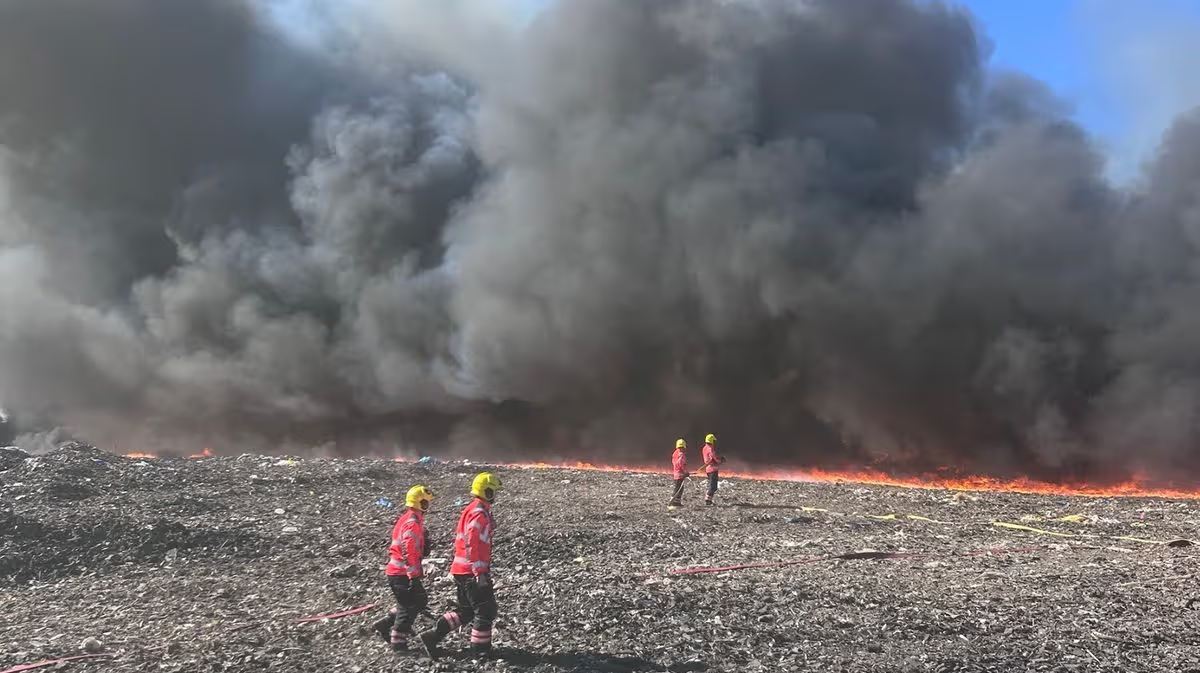
Residents have been told to keep their windows and doors close due to the smoke
Firefighters are currently battling a fire that has broken out at a landfill site in Cambridgeshire. Cambridgeshire Fire and Rescue Service were called to the landfill site on Pools Road, Wilburton, at 3.02pm today (Wednesday, April 22).
Advertisement
Six crews are currently at the scene alongside a water carrier. The incident is ongoing.
Clouds of smoke could be seen for miles. The fire service has told people living near the area to keep their windows and doors closed due to the amount of smoke.
A spokesperson for Cambridgeshire Fire and Rescue Service said: “Firefighters are currently responding to a fire at a landfill site in Pools Road, Wilburton. They were called at 3.02pm. Six crews are currently in attendance, along with the water carrier.
Advertisement
“The incident is ongoing, and those living near the area are asked to close windows and doors due to the amount of smoke.”
To get more news and top stories delivered directly to your phone, join our new WhatsApp community.Click this linkto receive your daily dose of CambridgeshireLive content.
We also treat our community members to special offers, promotions, and adverts from us and our partners. If you don’t like our community, you can check out any time you like. If you’re curious, you can read ourPrivacy Notice.
It is understood that the woman was approached as she walked at Hardwick Park in Stockton, behind the play area at 1.30pm on Monday (April 20).
Officers said the woman managed to escape and didn’t suffer any serious injuries but was “understandably shaken by the incident”.
The man is described as being of medium build, wearing an all-black tracksuit and a face covering and was on a black pedal bike.
Advertisement
A spokesperson from Cleveland Police said: “There were lots of dog walkers and people in the park at the time who came to help the woman and officers would like to speak to anyone who was there at the time.
“Officers would particularly like to speak to a woman who had light-coloured hair and was wearing light blue clothing.”
Anyone with information is urged to contact Cleveland Police on 101, quoting reference number 074004.
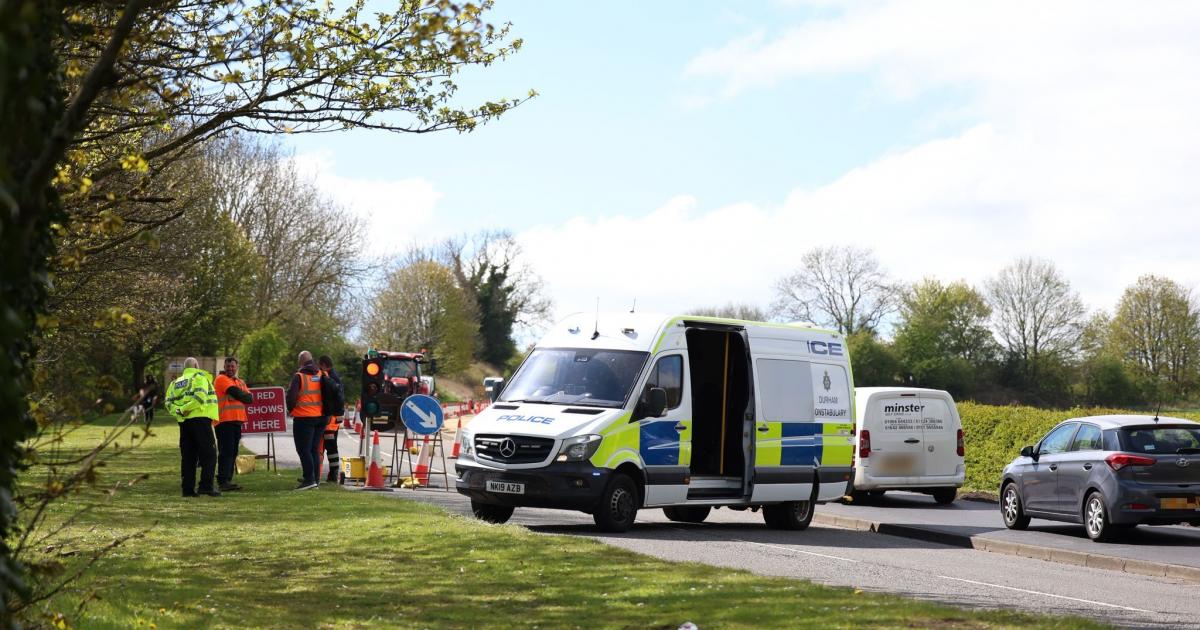
Emergency services were called to the A-road through Hemlington Row at 11.15am this morning (Wednesday, April 22), where the man was briefly trapped.
The 56-year-old is understood to have been loading a cabin onto the rear of a van at around when he briefly became pinned between them and suffered chest injuries.
The air ambulance was seen landing nearby and police closed the road around the roadworks.
The road was closed after incident for around three hours. (Image: SARAH CALDECOTT)
A Durham Police spokesperson said: “The man has suffered chest injuries and was taken to hospital by ambulance. He is said to be in a stable condition.”
Advertisement
The road was closed after incident for around three hours. (Image: SARAH CALDECOTT)
Police have now passed the incident to the Health and Safety Executive (HSE) for investigation.
The road was closed after incident for around three hours. (Image: SARAH CALDECOTT)
The road was closed after incident for around three hours. (Image: SARAH CALDECOTT)
A spokesperson from the North East Ambulance said: “We were called to an incident on the A690, Hemlington Row in Crook shortly before 11.15am on 22 April.
“We dispatched a double-crewed ambulance, a clinical team leader and were supported by Great North Air Ambulance Service.
“One patient was taken by road to University Hospital of North Durham.”
Advertisement
The road was closed for around three hours while the emergency services attended but it has now reopened.
The Northern Echo has contacted the HSE for comment.





















































You must be logged in to post a comment Login