
Crypto World
Volo Exploit Raises Security Concerns Across Sui DeFi Ecosystem

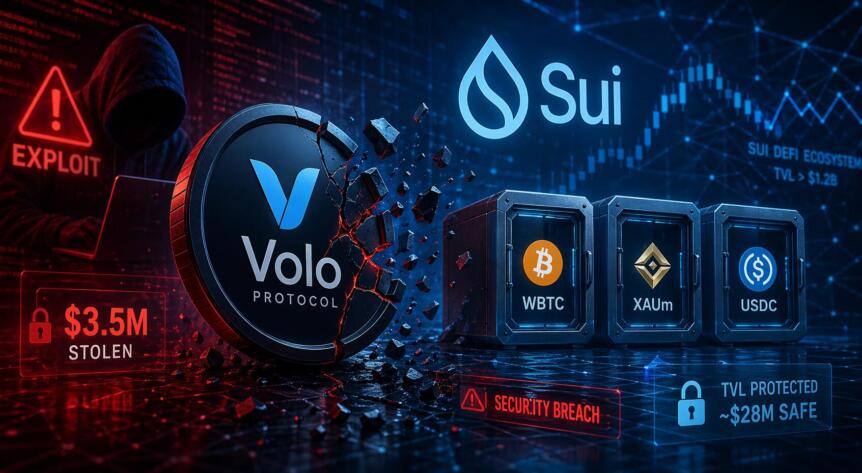
Volo Exploit Raises Sui Ecosystem Concerns
The first significant security breach of a liquid staking protocol occurred on April 22, 2026, when Volo Protocol was robbed of about $3.5 million across three vaults. The attack on WBTC, XAUm, and USDC pools has ignited broader discussion about the robustness of the fast-growing Sui DeFi ecosystem.
The exploit of Volo has quickly become a point of interest among analysts assessing risks in the fast-growing Sui ecosystem. Volo acted quickly to assure users that the breach had occurred and that it would cover all losses. Approximately $28 million TVL in unaffected vaults remained locked and safe after the team halted protocol activity within hours of learning about the exploit.
The most important question when it comes to ongoing research on the Volo exploit is whether it was an idiosyncratic flaw in the Volo vault design or a sign of systemic vulnerabilities in the Sui DeFi ecosystem. Early statements from the team suggest the issue was vault-specific rather than protocol-wide, meaning the Volo exploit was contained by design rather than by chance.
Volo Exploit Mechanism Still Under Investigation
However, uncertainty still surrounds the exact mechanism behind the Volo exploit. The attack mechanism remains not fully disclosed, and inquiries continue into the possibilities of the attack, flaws in the smart contracts, manipulation of oracles, or systemic vulnerabilities. A formal post-mortem should help clarify the root cause, and preliminary commentary suggests a possible network-level vulnerability.
Blockchain detective ZachXBT found that the funds associated with the Volo exploit, estimated to amount to about half a million dollars after the attack, were tracked to wallets controlled by attackers soon after the incident. The Sui Foundation has also joined recovery efforts and is organizing on-chain tracking.
The swiftness with which containment measures were implemented is one of the most remarkable features of the Volo exploit. The protocol was able to identify the breach, freeze all the vaults, and notify ecosystem partners within hours, which helped limit the loss to three impacted pools. This quick response served to avert what would have been a much greater loss across the platform’s $31.5 million TVL.
$1.2B Ecosystem Tested By Exploit Incident
Remarkably, vault isolation—intended to decrease systemic risk—proved a double-edged sword: it created a single point of failure yet helped avoid a complete protocol collapse. Whether such design decisions reduce or increase impact remains a hot topic among critics.
As the Sui DeFi ecosystem expands, with over $1.2 billion in TVL reported, the Volo exploit serves as a stress test of the network’s security assumptions. The event raises larger questions about whether the scaling of decentralized finance is being matched by mature risk controls.
In the meantime, the investigation continues, and the Volo exploit remains an important warning sign and an essential data point in understanding the evolving security landscape of next-generation DeFi systems.
Conclusion
Investigations into the Volo exploit are ongoing, with analysts seeking to determine whether the breach stemmed from an isolated vault flaw or deeper ecosystem risks. While funds were partially traced and losses contained, the incident has intensified scrutiny of security practices across Sui’s rapidly expanding DeFi infrastructure.
Summary
- Volo Protocol was hit by an exploit affecting vaults.
- Cause unclear: vault flaw versus Sui ecosystem risk.
- Incident raises concerns over Sui DeFi security.
Glossary of Key Terms
- Volo Exploit: Security breach that caused losses in Volo Protocol vaults.
- Volo Protocol: Liquid staking platform on the Sui blockchain.
- Liquid Staking: Using staked crypto while still earning rewards.
- Vaults: Smart contract pools holding user deposits.
- WBTC: Bitcoin represented as a token on Ethereum/Sui.
- XAUm: Tokenized asset used in Volo vaults.
- USDC: USD-pegged stablecoin used in DeFi.
- TVL: Total value locked in a DeFi protocol.
- Sui Ecosystem: DeFi network built on the Sui blockchain.
- On-chain Tracking: Tracing funds via blockchain data.
- Sui Foundation: Organization supporting Sui blockchain growth.
- DeFi: Decentralized finance without intermediaries.
FAQs
Q1: What is the Volo exploit?
A security breach on April 22, 2026, where about $3.5M was stolen from Volo vaults.
Q2: Were user funds recovered?
Volo pledged full reimbursement and froze operations, securing about $28M in unaffected vaults.
Q3: What caused the exploit?
The cause is still unknown, with probes into smart contract or oracle-related flaws.
Q4: What is the impact on Sui ecosystem?
It raised security concerns across Sui DeFi as the network continues to grow.

The stablecoin issuer says it has now supported more than 2,300 cases worldwide, including over 1,200 with U.S. agencies.
Tether said Thursday it has frozen $344 million in USDT across two wallet addresses on the Tron blockchain, acting on information shared by U.S. authorities about activity tied to “unlawful conduct.”
The stablecoin issuer said in a statement that the freeze, executed in coordination with the Office of Foreign Assets Control (OFAC) and U.S. law enforcement, prevented further movement of the funds once the addresses were identified. Tether did not specify the underlying alleged conduct.
The action lifts Tether’s cumulative cooperation with U.S. authorities to more than $2.1 billion in frozen assets, out of a global total exceeding $4.4 billion, the company said. Tether added that it now works with more than 340 law enforcement agencies across 65 countries and has supported over 2,300 cases globally, including more than 1,200 tied to U.S. agencies.
“USD₮ is not a safe haven for illicit activity,” Tether CEO Paolo Ardoino said in the announcement. “When credible links to sanctioned entities or criminal networks are identified, we act immediately and decisively.”
Ardoino added that the company combines blockchain transparency with real-time monitoring and direct coordination with law enforcement to “stop funds before they can move.”
The freeze extends a string of high-profile collaborations between Tether and U.S. authorities. The company noted that the Department of Justice has previously acknowledged its support in seizures of nearly $61 million and approximately $225 million tied to pig butchering fraud, a romance-investment scam category that is becoming more widespread.
Tether’s compliance posture has shifted markedly since 2022, when the company declined to preemptively freeze sanctioned addresses following the U.S. Treasury’s action against Tornado Cash. The issuer has since become a central player in cross-border on-chain enforcement, joining with Tron and TRM Labs in September 2024 to launch the T3 Financial Crime Unit, which had frozen more than $300 million in illicitly sourced funds as of late 2025.
The expanded enforcement footprint also coincides with tensifying U.S. regulatory pressure on stablecoin issuers. The GENIUS Act, signed into law in July 2025, requires payment stablecoin issuers to maintain on-chain freezing capabilities and comply with sanctions and AML rules, though final implementing regulations remain pending.
Tether launched its self-custodial wallet earlier this month and last week led a $150 million recovery plan for Drift Protocol following the Solana DEX’s April 1 exploit.
This article was written with the assistance of AI workflows. All our stories are curated, edited and fact-checked by a human.


Attackers hijacked password manager Bitwarden’s CLI version 2026.4.0 through a compromised GitHub Action, publishing a malicious npm package that actively steals crypto wallet data and developer credentials.
Security firm Socket discovered the breach on April 23 and linked it to the ongoing TeamPCP supply chain campaign. The rogue npm version has since been pulled.
Malware Target Risks Crypto Wallets and CI/CD Secrets
The malicious payload, embedded in a file called bw1.js, ran during package installation and harvested GitHub and npm tokens, SSH keys, environment variables, shell history, and cloud credentials.
TeamPCP’s broader campaign is separately confirmed to target crypto wallet data, including MetaMask, Phantom, and Solana wallet files.
According to JFrog, the stolen data was exfiltrated to attacker-controlled domains and committed back to GitHub repositories as a persistence mechanism.
Many crypto teams use the Bitwarden CLI in automated CI/CD pipelines for secrets injection and deployments. Any workflows that ran the compromised version may have exposed high-value wallet keys and exchange API credentials.
Security researcher Adnan Khan noted this is the first known compromise of a package using npm’s trusted publishing mechanism, which was designed to eliminate long-lived tokens.
What Affected Users Should Do
Socket recommends that anyone who installed @bitwarden/cli version 2026.4.0 rotate every exposed secret immediately.
Users should downgrade to version 2026.3.0 or switch to official signed binaries from Bitwarden’s website.
TeamPCP has chained similar attacks against Trivy, Checkmarx, and LiteLLM since March 2026, targeting developer tools that sit deep in build pipelines.
Bitwarden’s core vault remains unaffected. Only the CLI build process was compromised.
The post Bitwarden CLI Supply Chain Attack Puts Crypto Wallet Keys at Risk appeared first on BeInCrypto.
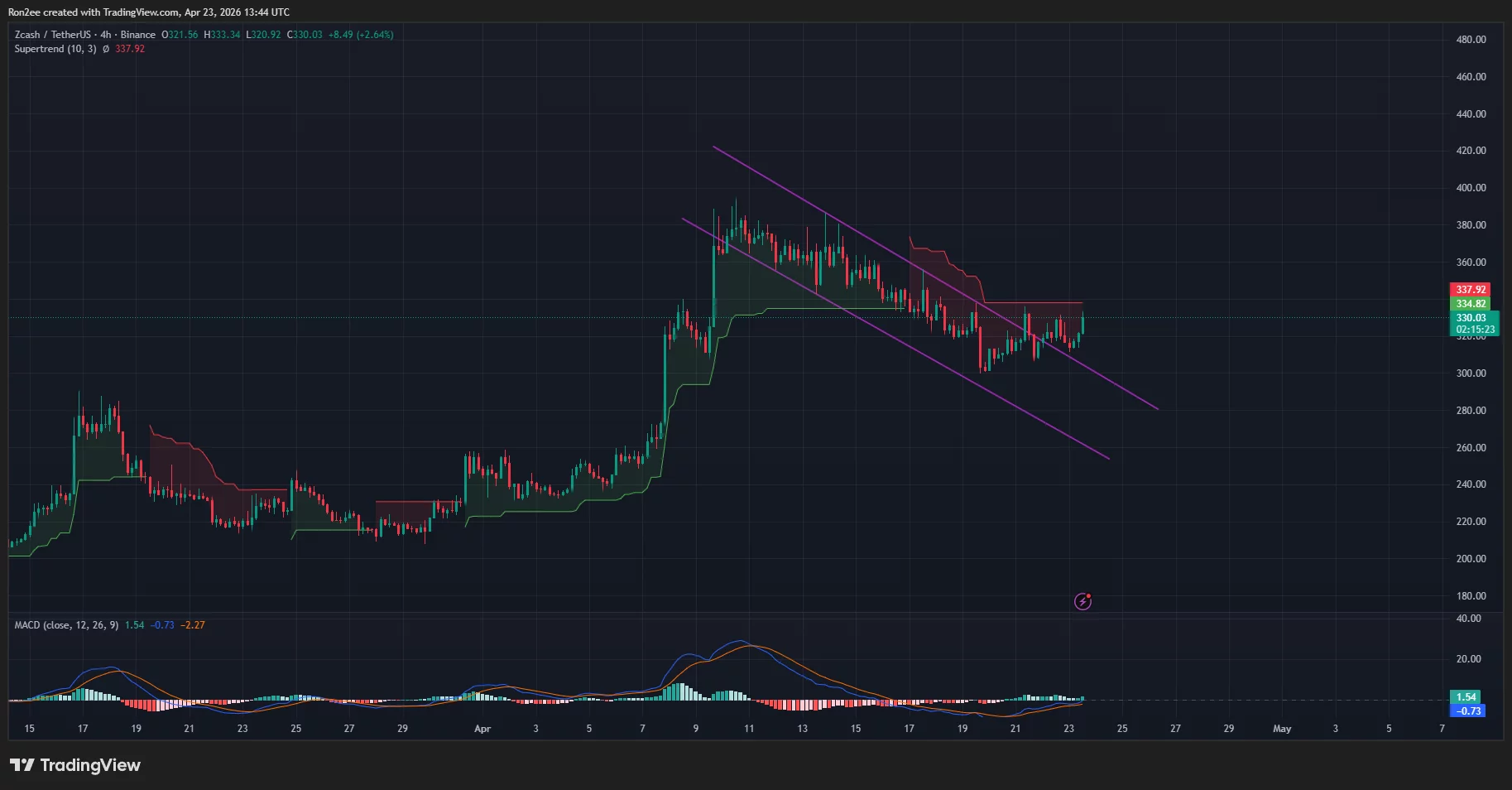
Zcash price rose around 3% on Thursday, holding above the $330 level after breaking out of a descending channel pattern.
Summary
- Zcash price holds above $330 after breaking out of a descending channel, signaling a shift toward a potential bullish trend.
- Grayscale’s spot ETF application and $25 million ecosystem funding round strengthen institutional and fundamental outlook.
- Key resistance lies between $337 and $361, with a breakout potentially opening the path toward the $400 psychological level.
According to data from crypto.news, Zcash (ZEC) was trading right around that $330 mark at the time of writing. This shows the token is holding onto strong gains after successfully reclaiming levels above $300. This move is particularly notable because the token continues to outperform much of the broader crypto market.
Zcash’s latest rally is being underpinned by a confluence of catalysts that have tightened available supply while simultaneously boosting interest from both institutional and retail players.
One of the biggest drivers behind this optimism is the application from Grayscale to convert its Zcash Trust into a spot ETF. If this is approved, it would mark the first regulated privacy-focused crypto ETF in history.
Such a development could potentially open the door for massive institutional inflows. Analysts estimate that this product could attract anywhere between $500 million and $2 billion, which would create a significant demand shock in an already tightening market.
At the same time, the Zcash ecosystem is undergoing a major structural shift. The recently launched Zcash Open Development Lab has secured $25 million in funding from major venture firms, including Paradigm, a16z, and Coinbase Ventures. This initiative signals a clear pivot toward building a broader private financial platform rather than simply remaining a niche privacy coin.
Upcoming product releases like the cashZ wallet and various upgrades to the Zashi wallet are expected to further reduce friction for private transactions and drive broader user adoption.
On-chain data also paints a very bullish picture for the asset. A significant portion of the Zcash supply is currently being removed from circulation. This is happening as a growing share of tokens is locked in shielded pools and institutional holdings.
When you combine this with the reduced issuance following the 2024 halving and additional reward allocations to development reserves, the available float continues to shrink. This sets the stage for a potential supply squeeze that could drive prices even higher.
Zcash price analysis
On the 4-hour chart, Zcash price has broken out from a descending parallel channel that had been capping its price action over the past few weeks. A breakout from a structure like this typically signals the end of a corrective phase and the start of a fresh upward trend.
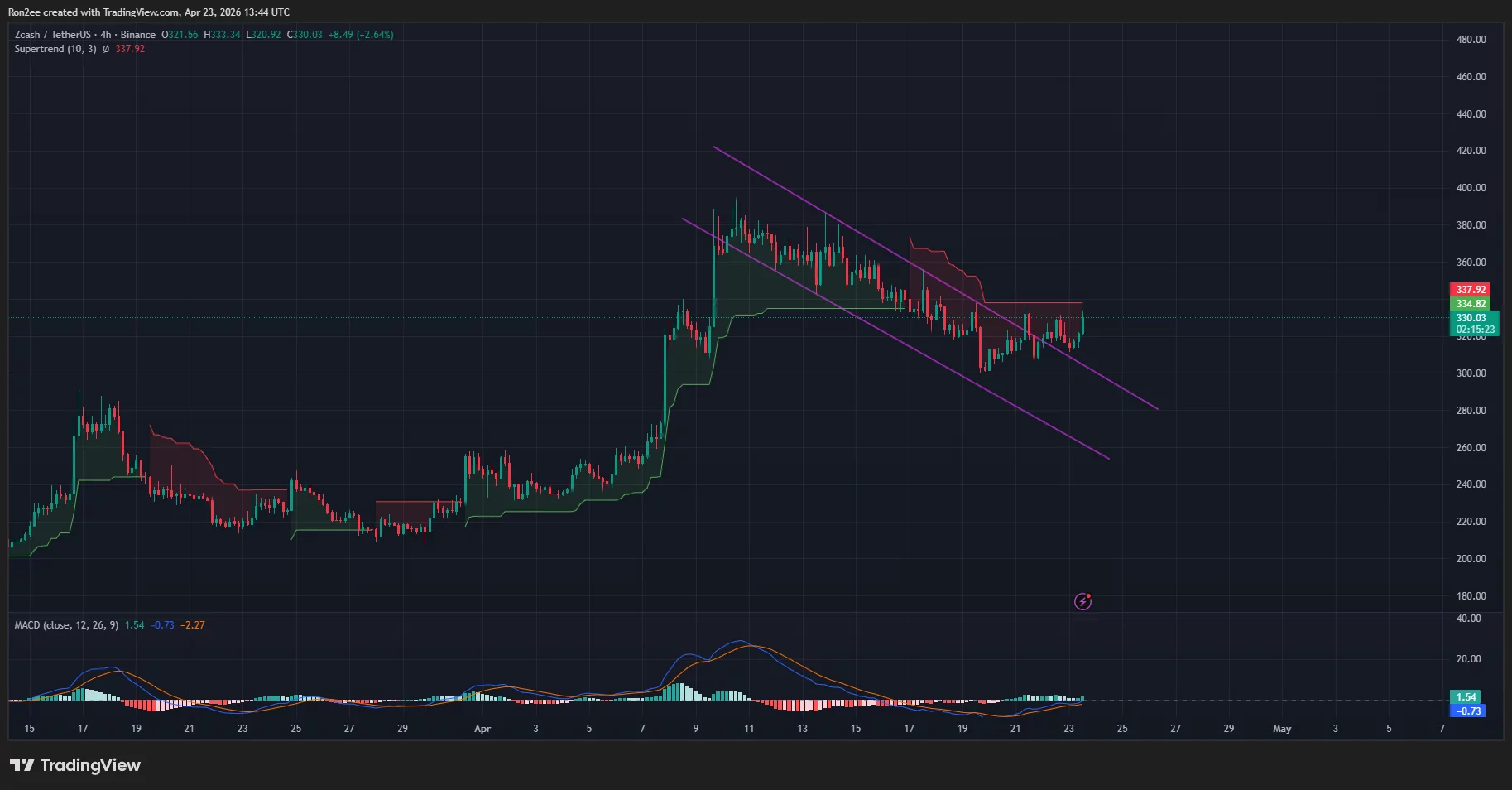
The Supertrend indicator has flipped green and is now acting as dynamic support. This confirms that the short-term trend has shifted in favor of buyers. Meanwhile, the MACD has crossed into positive territory and is trending higher. This indicates that bullish momentum is strengthening after a period of consolidation.
Zcash is now approaching a key resistance zone located between $337 and $361. This area has previously acted as a liquidity barrier. A decisive move above this region could trigger a significant short squeeze. This is especially likely since a large portion of traders remain positioned on the bearish side.
If bulls manage to clear this zone, the next major upside target sits near the $400 psychological level. There is even a potential extension toward the $450 region if momentum continues to accelerate.
On the contrary, a failure to hold above the $300 support level could invalidate this breakout. Such a move might push the price back toward the $280 zone, where it has found demand in recent trading sessions.
Disclosure: This article does not represent investment advice. The content and materials featured on this page are for educational purposes only.
Tether froze $344 million in USDT (USDT) across two Tron wallets in coordination with the Office of Foreign Assets Control and U.S. law enforcement, the company confirmed on April 23.
The action targets addresses flagged for activity tied to sanctions evasion and criminal networks. It represents Tether’s largest single enforcement action to date.
Freeze Tied to Active U.S. Investigations
The two blacklisted wallets held approximately $212.9 million and $131.3 million respectively. Tether said U.S. authorities shared intelligence linking the addresses to unlawful conduct before the freeze was executed, preventing further movement of funds
“USD₮ is not a safe haven for illicit activity. When credible links to sanctioned entities or criminal networks are identified, we act immediately and decisively,” read an excerpt in the announcement, citing Tether CEO Paolo Ardoino who framed the response as part of a broader compliance posture.
Tether now works with more than 340 law enforcement agencies across 65 countries. That cooperation has supported over 2,300 cases globally, with more than 1,200 tied to U.S. authorities.
Surpasses Previous Record
The $344 million freeze dwarfs the previous high of $182 million blacklisted across five Tron wallets in January 2026.
Tether has now frozen more than $4.4 billion in total assets linked to illicit activity, with over $2.1 billion connected to U.S. law enforcement.
The U.S. Department of Justice has previously acknowledged Tether’s role in enforcement actions that led to seizures of nearly $61 million and approximately $225 million tied to pig butchering fraud.
The latest freeze reinforces the argument that public blockchains offer investigators a traceable record that traditional cash transfers cannot.
The post Tether Freezes $344 Million USDT on Tron in OFAC Coordination appeared first on BeInCrypto.

Commercial vessels are seen off the coast of Dubai on April 20, 2026.
– | Afp | Getty Images
Bettors on the prediction markets platform Kalshi don’t think the Strait of Hormuz will be open to normal traffic flows for months.
Odds that traffic will return to normal by June 1 fell below 50% on Wednesday, after the U.S. and Iran extended a ceasefire but neither side disclosed any new agreement regarding Iran opening the Strait of Hormuz or the U.S. ending its naval blockade of the passageway.
On Thursday, President Donald Trump threatened to “shoot and kill” any boat laying mines in the strait, while oil prices climbed higher with Brent crude again above $100 per barrel.
Bettors on Kalshi give just a 42% chance that normal traffic flows through the strait by June 1. They assign a 59% chance that happens by July 1, and a 61% chance by Aug. 1. Kalshi defines normal traffic flows on the contract as the seven-day moving average of transit calls through the strait based on data from IMF PortWatch.
On Polymarket, bettors give a 45% chance that traffic through the strait returns to normal by the end of May, and a 67% chance by the end of June. Polymarket uses the same definition of normal traffic as Kalshi.
Transit through the strait remains low. On Wednesday — the same day Iran said it seized two ships sailing through the strait without authorization — eight ships crossed the strait, including three oil tankers, according to data from LSEG. Before the war, traffic typically included more than 100 ships daily in the strait.
In a Thursday note, UBS chief investment officer for the Americas Ulrike Hoffmann-Burchardi wrote that a reopening of the strait “remains elusive.”
She pointed to comments on Wednesday from Iran’s parliament speaker Mohammad Bagher Ghalibaf, who said the strait will not reopen so long as the U.S. naval blockade is in place.
“These developments point to the challenges of resolving the conflict and reopening the Strait to allow for a normalization of energy flows and production,” she wrote. Hoffmann-Burchardi added, “a prolonged period of elevated energy prices may weigh more heavily on growth.”
Kalshi bettors place the odds of a U.S. recession in 2026, which the platform defines traditionally as two consecutive quarters of negative growth, at just under 26%, down significantly from earlier in the war when it neared 37% at the end of March.
Disclosure: CNBC and Kalshi have a commercial relationship that includes a CNBC minority investment.
Markets shift and headlines fade, but the core principles of building long-term wealth remain constant. Join us for our third CNBC Pro LIVE, where investors of all backgrounds – from financial professionals to everyday individuals – come together to cut through the noise and gain actionable strategies for smarter, more disciplined investing. No matter where you’re starting from, you’ll leave with clearer thinking, stronger strategies. Enter your email here to get a discount code
Crypto World
BNB Price Prediction: If Crypto Is Dead, why Binance Clears $1.09 Trillion in 112 Days?
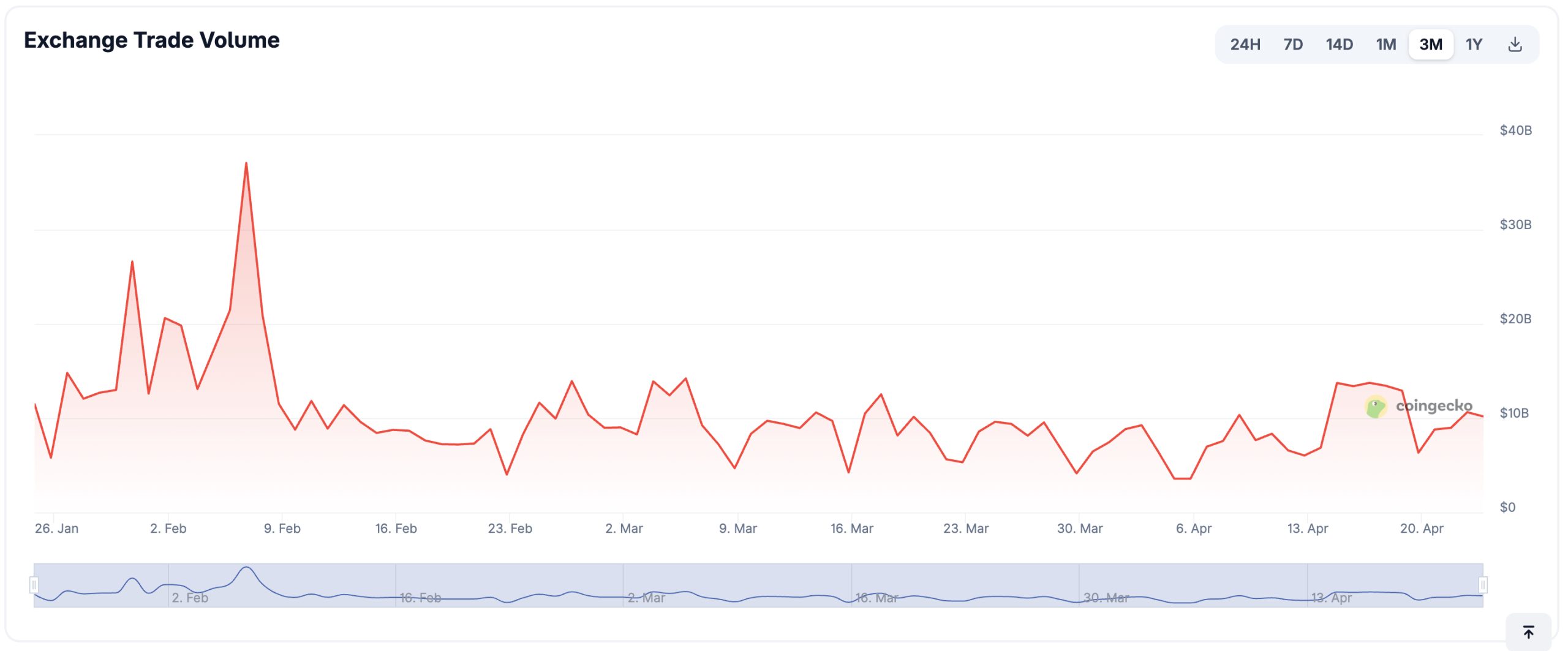
BNB price is doing well, and even our prediction model says so. While crypto obituaries keep circulating on social media, Binance quietly processed over $1.09 trillion in volume across 112 days.
BNB has been grinding through a “boring zone” at $620-$650. It’s a tight range with subdued headlines, deceptively active accumulation underneath. Recent 48-hour data shows more than $90 million USDT in trading volume, with interests clustering near the $625–$640 resistance band.
Bitcoin’s weekly 5% gain is lifting altcoins, giving BNB a tailwind, but the MACD is softening, which complicates the bullish read. As we know, altcoin strength hinges entirely on Bitcoin movement. The technical setup is more nuanced than the current price, with BNB having the most holders across L1 ecosystems.
BNB Chain is #1 in Token Holders — MOMO
BNB Chain currently leads all L1 blockchains with 329.5 million token holders, accounting for 18.9% of global market share, surpassing Ethereum at 17.7%. pic.twitter.com/yXC7mmwaxk
 (@momobsc_) April 23, 2026
Discover: The best crypto to diversify your portfolio with
BNB Price Prediction: $700 This Week
BNB 7-day SMA holds at $632, and the 100-period SMA sits below at $629, acting as a tight floor. The price is coiled between these levels in a classically ambiguous structure, with a finished head-and-shoulders pattern as the price starts to recover.
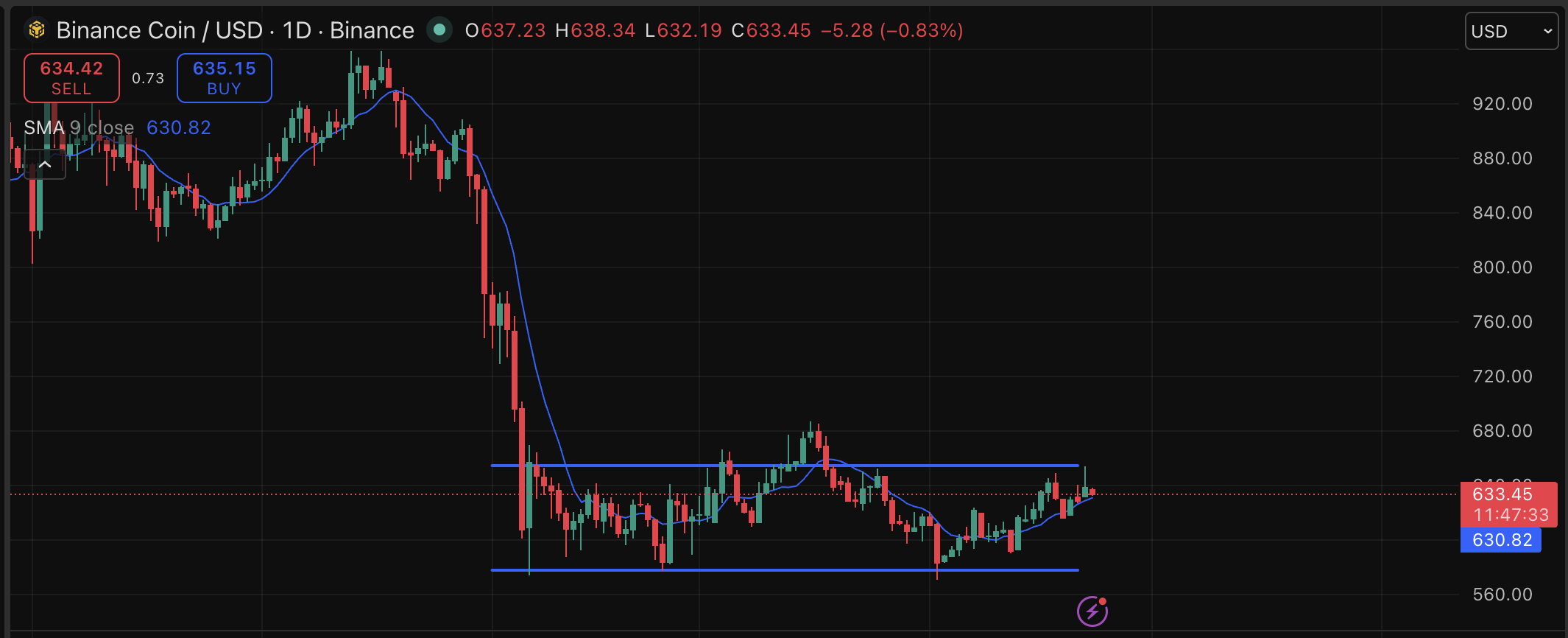
Key resistance is still sitting at $640 as the daily pivot, with meaningful supply clustered at $627–$660. Immediate support is tight at $620, then $610–$600, and a more significant demand zone at $507 if macro conditions deteriorate sharply, which has a razor-thin chance, but can happen.
The MACD weakening while volume rises is an unusual divergence; it either resolves as a false breakdown before a surge or confirms distribution near resistance. Watch the $630 close for directional confirmation.
Discover: The best pre-launch token sales
Bitcoin Hyper New BNB?
BNB at $634 represents a mature, large-cap asset with real utility, but also real ceiling constraints at the current market cap. Capturing another 10x from here requires the kind of macro tailwind that lifts entire cycles.
There’s a different risk profile than finding asymmetric exposure earlier in the curve. Some traders are rotating into earlier-stage infrastructure plays while BNB consolidates, looking for leverage that the large-cap can’t provide.
Bitcoin Hyper ($HYPER) is one project drawing that capital. It’s positioned as the first Bitcoin Layer 2 with Solana Virtual Machine (SVM) integration. HYPER is a technical combination that aims to deliver faster throughput than Solana while inheriting Bitcoin’s security.
The presale has raised $32.5 million at a current token price of just $0.013679, with 36% APY staking available now, only for presalers. Bitcoin’s $1.8 trillion market cap sits on slow, expensive, non-programmable rails, while BTC Hyper’s decentralized canonical bridge and low-latency execution layer are designed to change that.
The post BNB Price Prediction: If Crypto Is Dead, why Binance Clears $1.09 Trillion in 112 Days? appeared first on Cryptonews.
Recent progress in quantum computing has reignited a long-standing concern for bitcoin .
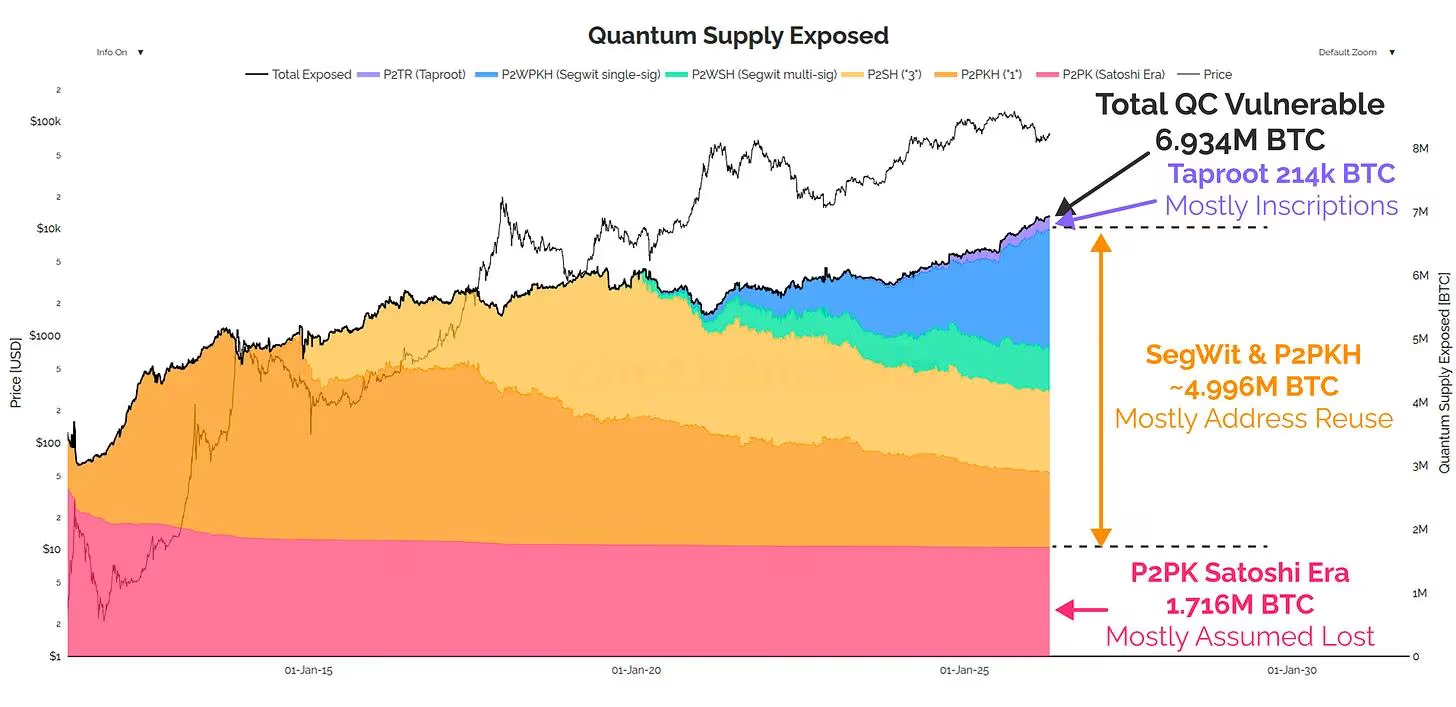
A sufficiently powerful cryptographically relevant quantum computer could, in theory, break bitcoin’s elliptic curve signatures, exposing coins with visible public keys, particularly early Satoshi-era wallets, according to bitcoin analyst James Check.
Quantum doomsayers warn that this would unleash a flood of supply and crash the market. The numbers suggest otherwise.
The threat of quantum computing is not in question.
Roughly 1.7 million BTC sit in Satoshi-era addresses that could be vulnerable under such a scenario. That is about $145 billion at current prices in potential sell pressure, which sounds catastrophic, but is in fact manageable.

During bull markets, long-term holders (investors that have held bitcoin for at least 155 days) routinely distribute between 10,000 and 30,000 BTC per day. At that pace, the entire Satoshi-era supply equates to roughly two to three months of typical profit taking. In the most recent bear market, more than 2.3 million BTC changed hands in a single quarter, exceeding the full quantum “target,” with no systemic collapse.

In addition, monthly exchange inflows approach 850,000 BTC. Derivatives markets cycle through notional volumes equivalent to the entire Satoshi stash every few days. What appears massive in isolation becomes relatively ordinary when set against bitcoin’s existing liquidity and turnover.
A sudden, concentrated release would still matter. It would likely drive volatility and could trigger a prolonged downturn, according to Check. But even that scenario assumes economically irrational behavior. Any actor capable of accessing such a trove would be incentivized to distribute gradually, likely hedging through derivatives to minimize slippage and maximize returns.
Bitcoin markets routinely absorb supply on the same order of magnitude as the P2PK era coins. The timeframe is measured in months, not years.
The real issue is not mechanical sell pressure. It is governance. The bigger issue is potentially freezing the Satoshi coins, through BIP-361, then letting everything play out as it should.
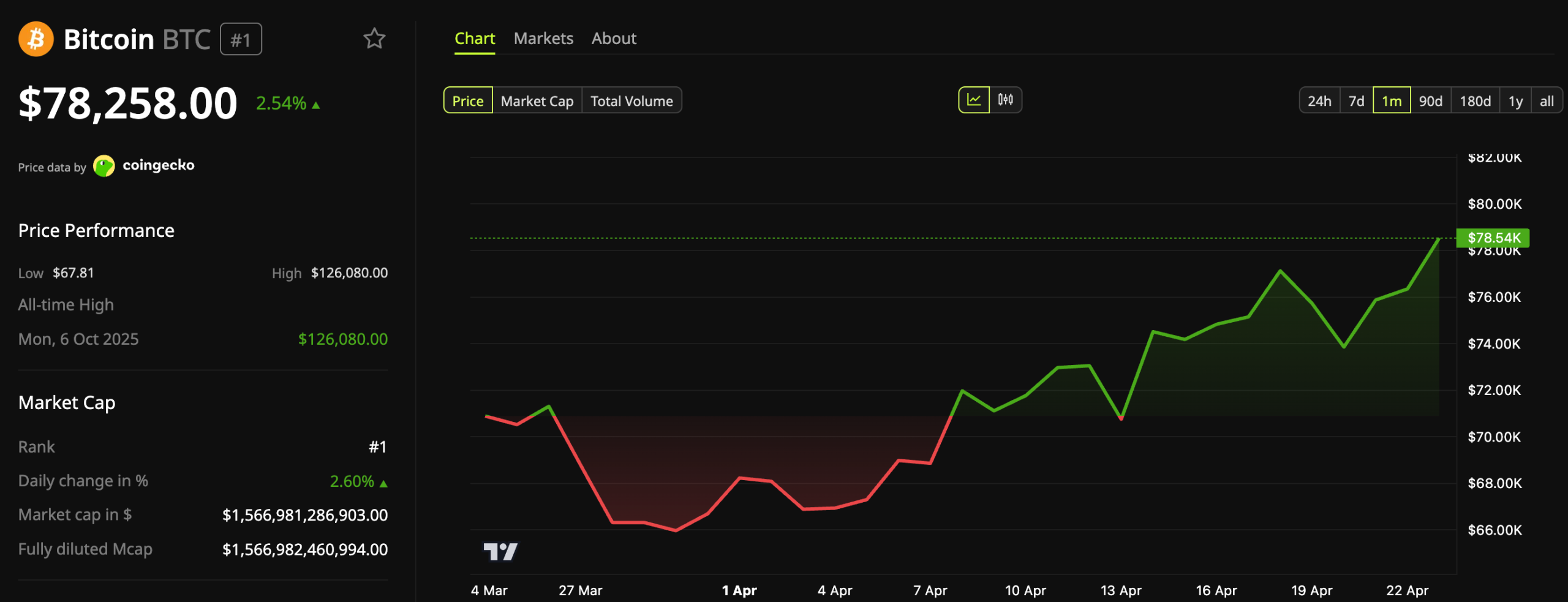
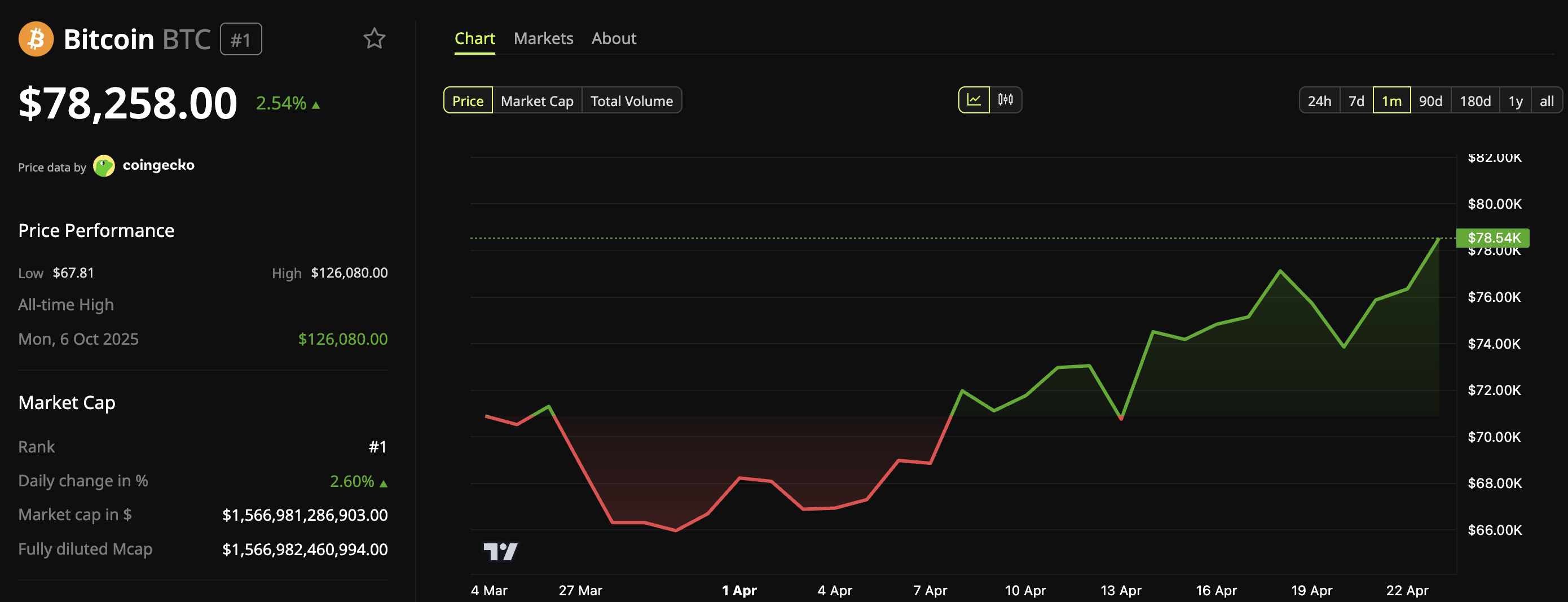
Bitcoin (BTC) has climbed more than 10% over the past month despite persistent volatility. The asset briefly surged past $79,000 in yesterday’s session.
This marked its highest level since early February before easing slightly. At press time, BTC was trading at $78,258, up 2.54% on the day.
However, despite the strong rebound, three key market indicators are now flashing a cautionary signal.
3 Reasons Bitcoin’s 10% Monthly Surge Could Be Hitting a Wall
Julio Moreno, head of research at CryptoQuant, said the rally is fueled by activity in perpetual futures. He added that spot demand continues to contract, although at a slower pace.
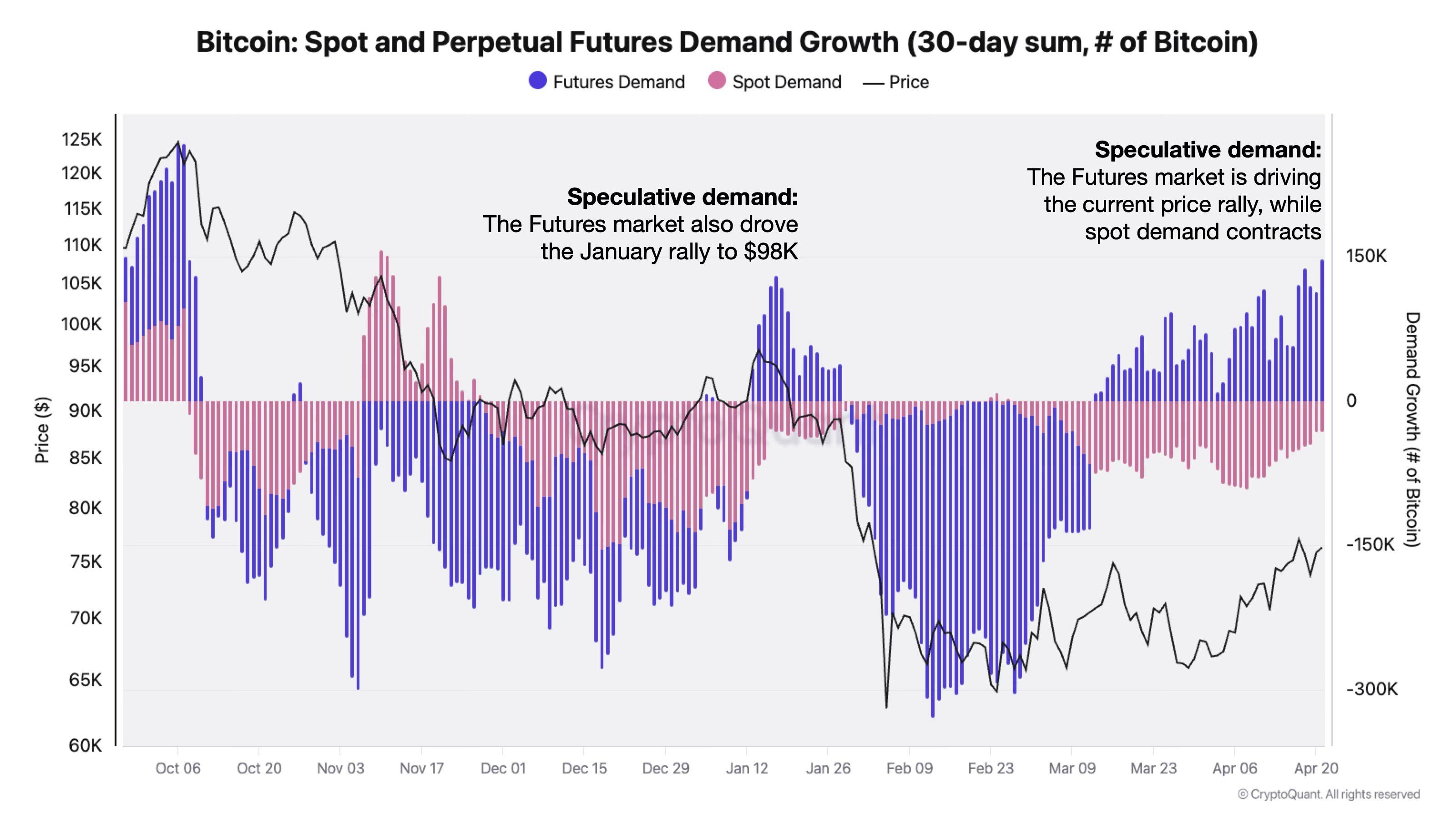
Moreno compared the setup to January, when BTC peaked near $98,000 before reversing sharply.
“There are risks of a correction if traders start taking profits while spot demand continues to contract,” Moreno said.
Subscribe to our YouTube channel to watch leaders and journalists provide expert insights
Glassnode data shows the 24-hour simple moving average of Short-Term Holder Realized Profit has climbed to $4.4 million per hour. That figure is nearly three times the $1.5 million threshold that has marked every local top year-to-date.
“In the absence of a meaningful demand catalyst capable of absorbing this wave of profit realization and sustaining momentum above the Short-Term Holder Cost Basis, a pullback from current levels would be entirely consistent with the pattern this report has outlined. The signals, taken together, point toward caution rather than conviction at this juncture,” the report noted.
Follow us on X to get the latest news as it happens
Lastly, Glassnode stated that BTC broke above the True Market Mean at $78,100, a “development that carries meaningful cyclical significance,” as per the firm. However, the next upside target is at $80,500, the Short-Term Holder Cost Basis.
Investors who accumulated between $60,000 and $70,000 are now approaching profits. According to Glassnode, this cohort has a strong incentive to exit positions. Furthermore, a recovery toward $80,000 would push more than 54% of recent buyers back into profit.
“This dynamic raises the probability of a local top formation in the near term, warranting caution despite the constructive breakout above the True Market Mean,” Glassnode added.
Thus, the warning signals are piling up. Whether fresh demand can absorb the distribution pressure will determine if the rebound extends or reverses.
The post 3 Warning Signs That Bitcoin’s Rally May Be At Risk appeared first on BeInCrypto.

The server returned a “404 Not Found”.
Something is broken. Please let us know what you were doing when this error occurred.
We will fix it as soon as possible. Sorry for any inconvenience caused.
Crypto World
Whales Just Accumulated 800 Billion PEPE Tokens in a Week: Is a Breakout Above $0.0000041 Coming?
PEPE price is trading at approximately $0.0000037, down 4.91% in the last 24h as Bitcoin’s pulls back below $78,000.
Volume tells the real story, 72% above average, with whales accumulating 800B tokens last week alone.
Whether that institutional appetite translates into a sustained breakout or another fakeout depends on one critical resistance level.
Bitcoin price surge early this week came on the heels of President Trump’s announcement extending a ceasefire with Iran, easing geopolitical pressure that had weighed on risk assets.
Spot Bitcoin ETFs have pulled in over $1.9 billion in recent inflows, led by BlackRock’s iShares Bitcoin Trust. The macro tailwind is real, but PEPE’s technical structure suggests the market still has unfinished business below current prices before any serious leg higher.
Meanwhile, broader memecoin momentum is building across the board, with traders rotating aggressively into assets outside the top ten. The setup is forming. Here’s what the chart is actually saying.
Discover: The best pre-launch token sales
Can PEPE Price Hit $0.0000520 Before the Next Bitcoin Correction?
PEPE price is consolidating in what on-chain analysts are calling a historic demand zone, against an all-time high of $0.00002803 set in December 2024, meaning the token is still trading roughly 54% below peak.
Daily trading volume holds firm between $367M and $437M, signaling that demand hasn’t evaporated despite the drawdown.
PEPE price is sitting right under a key trigger, and $0.00000410 is the level that decides whether this turns into continuation or just more chop, because a clean close above it flips resistance into support and opens the path toward $0.0000052, then higher.
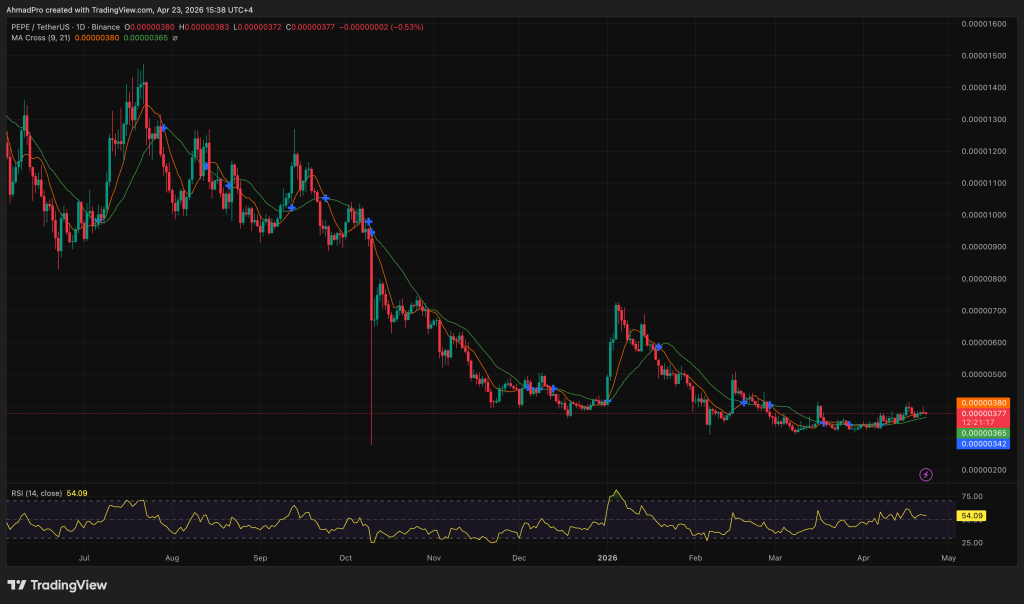
For now, though, it still looks like a waiting phase, with price likely moving between $0.0000037 and $0.0000041 while the market watches Bitcoin before committing to a real move.
The level underneath that matters is $0.00000361, because as long as it holds, the structure stays intact and dips can still get bought, but if it breaks with volume, the setup weakens fast and price likely drops toward the $0.0000030 zone.
Discover: The best crypto to diversify your portfolio with
Maxi Doge Targets Early-Mover Upside as PEPE Tests Key Resistance
PEPE’s $1.62 billion market cap means the math on a 10x from here gets uncomfortable fast. Reaching even half its all-time high requires sustained institutional flow that, candidly, has not yet materialized at scale.
Traders hunting asymmetric upside are increasingly scanning the presale tier, where entry prices are fixed, and the ceiling hasn’t been set by the market yet.
Maxi Doge (MAXI) is one name gaining traction in that conversation.
Built on Ethereum as an ERC-20 meme token, the project pitches itself as a 240-lb canine juggernaut embodying a 1000x leverage trading mentality, complete with holder-only trading competitions, leaderboard rewards, and a Maxi Fund treasury backing liquidity and partnerships.
The tagline is blunt: never skip leg day, never skip a pump.
The presale has raised $4.7M at a current price of $0.0002814, with dynamic staking APY available for early participants.
The project recently crossed a significant presale milestone, and the gym-bro meme culture driving its marketing has demonstrated genuine viral traction. (Meme velocity matters more than most analysts admit. PEPE’s own origin proved that.)
The post Whales Just Accumulated 800 Billion PEPE Tokens in a Week: Is a Breakout Above $0.0000041 Coming? appeared first on Cryptonews.

Tether Freezes $344M USDT in Coordination with U.S. Law Enforcement

Fan Letters: Has David Bruce’s Departure Changed The Dynamic?

Lume Cube Edge Light Go Review (2026): Versatile, Portable

Manchester United reach agreement with Casemiro over contract clause amid transfer speculation

Steven Gerrard disagrees with Gary Neville over ‘shock’ Chelsea and Arsenal claim | Football

US brings back mandatory military draft registration


-

 Sports6 days ago
NWFL Suspends Two Players Over Post-Match Clash in Ado-Ekiti
-

 Fashion6 days ago
Weekend Open Thread: Theodora Dress
-

 Politics6 days ago
Palestine barred from entering Canada for FIFA Congress
-
Entertainment4 days ago
NBA Analyst Charles Barkley Chimes in on Ice Spice McDonald’s Fiasco
-

 Business4 days ago
Powerball Result April 18, 2026: No Jackpot Winner in Powerball Draw: $75 Million Rolls Over
-

 Tech5 days ago
Auto Enthusiast Scores Running Tesla Model 3 for Two Grand and Turns It Into Bare-Bones Go-Kart
-

 Politics4 days ago
Zack Polanski demands ‘council homes not luxury flats for foreign investors’
-

 Crypto World6 days ago
Russia Pushes Bill to Criminalize Unregistered Crypto Services
-

 Politics3 days ago
Gary Stevenson delivers timely reminder to register to vote as deadline TODAY
-

 Business1 day ago
Rolls-Royce Voted UK’s Most Iconic Trade Mark as IPO Register Hits 150
-

 Politics20 hours ago
Disabled people challenge government SEND proposals over segregation concerns
-

 Politics20 hours ago
Making troops accountable for war crimes threatens US alliance, ex-SAS colonel warns
-
 Business7 days ago
Creo Medical agree sale of its manufacturing operation
-

 Crypto World6 days ago
Russia Introduces Bill To Criminalize Unregistered Crypto Services
-

 Politics21 hours ago
Starmer handler McSweeney to be dragged from shadows by Foreign Affairs Committee
-

 Politics21 hours ago
Zack Polanski responds to home secretary’s taser threat
-
Politics22 hours ago
Wings Over Scotland | How To Get Away With Crimes
-
 Crypto World5 days ago
Kelp DAO rsETH Bridge Hack Drains $292M as DeFi Losses Top $600M in Two Weeks
-

 Politics19 hours ago
‘Iran is still a nuclear threat’
-

 Business7 days ago
Cheaper Doritos and Lays helps PepsiCo win back struggling snackers
You must be logged in to post a comment Login