
Crypto World
Project Eleven Awards 1 BTC After Record Quantum ECC Break Raises Crypto Security Alarm


TLDR:
- Project Eleven paid 1 BTC after a researcher broke a 15-bit ECC key using public quantum hardware
- Giancarlo Lelli expanded the previous public quantum ECC record by 512x from the 2025 result
- Around 6.9 million Bitcoin sit in wallets with public keys visible on-chain and exposed
- New research cut estimates for full Bitcoin quantum attacks to as low as 10,000 qubits
Project Eleven has awarded a one Bitcoin bounty after a researcher completed the largest public quantum attack on elliptic curve cryptography to date. The breakthrough involved breaking a 15-bit elliptic curve key using publicly accessible quantum hardware.
The result renewed attention around long-term security risks for Bitcoin, Ethereum, and other blockchain networks using ECC. It also pushed post-quantum security discussions back into focus across the crypto market.
Quantum ECC Break Expands Bitcoin Security Debate
Project Eleven said researcher Giancarlo Lelli won its Q-Day Prize after deriving a private key from a public key across a 32,767 search space. He used a variant of Shor’s algorithm on cloud-accessible quantum hardware.
The method targeted the Elliptic Curve Discrete Logarithm Problem, which supports digital signature systems used by Bitcoin and Ethereum. These systems protect wallets, transactions, and ownership verification across major blockchains.
Project Eleven stated that this was the largest public demonstration of this attack class so far. The previous public record came in September 2025, when Steve Tippeconnic completed a 6-bit demonstration.
Lelli’s result increased that benchmark by a factor of 512. The company noted that no private chip or national laboratory was involved in the test.
Project Eleven CEO Alex Pruden said the falling hardware barrier makes the issue more urgent. He pointed to Google’s public target of becoming quantum-secure by 2029 as a sign that migration timelines are tightening.
The company said roughly 6.9 million Bitcoin remain in wallets with visible public keys on-chain. Those wallets could face exposure if large-scale quantum attacks become practical.
Bitcoin and Ethereum Face Long-Term Post-Quantum Pressure
The gap between a 15-bit test and Bitcoin’s full 256-bit encryption remains large, but recent research has changed the discussion. New estimates suggest the resource demands are falling faster than expected.
Google’s April 2026 whitepaper placed the requirement for a full 256-bit attack at fewer than 500,000 physical qubits. That estimate marked a major reduction from older assumptions.
A later paper from Caltech and Oratomic lowered that figure further to around 10,000 qubits using a neutral-atom architecture. Project Eleven described Lelli’s test as the practical side of those theoretical improvements.
The company said the challenge now looks more like an engineering problem than a physics limitation. That shift matters for Bitcoin, Ethereum, and other ECC-based systems securing more than $2.5 trillion in digital assets.
Project Eleven is now preparing its next challenge around AI models and quantum cryptanalysis. The firm said the next phase will examine how frontier AI tools may accelerate future cryptographic attacks.


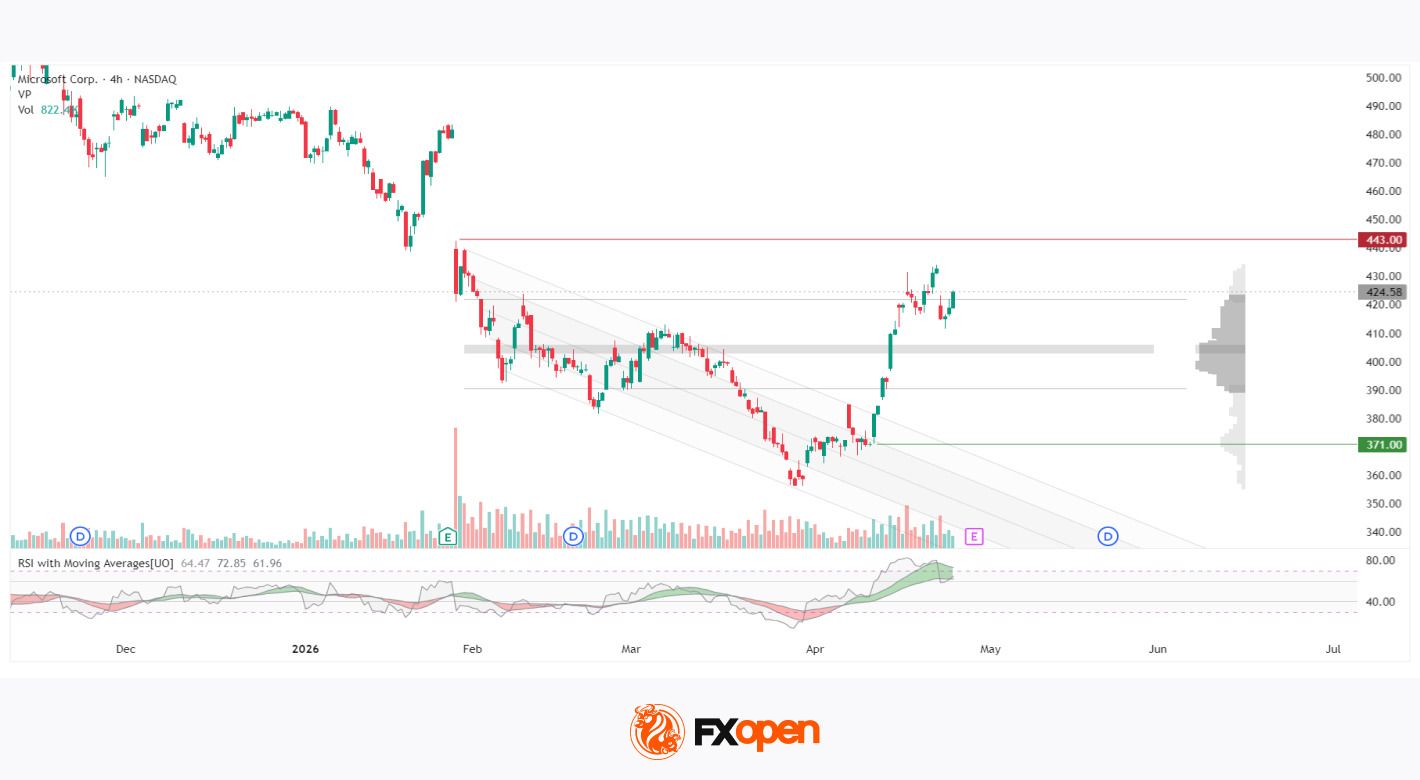
In January, Microsoft shares came under pressure following the company’s earnings report. Although both revenue and earnings per share exceeded analysts’ expectations, growth in the Azure cloud platform slowed to 39% year-on-year from 40% in the previous quarter—enough to disappoint investors. The market is now preparing for the next release: on 29 April, after the close of trading, Microsoft will publish results for the third quarter of its 2026 financial year. Analysts forecast adjusted EPS at $4.04, up 17% from the same period last year. The focus remains on Azure’s performance and the expansion of the paid user base for Copilot within Microsoft 365.
Technical Overview
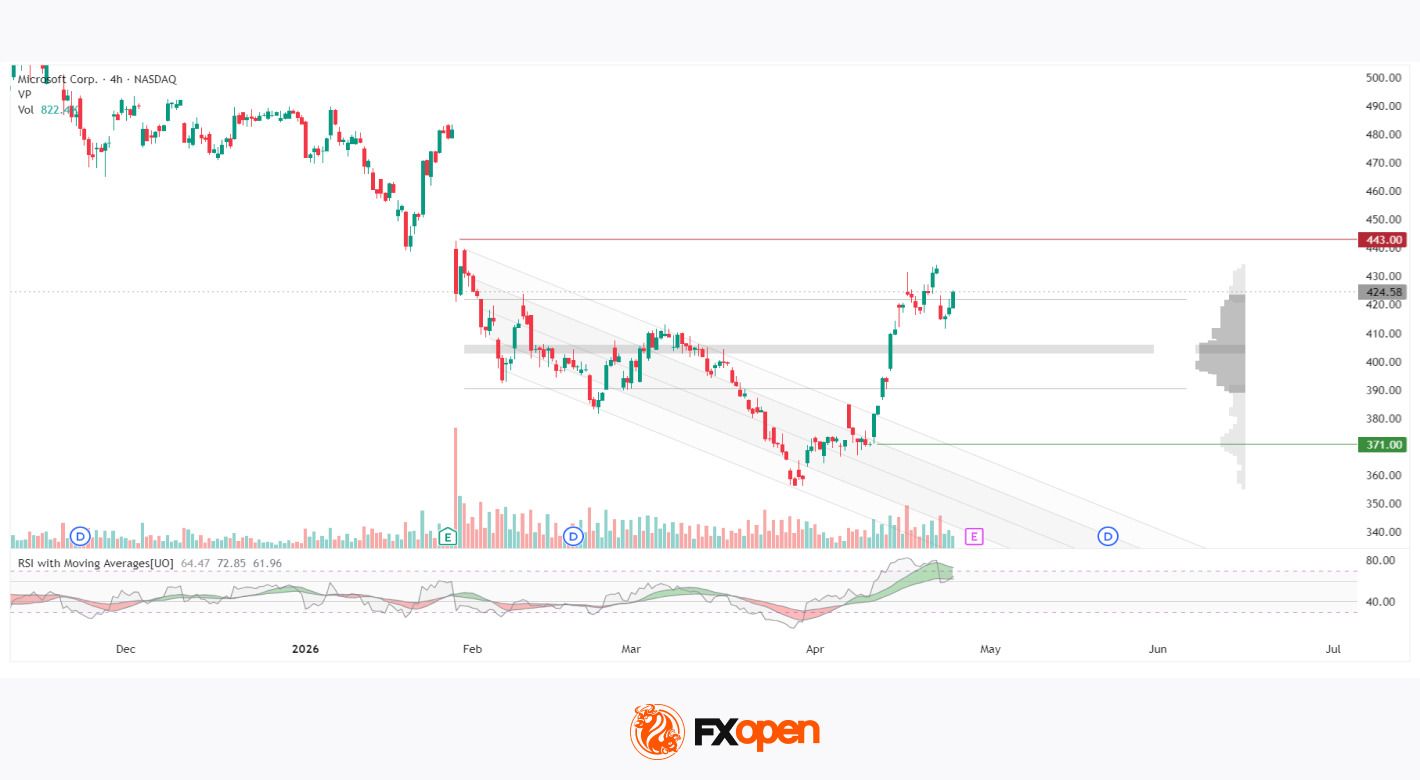
Until late January, Microsoft shares moved sideways, but the 29 January earnings release triggered a sharp gap down accompanied by an abnormal surge in vertical volume, prompting a rapid repricing of the asset. This move laid the foundation for a well-defined downward channel, with the price steadily declining along its boundaries to a low near 357 by the end of March. In April, a recovery pushed the price to around 433, followed by consolidation within the 412–433 range, where it remains ahead of the upcoming earnings announcement.
The horizontal volume balance zone is located at 403–406, with the broader market profile spanning 390–422—current prices are trading above the bulk of accumulated volume. The nearest significant resistance stands at 443, while support levels are seen at 390 and 371. The RSI with moving averages shows readings of 64 / 72 / 61: the oscillator sits between two upward-sloping moving averages, reflecting a bullish bias within the consolidation phase.
Summary
The 412–433 consolidation range is forming just ahead of the 29 April earnings release—an event similar to the one in January that triggered a two-month decline. The volume profile indicates that prices remain above the balance zone at 403–406, while RSI holds in positive territory. The market’s reaction to the upcoming results will determine whether the recovery extends further or the price returns to the prior accumulation range.
Buy and sell stocks of the world’s biggest publicly-listed companies with CFDs on FXOpen’s trading platform. Open your FXOpen account now or learn more about trading share CFDs with FXOpen.
This article represents the opinion of the Companies operating under the FXOpen brand only. It is not to be construed as an offer, solicitation, or recommendation with respect to products and services provided by the Companies operating under the FXOpen brand, nor is it to be considered financial advice.
Crypto World
SK Hynix (000660.KS) Soars to All-Time High Following Intel’s Explosive Earnings Report
TLDR
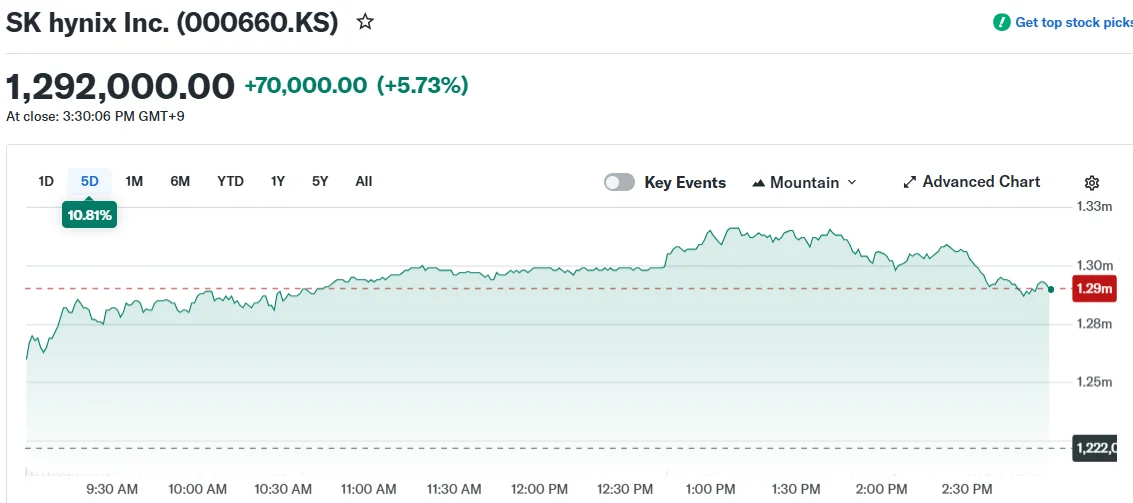
- SK Hynix climbed over 7% during Monday trading, establishing an all-time record
- Intel’s (INTC) robust earnings report triggered the semiconductor sector rally
- The results reinforced bullish sentiment around artificial intelligence chip requirements
- SK Hynix significantly outpaced competitor Samsung Electronics (005930.KS), which advanced 2.5%
- Labor strike threats scheduled for May dampened enthusiasm for Samsung shares
SK Hynix experienced a powerful rally exceeding 7% during Monday’s trading session, establishing a new all-time peak as semiconductor manufacturers benefited from Intel’s impressive quarterly performance.
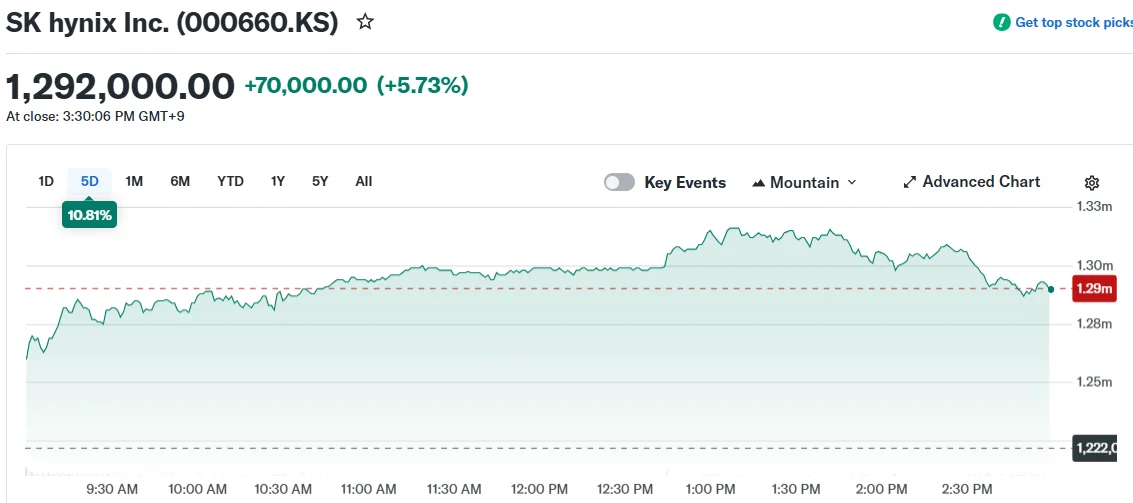
Intel delivered results robust enough to reignite market enthusiasm regarding AI-powered semiconductor requirements. This positive sentiment cascaded throughout the chip industry, with SK Hynix — a critical memory component provider for Nvidia — emerging as one of the session’s top performers.
The advance elevated the South Korean manufacturer to unprecedented territory, underscoring its increasingly vital role within the artificial intelligence infrastructure ecosystem.
Samsung Electronics posted positive movement as well, climbing approximately 2.5% in the same trading period. However, the advance occurred under less favorable circumstances.
The electronics giant confronts potential labor action from unionized employees in South Korea during the upcoming month. This uncertainty constrained Samsung’s upward momentum and expanded the performance differential between the two competitors.
For SK Hynix, the trading day unfolded without complications. No comparable challenges restrained its impressive ascent.
Intel’s Earnings Spark the Move
Intel’s quarterly disclosure served as the primary driver. While Intel itself skyrocketed approximately 23% on the back of its announcement, the broader implications for AI semiconductor demand generated movement across companies like SK Hynix.
Memory components represent essential elements of AI computing architecture. As requirements for AI processing units expand, demand simultaneously increases for the high-bandwidth memory solutions that SK Hynix manufactures. Market participants reacted decisively.
Intel’s earnings triumph provided investors with compelling evidence that AI hardware expenditures remain robust — and SK Hynix occupies a strategic position within that spending trajectory.
SK Hynix vs. Samsung
The performance disparity between SK Hynix’s 7%-plus surge and Samsung’s 2.5% increase reveals an important narrative. While both corporations compete within identical markets, SK Hynix has cultivated stronger positioning within the AI chip landscape through its strategic Nvidia partnership.
Samsung, notwithstanding its considerable size, entered Monday’s session carrying additional concerns. The possible May labor action introduces operational uncertainty that market participants are factoring into valuations, regardless of the ultimate outcome.
SK Hynix currently faces no comparable obstacles, and Monday’s performance illustrated the significance of that advantage.
The stock’s historic peak arrives as worldwide appetite for sophisticated memory components continues its upward trajectory. SK Hynix’s session advance exceeding 7% ranked among the most impressive performances throughout Asian equity markets on Monday.
Intel’s shares jumped approximately 23.7% in response to its earnings announcement, functioning as the catalyst for the comprehensive chip industry rally.


Markets are leaving April with a plethora of macro events to watch. Four major central banks, the Bank of Japan, U.S. Federal Reserve, European Central Bank, and Bank of England, all set interest-rate policy this week.
Layered on top is a slate of U.S. data including first-quarter GDP and March PCE inflation alongside earnings from Visa, Mastercard, Robinhood and some of the biggest tech companies, whose results could either reinforce or unwind the current tone.
Markus Levin, Co-founder of XYO, told CoinDesk that bitcoin is entering the week “with strong momentum around the $78,000 level, and while the Fed is expected to keep rates unchanged, persistent inflation could reinforce a hawkish tone and we could see bitcoin pull back to $72,000–$74,000 range once again in the short-term.”
Tech giants’ earnings, Levin added, could also be a crucial indicator “in reinforcing or challenging the current trajectory given their outsized influence on equity markets, while developments around the U.S.–Iran talks will steer sentiment through oil and dollar movements.”
What to Watch
(All times ET)
- Crypto
- May 1: Full shutdown of Magic Eden’s wallet services.
- Macro
- April 27, 10:00 p.m.: Bank of Japan Interest Rate Decision est. 0.75% (Prev. 0.75%)
- April 29, 8:45 a.m.: Bank of Canada Interest Rate Decision (Prev. 2.25%)
- April 29, 01:00 p.m.: U.S. Fed Interest Rate Decision est. 3.75% (Prev. 3.75%)
- April 30, 4:00 a.m.: Euro Area Inflation Rate YoY Flash for April (Prev. 2.6%)
- April 30, 6:00 a.m.: Bank of England Interest Rate Decision est. 3.75% (Prev. 3.75%)
- April 30, 07:15 a.m.: European Central Bank Interest Rate Decision est. 2.15% (Prev. 2.15%)
- April 30, 07:30 a.m.: U.S. GDP Growth Rate QoQ Adv for Q1 est. 1.5% (Prev. 0.5%)
- April 30, 07:30 a.m.: U.S. PCE Price Index YoY for March(Prev. 2.8%); Core YoY (Prev. 3%)
- April 30, 07:30 a.m.: U.S. Initial Jobless Claims for period ending April 25 est. 219K (Prev. 214K)
- May 1, 09:00 a.m.: U.S. ISM Manufacturing PMI for April est. 52.5 (Prev. 52.7)
- Earnings (Estimates based on FactSet data)
- April 28: Visa (V), post-market, $3.1
- April 28: Robinhood Markets (HOOD), post-market, $0.4
- April 28: Galaxy Digital (GLXY), pre-market, -$0.65
- April 30: Mastercard (MA), pre-market, $4.41
- April 30: Riot Platforms (RIOT), post-market, -$0.32
- April 30: CoinShares (CSHR), annual report expected
- May 1: WisdomTree (WT), pre-market, $0.25
Token Events
- Governance votes & calls
- Frax DAO is voting to add sGHO and USCC as yield strategies within sfrxUSD, expanding the stablecoin’s backing asset set. Voting ends April 26.
- Ether.fi DAO is voting on a treasury contribution to restore rsETH’s backing following the KelpDAO bridge exploit. Voting ends April 27.
- Compound DAO is voting on a proposal to update rsETH price feeds on its WETH and wstETH Ethereum mainnet markets. Voting ends April 27.
- Decentraland DAO is voting on the “2030 Transition Plan,” a strategic roadmap for the platform’s governance and metaverse product positioning. Voting ends April 30.
- Nouns DAO (Prop 959) is voting on a 501(c)(3) feasibility study to explore nonprofit status for the DAO, with significant implications for treasury management and grant-making. Voting ends April 30.
- Beefy DAO is voting on Q2 2026 contributor funding and Staworth contributor renewal. Voting for both ends April 30.
- RootstockCollective is voting on a grant milestone payment for Blockscout’s Global Wallet. Voting ends April 30.
- Arbitrum DAO is voting to transfer 6,000 ETH and roughly $150,000 in idle USDC from its main treasury to the Treasury Management Portfolio. Voting ends May 5.
- Unlocks
- Token Launches
- April 27: Chiliz (CHZ) to roll out FanTokens V2.0
- April 28: Binance to delist Dego Finance (DEGO), DENT (DENT) amd
- April 28: Pharos mainnet launches
- April 30: MegaETH (MEGA) token generation event expected to occur.
- May 1: Venice (VVV) to cut token emissions from 6 million to 5 million per year.
Conferences


Bitcoin (BTC) failed to hold its move toward $80,000 after a sudden wave of selling hit the derivatives market. The price dropped about 2.5% within a few hours and moved back below $78,000.
Summary
- Bitcoin dropped below $78,000 after $1.35 billion in hourly sell pressure hit derivatives markets.
- Binance led the move with about $1.2 billion in sell volume within one hour.
- Analysts said negative funding and falling Binance reserves may point to stronger long-term holders.
CryptoQuant analyst Darkfost said there was no clear announcement behind the move. He linked the correction to strong sell activity in futures markets as BTC approached the $80,000 zone.
Darkfost said Binance recorded about $1.2 billion in sell volume within one hour. Across all exchanges, Bitcoin saw about $1.35 billion in selling pressure during the same period.
The analyst said the data shows Binance remains a key venue for Bitcoin derivatives activity. The sharp move forced BTC to reverse before breaking the $80,000 level.
Funding rates remain deeply negative
Darkfost also noted that Bitcoin funding rates have stayed highly negative for several weeks. He said the 30-day cumulative funding rate has reached -7%, one of the lowest readings on record.
Such negative funding can create short-term pressure when traders build aggressive short positions. However, late short entries can later turn into buying pressure if prices move against them.
On-chain data points to stronger holders
Another CryptoQuant analyst, GugaOnChain, said Bitcoin’s current cycle looks different from past panic phases. He argued that large holders did not sell heavily during the recent geopolitical shock.
The analyst said Bitcoin saw early de-risking after the 2025 top. He said weak hands sold during the decline, while stronger investors absorbed supply near lower price zones.
GugaOnChain also pointed to Bitcoin’s realized price and spot recovery as signs of stronger market structure. He said the spot price recovered toward $79,000 while realized price stayed near $54,100.
The analyst added that Binance reserves fell by about 44,000 BTC after the shock. He described this as evidence that coins moved away from exchanges and into longer-term storage.
Bitcoin now trades in a market split between short-term derivatives pressure and stronger spot behavior. Traders are watching whether negative funding will keep weighing on price or create conditions for a short squeeze.
Key Takeaways
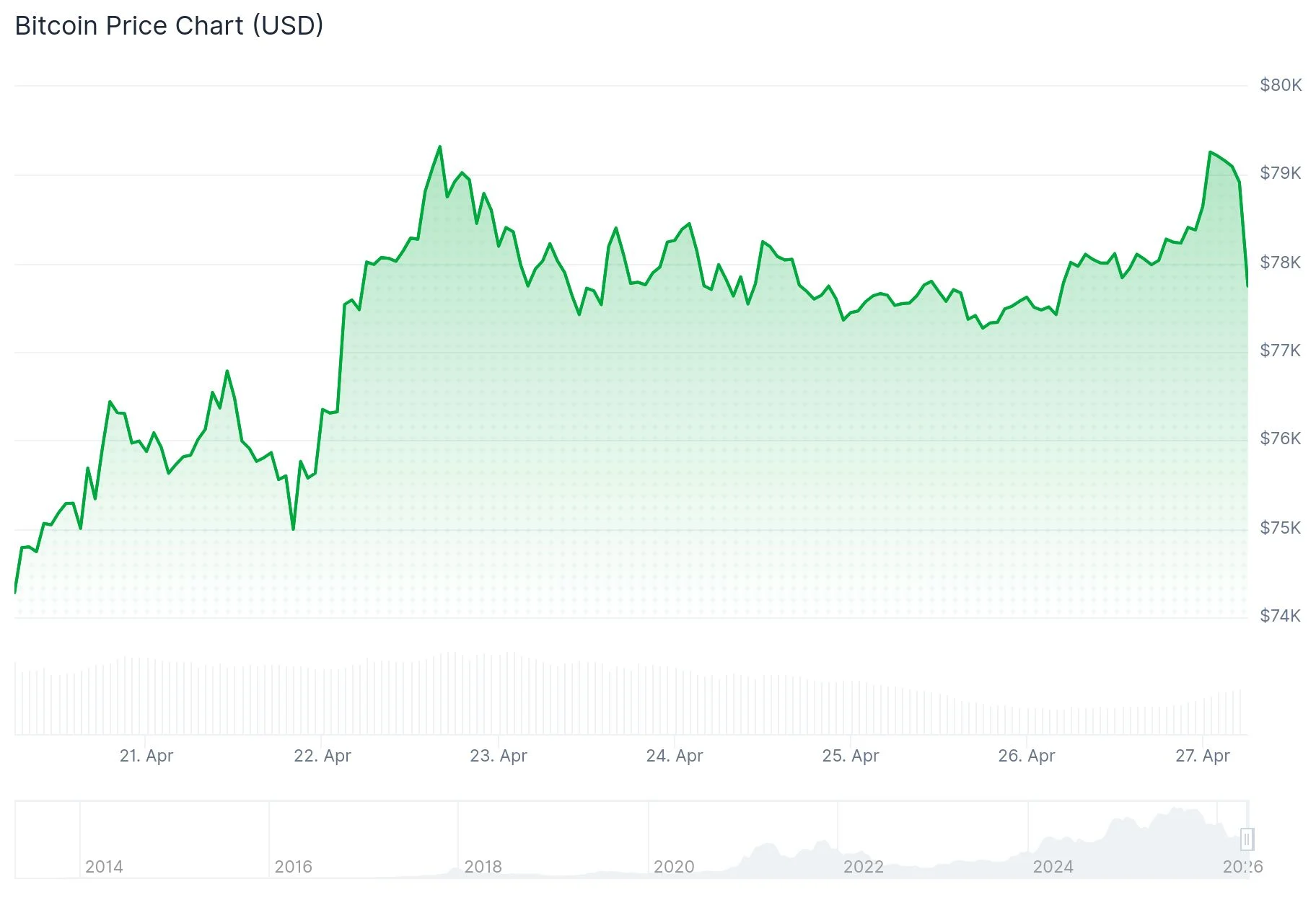
- BTC climbed to a 12-week peak of $79,399 before retreating, representing its fourth unsuccessful attempt to surpass $80,000 recently
- The surge followed news that Iran proposed reopening the Strait of Hormuz, though momentum quickly faded
- April has seen Bitcoin gain 16%, with Strategy accumulating $3.9 billion in BTC during the month
- Equity futures declined Sunday evening as crude oil surged past $100 per barrel amid escalating Iran concerns
- Critical central bank meetings from the Fed and ECB coincide with major technology sector earnings releases this week
Bitcoin surged to $79,399 in overnight trading before encountering resistance and retreating during Monday’s Asian session. The digital asset stabilized near $77,705, representing a modest 0.4% decline over the previous 24-hour period.
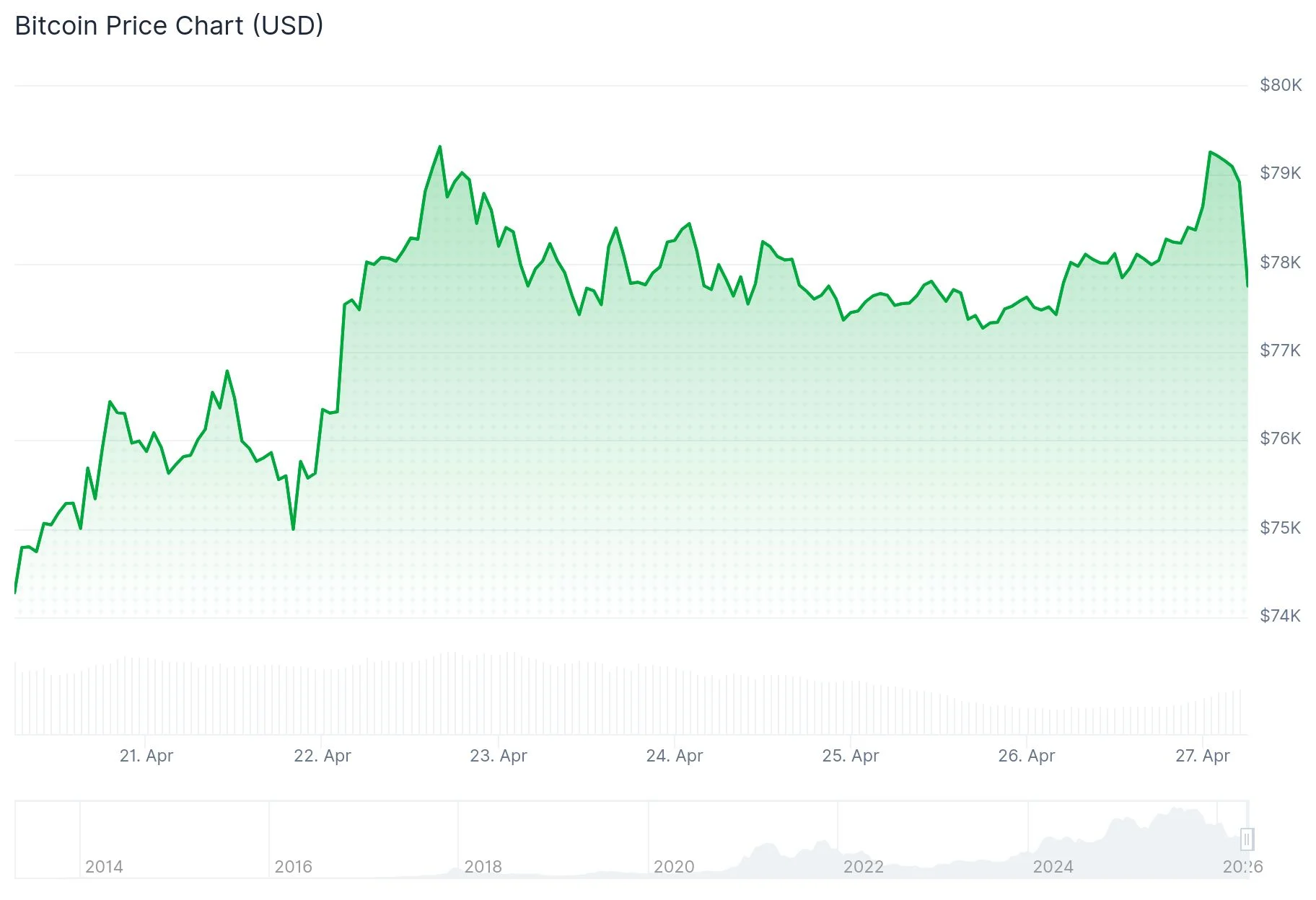
This marked the fourth occasion in recent sessions that bitcoin encountered selling pressure below the $79,000 threshold. The pattern of rejections is establishing a defined resistance zone that traders are monitoring closely.
The upward movement was catalyzed by an Axios report indicating Iran had presented a fresh proposal to restore access to the Strait of Hormuz, connecting nuclear negotiations to the removal of a US naval blockade. The development sent risk-sensitive assets higher initially.
Asian stock markets demonstrated robust gains. The MSCI Asia Pacific Index climbed 1.7%, emerging market indices reached new peaks, and Taiwan Semiconductor Manufacturing jumped 6%. Bitcoin participated in the rally momentarily before momentum evaporated.
Rachael Lucas, an analyst at BTC Markets, noted that the $80,000 price zone represents a breakeven point for numerous recent purchasers. This technical level typically generates selling activity as traders who held losing positions seek to exit without further losses.
The Resistance at $80K Remains Stubborn
Perpetual swap funding rates continue showing negative territory at -0.13% on a seven-day average, data from Coinglass indicates. This dynamic means short position holders are compensating long holders, creating conditions that could produce a short squeeze if bitcoin maintains support above current levels.
Bitcoin is tracking toward its first monthly gain exceeding 10% since May 2025. Strategy executed its largest monthly acquisition in twelve months, purchasing $3.9 billion worth of bitcoin in April, Bloomberg data shows.
Alternative cryptocurrencies also experienced declines. Ether decreased 2.4% to $2,329, Solana retreated 1.9% to $86, while BNB slipped 1.2% to $630.
Equity index futures weakened during Sunday’s overnight session. Dow Jones Industrial Average futures declined approximately 0.2%, with S&P 500 and Nasdaq 100 contracts each falling roughly 0.2%.
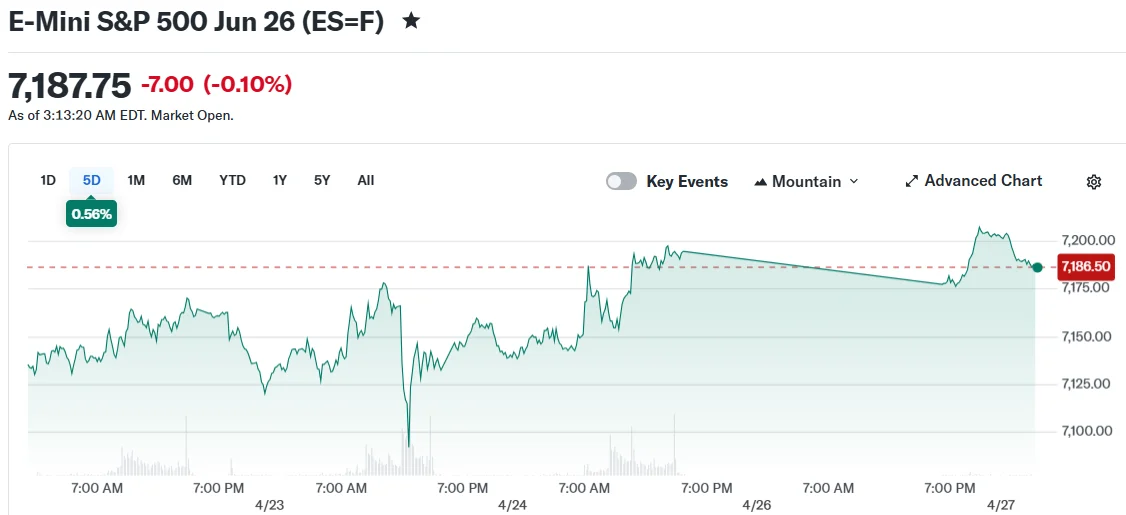
The futures weakness contrasted with last week’s strength, where both the S&P 500 and Nasdaq Composite achieved fresh record closing levels. The S&P 500 advanced more than 9% throughout April while the Nasdaq jumped over 15%.
Critical Week Ahead for Markets
Oil prices extended their advance on geopolitical uncertainty. Brent crude increased approximately 2% to levels exceeding $100 per barrel, with West Texas Intermediate climbing above $96.
Both the Federal Reserve and European Central Bank have monetary policy announcements scheduled this week. This particular Fed meeting holds added significance as one of the final meetings likely chaired by Jerome Powell before Kevin Warsh assumes leadership.
Multiple Magnificent Seven technology companies will report quarterly results this week. Market participants view these earnings as a critical gauge of how mega-cap equities are performing amid current economic conditions.
For bitcoin holders, the focus remains on whether a Fed policy signal or strong corporate earnings can provide the momentum needed to finally breach the stubborn resistance range.
Current market data shows bitcoin trading at $77,705 with persistently negative funding rates and the $80,000 level remaining unconquered after multiple attempts.


South Korea’s internet-only lender KBank has entered into a strategic partnership with Ripple to test blockchain-based cross-border remittances.
Summary
- KBank has partnered with Ripple to test blockchain-based cross-border remittances through a multi-phase proof of concept.
- Testing has moved to a virtual environment where on-chain transfers are being assessed across corridors, including the UAE and Thailand, according to local media reports.
According to multiple local media reports, the collaboration focuses on a proof-of-concept designed to measure improvements in transaction speed, cost efficiency, and transparency using Ripple’s global blockchain network.
Having completed an initial phase, the two firms verified a wallet-based remittance system through an app interface. In the ongoing second phase, reports state that testing has moved to a virtual environment where on-chain transfers are being assessed for stability across corridors, including the UAE and Thailand.
For this stage, KBank is using Ripple’s Palisade platform, a software-as-a-service wallet solution that, according to the same reports, meets international security standards.
Testing expands as regulatory backdrop evolves
Set against South Korea’s upcoming Digital Asset Basic Act, the partnership adds to a growing list of tie-ups between domestic financial institutions and blockchain firms.
Earlier in April, Ripple partnered with Kyobo Life Insurance to support tokenized government bond transactions through its custody platform.
Beyond the proof-of-concept stage, local reports indicate that the KBank partnership could extend into live remittance services and other digital asset initiatives.
As the sole banking partner of Upbit, KBank plays a central role in enabling fiat-to-crypto access under local rules that require exchange users to hold verified bank accounts.
The Upbit relationship has driven user growth, with KBank’s customer base rising from about 2 million in 2020 to 15 million by the end of last year, according to the reported figures.
As previously reported by crypto.news, Ripple recently outlined a four-phase roadmap to secure the XRP Ledger against future quantum computing risks, with Ayo Akinyele stating the threat has moved “from theoretical to credible” and now requires timely preparation.
The plan targets full post-quantum cryptography implementation by 2028, while Phase 2 testing is already underway in 2026, where Ripple’s cryptography team is evaluating NIST-standardised algorithms under live network conditions, including performance impacts on storage, bandwidth, and throughput.
Key Takeaways
- Scallop Protocol experienced a security breach resulting in approximately $142,000 (150,000 SUI tokens) stolen on April 26, 2026
- The vulnerability existed in an outdated V2 rewards contract originally deployed in November 2023
- A critical flaw involving an uninitialized “last_index” variable enabled the attacker to drain the entire rewards balance
- User deposits and primary protocol functions remained secure; normal operations continued within a two-hour window
- The perpetrator has proposed returning 80% of the stolen assets in return for a white-hat reward
A DeFi lending platform operating on Sui Network, Scallop Protocol, suffered a security breach that resulted in approximately $142,000 in SUI tokens being stolen on Sunday following an exploit of a legacy rewards smart contract.
The security incident occurred on April 26, 2026, with Scallop making the breach public at 12:50 UTC through an announcement on X (formerly Twitter).
Rather than compromising the primary protocol infrastructure, the perpetrator focused their attack on an obsolete auxiliary contract connected to Scallop’s sSUI spool—a rewards distribution mechanism designed for SUI token depositors.
The vulnerable smart contract was a V2 spool package that had been deployed in November 2023, making it over 17 months old at the time of exploitation.
On the Sui network, smart contracts become immutable once deployed. Previous versions remain active and accessible unless developers implement explicit version-based access restrictions. This architectural characteristic allowed the legacy contract to persist as an exploitable vulnerability.
The critical security weakness centered on an uninitialized variable named “last_index.” This parameter is designed to monitor accumulated rewards for participants in the staking system. Since this variable was never properly initialized during new account creation, the attacker could join the pool and extract rewards as though they had participated from inception.
The malicious actor staked approximately 136,000 sSUI tokens. Over the preceding 20 months, the spool index had accumulated to roughly 1.19 billion.
This discrepancy enabled the attacker to allocate themselves approximately 162 trillion reward points. Since the rewards distribution system operated on a one-to-one exchange ratio, the entire balance of 150,000 SUI was extracted in a single blockchain transaction.
Blockchain records show the transaction hash 6WNDjCX3W852hipq6yrHhpUaSFHSPWfTxuLKaQkgNfVL documenting the on-chain withdrawal.
Following the theft, the stolen assets were rapidly transferred through a privacy-focused mixing protocol on Sui, comparable to Tornado Cash, significantly complicating recovery efforts.
Team Response and Service Restoration
Scallop’s development team acted swiftly to freeze the compromised contract within minutes of detecting the exploit. Importantly, the core lending and borrowing infrastructure was not suspended. Customer deposits across all other Scallop markets remained fully protected.
The protocol’s leadership confirmed they would absorb 100% of the financial loss using treasury reserves. No reduction in user yield rates will occur as a result of this incident.
By 14:42 UTC, Scallop had reactivated the primary contracts. Standard withdrawal and deposit functionality was restored to normal operation in less than two hours from the initial breach.
Subsequently, the attacker initiated contact with the development team, proposing to return 80% of the stolen funds in exchange for recognition as a white-hat hacker with an associated bounty. The team is currently examining how this vulnerability evaded detection during previous security audits conducted by OtterSec and MoveBit.
DeFi Losses Continue Mounting in April 2026
This security breach comes on the heels of a comparable exploit targeting Volo Protocol earlier this month, which resulted in approximately $3.5 million in losses. Both incidents exploited peripheral contract infrastructure rather than core protocol mechanisms.
April 2026 has witnessed over $600 million in cryptocurrency thefts across 12 significant security incidents. By mid-April, cumulative losses for the month had surpassed $750 million.
Kelp DAO and Drift Protocol together represented approximately 95% of April’s total losses. The Kelp attack independently generated $177 million in bad debt on the Aave lending platform.
Scallop’s team has yet to release a comprehensive post-incident analysis. They have announced plans for an exhaustive security review of all remaining legacy contract packages.
As of this publication, neither the Sui Foundation nor Mysten Labs has issued an official statement regarding the security incident.

About 3.5% of informed traders, including market makers and skilled takers, capture over 30% of profits on prediction platforms, while about 67% of users absorb the entirety of losses.


Cross-border B2B stablecoin payments have been projected to reach $5 trillion by 2035, according to a new report from Juniper Research.
Summary
- Cross-border B2B stablecoin transactions are projected to reach $5 trillion by 2035, rising from $13.4 billion in 2026, according to Juniper Research.
- Juniper Research estimates that B2B flows will account for 85% of total stablecoin transaction value as enterprise adoption expands.
The report published on April 27 has estimated that the total cross-border B2B stablecoin transaction value will climb from $13.4 billion in 2026, with enterprise payments expected to dominate usage over the next decade.
Looking at the data, business-to-business flows are set to account for 85% of all stablecoin transaction value by 2035.
Usage is moving beyond retail trading activity, with companies integrating these tokens into treasury operations, supplier payments, and cross-border settlements where speed and cost remain critical factors.
Cross-border B2B use cases drive growth
Juniper’s findings point to inefficiencies in traditional correspondent banking as a key reason behind this rise. Conventional systems rely on multiple intermediaries, which often leads to delays, foreign exchange costs, and messaging fees.
Stablecoins, by contrast, settle on-chain almost instantly, cutting down both processing time and transaction costs. This makes them particularly useful for high-value corporate transfers, especially in corridors where dollar-backed tokens act as a neutral settlement layer.
“Stablecoins are not replacing payments infrastructure; they are being adopted where the advantages are most pronounced,” said Research Analyst Jawad Jahan.
“Cross-border B2B is where those advantages are greatest, and where we expect the most sustained volume growth over the forecast period.”
Juniper added that payment providers and issuers looking to capture this growth will need to focus on enterprise integrations and partnerships tied to treasury management systems.
Stablecoin activity spans multiple segments, including person-to-person transfers, business payments, consumer transactions, and card-linked usage. Even so, corporate flows are expected to take a clear lead as adoption matures.
Growth narrative meets regulatory caution
Across global policy circles, the rapid rise of dollar-backed stablecoins has drawn closer scrutiny, with central bankers warning that these instruments, while efficient, may introduce risks if they continue to expand outside established financial safeguards.
At a recent seminar in Tokyo, Pablo Hernández de Cos warned that U.S. dollar stablecoins could carry “material consequences” for global economic policy, pointing to concerns around how these assets are structured and redeemed.
He noted that major tokens such as USDt and USDC operate in ways that resemble investment products rather than liquid cash, with redemption conditions and fees that differ from traditional money systems.
De Cos warned that a sudden surge in redemptions could force issuers to liquidate reserve assets such as government debt and bank deposits, potentially creating pressure in underlying markets.
European officials have moved to tighten oversight under frameworks such as MiCA, warning that regulatory gaps could allow issuers to shift operations across jurisdictions during periods stress.
Banks are also testing alternatives that keep digital money within regulated systems, with Swiss institutions including UBS launching pilot projects for franc-denominated stablecoins that combine blockchain efficiency with existing financial controls.


French authorities have indicted at least 88 people over alleged wrench attacks targeting crypto owners.
Summary
- French prosecutors charged 88 people, including ten minors, over alleged crypto wrench attacks on holders.
- Authorities said 75 suspects remain in pre-trial detention as 12 investigations continue in Paris.
- Prosecutors warned crypto holders to avoid online overexposure that could make them physical targets.
The group includes ten minors, said Vanessa Perrée, France’s national prosecutor for organized crime.
The cases relate to 12 investigations handled by specialized judges at the Paris Judicial Court. Prosecutors said 75 of the accused remain in pre-trial detention as law enforcement continues to examine the networks behind the attacks.
Crypto owners face physical extortion threats
Wrench attacks involve physical threats or violence used to force victims to transfer crypto assets. French authorities have linked such crimes to home invasions, kidnappings, extortion attempts and forced wallet access.
PNACO has recorded a sharp rise in these cases. The agency tracked 18 incidents in 2024, 67 in 2025 and 47 so far in 2026, showing how physical crypto-related crime has grown in France.
Perrée said the crimes carry serious legal weight because they involve abduction, detention, extortion and attempts to force crypto transfers. She said the acts were serious because of “the harm caused to individuals” and the methods used.
Investigators have merged several cases after finding repeated links between some suspects. Perrée said these links revealed “the existence of structured networks,” with authorities still working to identify the organizers and money flows.
Security warnings grow for crypto users
The rise in wrench attacks has renewed warnings for crypto holders. Perrée urged users and relatives to stay careful and avoid “overexposure on social networks” that may make them targets.
Security experts have also warned that public displays of crypto wealth can create personal risk. Blockchain security firm CertiK said physical crypto attacks worldwide rose 75% in 2025 from the previous year.
Casa chief security officer Jameson Lopp has tracked wrench attacks worldwide since 2014. His public list shows 29 incidents so far this year, including five cases recorded in April.
Blockchain intelligence firm TRM Labs said such attacks have increased because criminals can connect public wealth signals with personal data found online. The firm also cited the perceived privacy of crypto transfers as a factor behind the rise.
Telegram founder Pavel Durov also commented on the situation in France. He suggested that the rise in attacks may be linked to alleged misuse of crypto investor tax data by a former tax official.
French investigators said their work remains active. Authorities are trying to identify all attackers, trace financial routes and break up the groups involved in the crypto wrench attack cases.

St Georges Primary Westhoughton celebrates 30 years with past staff

Dollar steady as traders eye US-Iran talks, central banks

Microsoft Shares Two Days Ahead of Earnings Release

Manchester United reach agreement with Casemiro over contract clause amid transfer speculation

US brings back mandatory military draft registration

Steven Gerrard disagrees with Gary Neville over ‘shock’ Chelsea and Arsenal claim | Football


-

 Politics6 days ago
Gary Stevenson delivers timely reminder to register to vote as deadline TODAY
-

 Fashion3 days ago
Weekend Open Thread – Corporette.com
-
Crypto World2 days ago
Hyperliquid $HYPE Rally Builds Momentum as AI Sector Enters Prove-It Phase
-
Crypto World7 days ago
Bank of Hawai’i (BOH) Q1 2026: Net Income Drops to $57.4M as Net Interest Margin Expands
-

 Politics5 days ago
Making troops accountable for war crimes threatens US alliance, ex-SAS colonel warns
-

 Politics5 days ago
Disabled people challenge government SEND proposals over segregation concerns
-

 Business5 days ago
Rolls-Royce Voted UK’s Most Iconic Trade Mark as IPO Register Hits 150
-

 Business3 days ago
Patterson-UTI Energy, Inc. (PTEN) Q1 2026 Earnings Call Transcript
-

 Politics5 days ago
Zack Polanski responds to home secretary’s taser threat
-
 Crypto World6 days ago
Five Value Stocks with Recovery Potential in 2026: PayPal (PYPL), Nike (NKE), and More
-
 Sports20 hours ago
IPL 2026: Ruturaj Gaikwad registers slowest fifty of the season, enters all-time unwanted list | Cricket News
-
Politics5 days ago
Wings Over Scotland | How To Get Away With Crimes
-

 Politics5 days ago
Starmer handler McSweeney to be dragged from shadows by Foreign Affairs Committee
-

 Crypto World5 days ago
New York sues Coinbase, Gemini over prediction market offerings
-
 Business5 days ago
HCL Tech share price tank over 9% after weak Q4. JPMorgan, HSBC & 3 others cut target price
-

 Politics5 days ago
‘Iran is still a nuclear threat’
-
Entertainment6 days ago
Sydney Sweeney cameo cut from “The Devil Wears Prada 2”, source explains why (exclusive)
-

 Fashion6 days ago
Kilkenny Design New Beauty Arrivals for Spring 2026
-

 Crypto World5 days ago
Crypto’s great hope in Senate’s Clarity Act still has a path to survive tight calendar
-
 Sports4 days ago
Tim Bradley names the current best in the world: “Better than Inoue and Usyk”
You must be logged in to post a comment Login