
Business
AI-Driven App Creation at Your Fingertips


Have you ever had a brilliant idea for a phone application, only to stop because you do not know how to code? You are definitely not alone. Many great ideas never see the light of day because traditional development takes a lot of time, money, and highly specialized knowledge. But the rules have officially changed. Using an AI app builder, you can now turn your best ideas into fully functioning software.
You get to skip the frustrating learning curve and jump straight into creating something amazing. Artificial intelligence translates your plain English instructions into working features. This puts the power of software creation directly into the hands of entrepreneurs, creators, and small business owners everywhere.
This guide will walk you through exactly how artificial intelligence helps you build, launch, and grow your own application. You will learn how to design beautiful interfaces, connect with your audience, and manage your new project with total confidence.
TL;DR Summary:
- Artificial intelligence translates your everyday words into working software features.
- Smart platforms save you thousands of dollars in expensive development costs.
- Custom apps give you a direct line of communication with your audience via push notifications.
- You can build your project visually, tweaking designs with simple text prompts.
- Launching your own application opens up massive new opportunities for your brand.
From ideas to reality with an AI App Builder
Building software used to mean staring at confusing screens for hours. Now, an AI app builder does the heavy lifting for you. You simply describe what you want your application to do, and the system generates the structure. It is like having a professional developer sitting right next to you, ready to take your instructions and turn them into reality.
You can build features like user profiles, shopping carts, and booking systems just by typing a prompt. If you need a reliable place to start, Base44 is a fantastic option. It gives you intuitive tools to build custom applications without writing a single line of code. You get to focus entirely on how your software solves problems for your users.
This fast process encourages you to experiment. You can test out different features to see what works best. If you want to add a loyalty program for your top customers, you just ask the builder to include one. The system sets up the database, the point tracking, and the reward screens automatically.
You also save an incredible amount of money. Hiring a firm to build custom software can cost tens of thousands of dollars. Smart builders let you launch your project for a tiny fraction of that price. You can take those savings and invest them directly back into growing your brand.

Image source: Base44 – AI app builder
Getting your brand noticed everywhere
An application does much more than just sell products or book appointments. It provides massive business visibility because your logo sits directly on your customer’s phone screen. Every time they unlock their device to check a text message or read the news, they see your brand. This repeated exposure builds strong familiarity and deep trust over time.
You also get to send push notifications directly to their pockets. When you have a big sale or an exciting update, you bypass crowded email inboxes entirely. This direct communication line keeps your audience engaged and excited about what you offer. It turns casual shoppers into fiercely loyal fans who interact with your business daily.
Having your own application also proves you take your business seriously. It shows your customers that you invest in providing them with the absolute best experience possible. People naturally gravitate toward brands that make interacting easy and enjoyable.
Gathering valuable audience insights
When people use your application, you learn exactly what they want. You can see which products they view the most, what time of day they log in, and which features they ignore. This data helps you make much smarter business decisions.
If you notice that a specific video tutorial gets thousands of views, you know your audience wants more of that content. You can confidently adjust your business strategy to give them exactly what they crave.
Designing a great user experience
People expect applications to look beautiful and work flawlessly. If a screen takes too long to load or a button is hard to tap, they will simply delete it and move on. Artificial intelligence helps you design intuitive layouts that guide users naturally from one screen to the next.
The system analyzes thousands of successful designs to suggest the best placement for your buttons, images, and menus. You can easily customize the colors and fonts to match your existing branding perfectly. If a layout feels clunky, you can ask the artificial intelligence to rearrange the elements for better visual flow.
You want to keep your navigation as simple as possible. Make sure your users can find exactly what they need in three taps or less. When you remove friction from the user experience, people stay on your software much longer.
Making accessibility a priority
Great design means ensuring everyone can use your tools comfortably. You want high contrast between your text and background colors so words are easy to read. Make your buttons large enough for thumbs to tap easily on smaller phone screens.
Smart builders often include built-in checks to ensure your layout is legible and accessible. Following these simple design principles shows your audience that you care deeply about their comfort.
Launching and getting downloads
Building your software is only the first part of your journey. Once you finish testing your features, you need people to actually download it. The art of mobile app promotion involves sharing your story across the right channels to build genuine excitement.
Start by telling your existing email subscribers and social media followers about your upcoming launch. Offer them a special discount or exclusive early access if they download the software on the very first day. Giving your biggest fans a VIP experience encourages them to leave glowing reviews.
Artificial intelligence can even help you write catchy social media captions and email newsletters to spread the word faster. You can generate a week’s worth of promotional posts in just a few minutes, keeping your audience excited leading up to launch day.
Optimizing for the app stores
When you submit your project to the major app stores, you want people to find it easily when they search. Write a clear, descriptive title that tells people exactly what your software does. Include relevant terms in your description that your ideal customers might search for.
Include bright, clear screenshots showing off your best features. A short preview video works wonders, too. When people can see exactly how the software works before they download it, they feel much more confident clicking that install button.
Growing and maintaining your project
The best applications evolve based on real user feedback. When people start using your creation, pay close attention to what they love and what frustrates them. You can use your intelligent builder to add new features or fix bugs in just a few minutes.
You never have to wait weeks for an external team to make a simple update. You control the dashboard, so you control the timeline. Keeping your software fresh and updated tells your users that you are actively listening to their needs.
Encourage your users to submit ideas for new features right inside the application. When you launch a feature that a customer specifically requested, they feel incredibly valued. This builds a vibrant, active community around your brand.
Staying consistent with updates
Try to release updates regularly to keep your software running smoothly. You do not need to invent massive new features every week. Sometimes an update just makes the screens load faster or changes a button color for better visibility.
Consistent maintenance shows the app stores that your project is alive and well. This can actually help your software rank higher in search results, bringing you even more downloads over time.
Expanding your toolkit for the future
Once you see how easy it is to create your own software, you will naturally look for more ways to grow your brand. You might start wondering, what is an AI website builder and how can it complement my new application? These smart tools work together to create a cohesive, beautiful experience for your customers across all their devices.
You can build a stunning landing page that directs people straight to your app store links. You can write blog posts that explain how to get the most out of your new features. When your tools talk to each other, managing your business becomes incredibly simple.
You have everything you need to build something incredible. You no longer have to let technical barriers hold your best ideas back. Grab your notebook, write down your goals, and start exploring an intelligent builder today. You are completely ready to turn your vision into a reality that people absolutely love to use.

S&P 500: I'm Chasing This Rally (Technical Analysis)

CHARTCHAI KANTHATHAN/iStock via Getty Images

By Michael Kagan and Stephen Rigo, CFA
Current Conditions Argue for Caution
Market Overview
The first quarter of 2026 was defined by a sharp shift in market leadership and a material deterioration in investor sentiment by quarter end. January and February were relatively calm at the S&P 500 Index (SP500) level, but important changes were already taking place beneath the surface. That calm gave way to volatility in March, when U.S. and Israeli strikes on Iran triggered a broad selloff with the index declining 5.0% during the month. By quarter end, the S&P 500 was down 4.3%, though still up a healthy 17.8% over the trailing 12 months.
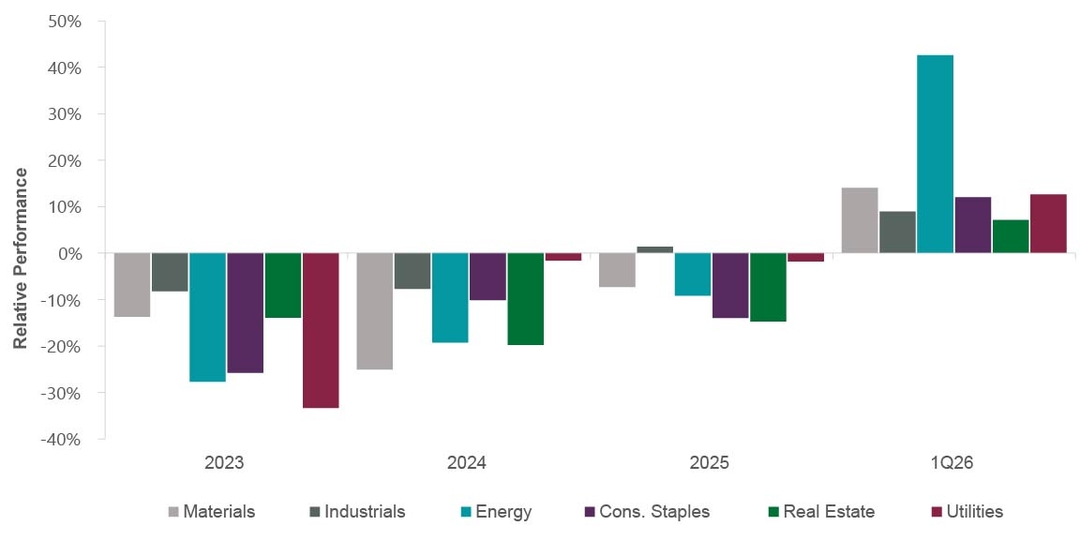
One of the quarter’s defining features was the emergence of new market leadership. Long-lagging sectors outperformed, reversing the AI-driven momentum that dominated the prior three years (Exhibit 1). Materials, industrials, energy, utilities, real estate and consumer staples all outperformed in the quarter despite having lagged the index in calendar years 2023, 2024 and 2025 (save for industrials’ in-line performance in 2025 largely due to AI-levered shares).
“The techno-optimist vision of an “age of abundance,” in which AI, robotics and automation drive sharply lower costs, is being challenged by scarcity across critical inputs.”
Energy was the clear standout, rising 38.2% as the U.S.-Iran conflict pushed crude oil prices above $100 per barrel. Materials also performed well, led by chemicals and mining companies that benefited from concerns around geopolitical supply disruption. Industrials’ outperformance was driven primarily by defense companies and entities tied to AI and energy infrastructure. Finally, consumer staples, real estate and utilities found footing as relative safe havens after a protracted period of underperformance (staples shares have lagged the index by nearly 50% over the past three years).
Exhibit 1: Long-Lagging Sectors Outperformed
As of March 31, 2026. Source: ClearBridge Investments, Bloomberg Finance.
By contrast, information technology (IT) and communication services, which led the market in each year from 2023 to 2025, underperformed sharply in the first quarter, falling 9.1% and 6.9%, respectively. Weakness began in January during earnings season as investors increasingly questioned the return on the substantial capital expenditures being undertaken by major technology companies such as Microsoft, Alphabet, Amazon and Meta. Those concerns broadened over the course of the quarter, moving from hyperscalers to hardware companies (the AI “picks and shovels”) and eventually hit one of the market’s hottest corners: memory. Financials and consumer discretionary also lagged as investors reassessed expectations for capital markets activity, credit quality, travel demand and housing in the face of persistent inflation pressures, particularly higher fuel costs.
Outlook
The near-term backdrop for equities has become less favorable over the past 90 days, and it should remain so even if the U.S. ultimately steps back from its campaign in Iran. The market is now contending with a more complicated mix of slowing labor demand, moderating wages and signs of inflation pressure.
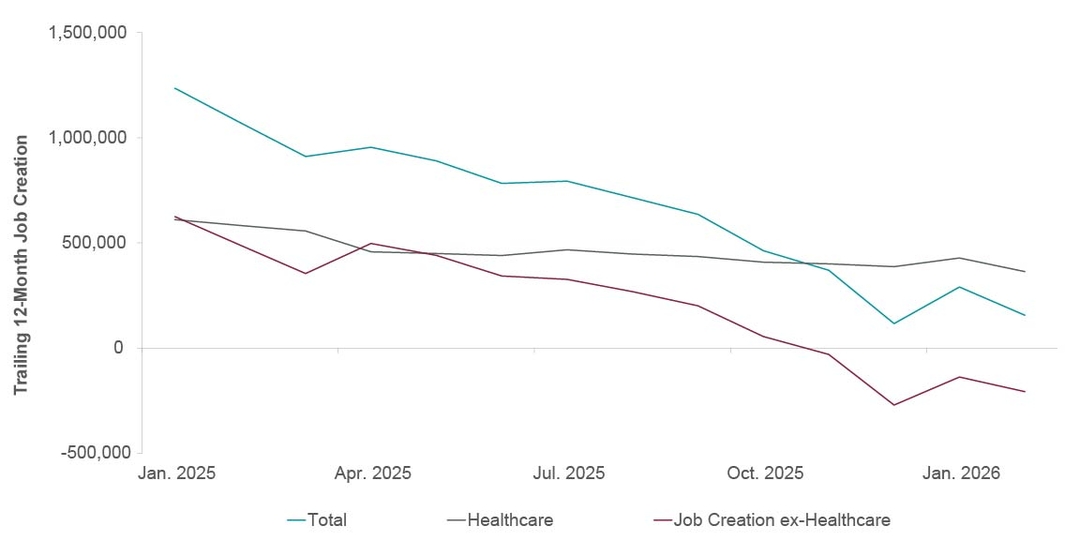
The labor market appears increasingly choppy. While March was a little better, during the previous four months overall payroll growth decelerated. Net job creation was negative excluding health care jobs, a lone bright spot for labor demand (Exhibit 2). Meanwhile, wage growth has steadily declined from its 2023 peak, straining the purchasing power of U.S. consumers, who are already outspending their income, on average. With corporations under pressure to demonstrate efficiency gains from investment in AI and automation, we do not expect labor conditions to reaccelerate meaningfully in the near term.
Exhibit 2: Job Creation Negative Except for Health Care
As of March 31, 2026. Source: ClearBridge Investments, Bureau of Labor Statistics.
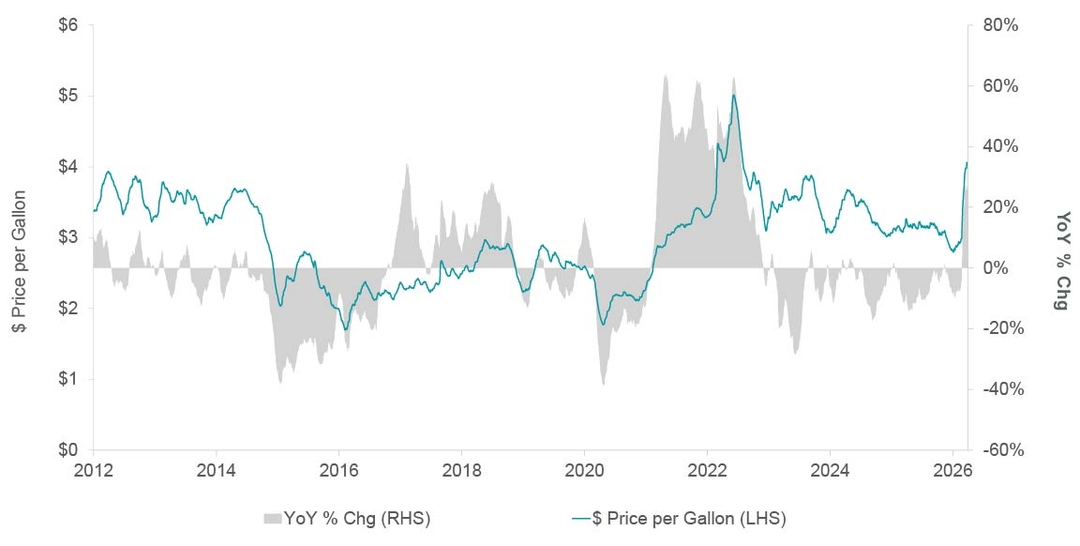
Meanwhile, inflation headwinds are tangible. The politicization and weaponization of energy infrastructure is likely to leave a long tail of higher energy prices. Yes, we are less dependent on oil than in previous energy shocks, but $4/gallon gasoline (up 28% year over year) will divert discretionary spending and mute the impact of higher tax refunds (Exhibit 3). The technology supply chain is also experiencing price pressure. With semiconductor foundries already struggling to meet surging demand, a potential helium shortage (an indispensable gas used in semiconductor manufacturing) due to natural gas infrastructure damage in the Middle East will raise the cost of incremental chip production. In addition, memory shortages driven by insatiable AI demand have pushed spot prices for this commodity materially higher, placing upward pressure on a broad range of products including phones, PCs and gaming consoles. In that context, the techno-optimist vision of an “age of abundance,” in which AI, robotics and automation drive sharply lower costs, is being challenged by scarcity across critical inputs.
Exhibit 3: Daily National Average Gas Prices
As of March 31, 2026. Source: ClearBridge Investments, Bloomberg Finance, American Automobile Association.
This, in turn, creates a difficult backdrop for the Federal Reserve. The Fed’s ability to ease financial conditions to support the labor market appears constrained given price pressure. Cutting rates risks reigniting runaway inflation. Meanwhile, raising rates to tame inflation risks further weakening of an already decelerating labor market. For risk assets such as equities, the concept of a Fed put supporting stocks is harder to bet on today, in our view.If geopolitical conditions stabilize and input cost pressures moderate, the economy may still have enough underlying momentum to move through this period without lasting damage.
“If geopolitical conditions stabilize and input cost pressures moderate, the economy may still have enough underlying momentum to move through this period without lasting damage.”
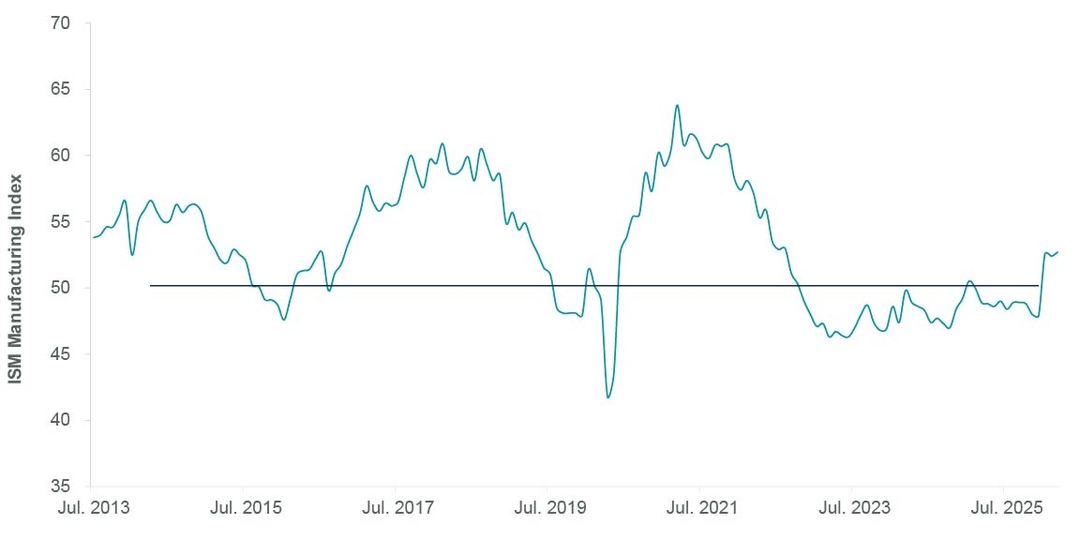
Even so, the outlook is not uniformly negative. The year began with signs of economic acceleration: the ISM Manufacturing Index has posted three consecutive months of expansion (a first since 2022; Exhibit 4), and corporate earnings continue to exceed expectations. The Supreme Court decision has (at least temporarily) rolled back tariffs, and tax refunds may offer a modest near-term cushion for consumers. Finally, equity markets have remained resilient, leaving the wealth effect tailwind in place for America’s highest earners. In sum, if geopolitical conditions stabilize and input cost pressures begin to moderate, the economy may still have enough underlying momentum to move through this period without lasting damage. That possibility argues for selectivity rather than indiscriminate defensiveness.
Exhibit 4: A Return to Expansionary Territory
As of March 31, 2026. Note: A reading >50 denotes expansion, while <50 denotes contraction. Source: ClearBridge Investments, Bloomberg Finance, Federal Reserve.
Conclusion
Current conditions argue for a more cautious stance. The continued strength in high-beta AI and quantum computer stocks during the March market decline indicates that animal spirits remain high. In our view, the “buy the dip” mindset that was so successful over the past decade looks less reliable in an environment where inflation risk, policy uncertainty and labor market softening are all rising simultaneously.
The combination of a softer consumer backdrop and renewed cost pressure meeting a long period of uninterrupted credit expansion (with significant expansion in the unregulated corner of private credit) suggests that the early stages of a credit cycle may be forming. If that proves correct, investors may need to revisit playbooks that have not been relevant in over a decade. Future market corrections, in that scenario, may carry greater risk and last longer than many have come to expect.
As always, we remain focused on through-the-cycle outperformance with an emphasis on downside protection. We are closely evaluating balance sheet strength and cash flow durability across our AI-exposed holdings to ensure our exposure remains concentrated in companies with the financial resilience to withstand a cooling in today’s exceptionally strong environment.
Portfolio Highlights
The ClearBridge Appreciation ESG Strategy outperformed the benchmark S&P 500 Index in the first quarter of 2026. On an absolute basis, the Strategy had positive contributions from five of 11 sectors. The consumer staples and energy sectors were the main positive contributors, while IT, communication services and financials were the main detractors.
In relative terms, overall sector allocation helped while stock selection detracted. Stock selection in financials and consumer discretionary proved beneficial, while stock selection in the materials and IT sectors detracted from relative results. Overweights to materials and consumer staples and an underweight to IT also helped. An energy underweight detracted.
On an individual stock basis, the biggest relative contributors during the quarter were Costco (COST), ASML (ASML), Kinder Morgan (KMI), Eaton (ETN) and Linde (LIN). The biggest detractors were McCormick (MKC), Microsoft (MSFT), Bank of America (BAC) and not owning ExxonMobil (XOM) and Chevron (CVX).
During the quarter, we initiated a new position in Roblox in communication services. We exited Amphenol (APH) in IT and McCormick in consumer staples.
ESG Highlights: Materiality Drives Stewardship Insights
ClearBridge’s approach to ESG integration remains rooted in a simple but enduring principle: material environmental, social and governance factors are integral to long-term value creation. As the global sustainability landscape evolves amid shifting regulatory priorities, geopolitical complexity and rapid technological change, our approach continues to emphasize fundamental research, active ownership and a disciplined focus on materiality.
Our 2026 Stewardship Report highlights how this philosophy is translating into tangible outcomes, underscoring both the breadth of our engagement activity and the depth of our ESG integration across portfolios.
A defining feature of ClearBridge’s ESG integration is our proprietary ClearBridge Materiality Framework™, which identifies the ESG factors most relevant to each sector and subsector. Engagement priorities are derived from this framework at the company level, ensuring that these efforts focus on issues that are financially material and aligned with our fiduciary duty.
In 2025, several key themes emerged as focal points of engagement:
- Decarbonization and climate adaptation
- Critical minerals and human rights
- Biodiversity and natural resource management
- Responsible AI and data governance
- Governance and shareholder rights
These themes reflect both structural global trends and evolving investor priorities. For example, climate-related engagements increasingly addressed not only emissions reduction but also adaptation and resilience topics, such as grid modernization, water management and disaster preparedness. Companies like DTE Energy, a utility making grid modernization and storm hardening investments, and Eaton, which builds backup power and electrical resilience systems, illustrate how investments in infrastructure resilience can support both sustainability outcomes and long-term earnings durability.
Similarly, the energy transition has elevated the importance of critical minerals, where demand for copper, lithium and rare earths is driven by electrification, AI infrastructure and renewable energy deployment. ClearBridge engagements in this area extend beyond environmental impact to include human rights, supply chain practices and community relations, particularly through collaborative initiatives such as PRI Advance, with which we have engaged with mining companies Antofagasta and Freeport-McMoRan.
The integration of new teams across regions in 2025 further strengthened the ClearBridge Materiality Framework™ by incorporating new insights from emerging markets, the U.K. and Australia. This global perspective enhances our ability to identify best practices, anticipate risks and engage companies more effectively across diverse regulatory and operating environments.
Insights from Global Engagements
ClearBridge’s global engagement activity provides a number of practical examples of how ESG considerations translate into investment insights and outcomes. Across regions, the most frequently addressed ESG factors in 2025 included energy transition risks, environmental impacts of operations, community relations, employee health and safety, capital allocation and executive compensation.
Several engagements illustrate our pragmatic approach focused on long-term value creation and positive change:
- Amazon.com (AMZN) (U.S.): Engagements focused on labor practices, safety and environmental efficiency. As of the first quarter of 2025, the company reported a 65% reduction in lost-time injuries over the last five years, progress toward net-zero by 2040 and improvements in logistics efficiency and renewable energy use. These developments demonstrate how operational improvements can enhance both social outcomes and cost efficiency at scale.
- ASML (Netherlands): Discussions centered on water usage, energy efficiency and supply chain emissions. While direct water usage is limited, engagement highlighted increasing regulatory and regional risks — water is a material topic due to increasing regulatory scrutiny, particularly in the Netherlands, and in Taiwan and the U.S. water stress is now considered a medium-level risk — reinforcing the importance of forward-looking risk management even where current exposure appears modest.
- Walmart (WMT) (U.S.): Engagement emphasized workforce development, wages and human rights in the supply chain. The company’s focus on internal upskilling and technology-enabled human rights monitoring illustrates how social considerations can strengthen operational resilience and labor productivity.
- Toronto-Dominion Bank (TD) (Canada): We engaged the company against the backdrop of U.S. regulatory scrutiny tied to material deficiencies in TD’s anti-money laundering (AML) program and proxy advisor recommendations to withhold votes from board members. ClearBridge’s nuanced voting decision in favor of contested directors took into account a meaningful board refresh in 2025 and momentum in remediation; it also reflected insights gained through direct dialogue, highlighting the value of active ownership beyond standardized proxy recommendations.
- Freeport-McMoRan (FCX) (U.S.): Engagement on emissions, water management and human rights demonstrated the complexity of balancing environmental performance with operational realities in resource-intensive industries. Progress on emissions reduction initiatives and disclosure improvements supported continued investment conviction while identifying areas for further engagement.
- Companhia Paranaense de Energia (ELPC) (Brazil): Engagements centered on governance transformation following privatization. Improvements in board independence, disclosure practices and strategic focus highlight how governance reform can unlock value and improve investor confidence in emerging markets.
- MercadoLibre (MELI) (Latin America): Engagement on data privacy and cybersecurity led to improved disclosures and attainment of ISO 27001 certification — an independent, third-party audit confirming an organization’s information security system manages data security risks effectively. This progression highlights how governance and technology-related ESG factors are increasingly central to maintaining customer trust and supporting growth in digital platforms.
Responsible AI and Emerging ESG Themes
One of the most rapidly evolving areas of ESG analysis in 2025 was responsible AI. As AI adoption accelerates across industries, factors such as data privacy, ethical use of AI, labor implications and environmental impacts such as energy and water consumption from data centers have grown in importance in our analysis.
This reflects the increasing importance of technology-driven risks and opportunities in sustainability analysis. Responsible AI is now viewed as a material factor influencing competitive positioning, regulatory exposure and stakeholder trust. ClearBridge’s approach emphasizes balancing innovation with accountability, seeking to ensure that companies adopt AI in ways that are transparent, secure and aligned with long-term societal value.
Conclusion
The 2026 Stewardship Report highlights a year of continued progress for ClearBridge’s ESG platform, characterized by global engagement activity and deeper integration of material sustainability factors into investment decision making. As global markets continue to evolve, our approach positions us to navigate complexity while identifying opportunities that align sustainability with shareholder value.
Michael Kagan, Portfolio Manager
Stephen Rigo, CFA, Portfolio Manager
Editor’s Note: The summary bullets for this article were chosen by Seeking Alpha editors.

Norwegian Cruise Line CEO Harry Sommer opens up about the impact of tariffs on cruise lines and travel on ‘Barron’s Roundtable.’
The U.S. Coast Guard is reportedly searching for a crew member who went overboard from a Norwegian Cruise Line ship bound for Boston after the person was seen falling from the vessel on security video.
The incident involved the Norwegian Breakaway, which was traveling from Bermuda to Boston when authorities were notified that a crew member had gone overboard about 12 miles east of Wellfleet, Massachusetts, according to Boston 25 News.
The vessel returned to the person’s last known position and deployed a rescue boat and life rings in an attempt to help.
“The United States Coast Guard has taken over the search and rescue operation and released the vessel to continue the voyage,” a Norwegian Cruise Line spokesperson told WCVB in a statement. “The safety, security, and well-being of our crew is our highest priority. Our thoughts are with the crewmember’s family during this difficult time.”
CRUISE INDUSTRY GIANT MAKES $100M STRATEGIC BET ON FLORIDA WITH MASSIVE MIAMI HEADQUARTERS

A close up view of the bow of the Norwegian Cruise Line NCL Breakaway ship, Great Stirrup Cay, The Bahamas. (effrey Greenberg/Universal Images Group via Getty Images / Getty Images)
FOX Business reached out to the U.S. Coast Guard and Norwegian Cruise Line for comment.
A Coast Guard helicopter arrived on scene shortly after 1 a.m. ET, and a crew from Coast Guard Station Provincetown joined the search, according to reports.
ROYAL CARIBBEAN PASSENGER ACCUSED OF JUMPING OVERBOARD TO DODGE VACATION GAMBLING DEBT
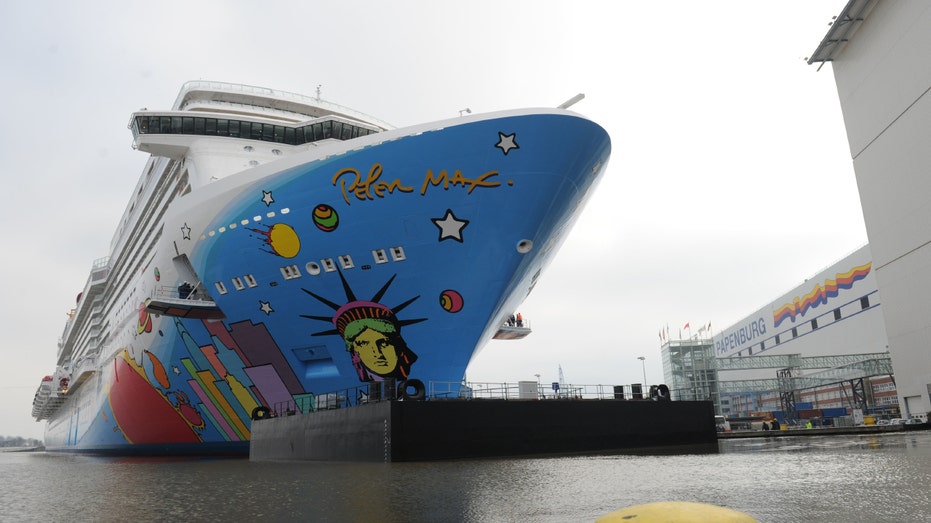
The ‘Norwegian Breakaway’ leaves the port of the Meyer warf in Papenburg, Germany, 13 march 2013. Thereby begins the delivery voyage of the 324m long and 40m wide passenger ship along the narrow Ems river to the North Sea. It is the largest cruise sh (Carmen Jaspersen/picture alliance via Getty Images / Getty Images)
Aerial searches were continuing Sunday morning.
Norwegian Cruise Line had not publicly identified the crew member as of Sunday, and the Coast Guard had not said whether the person had been found. The circumstances surrounding the fall were not immediately clear.
The incident delayed the ship’s return to Boston, according to Cruise Hive, which reported that embarkation for the vessel’s next sailing was expected to be pushed back as the search continued.
| Ticker | Security | Last | Change | Change % |
|---|---|---|---|---|
| NCLH | NORWEGIAN CRUISE LINE HOLDINGS LTD. | 18.51 | +0.09 | +0.49% |
| CCL | CARNIVAL CORP. | 27.17 | +0.52 | +1.95% |
| RCL | ROYAL CARIBBEAN GROUP | 265.84 | +5.41 | +2.08% |
| DIS | THE WALT DISNEY CO. | 102.60 | -1.05 | -1.01% |
| VIK | VIKING HOLDINGS LTD /BM/ | 81.82 | +0.84 | +1.04% |
The reported overboard incident comes weeks after another Norwegian Cruise Line crew member was lost at sea from the Norwegian Viva near Costa Maya, Mexico.
GET FOX BUSINESS ON THE GO BY CLICKING HERE
In that case, the cruise line later confirmed that the search had been suspended.

Invesco is an independent investment management firm dedicated to delivering an investment experience that helps people get more out of life.Be the first to know! Sign up for Invesco US Blog and get expert investment views as they post.Disclosure for all Invesco US articles: Before investing, carefully read the prospectus and/or summary prospectus and carefully consider the investment objectives, risks, charges and expenses. The information provided is for educational purposes only and does not constitute a recommendation of the suitability of any investment strategy for a particular investor. Invesco does not provide tax advice. The tax information contained herein is general and is not exhaustive by nature. Federal and state tax laws are complex and constantly changing. Investors should always consult their own legal or tax professional for information concerning their individual situation. The opinions expressed are those of the authors, are based on current market conditions and are subject to change without notice. These opinions may differ from those of other Invesco investment professionals. NOT FDIC INSURED MAY LOSE VALUE NO BANK GUARANTEE All data provided by Invesco unless otherwise noted. Invesco Distributors, Inc. is the US distributor for Invesco Ltd.’s retail products and collective trust funds. Invesco Advisers, Inc. and other affiliated investment advisers mentioned provide investment advisory services and do not sell securities. Invesco Unit Investment Trusts are distributed by the sponsor, Invesco Capital Markets, Inc., and broker-dealers including Invesco Distributors, Inc. PowerShares® is a registered trademark of Invesco PowerShares Capital Management LLC (Invesco PowerShares). Each entity is an indirect, wholly owned subsidiary of Invesco Ltd. ©2015 Invesco Ltd. All rights reserved.

Earnings call transcript: Capital One Q1 2026 sees EPS miss, stock falls

Invesco is an independent investment management firm dedicated to delivering an investment experience that helps people get more out of life.Be the first to know! Sign up for Invesco US Blog and get expert investment views as they post.Disclosure for all Invesco US articles: Before investing, carefully read the prospectus and/or summary prospectus and carefully consider the investment objectives, risks, charges and expenses. The information provided is for educational purposes only and does not constitute a recommendation of the suitability of any investment strategy for a particular investor. Invesco does not provide tax advice. The tax information contained herein is general and is not exhaustive by nature. Federal and state tax laws are complex and constantly changing. Investors should always consult their own legal or tax professional for information concerning their individual situation. The opinions expressed are those of the authors, are based on current market conditions and are subject to change without notice. These opinions may differ from those of other Invesco investment professionals. NOT FDIC INSURED MAY LOSE VALUE NO BANK GUARANTEE All data provided by Invesco unless otherwise noted. Invesco Distributors, Inc. is the US distributor for Invesco Ltd.’s retail products and collective trust funds. Invesco Advisers, Inc. and other affiliated investment advisers mentioned provide investment advisory services and do not sell securities. Invesco Unit Investment Trusts are distributed by the sponsor, Invesco Capital Markets, Inc., and broker-dealers including Invesco Distributors, Inc. PowerShares® is a registered trademark of Invesco PowerShares Capital Management LLC (Invesco PowerShares). Each entity is an indirect, wholly owned subsidiary of Invesco Ltd. ©2015 Invesco Ltd. All rights reserved.
Intel: The Unlikely Turnaround Story
Intel: Pump The Brakes

nonnie192/iStock via Getty Images

Listen below or on the go via Apple Podcasts and Spotify

Five of the Magnificent 7 report in a packed week. (0:17) Powell probe dropped, Warsh now faces vote. (2:00) Berkshire meets without Buffett after steep underperformance. (3:26)
The earnings floodgate opens this week with 180 S&P 500 companies reporting, including 11 Dow components and — most importantly — five of the Magnificent 7.
Apple (AAPL) reports Thursday, with investors focused on what a leadership transition means for its AI strategy.
Microsoft (MSFT), Meta (META), Amazon (AMZN) and Alphabet (GOOG) (GOOGL) all report Wednesday. Here’s how the debate is shaping up:
Apple:
Bulls say the company may trail in AI today, but its hardware ecosystem and on-device processing could position it as the long-term edge-computing winner.
Bears argue Apple is already priced like an AI leader, and with execution lagging and a CEO transition underway, the stock risks multiple compression.
Microsoft:
The question is AI payback. Bulls see signs that AI investment is translating into revenue, with cost discipline protecting margins. Skeptics counter that spending still runs ahead of returns and that Azure growth and Copilot adoption must justify the capex.
Meta:
Bulls say Meta shows the clearest AI monetization so far, with strong ad-driven margin expansion. The risk is macro — higher-for-longer rates could pressure both ad budgets and valuation multiples.
Amazon:
It’s a timing debate. Bulls point to AWS and custom silicon as long-term AI winners. Bears warn heavy capex and slower revenue conversion could weigh on near-term free cash flow.
Alphabet:
The upside lies in its fully integrated AI stack across search and cloud. The risk is that AI disrupts the core search business before new revenue streams scale.
Also on the calendar:
- Verizon (VZ) reports Monday.
- Visa (V), Coca-Cola (KO) and Starbucks (SBUX) report Tuesday.
- AbbVie (ABBV), Qualcomm (QCOM) and Ford (F) are up Wednesday.
- Eli Lilly (LLY), Merck (MRK) and Mastercard (MA) report Thursday.
- And Exxon Mobil (XOM) and Chevron (CVX) close out the week Friday.
The only thing that could rival such an earnings deluge would be a big Fed week. And while this week’s decision is widely expected to result in no rate move, it’s still a consequential one.
Wednesday’s FOMC decision will be the last with Jerome Powell as chairman.
On Friday, the DOJ said it had closed its criminal investigation into Powell and handed oversight of the probe into the Fed building renovation to the Inspector General. That clears the path for Kevin Warsh, whose nomination had been held up during the investigation. A Senate Banking Committee vote is expected Wednesday and Chairman Thom Tillis posted Sunday he would vote to confirm Warsh.
Economist Joseph Brusuelas said Powell “stood tall. He stared down the president. The DOJ blinked.”
Markets now face a scenario in which the new chairman could be a dissenting vote, Brusuelas added, as Warsh may push for a rate cut in June but lack majority support.
At Wednesday’s press conference, investors will also be watching for any signal on whether Powell intends to remain on the Board of Governors. He had previously indicated he would stay at the Fed until the DOJ probe was completed.
Prediction market Kalshi currently shows an 84% chance Powell exits as a Fed governor before 2027, with 65% odds of departure before August and 55% before June — down from peaks seen immediately after Friday’s DOJ announcement.
Economist Claudia Sahm said both the Fed and Warsh could benefit from Powell remaining temporarily as a governor.
“That’s only true because of the White House’s pressure campaign on the Fed,” she said. “In normal times, it would be time to go. It is not normal now.”
Also this week, Berkshire Hathaway (BRK.A) (BRK.B) will hold its first annual meeting Saturday without Warren Buffett at the helm.
Barron’s said the stock may offer an attractive entry point following one of its worst stretches of underperformance relative to the S&P 500 since Buffett took control in 1965.
In news this weekend, President Trump is safe after a gunman attempted to breach security at the Washington Hilton during Saturday night’s White House Correspondents’ Dinner.
The president was on the main dais when shots were fired on another floor of the hotel. Trump, the First Lady, Vice President JD Vance and Cabinet members were evacuated.
The New York Times reported that while some attendees sought shelter under tables, former Goldman Sachs chief Lloyd Blankfein, seated near the front of the ballroom, turned to a colleague and asked, “Are you going to finish that salad?”
In geopolitics, Steve Witkoff and Jared Kushner did not travel to Pakistan for previously planned talks aimed at ending the Iran war.
Trump said Iran “can call us anytime they want.”
Odds of a peace deal between the U.S. and Iran by the end of May slipped to around 30% on Polymarket.
And for income investors, Cal-Maine (CALM) goes ex-dividend on Wednesday, with a May 14 payout date.
Morgan Stanley (MS) goes ex-dividend Thursday, paying out May 15.
Costco (COST) goes ex-dividend Friday, also paying May 15.
Business
TTM Technologies: The AI Bottleneck Story Is Fully Valued, Earnings Preview (Rating Downgrade)
TTM Technologies: The AI Bottleneck Story Is Fully Valued, Earnings Preview (Rating Downgrade)

Bittensor (TAO) Surges 21.57% in Q1 2026 Amid Nvidia, Polychain Bets and $43M AI Revenue

Trump can’t secure a dinner, yet claims he wants to secure the Strait of Hormuz
PING Golf’s irons lineup has something for everybody

Manchester United reach agreement with Casemiro over contract clause amid transfer speculation

US brings back mandatory military draft registration

Steven Gerrard disagrees with Gary Neville over ‘shock’ Chelsea and Arsenal claim | Football


-

 Fashion2 days ago
Weekend Open Thread – Corporette.com
-

 Politics6 days ago
Gary Stevenson delivers timely reminder to register to vote as deadline TODAY
-
Crypto World1 day ago
Hyperliquid $HYPE Rally Builds Momentum as AI Sector Enters Prove-It Phase
-
Entertainment7 days ago
NBA Analyst Charles Barkley Chimes in on Ice Spice McDonald’s Fiasco
-
Crypto World6 days ago
Bank of Hawai’i (BOH) Q1 2026: Net Income Drops to $57.4M as Net Interest Margin Expands
-

 Politics4 days ago
Making troops accountable for war crimes threatens US alliance, ex-SAS colonel warns
-

 Politics4 days ago
Disabled people challenge government SEND proposals over segregation concerns
-

 Business4 days ago
Rolls-Royce Voted UK’s Most Iconic Trade Mark as IPO Register Hits 150
-

 Politics4 days ago
Zack Polanski responds to home secretary’s taser threat
-
 Sports7 hours ago
IPL 2026: Ruturaj Gaikwad registers slowest fifty of the season, enters all-time unwanted list | Cricket News
-

 Politics4 days ago
Starmer handler McSweeney to be dragged from shadows by Foreign Affairs Committee
-

 Business3 days ago
Patterson-UTI Energy, Inc. (PTEN) Q1 2026 Earnings Call Transcript
-
Politics4 days ago
Wings Over Scotland | How To Get Away With Crimes
-
 Crypto World5 days ago
Five Value Stocks with Recovery Potential in 2026: PayPal (PYPL), Nike (NKE), and More
-

 Crypto World5 days ago
New York sues Coinbase, Gemini over prediction market offerings
-

 Politics4 days ago
‘Iran is still a nuclear threat’
-
 Sports4 days ago
Tim Bradley names the current best in the world: “Better than Inoue and Usyk”
-
 Business5 days ago
HCL Tech share price tank over 9% after weak Q4. JPMorgan, HSBC & 3 others cut target price
-

 NewsBeat12 hours ago
LK Bennett closes all stores after entering administration
-

 Crypto World5 days ago
Crypto’s great hope in Senate’s Clarity Act still has a path to survive tight calendar
You must be logged in to post a comment Login