
Crypto World
Google Best Bets: How a $1.65B YouTube Deal Grew Into a $550B Asset


TLDR:
- Google acquired YouTube for $1.65 billion in 2006; the platform is now estimated to be worth $550 billion today.
- Google’s $258 million Uber bet returned over $5 billion by IPO, marking a roughly 20x gain on its initial investment.
- A $1 billion SpaceX investment made in 2015 is now worth over $21 billion based on the company’s current valuation.
- Google’s $3 billion Anthropic stake could reach $112 billion if the startup’s rumored $800 billion funding round closes successfully.
Google’s investment track record stands as one of the most remarkable in corporate history. The tech giant has turned a series of bold, early-stage bets into assets worth hundreds of billions of dollars.
From YouTube to Uber and SpaceX, Google’s capital allocation strategy has consistently outperformed traditional venture capital firms. Now, its position in Anthropic is drawing fresh attention from analysts and investors worldwide.
YouTube Acquisition Proved Critics Wrong Over Time
Back in 2006, Google acquired YouTube for $1.65 billion. At the time, many industry observers called the price excessive.
YouTube had no revenue, no clear business model, and faced mounting copyright litigation from major media companies.
Despite those concerns, Google moved forward with the deal. The platform eventually became the world’s dominant video-sharing service. Today, YouTube generates approximately $50 billion in annual revenue.
The platform’s estimated worth now stands at around $550 billion. That represents a return of over 300 times the original purchase price. Few corporate acquisitions in any sector have produced comparable results over a similar timeframe.
As noted in a widely shared post by @BullTheoryio, “Google turned a $1.65 billion purchase into a $550 billion asset.” The figures have sparked renewed discussion about how Google identifies and holds long-term value.
Uber, SpaceX, and Anthropic Continue the Investment Pattern
Google’s early-stage investment in Uber followed a similar trajectory. In 2013, Google invested $258 million into the ride-hailing startup. By the time Uber went public, that stake had grown to over $5 billion, a roughly 20x return.
In 2015, Google placed $1 billion into SpaceX. SpaceX is now valued at $350 billion. That single bet is currently worth over $21 billion, based on the company’s latest valuation figures.
The pattern continued in 2023, when Google committed $3 billion to Anthropic, the artificial intelligence company.
Google later pledged an additional $40 billion on top of that initial commitment. Anthropic’s current valuation sits at $380 billion.
Google holds a 14% stake in Anthropic. At the $380 billion valuation, that position is worth approximately $53 billion. Reports suggest investors are now discussing a funding round that could value Anthropic at $800 billion.
At that figure, Google’s stake would be worth around $112 billion. The original $3 billion entry point makes that potential return one of the most striking in recent venture capital history.


Crypto World
XRP Price Prediction Faces $1 Warning as Motley Fool Turns Bearish, But One Presale Keeps Growing
The XRP price prediction took a hit on April 25 after The Motley Fool published a warning telling investors not to buy the token until a major bank partnership is secured. XRP trades at $1.42 after falling 60% from its July 2025 high of $3.65, and the same week Morgan Stanley announced a dedicated fund to manage reserves for the stablecoin industry, according to CoinDesk.
Those numbers paint a clear picture. But nobody built lasting wealth buying large caps at resistance during a sideways market. The real returns came from finding the cheaper entry before the crowd arrived, and Pepeto’s presale at $0.0000001866 is attracting early money at a pace nothing else in 2026 has matched.
Bull runs never distribute gains equally. BTC leads, altcoins follow, and then early stage tokens deliver the outsized returns that rewrite portfolios in days. The proof lives on chain.
A single PEPE wallet that started with $2,184 across 1.5 trillion tokens saw the value peak near $43 million, with Lookonchain recording a $10.3 million cash out. Glauber Contessoto spent $180,000 on DOGE at $0.045 and hit seven figures within sixty days, per CNBC. A Dogwifhat position on Solana grew from $1,800 to $11 million, and one BONK holder converted $26,667 into over a million in less than seven days.
Not one of those projects shipped a product at launch. The outlook for XRP points to months of sideways trading, and April 2026 sits exactly 24 months past the 2024 halving. The window for presale entries is open right now.
XRP Price Prediction Compared: Pepeto and XRP (Ripple) in 2026
Pepeto: The Early Entry Every Cycle Rewards
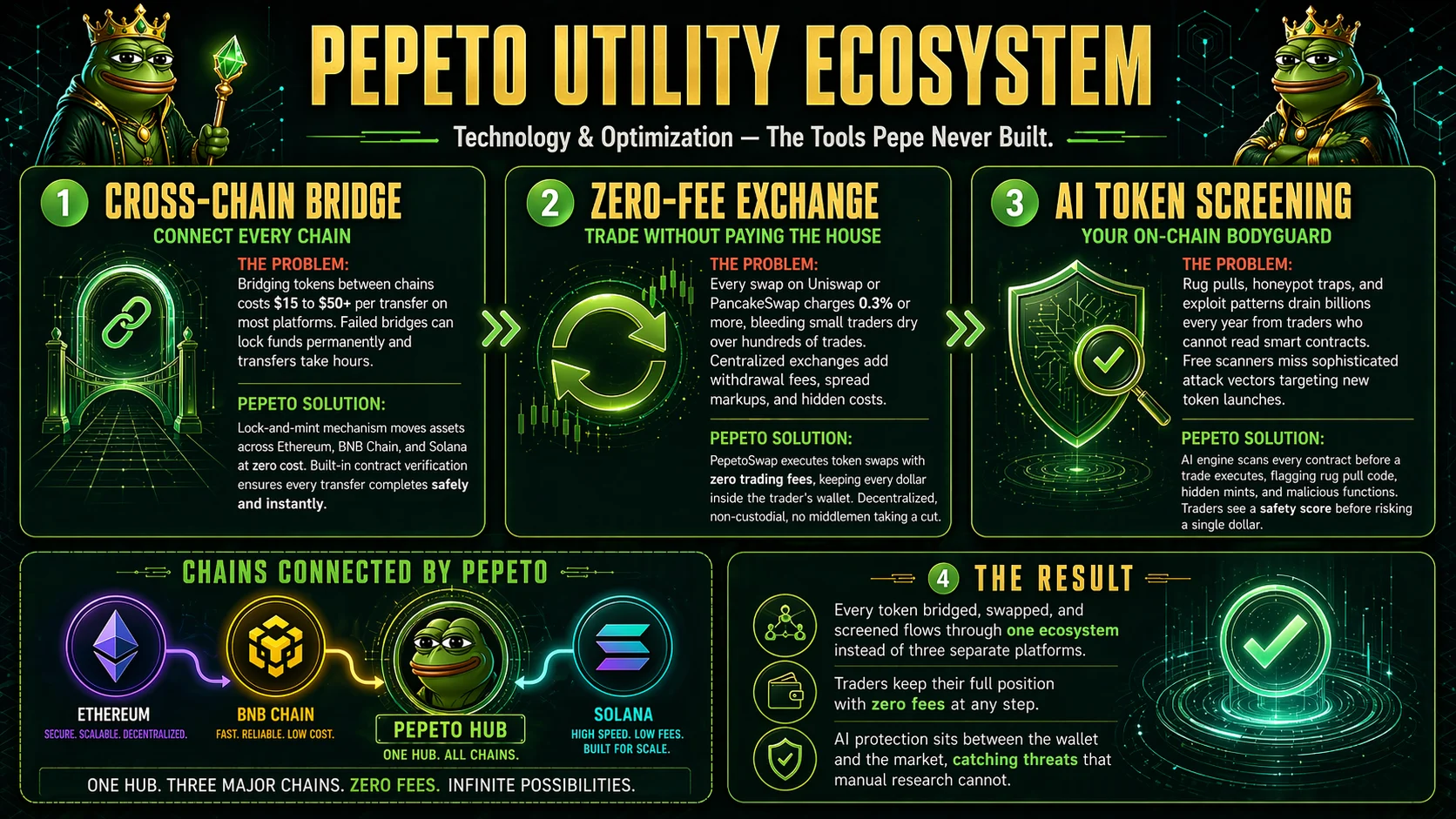
Every presale success story follows the same pattern: enter early, ride the move, take profit before the mainstream arrives. Pepeto fits all three conditions, and adds something those earlier tokens never offered. A working exchange with zero fee swaps, a cross chain bridge spanning Ethereum, BNB Chain, and Solana, and an AI scanner that spots dangerous contracts before capital touches them.
The developer who created the original Pepe token built this protocol from scratch, and a former Binance specialist runs the listing strategy toward an expected exchange debut.
SolidProof completed the audit before the raise opened, and more than $9.45 million has been committed while the Fear and Greed Index stays deep in fear, the same reading that pushed retail out before every previous major listing run.
Staking at 178% APY compounds daily while the XRP price prediction headlines play out on their own slow timeline. At $0.0000001866, the working exchange makes the listing target a floor rather than a ceiling. Wallets entering through the Pepeto official website now are positioning before the first public candle sets a price the presale will never see again.
XRP (XRP) Price at $1.42 as Triangle Squeeze Builds Near Breakout
XRP (XRP) trades at $1.42 on April 25, down 61% from its $3.65 all time high reached in July 2025, according to CoinMarketCap.
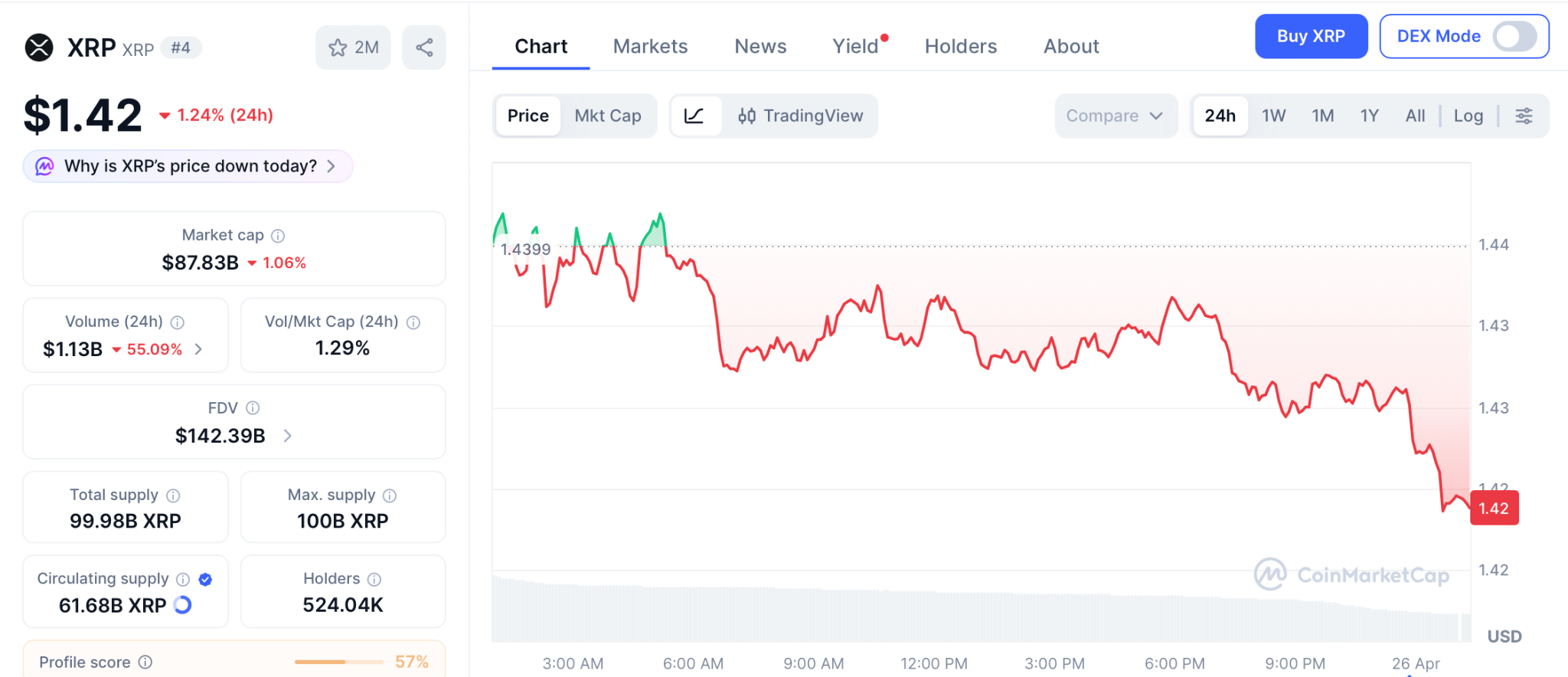
Spot XRP ETFs have attracted over $1.24 billion in inflows since late 2025, and the SEC classified XRP as a digital commodity in March 2026. But Ripple’s own stablecoin RLUSD threatens to replace XRP as a bridge currency. Support holds at $1.40 with resistance near $1.46, and roughly 60% of circulating supply sits at a $1.42 cost basis, creating a wall of sellers at every approach.
Conclusion:
Wallets adding Pepeto at presale pricing are positioned for the kind of returns the XRP price prediction needs years to deliver. The presale winner story follows the same pattern every time: a small group gets in early, the entry disappears, and the rest of the cycle is spent calculating what slipped away.
Pepeto carries the same BNB-era demand structure at presale pricing, paired with meme coin momentum no established token has offered this early in a cycle. The CoinMarketCap listing shows the Binance opening is close, the raise is at $9.45 million with 178% APY staking running daily, and the entry through the Pepeto official website is still open. Secure the position before the window closes.
Click To Visit Pepeto Website To Enter The Presale

FAQs
What is the XRP price prediction for 2026 after the 60% drop from all time highs?
The XRP price prediction for 2026 remains uncertain as the token trades at $1.42 with resistance at $1.46 and 60% of supply held at break even levels creating constant selling pressure. The Motley Fool warns investors to wait for a major bank partnership before buying.
Why is Pepeto drawing attention over large cap tokens like XRP right now?
Pepeto offers a presale entry at $0.0000001866 with an expected Binance listing, three working exchange tools, and a SolidProof audit, creating presale to debut returns that XRP at 61% below its all time high cannot generate from current levels.
Disclaimer: This is a Press Release provided by a third party who is responsible for the content. Please conduct your own research before taking any action based on the content.
Iran’s parliament speaker pushed back at U.S. claims of energy leverage on Sunday, arguing Tehran still holds unplayed supply cards as Strait of Hormuz oil exports remain 95% below normal flows.
Mohammad Bagher Ghalibaf framed the standoff as a poker game of supply versus demand levers, taunting Washington that U.S. summer gasoline demand will amplify the price pain at home.
Ghalibaf Counters U.S. Bragging With Card-Counting Math
Ghalibaf is a hardliner and former Revolutionary Guards commander who often addresses global traders. His latest message answers Washington officials boasting about superior energy leverage.
He laid out a balance sheet equating supply cards with demand cards. Iran’s side covers the Strait of Hormuz, Bab el-Mandeb, and regional pipelines.
He marked Hormuz as partly played, while Bab el-Mandeb and pipelines remain unused. The U.S. side already deployed Strategic Petroleum Reserve releases and absorbed some demand destruction.
However, his sarcastic closer warned Americans will not cancel summer vacations, so the bill will land at the gas pump.
“Add summer vacation to the right unless they want to cancel it for the US!”
Per Ghalibaf, the punchline targets U.S. peak driving demand from May through September.
Goldman Sachs Confirms Historic Supply Shock
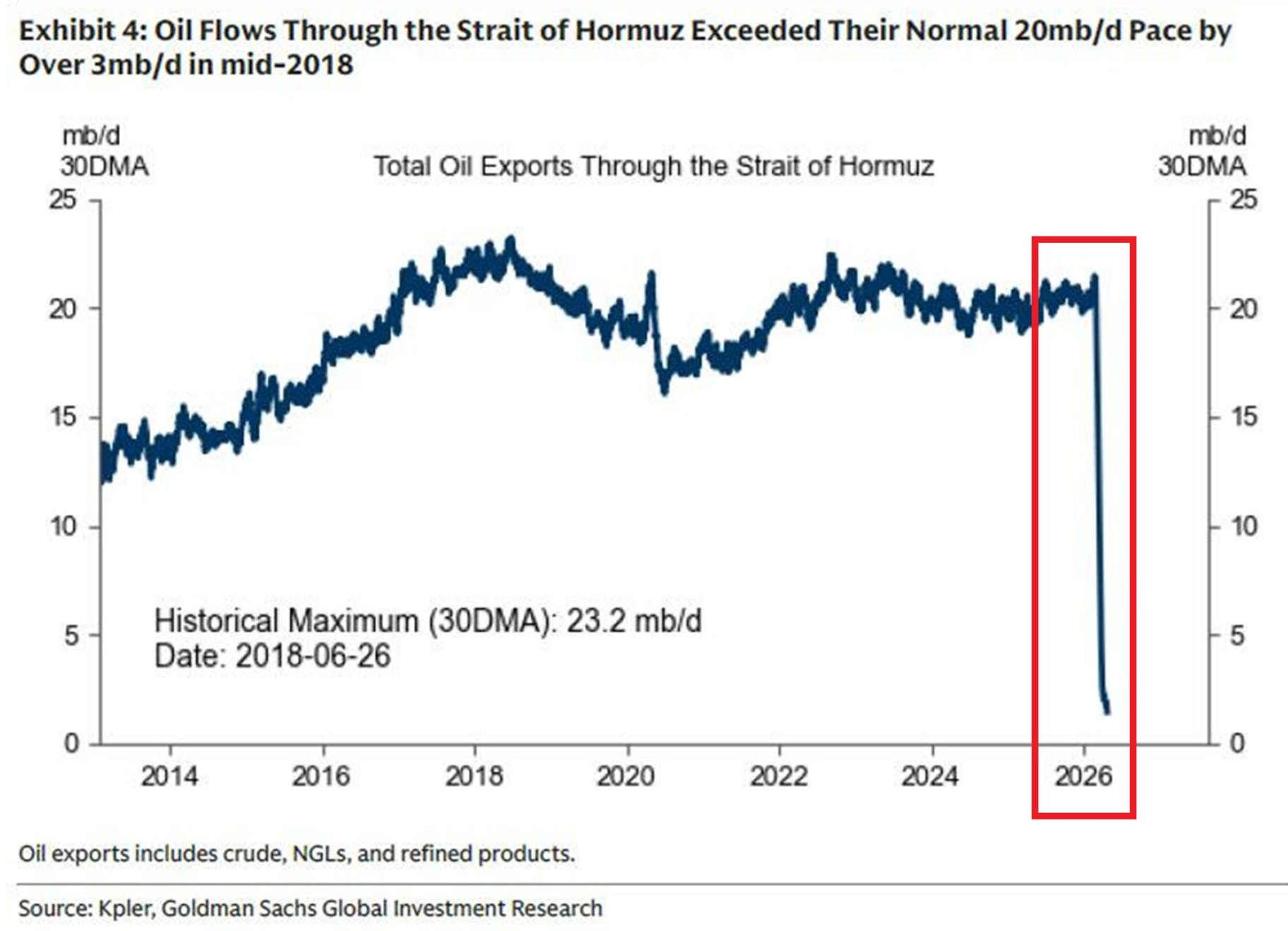
Goldman Sachs data showing the depth of the disruption. Total oil exports through Hormuz have collapsed roughly 95% from normal flows near 20 million barrels per day.
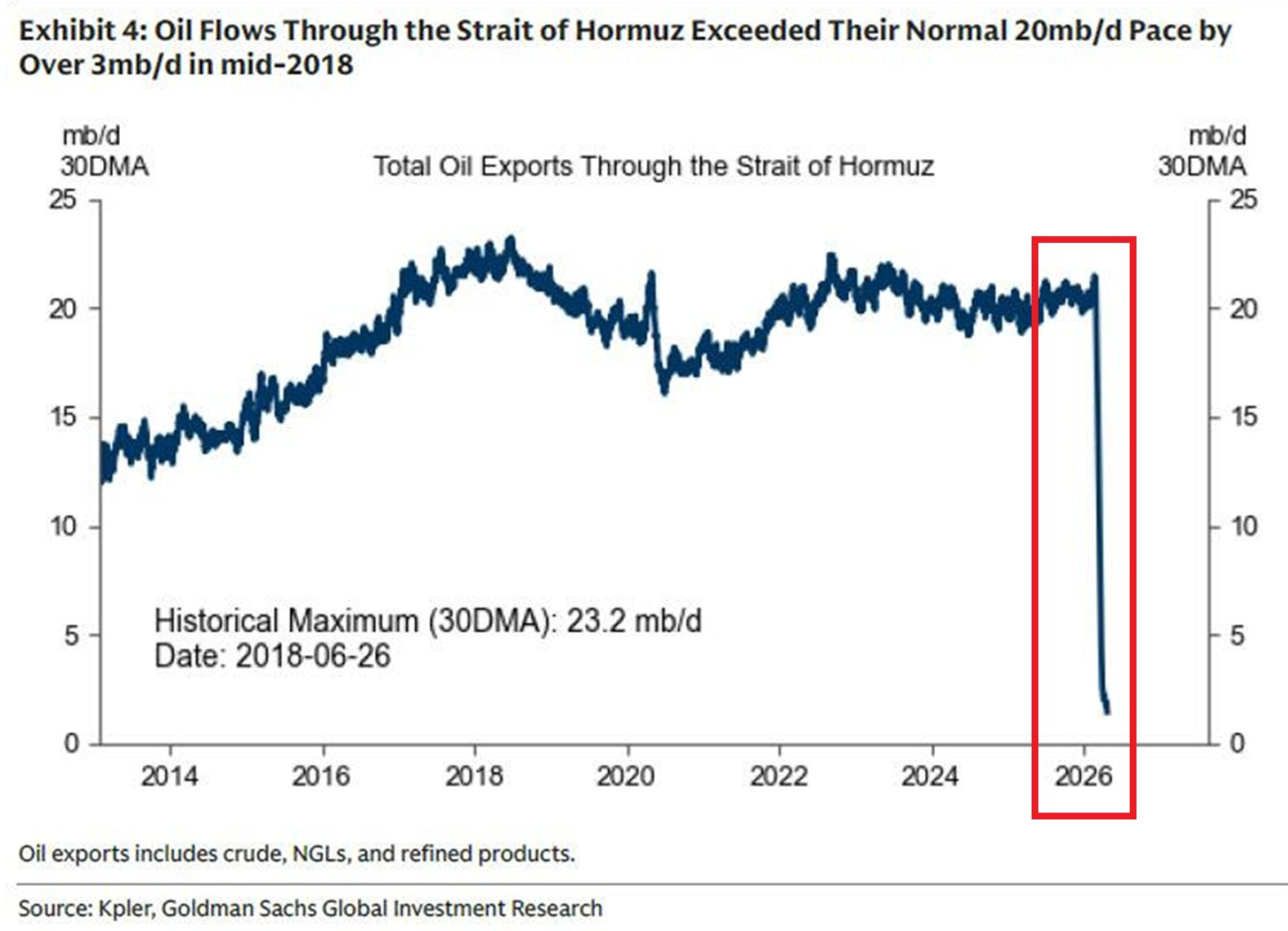
Gulf crude production has fallen by about 14.5 million barrels per day, or 57% versus pre-war levels. Available empty tanker capacity in the region is down by half, equal to about 130 million barrels of slack.
However, Goldman analysts caution that recovery hinges on pipeline capacity, available tankers, and well flow rates.
They estimate only 70% of lost supply returns within three months of any reopening, and 88% within six months.
Extended shut-ins risk reservoir damage, raising the chance that full restoration takes several quarters.
Trump Pitches U.S. Crude as Pain Drags Into Summer
Meanwhile, President Donald Trump has rejected the idea that Washington lacks leverage. He argues the U.S. produces more oil than Russia and Saudi Arabia combined and rarely imports through Hormuz.
Trump has urged China and European buyers to redirect orders to American producers. He has also told U.K. allies to drill in the North Sea, while defending his “Drill, Baby, Drill” agenda.
In contrast to past crises, he has warned voters that pump prices may stay elevated and could rise before the November midterms.
That message lines up with Ghalibaf’s taunt about peak gasoline season. Brent crude continues trading near $100 per barrel, with markets sensitive to any further escalation or inflation pass-through.
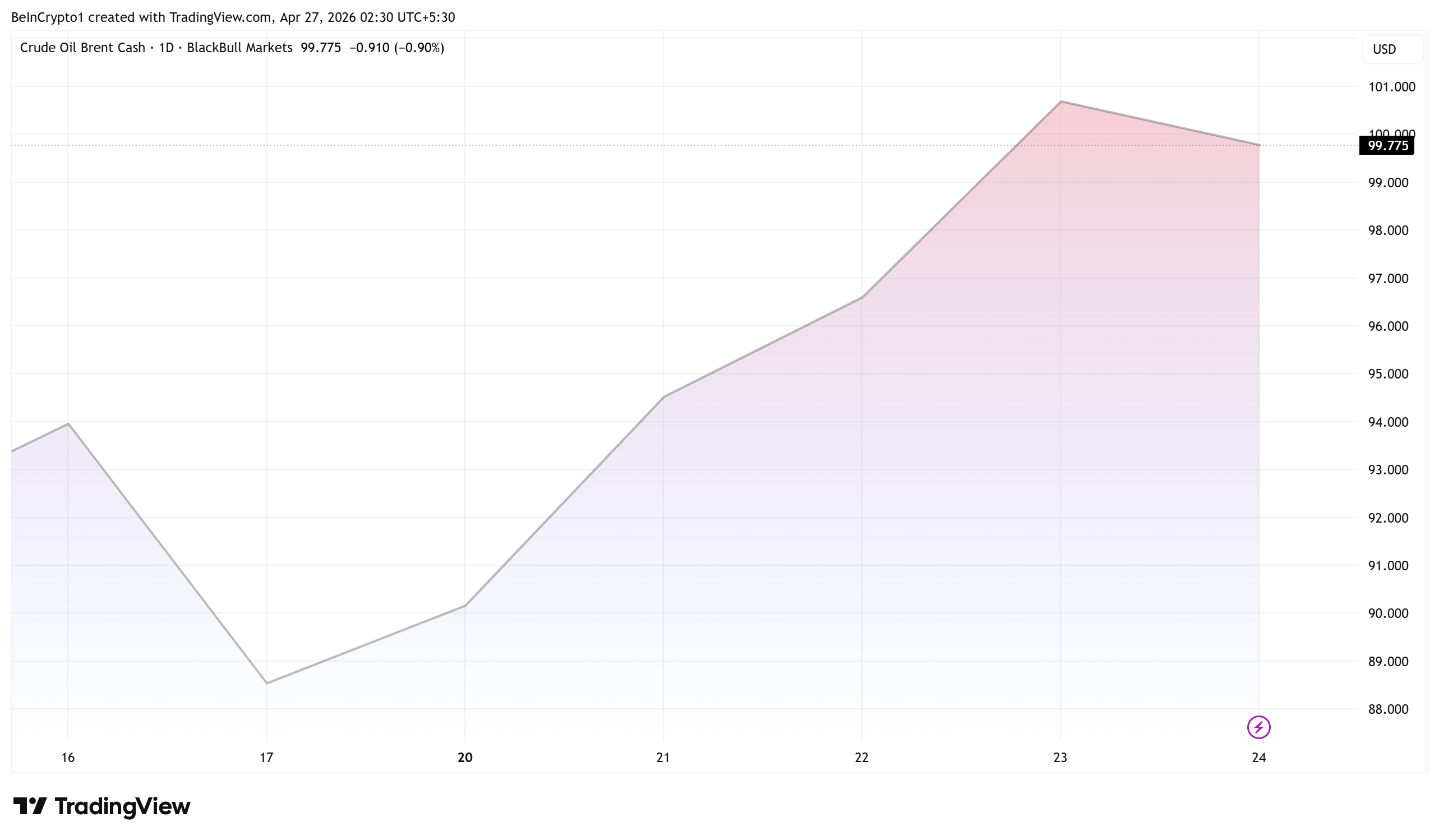
Tehran’s signal lands as physical supply realities harden. Whether Iran activates its remaining cards or keeps them in reserve will shape U.S. driving season prices in the weeks ahead.
Subscribe to our YouTube channel to watch leaders and journalists provide expert insights
The post Iran Claims Strong Oil Cards Ahead of Peak Gasoline Demand Season in the US appeared first on BeInCrypto.
Crypto World
Stellar DeFi Hits $200M TVL as Institutional Capital and Real-World Assets Take Center Stage
TLDR:
-
- Stellar’s DeFi TVL has crossed $200M for the first time, marking a record high across its protocols.
- Real-world assets including government bonds and real estate are now tokenized and flowing onto Stellar.
- Institutional investors are deploying serious capital, raising compliance and liquidity standards on the network.
- Soroban’s smart contract platform is lowering costs and expanding DeFi application development on Stellar.
- Stellar’s DeFi TVL has crossed $200M for the first time, marking a record high across its protocols.
Stellar has reached a new milestone in its decentralized finance journey. The network’s Total Value Locked across DeFi protocols has crossed $200 million for the first time.
This record comes as institutional investors and real-world asset tokenization continue to reshape the ecosystem. The growth reflects a structural shift rather than a short-lived speculative rally.
Capital flows tied to traditional financial instruments are identified as the primary driver behind this upward trend.
Real-World Assets Drive the Network’s Record TVL
Real-world assets are driving Stellar’s TVL to record highs. Government bonds, real estate, and tokenized instruments are now flowing into the network.
This marks a departure from earlier crypto cycles driven largely by retail speculation. Capital tied to tangible assets tends to be more stable and predictable.
Institutional players are not merely testing the waters on the blockchain. Their entry brings higher compliance and transparency standards to the platform.
Unlike retail-driven booms, institutional flows sustain liquidity over longer periods. This steadies the network against the sharp volatility often seen in crypto markets.
Analyst @SylvianGuibal noted this wave is driven by professional players seeking reliable and scalable infrastructure. The shift reflects a broader trend of tokenizing traditional finance on blockchain networks.
The network’s established track record in cross-border payments made it a natural fit for this capital. Existing regulatory relationships add an extra layer of confidence for these new entrants.
RWA inflows and institutional backing are redefining DeFi activity on Stellar. The ecosystem is moving away from high-risk protocols toward structured financial products.
This may attract participants from regulated financial markets. Over time, the network could connect conventional banking systems with decentralized finance.
Soroban Accelerates DeFi Growth Across the Ecosystem
Soroban, the network’s native smart contract platform, is adding momentum to the ecosystem’s current growth. It enables developers to build a new class of DeFi applications.
The platform offers lower transaction costs, enhanced programmability, and faster execution. These features make building efficient financial tools more practical.
With Soroban active, the range of products on the blockchain has expanded considerably. Developers can now construct complex instruments not previously possible on the network.
This opens the door to lending protocols, decentralized exchanges, and structured investment products. Each new application draws additional users and capital into the ecosystem.
Soroban’s adoption aligns with the current wave of institutional interest in the network. As larger financial players seek capable and cost-effective blockchain platforms, Soroban presents a strong case.
Lower fees translate to more efficient capital deployment for asset managers. This technical advantage is producing measurable results in real adoption.
Together, Soroban’s capabilities and the inflow of real-world capital are forming a reinforcing cycle on Stellar. As more developers build, more users arrive, and more capital follows.
The network is no longer growing at the margins of DeFi — it is moving toward its center. Current growth appears rooted in practical financial demand rather than short-term speculation.


Strategy’s Bitcoin (BTC) treasury climbed to a record $63.46 billion as of April 26, with the company holding 815,061 BTC across 107 purchase events at an average cost of $75,528 per coin.
The treasury has gained nearly $2 billion over the past week, rising from $61.56 billion as Bitcoin extended its rally and Executive Chairman Michael Saylor signaled continued accumulation.
Strategy Cements Position as Largest Corporate Bitcoin Holder
The new high follows the firm’s most aggressive month of buying in well over a year. Strategy added 34,164 BTC for roughly $2.54 billion last week at an average price of $74,395 per coin, its largest single-week purchase in 17 months.
That acquisition vaulted the company past BlackRock’s iShares Bitcoin Trust as the largest publicly disclosed Bitcoin holder, second only to the dormant wallets attributed to Satoshi Nakamoto. Strategy now controls roughly three-quarters of all Bitcoin held by corporate treasury vehicles.
The firm’s cost basis sits at $75,528, and current spot prices place its unrealized gain at 3.08%, or $1.9 billion above what it has paid for its stack to date.
April Purchase Marks 17-Month Buying Peak
The April buying spree was financed through a mix of capital instruments rather than through dilutive common stock issuance. Strategy raised $2.18 billion through the sale of STRF perpetual preferred equity and added $366 million from at-the-market sales of MSTR shares, according to company filings.
Saylor has also pointed to a 9.5% Bitcoin yield year-to-date in 2026, the firm’s internal metric for measuring how much its BTC-per-share ratio has grown for common shareholders. That figure forms the core of MicroStrategy’s case to equity holders for continuing to issue capital to buy the asset.
The company’s monthly buying pace has put a one million BTC target back into analyst conversations, with some projections placing the milestone within reach by late 2026 if current capital market conditions hold.
Saylor Signals Continued Bitcoin Buying
Critics like Peter Schiff have warned of a potential “death spiral” in Strategy’s preferred equity model, arguing that sustaining the 11.5% yield on STRC requires either stronger Bitcoin performance or continuous capital raises that could dilute shareholders.
However, Saylor’s posture suggests the buying cadence will not slow. Bitcoin’s broader rally into April has been uneven, with profit-taking around the $76,000 level capping earlier breakout attempts. The
Whether Strategy can sustain its current pace will depend on demand for STRF and other preferred instruments, and on Bitcoin staying above the firm’s blended cost basis.
With 815,061 BTC already on the balance sheet and Saylor signaling more buying ahead, the next test is how quickly the company can close the gap to its rumored seven-figure target without straining the capital structure that has made the strategy work so far.
The post MicroStrategy’s Bitcoin Holdings Hit $63.46 Billion Record appeared first on BeInCrypto.


Scallop, a money market on Sui Network, lost about 150,000 SUI on Sunday after an attacker drained a deprecated rewards contract tied to the protocol’s sSUI spool.
The team froze the affected contract within minutes and pledged full reimbursement from its treasury. Core operations resumed in under two hours.
Another Sui Exploit Hits Peripheral Code, Not the Core Protocol
Scallop disclosed the incident at 12:50 UTC on April 26 through a public notice on X. The attacker targeted a side contract powering rewards for the sSUI spool. That spool is the protocol’s incentive layer for SUI depositors.
The affected contract was frozen immediately, according to the team. Core lending and borrowing pools stayed untouched. User deposits remained safe across every other Scallop market.
Two hours later, Scallop confirmed the freeze had been lifted on the core contracts. Withdrawals and deposits resumed at 14:42 UTC.
Most users on the Sui network were unaffected by the morning’s events.
“Scallop will fully cover 100% of the loss,” the money market articulated.
Stale Package Code From 2023 Sat Behind the Exploit
Independent on-chain analysis points to a deprecated V2 spool package as the entry point. Scallop published the code in November 2023, more than 17 months before the attack. On Sui, deployed packages are immutable. Old versions stay callable unless explicitly version-gated.
The bug centered on an uninitialized last_index counter, which tracks accumulated rewards for stakers. The attacker staked roughly 136,000 sSUI to exploit it.
This math treated the position as if it had existed since the spool launched in August 2023.
The spool index had grown to about 1.19 billion over 20 months. That allowed the exploiter to harvest around 162 trillion reward points. Those redeemed one-to-one for 150,000 SUI from the rewards pool.
The transaction hash 6WNDjCX3W852hipq6yrHhpUaSFHSPWfTxuLKaQkgNfVL captures the on-chain proof of the drain.
A Familiar Pattern Across Sui DeFi
The incident follows a string of Sui exploits in recent weeks. Volo Protocol lost roughly $3.5 million earlier this month in a similar peripheral incident. Each case targeted side contracts rather than core protocol logic.
It also lands one week after a major bridge incident on Ethereum, which produced roughly $292 million in unbacked liquid restaking tokens. Both attacks happened over weekends, when liquidity is thin and response times can lag.
Neither the Sui Foundation nor Mysten Labs has made a public statement on the matter.
For Scallop, however, the financial damage looks contained. The protocol confirmed it will absorb the entire loss without diluting user yields.
The team has not released a full post-mortem yet, with a prospective publishing of a complete audit of every remaining legacy package likely to shape the broader Sui DeFi response.
The deeper question is how Sui builders should manage immutable code and forgotten attack surfaces.
The post Another DeFi Exploit Drains 150,000 SUI From Scallop’s Deprecated Contract appeared first on BeInCrypto.

The biggest Bitcoin treasury company’s data shows holdings are profitable, having gained about 3.3% amid Bitcoin’s rally to about $78,000.
Crypto World
Bittensor (TAO) Surges 21.57% in Q1 2026 Amid Nvidia, Polychain Bets and $43M AI Revenue
TLDR:
- TAO delivered a 21.57% gain in Q1 2026, recovering from $230 lows to close near $251 by quarter-end.
- Nvidia invested $420M in TAO with 77% staked, while Polychain added $200M in exposure during Q1 2026.
- Bittensor generated $43M in real AI usage revenue in Q1, driven by Chutes, Targon, and active subnets.
- A new locked stake governance model was introduced to prevent sudden subnet exits and boost long-term alignment.
Bittensor’s native token, TAO, wrapped up Q1 2026 with notable momentum despite a volatile stretch early in the quarter.
The token started around $300, dipped to approximately $230, then recovered to close near $251. Over the 90-day period, TAO delivered a 21.57% gain.
Institutional players moved in aggressively, and real AI usage revenue added weight to the project’s fundamentals heading into Q2.
Institutional Backing and On-Chain Revenue Drive TAO Credibility
Grayscale launched the Bittensor Trust (GTAO) with roughly $13 million in assets under management. BitGo also partnered with Yuma to provide institutional-grade custody and staking services for TAO.
These moves marked a clear shift toward mainstream financial participation in the Bittensor ecosystem.
Nvidia followed with a $420 million investment in TAO, with 77% of those tokens staked directly. Polychain Capital added $200 million in TAO exposure, leveraging available staking opportunities. Both moves sent a strong signal about institutional confidence in decentralized AI infrastructure.
Beyond investment, TAO generated approximately $43 million in revenue from actual AI usage during Q1. Subnets like Chutes and Targon are building functional APIs to serve real demand. This separates Bittensor from speculative projects with no tangible utility attached.
As crypto analyst Dami-Defi noted on X, “$TAO generated approximately $43M in revenue from actual AI usage in Q1,” pointing to real traction rather than hype.
The launch of Covenant-72B across 70+ nodes and the rollout of Quasar-3B on SN24 with long-context AI capabilities further strengthened the ecosystem’s product layer.
Governance Reform and Q2 Outlook Shape TAO’s Next Phase
A major subnet announced an exit by selling approximately $10 million worth of TAO during the quarter. This created short-term price pressure and raised concerns about ecosystem stability. Bittensor responded by introducing a locked stake governance mechanism.
The new model aims to stabilize subnet participation and prevent sudden exits like the one seen in Q1. It also seeks to improve long-term alignment among validators, subnet developers, and token holders. The governance change addressed a real structural gap in the network.
TAO’s market cap held within the $2 billion to $3 billion range throughout Q1. Daily trading volume grew by over $158 million, and both validator participation and subnet activity continued expanding. These metrics suggest the network is growing organically.
Looking ahead to Q2, continued subnet expansion and increased institutional attention on decentralized AI remain key catalysts. Price recovery toward $450 or higher is being watched by market participants.
Bittensor’s position as a marketplace for machine intelligence, at the crossroads of AI and crypto infrastructure, keeps TAO at the center of the decentralized AI narrative.
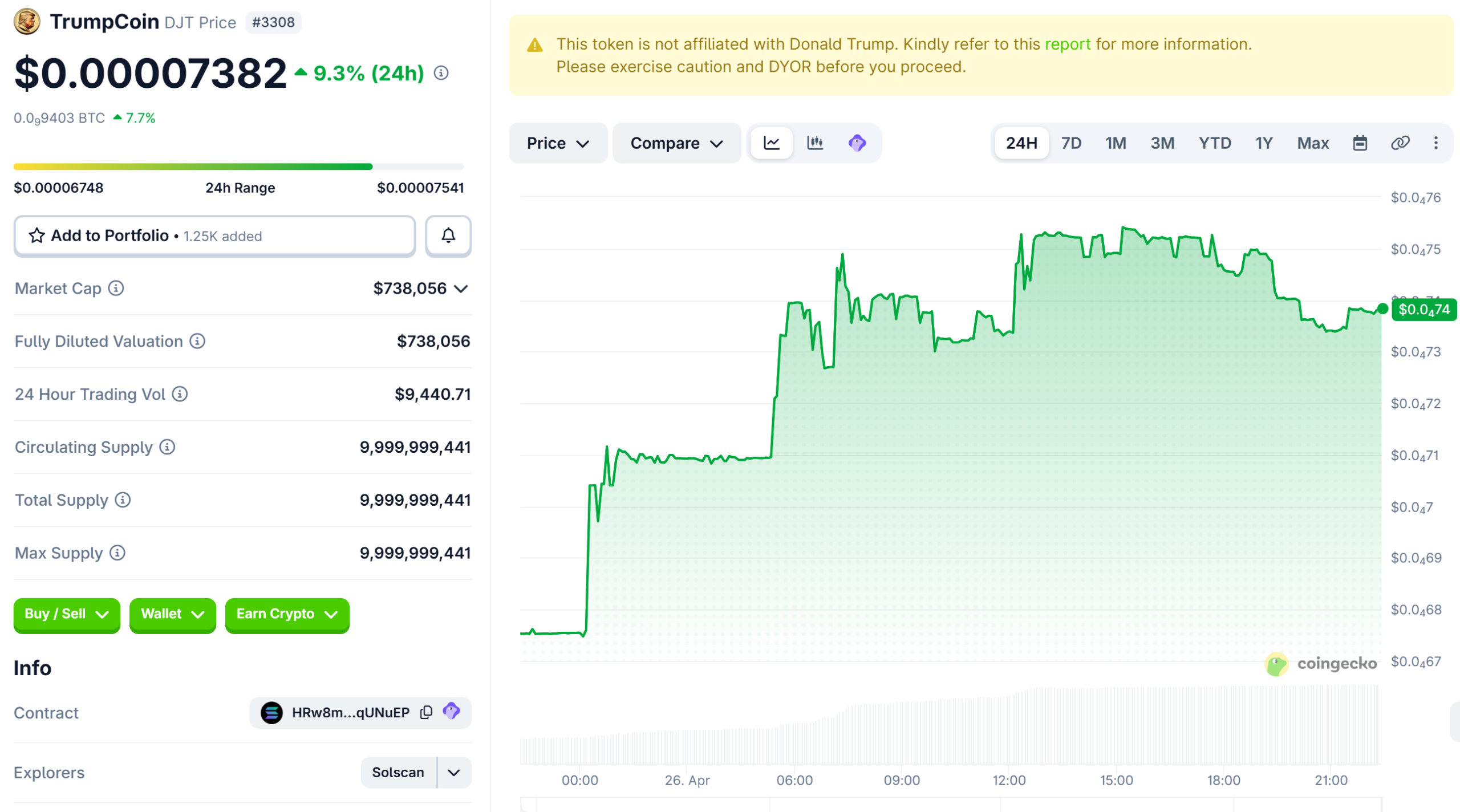
President Donald Trump’s defiant “It comes with the territory” remark after a gunman opened fire outside the Correspondents’ Dinner, lifted TRUMP, MAGA, and DJT tokens as traders responded to the President’s resilience messaging.
However, there remains speculation that the incident, as well as the last, were probably staged to win sentiment as approval odds remain low.
A Defiant Statement Reshapes Sentiment
Official Trump (TRUMP) climbed 4.20% over 24 hours, MAGA rose 1.09%, and TrumpCoin (DJT) led the group with an 9.3% jump.
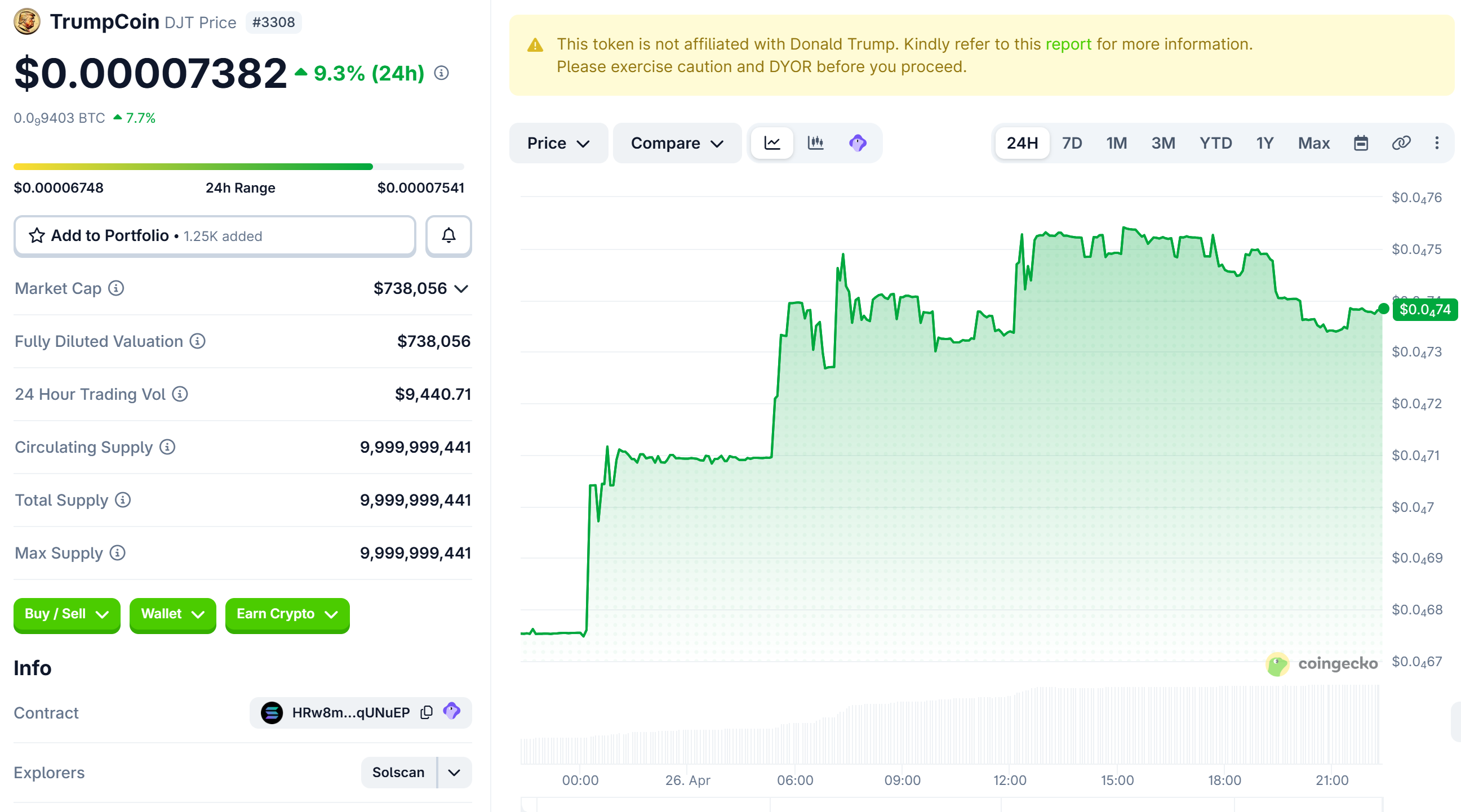
The surge comes after the White House posted a video on X on Sunday in which Trump described political violence as part of presidential life.
“It comes with the territory, and if you want to do a great job… take a look at what’s happened to some of our greatest presidents. It doesn’t happen to people that don’t do anything… It’s not going to deter me,” the White House reported, citing Trump.
The statement reframed Saturday night’s attack as something Trump considered the cost of public office, and tokens linked to his identity moved with it.
Staged Narrative Complicates the Rally
The reaction comes alongside a separate conversation about whether attacks on Trump are real. Days before the Correspondents’ Dinner shooting, CNN published analysis examining renewed claims that the 2024 Butler, Pennsylvania assassination attempt was staged.
The dispute has now extended to Saturday’s incident, with parts of the political conversation testing whether the Washington shooting will be folded into the same theory.
That tension matters for Trump-linked tokens, which trade as proxies for political sentiment more than fundamentals.
A defiance narrative tends to drive buying. A staged narrative can blunt it, since it implies the news has been engineered.
Sunday’s gains favor the first reading, but social media chatter throughout the day showed both framings circulating in parallel.
Investigators identified the alleged gunman as Cole Tomas Allen, a 31-year-old former teacher and video game developer from Torrance, California.
Law enforcement recovered a written manifesto in which Allen described his intent to target Trump administration officials. One law enforcement officer was struck in a bullet-resistant vest and is expected to recover, officials said.
“Don’t jump to conclusions and assume the WHCD shooting was staged until they’ve had a chance to read any bullets left at the scene,” highlighted Rep Jack Kimble.
Meanwhile, bettors see Trump’s approval ratings going lower, with others seeing supposed staged moves as a means to boost sentiment.
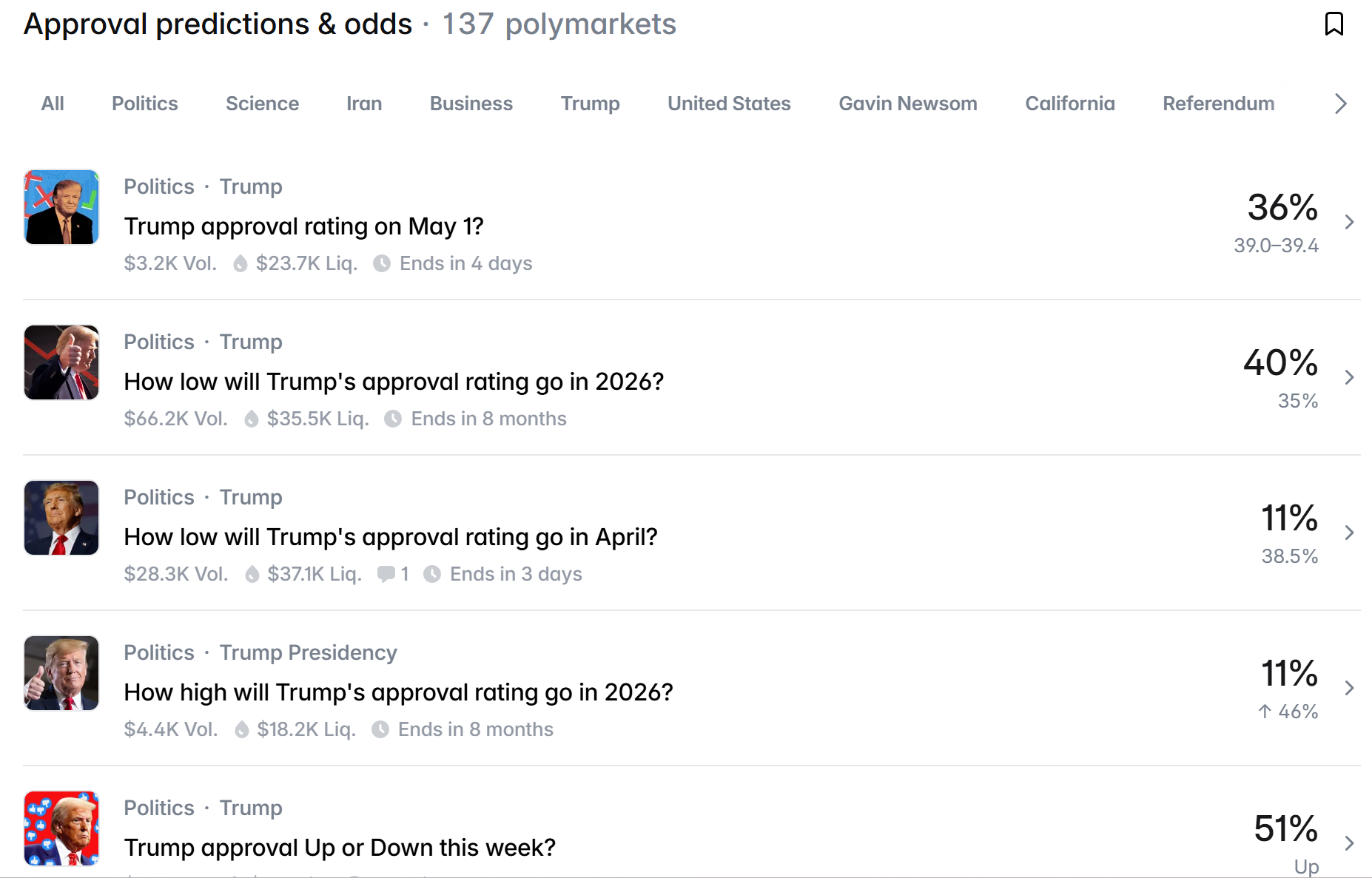
“A lot of people are saying they think the WHCD shooting was staged, as a way to change the narrative from his abysmal approval ratings and his bumbling of the Iran War,” one user posed.
The TRUMP token has weathered cycles like this before. Earlier this year, a supply unlock added pressure to a token already grappling with thinning demand.
Holders will watch whether the defiance reading carries momentum into the new week, or whether the competing staged framing pulls the rally back.
The post Trump’s Defiant Shooting Remark Lifts TRUMP, MAGA, DJT as Staged Narrative Resurfaces appeared first on BeInCrypto.
Crypto World
Chainlink CCIP Sets a New Standard for Secure and Decentralized Cross-Chain Interoperability
TLDR:
- Chainlink CCIP uses 16 independent node operators to validate all cross-chain activity across blockchain networks.
- CCIP decentralizes both observation and verification layers, eliminating single points of failure in cross-chain transfers.
- Asset issuers can set custom rate limits and circuit breakers to control and halt suspicious cross-chain transactions.
- The Cross-Chain Token standard gives token issuers full contract ownership with zero vendor lock-in or library dependency.
Chainlink’s Cross-Chain Interoperability Protocol (CCIP) is positioning itself as a leading solution for secure blockchain interoperability.
The protocol transfers both data and value between blockchain networks using a decentralized oracle network. Sixteen independent node operators validate all cross-chain activity.
Each operator undergoes security reviews before joining the network. This structure ensures no single entity can compromise cross-chain transactions.
How Decentralization Powers CCIP’s Core Architecture
CCIP operates through Chainlink’s decentralized oracle network, known as a DON. Every bridge between blockchains receives redundant validation from multiple independent operators. This design prevents any single point of failure from affecting the entire system.
The protocol separates two critical functions: observation and verification. Observation determines what occurred on the source chain, while verification confirms whether those events justify action on the destination chain. Both layers remain decentralized across independent operators and infrastructure providers.
As Chainlink noted, “A bridge can appear decentralized at the verifier layer while still relying on an opaque, correlated, or shortcut-heavy observation layer underneath it.”
Adding more verifiers on top of a centralized observer does not produce real security. CCIP addresses this by decentralizing both layers equally.
Node operators also maintain infrastructure diversity. This includes on-premises bare-metal deployments and multi-region cloud configurations.
That resilience kept CCIP fully operational during the October 2025 AWS outage, when other cross-chain providers experienced downtime.
Risk Controls Give Asset Issuers Greater Transaction Oversight
Beyond decentralization, CCIP includes several configurable risk controls for asset issuers. Rate limits allow issuers to set a maximum capacity and refill rate for transactions.
Automated circuit breakers can then halt activity if something goes wrong, stopping contagion before it spreads further.
Token issuers also retain full ownership of their contracts through the Cross-Chain Token standard. This removes vendor lock-in entirely, meaning issuers do not depend on specific CCIP libraries or functions. Ownership stays with the issuer at all times.
CCIP also supports token developer attestation. Asset issuers can participate directly in the verification process by attesting to burn or lock events. This adds another layer of confirmation before tokens are minted or unlocked on the destination chain.
Automated compliance tools round out the protocol’s risk management features. Issuers and protocols can incorporate permissioning logic into cross-chain workflows.
Pre-transaction checks and policy enforcement run before any transaction completes. Together, these controls make CCIP a structured and transparent option for institutions managing large-scale cross-chain asset transfers.

Strategy, the Virginia-based firm led by Michael Saylor and the largest Bitcoin treasury by total holdings, signaled that it will expand its BTC stash in the coming days.
Saylor posted a chart detailing the company’s Bitcoin purchase history, noting 107 transactions since 2020. The pattern has historically preceded new purchases, suggesting another acquisition could be forthcoming.
Less than a week earlier, Strategy completed a major purchase: 34,164 BTC for more than $2.5 billion, lifting total holdings to 815,061 BTC. At the time of publication, that pile was valued at around $63.6 billion using spot prices, according to data tracked by SaylorTracker.
Strategy’s BTC reserve dwarfs peers. BitcoinTreasuries data show Twenty One Capital, the second-largest publicly traded BTC treasury, holds about 43,514 BTC.
Strategy’s demand appears to outpace newly mined supply by roughly three times, a pace that could tighten availability if BTC moved off exchanges, according to Samson Mow, a vocal Bitcoin advocate.
Unrealized losses and a long-term growth thesis
The company reported an unrealized loss of about $14.5 billion for the first quarter of 2026, reflecting Bitcoin’s slide from a peak near $126,000 in October 2025 to roughly $60,000 in February 2026. Strategy’s average cost basis sits around $75,528 per BTC, though the current spot price around publication topped $78,000, putting the treasury back in positive territory on a mark-to-market basis.
Investor commentary around the plan’s feasibility remains mixed. Adam Livingston, an investor associated with Strategy, forecast that the firm could approach 1.2 million BTC by year-end 2026, contingent on continued capital inflows and the deployment of its STRC instrument, a variable-rate perpetual preferred stock described as a yield vehicle to fund the buys.
Rida Morwa, writing for Seeking Alpha, offered caution, noting that while the strategy has merit, it hinges on Bitcoin’s price continuing higher. He pointed to MicroStrategy’s aggressive use of preferred equity as a potential risk if BTC does not appreciate meaningfully.
Funding, price dynamics and what to watch next
Livingston said purchases are backed by capital raised from Strategy’s Variable Rate Series A Perpetual Stretch Preferred Stock (STRC), signaling a broader strategy to deploy capital as price volatility presents opportunities. The approach has sparked debate about sustainability, especially if BTC’s price stalls or retreats again.
Meanwhile, market observers are watching whether Strategy’s growing footprint can meaningfully influence supply dynamics. Samson Mow’s commentary suggests that sustained buying could absorb a larger share of new BTC supply versus what is mined each year, potentially contributing to forward price pressure if exchange reserves continue to thin.
Strategic accumulation by a major treasury holder underscores a broader trend: institutions and high-net-worth entities seeking bitcoin as a balance-sheet asset might help underpin longer-term demand, particularly as the macro landscape remains uncertain and regulatory clarity evolves.
What this means for investors and the market
If Strategy maintains its current buying cadence, the firm could become an even more influential anchor in BTC’s market structure, potentially shaping price dynamics and liquidity as it continues to absorb new supply. The key questions for readers are whether the STRC-financed buys are sustainable over a protracted cycle, how price volatility will interact with the treasury’s cost basis, and what the evolving regulatory backdrop could mean for similar strategies.
As Strategy presses forward, market watchers will monitor the pace of additional purchases, the effectiveness of STRC financing, and Bitcoin’s price trajectory to gauge how this approach might reshape risk and opportunity for other long-term holders and potential entrants into the “treasury” space.
Looking ahead, a decisive factor will be whether Strategy can maintain its trajectory toward larger holdings without compromising liquidity or exposed leverage, and how competing narratives—ranging from macro headwinds to regulatory shifts—will influence Bitcoin’s role as a corporate reserve asset.

Chris Brown Calls Out Critics For Throwing Shade At ‘R&B Tour’

Power Of Compounding #money #lawlessons #personalfinance #investment
May bank holiday supermarket opening times for Aldi, Tesco, Waitrose and more

Manchester United reach agreement with Casemiro over contract clause amid transfer speculation

US brings back mandatory military draft registration

Steven Gerrard disagrees with Gary Neville over ‘shock’ Chelsea and Arsenal claim | Football


-

 Fashion2 days ago
Weekend Open Thread – Corporette.com
-

 Politics6 days ago
Gary Stevenson delivers timely reminder to register to vote as deadline TODAY
-
Crypto World1 day ago
Hyperliquid $HYPE Rally Builds Momentum as AI Sector Enters Prove-It Phase
-
Entertainment7 days ago
NBA Analyst Charles Barkley Chimes in on Ice Spice McDonald’s Fiasco
-
Crypto World6 days ago
Bank of Hawai’i (BOH) Q1 2026: Net Income Drops to $57.4M as Net Interest Margin Expands
-

 Politics4 days ago
Making troops accountable for war crimes threatens US alliance, ex-SAS colonel warns
-

 Politics4 days ago
Disabled people challenge government SEND proposals over segregation concerns
-

 Business4 days ago
Rolls-Royce Voted UK’s Most Iconic Trade Mark as IPO Register Hits 150
-

 Politics4 days ago
Zack Polanski responds to home secretary’s taser threat
-
 Sports9 hours ago
IPL 2026: Ruturaj Gaikwad registers slowest fifty of the season, enters all-time unwanted list | Cricket News
-

 Politics4 days ago
Starmer handler McSweeney to be dragged from shadows by Foreign Affairs Committee
-

 Business3 days ago
Patterson-UTI Energy, Inc. (PTEN) Q1 2026 Earnings Call Transcript
-
 Crypto World5 days ago
Five Value Stocks with Recovery Potential in 2026: PayPal (PYPL), Nike (NKE), and More
-
Politics4 days ago
Wings Over Scotland | How To Get Away With Crimes
-

 Crypto World5 days ago
New York sues Coinbase, Gemini over prediction market offerings
-

 Politics4 days ago
‘Iran is still a nuclear threat’
-
 Sports4 days ago
Tim Bradley names the current best in the world: “Better than Inoue and Usyk”
-
 Business5 days ago
HCL Tech share price tank over 9% after weak Q4. JPMorgan, HSBC & 3 others cut target price
-

 NewsBeat13 hours ago
LK Bennett closes all stores after entering administration
-

 Crypto World5 days ago
Crypto’s great hope in Senate’s Clarity Act still has a path to survive tight calendar
You must be logged in to post a comment Login