Sequoia Capital co-steward Alfred Lin distributed 200 custom-engraved, numbered Mac Minis at the firm’s “AI at the Frontier” event, each loaded with easter eggs and designed by Sequoia’s design principal. The Mac Mini has become the unofficial hardware of OpenClaw, the open-source AI agent framework that surpassed React as GitHub’s most-starred project and caused Apple hardware shortages. Sequoia did not invest in OpenClaw — there is no company to invest in — but the giveaway positions the firm at the cultural centre of the agentic AI layer, the infrastructure connecting models to real-world actions where Lin believes the next wave of venture-backable companies will emerge.
Sequoia Capital co-steward Alfred Lin personally purchased 200 Mac Minis, had each one custom-engraved with a design mixing old cartography and machine learning contour plots, and distributed them to attendees at Sequoia’s “AI at the Frontier” event. Each machine contained two easter eggs: Sequoia’s ethos statement about creative spirits and underdogs, and a quote generated by an AI model. The engraving was designed by Andreas Weiland, Sequoia’s design principal. The Mac Minis were numbered. They are, by all accounts, beautiful objects. They are also $599 computers that have become the unofficial hardware of OpenClaw, the open-source AI agent framework that surpassed React as the most-starred project on GitHub in March, caused Apple to sell out of base Mac Minis in the United States, and established itself as the fastest-growing open-source project in the history of the platform. Sequoia did not invest in OpenClaw. There is no OpenClaw Inc. to invest in. The firm is distributing the hardware for a project it does not own, and that is the point.
Advertisement
The project
OpenClaw was built by Peter Steinberger, an Austrian developer who previously founded PSPDFKit, a PDF software kit used by applications serving roughly a billion people, which was acquired by Insight Partners for an estimated $100 million in 2024. Steinberger stepped away from coding after the sale. He returned in November 2025 when he started building what he initially called WhatsApp Relay, then Clawdbot, then OpenClaw. It is a free, open-source AI agent framework that runs locally on consumer hardware and integrates with external language models including Claude, GPT, and DeepSeek. Users interact through messaging services they already use: WhatsApp, Signal, Telegram, Discord, Slack. The agent orchestrates multi-step workflows: managing calendars, booking flights, sending emails, executing code, conducting research across multiple sources. By March 2026, it had approximately 247,000 GitHub stars and 47,700 forks. Jensen Huang called it “the next ChatGPT.”
The reason Mac Minis became the preferred hardware is Apple’s unified memory architecture, which is well-suited for running local AI inference. The $599 base model with 16 gigabytes of RAM became the entry point. Higher-memory configurations sold out first. By April 22, the base Mac Mini had sold out from Apple’s US online store. eBay markups reached $795 to $979 for base models. Delivery times for high-memory units stretched from six days to six weeks.Mac Mini and Mac Studio stock shortagesare driven by a combination of OpenClaw demand and a broader DRAM shortage, but OpenClaw established the Mac Mini as the reference hardware for running local AI agents in a way that no other project has managed. On April 4, Anthropic banned OpenClaw from Claude Pro and Max subscriptions, citing API abuse, which pushed even more users toward local inference and intensified the hardware demand.
The ecosystem
In February, Sam Altman announced that Steinberger was joining OpenAI to build “next-generation personal agents.” The hire was effectively an acqui-hire: OpenAI recruited Steinberger, not the software. OpenClaw transitioned to an independent open-source foundation, sponsored by OpenAI but not controlled by it. Steinberger had also received and rejected an offer from Meta. No acquisition price was publicly disclosed, though social media speculation ranged from the plausible to the satirical. The project’s commercial value lies not in the codebase itself but in the ecosystem that formed around it: 168 startups building hosting, deployment, and plugin services on top of OpenClaw, collectively generating approximately $400,000 per month in revenue.Tencent built its enterprise AI agent platform ClawPro on OpenClaw, adopting it for more than 200 organisations in beta.Nvidia built NemoClaw on top of OpenClawto add enterprise-grade security and privacy guardrails, announced at GTC 2026. Cisco launched DefenseClaw in response to a security crisis that exposed 42,665 publicly accessible OpenClaw instances and a supply-chain attack on the ClawHub marketplace that identified over 800 malicious skills.
The security problems are real and significant. A critical remote code execution vulnerability, CVE-2026-25253 with a CVSS score of 8.8, was discovered by researcher Mav Levin. The supply-chain attack on ClawHub, dubbed “ClawHavoc,” traced to a coordinated operation that seeded 341 malicious skills into the marketplace, growing to more than 800 before detection. These are the growing pains of an open-source project that went from a weekend hack to the most popular repository on GitHub in four months, without the security infrastructure that enterprise software demands. OpenAI’s sponsorship of the foundation and Nvidia’s NemoClaw are both attempts to add that infrastructure retroactively, which is cheaper than building it from scratch but harder than building it correctly from the start.
Advertisement
The thesis
Alfred Lin has publicly stated that “software code is no longer a moat.” This is the thesis that makes the engraved Mac Minis legible as strategy rather than swag. If the value in AI is shifting from models, which are commoditising rapidly, to the agentic infrastructure that connects models to real-world actions, then the open-source project that defines that infrastructure layer is the most important thing in venture capital that cannot be invested in.Sequoia’s $7 billion late-stage expansion fund, raised under Lin and co-steward Pat Grady after Roelof Botha stepped down in November 2025, is the largest fund in the firm’s history and is positioned squarely around AI. The fund includes stakes in OpenAI, Anthropic, and Physical Intelligence, a robotics company. The Mac Mini giveaway is Sequoia placing itself at the cultural centre of a movement it cannot own equity in, because the movement is open source and its creator was hired by a portfolio company before Sequoia could write a cheque.
Sequoia’s willingness to lead a $1 billion seed round for David Silver’s Ineffable Intelligence, which would be the largest seed round ever in Europe, shows the firm’s appetite for making defining bets in AI at every stage. The OpenClaw giveaway operates on a different logic. It is not a bet on a company. It is a bet on a layer, the agentic infrastructure layer where AI models connect to messaging apps, calendars, email, and code execution environments, where the value is captured not by the model provider but by whoever builds the best orchestration, the best plugins, the best security, and the best developer experience. Sequoia cannot buy OpenClaw. But it can be the firm that gave 200 numbered, engraved Mac Minis to the people building the ecosystem around it, which in venture capital is another way of saying: we were here first, and when the companies that emerge from this layer need a Series A, they will remember who handed them the hardware.
The symbol
The engraved Mac Mini is the Patagonia vest of the AI era. The Patagonia vest signalled membership in a financial elite that valued the appearance of rugged practicality over the display of wealth. The numbered Sequoia Mac Mini signals membership in an AI elite that values local inference, open-source tools, and the ability to run an agent framework on a $599 computer rather than paying for cloud API access. Both are status symbols disguised as utility objects. Both are distributed by institutions that benefit from the culture they promote. Goldman Sachs gave out vests to signal that its bankers were unpretentious operators. Sequoia gives out Mac Minis to signal that its partners understand the technology well enough to know which $599 computer matters. The difference is that the Mac Mini actually does something. It runs OpenClaw. It connects to language models. It orchestrates the workflows that the next generation of AI-native companies will be built on. The vest just kept you warm on the trading floor. The Mac Mini is a piece of infrastructure that happens to also be a branding exercise, which is what makes it more interesting than the average venture capital stunt. Sequoia is not sponsoring a conference. It is distributing the means of production for the agentic AI layer, one numbered machine at a time, with its ethos engraved on the bottom.
This feeder also comes with extra plastic flowers and a little brush for scrubbing them, and the app sends reminders when it’s time to clean. You’ll also find fun, seasonal touches in the app, like the ability to send digital bird holiday cards with the photos your feeder captures, and a tool that superimposes hats, clothes, and various accessories on the birds, which is actually funnier than it sounds. However, as with the Birdbuddy Pro seed feeder, below, the big downside is that the feeder’s sensor doesn’t always pick up every bird that visits, which can definitely be a bummer when you see something interesting out the window but it doesn’t show up in the app.
Best Smart Birdhouse
WIRED
Two cameras show two action views
Pole-mountable solar panel was reliable in my testing
Different hole sizes can be mounted for different species
TIRED
Wood requires upkeep
Birds didn’t like mesh floor (it is removable)
After experiencing another round of connection issues with the Birdfy Polygon (see below), I swapped it out for the newer Birdfy Duo and have had no issues whatsoever. The sleek, contemporary Duo is a fir box fitted with two cameras—one facing the hole and one tucked away discreetly inside the feeder, so you can get a full-spectrum view of what’s going on. Both cameras have night vision (the internal one is infrared). Like the Polygon, the Duo sports a remote for rebooting and recharging the camera (though the separate solar panel, which can be pole-mounted, has kept the cameras reliably charged), as well as different-size holes for different species, each with its own chew-proof predator guard. There’s a metal grate with drainage holes that you can slot into grooves in the lower third of the Nest to make the cavity larger or smaller. The interested chickadees of my yard seemed very put off by the grate, so I covered it with a layer of moss. The Birdfy app will collect images and string them together in a shareable “story,” but I haven’t had any avian takers, so all my images are in the “Nesting” category. So far, the Duo has been rained on a bunch and survived a mild heat wave, but I can tell the wood will need refinishing after this season.
Smart Bird Feeder With the Best App
Screenshot courtesy of Kat Merck
Birdbuddy
Smart Bird Feeder Pro
WIRED
Advertisement
Fun and feature-rich app
Built-in solar panel works great
TIRED
Camera doesn’t always capture all birds
Birdbuddy’s Pro model sports a snazzy new HDR camera that can also shoot 2K video with slow-motion capability. In addition to having a visibly larger and more advanced lens, the camera’s now got a larger focus range, 122-degree field of view, and high-fidelity microphone. (A subscription to Birdbuddy Premium for $70 a year unlocks 2K Ultra with a higher video bit rate, allowing for richer colors, sharper images, and less background noise—plus the ability to set alerts for sick or injured birds, among other things—but it’s perfectly usable without this. )
The photos aren’t nearly as impressive as those by competitors like the Birdfy Pro Duo, Camojojo Hibird, or Kiwibit, and the camera, frustratingly, only captures a small portion of the birds that actually visit. However, Birdbuddy’s app is a consistent standout, with a user-friendly design and plenty of helpful alerts, like if a cat is detected nearby, or if it’s time to clean the feeder.
It also serves you insights gathered over time, like what time certain species seem to prefer to visit. (Finches apparently like to visit my yard at 10 am daily.) The Birdbuddy also “sleeps” at night and does not seem to emphasize capturing photos of people, so it wouldn’t make a good choice to double as a security camera, and there are also unique seasonal features like the ability to send holiday cards or “dress up” visiting birds with hats, glasses, and sweaters. (It is funnier than it sounds, really!) Both Birdbuddys work with 2.4-GHz Wi-Fi only.
Another Birdbuddy downside is the infuriatingly small, hinged opening for filling the 4 cups’ worth of seed. The feeder comes with its own spouted cup, but I have yet to fill the feeder without making an enormous mess. I also tested the 3-in-1 Nutrition Set ($39), which includes a screw-on tray that can variably become a water fountain, jelly dish, or fruit stake for fruit-loving species like orioles. I’ve used it as a jelly dish and water fountain and found that it blocks enough of the perch area that birds tend to shift out of camera view to avoid it. However, this feeder is still worth it for those who like a more streamlined app experience or want to take advantage of some of its unique sharing features, especially Premium’s ability to share your feeder livestream with others.
If You Want to Use an Existing Bird Feeder
WIRED
Flexible design allows you to use an existing bird feeder
High-quality photo and video
Works with 5-GHz Wi-Fi
TIRED
Only has 90-degree field of view
Only comes with a wall mount
Solar panel has to be mounted separately
If you have a non-smart bird feeder you already like, or are interested in building your own and are just looking for a camera, Hibird’s stand-alone DIY feeder camera is what you want. It’s compatible with both 2.4-GHz and 5-GHz Wi-Fi bands—a rarity for bird-feeder cameras—and the cute green owl face streams the same better-than-average-quality 4K HD video and 32 MP pics as the bigger Hibird feeder, above. There is a subscription tier with features like increased storage, but the camera is still usable without it. There’s an auxiliary solar panel included for charging, and you can mount it via its quarter-inch nut on the included bendable arm and bracket, or jury-rig a custom solution. It pairs seamlessly with the Hibird app, with access to AI (which is just OK), livestreaming, and the Dr. Bird ChatGPT-like feature, where you can ask bird-related questions. (The answers are corny and not as granular as they could be, but the function still could be useful for some.)
These days, there isn’t much that the do-it-yourselfers of the world cannot purchase at their local Harbor Freight Tool store. Even if you can’t find what you need in-store, odds are the family-owned hardware retailer has a functional option available in its online outlet. While many no doubt flock to Harbor Freight in search of home improvement gear, the retailer also carries a full range of options best fit for use in the garage. In case you didn’t read the headline closely, yes, that does indeed include a DIY Manual Tire Changer.
That potentially game-changing garage fixture comes from Pittsburgh Tools, which is one of many notable brands currently owned by Harbor Freight Tools. At present, that tire changer is selling for a mere $64.99, and according to one customer, that budget-friendly sticker price may save you close to $20 every time you use it, since taking tires to a shop for swapping can get pricey in a hurry. It’s safe to assume the savings would be even bigger if you are looking to swap truck tires.
Advertisement
Thus, the question becomes whether the Pittsburgh Manual Tire Changer is up to that particular task. The answer isn’t entirely cut-and-dried, but according to its Harbor Freight product page, the changer should be able to handle tires for many light trucks. The site also notes that the device tops out at tires with 16-inch rims. Users, however, believe it may be able to handle much larger tires.
Advertisement
Here’s what users are saying about Harbor Freight’s Manual Tire Changer
For the record, the Pittsburgh Tire Changer currently holds a user rating of 4.3 stars from real customers, so some were less than satisfied with their purchase. As for what those customers didn’t like about the tire changer, most noted durability issues, claiming their device broke after little use or even on the first use. Others questioned its ability to function on passenger tires and even light truck tires.
That was hardly the case, however, for the YouTuber at Rock’s Powersports, who put their Pittsburgh Manual Tire Changer to the test with a set of 20-inch truck tires. Though even the tester was uncertain of the changer’s capability, he was ultimately able to swap out the 20-inch tire using the device. It should be noted, however, that it wasn’t exactly a smooth operation. He damaged his rims in the process and inadvertently broke the tire’s pressure monitoring sensor, which had to be replaced before installing the new tire.
As it happens, other consumers claim success in changing truck tires with the Pittsburgh changer in various user reviews. One even claims they successfully changed out a 22-inch tire using their Pittsburgh Tire Changer. They did, however, note that they were only able to do so with the help of a couple of extra accessories purchased separately. A couple of users state that a “duck head” attachment greatly improved the tire changer’s performance. So keep that in mind if you’re considering using Pittsburgh’s Manual Tire Changer to change your own truck tires.
Foundation Future Industries, a San Francisco startup whose CEO previously ran a bankrupt fintech, has secured $24 million in Pentagon research contracts to test humanoid robots for breaching enemy positions. Two Phantom MK-1 units were sent to Ukraine in February for logistics and reconnaissance testing. The company’s chief strategy adviser is Eric Trump, prompting Senator Warren to call the contracts “corruption in plain sight.” Foundation is seeking $500 million at a $3 billion+ valuation, but its production targets of 50,000 units by 2027 from a base of 40 require a 250x scale-up on roughly $21 million in total funding.
Foundation Future Industries, a San Francisco startup founded in April 2024, has secured $24 million in research contracts with the US Army, Navy, and Air Force to test humanoid robots designed to breach enemy positions. The company’s Phantom MK-1 is a 5-foot-9, 176-pound humanoid with 19 upper-body degrees of freedom, five-fingered hands, a camera-first vision system, and an LLM-driven autonomy stack that blends independent operation with supervised teleoperation. Two units were sent to Ukraine in February for frontline testing in logistics and reconnaissance, described as the first deployment of humanoid robots to any theatre of combat. The company is seeking $500 million in new funding at a valuation exceeding $3 billion. Its chief strategy adviser is Eric Trump, the son of the sitting president, a detail that prompted Senator Elizabeth Warren to call the Pentagon contracts “corruption in plain sight.” The company’s CEO previously ran a fintech startup that went bankrupt with tens of millions in consumer deposits unaccounted for.
Advertisement
The machine
The Phantom MK-1 walks at 1.7 metres per second, carries a 44-pound payload, runs on eight cameras with no bulky LiDAR, and uses proprietary cycloidal actuators delivering up to 160 newton-metres of torque. Its AI stack translates high-level task instructions into motion through an LLM pipeline, with operators retaining final authority over lethal decisions. The unit cost is approximately $150,000, with a lease model available at $100,000 per year. The MK-2, expected this month, consolidates electronics to reduce short-circuit risk, adds waterproofing and larger battery packs, increases payload capacity to 175 pounds, and uses cast-moulded bodywork to speed manufacturing and reduce costs. Foundation’s production targets are 40 units in 2025, 10,000 in 2026, and 50,000 by the end of 2027, with a steady-state target of 30,000 per year. Those numbers would require a manufacturing scale-up of 250 times in two years on a total funding base of roughly $21 million.
The company was founded by Sankaet Pathak, previously the CEO of Synapse, a banking-as-a-service platform that filed for bankruptcy in 2024; Arjun Sethi, CEO of Tribe Capital, which led Foundation’s $11 million pre-seed round; and Mike LeBlanc, a 14-year Marine Corps veteran and co-founder of Cobalt Robotics. LeBlanc provides the military credibility and has said the company believes there is “a moral imperative to put these robots into war instead of soldiers.” In June 2024, CNBC reported that Foundation had been fundraising with exaggerated claims about ties to General Motors, including assertions that GM had committed to invest and placed a $300 million purchase order. GM flatly denied all of it. LeBlanc confirmed the denial and said he was “embarrassed” the marketing materials existed. For a company asking the Pentagon to trust its robots in combat, the credibility gap matters.
The contracts
The $24 million in Pentagon contracts includes an SBIR Phase 3 designation, which qualifies Foundation as an approved military vendor, and specific research agreements for testing humanoid robots in breaching scenarios. Some contracts were inherited through the acquisition of a company called Boardwalk, including a US Air Force SBIR award valued at approximately $1.8 million. Eric Trump appeared on Fox Business to tout the contracts. Warren’s response was immediate: “Is the Pentagon a cash machine for Trump’s kids?” The political dimension is unavoidable. A sitting president’s son serving as chief strategy adviser to a company receiving Defence Department contracts raises governance questions regardless of the company’s technical merits. The contracts are real, but they are small.Shield AI recently raised $2 billion to scale its autonomous combat pilot, an AI system called Hivemind that flies aircraft autonomously and has been tested in combat conditions. Anduril secured a landmark $20 billion, ten-year US Army contract in March for its AI-enabled Lattice platform. Foundation’s $24 million is a research agreement, not a production order. The gap between a research contract and a deployed weapons system is measured in billions of dollars and years of testing.
The 💜 of EU tech
Advertisement
The latest rumblings from the EU tech scene, a story from our wise ol’ founder Boris, and some questionable AI art. It’s free, every week, in your inbox. Sign up now!
The Ukraine deployment adds a different kind of credibility. Two Phantom MK-1 units sent for logistics runs and reconnaissance sweeps in February represent real-world testing in a live conflict zone, and Foundation is using battlefield feedback to refine the MK-2 design. But “tested in Ukraine” is not “deployed in combat.” No humanoid robot has fired a weapon in a conflict. The units performed support tasks. The distinction matters because the company’s marketing, its fundraising narrative, and its Pentagon contracts all converge on the idea of a humanoid soldier, and the technology is not there yet.NATO-backed ARX Robotics secured 31 million euros for its autonomous battlefield robots, ground vehicles that perform logistics and reconnaissance without the complexity of bipedal locomotion.ARX Robotics is already scaling production of autonomous land drones to 1,800 units a yearat a new UK plant, a manufacturing reality that Foundation’s targets have not yet approached.
The debate
The Campaign to Stop Killer Robots, a coalition of more than 250 NGOs, has been advocating for a new international legal instrument ensuring human control in the use of force since 2013. Approximately 90 states have called for such an instrument. A minority of militarised states, including the United States and Russia, have blocked its adoption. In November 2025, the UN General Assembly First Committee adopted a resolution with 156 states in favour and 5 against calling for negotiations on autonomous weapons. The Group of Governmental Experts on lethal autonomous weapons systems has sessions scheduled for 2026 and is expected to submit a final report to the Convention on Conventional Weapons in November. This is the last year of the GGE’s mandate, making 2026 a make-or-break year for international regulation of autonomous weapons.
Foundation’s stated policy is that human operators retain final authority over lethal decisions, a “human-in-the-loop” commitment that the Pentagon’s own Directive 3000.09 on autonomy in weapon systems requires for autonomous and semi-autonomous platforms. But the company’s LLM-driven autonomy stack and its stated ambition to “reduce teleoperation needs over time” are in tension with that commitment. An LLM-driven task-to-motion pipeline that learns to operate more independently with each iteration is, by design, moving toward the autonomous capability that the international community is trying to regulate.The AI warfare push that made Helsing one of Europe’s most valuable tech firms, valued at 12 billion euros for military AI software that coordinates drone swarms, shows the scale of capital flowing into autonomous military systems. The ethical guardrails are voluntary. The funding incentives point in one direction.
Advertisement
The race
China demonstrated a motion-controlled humanoid robot for military tasks at an international military cadets event in Nanjing. WuBa Intelligent Tech secured approximately $69 million for its RoboWolf quadrupeds, backed by NORINCO, the state-owned defence conglomerate. The Pentagon added Unitree, a consumer robot-dog maker, to its Chinese Military Companies list in February 2026. War on the Rocks reported on a hidden system turning Chinese technology companies into military suppliers. Viral videos purporting to show a Chinese humanoid robot army were debunked by France 24 as AI-generated fakes, but the fakes themselves reflect the narrative arms race: the perception that a country is building robot soldiers may matter as much as the reality in shaping defence budgets and procurement decisions.
Russia has established an Unmanned Systems Forces as a new military branch, is deploying the Kurier autonomous mortar system that loads and fires without human input, and is rapidly expanding its ground drone fleet in Ukraine. Neither country has deployed humanoid robots in combat. The military robotics that are actually in use, on both sides of the Ukraine war and in US border patrol and base security operations, are wheeled, tracked, or quadruped. They succeed because they are simple, cheap, and expendable. A bipedal humanoid that costs $150,000 and falls over on rough terrain is none of those things. Defence tech venture capital hit a record $49.1 billion in 2025, nearly double the prior year, and Goldman Sachs projects 50,000 to 100,000 humanoid robots shipped globally in 2026 across all sectors.Surging defence stocks that signal huge potential for military tech startupshave created a funding environment where the pitch “humanoid robot soldiers” opens cheque books. Whether the technology justifies the pitch is a question the battlefield will answer, and the battlefield, so far, favours wheels over legs.
On the latest episode of TechCrunch’s Equity podcast, Kirsten Korosec, Sean O’Kane, and I discussed Apple’s big announcement. We reflected on how Apple has changed since Cook took over from Steve Jobs in 2011, and what challenges incoming CEO John Ternus will be facing.
“If you look at a certain camp, it is very much like, ‘John Ternus is a product guy and this is going to be amazing’ and it’s very nostalgic and going back to Steve Jobs,” Kirsten said. “But I think what people forget is that Tim Cook actually made another product, which was completely around operations.”
Similarly, Sean noted that Cook has given Ternus a strong “running start” as “the company’s numbers just sort of keep going up.” But a running start doesn’t guarantee victory: “How much volatility is around the corner? Are we really looking at a situation [with] the breaking apart of a global economy, along with the rise of artificial intelligence changing how business gets done?”
Advertisement
Keep reading for a preview — edited for length and clarity — of our full conversation.
Anthony: The decisions that Apple makes also trickle down to a bunch of other companies, because there are all kinds of startups that maybe don’t build their entire business on the iOS platform, but certainly a significant part of their business comes on the iPhone.
Kirsten: I think it’s been really interesting to see the different pockets of the tech world responding to whether this is a good or bad move and [asking] what were the successes of Tim Cook and what does Apple need now?
Techcrunch event
Advertisement
San Francisco, CA | October 13-15, 2026
If you look at a certain camp, it is very much like, “John Ternus is a product guy and this is going to be amazing” and it’s very nostalgic and going back to Steve Jobs. But I think what people forget is that Tim Cook actually made another product, which was completely around operations. And there has been some really interesting coverage, in even books that have done deep dives into this. His operations strategy is an Apple product. And it changed whole economies.
Advertisement
The question to me is: What happens when a strategist and operations guy leaves? Who is filling that void? Because you can make great products, and that’s very important in the Apple universe for sure. But you need to have an operations strategy. And the world is changing, it isn’t the same as it was when Tim Cook was first building this out.
Sean: It isn’t, but it’s hard to imagine a better running start to get as a new CEO than the company that Tim Cook has built.
As much as people complain about some of Apple’s products stagnating, the iPhone hasn’t really changed the design in many generations, whatever new products you do get are very kind of niche and overthought, like the Vision Pro — for all of that, the company’s numbers just sort of keep going up. They’re bringing in a ton of revenue. They make an incredible amount of money from the services business that Tim Cook spun up.
They’re doing, in some ways, better brand-building than in a while, by even going out and making content, like winning an Oscar for a movie, there’s just so much going on. And it seems like such a sturdy business, even in turbulent times, that Ternus can not have to worry about what the first year looks like.
Advertisement
We should say: Tim Cook is resigning as CEO in September this year. He’s also going to be executive chairman. So I think the idea here is, Tim Cook’s not going away and he’s still going to be your sort of shield against, and also sort of partner with, the Trump administration. Because he certainly has proved his ability to do that — sacrificing, I think, what many people would argue are some of Apple’s values in the process, in order to make sure those relationships are durable enough. Donald Trump even put a Truth Social post out about how Tim Cook kisses his ass all the time, in response to this news.
So the question, with all that said, is: As comfortable a start as this probably is for Ternus, how much volatility is around the corner? Are we really looking at a situation [with] the breaking apart of a global economy, along with the rise of artificial intelligence changing how business gets done? Is that something that’s really going to be easy for him to handle? And who is he going to put alongside him to make sure he’s able to handle it?
Anthony: And I think related to that is the question [is,] Apple seems to have a very durable business right now, both on the hardware side and increasingly on the service side, but to what extent can it continue to have that business just playing the old hits? At what point does it actually need to create a new product category?
I don’t know the exact answer to that. And maybe the iPhone [and] the creation of the smartphone category, in particular, is a once-in-a-generation kind of thing, you can’t really expect that to happen every 10 years or more.
Advertisement
I think there’s also this interesting question around AI. It seems like that is not a category that Apple has had a lot of success in, and maybe that’s okay. Maybe whatever products end up breaking through there, that’s just software on your iPhone, on your MacBook, and Apple is fine not having to build all of that [and] instead doing these partnerships like it’s doing.
But I don’t think that’s guaranteed. I think there’s probably a lot of stress and concern about what that future looks like.
Kirsten: Just really quickly, I was going to say that also Apple can and does have the cash on hand to make some big bets and acquisitions. And I’ll be really curious to see how John [Ternus] executes on that.
I mean, one of the places where I reported on Apple was the special projects team, Project Titan, the supposed Apple car, and that seems to have petered out and a lot of money was spent on that. Is he going to make any big bets?
Advertisement
You guys were talking about cash on hand, and I think it’s more than $45 billion at the end of 2025. So they have a lot of money to play around with. Is he going to do anything with it in the near term?
Sean: The other thing I think we should point out is, as we talk about Apple having a durable business, the App Store is also really crushing it lately. Sarah Perez wrote a really good story this week for us about all the different ways that numbers are up in the App Store — installs, new releases to the App Store, it’s just a really fascinating look for anybody who wants to dig into some data of one of the biggest sort of software marketplaces in the world.
In a world where everybody’s talking about how your ability to vibe code anything is going to remove the need for distributed software, [the App Store] is clearly proving that wrong.
When you purchase through links in our articles, we may earn a small commission. This doesn’t affect our editorial independence.
This is another one of those scenarios where it functionally doesn’t matter if the sponsors/authors of such bills are constitutionally illiterate or maliciously anti-constitutional. The result is the same. It’s at least performative for voters and campaign donors that you’re “doing something,” but if it passes, and it doesn’t get struck down immediately, and it has confusing and contradictory language, that’s a feature, not a bug. If the social media companies can’t figure out how to legally offer their services to children, they’ll opt out of doing so entirely—the same way the demise of Section 230 would require shutting down user input to avoid massive lawsuit damages. That’s a win for authoritarian conservatives who want to control narratives and legitimize only their preferred propaganda outlets. Notice that no censorial conservative legislator writes has their lobbyists write a law targeting Truth Social’s practices.
I expect everyone to read “Atlas Shrugged” when they’re a teenager.
Advertisement
And by the time they’re in their early or mid 20’s, I expect them to have acquired the intellectual maturity to figure out that it’s absolute bullshit from cover to cover.
Those who are incapable of this tend to try to use it as an instruction manual and cast themselves as saviors of the people, fearless leaders whose lofty goals must triumph, blah blah blah. As the best line in a series of bad movies observes: “There are always men like you.”
Wearable tech might be heading for a reset. We’ve already seen less intrusive devices like smart rings take off, but researchers are now pushing things further by stitching health tracking directly into clothing.
Researchers at National University of Singapore have developed a new battery-free textile system that can monitor blood pressure in real time, potentially turning everyday clothing into a full-time health tracker. The system, detailed in a recent Nature Electronics paper and reported by Tech Xplore, removes one of the biggest limitations of wearable, which is the need to constantly recharging the gadgets.
Nature Electronics
How the smart fabric breaks the wearable mold
Rather than relying on a built-in battery, the smart fabric uses ultra-thin sensors that stick directly to the skin and connect through a specially designed fabric. A “metamaterial” is at the center of this system, which is a carefully engineered fabric that wirelessly transfers power from a nearby smartphones to the sensors.
The setup splits power delivery and data communication into separate frequency channels that can help avoid interference and keeps the signal stable. In simpler terms, your phone acts as both the power source and the data hub that actively collects health data. So you won’t have to deal with the hassle of charging multiple gadgets. Being one of the biggest annoyances
Real-time tracking, even during workouts
Nature Electronics
The system focuses on monitoring systolic blood pressure, which measures the force of blood flow during heartbeats. In early tests, it was able to track these readings accurately even while users were exercising. This is where many wearable sensors struggle. So the level of consistency can be useful for long-term health tracking or early detection of cardiovascular issues.
The sensors themselves are extremely thin and flexible, designed to sit directly on the skin without getting in the way of movement. The textile layer then connects multiple sensors into a network, allowing continuous data collection across the body.
Advertisement
Battery-free wearables have been explored before. Though this approach does bring everything together into something closer to real-world use. By embedding the system into fabric, the researchers are pushing toward clothing that works as a passive health monitor rather than a separate device you have to remember to wear.
Running a fan page for your favorite celebrity is harder than you think. Once you pull back the curtain on what actually goes into managing these accounts, you realize that it’s far more demanding than most people would expect.
The BBC reported on how admiration for a public figure often turns into something closer to a full-time job, complete with pressure, expectations, and constant online scrutiny.
Why running a fan account isn’t all fun and games
Cottonbro Studio / Pexels
Fan accounts don’t run themselves. Many of these pages are updated constantly and consistently, tracking every appearance, post, or public mention of a celebrity. The goal here is to stay relevant, fast, and visible in an algorithm-driven ecosystem.
This translates to late nights, early updates, and an always-on mindset. Missing a single major update can cost engagement, which is everything in the world of social media fandom.
When fandom starts to feel like work
These aren’t anonymous content farms. The people behind these accounts are often deeply connected to the celebrities they follow, which brings its own set of challenges. The report highlights fans running large accounts dedicated to global pop stars like Taylor Swift and K-pop acts such as BTS, where expectations are especially intense.
Advertisement
Some admins described spending hours each day editing videos, translating content, and tracking updates just to keep their pages active. Fan page admins often find themselves pulled into arguments with rival fandoms, where even small disagreements can spiral into targeted harassment.
From the outside, fan pages might seem like a stream of edits, clips, and appreciation posts. In reality, they run on constant effort, emotional energy, and a need to keep up with a fast-moving internet culture. It might still seem worth it for many. But the idea that it’s easy or effortless doesn’t hold up once you see what’s happening behind the screen.
My morning coffee routine is one of my most sacred rituals, and there are plenty of affordable accessories that can make that first cuppa feel even more special. That’s true whether you rely on a dedicated coffee machine, a French press, a stovetop coffee maker or an AeroPress for your caffeine hit. (Me? I own all of the above, and switch between them depending on the occasion. No, I don’t have a problem.)
Below I’ve rounded up a selection of accessories that will give your coffee station an instant boost. All come in under $50, but most are sub-$20, and all can make a small but notable difference to your caffeine routine. My top pick is a Yeti travel mug, which is is equally great whether you’re sipping slowly at home or rushing around trying to get chores done. I have the Rambler travel ‘bottle’ and it’s completely leak-proof (even if I chuck it upside-down in my bag) and keeps my drink hot all morning. I’m also a huge fan of the fun range of colors you can choose from.
Quick side-note before we get started — US Mother’s Day is coming up (10 May) and if your mom is a coffee fan, I think any of these would make an excellent gift.
This article is part of a series of sustainability-themed articles we’re running to observe Earth Day 2026 and promote more sustainable practices. Check out all of our Sustainability Week 2026 content.
Do you have a broken kitchen appliance lurking at the back of a cabinet? Perhaps an air fryer that’s stopped heating, or a blender with a broken seal? You’re not alone. According to research from appliance manufacturer Tefal, 88% of British people have at least one unused appliance at home, and over a third have three to five in what Patrick Lucereau, Marketing Director at Tefal UK, calls a “kitchen graveyard”.
The problem is partly due to recycling awareness; people know they can recycle paper and glass, but many don’t realize that small appliances can be recycled too.
Advertisement
However, the best thing to do is keep your appliances out of the “kitchen graveyard” in the first place by taking proper care of them, with careful cleaning and maintenance. Here’s how to show your small appliances some love and give them a long and useful life.
Article continues below
Also remember that if a small part of an appliance breaks (like a lid or a seal), the manufacturer often sells replacements or can send you one if you write to their support department.
Air fryers
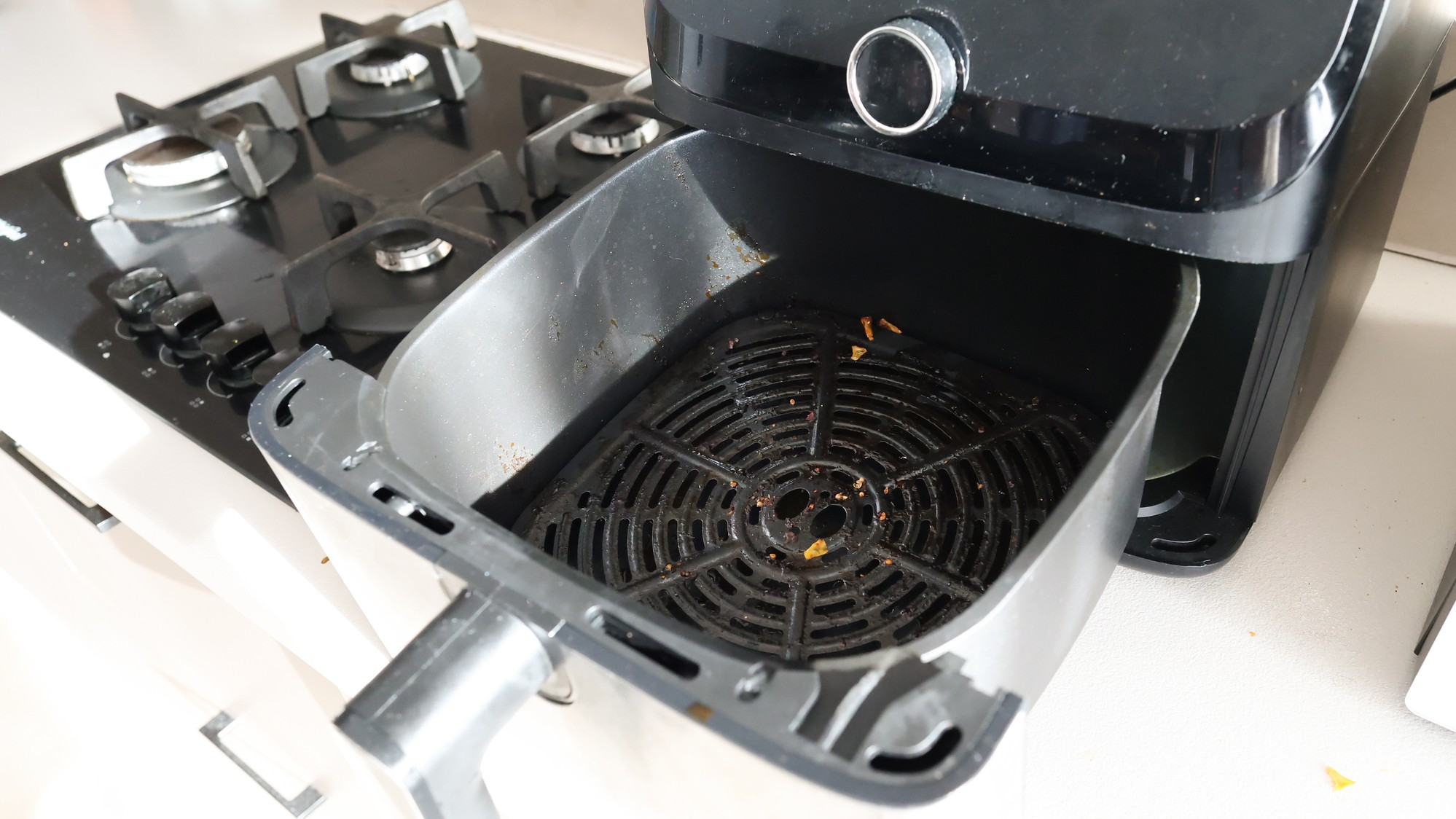
Air fryers get greasy — it’s in their nature — but regular deep cleaning will help prevent dirt building up and causing problems like overheating and bad smells.
Most of your air fryer’s components, including the baskets, racks, and trays, are removable for easy cleaning, and the basket almost certainly has a non-stick coating that prevents food and dirt from getting truly stuck on. Always read the instruction manual before you start washing, and avoid harsh and abrasive cleaning products that could damage the surface.
Advertisement
Don’t have the manual anymore? Find your air fryer on the manufacturer’s website, and you should be able to download a PDF copy.
Sign up for breaking news, reviews, opinion, top tech deals, and more.
It’s a fact of life that air fryers get dirty, but staying on top of cleaning will keep yours working like new (Image credit: Getty Images / KNataliia)
When it’s time to give your air fryer a proper deep clean, start by unplugging it and making sure it’s cool, then soak a cloth in warm, soapy water, wring it out so it’s just damp, and use it to clean any grease and fingermarks from the outside of the appliance. When that’s done, rinse the cloth, wring it out again, and wipe the machine down to remove any soap left behind.
Don’t be tempted to use glass cleaner if your fryer has a window; the next time it heats up, so will any residue left on the glass, releasing fumes. Instead, clean it the same way as the rest of the exterior, then buff away any streaks with a dry cloth.
Advertisement
Now look inside your air fryer. If you notice food stuck to the fan blades or heating element, clean it off with a new toothbrush. If the model allows it, remove the rubber or silicone seal, give it a good wash with warm, soapy water, rinse, and let it dry before replacing it. Dirty seals are a common cause of odors, so keep on top of maintenance to avoid unpleasant smells.
Whatever you do, don’t be tempted to submerge your air fryer in water or try to clean it by using it to heat water or cleaning chemicals.
Advertisement
Espresso machines
Espresso machines also benefit from deep cleaning, which will keep them brewing like new. Every part of the machine that comes into contact with beans, water, or milk is a potential breeding ground for bacteria (and can even grow mold), so it pays to keep up with maintenance.
You should give your coffee maker a quick clean each time you use it, a thorough clean at the end of the day, and a descaling every month, or after brewing 100 cups of coffee (whichever comes first).
Each time you prepare a brew with a manual espresso machine, make sure you rinse the brew group, purge the steam wand, and wipe the outside of the wand with a damp cloth. At the end of the day, empty and wash the drip tray, wipe out the portafilter basket with a damp cloth, and hand-wash the handle and basket.
Your automatic espresso machine’s manual will explain how to access the grinder so you can clean the burrs with a small, stiff-bristled brush (Image credit: Future)
If you have an automatic coffee maker, things are more complicated because moisture and stray coffee grounds inside the machine create a perfect environment for things to grow. At the end of the day, remove the side panel, take out the brewing group, and rinse it according to the manufacturer’s instructions. Remove the waste coffee grounds container, empty it, and wash it with soapy water. Empty and wash the drip tray, too, then use a damp cloth to clean up any coffee grounds you can see inside the machine.
Advertisement
When you’re done, leave everything out to dry thoroughly overnight, and leave the side panel off the machine so moisture can evaporate.
Whatever type of espresso machine you have, also clean the water tank at night and fill it with fresh, clean water in the morning.
It’s also worth cleaning the bean hopper and grinder from time to time, since oils from coffee beans can build up and eventually go rancid, while debris can get caught in the grinder burrs and cause them to stick.
Advertisement
Blenders
With the right care, your blender can last for 10 years or more — trust me, my faithful Dualit has been going even longer!
You should never immerse your blender’s motor unit in water. Instead, detach the jug or blending cup and wipe the outside of the base with a damp cloth. If the jug is dishwasher-safe, this will be the easiest way to get it completely clean, but make sure you read the manual to see how you should clean the blade unit and seal.
If the jug isn’t dishwasher-safe, fill your blending jug about a third of the way up with warm but not boiling water. You can add a very small amount of dish soap at this stage, too, but not too much, or you’ll end up with a mountain of suds.
(Image credit: Getty Images, Grace Cary)
Turn the blender on to give the soapy mixture a good whizz around before emptying the jug and rinsing it with water. Leave the blending jug to fully dry before placing the lid back on, as this could cause damp odors to build up.
Advertisement
If there are any pieces of food left around the blade assembly, remove them with a small, stiff-bristled cleaning brush or an unused toothbrush.
Recycling
All of these tips will help ensure your kitchen appliances have a long, useful life, but eventually a motor will wear out, or a heating element will give up the ghost. When it does, don’t stuff the broken gadget in a cupboard and forget about it — a surprising number of small household appliances can be recycled, and it’s easier than you might expect.
In the US, Best Buy accepts small kitchen appliances for recycling in-store, or you can request a mailing box if you can’t take them in person. Staples and Walmart also offer programs that will accept e-waste, including kitchen appliances. Take a look at MRM Recycling and Earth 911, where you can enter your ZIP code to see e-waste recycling facilities near you.
Advertisement
In the UK, Currys and B&Q take small electrical items for recycling, and your local recycling center might accept them, too. To see your options, visit recyclemyelectricals.org.uk and enter your postcode or address, then enter the type of appliance you want to get rid of. Depending on the type of item you have and its condition, you can choose whether you’d like to donate, repair, or recycle it, and the site will show you locations within a five-mile radius where you can do that.
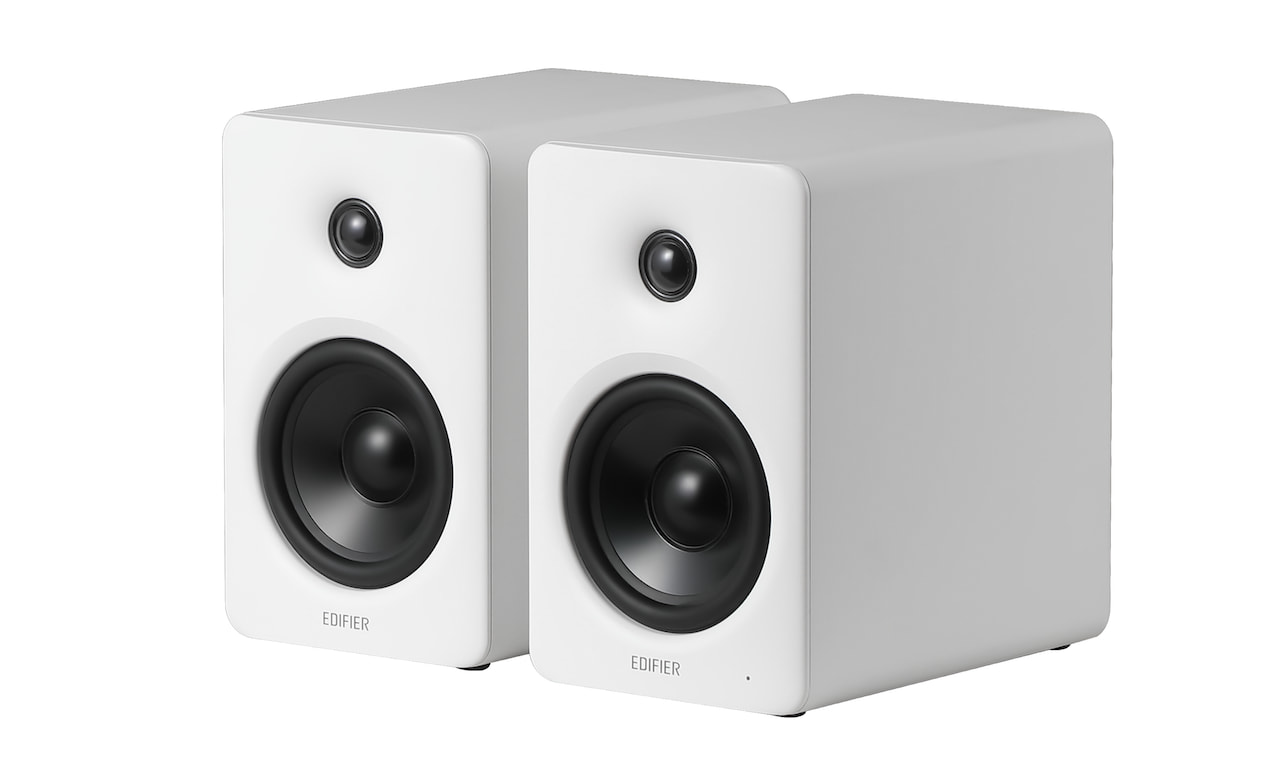
Edifier has built its reputation on delivering affordable, feature-rich speakers that don’t feel like compromises, and the new M90 continues that strategy with a compact active design aimed at both desktop and small room use. First introduced at CES 2026, where we got an early look and listen, the M90 is positioned as a flexible all-in-one solution that can move easily between nearfield listening and casual living room duty. After spending time with the system, it’s clear Edifier is targeting listeners who want simplicity, solid performance, and a smaller footprint at an affordable price.
About My Preferences:
This review is subjective, shaped by how I listen and what I value. I do my best to stay objective, but let’s be honest, bias doesn’t just pack up and leave the room.
My ideal sound leans toward controlled sub-bass, textured mid-bass, a slightly warm and natural midrange, and treble that extends cleanly without turning harsh. I also have mild treble sensitivity, so anything overly bright or aggressive tends to stand out quickly.
Testing equipment and standards can be found here.
Advertisement
Edifier M90 Specifications and Key Features:
The Edifier M90 is a compact active speaker system priced at $369.99, with cabinet dimensions of 133 x 212 x 225 mm (approximately 5.2 x 8.3 x 8.9 inches), making it easy to place on a desk, shelf, or media console. It uses a two-way, bi-amped design built around a 4-inch long-throw mid-bass driver and a 1-inch silk-dome tweeter, with dedicated amplification for each driver.
Total system power is rated at 100 watts RMS, split between 35 watts for the mid-bass and 15 watts for the tweeter per channel, and it can reach up to 100 dB SPL. That’s enough for nearfield listening or smaller living spaces without overreaching.
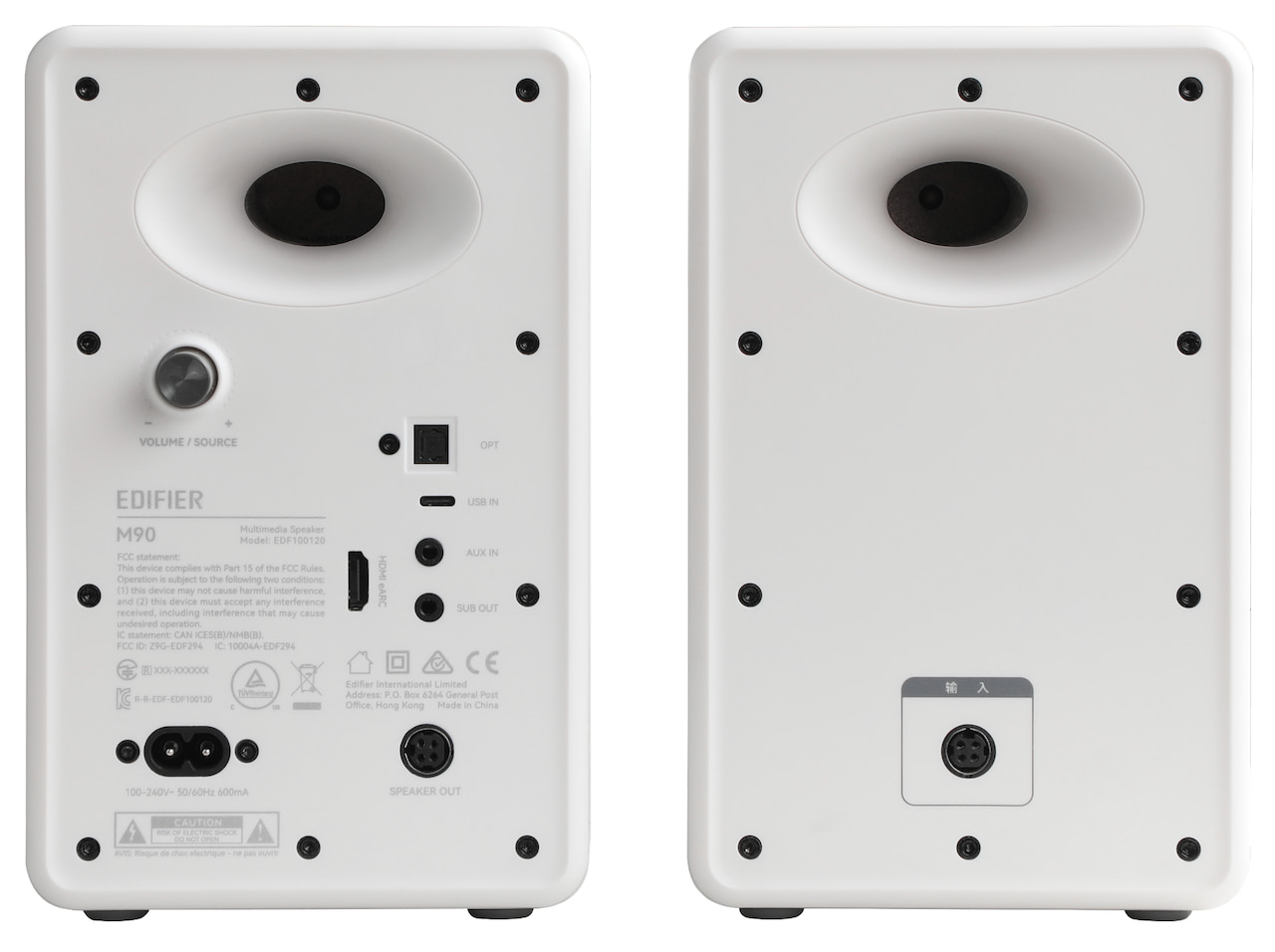
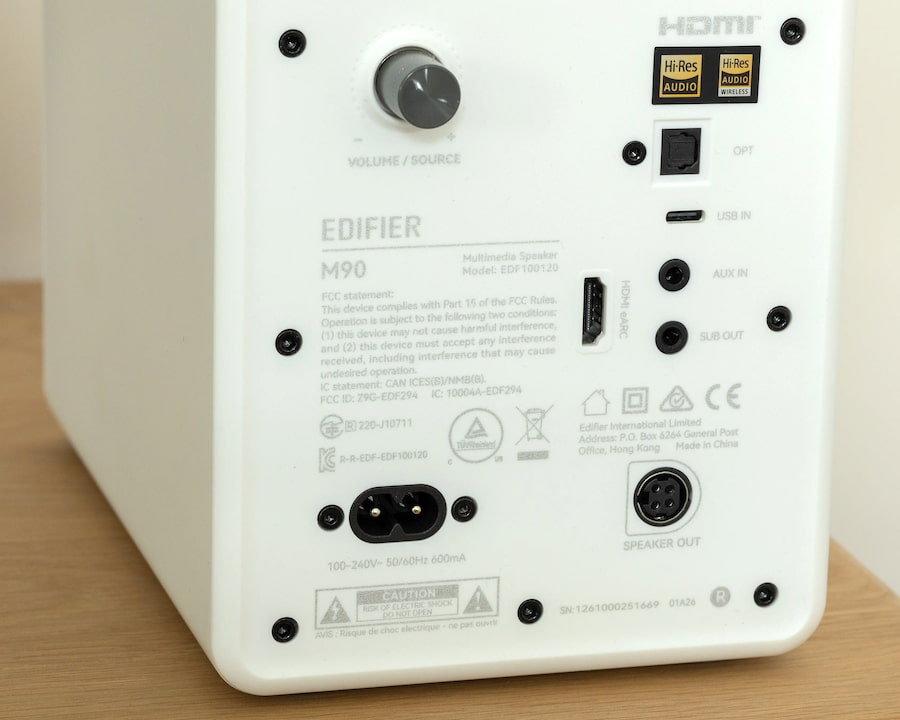
Connectivity is one of the M90’s stronger plays. Around back, you get HDMI eARC, optical, USB-C, and a standard AUX input, which covers everything from TVs and laptops to legacy gear. Wireless playback is handled by Bluetooth 6.0 with LDAC and multipoint support, so you can stream higher-quality audio and switch between devices without the usual friction. The system also supports up to 24-bit/96kHz audio depending on the source.
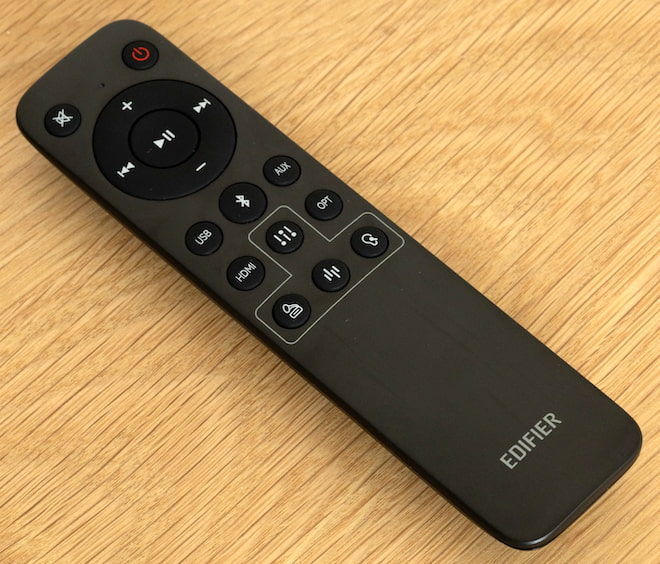
Ease of use hasn’t been overlooked either. The M90 includes onboard controls for quick adjustments, an omnidirectional remote that actually works from across the room, and support for the Edifier ConneX app on iOS and Android for additional control and setup. DSP is doing a lot of the heavy lifting behind the scenes, managing how the speakers handle music, movies, and gaming to keep performance consistent across different types of content.
Advertisement
Build Quality
The M90 feels well-built in the hand and features high-quality paint finishes. It doesn’t look out of place on a desk filled with high-end gear, which should suite deskscape enthusiasts well. The ports on the rear of the device are firmly set within the active speaker’s chassis, leaving no room for wobble or wiggle.
The included remote is a little basic, but is still put together well. The buttons and responsive and sized well, making them easy to manipulate in a dark room. It has plenty of range too, so even larger living and theater rooms shouldn’t run into distance issues.
I did find the M90 to be a little clumsy when used at my desk, however. Other desktop speakers often feature a front-facing selection of controls such as volume and power. The M90 does not, so you’ll need to use the wireless remote to manipulate its state even when sitting right next to it. Well, that or stand up and reach behind the right speaker , which isn’t a viable option for a wide (and cluttered) desk like mine.
Advertisement. Scroll to continue reading.
Advertisement
Listening
The M90 is a pretty flexible pair of speakers, but it feels most at home when running through your favorite album. Its default tuning is well-balanced, delivering crisp treble and an articulate upper-midrange. The M90 renders vocals nicely, capturing a strong share of nuance, particularly during quieter passages. The M90’s lower mids sit slightly back in the mix and aren’t overly emphasized, contributing to a more neutral, audiophile-leaning tonality.
This, paired with the speakers’ linear bass performance, give it a resolving, but sterile, timbre. You’ll want to pair the M90 with a discrete subwoofer to get a truly full-range experience, as the mid-bass woofer on the speaker doesn’t dig down much further than 150Hz.
Cycling through the other presets add varying degrees of warmth back in to the mix, giving guitars and drums additional substance. This also relaxes the upper-midrange, allowing vocals to settle back towards the middle of the sound-stage rather than center-front. I don’t like the “Monitor” and “Dynamic” presets as much as the “Classic” tuning, but then again, I don’t have any particular need for a pre-calibrated studio-monitor profile.
If you want to dive into personalization and fine-grained customization, the Edifier app allows you to configure and apply your own tuning via a 9-band software EQ. It works pretty and well and is responsive. The app is utilitarian in appearance, but functions smoothly and without bugs on Android.
Strong Gaming Performance
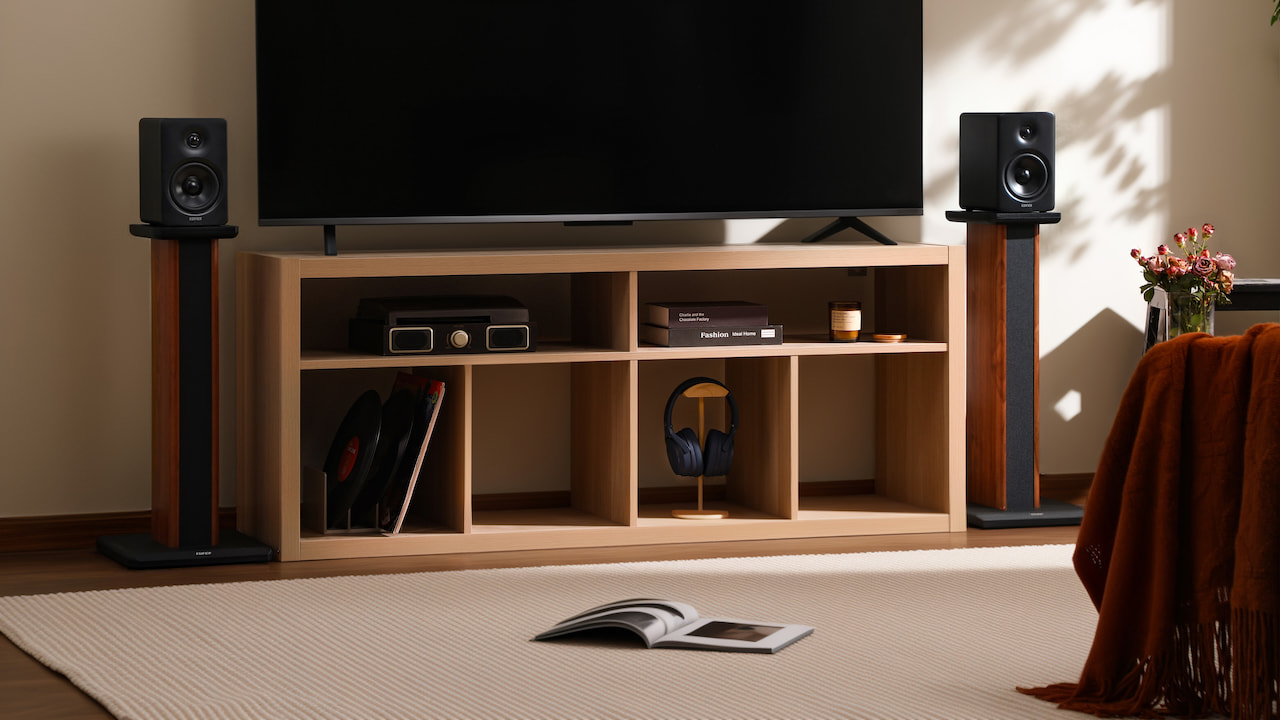
The M90 is a great couch-gaming set of speakers. Hooking it up to my TV via HDMI eARC was easy, and before I knew it I had high-headroom, low-latency audio ready to go. First-person shooters are pretty playable on the M90, even in fairly small rooms. In my gaming den, the speakers are positioned about 10 feet from my chair, flanking a 65-inch OLED TV. In this setup, the M90 delivers its best spatial rendering.
Advertisement
Cramming the M90 on to my work desk delivered somewhat less-exciting results. Its sound-field operates best at longer distances, and my desk (60″ x 38″) didn’t give me enough depth for gunshots and subtle footsteps to accurately render in titles like Call of Duty: Black Ops 7.
Frustrating Quirks, Fixed via Firmware Update
The M90’s excellent performance and great pricing is hamstrung by a few odd-ball choices made on its default firmware. If you’re experiencing unpredictable fade-in behavior or are noticing that the M90 falls asleep during quiet passages in video content, then install the Edifier Connect app and update its firmware. That behavior is a bug that was fixed as of 4/12/2026.
Likewise, if you’ve plugged a subwoofer in to the M90’s line out and found its gain to be too low, you’ll need to update the M90’s firmware and then adjust the gain in the app. This is the only way to adjust the line-out gain, so if you’re not a smartphone owner, you’re out of luck. I’d have liked to have seen additional physical controls for sub-out gain so I can more-easily fine-tune my sub’s output.
Edifier M90 (also available in black)
The Bottom Line
The M90 is a solid, cost-effective speaker for those that want to take advantage of modern eARC capabilities. Its strong technical capabilities, combined with its wide feature-set, make it a compelling proposition, especially when measured against its more-expensive peers. After updating the M90’s firmware, it becomes a capable and hassle-free companion for high-performance audio, especially for those that plan on deploying it in the living room.
Advertisement
Pros:
Wide soundstage
Lots of headroom
Articulate and performant
Customizable via EQ and tuning presets
Solid directional abilities for gaming
Includes responsive wireless remote
Supports wide variety of input modes including HDMI eARC
Cons:
Requires a subwoofer to get full-range sound
Not suited for smaller desktops
Some arrangements may require angled desk stands
No front-facing physical volumes controls, awkward for desktop use


























































You must be logged in to post a comment Login