




Connect with us
DAPA Banner

Tech

What Happens When An Engine Derates? Here’s What You Should Know

Published

on


If the diesel engine in your vehicle suddenly decides not to play ball and loses power, or is restricted to a certain speed, then it’s possible that the engine has been derated. While this is undoubtedly inconvenient, this is actually a feature of modern diesel engines that’s designed to protect them. 

Put simply, engine derating happens when engine sensors detect an issue with it. When this happens, the engine control unit initiates an intentional power drop. Importantly, this power reduction isn’t the failure, it’s a protective response designed to prevent damage or excess emissions. In short, although it probably doesn’t feel like it at the time, this system is there to help and can stop minor issues from becoming wallet-draining trips to the workshop. 

The triggers for this can vary depending on the vehicle, but typically, it happens when engine sensors detect that it’s operating outside of its designed operating limits. High running temperatures are a common cause — excessive heat is never a good thing in engines. Modern engines can also derate in response to emission-related issues. The latter can be caused by blocked diesel particulate filters, or even faults with the exhaust gas recirculation (EGR) valve. 

Advertisement

So, while the loss of performance might feel like something’s gone wrong, the reality is that the system is working exactly as intended. Let’s have a closer look at the double-edged sword that’s both inconvenient, but potentially engine-saving. 

Advertisement

What engine derating feels like behind the wheel

When an engine has been derated, the most obvious symptom is a noticeable drop in performance, often accompanied by the driver simultaneously experiencing a severe sinking feeling in the pit of their stomach. Acceleration might feel sluggish, with a muted throttle response, and engine revs and speed can also be restricted. 

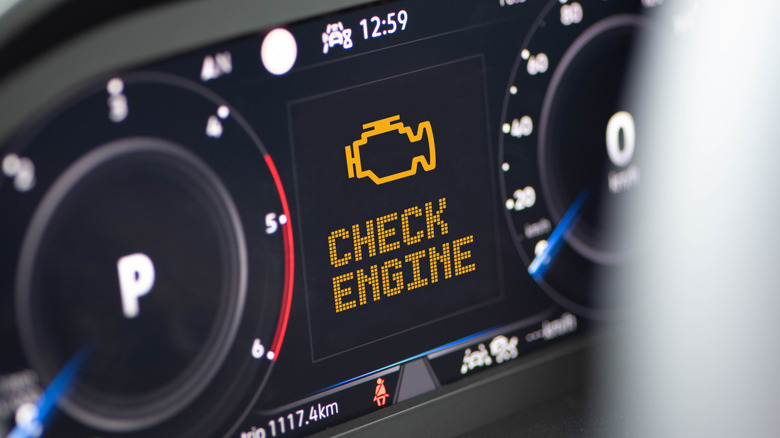
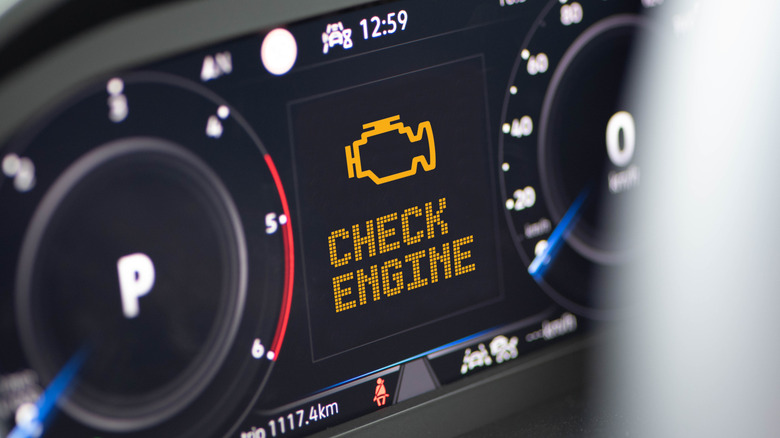
In some instances, the top speed can be restricted to as low as 5 mph. Essentially, this is a self-imposed limp mode that allows the vehicle to keep moving, but only enough to reach a safe location or a workshop. Depending on the particular engine and/or the severity of the issue, dashboard warning lights or messages may appear. Understanding what common dashboard warning lights mean can help you get an idea of what the underlying problem is. 

This is important, as not all derating is equal. In some situations, the power reduction is intermittent and relatively mild. For instance, if the problem is temperature-related, then the restriction may be lifted when the temperature normalizes. Of course, if this is a persistent problem, then a trip to the mechanic is probably wise. Even if the engine appears fine, there are plenty of ways that cars can lose coolant without a leak

What is important to understand when the engine’s power is derated is that although the vehicle may be driveable, it isn’t happy. The reduced performance is there to tell you that things aren’t well under the hood — and how you respond to it is important. 

Advertisement

What to do and what not to do when your engine derates

A derated engine might not always be an immediate emergency.  For instance, if a temperature-related derate occurs when the engine is operating under high loads and in high-ambient temperature situations, then it could be a one-off triggered by those operating conditions. This is especially true if the engine goes back to normal once the temperature normalizes. 

However, if the problem is more persistent, or the vehicle has entered a restrictive limp mode, then this isn’t something that can be tucked away as next week’s problem. Continuing to drive the vehicle in these circumstances, especially over long distances, can turn a relatively minor issue into an expensive and sob-inducing one. Warning lights, repeated derating, any indications of low-oil pressure or persistent overheating should always be treated seriously. 

It’s also worth noting that what a derate does to your vehicle’s performance today, might not be the case tomorrow. For instance, if the derate is linked to high-emissions from a vehicle, then the control system can add further restrictions until the underlying cause is addressed. 

Advertisement

Ultimately, while it might not seem like it, an engine derating might turn out to be a blessing in disguise. Frustrations aside, in most cases, this is the system stepping in to prevent a much more serious failure from developing. 


Advertisement

Source link

Continue Reading
Click to comment

You must be logged in to post a comment Login

Leave a Reply

Tech

Forced Windows updates can now be paused forever

Published

on

No more getting caught by a forced Windows 11 update while you’re in the middle of a meeting or a match. Microsoft announced some major changes coming to Windows Update on its blog, including the ability to indefinitely pause Windows updates, 35 days at a time.

To give users more control, Windows Update introduced the option to extend update pauses as much as users want. Once you opted to pause updates for Windows 11, you won’t be disturbed for 35 days at a time, but you can now reset this 35-day limit for as long as you want. You should eventually install these updates, as most of them are usually related to security upgrades and only sometimes require emergency fixes, but Microsoft is letting users decide when to do so. Microsoft’s Aria Hanson wrote in the blog that these changes were a result of feedback that consistently mentioned “disruption caused by untimely updates and not enough control over when updates happen.”

Beyond the update pauses, Microsoft is ensuring Windows 11 users always have the option to shut down or restart their devices without updating. These quality-of-life upgrades build on another recent change that allowed users to skip updates while setting up their new Windows devices. According to Microsoft, the latest Windows Updates features are currently rolling out to those enrolled in the Windows Insider program, specifically users in the Dev and Experimental Channels.

Source link

Advertisement
Continue Reading

Tech

Gamer Wants Real Nintendo 3DS Store Kiosk, Builds His Own from Scratch

Published

on

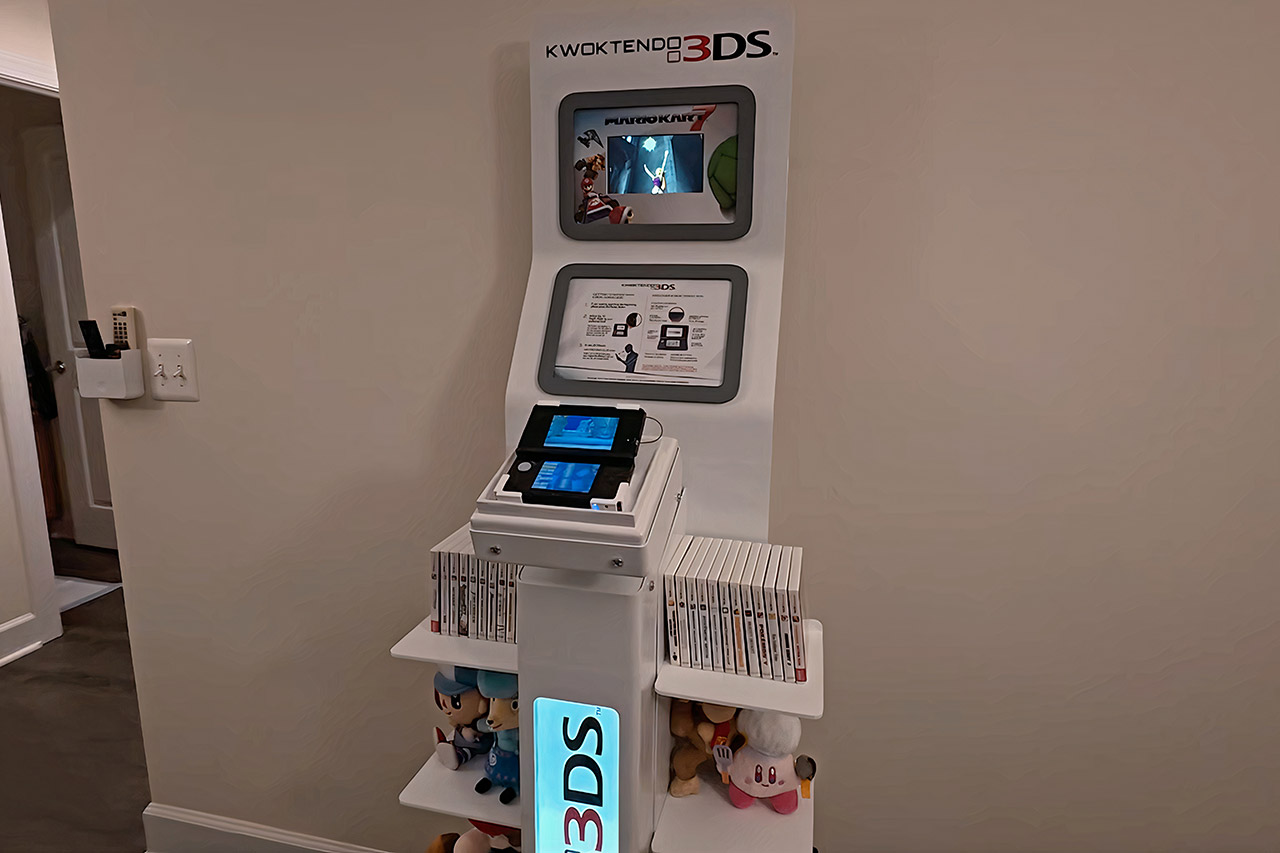
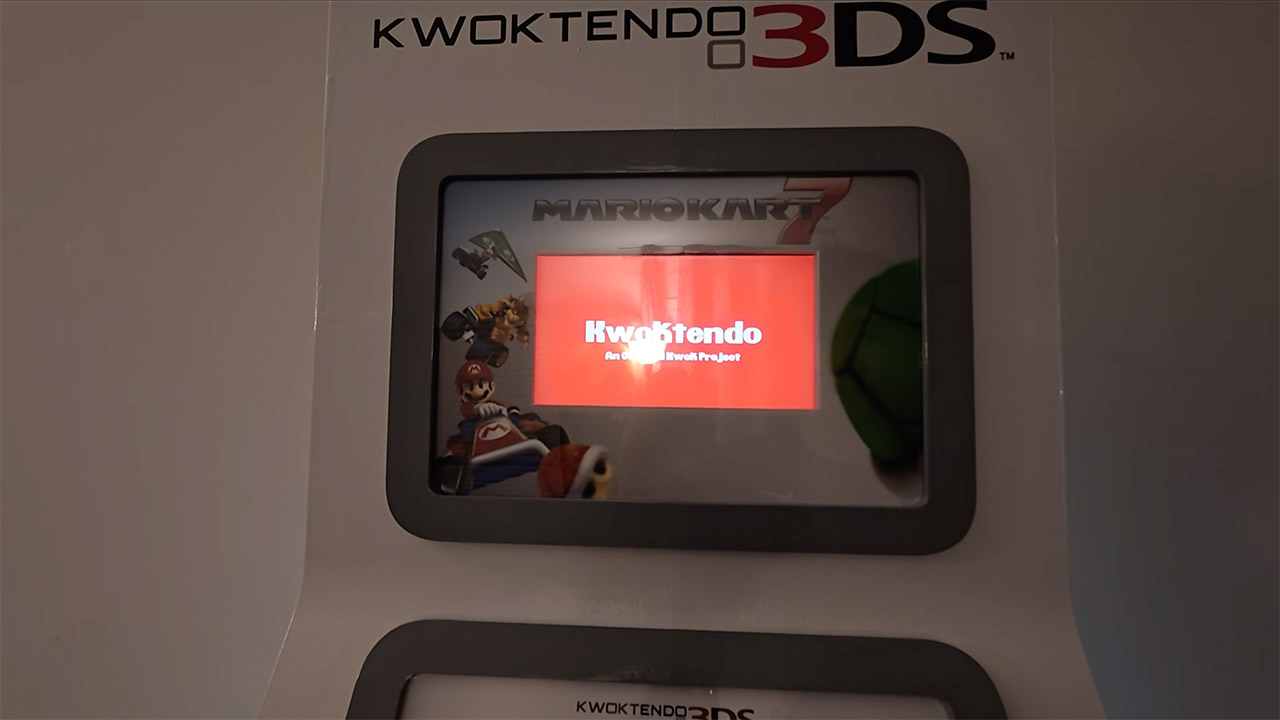
Custom-Built Nintendo 3DS Store Kiosk
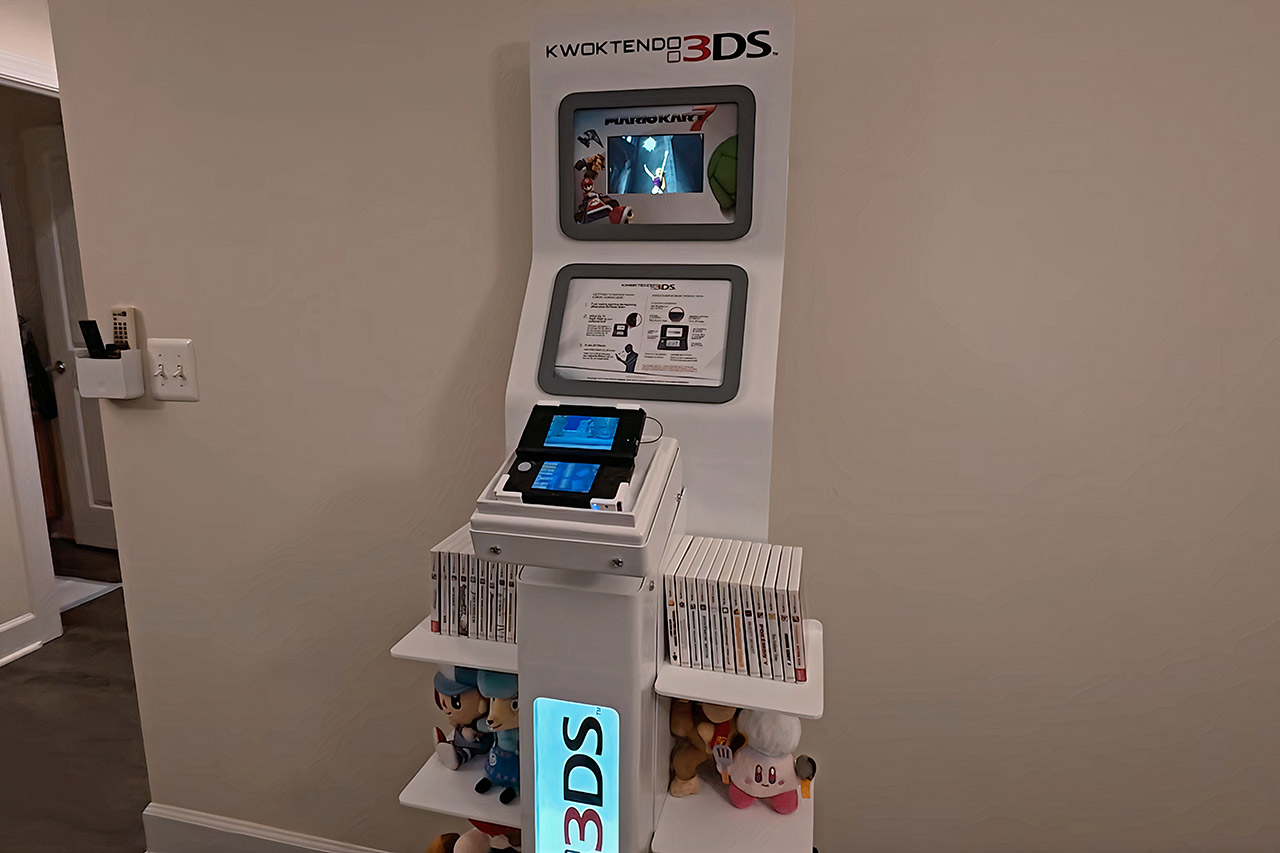
Project Kwokcade spent a long time looking for one of those rare Nintendo 3DS retail displays that used to be found in stores around the world. To be honest, original units don’t show up for sale very often, and when they do, the price is just a little out of reach for most collectors, so he decided to be creative and take a new approach. Instead of waiting, he switched to 3D modeling software and began creating each component from scratch.


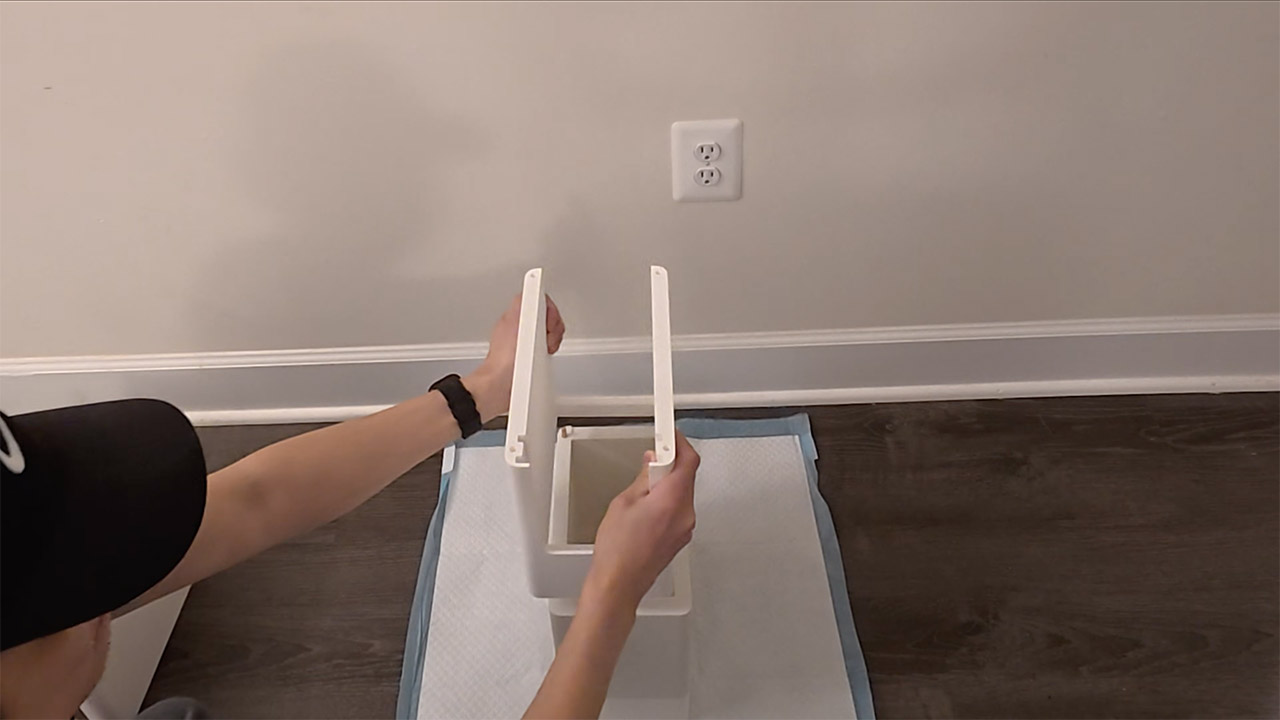
It all began with a little of cautious planning. He gathered all of the measurements and photos he could find online, including some extremely useful photographs given by other aficionados and footage from a collector in France. Using 3DS Max, he created a hollow digital model that could be printed at full size. He then divided the design into thirty-one individual parts, each of which would fit on a regular printer bed, and added some holes for dowels to keep everything together, as well as some threaded inserts that could accept screws later. He ensured that the walls were thin enough to save material while remaining robust enough to hold the entire structure once it was put together.

Printing was a bit of a marathon, as he plowed through spool after spool of PETG at 0.2 mm layer height, two walls, and 15% infill. Every main component simply rolled off the bed after a few days of nonstop printing. When he had a decent-sized collection of white plastic parts, he knew the true challenge had only begun. What truly mattered was getting everything aligned properly; a wobbly base would throw off the whole thing, so he double- and triple-checked every joint before deciding to basically glue things together.

Custom-Built Nintendo 3DS Store Kiosk
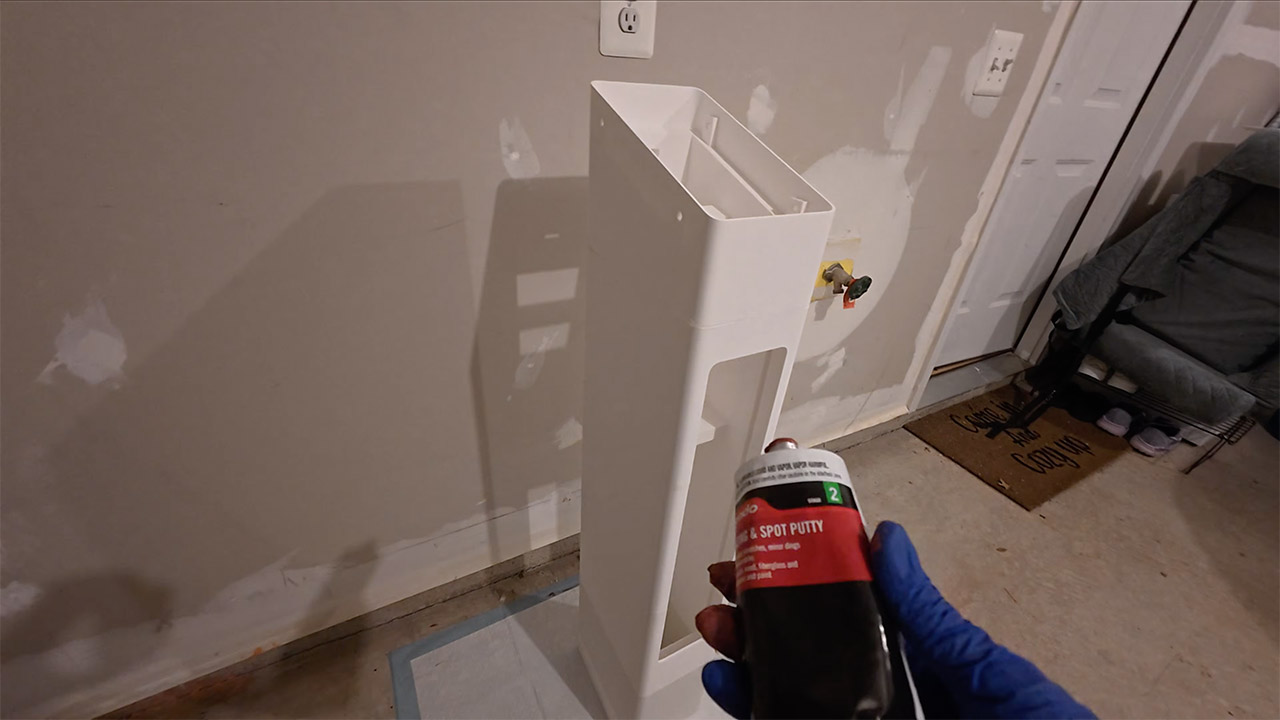
Post-processing was also time-consuming because he had to remove all of the layer lines and gaps from the print. He filled them in with Bondo glazing putty, then applied primer and sanded everything smooth. After two applications of Rustoleum paint, it looked like a legitimate retail display. The only issue was that it took a long time to complete, and if you missed a location somewhere, it would appear a mile away until the kiosk was fully assembled.

Custom-Built Nintendo 3DS Store Kiosk
Assembly was its own special kind of fun, however getting one major portion to line up properly was a headache in and of itself. In the end, he got there, using wooden dowels to reinforce the connections and super glue to keep everything in place. He then screwed the neck & base together & the tray to the top using three different lengths of screw. He put some plastic tubing over the internal wires to conceal them, then used a hot glue gun to secure any remaining features in place. As a finishing touch, he built a little wood panel to make the base shelf, painted it to match the rest of the kiosk, and called it a day.

Custom-Built Nintendo 3DS Store Kiosk
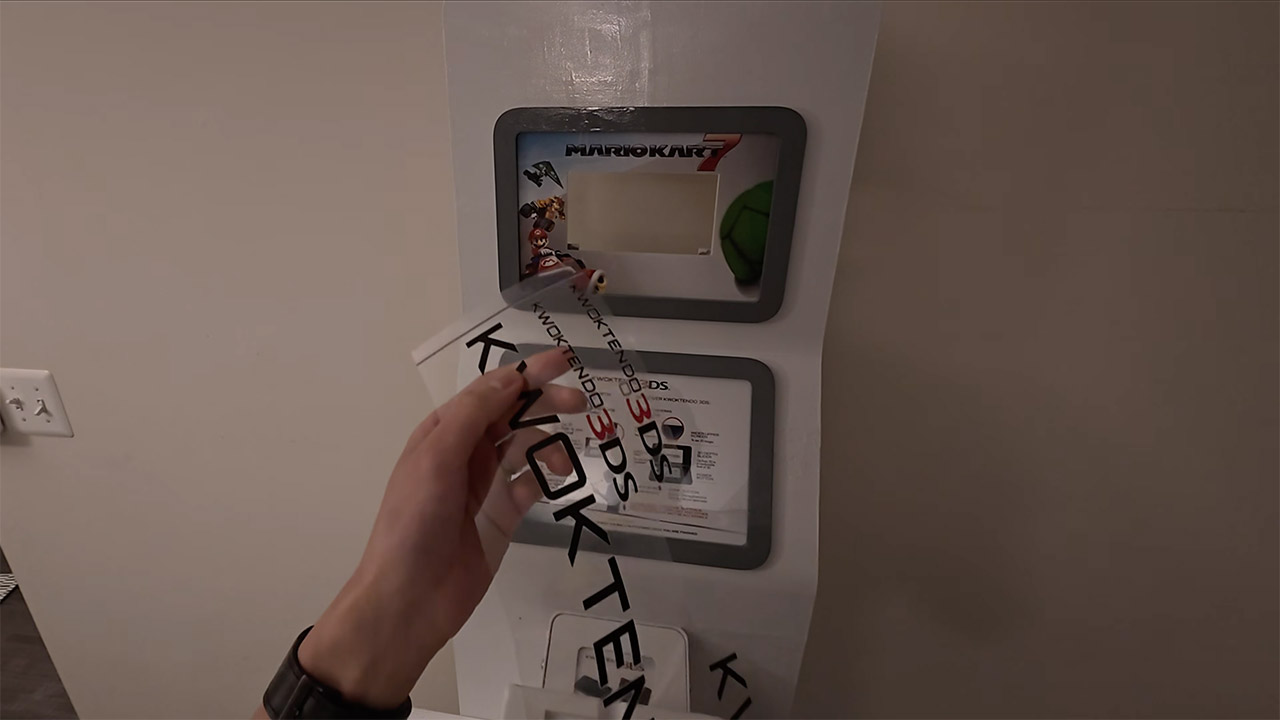
Attention is drawn to all of the elements that make this replica stand out, as well as the finer details that make it appear authentic. Three brand logos have arrived as UV DTF transfers, one for 19.5in, another for 13.5in, and a third for 5in, all of which press-fit perfectly onto the painted surface. Two large glass panels, one crystal clear and the other with a faint textured appearance from acid etching, have just been lowered into the slots in the front window. Some small plexiglass pieces were then inserted into the side apertures to create the illusion that the demo area was surrounded by protective barriers. The LED strip running inside lights up the space, which means it travels along the rear panel and through the front window glass, casting a nice soft glow similar to the original retail version. Furthermore, there is a hidden USB speaker that is ready to handle any audio needs. The cables are nicely organized thanks to a tiny strip down the back that keeps everything tidy.

Custom-Built Nintendo 3DS Store Kiosk
The operation is powered by a Raspberry Pi 3 or 4, which is linked with a Wisecoco seven-inch monitor. The software that powers this demo experience, including scanned cards and looped material from retailers, is stored on a microSD card. The Pi is neatly placed beneath the screen on the back panel, and the monitor is secured in a bespoke tray that was part of the original modeling. To top it off, a genuine 3DS has been inserted into the front holder, its stylus still in place and ready to be shown. Finally, everything is connected with a few cords and powers up as one unit.

Source link

Advertisement
Continue Reading

Tech

Ikea’s New Blow-Up Chair Was Tested by Cats

Published

on

A blow-up chair? Ikea has been here before. It attempted to make inflatable furniture in the mid-1990s, when designer Jan Dranger came to the Swedish company with a revolutionary idea to solve one of its biggest challenges: how to squish sofas into its preferred flat-pack format, simplifying transport and cutting costs.

It sounded like the perfect solution. Made from durable and recyclable polyolefin plastic, the chair and sofa designs could be inflated at home using only a hair dryer. Transport volumes would be cut by as much as 90 percent. Sadly, only after the “a.i.r” collection launched in the 2000 catalogue did Ikea’s ambitions become deflated.

Staff in stores said that the easy chairs and sofas looked like groups of “swollen hippos” in the furniture displays. Customers forgot to set their hair dryers to cold before inflating. Hot air takes up more space than cold air, so inevitably the sofas deflated as the air inside cooled. Even worse, the valves leaked, so after sitting down, an unglamorous farting noise issued from your general direction. By 2013, Ikea killed the a.i.r collection, but it had crucially learned many lessons.

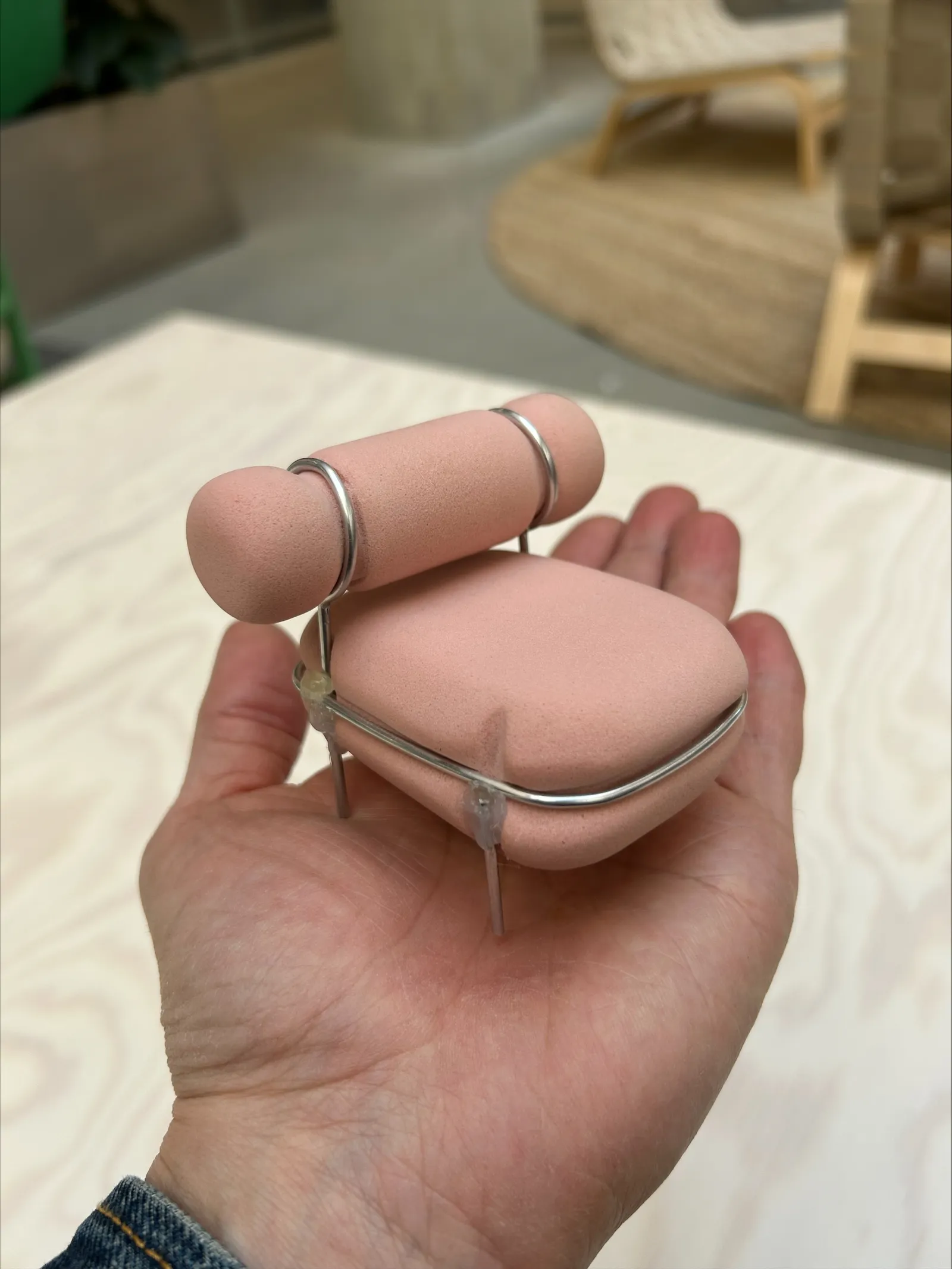
Fast-forward to the present day and now Mikael Axelsson is the intrepid Ikea designer who has decided to give blow-up furniture another try for the brand’s latest PS collection launching on May 13. However, his $200 inflatable armchair, called (somewhat uninspiringly) the “PS 2026 Easy Chair,” has had a stranger birth than any other of the 2,000 products Ikea releases each year. To start, he’s been sitting on this particular idea for 12 long years after he initially fashioned a Barbie-sized mock-up from foam and wire in 2014—just one year after the original a.i.r collection burst.

Advertisement
Image may contain Baby Person Furniture Chair and Cosmetics

Axelsson’s first model of the PS 2026 Easy Chair.

Courtesy of IKEA

Image may contain Helmet and Stretcher

The tubular chrome frame prototyping.

Courtesy of IKEA

At the time, the trouble was not merely that Axelsson struggled to figure out how to make an inflatable cushion feel more like foam and less like a beach ball; Ikea was also wary of returning so soon to the flatulent debacle that was its inflatable furniture failure. So his model was shelved, literally, in his office. Then, in 2023, Axelsson and the rest of the in-house team were summoned to drum up innovative designs for an upcoming PS collection, and he saw a chance to breathe life back into his inflatable easy chair concept.

Deciding to stick with his original tubular chrome frame idea, Axelsson hand-welded 20 prototypes himself, a skill acquired from growing up around his father’s metal workshop, but the beach ball problem remained.

Advertisement

“I remember when Mikael met with this guy who repairs tractor tires, and he came with the inner tube of a tractor,” Johan Ejdemo, Ikea’s global design manager, tells me. They put that in a concept chair. Better, but not perfect. Eventually, they struck upon the idea of a dual-chamber seat. “It’s one outer air section, and then one central air section,” Ejdemo says. “And you can regulate the comfort yourself, depending on how much you pump it up.”

Source link

Advertisement
Continue Reading

Tech

Hackaday Links: April 26, 2026

Published

on

It’s been three weeks since the Artemis II crew returned to Earth, and while the mission might be over for Reid Wiseman, Victor Glover, Christina Hammock Koch, and Jeremy Hansen, the work is only just beginning for engineers back at NASA. In a blog post earlier this week, the space agency went over the preliminary post-mission assessments of the spacecraft and its ground support equipment, and detailed some of the work that’s currently taking place as preparations begin for Artemis III.

During Artemis I, higher than expected damage was noted on both the Orion’s heat shield and the Space Launch System (SLS) launch pad. But according to NASA, the changes implemented after that first mission seem to have prevented similar issues this time around. The post also explains that reusable components of the Orion spacecraft, such as the avionics and the crew seats, are already in the process of being removed from Integrity so they can be installed in the next capsule on the production line.

While watching the live stream of the Artemis mission is the closest most of us will ever get to experiencing spaceflight, that doesn’t mean you can’t explore the solar system from the comfort of your own home — or more specifically, your browser. [Sani Huttunen] has created an incredible web-based solar system simulator that lets you explore our celestial neighborhood throughout different periods of time. You can tour the moons of Jupiter, see how the planets aligned on the date of your birth, and even check in on the Voyager probes. There are some very valid reasons to be skeptical about software moving to the web, but we’ve got to admit, this is a very slick demonstration of just how far modern browsers have come.

Speaking of how far things have come, are you ready for a car without a rear window? Polestar certainly hopes so, as their latest model does away with such quaint concepts. The glass panel in the roof ends right around the back headrests, and while the rear of the vehicle does open up for storage, the hatch is completely solid. In place of the traditional mirror, there’s a “high resolution” 1480 x 320 display that shows the feed from a rear-mounted camera.
Advertisement

No, that’s not a typo. At a time when smartphones are shipping with 2K displays, should the driver want to see what’s going on behind their $70,000+ USD electric vehicle, they’re limited to seeing it at a vertical resolution below that of VGA. We’d make a joke about Polestar offering up a “Rearview+” upgrade down the line that would give the driver a higher resolution view, but honestly, it’s getting a little too close to reality to be funny.

If that last one has you wishing for a reminder of simpler times, how about some new software for using the iconic Wii Remote as an input device? The Wii and its revolutionary controllers may be turning 20 later this year, but that hasn’t stopped the dedicated fans. This new wrapper provides accelerometer calibration, infrared tracking, and the ability to remap the Wii Remote’s buttons and create key combos. If you do something cool with it, we’d love to hear about it.

Finally, on the other end of the input spectrum, some details leaked out this weekend about Valve’s upcoming Steam controller — namely, the fact that it will cost players $99 at release. As reported by VICE, a hands-on review of the controller by TechyTalk was accidentally published early on YouTube, providing the public with pricing info ahead of an official announcement.

At first blush, this might seem like a lot of money to pay for a game controller, but it’s actually within striking distance of the sticker price on the standard controllers on the Xbox and PlayStation consoles. Perhaps more critically, it’s around half the price of the official “premium” controller offerings available for the aforementioned systems. Is it really any wonder that we’ve got cars without rearview mirrors when folks are putting down 200 bucks for a fancy PlayStation controller?

Advertisement

See something interesting that you think would be a good fit for our weekly Links column? Drop us a line, we’d love to hear about it.


Source link

Advertisement
Continue Reading

Tech

'Pluribus' & 'Come See Me In The Good Light' win Peabody awards for Apple TV

Published

on

Of the five nominations for the 86th Peabody Awards, Apple TV scored two wins. “Pluribus” won in the entertainment category, while “Come See Me In the Good Light” won in the documentary category.

Bright yellow background with bold black text PLUR1BUS beside a petri dish of yellow liquid, where a hand uses a cotton swab to draw a smiling face.
‘Pluribus’ brings home a Peabody award for Apple TV

Apple continues to rake in the awards with its original programming. At last count, Apple TV has 3,431 award nominations and 797 wins.
The results from the Peabody Awards are in, and Apple TV can add two more wins to its list. Five of its shows were nominated.

Continue Reading on AppleInsider | Discuss on our Forums

Source link

Continue Reading

Tech

Truecaller faces mounting pressures as its growth matures

Published

on

Truecaller is one of the world’s most widely used caller identification platforms, with more than 500 million users. Now it’s entering a more challenging phase as growth slows in its largest market and competition intensifies across telecom networks and smartphone platforms.

Much of Truecaller’s growth has been driven by India, which accounts for over 350 million users, or about 70% of its global base. The volume of spam and unwanted calls has turned the app from a simple caller ID service into a more embedded layer of everyday communication.

That position is now shaping its next phase. The company has introduced features such as AI Assistant and Family Protection to drive monetization, alongside tools like Community Suggestions to stay relevant as competition intensifies. This comes as telecom-led solutions such as Calling Name Presentation (CNAP), dedicated number series for verified business calls, and AI-based spam protection gain traction in India. Meanwhile, smartphone makers including Apple and Google continue to build caller identification and spam-blocking capabilities into their operating systems.

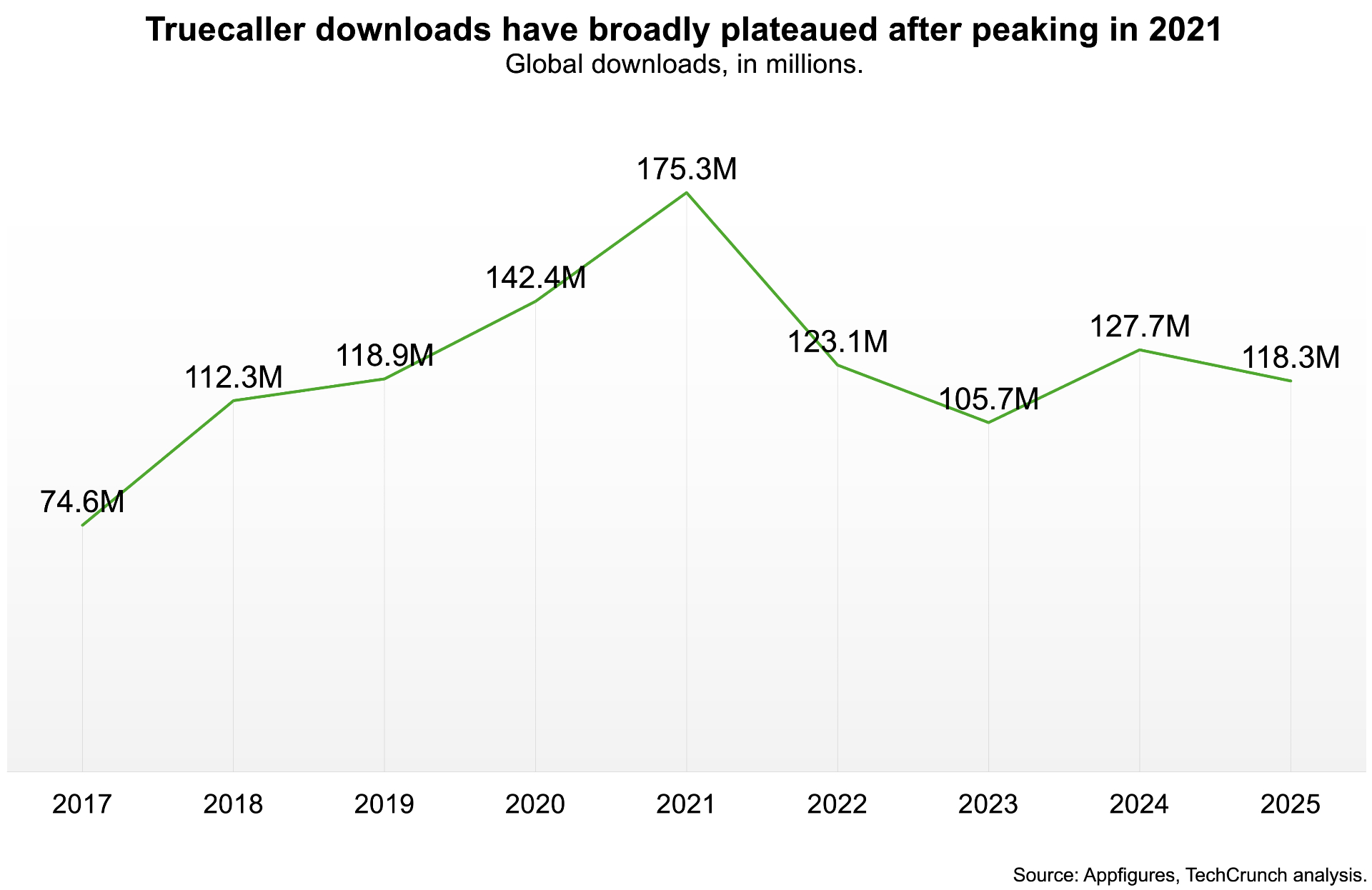
As competition increases, Truecaller’s growth is starting to slow. Data shared with TechCrunch from Sensor Tower shows downloads from India fell 16% year-over-year in 2025, while global downloads declined 5%, marking a reversal after several years of growth. Separate data from Appfigures shows downloads peaked at 175 million in 2021, dropped sharply in 2022 and have since hovered around 120 million annually.

Advertisement
Image Credits:Jagmeet Singh / TechCrunch

India remains Truecaller’s largest market, but its share of downloads has declined from over 70% at its peak to the mid-50s in recent years, pointing to a gradual shift in new user growth toward other markets.

Truecaller’s shift in growth dynamics is being closely watched by investors. The company’s shares have fallen about 78% since its 2021 IPO and are down around 37% so far this year, underscoring investor concerns about its growth outlook and business model. Chief Executive Rishit Jhunjhunwala told TechCrunch that one of the key questions from investors has been around the impact of CNAP in India. He also acknowledged recent headwinds in parts of the business, without elaborating further.

CNAP, an initiative pushed by India’s telecom regulator and is being implemented by telecom operators, displays caller names based on KYC records at the network level without requiring third-party apps. This overlaps with part of Truecaller’s core offering, but is more limited in scope.

Techcrunch event

San Francisco, CA
|
October 13-15, 2026

Advertisement

Truecaller’s Jhunjhunwala said the company does not see CNAP as a disruption but as validation of the problem.

“Truecaller operates as a global platform with a much richer and dynamic intelligence layer — spanning spam detection, fraud prevention, business identity, and user context across calls and messages,” he said. “This allows us to go significantly beyond basic caller ID.”

Advertisement
Truecaller’s Community Suggestions show user-generated context about incoming callersImage Credits:Truecaller

Bharath Nagaraj, director of equity research at Cantor Fitzgerald, said CNAP could slow user growth but is unlikely to materially disrupt Truecaller’s core business in the near term. Instead, he pointed to pressure in the company’s advertising segment — driven in part by changes from Google — as the more immediate challenge.

“If you look at the earnings for the company, 65%–70% of it now comes from ad revenue. And that impacted recently,” Nagaraj told TechCrunch.

In its last earnings call (PDF), Truecaller said that it lost roughly one-third of ad traffic from its largest partner in August 2025 — a partner analysts on the call identified as Google. Jhunjhunwala attributed the drop to an unresolved “algorithm issue,” while CFO Odd Bolin said the partner still accounts for more than a third of total revenue. The company is now adding new partners and building its own ad exchange to reduce dependence on any single platform.

But even moving to an in-house ad exchange may not fully address the challenge. Advertising remains highly competitive, with brands able to spend across multiple digital platforms, said Nagaraj. “You can show your ads on Truecaller, but you can also show them on Facebook,” he said.

In-app revenue continues to grow

The pressure on advertising comes even as other parts of Truecaller’s business are on a different trajectory. Data from Appfigures shows that while downloads have plateaued in recent years, gross in-app revenue has risen sharply — from $600,000 in 2017 to $39.3 million in 2025. It has already reached $13.4 million this year as of April 20.

Advertisement

Monthly revenue generated by in-app purchases on Truecaller is now consistently above $2 million and still climbing, per Appfigures.

Image Credits:Jagmeet Singh / TechCrunch

Truecaller’s presence on iOS has also grown from less than 5% of its total downloads in 2020–2021 to around 11–12% in recent years, per Appfigures, highlighting a shift toward higher-value markets. The company has stepped up efforts on Apple’s platform, including launching real-time caller ID for iPhone in early 2025 and rolling out feature updates to improve parity with its Android app.

Nonetheless, Apple recently expanded its call-screening capabilities, which could reduce the need for third-party apps among iPhone users.

Another key pillar of Truecaller’s monetization strategy is its enterprise offering, Truecaller for Business, which enables companies to verify their identities and communicate with customers via calls and messaging. The segment has been growing steadily, with revenue rising 39% in constant currency in 2025. Truecaller’s Jhunjhunwala said the company is expanding the platform globally by opening its chat services to partners and offering tools such as verified business caller ID to help enterprises verify identity and reach customers.

Alongside its enterprise push, Truecaller has also been expanding its consumer subscription business, which has over 4 million paid subscribers globally, as more users opt for features such as advanced spam protection, AI-based call screening, and an ad-free experience.

Advertisement

In the past, Truecaller has been criticized over how it builds and maintains its vast database of phone identities. An investigation by The Caravan raised questions about consent and data collection practices, particularly in India, where data protection laws have so far been less stringent. Truecaller has denied wrongdoing and maintains that it complies with applicable regulations, but the debate underlines the broader challenge of balancing utility, scale, and user privacy.

Despite all these challenges, Truecaller sees significant room for growth. The company is focused on addressing the rising complexity of communication, Jhunjhunwala said, as spam and scam calls become more sophisticated with advances in AI. Similarly, it plans to expand across all three revenue streams — advertising, enterprise services, and premium subscriptions — as it looks to sustain growth across markets. Whether that will be enough, however, may depend on how quickly it can adapt as caller identification shifts from standalone apps to the network, and to the phone itself.

When you purchase through links in our articles, we may earn a small commission. This doesn’t affect our editorial independence.

Source link

Advertisement
Continue Reading

Tech

BYD’s Denza Z Drops Its Roof on Over a Thousand Electric Horsepower

Published

on

BYD Denza Z Electric Supercar Open-Top
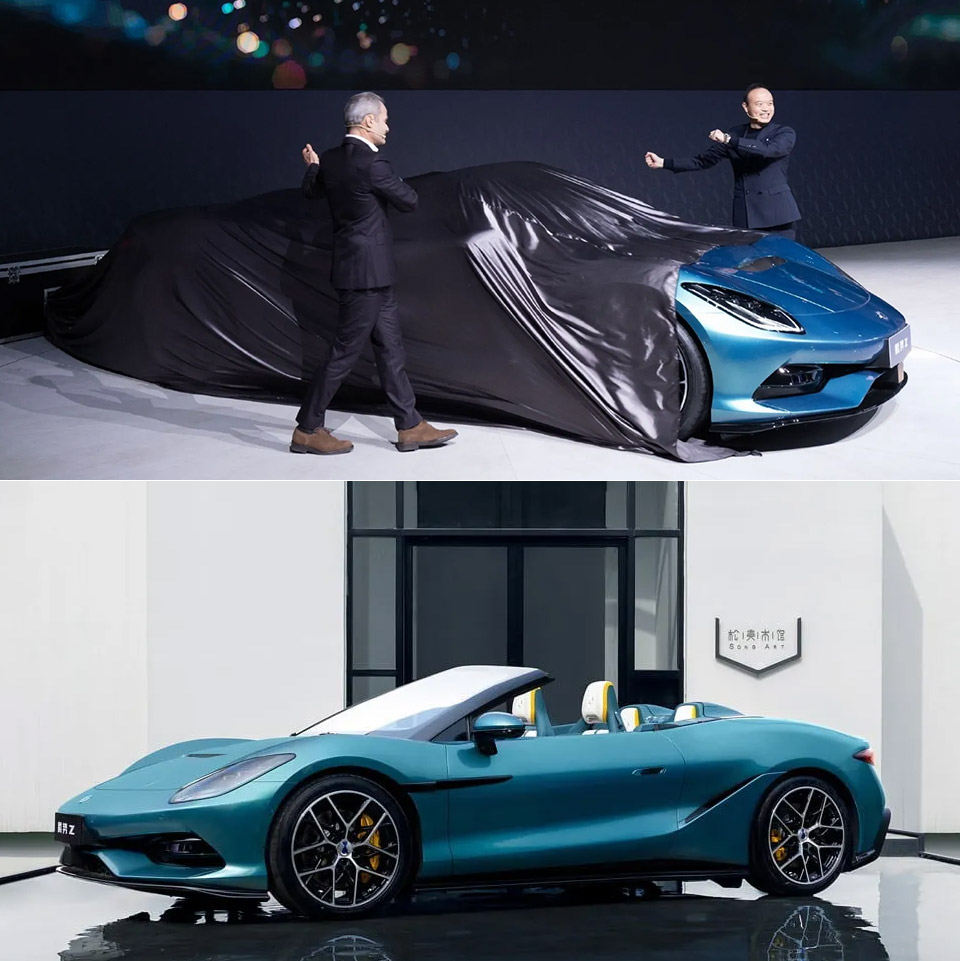
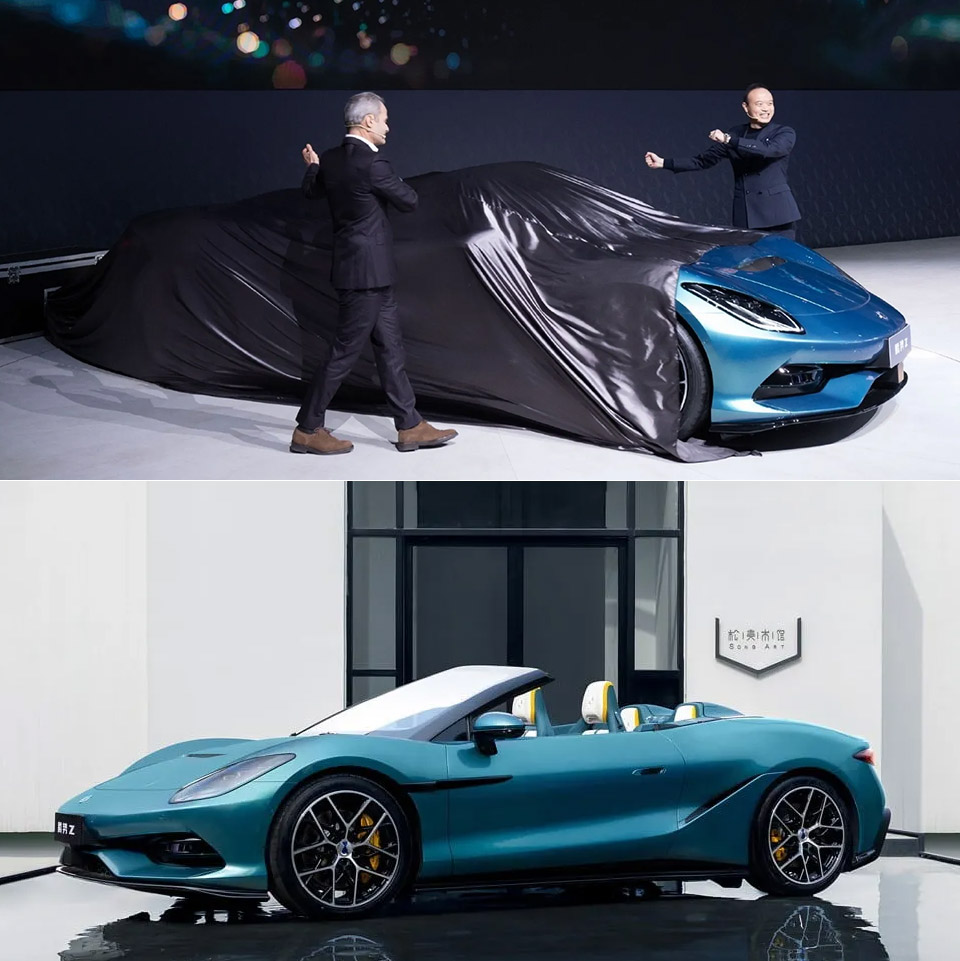
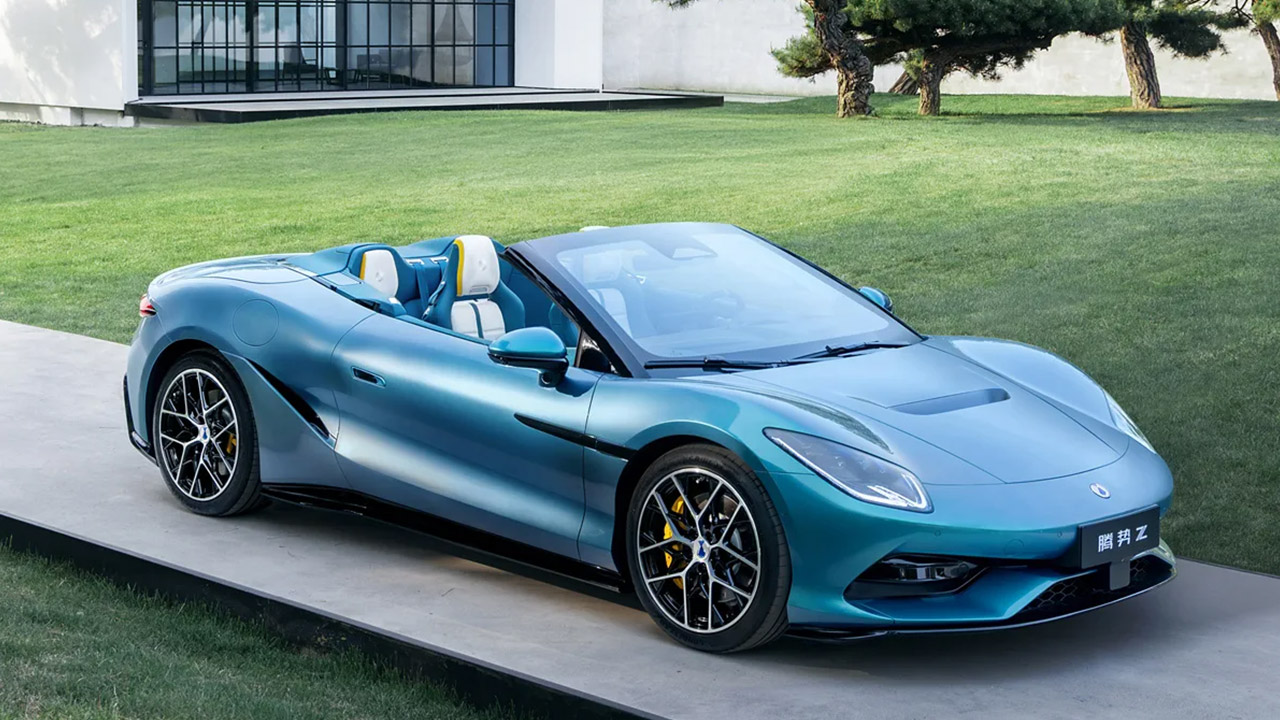
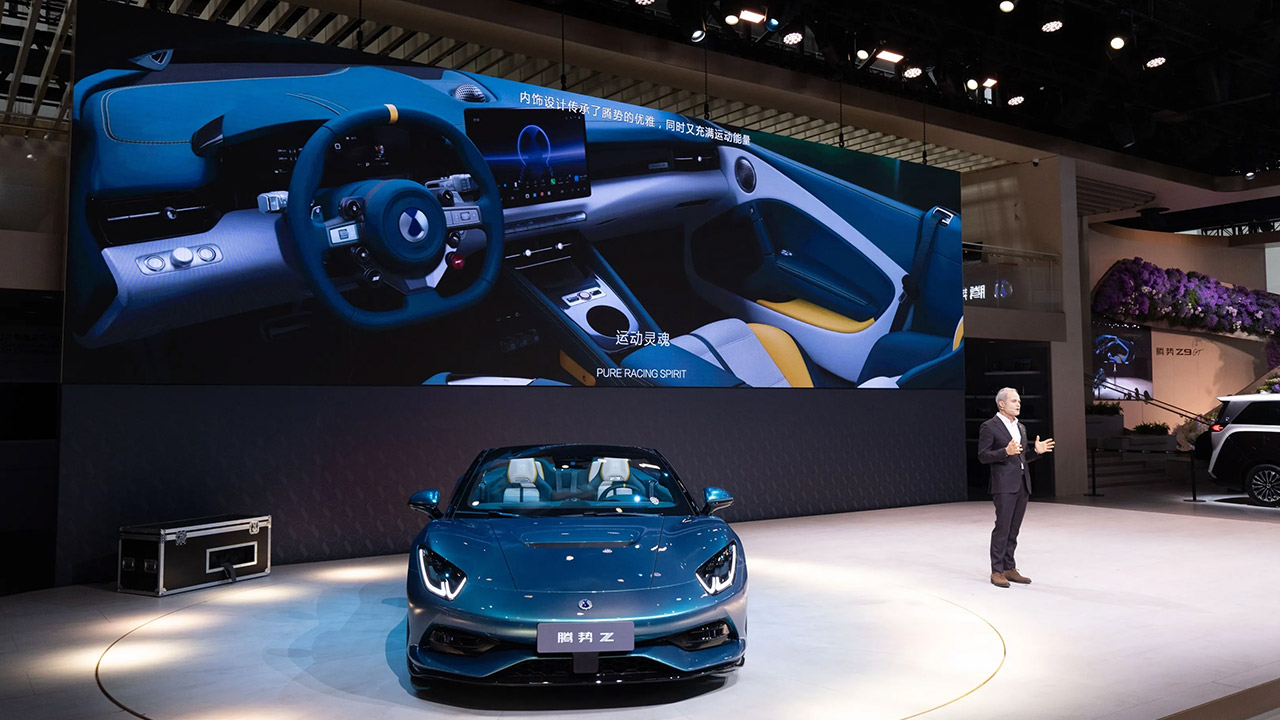
Attendees at the 2026 Beijing Auto Show strolled inside the main hall and were greeted by BYD’s Denza Z series convertible, a four-seater with a soft top that neatly folds up into the rear deck. Much of the automobile, including body panels, seats, and structural components, is made of carbon fiber, which helps to reduce weight and improve handling. When things get really fast, a tiny air vent on the bonnet helps to increase airflow and give the car a little extra downforce.


This car’s design was penned by a team directed by Wolfgang Egger, Audi’s former head of styling, who has a keen sense of style. Smooth curves and exquisite features combine to make the car look attractive without going overboard. The doors are beautiful and long, with no handles visible, but the large wheels and brilliant brake calipers provide a good idea about the beast of a car hiding underneath. We noticed one car painted in a wonderful sheen blue-green that looked amazing in the hall.

Sale


Segway Ninebot S2 Electric Self-Balancing Scooter – Master Your Commute w/t 11.2 mph Max. Speed, 21.7 Mi…
  • Speed & Range: Experience exhilarating rides with the Ninebot S2’s impressive top speed of 11.2 mph and range of 21.7 miles.
  • Beginner-Friendly: Perfect for riders aged 16-50, the Segway S2 features a user-friendly learning mode, providing a smooth and gradual introduction.
  • Adjustable & Supportive: Enjoy a customized fit tailored to your needs, as the Segway S2 accommodates heights ranging from 4’3″ to 6’6″ and supports…


Under the hood, or rather, beneath the floor, is a trio of electric motors that work together to drive all four wheels using Denza’s E3 system. And what a power bump, with well over 1,000 horsepower. It can accelerate from zero to sixty-two miles per hour in less than two seconds flat! They used the DiSus-M magnetorheological suspension from the Yangwang U9 and added features such as predictive road scanning and full chassis control, allowing the car to corner like a dream even while the roof was down. The steering is also steer-by-wire, which keeps things feeling quite sharp and responsive.

Advertisement

BYD Denza Z Electric Supercar Convertible
The car is powered by BYD’s latest Blade Battery, which rests low on the floor and supports Flash Charging 2.0. That means a full charge can be achieved in as little as five minutes at the appropriate charging station. The same battery pack is used in a few different models, providing ample range while remaining smooth on the inside. They also have several advanced driving aids, all gathered under the Eye of the God suite, which supports in day-to-day tasks while also adding some extra safety measures for longer journeys.

BYD Denza Z Electric Supercar Convertible
The four seats inside the automobile are placed in a way that makes the back row feel functional rather than crowded. A large screen dominates the center of the dashboard, flanked by a digital instrument panel and a wireless charging station. The central console has a neat and easy button layout for climate control and drive mode. The materials seem high-quality while remaining nice and utilitarian, and the tri-color accents on the display model provide a wonderful touch of flair.

BYD Denza Z Electric Supercar Convertible
Denza plans to ship the convertible to Europe first this summer. Following that, it will make a complete global debut at the Goodwood Festival of Speed in July. In case you’re wondering, the car will also perform some demonstration laps there. They’re still doing track testing at the Nürburgring, and they anticipate to have proper lap times shortly. Chinese buyers will have to wait till after the worldwide deployment is complete. The car will be available in three versions: normal, open top, and dedicated track edition.

BYD Denza Z Electric Supercar Convertible
In terms of price, it will be significantly less expensive than its competitors. Early estimates in China range between 400,000 and 500,000 yuan, or $59,000 to $73,000. That places the Denza Z in the same category as the Maserati GranCabrio, but with more power and faster charge, making it a really fantastic offer all around. Prices in Europe will be published closer to the time the automobile goes on sale.
[Source]

Source link

Continue Reading

Tech

Today’s NYT Mini Crossword Answers for April 27

Published

on

Looking for the most recent Mini Crossword answer? Click here for today’s Mini Crossword hints, as well as our daily answers and hints for The New York Times Wordle, Strands, Connections and Connections: Sports Edition puzzles.


See those circles in the grid of today’s Mini Crossword? All of them will contain the same letter, when you’re done. Read on for all the answers. And if you could use some hints and guidance for daily solving, check out our Mini Crossword tips.

If you’re looking for today’s Wordle, Connections, Connections: Sports Edition and Strands answers, you can visit CNET’s NYT puzzle hints page.

Advertisement

Read more: Tips and Tricks for Solving The New York Times Mini Crossword

Let’s get to those Mini Crossword clues and answers.

completed-nyt-mini-crossword-puzzle-for-april-27-2026.png

The completed NYT Mini Crossword puzzle for April 27, 2026.

Advertisement

Mini across clues and answers

1A clue: Word for “dad” in Spanish, Italian, Russian and Hindi
Answer: PAPA

5A clue: Go crazy, as a crowd
Answer: ERUPT

7A clue: Drink with a red, white and blue logo
Answer: PEPSI

Advertisement

8A clue: Philadelphia M.L.S. team
Answer: UNION

9A clue: Buddy
Answer: PAL

Mini down clues and answers

1D clue: Make more exciting
Answer: PEPUP

2D clue: Madison Square Garden, e.g.
Answer: ARENA

Advertisement

3D clue: Center of the eye
Answer: PUPIL

4D clue: Lhasa ___ (dog breed)
Answer: APSO

5D clue: Element #50
Answer: TIN

Advertisement

Source link

Continue Reading

Tech

Who is Dr Tan Kim Yong? The founder behind Hao Mart, AIM Corp, & a supermarket legal battle

Published

on

From a Whampoa minimart to Orchard Road: The rapid expansion of Hao Mart under Dr Tan Kim Yong

Once a materials specialist, Dr Tan Kim Yong opted for a completely different career path and opened convenience store Hao Mart in 2016.

Since then, however, the journey of Hao Mart has been a roller coaster ride, fuelled by expansion plans and legal troubles. We take a look back at the journey of Hao Mart founder Dr Tan Kim Yong.

1999: After spending six years as Chief R&D Officer of AGC Multi Material Singapore, Dr Tan Kim Yong founded Advanced Integrated Manufacturing Corporation (AIM). According to their website and LinkedIn page, the firm supplies “Nadcap and AS9100 accredited manufacturing services,” which are used in aerospace, defence, and high-tech industries.

May 26, 2005: As AIM expanded internationally, it became formally listed on the SGX Mainboard in 2005, with Dr Tan serving as Group Chairman and CEO and a substantial shareholder.

Advertisement
Hao Mart’s first minimart in Whampoa./ Image Credit: T T Teo, Saad Chinoy via Google Reviews

2016: In 2016, Dr Tan entered Singapore’s highly competitive grocery space, opening the first Hao Mart outlet in Whampoa. Established with the concept of a “super-mini-mart,” the outlet combines a convenience store concept with the product range of a supermarket.

May 2, 2017: AIM was delisted from SGX due to low trading liquidity, compliance costs, and other factors. Hao Corp—the parent company of Hao Mart—was listed as the offeror of the now-private entity.

2019: Hao Mart began accelerating its retail expansion into multiple formats. Amid the expansion, it filed its first financial statement for FY2019, with a loss of S$2.2 million.

Aug 8, 2019: Hao Megamart opened at The Grandstand. Spanning over 46,000 sq ft, it carried more than 70,000 products, including live seafood, a butchery, bakery, fresh produce, household goods, and branded electronics—positioning itself as a one-stop hypermart alternative to Giant and NTUC FairPrice.

Dec 20, 2019: Another retail format, “Eccellente by Hao Mart,” targeting a more premium, international grocery audience, was launched. Outlets opened in Marina Square, Westgate, and Kinex.

Advertisement

Nov 2021: Hao Mart hits its peak of 51 stores in Singapore. It also signed a 7.5-year lease with department store landlord OG for all five levels of the former OG Orchard Point building. The ambitious deal marked Hao Corp’s biggest expansion yet, bringing its grocery and F&B concept to the heart of the Orchard Road shopping belt.

Mar 2023: Hao Mart reported a loss of S$23.2 million for FY2023, after turning profitable for the previous two financial years.

Aug 4, 2023: OG entered a facility agreement with Dr Tan personally, extending a S$66.2 million loan to fund Taste Orchard’s opening at the former Orchard Point. The loan is secured by a mortgage over Dr Tan’s Good Class Bungalow at Jervois Hill, one of Singapore’s most prestigious neighbourhoods. By this time, the project’s opening had already been delayed by around six months from its original planned commencement in Feb.

Taste OrchardTaste Orchard
Taste Orchard was Hao Mart’s first foray into the Orchard Road belt./ Image Credit: orchardmalls.com

Feb 2024: Taste Orchard opens, featuring three floors occupied by Eccellente by Hao Mart, offering a live seafood station, a butchery & deli counter, and an FYI Live Kitchen. Tenants on other floors include Sushiro, BHC Chicken, Killiney Kopitiam, and Warabimochi Kamakura.

Jan – Nov 2024: According to OG’s lawsuit, Hao Mart failed to pay rent at Taste Orchard from Jan to Nov 2024. The supermarket also allegedly sublets parts of the premises to other tenants without obtaining OG’s prior approval, which OG later claims constitutes a breach of the 7.5-year lease.

Advertisement

Dec 2024: Hao Mart stores dwindled to 20, according to its website.

Jul 2025: The cracks start to appear publicly. at the prime location, and Hao Mart themselves scale down operations at the building. The basement supermarket was shuttered, with products moved elsewhere in the building.

Aug 2025: Hao Mart sues PropNex Realty for alleged misrepresentation over the Taste Orchard lease. This kick-started a series of lawsuits.

Sept 2025: Landlord , demanding that tenants move out by the end of the year. The move comes just 18 months after Taste Orchard opened. No explanation is given for the lease termination.

Advertisement

Oct 2025: OG files a lawsuit against Hao Mart for S$6.6 million, including unpaid rent, taxes, and other charges. Hao Mart files a counterclaim, alleging that OG itself breached a separate oral agreement.

Dec 2025: Taste Orchard officially ceases operations, and the premises are returned to OG.

Jan 2026: Hao Mart, Dr Tan, and his wife sue OG for S$57.5 million in damages. They allege a conspiracy by OG to cause loss to Hao Mart by damaging or destroying their business. In the same period, Hao Mart reported a S$49.6 million loss for FY2025, with the financial statements filed belatedly in Jan 2026.

Apr 2026: Media reports indicate that Hao Mart has been reduced to just seven outlets amid ongoing legal disputes, as the company sinks deeper into losses.

Advertisement
  • Read other articles we’ve written on Singaporean businesses here.

Featured Image Credit: Hao Mart/Facebook

Source link

Advertisement
Continue Reading

Tech

Today’s NYT Wordle Hints, Answer and Help for April 27 #1773

Published

on

Looking for the most recent Wordle answer? Click here for today’s Wordle hints, as well as our daily answers and hints for The New York Times Mini Crossword, Connections, Connections: Sports Edition and Strands puzzles.


Today’s Wordle puzzle is kind of crazy. The same letter shows up three times. If you need a new starter word, check out our list of which letters show up the most in English words. If you need hints and the answer, read on.

Read more: New Study Reveals Wordle’s Top 10 Toughest Words of 2025

Advertisement

Today’s Wordle hints

Before we show you today’s Wordle answer, we’ll give you some hints. If you don’t want a spoiler, look away now.

Wordle hint No. 1: Repeats

Today’s Wordle answer has one repeated letter, which appears three times.

Wordle hint No. 2: Vowels

Four out of the five letters are vowels, but one of them shows up three times. There are two different vowels: the threepeat, and another one.

Wordle hint No. 3: First letter

Today’s Wordle answer begins with E.

Advertisement

Wordle hint No. 4: Last letter

Today’s Wordle answer ends with E.

Wordle hint No. 5: Meaning

Today’s Wordle answer refers to something that’s strange or mysterious.

TODAY’S WORDLE ANSWER

Today’s Wordle answer is EERIE.

Advertisement

Yesterday’s Wordle answer

Yesterday’s Wordle answer, April 26, No. 1772, was GLOSS.

Recent Wordle answers

April 22, No. 1768: SNORE

April 23, No. 1769: TWEET

April 24, No. 1770: DRUNK

Advertisement

April 25, No. 1771: WOMEN

Source link

Advertisement
Continue Reading

Trending

Copyright © 2025