
Crypto World
Microsoft Shares Two Days Ahead of Earnings Release

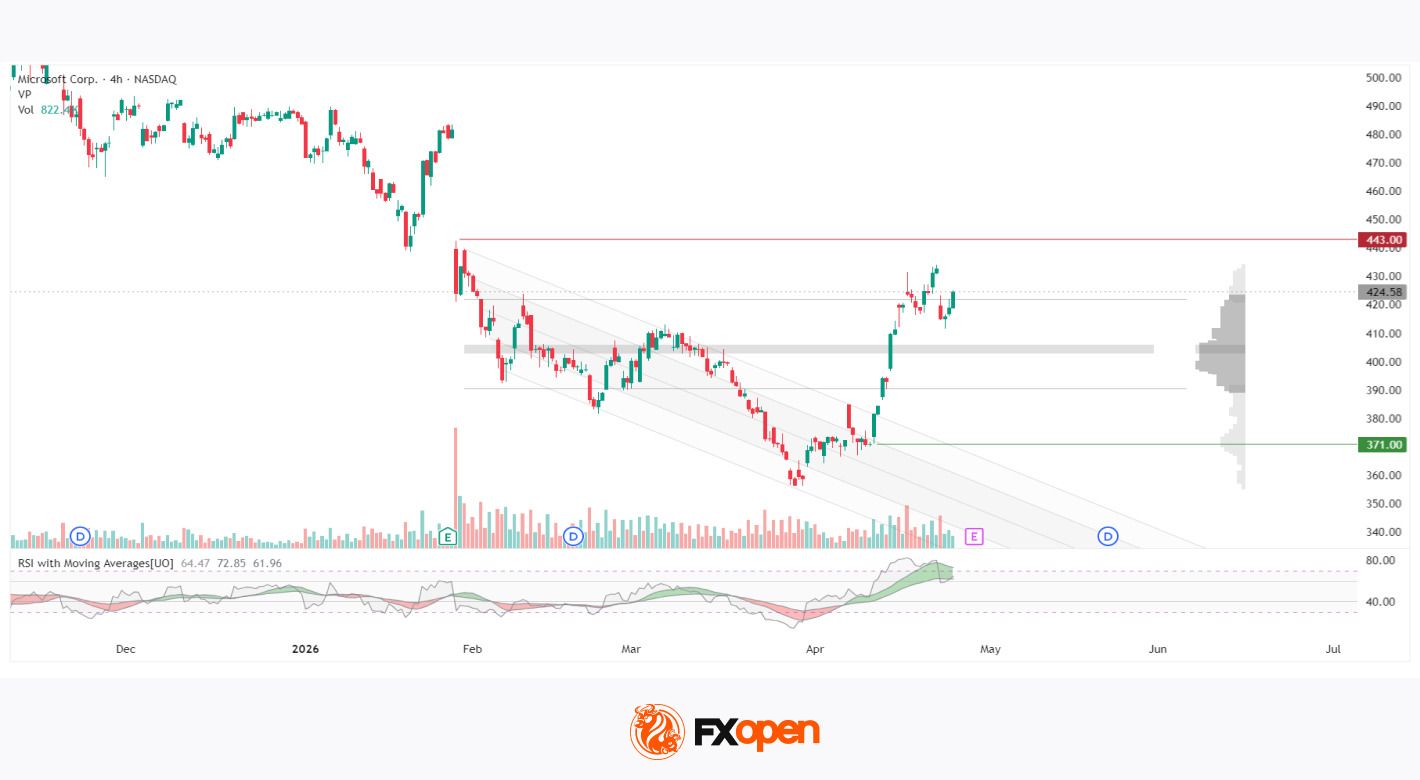
In January, Microsoft shares came under pressure following the company’s earnings report. Although both revenue and earnings per share exceeded analysts’ expectations, growth in the Azure cloud platform slowed to 39% year-on-year from 40% in the previous quarter—enough to disappoint investors. The market is now preparing for the next release: on 29 April, after the close of trading, Microsoft will publish results for the third quarter of its 2026 financial year. Analysts forecast adjusted EPS at $4.04, up 17% from the same period last year. The focus remains on Azure’s performance and the expansion of the paid user base for Copilot within Microsoft 365.
Technical Overview
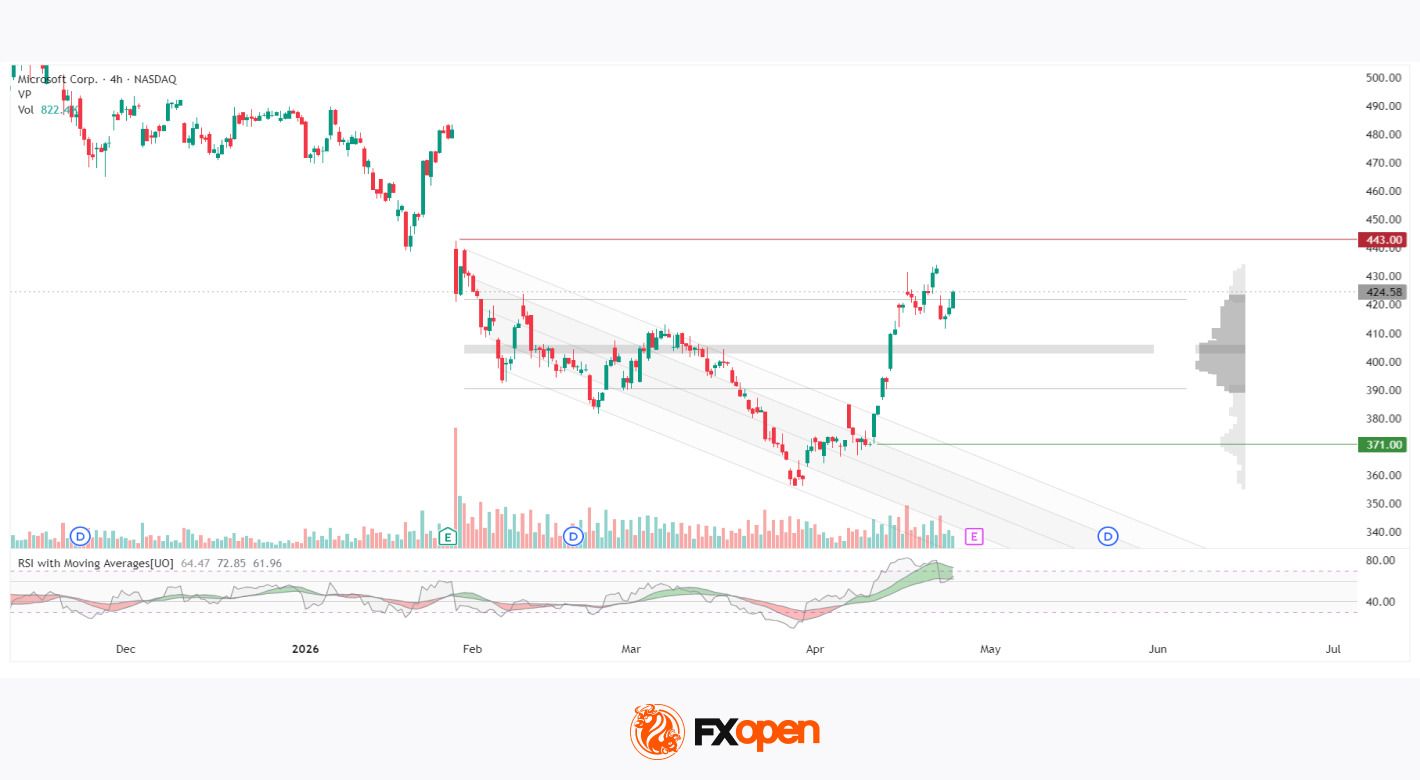
Until late January, Microsoft shares moved sideways, but the 29 January earnings release triggered a sharp gap down accompanied by an abnormal surge in vertical volume, prompting a rapid repricing of the asset. This move laid the foundation for a well-defined downward channel, with the price steadily declining along its boundaries to a low near 357 by the end of March. In April, a recovery pushed the price to around 433, followed by consolidation within the 412–433 range, where it remains ahead of the upcoming earnings announcement.
The horizontal volume balance zone is located at 403–406, with the broader market profile spanning 390–422—current prices are trading above the bulk of accumulated volume. The nearest significant resistance stands at 443, while support levels are seen at 390 and 371. The RSI with moving averages shows readings of 64 / 72 / 61: the oscillator sits between two upward-sloping moving averages, reflecting a bullish bias within the consolidation phase.
Summary
The 412–433 consolidation range is forming just ahead of the 29 April earnings release—an event similar to the one in January that triggered a two-month decline. The volume profile indicates that prices remain above the balance zone at 403–406, while RSI holds in positive territory. The market’s reaction to the upcoming results will determine whether the recovery extends further or the price returns to the prior accumulation range.
Buy and sell stocks of the world’s biggest publicly-listed companies with CFDs on FXOpen’s trading platform. Open your FXOpen account now or learn more about trading share CFDs with FXOpen.
This article represents the opinion of the Companies operating under the FXOpen brand only. It is not to be construed as an offer, solicitation, or recommendation with respect to products and services provided by the Companies operating under the FXOpen brand, nor is it to be considered financial advice.

Crypto World
BTC price hits wall at $80,000, one analyst says the pullback is temporary: Crypto Daily
Bitcoin is doing that familiar dance just below a big round number, $80,000, stalled by sellers even as fresh stablecoin liquidity, ETF demand and a risk-on equity market suggest the breakout may be delayed rather than denied.
The leading cryptocurrency briefly climbed above $79,000 during Asian trading hours before slipping back to trade below $78,000 recently. Over the past 24 hours, bitcoin has lost about 0.4%. Ether (ETH) has fallen 0.6%, XRP (XRP) is down 0.8% and Solana’s SOL has dropped more than 1%. Broader market benchmarks, including the CoinDesk Memecoin Index and Smart Contract Platform Select Capped Index, were also under pressure, falling more than 1% each.
According to Alex Kuptsikevich, chief market analyst at FxPro, the $80,000 level is acting as a near-term ceiling due to concentrated sell orders.
“Bitcoin has approached the $80K mark for the second time in the last few days, but has since experienced significant downward momentum. As it approaches this round figure, a build-up of sell orders is preventing the coin from moving further upwards,” he said in an email.
Still, Kuptsikevich argued the pullback appears temporary and consistent with a broader uptrend that began in late March.
This is an excerpt from CoinDesk newsletter ‘Daybook.’ Sign up here, if you haven’t already.
On-chain and ETF data offer support for that view. Crypto exchange Binance has recorded a net inflow of roughly $3.4 billion in stablecoins so far this month, following $3 billion in March, according to CryptoQuant data. That suggests fresh capital inflows, waiting for a entry point.
“This indicates an influx of new capital waiting to participate in the recovery,” pseudonymous CryptoQuant analyst Darkfost wrote on X.
Institutional demand remains strong. U.S.-listed spot bitcoin ETFs have pulled in $2.44 billion in investor money this month, the most since October, when bitcoin hit record highs above $126,000.
But not everything is hunky-dory. Security risks in decentralized finance (DeFi) continue to weigh on sentiment. On Sunday, the SUI-based lending platform Scallop was exploited, resulting in the loss of roughly 150,000 SUI, or about $142,000. While small, it adds to a growing list of attacks this month, including the massive Drift and KelpDAO exploits.
Together, DeFi protocols have lost an estimated $623 million to hacks in April alone, according to Memento Research. Since inception, total losses from DeFi-related exploits have climbed to roughly $7.72 billion, according to data source DeFiLlama. This underscores a persistent structural risk for the sector.
In traditional markets, WTI crude oil prices continue to hover above $90 per barrel, with Brent above $100 as supply remains constrained. The latest pricing is significantly higher than $70 or below before the Iran war began in late February, and threatens to destabilize global economy with high inflation. Stay alert!
Read more: For analysis of today’s activity in altcoins and derivatives, see Crypto Markets Today . For a comprehensive list of events this week, see CoinDesk’s “Crypto Week Ahead.”
What’s trending
Today’s signal

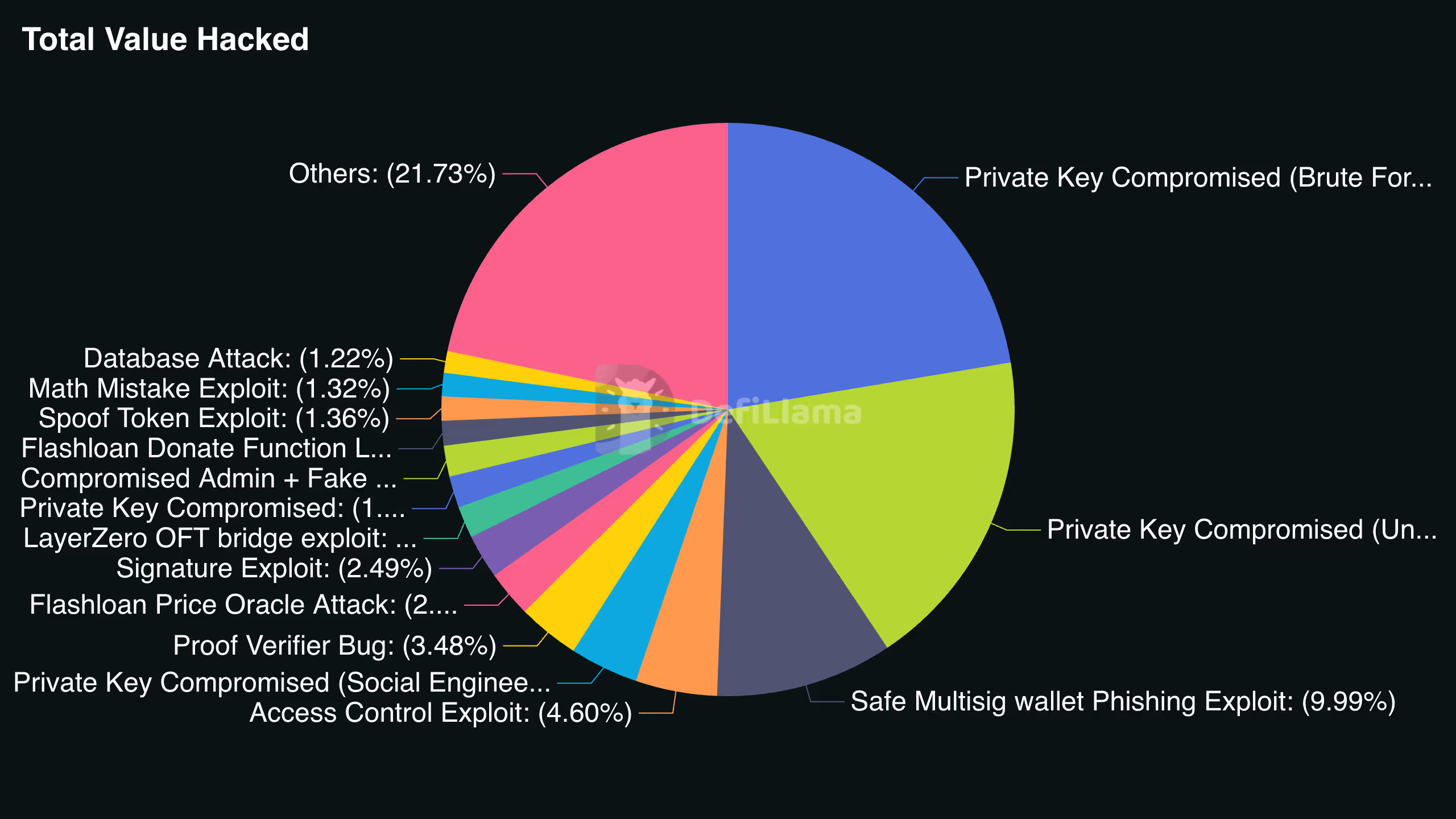
The pie chart shows the breakdown of total losses suffered in crypto hacks by different methods of attack, including private key compromises, phishing exploits, access control issues and other smart-contract vulnerabilities.
Since inception, the biggest vulnerability has been private key compromises, accounting for 40% of the total.
Think of a private key as the master password to your crypto wallet. It’s a long, random string that proves you control your wallet and own crypto funds in it, allowing you to transact onchain. The issue, however, is that there is no reset password option if you lose the key.
So, once the hacker has it, you have lost your wallet and funds. This is known as the private key compromise and the fact that it’s the biggest security risk indicates that audits need to focus beyond just smart contracts.


Google DeepMind has entered into a partnership with South Korea to provide the technical backbone for the country’s K-Moonshot initiative, an ambitious national programme designed to solve the most complex scientific challenges of the century using AI.
Summary
- Google DeepMind partners with South Korea on K-Moonshot, exchanging AI models and data to tackle scientific challenges across life sciences, climate, and meteorology.
- Google to build its first global AI campus in Seoul, with plans for researcher training, industry collaboration, and potential deployment of U.S.-based engineers.
According to recent reports, the collaboration will span several high-stakes fields such as life sciences, meteorology, and climate research. To accelerate progress, both sides have committed to a deep exchange of AI models, specialized tools, and vast scientific datasets.
The agreement was inked in Seoul on Monday by DeepMind Chief Executive Demis Hassabis and Deputy Prime Minister and Science Minister Bae Kyung-Hoon. As a core part of this deal, Google will establish a dedicated AI-focused campus in Seoul.
This facility marks the first of its kind for the company globally and is expected to serve as a melting pot for local engineers, startups, and academic institutions while hosting elite training programmes for Korean researchers.
Officials from the South Korean government said they have already requested that Google dispatch at least ten senior engineers from its U.S. headquarters to provide on-the-ground support for the initiative.
While Demis Hassabis indicated the company is carefully considering this request, he also highlighted plans to strengthen existing ties with local industrial giants, including Samsung, SK Hynix, and Hyundai’s Boston Dynamics.
The partnership will also prioritize the ethical side of innovation by including joint work on AI safety. This cooperation will extend directly to Korea’s AI Safety Institute to ensure that these new technologies are developed with rigorous oversight.
For the uninitiated, K-Moonshot is South Korea’s premier science and technology roadmap built around twelve transformative goals. These targets include revolutionary breakthroughs in AI-led drug discovery, the quest for sustainable fusion energy, and the creation of next-generation humanoid robotics.
Deal follows Alphabet’s expanded AI investment push
The collaboration comes shortly after Alphabet Inc. outlined a major funding commitment to AI firm Anthropic, signalling continued momentum in the sector.
Alphabet said it would invest $10 billion upfront, with plans to commit up to $30 billion more over time. The total package could reach $40 billion if the company meets performance and usage milestones.
Anthropic added that the initial investment values the firm at $350 billion, matching its February round and placing it among the most highly valued startups globally.
Crypto World
Bitcoin swings below $78,000 after failed breakout as altcoins slide: Crypto Markets Today
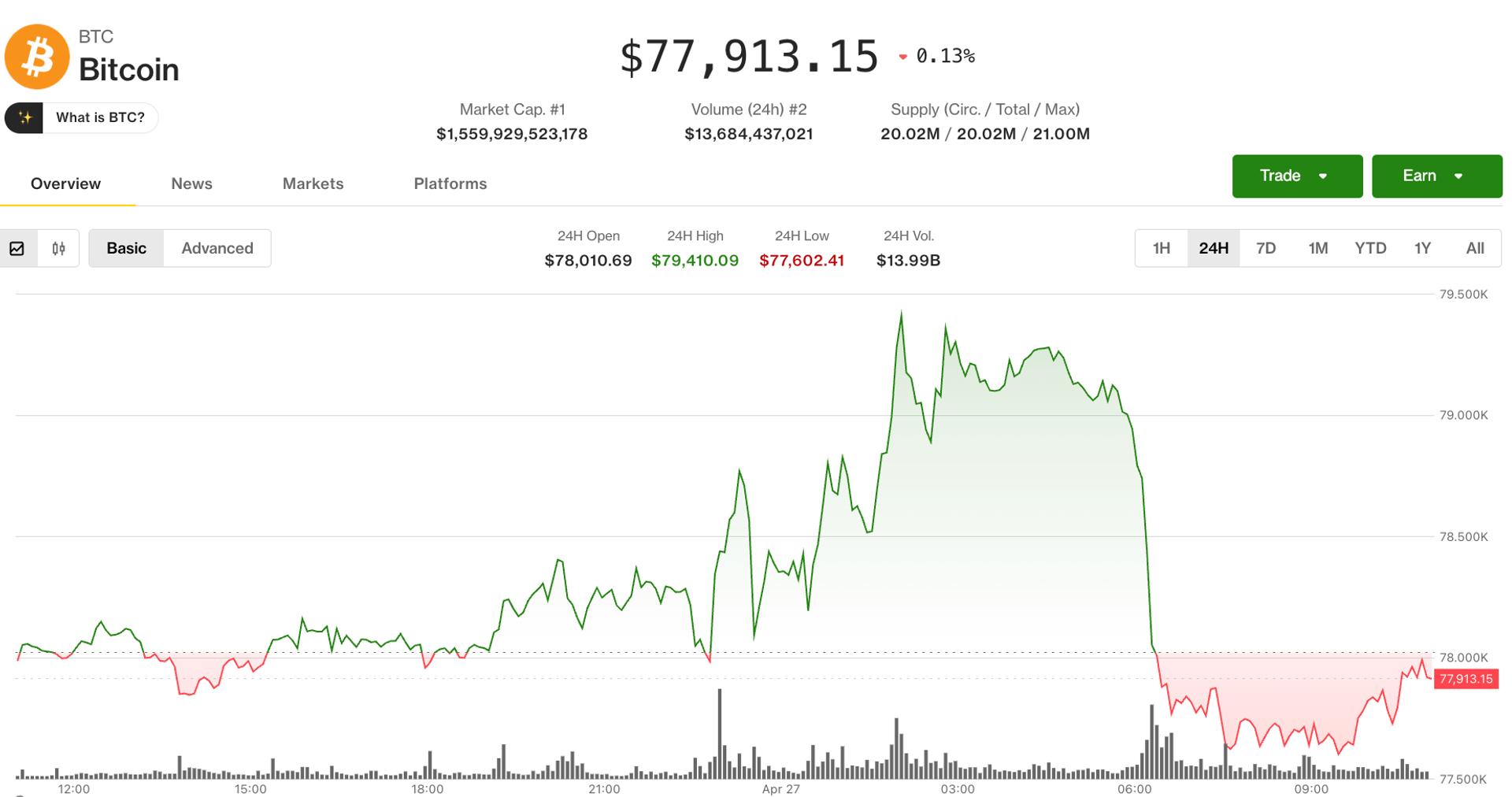
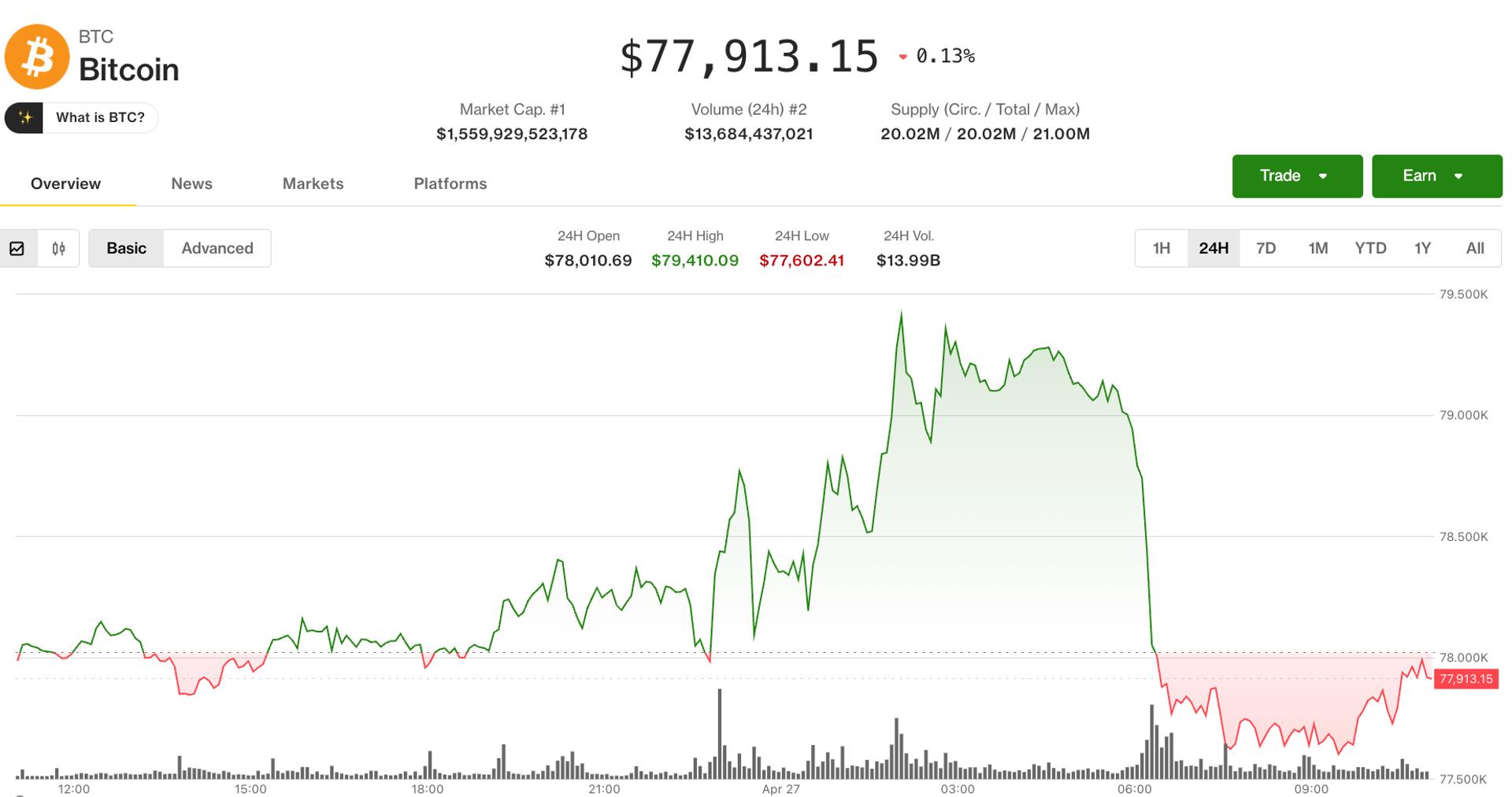
Volatility returned to crypto markets Monday as bitcoin spiked up to $79,480 before quickly reversing to $77,800.
The move began around 23:00 UTC with the opening of U.S. equity and CME bitcoin futures, a period that often sees heightened volatility.
By 05:30 UTC, the price began falling after it failed to break above the $80,000 level, dropping 2% in an hour.
The decline occurred as oil reached its highest level since the ceasefire between the U.S. and Iran began. Brent crude trades at $107 per barrel after U.S. President Donald Trump canceled plans to send U.S. officials for talks in Pakistan on Saturday.
Ether (ETH) recently traded around $2,320 after losing 2.2% since midnight UTC, underperforming bitcoin, which is down by 1.1%, but not falling as precipitously as several altcoins.
Derivatives positioning
- Nearly $300 million in crypto futures bets have been liquidated in the past 24hours. Most of these have been bearish short plays, which likely faced the brunt of the cryptocurrency’s brief rally to nearly $79,500.
- Open interest (OI) in XRP futures rose by nearly 2.5% in 24 hours. That’s the biggest increase among major tokens, including bitcoin, ether and solana (SOL). The OI touched a one-week high of 1.82 billion XRP alongside negative perpetual futures funding rates and OI-adjusted cumulative volume delta. This combination paints a bearish picture, consistent with the bitcoin and ether markets.
- Analysts, however, said that persistent negative funding rates in BTC are mainly due to institutions hedging their bullish exposure in related markets and do not represent an outright bearish bet on the market.
- HBAR, CC, XLM and HYPE are other standout OI gainers of the past 24 hours.
- SUI records the most negative CVD, suggesting sustained aggressive selling through market orders. A Sui-based DeFi protocol named Scallop was hacked early today, and the perpetrators walked away with approximately 150,000 SUI tokens valued just over $140,000.
- Bitcoin and ether’s 30-day implied volatility indexes extended declines, painting a picture of market calm that supports continued price rallies in the two assets. This is consistent with the recent drop in Wall Street’s VIX index, a gauge for the S&P 500 index, and record highs in other key measures, including the Nasdaq.
- On Deribit, bitcoin and ether options continue to show a bias for puts across all time frames. Ether options expiring in December and next March are notably less bearish than their bitcoin counterparts.
- Bitcoin’s $80,000 strike call option is the most popular on Deribit, boasting a notional open interest of over $1.5 billion. The dealer gamma here is positive, which implies that dealers (market makers) could sell on a potential breakout above this level and similarly buy the dip, arresting the price volatility.
- Speaking of flows, Laser Digital said investors are favoring risk reversals over outright puts. This means traders prefer options strategies that profit from price swings and differences in how options are priced at different strike levels.
Token talk
- While the broader market was volatile on Monday, the altcoin sector was hit hardest during the 05:30 UTC selloff.
- Liquid restaking token Lido (LDO) led losses, giving back all of Sunday’s gains to fall around 17%.
- The bitcoin-heavy CoinDesk 20 (CD20) Index is down 1.5% since midnight UTC, while the DeFi Select Index (DFX) has lost 2.3%, with only the Smart Contract Platform Select Index (SCPX) performing worse, down 2.5%.
- A handful of tokens managed to avoid the selloff, notably PENGU, JUP and CHZ, which rose 9.1%, 4% and 3.1%, respectively.
- CoinMarketCap’s “Altcoin Season” indicator sits at a neutral 39/100, unchanged from last week and well below last month’s high of 51/100.


The European Union (EU) released its “biggest package” of sanctions in two years against Russia, describing the measures as far-reaching and restrictive. They specifically target crypto with a total ban on providers and platforms established in that country.
“Russia is becoming increasingly reliant on cryptocurrencies for international transactions,” the EU said in an April 23 statement. “The EU is introducing a total sectoral ban on providers and platforms established in Russia that allow the transfer and exchange of crypto assets.”
The bloc also banned Russia’s central bank digital currency (CBDC), the ruble-pegged RUBx stablecoin and all EU support for the development of the digital ruble.
The sanctions include measures against 20 Russian banks and four third-country financial institutions and entities connecting to the Russian System for Transfer of Financial Messages (SPFS), the Russian banking messaging network, according to a Chainalysis report.
The blockchain intelligence firm said the EU also imposed sanctions on TengriCoin, a Kyrgyz crypto exchange operating as Meer.kg, where significant amounts of the government-backed stablecoin A7A5 are traded.
That measure follows years of escalating enforcement targeting the wider Garantex–Grinex–A7A5 ecosystem that has been extensively tracked, Chainalysis noted.
As documented, A7A5 has been prolific, processing $119.7 billion to date and functioning as a purpose-built settlement rail designed to bridge sanctioned Russian businesses into the global financial system, the firm said. In the 2026 Crypto Crime Report, that figure exceeded $93.3 billion in less than a year.
“The new measures now create an ecosystem-wide crypto restriction on Russia and Belarus,” the blockchain intelligence firm said.
The firm said that people from the EU are now no longer allowed to transact with cryptocurrency service providers (CASPs) and decentralized finance (DeFi) platforms from Russia and Belarus. They are also barred from providing Markets in Crypto-Assets Regulation (MiCA) crypto services to Belarusian individuals and entities.
The EU also stated that “netting transactions with Russian agents are now forbidden, to prevent the circumvention of EU sanctions.”
Countries referenced in the sanctions package in connection with financial services, trade flows, or intermediary activity include Kyrgyzstan, China, the United Arab Emirates, Uzbekistan, Kazakhstan and Belarus.


Digital asset investment products recorded $1.2 billion in inflows last week, marking the fourth straight week of positive flows.
Summary
- Digital asset funds saw $1.2 billion in weekly inflows, marking a fourth straight positive week.
- Bitcoin led with $933 million in inflows as spot ETFs posted their strongest week in months.
- Ethereum attracted $192 million, while blockchain equity ETFs recorded strong demand over three weeks.
The latest CoinShares report said eight assets attracted inflows, up from six in the prior week.
The move came as Bitcoin traded above $76,000 for the first time since the February correction. Total assets under management rose to $155 billion, the highest level since February 1.
Bitcoin ETFs drive institutional demand
Bitcoin (BTC) led the market with $933 million in weekly inflows. The figure brought year-to-date Bitcoin fund inflows to $4 billion, showing renewed demand from institutional investors.
Spot Bitcoin ETFs also posted their strongest weekly inflows in several months. Nearly $1 billion entered the products over the past week, with April 17 recording more than $663 million in net inflows.
Moreover, Ethereum investment products added $192 million in inflows. This marked the third consecutive week in which Ethereum inflows stayed above $190 million.
XRP also returned to inflows after one week of outflows. The move showed broader investor participation as more assets joined Bitcoin and Ethereum in attracting capital.
Blockchain equities hit record demand
Blockchain equity ETFs recorded $617 million in inflows over three weeks. CoinShares said the segment reached record weekly inflows as investors sought wider exposure to blockchain technology and related companies.
The United States led regional inflows with $1.1 billion. Germany followed with $61.7 million, while Switzerland recorded $35.2 million after reversing the prior week’s outflows.
Canada also saw $15 million in inflows, pointing to a wider regional bid than recent weeks. The report noted that investors are watching the April 28–29 FOMC decision, which may keep some caution in the market.
The latest flows show that institutional demand for crypto funds has improved as Bitcoin recovers from earlier weakness. However, total assets under management remain below the October 2025 peak of $263 billion.
Short Bitcoin products drew $16.5 million in inflows. CoinShares said this was broadly in line with the prior month’s average, suggesting steady but not extreme hedging demand.
The market now faces a key macro week. The Fed decision, inflation expectations, and geopolitical risks may shape whether inflows continue or slow after four weeks of gains.


The artificial intelligence (AI) boom is often framed as a story of capital, code, and compute. Alphabet, Amazon, Meta, and Microsoft forecast capital expenditures of about $650 billion in 2026. At the same time, AI-linked stocks are trading near all-time highs.
Beneath the software layer, however, sits a physical supply chain that depends on transformers, switchgear, batteries, grid capacity, and a less-discussed input: Helium.
AI’s $650 Billion Buildout Has a Helium Problem
For context, Helium is a critical input for semiconductor manufacturing, supporting cooling, leak detection, and high-precision processes. Yet the supply is quite concentrated.
According to the US Geological Survey, Mineral Commodity Summaries 2026, global production in 2025 reached approximately 190 million cubic meters. The United States, Qatar, and Russia together account for roughly 84% of global helium output.
Qatar’s output reached 63 million cubic meters that year, accounting for roughly a third of the global helium supply. Almost all of it comes out of Ras Laffan Industrial City, the world’s largest LNG complex.
That balance broke on March 18, when Iran struck Ras Laffan during the broader US-Iran war. QatarEnergy declared force majeure on some of its long-term liquefied natural gas (LNG) contracts. In a press release, it also warned repairs could take up to 5 years.
“QatarEnergy expects the damage to its Ras Laffan Industrial City caused by missile strikes, which occurred on Wednesday 18 March 2026, and in the early hours of Thursday 19 March 2026, to cost about $20 billion a year in lost revenue and to take up to five years to repair, impacting supply to markets in Europe and Asia,” the state-owned petroleum company wrote.
Follow us on X to get the latest news as it happens
Russia closed the second door in April. It imposed export controls on Helium through the end of 2027. Officials cited domestic supply needs, particularly for fibre-optic components used in military drones.
Electrical equipment bottlenecks are compounding the problem. Roughly half of the US data centers slated to come online this year are now facing delays or outright cancellations, with transformers, switchgear, and batteries in short supply.
The same components are needed to expand the grid itself, which is also absorbing rising demand from electric vehicles and heat pumps. Domestic manufacturing capacity has not kept pace, leaving data center developers increasingly dependent on imports.
Thus, the AI boom is running into a physical chokepoint that capital alone cannot fix. Wall Street has priced in the execution, yet the inputs behind that execution are tightening one by one.
Subscribe to our YouTube channel to watch leaders and journalists provide expert insights
The post How the Iran War Exposed the Physical Backbone of the AI Boom appeared first on BeInCrypto.
TLDR
- Citigroup increased its near-term Brent crude forecast to $120 per barrel from a previous $95 estimate
- Goldman Sachs elevated its fourth-quarter Brent projection to $90 per barrel, representing a nearly $30 increase from pre-crisis levels
- Persian Gulf crude shipments through the Strait of Hormuz have dropped to virtually zero
- Cumulative supply losses have reached approximately 500 million barrels since hostilities commenced
- Brent crude prices have surged nearly 50% since conflict erupted in late February
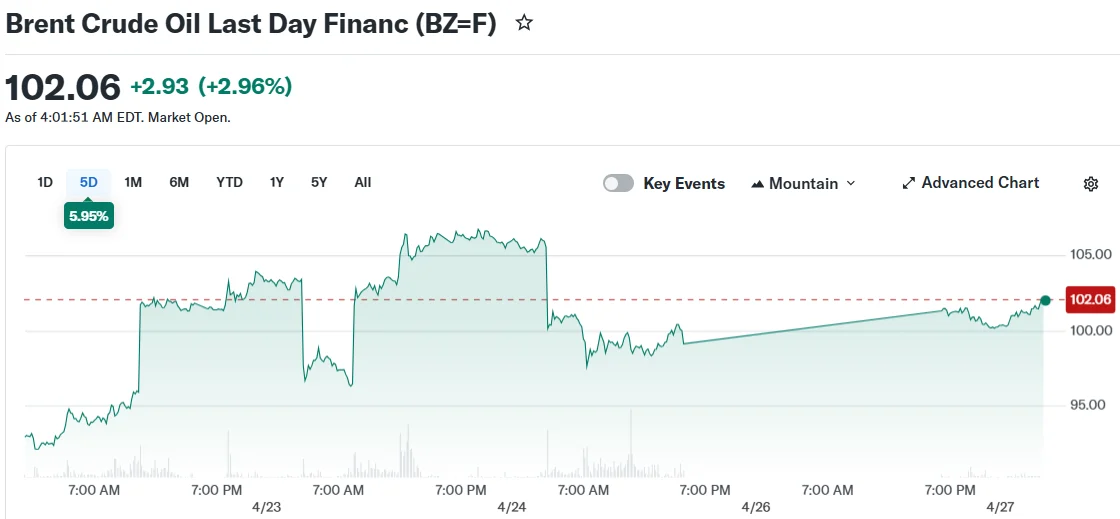
Major financial institutions Citigroup and Goldman Sachs have significantly elevated their crude oil price projections as the blockade of the Strait of Hormuz persists with no immediate resolution in sight. On Monday, Brent crude was hovering around $108.50 per barrel, climbing roughly 3% during the session and marking its sixth consecutive day of gains.
Citigroup’s revised outlook places Brent at $120 per barrel within the next zero to three-month timeframe. The financial institution has also adjusted its quarterly average projections to $110, $95, and $80 for Q2, Q3, and Q4 of 2026 respectively. These updated numbers represent substantial increases from the bank’s previous quarterly estimates of $95, $80, and $75.
The bank assigns a 50% probability to its primary forecast scenario. This baseline assumption anticipates the Strait will begin reopening by the conclusion of May, representing a one-month delay compared to Citi’s earlier expectations.
Citi’s research team noted that Tehran’s regime possesses both economic and geopolitical motivations to maintain the effective closure of the Strait for the foreseeable future. The analysts contend this strategy would constrict worldwide oil availability, accelerate the depletion of stored reserves, and elevate market prices.
According to Citi’s calculations, approximately 500 million barrels in aggregate supply have vanished from markets since the conflict’s onset. Should the waterway remain blocked throughout May, the institution forecasts aggregate losses could climb to 1.3 billion barrels.
Goldman Sachs Raises Forecasts
Goldman Sachs similarly revised its oil price predictions upward on April 27. The investment bank currently anticipates Brent will average $90 per barrel during the fourth quarter of 2026, representing an increase from its earlier $80 forecast. Goldman indicates this projection now stands nearly $30 above pre-crisis levels, before what market watchers have termed the “Hormuz shock.”
Goldman’s analysis suggests that 14.5 million barrels daily of Persian Gulf crude output disruptions are causing worldwide stockpiles to decline at an unprecedented rate of 11 to 12 million barrels per day throughout April. The firm anticipates a supply shortfall of 9.6 million barrels daily for the current quarter. Goldman’s updated forecasts position Brent at $100 for the present quarter and $93 during Q3.
Morgan Stanley Holds Steady
Morgan Stanley has maintained its existing price forecasts without modification. The institution anticipates Brent will average $110 during the current quarter, $100 throughout Q3, and $90 in Q4. Morgan Stanley’s calculations indicate Gulf region oil shipments have plummeted by 14.2 million barrels daily as a consequence of the closure.
The financial institution noted that worldwide petroleum reserves have declined by an estimated 4.8 million barrels per day, with diminished consumption partially explaining the discrepancy.
Citi’s optimistic scenario, assigned a 30% probability, envisions Brent reaching $150 per barrel should disruptions persist through June’s conclusion. An extreme scenario involving damage to critical infrastructure could propel prices to a sustained range of $160–$180 per barrel.
Under Citi’s primary forecast scenario, global crude inventories are projected to fall to their lowest levels in more than ten years by the end of July.

Crypto World
Bitcoin Price Prediction: Sell-Off Monday in Another Failed Attempt to Break Resistance
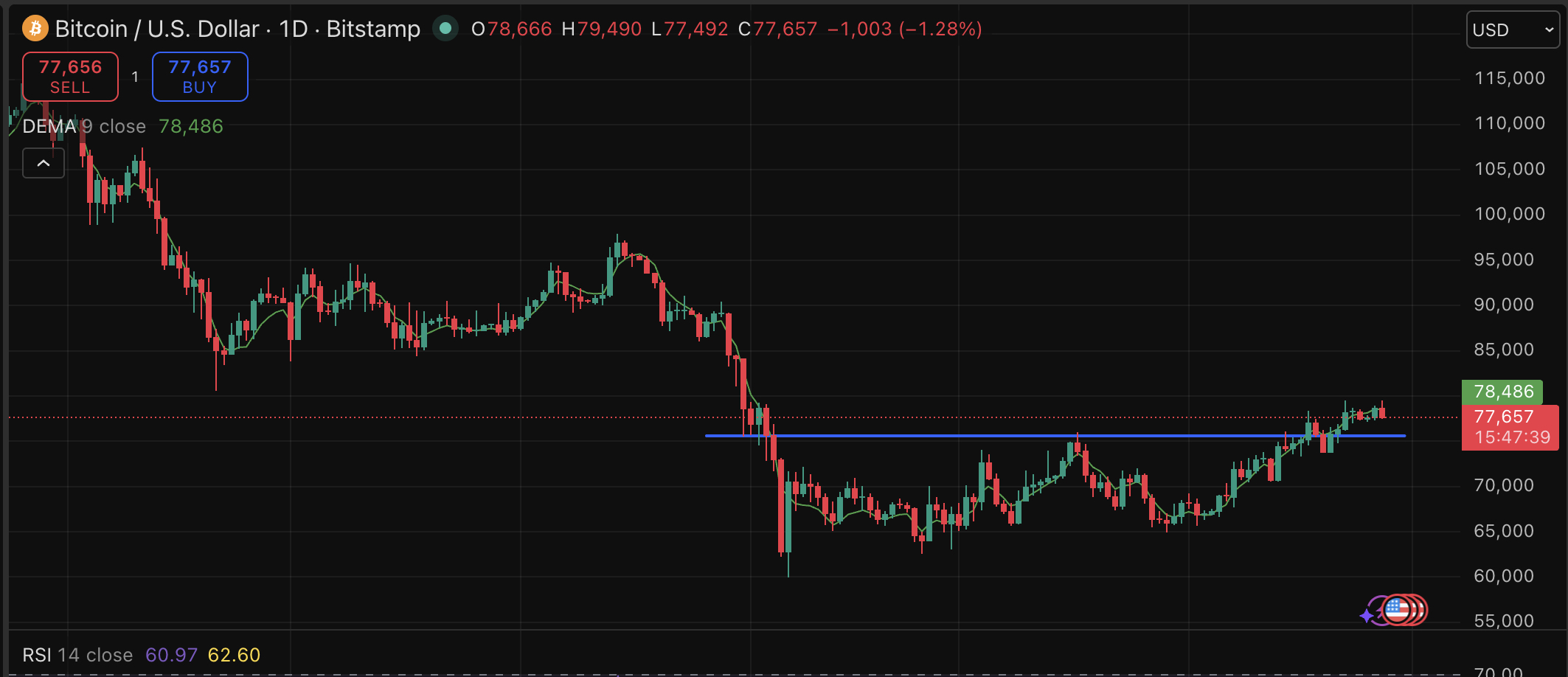
Bitcoin price briefly touched $79,400 in early Monday trading before retreating sharply, as the the $80,000 ceiling prediction held firm for yet another rejection.
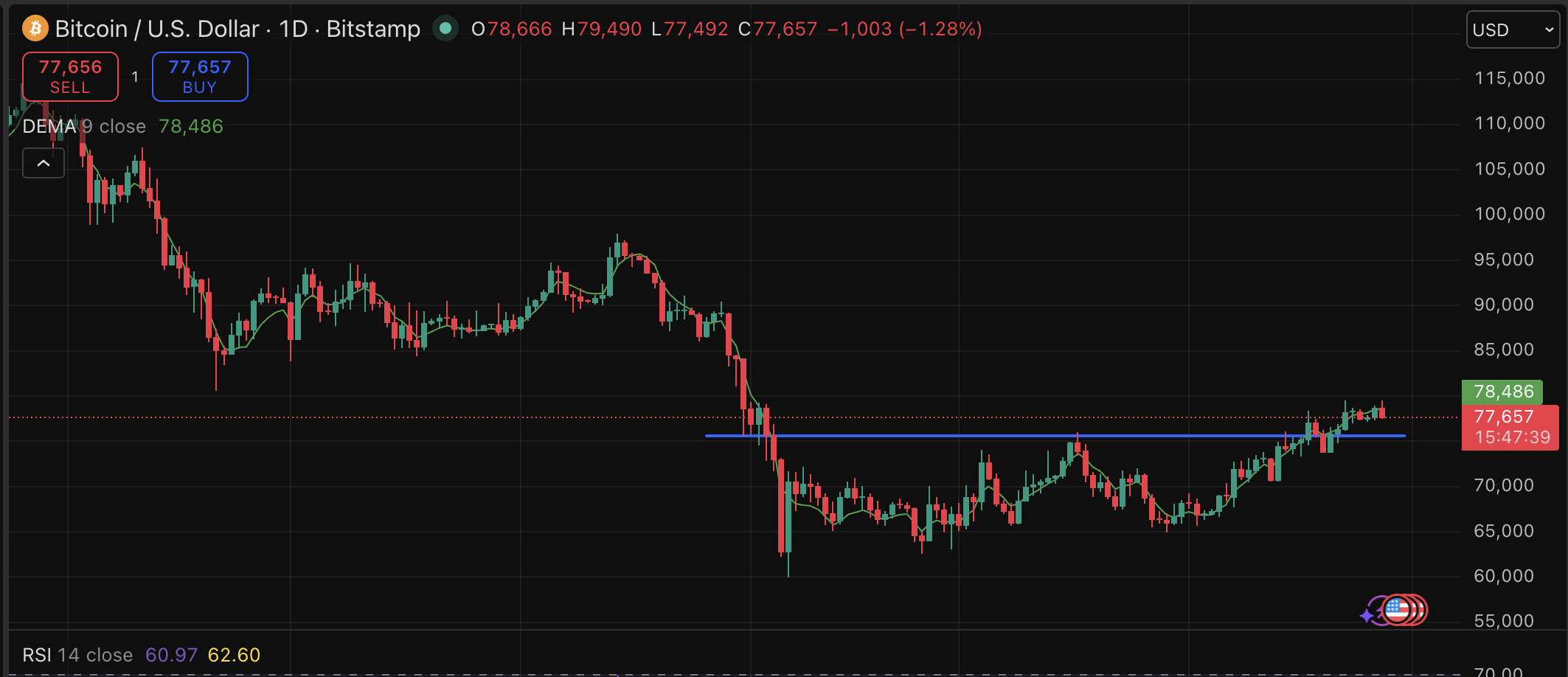
The initial spike was triggered by a report that Iran had offered the United States a proposal to reopen the Strait of Hormuz, briefly lifting risk appetite across markets. The relief trade evaporated fast. Rising oil prices and unresolved geopolitical tensions reasserted control, dragging BTC back below $78,000 within hours.
Asian equities, like the Nikkei and KOSPI, both at record highs, offered little spillover support for crypto as Bitcoin has now staged multiple failed attempts. The $79,000–$80,000 band keeps acting as a rejection level, reinforcing overhead resistance.
Discover: The best crypto to diversify your portfolio with
Bitcoin Price Prediction: Break $80,000 Next Attempt?
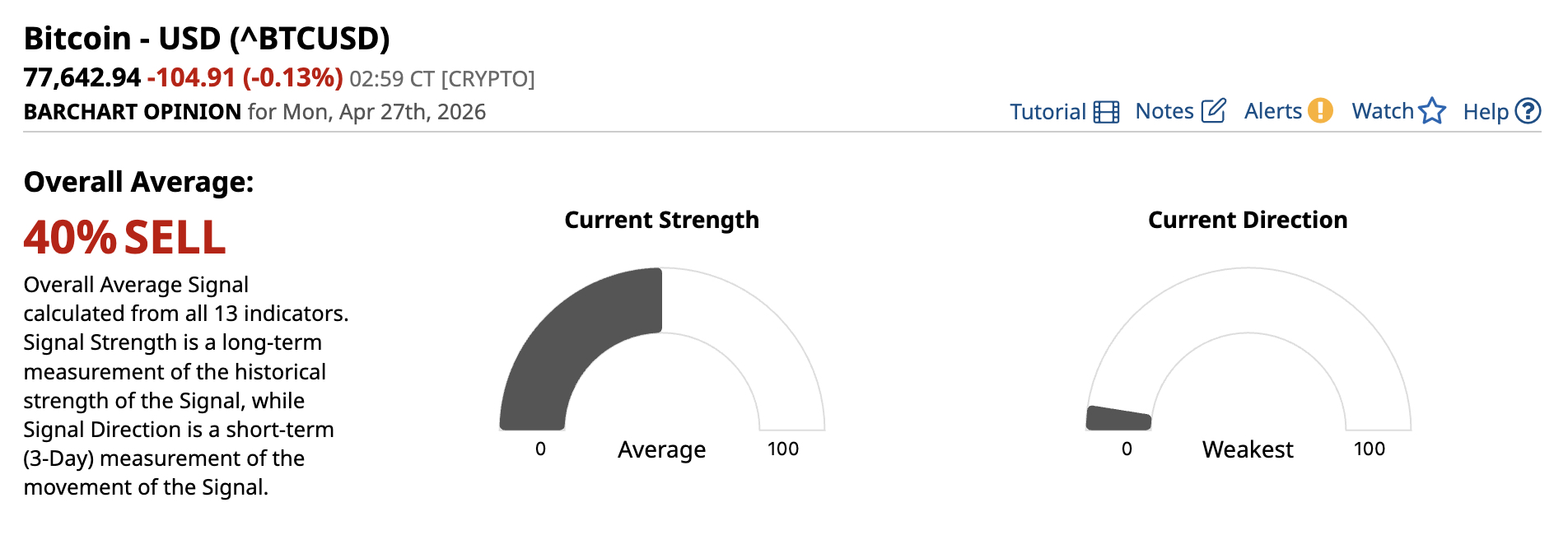
Bitcoin is trading below $77,000 this morning, pinned between well-defined levels. Technical composite shows 40% sell signal from 13 indicators, yet RSI sits at 62 in the neutral area still.
CoinGlass data shows dense sell liquidity stacked between $78,000 and $80,000 in two separate clusters. Analyst Elja has flagged the $78,000 zone specifically as a former support flipped resistance on the weekly chart; a failure to close above it this week stalls the entire recovery thesis.
If Bitcoin can close this week above $79,400, its first major resistance, the next target is $82,000. But another rejection at $79,000 could trigger a bear flag breakdown toward $75.,000, which could also open the door to the $73,500 demand zone.
Discover: The best pre-launch token sales
Bitcoin Hyper Targets Early-Mover Upside as Bitcoin Stalls at Key Resistance
BTC at $78,000 for the third consecutive week starts to look like a distribution pattern rather than an accumulation. Spot buyers are absorbing resistance rather than breaking through it. For traders rotating out of range-bound large-cap exposure, the risk/reward calculus shifts toward earlier-stage infrastructure plays with asymmetric upside.
Bitcoin Hyper ($HYPER) is one project drawing attention in that context. It positions itself as the first Bitcoin Layer 2 with full Solana Virtual Machine (SVM) integration, meaning smart contract execution at sub-second latency on Bitcoin’s security layer.
The presale has raised $32.5 million at a current token price of $0.0136, with staking live and offering a high 30% APY to early participants.
The core infrastructure pitch: BTC’s trust model plus SVM’s programmability, bridged natively via a Decentralized Canonical Bridge for trustless BTC transfers.
Research Bitcoin Hyper here before the next price increase.
The post Bitcoin Price Prediction: Sell-Off Monday in Another Failed Attempt to Break Resistance appeared first on Cryptonews.


XRP Healthcare has launched XRPHAI trading on MEXC, marking the token’s first public market listing, according to a Monday press release.
Summary
- XRPHAI is now trading on MEXC after no private sale, airdrop, or prior exchange listing.
- Users can earn XRPHAI through verified health actions inside XRP Healthcare’s AI-powered mobile app.
- XRPHAI has a fixed 1 billion supply, with its issuing account permanently disabled for minting.
Deposits opened on April 27, while withdrawals are scheduled to begin on April 28, 2026. The company said XRPHAI had no prior private sale, airdrop allocation, or earlier exchange listing. XRP Healthcare said this structure allows market pricing to start through public trading.
XRPHAI is the utility token for the XRPH AI ecosystem, built on the XRP Ledger. The token will support rewards through Proof of Health, a system designed to reward users for verified health-related activity.
Users can earn XRPHAI through the XRPH AI App by engaging with AI healthcare tools. These include wellness tasks, AI-guided health support, image-based checks, education features, multilingual access, and doctor search tools.
App includes prescription savings card
The XRPH AI App also includes the XRP Healthcare Prescription Savings Card. The company said the free card can help users access medication discounts while earning XRPHAI rewards.
The card is accepted at more than 68,000 U.S. pharmacies, including Walmart, Walgreens, and CVS Pharmacy. XRP Healthcare said users can access savings of up to 80% on prescriptions.
XRP Healthcare outlines supply and rollout
XRPHAI has a fixed maximum supply of 1 billion tokens. The company said the issuing account has been permanently disabled, meaning no more tokens can be minted.
Phase 1 of the reward system is scheduled to begin on April 28. Phase 2, which adds more reward features for XRPH holders, has already been developed and is expected to follow.
XRP Healthcare CEO Kain Roomes said, “We are now live, and this marks an important milestone as we bring the XRP Healthcare ecosystem into the public market.”
Co-founder and COO Laban Roomes added, “Proof Of Health introduces a structured way to reward real participation within healthcare.”

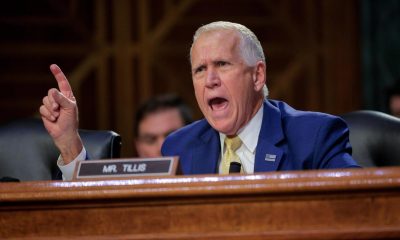
Republican Senator Thom Tillis signaled on Sunday that he will no longer block Kevin Warsh’s bid to become Federal Reserve chair, following the conclusion of a Department of Justice probe into Jerome Powell related to the Fed’s headquarters renovation. In a post on X, Tillis said the three-month DOJ inquiry has closed and that he is “looking forward” supporting Warsh’s confirmation.
“I have been clear from the start: the U.S. Attorney’s Office criminal investigation into Chair Powell was a serious threat to the Fed’s independence, and it needed to end before I could support Kevin Warsh’s confirmation,” Tillis wrote, adding that he welcomes the inspector general’s investigation as a necessary and appropriate measure, and that he expects it to be conducted thoroughly and professionally.
Tillis, a Republican on the Senate Banking Committee, held significant leverage to slow or block Warsh’s appointment by employing a procedural hold or withholding his vote to prevent advancement to a full Senate floor vote. The development aligns with a broader regulatory and policy environment as the Fed prepares for a leadership transition.
Powell’s tenure is scheduled to end May 15, with Warsh anticipated to assume the role in the days that follow once confirmed by the full Senate. The Senate Banking Committee has set its vote for April 29, while the timing of the full Senate confirmation remains unsettled and could occur during the week of May 11.
Related reporting notes broader policy momentum surrounding crypto regulation and central bank policy debates in the United States. The discussion comes as lawmakers weigh how a new Fed chair might influence rates and financial stability, with potential indirect implications for digital assets and crypto market structure.
There has been ongoing debate about how Warsh’s leadership at the Federal Reserve could affect the crypto market. Warsh, a former Fed governor, has been characterized in coverage as hawkish on some fiscal policy questions and skeptical about aggressive easing, a stance that could influence risk appetite for higher-beta assets, including cryptocurrencies. Yet, observers note that policy independence remains a core premise of the Fed, and Warsh has said that decisions will be made independently of political pressure.
Warsh is also regarded as crypto-friendly relative to some peers. His public disclosures show exposure to more than 30 crypto projects, including assets such as Solana and decentralized exchanges like dYdX. This background has been cited by observers as potentially shaping his approach to crypto policy and industry engagement, though no policy positions have been formally announced beyond adherence to Fed independence and regulatory rigor.
Source data and coverage indicate that the nomination process is proceeding under standard Senate oversight, with a clear path toward a formal vote by the Banking Committee and a subsequent floor vote. As reported, the transition timeline remains contingent on committee outcomes and Senate scheduling, with a federal leadership handover anticipated in mid-May if confirmations proceed smoothly.
According to Cointelegraph, the broader regulatory discourse continues to intersect with crypto-market participants, institutional investors, and financial institutions seeking clarity on policy direction, licensing expectations, and cross-border oversight. The unfolding confirmation process thus sits at the nexus of monetary policy, financial regulation, and crypto market structure considerations.

This Iconic Disney Classic Never Got a Sequel, but Its Lost Trailer Shows What We Almost Had

California farmers say high diesel costs and regulations threaten their survival
BTC price hits wall at $80,000, one analyst says the pullback is temporary: Crypto Daily

Manchester United reach agreement with Casemiro over contract clause amid transfer speculation

US brings back mandatory military draft registration

Steven Gerrard disagrees with Gary Neville over ‘shock’ Chelsea and Arsenal claim | Football


-

 Politics7 days ago
Gary Stevenson delivers timely reminder to register to vote as deadline TODAY
-

 Fashion3 days ago
Weekend Open Thread – Corporette.com
-
 Crypto World2 days ago
Hyperliquid $HYPE Rally Builds Momentum as AI Sector Enters Prove-It Phase
-
Crypto World7 days ago
Bank of Hawai’i (BOH) Q1 2026: Net Income Drops to $57.4M as Net Interest Margin Expands
-

 Politics5 days ago
Making troops accountable for war crimes threatens US alliance, ex-SAS colonel warns
-

 Politics5 days ago
Disabled people challenge government SEND proposals over segregation concerns
-

 Business5 days ago
Rolls-Royce Voted UK’s Most Iconic Trade Mark as IPO Register Hits 150
-

 Business3 days ago
Patterson-UTI Energy, Inc. (PTEN) Q1 2026 Earnings Call Transcript
-

 Politics5 days ago
Zack Polanski responds to home secretary’s taser threat
-
 Crypto World6 days ago
Five Value Stocks with Recovery Potential in 2026: PayPal (PYPL), Nike (NKE), and More
-
 Sports23 hours ago
IPL 2026: Ruturaj Gaikwad registers slowest fifty of the season, enters all-time unwanted list | Cricket News
-

 Politics5 days ago
Starmer handler McSweeney to be dragged from shadows by Foreign Affairs Committee
-
Politics5 days ago
Wings Over Scotland | How To Get Away With Crimes
-

 Crypto World6 days ago
New York sues Coinbase, Gemini over prediction market offerings
-
Entertainment6 days ago
Sydney Sweeney cameo cut from “The Devil Wears Prada 2”, source explains why (exclusive)
-
 Crypto World6 days ago
Crypto’s great hope in Senate’s Clarity Act still has a path to survive tight calendar
-
 Business5 days ago
HCL Tech share price tank over 9% after weak Q4. JPMorgan, HSBC & 3 others cut target price
-

 Politics5 days ago
‘Iran is still a nuclear threat’
-
 Sports4 days ago
Tim Bradley names the current best in the world: “Better than Inoue and Usyk”
-

 NewsBeat1 day ago
LK Bennett closes all stores after entering administration
You must be logged in to post a comment Login