“EVERY second shop in Newgate Street, the main street in Bishop Auckland, shuttered up and the shopkeeper ruined,” wrote the town’s prospective MP Hugh Dalton in his diary 100 years ago.
This was not the result of an out-of-town shopping centre. This was because of the General Strike which broke out a century ago this weekend and brought Britain to a standstill.
READ MORE: PICKETS IN PRIESTGATE AND FURY IN FERRYHILL: DAY-BY-DAY HOW THE GREAT STRIKE UNFOLDED IN THE NORTH-EAST
In Bishop Auckland, Dalton, leading member of the Labour Party, found “white-faced women who starved themselves to feed their children” and “men sitting silent in clubs too poor to buy either a drink or a smoke”.
Later, in December 1926, he made a single entry: “Miners hopelessly defeated”.
![]() Digging for coal at Murton during the 1926 strike
Digging for coal at Murton during the 1926 strike
Coal lay at the start and finish of the General Strike.
More than one million miners made coal the largest industry in Britain, and in 357 towns and villages of County Durham, it shaped the social geography.
Coal mining was the dirtiest, most dangerous (more than a thousand deaths annually) and dehumanising occupation in the country (80 per cent of coal was hewn by hand-pick). It gave rise to class conflict and the most appalling industrial relations.
![]() A County Durham soup kitchen during the 1926 strike.
A County Durham soup kitchen during the 1926 strike.
But after the First World War, there was a falling demand for coal, and the strike originated in an attempt by mine-owners to pass the problems of a declining industry down to their workers. Rather than amalgamate struggling pits, the owners tried to cut wages and increase hours.
The situation was aggravated by Chancellor Winston Churchill restoring Britain’s currency to the Gold Standard in 1925 in an attempt to regain the country’s financial prestige. This meant Britain’s currency was over-valued at a time when other countries were devaluing – therefore, cheap foreign coal came into Britain while British coal for export became 10 per cent dearer – and Durham coal was an exported commodity.
Miners resisted the owners’ changes – “not a penny off the pay, not a second on the day” – and appealed to the Trades Union Congress, which represented eight million workers, for support.
When lengthy negotiations failed as miners refused to accept inferior terms, they were “locked out” of their collieries on April 30. They reacted by going on strike on May 1.
Miner solidarity was total and was almost equalled by the 1.75 million workers called out by the TUC in support.
Yet on May 12, the strike – a “nine days wonder” – was over as the TUC capitulated.
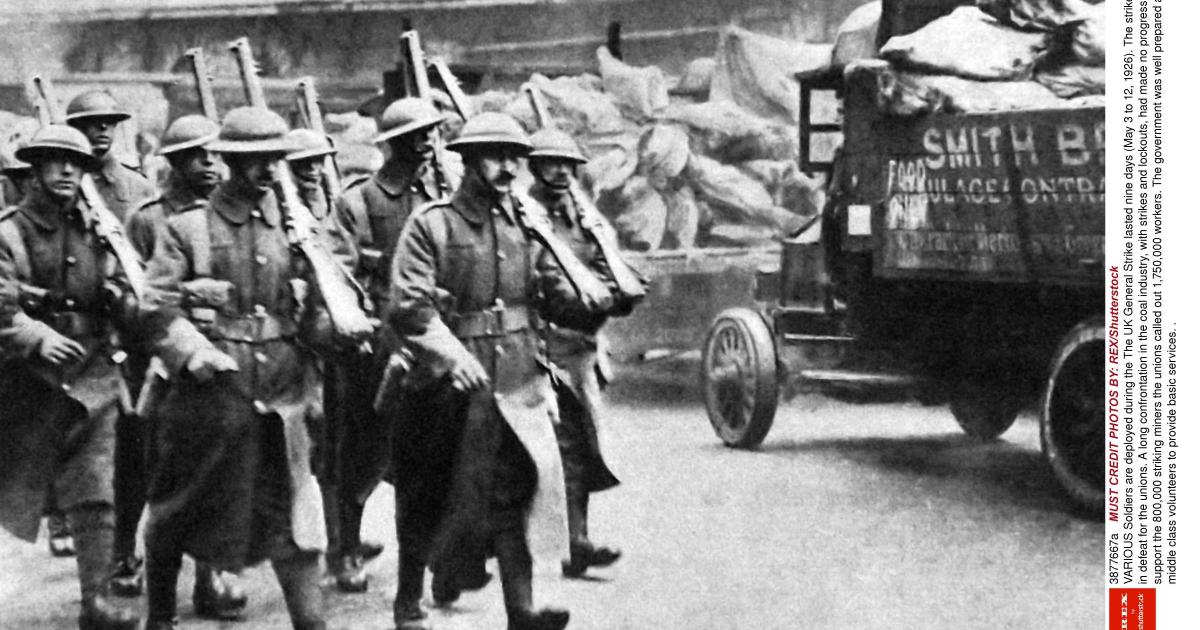
![The troops are called in to deal with the strikers. Photo by Universal History Archive/REX/Shutterstock]() The troops are called in to deal with the strikers. Photo by Universal History Archive/REX/Shutterstock
The troops are called in to deal with the strikers. Photo by Universal History Archive/REX/Shutterstock
Most miners continued to strike for six months until starvation and isolation – Dalton’s diary highlighting the appalling conditions on the ground in the coalfield – forced them to accept the owners’ harsh terms, and the lock-out ended.
Responsibility for this dire state of affairs can be shared between the four participants.
The TUC was anxious to protect its members’ wages but its leaders were divided and timid. They hoped not to paralyse the country but to pressure the government into forcing concessions from the owners. Afraid of “reds”, moderates like Ernest Bevin sought a Trumpian “exit ramp” from early days.
![Righting a bus that was turned over in Glasgow by strikers]() Righting a bus that was turned over in Glasgow by strikers
Righting a bus that was turned over in Glasgow by strikers
The men’s leaders, like the Miners’ Federation of Great Britain (MFGB) secretary and gifted orator Arthur Cook, trusted neither the TUC nor a Conservative government. He stubbornly held to the rhetorical “not a penny off the pay, not a second on the day” long after May 12, until union funds of £4m were exhausted.
Colliery owners, at a time of right-wing government, adopted an intransigent stance. They remained deaf to calls for colliery improvement and felt they only had to wait the strike out. Even Tory hawk Lord Birkenhead called them the “stupidest men in England” and Prime Minister Stanley Baldwin found them “stupid and discourteous”.
![During the 1926 Great Strike, unemployed miners formed fashionable jazz bands to wile away the hours. This is the No Place Nobblers, from near Stanley]() During the 1926 Great Strike, unemployed miners formed fashionable jazz bands to wile away the hours. This is the No Place Nobblers, from near Stanley
During the 1926 Great Strike, unemployed miners formed fashionable jazz bands to wile away the hours. This is the No Place Nobblers, from near Stanley
Baldwin shrewdly grasped that by trying to coerce him, the TUC had converted an industrial dispute into a political one. He was thus able to portray himself as a “man of peace” and to brand the strike as a threat to the constitution.
By contrast, Churchill denounced striking workers as “the enemy” trying to “hold up the nation”, words that could have been a rehearsal for the way the 1984 miners’ strike was presented by another Conservative government.
History suggests that, against these forces, the strike was doomed from the beginning.
Planning by the TUC was eleventh hour, improvised and fragmented. There were more than 500 Councils of Action acting virtually autonomously, such as the proactive and radical centre of Chopwell (“Little Moscow”), in Gateshead.
![]() FIGHTING FOR COAL: Striking miners digging for coal at South Hetton during the 1926 strike
FIGHTING FOR COAL: Striking miners digging for coal at South Hetton during the 1926 strike
By contrast, government planning was timely and comprehensive. Coal and food were stockpiled and an emergency structure divided Britain into 10 districts. Each was under a Civil Commissioner empowered to recruit half-a-million (chiefly middle class) “patriotic volunteers” and to use the armed forces to ensure that food was smoothly delivered.
Warships also acted as an intimidating presence by turning their guns towards ports.
Leadership was exercised effectively by Baldwin and based on a clear strategy of protecting parliamentary democracy, while the supine TUC shrank from turning off the lights and fires and bringing industry to a halt.
Local leaders were more impressive. In Chopwell, Will Lawther – later the Labour MP for Barnard Castle – led the blocking of roads from Newcastle to Consett in order to undermine “volunteer” action, and he was imprisoned after the police baton-charged his supporters outside the Gateshead court.
![The Flying Scotsman derailed near Cramlington when strikers removed a rail from the East Coast Main Line]() The Flying Scotsman derailed near Cramlington when strikers removed a rail from the East Coast Main Line
The Flying Scotsman derailed near Cramlington when strikers removed a rail from the East Coast Main Line
In propaganda terms, Churchill orchestrated the government case in a nationally circulated newspaper called “The British Gazette”.
By contrast, the TUC deprived itself of favourable coverage by calling out the printers to strike! Their “British Worker” newspaper was hand-printed and circulation in Durham was limited to 16,000. In Blaydon, workers produced a publication called “The Northern Light” which was cyclostyled on equipment which was moved from house to house to avoid arrest.
The technically independent BBC focused on the political issue too and even blocked a broadcast of the Archbishop of Canterbury’s peace initiative. Its chairman was Darlington coal lord Jack Pease, Baron Gainford.
Road transport was at the centre of most of the trouble, but in general food and coal supplies were maintained. On Newcastle quayside, a submarine and two destroyers were moored beside a food-ship and convoys to Consett had police escorts.
It cost the United Bus Company £600 to repair damage to vehicles in Bishop Auckland.
Volunteers numbering 25,000, including university students, were available in the North East to drive private cars and lorries, and a further 12,000 acted as special constables. Of a national figure of 1,760 arrests for disorder, 396 were in the North East District.
Thankfully, no one was killed in the UK.
In the last analysis, the power of the state prevailed. The TUC had no stomach for the fight and the government spent £433m on winning it.
In working class Durham, there was little for strikers to do as support was solid and blacklegs practically unknown.
It was a hot summer and men at first enjoyed the natural warmth and light, and relief from toil.
But some families were turned out of their tied housing by the mine owners, and by July, with no benefits system for able men, food was running short. Perhaps in mining villages, some men could hunt and fish or “acquire” vegetables, but in towns there was more scavenging, notably of coal from heaps and railway lines, but also men had the possibility of casual work.
There was no paid work available for women and they can be seen to have been the real victims of the strike.
By November, only five per cent of Durham miners had returned to work, but by the end of that month, the privations their families and communities were suffering, forced the majority to accept severe, locally-dictated terms.
Nationally, the triumph of the owners meant there was no reorganisation and so nationalisation, universally popular with miners, did not come about until 1947.
In 1927, Baldwin introduced an Act of Parliament that outlawed sympathetic strikes. This, though, was seen by some as unnecessarily vindicative and contributed to his ousting in 1929, although it was not repealed until 1946.
The miners remained stoical and stubborn but recognised that a better future lay in supporting Labour politics rather than in industrial action. They were rewarded as early as 1929 with the formation of the second Labour government, with Will Lawther defeating the sitting Conservative MP Cuthbert Headlam in Barnard Castle.
Some miners and their supporters were victimized in 1926 but the strike was also a warning to employers that conciliation and collective bargaining were less risky than confrontation. And with non-militant men like Bevin leading the unions away from direct action, the result was relative industrial peace until the 1970s.
Sadly, 60 years after the General Strike, the lessons of under-preparation and taking on a strong government were not learned by a future miners’ leader who shared a first name with his role model Arthur Cook.
![]() Glynn Wales at the Tommy statue in Seaham
Glynn Wales at the Tommy statue in Seaham
- Glynn Wales, of Bishop Auckland, began his career as a history teacher in 1969 at Ferryhill Grammar School, and he rose to become head of Ferryhill Comprehensive until he retired in 1997 to join Durham university and train the next generation of history teachers























































You must be logged in to post a comment Login