
Crypto World
Earn daily passive crypto income with zero investment


Disclosure: This article does not represent investment advice. The content and materials featured on this page are for educational purposes only.
Mobile cloud mining expands in 2026 as BM Blockchain attracts beginner interest in BTC and DOGE mining.
Summary
- Mobile-first cloud mining platforms like BM Blockchain simplify Bitcoin mining without hardware or setup complexity.
- The platform offers beginner-friendly crypto mining with guided onboarding and mobile access to mining tools.
- As mining interest grows, BM Blockchain appeals with easy entry, no hardware needs, and streamlined participation.
As more people look up things like what Bitcoin mining is, how to mine Bitcoin, and whether any free cloud mining options still exist in 2026, the mobile-first crypto mining space keeps growing. On Android, iOS, and web dashboards, more users are choosing Bitcoin and Dogecoin cloud mining platforms instead of buying hardware, dealing with heat and power bills, or running dedicated mining rigs.
In real life, “free” usually doesn’t mean mining is forever at zero cost. In 2026, it more often points to free sign-ups, welcome bonuses, trial access, or mobile tools that let people get a feel for mining-related systems before paying for larger plans. That’s why comparison roundups still matter for anyone trying to understand how Bitcoin mining works, how BTC cloud mining platforms actually run, and which services might be easier for beginners.
Below is an original roundup of five platforms that people often mention when talking about the best cloud mining, the best crypto cloud mining options, and beginner-friendly ways to access Bitcoin and Dogecoin mining in 2026.
Top free cloud mining platforms (2026 comparison)
| Platform | Best For | Mobile Access | Entry-Level Feature |
| BM Blockchain | Beginner-friendly platform-based mining access | Mobile-friendly / browser access | Publicly referenced onboarding-related allocations valued at up to $108 |
| StormGain | Users looking for app-based mining activation | Android app | In-app mining activation cycle model |
| ECOS | Contract-style cloud mining access | Android / iOS app | Hosted infrastructure and integrated wallet tools |
| NiceHash | Users monitoring mining operations and hashrate markets | Android / iOS app | Mining marketplace and management interface |
| Binance Pool | Exchange ecosystem users seeking mining-related access | Mobile ecosystem support | Mining-related services integrated within a broader exchange environment |
1. BM Blockchain — Best for users looking for a low-barrier starting point
BM Blockchain can be seen as a beginner-friendly choice for people who want to try Bitcoin cloud mining or Dogecoin mining through a platform, instead of buying and running their own mining hardware. Based on publicly available industry information, BM Blockchain is described as focusing on letting users take part in infrastructure, access computing power, and get a more guided onboarding experience if they’d rather not deal with hardware setup themselves.
For those searching for things like how to mine Bitcoin or how to start mining Bitcoin without building a rig, this kind of platform setup may sound appealing because it removes a lot of the usual technical friction. Instead of setting up and tuning equipment, users can look through the platform’s tools, compare different ways to participate, and get started through a mobile-friendly experience.
Industry disclosures also mention welcome allocations during onboarding valued at up to $108, framed as participation incentives rather than any promised financial result. Interested investors who are comparing cloud mining apps or looking up the best cloud mining options, that kind of easier, low-effort onboarding could make BM Blockchain stand out as a place to begin.
BM Blockchain 2026 illustrative participation snapshot
| Model | Entry Amount | Term | Illustrative Daily Estimate | Illustrative End-of-Term Estimate |
| Starter Plan | $200 | 1 Day | $7.00 | $207.00 |
| A15 Compute | $1,200 | 2 Days | $43.20 | $1,286.40 |
| A2 Cluster | $3,600 | 3 Days | $136.80 | $4,010.40 |
| GPU Node | $8,000 | 2 Days | $344.00 | $8,688.00 |
| Hyd Compute | $16,800 | 3 Days | $924.00 | $19,572.00 |
Stable returns and a clear timeline: This is a truly hands-free way to earn Bitcoin daily.
BM Blockchain states that actual returns may vary depending on platform conditions, applicable terms, fees, operational assumptions, timelines, and broader market factors.
View the full contract and claim $108 worth of free hashrate!

2. StormGain — Best for a Bitcoin miner app experience
StormGain often comes up when people search for terms like best Bitcoin miner app, bitcoin miner app, or bitcoin mining apps, mainly because it offers a mobile-first way to access mining. Beginners in particular talk about it when they want an app that works through simple activation instead of dealing with a more technical contract-style dashboard.
A big reason StormGain shows up so much in beginner conversations is convenience. When someone is asking how to mine Bitcoin on a phone or is looking for a crypto mining experience on mobile, an app-based interface usually feels easier to approach than more traditional mining services.
3. ECOS — Best for structured contract-based cloud mining
ECOS often shows up in cloud mining roundups because it gives users a more structured setup, with hosted mining contracts and centralized tools to manage their accounts. Compared to lighter apps that focus more on quick activation, ECOS tends to suit people who want something more organized and a clearer, contract-style way of presenting the service.
For anyone looking into bitcoin cloud mining, BTC cloud mining, or how to start crypto mining, this approach can feel closer to getting longer-term access to mining infrastructure than just using a casual app.
4. NiceHash — Best for users interested in mining marketplace tools
NiceHash usually comes up less as a typical “free mining app” and more as a marketplace for mining power, along with a platform to manage day-to-day mining operations. That’s why it tends to appeal to people who want to see things like hashrate prices, use account tools, and track mining activity, instead of relying on a simple sign-up bonus approach.
For people looking up what miners are in blockchain, or trying to get a clearer picture of how mining marketplaces work, NiceHash is still one of the better-known names in this space.
5. Binance Pool — Best for exchange-integrated mining access
Binance Pool gets attention mainly because it links mining services with the wider Binance exchange ecosystem. For users who already use Binance regularly, this all-in-one setup can feel easier than running mining through a separate platform.
Looking at different cryptocurrency cloud mining services? People often see Binance Pool as a solid choice when it matters to have everything connected in one ecosystem, not just the mining access on its own.
Why Bitcoin and Dogecoin cloud mining continues to attract attention
Bitcoin is still the best-known digital asset by market value, and Dogecoin continues to get a lot of attention from everyday buyers. Put together, they show two very visible, but very different, corners of the digital asset market.
Many people who look up how to mine cryptocurrency, how to mine Dogecoin, or how long it takes to mine Dogecoin usually aren’t trying to run a large mining setup. More often, they’re looking for an easier way to get started so they can understand what it means to mine Bitcoin, how cloud-style options work, and whether a mobile-friendly service makes more sense for them than buying and managing their own hardware.
That’s part of why mobile crypto mining and browser-based tools are still getting more attention in 2026.
How to choose the right cloud mining platform
Every platform works a bit differently, and “free” doesn’t always mean the same thing everywhere. In real use, people should compare:
- Wwhat “free” actually means on the platform
- Whether the service is app-based, browser-based, or contract-based
- How clearly the participation model is explained
- Whether fees, estimates, and withdrawal rules are disclosed
- Whether the platform is designed for beginners or more advanced users
A practical way to do this is to begin on a platform with a lower entry barrier, get familiar with the participation rules, and try out the user experience first, then gradually increase the allocation.
Frequently asked questions
What is Bitcoin mining?
Bitcoin mining is basically how transactions get checked and then recorded on the blockchain, using computing power. In the past, that usually meant having dedicated mining machines, but a lot of people now start by looking into Bitcoin cloud mining platforms instead of buying and running hardware themselves.
How does Bitcoin mining work?
Bitcoin mining works by using computing power to confirm transactions on the network and help keep the blockchain secure. With cloud mining, people generally use remote services and rented infrastructure rather than owning and running the machines directly.
How can I mine Bitcoin as a beginner?
For those who are new, the easiest starting point is often an app or a platform that walks them through it. Many people who search for how to mine Bitcoin or how to start mining Bitcoin begin with cloud dashboards, instead of jumping straight into ASIC hardware.
What is cryptocurrency mining?
Cryptocurrency mining usually means using computing power to help process blockchain transactions and keep the network running safely. People searching for what cryptocurrency mining is or what cryptocurrency mining is are often trying to understand the difference between mining with their own hardware and joining through a cloud-based option.
What is the best Bitcoin miner app in 2026?
There isn’t one best choice that fits everyone. People looking for the best bitcoin miner app often compare things like how easy it is to use, how clear the terms are, how transparent it feels, and whether it’s mainly for activation, monitoring, or actually connecting users to a broader mining marketplace.
Can crypto be mined on a laptop or phone?
Most of the time, doing serious mining directly on a laptop or phone isn’t really practical anymore. That said, some people use cloud mining apps, crypto mining phone tools, or mobile-friendly dashboards that let them join or manage mining without making the device do the heavy work.
How to mine Dogecoin in 2026?
For those who are asking how to mine Dogecoin, it usually comes down to two routes: mine directly with the right hardware, or join through a cloud platform that offers access tied to Dogecoin. The cloud approach is often easier for beginners since they don’t have to deal with hardware setup.
How long does it take to mine Dogecoin?
That depends on how a person is mining, how much computing power is involved, and which platform or setup they’re using. So, searches like how long to mine Dogecoin and dogecoin cloud mining earnings can lead to very different expectations, depending on whether someone means solo mining, pooled mining, or a platform-based setup.
What does “cloud mining free” really mean?
Most of the time, it means free sign-up, a welcome bonus, a trial period, or limited-time activation — not endless mining with zero cost. It’s worth checking how each platform explains what “free” includes.
Conclusion
The mining scene in 2026 isn’t dominated by just one kind of product anymore. People can now choose from infrastructure-focused services, mobile-first onboarding platforms, mining marketplaces, and ecosystems tied to exchanges.
For those who are looking up things like what Bitcoin mining is, how to mine Bitcoin, the best cloud mining options, or how to mine Dogecoin, a good place to begin is usually a platform that clearly explains how someone can get access and makes it easier to start without having to own hardware. Publicly mentioned onboarding offers, like the $108 welcome incentive linked to BM Blockchain, also show how some platforms are trying to make it simpler for first-time users to get started.
As usual, it’s worth comparing the terms across platforms, understanding what each one actually means by “free,” and checking the participation rules before jumping in.
Disclosure: This content is provided by a third party. Neither crypto.news nor the author of this article endorses any product mentioned on this page. Users should conduct their own research before taking any action related to the company.

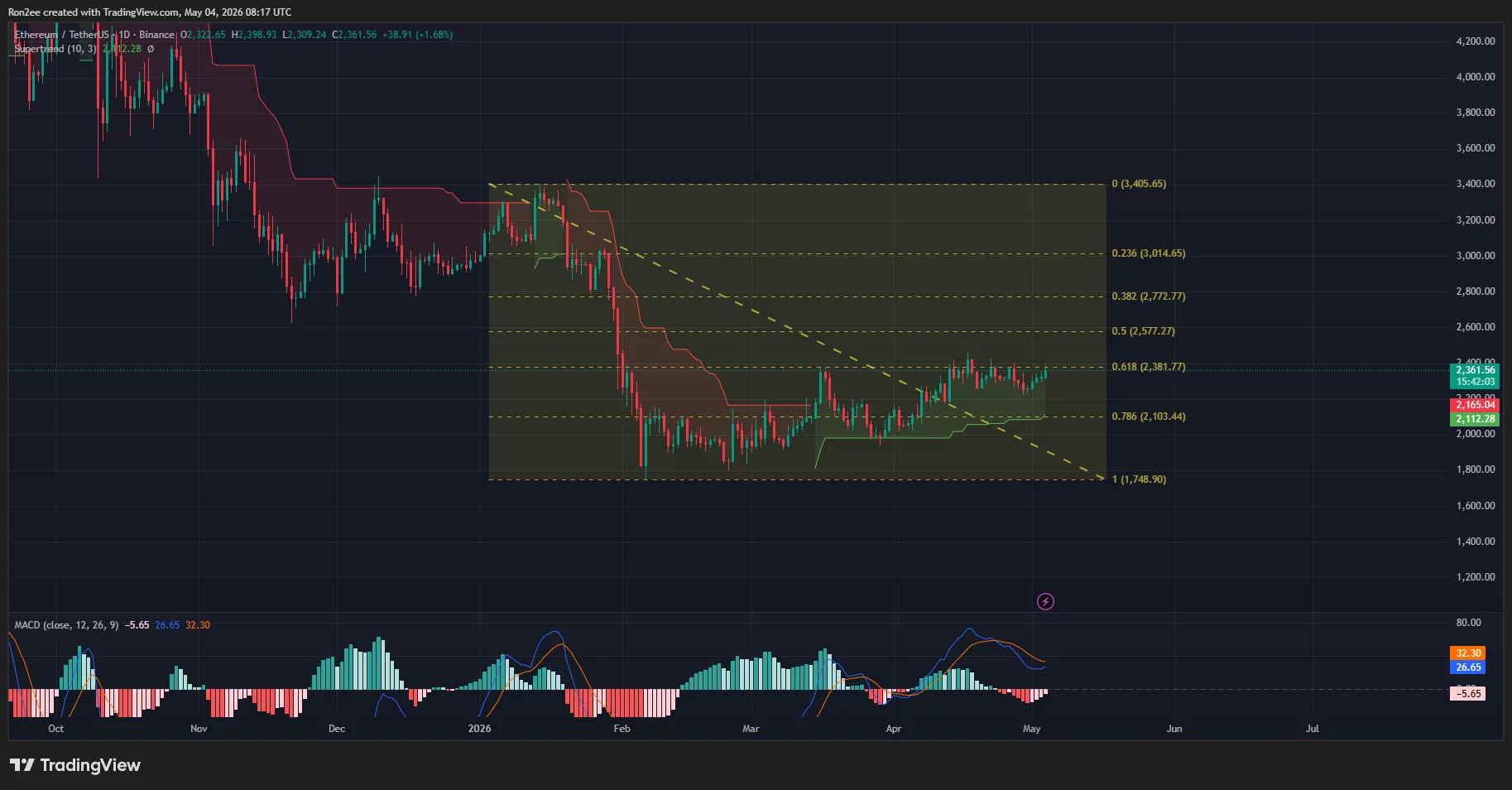
Ethereum price is eyeing a breakout from the $2,400 resistance, which has capped the token’s gains over the past week.
Summary
- Ethereum price is testing the $2,400 resistance after rebounding to $2,393, with repeated rejections keeping its price within a tight range.
- Technical indicators signal potential upside, with a looming MACD bullish crossover and Supertrend remaining in an uptrend since mid-March.
- ETF inflows ($101M) and declining exchange reserves (14.5M ETH, lowest since 2016) point to improving demand and reduced sell pressure.
According to data from crypto.news, Ethereum (ETH) price rebounded 3.5% to $2,393 on May 4 before facing rejection at $2,400 and stabilizing around $2,370 at press time. While Ethereum has briefly broken above the $2,400 mark on two occasions over the past month, the altcoin lost momentum and quickly retraced below the level.
However, at press time, several technical and fundamental factors suggest that the token could finally escape from the narrow trading range.
Notably, on the daily chart, Ethereum price is approaching a bullish MACD crossover, which typically signals a shift toward upward momentum. The last time such a positive crossover occurred, Ethereum price rose nearly 25% within a month.
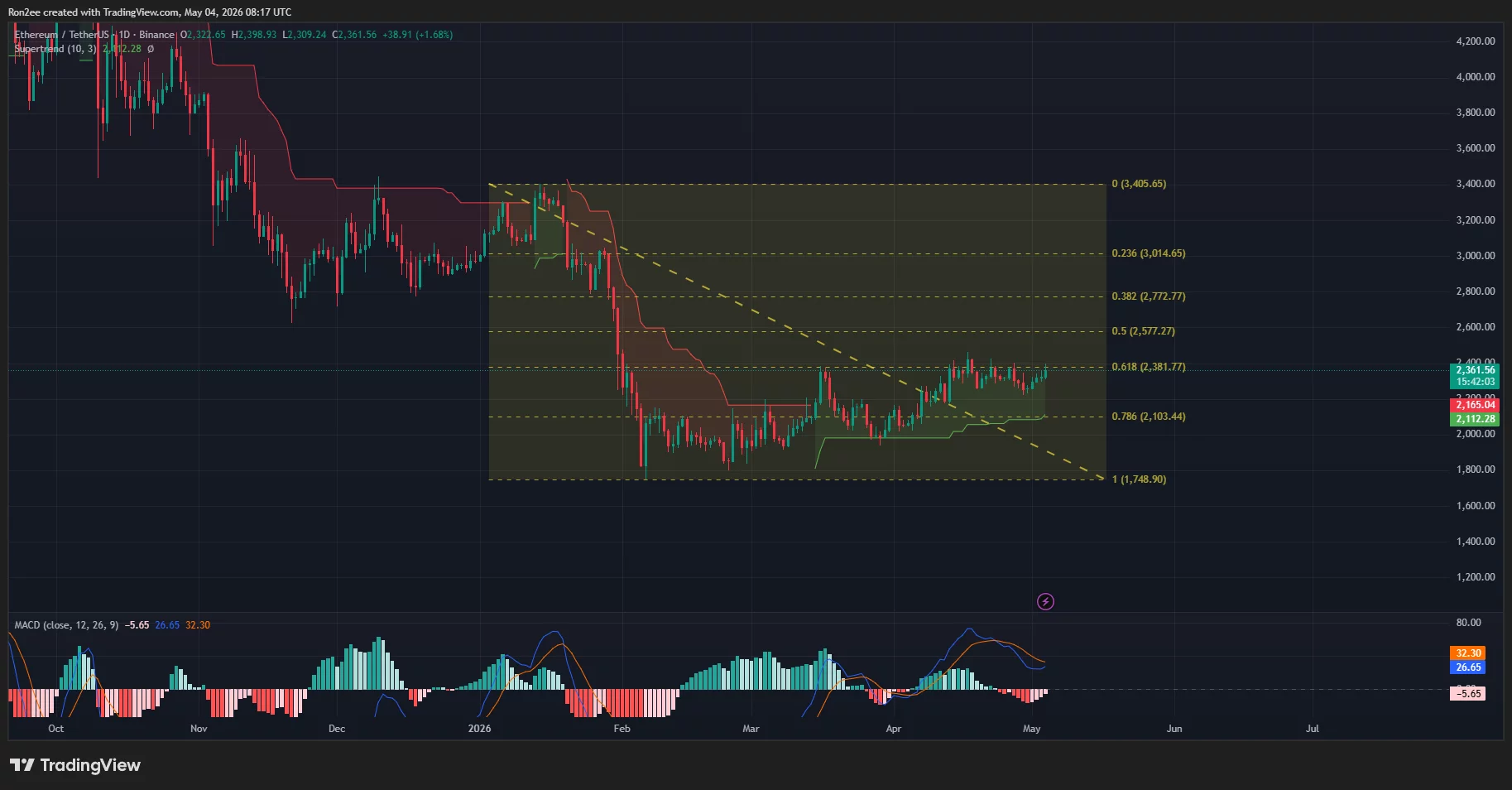
The Supertrend has remained green since mid-March, a sign that the broader market structure remains in an uptrend despite recent price fluctuations.
At press time, Ethereum price was near the 61.8% fibonacci retracement level at $2,381, a sign that bulls are aggressively defending the mid-range zone. A decisive break above the current resistance could trigger a breakout from the $2,400 and a move towards the next key 38.2% retracement level at $2,772 if bullish momentum holds.
Besides strong technical signals, on-chain demand also seems to support a potential rally. Data from SoSoValue show that Ethereum ETFs recorded over $100 million in net inflows last Friday, breaking off a 4-day negative streak, which saw $183 million in outflows.
While this is not yet a sign that institutional investors will go all in immediately, it shows renewed appetite for the asset, especially if the positive flows continue to show up this week.
Another catalyst that could support Ethereum’s gains is the drop in ETH balances on exchanges. Per data from CryptoQuant, Ethereum exchange reserves have fallen to 14.5 million, the lowest level since mid-2016, indicating reduced selling pressure on the token.
Disclosure: This article does not represent investment advice. The content and materials featured on this page are for educational purposes only.
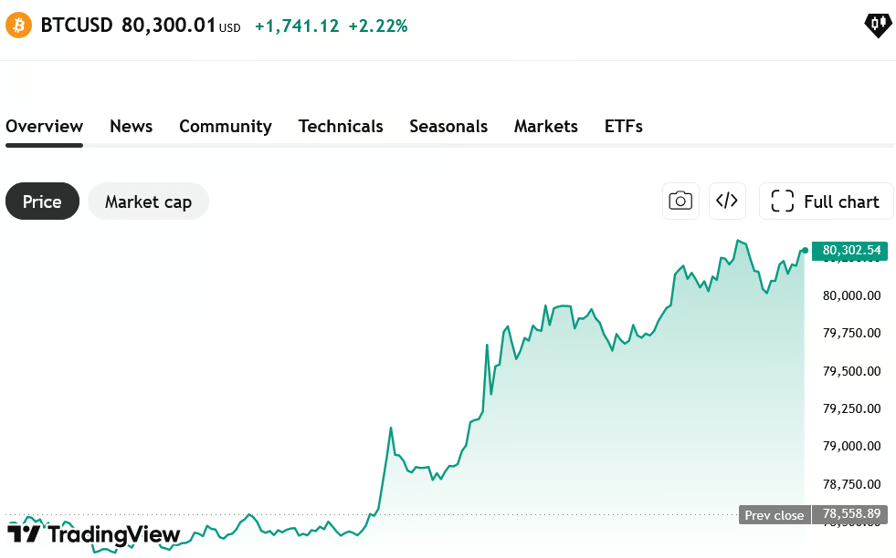
Bitcoin breached $80,000 on Monday, rising 2.7% over a three-hour span as Asian equities began trading, marking its highest price since Jan. 31, 2026.
The Bitcoin rally began at 1:25 am UTC, rising from $78,415 to break the $80,000 level about 75 minutes later before climbing to $80,515 by 4:20 am UTC, according to TradingView data.

Bitcoin’s price change on Coinbase on Monday. Source: TradingView
The rally coincided with a 2.3% rise in the MSCI AC Asia Index to 245.2 on Monday morning, breaking its previous high of 243.6 on Feb. 22, about a week before the US-Iran war began.
A rise in the MSCI AC Asia Index at the start of the week generally reflects positive global risk sentiment in response to weekend developments, though it doesn’t necessarily mean that US equities will follow suit.
Ether (ETH), XRP (XRP) and BNB (BNB) also rallied and are up 3.9%, 2.4% and 3.3% over the last 24 hours, at the time of writing.
The price rise also comes as crypto momentum has been building in Washington, where members of the banking and crypto industries reached a compromise on stablecoin yield provisions in the CLARITY Act, with a Senate markup expected this month.
The US-based spot Bitcoin exchange-traded funds have also seen net inflows in 11 of the past 14 trading days, indicating that institutional demand remains strong.
Friday’s inflow of $629.8 million also marked the US Bitcoin ETF industry’s strongest day in two weeks.
Bitcoin up nearly 30% from 2026 low
Bitcoin’s climb back to $80,000 marks a nearly 30% recovery from its 2026 low of about $62,000 reached on Feb. 5, and several industry observers said there is a path for Bitcoin to reach $100,000.
Related: Strategy takes Bitcoin buying breather ahead of Q1 earnings report
One of them is MN Trading Capital founder Michael van de Poppe, who said Friday that Bitcoin does not need a fresh narrative to return to the $100,000 mark:
“There doesn’t need to be a narrative that pushes the price upwards,” he said, stating that as the price moves upwards, “the narrative will create itself.”
The crypto industry is also watching the US Bitcoin Reserve after White House crypto adviser Patrick Witt said at the Bitcoin Conference in Las Vegas last week that a “big announcement” on President Donald Trump’s Bitcoin reserve is coming in the next few weeks.
Magazine: Adam Back says current demand is ‘almost’ enough to send Bitcoin to $1M
Crypto World
Bitcoin (BTC) Price Forecast: Legendary Trader Projects $250K Target While Warning of Extended Consolidation
Key Takeaways
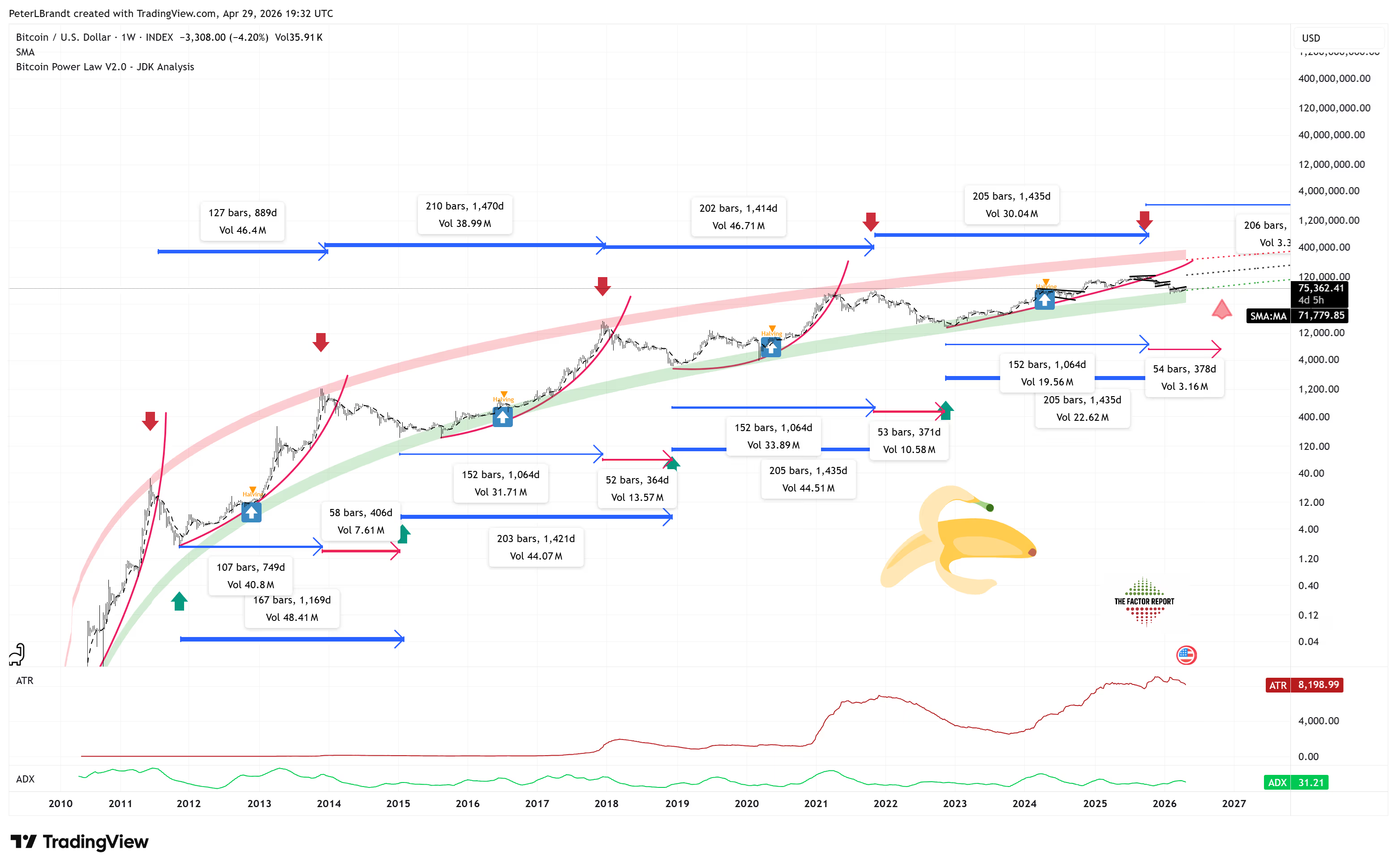
- Legendary commodities trader Peter Brandt projects Bitcoin reaching $250,000 by the end of 2029.
- Brandt anticipates an extended consolidation period that may continue through September or October 2026.
- Bitcoin has already rebounded more than 25% from its February trough around $60,000.
- The projection relies on analyzing Bitcoin’s recurring four-year halving cycle patterns.
- Brandt maintains flexibility, stating he’ll adjust his thesis if market behavior deviates from historical patterns.
Peter Brandt, a commodities trading veteran with nearly fifty years of market experience, has unveiled a comprehensive price trajectory for Bitcoin. His ultimate target stands at $250,000 by the close of 2029. However, he emphasizes that the cryptocurrency market faces considerable consolidation before initiating that major upward move.

According to Brandt’s assessment, Bitcoin is presently navigating through a bottoming formation that could persist until September or October 2026. This extended timeframe isn’t speculation. It’s derived from careful examination of Bitcoin’s four-year halving cycle, a pattern that has demonstrated remarkable consistency throughout the cryptocurrency’s history.
In April 2024, Bitcoin underwent its scheduled halving event — reducing the mining reward from 6.25 BTC to 3.125 BTC per block. Historical data shows that bull market peaks typically emerge approximately 16 to 18 months following each halving event. Based on this framework, the most recent cycle peak occurred around October 2025, when Bitcoin reached approximately $126,000.
Understanding the Four-Year Cycle Structure
After reaching that peak, Brandt anticipates a bear market phase spanning roughly twelve months. This timeline would position a market bottom somewhere in the autumn of 2026. Subsequently, a fresh uptrend would develop heading into the April 2028 halving, potentially culminating at $250,000 during late 2029.
“I am not calling for a low until Sep/Oct 2026,” Brandt explained to CoinDesk. “It is not necessary for the recent low to be penetrated. We could get a rally and then chop sideways to down. Worst case would be a move back into the lower green banana peel which would be into the 50s, maybe high 40s. Then blast off for $250k and a high in late 2029.”
This analysis suggests Bitcoin may trade within a range of approximately $47,000 to $80,000 for over a year before any substantial bullish momentum develops.
This perspective contrasts with many cryptocurrency analysts who believe the bear market concluded in February when Bitcoin established a floor near $60,000. Since that low point, BTC has surged over 25%, trading around $80,300 in early May 2026.
A Non-Dogmatic Forecasting Philosophy
What distinguishes Brandt from numerous market forecasters is his transparent commitment to revising his outlook when circumstances warrant. “As long as the market follows the script I will stay with my projections. If at some point the price discovery moves off script I will be forced to revise all my thinking. I will NOT be dogmatic about it,” he stated.
This adaptive methodology represents a refreshing contrast in an environment where many analysts remain stubbornly attached to failed predictions.
Currently, Bitcoin is trading near $79,740, remaining considerably below its 2025 all-time high.



Coinbase has urged U.S. derivatives regulators to keep prediction markets under existing rules, filing a formal response as legal pressure builds around event-based contracts.
Summary
- Coinbase has submitted a letter to the Commodity Futures Trading Commission arguing that prediction markets fall within existing regulatory authority.
- Chief Policy Officer Faryar Shirzad said event-based contracts resemble traditional futures and called for a principles-based framework.
According to a letter submitted to the Commodity Futures Trading Commission and addressed to Secretary Christopher Kirkpatrick on April 30, Coinbase responded to the agency’s Advance Notice of Proposed Rulemaking on prediction markets, arguing that such products already fit within current statutory authority.
In the filing, Coinbase described prediction markets as “one of the most dynamic areas of derivatives markets,” while stating that no new legislative mandate is required to oversee them under existing frameworks. Chief Policy Officer Faryar Shirzad signed the letter and called on regulators to preserve a principles-based approach that prioritises market integrity.
Shirzad told the press that event-based contracts are not a new concept and compared them to traditional futures, explaining that both mechanisms aggregate dispersed information into pricing signals. Coinbase’s submission also asked the CFTC to clarify how it intends to exercise its authority to block contracts deemed against the public interest.
Coinbase said in the letter that consistent safeguards should apply to all users, whether they trade directly on platforms or through intermediaries, adding that regulatory clarity would help maintain trust as participation expands.
The filing comes as disputes over event contracts continue to surface at the state level, including a lawsuit in Wisconsin that has added urgency to the regulatory debate. Coinbase’s position places it among firms seeking federal clarity at a time when jurisdiction between state authorities and federal regulators remains contested.
Earlier, Shirzad addressed a separate policy issue tied to stablecoin rewards during negotiations around the CLARITY Act, telling Reuters that revised language preserved “what matters” for crypto platforms while introducing limits on rewards that resemble bank interest. Senators Thom Tillis and Angela Alsobrooks negotiated that compromise, which restricts deposit-like yields while allowing activity-based incentives tied to platform use.
With the Senate Banking Committee targeting a markup of the CLARITY Act in the week of May 11, Coinbase’s latest filing on prediction markets adds to its ongoing engagement with U.S. policymakers across multiple areas of crypto regulation.
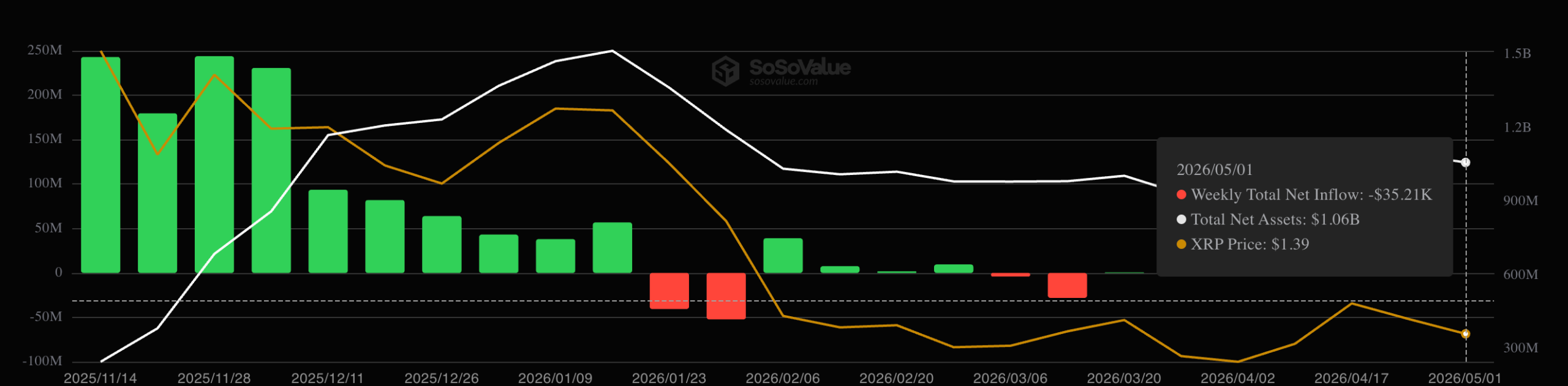
XRP spot exchange-traded funds (ETFs) recorded a net outflow last week, ending three consecutive weeks of inflows and signaling a cooling institutional appetite for the asset.
At the same time, liquidity conditions on Binance have weakened. The exchange’s 30-day XRP liquidity index dropped to its lowest level in five years.
Institutional Demand for XRP Cools After April Surge
According to data from SoSoValue, roughly $35,210 exited XRP ETFs in the week ending May 1. This marked the end of a stretch of consistent buying.
XRP ETFs pulled in $82.88 million across the prior three weeks. The week of April 17 alone delivered $55.39 million in net inflows. This was the strongest inflow since mid-January.
Cumulative net inflows sit at $1.29 billion. Nonetheless, weekly net assets slipped to $1.06 billion.

Follow us on X to get the latest news as it happens
XRP Liquidity Index Hits 2020 Low on Binance
Meanwhile, an analyst flagged that XRP’s liquidity index has fallen to 0.038, the weakest reading recorded since 2020. According to the post, the drop points to a “clear weakness in market depth.”
In conditions like these, even moderate capital inflows can swing the price sharply in either direction. However, the analyst added that price action has remained relatively stable.
This is typically seen as a transition period in which prices have yet to fully reflect weakening liquidity, or as a phase of consolidation ahead of a larger move.
“On the other hand, the decline in the liquidity index may indicate a gradual exit by large investors or a reduction in institutional trading activity, further increasing market fragility,” Arab Chain noted.
The current setup leaves XRP exposed in both directions. A modest inflow could trigger a sharp rally in a thin market. At the same time, continued weakness in demand may increase the risk of a downside move.
Subscribe to our YouTube channel to watch leaders and journalists provide expert insights
The post XRP ETFs End 3-Week Green Run as Weekly Flows Turn Negative appeared first on BeInCrypto.

The U.S. Commodity Futures Trading Commission is soliciting public input on a March-proposed rule aimed at tightening and clarifying the agency’s authority over prediction-market event contracts. More than 1,500 comments were filed as the comment window closed, reflecting a broad mix of support for clearer federal oversight and concerns that new rules could curb access or push activity into less regulated spaces.
Key takeaways
- The CFTC drew more than 1,500 public responses to its proposed rule, which would empower the regulator to amend or issue new regulations for event contracts on prediction markets.
- Kalshi and Polymarket endorsed the CFTC’s stance on exclusive federal jurisdiction, with Kalshi’s Luana Lopes Lara urging guidance to keep event contracts listed and overseen by the Commission; Polymarket’s Justin Hertzberg likewise backed strong CFTC authority.
- Industry voices such as Andreessen Horowitz supported the move, arguing that state actions to regulate or ban prediction markets threaten impartial access and the viability of CFTC-regulated platforms.
- State gambling regulators and some lawmakers pushed back, warning that prediction markets could masquerade as unregulated sportsbooks or raise questions about jurisdiction over sports and geopolitical markets.
- The debate appears amid ongoing legal tensions between federal regulators and several states, who have pursued or threatened litigation over prediction-market operations.
Federal rulemaking and the broad jurisdictional question
The public comment period centered on a CFTC proposal designed to formalize the agency’s ability to adjust or introduce regulations governing event-based contracts offered on prediction markets. The agency’s aim is to clarify oversight for products that people bet on outcomes ranging from elections to geopolitical events, by carving out a defined federal jurisdiction that some market participants say is overdue, while others worry about potential overreach into areas traditionally governed by state gambling regulators.
In the view of Kalshi, a leading prediction-market platform, the proposal could usefully supplement existing rules. Kalshi co-founder and chief operating officer Luana Lopes Lara told the commission that its current framework is “well-designed and effective,” and urged the agency to provide guidance that would ensure the universe of event contracts can continue to be listed, traded, and overseen by the Commission. Her stance reflects a desire for regulatory clarity that maintains a federal standard without stifling innovation.
A separate industry voice, Polymarket, echoed similar sentiment. Polymarket US CEO Justin Hertzberg commended CFTC Chair Mike Selig for reaffirming the Commission’s exclusive jurisdiction over prediction markets, while stressing that the regulator should continue to exercise that authority. The call for certainty here mirrors a broader industry preference for predictable rules that reduce the risk of a patchwork state-by-state regime.
Supportive voices: investors and builders weigh in
Beyond Kalshi and Polymarket, venture capital firm Andreessen Horowitz joined the chorus advocating for federal clarity. In a letter, the firm argued that actions by individual states to regulate or ban prediction markets can impede impartial access and raise barriers for participants who rely on predictable, federally supervised systems.
From the industry’s perspective, a stable federal framework could unlock participation from institutions and developers who have looked for consistent regulatory ground to justify scaling operations that depend on prediction-market economics. Yet supporters also recognize that clear rules must address real-world risks, including consumer protection, market manipulation, and the potential for insider knowledge to influence outcomes.
Regulators and lawmakers push back: concerns about overreach and misuse
Not everyone in the regulatory ecosystem welcomed the CFTC’s stance. Several state gambling regulators pressed back, arguing that the federal approach could obscure the line between sports betting and prediction markets, and potentially allow platforms to circumvent state oversight. Pennsylvania’s Kevin O’Toole, executive director of the Gaming Control Board, asserted that the CFTC’s position could allow prediction markets to masquerade as unregulated sportsbooks. Similarly, Mary Beth Thomas, executive director of the Tennessee Sports Wagering Council, contended that sports event contracts offered on prediction markets may fall outside the CFTC’s jurisdiction altogether and should remain under state control.
Missouri’s perspective was notably pointed. Michael Leara, executive director of the Missouri Gaming Commission, urged Congress to preserve state jurisdiction over sports-event contracts, arguing that lawmakers did not intend futures markets to embody gambling activities. Such framing highlights the friction between a federally focused approach to prediction markets and states that view these activities as intrinsically tied to traditional gambling regulation.
The debate also touched on broader policy concerns. Some lawmakers worry about the potential for prediction markets to monetize geopolitical events or to be influenced by insiders with privileged information. In a joint letter, Dennis Kelleher, CEO and co-founder of Better Markets, along with 12 consumer groups, urged the CFTC to prohibit event contracts tied to elections or geopolitical events, arguing such contracts could influence public policy or governmental action.
The intensity of state-level pushback has intersected with ongoing legal action in the federal arena. The CFTC has argued that it should hold authority over prediction markets and has pursued litigation against several states that challenged this position, signaling a deliberate effort to secure a clear federal role in this space. The tension between state sovereignty and federal oversight remains a central throughline of the current discourse.
Market implications: what readers should watch next
Looking ahead, the CFTC’s next steps will be crucial for market participants navigating prediction markets and related crypto ventures. While the proposed rule is designed to formalize federal oversight, the precise contours of the final rule—and how it will be interpreted by states and courts—remain to be seen. For traders and platform operators, the outcome could impact licensing trajectories, listing standards, and the balance between consumer protections and open access.
The broader environment also includes notable developments around insider trading restrictions and platform governance. Kalshi and Polymarket indicated in recent weeks that they have tightened insider-trading controls and restricted certain users, such as politicians, from participating in their markets. These steps may reflect a growing sensitivity to insider risks and could inform how stricter federal guidance might shape platform policies going forward. Separately, the Senate’s decision to ban its members and staff from using prediction markets has added a political dimension to the regulatory conversation, signaling that policymakers are watching how these tools are used in practice.
As the CFTC weighs public input, observers will be watching for signs of timing and substance in forthcoming guidance or a final rule. If the agency provides clearer standards on listing, trading, and oversight of event contracts, it could spur greater participation from compliant players while also clarifying the boundaries for state regulators. Conversely, if the final rule narrows federal reach or imposes onerous requirements, it could slow adoption and push certain activities toward gray areas or state-level solutions.
Readers should monitor next statements from the CFTC, any coordinated actions among states, and the evolution of platform policies around eligibility, insider trading, and dispute resolution. The outcome will help define not only the regulatory risk landscape for prediction markets but also the broader trajectory of how crypto-related derivatives and event-based instruments integrate into the U.S. financial-regulatory framework.


Stablecoins may need a new public identity as their role expands beyond crypto trading, according to Robert Hackett, head of special projects at a16z crypto.
Summary
- A16z says stablecoins now serve wider payment and finance roles beyond basic price stability.
- Robert Hackett argued the term still reflects crypto’s volatility problem, not today’s broader use.
- The stablecoin name may remain, even as digital dollars and onchain assets gain adoption.
In a May 1 report, Hackett said the word came from crypto’s early years, when builders needed tokens that could hold steady value during sharp market swings.
He said the name once made sense because it explained the main problem these assets solved. However, Hackett argued that the technology has moved past that early use case. He wrote, “Stability is now table stakes. It’s a prerequisite, and not the point.”
Stablecoins move beyond price stability
Stablecoins are cryptocurrencies designed to track assets such as the U.S. dollar, gold, or other reference values. They now support payments, transfers, settlement, savings products, and financial apps built on public blockchains.
Hackett said the term still points to the original problem of crypto volatility, not to the wider platform stablecoins have become. He added that the real question is no longer whether these assets can hold value, but what builders can create with them.
The market has also grown. DefiLlama data showed the total stablecoin market cap near $320.84 billion, with USDT holding about 59.06% dominance. That size has made the sector one of crypto’s main bridges to payments and dollar-based activity.
Rebrand debate grows among builders
John Palmer, a developer and brand adviser, made a similar case last week. He said it “feels like a bug” to call them stablecoins because the category may expand crypto’s use far beyond its current reach.
Palmer also said these assets deserve a self-defined name, rather than one built as a response to volatility. His comments matched Hackett’s view that the word stablecoin frames the technology as a fix, not as a base layer for digital money.
Moreover, Hackett said other terms, such as “digital cash” or “programmable money,” may describe the technology better. Still, he noted that such names can feel too awkward for common use.
He also said early names often remain even after technology changes. As an example, he compared stablecoins with terms such as horsepower and email. In his view, people may later speak more often about digital dollars, digital euros, and other onchain assets.
Elsewhere, the a16z comments came as the firm stays active in wider crypto policy debates. Crypto.news reported that a16z also backed the CFTC in a dispute over state-level restrictions on prediction markets, showing its wider role in digital asset regulation discussions.


Payward has completed its acquisition of Bitnomial, giving Kraken a regulated pathway to launch crypto derivatives in the U.S.
Summary
- Payward has completed its Bitnomial acquisition, securing all three CFTC licenses needed to run a U.S. crypto derivatives business.
- Kraken will begin with spot margin trading, with perpetuals and options set to follow, co CEO Arjun Sethi said.
- The deal, previously valued at up to $550 million, gives Payward a regulated route to offer derivatives through Kraken and NinjaTrader.
According to a company statement released Friday, the deal hands Payward control of a full set of Commodity Futures Trading Commission licenses, including a Futures Commission Merchant, a Designated Contract Market, and a Derivatives Clearing Organization, allowing it to operate trading, clearing, and brokerage services under one framework.
Arjun Sethi, co-CEO of Payward and Kraken, said the rollout will begin with spot margin trading on Kraken, with perpetual contracts and options scheduled to follow, adding that “that stack is what makes the next set of products possible.”
Bitnomial, based in Chicago, spent more than a decade securing the three CFTC approvals required to run a complete derivatives operation, a combination no other crypto-native U.S. firm holds at the same time, according to Payward’s earlier disclosure in April.
With the transaction closed, Bitnomial will operate within Payward while keeping its regulatory structure and third-party services intact, the company said, alongside plans to expand the exchange’s team as development continues.
Payward said the integration will connect Bitnomial’s infrastructure across Kraken, NinjaTrader, and its business-to-business platform, allowing banks, brokerages, and payment firms to access regulated U.S. crypto derivatives through a single API.
When the acquisition was first announced, Payward said the deal could reach up to $550 million in cash and stock, valuing the company at $20 billion, although final terms were not disclosed upon closing.
Company data released in April showed Payward generated $2.2 billion in revenue in 2025, processed about $2 trillion in transaction volume, and held more than $48 billion in customer assets at year-end.
Outside the U.S., Payward said it already runs regulated derivatives businesses in the UK following a 2019 acquisition and introduced EU-regulated offerings in 2025, building out its international presence ahead of entering the U.S. market with a fully licensed structure.
The acquisition follows a separate $200 million investment from Deutsche Börse Group earlier this month, while Payward confirmed it had confidentially filed a draft S-1 with the U.S. Securities and Exchange Commission in November as it continues to consider a public listing.


The 11 U.S.-listed spot bitcoin exchange-traded funds (ETFs) have now recorded two consecutive months of net inflows in a sign of renewed institutional appetite for the leading cryptocurrency.
But zoom out, and the recovery looks more modest than the monthly headlines suggest.
ETFs have pulled in a total of $3.29 billion in investor funds over the past two months, according to data source SoSoValue. May began on a positive note, with ETFs registering a net inflow of $629 million on Friday.
That has lifted the cumulative net inflows since the launch in January 2024 to $58.72 billion, which is still shy of the record high of $61.19 billion in October. It’s also the month when bitcoin’s spot price hit its lifetime peak of over $126,000.
The gap shows that, though demand has recovered, it has yet to compensate for the outflows between November 2025 and February 2026. The four-month stretch saw investors yank $6.38 billion alongside a sharp slide in bitcoin to nearly $60,000 from over $100,000.
It’s not necessarily a reason for alarm, but a useful reality check on where things stand compared to the peak of October’s bullish sentiment. It tells us that the recovery in ETF flows is real but incomplete. Whether it gains enough momentum remains to be seen in the days ahead.
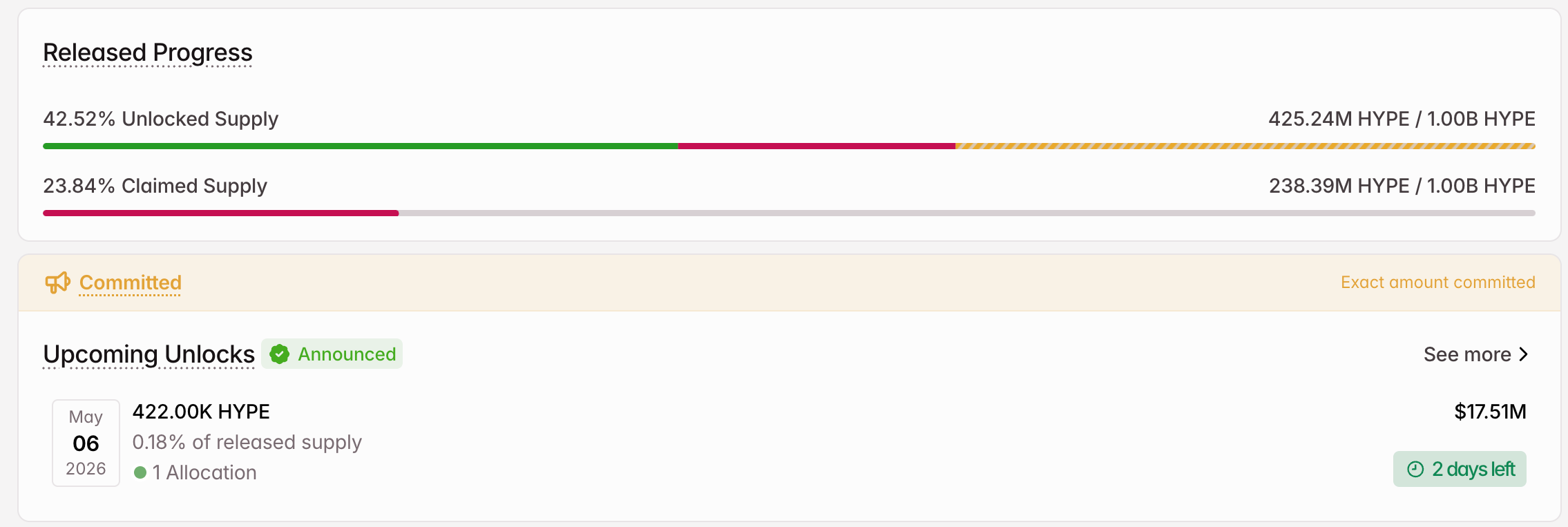
The crypto market will welcome tokens worth around $621.4 million in the first week of May 2025. Major projects, including Hyperliquid (HYPE), Ethena (ENA), and RedStone (RED), will release significant new token supplies.
These unlocks could introduce market volatility and influence short-term price movements. So, here’s a breakdown of what to watch.
1. Hyperliquid (HYPE)
- Unlock Date: May 6
- Number of Tokens to be Unlocked: 422,000 HYPE
- Released Supply: 425.24 million HYPE
- Total Supply: 1 billion HYPE
Hyperliquid is a leading decentralized perpetual futures exchange built on its own Layer-1 blockchain. It offers high-performance trading with low latency, on-chain order books, and sub-second transaction finality.
On May 6, the team will unlock 422,000 HYPE worth $17.5 million. The tokens account for 0.18% of the released supply.

The team has allocated the unlocked supply to core contributors. Tokenomist pointed out that HYPE has historically claimed far fewer tokens than its projected unlock amounts.
2. Ethena (ENA)
- Unlock Date: May 5
- Number of Tokens to be Unlocked: 171.88 million ENA
- Released Supply: 8.09 billion ENA
- Total Supply: 15 billion ENA
Ethena is a synthetic dollar protocol built on Ethereum (ETH). The protocol’s flagship product is USDe, a synthetic dollar stablecoin. Furthermore, ENA is the protocol’s governance token.
The team will release 171.88 million ENA tokens on May 5. The tokens, worth $17.28 million, account for 2.12% of the released supply.

Ethena will award the 93.75 million tokens to core contributors. In addition, the investors will receive 78.13 million ENA.
3. RedStone (RED)
- Unlock Date: May 6
- Number of Tokens to be Unlocked: 40.85 million RED
- Released Supply: 334.94 million RED
- Total Supply: 1 billion RED
RedStone is a modular blockchain oracle protocol that feeds trusted, real-time external data into smart contracts and decentralized finance (DeFi) applications across multiple blockchains.
The team will release 40.85 million tokens on May 6. The tokens are worth $5.54 million. Furthermore, they account for 12.2% of the released supply.

The team will split the unlocked supply four ways. Early backers will get 26.42 million tokens. Core contributors will receive 5.56 million RED.
In addition, the team will allocate 5.54 million altcoins to the ecosystem and data providers. Lastly, it will direct 3.33 million tokens towards protocol development.
In addition to these three, Space and Time (SXT), Opinion (OPN), and BounceBit (BB) will also experience a new supply entering the market in the first week of May.
The post 3 Token Unlocks to Watch in the First Week of May 2026 appeared first on BeInCrypto.

RHORI’s Kelsey Swanson Has 1 Boyfriend After Polygamy Claims

Cal Raleigh’s status uncertain when Mariners host Braves

The legendary Oak Ridge lab just developed a portable device that detects GPS-spoofing live

Manchester United reach agreement with Casemiro over contract clause amid transfer speculation

US brings back mandatory military draft registration

Steven Gerrard disagrees with Gary Neville over ‘shock’ Chelsea and Arsenal claim | Football


-

 Tech7 days ago
Register Renaming | Hackaday
-

 Politics6 days ago
Drax board avoid their own AGM, accused of greenwashing & environmental racism
-

 Fashion5 days ago
Kylie Jenner’s KHY Enters a New Era with ‘Born in LA’
-

 Tech7 days ago
Why Blue Badges Disappeared From Toyota Hybrids
-

 Tech7 days ago
Images of Samsung’s rumored smart glasses have leaked
-

 NewsBeat14 hours ago
Channel 5 – All Creatures Great and Small series 7 new post
-
 Tech3 days ago
Trump’s 25% EU auto tariff breaches Turnberry Agreement that also covers semiconductors and digital trade
-

 Business5 days ago
Most Commercial Energy Audits Miss the Real Losses
-

 Business7 days ago
(VIDEO) Charlize Theron Climbs Times Square Billboard to Promote New Netflix Thriller ‘Apex’
-

 Crypto World6 days ago
CFTC’s AI will review U.S. crypto registration applications, chairman tells CoinDesk
-
 Sports3 days ago
Paul Scholes issues Marcus Rashford reality check as agreement emerges over Man United star
-

 Business5 days ago
Barclay Brothers Avoid Bankruptcy: HSBC Drops High Court Petitions After IVA Deal
-
 Entertainment7 days ago
Alicia Keys Calls Out Music Industry ‘Boys Club’
-
 Business5 days ago
Tesla Officially Registers Elon Musk’s Stock: What Investors Need to Know
-

 Tech6 days ago
Get Ready for More Brain-Scanning Consumer Gadgets
-
 Crypto World6 days ago
Robinhood Phishing Scam Exploits Gmail Dot Feature to Bypass Security
-

 Crypto World6 days ago
Gmail Dot Trick Underpins Robinhood Phishing, Sending Real-Looking Emails
-

 Entertainment6 days ago
Sister Wives: Janelle Posts New Scary Warning
-

 Business3 days ago
Two Powerball Tickets Split $143 Million Jackpot in Indiana and Kansas
-

 Business6 days ago
Superdry co-founder accused of raping woman
You must be logged in to post a comment Login