
Crypto World
Bitcoin price crosses $81K, but derivatives and network activity remain low: check forecast



- Bitcoin (BTC) holds above $81,000 as short-term momentum strengthens.
- Weak network growth signals cautious market participation.
- BTC faces major resistance at $89,500.
Bitcoin has climbed above $81,000, extending its monthly recovery and testing its highest trading range in roughly three months.
At press time, BTC was trading around $81,467 after gaining 5.2% over the past seven days and 17.6% over the last 30 days.
The latest move places Bitcoin in a critical technical zone, with several underlying metrics suggesting the rally is still developing under cautious conditions rather than broad market conviction.
Network activity and derivatives participation remain muted
While Bitcoin’s spot price has improved, on-chain data point to weaker user participation than during previous major rallies.
Active addresses and transaction activity have not increased at the same pace as price, signalling that retail demand remains limited.
This divergence between price and blockchain activity often suggests that current momentum is being supported more by institutional demand and large investors than by widespread organic adoption.
Notably, institutional participation through spot Bitcoin ETFs has surged, with billions in capital inflows helping stabilise prices above key support zones.
However, derivatives market participation has remained relatively restrained compared to previous breakout cycles, with lower speculative leverage and softer futures activity indicating traders are cautious.
In addition, the Crypto Fear & Greed Index currently reads 50, placing sentiment in neutral territory.
This reflects a market that is neither euphoric nor fearful, reinforcing the idea that Bitcoin’s recent strength has not yet triggered widespread speculative enthusiasm.
Technical indicators show bullish momentum
Bitcoin’s short-term technical structure remains positive, with 12 out of 23 major technical indicators leaning bullish currently.
Furthermore, BTC is trading above its 10-day, 20-day, 50-day, and 100-day exponential moving averages, which support continued bullish momentum.

However, Bitcoin remains below its long-term 200-day EMA, showing that macro resistance is still intact.
The 14-day Relative Strength Index stands at 69.5, placing BTC just below overbought territory.
While this suggests strong momentum, traders should closely watch for possible exhaustion if RSI breaks above 70 without stronger volume.
Post-halving cycle points to late-stage expansion
Bitcoin’s fourth halving took place in April 2024, reducing miner rewards to 3.125 BTC per block.
The asset is now approximately 25 months into its post-halving cycle.
Historically, this stage has often aligned with stronger price expansion, heightened volatility, and eventual cycle peaks before larger retracements.
Previous Bitcoin bull cycles reached new all-time highs roughly 1,405 to 1,477 days apart.
Based on this pattern, the current cycle may still have room for further upside, though historical trends also suggest increasing risks of correction as the cycle matures.
Short-term Bitcoin forecast remains cautiously bullish
Looking at the current market structure, the immediate resistance zone sits at $89,479.
A confirmed close above that level could open the path toward the next resistance near $90,975.
However, in case of a pullback, especially if the oversold region is reached, then the key support level sits at $75,109.
A break below $75,109 would likely weaken the bullish structure and raise the probability of deeper corrections.
Moving ahead, traders should carefully monitor the Bitcoin ETF inflows, whale accumulation, and RSI behaviour, for clearer confirmation of whether the current move can develop into a larger sustained rally.



OKX is preparing to offer perpetual futures tied to private companies, including OpenAI, SpaceX, and Anthropic, intensifying a growing race among crypto firms to bring pre-IPO speculation markets on-chain, the company said Wednesday in a blog post.
The contracts will provide synthetic price exposure to private companies ahead of their anticipated public listings, without granting actual equity ownership or shareholder rights.
Bitget entered the sector in April with “IPO Prime,” listing a Solana-based SpaceX-linked token issued through investment platform Republic. Last year, Injective rolled out pre-IPO perpetual futures tied to firms including OpenAI, Anthropic, SpaceX, and Perplexity, describing the products as a way to bring the $13 trillion private equity market “directly on-chain.”
The trend also reflects how crypto exchanges are increasingly moving beyond bitcoin and ether (ETH) trading to include equities, prediction markets, and real-world assets as they seek new sources of trading activity.
Robinhood tried something similar but took a different approach last year. The fintech platform offered OpenAI-linked tokens backed by a special purpose vehicle that held equity purchased on the secondary market, rather than direct equity ownership.
OpenAI publicly distanced itself from the product at the time, warning that any transfer of actual company equity would require its approval.
Risk assets rallied across the globe and oil crashed during Monday’s European hours as reports of progress in U.S.–Iran peace talks boosted risk sentiment.
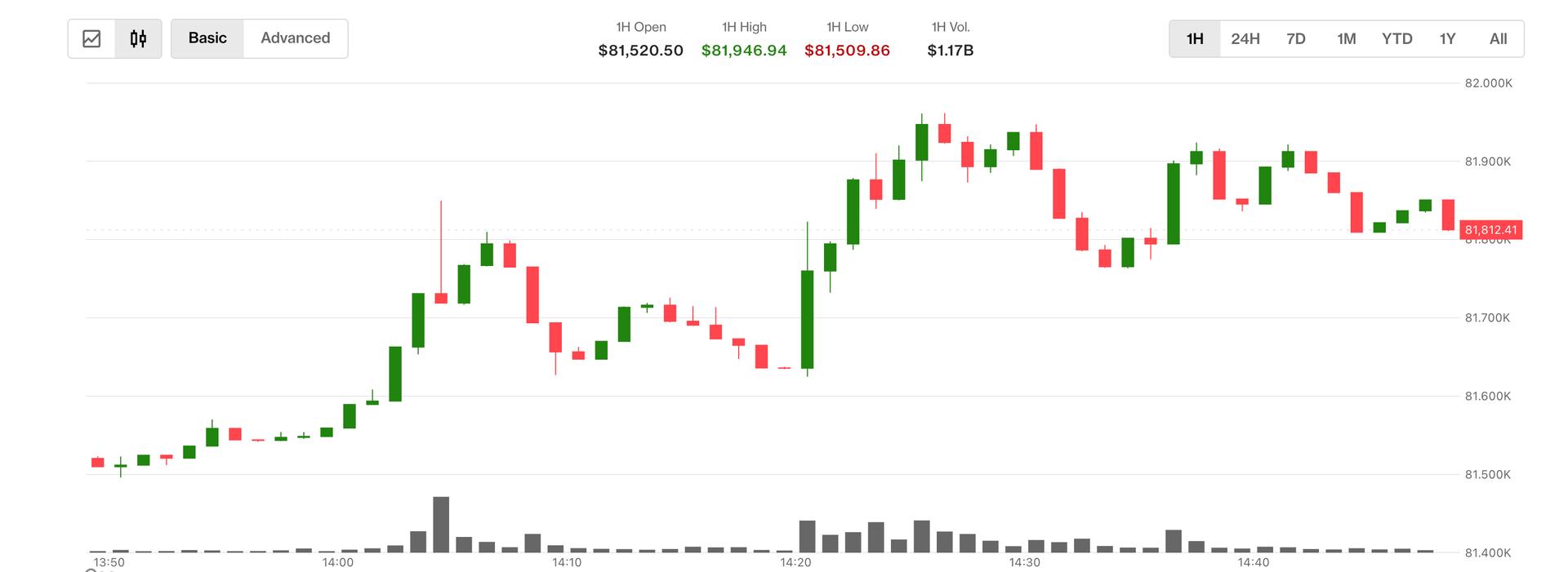
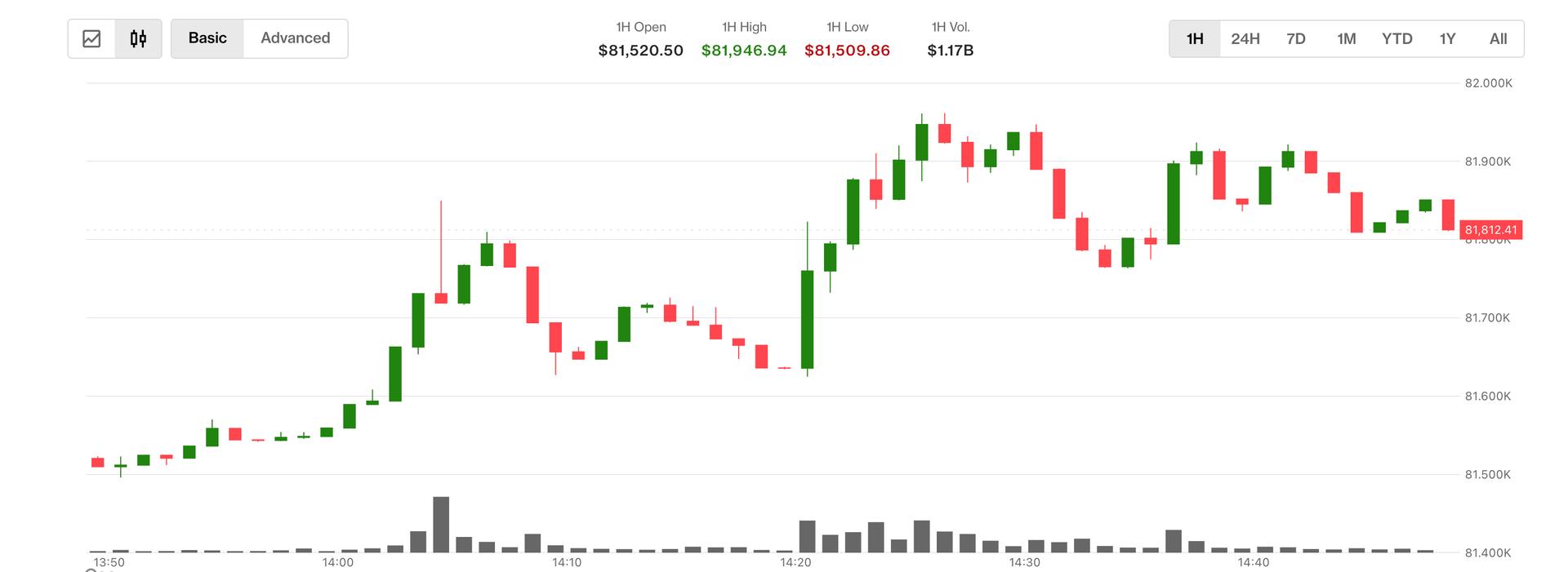
Bitcoin extended Asian gains to trade close to $82,000 during the European hours, as futures tied to Wall Street’s tech heavy index Nasdaq rose over 1%. Futures tied to WTI crude oil fell 6% to $95.28 per barrel.
The move followed an Axios report that Washington and Tehran are close to a one-page memorandum of understanding aimed at ending the war. The draft agreement is said to include negotiations between U.S. envoys Steve Witkoff and Jared Kushner and Iranian officials, conducted both directly and through intermediaries.
The report raised hopes for the normalization of oil flows through the Strait of Hormuz, which has reportedly been mined by Iranian forces. The disrupted flows since late February have wreaked havoc in energy markets across the world, especially in Asia.
According to the report, Iran would agree to remove highly enriched uranium from the country, a long-standing U.S. demand that Tehran has previously resisted. However, some market participants questioned the likelihood of a durable breakthrough, particularly around nuclear concessions.
“I’m a bit skeptical on the final point about Iran ceding ground on the nuclear front. But we’ll have to wait and see I guess,” ForexLive’s currency analyst Justin Low said.
Still, the prospect of de-escalation was enough to trigger a broad shift in positioning, with traders moving into risk assets and out of energy exposure on expectations of reduced geopolitical friction.

A crypto-backed political action committee affiliated with Fairshake is intensifying its midterm push, disclosing a six-figure media spend in support of a GOP incumbent in Indiana. A Federal Election Commission filing shows Defend American Jobs, part of Fairshake’s network, spent more than $514,000 on media in favor of James Baird in Indiana’s 4th Congressional District.
The filing details a substantial media buy aimed at aiding Baird’s reelection bid as political groups aligned with cryptocurrency advocacy sharpen their spending as Americans head toward the midterms. Baird, who took office in January 2019, has backed digital-asset policy initiatives in the past, including votes on the GENIUS Act, a stablecoin-related payments bill, and the CLARITY Act, a package shaping digital-asset market structure. Stand With Crypto, a Coinbase-aligned crypto advocacy organization, rates Baird as a candidate who “strongly supports crypto.”
Fairshake and its affiliates—Defend American Jobs and Protect Progress—have signaled a broader strategy for 2026, signaling that they expect to deploy millions to back “pro-crypto” candidates in the general election cycle. The latest filing places a concrete figure on Indiana activity, but the umbrella aims to sustain a nationwide footprint as candidates with crypto-friendly stances seek advantage ahead of November’s elections.
Cointelegraph has previously reported sizable investments by Fairshake-backed political action committees. In 2024, the group disclosed more than $130 million in media expenditures supporting crypto-friendly candidates, including a roughly $40 million outlay in Ohio’s U.S. Senate race, which the PAC framed as part of its broader drive to favor pro-crypto leadership. The Indiana filing comes as the network seeks to translate those nationwide efforts into momentum in key battlegrounds.
The Indiana race itself is straightforward: the primary pits Baird against state Representative Craig Haggard. Backers of Fairshake’s broader effort include notable crypto industry players Coinbase and Ripple Labs. Cointelegraph requested comment from Fairshake but did not receive an immediate reply.
Key takeaways
- Defend American Jobs reported a media spend of about $514,000 to back James Baird in Indiana’s 4th District, illustrating a targeted use of crypto-linked PAC funds in state races.
- Fairshake’s network, including Defend American Jobs and Protect Progress, signals an ongoing plan to spend “millions” in support of pro-crypto candidates during the 2026 cycle.
- The broader crypto-political operation links to major industry players such as Coinbase and Ripple Labs, highlighting the industry’s willingness to mobilize resources through PACs.
- Historical context shows a pattern of large media spending by crypto-aligned PACs in 2024, with Ohio singled out as a major example; what happens in 2026 could inform the broader regulatory and political climate.
- Regulatory dynamics remain central: the GENIUS Act, the CLARITY Act, and their movement through Congress frame how the crypto sector seeks formal market structure and regulatory clarity ahead of elections.
Crypto influence in the Indiana primary and beyond
The Indiana filing situates Defend American Jobs and its associated groups within a broader ecosystem that has emerged around the Fairshake umbrella. The groups are positioning themselves as defenders of crypto-friendly policies at a time when policymakers in the United States grapple with how to regulate digital assets, ensure market integrity, and guard consumer protection without stifling innovation. The CLARITY Act, which outlines a proposed framework for digital asset markets, has been stalled in the Senate after clearing the House in mid-2025. Observers note that bipartisan talks and a recent compromise proposal have changed the dynamics, but uncertainty remains about whether the bill will reach a floor vote and what changes, if any, will be accepted by the Senate leadership.
In Indiana, Baird’s voting history on crypto-related legislation has fed into the narrative that he is crypto-friendly. Stand With Crypto’s rating of his stance reinforces the messaging strategy behind the campaign’s sizable media investment. For opponents, the spending underscores a broader effort to elevate crypto policy as a decisive electoral issue, a pattern already seen in other states where the PAC has directed substantial resources.
Data from Fairshake indicates a broader ambition: to mobilize financial support for candidates deemed favorable to crypto interests. The group has previously disclosed substantial war chests, with Fairshake reporting assets in the hundreds of millions of dollars in some periods. In Illinois, for example, the network allocated significant sums to races for governor and the state legislature, and it has noted similarly sizable activity in Texas. While the quantities shift with each cycle, the underlying strategy remains consistent: align political power with policy outcomes favorable to the crypto sector.
Analysts and observers point to the regulatory backdrop as the crucial determinant of political spending. The CREPT or “crypto market structure” framework advanced by the House and the stalled Senate process create a high-stakes environment for investors and builders who seek clarity and early-stage policy certainty. The prospect of broader, standardized rules—covering stablecoins, custody, exchanges, and market surveillance—could translate into a more predictable operating environment for participants and, by extension, influence political calculations in the midterms and beyond.
As campaigns continue to evolve, readers should watch whether the Senate marks up the CLARITY Act or introduces new language that reflects evolving concerns about ethics, disclosure, and stablecoin yields. The degree to which crypto industry players mobilize on the ground—via PACs, donor networks, and advocacy coalitions—will offer a critical gauge of how political finance intersects with technology policy in the coming months.
To corroborate any specific claims or updates, observe the ongoing FEC filings and committee disclosures, which continue to shape the public ledger of crypto-aligned political spending. For the latest on Fairshake and its affiliates’ activity, readers can review the official FEC filing referenced in this report: Defend American Jobs PAC, C00836221, 1972239, se.
What remains uncertain is how the regulatory process will unfold in the Senate and how much of the crypto policy agenda will be reflected in campaign messaging as the midterms approach. Investors and users should weigh the potential implications: more formal market structures could unlock broader adoption, while the political calculus surrounding who controls policy could influence funding landscapes for crypto-friendly candidates in 2026 and beyond.
As the year advances, the industry will continue to monitor both the policy horizon and the political battlefield, where campaign spending and regulatory ambition intersect with the real-world adoption of digital assets.

Ripple signalled a multi-chain stance as its chief executive rejected labels tied to a single token strategy. The company reaffirmed its commitment to XRP while supporting broader blockchain growth. Leadership also addressed artificial intelligence, stating it supports expansion rather than workforce reductions.
Ripple CEO Rejects Single-Chain Identity and Supports Broader Crypto Ecosystem
Brad Garlinghouse stated that he does not align with maximalist views around any single digital asset. He emphasised that blockchain growth depends on multiple networks working together. He added that industry tribalism limits innovation and slows long-term adoption.
He highlighted that Bitcoin remains an important part of the ecosystem despite competition among networks. He explained that different chains serve different use cases across finance and technology. He maintained that a multi-chain future offers stronger resilience and broader utility.
He also referenced strong community engagement around XRP and acknowledged its role in Ripple’s strategy. He noted that user communities drive awareness and support development across networks. He confirmed that XRP continues to guide Ripple’s long-term direction.
Ripple Reinforces XRP Commitment While Expanding Adoption Strategy
Garlinghouse clarified that Ripple remains closely tied to XRP through its holdings and ecosystem efforts. He stated that the company continues to hold a significant portion of XRP supply. He explained that this position aligns Ripple with the network’s long-term success.
He added that Ripple’s acquisitions aim to increase XRP adoption across financial services. He pointed out that liquidity growth remains a key objective for the company. He linked these efforts to expanding real-world use cases for digital assets.
He also addressed regulatory developments, including progress around the CLARITY Act. He noted that lawmakers continue refining the bill through bipartisan discussions. He expressed confidence that regulatory clarity could support industry growth in the near term.
AI Drives Growth Strategy as Ripple Distances Itself From Layoffs Trend
Garlinghouse discussed artificial intelligence and its impact on Ripple’s operations and growth plans. He stated that AI enables faster product development and improved efficiency across teams. He emphasised that the company uses AI to expand rather than reduce its workforce.
He contrasted Ripple’s approach with layoffs reported at other firms, including Coinbase. He noted that some companies have reduced staff while shifting toward automation strategies. He argued that such decisions often reflect broader operational challenges rather than AI alone.
He concluded that Ripple benefits from its private structure when managing costs and growth decisions. He explained that this flexibility allows the company to invest steadily in innovation. He maintained that AI will continue shaping crypto development without replacing human contribution.


Crypto bank Anchorage Digital has introduced an agentic banking service that allows AI systems to access and move funds across traditional and crypto payment rails without human intervention.
Summary
- Anchorage Digital has launched an agentic banking service that lets AI agents access and move funds across crypto and traditional payment rails.
- CEO Nathan McCauley said the system assigns AI agents verified identities, spending limits, and audit controls to meet compliance requirements.
- The rollout includes a Google Cloud partnership, as firms like Coinbase and the Solana Foundation expand tools for AI-driven payments using stablecoins.
According to Anchorage Digital co-founder and CEO Nathan McCauley, the new infrastructure equips AI agents with direct access to financial rails while operating under predefined controls designed for institutional use.
In a recent X post, McCauley said that the system enables agents to transact across both fiat-linked systems and blockchain networks.
Anchorage stated that each AI agent will be assigned a verifiable identity, along with spending limits, permissions, and policy controls that govern how funds can be used. Auditability features have been built into the system to ensure compliance with regulatory standards, particularly as institutions begin to test automation across treasury and payment functions.
McCauley noted that existing financial systems were not designed for non-human actors, even as companies increasingly automate operational workflows. Meanwhile, he has previously described agentic finance as a major growth area.
“This is, in my view, set to be a trillion-dollar industry where we are going to have agents paying each other, agents paying merchants, and agents getting paid,” he said during his appearance at the Consensus 2026 conference in Miami.
The rollout includes a partnership with Google Cloud, which provides the intelligence layer for agent interaction. Anchorage said this layer allows AI agents to discover services, negotiate terms, and coordinate transactions with other agents in real time.
Recent developments across the crypto sector show similar efforts to enable machine-driven transactions. The Solana Foundation has launched a gateway service with Google Cloud that allows AI agents to pay for APIs using stablecoins on the Solana network, expanding payment use cases beyond human-driven activity.
Earlier, Coinbase introduced Agentic.market, a platform where AI agents can discover and pay for services using USDC through the x402 protocol. Coinbase reported that the protocol has already processed about 165 million transactions across more than 480,000 agents, indicating that machine-to-machine payments are already operating at scale.
On April 30, Oobit, backed by Tether, launched a Visa-supported virtual card that allows AI agents to make online purchases using USDT. The company said the cards are funded directly from Tether’s treasury, allowing continuous use of capital without requiring fiat conversions or manual top-ups.
Anchorage’s move builds on its earlier focus on infrastructure tied to institutional risk management. In March, the bank took a strategic stake in Immunefi and acquired its IMU token, linking regulated custody services with on-chain security programs aimed at reducing smart contract vulnerabilities.
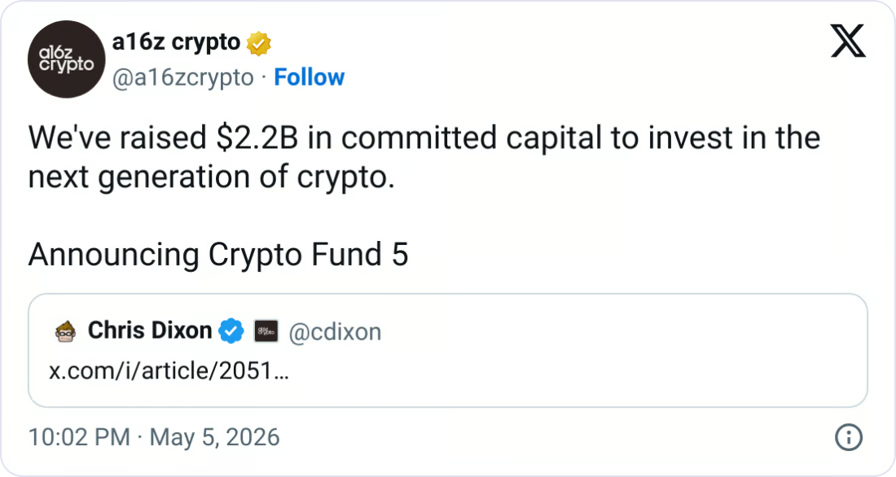
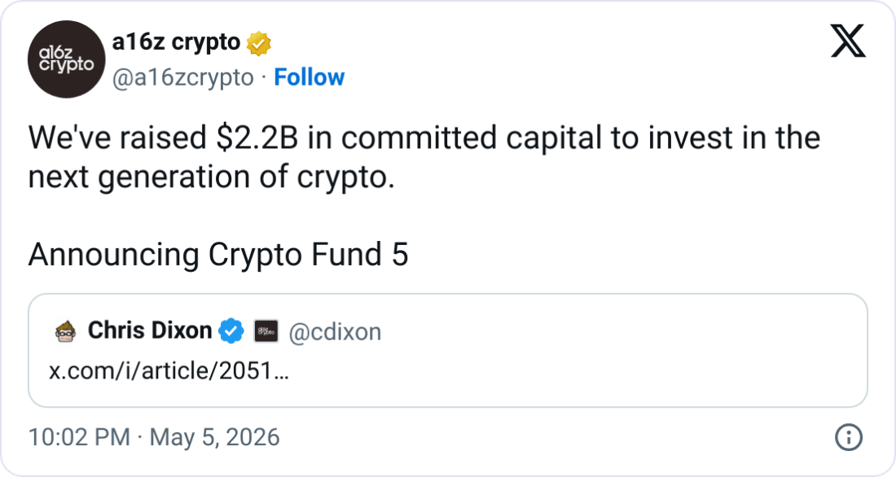
The crypto-focused arm of venture capital firm Andreessen Horowitz has raised $2.2 billion for its fifth fund dedicated to backing crypto projects.
In a blog post on Tuesday, a16z Crypto said its latest fund, Crypto Fund 5, would back founders “turning new infrastructure into products people use every day,” including stablecoins, perpetual futures, prediction markets and tokenized assets.
“Software is getting more complex and harder to trust,” a16z Crypto general partners Eddy Lazzarin, Guy Wuollet, Ali Yahya and founder and managing partner Chris Dixon wrote in the blog post.
“The infrastructure the internet runs on is more consolidated than ever. In that environment, the properties that crypto networks were designed to provide become more valuable, not less,” they added.
A16z’s latest fund comes a day after rival venture firm Haun Ventures said it raised a $1 billion fund for crypto and artificial intelligence, suggesting venture capital appetite for crypto remains strong even as the bulk of funding has focused on AI.
Source: a16z Crypto
AI firms received a record $242 billion in venture funding in the first quarter of 2026, according to a Crunchbase report released in April, with the technology capturing 80% of the record $300 billion in global venture funding during the quarter.
Crypto Fund 5 is smaller than its predecessor, a record $4.5 billion crypto-focused fund that a16z Crypto launched four years ago in May 2022, just as the Terra blockchain imploded, causing a chain reaction of crypto company collapses and a regulatory crackdown.
A16z said that crypto is in “one of those quieter moments” of the cycle, and it is seeking out “what people keep using when the hype fades.”
It added that stablecoin use “has kept climbing even through downturns,” and it has also seen “meaningful growth” in crypto perpetual futures and prediction markets.
Related: Crypto VC funding plunges to $659M in April, hits near two-year low
“Traditional assets are starting to move onchain, and onchain finance is being used for assets beyond network tokens,” a16z added. “A new financial system is taking shape that runs continuously, settles nearly instantly, costs almost nothing, and is open to anyone with internet access.”
It added that crypto has been buoyed by a US regulatory landscape that is “moving in the right direction,” with an array of supportive lawmakers and White House officials helping advance the stablecoin-regulating GENIUS Act, which a16z said was “a good example of what thoughtful policy can look like.”
“We expect more regulatory progress for the rest of the crypto market through legislation and rulemaking,” it added.
Magazine: Adam Back says current demand is ‘almost’ enough to send Bitcoin to $1M
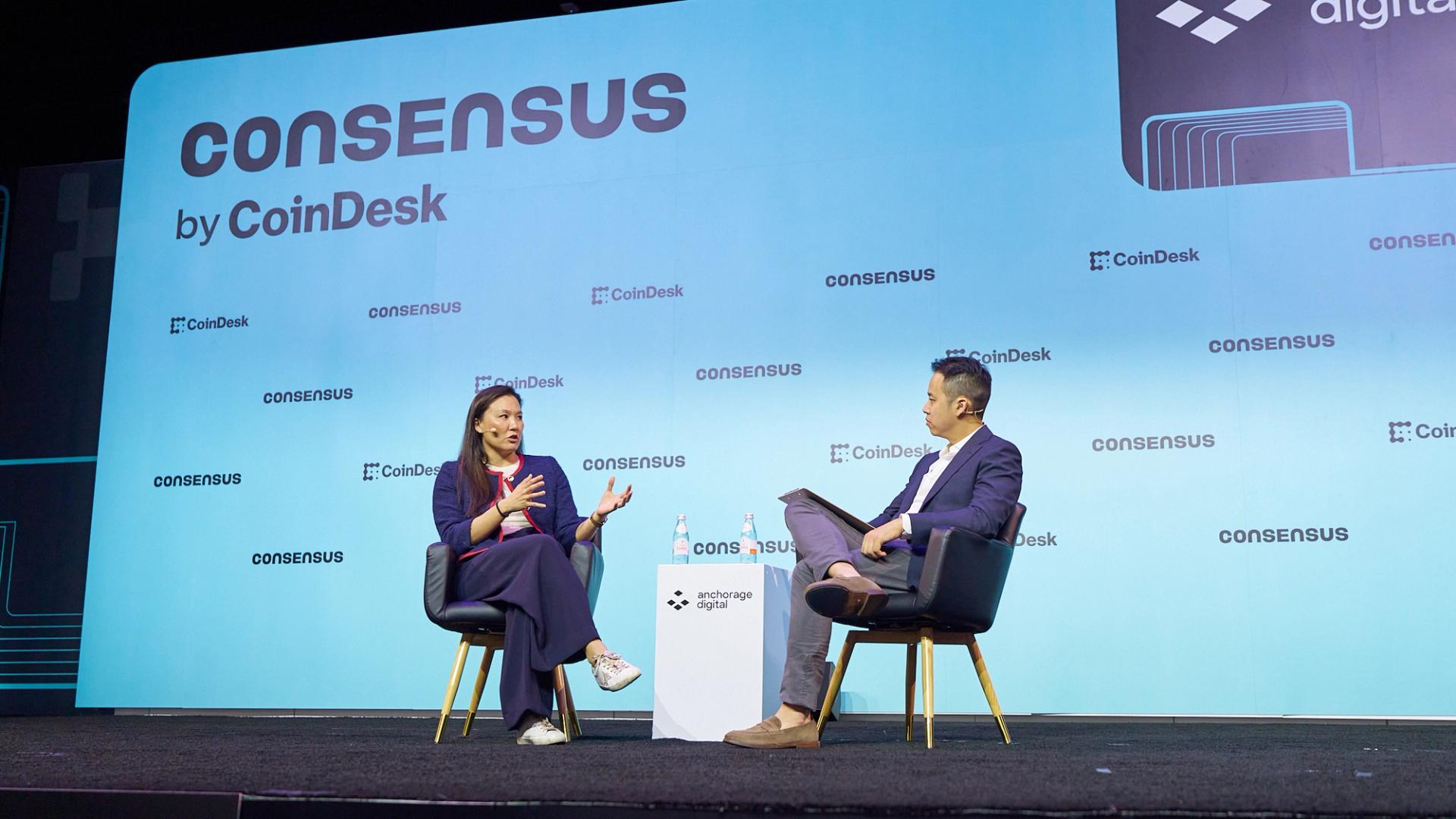
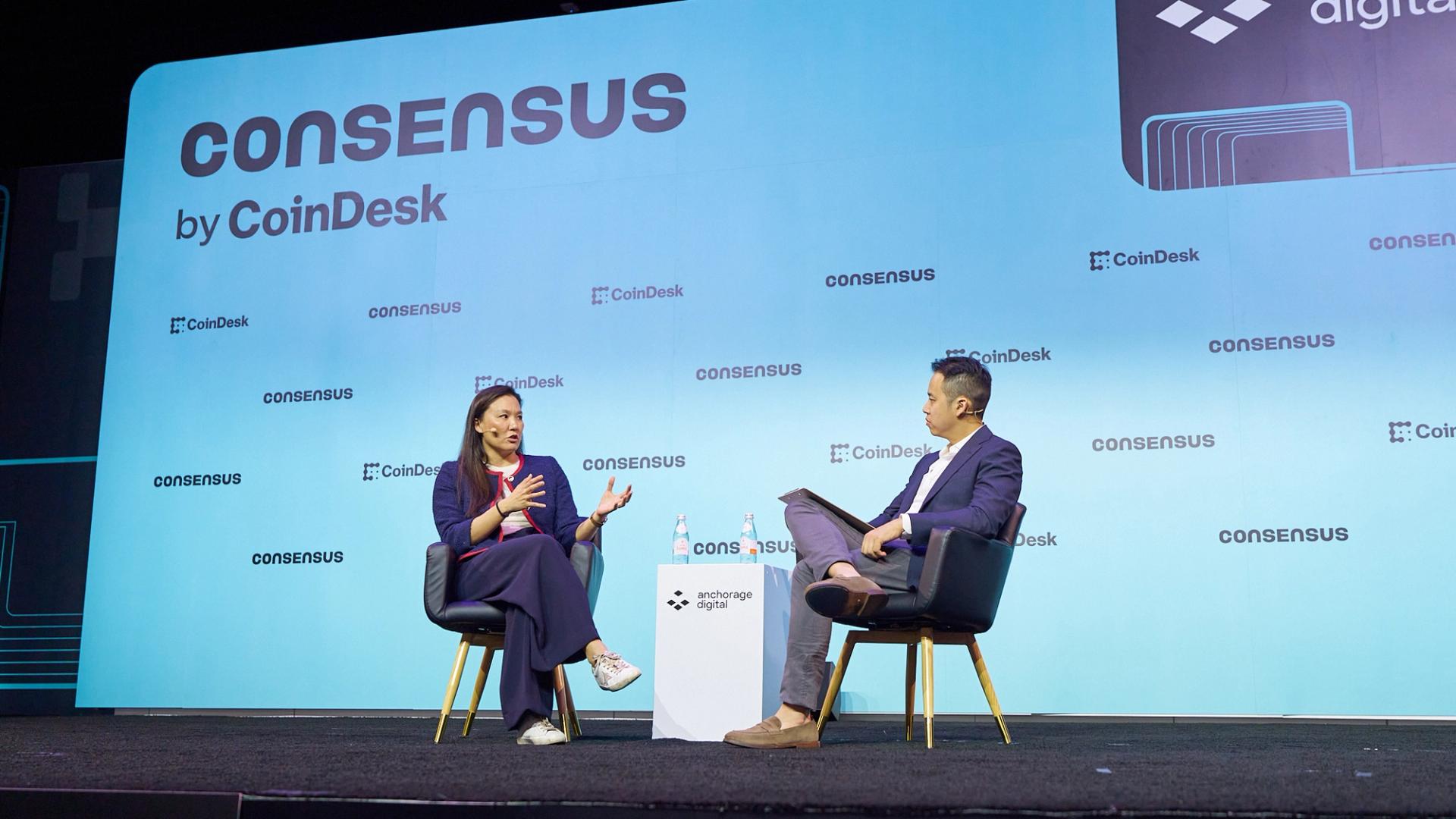
Solana Foundation president Lily Liu said growing adoption of stablecoins by major corporations is validating blockchain’s evolution into global financial infrastructure, while also laying the groundwork for AI-driven “machine economies.”
Speaking at Consensus Miami 2026 on Tuesday, Liu pointed to recent announcements involving Meta and Western Union integrating stablecoin payments on Solana as evidence that large enterprises increasingly view blockchain rails as practical infrastructure rather than speculative technology.
“It’s not new,” Liu said, referencing Visa’s decision in 2023 to build stablecoin settlement capabilities on Solana following what she described as an “extensive objective review” of blockchain networks.
“Fast and cheap is a no-brainer for payments,” she said, adding that enterprises also need deep liquidity, developers and a broad ecosystem of applications surrounding those payment rails.
Liu described Western Union’s move onto blockchain infrastructure as a particularly meaningful milestone for the crypto industry. “When I first came into this industry in 2014, Western Union was always the white whale crypto,” she said.
Exploring the intersection of crypto and artificial intelligence, Liu argued that blockchain-based payments are uniquely suited for “agentic commerce,” where AI agents transact autonomously with other machines and services.
Traditional internet payment systems remain heavily dependent on credit cards, which make micropayments economically impractical because of interchange fees, Liu said. Blockchain rails, by contrast, enable sub-dollar transactions and real-time payment streaming.
“The vast majority of transactions that happen on the internet are actually of microtransaction value,” Liu said. “You literally cannot process those individual transactions because you’ve got to put them through credit cards.”
Liu also defended the Solana ecosystem’s recent interventions following security incidents involving projects such as Vault and Drift, saying preserving industry confidence sometimes outweighs competitive rivalries inside decentralized finance.
Looking ahead, Liu argued the industry is still underestimating blockchain’s ultimate role. Rather than functioning primarily as generalized technology platforms, she said blockchains are fundamentally “financial rails first and foremost.”
She added that crypto’s longer-term promise could extend beyond payments into what she called “internet capital markets,” allowing companies and sovereign entities worldwide to access global capital formation more directly.
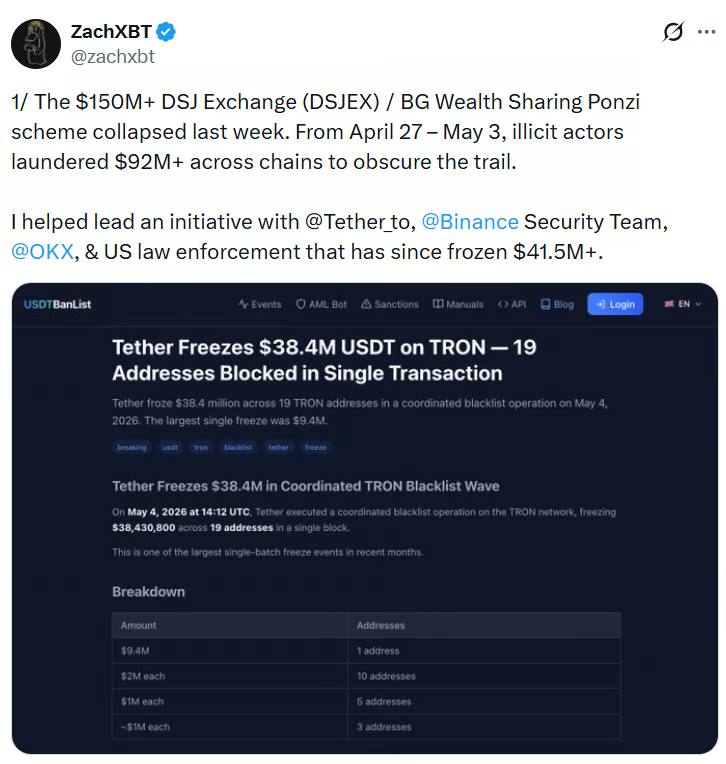
Investment group BG Wealth Sharing, a suspected $150 million crypto Ponzi scheme, has had its domain seized by law enforcement days after allegedly rug-pulling users.
Onchain sleuth ZachXBT said on X on Tuesday that “illicit actors” connected to the group tried to launder more than $92 million in crypto between April 27 and Sunday, but he helped lead an initiative that froze more than $41 million, working alongside Tether, Binance, OKX and US law enforcement.
He also said the scheme was likely responsible for losses greater than $150 million, given it’s been operating since 2025 and the “thousands of victim exchange withdrawals identified.”
“While these Chinese investment frauds are obvious to most, they purposely target unsophisticated retail investors via social media,” ZachXBT added. “Reading through victim posts, many still seem to be in denial that they were scammed.”
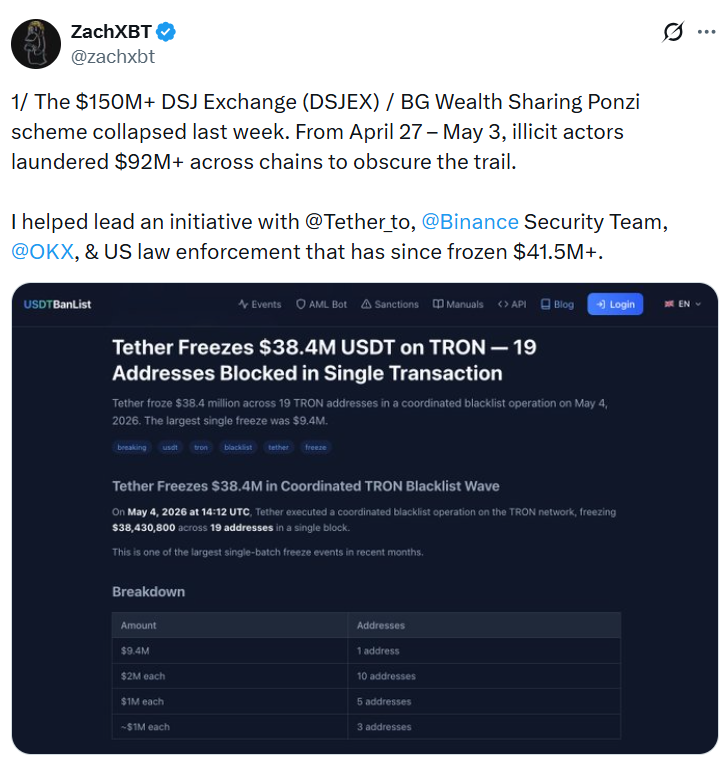
Source: ZachXBT
The US Federal Bureau of Investigation reported in April that American victims lost $21 billion to cyber-enabled crime last year, with crypto investment scams accounting for a large share of the losses.
BG Wealth Sharing domain seized by US law enforcement
As of Wednesday, the BG Wealth Sharing website displays a notice that it was seized by US law enforcement as part of a joint operation between Operation Level Up and the Scam Center Strike Force.
Several regulators had warned that BG Wealth Sharing was an unlicensed entity and advised caution since 2025. In April, the Central Bank of Samoa said it was an investment scam and advised investors to avoid the company.
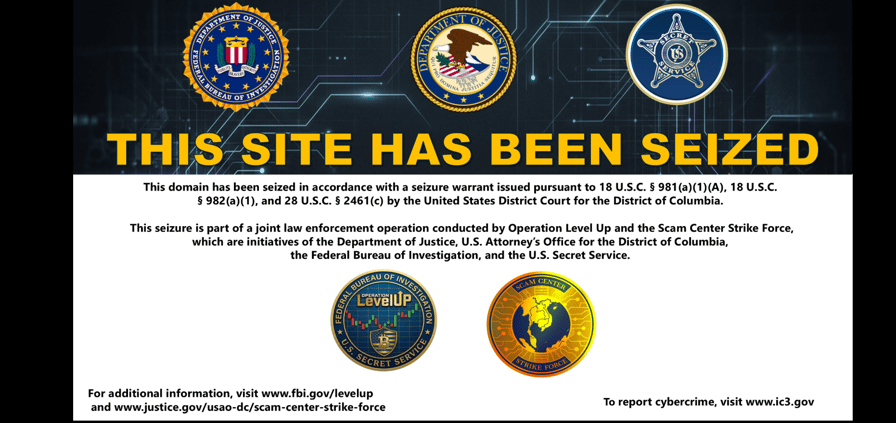
A domain linked to BG Wealth Sharing has been seized by US authorities. Source: BG Wealth Sharing
BG Wealth Sharing, according to authorities, claimed to provide guidance on crypto trading, advertised heavily on social media and offered “daily profit opportunities,” referral commissions, rank-based bonuses and a daily yield of 1.3% to 2.6%.
Related: Google Cloud flags North Korea-linked crypto malware campaign
One last rug pull before going offline, users say
Before BG Wealth Sharing went offline, purported CEO Stephen Beard told users in a video address Saturday that its DSJ Exchange was on the cusp of an initial public offering and that a 12% tax on account balances was required as part of the regulatory process.

BG Wealth Sharing CEO Stephen Beard told users a 12% tax on account balances was required as part of an initial public offering process. Source: ZachXBT
By Sunday, users warned on social media that the whole scheme was a rug pull in progress. On Monday, the Washington State Department of Financial Institutions issued a similar warning.
In an update to its earlier post about BG Wealth Sharing, the regulator said it had received complaints from investors and warned that it was likely a scam.
“A company that requires an investor to deposit additional external funds in order to withdraw their investment is highly likely to be operating an advance fee scam.”
Magazine: DeFi’s billion-dollar secret: The insiders responsible for hacks

Anchorage Digital is rolling out an agentic banking infrastructure designed to let AI agents access and move money across both traditional financial rails and crypto payment networks. Announced by Anchorage co-founder and CEO Nathan McCauley, the move aims to give autonomous agents the kind of programmable financial access that proponents say will underpin a new wave of AI-enabled commerce—an opportunity some insiders estimate could reach into the trillions of dollars.
Speaking at Consensus 2026 in Miami, McCauley framed the development as part of a broader shift toward automation in treasury, payments, and procurement—performed by systems that weren’t built for non-human actors. The launch coincides with a strategic partnership with Google Cloud, which will provide an intelligence layer that enables AI agents to discover, negotiate, and coordinate with one another. McCauley described the project as a foundational step toward a future where agents can transact across both fiat and crypto rails, with governance and compliance baked in from the start.
Key takeaways
- Anchorage’s agentic banking infrastructure enables AI agents to transact with verifiable IDs, preset spending limits, permissions, and auditability to support regulatory compliance.
- The collaboration with Google Cloud supplies the intelligence layer that allows agents to discover, negotiate, and coordinate across financial ecosystems.
- Industry observers highlight a broader trend of banks, labs, and hyperscalers partnering to embed AI and automation into regulated financial infrastructure—moving beyond human-only processes.
- Parallel initiatives across crypto and fintech show multi-chain and cross-rail experimentation, including Solana’s gateway with Google Cloud for API payments in stablecoins and AI-enabled usage of USDT via virtual cards.
- Analysts and industry participants acknowledge substantial uncertainty around regulation, risk, and scale but emphasize the potential for a new market segment, potentially worth trillions of dollars, if adoption accelerates.
Anchorage’s agentic banking infrastructure
At the core of Anchorage’s announcement is a banking service designed to formalize what McCauley described as a shift toward agentic finance. AI agents would receive a verifiable identity and operate within predefined constraints — including spending limits, permissions, and policies — while maintaining robust auditability to satisfy regulatory expectations. In effect, the system aims to bridge non-human automation with traditional compliance frameworks, a balance many institutions have struggled to achieve as they explore automation across treasury, payments, and procurement.
“Institutions are experimenting with automation across treasury, payments, and procurement, but they’re doing it on top of systems that were never designed for non-human actors,” McCauley wrote, underscoring the gap the new service seeks to fill. The added layer of governance, coupled with the ability to transact on both fiat and crypto rails, could unlock new efficiencies for corporate treasuries, payment service providers, and AI-driven platforms seeking to streamline operations without sacrificing control.
The alliance with Google Cloud is central to this strategy. The two companies intend to give AI agents the tools to identify opportunities, negotiate terms, and coordinate actions with other agents in a trusted, auditable environment. The practical upshot is a more scalable, programmable financial fabric in which automated agents—not just humans—can initiate and complete transactions within a regulated framework.
Analysts familiar with Anchorage’s approach note that the combination of custody-grade security and AI-enabled automation could reshape how enterprises manage liquidity, settlement, and procurement. The emphasis on verifiable identity and policy-driven access is a deliberate attempt to address concerns around non-human actors operating in financial ecosystems, an area that regulators have flagged as critical as automation grows.
Industry momentum and ecosystem moves
The Anchorage unveiling sits within a broader wave of experimentation around agentic finance. In parallel, the Solana Foundation announced a gateway service with Google Cloud that enables AI agents to pay for APIs using stablecoins on the Solana network, extending the concept of AI-driven payments into another major blockchain ecosystem. The integration signals increasing interoperability among cloud providers, blockchains, and AI agents as developers explore scalable, programmable money flows.
Within the crypto wallet space, other initiatives are advancing the practical use of AI-enabled spend. Oobit, a Tether-backed wallet, rolled out a Visa-enabled virtual card enabling AI agents to make online purchases with USDT for business purposes. The card is funded directly from Tether’s treasury, allowing agents to operate with capital without repeatedly topping up through fiat on-ramps or currency conversions. Taken together, these developments illustrate a trend toward operationalizing agentic payments across multiple rails and formats.
Industry chatter around the pace and scale of such activity often references the potential demand from AI agents. Some industry observers, including Stripe, have argued that blockchains and associated infrastructure will need to handle a far larger volume of transactions per second to support AI-driven automation. While projections vary, the underlying argument is that agentic commerce could drive demand beyond the capacity of traditional networks if not scaled appropriately. McCauley’s own projection at Consensus 2026 framed the sector as a major trend for the coming decade, describing it as a trillion-dollar opportunity where agents pay other agents, pay merchants, and are paid themselves.
Oliver Segovia, a Ripple Labs researcher and former head of product marketing, commented on the collaboration’s broader implications. He suggested the trend signals closer cooperation between labs, regulated banks, and cloud-based infrastructure, with banks gradually building intelligence atop core systems while labs push automation deeper into regulated spaces. Such synergies could redefine who the primary ecosystem builders are in an era of AI-augmented finance.
Implications for investors, users, and builders
What Anchorage, Solana, and Oobit are unfolding is not just a single product launch but a signal of how future financial infrastructure could operate. For investors, the potential payoff hinges on adoption: will AI developers and corporations embrace agentic banking as a standard mechanism for automated operations, and will regulators keep pace with rapid innovation without stifling safety?
For developers and builders, the emphasis on identity, permissions, and auditability offers a model for designing autonomous financial agents that can operate transparently within legal and compliance boundaries. Such an approach could lower the friction for institutions to experiment with AI-driven treasury and payments workflows, while also introducing new kinds of risk management and oversight requirements that must be codified into product design.
From a regulatory perspective, the growing overlap between AI, automation, and regulated financial activity will likely attract heightened scrutiny. The challenge will be to establish standards that protect consumers and institutions without impeding innovation or creating unnecessary friction for compliant actors. Observers will be watching how these early pilot deployments interact with existing frameworks for programmatic money movement, identity verification, and anti-money-laundering controls.
Meanwhile, the market will be watching for tangible milestones: further integrations with major clouds, additional cross-rail expansions, and real-world use cases that demonstrate measurable gains in efficiency or security. If the trillion-dollar forecast outlined by McCauley materializes, it could redefine which players set the standards for interoperable, AI-enabled finance and how users access and manage funds across both traditional and crypto ecosystems.
What remains uncertain is how quickly financial institutions will embrace fully autonomous, policy-governed money movement at scale and how regulators will codify the responsible use of AI agents in payments and custody. Yet the wave of partnerships and pilot programs underway suggests a deliberate push toward more intelligent, automated financial infrastructure—one that could redefine how money moves in a rapidly evolving digital economy.
Readers should keep an eye on how these alliances evolve: whether more banks and fintechs adopt similar agentic frameworks, how AI agents manage risk across rails, and what regulatory guardrails emerge to safeguard both institutions and end users as automation becomes a core feature of everyday finance.
Crypto World
Crypto custodian Taurus moves straight into EU capital markets with MiFID license in Cyprus


Cryptocurrency custody firm Taurus has been granted a MiFID II investment license in Cyprus under the regulatory ambit of Mediterranean island’s regulator, the Cyprus Securities and Exchange Commission (CySEC).
The license enables Taurus to offer MiFID-regulated investment services for tokenized financial instruments to banks and asset managers across the European Union (EU), as well as secondary trading for tokenized bonds, fund shares, equities, and structured products, according to a press release on Wednesday.
“Banks like to face fully regulated entities that are similar to the one they used to work with,” Sébastien Dessimoz, co-founder and Managing Partner at Taurus, said in an interview.
“All the brokers in Europe are MiFID licensed firms, and Taurus is a broker also and now a MiFID licensed firm. So those banks and institutions can be sure we are subject to all the necessary guarantees – on top of that we’re onshore in Europe, which is also highly appreciated,” he added.
MiFID II (Markets in Financial Instruments Directive II) is the European Union’s core regulatory framework for investment services, trading venues, and financial assets such as equities, bonds, derivatives, and structured products. It is designed for traditional capital markets, meaning a MiFID license effectively allows firms to operate as regulated investment service providers across the EU.
The license, therefore, will help Taurus bridge its crypto-native infrastructure with the regulatory perimeter used by banks and asset managers, allowing it to offer tokenized securities to institutional clients in their preferred format.
Taurus already works on crypto custody and tokenization with the likes of Deutsche Bank, ClearBank, KBC, Santander, State Street, CACEIS, Pictet, and Swissquote. The firm also has a licence from Swiss regulator FINMA, and an EU Markets in Crypto Assets (MiCA) application is in the pipeline too, said Dessimoz.
As a fully regulated entity incorporated in Europe, Taurus can offer classical investment services for transferable securities, Dessimoz said, and also give clients the possibility to buy or sell distributed ledger technology (DLT) financial instruments such as tokenized equity, tokenized debt, tokenized fund shares; in other words, crypto-assets that qualify as MiFID financial instruments.
Several other firms, such as OKX, Gemini, Crypto.com, Kraken, Bitstamp, and Perpetuals.com, hold MiFID II licenses.

Aryna Sabalenka calls for tennis players to boycott Grand Slams over prize money

Best Carry-On Suitcases (2026): Away, Rimowa, Tumi

The Fed Shakeup That Sets Off Bitcoin’s Biggest Rally Ever!

Manchester United reach agreement with Casemiro over contract clause amid transfer speculation

US brings back mandatory military draft registration

Steven Gerrard disagrees with Gary Neville over ‘shock’ Chelsea and Arsenal claim | Football


-
 Business7 days ago
Tesla Officially Registers Elon Musk’s Stock: What Investors Need to Know
-

 NewsBeat3 days ago
Channel 5 – All Creatures Great and Small series 7 new post
-

 Entertainment6 days ago
Insider Claims Reason Behind Key & Peele Split
-
 Tech5 days ago
Trump’s 25% EU auto tariff breaches Turnberry Agreement that also covers semiconductors and digital trade
-
 Sports5 days ago
Paul Scholes issues Marcus Rashford reality check as agreement emerges over Man United star
-

 Entertainment5 days ago
Met Gala 2026 Rumored Guest List Is Turning Heads
-

 Business7 days ago
Barclay Brothers Avoid Bankruptcy: HSBC Drops High Court Petitions After IVA Deal
-

 Entertainment6 days ago
Celebrities Who Are Attending the 2026 Met Gala Event
-

 Crypto World7 days ago
Meta (META) starts stablecoin payout to creators in Circle’s USDC on Polygon, Solana via Stripe
-

 Business5 days ago
Strait of Hormuz Blockade Persists Amid US-Iran Standoff, Sending Oil Prices Soaring
-

 Tech7 days ago
Texas Instruments made a new flagship graphing calculator: the TI-84 Evo
-
Business6 days ago
Strait of Hormuz Remains Heavily Restricted on April 29 Amid Iran Conflict
-
 Sports4 days ago
David Benavidez responds to team Canelo saying the fight will never happen
-
Entertainment5 days ago
New on Prime Video in May 2026 — Full List of Movies and Shows
-

 Sports4 days ago
Cavaliers vs. Raptors Game 6 live score, updates, highlights from 2026 NBA playoffs first-round series
-

 Tech6 days ago
Mark Zuckerberg Says Meta Is Working On AI Agents For Personal And Business Use
-

 Entertainment4 days ago
Kylie Jenner Hit With Second Lawsuit From Ex-Housekeeper
-

 Sports6 days ago
Saudi Arabia set to withdraw LIV Golf funding after 2026 season, per reports
-

 Sports4 days ago
Plane crash in Wimberley, Texas kills 5 pickleball players at tournament
-
 Sports4 days ago
IPL 2026: ‘Love you darling’- Hardik Pandya’s reaction to MS Dhoni steals the show |Watch | Cricket News
You must be logged in to post a comment Login