Connect with us
DAPA Banner
DAPA Coin
DAPA
COIN PAYMENT ASSET
PRIVACY · BLOCKDAG · HOMOMORPHIC ENCRYPTION · RUST
ElGamal Encrypted MINE DAPA
🚫 GENESIS SOLD OUT
DAPAPAY COMING

NewsBeat

‘Nasty’ boyfriend jailed for strangling girlfriend during caravan holiday attack

Published

on

Daily Record

Lewis Rudd viciously attacked the woman after she made late-night crumpets for herself following a night out – instead of first doing some cheese on toast for him

A ‘nasty’ boyfriend strangled and stamped on his terrified partner during a ‘huge argument’ while on a make-or-break caravan holiday. Lewis Rudd was in “a big ball of anger” when he launched a vicious attack on the woman after she made herself late-night crumpets following a night out – rather than first preparing cheese on toast for him.

The Middlesbrough man “came storming into” the bedroom, woke her up, dragged her out of bed and subjected her to a brutal assault, Hull Crown Court heard. Rudd, 36, denied charges of intentional strangulation and causing actual bodily harm to the woman on October 31, 2022, but was found guilty by a jury following a trial, reports Teesside Live.

Advertisement

The court was told the couple, who had been together for more than five years, were locked in a “very toxic relationship”. They travelled to Thornwick Bay holiday village at Flamborough, near Bridlington, for a make-or-break weekend away.

Upon returning to the caravan after a night out on the Sunday, the woman began making crumpets for herself and cheese on toast for him. Rudd took exception to her cooking the crumpets first, and she happened to be holding a bread knife at the time.

He “made a big fuss” about the bread knife, which sparked a “massive, huge argument”.

The woman told Rudd: “I don’t want to be with you. This isn’t how I want it to be.”

Advertisement

She firmly denied threatening him with the knife, lunging towards him with it, or threatening to cut his throat.

The woman claimed: “He was screaming and shouting to me. He was saying I was worthless. I knew he was seeing someone else.”

She told Rudd she was heading to bed, and said she had fallen asleep when Rudd “came storming into the room” and roused her.

Rudd told her: “I’m going home. I’m sick of this.” She recalled: “All of a sudden, he just started attacking me. I was all tangled up in the bed sheets.”

Advertisement

The pair were “screaming and shouting” at one another.

“I remember him charging at me and he wrapped his hands around my neck,” she said.

Rudd hauled her out of bed and pinned her to the floor. She desperately tried to free herself, digging her nails into him in an attempt to “shock him” into loosening his grip.

She mouthed “I can’t breathe” to which Rudd replied “F***ing good!”

Advertisement

She screamed that he was going to kill her before losing consciousness. The final thing she recalled before blacking out was catching sight of Rudd’s foot.

The woman managed to flee by going to the bathroom and leaping from the window, crashing onto the concrete below.

She then contacted the security office, where staff members alerted the police. Paramedics rushed to the scene and the woman was taken to Scarborough Hospital, where she was found to have a cut to her head, abrasions on her neck and tenderness across her chest and spine.

She later stated: “When he gets drunk, he gets nasty.”

Advertisement

Rudd drove away from the holiday park in his vehicle but was subsequently arrested by officers at a petrol station. He later pleaded guilty to drink driving and received a driving ban, the court was told.

During his defence testimony, Rudd informed the court that he and his partner had travelled to the caravan that weekend for “some us time” together.

“It was just nice to get away,” he said.

They visited the holiday village’s clubhouse on the Saturday evening, with him in a Dracula costume and her dressed as Edward Scissorhands, and enjoyed a ‘good night’. However, following another evening out drinking on the Sunday, they returned to the caravan around midnight.

Advertisement

“Everything just changed just like that,” he maintained.

Rudd, from Birkall Road, Thorntree, Middlesbrough, stated that his partner served him his cheese on toast but then held the bread knife against his throat.

He alleged she told him: “I would love to cut your throat.”

He insisted he “definitely” didn’t regard it as a joke.

Advertisement

“It’s not really something you joke about, to be honest,” he said.

“I was more scared than anything. I retaliated. We had a heated argument. She still had the knife in her hand. She came at me so I put my hands up to push her away.

“That’s when she attacked my face. I defended myself. She tried to grab my face. I went to the bedroom and started packing my belongings. I just wanted to get out of there.”

He refuted claims that he strangled, punched or stamped on his partner and disputed causing any of the injuries she sustained. The jury, however, dismissed his account and found him guilty.

Advertisement

Recorder Nick Worsley KC told Rudd that the woman believed she was going to die. “The last thing that she saw was your shod foot coming towards her,” said Recorder Worsley.

“You punched her, stamped on her and strangled her into unconsciousness. You claimed at trial that you acted in self-defence. You denied causing any injuries or bruising and said she was lying.

“None of it was true. You told the jury a pack of lies. The jury saw through them and through you.”

Rudd was handed a three-and-half year prison sentence and given an indefinite restraining order. He had remained on bail throughout the trial and during the sentencing hearing.

Advertisement

Ensure our latest stories always appear at the top of your Google Search by making us a Preferred Source. Click here to activate or add us as your Preferred Source in your Google search settings.


Source link

Continue Reading
Click to comment

You must be logged in to post a comment Login

Leave a Reply

NewsBeat

Why humans care so much about body odour, and what it really tells us

Published

on

Why humans care so much about body odour, and what it really tells us

Humans spend a great deal of time trying to smell good. We wash, deodorise and perfume our bodies daily, suggesting body odour must matter. Yet scientifically, the picture is far less straightforward.

In the animal world, smell is a powerful communication tool. Many species use scent to signal readiness to mate, mark territory or warn of danger. Female moths, for example, release chemical cues that attract males over long distances in predictable ways.

Humans also produce body odour through sweat and sebaceous glands. In addition, apocrine sweat glands are concentrated in areas such as the armpits, genitals and around the nipples. These glands release oily secretions that skin bacteria break down into the characteristic smells associated with body odour.


À lire aussi :
The biology of body odour, from sweat glands to skin bacteria

Advertisement

Biologically, the human body is certainly equipped to produce odours that others can detect. Whether these odours carry information in the same way as scent signals do in other species remains uncertain.

Modern hygiene complicates the picture. In many societies, frequent washing and fragranced products mask natural odours. This makes it difficult to study how scent might operate in everyday human interaction under less controlled conditions.

Love stinks? Attraction, pheromones and genes

Smell is often assumed to play a major role in attraction. People frequently report liking a partner’s scent, and some studies suggest partners can recognise each other’s body odour. But the direction of the effect is difficult to untangle. Smell may help shape attraction, but emotional attachment and familiarity may also make a partner’s scent seem more pleasant.

The idea that smell shapes romantic attraction remains popular. Early studies suggested people might prefer the scent of partners with different immune system genes, potentially increasing the chances of healthier offspring.

Advertisement

Results, however, are mixed. Some studies support this pattern, others do not. There is currently no clear evidence that humans reliably use smell to select genetically compatible partners.

Claims about human pheromones are even harder to support. In animals, pheromones are usually understood as specific chemical signals that trigger reliable responses in other members of the same species. In humans, no equivalent system has been clearly demonstrated.

Researchers have examined individual components of human body odour that have been proposed as possible human pheromones. A few molecules, such as androstadienone and estratetraenol, have been studied as possible chemosignals. A chemosignal is a chemical cue that may carry information and influence perception, mood or behaviour. Some studies have reported small effects on mood, attention or social perception, but findings are inconsistent and difficult to interpret. These compounds have not been shown to work as human pheromones in the strong biological sense.

Advertisement

Most scientists agree that clear, animal-style pheromone communication has not been demonstrated in humans.

There are also anatomical differences. Unlike many mammals that rely heavily on pheromone communication, humans do not appear to have a clearly functional vomeronasal organ, a sensory structure that detects pheromones in many animals, or an accessory olfactory bulb, the brain region that processes those signals. These play central roles in scent communication in species such as mice.


À lire aussi :
There’s no evidence human pheromones exist – no matter what you find for sale online


So while humans clearly produce and detect body odour, evidence for a precise biological signalling system is limited.

Advertisement

Cultural learning also shapes odour perception. Babies show relatively few strong preferences early in life, but over time people learn what is pleasant or unpleasant through experience and social norms. Foods considered delicious in one culture can seem intolerable in another.

Beyond attraction, smell may have a more basic function: helping us decide whether to approach or avoid things. We use it to judge food, environments and other people, often as a rapid safety check.

We quickly adapt to familiar scents and stop noticing them. New or unexpected smells, particularly unpleasant ones, capture attention because they may indicate risk.

Can we smell emotions or illness?

Growing evidence suggests body odour carries information about physical and emotional states.

Advertisement

Emotional experiences can alter the chemistry of sweat. In experiments where participants watched films designed to evoke fear or happiness, researchers collected sweat samples from their armpits. When others later smelled these samples, their facial muscles responded in ways consistent with those emotions, suggesting a form of low-level communication with little conscious awareness.

Body odour also changes during illness. In laboratory studies where participants’ immune systems were temporarily activated using compounds that trigger an immune response, their scent shifted within hours. Smellers described these samples as slightly more sweaty or less pleasant, despite the differences being subtle.

This suggests the human nose may detect some early signs of illness before obvious symptoms appear, although this does not mean people can reliably diagnose illness by smell in everyday life.

Historical accounts hint at this connection. Before germ theory, illness was often associated with “bad air” under what became known as the miasma theory. The explanation was wrong, but it reflected a real observation that illness and infection are often associated with distinctive odours.

Advertisement

Today, trained dogs can detect certain cancers and infections through scent. But humans may also pick up some sickness-related cues. In a study I was involved in, volunteers whose immune systems had been temporarily activated produced sweat that others rated as more intense, unpleasant and unhealthy.

Exposure to unpleasant odours may even prime the immune system. In one study, people exposed to strongly disgusting smells showed increased inflammatory responses in saliva, suggesting the body prepares for potential infection when encountering cues linked to disease.

Advertisement

The same biological richness that makes smell difficult to study also makes it promising, but challenging, in medicine.

Interest is growing in scent as a diagnostic tool. Illness alters the chemical composition of breath, sweat and skin oils, and researchers are working to identify the molecules responsible.

If reliable patterns can be established, electronic “noses” could detect disease early through non-invasive testing. This approach is already being explored for several cancers.

The difficulty is that body odour contains hundreds of molecules, and isolating meaningful signals is hard. Still, the potential is substantial. A simple device capable of detecting disease through scent could transform screening and diagnosis.

Advertisement

Smell helps us navigate risk, detect possible illness, recognise familiarity and interpret our surroundings, often without conscious awareness. That is powerful, but it is not the same as a proven human pheromone system.

Future research may reveal more about this overlooked sense. Scientists are exploring technologies that can capture and reproduce smells digitally, potentially allowing odours to be transmitted remotely, alongside medical applications such as scent-based diagnostics.

For a sense that rarely demands attention, smell exerts a constant influence on how we respond to the world and to each other.

Strange Health is hosted by Katie Edwards and Dan Baumgardt. The executive producer is Gemma Ware, with video and sound editing for this episode by Anouk Millet. Artwork by Alice Mason.

Advertisement

In this episode, Dan and Katie talk about a social media clip via YouTube from Alexandrasgirly.

Listen to Strange Health via any of the apps listed above, download it directly via our RSS feed or find out how else to listen here. A transcript is available via the Apple Podcasts or Spotify apps.

Advertisement

Source link

Continue Reading

NewsBeat

Tottenham: Premier League club launches season review after injury woe

Published

on

Xavi Simons being wheeled down a touchline on a stretcher

As part of the audit, they are considering numerous factors to work out why it has become such a problem.

For example, Spurs are analysing the “bounce” on the club’s home pitch in comparison to that at rival grounds and their Enfield training centre.

At present, the club have found there is no major difference between the conditions of other pitches in comparison to their home ground, but testing is ongoing.

There is a view that certain knee injuries are unavoidable – Odobert for instance damaged his ACL following an awkward landing.

Advertisement

It is also understood Spurs are confident the on-field treatment of Simons’ injury did not result in additional damage to the Dutchman’s knee.

There has been criticism from supporters after footage showed medics allowing the attacker to put weight on his knee despite having suffered a serious injury.

One of the key improvements Lewindon has recommended is to make medical support more individually tailored – based on factors including strength, fatigue and robustness.

Medical staff will compile bespoke profiles for each player that will include personal insights as well as physical and psychological information to ensure they can deliver expert individual support to treat – but also prevent – injury.

Advertisement

There is also set to be greater leeway for injured players to conduct part of their rehabilitation away from the club’s training facility.

Players across the Premier League are increasingly relying on external medical practitioners to aid their fitness and recovery, while many overseas footballers even return to their homeland for treatment.

That dynamic often causes friction but moving forward Tottenham are open to letting players leave their direct care provided all parties involved agree to one shared recovery plan – though Spurs would ultimately take responsibility for any problems that arise during the process.

The medical team will work closely alongside head coach Roberto de Zerbi and his staff over the summer amid concerns changing managers three times in under 12 months has contributed to their injury problems.

Advertisement

Tottenham will look to introduce an integrated structure that will ensure De Zerbi, or a member of his staff, the medical department and the player are involved in deciding when a player can accelerate their rehabilitation plans.

Psychology is also a key component of the ongoing review with the club set to employ a full-time head of psychology to work with the players and staff.

Source link

Advertisement
Continue Reading

NewsBeat

Mum’s ‘disgust’ after what she saw on beach after Bank Holiday chaos

Published

on

Manchester Evening News

Nicola Jameson, from Atherton, described the scene as “horrendous and a bit sad”

A mum from Greater Manchester has said she was disgusted after what she saw on the beach after Bank Holiday chaos in the area. Formby Beach car park was closed on Monday (May 25) as it reached capacity and police blocked roads leading to the sand.

Advertisement

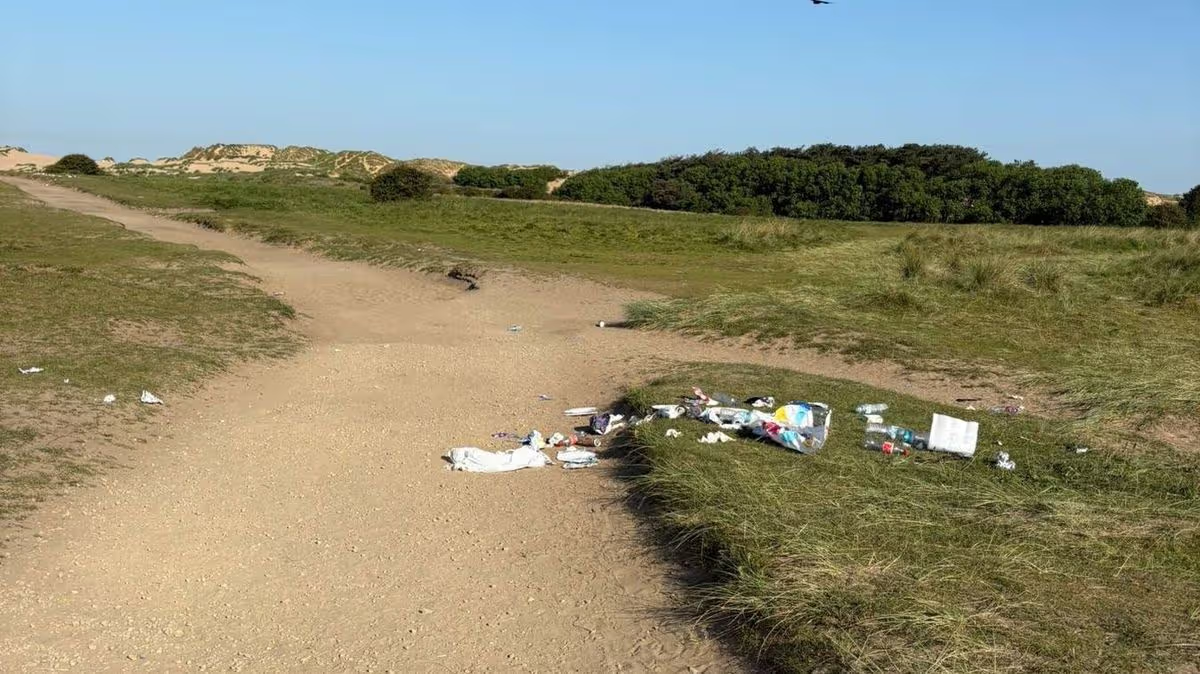
Dozens of cars were spotted travelling towards towards the beauty spot, leading to large queues in the area. Footage has since been shared of significant amounts of litter left on Formby beach. Hundreds of parking fines were also handed out over the weekend.

Clips were taken by Nicola Jameson while she was out walking her dog on Tuesday, who condemned ‘bone idle’ people after spotting discarded nappies and chicken. Nicola told the ECHO she often travels from her home in Atherton to Formby and was caught by surprise by the state of the beach.

Click here to get the biggest stories straight to your inbox in our Daily Newsletter

Nicola, 33, said: “It was horrendous. I just didn’t expect it. It was a bit sad. There were people coming to the beach this morning. I wouldn’t like to take my kids to see that. People are happy to enjoy the beach but not happy to clean up.

Advertisement

“The dog likes going to Formby. I was talking to quite a few locals on the beach – they said every time there’s nice weather, it’s left in a state. There were nappies, barbecues, my dog was eating chicken bones, all things that shouldn’t be there. Cans, vodka bottles too.”

Nicola said individuals, rather than the council, need to take more responsibility for looking after beauty spots such as Formby. She said: “I understand that people want to go and have a nice day but whatever you take with you, take it back. Older people were cleaning it up – that’s not their job.

“There aren’t enough bins but it’s a very difficult place to get to with the sand dunes. The council were there very early this morning. I think people need to take responsibility. You know what’s nice and what’s not nice.

Advertisement

“It was disgusting. The nappies – eugh. It was awful. I think people need to stop being bone idle. People moan about this country. But we have a nice day and a nice place like that gets ruined.

“If they went aboard, they wouldn’t do it there. If one person leaves stuff, everyone else thinks it’s alright and they do the same.”

There were similar scenes at other beaches in Sefton on Monday. A teenager was also taken to hospital after suffering injuries from a ‘bladed weapon’ on Crosby beach.

Advertisement

In response to these issues, Sefton Council issued an urgent warning visitors about the importance of planning and acting responsibly when visiting its beaches following ‘unacceptable’ scenes over the weekend.

The statement said: “During warm and sunny weather, coastal locations including beaches at Ainsdale, Formby and Crosby receive an extraordinary number of visitors. While Sefton Council fully understands why visitors want to visit its beautiful coastline, and welcomes them, this should not be at the cost, inconvenience or safety of local residents.

“Inconsiderate and illegally parking on residential streets near to beaches can make pavements unusable and inaccessible for some. It could also prevent emergency vehicles such as ambulances and fire engines from reaching incidents at the beaches themselves and in local people’s homes.

“Unfortunately, this weekend saw some visitors, who flock to Sefton from across the whole of the North West and beyond, park in this way. Irresponsible and dangerous parking led to around 700 parking fines being issued by enforcement team members across the Bank Holiday weekend.

Advertisement

“Further reports of anti-social behaviour were reported to Sefton Council, with staff from its Green Sefton service diverted from their regular maintenance and community work to deal with its effects, including littering and damage to toilet facilities.

“The council also understands there were anti-social incidents at local rail stations and other locations. Anti-social behaviour impacts residents, other visitors and Sefton’s protected natural habitat, and is unacceptable.”

As Mark Shaw, service manager for the council’s Green Sefton service said: “We have always said that we welcome visitors to our coastline.

“All we ask is that they act responsibly when they come here, show some consideration for the local people who live here all year round and respect the coast. We also ask them to leave the place as they find it, which might mean taking your rubbish away with you.

Advertisement

“That’s not too much to ask and if people can’t manage that or want to engage in unacceptable anti-social behaviour, we’d prefer that they went elsewhere.”

Source link

Continue Reading

NewsBeat

Starmer has no plan for Britain’ and ‘The heat’s still on’

Published

on

Starmer has no plan for Britain' and 'The heat's still on'
BBC "Blair: Starmer has no plan for Britain" reads the headline on the front page of the Daily Telegraph.BBC

Several of today’s papers lead on an essay by former Prime Minister Sir Tony Blair criticising the Labour government. The Telegraph summarises his words with “Starmer has no plan for Britain”, calling Sir Tony’s comments a “stinging attack”. In a follow up to the news that former SNP chief Peter Murrell admitted to embezzling £400,000 from the Scottish party, the Telegraph says a witness “casts doubt” on Murrell’s estranged wife, former First Minister Nicola Sturgeon, not knowing of his crime. It reports Sturgeon had said she was unaware of a motorhome Murrell had bought, but one man says he saw her buying “frozen pizza and garlic bread” near where it was parked.

Source link

Continue Reading

NewsBeat

How to actually pronounce Northumberland village Whittingham

Published

on

How to actually pronounce Northumberland village Whittingham

This small village sits in the Coquet valley a few miles east of Rothbury, just south of the A697 between Morpeth and Wooler, surrounded by fields, wooded slopes and big views towards the National Park.

Where is Whittingham in Northumberland?

Whittingham is tucked away in the countryside east of Rothbury, on the route many people use to cut across Northumberland between Morpeth, Wooler and the Cheviots.

It is the kind of place that appears on signposts for walkers, cyclists and day‑trippers heading for the Coquet valley and the hills beyond, even if they have never actually stopped in the village itself.

Advertisement

How most people say it (and get it wrong)

On paper, Whittingham looks straightforward. Most visitors automatically sound it out as “Whit‑ting‑ham”, hitting every consonant and giving the final “ham” its full weight.

It feels logical if you are reading it off a map or a sat nav – but it is not how locals say it, and it is the quickest way to give yourself away as someone from out of the area.

The local pronunciation: Whitting‑jum

In Northumberland, the name is smoothed out into “Whitting‑jum” – effectively “WHITT‑in‑jum” – with the stress on the first syllable and the end of the word collapsing into a quick “jum” sound instead of a sharp “ham”.

The middle consonants are softened, the final “ham” all but disappears, and the whole word runs together much more quickly than it looks on the sign.

Advertisement

Why English place names drop the “ham”

It fits a wider English pattern where “‑ham” has worn down in everyday speech.

Guides often point to examples such as Nottingham – said more like “Nott‑ing‑um” than “Not‑ting‑ham” – to explain why names ending in “ham” don’t always keep that full ending.

Whittingham follows the same logic, just with a particularly Northumbrian twist in that soft “‑jum” finish that you hear up and down the Coquet valley.

Advertisement

How to sound a little less like a visitor

For anyone planning walks around Rothbury, a drive through the Coquet valley or a holiday in rural Northumberland, getting Whittingham right is an easy way to sound less like a visitor.

Next time you see the village on a signpost or in a route planner, skip the textbook “Whit‑ting‑ham” and go for the local version instead: Whitting‑jum.

It is a tiny change, but it is exactly the sort of detail Northumbrians notice – and appreciate

Advertisement

Source link

Continue Reading

NewsBeat

Asda closing as Waitrose set to take over Greater Manchester supermarket

Published

on

Manchester Evening News

The ‘immaculate’ Asda store in Hale Barns Square will close its doors before being replaced by a Waitrose in autumn 2026

A major UK supermarket chain is set to shut one of its ‘immaculate’ stores, with a rival food retailer poised to take its place.

The Asda branch in Greater Manchester is closing and will be replaced by a Waitrose.

Advertisement

Situated in Hale Barns Square, the site has been occupied by Asda since May 2024, having previously been home to a Booths supermarket.

The 15,000 square foot store underwent a full refurbishment during that time, and currently features a café, lottery, and parcel collection service, alongside a sizeable car park offering around 160 spaces.

Shoppers have previously praised the branch, describing it as “immaculate”.

Advertisement

Local Asda customers will now need to travel to either the Altrincham or Wythenshawe branches for their weekly shop.

An Asda spokesperson said: “Like all major supermarkets, we regularly review our store estate to ensure it continues to meet the customer needs and remains commercially sustainable.

“We’d like to thank our colleagues and the local community at our Hale Barns store and reassure customers they can continue to access Asda’s great value and products at our nearby Altrincham and Wythenshawe superstores, or online at asda.com.”

According to Altrincham Today, the store will undergo a full refit before reopening as a Waitrose in autumn 2026.

Advertisement

David Donovan, Waitrose Regional Manager, said: “Opening in Hale Barns is an exciting opportunity for Waitrose and we’ll offer the very best products and customer service for food lovers in the area.

“As part of this, we’re building a brilliant team and we look forward to welcoming them and our customers in the coming months. We’ll be sharing more details on our plans soon.”

Alun Jones, Waitrose’s Head of Physical Estate, added: “Growing our presence in the north is important to us and the Hale Barns store is a significant next step in our plan. Alongside our stores in Altrincham and Wilmslow, Hale Barns is a great fit for our brand.”

Source link

Advertisement
Continue Reading

NewsBeat

DWP PIP travel abroad warning for claimants planning summer holidays

Published

on

Cambridgeshire Live

PIP recipients must notify the DWP before travelling abroad for more than four weeks or risk having their payments paused or stopped

The Department for Work and Pensions has issued guidance for claimants who are planning to travel this summer. July and August represent the peak travel period for Britons, with many jetting off to popular destinations such as Spain, Portugal, Italy and Greece for a sunny getaway. However, for those in receipt of Personal Independence Payment (PIP), there are specific rules that must be adhered to when leaving the UK.

Advertisement

Those claiming PIP are required to declare any changes to their personal circumstances. Alongside changes of address or carer needs, this encompasses which country they are residing in, particularly if that extends beyond four weeks. Should they neglect to notify the DWP of their travel arrangements, they risk having their benefit entitlement paused or stopped altogether, the department cautions. If you are departing the country for longer than four weeks, even for a holiday, you must inform the DWP.

You are required to notify the department of the date you are leaving the UK and the date of your return. Failing to do so could have a direct impact on your PIP entitlement.

The GOV.UK website states that you must contact the PIP enquiry line “straight away” if you plan to go abroad for more than four weeks. If you are considering travelling abroad this year, or are currently booking a holiday lasting longer than four weeks, contact the DWP with the relevant details at the earliest opportunity. You can do this by contacting the PIP enquiry line on 0800 121 4433. The service operates from 9am to 5pm, Monday to Friday.

The benefit rose on April 6 by 3.8 percent in line with inflation, meaning those with certain disabilities or illnesses, including musculoskeletal conditions, are now receiving increased amounts, reports the Express.

Advertisement

PIP is typically paid every four weeks. There are two separate types of payments, both of which have higher and lower rates depending on an individual’s circumstances.

The daily living component is either £76.70 or £114.60, while the mobility element of the payment is either £30.30 or £80. Overall, monthly payments can reach as high as £748 following changes in April of this year.

Award durations vary, but the DWP has revealed the conditions where claimants tend to receive the longest awards. The complete list of the 12 conditions with the highest proportion of long-term awards, as identified by the DWP, is as follows:

  • Visual disease — 68 per cent long-term awards (40,809 of 60,360 claimants)
  • Neurological disease — 55 per cent (273,628 of 494,817)
  • Hearing disorders — 54 per cent
  • General musculoskeletal disease — 54 per cent
  • Respiratory disease — 51 per cent
  • Regional musculoskeletal conditions — 47 per cent
  • Skin disease — 45 per cent
  • Endocrine disease — 44 per cent
  • Cardiovascular disease — 42 per cent
  • Psychiatric disorders — 41 per cent (largest claimant group overall, with 1,523,811 recipients)
  • Gastrointestinal disease — 34 per cent
  • Malignant disease — 25 per cent (32,044 of 127,423 claimants)

Source link

Advertisement
Continue Reading

NewsBeat

Little Bird Artisan Market set to return to Richmond

Published

on

Little Bird Artisan Market set to return to Richmond

Richmond Market Place will be transformed on Sunday (May 31) by the Little Bird Artisan Market, which will run from 10am to 3pm and feature a curated selection of independent traders from across Yorkshire.

Handmade goods will be on offer for visitors to browse and buy, including arts and crafts, ceramics, candles, photography, clothing, and artisanal food and drink.

Richmond is preparing to welcome visitors as the Little Bird Artisan Market returns to the town’s historic Market Place (Image: Supplied)

Jackie Crozier, managing director of Little Bird Made, said: “We are absolutely thrilled to be back in the heart of Richmond this weekend.

“With the sun forecast to shine, it’s the perfect opportunity for families to get outdoors, enjoy the historic surroundings, and support small businesses.

Advertisement

“Whether you’re looking for a unique piece of local art, a handmade treat, or just a great atmosphere before the routine of the school run starts again, there is something here for everyone.”

Richmond is preparing to welcome visitors as the Little Bird Artisan Market returns to the town’s historic Market Place (Image: Supplied)

The market is designed to offer visitors a full day out, with organisers encouraging people to explore Richmond’s high street, its independent shops, and the wider town.

A day trip could also include visits to local landmarks such as Richmond Castle, Easby Abbey, or the scenic Richmond Falls.

The event is free to attend, dog-friendly, and accessible, making it suitable for all ages.

Advertisement

Carly Frame, owner of Wild Spore, said: “Little Bird Markets have been a fantastic platform for us to launch our small business from.

Richmond is preparing to welcome visitors as the Little Bird Artisan Market returns to the town’s historic Market Place (Image: Supplied)

“Their professional yet friendly approach has enabled me to build a strong customer base in various locations across North Yorkshire and allowed our business to grow.

“We are excited to be trading in Richmond on Sunday, and can’t wait to talk to visitors about all things mushrooms.”

Anyone interested in trading at future Little Bird Artisan Markets can find more information or apply for a stall by emailing info@littlebirdmade.co.uk or visiting www.littlebirdmade.com.

Advertisement

Updates and event details are also shared on social media by following @LittleBirdMade on Instagram or Facebook.

Source link

Advertisement
Continue Reading

NewsBeat

Missing British woman Wendy Iles found after desperate search but key mystery still remains

Published

on

Daily Mirror

Wendy Iles has been found safe and well – but her poor dog Beau is still missing, with Valencia locals urged to be on the lookout for the elderly woman’s beloved springer spaniel

Missing Wiltshire woman Wendy Iles has been found, her daughter Louise has confirmed, after a frantic search turned up both her 68-year-old mum and her campervan, which is understood to had suffered a tyre blowout.

Still missing, however, is Beau, Wendy’s beloved springer spaniel. Louise confirmed the family is “still looking for my mum’s dog” in Spain.

Concerned relatives alerted police – both Interpol and back home in the UK – after Wendy vanished, and was last heard from at around 9pm on Sunday while in the Alfafar area, near Valencia. Louise said when she last spoke to her mum she was confused and the campervan she had been driving had been stolen.

Advertisement

The Wiltshire mum had been travelling from a residential area called Cumbre del Sol in and was en route to Caen in France to get the ferry back to the UK. Concerns were raised when Wendy never made her ferry connection.

Her daughter Louise raised the alarm with both European and UK authorities amid fears Wendy’s campervan and passports had been stolen after she failed to meet important travel connections and her phone was switched off.

She failed to make the crossing on May 23.

Responding to questions on an expat forum about why she believed the vehicle had been stolen, Louise explained: “I am going with my last conversation with her where she was without the vehicle and had reported it stolen.”

She also expressed frustration at the difficulties involved in tracing her mother’s movements.

“British police will not track her bank transactions until she’s classed as high risk, and Spanish police will not search until 48 hours have passed,” she said.

Advertisement

Louise added that Wendy appeared confused during their last contact and had failed to arrive at a hotel she had recommended while they tried to resolve issues surrounding the camper van.

Source link

Continue Reading

NewsBeat

Police tow cars at popular Welsh beach as people dump vehicles at the side of the road

Published

on

Wales Online

Officers attended Ogmore-by-Sea on Monday to move cars which had blocked the road as visitors battled for parking

Police were forced to move a number of cars which had parked illegally near a popular Welsh beach on Bank Holiday Monday. Officers attended Ogmore-by-Sea beach on the afternoon of May 25 to unblock the road.

Advertisement

The beachside car park was completely full on another scorching day in Wales, leading many sunseekers to leave their vehicles along the B4524 in a desperate bid to not abandon their beach plans. The police said the road was blocked due to “the number of cars”.

Some cars were cleared from the area while others were left with cautionary police tap in a bid to clamp down on unofficial parking measures.

A spokesperson from South Wales Police said: “South Wales Police was called to Ogmore-by-Sea car park at 2:30pm on Monday May 25 due to a road being blocked due to the number of cars.

“Officers assisted in getting the road clear before leaving the scene.”

Advertisement

One local wrote on social media: “The main river road from just before Portobello corner to the top cattle grid is a “Clearway” for safety reasons not to spoil people’s fun.. people need to start realising this ..”

Another person said she’d never seen the parking so bad. She wrote: “In all the years I’ve been going there or just driving past I have never seen it so busy even some of the big stone boulders had been moved to park on the grass.”

However, one visitor was less sympathetic to the police approach. They added: “It’s one day of sun and fun for families. Let’s ruin it for them. What’s wrong with people!? If you live by the sea guess what people will flock in hot weather.”

Monday broke the record for the hottest May day ever recorded with a new Welsh temperature record being set at 32.2°C in the afternoon at Hawarden Airport.

Advertisement

Beaches across south Wales were swarmed full of visitors and locals hoping to enjoy some of the baking temperatures during the bank holiday heatwave. Several business owners in Barry said the seafront destination was the busiest they’d ever seen it as they called for the police to increase their presence of particularly busy days.

Get daily breaking news updates on your phone by joining our WhatsApp community here. We occasionally treat members to special offers, promotions and ads from us and our partners. See our Privacy Notice.

Source link

Advertisement
Continue Reading

Trending

Copyright © 2025