Connect with us
DAPA Banner

Business

First Parcels Land in Darlington as Prime Air Launches

Published

on

First Parcels Land in Darlington as Prime Air Launches

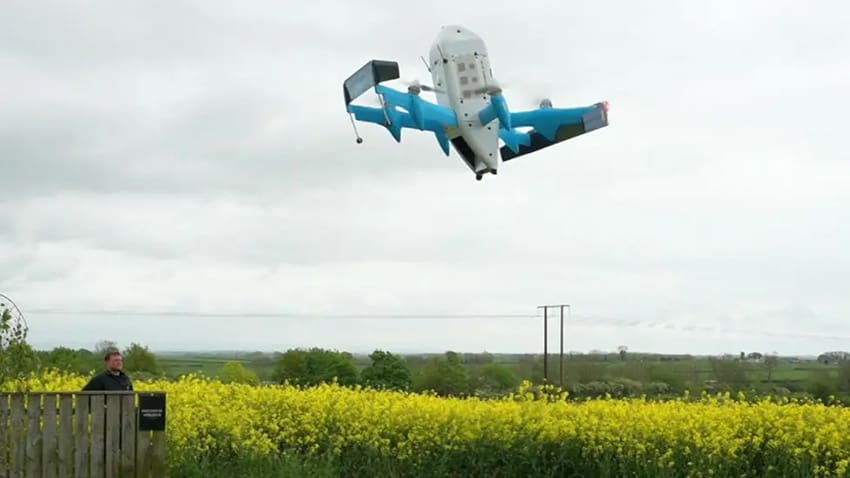
Amazon has quietly opened a new front in the battle for ultra-fast delivery, becoming the first retailer in Britain to drop parcels by drone after a limited launch in Darlington, County Durham.

The service, operated under the company’s long-gestating Prime Air programme, will see packages weighing less than 5lb (2.2kg) flown out from an Amazon fulfilment centre to homes within a 7.5-mile (12km) radius. Initial payloads are unglamorous but practical: beauty products, batteries, charging cables and the kind of small household items shoppers tend to discover they need only when it is already too late to drive to the shops.

For Amazon, which first promised drone deliveries more than a decade ago and has since watched the technology stutter through regulatory and engineering setbacks, the Darlington launch is both a proof point and a test bed. For Britain’s retail sector, including the small and medium-sized businesses that increasingly rely on Amazon’s logistics network, it is a sharper reminder still that the goalposts on customer expectation are moving once again.

The trial’s earliest beneficiary was Rob Shield, a Darlington farmer who let Amazon use an Airbnb on his land for its first test runs. The novelty, he admits, soon took over.

“Initially it was a novelty, so we were ordering everything under the sun,” he says. “Pens, paper, chocolates, anything to make it keep coming.”

Advertisement

Parcels arrive in shoebox-sized packages, released from a height of around 12ft onto the front garden. The spectacle, Mr Shield concedes, drew its own audience: “We’d have people come just to see it.”

What began as a curiosity has become, in his telling, a quiet utility. “You start realising, ‘I actually need something today’, like tape measures and stuff you’re always losing. We just order it and it comes.”

In the UK, Amazon’s drones currently promise delivery within two hours. The American benchmark is rather more pointed: David Carbon, vice president of Amazon Prime Air, says the average delivery time in the US is now 36 minutes.

“The certainty is people have never told us they want their stuff slower,” he says. “If you’ve got kids and you want fever medication, you want it. You don’t want to drive to the store.”

Advertisement

Amazon will cap operations at ten flights an hour and up to one hundred deliveries a day on weekdays, a deliberately modest cadence designed to satisfy regulators rather than sceptical shareholders.

The aircraft in question is the MK30, Amazon’s latest model, fitted with sensors intended to avoid trampolines, washing lines, pedestrians and other aircraft. GPS guides the drone to each drop-off, where it releases its load. “This is effectively an autonomous drone that can do what a pilot does in a flight deck. It can do what ground crews do, and it can deliver a package,” Mr Carbon says.

That autonomy is not absolute. The Darlington flights are conducted “beyond visual line of sight”, BVLOS in industry parlance, but every aircraft is monitored remotely by an operator who liaises with air traffic control at nearby Teesside Airport when required.

The choice of Darlington is, on closer inspection, a piece of careful corporate scouting rather than an accident of geography. The town offers a useful mix of residential streets, major roads and an airport in close proximity, allowing Amazon to stress-test its kit across multiple environments without travelling far. Crucially, it sits beside an Amazon hub with the deep stock needed to support the service.

Advertisement

It is also the only location outside the United States where the company is operating drone deliveries.

The Civil Aviation Authority has granted approval for a trial running to the end of the year, with temporary protected airspace, a regulatory prerequisite for autonomous flight under current rules, secured until mid-June and expected to be extended. Darlington Borough Council, which approved temporary planning permission for what it described as the “unprecedented nature of the scheme”, said it was “great to see Darlington at the forefront of such a pioneering scheme which highlights our borough as an area of innovation, development and investment”.

The limits of flying logistics

For all the choreography, the technology has obvious constraints. Eligible customers will need a garden or yard. Flats and terraces without outside space are excluded.

Dr Anna Jackman, an associate professor of geography at the University of Reading, says the Darlington trial illustrates both the promise and the limitations of the technology. “A lot of our demand for delivery services is in urban centres. They are very densely populated, very congested. And the reality is [drone deliveries] don’t work well in high-rise buildings.”

Advertisement

Rooftop drop-offs and centrally located drone hubs are being explored, she adds, “but right now we’re not there yet”.

There is also the question of safety, where Amazon’s record is not unblemished. In February, an MK30 drone clipped the gutter of an apartment building in a Dallas suburb after losing GPS signal, falling to the ground and breaking apart. No one was hurt, and Amazon has since suspended deliveries to similar buildings. Mr Carbon describes it as one of the “things we learn as we go along”, noting that 170,000 drone flights have been completed safely.

Drones are not entirely new to British skies. The NHS is trialling them to ferry blood supplies across London, and Royal Mail is using them to reach remote communities in Orkney. Amazon’s intervention is different in character: this is a commercial play by the country’s largest online retailer, and the read-across for smaller businesses is significant.

Independent retailers and the SMEs that use Amazon’s marketplace will, sooner or later, face customers who have come to view sub-two-hour delivery as the baseline. The pressure to match, or at least mitigate, that experience will fall hardest on those without the logistics muscle of a global platform. At the same time, the gradual normalisation of BVLOS flight could open new commercial doors for British drone operators, software firms and aerospace suppliers servicing the sector.

Advertisement

For now, the residents of Darlington are the test market, and reaction has been mixed. The launch itself ran years behind Amazon’s original 2023 pledge to begin in 2024, a reminder that aviation regulation does not bend easily to Silicon Valley timelines.

Mr Carbon is unrepentant. “We wouldn’t be doing it if it wasn’t commercially viable,” he says. “It’s a business, right? Absolutely, it can be commercially viable, and that’s the goal that we’re going after.”

Whether it ends up reshaping British retail logistics or remaining an expensively engineered curiosity will depend on what happens next: the regulator’s willingness to widen the airspace, Amazon’s appetite to keep spending, and customers’ willingness to look up.


Amy Ingham

Amy is a newly qualified journalist specialising in business journalism at Business Matters with responsibility for news content for what is now the UK’s largest print and online source of current business news.

Advertisement

Continue Reading
Click to comment

You must be logged in to post a comment Login

Leave a Reply

Business

At Close of Business podcast May 7 2026

Published

on

At Close of Business podcast May 7 2026

Tom Zaunmayr and Jack McGinn discuss The McKell Institute’s foray into WA.

Continue Reading

Business

Why Nano Banana Is Becoming the Core Engine Behind Visual AI Workflows

Published

on

Parliament has launched a new inquiry into British film and high-end TV, examining issues around skills and retention as well as challenges posed from the rise of artificial intelligence.

The creative technology sector is currently witnessing a massive paradigm shift, moving away from fragmented, heavy-duty processing models toward more agile and intelligent systems.

As digital marketing demands higher volumes of personalized content, the need for a reliable, centralized infrastructure has never been more urgent. Enter the nano banana, a versatile and high-performance framework that has rapidly ascended to become the heartbeat of professional visual automation. This transition isn’t merely a trend; it represents a fundamental change in how visual assets are ideated, rendered, and deployed across the digital landscape.

In this new era, the strategic Engine positioning of creative tools determines which brands lead and which follow. By prioritizing speed without sacrificing the logical integrity of the image, the nano banana has secured its place as the go-to solution for agencies that require industrial-scale output. Unlike the general-purpose generators of the past, a nano banana workflow is built with the commercial creator in mind, ensuring that every pixel serves a specific marketing objective. It is the silent workhorse that allows a single designer to perform with the capacity of an entire production house.

Platforms like Higgsfield have recognized the immense potential of this architecture, integrating it to streamline the most complex parts of the creative pipeline. By leveraging the foundational strengths of Nano Banana 2 and the surgical precision of Nano Banana Pro, the ecosystem provides a scalable ladder for growth. Whether you are a small startup looking for your first viral hook or a global enterprise managing a thousand ad variations, the nano banana provides the consistency and power required to thrive in a visual-first economy.

The Convergence of Speed and Precision in Visual Workflows

The primary challenge in visual AI has always been the trade-off between how fast a model can work and how accurate the result remains. For years, “fast” meant “blurry,” while “precise” meant “expensive and slow.” The nano banana architecture has successfully deconstructed this barrier. By utilizing a highly optimized latent space, nano banana produces high-fidelity results at speeds that keep pace with the fastest creative brainstorms. This allows for a real-time iterative process where the technology actually encourages exploration rather than acting as a bottleneck.

Advertisement

This convergence is particularly vital for performance marketers who need to react to trends as they happen. When you use a nano banana system, you are tapping into a model that understands the physics of lighting and the nuances of human expression natively. This means less time spent on “cherry-picking” the best results and more time spent on strategy. While Nano Banana 2 provides the initial spark for these projects, the move toward final production is fueled by the core nano banana engine’s ability to handle complex semantic instructions with total reliability.

Furthermore, the nano banana is designed to be hardware-efficient. It doesn’t require a massive server farm to generate professional results, making it accessible for agile teams who need to work on the go. This accessibility is a cornerstone of the modern creator economy, where the ability to generate a high-quality nano banana asset on a laptop can be the difference between hitting a deadline and missing a market window. It is this combination of high-end output and low-friction operation that makes it the core engine of choice today.

  • Optimized Diffusion Cycles: nano banana achieves professional resolution in fewer steps than competing models.
  • Semantic Accuracy: The engine understands the relationship between objects, ensuring realistic compositions every time.
  • Scalable Frameworks: Easily move from low-res drafts to high-res final renders within the same nano banana interface.

Seamless Integration into Commercial Advertising Pipelines

Visual AI is only as good as its ability to fit into existing commercial workflows. The nano banana was built from the ground up to be a team player. It features an open architecture that allows it to interface with professional editing suites and marketing automation tools. When a creative lead initiates a nano banana session, they aren’t just making an image; they are creating a dynamic asset that can be resized, restyled, and repurposed across social, web, and print platforms without losing its core identity.


Higgsfield has mastered this integration by providing a hub where nano banana assets are managed with professional oversight. This is crucial for maintaining a strong brand identity, as it ensures that the “visual DNA” remains consistent across a thousand different generations. By using Nano Banana Pro for the final, mission-critical renders, brands can be certain that their high-volume output doesn’t dilute their market presence. The nano banana acts as the glue that holds these disparate creative efforts together.

  • Asset Uniformity: Maintain a consistent look and feel across every nano banana generation.
  • Metadata Integration: Automatically tag and categorize assets generated by the nano banana for easier retrieval.
  • Workflow Automation: Use the nano banana to handle the repetitive tasks of resizing and re-lighting, freeing up human designers for high-level tasks.

Democratizing High-End Creative Directing

Perhaps the most impactful role of the nano banana is its ability to turn anyone with a vision into a creative director. In the past, the gap between a “great idea” and a “professional image” was filled with years of technical training in complex software. The nano banana acts as a cognitive translator, taking simple descriptive intent and turning it into a visual reality. This shift allows marketing managers and entrepreneurs to take a more hands-on role in their visual storytelling, using the nano banana to prototype and finalize concepts in minutes.

The collaborative potential of the nano banana is immense. Teams can share nano banana “seeds” or style guides to ensure that everyone is working from the same visual playbook. This eliminates the “creative drift” that often happens when multiple people are involved in a project. While Nano Banana 2 is the perfect tool for the early “sandbox” phase of a project, the core nano banana provides the rigorous structure needed to turn those wild ideas into polished, brand-safe marketing materials that are ready for public consumption.

Advertisement

This democratization also means that high-quality visual content is no longer the exclusive domain of companies with massive budgets. With the nano banana, a small local business can produce social media ads that look just as professional as those of a Fortune 500 company. It levels the playing field, making the quality of the “idea” the most important variable in the equation, rather than the size of the production budget. The nano banana is truly the engine of a more equitable creative future.

Technical Reliability: The Anatomy of the Engine

To understand why the nano banana is winning the AI arms race, one must look at its technical “anatomy.” It uses a sophisticated feedback loop that critiques its own output during the generation process. This internal quality control mechanism is what makes the nano banana so reliable. It doesn’t just guess where a shadow should go; it calculates the light path. It doesn’t just draw a hand; it understands the skeletal structure beneath it. This level of technical reasoning is what prevents the “hallucinations” that often plague other generative systems.

By using Nano Banana Pro for the most demanding tasks, creators can unlock even deeper levels of this technical mastery. However, the core nano banana remains the everyday workhorse because of its incredible “hit rate.” You don’t have to generate a hundred versions to find one that works. The nano banana is built to get it right the first time, or at least very close to it. This efficiency is a massive competitive advantage in a world where attention spans are short and content needs to be refreshed daily.

  1. Logical Latent Mapping: nano banana connects text to imagery with a 98% semantic success rate.
  2. Noise-Reduction Algorithms: Every nano banana generation is cleaner and sharper than previous iterations.
  3. Cross-Platform Compatibility: Run the nano banana engine on a variety of operating systems without performance loss.

The Role of Nano Banana in Global Content Strategy

For a global brand, “content” isn’t a single event; it’s a constant stream. Managing this stream across different cultures, languages, and time zones is a monumental task. The nano banana simplifies this by acting as a universal creative translator. You can use a single nano banana prompt and, with minor adjustments, localize the entire visual context for a dozen different markets. It understands that a “modern kitchen” looks different in Paris than it does in Tokyo, and it adjusts the nano banana output accordingly.

Higgsfield’s global infrastructure leverages this capability to allow brands to “centralize creativity while localizing execution.” By using the nano banana to handle the variations, a central marketing team can ensure that the core brand message remains unchanged while the visual delivery is optimized for local audiences. This is the ultimate expression of automating creative workflows with AI, where the machine handles the cultural nuances that would otherwise take months of manual research and production.

Advertisement
  • Cultural Intelligence: The nano banana recognizes regional aesthetics and applies them accurately.
  • Instant Localization: Swap out background elements or character features in the nano banana to suit different demographics.
  • Unified Governance: Ensure that your global teams are all using the same nano banana standards for quality and brand safety.

Ethical Design and the Future of Visual AI

As we integrate the nano banana deeper into our professional lives, the conversation naturally turns toward the future of ethical design. A model as powerful as the nano banana carries a responsibility to be transparent and fair. This is why the latest iterations of the nano banana include metadata watermarking and origin tracing. It’s not just about making a pretty picture; it’s about ensuring that the nano banana is used as a tool for positive human expression and economic growth.

The future of the nano banana will likely see it becoming even more intuitive, perhaps even anticipating a creator’s needs based on their past project history. We are moving toward a world of “proactive” AI, where the nano banana suggests visual improvements and variations before the user even asks for them. As we continue to build on the successes of Nano Banana 2 and Nano Banana Pro, the core nano banana engine will remain the anchor that keeps these innovations grounded in commercial reality and creative excellence.

Conclusion: Anchoring Your Creative Future with Nano Banana

The evidence is clear: the nano banana is no longer just a “tool” it is the foundational engine that makes modern visual AI workflows possible. Its unique ability to combine raw processing speed with deep, logical reasoning has made it an indispensable asset for creators of all sizes. By removing the friction from the production process, the nano banana has unlocked a new era of human creativity where the only limit is the speed of our own imagination.

Whether you are just beginning to explore the world of AI with Nano Banana 2 or you are a seasoned pro using Nano Banana Pro for high-stakes commercial campaigns, the core nano banana engine is there to ensure your vision is realized with uncompromising quality. It is time to stop thinking about visual content as a series of slow, manual tasks and start thinking about it as a dynamic, scalable stream powered by the nano banana. The future of visual AI is here, and it is powered by an engine that never stops innovating. Embrace the nano banana and transform your creative workflow forever.


Advertisement

Continue Reading

Business

Conagra highlights healthy product sales

Published

on

Conagra highlights healthy product sales

Citizenship Report also looks at supply chain and waste reduction.

Continue Reading

Business

Why is Howmet Aerospace stock surging today?

Published

on


Why is Howmet Aerospace stock surging today?

Continue Reading

Business

Welsh construction sector has reported a fall in workloads

Published

on

Business Live

The RICS has released its latest construction monitor

Construction.(Image: Getty Images)

The construction sector in Wales has reported a decline in workloads. According to the latest construction monitor from the Royal Institution of Chartered Surveyors (RICS) workloads declined across most subsectors in the first quarter (Q1) of this year with the outlook softening.

A net balance of minus 17% of survey respondents in Wales reported a fall in overall construction activity, which is the lowest this balance has been in two years, and the third consecutive quarter this balance has been in negative territory.

Advertisement

All subsectors saw declines in activity according to the balance of respondents other than public housing which saw a marginal increase (a net balance of plus 5%). The weakest net balance was for the private commercial subsector with a net balance of minus 36% of respondents.

READ MORE: What should be the economic priorities of the next Welsh GovermentREAD MORE: Law firm Hugh James expands its presence in London with acquisition of Howat Avraam

Financial constraints were cited by 76% of respondents in Wales as a factor limiting activity, making it the second most reported obstacle, after planning and regulation at 85%. This is the highest number of respondents citing financial constraints since 2019 and a significant increase since the last quarter of last year. Anecdotally, respondents pointed to planning issues relating to nutrient neutrality as a continuing challenge.

With the increase in challenges facing the construction market, expectations for the year ahead have lowered. The net balance for 12-month workload expectations was plus 5% in the latest report compared to plus 9% the last time. And 12-month expectations for both employment and profit margins are now in negative territory. In the net balance for profit margin expectations at minus 44% is now at its lowest since the first quarter of 2020.

Advertisement

Survey respondent Jayne Rowland Evans of GKR Maintenance & Building Co in Caerphilly, said: “There is a lack of tenders. Procurement requirements and SSIP (safety schemes in procurement) are ever-increasing and difficult for SMEs who do not have dedicated departments.”

Mark Evans of Ivor Russell Partnership in Swansea said: “The impact of nitrates on the planning system in Wales has brought the construction industry to a near stop. Natural Resources Wales and the Welsh Government need to resolve the issue urgently, as all sectors are having to make staff redundant with immediate effect.”

RICS chief economist, Simon Rubinsohn, said: “The impact of the war in the Middle East is clearly visible in the Q1 construction monitor. Rising material costs, a tougher credit environment and increased pressure on margins are already leading some developers to slow construction activity. More significantly, plans for the next 12 months are being scaled back most notably in the private sector. Expectations around housebuilding are now flat which aligns with the comments from leading housebuilders in their recent trading updates and results statements.”

Advertisement
Continue Reading

Business

Twist Bioscience: AI Momentum Is Real, But The Easy Money Has Been Made

Published

on

Colorful DNA helix with conceptual polymer sequencing data in the background

Twist Bioscience: AI Momentum Is Real, But The Easy Money Has Been Made

Continue Reading

Business

Global Payments announces $500 million accelerated share repurchase program

Published

on


Global Payments announces $500 million accelerated share repurchase program

Continue Reading

Business

Startup Propy deploying $100M to put real estate deals on the blockchain

Published

on

Startup Propy deploying $100M to put real estate deals on the blockchain

Continue Reading

Business

Bel Group acquires Ingenuity Foods’ brands

Published

on

Bel Group acquires Ingenuity Foods’ brands

Acquisition includes Brainiac and Little Brainiac brands.

Continue Reading

Business

Sarepta Stock Slumps. Why an Earnings Beat Wasn’t Enough for the S&P 500 Loser.

Published

on

Sarepta Stock Slumps. Why an Earnings Beat Wasn’t Enough for the S&P 500 Loser.

Sarepta Stock Slumps. Why an Earnings Beat Wasn’t Enough for the S&P 500 Loser.

Continue Reading

Trending

Copyright © 2025