When Sir David Attenborough was born in 1926, George V was on the throne, Stanley Baldwin was in Downing Street, and the BBC, the institution where he would spend many productive decades, was, itself, still in nappies.
Over the years, Attenborough has become the face and voice of natural history the world over. From chasing animals through jungles and deserts, to observing the myriad changes to our ecosystem in his near century on planet earth, Attenborough has been a guide through the wild citizens and untouched places of our world.
Here, ahead of his 100th birthday this week, we look at some of the moments from his televisual oeuvre that have defined Attenborough for generation after generation.
Attenborough and the puffins, Wild Isles
Advertisement
As the years have gone by, Attenborough’s forays in front of the camera have become increasingly rare. Appearing in 2023’s domestic-focused Wild Isles, Attenborough sits amid a colony of Pembrokeshire puffins. “Never has there been a more important time,” he implores the audience, “to invest in our own wildlife.” In its accessibility and urgency, it shows a man still, somehow, in his prime.
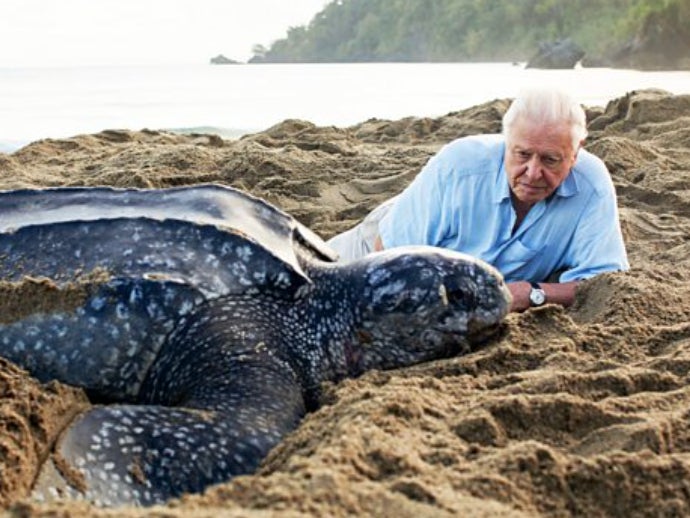
Attenborough and the leatherback, Blue Planet II
David Attenborough and a leatherback turtle on ‘Blue Planet II’ (BBC)
At the ripe age of 91 years old, Attenborough could’ve been forgiven for reclining on a beach in the Caribbean. That he would do so, back in 2017, in the moonlit company of leatherback turtles is typical of the man. “Whoops,” he exclaims, with a half-chuckle, as a giant leatherback turtle prepares to lay her eggs. All that’s missing from the scene is a striped beach towel and pina colada.
Attenborough vs curling at the Winter Olympics, Radio 1
Attenborough’s voice and intonation make him ripe for parody, a fact he made light of when appearing on Greg James’s Radio 1 show back in 2014. Lending his dulcet tones to the women’s curling event at the Winter Olympics, he narrated proceedings in trademark fashion. “The frisking is frantic,” he said, as the stone slid down the Sochi ice, “and often futile.” The seriousness of his voice paired with the lack of self-importance has been key to his success (both as a sports commentator and, more often, a wildlife presenter).
Advertisement
Attenborough on Raine Island, Planet Earth III x Zoo Quest
“As far as I know,” Attenborough told viewers, during 2023’s Planet Earth III, “I was one of the first people to film on Raine Island, back in 1957.” It was 66 years ago when Attenborough first set foot on this coral cay in the Great Barrier Reef to witness the world’s largest population of green turtles for an episode of his show Zoo Quest. Reflecting on this so many decades later, with the same issues at stake, is a remarkable feat of both zoological and televisual longevity.
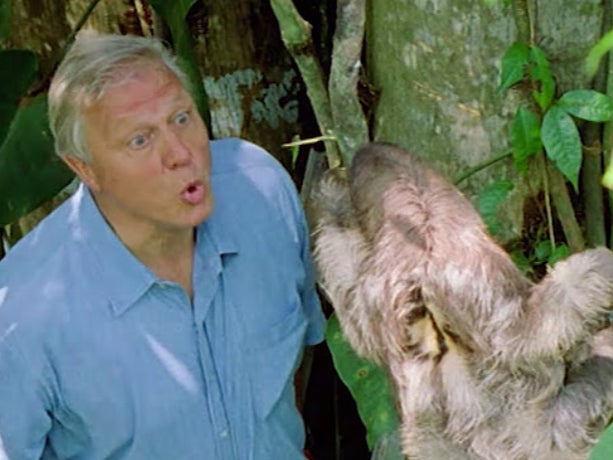
Attenborough and sloth, The Life of Mammals
David Attenborough saying ‘boo!’ to a sloth in ‘The Life of Mammals’ (BBC)
In 2002, Attenborough was back to his roots as a hands-on zoologist for this 10-part series about earth’s dominant animal class. But it was an intimate interaction shared with a sloth (“the most extraordinary plant predator”) that captured viewers’ imaginations. “Boo!” he says to the sloth, with somewhat uncharacteristic playfulness. The central American herbivore looks back at the naturalist, stretching its head out in measured curiosity, and for a beautiful moment it’s ambiguous as to who is scientist and who is subject.
Attenborough vs python, Zoo Quest
Advertisement
Back in the 1950s – long before bravura herpetologists had turned snake wrangling into a TV artform – a young Attenborough found himself in Indonesia, face to face with an enormous python. Not much older than 30, Attenborough already possessed that recognisable voice of his – but what is utterly unrecognisable is the figure nimbly scuttling up a tree, khaki shirt unbuttoned to reveal a rippling torso. The conscientious tone that would come to typify Attenborough’s later narration is entirely absent as he stuffs the python’s head into a burlap sack and grins for the camera in his moment of triumph.
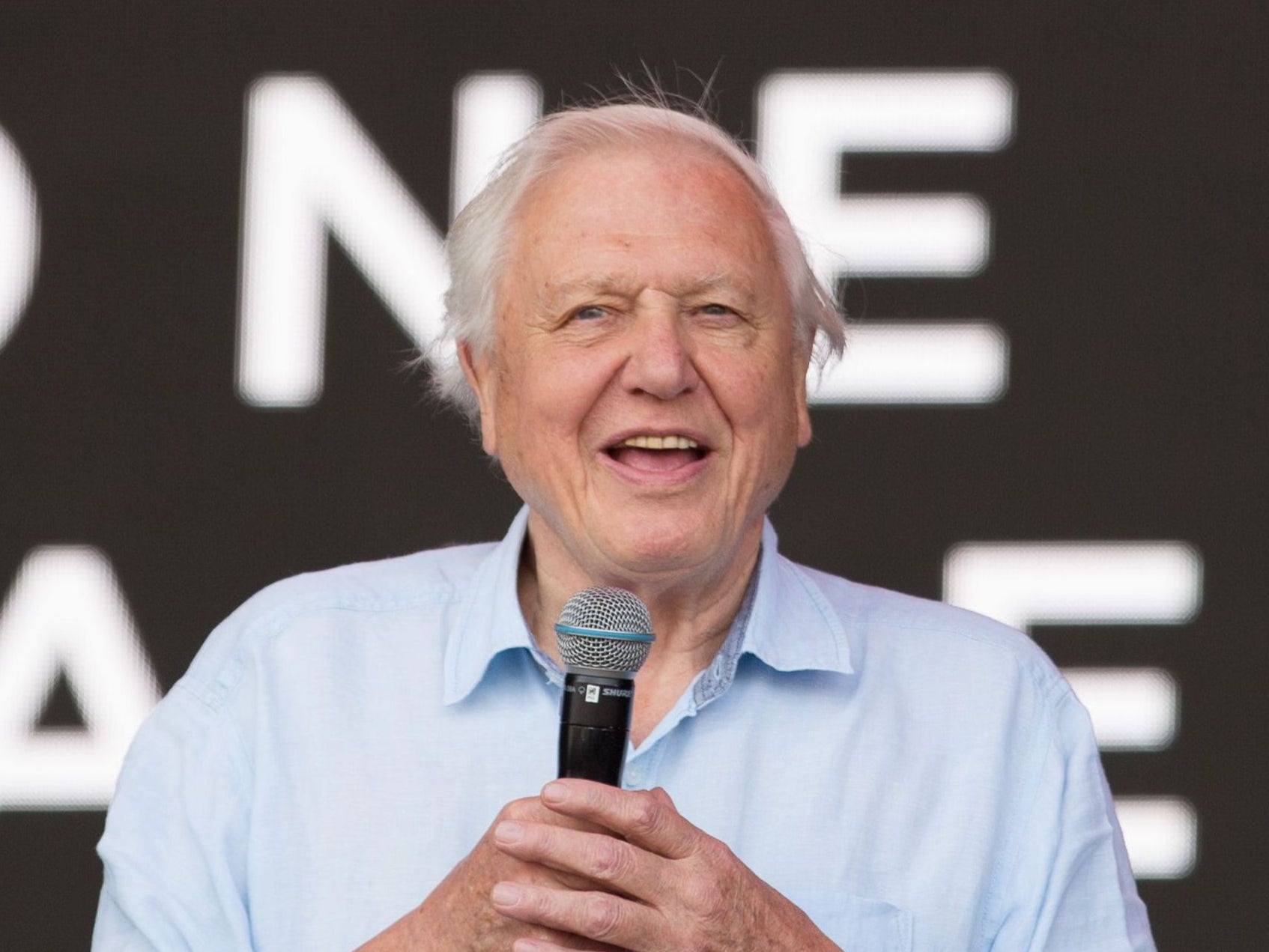
Attenborough at Glastonbury 2019
Watch Apple TV+ free for 7 day
New subscribers only. £9.99/mo. after free trial. Plan auto-renews until cancelled.
ADVERTISEMENT. If you sign up to this service we will earn commission. This revenue helps to fund journalism across The Independent.
Advertisement
David Attenborough addressing the Glastonbury crowd in 2019 (Maja Smiejkowska/Shutterstock)
Bob Dylan, Radiohead, Jay-Z: all the biggest acts in the world have played the Pyramid Stage at Glastonbury. So, it was oddly fitting when, in 2019, this titan of the natural world took prime position at Worthy Farm to give a rousing speech about the festival’s accomplishments in divesting itself of plastic. “This great festival has gone plastic-free,” he told the enormous crowd. “That is more than a million bottles of water that have not been drunk by you in plastic bottles.” The roar that greeted the nonagenarian’s rather banal appearance was the sort usually reserved for teen idols or ageing rock superstars.
Attenborough and the Cargo Cult, The People of Paradise
It’s not unfair to say that David Attenborough walked so that men like Bruce Parry and Anthony Bourdain could run. In 1960’s The People of Paradise, a youthful Attenborough deviated from his zoological background for a sojourn in the cultural anthropology arena. His episode amongst the Cargo Cult of Vanuatu, who worship a mystic figure called “John Frum” is particularly excellent. Watching it in 2023 is a good reminder of how much smaller the world seemed when Attenborough first began broadcasting.
The clever killer whales, Frozen Planet II
One of Attenborough’s key skills as a narrator is his ability to read meaning into animal behaviours, parsing them for a lay (read: human) audience. One of the most striking examples came during 2022’s Frozen Planet II. A pod of killer whales swim in formation to create waves that displace a delicious, succulent seal skulking safely on an ice floe. “It’s an ingenious solution,” he says, with almost grandfatherly pride, as the whales rip the seal to smithereens and sup on its exquisite blubber.
Advertisement
Lizard vs snakes, Planet Earth II
There’s nothing audiences love more than the rare moments when the animal kingdom pits one species against another. The best example of this, in recent years, comes from 2016’s Planet Earth II. A death match is waged between a lizard – sprinting through the desert as though it’s in Mad Max – and countless deadly snakes. This was one of the first clips from an Attenborough documentary to go viral on social media, aided by a legendary slot on Channel 4’s Gogglebox.
Attenborough and the Queen, The Queen’s Green Planet
When David Attenborough met the Queen (ITV)
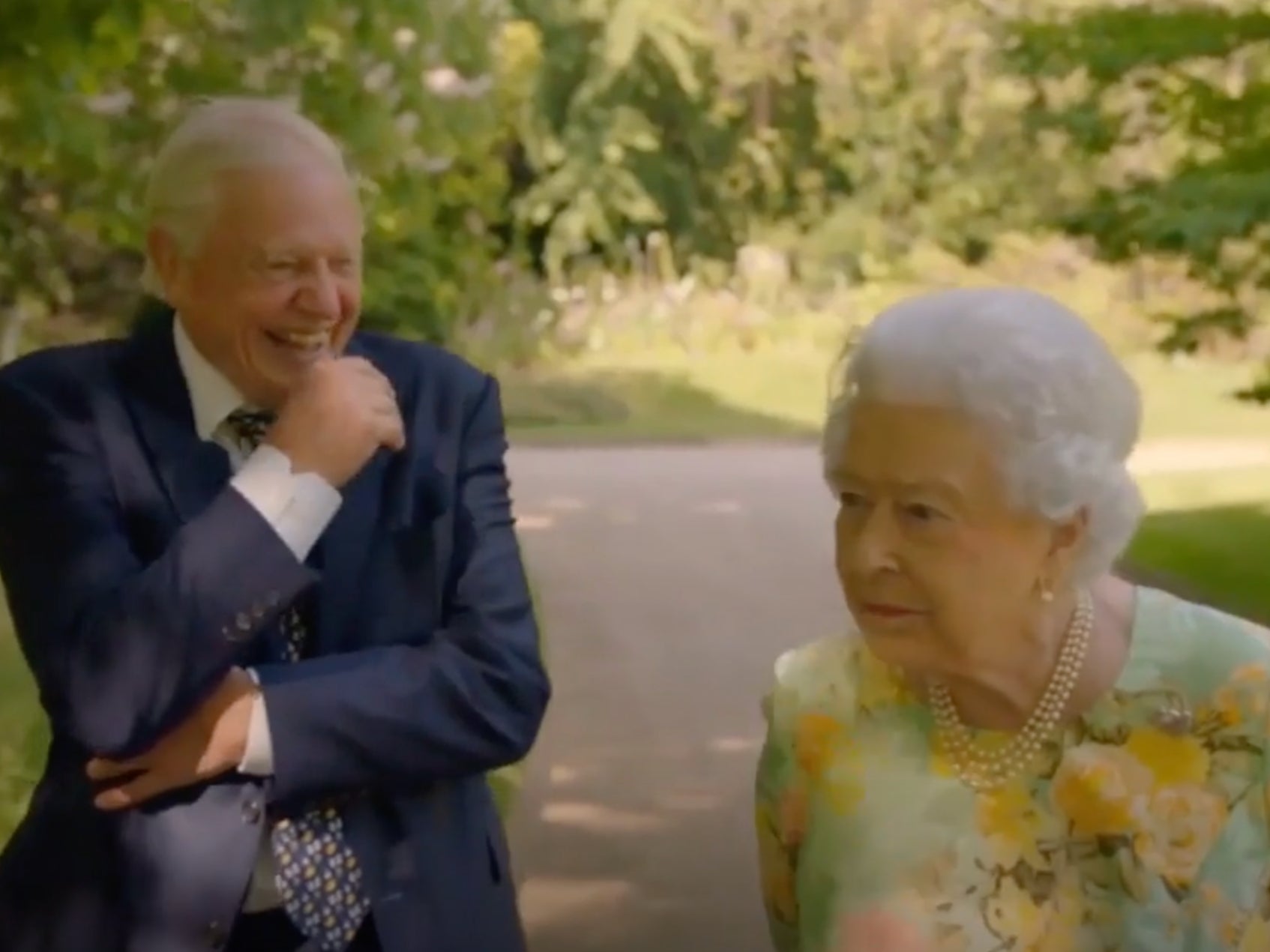
ITV really bagged the big guns for its 2018 documentary, The Queen’s Green Planet. David and Elizabeth, the nonagenarians, who were born just a couple of weeks apart in 1926, were filmed going for a pleasant stroll in the gardens of Buckingham Palace. The conversation itself isn’t exactly scintillating – the Queen compares a variety of trees to her awful children – but there’s something pleasing about the sight of these two figures, both of whom had acquired living (at the time) legend status, pottering around the garden.
Attenborough and Obama, 2015
Advertisement
In his later years, Attenborough began to transition from naturalist to campaigner. In 2015 he sat down in the Oval Office with then-President Barack Obama to discuss life on our “blue marble”. The two discuss the renewable energy transition, population urbanisation and educating children about the natural world. But what’s most striking, perhaps, is that both these men look infinitely more statesmanlike than those politicians now convening at COP after COP to talk about these same issues.
Attenborough and Lonesome George, Galapagos 3D
“This is the rarest living animal in the world,” whispered Attenborough, as Lonesome George, the last Pinta Island tortoise, crawled beside him. Attenborough’s 2013 series Galapagos 3D – made during the short-lived 3D fad – saw him get up close and personal with a creature who, having been born in 1910, made the silver-haired presenter look like a spring chicken. Even more remarkably, the tortoise died a fortnight later at the age of 102, making it his last on-camera interview. Attenborough was not, to my knowledge, questioned in connection with the tortoise’s death.
Attenborough and the mountain gorillas, Life on Earth
Advertisement
Probably the most instantly recognisable on-camera sequence from Attenborough’s decades at the BBC, this 1979 encounter with mountain gorillas at Dian Fossey’s sanctuary in Rwanda is a remarkably tactile piece of broadcasting. These huge apes – who could comfortably rip his face off and use it as a banana dish – start to tussle with the presenter in the foliage. Rather than run for his life, Attenborough submits, even grinning broadly as two baby gorillas remove his shoes. For a man best known to a whole generation as a disembodied voice, it is a wonderfully corporeal moment.
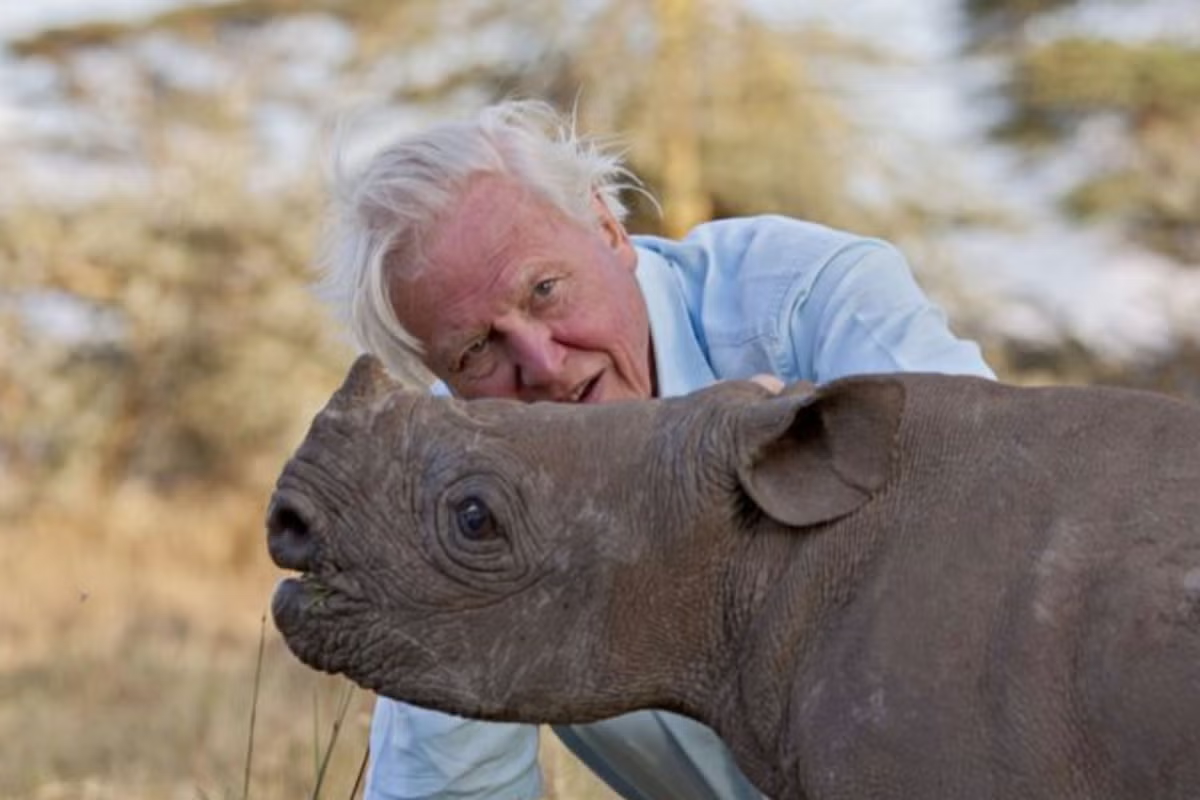
Attenborough and the baby rhino, Africa
David Attenborough and a rhino in ‘Africa’ (BBC)
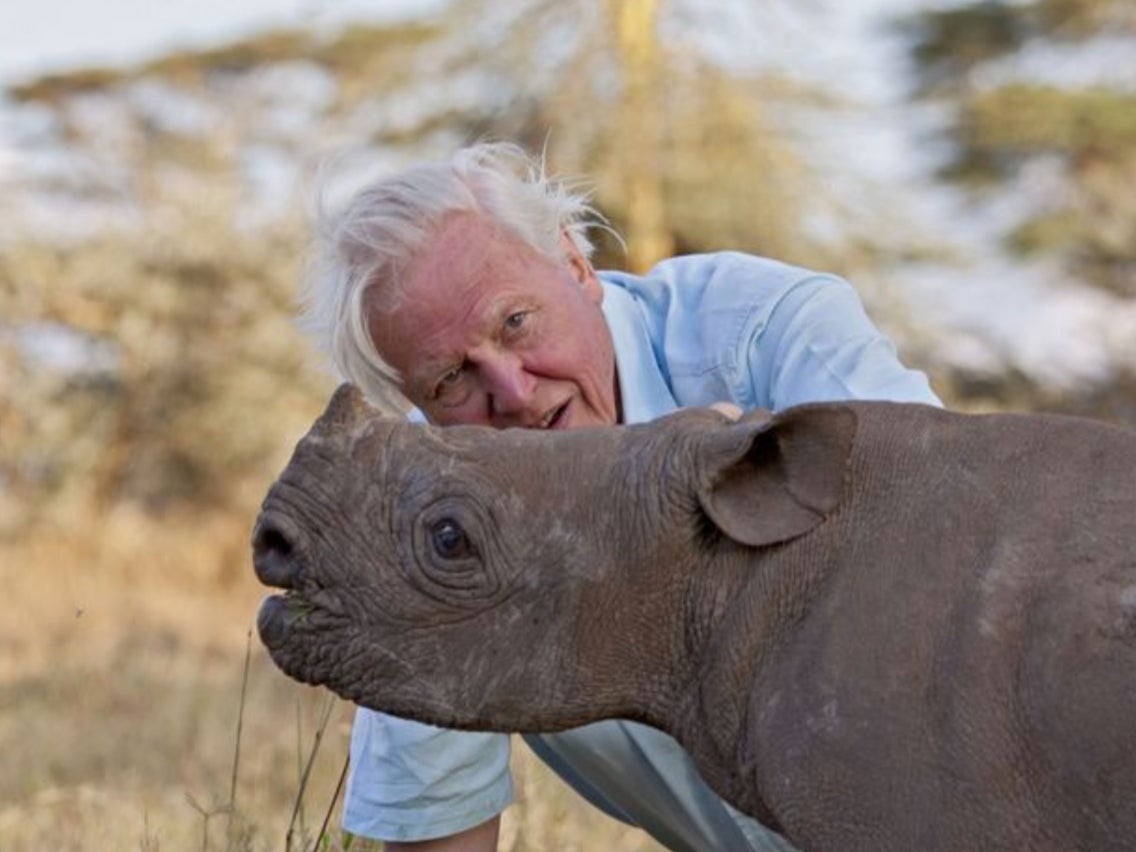
What’s better than a full-sized rhino? A baby one, of course! On all-fours in the African savannah, Attenborough comes face to face with a pint-sized rhinoceros. They squeak at one another, the older man replicating the younger mammal’s juvenile calls. “Enchanting creature,” Attenborough muses afterwards, but that shot of them locking eyes – one gnarled and wrinkled by evolution, the other craggy and lined with age – remains iconic. It is a moment not of enchantment, but of fraternity.
Attenborough’s butterfly, Micro Monsters
Big cats, giant snakes, great apes: these showstopping animals might take the headlines, but Attenborough is as adept working on a far smaller canvas. There is no more poignant example of this than a scene from 2013’s Micro Monsters, in which a butterfly lands on the presenter’s index finger. The insect seems to hold its poise while Attenborough delivers his trademark narration, his eyes staring inquiringly at the patterned wings just a few inches from his face.
Advertisement
Attenborough’s orangutan, Zoo Quest
Zoo Quest, the show that made Attenborough’s career as a presenter, was based on a premise that now seems wildly dated: the staff of London Zoo, and the BBC, travel the world to capture animals for the site’s permanent collection. All the same, the show introduced the British public to far-flung locales and their equally eye-catching denizens. The highlight is, perhaps, the search through Indonesia for an orangutan. Tracking discarded fruit on the floor, Attenborough spots their distinctive orange fur through the foliage. The ape proceeds to hang there “screaming and breaking off branches to throw down at [Attenborough]”. Fair enough – anything to avoid a trip to 1950s London.
Attenborough at COP26 2021
With Britain hosting COP26, the global climate change summit, it was natural that the organisers would turn to the nation’s most respected voice on issues of the natural world. Opening the summit in Glasgow, Attenborough delivered a rousing speech against a backdrop of dramatic images of planet earth – together with illustrations of humanity’s impact on it. “If working apart we are a force powerful enough to destabilize our planet,” he told attendees of the conference, “surely working together we are powerful enough to save it.” At a conference famous for half-measures and backroom deals, it was a spine tingling moment of public performance.
Advertisement
Dancing with the capercaillie, The Life of Birds
The capercaillie – the horse of the wood – is the world’s largest grouse. Up in Scotland, Attenborough gets up close with the local alpha male. “He is so charged up,” Attenborough observes wryly, as the bird, tail feathers standing erect, bears down on him. Moments later, the capercaillie has, somewhat over-dramatically, knocked the long-in-the-tooth presenter to the ground. “Now, now!” he exclaims, with a chuckle, as the beak of the capercaillie rattles with indignation.
Attenborough, tortoise and Graham Norton, The Graham Norton Show
David Attenborough jokingly narrating raunchy tortoise video on ‘The Graham Norton Show’ (BBC)
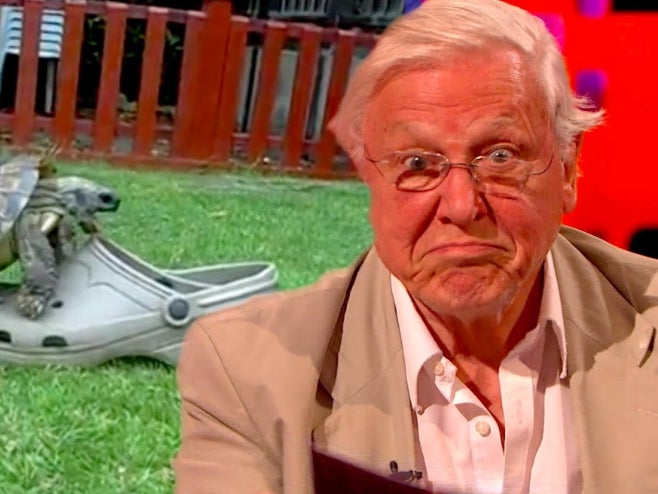
Attenborough has a long association with animals mating. “Does it get to the point where you just feel like an old perv?” asked Graham Norton when the esteemed knight of the realm sat on his red couch in 2012. Attenborough was a fixture of talk shows, from Parkinson to Friday Night with Jonathan Ross, and a very good sport. Following his cheeky enquiry, Norton made Attenborough provide his trademark narration to grainy video footage of a tortoise attempting to have its way with a rubber Croc. “The humble tortoise gently mounts his chosen mate,” Attenborough says soberly, “in a dance as old as time itself.”
Evil shoebills, Africa
Advertisement
Attenborough’s reassuring voice was often utilised to good effect in heart-warming stories of survival against the odds, but it could also run counter to that grain. There’s no better example than in 2013’s Africa, when two shoebill chicks start to fight in their mother’s absence. “This is more than scrap between two siblings,” Attenborough growls, as the comically grotesque shoebill bites at its runty brother’s neck. “It reveals a dark side.”
Lions vs elephant, Planet Earth
The BBC’s Natural History unit has always been at the cutting edge of technological developments. Underwater photography, drones and infrared are now staples of their broadcasts. Back in 2006, for the first series of Planet Earth, the team caught an extremely rare natural event using what was then considered state of the art technology: night vision. “They’re specialist elephant hunters,” Attenborough says of a pack of lions chasing their next meal, using narration sparingly as audiences bear witness to the elephant being dragged to the ground. He concludes, with trademark pragmatism, that “this elephant will feed the whole pride for at least a week”.
In sport, fairness matters. But when it comes to buying tickets to watch the world’s biggest ever sporting event, money matters too.
Attending the men’s Fifa World Cup 2026 will be much more expensive than any previous World Cup. And that’s not what fans were promised.
In fact, when the US, Canada and Mexico set out their original bid to host the tournament, they said a seat at the final would cost a maximum of US$1,550 (£1,174).
But by April 2026, the cheapest standard final ticket had reached US$5,785. The most expensive seats hit US$10,990 and later tripled. Just two days before the start of the tournament there were reports of 180,000 unsold tickets.
Advertisement
Politicians in New York and New Jersey have launched a formal investigation into allegations that Fifa has confused fans and inflated prices. Fans have complained of a lack of clarity, with many waiting hours in online queuing systems with no idea of the amount they’d have to pay when (and if) they were allocated tickets.
The increase in costs may remind some music fans of the 2024 scandal over Oasis concert tickets when customers watched prices more than double from £148 to £355 as they waited in online queues.
“Dynamic pricing”, when prices go up and down depending on levels of demand, will also be familiar to anyone who has been surprised by swift changes in the price of flights before a holiday. The same seat can cost more today than it did yesterday simply because more people want it.
Advertisement
Fifa denies that it is has engaged in dynamic pricing, saying that they use “variable pricing” instead. But from a consumer’s point of view, it amounts to the same result – the price of tickets that they want to buy changes, usually in an upward direction.
In response to the Oasis dynamic pricing episode, UK regulators later forced ticket sellers to commit to showing price ranges before fans join a queue. By using a “variable” system, Fifa positions itself outside that regulatory precedent entirely.
It faces no obligation to disclose prices in advance and no requirement to explain how they change.
A game of monopoly
But dynamic pricing isn’t always a bad thing for consumers. In fact, it can help them to get a better deal. Economists studying airline markets found that dynamic pricing can reduce prices as different airlines compete for passengers.
Advertisement
The trouble is that Fifa operates in a market with zero competition. No rival sells World Cup tickets. No substitute product exists.
The work of Nobel prize-winning economist Jean Tirole demonstrated that when a single firm controls an essential platform and operates at every level of the market, competitive discipline on pricing disappears. The operator stops seeking an efficient price and starts trying to extract the very maximum that the consumer will tolerate.
For football World Cups, Fifa sets the primary price. It runs the only sanctioned resale marketplace. It pockets 30% on every secondary transaction when unwanted tickets are sold on. It makes money on the first sale, and earns a bit more on the second.
No outcome costs Fifa money. No regulators intervene. But not everyone is prepared to pay out.
Advertisement
Adjusting for inflation, World Cup ticket prices have been stable for 30 years. Then Fifa introduced its new model and the entire pricing architecture shifted. This would explain all the unsold tickets.
For example, England’s semi-final and final allocations failed to sell out. Every fan who applied got a seat.
After the backlash, Fifa introduced a US$60 “Supporter Entry Tier” for every match, including the final. It amounts to roughly 10% of each national association’s allocation, a few hundred seats in stadiums holding up 80,000. As a pricing intervention, it changes nothing apart from an attempt to absorb criticism.
The day before the World Cub began Fifa president Gianni Infantino defended the level of ticket pricing, claiming that if they were cheaper the majority would have been resold on the black market. He added that the money generated was required to fund football development across the world.
Consumer research explains exactly what went wrong. When people buy a service rarely and can’t understand how the price was set, they don’t just feel frustrated, they feel cheated.
And when they feel cheated, they walk away. Fifa treated fan loyalty as guaranteed demand. Supporters’ reaction proved it isn’t.
Then, at the start of June, Fifa quietly slashed prices across all 104 matches and returned 70% of its block booked hotel rooms due to low demand – a last minute change of tactics probably designed to save face and avoid empty seats. But to many, desperately chasing lost fans after trying to extract more revenue than any World Cup in history already looks like foul play.
Fans have said they are worried about the Boyzone singer after he briefly stepped out on stage for just a few songs during the band’s two farewell shows in London
Boyzone’s Mikey Graham has sold his former long-time family home in Dublin.
Advertisement
The 53-year-old has made plenty of headlines this week after returning to the stage to join the other members of Boyzone at their two farewell shows.
Many fans expressed concern and speculated whether Mikey would participate in the final shows after he had been missing from the band’s reunion and there had been little promotion of his involvement.
When Mikey stepped out on stage to sing a few songs at Emirates Stadium, the crowd erupted in cheer, but many people expressed concern for his health as he sat on a stool during the show and sang just four tunes out of the 25-song long setlist.
Now, property records have revealed that the singer actually put his longtime home on the market in March of this year. Avalon, in Courtlough, Balrothery, Co. Dublin, which was listed as Mikey’s registered address, sold for €885,000, RSVP Live reports.
Advertisement
He lived in the North County Dublin town and built his family home there two decades ago.
It is not the first change he has gone through recently, as last year, the star and his wife divorced after over 20 years together. Mikey first met his ex-wife, Karen, in 1998, while she was a dancer on a Boyzone tour.
They dated for a few years before getting married in 2004. Two years later, they welcomed their first child together, whom they named Sienna Nicole. Mikey also has another daughter, Hannah, from a previous relationship.
Sienna recently defended her dad against online trolls, saying she was incredibly proud of him for returning to the stage.
Advertisement
“No one will ever know the extent that it took my dad to get to this point and get onto this stage and perform to many people in that way, so as his daughter, as I can say is that I am incredibly proud of him and that is the bottom line.”
Almost two thirds, about 63.7 per cent, of the 13,000 people who responded to City of York Council’s consultation said switching to bins would make recycling easier for them.
But around 38.7 per cent said storage space could be an issue, with others raising concerns about how they would look on the street, capacity and moving them for collections.
A council report on the findings stated the amount of responses showed people felt strongly about the issue but there was no one size fits all solutions to concerns raised.
The consultation comes after the council first unveiled plans for recycling bins in February.
Advertisement
RECOMMENDED READING:
It would see most York household’s existing recycling boxes replaced with two wheelie bins, one for paper and cardboard and another for glass, tins and plastics.
Each bin would be collected every four weeks on two-week alternating cycles.
The estimated cost of the changes is £2.8 million, including making and delivering the bins, versus savings of around £310,000-a-year.
Advertisement
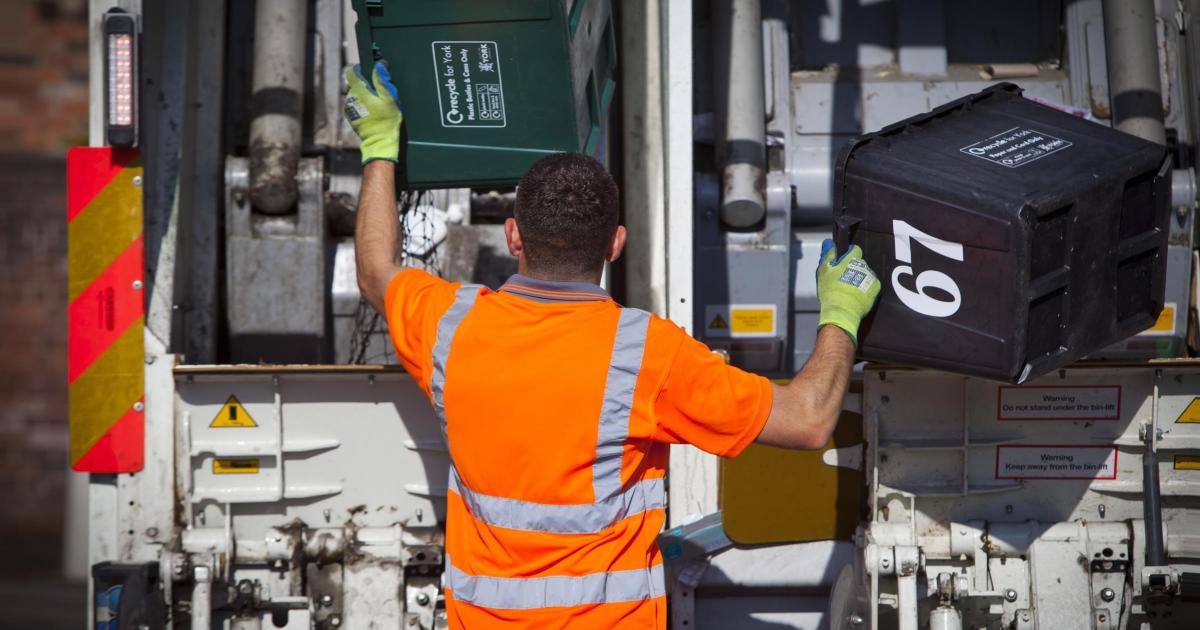
Council officials said the changes would make collections more efficient, recycling easier for the elderly and disabled, reduce the risk of staff injuries and stop litter blowing off boxes.
The proposals also come as the council looks to save £520,000 from its waste collection services over the next two years.
York’s current recycling boxes could be ditched under council plans (Image: Supplied)
They also come ahead of requirements for soft plastics to be collected from kerbsides by March next year.
But concerns have previously been raised about changes to the frequency of collections and how they could affect people such as those in terraced houses who lack storage space.
Advertisement
The roughly 63.7 per cent of people who said the changes would make recycling easier for them compare to around 23.9 per cent who said they would make it harder.
Those who said they may do or were not sure accounted for about 12.5 per cent of respondents.
About 71.9 per cent of those surveyed said having wheelie bins would make it easier to recycle larger cardboard packaging such as boxes for TVs.
It compares to 18 per cent who said it would make it harder and about 10 per cent who did not know.
Advertisement
The visual impact of bins on the street was said to be a barrier to using wheelie bins by about 16.7 per cent of respondents.
About 8.8 per cent were concerned about capacity for the amount of waste they recycled while about 3.1 per cent said the distance to collection points was an issue.
More than half, about 55.1 per cent, said they saw no barriers to using wheelie bins.
The main challenges people said they faced with the current boxes was litter being left behind on the street following collections, according to almost 65.7 per cent of respondents.
Advertisement
Others included not having enough capacity, boxes breaking too easily, being too heavy, them getting wet due to the weather and a lack of storage space.
About three quarters of those who responded to the survey, about 75.9 per cent, lived in households with between two and four people.
Almost a fifth, about 19.5 per cent, were single households and almost 4.6 per cent lived in homes with five or more people.
The council’s report stated options for households concerned about space could be to offer them 180L or 140L bins, rather than the 240L currently proposed.
Advertisement
They added there was no substantial evidence to suggest that storing waste for longer would pose a fire risk, including due to antisocial behaviour.
Councillors are set to discuss the results of the consultation at the Place Scrutiny Committee on Tuesday, June 16.
A teenager who was allegedly part of a crowd who threw a petrol bomb into the open front door of a police Land Rover was arrested after the Coastguard retrieved him from Belfast Lough, a court heard today.
Belfast Magistrates Court also heard claims that as he was being chased by a PSNI inspector who had been set on fire by the petrol bomb, 18-year-old Ryan Fowles discarded a face covering and gloves when he entered the water in Carrick.
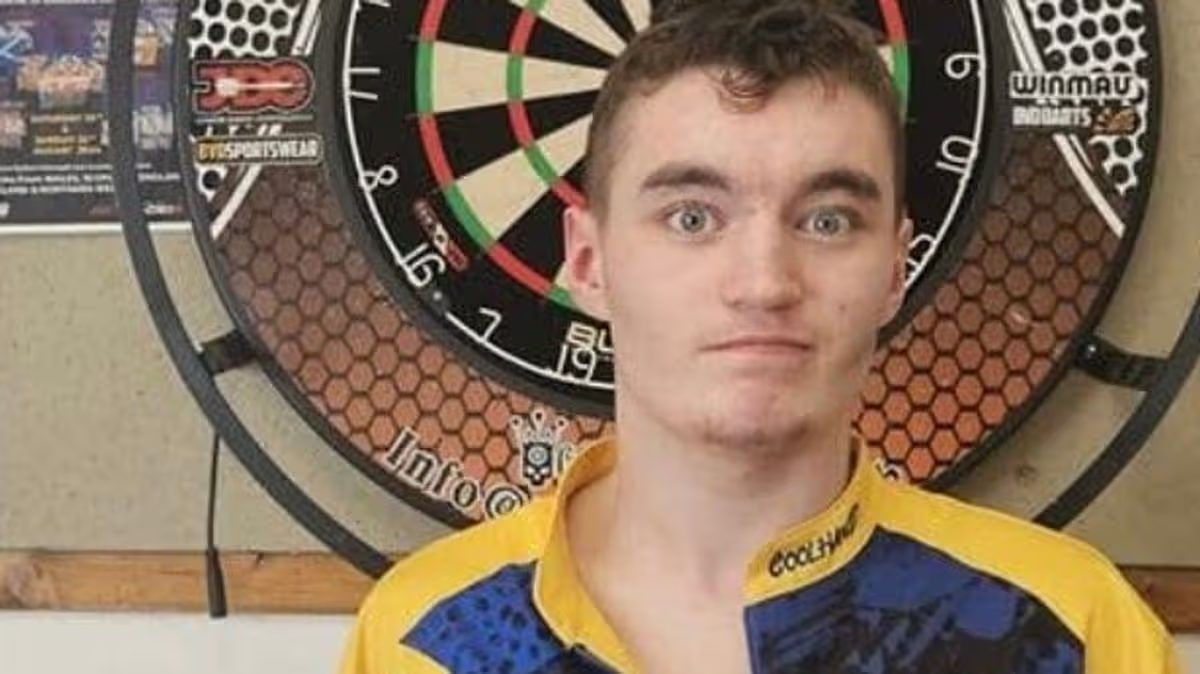
Appearing in the dock, Fowles, with an address on the Larne Road in Carrick, was charged with rioting on 9 June this year.
Advertisement
During a contested application for bail, a police officer outlined how a crowd of masked rioters were attacking police in Carrick on Tuesday evening, hurling masonry and paint bombs at a police Land Rover.
A street had been blocked by bins set on fire in the middle of the road and the court heard that when an inspector opened the door to move one out of the way, a rioter stepped forward and threw a lit petrol bomb through the open passenger door. The petrol bomb ignited and the inspector was set on fire and suffered burn injuries but after it was extinguished, he gave chase to one of the alleged rioters.
Fowles ran across the Marine Highway and into the sea, allegedly discarding gloves and a face covering into the water. The court heard he remained in the water until the Coastguard and his dad arrived to retrieve him.
Although initially arrested, Fowles was released to go to hospital for treatment for a broken arm but following a phone call on Wednesday, he voluntarily presented himself to police.
Advertisement
Submitting that Fowles should be refused bail over concerns about further offending and the risk of further public disorder, the officer added that a remand in custody would send a “strong message to deter others from participating” in further disruption.
Defence solicitor Hamill Clawson, from Reid Black Solicitors, argued that despite the statement of the police inspector, Fowles could not be identified on CCTV footage as taking part in the riot. He told the court that interviewing officers accepted that Fowles could not be seen on the footage.
According to the defendant, he had been watching the disruption rather than taking part when “he was struck with a baton and in fear, he ran and got into the sea”.
Submitting that the sole evidence was the alleged observations of the inspector, Mr Hamill highlighted that in addition to mental health difficulties and a diagnosis of autism, Fowles has a completely clear record so with conditions, he could be granted bail.
Advertisement
District Judge Anne Marshall said while Mr Clawson had made every point that he could, “given the ongoing public disorder, I am satisfied that there is risk of further offending, a risk of harm and public disorder”.
Accordingly, she refused bail and Fowles was remanded in custody with the case adjourned to 9 July.
Today, the UK Defence Secretary John Healey has resigned.
In his resignation letter to the PM, Healey set out his reasons for leaving, telling the PM the defence investment plan “falls well short of what is required for defence and the country at this dangerous time”.
The sixth minister to resign for Starmer’s cabinet in a month, and one of its most loyal, the question will now turn to what lies ahead for the PM.
Advertisement
Adam and Chris are joined by Shashank Joshi Defence Editor of the Economist
You can now listen to Newscast on a smart speaker. If you want to listen, just say “Ask BBC Sounds to play Newscast”. It works on most smart speakers.
You can join our Newscast online community here: https://bbc.in/newscastdiscord
Get in touch with Newscast by emailing newscast@bbc.co.uk or send us a WhatsApp on +44 0330 123 9480.
Advertisement
New episodes released every day. If you’re in the UK, for more News and Current Affairs podcasts from the BBC, listen on BBC Sounds: https://bbc.in/4guXgXd
Newscast brings you daily analysis of the latest political news stories from the BBC. The presenter was Adam Fleming. It was made by Jack Maclaren with Anna Harris and Gabriel Purcell-Davis. The social producer was Joe Wilkinson. The technical producer was . The assistant editor is Chris Gray. The senior news editor is Sam Bonham.
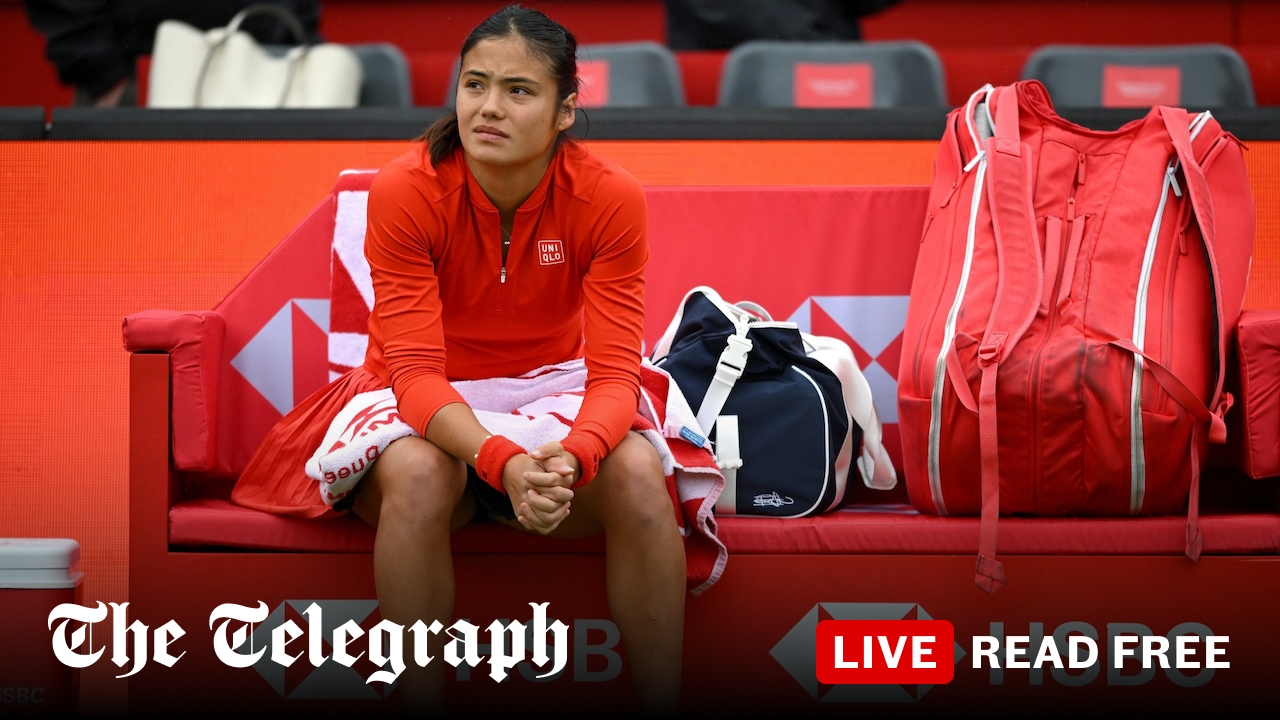
Emma Raducanu and mini resets are as much part of the British tennis landscape as Queen’s and rain delays (Exhibit A: today’s weather in London). But the British No 1 struck a confident figure both during and after her 6-0, 6-3 win over over qualifier Anna Blinkova on Tuesday. Enough to suggest that the green green grass of home may be what her season needed after year of mis-starts, inaction and frustration.
Obviously one match does not make a summer and the real tests are to come, starting with her match against Sorana Cîrstea in west London today. Yet, Raducanu sounded upbeat after the win on Tuesday saying (via writing on a TV camera) that she was happy to be “back home”, hinting at the possibility that this will not be another false dawn.
“Despite not having played a lot of matches, I was really pleased with how I came out and was playing very free,” the world No 42 said. “I think I was just feeding off of the atmosphere, and it felt free, it felt clear, and a lot of clarity. Not necessarily thinking too much, not trying to do too much.
Advertisement
“I love playing on grass. And playing at home, I think it also brings a really good side out of me.”
Raducanu will need all of that “good side” today when she faces Cirstea. The in-form Romanian stands at No 10 in the rankings for this season. And the last time the pair met, in the final of the Transylvania Open in early February, Cîrstea dished out a 6-0, 6-2 thrashing. The mitigating circumstance is that it was around the time when the Briton picked up the virus that has dogged season since.
So today’s match will serve up a useful gauge of where Raducanu’s game is, one that on Tuesday at least, looked to be heading in the right direction.
Stay here for all the action from west London where I imagine people will be doing the opposite of a rain dance (a sun dance?) in a bid to see some action at the famous club.
Anna Kendrick’s psychological thriller is airing on Film4 tonight, and fans have hailed it a ‘masterpiece’ that is ‘scarier than any horror’
19:40, 11 Jun 2026Updated 19:41, 11 Jun 2026
A thriller hailed as a “masterpiece” is set to air on television this evening.
Having originally premiered in 2022, audiences have declared it “scarier than any horror”, making it an ideal late-night watch.
Alice, Darling screens on Film4 tonight, following its world debut at the Toronto International Film Festival four years ago.
Advertisement
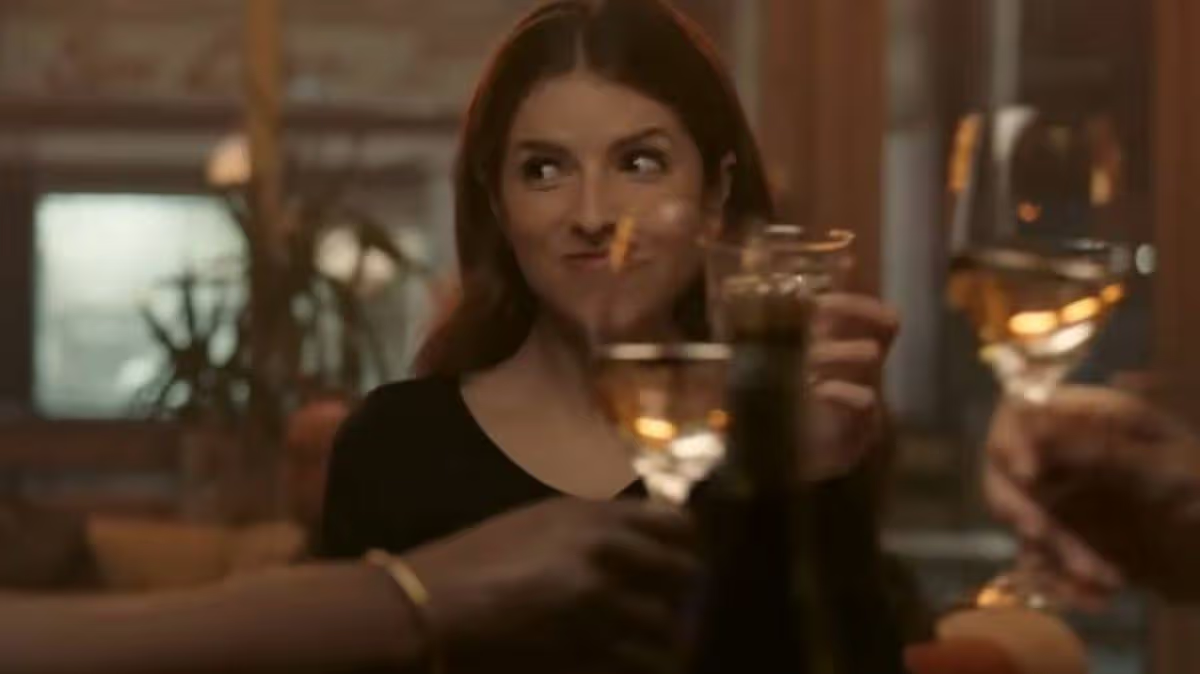
Fronted by Anna Kendrick, the thriller sees the Pitch Perfect star portray Alice, a young woman trapped in a psychologically abusive relationship with her boyfriend Simon (played by Charlie Carrick).
Following candid advice from friends during a holiday — which she has disguised as a work trip — Alice resolves to distance herself from both the relationship and her co-dependency with Simon. However, events take a sinister turn, reports the Mirror.
Upon discovering Alice’s deception, Simon tracks her down to a secluded lakeside cabin, arriving unannounced, his menacing and controlling nature lurking beneath an outwardly charming façade.
The official synopsis reveals: “A young woman trapped in an abusive relationship becomes the unwitting participant in an intervention staged by her two closest friends.”
The cast also includes Kaniehtiio Horn and Wunmi Mosaku as Alice’s friends, Tess and Sophie.
Alice, Darling has been hailed as “very underrated” by fans, with one calling it: “Tremendously well done.” They added: “It will leave you uncomfortable and vulnerable and essentially raw, but the journey, truth and confrontation is more than worth it if you can face and stare and confront the demons within us or around us all.”
Another called it a “mesmerising watch”, while someone else said it was “unquestionably poignant”. One review also read: “The tension and subtlety that Anna plays her role is a masterpiece.”
Advertisement
Another viewer called it “perfect”, as someone else hailed its “underrated brilliance”. Yet another said it was “hard to watch but absolutely worth it,” while someone else called it “scarier than any horror”.
Twilight actress Anna previously revealed how she related to her character in Alice, Darling, after a personal experience with emotional abuse.
She told People Magazine, of recalling the first time she read the screenplay: “I was coming out of a personal experience with emotional abuse and psychological abuse.
Advertisement
“I think my rep sent it to me, because he knew what I’d been dealing with and sent it along. Because he was like, ‘This sort of speaks to everything that you’ve been talking to me about’.”
She went on: “I was in a situation where I loved and trusted this person more than I trusted myself. So when that person is telling you that you have a distorted sense of reality and that you are impossible and that all the stuff that you think is going on is not going on, your life gets really confusing really quickly.
“And I was in a situation where, at the end, I had the unique experience of finding out that everything I thought was going on was in fact going on. So I had this kind of springboard for feeling and recovery that a lot of people don’t get.”
Advertisement
She went on to say that the script was “surprising timing” but she “wasn’t in danger of re-traumatizing myself,” and felt that making the film became “incredible cathartic”.
Alice, Darling airs at 9pm on Film4 on Thursday, June 11.
It is described as being a cornerstone of the community
Bridgend residents have started an online petition against plans to close a Flying Start nursery based in the North Cornelly area.
Advertisement
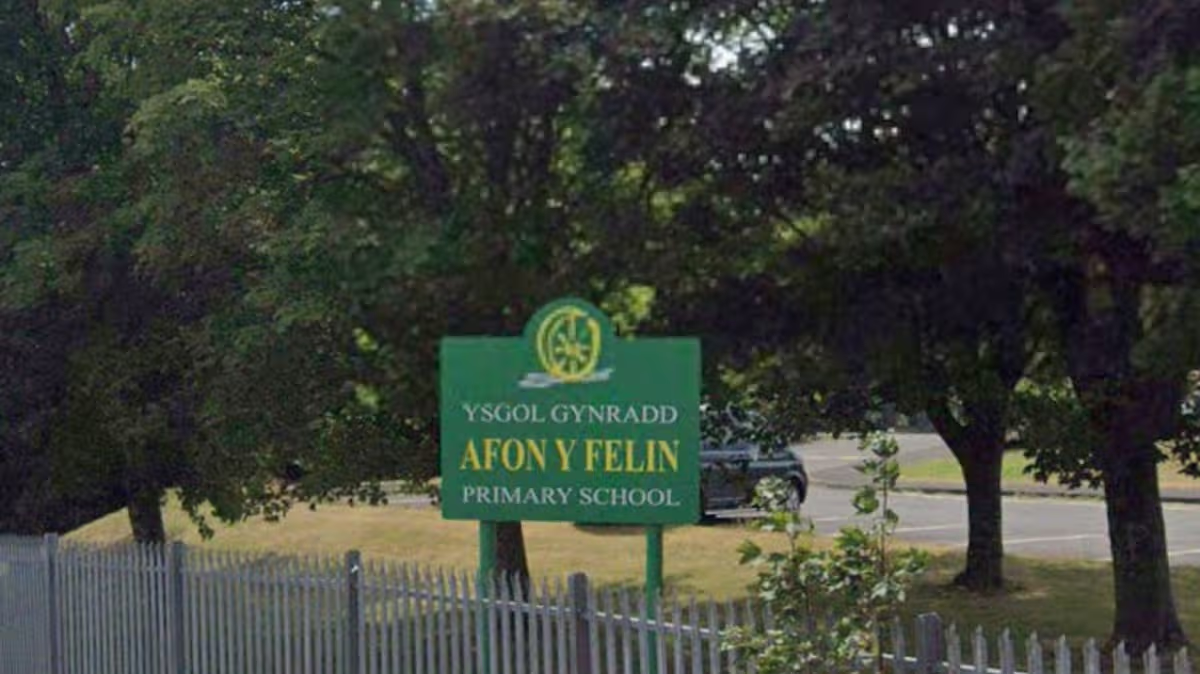
The plans, which would result in the closure of the Flying Start provision at Afon Y Felin Primary school, were decided by Bridgend County Borough Council at a cabinet meeting held in May.
It has led to opposition from local parents who say the decision “threatens the wellbeing” of countless children and families from the area with the facility considered to be a cornerstone of the community. Stay in the know by making sure you’re receiving our daily newsletter.
Flying Start is a Welsh Government-funded childcare programme targeted at children aged 0from birth to three and their families living in identified postcodes in the Bridgend area.
The online petition currently has more than 200 signatures and asks that the authority reconsider their decision to close down the essential local service.
Advertisement
A section of the petition read: “Unfortunately the Afon Y Felin Flying Start is facing potential closure.
“This decision threatens the wellbeing of countless children and families within our community who depend on this establishment for quality nursery education and support.
“It’s not just a nursery; it is a cornerstone of our community, offering a safe space where children can learn, play, and develop essential life skills.
“The closure would lead to loss of jobs for dedicated staff and disrupt the lives of families who rely on this centre.
Advertisement
“It’s proven that early childhood education is crucial in laying the foundation for future success, both academically and socially.
“Denying our children these formative experiences will set them back in their development.”
A council spokesman said the decision to end the Flying Start provision at the site had been made after they were informed the current provider did not intend to retender their contract.
They added there was enough local provision to cover all of the children at the school and would now be writing to parents and carers.
Advertisement
They said: “Bridgend County Borough Council has stepped in and looked at how Flying Start services based at Afon Y Felin Primary could be provided differently in future in the North Cornelly area after being informed that the current provider does not intend to retender for the contract.
“We can confirm that several other approved Flying Start providers are operating within the community, which means that children who currently use the Afon Y Felin scheme will be able to transition across to one of the alternative providers.
“Bridgend County Borough Council is writing to parents who use the Flying Start service based at Afon Y Felin to explain the situation, reassure them that there is enough local provision to cover all of the children, and to offer support in finding and transitioning over to one of the approved alternative Flying Start providers.
“Our aim is to ensure that no child misses out on Flying Start services in the North Cornelly area and to help make the transition to a new provider as smooth and as positive as possible.”
Advertisement
Get daily breaking news updates on your phone by joining our WhatsApp community here. We occasionally treat members to special offers, promotions and ads from us and our partners. See our Privacy Notice.
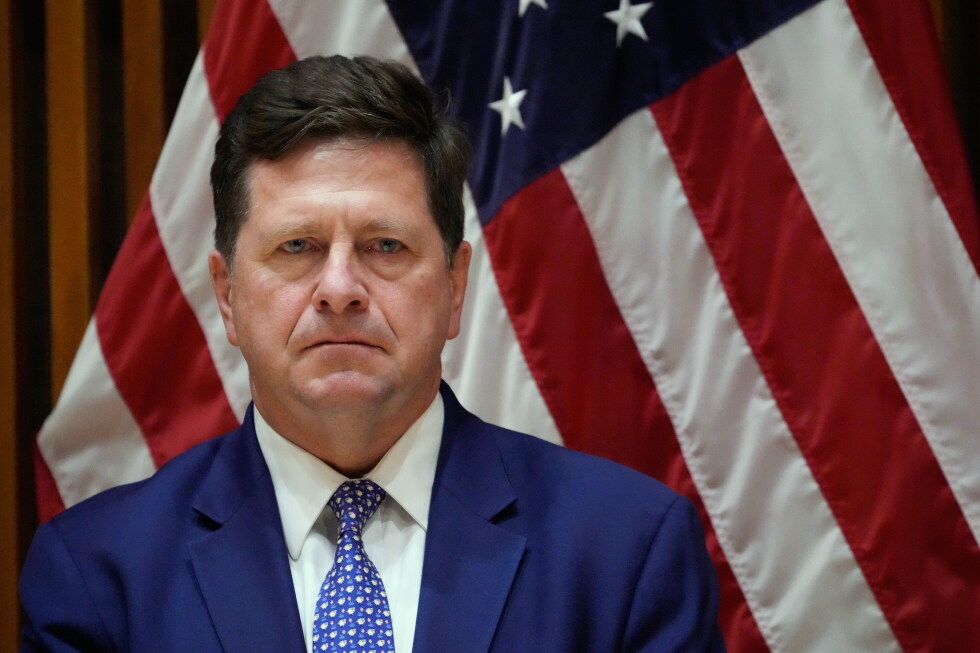
WASHINGTON (AP) — President Donald Trump said Thursday that he plans to nominate Jay Clayton, the U.S. attorney for the Southern District of New York and a former Securities and Exchange Commission chairman, as director of national intelligence.
Trump announced the nomination on social media amid pressure from Congress to name a permanent replacement for Tulsi Gabbard, who resigned last month. Trump faced intense pushback over his decision to name Bill Pulte, head of the Federal Housing Finance Agency, as acting director. The job oversees the coordination of 18 intelligence agencies.
The situation has led to a standoff in Congress after Democrats said they would refuse to renew foreign intelligence powers unless Trump pulled Pulte’s nomination and named a permanent nominee.
“Few people anywhere in the Legal Community are respected at the level of Jay,” Trump wrote. “I encourage the United States Senate to confirm Jay as soon as possible.”
Advertisement
As the U.S. attorney in Manhattan, Clayton oversees the largest and most prestigious of the Justice Department’s prosecution offices, with a vast portfolio ranging from terrorism and espionage cases to security fraud and public corruption.
He took over from interim U.S. attorney Danielle Sassoon, who resigned in February after refusing to carry out orders from the Justice Department to drop corruption charges against Mayor Eric Adams. The case was eventually dropped after prosecutors from Washington submitted a request to a judge.
Republicans hope to move quickly on nomination
Clayton appeared Monday on CNBC’s “Squawk Box,” where he raised questions about the integrity of California’s elections. Trump has claimed without evidence that the state’s slow count in its recent primaries meant the vote was rigged.
“The American people are right to question it,” Clayton said, adding that the delay in results increased the opportunity for fraud.
Advertisement
Senate Majority Leader John Thune, R-S.D., says the Senate could move “fairly quickly” to confirm Clayton as Director of National Intelligence if the White House submits his paperwork soon.
He praised Clayton after Trump said on social media that he would nominate him for the job, saying he has a “great reputation.”
Democrats are holding up the renewal of a key surveillance law, the Foreign Intelligence Surveillance Act, in protest of Trump’s decision to temporarily tap Pulte. They say they won’t support an extension of the law, which expires at midnight on Friday, until Trump withdraws Pulte’s appointment.
Trump previously said Pulte would take over on June 19. It is unclear whether the Senate could move quickly enough to confirm Clayton before that date.
Advertisement
“I don’t know what realistic is, but we’re gonna probe the limits of it,” Thune said.
Connecticut Rep. Jim Himes, the top Democrat on the House Intelligence Committee, said he has “known and respected” Clayton for decades and that had he been tapped as DNI a week ago, “lots of pain might have been avoided.”
“His intelligence, temperament and deep commitment to public service will make him a terrific DNI,” Himes said.
Asked about Clayton’s nomination, Senate Democratic Leader Chuck Schumer said that “Pulte has to go.”
Advertisement
“He cannot be in the DNI role,” Schumer said. “It’s too important.”
Trump’s pick has led SDNY during a tumultuous period
Clayton navigated his way through a 14-month tenure in the Southern District of New York without clashing with the federal judges in the busiest court in the nation, unlike his counterparts in upstate New York and New Jersey. After his interim term expired after 120 days, the judges of the Southern District appointed him as U.S. attorney.
Clayton was sworn in as U.S. attorney in April 2025 on the same day three prosecutors resigned, saying they felt pressured to admit wrongdoing or regret about prosecuting the now-dismissed corruption case against then-New York Mayor Eric Adams.
Then, weeks later, the office had to withstand controversy over the Trump administration’s firing of one of its most respected and successful prosecutors, Maurene Comey. She claims she was fired because of Trump’s dislike of her father, former FBI Director James Comey.
Advertisement
Under Clayton, the Manhattan U.S. attorney’s office facilitated the unsealing of thousands of pages of court records from the prosecutions of Jeffrey Epstein and Ghislaine Maxwell — documents that were made public as part of the Justice Department’s release of records related to the late sex offender and his longtime confidant.
Clayton filed documents with the court explaining the process the government followed in releasing the materials.
Clayton has also overseen the prosecution of former Venezuelan President Nicolás Maduro and Maduro’s wife, Cilia Flores, on drug trafficking charges.
Clayton has overseen cases involving national security threats
Several recent terrorism cases brought by Clayton’s office touch on the global threats and influences that he’ll be navigating if confirmed as director of national intelligence.
Advertisement
They include the May arrest of Mohammad Baqer Saad Dawood Al-Saadi, an Iraqi and Iranian citizen accused of plotting 20 attacks in Europe and Canada and planning to attack a Manhattan synagogue and Jewish centers in Los Angeles and Scottsdale, Arizona, in retaliation for the U.S. war on Iran.
“There are foreign nations and terrorist organizations that see our success as a threat. A threat that they want eliminated,” Clayton said at a recent press briefing. “That is a stark truth.”
“And don’t take my word for it,” he added. “Take their words and their actions. When your enemies tell you something, and when they act, you should know that they mean it.”
The first Trump administration tried in June 2020 to install Clayton, then the chairman of the SEC, as U.S. attorney in Manhattan, but backed down and instead allowed Deputy U.S. Attorney Audrey Strauss to serve in the post. The reversal came after then-U.S. Attorney Geoffrey S. Berman agreed to step down, following assurances that probes into Trump allies would not be disrupted and that Strauss could lead the office.
Advertisement
At the time, the office was looking into dealings by Rudy Giuliani, who was serving then as Trump’s personal attorney, and was also investigating the actions of a state-owned Turkish bank.
Trump doubled down on naming Pulte as the acting director, even though he emphasized it would be a short-term job. The president said he wanted Pulte to downsize the office, which has already been significantly scaled back in his second term.
Gabbard resigned on May 22, citing her husband’s cancer diagnosis.
Trump said last week that he was interviewing five candidates for his pick to lead the agency permanently and that all have national security backgrounds.
Advertisement
___
Neumeister and Sisak reported from New York. Associated Press writers Eric Tucker, Mary Clare Jalonick and Seung Min Kim in Washington contributed to this report.
Emmerdale’s Graham Foster made a surprise return to the Dales in January, but what do fans know about the man behind the character, actor Andrew Scarborough?
Emmerdale legend Graham Foster has lost no time in getting back to his roots in the village following his jaw-dropping return in January.
Advertisement
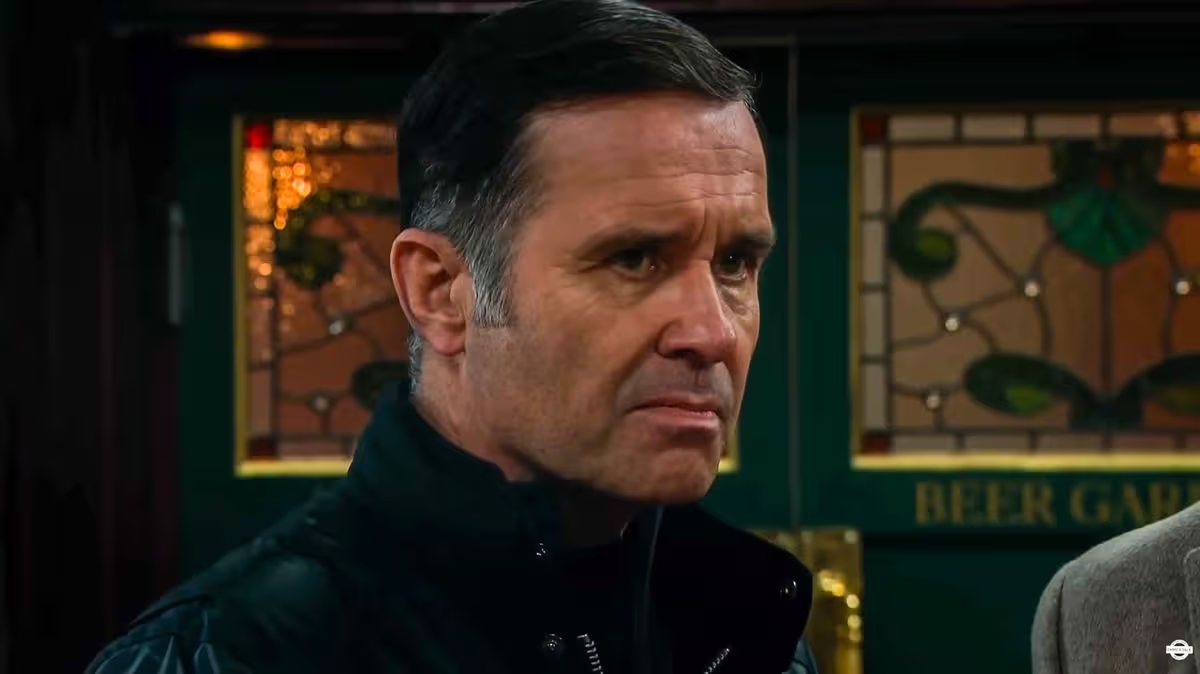
As devoted fans will recall, the much-loved character, portrayed by Andrew Scarborough, was believed to have perished in 2020, before sensationally reappearing during the soap’s crossover with Coronation Street.
Joe Tate (Ned Porteous) was left stunned to find his father figure alive and well, with the pair now residing together at Home Farm. Graham has also attempted to reignite his romance with Rhona Goskirk (Zoe Henry) and has embarked on a fling with Kim Tate (Claire King).
In a compelling twist, viewers are currently witnessing a gentler side to Graham as he takes troubled teenager Kyle Winchester (Huey Quinn) under his wing, following his father Cain’s (Jeff Hordley) battle with prostate cancer, reports the Express.
Reflecting on his comeback, Andrew Scarborough spoke candidly about the surprise of his ITV soap return: “I never expected it at all. Although saying that, I did think that Graham always had a possibility of coming back.”
Speaking about keeping his return under wraps from his nearest and dearest, Andrew, 52, said: “Oh yes, it’s been a big secret, and I kept it mostly quiet from my family, which was tricky.”
He added over who he told: “Oh yes, just a limited few, certainly it is on one hand, in fact I had some cousins who contacted me after it was shown, saying you sod.”
Advertisement
Among Andrew’s family members is his sister, Victoria Scarborough, who is equally a well-established actress in her own right.
Who is Andrew Scarborough’s famous sister?
Victoria, 59, is widely recognised for her portrayal of Ruth Bannerman in The Grand in 1998, Betty MacFell in The Cinder Path in 1994, and Claire Monceau in Charlotte Gray in 2001.
The talented actress has also featured in an extensive catalogue of television programmes, including The Royal, Birds of a Feather, Holby City, Silent Witness, Where the Heart Is, and Heartbeat.
Advertisement
It appears Victoria has since ventured into writing and directing, with the short films Hysteria (2022) and Speed Date (2019).












































You must be logged in to post a comment Login