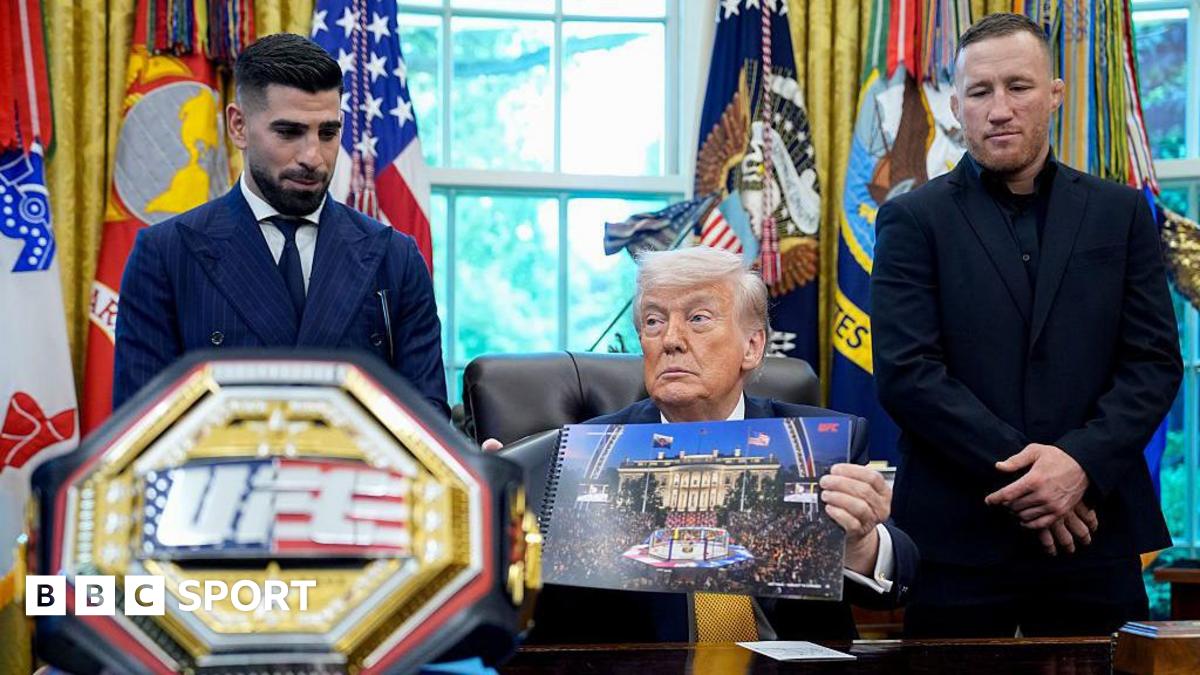


Some tickets for the UFC’s one-of-a-kind event at the White House next month will cost around $1.5m (£1.1m), according to respected MMA journalist Ariel Helwani.
The promotion is set to host a show at the the home of the United States president on 14 June, called UFC Freedom 250, to mark 250 years of American independence.
UFC president Dana White said this week that 4,300 people will watch the event on the South Lawn, most of whom will be members of the military, while 85,000 tickets will be made available for free to members of the public to watch the event at the nearby Ellipse Park.
The remaining numbers will be made up by “high rollers” who will have to pay $1.5m to watch the show as part of a luxury package.
Advertisement
“Partner investment is what it’s being called,” said Helwani.
“This is the offer: UFC Freedom 250, a partner welcome reception, press conference reserved seating, ceremonial weigh-ins, general admission access, Zak Brown concert access, UFC 329 floor tickets, and WWE event integration ring signage.
“It’s a deck being sent out to a lot of influential people, high rollers.”
BBC Sport has asked the UFC for clarification around tickets for the event.
Written by Neil Forsyth (also creator of Brink’s-Mat robbery drama The Gold), Legends balances tension and realism with a measured, slow-burn pace that prioritises character over spectacle. Steve Coogan plays Don, a former undercover police officer tasked with recruiting customs officers to go undercover themselves to infiltrate drug gangs.
Much of its strength rests on the central performance of Tom Burke, whose portrayal of the lead undercover officer, Guy, anchors the series emotionally. Burke brings a quiet intensity to the role, capturing the unease, vulnerability, and moral ambiguity of someone living between identities.
Advertisement
The supporting cast also does an exceptional job, reinforcing the drama’s grounded and realistic tone, capturing the collective pressure, uncertainty and emotional toll of undercover work.
Becoming a legend
Unlike elite operatives, these are everyday officials thrust into extraordinary criminal worlds, making the series not just gripping television, but a sharp exploration of how undercover work reshapes identity, morality and survival.
The title itself is significant. In undercover policing, a “legend” is the carefully constructed false identity, complete with backstory, relationships, habits and a believable past. These identities must withstand intense scrutiny from criminals, meaning success depends on absolute credibility.
Advertisement
In Legends, officers must abandon their real selves and convincingly live as criminals to gain trust. This demands constant performance, producing intense psychological strain as loyalty to the state clashes with the need to belong within a criminal world.
In criminology, this reflects the concept of identity conflict. Undercover officers must operate simultaneously as agents of the law and participants in deviance. Howard Becker’s labelling theory is particularly relevant here: labels do not simply describe behaviour – they shape it.
To be effective, officers must adopt the identity of the “criminal,” often participating in minor illegality or forming close ties with offenders. As former undercover cop Don explains, “Your legend has to come from you, or it won’t work,” emphasising that a convincing undercover identity cannot simply be performed, it must feel authentic and internally lived to be believable.
Psychological unravelling
The result is moral ambiguity, where the line between observation and complicity becomes increasingly unstable. As seen in Donnie Brasco (1997) and The Departed, (2006) prolonged immersion can erode the boundary between professional duty and personal identity, leading not to control, but fragmentation.
Advertisement
Legends appears to centre on this psychological unravelling. These are not distant professionals but ordinary individuals removed from everyday life, required to deceive family and colleagues while facing the constant threat of exposure. This is particularly evident with Guy, who appears increasingly weighed down by the demands of sustaining his legend.
Even in controlled situations, there is a sense of constant vigilance in his interactions – carefully measured responses, restrained body language, and an underlying tension that suggests the effort required to remain convincing. At the same time, brief glimpses of his life beyond the operation hint at growing emotional distance, reinforcing how the undercover role begins to dominate his identity.
Criminologists describe this as role contamination, where it stops being a performance and begins to reshape the real self. The deeper the infiltration, the harder it becomes to return.
The criminal world they enter is equally significant. The series focuses on drug gangs, which links directly to organised crime theory. Drug trafficking organisations are not chaotic groups of offenders, but structured systems with hierarchies, codes of loyalty and mechanisms of control. Trust is currency; betrayal is often fatal.
Advertisement
For undercover officers, success depends on understanding not just who controls the drugs, but who controls fear, respect and power. This aligns with criminal enterprise theory, which argues that organised crime emerges in response to market demand.
Drug trafficking persists because prohibition generates profitable black markets, and criminal groups operate much like businesses within them. In this sense, Legends is not simply about crime, but about parallel economies embedded within society – where criminals may wield more immediate authority than the state.
Legends raises pressing ethical questions about the way undercover policing is conducted. Netflix
In many communities, organised crime groups provide forms of protection, employment and dispute resolution where trust in formal institutions is weak. Drug gangs can become alternative authorities. For undercover officers, this makes infiltration even more complex because they must navigate a world where legitimacy is not automatically attached to the police or the government.
Instead, loyalty may belong to the gang leader who provides security or income. As it goes on, Legends is likely to show how dangerous this balance becomes when officers must earn trust in a system built on suspicion.
Advertisement
Legends also raises pressing ethical questions. Undercover policing relies on deception, manipulation and at times emotional exploitation. Officers may form relationships with people who are unaware they are being investigated, blurring the boundaries of acceptable state power.
If the law depends on deception to enforce itself, where should the limits lie? As films like Sicario (2015) suggest, the pursuit of justice can itself become morally compromised. Legends will probably explore this moral uncertainty, showing that successful infiltration often comes at a personal and ethical cost.
Ultimately, Legends is far more than a crime drama about drug gangs. It is a study of how states confront organised crime by constructing false identities and sending ordinary people into extraordinary danger.
This makes Legends not only compelling television, but also a valuable exploration of policing, identity, organised crime, and the hidden moral costs of state power.
Meetings have taken place between players and Grand Slam representatives. The players have made no progress in their request for benefit contributions, and rejected discussions about the formation of a Grand Slam player council.
Sinner expressed his disappointment at the 9.5% prize money offered by this month’s French Open – as players believe the total sum is still some way below the 22% of tournament revenue they feel entitled to.
The financial pot at last year’s US Open rose by 20%, with the figure for January’s Australian Open nearly 16% higher year on year.
“I think in the next couple of weeks we know also the prize money we’re going to have in Wimbledon,” Sinner said.
Advertisement
“We truly hope that it’s going to be better. Then, of course, US Open. So I do understand players talking about boycott because it’s somewhere we also need to start. It has been a very long time with this.”
Sinner stopped short of committing himself to boycotting one of the Slams.
“Of course, it’s tough to say. I cannot predict the future in a way,” he said.

“It’s the first time that I feel like the players are all in the same scenario and in the same point of view.
Advertisement
“I think it’s also right because without the players, they are not going to happen, any tournaments. In the same time we also know and we respect the tournaments because they make us bigger as athletes.
Marcus Rashford faces an uncertain future as the Manchester United loanee’s stint at Barcelona nears it’s conclusion
15:51, 07 May 2026Updated 15:59, 07 May 2026
Manchester United have been handed fresh concerns that a deal with Barcelona for Marcus Rashford may not be possible due to the La Liga club looking at alternative options. Rashford’s future remains increasingly uncertain as the end of his loan spell at the Camp Nou approaches.
United loaned Rashford to Barcelona after the England international expressed a desire to leave Old Trafford.
There has since been the expectation that Rashford would leave United on a permanent basis this summer, with Barcelona the likely destination. The Spanish giants hold the option of signing Rashford on a permanent deal for £26million, but there have been reports that Barca are yet to hold any talks about a long-term move for the United star.
Advertisement
Get MEN Premium now for just £1 HERE – or get involved in our United WhatsApp group by clicking HERE. You can also join our United Facebook page by clicking HERE and don’t miss out on our brilliant selection of newsletters HERE.
Now, a report from Spanish news outlet Mundo Deportivo has claimed that Barcelona are exploring the left wing market for potential alternatives to Rashford this summer.
One player mentioned as a possible target for Barcelona is Newcastle United star Anthony Gordon, who was recently in the England squad with Rashford and could be international teammates once again at this summer’s World Cup.
Advertisement
The report claims, though, that Newcastle’s asking price of €85million (£73.5million) could prove to be a problem for Barcelona in their hopes of signing the forward Everton star.
Rashford has enjoyed an impressive loan spell at Barcelona this season, scoring 13 goals and providing 14 assists across all competitions.
Barcelona are not the only club to be linked with signing the 28-year-old on a permanent deal this summer, with the likes of Arsenal, Tottenham Hotspur and Aston Villa all mentioned as potential destinations in the Premier League, while Bayern Munich have also seen their name mentioned on the rumour mill.
Sky Sports, HBO Max, Netflix and Disney+ with Ultimate TV package
Advertisement
This article contains affiliate links, we will receive a commission on any sales we generate from it. Learn more
Sky has upgraded its Ultimate TV and Sky Sports bundle to now include HBO Max, Netflix, Disney+, discovery+ and Hayu, as well as 135 channels and full Sky coverage of the Premier League and EFL.
Sky broadcasts more than 1,400 live matches across the Premier League, EFL and more with at least 215 live from the top flight alongside Formula 1, darts and golf.
It remains to be seen what the future holds for Rashford, who will return to United this summer following the conclusion of his loan deal.
Earlier this year, Barcelona president Joan Laporta made it clear that he and the club want Rashford to remain at the Camp Nou on a long-term basis.
“We will try, in Barca’s interest, to ensure that Marcus Rashford can continue with us beyond this season,” Laporta said in March.
Advertisement
“Marcus is performing very well with assists and goals, we’re happy. We could extend the loan further. It depends on what Deco wants
“There are formulas, such as paying part of the buy option to Manchester United and figuring out the rest later.”
At least six people are in hospital, including three Brits, after possible contact with the virus. Three people have died, including a Dutch couple and a German citizen.
Authorities are also searching for seven British nationals who disembarked the hantavirus-hit cruise ship.
Authorities are urgently tracing passengers and crew from a flight between Saint Helena and Johannesburg after a woman on board later died of hantavirus. There were 82 passengers and six crew members on the April 25 flight, and concerns raised by the World Health Organisation about possible human-to-human transmission have increased the urgency of locating them. They said the overall threat still remains low, but concerns about potential transmission are growing. #virus#hantavirus#worldhealthorganization
Some 30 people left the ship at St Helena after the first victim died on MV Hondius, including a woman who also died a few days later in Johannesburg after contracting the virus.
Sign up for all of the latest stories
Start your day informed with Metro’s News Updates newsletter or get Breaking Newsalerts the moment it happens.
Advertisement
During a briefing earlier today, the World Health Organisation (WHO) said cases of hantavirus are expected to rise, so could it be the ‘next pandemic’?
What is hantavirus?
Hantaviruses are a family of rodent-bourne viruses, with each strain tied to a specific host species.
It’s spread when people come into contact with infected droppings, saliva, urine or nesting materials, but is extremely rare, and rarely passed from person to person.
Hantavirus is avirus transmitted by infected rodents causing severe respiratory and hemorrhagic diseases in humans. (Credits: Getty Images)
The incubation period for this illness is generally two to four weeks, according to the government, but can range from as little as two days to as long as eight weeks.
The Andes strain of hantavirus has been spreading across MV Hondius, and it’s been responsible for human-to-human transmission in the past in parts of South America.
What are the symptoms of hantavirus?
Early symptoms of hantavirus are similar to the flu, and include headaches, dizziness, chills as well as abdominal problems like diarrhoea, vomiting and nausea.
If it progresses into Hantavirus Pulmonary Syndrome, patients can experience headaches, dizziness, chills and abdominal problems like nausea, vomiting, and diarrhoea.
Advertisement
If you develop Hemorrhagic Fever with Renal Syndrome, initial symptoms will include intense headaches, back and abdominal pain, fever or chills, nausea, and blurred vision.
If the disease progresses, later symptoms include low blood pressure, acute shock (lack of blood flow), internal bleeding, and acute kidney failure, according to the CDC.
Hantavirus can be fatal, so it’s important to keep an eye on symptoms if you believe you’ve been exposed. There is currently no cure for the disease.
Advertisement
Should we be worried?
While the current outbreak and the rise in cases may be frightening, health officials do not expect the outbreak to be an epidemic.
During a briefing today, WHO Chief Dr Tedros Ghebreyesus said that the organisation is aware of reports of other people with symptoms who may have had contact with passengers from the MV Hondius cruise ship.
More cases may be reported, he said, but WHO stresses that it has assessed the public health risk ‘as low’.
Advertisement
WHO has stressed that the hantavirus outbreak is not similar to coronavirus (Credits: REUTERS)
Meanwhile, infectious disease epidemiologist Maria van Kerkhove stressed during the WHO briefing that the hantavirus outbreak is ‘not the start of a Covid pandemic’ as the virus doesn’t spread in the same way as coronavirus.
Confirming that while the number of cases are on the rise, she added ‘This is not Covid, this is not influenza, it spreads very differently.’
Dr Abdirahman Mahamud, director at the alert and response co-ordination department of the World Health Organisation’s Emergencies Health Programme, highlighted a similar outbreak in Argentina between 2018 and 2019, which led to a total of 34 cases.
Dr Mahamud added: ‘We don’t anticipate a large epidemic. With experience our member states have, and the actions they have taken, we believe that this will not lead to subsequent chain of transmission.’
Passengers with holidays booked this summer have been issued guidance
Brits with holidays booked this summer have been told not to change their travel plans. It comes as thousands of flights have been cancelled across the globe this month amid rising jet fuel prices.
Advertisement
According to data from aviation analytics firm Cirium, 13,000 flights across the world have been cut in May. Although it sounds like a significant number, it equates to only one per cent of global flights, the majority of which are operating outside of the UK.
Only 0.53per cent of the UK’s planned flights have been cancelled, which the UK government states is within the normal range. It highlights that in previous years typically around one per cent of all flights arriving or departing from the UK are cancelled.
Click here to get the biggest stories straight to your inbox in our Daily Newsletter
The Department for Transport; Department for Energy Security and Net Zero; and the Foreign, Commonwealth and Development Office have reassured holidaymakers that there is currently not a jet fuel crisis in the UK and that the Government is continuing to monitor the situation.
Advertisement
In a joint statement they said: “There is no current need for passengers to change their travel plans. UK airlines buy jet fuel in advance, and airports maintain stocks to support their resilience. The government is working closely with the aviation industry to monitor risks and minimise disruption to passengers.
“If your flight is cancelled, you have clear legal rights, including the right to a full refund or re-routing.” Those with holidays booked are urged to check with their airlines before they travel and to check the FCDO travel advice pages for the latest guidance.
Jet fuel prices have soared as a result of the Middle East war and the closure of the Strait of Hormuz. The Government said it has been closely monitoring jet fuel stocks and continues “to plan for a range of contingencies, while focusing on securing a long lasting and workable solution to get shipping flowing freely again through the Strait of Hormuz.”
“If you have a holiday booked in for the coming months – including the May half term – we expect it to go ahead as planned.Whilst there have been reports about cancellations globally, these amount to less than one percent of overall flights.”
On Thursday (May 7), PC Mark Burrows was found not guilty by a jury following a trial at Chester Crown Court which lasted seven days.
PC Burrows had been accused of causing death by dangerous driving after fatally crashing with mum-of-three Heather Smedley in Oldham on December 23, 2022, as he pursued a stolen car.
Now, following his acquittal, GMP have issued a statement defending PC Burrows, saying he is not responsible for the death of Mrs Smedley.
Assistant Chief Constable Chris Sykes said: “Mark Burrows went to work that day like any other day: intent on serving the public and keeping them safe from those who seek to do harm. It is nothing short of tragic that an innocent woman died in the course of those duties.
“My thoughts are with Heather Smedley’s loved ones who continue to mourn her devastating loss. Only one man was responsible for Heather’s death that day and he’s already behind bars.
“The impact of this incident on PC Burrows is lifelong and has been compounded by a criminal investigation. It is important officers are held to account for their actions, but are not fearful of the consequences of putting themselves in harm’s way.
Heather Smedley died two days before Christmas Day (Image: GMP)
“Our highly trained pursuit drivers are some of the thousands of brave and skilled officers who routinely face dangerous and difficult situations to protect the public. They have my full support in continuing to use their specialist training to confront danger and keep you safe.”
PC Burrows was pursuing a stolen Audi A3 on Oldham Road, Heyside, travelling at speeds of up to 80mph.
Doyle overtook several vehicles close to the junction with Otmoor Way, with PC Burrows performing the same manoeuvre. However, at the same time, Mrs Smedley began turning into Otmoor Way.
While the car being driven by Doyle narrowly avoided crashing into Mrs Smedley, PC Burrows’s car fatally crashed into her.
Advertisement
During an emotional testimony, a tearful PC Burrows told the court he believed Mrs Smedley had seen his car and that she was yielding to let him overtake her.
He added that once he realised Mrs Smedley’s car was turning into his path, he immediately hit the brakes.
The Eboracum Roman Festival will take over the city from May 16 to May 31, offering visitors two weeks of immersive history, entertainment, and family fun across various landmark venues.
Organised by York Museums Trust in collaboration with partners including the York Archaeological Trust and York Minster, the festival promises hands-on activities, talks and trails for all ages.
Romans line up in York Museum Gardens (Image: Gareth Buddo)
Clare Alton-Fletcher, participation and learning manager at York Museums Trust, said: “York Museums Trust are delighted to be hosting the Eboracum Roman Festival again along with the ArchaeoYork group of York Minster, York Archaeological Trust, York Civic Trust and the University of York this year, as well as partnering with Uncomfortable York and City Screen for more Roman events.
“The festival always offers a fantastic experience for partners across the city to come together and showcase the best of York’s history to residents and visitors, and we can’t wait to share amazing activities happening across the city with you all.
Advertisement
“The Living History Weekend is going to be a fun-filled celebration; we are beyond excited to have Greg Jenner and Terry Deary with us this year.
“There’s something for everyone throughout the rest of half term too, with lots of Roman-related activities to enjoy at the Yorkshire Museum.”
Roman Soldier in York Museum Gardens (Image: Gareth Buddo)
The Living History Weekend will be held on May 23 and 24 in the York Museum Gardens, featuring a Roman encampment with demonstrations of traditional crafts including weaving, carpentry, pottery and blacksmithing.
Visitors can interact with costumed legionaries, learn about daily life in Roman times and try their hand at some of the crafts.
Advertisement
Military displays by the Ermine Street Guard will showcase Roman formations and weaponry, while an Edible Garden tour on May 23 will focus on plants and herbs used by the Romans for cooking, medicine and even poisons.
Roman camp in York Museum Gardens (Image: Gareth Buddo)
Children can take part in the ticketed Kids Barbaric Battle, dressing as legionaries and charging across the lawn.
Artillery demonstrations will also bring ancient warfare to life.
The festival also features talks by popular authors.
Advertisement
Historian and podcaster Greg Jenner will present a family-friendly talk titled Totally Chaotic History: Roman Britain Gets Rowdy on May 23 at the Yorkshire Museum.
Horrible Histories author Terry Deary will speak on May 24, delivering a talk for audiences aged 16 and over titled Revolting – A Riotous History of Rebellions and Revolutions.
Throughout the weekend, storytelling sessions will include readings by Kate Campbell, author of Vlad and the Roman Triumph, and Stories Alive with their version of The Labours of Hercules.
Visitors can meet authors Simon Turney, Simon Elliot, Paul Chrystal and Alex Gough in the Bibliothēca tent, where they will discuss, sign and sell their books.
Advertisement
York Archaeological Trust, the Roman Bath Museum and the Yorkshire Museum will be in the Archaeology Zone featuring mock excavation pits and hands-on artefact sessions.
Gareth Henry, director of public engagement at York Archaeology, said: “Working in partnership across the city is always such a pleasure.
“The Eboracum Roman Festival is a hit in the city and we’re so excited to be bringing an expanded new archaeology zone to the festival this year and support the Living History Camp in the Museum Gardens.”
Additional events will be held city-wide, including costumed interpreters at York Minster, Roman-themed walking tours, and a city treasure hunt supported by the University of York.
Advertisement
A free symposium exploring Egypt’s presence in Roman York will be held on May 20.
The Yorkshire Museum’s newly opened exhibition Chariots, Treasure and Power: Secrets of the Melsonby Hoard, which showcases the largest deposit of Iron Age objects ever found in Britain, will be highlighted during the festival.
Family activities inside the museum will be included with general admission, including workshops, games and encounters with a costumed Roman.
The festival concludes on May 31 with a screening of the film Gladiator at City Screen.
Advertisement
A schools programme will offer free online resources as well as a livestreamed Roman history session on May 21.
For full details, tickets, and booking information, visit the Yorkshire Museum website.
North will join head coach Brendon McCullum, director of cricket Rob Key and the Test and limited overs captains – Stokes and Harry Brook – in selecting England squads, with some input on the final XI for matches. Performance director Ed Barney and head of player identification David Court are also involved in selection.
North’s brief will include involvement in selection for England Lions, liaising with counties and leading a team of scouts.
Under McCullum, England have often ignored proven performers from county cricket in favour of the players they believe to have the attributes for international cricket. It will perhaps be North’s role to provide balance to England’s methods.
He may only have a limited involvement in the process of choosing a squad for the first Test against New Zealand, beginning at Lord’s on 4 June.
Advertisement
The squad is set to be named in the week beginning 18 May, with an England training camp in Loughborough commencing on 25 May.
In the aftermath of the heavy loss in Australia, Stokes’ team are likely to be looking for a new opener to replace Zak Crawley.
Durham’s Emilio Gay and Somerset’s James Rew would be the leading contenders, and could both be named in the squad for the first Test.
The identity of England’s frontline spinner and seamers to join the fast-bowling department would also be up for discussion.
Advertisement
Around 80 candidates submitted applications for the selector job in April. These were then whittled down by initial conversations, leading to the final interviews.
In inviting applications, the England and Wales Cricket Board (ECB) said it was looking for “significant professional experience and intimate knowledge of international and first-class cricket, including knowledge of emerging players and county network”.
The ECB added that applicants should have “demonstrable experience of informing talent identification”, “a strong understanding of data and analytics within cricket” and “the ability to manage relationships with cricketers at international and county levels”.
As more information continues to unfold surrounding the outbreak of hantavirus aboard a cruise ship, questions about the rare virus continue to arise – including curiosity around how long it takes for symptoms to show up if someone has contracted the illness.
Three passengers aboard the MV Hondius cruise ship have died, and several others were sickened amid the outbreak of the rare family of viruses, most commonly contracted by exposure to rodent urine, droppings or saliva.
“There are over 20 different types of hantaviruses, which are typically spread to humans after inhalation of contaminated rodent droppings,” said Kari Moore Debbink, a teaching professor in the department of molecular microbiology and immunology at the Johns Hopkins Bloomberg School of Public Health in Baltimore.
Advertisement
“Andes is the only type of hantavirus that has been documented to transmit human-to-human with close contact and exposure to bodily fluids,” she told HuffPost.
Debbink explained that health officials are still doing contact tracing to determine what the possible transmission methods were on the cruise ship, but that she believes it was “likely through respiratory secretions, droplets, and/or saliva”.
The ship departed from Argentina on April 1 and was scheduled to include stops in Antarctica and other locations. Three patients – either with confirmed or suspected cases of hantavirus – were evacuated from the ship off the coast of Cape Verde on Wednesday. The ship has since departed Cape Verde and is headed toward Spain’s Canary Islands, The Associated Press reported.
While the outbreak from the MV Hondius is certainly a devastating situation, experts in public health and preventative medicine told HuffPost in an article published earlier on Wednesday that they don’t believe there is a current risk to the general public.
Advertisement
Dr. William Schaffner, a professor of preventive medicine in the department of health policy at Vanderbilt University Medical Center in Nashville, said that the outbreak was a “confined, localised problem” at the moment.
“And, of course, we all have our fingers crossed that that’s how it will remain,” he said.
With so much renewed attention on hantavirus, here’s what to know about the symptoms and how long it typically takes before they start showing up.
Health workers in protective gear arrive to evacuate patients from the MV Hondius cruise ship at a port in Praia, Cape Verde on Wednesday, May 6, 2026.
When do symptoms of hantavirus typically appear after exposure?
Advertisement
Debbink explained that there are several different types of hantavirus, and that they each have different incubation periods.
“However, in this case it’s Andes, which has an incubation period of around one to six weeks,” she said, before noting that one study showed a median time to develop symptoms after exposure was around 18 days, while another study with a smaller sample size showed an incubation period from human-to-human transmission of 12 to 27 days.
It’s unclear if – and for how long – passengers and those exposed to the outbreak will be advised to quarantine.
Pablo Vial, an infectious disease physician at Clinica Alemana at the University of Development in Santiago, told the Science journal in an article published Tuesday that “we don’t really have an established protocol for people who have been exposed to the virus”.
“Then a few days after the initial symptoms, respiratory symptoms including coughing, shortness of breath, shock and fluid filling the lungs can occur,” she said. “It’s fatal in 30-40% of cases that progress to respiratory symptoms.”
Hantaviruses can cause two syndromes: the hantavirus pulmonary syndrome (HPS) or the hemorrhagic fever with renal syndrome (HFRS), according to the Centers for Disease Control & Prevention.
Advertisement
HPS is a deadly disease that affects the lungs with symptoms showing up between one to eight weeks after contact with an infected rodent. HFRS is a deadly disease that affects the kidneys with symptoms typically developing one to two weeks after exposure, the website states.
The CDC explains that the severity of the disease caused by hantavirus depends on the type of hantavirus causing the syndrome. Debbink said, generally speaking, “exposure to hantaviruses is not very common, and Andes virus is only found in South America”.
“Usually the rodents that carry them tend to live in more rural areas,” she said, adding that people who are in contact with rodents or rodent droppings through their work are more at risk, but other people – like a tourist hiking in a rural area, for example – can also be at risk.
As for the U.S., the Sin Nombre virus is the most common hantavirus in the country and it’s mostly in the Southwest, Debbink explained.
Advertisement
“So people can be more/less at risk based on where they live,” she said.
When Sir David Attenborough was born in 1926, George V was on the throne, Stanley Baldwin was in Downing Street, and the BBC, the institution where he would spend many productive decades, was, itself, still in nappies.
Over the years, Attenborough has become the face and voice of natural history the world over. From chasing animals through jungles and deserts, to observing the myriad changes to our ecosystem in his near century on planet earth, Attenborough has been a guide through the wild citizens and untouched places of our world.
Here, ahead of his 100th birthday this week, we look at some of the moments from his televisual oeuvre that have defined Attenborough for generation after generation.
Attenborough and the puffins, Wild Isles
Advertisement
As the years have gone by, Attenborough’s forays in front of the camera have become increasingly rare. Appearing in 2023’s domestic-focused Wild Isles, Attenborough sits amid a colony of Pembrokeshire puffins. “Never has there been a more important time,” he implores the audience, “to invest in our own wildlife.” In its accessibility and urgency, it shows a man still, somehow, in his prime.
Attenborough and the leatherback, Blue Planet II
David Attenborough and a leatherback turtle on ‘Blue Planet II’ (BBC)
At the ripe age of 91 years old, Attenborough could’ve been forgiven for reclining on a beach in the Caribbean. That he would do so, back in 2017, in the moonlit company of leatherback turtles is typical of the man. “Whoops,” he exclaims, with a half-chuckle, as a giant leatherback turtle prepares to lay her eggs. All that’s missing from the scene is a striped beach towel and pina colada.
Attenborough vs curling at the Winter Olympics, Radio 1
Attenborough’s voice and intonation make him ripe for parody, a fact he made light of when appearing on Greg James’s Radio 1 show back in 2014. Lending his dulcet tones to the women’s curling event at the Winter Olympics, he narrated proceedings in trademark fashion. “The frisking is frantic,” he said, as the stone slid down the Sochi ice, “and often futile.” The seriousness of his voice paired with the lack of self-importance has been key to his success (both as a sports commentator and, more often, a wildlife presenter).
Advertisement
Attenborough on Raine Island, Planet Earth III x Zoo Quest
“As far as I know,” Attenborough told viewers, during 2023’s Planet Earth III, “I was one of the first people to film on Raine Island, back in 1957.” It was 66 years ago when Attenborough first set foot on this coral cay in the Great Barrier Reef to witness the world’s largest population of green turtles for an episode of his show Zoo Quest. Reflecting on this so many decades later, with the same issues at stake, is a remarkable feat of both zoological and televisual longevity.
Attenborough and sloth, The Life of Mammals
David Attenborough saying ‘boo!’ to a sloth in ‘The Life of Mammals’ (BBC)
In 2002, Attenborough was back to his roots as a hands-on zoologist for this 10-part series about earth’s dominant animal class. But it was an intimate interaction shared with a sloth (“the most extraordinary plant predator”) that captured viewers’ imaginations. “Boo!” he says to the sloth, with somewhat uncharacteristic playfulness. The central American herbivore looks back at the naturalist, stretching its head out in measured curiosity, and for a beautiful moment it’s ambiguous as to who is scientist and who is subject.
Attenborough vs python, Zoo Quest
Advertisement
Back in the 1950s – long before bravura herpetologists had turned snake wrangling into a TV artform – a young Attenborough found himself in Indonesia, face to face with an enormous python. Not much older than 30, Attenborough already possessed that recognisable voice of his – but what is utterly unrecognisable is the figure nimbly scuttling up a tree, khaki shirt unbuttoned to reveal a rippling torso. The conscientious tone that would come to typify Attenborough’s later narration is entirely absent as he stuffs the python’s head into a burlap sack and grins for the camera in his moment of triumph.
Attenborough at Glastonbury 2019
Watch Apple TV+ free for 7 day
New subscribers only. £9.99/mo. after free trial. Plan auto-renews until cancelled.
ADVERTISEMENT. If you sign up to this service we will earn commission. This revenue helps to fund journalism across The Independent.
Advertisement
David Attenborough addressing the Glastonbury crowd in 2019 (Maja Smiejkowska/Shutterstock)
Bob Dylan, Radiohead, Jay-Z: all the biggest acts in the world have played the Pyramid Stage at Glastonbury. So, it was oddly fitting when, in 2019, this titan of the natural world took prime position at Worthy Farm to give a rousing speech about the festival’s accomplishments in divesting itself of plastic. “This great festival has gone plastic-free,” he told the enormous crowd. “That is more than a million bottles of water that have not been drunk by you in plastic bottles.” The roar that greeted the nonagenarian’s rather banal appearance was the sort usually reserved for teen idols or ageing rock superstars.
Attenborough and the Cargo Cult, The People of Paradise
It’s not unfair to say that David Attenborough walked so that men like Bruce Parry and Anthony Bourdain could run. In 1960’s The People of Paradise, a youthful Attenborough deviated from his zoological background for a sojourn in the cultural anthropology arena. His episode amongst the Cargo Cult of Vanuatu, who worship a mystic figure called “John Frum” is particularly excellent. Watching it in 2023 is a good reminder of how much smaller the world seemed when Attenborough first began broadcasting.
The clever killer whales, Frozen Planet II
One of Attenborough’s key skills as a narrator is his ability to read meaning into animal behaviours, parsing them for a lay (read: human) audience. One of the most striking examples came during 2022’s Frozen Planet II. A pod of killer whales swim in formation to create waves that displace a delicious, succulent seal skulking safely on an ice floe. “It’s an ingenious solution,” he says, with almost grandfatherly pride, as the whales rip the seal to smithereens and sup on its exquisite blubber.
Advertisement
Lizard vs snakes, Planet Earth II
There’s nothing audiences love more than the rare moments when the animal kingdom pits one species against another. The best example of this, in recent years, comes from 2016’s Planet Earth II. A death match is waged between a lizard – sprinting through the desert as though it’s in Mad Max – and countless deadly snakes. This was one of the first clips from an Attenborough documentary to go viral on social media, aided by a legendary slot on Channel 4’s Gogglebox.
Attenborough and the Queen, The Queen’s Green Planet
When David Attenborough met the Queen (ITV)
ITV really bagged the big guns for its 2018 documentary, The Queen’s Green Planet. David and Elizabeth, the nonagenarians, who were born just a couple of weeks apart in 1926, were filmed going for a pleasant stroll in the gardens of Buckingham Palace. The conversation itself isn’t exactly scintillating – the Queen compares a variety of trees to her awful children – but there’s something pleasing about the sight of these two figures, both of whom had acquired living (at the time) legend status, pottering around the garden.
Attenborough and Obama, 2015
Advertisement
In his later years, Attenborough began to transition from naturalist to campaigner. In 2015 he sat down in the Oval Office with then-President Barack Obama to discuss life on our “blue marble”. The two discuss the renewable energy transition, population urbanisation and educating children about the natural world. But what’s most striking, perhaps, is that both these men look infinitely more statesmanlike than those politicians now convening at COP after COP to talk about these same issues.
Attenborough and Lonesome George, Galapagos 3D
“This is the rarest living animal in the world,” whispered Attenborough, as Lonesome George, the last Pinta Island tortoise, crawled beside him. Attenborough’s 2013 series Galapagos 3D – made during the short-lived 3D fad – saw him get up close and personal with a creature who, having been born in 1910, made the silver-haired presenter look like a spring chicken. Even more remarkably, the tortoise died a fortnight later at the age of 102, making it his last on-camera interview. Attenborough was not, to my knowledge, questioned in connection with the tortoise’s death.
Attenborough and the mountain gorillas, Life on Earth
Advertisement
Probably the most instantly recognisable on-camera sequence from Attenborough’s decades at the BBC, this 1979 encounter with mountain gorillas at Dian Fossey’s sanctuary in Rwanda is a remarkably tactile piece of broadcasting. These huge apes – who could comfortably rip his face off and use it as a banana dish – start to tussle with the presenter in the foliage. Rather than run for his life, Attenborough submits, even grinning broadly as two baby gorillas remove his shoes. For a man best known to a whole generation as a disembodied voice, it is a wonderfully corporeal moment.
Attenborough and the baby rhino, Africa
David Attenborough and a rhino in ‘Africa’ (BBC)
What’s better than a full-sized rhino? A baby one, of course! On all-fours in the African savannah, Attenborough comes face to face with a pint-sized rhinoceros. They squeak at one another, the older man replicating the younger mammal’s juvenile calls. “Enchanting creature,” Attenborough muses afterwards, but that shot of them locking eyes – one gnarled and wrinkled by evolution, the other craggy and lined with age – remains iconic. It is a moment not of enchantment, but of fraternity.
Attenborough’s butterfly, Micro Monsters
Big cats, giant snakes, great apes: these showstopping animals might take the headlines, but Attenborough is as adept working on a far smaller canvas. There is no more poignant example of this than a scene from 2013’s Micro Monsters, in which a butterfly lands on the presenter’s index finger. The insect seems to hold its poise while Attenborough delivers his trademark narration, his eyes staring inquiringly at the patterned wings just a few inches from his face.
Advertisement
Attenborough’s orangutan, Zoo Quest
Zoo Quest, the show that made Attenborough’s career as a presenter, was based on a premise that now seems wildly dated: the staff of London Zoo, and the BBC, travel the world to capture animals for the site’s permanent collection. All the same, the show introduced the British public to far-flung locales and their equally eye-catching denizens. The highlight is, perhaps, the search through Indonesia for an orangutan. Tracking discarded fruit on the floor, Attenborough spots their distinctive orange fur through the foliage. The ape proceeds to hang there “screaming and breaking off branches to throw down at [Attenborough]”. Fair enough – anything to avoid a trip to 1950s London.
Attenborough at COP26 2021
With Britain hosting COP26, the global climate change summit, it was natural that the organisers would turn to the nation’s most respected voice on issues of the natural world. Opening the summit in Glasgow, Attenborough delivered a rousing speech against a backdrop of dramatic images of planet earth – together with illustrations of humanity’s impact on it. “If working apart we are a force powerful enough to destabilize our planet,” he told attendees of the conference, “surely working together we are powerful enough to save it.” At a conference famous for half-measures and backroom deals, it was a spine tingling moment of public performance.
Advertisement
Dancing with the capercaillie, The Life of Birds
The capercaillie – the horse of the wood – is the world’s largest grouse. Up in Scotland, Attenborough gets up close with the local alpha male. “He is so charged up,” Attenborough observes wryly, as the bird, tail feathers standing erect, bears down on him. Moments later, the capercaillie has, somewhat over-dramatically, knocked the long-in-the-tooth presenter to the ground. “Now, now!” he exclaims, with a chuckle, as the beak of the capercaillie rattles with indignation.
Attenborough, tortoise and Graham Norton, The Graham Norton Show
David Attenborough jokingly narrating raunchy tortoise video on ‘The Graham Norton Show’ (BBC)
Attenborough has a long association with animals mating. “Does it get to the point where you just feel like an old perv?” asked Graham Norton when the esteemed knight of the realm sat on his red couch in 2012. Attenborough was a fixture of talk shows, from Parkinson to Friday Night with Jonathan Ross, and a very good sport. Following his cheeky enquiry, Norton made Attenborough provide his trademark narration to grainy video footage of a tortoise attempting to have its way with a rubber Croc. “The humble tortoise gently mounts his chosen mate,” Attenborough says soberly, “in a dance as old as time itself.”
Evil shoebills, Africa
Advertisement
Attenborough’s reassuring voice was often utilised to good effect in heart-warming stories of survival against the odds, but it could also run counter to that grain. There’s no better example than in 2013’s Africa, when two shoebill chicks start to fight in their mother’s absence. “This is more than scrap between two siblings,” Attenborough growls, as the comically grotesque shoebill bites at its runty brother’s neck. “It reveals a dark side.”
Lions vs elephant, Planet Earth
The BBC’s Natural History unit has always been at the cutting edge of technological developments. Underwater photography, drones and infrared are now staples of their broadcasts. Back in 2006, for the first series of Planet Earth, the team caught an extremely rare natural event using what was then considered state of the art technology: night vision. “They’re specialist elephant hunters,” Attenborough says of a pack of lions chasing their next meal, using narration sparingly as audiences bear witness to the elephant being dragged to the ground. He concludes, with trademark pragmatism, that “this elephant will feed the whole pride for at least a week”.
You must be logged in to post a comment Login