

Crypto World
US Treasury Quietly Demands Binance Comply With Monitoring Deal

Regulatory scrutiny around Binance has intensified as reports emerge that the US Treasury privately insisted the crypto exchange adhere to an independent monitoring program established under a 2023 settlement with US authorities. The Information, citing internal communications, said the demand followed disclosures that funds potentially tied to Iran flowed through Binance, prompting renewed pressure from lawmakers and regulators to demonstrate ongoing compliance and effective controls. The episode arrives amid broader enforcement activity tied to Binance’s US and international operations and the evolving regulatory framework governing crypto firms.
Binance has publicly asserted its commitment to compliance, telling Cointelegraph it would cooperate with the independent monitor and maintain transparency as it strengthens anti-money-laundering and KYC controls. The remarks came as executive leadership faced renewed questions about governance and continued access to global liquidity for Binance.US, the firm’s U.S. affiliate, as authorities reassess cross-border oversight in the sector.
Key takeaways
- The US Treasury is reported to have privately required Binance to comply with a three-year independent monitoring program that was part of a 2023 settlement with Treasury and the Justice Department, according to The Information.
- The settlement in 2023 involved a $4.3 billion payment and established ongoing monitoring overseen by government officials; the new reporting emphasizes continued regulatory oversight even after the initial accord.
- Allegations that as much as $1 billion flowed through Binance to Iran-linked entities prompted renewed scrutiny and reports that Binance dismissed staff who flagged those transfers, underscoring enforcement focus on sanctions evasion risk.
- A group of US senators reportedly urged Treasury Secretary to detail Binance’s adherence to the 2023 settlement, reflecting legislative concern about compliance and sanctions enforcement within the industry.
- Binance’s response stressed cooperation with the monitor and ongoing collaboration with agencies, framing oversight as a mechanism to strengthen AML/KYC controls.
- Comments by former Binance CEO Changpeng Zhao at the Consensus conference in Miami highlighted his stance on leadership roles and broader liquidity considerations, while filings show legal actions related to the company’s AML regime in the 2023 settlement.
- Regulatory and geopolitical context remains volatile: Zhao’s legal exposure and the involvement of U.S. political figures intersect with cross-border policy developments, including potential implications for MiCA-era standards and cross-jurisdictional enforcement.
Regulatory oversight and monitoring obligations
According to The Information, the 2023 settlement between Binance, the US Treasury, and the US Department of Justice required Binance to operate under an independent monitoring program for a three-year period. The program was designed to assess and verify the firm’s compliance with sanctions, AML, and counter-terrorist financing obligations, with oversight to be conducted by government-appointed officials and an independent monitor. The reported private demand from the Treasury to continue strict adherence to that monitoring framework underscores the persistence of sanctions enforcement risk for large crypto platforms operating on a global scale.
The same reporting raises questions about the efficacy and reach of such monitors in a rapidly changing regulatory environment. The tied disclosures of a $4.3 billion settlement illustrate the scale of the settlement and the severity of expectations for ongoing compliance enforcement. For institutions and banks interacting with crypto entities, the situation reinforces the importance of robust due diligence, continuous monitoring, and clear line items in sanctions screening and AML/KYC programs to address cross-border risk, especially where sensitive jurisdictions are involved.
Beyond the financial penalties, the unfolding narrative includes congressional attention. A group of US senators reportedly urged Treasury Secretary to provide a formal update on Binance’s adherence to the 2023 settlement—the type of oversight activity that can influence licensing prospects, agency cooperation, and the perceived reliability of centralized exchanges in meeting U.S. regulatory standards. The reporting environment signals a tighter coupling between enforcement actions and regulatory transparency obligations for major crypto platforms.
Binance, for its part, emphasized cooperation with the monitor and with regulatory authorities. A spokesperson told Cointelegraph that the firm views oversight as an “important part of continuously strengthening our compliance and anti-money laundering controls,” and that Binance intends to provide the monitor with “full cooperation and transparency.” The emphasis on ongoing collaboration aligns with a broader regulatory expectation that major exchanges demonstrate verifiable compliance capabilities rather than relying solely on post hoc remediation.
Executive responses and leadership perspectives
The Information’s reporting on regulatory oversight coincided with Changpeng Zhao’s appearance at the Consensus conference in Miami. Zhao, who stepped down as Binance CEO in November 2023, has publicly signaled a cautious stance toward the future of leadership in the crypto sector. He told attendees that while he had been “trying to avoid” the United States, he did not rule out strategic moves to preserve user access to global liquidity, including the possibility of reviving Binance.US as a channel to maintain broader liquidity flows. He also rejected the notion of taking a leadership role at another crypto company, describing himself as a “one-trick pony.”
Legal and regulatory developments surrounding Zhao and Binance have continued to unfold through public filings and enforcement activity. Regulatory documents indicate Zhao pleaded guilty to a single felony charge related to failure to maintain an adequate anti-money-laundering regime at Binance as part of the 2023 settlement. While the specifics of the legal matter and its implications are subject to ongoing litigation and procedural developments, the admission underscores the lasting regulatory risk profile associated with major crypto exchanges and their executives.
Further complicating the public narrative is a report that Zhao’s ties to political and business developments have attracted attention beyond the U.S. regulatory sphere. In a separate thread of coverage, reports have highlighted high-profile investments and potential political entanglements that have, at times, intersected with regulatory discourse. The conversation around enforcement, leadership, and governance remains salient for institutional stakeholders evaluating exposure to exchange-level risk and compliance obligations.
Legal actions, enforcement context, and policy implications
The enforcement trajectory surrounding Binance encompasses a confluence of U.S. authorities, cross-border considerations, and internal governance decisions. The 2023 settlement’s legal framework—which included a substantial monetary penalty and the imposition of a monitoring regime—serves as a reference point for how authorities are likely to evaluate ongoing sanction compliance, AML controls, and corporate governance in the crypto sector. The reported guilty plea by Zhao, while tied to the same settlement, adds a personal accountability dimension to the broader regulatory narrative and may influence how future settlements are structured, disclosed, and monitored.
The regulatory cross-currents extend to policy conversations around market structure and licensing. In the European Union, developments tied to the Markets in Crypto-Assets Regulation (MiCA) are shaping standards for licensing, supervisory oversight, and cross-border enforcement. While the U.S. and EU frameworks differ in emphasis and approach, the underlying objective is consistent: ensure robust AML/KYC controls, transparent governance, and credible sanctions enforcement for entities operating in or with the crypto ecosystem. The Binance case thus sits at the intersection of ongoing U.S. enforcement initiatives and the broader global push toward harmonized, regulatorily coherent crypto markets.
The political dimension also factors into risk assessment. Reports of ties between Binance and high-profile political or business actors have fed scrutiny from lawmakers and regulatory observers. While investigators pursue specific regulatory obligations and sanctions compliance, the broader policy implication is clear: as enforcement actions evolve, institutions must weigh the implications for licensing trajectories, correspondent banking relationships, and the ability to provide compliant, regulated access to digital assets on a global scale.
For practitioners and compliance teams tracking regulatory developments, the key takeaway is that the Binance case illustrates a persistent demand for verifiable compliance evidence, continuous monitoring, and transparent remediation plans. The combination of a major settlement, a dedicated monitoring regime, and ongoing congressional engagement creates a framework in which crypto firms must demonstrate durable AML/KYC capabilities, rigorous sanctions screening, and governance that withstands scrutiny from multiple authorities across jurisdictions.
Closing perspective
The evolving narrative around Binance underscores the critical importance of verifiable compliance infrastructure for large crypto platforms operating on global rails. As regulatory expectations sharpen and enforcement tools expand, institutions should monitor not only the outcomes of specific investigations but also how monitoring, governance, and cross-border cooperation evolve within the broader policy environment. The next steps—clarity on monitoring outcomes, additional regulatory disclosures, and any potential licensing adjustments—will likely shape the credibility and resilience of major exchanges in a tightening regulatory landscape.
Notes and attribution: The reporting environment draws on The Information’s coverage of the Treasury’s posture toward Binance’s monitoring program, and on Cointelegraph’s reporting and coverage of Binance’s public statements and Zhao’s remarks at Consensus. For reference, The Information article is linked here, and Cointelegraph’s coverage is cited where relevant in ongoing updates.

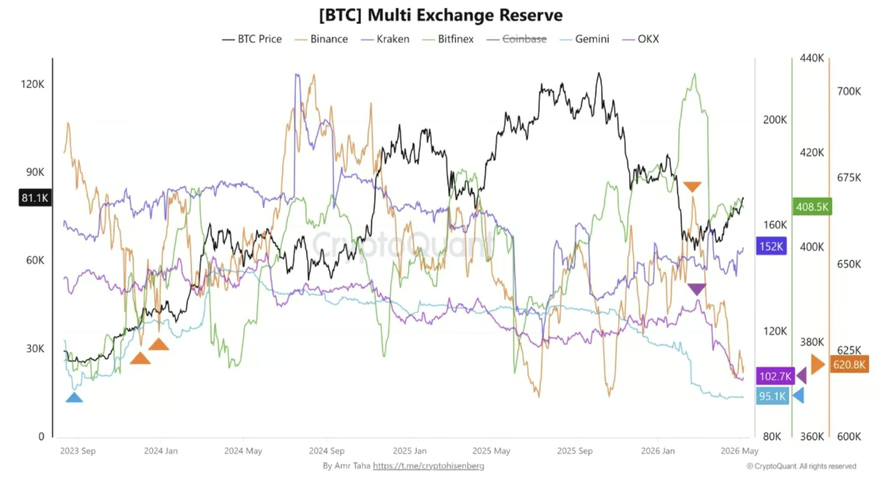
Bitcoin (BTC) reserves on major crypto exchanges have dropped to their lowest level since 2023, with nearly 100,000 BTC withdrawn from Binance, OKX and Gemini in less than three months.
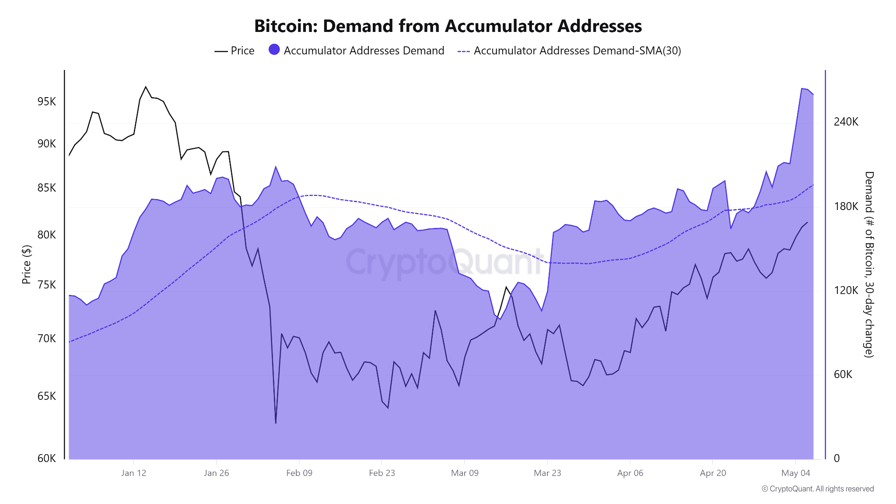
The outflows coincided with stronger demand from accumulator addresses, as the cohorts’ holdings have increased by 60.5% over the past two weeks.
Bitcoin exchange reserves fall to two-year low
Crypto analyst Amr Taha noted that Bitcoin reserves on Binance, OKX and Gemini have declined sharply since February. Binance recorded the largest drawdown, with reserves dropping to nearly 620,000 BTC on May 7, down from roughly 670,000 BTC on Feb. 21. The decline pushed Binance’s holdings below levels last seen in December 2023.
OKX followed the same trend. Its Bitcoin reserve fell to around 102,000 BTC this week, from nearly 132,000 BTC on March 2. Gemini also posted steady outflows, sliding to 95,000 BTC from 114,800 BTC in early February.
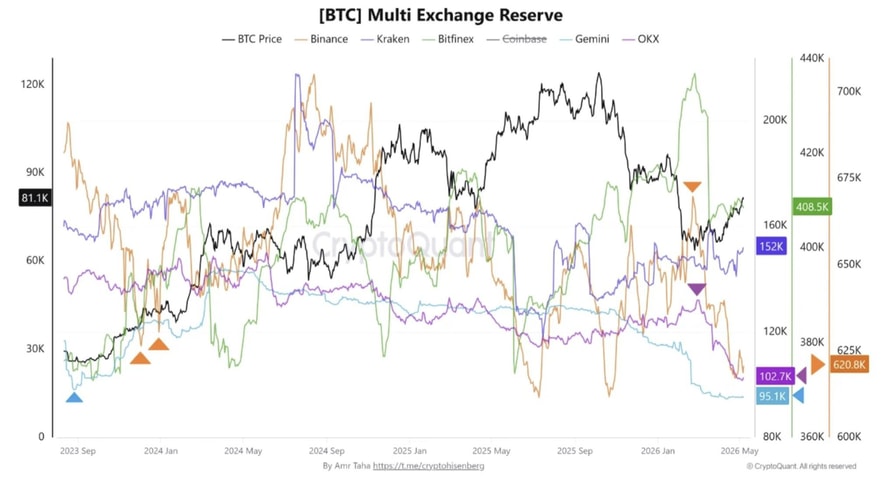
BTC multi-exchange reserves. Source: CryptoQuant
Combined, the three exchanges recorded an outflow of nearly 100,000 BTC, valued at over $8 billion at current prices.
Taha noted that a synchronized decline across multiple exchanges carries more weight than isolated outflows from a single exchange. Fewer coins on trading platforms can amplify the price reaction when strong spot demand returns.
The move coincides with a shrinking OTC balance. Lower OTC balances can reduce the amount of Bitcoin available for large private transactions outside exchanges.
The latest 30-day OTC balance change showed a net decline of 24,940 BTC, while the same metric had risen to nearly 25,300 BTC on Feb. 8 after Bitcoin’s drop toward $60,000. The reversal shows that OTC supply inflows have slowed significantly since the February sell-off.
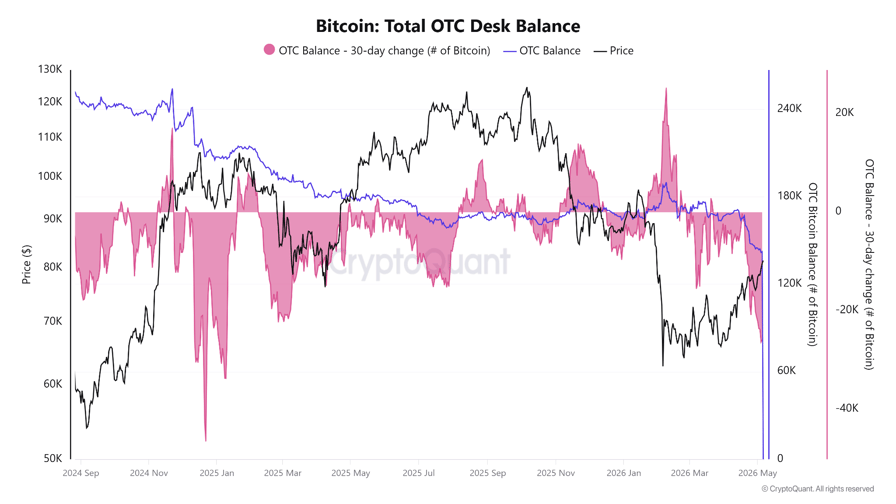
Bitcoin total OTC desk balance. Source: CryptoQuant
Related: Bitcoin Bollinger Bands push key breakout as creator acts on positive signal
“Accumulator” demand rises as Binance buyers turn positive
Long-term participants increased their Bitcoin accumulation during the latest recovery phase. CryptoQuant data shows demand from accumulator addresses climbed to 264,000 BTC on May 6, up from 164,440 BTC on April 23. The same metric fell to nearly 100,000 BTC on March 15, after peaking above 205,000 BTC on Feb. 5.
Bitcoin demand from accumulator addresses. Source: CryptoQuant
The increase in accumulation coincided with Bitcoin’s recovery toward $82,800, indicating stronger buying activity by long-term holders during the recent price advance.
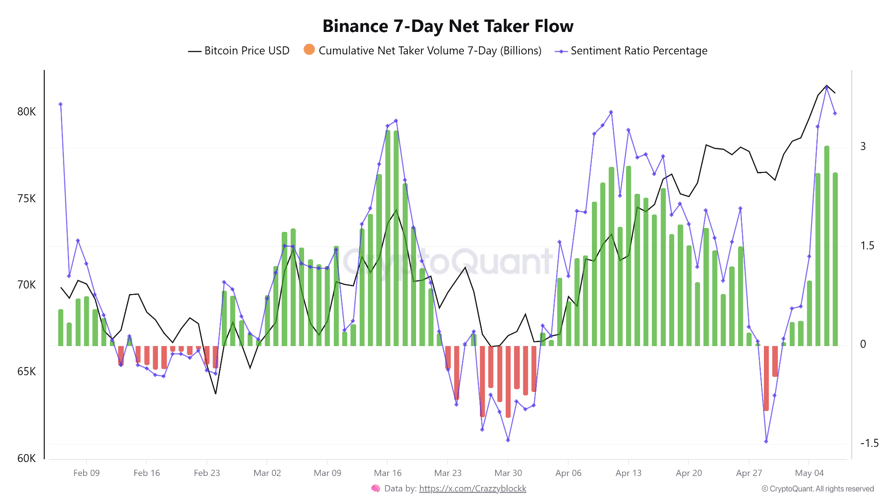
Derivatives activity also strengthened during the recent rally. Binance’s seven-day net taker volume moved from approximately -$1 billion (seller-dominated) in late March to +$2.63 billion (buyer-dominated) on Thursday.
Binance’s seven-day net taker volume for BTC. Source: CryptoQuant
Related: VanEck’s Sigel sees Bitcoin reaching $1M within five years

Coinbase said on Friday its markets are being placed in “cancel only” mode but will begin to re-enable trading “shortly.”
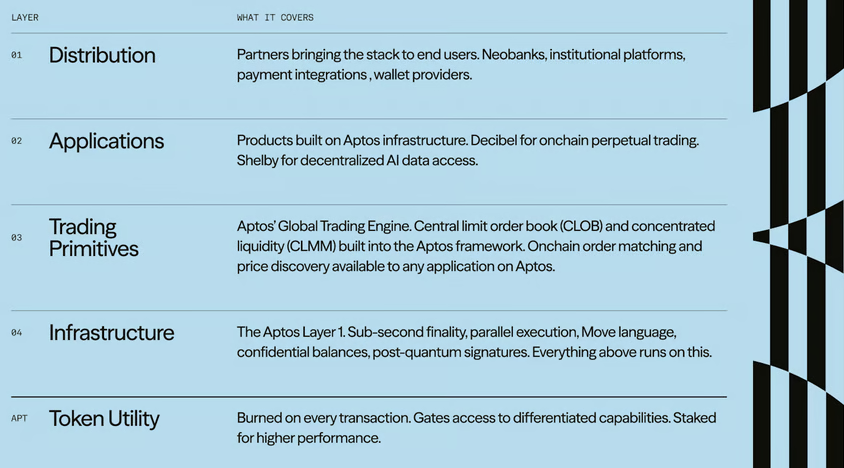
Aptos Foundation and Aptos Labs have committed $50 million to Aptos development, with a particular focus on AI agent infrastructure and research, including support for two products it shipped last year to meet rising demand for onchain AI agent activity.
Those products include Decibel, an AI-powered onchain order book and perpetuals exchange that launched on the Aptos mainnet in February, and Shelby, a decentralized storage protocol that seeks to support the workloads of AI agents, the Aptos Foundation said on Thursday.
“Autonomous agents are already transacting onchain at frequencies no human can match, routing to whatever venue is fastest, most consistent, and least gameable,” it said.
Aptos joins a growing number of crypto protocols seeking opportunities in supporting the agentic AI economy. Aptos said there is a need to build infrastructure that offers sub-second finality and systems that “run 24/7 with no human to escalate to.”
AI agents can act as personal assistants for people, both at home and in the workplace, completing everyday tasks on their behalf, whether it be booking a flight, making a shopping purchase or executing a high-level trade onchain.
The Aptos ecosystem’s “full stack” plan for markets and machines. Aptos Network
Last month, Coinbase CEO Brian Armstrong predicted there will be “more AI agents transacting online than humans very soon,” echoing comments from Circle CEO Jeremy Allaire in January that “literally billions of AI agents” will be transacting onchain in three to five years.
The World Economic Forum is expecting a boom too, having predicted in January that AI agents could become a $236 billion market by 2034, a 43-fold rise from its $5.4 billion market size in 2024.
AI agents use blue-chip stablecoins to transact
On Wednesday, Amazon Web Services said it integrated Coinbase’s x402 payments protocol into Amazon Bedrock AgentCore to allow AI agents to make USDC (USDC) payments and access services through AWS-managed payment controls.
A week earlier, crypto wallet startup Oobit launched a Visa-supported virtual card for AI agents to make online purchases in USDt (USDT) on behalf of businesses.
The foundation said the Aptos (APT) token would play a central role in the ecosystem’s AI agent economy by being burned in transactions, required to access advanced AI agent features, and staked to improve performance.
Related: How AI agents can reshape arbitrage in prediction markets
The foundation said the $50 million would also be used to develop other aspects of the “Aptos stack,” which also includes integrations with neobanks, institutional platforms and wallet providers.
Aptos said it also plans to work on building encrypted mempools and offer confidential perps trading, among other things.
Aptos rolled out privacy-focused coin last month
Meanwhile, Aptos launched a privacy-focused coin — Confidential APT — on Aptos mainnet on April 24 as part of an effort to fix a long-standing trade-off between protecting user privacy and preserving transparency for compliance.
Aptos Labs founding engineer Sherry Xiao, told Cointelegraph that Confidential APT could help businesses hide the salaries of employees who are paid onchain, as well as conceal treasury movements, settlement flows and trading strategies that competitors could otherwise see.
Magazine: Guide to the top and emerging global crypto hubs — Mid-2026
Crypto World
Hyperliquid Strategies Reports $152.5 Million Quarterly Profit as HYPE Rally Lifts Treasury


Hyperliquid Strategies Inc (PURR) reported a $152.5 million net profit for the three months ended March 31, 2026.
The firm said that unrealized gains of $198.4 million on its Hyperliquid (HYPE) token holdings drove the result. HYPE surged 44% in Q1 2026, significantly outperforming major cryptocurrencies.
Hyperliquid Strategies Records Profits on HYPE Rally
Despite the strong quarterly performance, the company reported a net loss of $165.4 million for the nine months ending March 31, 2026. However, Hyperliquid Strategies maintains a bullish stance on HYPE.
“We materially scaled our HYPE treasury, announced our validator partnership with Unit, and completed the disposition of the majority of our legacy bio-tech operations… We remain highly optimistic about Hyperliquid’s trajectory as HIP-3 RWA perps, portfolio margin, and outcome markets drive the potential for sustained growth and fee generation,” CEO David Schamis said.
Since December 2025, the firm has deployed $216 million to accumulate roughly 7.3 million HYPE. It also spent $10.5 million repurchasing 3 million PURR shares.
Hyperliquid Strategies’ treasury reached 20 million HYPE tokens as of April 29, with $103 million in cash. Total assets stood at $809.4 million on March 31. The firm also booked $2.6 million in staking revenue during the quarter.
Follow us on X to get the latest news as it happens
How HYPE Outperformance Reshaped the DAT Leaderboard
The DAT sector has been under pressure since late 2025. Firms holding Bitcoin, Ethereum, and Solana (SOL) have experienced deep paper losses.
BeInCrypto data showed Hyperliquid Strategies sitting on $595.1 million in unrealized profit in March. Hyperion DeFi was the only other HYPE-focused treasury in positive territory at the time.
Notably, Strategy has since returned to the green following BTC’s recovery. The three firms now stand as the only DAT vehicles posting unrealized profits, according to Artemis data.
Bitmine Immersion Technologies (BMNR), the largest corporate Ethereum holder, carries $6.8 billion in paper losses by comparison.
Subscribe to our YouTube channel to watch leaders and journalists provide expert insights
The post Hyperliquid Strategies Reports $152.5 Million Quarterly Profit as HYPE Rally Lifts Treasury appeared first on BeInCrypto.
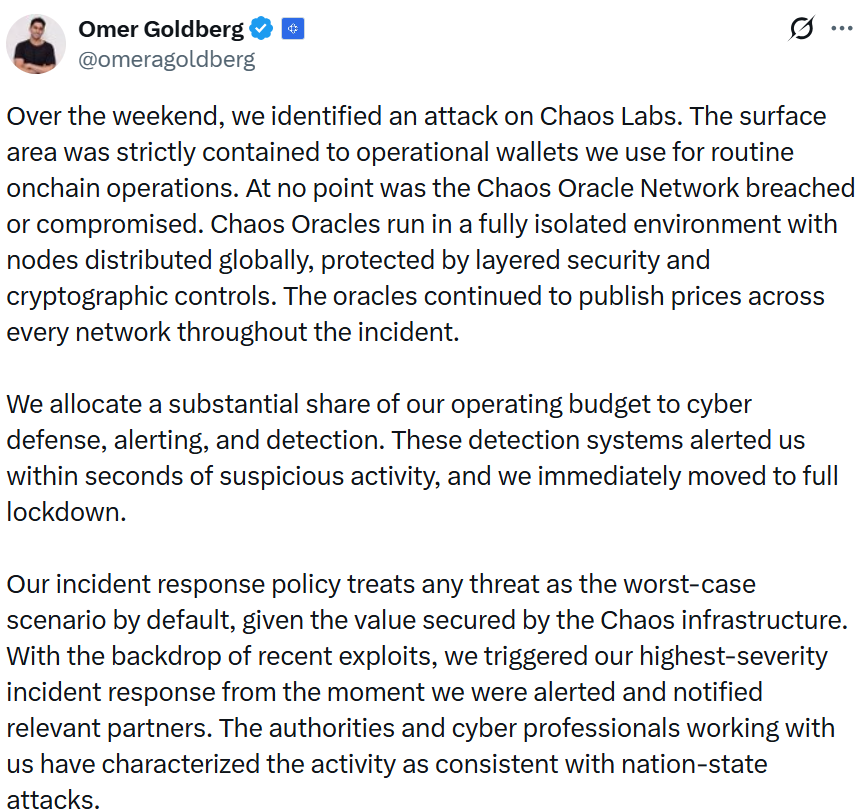
Crypto risk management and infrastructure provider Chaos Labs said its Chaos Oracle Network, which provides data feeds to blockchain applications, was not compromised after a hacking attempt over the weekend by a potential “nation-state.”
Chaos Labs founder Omer Goldberg said in an X post Thursday that the company identified an attack over the weekend, possibly by a “nation state,” and immediately moved to a full lockdown.
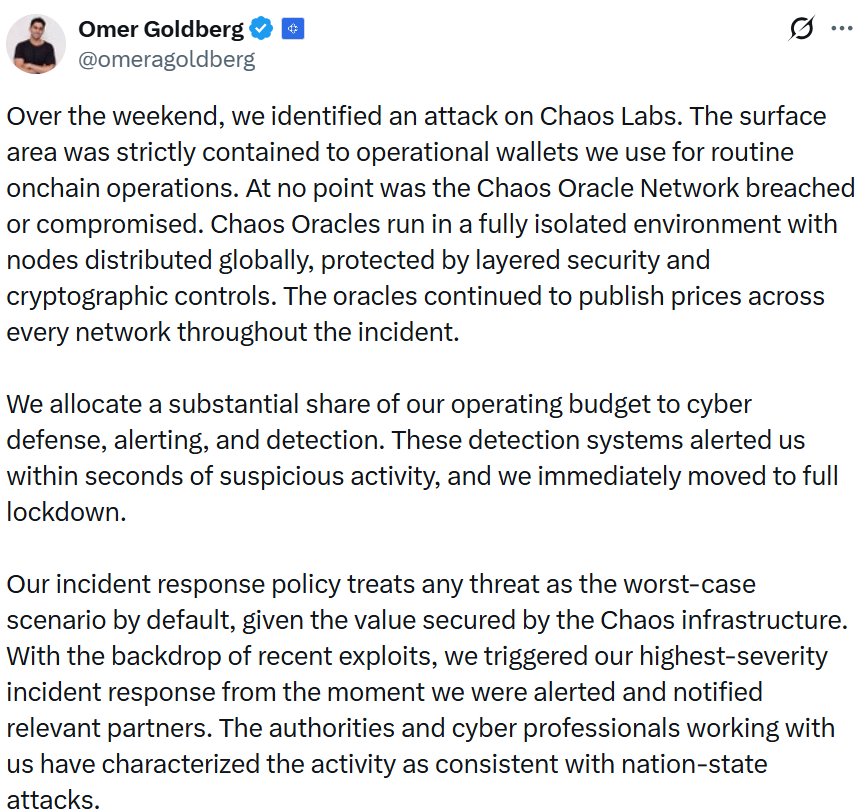
“The surface area was strictly contained to operational wallets we use for routine onchain operations. At no point was the Chaos Oracle Network breached or compromised.”
“Chaos Oracles run in a fully isolated environment with nodes distributed globally, protected by layered security and cryptographic controls,” Goldberg said.
“The authorities and cyber professionals working with us have characterized the activity as consistent with nation-state attacks,” he added. “The investigation continues, and we will share more as it allows.”
State-backed hacker groups, particularly those from North Korea, have been seen as a persistent threat to the crypto space.
North Korea-affiliated actors have been accused of stealing at least $578 million across several major incidents in April and have been linked to many of the industry’s largest hacks. North Korea recently rejected claims linking it to global cybercrime, calling the allegations unfounded.
Goldberg said that Chaos Labs has rotated all keys since the attempted attack and said there hasn’t been any further suspicious activity.
Source: Omer Goldberg
Recent industry exploits prompted “highest severity” response
The April Kelp DAO hack has been one of the year’s largest security incidents, causing broader ecosystem contagion and impacting the interconnected crypto lending market.
Drift Protocol, a decentralized cryptocurrency exchange, and at least a dozen other crypto entities were hacked in the same month.
Goldberg said against the backdrop of recent exploits, Chaos Labs triggered its “highest-severity incident response” after detecting the attempted hack.
“We allocate a substantial share of our operating budget to cyber defense, alerting, and detection,” he added.
Several crypto firms shift to Chainlink
Borrowing platform Tydro said it is migrating to the Chainlink oracle platform following the attack on Chaos Labs, adding to the list of crypto firms that have switched providers in recent weeks.
Related: Chaos Labs taps out as Aave’s risk provider, decision ‘not made in haste’
DeFi protocol Kelp DAO is migrating its restaking token rsETH to the Chainlink oracle platform following the April exploit. It continues to blame the attack on LayerZero’s cross-chain infrastructure, which LayerZero has disputed.
Decentralized finance platform Solv Protocol has also flagged plans to migrate its cross-chain infrastructure from LayerZero to Chainlink in “light of recent industry events.”
Magazine: Guide to the top and emerging global crypto hubs — Mid-2026


Coinbase shares fell after the U.S. crypto exchange posted a $394.1 million net loss for Q1 2026.
Summary
- Coinbase posted a $394.1 million Q1 loss as transaction revenue fell sharply from last year.
- Shares dropped after hours as revenue missed expectations and trading activity weakened across crypto markets.
- Management pointed to derivatives, prediction markets, USDC, and Base as its longer-term growth areas now.
The result marked its second straight quarterly loss and reversed a $65.6 million profit from the same period last year.
Google Finance showed COIN closing at $192.96, down 2.53%, before falling another 4.70% to $183.90 after hours. The move followed a revenue miss and a wider loss than analysts expected. The stock has also traded lower in 2026.
Trading slowdown hits revenue
Coinbase reported total revenue of $1.41 billion, down from $2.03 billion a year earlier. Its 10-Q showed transaction revenue fell to $755.8 million from $1.26 billion, while subscription and services revenue fell to $583.5 million from $674.6 million.
The company linked the weaker trading backdrop to softer market conditions. CFO Alesia Haas said “Macro conditions were genuinely tough,” adding that total crypto market cap and total crypto trading volume both fell more than 20% quarter over quarter.
Additionally, trading volume dropped to $202 billion from $401 billion a year earlier. Coinbase said the decline came as global crypto spot trading volume fell 44% during the period, leaving the exchange more exposed to lower user activity.
Consumer transaction revenue fell 48% to $566.9 million. Institutional transaction revenue rose 37% to $135.7 million, helped by derivatives trading and the Deribit acquisition. However, that growth did not offset the broader decline in spot-related revenue. Bitcoin accounted for 40% of spot transaction revenue in Q1.
Coinbase leans on wider products
Coinbase used the update to point investors toward products beyond spot trading. Its release said crypto trading volume market share reached 8.6%, while retail derivatives annualized revenue topped $200 million. It also said prediction markets reached more than $100 million in annualized revenue in March.
Chief executive Brian Armstrong said the company saw growth in derivatives, USDC, and Base activity. The message matched his wider plan to make Coinbase a broader venue for crypto, tokenized assets, derivatives, and event contracts.
Related crypto.news coverage said Coinbase had already framed its Q4 loss around a wider push into derivatives, stablecoins, and new markets. Crypto.news also reported on Coinbase’s prediction markets strategy, calling it part of an “everything exchange” plan.
Another related crypto.news update covered Agentic.market, where AI agents use USDC through x402 payments. For investors, the Q1 report showed two different stories. Trading revenue fell sharply, but Coinbase kept building products that may reduce its exposure to spot market cycles.
The near-term pressure remains clear, while the wider strategy now faces a harder test in a weaker crypto market and tougher investor mood after two straight quarterly losses and a sharp share-price reaction.


- Bitcoin retreated amid clashes in the Strait of Hormuz and rising oil prices.
- Analysts argue that a limited appetite for full‑scale escalation caps downside risk.
- Bulls aim for a rebound toward $82,000, but bears could target a breakdown below $78,000.
Bitcoin dropped to around $79,200 in early trading on Friday as fresh military skirmishes in the Strait of Hormuz rattled global risk assets.
The crypto bellwether was witnessing a sharp intraday pullback after a brief run above $80,000, with the latest price swing highlighting prevailing weakness amid potential geopolitical shocks.
However, despite this outlook, is a classic “bear trap” in play?
Iran ceasefire cracks dent Bitcoin momentum
Bitcoin rallied above $82,500 on Monday, igniting further bullish sentiment across the broader cryptocurrency market.
However, BTC has reversed as selling pressure resurfaced, dropping to support near $79,200.
The downturn coincides with fresh clashes in the Strait of Hormuz after Iran accused the United States of striking an oil tanker, prompting retaliatory strikes by the Islamic Revolutionary Guard Corps (IRGC) against US warships.
The US says it responded with counterstrikes.
Energy markets reacted swiftly, with Brent crude pushing back above $100 per barrel as local skirmishes reignited fears of supply disruption in the world’s key oil chokepoint.
According to SosoValue, the flare‑up has injected fresh anxiety into the so‑called “14‑point deal” narrative, a diplomatic framework aimed at stabilizing the region.
However, the platform notes that President Donald Trump’s insistence that the ceasefire remains in place, and Washington’s framing of its actions as “self‑defense,” point to a lack of appetite for full‑scale escalation.
“If both sides publicly signal restraint, the damage to global risk appetite remains localized,” SosoValue observed on X.
Bitcoin price forecast: a bear trap or deeper retreat?
According to analysts, a scenario that sees the current macro fallout contained could set the stage for a bullish reversal.
Santiment has noted a wave of profit‑driven holder capitulation in recent days, which it says hints at a potential sharp rebound amid thinning liquidity.
“Capitulation is one of the key ingredients to the beginning of bull runs, and wallets can drop out during both a price fall (out of fear of losing more) or on a price rise (expecting prices to not go any higher),” the firm posted.
Meanwhile, veteran market technician John Bollinger recently flagged Bitcoin’s trend model as flipping positive. BTC has retreated from the upper Bollinger Bands line, but the BBTrend indicator remains bullish.
This suggests a short‑squeeze could materialize if prices hold support levels.
Bulls will also need to reclaim upward momentum on strong volume, largely helped by limited escalation in the Gulf, contained oil‑price spikes, and the crypto‑friendly CLARITY Act.
Key resistance levels could be around $85,000-$90,000. However, if downside risks continue, bears could eye a deeper correction toward the $60,000 support zone.
Bitcoin hovered around $79,615 on Friday morning.

Chaos Labs, a crypto risk management and infrastructure provider, says its Chaos Oracle Network—used to feed data to blockchain applications—emerged from a weekend hacking attempt without a breach. Founder Omer Goldberg disclosed that the incident was detected promptly and that the surface area was confined to operational wallets used for routine on-chain operations. He emphasized that the Chaos Oracle Network remained secure, operating in a fully isolated environment with globally distributed nodes protected by layered security and cryptographic controls.
In a Thursday X post, Goldberg said authorities and cyber professionals view the activity as consistent with nation-state attacks, though the investigation is ongoing and updates will be shared as allowed. He also noted that Chaos Labs rotated all keys in response and has not observed any further suspicious activity since the initial incident.
While the claim of a possible nation-state attribution remains contested within broader cyber security discourse, the event occurs against a backdrop of heightened concerns over the security of cross-chain infrastructure and oracle providers. North Korea-linked actors have been linked to several large-scale exploits in recent months, though Pyongyang has denied involvement in global cybercrime. The April incident landscape, including the high-profile Kelp DAO breach, has intensified scrutiny on the sector’s risk controls and incident response protocols.
Goldberg stressed that Chaos Labs’ incident response was decisive and proportionate, stating that the company has rotated keys and that there has been no recurrence of suspicious activity. He added that the organization remains committed to robust cyber defense, noteing that a substantial portion of operating budgets is devoted to alerting, detection, and defense in an increasingly hostile threat environment.
Key takeaways
- The Chaos Oracle Network was not breached; the surface area was limited to routine operational wallets, with keys rotated and no subsequent suspicious activity detected.
- The incident prompted a full lockdown and a “highest-severity” incident response, underscoring the sector’s emphasis on rapid containment and cyber resilience.
- Authorities have described the activity as potentially consistent with nation-state tactics, though investigations continue and attribution remains under review.
- Across the industry, firms are reassessing oracle security and moving toward more trusted infrastructure, highlighted by a wave of migrations to Chainlink.
Chaos Labs’ response and the evolving oracle security landscape
Chaos Labs framed the weekend event as a test of the resilience of its data feeds and risk-management stack. Goldberg’s account of the incident centers on containment and rapid isolation: the compromised surface was confined to operational wallets used for routine on-chain operations, and the Chaos Oracle Network itself remained untouched. The firm rotated all keys in response, and Goldberg said there has been no follow-on anomalous activity since the initial response.
The company also highlighted the defensive posture underpinning its operations. “Chaos Oracles run in a fully isolated environment with nodes distributed globally, protected by layered security and cryptographic controls,” Goldberg wrote. The emphasis on segmentation and cryptographic safeguards reflects a broader industry push to harden critical infrastructure as the DeFi ecosystem expands and becomes more interconnected with cross-chain services.
In the broader context, security incidents in 2024 have driven heightened vigilance across the space. The April Kelp DAO breach, which coincided with a string of other exploits, sent waves through DeFi and highlighted the fragility of cross-chain and oracle architectures. Such events have intensified the debate about where trust should reside in any data feed—from the providers that curate data to the networks that transport and verify it across chains.
Despite the fog of attribution, the incident has already contributed to a shift in how protocols evaluate oracles and cross-chain infrastructure. The attack environment has reinforced the view among developers and investors that a multi-sourced, heavily audited oracle framework can act as a critical line of defense against cascading risks in DeFi and beyond.
Chainlink migration wave and what it signals for the sector
The Chaos Labs event has added momentum to a broader migration trend toward Chainlink’s oracle platform. Several projects have signaled or initiated moves to Chainlink in response to security concerns around other providers’ infrastructures. Notably, Tydro, a borrowing platform, announced plans to migrate to Chainlink after the Chaos Labs incident, joining a growing cohort of projects seeking more trusted oracle security amid a period of industry-wide scrutiny.
In related moves, Kelp DAO has migrated its restaking token rsETH to the Chainlink Oracle platform, continuing to fault LayerZero’s cross-chain infrastructure in connection with the April exploits. LayerZero has disputed the attribution, but the migration underscores a preference for proven, auditable cross-chain connectivity in a volatile security environment. Separately, Solv Protocol has publicly flagged plans to migrate its cross-chain infrastructure from LayerZero to Chainlink, citing recent industry events as a driver for re-evaluating security and reliability in interoperability.
Taken together, the shifts point to a broader industry emphasis on oracle reliability and secure cross-chain messaging as the backbone of DeFi’s ongoing growth. Chainlink’s established track record in providing decentralized, tamper-resistant data feeds appears to be a factor driving these migrations, even as other players continue to innovate and compete in the space. The exact timelines for these migrations vary by project, but the trend is clear: builders are prioritizing security posture and resilience in the face of an increasingly sophisticated threat landscape.
For investors and developers alike, the episode reinforces a core takeaway: the infrastructure that underpins DeFi—especially data feeds and cross-chain messaging—has become a strategic battleground. While attribution remains a puzzle in many high-profile exploits, the practical impact is tangible: protocols are increasingly choosing platforms with transparent security practices, verifiable audits, and robust incident response protocols as a core element of their risk management strategy.
North Korean-linked actors have been repeatedly associated with major crypto hacks, and the sector continues to monitor whether these patterns will intensify or shift as security practices improve. The opposing narrative—denials from the North Korean side—highlights the ongoing geopolitical tension surrounding cybercrime and the crypto industry. As investigators continue to piece together recent incidents, the market will likely watch how oracle providers differentiate themselves on security and reliability in the months ahead.
With Chaos Labs’ investigation still in progress, the industry will be watching how quickly and transparently new details emerge, and whether additional firms will accelerate their migrations to Chainlink or other trusted infrastructures. The evolving story underscores a broader shift toward stronger, more auditable cross-chain connectivity in a space that increasingly depends on dependable data feeds to sustain growth and user trust.
Source: Omer Goldberg, Chaos Labs (via X post); ongoing industry reporting surrounding the Kelp DAO and other exploits. For additional context on related incidents and reactions across the sector, see ongoing industry reports and coverage from Crypto outlets.
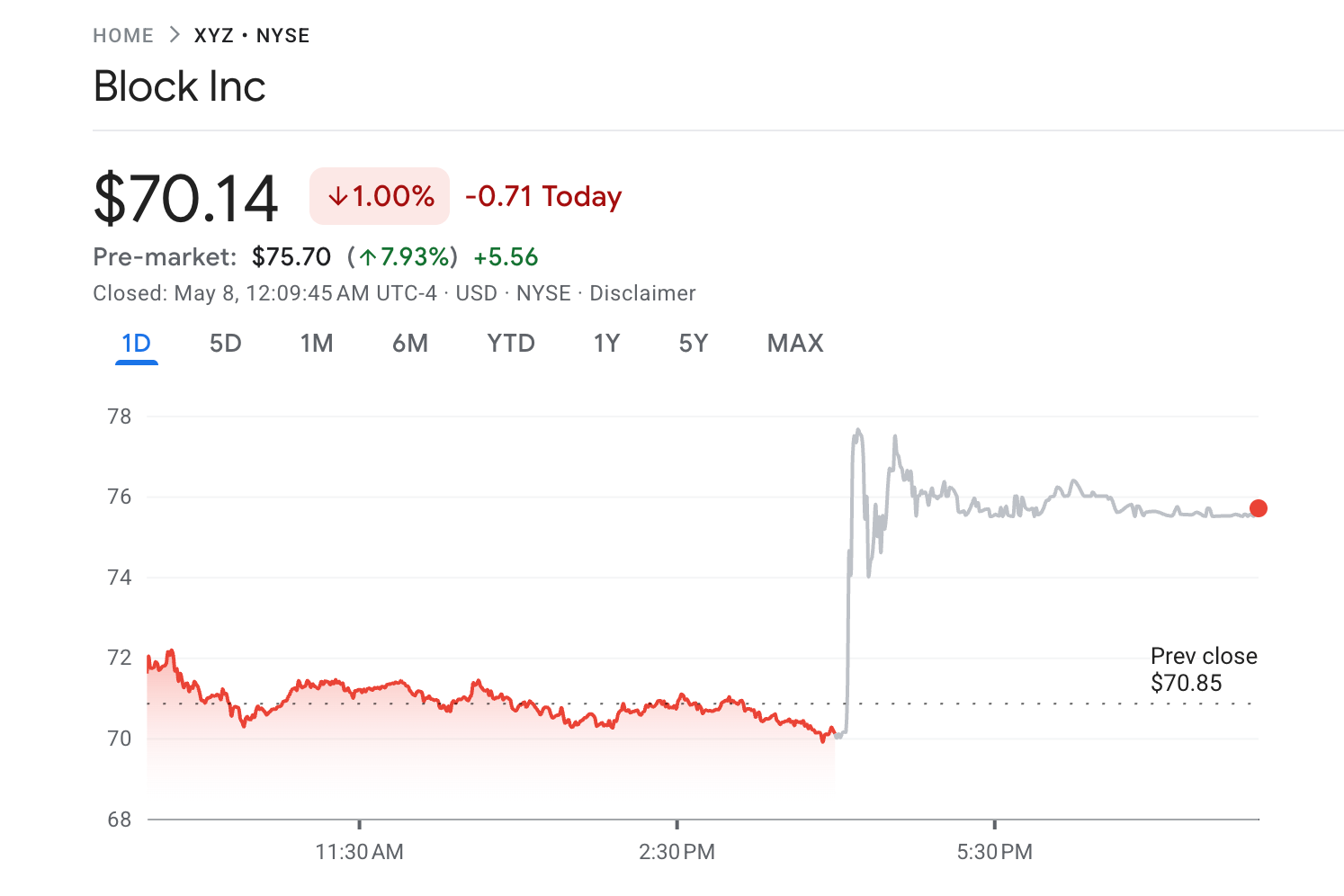
Block Inc stock surged in after-hours trading after the firm reported first-quarter earnings.
Block (XYZ) shares ended regular trading at $70.14 on the NYSE, down 0.97%. The stock then rose 7.93% to $75.70 in after-hours trading, according to Google Finance data.

Block Q1 Earnings Lifts Stock Prices
The rise came as the Jack Dorsey-led company reported adjusted diluted earnings of $0.85 per share, topping estimates of $0.68. The EPS grew 52% year over year.
“This quarterly report represents an earnings surprise of +25.68%,” Zacks noted.
Follow us on X to get the latest news as it happens
Furthermore, gross profit climbed 27% year over year to $2.91 billion, with strength across both the Cash App and Square segments.
Cash App gross profit grew 38% to $1.91 billion. Square’s gross profit rose 9% to $982 million as gross payment volume growth accelerated to 13%. Adjusted operating income grew to a record $728 million, expanding margins to 25%.
The strong performance arrived even as Block swung to a net quarterly loss. The payments firm posted a $309 million net loss attributable to common stockholders. The figures reflect a $172.8 million remeasurement loss on its Bitcoin investment.
Notably, Block raised its full-year 2026 guidance on the back of the quarter’s outperformance. The company now projects gross profit growth of 19% for the year ($12.33 billion), alongside margin expansion and a 62% jump in adjusted diluted EPS ($3.85).
“We continued to deliver strong financial performance in the first quarter as AI became more central to how Block operates and what we build for customers. We exceeded our guidance across gross profit, Adjusted Operating Income, and Adjusted EPS,” Dorsey wrote in the shareholder letter.

For Q2, Block expects $3.04 billion in gross profit and $0.86 in adjusted diluted EPS, marking 20% and 39% year-over-year growth, respectively. The firm will report Q2 results on August 5.
Subscribe to our YouTube channel to watch leaders and journalists provide expert insights
The post Block Shares Surge Nearly 8% After Hours Despite $309 Million Net Loss appeared first on BeInCrypto.
Key Takeaways
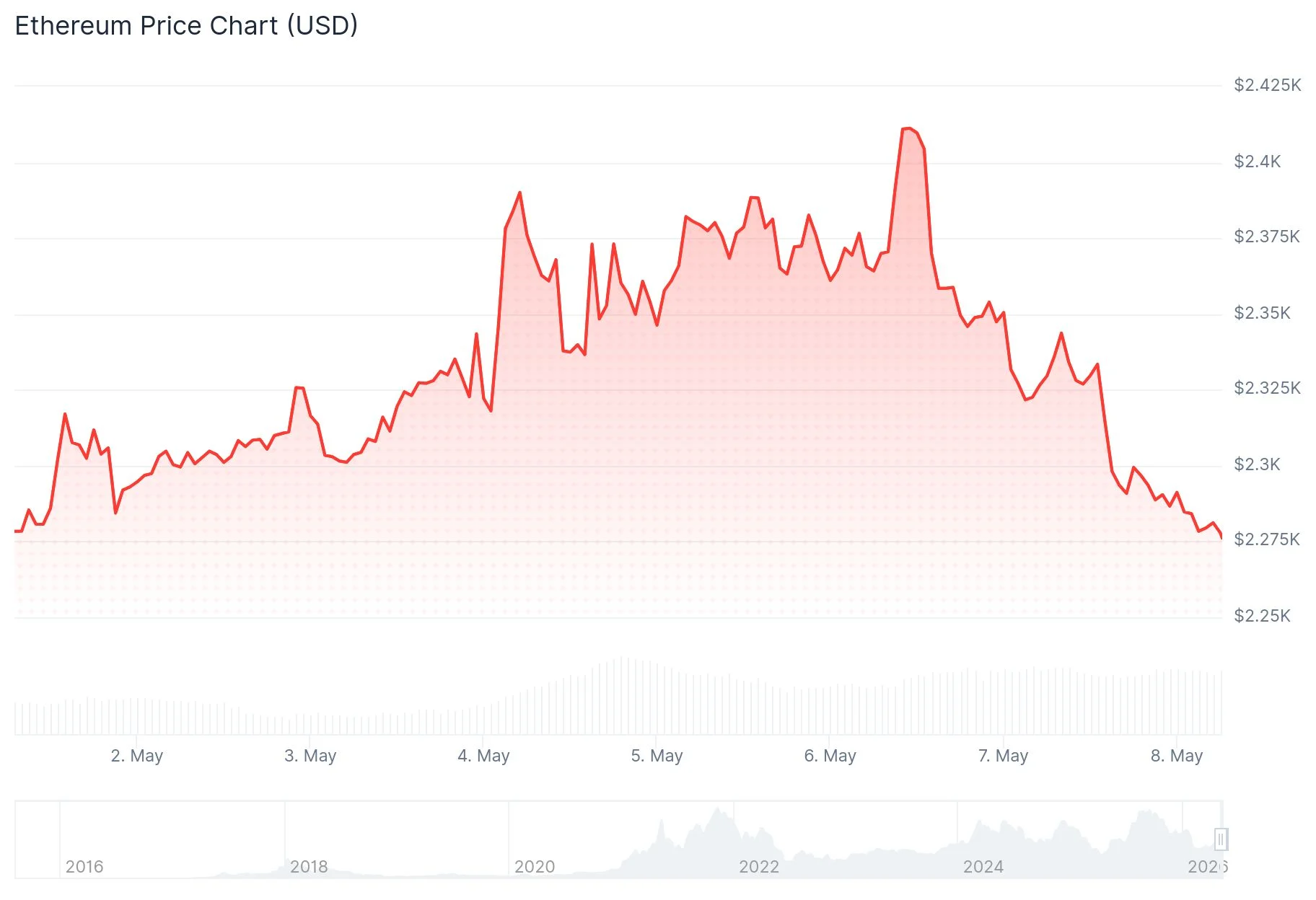
- ETH declined approximately 3%, currently trading between $2,280–$2,293
- Large holders transferred more than 63,000 ETH to Binance, signaling potential selloff
- Whale accumulation decreased 21.5% from October 2025 highs
- Open interest reached 14.85M ETH amid rapid short position expansion
- Market analyst Ted Pillows highlights insufficient spot demand weighing on ETH
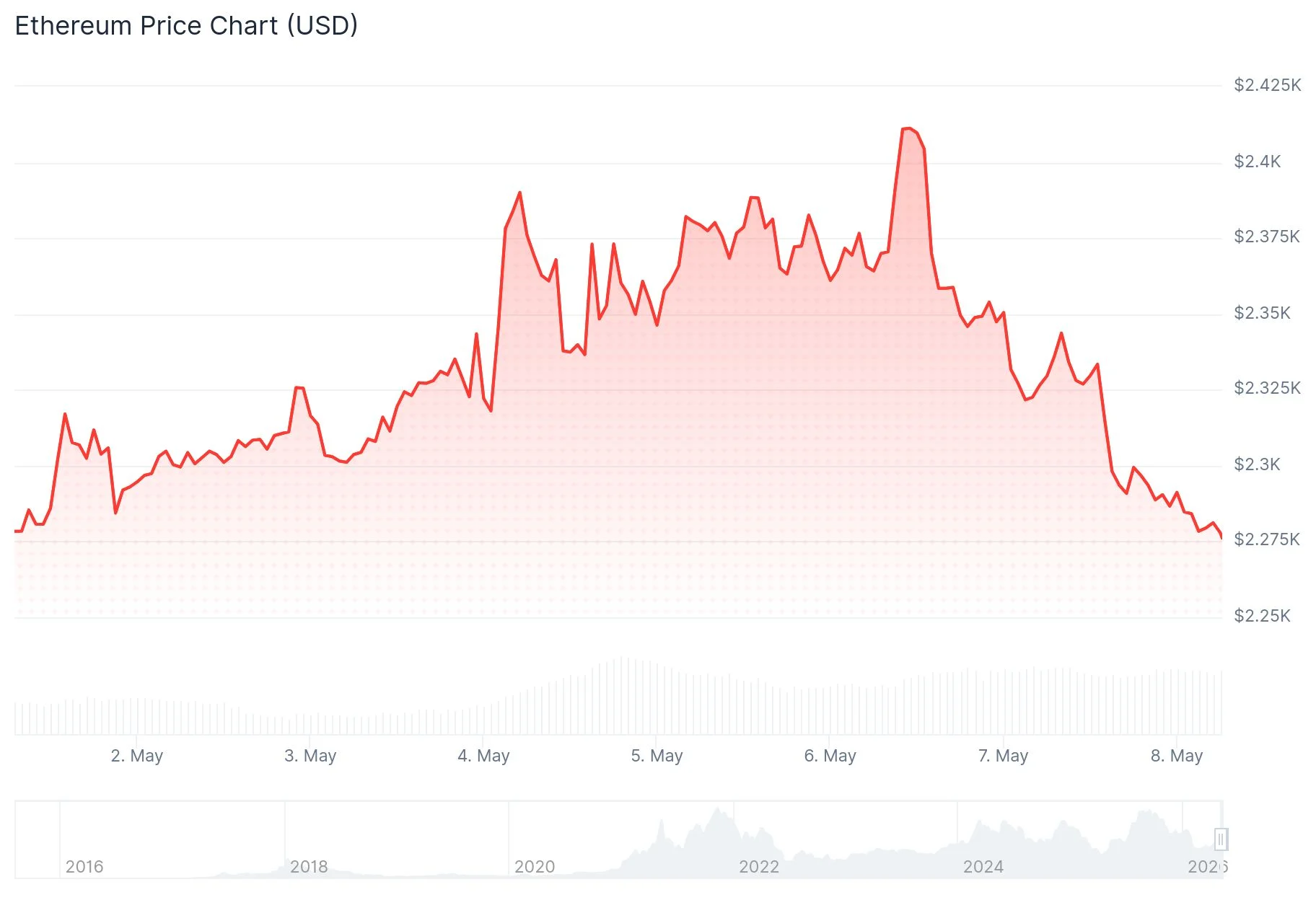
Ethereum has experienced a nearly 3% decline over the last 24 hours, with current prices hovering around $2,280 as of this report. This downturn coincides with significant movements by major holders transferring their assets to trading platforms, typically signaling impending liquidation.
Blockchain analytics platform Lookonchain identified that an address associated with cryptocurrency asset manager Metalpha transferred 27,000 ETH, valued at approximately $62.78 million, to Binance. Another significant holder executed a separate transaction, moving 14,062 ETH worth $32.82 million to the identical platform during the same period.
These transactions came after Bitcoin veteran Garrett Jin deposited a massive 166,000 ETH to Binance on Wednesday, representing roughly $396 million in value. This series of substantial transfers has heightened market anxiety regarding additional downward price pressure.
Crypto analyst Ali Martinez highlighted an extended trend in large holder activity. Addresses containing between 1,000 and 10,000 ETH accumulated from 12.95 million coins in April 2025, reaching a maximum of 15.95 million by October 6, 2025. However, these holdings have since contracted to approximately 12.52 million ETH — representing a 21.5% reduction.
According to Martinez, Ethereum requires a “fresh wave of institutional or retail demand” to breach the $3,000 threshold.
Bearish Sentiment Dominates Derivatives Markets
Futures market indicators are revealing a distinctly pessimistic outlook. Open interest has surged to 14.85 million ETH — the highest level recorded since July of last year — despite concurrent price declines. This pattern, combined with negative funding rates, indicates an accelerating accumulation of bearish positions.
The 30-day moving average of Ethereum’s Net Taker Volume is approaching negative territory, suggesting that bearish traders are increasingly controlling futures market activity. Additionally, ETH saw $96.3 million in forced liquidations during the past day, with $89.1 million stemming from bullish positions.
Market analyst Ted Pillows shared his perspective on X, stating: “$ETH tried to hold above the $2,400 level again but failed. Spot demand is very weak, which is pushing Ethereum lower. Until that changes, ETH will continue to underperform the market.”
Critical Support and Resistance Zones
Technically, Ethereum maintains a position above its 50-day EMA at $2,262 but faces resistance from the 100-day EMA at $2,349. The Relative Strength Index hovers just beneath 50, while the Stochastic Oscillator trends downward toward 30.
Should ETH breach the $2,262 support level, additional downside targets emerge at $2,211, followed by $2,107. On the bullish side, clearing $2,388 would be necessary to challenge the $2,746 resistance zone.
The $2,300–$2,500 corridor has functioned as a distribution area throughout the past month, with smaller investors liquidating approximately 1.5 million ETH during the previous two weeks.


Financial Growth (Attracts wealth, opportunities, and recognition (Pyrite as a “Money Magnet”).

Bolton Council local elections 2026 results in full

Edwards Questionable for Game 3 as Timberwolves Eye Series Lead Over Spurs

Manchester United reach agreement with Casemiro over contract clause amid transfer speculation

US brings back mandatory military draft registration

Steven Gerrard disagrees with Gary Neville over ‘shock’ Chelsea and Arsenal claim | Football


-

 NewsBeat5 days ago
Channel 5 – All Creatures Great and Small series 7 new post
-

 Crypto World23 hours ago
Upbit adds B3 Korean won pair as Base token gains Korea access
-
 Tech7 days ago
Trump’s 25% EU auto tariff breaches Turnberry Agreement that also covers semiconductors and digital trade
-
 NewsBeat1 day ago
NCP car park operator enters administration putting 340 UK sites at risk of closure
-
 Sports7 days ago
Paul Scholes issues Marcus Rashford reality check as agreement emerges over Man United star
-

 Entertainment6 days ago
Met Gala 2026 Rumored Guest List Is Turning Heads
-
Entertainment7 days ago
New on Prime Video in May 2026 — Full List of Movies and Shows
-

 Entertainment6 days ago
Kylie Jenner Hit With Second Lawsuit From Ex-Housekeeper
-

 Tech7 days ago
Meta ends Sama contract after Kenyan workers report seeing intimate footage from Ray-Ban smart glasses users
-

 Business7 days ago
Strait of Hormuz Blockade Persists Amid US-Iran Standoff, Sending Oil Prices Soaring
-

 Sports6 days ago
Cavaliers vs. Raptors Game 6 live score, updates, highlights from 2026 NBA playoffs first-round series
-
 Sports6 days ago
David Benavidez responds to team Canelo saying the fight will never happen
-
Entertainment5 days ago
New Netflix Movies in May 2026 — My Top 3 Picks to Stream
-

 Entertainment5 days ago
Melissa Joan Hart and More Stars Attend 2026 Kentucky Derby
-
 Sports6 days ago
IPL 2026: ‘Love you darling’- Hardik Pandya’s reaction to MS Dhoni steals the show |Watch | Cricket News
-

 Entertainment6 days ago
Young and the Restless Next Week: Cane Arrested & Matt’s Deadly New Scheme!
-
 Crypto World6 days ago
Pi Network Mandates Protocol 23 Upgrade for All Mainnet Nodes Before May 15 Deadline
-

 Business5 days ago
Luka Doncic Injury Update: Doncic’s Hamstring Recovery Slows Lakers’ Hopes Against Thunder: Can He Run Yet?
-

 Sports7 days ago
Bayern won’t hand bottom side Heidenheim ‘gifts’ despite PSG game
-

 Sports7 days ago
What Preity Zinta Said After Punjab Kings’ First Defeat Of IPL 2026
You must be logged in to post a comment Login