

Crypto World
Galaxy identifies 7 Democrats as key to advancing CLARITY Act

A pivotal stage in the pursuit of federal clarity for cryptocurrencies is approaching, with Galaxy Digital signaling that a core group of seven Democratic lawmakers on the U.S. Senate Banking Committee could be decisive as the Digital Asset Market Clarity Act enters markup this week. The crypto-focused investment firm assessed lawmakers’ positions on the CLARITY Act, labeling some as constructive toward a pro-crypto framework and others as potential deal-makers, while flagging a few expected to oppose the bill based on past votes and statements.
In a Sunday post on X, Galaxy Digital described Ruben Gallego and Angela Alsobrooks as “constructive/pro-framework” voices. Four other lawmakers were characterized as “deal-makers,” and one was tagged as “mixed.” The firm suggested that Democratic votes in markup would significantly raise the odds of advancing the legislation toward a Senate floor vote. The CLARITY Act, if enacted, would aim to establish clearer federal rules for the crypto sector, potentially reducing regulatory uncertainty and encouraging more blockchain projects to base operations in the United States.
Galaxy Digital’s summary highlighted four senators—Mark Warner, Catherine Cortez Masto, Andy Kim, and Raphael Warnock—as “deal-maker/conditional” supporters who have shown receptiveness to a crypto framework and have previously backed related legislation such as the GENIUS Act. Lisa Blunt Rochester was positioned as “mixed,” a potential swing vote given her crypto stance history. The seven lawmakers identified by Galaxy Digital as those most likely to influence the markup represent a focal point of ongoing negotiations about how broad a regulatory framework should be and where safeguards against illicit finance fit into the package.
Key takeaways
- The CLARITY Act’s fate in the Senate hinges on a handful of Democrats on the Banking Committee, according to Galaxy Digital, which frames seven lawmakers as pivotal for markup outcomes.
- A successful markup could nudge the bill toward a Senate floor vote, potentially reshaping the regulatory landscape for the U.S. crypto industry and encouraging more domestic development.
- The bill’s path remains uncertain, with several notable Democrats historically aligned with crypto objecting or voting against related measures, underscoring the need for broad bipartisan support.
- Past signals around the GENIUS Act and Coinbase’s withdrawal of support for the CLARITY Act in January illustrate the fragility and complexity of building consensus in Congress on crypto regulation.
- Industry policy groups and industry insiders warn that meaningful federal clarity will require protections for innovation, clear open-source guidelines, and balanced rules for DeFi and stablecoins, as noted by stakeholders and observers.
How the Senate battle could tilt toward clarity
At the heart of the current push is the expectation that the CLARITY Act will establish a more defined federal framework for digital assets, addressing long-standing regulatory ambiguity that has deterred some projects from choosing the United States as a base of operations. Galaxy Digital’s assessment emphasizes that the markup could hinge on a coalition of Democratic votes that are either openly supportive or moderate enough to broker a path forward. The firm specifically named Gallego and Alsobrooks as constructive forces, signaling a willingness to engage with a pro-framework approach. Meanwhile, Warner, Cortez Masto, Kim, and Warnock are described as deal-makers who could unlock progress if their support remains conditional on certain guardrails and compliance provisions.
The article notes that Blunt Rochester is considered mixed, potentially providing a swing vote in a narrowly divided chamber. The dynamic matters because the Senate Banking Committee’s 24 members (13 Republicans and 11 Democrats) require at least half to advance the bill to the broader Senate floor. With that arithmetic in mind, the positions of the seven highlighted lawmakers could materially shape the committee’s markup outcome and set the tone for subsequent negotiations across party lines.
What the CLARITY Act aims to change—and why it matters
The central promise of the CLARITY Act is regulatory clarity. Proponents argue that a formal set of federal guidelines would reduce the patchwork of state laws and ad hoc enforcement actions that have created uncertainty for developers, exchanges, and users. By providing clearer rules on what constitutes a digit asset, how custody and anti-money laundering controls should function, and where DeFi projects fit within the compliance regime, the act could lower the barrier to entry for legitimate projects seeking to operate in the United States. In practical terms, investors and builders could gain confidence that regulatory expectations are codified and predictable rather than subject to shifting interpretations.
Coinciding with the markup timeline, industry voices have framed the stakes in terms of innovation and capital formation. The policy debate also centers on safeguarding against illicit finance risks while ensuring that legitimate crypto projects can compete globally. Proponents argue that a clear federal framework would reduce regulatory friction and attract more capital and talent to the U.S., while skeptics warn that any framework must avoid overreach that could stifle innovation or favor incumbents with existing regulatory advantages.
Beyond the immediate legislative mechanics, the CLARITY Act sits within a broader regulatory conversation about how the United States should treat digital assets amid evolving global standards. The bill’s momentum has been affected by earlier developments, including Coinbase’s withdrawal of support in January due to concerns about protections for open-source developers, potential collateral impact on stablecoins yields, and broader DeFi regulation questions. Those concerns underscore the delicate balance lawmakers must strike between fostering innovation and addressing consumer safeguards and financial stability.
Momentum, hurdles, and what to watch next
Analysts and policymakers have long noted that bringing crypto regulation into a coherent federal framework will require consensus-building. Kara Calvert, Coinbase’s vice president of U.S. policy, underscored at Consensus 2026 that passage would likely demand bipartisan backing and a threshold around 60 votes to clear the Senate, highlighting the practical realities of passing a comprehensive crypto bill in a polarized environment. The markup date—the moment when the committee considers the bill and votes on whether to advance it—has been scheduled, but the path to the Senate floor remains contingent on securing a broader coalition of support within the chamber.
Independent trackers and advocacy groups have attempted to quantify where lawmakers stand. Stand With Crypto, which scores politicians based on their public statements and votes related to crypto policy, identifies Warner, Cortez Masto, and Alsobrooks as strongly supportive of crypto, while categorizing Kim as neutral and Reed, Warren, and Smith as more likely to oppose crypto measures. Van Hollen and Warnock, according to this tracker, lack sufficient data to be ranked. Such scoring provides a lens on how the political landscape could shift as the markup approaches and as lawmakers negotiate the bill’s precise text and safeguards.
It’s worth noting that the CLARITY Act’s trajectory has already experienced a pause: Coinbase’s withdrawal of support signaled the fragility of legislative consensus and the importance of addressing open-source policy protections, regulatory safeguards for stablecoins, and clear DeFi rules. The combination of regulatory complexity and the competing priorities of stakeholders—ranging from consumer protection to innovation incentives—will continue to shape how far the act can go in the current session.
Looking ahead: what we should expect
As Thursday’s markup looms, traders, developers, and investors will be watching not only for a vote on advancing the CLARITY Act but also for the text’s final form. The degree of bipartisan support, the strength of amendments, and the precise balance of guardrails against illicit finance will influence whether the bill’s prospects improve at the Senate level. If the committee approves the bill, it would proceed to scheduling, debate, and possible further amendments on the Senate floor—an additional phase where political winds can shift based on broader economic and regulatory signals.
In the near term, the key takeaway for the market is that the bill’s fate remains a litmus test for the U.S. approach to crypto regulation. A measured, clear framework could unlock more confident investment and project deployments domestically, while significant concessions or delays could prolong regulatory ambiguity and drive capital to markets perceived as more certain. Investors and builders should monitor not only the committee’s markup decisions but also the evolving stance of major lawmakers and industry voices as they navigate the tension between innovation and oversight.
What to watch next: the markup outcome on Thursday, the level of cross-party support the bill can secure, and how lawmakers reconcile crypto industry concerns with broader financial-regulatory objectives. Until the text and votes crystallize, the CLARITY Act remains a pivotal test of whether Washington can deliver a comprehensive, pragmatic framework for digital assets that satisfies both innovation and risk management imperatives.

The company behind the second-largest stablecoin by market cap has successfully raised $222 million in the presale of a token tied to its new blockchain called Arc.
The fully diluted valuation has risen to $3 billion, while company CEO Jeremy Allaire hinted that the firm will also enter into the “apps business.”
The Q1 results press release from Circle informed that the USDC in circulation grew 28% during the first quarter of the year and reached $77 billion. More impressively, the USDC on-chain transaction volume jumped by over 260% to $21.5 trillion. The total revenue and reserve income in Q1 of $694 million showed an increase of 20%.
The $222 million presale raise at a $3 billion fully diluted network valuation saw participation by many industry and legacy giants, including ARK Invest, BlackRock, Bullish, Intercontinental Exchange, SBI Ground, and Standard Chartered Ventures.
The white paper for the upcoming asset, ARC Token, went live today and reportedly outlines how “a native coordination asset could support governance, security, and network operations” on the Arc blockchain.
“We’re entering the operating system business, and we’re doing it by building this multi-stakeholder distributed model with a token, with a distributed network … and we’re also getting into the apps business,” CEO Allaire told CNBC.
The chief exec added that the launch of the company’s Agent Stack will build trusted infrastructure for “AI-native economic activity and a more programmable internet financial system.”
Circle’s stock price (CRCL) is up by over 2% in pre-market activity. Recall that the shares rocketed by 20% last week after two US senators announced a bipartisan compromise of the most contentious issues regarding the highly anticipated stablecoin deal.
The post BlackRock Bets on Circle’s Arc: $222M Raised in Major Token Presale appeared first on CryptoPotato.

Update (May 11, 2026, at 13:17 UTC): This article has been updated to include responses from Mohammed Al Hakim, president and general manager for the UAE at Crypto.com.
Crypto.com has received a Stored Value Facilities license from the Central Bank of the United Arab Emirates, allowing residents to pay Dubai government fees using cryptocurrencies via its platform, the company said Monday.
The company says the license allows users to fund payments in digital assets while settlements are made in UAE dirhams or in dirham-backed stablecoins approved by the central bank under the SVF framework.
Mohammed Al Hakim, president and general manager for the UAE at Crypto.com, told Cointelegraph that the approval followed a comprehensive supervisory and operational readiness assessment by the Central Bank of the UAE, including reviews of governance frameworks, anti-money laundering (AML) and counter financing of terrorism (CFT) controls, cybersecurity standards, transaction monitoring systems, safeguarding arrangements, and operational resilience.
The approval allows Crypto.com to activate its partnership with Dubai’s Department of Finance, giving the exchange access to provide digital asset payment services for government fees through its platform under Dubai’s cashless payments strategy.
The company said the license could also support future payment integrations with Emirates Airlines and Dubai Duty Free, though those services remain subject to further approvals from the UAE central bank.

Crypto.com secures SVF license. Source: Crypto.com
The SVF authorization applies to its local Dubai entity, Foris DAX Middle East FZE, which trades as Crypto.com. Al Hakim told Cointelegraph that Crypto.com operates under two distinct but complementary regulatory frameworks in the UAE: VARA’s Virtual Asset Service Provider (VASP) regime, which governs virtual asset activities such as trading and exchange services, and the Central Bank’s SVF framework, which regulates payment infrastructure and stored value services connected to the domestic financial system.
Related: Crypto.com gets into prediction markets through High Roller tie-up
Crypto.com expands UAE regulatory and payments push
The new authorization adds another layer to Crypto.com’s regulatory footprint in the UAE, where it already holds a Virtual Asset Service Provider license from VARA and promotes its platform as an institutional-grade, compliance-focused venue for digital assets.
Outside the UAE, the company has been building a similar regulated profile, including securing licensing to operate under the European Union’s Markets in Crypto Assets (MiCA) regime and obtaining conditional approval from the United States Office of the Comptroller of the Currency for a national trust bank charter that would allow it to act as a qualified digital asset custodian.
At the same time, Crypto.com is expanding into event-based derivatives and prediction markets through a regulated US affiliate, part of a broader strategy to combine tighter regulatory oversight with a growing range of trading and payments products around cryptocurrencies.
Al Hakim added that the SVF approval positions Crypto.com to serve as a regulated bridge between virtual assets and traditional payment infrastructure in the UAE, enabling use cases such as government fee payments and merchant settlement within a unified regulatory framework.
Magazine: Guide to the top and emerging global crypto hubs — Mid-2026


Morgan Stanley launched a crypto price war on E*Trade at 50 basis points, undercutting Coinbase and Schwab.
Summary
- Morgan Stanley launched a pilot on May 6 allowing E*Trade users to trade Bitcoin, Ether, and Solana at 50 basis points per trade via Zerohash.
- The fee undercuts Schwab’s 75bps, Fidelity’s 1%, and Coinbase’s retail rates, prompting Bloomberg analyst Eric Balchunas to warn crypto exchanges to be scared.
- Morgan Stanley plans to expand crypto access to all 8.6 million E*Trade clients later in 2026 alongside a proprietary digital wallet.
Morgan Stanley has launched a crypto trading pilot on its ETrade platform at 50 basis points per trade, immediately undercutting every major retail rival. Bitcoin, Ether, and Solana are available directly inside ETrade brokerage accounts via Zerohash, which handles liquidity, custody, and settlement.
The 50-basis-point fee sits below Schwab’s 75bps, Fidelity’s 1%, and Coinbase retail fees that can exceed 0.5% depending on tier and payment method. Jed Finn, Morgan Stanley’s head of wealth management, said the move is “much bigger than trading crypto at a cheaper rate,” describing it as a strategy to keep its 8.6 million clients inside its own ecosystem.
Why crypto exchanges are watching nervously
Bloomberg ETF analyst Eric Balchunas warned immediately after the launch that “crypto exchanges should be scared.” He drew a direct comparison to the fee race that followed the launch of spot Bitcoin ETFs, which saw providers start at 50 basis points before Morgan Stanley undercut them all with a 14-basis-point offering.
“By the time the dust settles it’ll be pretty dirt cheap to trade crypto everywhere,” Balchunas said. Industry leaders pushing back noted the perspective is US-centric, with global platforms already diversified beyond spot-trading fees into derivatives, DeFi, and international markets.
Coinbase, which posted a $1.49-per-share quarterly loss for Q1 2026 on revenue of $1.41 billion, already launched commission-free stock trading in February as part of its “Everything Exchange” strategy to reduce dependence on crypto trading fees.
The scale of Morgan Stanley’s distribution advantage
Morgan Stanley’s 16,000 financial advisors oversee $9.3 trillion in client assets, a distribution channel crypto-native platforms cannot match. The pilot is small for now, but the bank plans to roll out access to all 8.6 million E*Trade clients later in 2026 alongside a proprietary digital wallet capable of holding crypto alongside tokenized stocks, bonds, and real estate.
The move follows Morgan Stanley’s April 8 launch of its own spot Bitcoin ETF, MSBT, which charges just 14 basis points and avoided outflows throughout its entire first month of trading, a record no other spot Bitcoin ETF matched during the same period.


Crypto investment products absorbed $858 million last week, ahead of the upcoming CLARITY Act markup and Fed chair transition.


Circle shared a recap of its Q1 2026 earnings call led by Co-Founder, Chairman and CEO Jeremy Allaire.
Crypto World
BeInCrypto Institutional Research: 15 Firms Setting the Standard for Crypto Corporate Governance


Best Crypto Corporate Governance is a category within the BeInCrypto Institutional 100 awards, covering firms whose public-market discipline, banking charters, board structure, audit maturity, and crisis-response record set governance standards for digital assets.
The 15 firms below are listed alphabetically and are not ranked. A shortlist will be named in May 2026, with the winner announced at Proof of Talk in Paris on June 2–3, 2026.
- Long list: 15 firms across listed crypto companies, federal crypto banks, regulated custody firms, TradFi banks, and public-market digital asset platforms
- Order: Listed alphabetically, not ranked
- Initial pool: More than 30 firms screened; 15 advanced to the long list
- Scoring: 20% quantitative data · 80% Expert Council
- Criteria assessed: Public-market discipline, banking charter strength, board independence, audit maturity, incident response, disclosure quality, leadership credibility
- Data sources: OCC, SEC EDGAR, NYDFS, FCA, FINMA, BaFin, MAS, MiCA-CASP registers, audited reports, company disclosures, PitchBook, Tracxn, and Crunchbase
| Firm | Governance Sub-Segment | HQ | Reach | Top Listing / Charter | Representative Work |
|---|---|---|---|---|---|
| Anchorage Digital | Federally chartered crypto bank | SF / NY / Sioux Falls / Singapore / Porto | $4.2B valuation Backed by a16z, GIC, Goldman Sachs, KKR, Visa, Tether |
Long-tenured public company governance record Spiral continues Bitcoin open-source funding |
OCC-supervised bank holding structure Prior OCC AML order resolved after remediation |
| BitGo | Public + federally chartered custody | Sioux Falls / Palo Alto | $104B+ AUC $2.08B valuation at IPO |
NYSE: BTGO OCC final national trust bank charter |
NYSE IPO completed Jan 2026 First public federally chartered digital asset infrastructure firm |
| Block | Public fintech with Bitcoin surface | San Francisco, USA | Cash App + Square ecosystem 57M Cash App monthly actives |
NYSE: XYZ Public since 2015 |
NYSE listing brought a public governance framework Tom Farley leads as CEO |
| BNY | Global bank with crypto custody | New York, USA | $55.8T AUC/A Oldest US bank and securities firm |
NYSE: BK OCC-regulated bank |
Co-custodian for Morgan Stanley Bitcoin Trust Live BTC and ETH custody since 2022 |
| Bullish | Public institutional exchange | George Town, Cayman Islands | Institutional spot and derivatives venue Public-market exchange governance |
NYSE: BLSH Listed via SPAC in Aug 2025 |
Charter approved Dec 2025 Inherits the Fidelity institutional governance framework |
| Circle Internet Group | Public stablecoin issuer | Boston / NYC | USDC $73B market cap Monthly Deloitte reserve attestations |
NYSE: CRCL OCC conditional national trust charter |
First public stablecoin issuer after IPO Conditional charter granted Dec 2025 |
| Coinbase | Public crypto-native platform | Wilmington / SF | S&P 500 inclusion Deloitte auditor and SOX framework |
NASDAQ: COIN Public since Apr 2021 |
SEC enforcement action dismissed in Feb 2025 Board includes leading technology investors and operators |
| Fidelity Digital Assets, NA | Asset-manager operated federal trust | Boston, USA | Backed by Fidelity’s $15T+ AUA platform Custody for FBTC and FETH |
OCC conditional national trust bank charter Conversion from the New York State trust |
Confidential SEC IPO filing in Nov 2025 Deutsche Börse made a $200M strategic share purchase |
| Galaxy Digital | Public multi-product crypto firm | New York / Delaware | Trading, asset management, investment banking, mining US public-market framework |
NASDAQ: GLXY Re-domiciled from Toronto to Delaware |
Nasdaq uplisting completed in May 2025 Shifted into a full US-listed governance regime |
| Kraken (Payward) | Multi-charter crypto bank + IPO track | San Francisco, USA | Profitable with positive EBITDA Krak app across 130 countries |
Wyoming SPDI charter OCC trust application filed May 2026 |
Closed Bitstamp acquisition in Jun 2025 WonderFi acquisition expanded Canada’s presence |
| Robinhood Markets | Public broker with crypto stack | Menlo Park, USA | 26M funded customers Bitstamp adds global crypto licences |
NASDAQ: HOOD Public since Jul 2021 |
Long-running public company disclosure regime Bitcoin treasury model governed through public filings |
| Securitize | SEC-regulated tokenization infrastructure | Miami, USA | $4B+ tokenized assets Partners include BlackRock, Apollo, BNY |
SEC-registered broker-dealer, ATS, transfer agent, ERA NASDAQ SPAC planned |
SPAC merger announced at $1.25B valuation NYSE selected Securitize for tokenized securities platform |
| Standard Chartered | Global bank with digital asset stack | London, UK | $900B assets 170+ year banking history |
LSE: STAN and HKEX: 2888 Multi-jurisdiction bank governance |
Digital asset custody through SC Ventures and Zodia Hong Kong stablecoin licence candidate |
| Strategy (MicroStrategy) | Public Bitcoin treasury company | Tysons Corner, Virginia | Largest corporate BTC holder Public since 1998 |
NASDAQ: MSTR Rebranded from MicroStrategy in 2025 |
Long-running public-company disclosure regime Bitcoin treasury model is governed through public filings |
| Sygnum | Swiss-licensed crypto bank | Zurich, Switzerland | 2,000+ institutional clients $5B+ AUM and unicorn valuation |
FINMA banking licence MAS, Liechtenstein, ADGM permissions |
Reached unicorn status in Jan 2025 Sygnum Connect and Sygnum Protect live |
About This List
The BeInCrypto Institutional 100 — Crypto Corporate Governance (2026 Long List) identifies firms whose governance structures support institutional confidence in digital assets. Firms are listed alphabetically and are not ranked at this stage.
This category includes listed crypto-native companies, federally chartered crypto banks, traditional financial institutions with material digital asset operations, and heavily regulated private infrastructure providers. Firms with material unresolved governance concerns were not advanced to the long list, regardless of scale.
Methodology
This category is evaluated under Track C of the BeInCrypto Institutional 100 methodology: 20% based on quantitative metrics and 80% based on Expert Council scoring.
The assessment spans seven criteria: public-market discipline and SOX-equivalent disclosure; banking charter or regulatory framework strength; board independence; audit and compliance maturity; response to regulatory or security incidents; transparency; and leadership credibility.
A negative signal scan operates as a precondition. Firms with material unresolved governance failures are excluded from primary consideration before scoring.
Data was verified using OCC national trust bank charter records, SEC EDGAR filings, NYDFS trust and BitLicense registers, FCA, FINMA, BaFin, MAS, and MiCA-CASP records, audited annual reports, firm disclosures, and private-market sources, including PitchBook, Tracxn, and Crunchbase.
The post BeInCrypto Institutional Research: 15 Firms Setting the Standard for Crypto Corporate Governance appeared first on BeInCrypto.


Crypto compliance demand is surging as AI fraud evolves faster than firms can respond, Sumsub CEO Andrew Sever says.
Summary
- Sumsub CEO Andrew Sever told Consensus Miami that sophisticated AI fraud attacks on crypto firms increased 180% year over year.
- Only 23% of crypto companies are ready to comply with new identity and fraud rules, according to Sumsub’s State of the Crypto Industry 2026 report.
- Chainalysis has separately launched blockchain intelligence agents to help compliance teams manage growing alert volumes at machine speed.
Crypto compliance firms are reporting a sharp rise in demand as AI fraud attacks become faster, more sophisticated, and harder to stop. Sumsub co-founder and CEO Andrew Sever told Consensus Miami that fraud is evolving faster than the industry can respond.
“Before, the main things were verification speed and conversion rate,” Sever said. “Today, the majority of companies prioritize verification accuracy.” High-quality AI fraud attacks on crypto surged 180% year over year, with sophisticated attacks now using deepfakes, synthetic identities, and automated phishing networks that can bypass standard verification systems.
What is driving the compliance surge
Sever warned that bad actors now use large language models to launch thousands of personalised phishing attempts per minute, mimicking legitimate exchanges without detectable errors. “Imagine a bad actor trying to penetrate the system using a deepfake. If it fails, they try again in two minutes,” he said.
Only 23% of crypto companies are currently ready to comply with incoming identity and fraud regulations, according to Sumsub’s State of the Crypto Industry 2026 report. Sever noted that 72% of firms told Sumsub they would change their internal compliance processes as a result of the pressure.
Illicit crypto reached $154 billion in 2025 according to Chainalysis, up 162% from the prior year, with scammers and sanctioned entities both driving volume higher. The scale of the problem is pushing compliance teams toward automated systems.
How the industry is responding
Chainalysis launched blockchain intelligence agents in March designed to absorb the growing alert load facing compliance teams, triaging, gathering context, and surfacing conclusions faster than human analysts working alone. Emmanuel Marot, vice president of products at Chainalysis, said the company wants to “automate the tasks of our customers as much as possible.”
A DOJ rollback of crypto enforcement in early 2026, flagged by senators citing the same Chainalysis data, has added further pressure on private-sector compliance teams to fill the gap left by reduced federal oversight.


NEAR Intents upgraded its frontend to enable single-flow swaps from over 100 tokens directly into ZEC, leveraging intent-based architecture for crosschain transactions.


Tom Lee has slowed Bitmine ETH purchases after the firm amassed over 5.2 million tokens and 4.3% of Ethereum’s supply.
Summary
- Bitmine bought 26,659 ETH last week, worth roughly $63 million, down from over 100,000 ETH in each of the prior three weekly periods.
- Tom Lee said the previous pace would have taken Bitmine to its 5% Ethereum supply target by mid-July, prompting the slowdown.
- Bitmine holds over 4.7 million ETH staked, generating an estimated $319 million in annualised staking rewards at current yields.
Bitmine Immersion Technologies (BMNR) bought 26,659 ETH last week worth roughly $63 million, sharply down from the more than 100,000 ETH it had been acquiring each week for months. The purchase lifted total holdings to over 5.2 million ETH, worth approximately $12.1 billion, making Bitmine the world’s largest Ethereum treasury company.
Chairman Tom Lee said the firm had deliberately reduced its pace. “We have decided to slow down our pace of weekly accumulation from over 100,000 per week,” he said. “Our previous pace of buys would have us reach 5% by mid-July.”
Why Bitmine is pulling back on purchases
Bitmine originally expected to reach its 5% Ethereum supply target in late 2026. The aggressive accumulation pace shortened that timeline to weeks, prompting a reassessment. The company now holds 4.31% of Ethereum’s circulating supply of approximately 120.7 million ETH.
Lee reiterated his view that “crypto spring” has begun, pointing to Ethereum’s recent price recovery. “If ETH closes above $2,100 at the end of May, this would be the third consecutive monthly gain. This has never been seen in a crypto bear market,” he said.
Since the start of 2026, Bitmine has acquired more than 1 million ETH. Its total crypto, cash, and equity holdings stood at $13.4 billion as of May 10, including 201 Bitcoin, a $200 million stake in Beast Industries, and $775 million in cash.
Staking strategy and what comes next
Bitmine has staked 4,712,917 ETH, representing more than 90% of its total holdings and generating an estimated $319 million in annualised staking rewards based on a 2.86% seven-day yield. That makes it the largest ETH staker of any public company globally.
The company’s MAVAN staking platform, launched earlier in 2026, is being positioned to serve institutional clients alongside Bitmine’s own treasury operations.
Lee said Ethereum’s two primary drivers going forward are Wall Street’s move to tokenization and the rise of agentic AI systems relying on public blockchains for payments and verification.
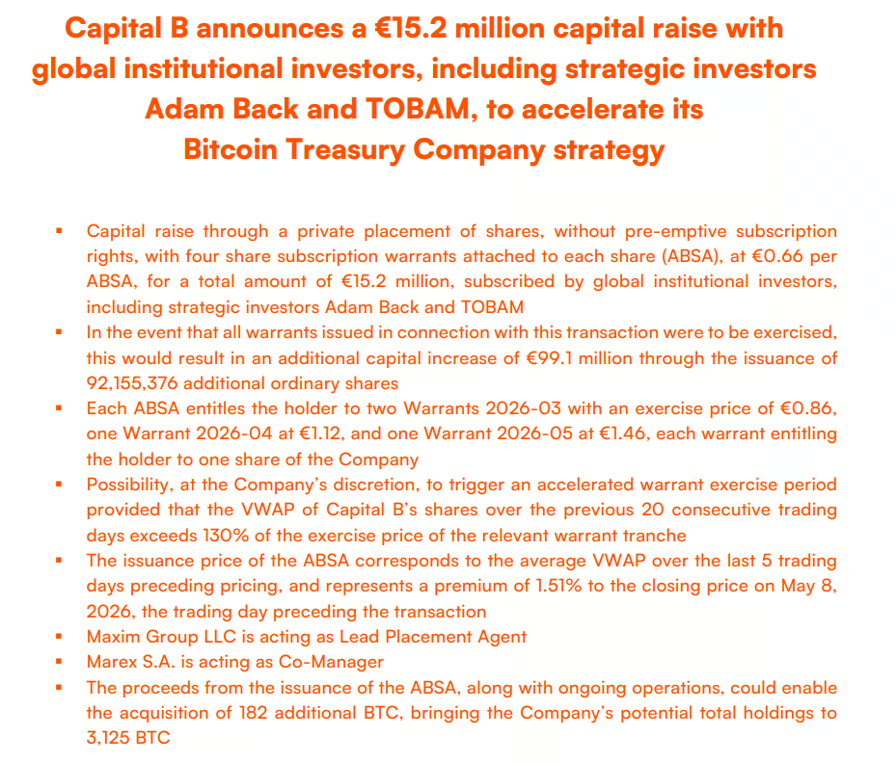
France-listed Bitcoin treasury company Capital B raised 15.2 million euros ($17.8 million) from strategic investors including Blockstream CEO Adam Back and Paris-based asset manager TOBAM as it seeks to expand its BTC treasury.
The new capital was raised through a private placement of shares, with four share subscription warrants attached to each share at a fixed price of $0.78, the company said Monday.
The company said the proceeds, together with ongoing operations, could allow it to acquire another 182 Bitcoin, potentially lifting its total holdings to 3,125 BTC.
If all warrants issued in connection with the transaction were exercised, Capital B could raise an additional $116.5 million through the issuance of about 92 million additional shares, wrote Alexandre Laizet, the board director of Bitcoin strategy at Capital B.
The raise shows Capital B is still pursuing Bitcoin accumulation while parts of the corporate Bitcoin treasury sector are taking a more defensive posture, including hedging programs, debt reduction and asset sales after months of weaker market conditions.
The company’s latest raise comes a week after Capital B raised $1.3 million from Adam Back to accelerate its Bitcoin treasury strategy.

Capital B raises $17.8 million from Adam Back and TOBAM. Source: Capital B
Capital B shares rise after capital raise
Capital B shares rose around 4.3% after the announcement on Monday and traded around 0.67 euros ($0.79) at the time of writing.
The company’s shares are down by around 11% year-to-date, data from Yahoo Finance shows.

Capital B shares, 24-hour chart, in euros. Source: Yahoo Finance
Capital B is currently the 25th-largest Bitcoin treasury firm, holding 2,943 BTC, worth about $237 million. It ranks as Europe’s second-largest Bitcoin treasury following Germany’s Bitcoin Group SE, according to Bitcointreasuries data.
Related: Adam Back says Bitcoin’s post-quantum shift may reveal true Satoshi stash
On April 20, Michael Saylor’s Strategy raised an additional $2.5 billion from the issuance of Stretch (STRC) and the sales of Class A common stock (MSTR). On April 23, XCE raised $794,000 of capital in a round backed by Adam Back.
Barring these raises, no other Bitcoin treasury companies have publicly announced a capital raise during the past six weeks. However, some companies are looking to hedge against the downside risk of the bear market.
On April 24, Nasdaq-listed Bitcoin treasury company Nakamoto announced an actively managed Bitcoin derivatives program seeking to generate recurring income from volatility and hedge part of its corporate BTC holdings against downside exposure. A month earlier, the company announced the sale of 284 Bitcoin (worth about $20 million at the time), in a March 30 filing with the US Securities and Exchange Commission.
Earlier in February, Bitcoin treasury company Genius Group said it sold its remaining treasury holdings of 84 BTC for about $5.7 million, which it used toward repaying an $8.5 million debt obligation, according to an SEC filing.
Magazine: Bitcoin vs. the quantum computer threat — Timeline and solutions (2025–2035)

Shakur Stevenson names who he wants to see Benavidez face next: “It’s the best fight in boxing”

Ilya Sutskever Stands by His Role in Sam Altman’s OpenAI Ouster: ‘I Didn’t Want It to Be Destroyed’

Bacon sandwiches will be much tastier if you do easy step before eating

Manchester United reach agreement with Casemiro over contract clause amid transfer speculation

US brings back mandatory military draft registration

Steven Gerrard disagrees with Gary Neville over ‘shock’ Chelsea and Arsenal claim | Football

Breaking XRP NEWS! Ripple Brad Garlinghouse Just Said This About XRP At Consensus!

Without guidance, structure, and financial education, sudden ownership can sometimes lead to

The AI Coin That’s About To FLIP Ethereum Is PUMPING Right Now (Arthur Hayes Just Confirmed It)
-
 Crypto World4 days ago
HarrisX Poll Found 52% of Registered Voters Support the CLARITY Act
-

 Fashion3 days ago
Weekend Open Thread: Marianne Dress
-

 Crypto World5 days ago
Upbit adds B3 Korean won pair as Base token gains Korea access
-
 NewsBeat5 days ago
NCP car park operator enters administration putting 340 UK sites at risk of closure
-

 Tech2 days ago
Auto Enthusiast Carves Functional Two-Stroke Engine from Solid Metal
-

 Politics3 hours ago
What to expect when you’re expecting a budget
-

 Politics3 days ago
Politics Home Article | Starmer Enters The Danger Zone
-
 Business3 days ago
Ignore market noise, India’s long-term story intact, say D-Street bulls Ramesh Damani and Sunil Singhania
-

 Crypto World7 days ago
UAE Free Zone Deploys Blockchain IDs to Verify Registered Firms
-

 Fashion23 hours ago
What to Know Before Buying a Curling Wand or Curling Iron
-

 Fashion8 hours ago
Coffee Break: Travel Steam Iron
-

 Tech19 hours ago
GM Agrees To Pay $12.75 Million To Settle California Lawsuit Over Misuse Of Customers’ Driving Data
-

 Crypto World5 days ago
BlackRock CEO Larry Fink Discusses a New Asset Class
-

 Crypto World5 days ago
Robinhood says Wall Street is building onchain
-

 Entertainment5 days ago
Sarah Paulson Called Out For Met Gala ‘Hypocrisy’
-
 Sports6 days ago
NBA playoff winners and losers: Austin Reaves is not loving Lakers vs. Thunder matchup, but Chet Holmgren is
-

 Tech6 days ago
Apple and Samsung are dominating smartphone sales so thoroughly that only one other company makes the top 10
-

 Entertainment5 days ago
Bold and Beautiful Early Spoilers May 11-15: Steffy Revolted & Liam Overjoyed!
-

 Tech6 days ago
I tested the Xiaomi 17 Ultra’s camera and I don’t think I’ll ever go back to an iPhone
-

 Fashion5 days ago
The Best Work Pants for Women in 2026
You must be logged in to post a comment Login