

Crypto World
Polygon CDK Unveils Institutional-Grade Privacy Chains With Full Access to Global Liquidity


TLDR:
- Polygon CDK’s validium config keeps raw transaction data sealed within institution-owned infrastructure.
- Settlement on Ethereum uses only a cryptographic commitment and a ZK proof, never exposing transactions.
- Five composable privacy levels let institutions scale confidentiality without migrating between configurations.
- Private CDK chains connect to Agglayer, preserving access to Ethereum, multi-chain liquidity, and fiat ramps.
Polygon CDK has announced a new privacy configuration for institutions building custom blockchains on its technology stack.
The upgrade keeps raw transaction data inside institution-owned infrastructure. At the same time, chains built on the configuration retain open access to global liquidity networks.
Powered by Succinct Labs’ SP1 Hypercube proving system, only a cryptographic commitment and a zero-knowledge proof settle to Ethereum.
The configuration primarily targets banks, payments companies, and asset managers that are moving onchain.
How the Privacy Configuration Works
Polygon CDK now offers a validium configuration developed in partnership with Succinct Labs. Transaction data stays within an institution-operated data availability environment.
Raw transaction data never reaches a public network. Ethereum receives only a cryptographic fingerprint and a validity proof for settlement.
The SP1 Hypercube proving system is already live in production on Katana Network. Settlement relies on validity proofs rather than a trusted operator with data access.
This approach means no single party holds visibility into the institution’s transaction data. The chain is verified publicly, but its transaction contents remain confidential.
@0xPolygon stated: “Ethereum confirms the chain is operating correctly. It never sees the transactions.” Role-based controls gate RPC endpoints and block explorers through enterprise systems like Okta and Azure AD. Policies apply at the contract and function level. Counterparties view only their own transactions.
Auditors receive scoped read access, while regulators get selective disclosure capabilities. Chain operators, by contrast, retain full visibility over all chain activity.
Even operational metadata — block contents, transaction counts, gas usage — can stay private. Institutions ultimately control what information is shared and with whom.
Five Privacy Levels and Cross-Chain Liquidity
Polygon CDK gives institutions five composable privacy levels with no migration required. The base level covers permissioned access through role-based RPC and private block explorers.
The newest tier is the confidential chain, keeping data within institution-owned infrastructure. A third level adds trusted execution environments for sealed workloads like dark-pool matching and sealed-bid auctions.
The fourth level applies fully homomorphic encryption to permissioned token rails. Balances and transfer amounts stay encrypted onchain throughout.
Apex Group’s T-REX Ledger with Zama on ERC-3643 already demonstrates this in production. The fifth level uses client-side zero-knowledge proofs through Hinkal to shield wallet-layer transactions from onchain visibility.
Despite the privacy architecture, Polygon CDK chains stay connected to Agglayer. Through this layer, private chains can access Ethereum, other L1s and L2s, and non-EVM networks like Miden.
A regional bank can settle with counterparties on other chains. Fiat ramps and stablecoin liquidity remain accessible through the Open Money Stack.
Target institutions include banks launching tokenized deposits and payments companies building stablecoin corridors. Asset managers issuing tokenized funds and crypto-native teams requiring enterprise SLAs also qualify.
Each deployment remains subject to applicable laws and regulations. Institutions can start at one privacy level and expand from there.


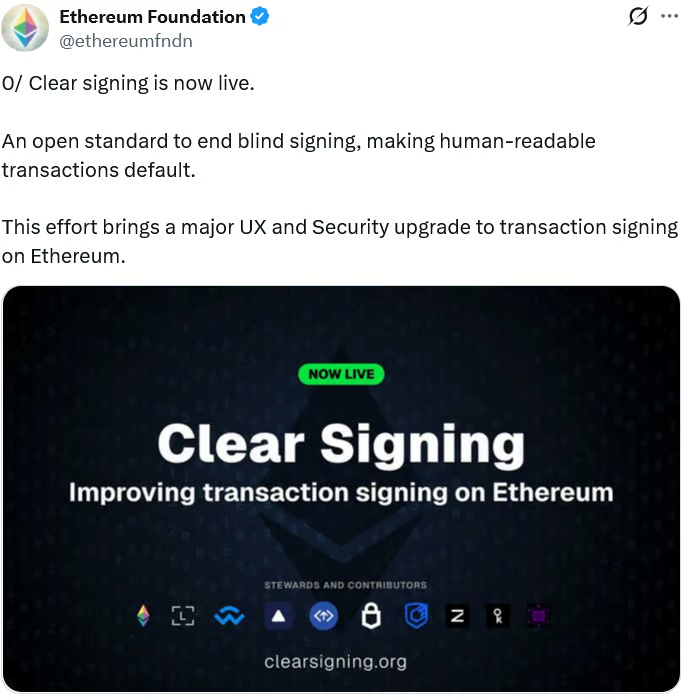
The Ethereum community has introduced Clear Signing, a security feature that ensures users can clearly understand transaction details before signing, replacing unreadable hex data and reducing risks from blind signing attacks.
“Approving a transaction is meant to be the last line of defense when exercising control over what happens to your assets on the blockchain. When it is done blindly, that defense does not hold,” the Ethereum Foundation said on Tuesday, calling blind signing a “structural flaw” that has contributed to billions of dollars in losses, including the $1.4 billion Bybit hack last year.
The “What You See Is What You Sign” security feature aims to address this issue and is being integrated by several self-custody crypto wallets, including Ledger, Trezor and MetaMask.

Source: Ethereum Foundation
The security feature comes as bad actors target the crypto industry with increasingly sophisticated hacks and scams despite considerable improvements in security measures in recent years.
North Korean state-backed workers have stolen over $7 billion in funds alone since 2009, with a large share of that coming from crypto protocols. The Bybit hack was its largest crypto heist by compromising a third-party service provider and manipulating transaction signatures.
Trezor chief technology officer Tomáš Sušánka told Cointelegraph that attackers have been exploiting this relentlessly due to there not being a widely accessible security feature that is capable of distinguishing malicious smart contracts from legitimate transactions.
This issue has led users to “unknowingly sign them, and lose everything,” Sušánka said, adding that the Clear Signing feature “directly addresses this by making transactions human-readable before approval.”
The Clear Signing feature was introduced through the Ethereum Foundation’s Trillion Dollar Security Initiative and initiated by Ledger through the open-source ERC-7730 token standard.
The foundation said the key components of the Clear Signing feature include “human-readable transaction descriptions” and a “neutral, mirrorable descriptor registry.”
Related: Ethereum’s EEZ could pull other blockchains into its orbit
It also includes an attestation framework enabling auditors to verify those descriptors.
A host of crypto platforms are supporting Clear Signing
Several other crypto wallets and Ethereum privacy and security platforms contributed to the Clear Signing feature, including Keycard, WalletConnect, Argot, Sourcify, Zama, ZKnox and Fireblocks.
Sušánka said Trezor seeks to implement the security feature before June 30.
“We’re implementing this standard because it’s the right thing to do for our users,” Sušánka said before calling the Clear Signing feature a “critical security advancement for our entire industry.”
Magazine: Guide to the top and emerging global crypto hubs: Mid-2026


More than 100 amendments have been attached to the Senate’s crypto market structure bill ahead of Thursday’s Banking Committee markup.
Summary
- Senate lawmakers filed more than 100 amendments to the CLARITY Act ahead of Thursday’s markup vote.
- Democratic senators proposed tighter stablecoin yield restrictions and new ethics rules tied to crypto holdings by public officials.
- Developer protections and plans to restore the Justice Department’s crypto enforcement unit were also added to the amendment list.
POLITICO reported that most of the proposed changes came from Democratic senators, while Republicans submitted a narrower set of revisions tied to sections already debated during months of closed-door negotiations. Committee members are expected to review and vote on the amendments during Thursday’s hearing before deciding whether to move the legislation to the Senate floor.
Released Monday, the Senate Banking Committee’s updated CLARITY Act draft revived talks that had stalled earlier this year after Coinbase publicly stepped away from negotiations. The company had objected to earlier restrictions tied to stablecoin reward programs, prompting lawmakers and industry groups to reopen discussions around the bill’s language.
One of the newest amendments targets the stablecoin yield compromise included in the revised draft. Senators Jack Reed and Tina Smith are seeking tougher wording that would prohibit interest-like rewards using a “substantially similar” standard instead of the current “functionally equivalent” test tied to bank deposits.
Banking organizations have already criticized the revised language. Earlier this week, the American Bankers Association and four other financial trade groups said the proposal could still allow stablecoin products to compete with traditional savings accounts by offering reward mechanisms that resemble deposit interest.
Senate debate expands beyond stablecoins
Away from the stablecoin fight, several amendments focus on ethics restrictions and criminal liability tied to crypto activity. Senator Chris Van Hollen has proposed a measure that would prevent the president, vice president, members of Congress, senior executive officials, and their families from holding or promoting crypto-related businesses.
Ethics provisions have remained unresolved since lawmakers restarted negotiations earlier this year. During Consensus Miami 2026, Senator Kirsten Gillibrand said Democratic support would depend on conflict-of-interest protections being added to the legislation. Senate Banking Committee ranking member Elizabeth Warren later criticized the revised draft for leaving those restrictions out.
Developer protections have also resurfaced through a proposal from Senator Catherine Cortez Masto. Her amendment would create a safe harbor protecting software developers from criminal liability for failing to register as money transmitters.
Crypto advocacy groups have supported similar language tied to the Blockchain Regulatory Certainty Act, which was folded into the committee’s updated draft earlier this week. Under that section, developers and infrastructure providers that do not control customer funds would not automatically fall under money transmitter rules.
Concerns from law enforcement officials, however, have not disappeared. Punchbowl News reported this week that Senators Chuck Grassley and Cynthia Lummis reached a separate agreement designed to preserve prosecutors’ ability to pursue crypto-related financial crimes.
Additional amendments expected during Thursday’s session include sanctions provisions, rules tied to institutional crypto activity, and a proposal from Senator Andy Kim seeking to restore the Justice Department’s National Cryptocurrency Enforcement Team, which was dismantled last year.
Republicans still control the Banking Committee and hold the Senate majority, though internal disagreements remain. Senator Thom Tillis previously warned he would not back the bill unless changes were made to several provisions.
Outside Capitol Hill, lobbying pressure has intensified ahead of the markup. Coinbase CEO Brian Armstrong said during an X livestream on May 12 that the latest draft preserved the crypto industry’s “must haves,” while banking lobby groups continued pressing senators for stricter limits on stablecoin rewards.
Even if the Banking Committee advances the legislation this week, senators would still need to combine it with the separate version approved earlier by the Senate Agriculture Committee. Passage on the Senate floor would require support from at least 60 lawmakers, forcing Republican sponsors to secure Democratic votes before the bill can move forward.
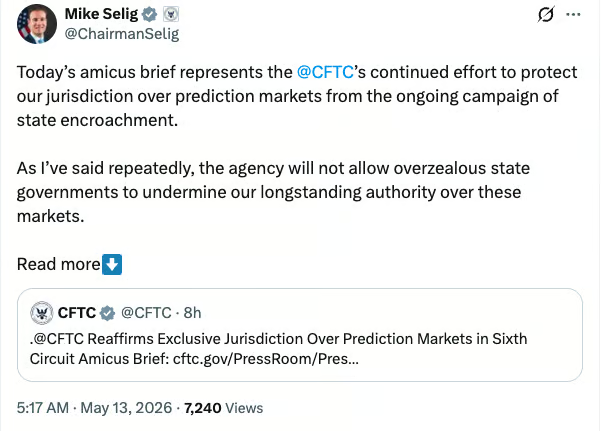
The US Commodity Futures Trading Commission has backed Kalshi in the company’s legal fight against the state of Ohio, asking an appeals court to affirm that the regulator has jurisdiction over prediction markets.
The CFTC filed an amicus brief in the Sixth Circuit Court of Appeals on Tuesday, accusing Ohio of “jurisdictional overreach” after state authorities told Kalshi last year to stop offering sports event contracts in the state, calling them unlicensed sports gambling.
Kalshi sued Ohio authorities in October, seeking to have a federal court stop the Ohio Casino Control Commission and the state attorney general from taking action, but the court denied the request in March, leading Kalshi to appeal the decision.
“The federal district court in Ohio took an improperly narrow view of the Commission’s jurisdiction, and we are asking the Court of Appeals to correct that error,” CFTC Chairman Mike Selig said in a statement. “As I’ve said repeatedly, the CFTC will not allow overzealous state governments to undermine the agency’s longstanding authority over these markets.”
The dispute is one of many similar cases determining whether states have the power to restrict federally regulated prediction markets and has implications for major prediction market platforms such as Kalshi and Polymarket.
The CFTC’s latest amicus brief is its second backing a prediction market after it filed one in the Ninth Circuit Appeals Court in February supporting Crypto.com in a legal battle against regulators in Nevada.
In its brief, the CFTC argued that “Ohio’s jurisdictional overreach into the Commission’s sphere threatens regulatory upheaval,” as the agency oversees event contracts trading as swaps or binary options on designated contract markets (DCMs).

Source: Mike Selig
“If States can restrict event contracts on sports, the Commission’s longstanding jurisdiction over these other event contracts could be imperiled too,” it wrote. “The Court should enforce the Commission’s exclusive jurisdiction and hold that Ohio cannot regulate event contracts traded on DCMs.”
Related: Prediction market battle gets closer to Supreme Court
The CFTC’s brief comes after it sued five states to assert its jurisdiction over prediction markets, launching action against regulators in Wisconsin, New York, Arizona, Connecticut and Illinois.
The states had either sent cease-and-desist letters or had sued the prediction markets Kalshi, Polymarket, Crypto.com, Robinhood, and Coinbase, all of which are CFTC-regulated DCMs, over their offering of sports event contracts.
“States cannot circumvent the clear directive of Congress,” Selig said last month after the CFTC sued Wisconsin. “Our message to Wisconsin is the same as to New York, Arizona, and others: if you interfere with the operation of federal law in regulating financial markets, we will sue you.”
Magazine: Should users be allowed to bet on war and death in prediction markets?
Crypto World
Banking Africa: Cantor8 Moves Deeper Into Africa’s Mobile Money Sector via Yiksi Limited
[PRESS RELEASE – Zug, Switzerland, May 12th, 2026]
As part of a broader initiative to expand access to essential banking infrastructure across Africa, Cantor8 has revealed plans to bring leading mobile money systems such as M-PESA and EVC Plus onchain via Yiksi Limited.
Cantor8 has secured exclusive MOUs with Yiksi Limited, outlining plans to bring leading mobile money systems onchain and enable direct digital money services-to-crypto conversion via blockchain rails.
Through its partnership with Taran App, a leading African fintech platform, and Yiksi, Taran App’s cryptocurrency exchange, Cantor8 will leverage Taran App’s infrastructure to bring two of Africa’s most widely used forms of mobile money on-chain via the Canton Network.
The partnership serves as a crucial pilot for a broader rollout across additional African nations and mobile money ecosystems, demonstrating how onchain digital money infrastructure can scale across the continent.
Mobile Money Infrastructure and Blockchain Integration
Limited banking infrastructure in regions like Kenya and Somalia has led to the widespread adoption of mobile money systems like M-PESA and EVC Plus.
These platforms are vital for financial inclusion and economic activity in mobile-first ecosystems where traditional bank penetration, around 15% in Somalia, remains low due to physical and documentation barriers.
Migrating these systems to blockchain networks like the Canton offers a significant opportunity to enhance interoperability, settlement efficiency, and global connectivity. This evolution, in turn, provides users with a fully integrated digital financial system that bypasses conventional infrastructure.
Despite access challenges, ongoing innovation in digital onboarding continues to reduce barriers, scaling payments and remittances across these emerging markets.
The Need for Digital Money in African Economies
To understand the impact of digital money and mobile-based transfer systems like M-PESA and EVC Plus, it helps to first understand the regions in which they operate and have seen widespread adoption.
At the core, three key factors have driven the success of these systems in emerging economies like Somalia and Kenya:
- Limited-to-non-existent access to reliable banking infrastructure.
- A high degree of mobile phone access and competence.
- Unworkable local currencies.
The Banking Gap
Since 1991, Somalia has transitioned into a mobile-first economy led by services like EVC Plus, filling the void left by a sparse traditional banking sector. According to the US State Department’s 2025 Investment Climate Statement, formal banking penetration sits at just 15% due to branch scarcity and rigid ID requirements.
Cantor8 aims to bridge this gap by integrating secure digital infrastructure and modernizing mobile connectivity.
The firm is targeting similar inclusion gaps in Kenya, where M-PESA dominates but rural barriers persist. By deploying mobile-first technology, Cantor8 intends to scale financial access and integrate these emerging markets into a cohesive digital ecosystem.
Nonviable Local Currencies
Somalia and Kenya are increasingly pivoting toward mobile-first financial systems to navigate structural economic challenges.
In Somalia, decades of central banking limitations and counterfeit Somali Shilling (SOS) circulation have driven a market shift toward the US Dollar and mobile money for stability.
Kenya’s Shilling (KES) remains more integrated into global markets, though its debt profile reflects heavy infrastructure investment. Despite macroeconomic pressures, Kenya continues to lead in digital innovation, utilizing mobile platforms to deepen economic participation.
Together, both nations demonstrate a move away from physical cash toward digital foundations, clearly setting the stage for next-generation payment infrastructure and improved fiscal stability across East Africa.
Mobile-Native Populations
Somalia and Kenya are cementing their status as mobile-first economies as cellular connectivity outpaces traditional banking growth. Somalia’s mobile penetration has reached nearly 60%, with 11.5 million connections growing at a 7% annual clip, driving widespread adoption of digital finance.
Kenya’s ecosystem is even more saturated; as of late 2025, SIM subscriptions hit 78.4 million (a 149.5% penetration rate). This high density of roughly 1.5 SIMs per person underscores the central role of telecoms in regional commerce.
Together, these metrics provide a robust foundation for next-generation digital payment infrastructure across East Africa’s most connected populations.
The Rise of Digital Money
The aforementioned factors create the perfect conditions for a financial system that is (a) denoted in USD, (b) immediately accessible through mobile devices, and (c) provides similar functionality to bank accounts, to flourish.
Digital money system, EVC Plus (operated by Hormuud Telecom) is now the backbone of Somalia’s economy. Mobile money adoption in Somalia is among the highest in the world, with over 87% of the population using mobile money services.
For additional context, Hormuud currently serves nearly 5 million users, the vast majority of which use EVC Plus for daily transactions.
Similarly, as of 2025, a staggering 85% of Kenyan adults had access to financial services through digital platforms like M-PESA. Indeed, several estimates put M-PESA’s share of mobile money transaction value in Kenya at well over 90%.
Enter Canton Network & Cantor8
By leveraging Cantor8’s cutting edge infrastructure components, such as its C8 Registry token issuance engine, mobile money systems like M-PESA and EVC Plus can be brought directly onto blockchain rails – Canton Network specifically.
In doing so, said mobile money gains access to both the advantages brought by blockchain generally, and those that only Canton Network can deliver.
Instant Settlement
Blockchain rails are able to provide atomic settlement on transactions, meaning transfers and other actions are settled instantly, all in one single transaction. This entirely eliminates the aforementioned ‘in-transit’ risk and dramatically reduces the operational burden placed on mobile money providers.
No settlement gap. No extractive middlemen. More efficient money.
Compliant Privacy
While public blockchains like Ethereum and Solana expose all historical transaction data, the Canton Network provides a privacy-focused alternative essential for regulated industries like banking. Built to shield sensitive details, including counterparties, balances, and timing, Canton ensures transaction data remains confidential.
To meet compliance standards, the network generates tamper-proof audit trails accessible only to authorized regulators and auditors. Integrating M-PESA and EVC Plus onto Canton’s rails allows users to maintain total financial privacy while enabling seamless, foolproof oversight for authorities.
Interoperability
Canton operates a so-called ‘network-of-networks’ where differing institutions operate and maintain their own blockchain ledgers, ensuring privacy is maintained, while the network’s key interoperability component (The Global Synchronizer) allows for these separate networks to interact seamlessly.
In the case of mobile money, users will be able to put their funds to use in different countries and at different merchants, without undertaking lengthy and high-risk conversation processes.
Banking Africa
Through an interoperable system of mobile money platforms, users will be able to leverage the stability of the US Dollar, seamlessly use and transfer their funds across borders, and much more.
The end goal of Cantor8’s initiative is to create a seamless pan-African payments system that remedies inequalities around banking infrastructure and creates a more interconnected and efficient African economy. This is just the beginning.
About Cantor8
Cantor8 is the leading infrastructure provider for the Canton Network ecosystem. Founded and operated by Oxbridge alumni, exited founders, and best-in-class DAML developers, Cantor8’s product suite spans self-custody wallet solutions, private transfer infrastructure, compliant token issuance, bespoke development services, and much more besides.
If you are interested in speaking with us, users can reach out to reni@cantor8.tech.
The post Banking Africa: Cantor8 Moves Deeper Into Africa’s Mobile Money Sector via Yiksi Limited appeared first on CryptoPotato.


The fintech project SNC Scandic Coin (SNC) was launched by the global Scandic Finance Group (SFG). In an interview with the Neue Zürcher Nachrichten, Uwe Sellmer, a specialist in the financial sector, explained how the SNC token differs from speculative cryptocurrencies: it will serve as a regulated payment, access and loyalty instrument integrated into the SFG Group’s services, rather than merely being an object of speculation. Specifically, users within the network can pay for media apps, private jet flights, yachts, cars, AI products and domains, amongst other things, and benefit from loyalty programmes. This practical range of applications is a key feature of the RWA project, as many competitors offer only a vague ‘vision of the future’ without any tangible benefits.
Transparency, Audit and Compliance
The developers have ensured that the SNC SCANDIC Coin meets the requirements of regulatory oversight and strict compliance. The smart contract was audited by CertiK: according to the public Skynet report dated 2 March 2026, the SNC Scandic Coin has no critical vulnerabilities. The project has a KYC-KYB and anti-money laundering (AML) system, which is contractually managed by the data and credit service provider CRIF, which also certifies ESG certificates, thereby emphasising sustainable practices. A multi-layered AML risk management system underscores the commitment to creating a trustworthy product.
A broad ecosystem rather than a standalone product
The SNC Scandic Coin is not viewed in isolation, but as part of a broad Scandic ecosystem. The official website lists numerous divisions – such as SNC Scandic Fly, SNC Scandic Pay, Scandic Cars, SNC Scandic Estate, SNC Scandic DEV, SNC Scandic SEC, SNC Scandic Domains and SNC Scandic Yachts. These divisions are intended to use the coin as a common means of payment and deploy it for various RWA (Real-World Asset) services. According to Sellmer, the Legier Group publishing network – which comprises over 115 globally active daily newspapers across all continents offering 24/7 breaking news and its own news app – will provide media coverage.
Value proposition and fee model
From the user’s perspective, the SNC Coin offers several advantages: real-world utility through integration with specific services, low fees and fast processing thanks to optimised smart contract technology, an integrated ecosystem combining travel, property, brokerage services and lifestyle offerings, as well as a transparent structure with a fixed token supply and traceable distribution. The FAQ explains that the coin supports payments, access levels, rewards and ecosystem functions. Digital assets and data are secured using decentralised storage methods and institutional cold wallets, and for maximum security, the extensive SNC development team recommends the use of hardware wallets and, to safeguard every token holder, relies among other things on a vesting period for SNC Coins, which further ensures that the legal regulations of the supervisory authorities are fully complied with.
Tokenomics: Limited supply and clear allocation
The comprehensive white paper (210 A4 pages) and the website provide insight into the token economy. The total supply of SNC is capped at one billion tokens. According to the tokenomics model, the launch price is set at 0.02 EUR. A detailed schedule governs when these tokens will be released. The valuation at launch amounts to 20 million US dollars; according to the project description, this is not a legal commitment regarding the value of the token, but rather reflects assumptions regarding supply, market launch and development. Furthermore, the technical requirements for staking the SNC Scandic Coin have already been established in this context.
Milestones and Timeline
The roadmap focuses on transparency and stages: the foundation phase and development, including the audit, have been completed. Next up is the Token Generation Event (TGE); this will be followed by integration steps with partner services before the SNC Scandic Coin finally scales globally. An FAQ section notes that the SNC Coin is currently still in the preparatory phase and no live mainnet token is available; trading will commence shortly after the mainnet launch on a major centralised exchange (BitMart) and other major exchanges. Those interested should monitor the official channels, as exact launch dates will only be published on X.
Assessment and Outlook
Uwe Sellmer emphasises that “SNC” stands for S: Security/Synergy, N: Network and C: Community, and represents Scandinavian values such as transparency and modern design. The combination of real-world utility, limited supply, regulatory clarity and a comprehensive ecosystem sets the coin apart from many crypto projects where speculative hype takes centre stage. However, in accordance with legal requirements, the project highlights risks in its FAQs: Digital assets carry technical, market, liquidity, regulatory and execution risks, and interested parties should refer to official risk disclosures and the launch documentation.
In this context, the SNC Scandic Coin has potential to become a milestone in the fintech sector; however, as is always the case in any business, this depends not only on the technology and marketing, but also on the acceptance of the token.
Imprint of SNC Scandic Coin
About NEUE ZÜRICHER NACHRICHTEN
Founded in Zurich in 1904, the “Neue Zürcher Nachrichten” (“NZN”) is a Swiss daily newspaper known for its liberal-conservative perspective and commitment to high-quality journalism. Published around the clock in six languages, NZN covers Swiss, European, and global news, with a strong focus on in-depth analysis, background reporting, and opinion coverage. Through its ongoing digital expansion, NZN continues to provide reliable and diverse news coverage to a broad international audience.
The post SNC Scandic Coin (SNC) Project Launch: Real Assets Meet Digital Utility appeared first on BeInCrypto.
Crypto World
Bitcoin Suisse expands with Digital Asset License and Investment Business Act Registration Approval in Bermuda

[PRESS RELEASE – Zug, Switzerland, May 12th, 2026]
Bitcoin Suisse (International) Ltd., an affiliate of the Bitcoin Suisse Group, has received a Class F license under Bermuda’s Digital Asset Business Act and Class B registration approval under the Investment Business Act from the Bermuda Monetary Authority, authorising regulated digital asset management and investment advisory services for professional and institutional clients.
The Bitcoin Suisse Group today announced that its affiliate Bitcoin Suisse (International) Ltd. has obtained a Class F digital asset business license under Bermuda’s Digital Asset Business Act and Class B registration under the Investment Business Act 2003 from the Bermuda Monetary Authority (BMA). The approval has been granted on a pre‑operational basis, subject to the completion of customary conditions prior to commencing regulated digital asset management and investment advisory services for professional and institutional clients.
The BMA’s approval marks a significant step in Bitcoin Suisse’s international expansion. Bitcoin Suisse (International) Ltd. now has the regulatory foundation to provide investment advisory and asset management services to professional and institutional clients outside Switzerland through a dedicated entity.
“Institutional investors increasingly recognize digital assets as a permanent part of their portfolios. What they need is a partner who combines deep crypto-native expertise with the governance and regulatory standards they expect from traditional financial services. The BMA approvals mark an important step in Bitcoin Suisse’s transition towards a global wealth management platform and allow us to be exactly that partner for clients internationally.” – Andrej Majcen, Co-Founder and Group CEO of Bitcoin Suisse.
Regulated Investment Advisory and Asset Management
Bitcoin Suisse (International) Ltd. is domiciled in Hamilton, Bermuda, and is fully owned by BTCS Holding Ltd., the group’s holding entity. The DABA license covers the provision of regulated digital asset business services, while the IBA registration enables the entity to provide investment advisory and discretionary portfolio management. The entity will serve professional and institutional clients with a suite of services spanning investment advisory, discretionary portfolio management mandates, and proprietary investment strategies. Clients may fund mandates in Bitcoin, stablecoins, or fiat currency.
The entity operates on a non-custodial basis and relies on regulated custodial providers and partner banks to deliver institutional-grade security. An experienced CIO Office and dedicated research function underpin all investment decisions, drawing on Bitcoin Suisse’s proprietary Crypto Analysis Framework and its Global Crypto Taxonomy – a classification system covering approximately 600 digital assets across six sectors, developed over more than a decade of crypto-native research.
Bermuda: A Premier Jurisdiction for Regulated Digital Asset Services
Bermuda has established itself as one of the world’s leading jurisdictions for digital assets, having introduced the Digital Asset Business Act in 2018 as one of the first comprehensive frameworks of its kind. The granting of both a DABA license and an IBA registration to Bitcoin Suisse (International) Ltd. reflects the group’s compliance infrastructure, governance standards, and operational maturity.
Part of a Broader Global Regulatory Rollout
The presence in Bermuda complements Bitcoin Suisse’s existing international footprint. The group already holds an In-Principle Approval (IPA) from the Financial Services Regulatory Authority (FSRA) of the Abu Dhabi Global Market (ADGM), reflecting its commitment to serving clients across the Middle East under a regulated framework. Together, these milestones underline Bitcoin Suisse’s ambition to bring its native crypto expertise to professional and institutional clients across multiple jurisdictions, including (U)HNWIs, family offices, external asset managers, and corporate counterparties.
About Bitcoin Suisse AG
Bitcoin Suisse AG is a leading premium crypto financial services provider. Founded in 2013 by crypto-native experts, it provides a cohesive suite of trading, custody, staking and lending services for institutional clients, crypto foundations, family offices, asset managers and high-net-worth individuals. Bitcoin Suisse is headquartered in Zug and has built a team of over 200 highly qualified experts in Switzerland, Europe and the Middle East. www.bitcoinsuisse.com
The post Bitcoin Suisse expands with Digital Asset License and Investment Business Act Registration Approval in Bermuda appeared first on CryptoPotato.

[PRESS RELEASE – Zurich, Switzerland, May 12th, 2026]
The fintech project SNC Scandic Coin (SNC) was launched by the global Scandic Finance Group (SFG). In an interview with the Neue Zürcher Nachrichten, Uwe Sellmer, a specialist in the financial sector, explained how the SNC token differs from speculative cryptocurrencies: it will serve as a regulated payment, access and loyalty instrument integrated into the SFG Group’s services, rather than merely being an object of speculation. Specifically, users within the network can pay for media apps, private jet flights, yachts, cars, AI products and domains, amongst other things, and benefit from loyalty programmes. This practical range of applications is a key feature of the RWA project, as many competitors offer only a vague ‘vision of the future’ without any tangible benefits.
Transparency, Audit and Compliance
The developers have ensured that the SNC SCANDIC Coin meets the requirements of regulatory oversight and strict compliance. The smart contract was audited by CertiK https://skynet.certik.com/projects/scandic-coin: according to the public Skynet report dated 2 March 2026, the SNC Scandic Coin has no critical vulnerabilities. The project has a KYC-KYB and anti-money laundering (AML) system, which is contractually managed by the data and credit service provider CRIF, which also certifies ESG certificates, thereby emphasising sustainable practices. A multi-layered AML risk management system underscores the commitment to creating a trustworthy product.
A broad ecosystem rather than a standalone product
The SNC Scandic Coin is not viewed in isolation, but as part of a broad Scandic ecosystem. The official website lists numerous divisions – such as SNC Scandic Fly, SNC Scandic Pay, Scandic Cars, SNC Scandic Estate, SNC Scandic DEV, SNC Scandic SEC, SNC Scandic Domains and SNC Scandic Yachts. These divisions are intended to use the coin as a common means of payment and deploy it for various RWA (Real-World Asset) services. According to Sellmer, the Legier Group publishing network – which comprises over 115 globally active daily newspapers across all continents offering 24/7 breaking news and its own news app – will provide media coverage.
Value proposition and fee model
From the user’s perspective, the SNC Coin offers several advantages: real-world utility through integration with specific services, low fees and fast processing thanks to optimised smart contract technology, an integrated ecosystem combining travel, property, brokerage services and lifestyle offerings, as well as a transparent structure with a fixed token supply and traceable distribution. The FAQ explains that the coin supports payments, access levels, rewards and ecosystem functions. Digital assets and data are secured using decentralised storage methods and institutional cold wallets, and for maximum security, the extensive SNC development team recommends the use of hardware wallets and, to safeguard every token holder, relies among other things on a vesting period for SNC Coins, which further ensures that the legal regulations of the supervisory authorities are fully complied with.
Tokenomics: Limited supply and clear allocation
The comprehensive white paper (210 A4 pages) and the website provide insight into the token economy. The total supply of SNC is capped at one billion tokens. According to the tokenomics model, the launch price is set at 0.02 EUR. A detailed schedule governs when these tokens will be released. The valuation at launch amounts to 20 million US dollars; according to the project description, this is not a legal commitment regarding the value of the token, but rather reflects assumptions regarding supply, market launch and development. Furthermore, the technical requirements for staking the SNC Scandic Coin have already been established in this context.
Milestones and Timeline
The roadmap focuses on transparency and stages: the foundation phase and development, including the audit, have been completed. Next up is the Token Generation Event (TGE); this will be followed by integration steps with partner services before the SNC Scandic Coin finally scales globally. An FAQ section notes that the SNC Coin is currently still in the preparatory phase and no live mainnet token is available; trading will commence shortly after the mainnet launch on a major centralised exchange (BitMart) and other major exchanges. Those interested should monitor the official channels, as exact launch dates will only be published https://x.com/SCANDICCOINECO.
Assessment and Outlook
Uwe Sellmer emphasises that “SNC” stands for S: Security/Synergy, N: Network and C: Community, and represents Scandinavian values such as transparency and modern design. The combination of real-world utility, limited supply, regulatory clarity and a comprehensive ecosystem sets the coin apart from many crypto projects where speculative hype takes centre stage. However, in accordance with legal requirements, the project highlights risks in its FAQs: Digital assets carry technical, market, liquidity, regulatory and execution risks, and interested parties should refer to official risk disclosures and the launch documentation.
In this context, the SNC Scandic Coin has potential to become a milestone in the fintech sector; however, as is always the case in any business, this depends not only on the technology and marketing, but also on the acceptance of the token.
Imprint of SNC Scandic Coin
https://snccoin.dev/en/imprint
About NEUE ZÜRICHER NACHRICHTEN
Founded in Zurich in 1904, the “Neue Zürcher Nachrichten” (“NZN”) is a Swiss daily newspaper known for its liberal-conservative perspective and commitment to high-quality journalism. Published around the clock in six languages, NZN covers Swiss, European, and global news, with a strong focus on in-depth analysis, background reporting, and opinion coverage. Through its ongoing digital expansion, NZN continues to provide reliable and diverse news coverage to a broad international audience.
The post SNC Scandic Coin (SNC) Project Launch: Real Assets Meet Digital Utility appeared first on CryptoPotato.


JPMorgan has filed to launch the JPMorgan OnChain Liquidity-Token Money Market Fund, a tokenized government money market fund with the ticker JLTXX.
Summary
- JPMorgan’s JLTXX fund targets stablecoin issuers needing Treasury-backed reserves and blockchain-based share transfer tools.
- Morgan Stanley’s MSNXX launch shows Wall Street banks are competing for stablecoin reserve management mandates.
- Earlier coverage linked JPMorgan to an XRPL settlement pilot with Mastercard, Ripple, and Ondo Finance.
The filing lists Token Class Shares dated May 13, 2026, and says the fund seeks current income while keeping liquidity and principal stability.
The fund is built for stablecoin issuers that need reserve assets under the GENIUS Act. JPMorgan says JLTXX will invest in a way intended to meet eligible reserve asset rules. Its portfolio will focus on U.S. Treasury securities and overnight repurchase agreements backed by Treasurys or cash.
Ethereum becomes the current blockchain rail
The filing says Ethereum is the only public blockchain currently available for investors, though JPMorgan expects to add more networks later. Investors must use approved blockchain addresses before they can buy, redeem or transfer token balances linked to fund shares.
JLTXX keeps official ownership records in traditional book-entry form. The blockchain layer records token balances and can help investors send transaction requests. The fund also says token balances and fund shares are not stablecoins, and JLTXX is not a stablecoin issuer.
Moreover, the Token Class Shares carry a $1 million minimum investment to open an account. The fund lists total annual operating expenses after fee waivers and reimbursements at 0.16%. These waivers are set to run through June 30, 2028, before JPMorgan decides whether to renew or change them.
The filing also describes optional stablecoin services through Morgan Money. Under that process, shareholders may convert USDC into U.S. dollars before fund purchases or convert redemption proceeds back into USDC after redemptions. JPMorgan says Circle is not affiliated with the fund, its adviser or Kinexys Digital Assets.
Wall Street moves into reserve products
The filing comes after Morgan Stanley launched its Stablecoin Reserves Portfolio in April. Market updates said the fund, trading under ticker MSNXX, targets stablecoin issuers and invests in cash, short-dated Treasury bills and overnight repo agreements backed by Treasurys. It has a $10 million minimum investment.
JPMorgan has also tested tokenized Treasury settlement outside its new filing. Earlier coverage said JPMorgan, Mastercard, Ripple and Ondo completed a cross-border redemption test using the XRP Ledger and bank rails. In that pilot, OUSG moved through XRPL while Kinexys sent dollars to Ripple’s Singapore bank account.
Meanwhile, the IMF has warned that tokenization changes how settlement, liquidity and risk management work. Its April note said tokenized finance needs clear policy rules, safe settlement assets, code governance, legal certainty and global coordination.
The fund filing also lists risks. It says future rules under the GENIUS Act may affect whether the fund can serve as backing for stablecoins. The IMF added that weak safeguards could create “speed, concentration, and fragmentation” risks in tokenized finance.

The U.S. Commodity Futures Trading Commission has urged the Sixth Circuit Court of Appeals to affirm federal reach over prediction markets in a dispute centered on Kalshi and the state of Ohio. In an amicus brief filed on behalf of the agency, the CFTC argues that Ohio’s attempt to curb Kalshi’s sports-event contracts represents a jurisdictional overreach that threatens the CFTC’s longstanding oversight of event-based markets traded on designated contract markets (DCMs).
The dispute began when Ohio authorities told Kalshi last year to halt its sports-event contracts in the state, labeling them unlicensed sports gambling. Kalshi subsequently sued the Ohio Casino Control Commission and the state attorney general in an effort to obtain a federal court order blocking state action. A federal district court in Ohio denied Kalshi’s request in March, prompting an appeal to the Sixth Circuit.
“The federal district court in Ohio took an improperly narrow view of the Commission’s jurisdiction, and we are asking the Court of Appeals to correct that error,” CFTC Chairman Mike Selig stated. “As I’ve said repeatedly, the CFTC will not allow overzealous state governments to undermine the agency’s longstanding authority over these markets.”
The amicus filing signals the CFTC’s willingness to mobilize federal authority to shield prediction markets from potential state encroachments. The agency contends that Ohio’s actions would disrupt the regulatory framework surrounding event contracts, which the CFTC views as swaps or binary options traded on DCMs under federal supervision. The brief argues that the Ohio jurisdictional overreach could imperil the CFTC’s authority over similar contracts beyond sports-related events.
The Kalshi-Ohio case is part of a broader legal riddle about how far states may go in regulating federally overseen prediction markets. The decision has practical consequences for major platforms in the space, including Kalshi and Polymarket, as well as other CFTC-regulated venues such as Crypto.com, Robinhood, and Coinbase. The outcome could influence how state regulators interact with federally designated markets and may shape future licensing and enforcement strategies for market operators.
The CFTC’s latest amicus brief is the agency’s second supporting a prediction-market contender. In February, the CFTC filed a brief in the Ninth Circuit in a separate matter supporting Crypto.com in a Nevada regulatory dispute. The agency’s posture suggests a broader pattern of federal protection for prediction markets against state attempts to apply divergent regulatory theories to activity that falls under federal market regulation.
Key takeaways
- The Sixth Circuit is asked to endorse the CFTC’s view that federal jurisdiction over event contracts cannot be overridden by state actions, preserving the CFTC’s authority over prediction markets traded on DCMs.
- The legal clash centers on Kalshi’s ability to offer sports-event contracts within Ohio and whether state regulators can bar federally regulated markets within their borders.
- The CFTC’s amicus brief marks the agency’s second public backing of a prediction-market platform, following a prior filing in the Ninth Circuit on Crypto.com’s Nevada-related regulatory matter.
- The dispute sits within a wider pattern of states challenging federal regulation of prediction markets, including recent suits and cease-and-desist actions involving Wisconsin, New York, Arizona, Connecticut, and Illinois.
- Analysts and compliance teams should monitor how the appellate court interprets federal over state power in the prediction-market space, given potential licensing, cross-border operations, and regulatory alignment considerations for platform operators.
Context and legal significance
The core question in Kalshi’s Ohio case is whether state authorities may regulate or restrict “event contracts” that the CFTC treats as part of its federal mandate to oversee swaps and binary options trading on designated contract markets. The CFTC contends that allowing state intervention would “imperil” the agency’s exclusive jurisdiction over these contracts and thereby threaten the integrity of a nationwide regulatory regime designed to oversee formalized risk-transfer markets. The agency’s posture underscores the Biden-era enforcement emphasis on preserving federal preemption in financial-market regulation, particularly as prediction markets gain more institutional traction and visitor interest from mainstream platforms.
Ohio’s stance—describing Kalshi’s offerings as unlicensed sports gambling—reflects a broader tension between state gambling laws and federal market oversight. Critics of aggressive state enforcement argue that a patchwork of state interpretations could complicate compliance for national platforms, forcing operators to navigate divergent rules that may conflict with federal standards. Proponents of state action, however, contend that consumer protection and revenue considerations justify local oversight. The Sixth Circuit’s eventual ruling could clarify how courts balance these competing interests, with implications for both licensing regimes and enforcement authorities across the United States.
Regulatory landscape and cross-cutting implications
The Ohio episode is one thread in a miscellany of legal actions that collectively test the boundaries of federal market regulation. The CFTC’s suits against Wisconsin, New York, Arizona, Connecticut, and Illinois—where regulators targeted various prediction-market ventures or the operators themselves—illustrate a sustained effort to guard the federal framework from state-by-state constriction. In the Ohio matter, the question is not merely whether Kalshi violated state rules, but whether the state could assert jurisdiction over activity that the CFTC administers on a nationwide basis.
From a policy perspective, the dispute has significance for platforms that operate or plan to operate prediction markets in multiple jurisdictions. Kalshi, Polymarket, and Crypto.com are among the players tied to the CFTC-regulated DCM framework, and the outcome could affect licensing pathways, registration requirements, and the scope of permissible event-contract offerings. For institutions, these developments intersect with AML/KYC considerations, risk controls, and ongoing compliance with a federal standard that preempts inconsistent state actions.
Beyond the U.S. federal-state dynamic, observers note potential cross-border ramifications. European markets sit under a different regulatory architecture, with MiCA (Markets in Crypto-Assets) shaping licensing and supervision for crypto-asset-related activities. While MiCA operates in a separate jurisdiction, the Kalshi-Ohio dispute highlights the ongoing friction between provincial or national regulatory prerogatives and centralized, federally coordinated market oversight—a theme that may inform cross-border platform strategies and regulatory dialogue in the years ahead.
Institutional impact and compliance considerations
For exchanges and platform operators, the case underscores the importance of robust licensing strategies and clear delineation of the jurisdictional boundaries governing event-based contracts. Compliance teams should monitor evolving appellate rulings, as decisions at the Sixth Circuit level could recalibrate expectations for state interactions with federally regulated markets. Risk and legal teams may need to review internal controls around product offerings to ensure alignment with the prevailing interpretation of what constitutes a DCM-traded event contract and how those contracts are classified for regulatory purposes.
From a governance perspective, the CFTC’s involvement in amicus filings indicates a willingness to engage in strategic litigation that defines the perimeter of federal authority over prediction markets. Institutions should prepare for continued regulatory contestation across districts and circuits, with potential implications for licensing, enforcement risk, and the scalability of platform operations in the United States.
For market participants, the ongoing discourse reinforces the importance of transparent compliance programs, clear product disclosures, and consistent enforcement narratives. In parallel, the case may influence how state regulators assess related gaming and gambling statutes in relation to federally regulated financial-market activities, potentially prompting harmonization efforts or renewed legislative dialogue at both state and federal levels.
Closing perspective
The Kalshi-Ohio matter remains a focal point in the evolving interface between state regulatory prerogatives and federal market oversight. While the Sixth Circuit weighs the CFTC’s jurisdictional claim, observers should watch for how the appellate court interprets the balance of powers and what that portends for the broader ecosystem of prediction-market platforms. The outcome will not only shape licensing and enforcement norms but could also influence cross-border regulatory alignment and the strategic posture of institutional market participants in this rapidly developing sector.

The last few months have been volatile for the price of ETH, the company stated on X on Wednesday. The asset has consolidated around bear market lows of $2,000 since the beginning of February and has yet to make any move to pre-crash levels.
Nevertheless, “the structural indicators of long-term institutional adoption of Ethereum continued to build,” stated SharpLink.
Sharplink Gaming is the world’s second-largest Ether DAT with 863,000 ETH worth around $1.89 billion. However, it has not made any further significant purchases since October 2025.
Staking, ETFs, and RWA Momentum
The firm highlighted several key metrics for its thesis, including continually increasing total value staked. Staking deposits have not slowed through bear markets, including a 50% price drawdown from the 2025 peak, it stated. There are currently 38.7 million ETH staked, worth around $89 billion, and equating to 32% of the total supply.
“Conviction in Ethereum’s yield layer is compounding regardless of price.”
Additionally, long-term holders did not flinch at the bear market drawdown, with every cohort holding ETH for more than six months holding its position through the recent volatility.
It also observed that short-term ETH holders were at breakeven with an MVRV sitting at 1.0, which indicates “recent buyers have no meaningful profit to sell, and loss-cutters have cleared out.”
“At the same time, exchange balances have fallen to 15 million ETH, a multi-year low. Less ETH available to sell. Less incentive to sell it. That is a supply constraint.”
Meanwhile, US spot ETH ETF flows turned positive in April after several months of net outflows as investors poured back into regulated ether products, even during a month that included a major DeFi exploit, it stated.
The last few months have been volatile for the price of ETH. But in parallel, the structural indicators of long-term institutional adoption of Ethereum continued to build.
A look at the data.

— Sharplink (@Sharplink) May 12, 2026
SharpLink also noted Ethereum’s dominance in real-world asset tokenization, and this week’s news that BlackRock said it would begin tokenizing an existing multibillion-dollar money market fund on Ethereum. Also this week, JP Morgan announced the launch of a second tokenized money market fund on Ethereum.
“These are not separate trends. They are the same story told in different ways,” stated SharpLink.
“Asset managers tokenizing on-chain choose Ethereum. Stablecoins settle on Ethereum. Autonomous agents operate on Ethereum.”
Meanwhile, Mike Novogratz’s Galaxy and SharpLink launched a $125 million Ethereum-powered DeFi yield fund this week.
Not Reflected in ETH Prices
Despite these solid fundamentals, spot Ether prices are still deflated. ETH fell back to its lowest level for almost two weeks, just above $2,250 in late trading on Tuesday, following the US CPI print and increase in inflation.
It managed to recover to just below $2,300 during Asian trading on Wednesday, but failed to break above it at the time of writing.
The asset has been tightly range-bound for the past month and remains almost 54% down from its all-time high in August 2025, so those institutional adoption fundamentals are not being reflected in spot markets yet.
The post Structural Indicators of Long-term Institutional Ethereum Adoption Building: SharpLink appeared first on CryptoPotato.
Michael Enea: There has to be a total overhaul inside the Welsh Conservatives

Rory McIlroy’s PGA practice round cut short due to toe blister

Today’s NYT Mini Crossword Answers for May 13

Manchester United reach agreement with Casemiro over contract clause amid transfer speculation

US brings back mandatory military draft registration

Steven Gerrard disagrees with Gary Neville over ‘shock’ Chelsea and Arsenal claim | Football


-
 Crypto World5 days ago
HarrisX Poll Found 52% of Registered Voters Support the CLARITY Act
-

 Fashion5 days ago
Weekend Open Thread: Marianne Dress
-

 Crypto World6 days ago
Upbit adds B3 Korean won pair as Base token gains Korea access
-
 NewsBeat6 days ago
NCP car park operator enters administration putting 340 UK sites at risk of closure
-

 Fashion2 days ago
Coffee Break: Travel Steam Iron
-

 Fashion2 days ago
What to Know Before Buying a Curling Wand or Curling Iron
-

 Tech3 days ago
Auto Enthusiast Carves Functional Two-Stroke Engine from Solid Metal
-

 Politics1 day ago
What to expect when you’re expecting a budget
-

 Politics4 days ago
Politics Home Article | Starmer Enters The Danger Zone
-
 Business4 days ago
Ignore market noise, India’s long-term story intact, say D-Street bulls Ramesh Damani and Sunil Singhania
-

 Crypto World7 days ago
BlackRock CEO Larry Fink Discusses a New Asset Class
-

 Tech2 days ago
GM Agrees To Pay $12.75 Million To Settle California Lawsuit Over Misuse Of Customers’ Driving Data
-
 Sports7 days ago
NBA playoff winners and losers: Austin Reaves is not loving Lakers vs. Thunder matchup, but Chet Holmgren is
-

 Entertainment6 days ago
Sarah Paulson Called Out For Met Gala ‘Hypocrisy’
-

 Entertainment5 days ago
General Hospital: Ric & Ava Bombshell – Ric’s Massive Secret Exposed!
-

 Crypto World6 days ago
Robinhood says Wall Street is building onchain
-

 Politics6 days ago
Simon Cowell Says He Was ‘Horrible’ To Susan Boyle During BGT Audition
-

 Sports6 days ago
UEFA Champions League final schedule, teams, venue, live time and streaming | Football News
-

 Entertainment6 days ago
Bold and Beautiful Early Spoilers May 11-15: Steffy Revolted & Liam Overjoyed!
-

 Entertainment6 days ago
Why David Letterman Called CBS ‘Lying Weasels’
You must be logged in to post a comment Login