Yamaha’s new YHT-4970U Home Theater in a Box makes a pretty direct argument against spending $700 on another soundbar. The system bundles Yamaha’s new RX300A AV receiver with a matched 5.1-channel speaker package, speaker wire, and a subwoofer cable, giving first-time home theater buyers a real AVR-based surround system in one box.
No, it will not be as clean or idiot-proof as a soundbar. You will have to run wires. You will have to place speakers. Civilization may survive. The payoff is discrete surround channels, a real receiver at the center of the system, and an upgrade path that most soundbars simply do not offer at this price point.
The RX300A AVR
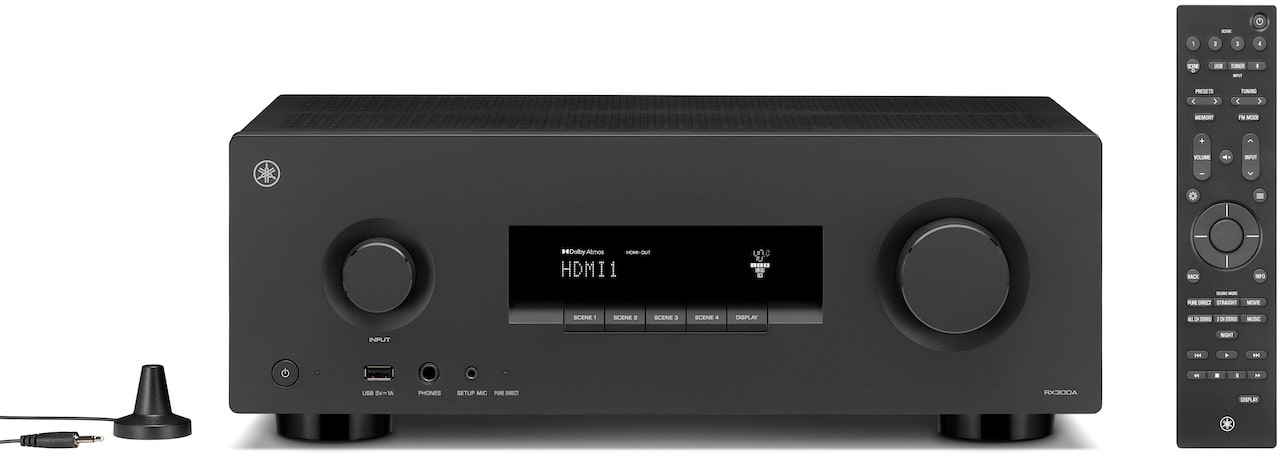
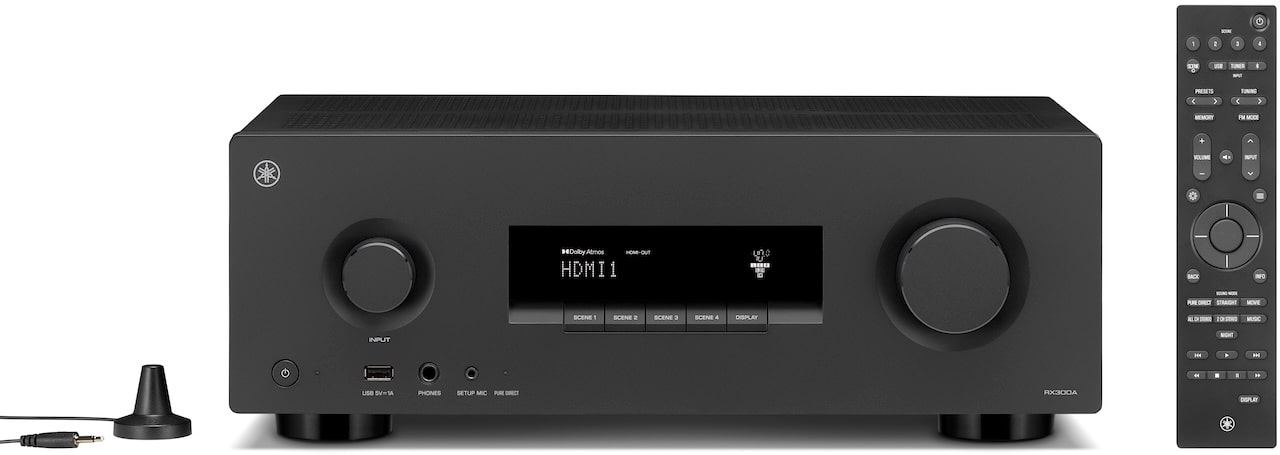
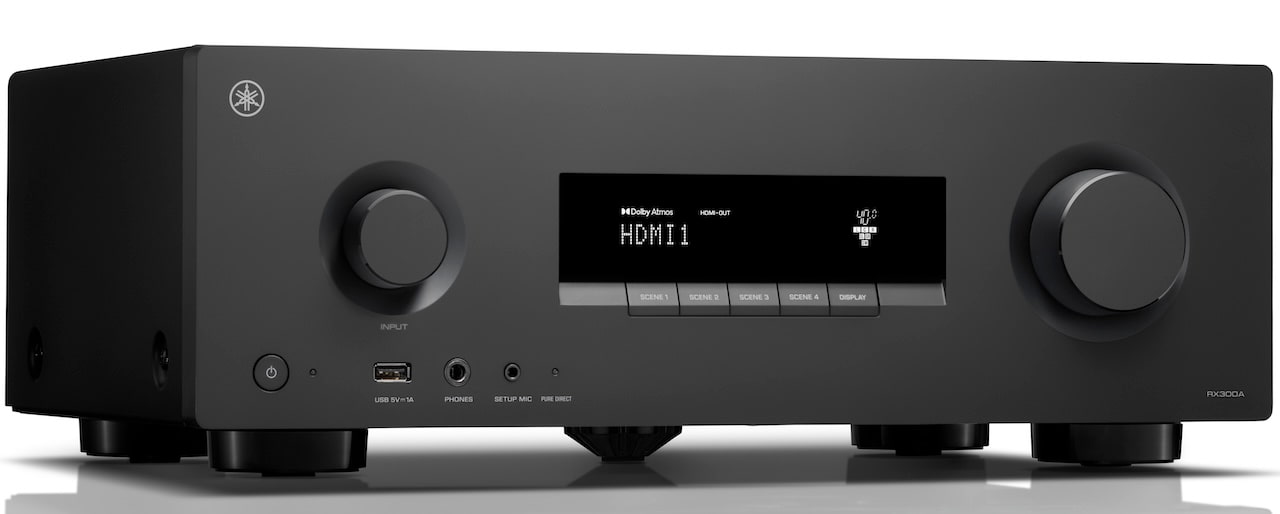
The RX300A AV receiver included with the YHT-4970U updates the look of Yamaha’s previous entry-level design, moving away from the older RX-V385, which originally arrived in 2018. The new front panel is cleaner and less crowded, with fewer visible buttons and simpler labeling, while still keeping the core controls easy to find. It is not a radical redesign, but it does make the receiver look more current and easier to understand for buyers who may be setting up an AVR-based system for the first time.
The RX300A includes an Anti‑Resonance Technology (A.R.T.) Wedge. This is a center-mounted “fifth foot” from Yamaha’s flagship AVENTAGE series that helps reduce vibration and improve stability, supporting cleaner, more accurate sound reproduction.
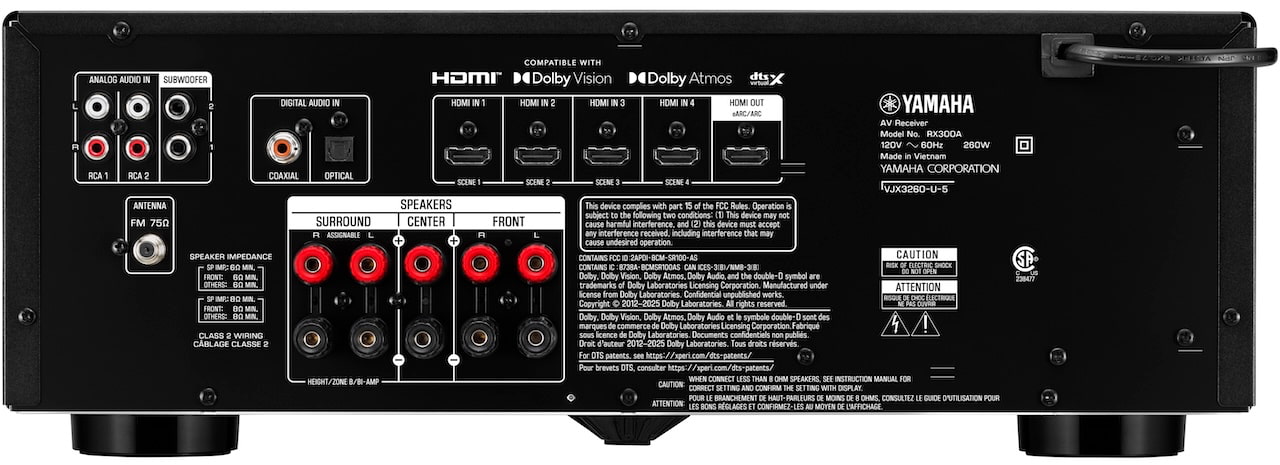
The incorporation of HDMI 2.1 supports high‑performance video sources, including 4K/120Hz and 8K/60Hz pass-through, along with Dolby Vision and HDR10+ for improved contrast, color accuracy, and detail. Gaming‑focused features, such as Variable Refresh Rate (VRR) and Auto Low Latency Mode (ALLM), help ensure smooth, responsive gameplay when paired with modern consoles.
Advertisement
Room Correction
The RX300A provides a setup microphone that enables automatic room correction for the YHT-4970U system by measuring room acoustics and speaker behavior. This allows the receiver to optimize sound performance for the listening environment. An on-screen setup guide further simplifies installation by walking users through connections and configuration step by step.
Sound Setting Simplicity
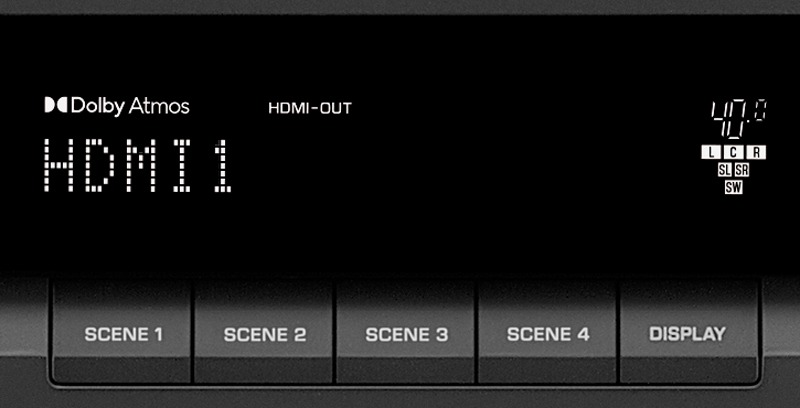
The RX300A also includes Yamaha’s Scene buttons, which let users store and recall common settings with a single press. Each Scene can be assigned to an input, sound program, and related playback settings, making it easier to jump between TV, movies, music, and gaming without digging through menus every time. It is a practical feature for an entry-level home theater system because it reduces setup friction and keeps the receiver from feeling like homework with speaker terminals.
The RX300A supports Dolby Atmos in two ways. If you run speaker wires to the rear of your room and place speakers there for 5.1 channels, the receiver can add virtual height effects to simulate sound coming from above you. If instead, you want real height channels or you don’t want to run wires to the back of the room, you can configure the receiver for height channels and mount those extra speakers on the ceiling or high on the front or side wall for discrete height effects. This would be a real 3.1.2-channel Dolby Atmos system, with the receiver creating virtual rear channel effects. Note that Yamaha calls this a “3.2.2-channel” configuration, because there is a second subwoofer output on the receiver that could can use if you have a second sub.
And while the RX300A does not natively decode DTS:X, it does support DTS Virtual:X, which is designed to create a more spacious height effect from DTS soundtracks without requiring physical height speakers. That distinction matters. Real height channel decoding and real height speakers will deliver the more convincing immersive sound experience, while virtual processing is the compromise for rooms where adding more speakers is not practical. Useful? Yes. Ideal? Nope. But keep in mind, people, this is an entry level receiver so it can’t do everything.
For wireless connectivity, Bluetooth Multipoint allows two devices (such as a smartphone and tablet) to remain paired simultaneously, making it easy to switch between sources without reconnecting. The RX300A can also be used with Bluetooth headphones or speakers.
The Speakers and Subwoofer
The RX300A is the control center of the YHT-4970U, but Yamaha also includes the rest of the basic 5.1-channel speaker package in the box. The system comes with two compact front speakers, two compact surround speakers, a compact center channel speaker, and an 8-inch, 50-watt powered subwoofer, with the speakers and subwoofer connecting to the receiver using standard speaker wire and audio cable connections.
Advertisement. Scroll to continue reading.
Advertisement
Pro Tip #1: The package includes one powered subwoofer, but the RX300A provides two subwoofer outputs, so a second subwoofer can be added later if the room or your bass addiction demands backup.
Pro Tip #2: Because the RX300A uses standard passive speaker connections and powered subwoofer outputs, the included speakers are not a dead end. Owners can upgrade the front, center, surround speakers, or subwoofer later without replacing the entire system. That is one of the biggest advantages over most soundbar packages: the YHT-4970U starts as a complete system, but it does not have to stay frozen that way forever.
Dolby Atmos Dolby True HD Dolby Digital Plus Dolby Digital DTS
Dolby True HD Dolby Digital Plus Dolby Digital DTS-HD Master Audio DTS- HD High Resolution DTS DTS 96/24 DTS Neo:6
Surround Sound Post Decoding Formats
Dolby Surround DTS Virtual:X
Not Indicated
Network Decoding Formats
No
No
USB Decoding Formats
MP3 MPEG4-AAC WM WAV
MP3 MPEG4-AAC WMA WAV
HDMI Decoding Formats
PCM (8ch max)
PCM (8ch max)
Sound Modes
Pure Direct Straight Movie All Channel Stereo 2 Channel Stereo Music Night
Direct Straight Enhancer Bass program BD/DVD TV CD Radio
Zone B
Yes
Not Indicated
Room Calibration
Room Correction
YPAO
Other Features
Dialogue Level Subwoofer Trim Extra Bass Lip Sync
Dialogue Level Subwoofer Trim Extra Bass Lip Sync
HDMI Connections
4 Inputs / 1 Output
4 Inputs / 1 Output
HDMI Features
HDMI 2.1 8K60Hz/4K120Hz eARC, ARC VRR ALLM QMS HDCP 2.3 CEC Auto Lip Sync Deep Color x.v. Color HD audio playback
HDMI Version 2.0b Video Upscaling To 4K eARC, ARC HDCP 2.2 CEC Auto Lip Sync Deep Color x.v. Color HD audio playback
High Dynamic Range (HDR) Support
HDR10+ HDR10 Dolby Vision Hybrid Log-Gamma
HDR10 Dolby Vision Hybrid Log-Gamma
Headphone Output
1
1
Subwoofer Pre-outs
2
1
HDMI
4 Inputs / 1 Output
4 Inputs / 1 Output
Analog RCA Inputs
2
2
Analog Aux Input
No
1 x 1/8″ / 3.5 mm Aux (Front)
Optical Input
1
1
Coaxial Input
1
2
USB
1 (Audio File Playback from a Mass Storage Device, Firmware Updates)
1
FM/AM Tuner
Yes / No
Yes/Yes
Bluetooth
Yes (Ver. 5.3, Multipoint)
Yes (Version 2.)1
Streaming
No (Streaming through Bluetooth only)
No (Streaming through Bluetooth only)
Wi-Fi / Ethernet Port
No
No
Speaker Output
5 (binding post terminals)
5 (binding post terminals)
Speaker Design
2 x Front, Bass Reflex 2 x Surround: Bass Reflex 1 x Center: Acoustic Suspension
2 x Front, Bass Reflex 2 x Surround: Bass Reflex 1 x Center: Acoustic Suspension
Speaker System Frequency Response
Not Indicated
28 Hz to 25 kHz
Speaker System Power Handling
Nominal Input Power 30 W per Channel
Max Input Power 100 W per Channel
Advertisement
Nominal Input Power 30 W per Channel
Max Input Power 100 W per Channel
Speakers Impedance
6 Ohms
6 Ohms
Speakers Sensitivity
Front, Surround: 83 dB, 2.83 V/m
Center: 84 dB, 2.83V/m
Advertisement
Front, Surround: 83 dB, 2.83 V/m
Center: 84 dB, 2.83V/m
Speaker Drivers
1x 2.75″ / 69.85 mm Full-Range Cone per Speaker
1x 2.75″ / 69.85 mm Full-Range Cone per Speaker
Subwoofer
Powered, Bass Reflex (twisted flare port)
Power Output RMS: 50 W (5 Ohms, 100 Hz, 10% THD)
Advertisement
Dynamic: 100 W (5 Ohms)
Frequency Response: 28 to 200 Hz
Driver: 1x 8″ / 203.2 mm Cone
Powered, Bass Reflex Power Output RMS: 50 W (5 Ohms, 100 Hz, 10% THD)
Advertisement
Dynamic: 100 W (5 Ohms)
Frequency Response: 28 to 200 Hz
Driver: 1x 8″ / 203.2 mm Cone
Power Consumption
260W
AVR: 400W Subwoofer: 40W
Standby Power Consumption
≤0.3W
≤ 0.2 W
Auto Power Standby
Yes
Yes
App
Not Indicated
Not Indicated
Dimensions (AVR)
434W x 157H x 319D mm
Advertisement
17-1/8”W x 6-1/8”H x 12-1/2”D
17.13″W x 6.31″H x 12.56″D
Dimensions (Speakers)
Not Indicated
Front and Surrounds: 4.38 x 6.88 x 4.63″ / 111.13 x 174.63 x 117.48 mm
Center: 10.88 x 4.38 x 4.63″ / 276.23 x 111.13 x 117.48 mm
Dimensions (Woofer)
11” W x 11” H x 13” D
Included Accessories
Remote Control Batteries FM Antenna Setup Mic Microphone Stand Quick Guide Safety Guide
Remote Control Batteries AM/FM Antenna Setup Mic Microphone Stand Quick Guide Safety Guide
The Bottom Line
The Yamaha YHT-4970U makes sense for buyers who want a real 5.1-channel AVR-based home theater system without buying every piece separately. It also offers a flexible configuration option to use front height speakers instead of surround speakers for Dolby Atmos, in case running wires to the back of your room is problematic. For $700, it delivers discrete speakers, a powered subwoofer, Bluetooth, HDMI connectivity, and a genuine upgrade path.
The limitations are clear. There is no discrete 5.1.2-channel option for Dolby Atmos. That would take 7 amplifier channels, where this only has 5. And the RX-300A receiver doesn’t support DTS:X decoding. But in today’s Dolby Atmos-heavy streaming and physical media ecosystems, this may not be that big a deal to most buyers. Also, the included speakers are likely the starting point, not the finish line. The good news is that the RX300A uses standard speaker and subwoofer connections, so owners can upgrade the speakers or add a second subwoofer later as budget and available space allow.
Advertisement
Who is it for? First-time home theater buyers, secondary rooms, and anyone who wants actual surround sound instead of another soundbar trying to do architectural drawings with DSP.
Pricing & Availability
Yamaha YHT-4970U 5.1-Channel Home Theater in a Box – $699.95 (July 2026)
In 2021, I wrote about Fire Emblem for our 20th anniversary GBA story. Over the past five years, I’ve played it from start to finish two times, and can once again confirm that it is my favorite Game Boy Advance game.
I hadn’t even heard about Fire Emblem as a series until I got into Advance Wars, another Intelligent Systems game. From there, I discovered that a whole series of fantasy-inspired games with similar gameplay existed, but had never been translated into English. Thirsty for more, but with a distinct lack of Japanese language skills, I spent a year getting deep into Final Fantasy Tactics, old Shining Force games, Vandal Hearts and basically anything vaguely Fire Emblem-shaped that was available in English. Then, off the back of Advance Wars‘ success, Nintendo decided to release a Fire Emblem game in the west, and simply called it Fire Emblem.
Released as Fire Emblem: The Blazing Blade in Japan, Fire Emblem was technically the second GBA FE title and the seventh overall. The battles were challenging, and its RPG elements drew me in much more than Advance Wars ever did. With a vast story full of twists and turns, and a cast of characters I truly cared about, I was instantly hooked. Which made it all the more tough when I encountered perhaps FE’s most famous mechanic: permadeath. The loss of a character who’s seen you through thick and thin dying a pathetic and meaningless death, all because you left them one square away from safety, is memorable.
Despite a few missteps, over the years Fire Emblem became my favorite series, and I am deeply excited by Fortune’s Weave finally getting a release date. But I still come back to the GBA game to relive that love-at-first-sight moment.
Advertisement
In 2026, I’m so familiar with the game that it’s very rare for me to lose a party member by accident. Those once-challenging battles are now more of a warm embrace. Unfortunately, playing it has become harder in recent years. Though I still have my original cart, both my Game Boy Advance and my old DS Lite are really worse for wear. I tried to play on the Switch 2’s online library recently, but I think the screen size just isn’t a great match for GBA games.
In that respect, modern retro handhelds have been a godsend. I spent way too much on the Aya Neo Pocket Micro Classic, a machine with the same aspect ratio of the original GBA, and loved my playthrough of Fire Emblem on that. It does feel weird playing it on anything but a Game Boy Advance, though. I’ve been saying this for the best part of a decade at this point, but I do wish Nintendo would take advantage of this deep thirst for its old games and produce a bespoke console similar to the Classic Editions of the SNES and NES.
The number of iPhones stolen in London that have been reactivated by thieves has plummeted in recent weeks, preventing them from being sold and, hopefully, making iPhones less likely to be stolen in the future.
The theft of iPhones has become a real problem for London in recent years. So much so that some thieves have been known to hand back a stolen phone if it turns out not to be an iPhone.
Thieves typically use mopeds to ride up to a victim before snatching their iPhone and riding off. But the thieves don’t want the iPhone itself; they want to sell it on for cash. And that only works if they can unlock and reset it.
But in an interview with the BBC, Metropolitan Police Commissioner Sir Mark Rowley admitted that’s happening less than usual.
Advertisement
The comment came as Rowley was calling on tech firms to make stolen phones harder to unlock and sell. But he also admitted that Apple appears to have already made a huge dent in the problem with an existing security feature.
Stolen, but not forgotten
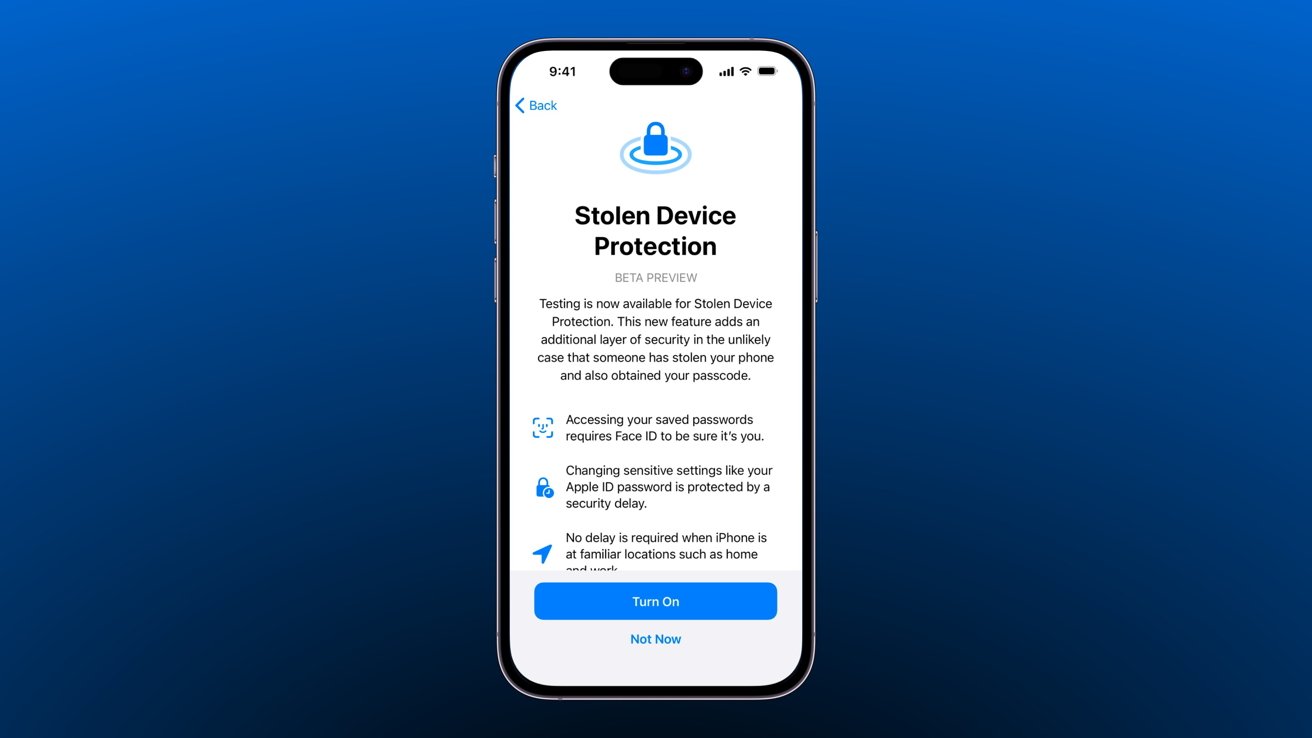
While iPhones have supported Stolen Device Protection since 2023, Apple enabled it by default with the iOS 26.4 update in March 2026.
Stolen Device Protection, when enabled, requires biometric authentication when doing a range of things. Vitally for stolen iPhones, those things include turning off Lost Mode as well as erasing its content and settings.
Some security actions even require a delay before they can be enacted, giving the owner of a stolen iPhone the time to mark it as lost using the Find My network.
Advertisement
This means that a thief cannot reset an iPhone, even if they know your passcode. And that may well have been enough to make iPhones more difficult for thieves to sell on.
Rowley told the BBC Radio 4’s Today program that thieves were using software to “factory reset” devices before selling them on. But he says that Apple has “cracked” the problem with data showing that “the vast majority of phones” stolen in recent weeks have not been reset.
Rowley also added that the Metropolitan Police has entered into an “intelligence sharing agreement” with Apple. It’s hoped this will result in a better understanding of how iPhones are being stolen and sold in London.
China used ChatGPT to generate comments, posts, and cartoons
The content capitalized on issues surrounding data centers and tariffs
The material was shared on social media to exacerbate existing tensions
OpenAI has banned a number of accounts that it says were linked to social media influence campaigns surrounding the growing opposition to data centers and President Trump’s tariffs on foreign imports.
The two campaigns, named “Data Center Bandwagon” and “Tech and Tariffs”, used ChatGPT to generate posts, comments and cartoons intended to sow political division in the US.
China’s intention was to deepen the divide by drumming up online engagement with AI generated posts, OpenAI said, but the campaigns failed to gain any traction.
Latest Videos From
China exacerbates existing tensions
The negative effects of data center construction and the additional costs imposed on consumers by tariffs are existing areas of contention within US society, but they weren’t narratives invented by China.
Advertisement
Instead, according to OpenAI, these campaigns were designed to increase the scale of the issues and broaden their visibility among online groups and on social media sites such as X.
It is the first time that OpenAI models have been used in a Chinese foreign influence campaign, a spokesperson told Axios.
OpenAI said that a Chinese government contractor was responsible for the data center campaign, which shared posts drawing on existing concerns surrounding power grid capacity and electricity prices in areas where data centers were planned or constructed.
Advertisement
Sign up to the TechRadar Pro newsletter to get all the top news, opinion, features and guidance your business needs to succeed!
OpenAI’s account of a foreign country using AI to capitalize on political issues adds some limited validity to recent Republican claims that the entire data center opposition movement being a Chinese influence campaign, but does little to address the very real, tangible effects that data center projects are having on local communities in the US.
A group of Republicans recently called upon FBI Director Kash Patel to investigate anti-data center sentiment, alleging that the rising tide of opposition is being fueled by China, as the inclusion of similar phrasing around water usage, energy constraints, transparency surrounding approval, and utility bill use “language too similar to be coincidental”.
Xbox CEO Asha Sharma, roughly 100 days into her tenure, delivered a blunt assessment of Microsoft’s gaming business in a memo to employees Wednesday, saying that heavy spending with thin profit margins and declining revenue “cannot continue.”
The memo, posted publicly on the Xbox blog, came as Bloomberg News reported that the division is planning major job cuts next month, soon after the close of Microsoft’s fiscal year on June 30. Xbox is also planning significant cuts to marketing and other budgets, according to the report.
The exact scale of the layoffs is not yet clear. Microsoft declined to comment. The Verge also reported that Xbox “will be hit with significant layoffs next month,” citing people familiar with the plans.
Sharma’s memo did not mention layoffs but described a business that needs a sweeping reset. She and Xbox content chief Matt Booty, who co-signed the memo, cited rising hardware component costs, an overextended studio system, and aging platform infrastructure among the challenges facing the division.
Xbox will end the fiscal year at about a 3% “accountability margin,” an internal metric Microsoft uses to measure the profitability of the business, according to the memo.
Advertisement
“Excluding Activision Blizzard King, over the past five years, we have spent over $20 billion on ongoing investments in our content, platform, and hardware subsidy, but our annual revenue has declined nearly half a billion during that time,” Sharma and Booty wrote. “Going forward, this cannot continue.”
Microsoft’s most recent quarterly filing illustrates the challenge. Gaming revenue fell 7% to $5.3 billion in the quarter ended March 31, with Xbox hardware revenue down 33% on lower console sales, and Xbox content and services revenue down 5%.
The memo follows Sunday’s Xbox Games Showcase, where Sharma reversed course on the company’s multiplatform strategy, announcing that Gears of War: E-Day and Clockwork Revolution will be Xbox console exclusives. Bloomberg reported Wednesday that a PlayStation 5 version of the new Gears of War game had been in development, and was canceled, before the announcement.
Sharma took over in February from Phil Spencer, the longtime Xbox leader who announced his retirement after 38 years at Microsoft. A former Instacart COO and Meta product executive, she previously ran Microsoft’s CoreAI product organization.
Samsung’s next rugged smartwatch could be getting one of the biggest battery upgrades we’ve seen on a Wear OS device.
According to a new report, the Galaxy Watch Ultra 2 will feature a battery with a rated capacity of 784mAh. This would likely be marketed as an 800mAh cell when the watch launches. If accurate, that would represent a jump of more than 30% over the current Galaxy Watch Ultra’s already sizeable 590mAh battery.
Battery life has become one of the biggest battlegrounds for smartwatch makers. This is especially true in the Wear OS world, where many devices still struggle to make it comfortably through multiple days of use. That’s what makes this rumoured upgrade stand out.
For comparison, reports suggest Samsung will equip the upcoming 40mm Galaxy Watch 9 with a 382mAh battery. Meanwhile, Google’s latest Pixel Watch 4 models pack 325mAh and 455mAh cells, depending on size. On paper at least, the Galaxy Watch Ultra 2 would offer almost double the battery capacity of many mainstream Wear OS watches.
Advertisement
Of course, battery size doesn’t automatically translate into battery life. Factors such as display efficiency, software optimisation and processor performance all play a major role. However, the original Galaxy Watch Ultra already ranks among the better-performing Wear OS watches for endurance. As a result, a larger battery could make its successor even more appealing for users who prioritise longevity over slim designs.
Advertisement
The report also suggests Samsung will pair the new watch with Qualcomm’s Snapdragon Wear Elite platform. This platform will power several upcoming flagship smartwatches. If the chip delivers meaningful efficiency gains alongside the larger battery, Samsung could be looking at a substantial real-world improvement.
It’s also shaping up to be the first major refresh of the Ultra line since the original model launched. While last year’s update focused largely on refinements, the Galaxy Watch Ultra 2 is beginning to look like a more significant upgrade. This could be especially true if battery life becomes its headline feature.
Advertisement
Samsung is widely expected to unveil the Galaxy Watch Ultra 2 in July alongside the Galaxy Z Fold 8.
It’s no secret that Asus knows how to make gaming laptops. But what if you’re tired of the conventional gaming laptop that has a screen on top and a keyboard on the bottom? That’s exactly the problem Asus wants to solve, as it has just opened pre-orders for its latest premium gaming product in India. The new lineup is headlined by the flagship ROG Zephyrus Duo, which features two screens and an NVIDIA GeForce RTX 5090 graphics card. Along with that, the company has also announced refreshed versions of the Zephyrus G14 and G16, the TUF Gaming A14, and the creator-focused ProArt PZ14. Here’s everything you need to know about them.
What’s Up With The Zephyrus Duo?
The biggest announcement is the new ROG Zephyrus Duo, ASUS’s latest take on the dual-screen gaming laptop concept. The laptop features two 16-inch 3K OLED touch displays, allowing users to run games, editing tools, livestream controls, or AI applications simultaneously. ASUS says the system is powered by up to an Intel Core Ultra 9 Series 3 processor and an NVIDIA GeForce RTX 5090 graphics card.
The secondary display can be used for multitasking, while a 320-degree hinge and detachable wireless keyboard allow the laptop to be used in multiple modes. ASUS has also included its Intelligent Cooling system with liquid metal thermal compound and a tri-fan setup to keep temperatures under control. The ROG Zephyrus Duo starts at ₹5,49,990, while the top-end RTX 5090 variant costs ₹6,99,990.
Zephyrus and TUF Series Get RTX 50-Series Upgrades
ASUS has also refreshed its popular Zephyrus G14 and G16 gaming laptops with NVIDIA’s latest RTX 50-series GPUs. The Zephyrus G14 continues to target users who want a powerful gaming laptop in a compact package. It weighs just 1.5kg and features a 3K ROG Nebula HDR OLED display with 100% DCI-P3 color coverage. ASUS pairs the display with Intel Core Ultra processors and up to RTX 5070 Ti graphics.
The larger Zephyrus G16 is aimed at users looking for more screen real estate without sacrificing portability. Despite packing a 16-inch display and a 90Wh battery, the laptop weighs under 2kg. It comes with Intel Core Ultra 9 processors and up to RTX 5080 graphics, depending on the configuration.
ASUS has also announced the TUF Gaming A14, a more affordable gaming laptop that weighs just 1.46kg. The laptop runs on AMD’s new AI-powered Gorgon Point processor paired with NVIDIA GeForce RTX 5060 graphics. ASUS says it has been designed for students, gamers, and creators who need a portable machine without giving up gaming performance.
Advertisement
Pricing starts at:
TUF A14 – ₹1,99,990
Zephyrus G14 Refresh – ₹2,59,990
Zephyrus G14 RTX 5070 – ₹3,69,990
Zephyrus G16 RTX 5070 Ti – ₹4,19,990
Zephyrus G16 RTX 5080 – ₹5,09,990
ProArt PZ14 for Creators
For creators, ASUS has introduced the new ProArt PZ14, a lightweight 2-in-1 device with a detachable keyboard. The laptop features a 14-inch 3K ASUS Lumina Pro OLED touchscreen with 100% DCI-P3 coverage and Pantone validation. It is powered by Qualcomm’s Snapdragon X2 Elite processor and offers up to 80 TOPS of AI performance. ASUS says the device can deliver up to 22 hours of battery life and supports the ASUS Pen for creators who sketch, design, or edit on the go. The ProArt PZ14 is priced at ₹2,69,990.
As the US war with Iran continues to roil the Middle East, new research shared exclusively with WIRED shows that YouTube is hosting and possibly profiting from dozens of channels linked to US-sanctioned groups linked to the Iranian government, including many with direct ties to the country’s Islamic Revolutionary Guard Corps (IRGC).
The research, from the nonprofit Tech Transparency Project, identified more than 75 channels that appear to be run by entities that have been officially sanctioned by the Treasury Department’s Office of Foreign Assets Control (OFAC), which has been enforcing sanctions against Iran for decades.
The channels have been monetized, meaning that YouTube runs ads on their videos that generate revenue. The researchers documented ads for companies ranging from Subaru to Verizon, TurboTax, the weight-loss drug Ozempic, and fast-food outlet KFC. In one case, the researchers observed an ad for the US Customs and Border Protection running on a video produced by Iran’s Ministry of Cultural Heritage, Tourism, and Handicrafts.
“That means YouTube placed an ad paid for with US tax dollars on a channel for an Iranian government ministry,” the researchers wrote. US Customs and Border Protection did not respond to a request for comment.
Advertisement
“The numerous holders of all these YouTube channels include Iranian individuals and entities that aren’t just subject to the comprehensive US embargo on Iran, but sanctioned by OFAC under a variety of its sanctions programs, including counterterrorism, nonproliferation, human rights abuses, or those specific to the Iranian government more generally,” Kian Meshkat, an attorney specializing in US economic sanctions who reviewed the research, tells WIRED.
“Google is committed to compliance with applicable sanctions and trade compliance laws,” says Google spokesperson Nate Funkhouser. “If we find that an account violates our policies, we take appropriate action.”
YouTube was officially banned in Iran in 2012, but it continues to be used by the regime to share propaganda. Google’s own publisher policies, which apply to YouTube, make it clear that the company’s ad tools “may not be used for or on behalf” of parties in Iran.
In 2024, YouTube did take some action, shutting down an account associated with Iran’s foreign ministry. ”Due to established US sanctions, Iran’s state-owned channels are not permitted on YouTube,” the company said at the time.
Advertisement
TTP’s researchers trawled the platform for the names of individuals directly sanctioned by the US as a threat to national security, as well as for accounts seemingly run by Iranian government officials, identifying a total of 84 channels. All showed ads in the videos on their channels, including in-feed ads, in-stream ads, and YouTube Shorts ads.
Among the sanctioned individuals identified were Babak Zanjani, a businessman helping Iran’s Islamic Revolutionary Guard Corps evade sanctions; Ali Akbar Velayati, an adviser to Iran’s new supreme leader who threatened US forces in the region; and Naji Sharifi Zindashti, who is accused of targeting Iranian dissidents abroad for assassination, including two residents of Maryland.
Al-Mustafa International University, an Iranian Islamic seminary school sanctioned in 2020 for indoctrinating and recruiting foreign intelligence sources, has at least four YouTube channels, according to the researchers, including English- and French-language channels. The channels, which feature video courses and lectures, were monetized with in-stream and in-feed ads, including ads for BJ’s Wholesale Club and Warner Bros.’ horror film They Will Kill You.
Among the government entities identified as having YouTube channels showing ads was Iran’s Counterterrorism Special Forces unit, which has been accused of using lethal force on unarmed protesters. Iran’s state broadcaster, the Fars News Agency, which is well known for spreading disinformation and propaganda, also has a YouTube channel showing ads.
Opendoor, the San Francisco-based online home-buying platform, is shutting down its India operations less than two years after expanding its presence in the country. The decision has become a flashpoint in the debate over whether AI is starting to alter the economics of offshore work.
In announcing the decision on Wednesday, CEO Kaz Nejatian cited a push to bring operational work back to the U.S., where Opendoor’s customers are, and a shift toward smaller AI-native teams. The company did not respond to requests for comment on how many employees were affected or how much of the decision was driven by AI efficiency. But the announcement quickly gained traction across Silicon Valley, where founders, investors, and outsourcing experts see it as an early example of how AI is reshaping the economics that made India a global hub for back-office operations.
To understand why they care, it helps to know what’s at stake for India. It has evolved far beyond its roots as a destination for outsourced back-office work. The country is now the world’s largest Global Capability Center market — a term for dedicated offshore units multinationals set up to handle everything from IT and finance to R&D — with more than 2,100 centers employing about 2.36 million people and generating nearly $100 billion in annual revenue.
Opendoor itself had built a large team in India to handle manual workflows across fragmented systems, Nejatian said. The company had nearly 250 employees in India when it opened offices in Chennai and Bengaluru in 2024. But the entire company has been scaling back in recent years. Securities filings show Opendoor employed 1,042 people globally at the end of last year, compared with 1,470 a year earlier. Similarly, its non-U.S. workforce declined to 184 employees at the end of last year, compared with 342 employees at the end of 2024.
Advertisement
Those broader workforce reductions make it difficult to view the India closure solely through the lens of outsourcing. Opendoor has been cutting costs across the business after a difficult period for the U.S. housing market that hit online home-buying companies especially hard. Still, the language Nejatian used to explain the move resonated with investors and outsourcing analysts who see AI reshaping how companies organize operational work.
Some investors viewed the decision as a sign of what AI could mean for India’s vast outsourcing workforce. “As manual work gets replaced by AI, a lot of jobs will be lost in India,” wrote Sheel Mohnot, co-founder of Better Tomorrow Ventures.
Others viewed Opendoor as evidence of a larger shift in how companies are organized. Keshav Lohia, a venture capitalist at Emergent Ventures, described the decision as a “watershed moment” for AI-driven operations, arguing that advances in AI are beginning to challenge the cost-arbitrage model that made India a popular offshoring destination.
Phil Fersht, chief executive of HFS Research, an advisory firm that tracks the global outsourcing and business services industry, told TechCrunch that the development should not be viewed simply as jobs moving from India to the U.S. The more important shift, he said, is that AI is reducing the amount of operational labor companies require in the first place, allowing firms to run leaner organizations regardless of location.
Advertisement
“This is not an isolated restructuring,” Fersht said. “It is part of a much broader pattern we are starting to see as companies redesign operations around AI, automation, and much leaner workflows.”
Fersht argued that the winners would be companies that combine AI, software and human expertise to deliver outcomes without continually adding headcount, a model he described as “Services-as-Software.” While Opendoor may be one of the first high-profile examples, he said it is unlikely to be the last.
Some investors are already extrapolating beyond individual companies. Varun Rekhi, a venture capitalist at Speedinvest, argued that if AI reduces demand for labor-intensive services, it could eventually pressure one of India’s most important export industries, which is built around supplying talent and expertise to global corporations.
For now, Opendoor remains a complicated case study — a company that has been cutting headcount broadly for years, and whose India exit may say as much about its own struggles as it does about the future of AI and offshore work.
Advertisement
When you purchase through links in our articles, we may earn a small commission. This doesn’t affect our editorial independence.
Great Marlow restricts network access while it investigates suspected infection
Great Marlow School in Buckinghamshire, England, has entered its second day of a shutdown following “a suspected malware incident.”
Only students sitting their GCSE and A-level exams – those in Years 11 and 13 – were permitted to attend on Wednesday, in line with their exam timetable, and the same goes for Thursday.
Advertisement
Students in other years (Years 6-10 and Year 12) were told to stay at home and access what revision materials they can via Microsoft Teams as teachers are currently unable to set them any work.
Those scheduled to take internal mock exams, students in Years 10 and 12, will sit them later in the year. Some extracurricular activities, such as Year 7’s learn-to-row session, have been rearranged, although the 7 and 8 athletics event will go ahead on Thursday as planned.
Great Marlow School’s statement suggests it remains in the containment stage of its recovery, with limited access to systems.
“As a precautionary measure, we have restricted access to elements of our network while we investigate the issue thoroughly and take the necessary steps to ensure the security and integrity of our systems and data,” headteacher Guy Pendlebury said in a statement on the school’s website on Tuesday evening.
Advertisement
“We are responding in line with guidance from the Department for Education (DfE) and the National Cyber Security Centre (NCSC). Immediate action has been taken to contain the incident, and we are working closely with specialist IT and cybersecurity professionals to fully assess the situation and restore normal operations as quickly and safely as possible. Appropriate reporting procedures have also been followed.”
The school did not comment on whether the attack involved ransomware or if any of its data was presumed compromised.
It adds to a grim week for cybersecurity in the education sector. A high school in Illinois also closed for two days this week due to a ransomware attack, but reopened on Wednesday, although its phone lines are still down. And Nottingham Uni confirmed it was the victim of Shiny Hunters.
In Wales, 13 schools across the Powys region were affected by a cyberattack that is thought to have led to data theft from only one of these institutions.
Advertisement
Powys council disclosed the attack on June 4, saying it was originally identified in April, and sensitive data belonging to students and school staff is suspected of being compromised.
Deezer has launched a free online AI music detector that checks playlists from 20 major streaming platforms for AI-generated tracks. It uses the same technology Deezer has been using to detect and tag synthetic music on its own service.
The tool is available in 27 languages, and it arrives as Deezer says nearly 75,000 AI-generated tracks are being delivered to it every day. That volume gives the launch a sharper edge than a simple playlist cleanup feature. It’s a way to put synthetic-song detection in front of listeners before the rest of streaming settles on common rules.
How much AI music is hiding in playlists
Deezer says 43% of people arriving from other streaming services already have AI-generated music in their playlists. For listeners, the new scanner answers a basic question that most platforms still don’t surface clearly.
Deezer
Users connect a streaming account, choose playlists, and review the results. Because the scanner works across 20 common services, Deezer can get its detection system in front of people who don’t use its app.
That stance lands while major music apps are testing how far they want to go with generative tools, including Spotify’s experiments around AI-made covers and remixes. Deezer is focusing on the cleanup job that follows, identifying AI songs after they’ve already entered a library.
Advertisement
Why would the industry license Deezer’s detector
Deezer says its detection technology can identify tracks from major generative music models, including Suno and Udio. It can also be expanded when the company has enough data examples from other tools.
The company says it has made progress on a broader system designed to catch synthetic content without a model-specific training set. That gives Deezer a business case beyond the public playlist scanner. It wants platforms, labels, distributors, and rights groups to use the same underlying technology to spot machine-made tracks before they distort discovery or payment systems.
Unsplash
What happens after AI tracks are tagged
Deezer says fully AI-generated music makes up only 1% to 3% of streams on its service, but it also says as much as 85% of those streams were fraudulent in 2025. When Deezer finds stream manipulation, it excludes those plays from royalty payments.
The company has already removed AI-generated tracks from algorithmic recommendations and editorial playlists. Broader steps, including supplier policy changes or demonetization, are still under review. For listeners and the industry, Deezer’s practical message is clear. Detection has to happen before trust, royalties, and recommendations can be cleaned up.

























































You must be logged in to post a comment Login