

Business
Commonwealth Bank shares slump on tax changes, provisions; Australian lenders fall




Business
(VIDEO) Putin Hails Successful Sarmat Test as ‘Most Powerful Missile in the World’ Amid Nuclear Modernization

MOSCOW — Russian President Vladimir Putin on Tuesday praised the successful test launch of the RS-28 Sarmat intercontinental ballistic missile, describing it as “the most powerful missile in the world” and announcing plans to place it on combat duty by the end of 2026. The launch from the Plesetsk Cosmodrome in northern Russia marked a significant step in Moscow’s efforts to modernize its nuclear arsenal amid heightened global tensions and the expiration of key arms control treaties with the United States.
Strategic Missile Forces Commander Col. Gen. Sergei Karakayev reported the successful firing to Putin via video link. The silo-based Sarmat, known in the West as “Satan II,” was launched at 11:15 a.m. Moscow time and flew approximately 5,500 kilometers to a test range on the Kamchatka Peninsula in Russia’s Far East. All mission objectives were achieved, according to Russian officials.
“This is the most powerful missile system in the world,” Putin declared in televised remarks. He emphasized that the combined power of the missile’s individually targeted warheads exceeds that of any Western counterpart by more than four times. The Sarmat, weighing around 208 tons and standing 35 meters tall, can carry a payload of up to 10 tons and travel more than 35,000 kilometers — enough to reach targets anywhere on Earth via polar trajectories.
Technical Capabilities and Strategic Importance
The RS-28 Sarmat is designed to replace the aging Soviet-era R-36M2 Voevoda missiles. Russian officials claim it can penetrate all existing and prospective missile defense systems through advanced maneuverability, decoys and hypersonic capabilities. Its heavy payload allows it to carry multiple independently targetable reentry vehicles (MIRVs), hypersonic glide vehicles or other advanced warheads.
Putin linked the missile’s development to the U.S. withdrawal from the 1972 Anti-Ballistic Missile Treaty, framing it as a necessary response to perceived threats. The test comes months after the New START treaty — the last major bilateral nuclear arms control agreement between Russia and the United States — effectively lapsed without renewal.
Military analysts note the Sarmat’s ability to fly over the South Pole could complicate detection and interception by Northern Hemisphere-based defense systems. Its liquid-fueled design provides flexibility in targeting while presenting engineering challenges that have delayed full deployment for years.
Context of Heightened Tensions
The launch occurs against the backdrop of Russia’s ongoing military operation in Ukraine, now in its fourth year. Putin recently suggested the fighting could be nearing an end, yet Western officials express skepticism amid continued battlefield developments. The missile test serves as a reminder of Russia’s nuclear capabilities at a time when NATO continues to support Kyiv with advanced weaponry.
Russia has conducted previous Sarmat tests, some of which faced setbacks, including a reported explosion during a 2024 silo test. Despite these hurdles and the recent arrest of a key defense industry executive, Tuesday’s launch was presented as a validation of the program. The first regiment equipped with Sarmat missiles is slated for the Uzhur division in Krasnoyarsk region.
International Reactions and Concerns
Western governments and NATO expressed concern over the test, viewing it as nuclear saber-rattling. U.S. officials confirmed Russia provided advance notification consistent with transparency obligations, though formal verification mechanisms remain limited without New START. European leaders warned that such demonstrations raise escalation risks in an already volatile security environment.
Arms control experts highlight the dangers of an unchecked nuclear arms race. With both Russia and the United States modernizing their arsenals, the absence of binding limits could lead to increased deployments and heightened miscalculation risks. China, expanding its own nuclear forces, adds another layer of complexity to global strategic stability.
Russia’s Broader Nuclear Modernization
The Sarmat represents one element of Russia’s ongoing nuclear overhaul, which includes hypersonic weapons like the Avangard, the Burevestnik nuclear-powered cruise missile and the Oreshnik intermediate-range system recently used in Ukraine. Putin has repeatedly positioned these developments as essential for national security and deterrence.
State media showcased footage of the launch, featuring dramatic plumes of fire and smoke as the massive missile lifted off. Kremlin spokespeople stressed the test’s purely defensive nature while underscoring its deterrent value against potential adversaries.
Domestic and Geopolitical Messaging
For domestic audiences, the announcement reinforces narratives of Russian technological superiority and military strength. It coincides with preparations for Victory Day commemorations and efforts to project confidence amid economic sanctions and battlefield challenges.
Internationally, the timing amplifies Russia’s messaging that it will not be cowed by Western pressure. Putin’s comments tie the missile directly to perceived U.S. and NATO aggression, a recurring theme in his public addresses.
Analysts caution that while the Sarmat enhances Russia’s second-strike capability, its deployment will face logistical hurdles, including production scaling and maintenance of complex liquid-fueled systems. Past delays suggest full operational capability may extend beyond initial timelines.
Implications for Global Security
The successful test underscores the evolving nature of strategic deterrence in the 21st century. As traditional arms control frameworks erode, nations increasingly rely on technological advancements to maintain balance. The Sarmat’s claimed invulnerability to defenses could prompt countermeasures, including new space-based sensors or hypersonic interceptors.
For now, the focus remains on verification and monitoring. Independent experts will scrutinize available data to assess the test’s true performance against Moscow’s bold claims.
As Russia moves toward deploying its newest strategic weapon by year’s end, the world watches closely. The Sarmat launch adds another high-stakes chapter to an era of renewed great-power competition, where nuclear rhetoric and demonstrations continue to shape international relations. Whether it leads to renewed dialogue on arms control or further escalation remains one of the defining questions of our time.

The property fund acquired the government-leased office building from Corval for $79.4 million.

The Hyderabad-based precision engineering company posted a consolidated net profit of Rs 44.28 crore for the March quarter, sharply higher than Rs 13.72 crore reported in the same period last year, reflecting a growth of about 223%.
Revenue from operations for the quarter rose nearly 67% to Rs 306 crore from Rs 183 crore a year earlier. The increase was mainly driven by higher product sales, which rose to Rs 303 crore from Rs 179 crore in the corresponding quarter last year.
Profit before tax stood at Rs 59.54 crore in Q4, up from Rs 18.62 crore in the year-ago period, marking an increase of nearly 220%.
For the full year FY26, the company reported consolidated net profit of Rs 94.03 crore, compared with Rs 52.89 crore in FY25, translating into growth of close to 78%.

Annual revenue from operations rose 31% to Rs 876.21 crore from Rs 675.99 crore in the previous financial year.
Profit before tax for FY26 increased to Rs 126.15 crore from Rs 71.57 crore in FY25, registering growth of more than 76%.Total expenses during the March quarter rose to Rs 262.92 crore from Rs 164.50 crore in the same quarter last year. Cost of materials consumed increased to Rs 165 crore from Rs 95.66 crore, reflecting higher production activity and execution.
Employee benefit expenses came in at Rs 43.05 crore compared with Rs 34.51 crore a year earlier, while finance costs rose to Rs 9.62 crore from Rs 5.93 crore. Despite the rise in costs, the company’s quarterly profit before tax margin improved to nearly 18.4% from 10.2% in the year-ago quarter, indicating better operational efficiency.
MTAR Technologies operates across sectors such as clean energy, civil nuclear power, aerospace and defence, and precision engineering manufacturing. The company has been strengthening its execution capabilities and expanding its order pipeline amid growing opportunities in strategic manufacturing and energy transition-related businesses.
(Disclaimer: Recommendations, suggestions, views and opinions given by the experts are their own. These do not represent the views of The Economic Times)

After workers in Kenya, tasked with watching videos made through Meta’s glasses to create AI training data for the company, said they were being required to watch graphic content like sex and bathroom usage, people who own the glasses filed two lawsuits. In one, people said they had no idea such videos had been made. In the other, they said they did not know their videos were being shared by the company for review.

A colossal legal battle over Hancock Prospecting’s mining empire continues with appeal notices officially lodged against Wright Prospecting, DFD Rhodes, the Rinehart children, and Rio Tinto.

Check out what’s clicking on FoxBusiness.com.
Waymo is recalling its massive fleet of autonomous vehicles over a defect that may pose significant safety risk, according to federal regulators.
The action follows an incident in which a driverless vehicle failed to come to a complete stop after encountering flooded road conditions on a high-speed roadway, the National Highway Traffic Safety Administration (NHTSA) said in a May 6 report.
“Entering a flooded roadway can cause a loss of vehicle control, increasing the risk of a crash or injury,” the agency said.
The recall covers 3,791 vehicles equipped with the company’s 5th and 6th generation Automated Driving Systems (ADS), which regulators estimate have a 100% defect rate.
WAYMO TO BRING DRIVERLESS CARS TO CHICAGO, EYES MIDWEST EXPANSION

A Waymo autonomous taxi on Bush Street in San Francisco, California, US, on Dec. 17, 2025. (David Paul Morris/Bloomberg via Getty Images / Getty Images)
The company currently operates thousands of vehicles across the U.S., including San Francisco, Los Angeles, Phoenix and Austin.
According to the report, when a Waymo robotaxi approaches standing water on higher-speed roads, it may slow down but fail to come to a full stop after detection.
Federal regulators said the first incident occurred on April 20, when an unoccupied Waymo vehicle encountered an “untraversable flooded section” of roadway with a 40 mph speed limit.
That same day, Waymo implemented additional restrictions to reduce the risk of similar incidents in inclement weather, including updates to weather-related controls and changes to mapping systems used by its vehicles.
TESLA DODGES CALIFORNIA LICENSE SUSPENSION AFTER DROPPING MISLEADING ‘AUTOPILOT’ MARKETING TERMS

A Waymo car is halted on the road amid a power outage in San Francisco, California, U.S., December 20, 2025. (Reuters / Reuters Photos)
All affected vehicles received an interim software update by April 20, 2026.
Waymo then initiated a recall on April 24.
| Ticker | Security | Last | Change | Change % |
|---|---|---|---|---|
| GOOG | ALPHABET INC. | 383.82 | -2.95 | -0.76% |
Federal regulators added that the affected vehicles were manufactured between March 17, 2022, and April 20, 2026.
CLICK HERE TO GET FOX BUSINESS ON THE GO

Waymo operates across several major U.S. cities, including San Francisco, Los Angeles, Phoenix and Austin. (Source: Waymo)
Because Waymo owns the entire fleet of nearly 3,800 affected units, they were able to apply an interim remedy immediately without the need for traditional consumer notifications.
Owners seeking additional information may also contact the NHTSA Vehicle Safety Hotline at 1-888-327-4236 or go to www.nhtsa.gov.
Business
Kalyan Jewellers, Titan, other jewellery stocks crash up to 6% as Centre hikes gold customs duty to 15%

Kalyan Jewellers was the worst hit, tanking 6% to their day’s low of Rs 340 on the NSE, while Senco Gold dipped over 3% to their day’s low of Rs 302. Titan was relatively resilient, down 1%, while Thangamayil Jewellery was down over 3% in early trade.
Following the revision, the total customs duty on gold and silver has been raised to 15% from 6% earlier. The government has imposed a 10% basic customs duty and a 5% Agriculture Infrastructure and Development Cess (AIDC) on gold and silver imports, taking the effective import tax to 15% from 6%. Platinum and related precious metal components such as hooks, clasps, clamps, pins and screw backs used in manufacturing will also attract a 10% duty.
The higher duties could dampen demand in the world’s second-largest consumer of precious metals, although they may help narrow India’s trade deficit and support the rupee, one of Asia’s worst-performing currencies.
The sharp increase in import duty on gold and silver is likely to be viewed as a near-term negative for jewellery companies as higher duties could push up domestic gold prices and weigh on consumer demand. Costlier jewellery may lead buyers to postpone purchases, particularly in price-sensitive segments. However, organised players could still fare better than smaller unorganised jewellers due to stronger brands, better inventory management and higher customer trust.
The move comes days after Prime Minister Narendra Modi, during a speech in Hyderabad on Sunday, urged citizens to reduce fuel consumption, use public transport, avoid foreign travel and refrain from purchasing gold for one year.
India has been trying to curb gold imports in recent weeks and began levying a 3% integrated goods and services tax (IGST) on gold and silver imports, prompting banks to halt imports for more than a month.As a result, April imports fell to a near 30-year low. Banks have since resumed imports after paying the 3% IGST, but imports are now likely to fall again following the increase in import duties, bullion dealers told Reuters.
Gold has long been regarded as one of the most reliable long-term assets for Indian families, especially during uncertain times. Beyond its financial value, the precious metal holds deep cultural significance in India, symbolising tradition, security, weddings, household savings and generational wealth.
Sensex, Nifty today: Catch all the LIVE stock market action here
(Disclaimer: Recommendations, suggestions, views and opinions given by the experts are their own. These do not represent the views of The Economic Times)
Business
Dixon Tech shares jump 4% after Q4 results. Do Goldman Sachs, Motilal Oswal forecast further upside?

Revenue from operations for Q4FY26 rose 2% year-on-year to Rs 10,511 crore, compared with Rs 10,293 crore in the corresponding quarter of the previous financial year.
Total income during the quarter increased 3% to Rs 10,595 crore from Rs 10,304 crore a year ago. Other income stood at Rs 84 crore, significantly higher than Rs 11 crore reported in the year-ago quarter.
Earnings before interest, taxes, depreciation and amortisation, or EBITDA, rose 9% year-on-year to Rs 493 crore in the reported quarter.
Dixon Tech shares: Should you buy, sell or hold?
Brokerage firm Goldman Sachs has maintained a “Sell” rating on Dixon Technologies and revised its target price to Rs 9,790 from Rs 9,985 earlier (3.4% downside). The brokerage said the company’s Q4 results missed estimates mainly due to weaker performance in the mobile and EMS segments, although EBITDA margin at 3.9% remained broadly in line with expectations. Goldman Sachs noted that elevated DRAM prices continue to weigh on mobile phone volumes and expects the FY27 outlook for the mobile business to remain subdued. The brokerage also cautioned that the absence of PLI incentives could pressure margins further and said the earnings downgrade cycle may continue. However, it added that the rollout of PLI 2.0 could emerge as a near-term positive trigger for the stock.
Sensex, Nifty today: Catch all the LIVE stock market action here
Motilal Oswal has also maintained a “Buy” rating on Dixon Technologies with a target price of Rs 14,600, indicating an upside potential of 44%. The brokerage said it has slightly revised its FY27 and FY28 estimates to factor in lower volumes and margins, though higher smartphone realisations are expected to provide support. It now expects the company to deliver a CAGR of 33% in revenue, 37% in EBITDA and 36% in profit after tax between FY26 and FY28. The brokerage further said EBITDA margin is projected at 3.3% in FY27 and is likely to improve to 4.1% in FY28 as backward integration initiatives begin contributing following the PLI scheme.JM Financial has maintained an “Add” rating on Dixon Technologies with a target price of Rs 11,200, implying an upside potential of 10.5%. The analysts cautioned that elevated chip prices could weigh on smartphone demand and restrict organic smartphone volume growth in FY27. Excluding Vivo, the company has guided for flat smartphone volumes in FY27, while the best-case scenario would be double-digit growth if the PLI 2.0 scheme materialises and meaningfully boosts exports within the year. The brokerage added that a possible 12-15% rise in smartphone average selling prices could partly offset pressure on revenues, although it believes even flat volumes in FY27 may prove optimistic under current conditions.
(Disclaimer: Recommendations, suggestions, views and opinions given by the experts are their own. These do not represent the views of The Economic Times)
Revenue from operations during the March quarter declined 13% year-on-year to Rs 14,900 crore, compared with Rs 17,096 crore in the corresponding quarter of the previous year. Despite the fall in revenue, EBITDA for the quarter rose 10% to Rs 4,216 crore.
The renewable energy segment continued to remain a major growth contributor. Profit after tax before exceptional items from the renewables business rose 59% year-on-year to Rs 1,994 crore in FY26, while Q4 profit stood at Rs 406 crore. The solar manufacturing business’ FY26 profit more than doubled to Rs 857 crore. The company attributed the increase to ramp-up in module and cell manufacturing as well as yields exceeding 95%. The rooftop solar business reported a 150% jump in annual profit to Rs 499 crore.
Tata Power shares: Should you buy, sell or hold?
Brokerage firm Goldman Sachs has maintained a “Sell” rating on Tata Power with a target price of Rs 300, a downside of 28%. The brokerage said Tata Power’s Q4 profit after tax came in 13% below estimates and remained broadly flat year-on-year, impacted by weaker renewable energy generation and lower contribution from joint ventures. While the brokerage sees strong long-term growth visibility in rooftop solar and distribution, it flagged renewable energy generation execution as a key risk amid curtailments and transmission constraints. It also said the stock’s current valuation already factors in much of the optimism, with Tata Power trading at a premium to its historical price-to-book valuation.
Brokerage firm Motilal Oswal Financial Services has maintained a “Buy” rating on Tata Power with a target price of Rs 490, implying an upside potential of around 17%. The brokerage highlighted that rooftop solar installations doubled year-on-year to nearly 1.7 GW in FY26, with management expecting the rooftop solar business to grow at least 50-60% in FY27 while targeting a 20% market share over the next three years. Motilal Oswal also pointed to strong growth in the cell and module manufacturing business, where EBITDA more than doubled in FY26, and noted that the company has guided for renewable energy commissioning of 2.5 GW each in FY27 and FY28.
Brokerage firm JM Financial has reiterated its “Buy” call on Tata Power and retained a target price of Rs 485, indicating a potential upside of nearly 16%. The brokerage said the company’s key growth drivers remain its 4.9 GW cell and module manufacturing facility, strong momentum in the rooftop solar business backed by a healthy order book, and steady performance at Odisha discoms. JM Financial also noted that the operationalisation of the Mundra plant following the supplementary power purchase agreement with Gujarat is expected to support growth, with the brokerage forecasting a FY26-28 CAGR of 13% in revenue, 14% in EBITDA and 19% in profit after tax.
(Disclaimer: Recommendations, suggestions, views and opinions given by the experts are their own. These do not represent the views of The Economic Times)
Business
Silver jumps Rs 17,000/kg, gold soars to Rs 1.62 lakh/10g after centre hikes import duty. What should investors do?
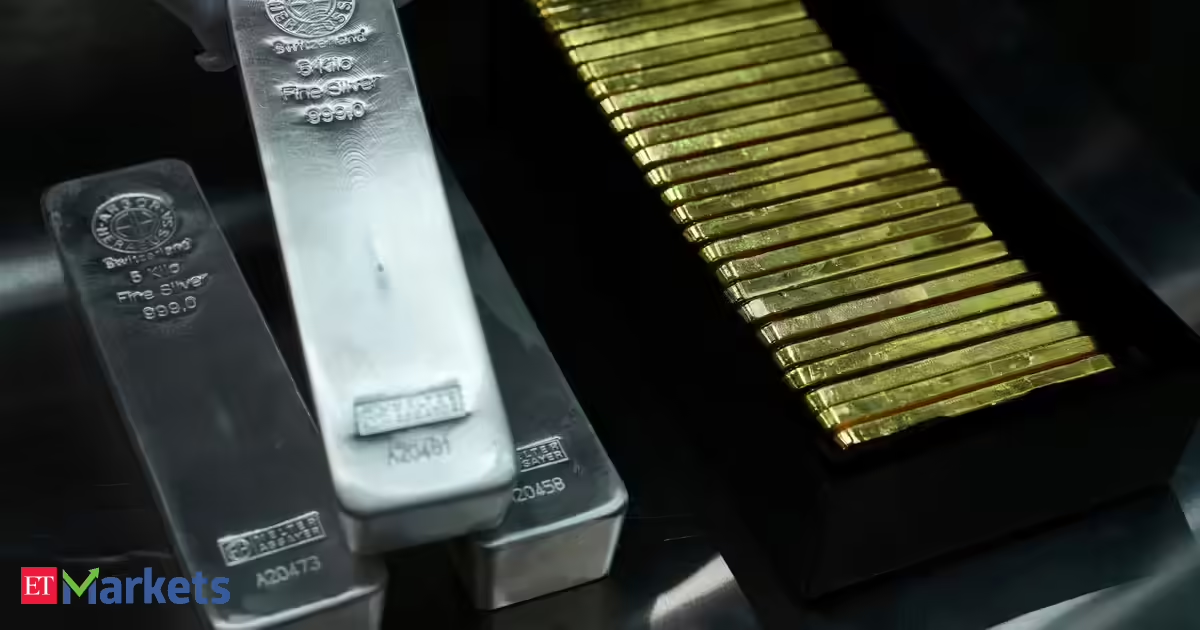
In the domestic market, MCX silver futures for July 2026 delivery jumped Rs 16,743 or 6% to Rs 2,95,805 per kg. Gold futures for June 2026 delivery rallied Rs 9,206 or 6% Rs 1,62,648 per 10 grams. In the previous session, silver ended higher, while gold dropped marginally lower.
Following the revision, the total customs duty on gold and silver has been raised to 15% from 6% earlier. The government has imposed a 10% basic customs duty and a 5% Agriculture Infrastructure and Development Cess (AIDC) on gold and silver imports, taking the effective import tax to 15% from 6%.
In the international market, spot gold fell 0.4% to $4,695.99 per ounce, while U.S. gold futures for June delivery rose 0.4% to $4,705.30. Among other precious metals, spot silver rose 0.2% to $86.71 per ounce after touching its highest level since March 11 earlier in the session. Platinum declined 0.8% to $2,109.53, while palladium slipped 0.2% to $1,487.47.
Recent data showed U.S. consumer inflation accelerated further in April, with the annual inflation rate recording its sharpest increase in nearly three years. The figures have further reduced market expectations of a Fed rate cut this year, thus weighing on sentiment globally.
How should you trade gold?
Manoj Kumar Jain of Prithvi Finmart said both precious metals were witnessing extremely high volatility, although silver prices could hold support near $76.00 per troy ounce, while gold was likely to sustain support around $4,555.00 per troy ounce on a weekly closing basis.
According to Jain, gold has support at $4,640-$4,610 and resistance at $4,740-$4,770 per troy ounce. Silver has support at $82.40-$80.00, while resistance is seen at $88.80-$92.00 per troy ounce in the current session. On MCX, gold has support at Rs 1,52,800-1,52,100 and resistance at Rs 1,54,000-1,54,850, while silver has support at Rs 2,74,400-2,70,700 and resistance at Rs 2,83,000-2,88,000.
He advised traders holding long positions in both precious metals based on these recommendations to book profits near the target levels.
Gold rates in physical markets
Gold Price today in Delhi
Standard gold (22 carat) prices in Delhi stand at Rs 1,13,048/8 grams while pure gold (24 carat) prices stand at Rs 1,23,312/8 grams.
Gold Price today in Mumbai
Standard gold (22 carat) prices in Mumbai stand at Rs 1,12,928/8 grams while pure gold (24 carat) prices stand at Rs 1,23,192/8 grams.
Gold Price today in Chennai
Standard gold (22 carat) prices in Chennai stand at Rs 1,14,704/8 grams while pure gold (24carat) prices stand at Rs 1,25,072/8 grams.
Gold Price today in Hyderabad
Standard gold (22 carat) prices in Hyderabad stand at Rs 1,12,928/8 grams while pure gold (24 carat) prices stand at Rs 1,23,192/8 grams.
(Disclaimer: Recommendations, suggestions, views and opinions given by the experts are their own. These do not represent the views of The Economic Times)

JPMorgan joins reserve fund race with Ethereum-based JLTXX

Mother and son kept animals in ‘hazardous environment’ without water

(VIDEO) Putin Hails Successful Sarmat Test as ‘Most Powerful Missile in the World’ Amid Nuclear Modernization

Manchester United reach agreement with Casemiro over contract clause amid transfer speculation

US brings back mandatory military draft registration

Steven Gerrard disagrees with Gary Neville over ‘shock’ Chelsea and Arsenal claim | Football

Crypto Market Alert: CPI Data, Fed Updates, and Global Geopolitics Explained

Breaking News for XRP & Crypto #xrp #ripple #crypto #xrpnews #bitcoin #btc #cryptocurrency #eth #sol

Don’t let scammers STEAL your HOUSE!!! #money #finance #home #scam #asset
-
 Crypto World5 days ago
HarrisX Poll Found 52% of Registered Voters Support the CLARITY Act
-

 Fashion4 days ago
Weekend Open Thread: Marianne Dress
-

 Crypto World6 days ago
Upbit adds B3 Korean won pair as Base token gains Korea access
-
 NewsBeat6 days ago
NCP car park operator enters administration putting 340 UK sites at risk of closure
-

 Fashion1 day ago
Coffee Break: Travel Steam Iron
-

 Fashion2 days ago
What to Know Before Buying a Curling Wand or Curling Iron
-

 Tech3 days ago
Auto Enthusiast Carves Functional Two-Stroke Engine from Solid Metal
-

 Politics1 day ago
What to expect when you’re expecting a budget
-

 Politics4 days ago
Politics Home Article | Starmer Enters The Danger Zone
-
 Business4 days ago
Ignore market noise, India’s long-term story intact, say D-Street bulls Ramesh Damani and Sunil Singhania
-

 Crypto World7 days ago
BlackRock CEO Larry Fink Discusses a New Asset Class
-

 Tech2 days ago
GM Agrees To Pay $12.75 Million To Settle California Lawsuit Over Misuse Of Customers’ Driving Data
-
 Sports7 days ago
NBA playoff winners and losers: Austin Reaves is not loving Lakers vs. Thunder matchup, but Chet Holmgren is
-

 Entertainment6 days ago
Sarah Paulson Called Out For Met Gala ‘Hypocrisy’
-

 Entertainment5 days ago
General Hospital: Ric & Ava Bombshell – Ric’s Massive Secret Exposed!
-

 Politics5 days ago
Simon Cowell Says He Was ‘Horrible’ To Susan Boyle During BGT Audition
-

 Crypto World6 days ago
Robinhood says Wall Street is building onchain
-

 Entertainment6 days ago
Bold and Beautiful Early Spoilers May 11-15: Steffy Revolted & Liam Overjoyed!
-

 Sports6 days ago
UEFA Champions League final schedule, teams, venue, live time and streaming | Football News
-

 Entertainment6 days ago
Why David Letterman Called CBS ‘Lying Weasels’
You must be logged in to post a comment Login