

Crypto World
JPMorgan joins reserve fund race with Ethereum-based JLTXX



JPMorgan has filed to launch the JPMorgan OnChain Liquidity-Token Money Market Fund, a tokenized government money market fund with the ticker JLTXX.
Summary
- JPMorgan’s JLTXX fund targets stablecoin issuers needing Treasury-backed reserves and blockchain-based share transfer tools.
- Morgan Stanley’s MSNXX launch shows Wall Street banks are competing for stablecoin reserve management mandates.
- Earlier coverage linked JPMorgan to an XRPL settlement pilot with Mastercard, Ripple, and Ondo Finance.
The filing lists Token Class Shares dated May 13, 2026, and says the fund seeks current income while keeping liquidity and principal stability.
The fund is built for stablecoin issuers that need reserve assets under the GENIUS Act. JPMorgan says JLTXX will invest in a way intended to meet eligible reserve asset rules. Its portfolio will focus on U.S. Treasury securities and overnight repurchase agreements backed by Treasurys or cash.
Ethereum becomes the current blockchain rail
The filing says Ethereum is the only public blockchain currently available for investors, though JPMorgan expects to add more networks later. Investors must use approved blockchain addresses before they can buy, redeem or transfer token balances linked to fund shares.
JLTXX keeps official ownership records in traditional book-entry form. The blockchain layer records token balances and can help investors send transaction requests. The fund also says token balances and fund shares are not stablecoins, and JLTXX is not a stablecoin issuer.
Moreover, the Token Class Shares carry a $1 million minimum investment to open an account. The fund lists total annual operating expenses after fee waivers and reimbursements at 0.16%. These waivers are set to run through June 30, 2028, before JPMorgan decides whether to renew or change them.
The filing also describes optional stablecoin services through Morgan Money. Under that process, shareholders may convert USDC into U.S. dollars before fund purchases or convert redemption proceeds back into USDC after redemptions. JPMorgan says Circle is not affiliated with the fund, its adviser or Kinexys Digital Assets.
Wall Street moves into reserve products
The filing comes after Morgan Stanley launched its Stablecoin Reserves Portfolio in April. Market updates said the fund, trading under ticker MSNXX, targets stablecoin issuers and invests in cash, short-dated Treasury bills and overnight repo agreements backed by Treasurys. It has a $10 million minimum investment.
JPMorgan has also tested tokenized Treasury settlement outside its new filing. Earlier coverage said JPMorgan, Mastercard, Ripple and Ondo completed a cross-border redemption test using the XRP Ledger and bank rails. In that pilot, OUSG moved through XRPL while Kinexys sent dollars to Ripple’s Singapore bank account.
Meanwhile, the IMF has warned that tokenization changes how settlement, liquidity and risk management work. Its April note said tokenized finance needs clear policy rules, safe settlement assets, code governance, legal certainty and global coordination.
The fund filing also lists risks. It says future rules under the GENIUS Act may affect whether the fund can serve as backing for stablecoins. The IMF added that weak safeguards could create “speed, concentration, and fragmentation” risks in tokenized finance.

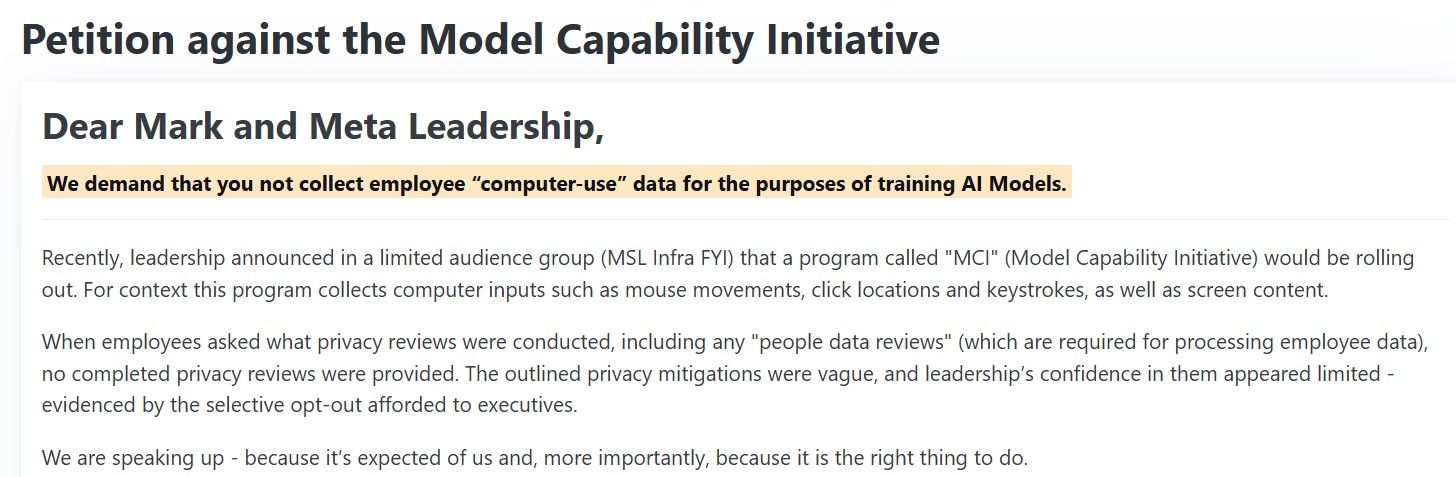
Meta employees at multiple U.S. offices distributed protest flyers. The action targets an internal tool that records mouse movements and keystrokes to train Meta’s AI models.
The flyers appeared in meeting rooms, on vending machines, and atop toilet paper dispensers. They direct staff to a petition demanding Meta withdraw the tool, called the Model Capability Initiative.
Mouse-Tracking Tool Collects Data Across Hundreds of Sites
Meta installed the Model Capability Initiative on U.S. employees’ work computers. The software captures clicks, keystrokes, and periodic screenshots. It runs across hundreds of applications, including Google, LinkedIn, and Wikipedia.
Meta says the data trains AI agents to mimic real human behavior on the web. According to a spokesperson, the models need real examples of how people use software. The company cited button clicks and dropdown menus as key inputs.
Several Meta employees called the program “dystopian” in interviews last month. Workers fear the tool could expose passwords and unreleased product details. They also flagged concerns about personal information, including immigration status, health records, and family details.
Petition Lands Days Before 8,000-Job Layoff
The petition builds on internal opposition that has grown since the April rollout. The flyer campaign on May 12 marked the first coordinated public action by U.S. staff against the program.

Pressure on Meta’s workforce is compounding. Chief people officer Janelle Gale said in late April that the company will cut 8,000 roles on May 20. The move is part of an efficiency drive tied to AI spending. Another 6,000 open positions will go unfilled.
Across the Atlantic, Meta employees in the United Kingdom announced a separate organizing effort this week. They are partnering with the United Tech and Allied Workers union.
Privacy Trade-Off Sits at AI Training Frontier
Meta says safeguards prevent the capture of certain sensitive content. However, it has not detailed the technical scope of those filters. Affected employees argue that consent terms are coercive, given the impending layoffs.
The dispute highlights a wider problem for large AI developers. Quality human behavioral data is increasingly scarce, and companies are turning to their own workforces to fill the gap.
Whether the May 12 protest pressures Meta to alter the program remains unclear. The outcome may signal how much leverage employees retain in an AI-driven cost-cutting cycle.
The post Meta Employees Protest Mouse-Tracking Tool Built to Train AI Models appeared first on BeInCrypto.
Ethereum liquid restaking platform Kelp and decentralized lending protocol Aave have completed a series of steps to restore rsETH backing, including burning the exploiter’s rsETH tokens.
Kelp DAO detailed a post-exploit recovery for its liquid staking token rsETH on Tuesday, confirming that the hacker’s tokens were burned on the layer-2 Arbitrum network.
The 117,132 rsETH — worth about $278 million at current prices — will be progressively restored over two weeks using funds from the Aave Recovery Guardian multisignature wallet, which is controlled by the DeFi United recovery group and Kelp’s own recovery safe.
The funds will be routed through the LayerZero OFT adapter, the smart contract responsible for locking, minting, burning and releasing rsETH during cross-chain transfers.
Kelp DAO confirmed that rsETH on mainnet and layer-2 networks, which has a market capitalization of $1.5 billion, remains fully backed at all times.
The move to recover the liquid staking tokens will bring users impacted by one of this year’s largest DeFi exploits one step closer to recovery.
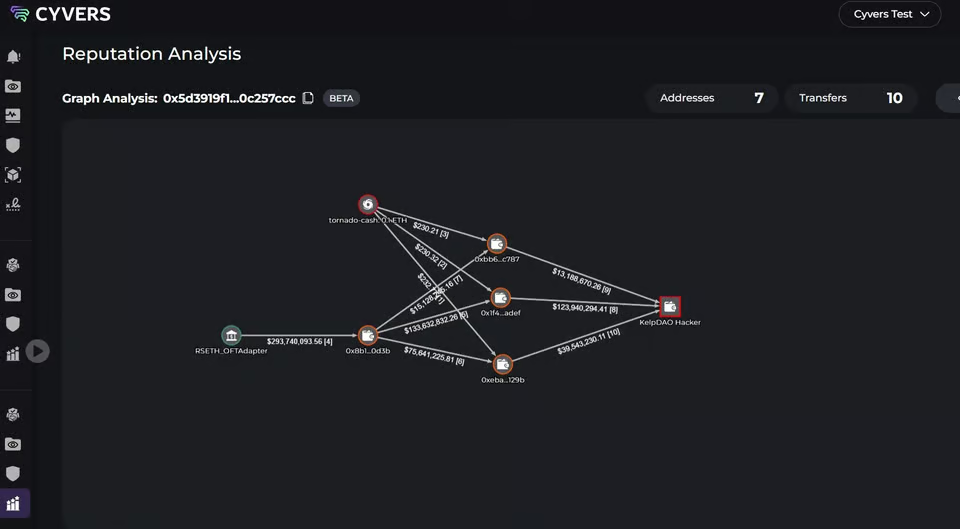
Kelp was hacked in April when attackers widely attributed to North Korea’s Lazarus Group exploited its rsETH adapter bridge contract, the software that manages the platform’s liquid restaking token, and drained about $293 million.
Blockchain security firm OpenZeppelin reported at the time that no smart contract bug had been publicly identified, adding that “the system failed operationally,” and this is a category of risk the DeFi industry has “consistently underweighted.”

Tracking the exploited funds. Source: Cyvers
Withdrawals will resume within 24 hours
Kelp said it will unpause withdrawals, “tentatively within 24 hours,” after the first tranche is returned to the smart contract. All rsETH operations, including deposits, redemptions, bridging and claims, will resume as usual after the contracts are reactivated.
The protocol has also completed a “security hardening pass,” and bridging security now requires four independent attestors and 64 block confirmations, while it has deprecated some layer-2 routes.
Related: At least a dozen crypto entities attacked since Drift Protocol hack
It is also in the process of migrating to Chainlink’s Cross-Chain Interoperability Protocol (CCIP) for “further strengthened cross-chain bridging.”
Derivatives traders undeterred by DeFi hacks
Kelp is a prominent liquid restaking protocol on Ethereum, primarily built on top of EigenLayer, where users deposit ETH or other supported liquid staking tokens for additional yields.
The protocol’s total value locked hit an all-time high of just over $2 billion in September 2025 but has since declined by about 26% to $1.55 billion, according to DefiLlama.
Cointelegraph reported this week that ETH derivatives traders have largely remained unfazed by the recent wave of DeFi exploits, with professional sentiment holding steady despite elevated security concerns.
Magazine: DeFi’s billion-dollar secret: The insiders responsible for hacks

Key Highlights
- Shares of QUBT climbed more than 26% during Tuesday’s premarket session following Q1 revenue of $3.7M that exceeded the $3.1M analyst consensus
- First quarter revenue skyrocketed from a mere $39,000 in Q1 2025, representing a dramatic 12-month transformation
- Rosenblatt Securities maintained its Buy rating with a $22 price objective; Wedbush kept its $12 target intact
- The Arizona-based foundry has transitioned from pure research to revenue-generating operations
- Strategic purchases of Luminar Semiconductor and NuCrypt enhance laser, detector, and quantum encryption technologies
Quantum Computing (QUBT) reported first quarter results that exceeded expectations, propelling shares significantly higher during Tuesday’s session. The firm generated $3.7 million in quarterly revenue, comfortably beating the Street’s $3.1 million projection. The adjusted loss per share of 2 cents also topped analyst estimates.
The year-on-year revenue comparison tells a compelling story. During the first quarter of 2025, the organization recorded merely $39,000 in sales. The current $3.7 million figure represents an extraordinary reversal — although the operational loss expanded to $20 million.
QUBT stock climbed 26.33% in premarket action on Tuesday, building on the previous session’s 6.04% advance. Shares now trade near $13, approaching year-to-date highs, despite remaining down 0.78% for the full year.
Trading activity intensified significantly. Approximately 16.6 million QUBT shares traded hands, well above the three-month average daily volume of roughly 11.59 million.
Wall Street Weighs In
The quarterly report prompted renewed analyst coverage. John McPeake of Rosenblatt Securities confirmed his Buy recommendation while maintaining a $22 price objective, suggesting potential gains exceeding 116% from present levels.
Antoine Legault (four stars) at Wedbush retained his Hold stance with a $12 target, indicating approximately 18% upside potential.
The aggregate Wall Street view registers as Moderate Buy, derived from four Buy recommendations and two Hold ratings issued during the last three months. The mean price objective among these analysts stands at $17.83, translating to roughly 75% upside potential.
CEO Dr. Yuping Huang highlighted photonics as the primary catalyst for expansion. He emphasized the technology’s minimal power requirements and ambient temperature operation as advantages for future data processing applications.
Arizona Manufacturing Facility Milestone
Among the most significant developments from this quarterly report is the Arizona foundry’s performance. The production site, which fabricates the company’s Thin-Film Lithium Niobate (TFLN) chips, had faced scrutiny from short sellers questioning its commercial prospects.
Executive leadership verified the foundry now generates actual revenue. This marks a substantial transition from its previous status as exclusively a research and development center.
The organization also indicated intentions to establish a second production location, implying that TFLN chip demand exceeds present manufacturing capacity.
Unlike numerous rivals dependent on external foundries, Quantum Computing maintains complete control over manufacturing operations spanning hardware through software. This vertical integration strategy minimizes supply chain vulnerabilities and accelerates product development timelines.
The two recently completed acquisitions — Luminar Semiconductor and NuCrypt — incorporate laser and detector technologies alongside quantum encryption capabilities. These additions help reduce expenses associated with constructing room-temperature quantum platforms by internalizing critical component production.
Quantum Computing executives verified that QCi Foundry now contributes to revenue generation for the first time, representing a tangible evolution from development-phase enterprise toward operational commercial business.

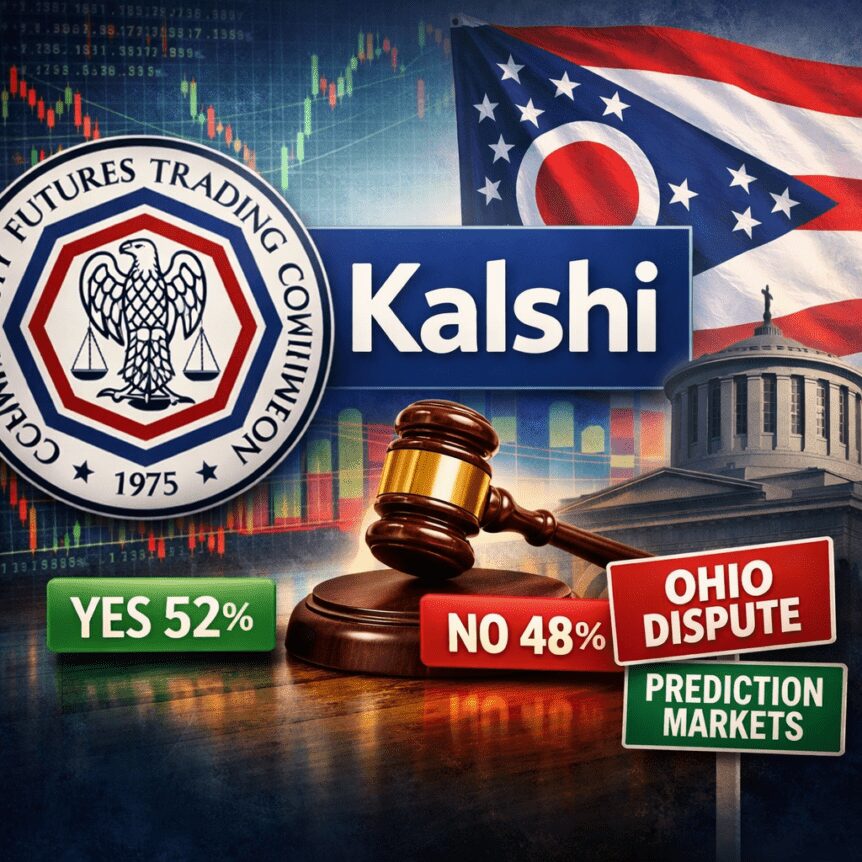
The U.S. Commodity Futures Trading Commission is stepping up its defense of federal authority over prediction markets, as it filed an amicus brief in the Sixth Circuit backing Kalshi in its challenge to Ohio’s regulatory stance. The CFTC argues that Ohio’s actions amount to jurisdictional overreach and threaten to undermine the agency’s exclusive reach over event contracts traded on designated contract markets (DCMs).
Kalshi, a regulated prediction market operator, sought relief in federal court after Ohio authorities told Kalshi last year to halt offering sports event contracts in the state, labeling them unlicensed sports gambling. Kalshi had proceeded with such contracts in other jurisdictions, but Ohio’s position prompted the company to sue the state attorney general and the Ohio Casino Control Commission in October. A federal district court later denied Kalshi’s request to enjoin the state’s actions in March, prompting Kalshi to appeal. The CFTC’s latest amicus brief represents its second public backing of a prediction-market operator in a circuit court battle, following a similar filing in the Ninth Circuit in February supporting Crypto.com in a Nevada regulatory dispute.
“The federal district court in Ohio took an improperly narrow view of the Commission’s jurisdiction, and we are asking the Court of Appeals to correct that error,” CFTC Chairman Mike Selig said in a statement. “As I’ve said repeatedly, the CFTC will not allow overzealous state governments to undermine the agency’s longstanding authority over these markets.”
The dispute sits at the intersection of federal authority and state law, with implications for Kalshi, Polymarket, Crypto.com and other platforms that offer event contracts. The CFTC’s position is that Ohio’s push to regulate and stop Kalshi’s sports-event contracts threatens what the agency regards as exclusive federal oversight of these markets. The agency asserts that event contracts traded on DCMs fall under its swaps or binary options framework, and that allowing state restrictions undermines the federal framework established to regulate capital markets and related products.
The Sixth Circuit fight is one thread in a broader regulatory battle over prediction markets. The CFTC has brought suits against several states in recent months to enforce federal jurisdiction—moves that echo its stance in states such as Wisconsin, New York, Arizona, Connecticut and Illinois. In those actions, regulators argued that the states attempted to apply local gambling or securities laws to platforms offering sports or other event-based contracts. The CFTC has said that such interference risks fragmenting a federally regulated system and creating a patchwork of inconsistent rules that could chill legitimate market activity.
“If States can restrict event contracts on sports, the Commission’s longstanding jurisdiction over these other event contracts could be imperiled too,” the CFTC wrote in the Sixth Circuit filing. “The Court should enforce the Commission’s exclusive jurisdiction and hold that Ohio cannot regulate event contracts traded on DCMs.”
The broader context includes prior CFTC actions and public statements underscoring a push to define and defend the reach of federal regulation over these innovative markets. The agency has described prediction markets as a domain governed by federal rules, not a patchwork of state prohibitions, and has signaled a willingness to go to court to protect that framework. Chairman Selig’s comments reflect a stance that federal law should guide how event contracts are offered, traded and regulated, even as states press their own regulatory theories.
Beyond the Ohio case, the litigation arc this year places Kalshi and other operators under heightened regulatory scrutiny in multiple jurisdictions. In February, the CFTC filed a separate amicus brief in the Ninth Circuit supporting Crypto.com in its Nevada-related dispute, illustrating a pattern of federal regulators backing prediction-market actors across different appellate courts. The agency’s broader strategy is to hinge its defense on the idea that Congress delegated to the CFTC a specific, exclusive remit over event contracts when traded on regulated venues, a remit that would be compromised if states can arbitrarily circumscribe or ban such activity within their borders.
For market participants, the questions at stake go beyond a single lawsuit. Kalshi, Polymarket, Crypto.com, Robinhood and Coinbase—operators offering sports-event contracts or related products on CFTC-regulated platforms—navigate a regulatory landscape that is still taking shape. A ruling in the Sixth Circuit could either reinforce the federal model, or open the door to a wave of state-by-state attempts to curb or reclassify prediction-market activity. The stakes aren’t purely legal; they determine how traders hedge or speculate on future events, how developers structure product offerings, and how investors assess the regulatory risk embedded in these markets.
Analysts and industry observers have noted that the current wave of cases could influence future Supreme Court considerations, given the nationwide reach and the potential for divergent state outcomes. The ongoing legal drama underscores a central tension: whether prediction markets should operate under a unified federal regime or whether states retain meaningful discretion to restrict or redefine them under local gambling or consumer-protection laws. The resolution of the Ohio matter, and related suits in other circuits, will help clarify the balance between state sovereignty and federal market regulation.
As Kalshi and its opponents await the Sixth Circuit’s ruling, market participants will be watching for several telltale signs: how the court interprets the CFTC’s authority over event contracts, whether state actions can be sustained without chilling cross-border platform operations, and how a potential ruling could alter the business models of prediction-market platforms that rely on regulated DCM environments. The outcome will likely influence how other states approach prediction-market products and could shape the pace at which new event-based financial instruments reach broader adoption.
What comes next may hinge on the Sixth Circuit’s process and timing. While the outcome remains uncertain, the CFTC’s dual-front approach—defending federal jurisdiction in multiple appellate venues—signals that the regulator intends to maintain a central role over how event contracts are offered and traded. For investors and operators alike, the evolving jurisdictional calculus will determine not just legal exposure, but the operating feasibility and strategic planning for prediction-market ecosystems in the years ahead.
Readers should monitor upcoming developments in the Kalshi case for the Sixth Circuit, as well as related actions in Wisconsin, New York, Arizona, Connecticut, and Illinois. The convergence of these cases will help define the boundaries of federal authority in prediction markets and set the tone for how these platforms evolve within a regulated, nationwide framework.

More than 100 amendments have been filed to the Digital Asset Market Clarity Act ahead of the Senate Banking Committee’s scheduled markup on May 14, 2026, a volume that signals the bill has entered genuine horse-trading territory, not procedural formality.
Triple-digit amendments at this stage mean the legislative text is live, contested, and being reshaped in real time by competing institutional interests.
The markup, set for 10:30 a.m. in Dirksen Room 538, follows the House’s bipartisan 294-134 passage of the bill on July 17, 2025.
The White House has flagged a July 4, 2026 target for presidential signature, a deadline that gives the Senate roughly seven weeks to resolve disputes that have already derailed two prior markup sessions.
Discover: The best pre-launch token sales
What 100-Plus Amendments Actually Signal About the Clarity ACT Bill’s Fault Lines
The amendment volume is not noise. It maps, with unusual precision, exactly where the bill’s drafters left negotiating room, and where they didn’t.
The most contested provisions cluster around four areas: stablecoin yield treatment, DeFi protocol liability, digital asset mixer classifications, and software developer safe harbors under the Blockchain Regulatory Certainty Act provisions embedded in the Senate’s expanded nine-title structure.
Democrats, including Senators Elizabeth Warren, Chris Van Hollen, Angela Alsobrooks, and Raphael Warnock, have pushed ethics amendments that would bar public officials and their families from profiting on stablecoins or crypto while in office, alongside restrictions preventing big tech firms from issuing stablecoins.
Van Hollen’s “anti-corruption” and “anti-touting” disclosure amendments are framed as consumer protection measures.
Republicans, including Senators Cynthia Lummis, Bill Hagerty, and Thom Tillis, view that framing as a deliberate bill-killer, ethics language broad enough to suppress Democratic floor votes without being negotiable on substance.
The stablecoin yield debate is technically specific: amendments contest whether the bill’s language banning interest payments on stablecoins should include the word “solely,” a single-word distinction that determines whether yield-bearing stablecoin products are structurally compliant or categorically prohibited.
— Eleanor Terrett (@EleanorTerrett) May 12, 2026
 NEW: Since last Friday, @ABABankers members have sent more than 8,000 letters to Senate offices urging lawmakers to fix the stablecoin yield compromise, per a source familiar with the effort. It apparently does not include a separate phone call campaign.
That is not a drafting detail, it is a market-structure decision worth billions in product revenue for issuers already operating in that space.
The CLARITY Act’s jurisdictional architecture, CFTC exclusive authority over spot and cash markets for “digital commodities” on decentralized blockchains, SEC retaining primary oversight over investment contracts and fundraising, remains the bill’s structural core.
Most amendments, analysts note, are negotiating tactics unlikely to survive the markup vote. The real question is which ones are concessions in disguise. That distinction determines the bill’s final shape more than the raw amendment count does.
What Passes the Markup, and What Stalls the Full Senate Floor Vote
If the Banking Committee clears the bill on May 14 with ethics language Democrats can accept, likely a narrowed version targeting Trump-family conflicts rather than a categorical ban, the Senate Agriculture Committee follows with its own markup, and the floor vote timeline toward July 4 holds.
If Warren’s coalition treats the ethics provision as a floor requirement and Republicans refuse to incorporate it, the bill exits committee on party lines and faces a 60-vote cloture threshold it cannot currently clear.
The banking lobby’s opposition to DeFi safe harbor provisions adds a second pressure vector. Banks have argued that developer liability protections create regulatory arbitrage, allowing DeFi protocols to operate without the compliance infrastructure that chartered institutions must maintain.
If that argument gains traction with moderate Democrats, the Blockchain Regulatory Certainty Act provisions get stripped or diluted, which fractures the crypto industry coalition that has been the bill’s most consistent Senate floor lobbying force.
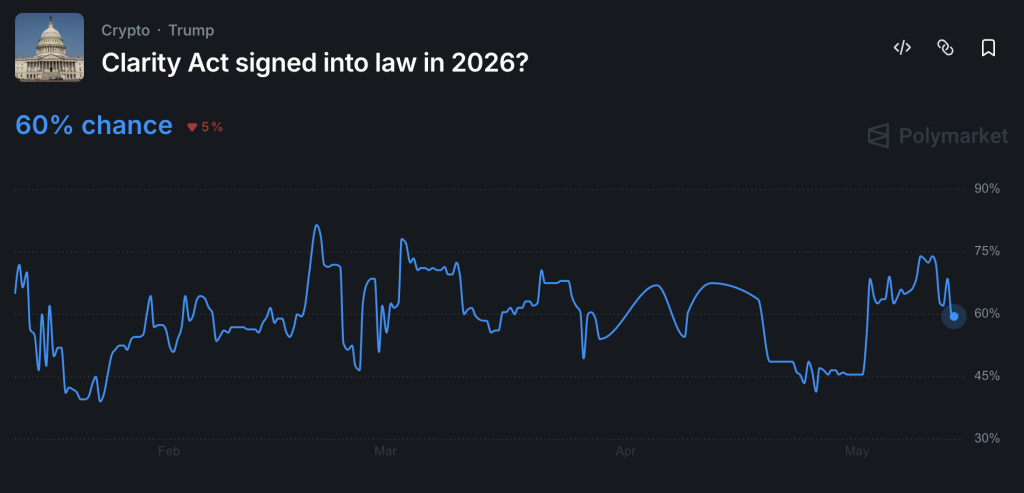
Bipartisan momentum is real, 78 House Democrats voted for the bill, and the CLARITY Act’s stablecoin reserve framework drew support from members who previously opposed crypto legislation. But House votes don’t transfer to Senate arithmetic. The 60-vote math is the decisive variable, and it runs through the ethics amendment.
The May 14 committee vote is the first hard signal on whether this Congress delivers a crypto market structure framework before the legislative calendar tightens. Everything after that depends on what the markup produces,x and which amendments survive it.
The post Senators File 100-Plus Amendments to Crypto Bill Ahead of Senate Markup appeared first on Cryptonews.
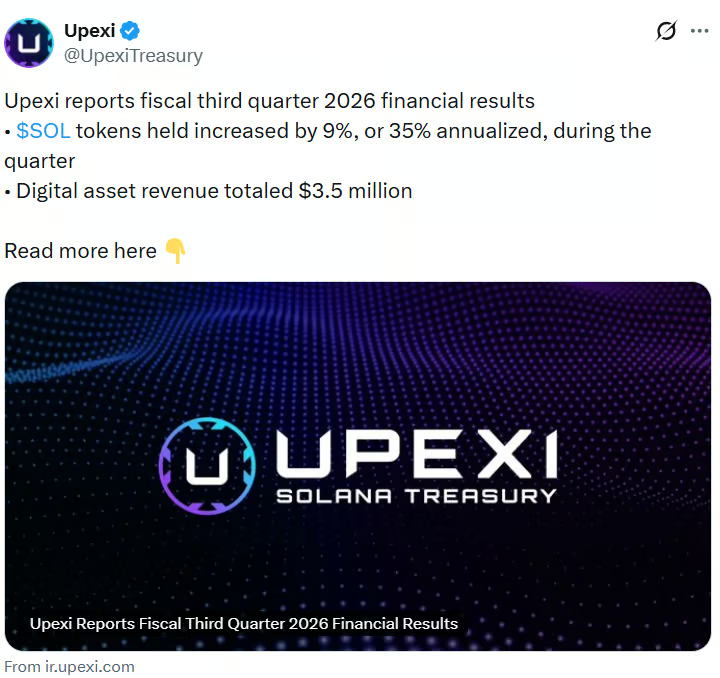
Shares in Solana treasury company Upexi fell 8.16% on Tuesday after reporting a widened net loss of $109 million in its fiscal third quarter, driven by a fall in the value of its crypto holdings.
The company reported $92.3 million in unrealized losses on digital assets, according to a filing on Tuesday. This was despite total revenue rising 46% to $4.6 million compared with the same period last year, driven by crypto staking revenue.
Upexi CEO Allan Marshall said during the earnings call that Upexi faced a challenging environment, along with the rest of the industry, but it has focused on initiatives to improve the company’s fundamentals through share buybacks and a convertible note offering to raise additional capital.
“Our fiscal third quarter was characterized by a challenging environment, most notably a continued decline in both the price of Solana and industry multiples. Both had a direct impact on our stock and were the result of a general bear market in crypto,” he said.

Source: Upexi
“While we, like any treasury company, are heavily impacted by token prices and valuation multiples, we are not simply waiting around for the environment to improve but rather are taking a proactive approach with several efforts afoot,” Marshall added.
Solana holdings increased by 9% during the quarter
Upexi had 2.5 million Solana tokens, worth more than $238 million, in its holdings as of March 31, its results show, making it the second-largest corporate Solana treasury after Forward Industries, which holds more than 7 million tokens, according to CoinGecko.
Related: Strategy CEO Phong Le says company will sell BTC only in specific cases
Previously, its business centered on consumer products and e-commerce before publicly announcing a pivot to becoming a Solana treasury company in late April 2025.
Marshall said that, in the long term, the company expects Solana to be viewed independently of Bitcoin as investor knowledge increases and to be judged on its own underlying fundamentals.
“While we believe the biggest determinant of the price of Solana will be the price of Bitcoin over the near term, we see this changing over the next few years,” he said.
“This is primarily because Bitcoin and Solana are two completely different constructs, with the former a store of value or digital gold, and the latter a new type of computer, and one that is upgrading our antiquated financial infrastructure.”
Forward Industries, the largest Solana treasury company, has scheduled its next earnings call for Thursday. In its previous results, released in February, its revenue increased from $4.6 million to $21.4 million. The company said the increase was largely driven by staking revenue.
Magazine: Guide to the top and emerging global crypto hubs — Mid-2026
EUR/USD declined from 1.1800 and traded below 1.1750. USD/JPY is rising and might gain pace above 158.00 and 158.80.
Important Takeaways for EUR/USD and USD/JPY Analysis Today
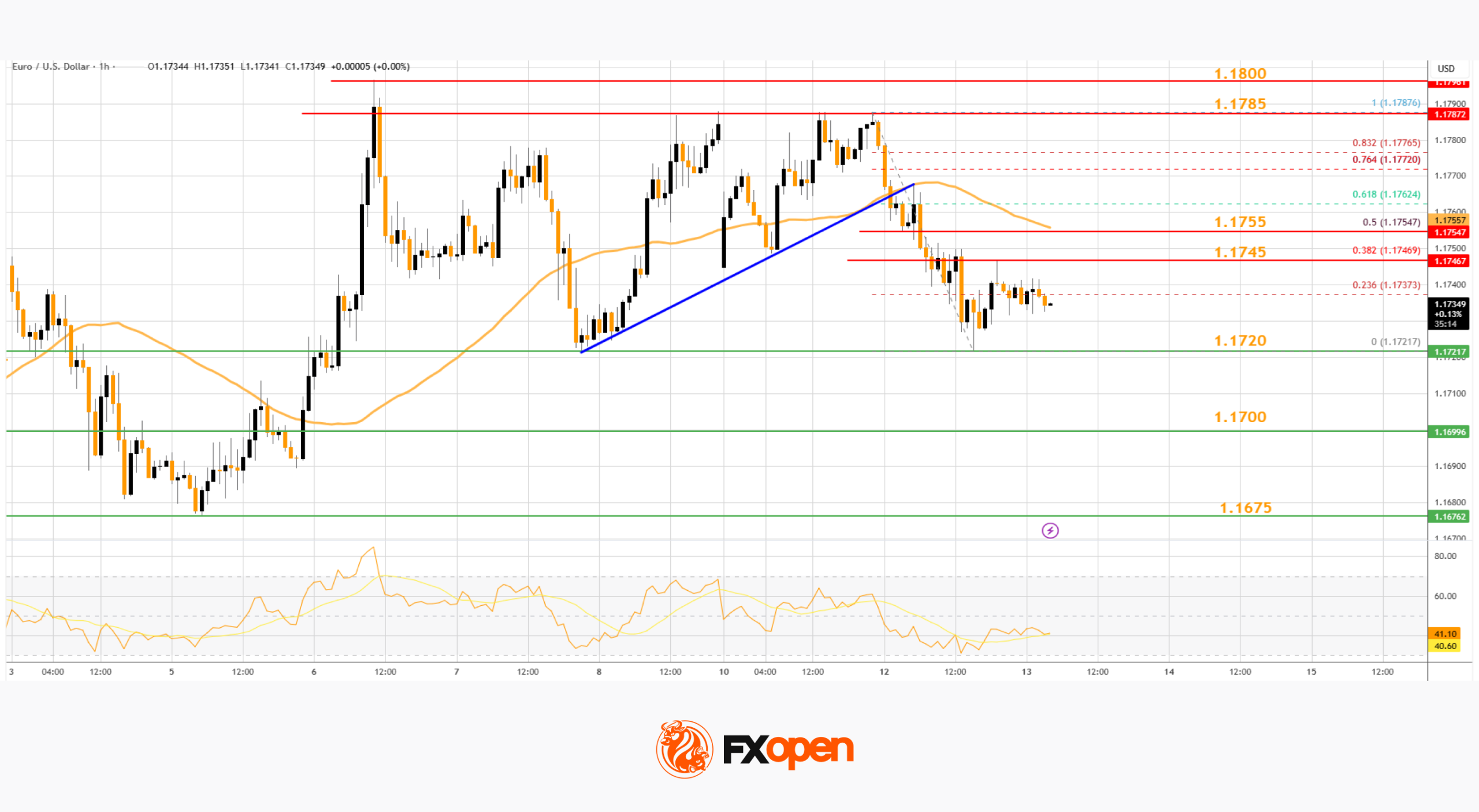
· The Euro started a fresh decline after a decent move to 1.1800.
· There was a break below a key bullish trend line with support at 1.1765 on the hourly chart of EUR/USD at FXOpen.
· USD/JPY climbed higher above the 156.40 and 157.10 levels.
· There is a major bullish trend line forming with support at 157.40 on the hourly chart at FXOpen.
EUR/USD Technical Analysis
On the hourly chart of EUR/USD at FXOpen, the pair climbed above the 1.1780 resistance zone before the bears appeared, as discussed in the previous analysis. The Euro started a fresh decline and traded below 1.1765 against the US Dollar.
There was a break below a key bullish trend line with support at 1.1765. The pair declined below 1.1750 and tested 1.1720. A low was formed near 1.1721 and the pair started a consolidation phase.
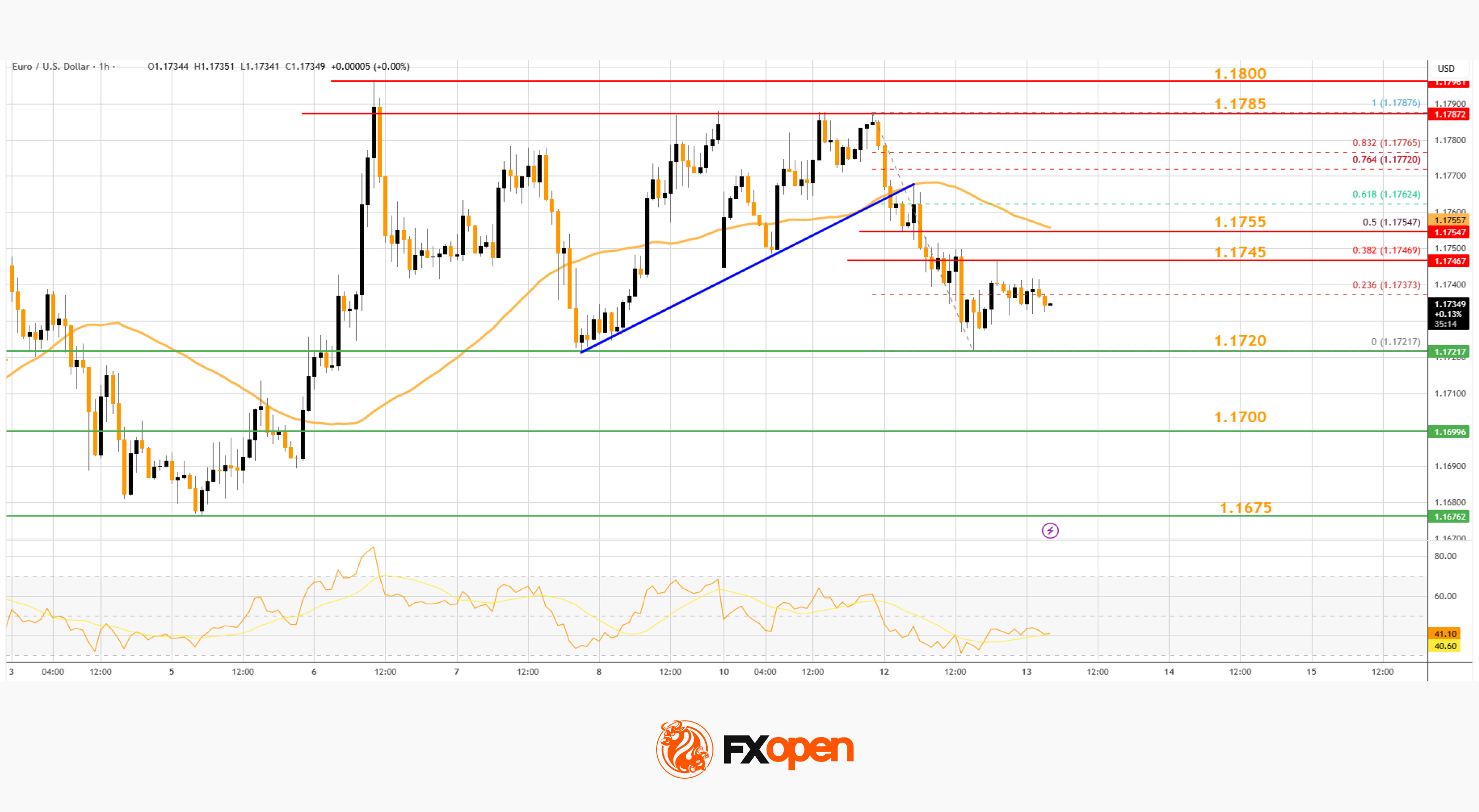
There was a minor recovery wave above 1.1740 and the 23.6% Fib retracement level of the downward move from the 1.1787 swing high to the 1.1721 low. EUR/USD is still trading below 1.1750 and the 50-hour simple moving average.
On the upside, the pair is now facing hurdles near 1.1745. The next key resistance is 1.1755 and the 50% Fib retracement. The main barrier for the bulls could be 1.1785. A clear move above 1.1785 could send the pair toward 1.1840. An upside break above 1.1840 could set the pace for another increase. In the stated case, the pair might rise toward 1.1920.
If not, the pair might resume its decline. The first major support on the EUR/USD chart is near 1.1720. The next important region for buyers sits at 1.1700. If there is a downside break below 1.1700, the pair could drop toward 1.1675. Any more losses might send the pair toward 1.1640.
USD/JPY Technical Analysis
On the hourly chart of USD/JPY at FXOpen, the pair started a fresh upward move from 155.00. The US Dollar gained bullish momentum above 156.50 against the Japanese Yen.
It even cleared the 50-hour simple moving average and 157.00. The pair climbed above 157.50 and traded as high as 157.78. The pair is now consolidating gains above the 23.6% Fib retracement level of the upward move from the 155.03 swing low to the 157.78 high.
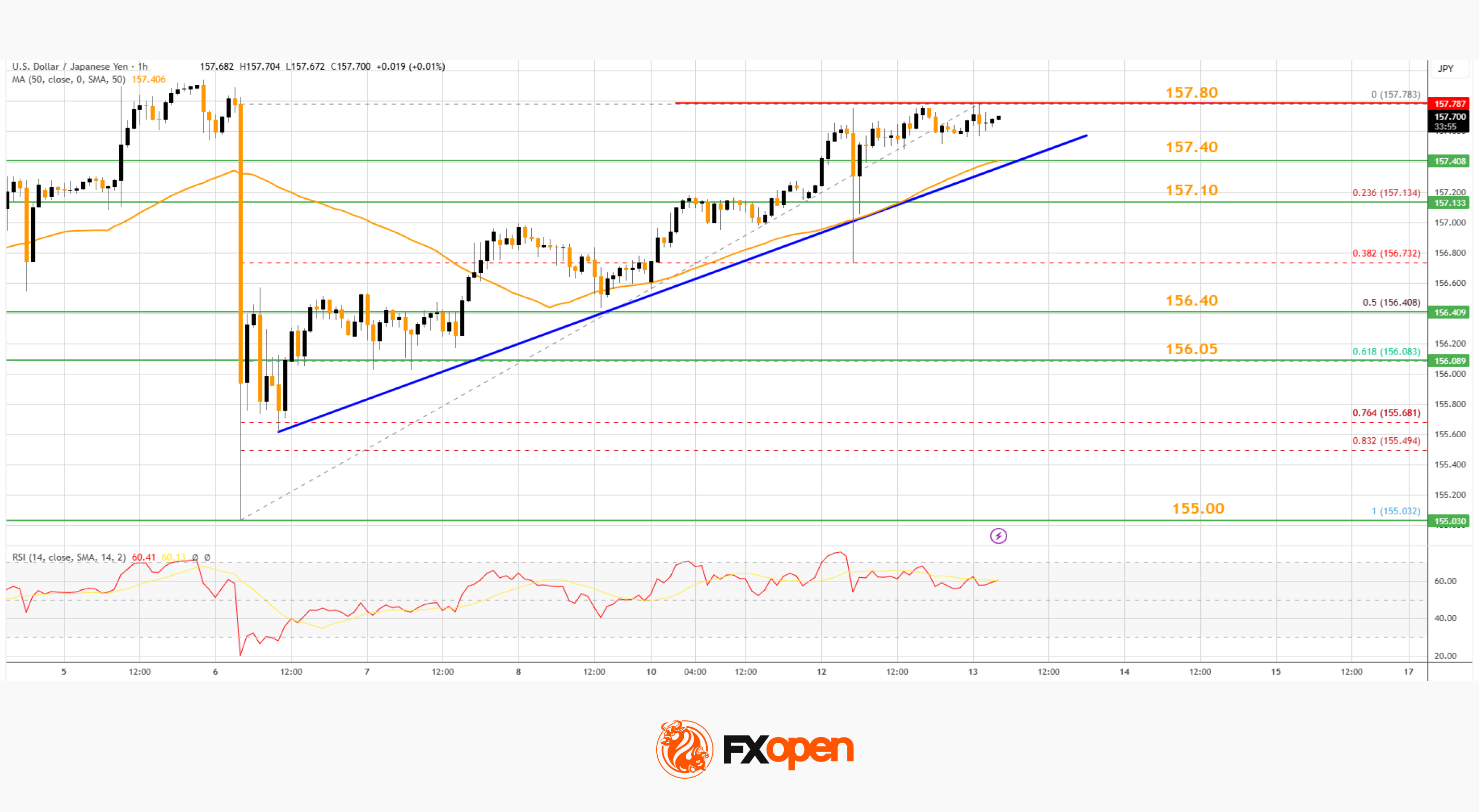
The current price action above 157.40 is positive. Immediate resistance on the USD/JPY chart sits at 157.80. The first key hurdle is near 158.00. If there is a close above 158.00 and the RSI moves above 65, the pair could rise toward 158.80.
The next major stop for the bulls could be 159.50, above which the pair could test 160.00 in the coming days. On the downside, the first major support is 157.40, a bullish trend line, and the 50-hour simple moving average.
The next area of interest for buyers could be 157.10. If there is a close below 157.10, the pair could decline steadily. In the stated case, the pair might drop toward the 50% Fib retracement at 156.40. Any more losses might open the doors for a drop to 155.00.
Trade over 50 forex markets 24 hours a day with FXOpen. Take advantage of low commissions, deep liquidity, and spreads from 0.0 pips (additional fees may apply). Open your FXOpen account now or learn more about trading forex with FXOpen.
This article represents the opinion of the Companies operating under the FXOpen brand only. It is not to be construed as an offer, solicitation, or recommendation with respect to products and services provided by the Companies operating under the FXOpen brand, nor is it to be considered financial advice.
Legend, a mobile-first DeFi aggregator, is winding down after roughly two years of operation, joining a growing wave of crypto apps that have announced closures this year. The project aimed to simplify DeFi by letting users earn, trade, borrow and swap assets via a single non-custodial interface that bridged major protocols like Aave, Compound and Uniswap.
Co-founders, including former Compound Finance executives, argued that the right interface could bring DeFi’s powerful primitives to mainstream users. “We believed the right interface could put DeFi’s most powerful primitives in front of mainstream users,” Legend’s co-founder Jayson Hobby said this week. Yet despite initial traction, the team said the product did not scale to a sustainable level, and closing was the prudent choice for both the team and investors. Legend will keep the app online for about 60 days and go offline on July 12, marking the end of its two-year run.
Legend’s shutdown sits within a broader pattern this year as more DeFi, NFT and GameFi projects announce closures. Cointelegraph’s coverage shows that more than 20 protocols across these spaces have halted operations in 2026, underscoring the difficult market environment for project builders. For example, ZeroLend disclosed in February that it would shut down after three years due to an unsustainable business model. ZeroLend’s decision was part of a wave of exits across the sector.
Beyond these high-profile exits, the industry has seen a string of wind-downs tied to security incidents and financial pressures. Solana DeFi aggregator Step Finance said it was winding down in February after a January breach that drained a $40 million treasury wallet, and DeFi derivatives protocol Polynomial also ceased operations in February. Balancer Labs, the team behind Balancer, shuttered in March after mounting financial pressure following a $116 million hack in November. Seamless Protocol, which offered DeFi lending on Base, announced a wind-down in April, attributing the decision to volatile market conditions.
Legend describes itself as non-custodial and mobile-first, designed to consolidate DeFi activities into one place. The platform enabled users to earn, borrow and trade stablecoins and Ether by integrating with established protocols such as Aave, Compound and Uniswap. It announced its first funding round—$15 million—in February 2025, led by Andreessen Horowitz and Coinbase Ventures, signaling investor appetite for UX-focused DeFi aggregators in the wake of a bear-market lull.
Hobby emphasized a pragmatic takeaway from Legend’s experience: “Users don’t care whether product is onchain or not. They want outcomes—better yield, faster payments, more control over their money.” His broader reflection on crypto UX captured a paradox: “The product that wins isn’t the one that explains crypto better, it’s the one that hides it completely. The benefits are felt, not explained.”
The wind-down also reflects the market’s ongoing tug-of-war between user-friendly interfaces and the capital required to sustain multi-protocol aggregators during a downturn. While the exact user metrics for Legend remain private, the wider DeFi ecosystem has experienced a pronounced contraction in activity. TVL across DeFi has fallen roughly 50% since October, illustrating the scarcity of liquidity and the headwinds facing new product formats built on top of fragmented on-chain services.
Key takeaways
- Legend will shut down on July 12, after about two years in operation, selling a mobile-first, non-custodial DeFi aggregator that integrated with Aave, Compound and Uniswap.
- The project cited unsustainable scale as the reason for closure, choosing to wind down over pursuing a longer, riskier path to profitability.
- Legend’s exit is part of a broader trend in 2026 in which more than 20 DeFi, NFT and GameFi protocols have announced closures, including notable cases in the wake of security incidents and bear-market pressures.
- Industry closures extended beyond Legend: ZeroLend (February), Step Finance (February after January breach), Polynomial (February), Balancer Labs (March), and Seamless Protocol (April) illustrate a cross-section of challenges facing DeFi builders.
- The funding history—$15 million in February 2025 from Andreessen Horowitz and Coinbase Ventures—highlights the tension between ambitious UX-driven DeFi projects and the harsh economics of the current cycle.
Legend’s wind-down in the context of a shifting DeFi landscape
Legend’s mission—delivering DeFi primitives through a single, streamlined interface—was emblematic of a broader push to make decentralized finance accessible without forcing users to manage multiple wallets or interfaces. By aggregating earning, trading, borrowing and swapping across leading protocols, Legend positioned itself as a bridge between sophisticated DeFi mechanisms and mainstream users who want tangible outcomes rather than technical explanations.
However, the numbers tell a challenging story. While the exact user and TVL metrics for Legend remain private, the ecosystem-wide environment has tightened. The DeFi space has endured not only a bear-market backdrop but also several high-profile security incidents and capital constraints that have forced even well-funded projects to re-evaluate their models. The recurring theme is clear: user-friendly design alone is not enough if the underlying economics cannot sustain growth and resilience over the long term.
What this means for users and builders alike
For users, theLegend wind-down underscores the fragility of DeFi products built atop multiple protocols. It also highlights a practical reality: even well-funded UX-centric projects can struggle to achieve scalable, profitable operations in a still-tough market. As the ecosystem absorbs these exits, builders may increasingly prioritize sustainability—whether through leaner product scopes, more defensible revenue models, or closer alignment with real-world use cases that deliver measurable outcomes.
For investors and developers watching the sector, Legend’s termination signals both risk and opportunity. Risk, in that ambitious aggregators face cost pressures in bear markets; opportunity, in that the same UX lessons can inform the next generation of DeFi products—those that balance user-centric design with a clear path to monetization and resilience in volatile conditions.
As the dust settles, observers should monitor whether the wave of closures softens or accelerates, and which models survive the market cycle. The ongoing challenge is clear: create DeFi experiences that feel seamless and reliable enough for mainstream users while maintaining the capital efficiency needed to endure years of unpredictable market dynamics.
Looking ahead, readers should watch for how remaining DeFi players adjust their roadmaps—whether they narrow scope to preserve capital, pursue strategic partnerships to share costs, or explore new monetization strategies that align incentives across users, protocols and developers. The Legend story is a reminder that UX innovation alone isn’t a guarantee of longevity; sustainable scale remains the defining hurdle for DeFi in any market regime.
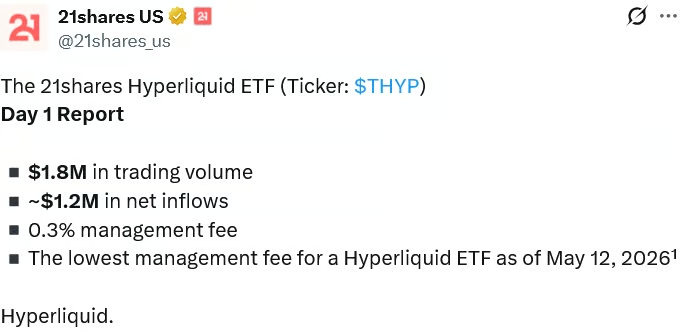
Crypto asset manager 21Shares’ first Hyperliquid exchange-traded fund in the US drew $1.2 million in net inflows and saw $1.8 million in trading volume on its Nasdaq debut.
“Very very solid day and better than your average ETF launch for sure but nothing too crazy,” Bloomberg analyst James Seyffart said as the ETF finished its first day of trading on Tuesday.
Still, the 21Shares Hyperliquid ETF (THYP) debut trading volume was a fraction of the volume compared to earlier buzzy crypto ETFs, such as the Bitwise Solana Staking ETF (BSOL), which attracted $56 million on its opening day in late October, and the Canary XRP ETF (XRPC), which brought in $58 million on its debut in November.
THYP seeks to track the spot price of the Hyperliquid (HYPE) token, which is tied to the perpetual futures platform of the same name that has facilitated over $8.4 trillion in trading volume since launching in 2023.

Source: 21Shares
21Shares’ Hyperliquid ETF adds to a growing number of altcoins that have been packaged into funds made available on Wall Street, as the Securities and Exchange Commission has loosened its grip on crypto ETFs.
In September, the SEC moved away from a case-by-case review of spot crypto ETFs in favor of “generic listing standards,” making approvals of crypto ETFs easier.
THYP was launched ahead of the Bitwise Hyperliquid Staking ETF (BHYP), which Seyffart predicted is next in line for SEC approval.
Grayscale is also awaiting the SEC’s decision on its Grayscale HYPE ETF (GHYP).
Related: Trader loses $3M as leveraged Fartcoin position unwinds on Hyperliquid
THYP carries a 0.3% management fee, far lower than the 0.67% fee proposed by Bitwise for its Hyperliquid ETF. Grayscale is yet to set a fee for its ETF.
In December, Seyffart predicted that many crypto exchange-traded products would be liquidated by the end of 2027 due to a lack of demand.
His comments came before a Bloomberg report in April that found that the average lifespan of ETFs fell from 4.66 years in 2024 to about 3.5 years in 2025.
Dozens of ETFs have already been liquidated across the first few months of 2026, though none were notable crypto ETFs.
Magazine: Solana vs Ethereum ETFs, Facebook’s influence on Bitwise: Hunter Horsley
XRP Ledger wallets holding at least 10,000 XRP have reached a record 332,230, according to Santiment data shared on X.
Summary
- XRP wallets holding at least 10,000 tokens reached a record 332,230, according to Santiment data.
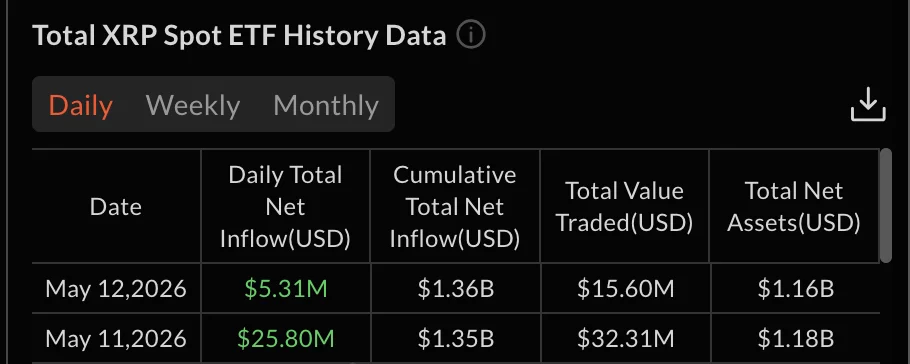
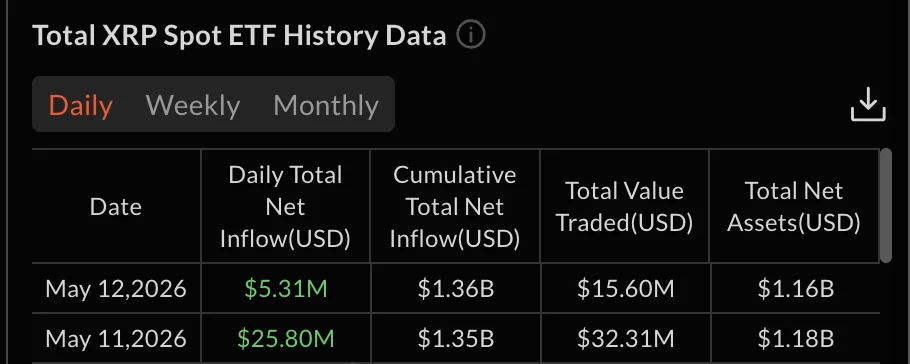
- U.S. spot XRP ETFs added $5.31 million after Monday’s stronger $25.8 million inflow day.
- EGRAG Crypto’s Elliott Wave chart shows $7, $13 and $27 as possible targets.
The analytics firm said the number has grown steadily since June 2024, even during periods of weak price action and market stress.
Santiment said larger holders kept adding XRP despite volatility. It also noted that the sharp drop of more than 4,500 such wallets between Feb. 6 and Feb. 8 had no confirmed XRP-specific cause. The firm said “there does not appear to be one confirmed XRP-specific event directly tied to it.”
XRP price stays near resistance
Ripple’s native token (XRP) traded at $1.45 on May 13, down 0.28% over 24 hours, according to crypto.news price data. The token traded between $1.42 and $1.47 during the same period, with daily volume above $2.11 billion.
The wider trend remains mixed. XRP gained 2.29% over seven days and 9.83% over the past month, but it still trades well below its July 2025 all-time high of $3.65. Crypto.news data shows the token is down about 60% from that peak.
ETF inflows add fresh market context
U.S. spot XRP ETFs recorded $25.8 million in daily net inflows on May 11, their strongest day since Jan. 5, according to SoSoValue data cited by crypto.news. Franklin Templeton’s XRPZ led with $13.6 million, followed by Bitwise’s XRP ETF with $7.6 million and Grayscale’s GXRP with $4.6 million.
Interestingly, inflows continued on May 12, with $5.31 million in daily net inflows. It also shows cumulative net inflows at $1.36 billion and total net assets at $1.16 billion. That suggests ETF demand did not stop after Monday’s stronger inflow day.
Analysts watch the $1.50 area
EGRAG Crypto points possible upside targets at $7, $13 and $27. The analyst framed the main issue as timing, asking “Has XRP already completed the macro bottom?”
The chart shows XRP holding above a long-term rising trendline while moving near short-term resistance. Crypto.news recently reported that XRP had rallied toward $1.50 after forming an inverse head-and-shoulders pattern. Analysts are watching the $1.50 level as a key breakout point for buyers.
Disclosure: This article does not represent investment advice. The content and materials featured on this page are for educational purposes only.

Amazon Employees Are ‘Tokenmaxxing’ Due To Pressure To Use AI Tools

Rivals Season 2 review: Another glorious round of romping and revenge

Meta Employees Protest Mouse-Tracking Tool Built to Train AI Models

Manchester United reach agreement with Casemiro over contract clause amid transfer speculation

US brings back mandatory military draft registration

Steven Gerrard disagrees with Gary Neville over ‘shock’ Chelsea and Arsenal claim | Football


-
 Crypto World5 days ago
HarrisX Poll Found 52% of Registered Voters Support the CLARITY Act
-

 Fashion5 days ago
Weekend Open Thread: Marianne Dress
-

 Crypto World6 days ago
Upbit adds B3 Korean won pair as Base token gains Korea access
-
 NewsBeat6 days ago
NCP car park operator enters administration putting 340 UK sites at risk of closure
-

 Fashion2 days ago
Coffee Break: Travel Steam Iron
-

 Fashion2 days ago
What to Know Before Buying a Curling Wand or Curling Iron
-

 Tech3 days ago
Auto Enthusiast Carves Functional Two-Stroke Engine from Solid Metal
-

 Politics1 day ago
What to expect when you’re expecting a budget
-
 Business4 days ago
Ignore market noise, India’s long-term story intact, say D-Street bulls Ramesh Damani and Sunil Singhania
-

 Politics4 days ago
Politics Home Article | Starmer Enters The Danger Zone
-

 Crypto World7 days ago
BlackRock CEO Larry Fink Discusses a New Asset Class
-

 Tech2 days ago
GM Agrees To Pay $12.75 Million To Settle California Lawsuit Over Misuse Of Customers’ Driving Data
-
 Sports7 days ago
NBA playoff winners and losers: Austin Reaves is not loving Lakers vs. Thunder matchup, but Chet Holmgren is
-

 Entertainment6 days ago
Sarah Paulson Called Out For Met Gala ‘Hypocrisy’
-

 Entertainment6 days ago
General Hospital: Ric & Ava Bombshell – Ric’s Massive Secret Exposed!
-

 Politics6 days ago
Simon Cowell Says He Was ‘Horrible’ To Susan Boyle During BGT Audition
-

 Crypto World6 days ago
Robinhood says Wall Street is building onchain
-

 Sports6 days ago
UEFA Champions League final schedule, teams, venue, live time and streaming | Football News
-

 Entertainment7 days ago
Bold and Beautiful Early Spoilers May 11-15: Steffy Revolted & Liam Overjoyed!
-

 Entertainment6 days ago
Why David Letterman Called CBS ‘Lying Weasels’
You must be logged in to post a comment Login