











If you own a modern smartphone, there’s an excellent chance that its battery has run dangerously low on you at least a few times. Murphy’s Law dictates that this will naturally occur at the worst possible moment, say when you need to make an important phone call or when you’re lost and need to navigate home.
Because it’s not meant to be used regularly — indeed it may never get used at all — it’s not completely unreasonable that such a device would only be good for one or two charges before its spent and must be replaced. It’s a bit like keeping a road flare in the car; it’s unlikely you’ll ever use the thing, but if you do, it only needs to work once.
But then what? According to ChargeTab, once the gadget has depleted its internal ~3,000 mAh battery it cannot be recharged and is no longer usable. Now to be fair, they specifically tell you to not throw it in the trash. They’ll send you a free return label to ship it back to them, at which point it will be refurbished and put back into circulation. The company argues that this recycling program, combined with the fact that the batteries inside the ChargeTabs were supposedly diverted from landfills in the first place, makes their entire operation eco-friendly.

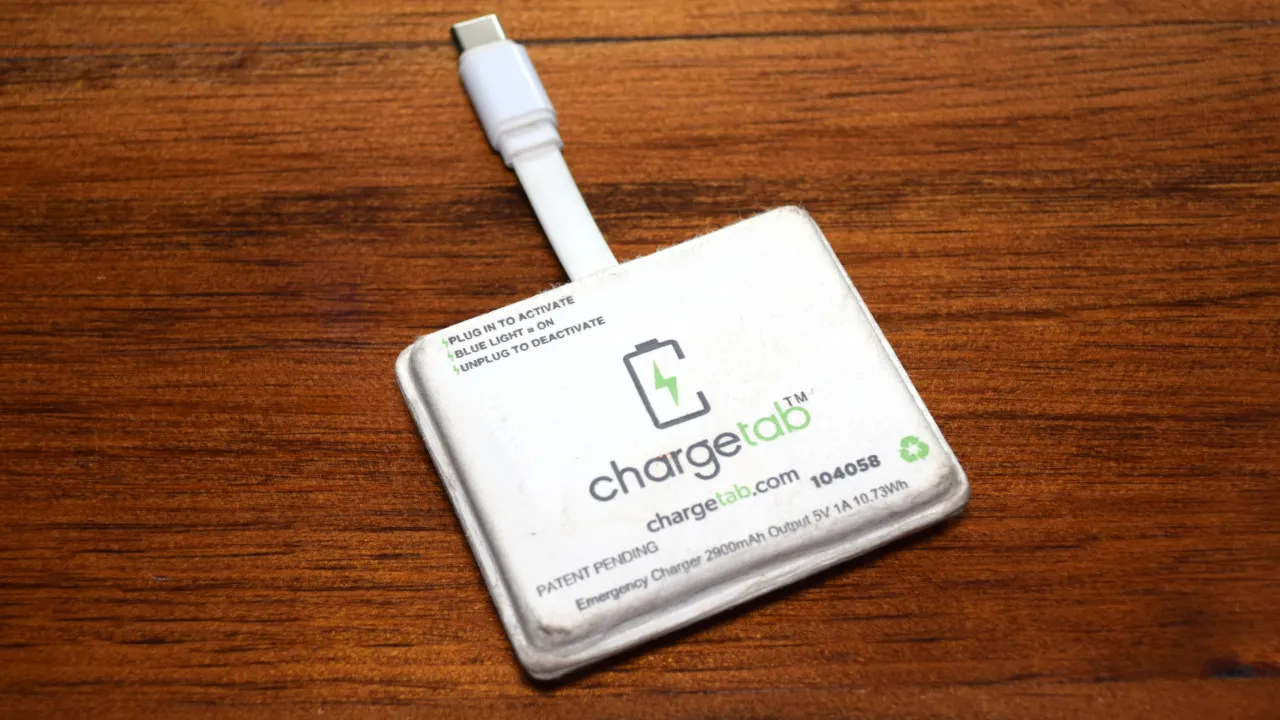
Yet here we have a pair of ChargeTabs that were thrown in the regular garbage and would have taken a one-way trip to the local landfill if it wasn’t for the fact that I habitually dig through garbage cans like a raccoon. So let’s take a look at what’s inside one of these emergency phone chargers and if the idea is as green as the company claims.
Paper, Not Plastic
If nothing else, the enclosure of the ChargeTab is pretty unique. As part of the whole eco-friendly shtick they have going on, the device is encased in a biodegradable paper shell. Usually I wouldn’t approve of a device that’s sealed up rather than put together with fastners, but it’s hard to complain when you can cut the thing open with a pair of scissors. Of course reassembly would be tricky, but clearly that’s not something they were concerned with.
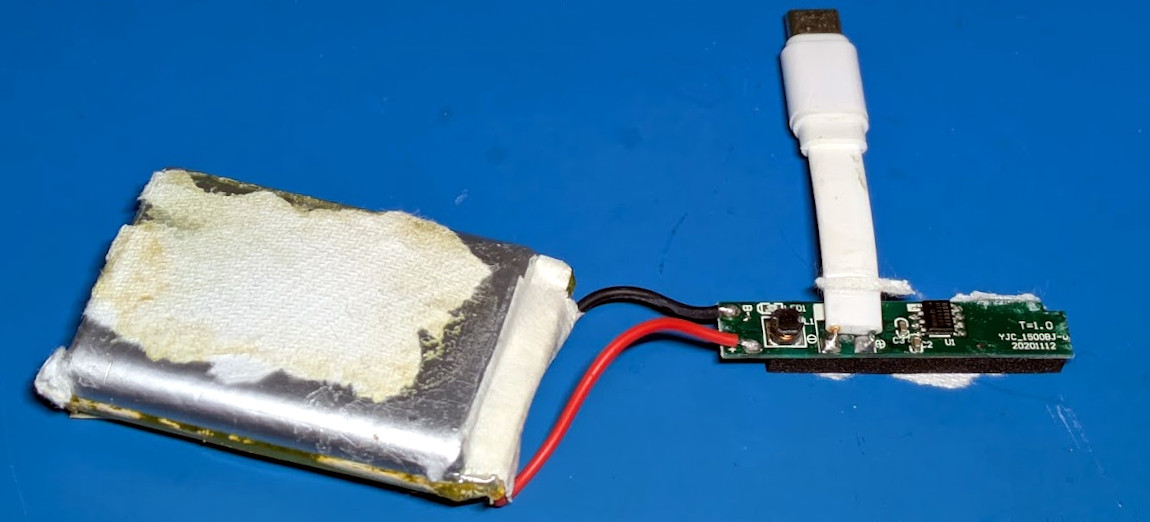
As for the internals, there’s really not much going on. Just a chunky LiPo pouch battery and a thin PCB with an SOIC8 IC, an inductor, a couple of capacitors, and a single LED.
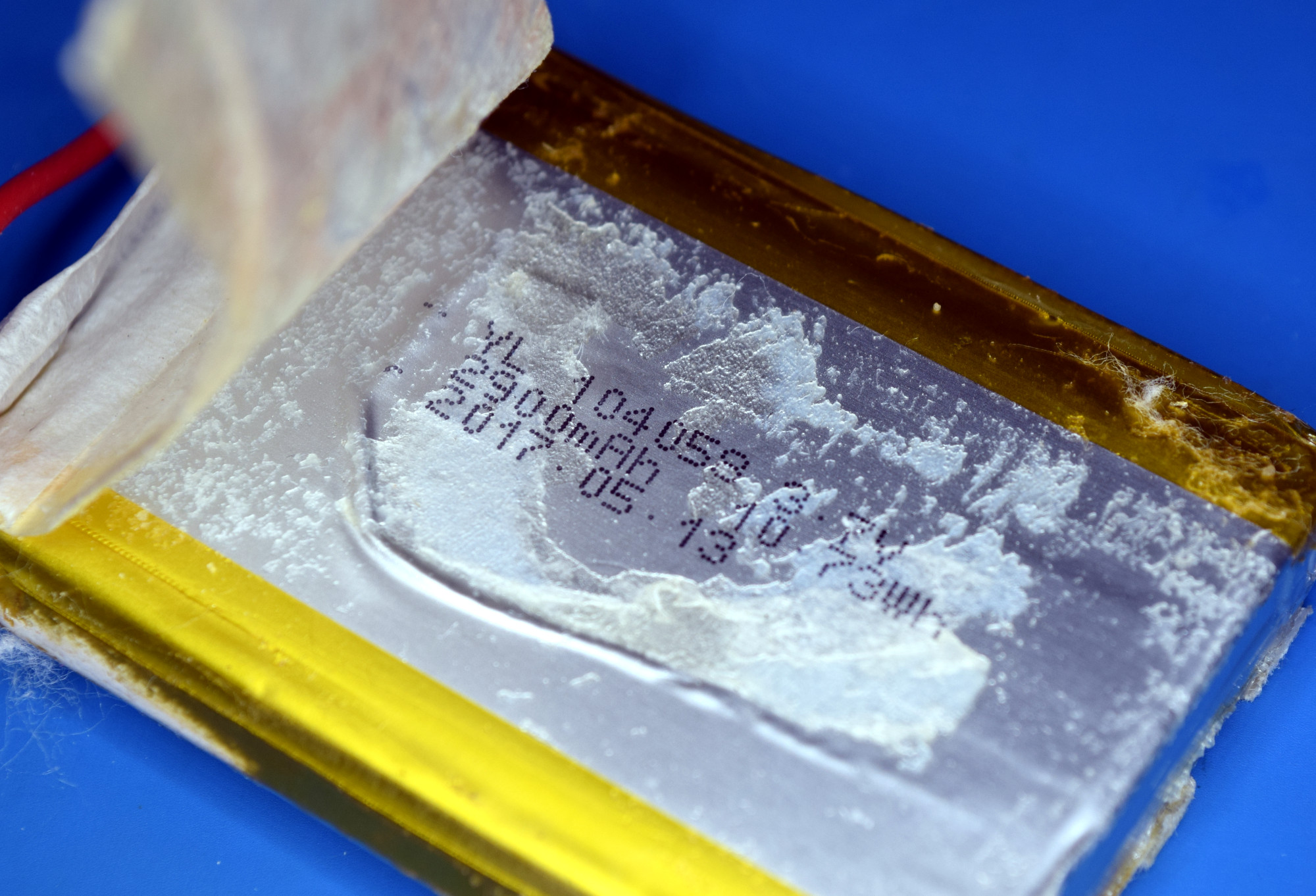
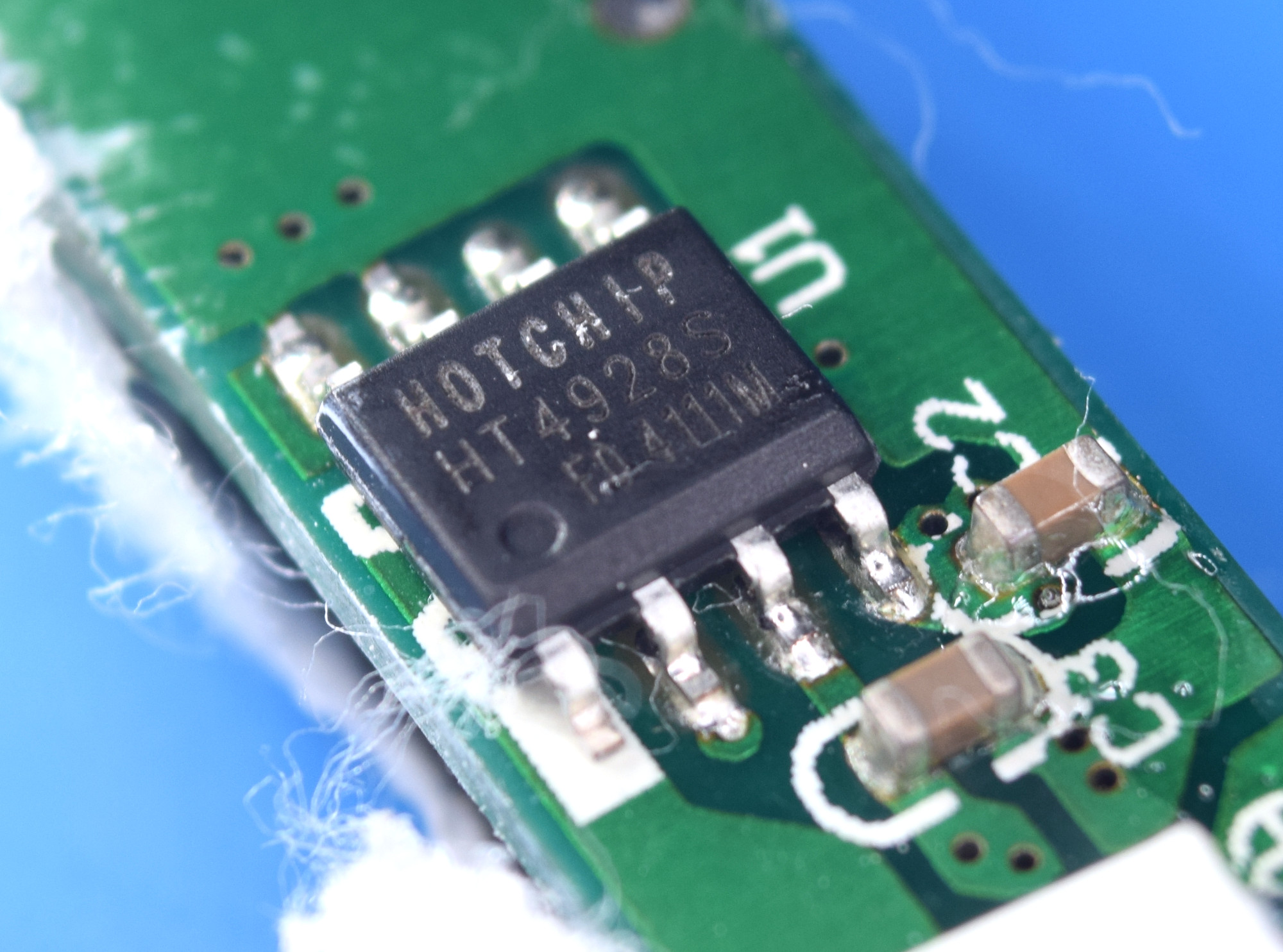
The battery is marked YL 104058, has a capacity of 2,900 mAh, and a date code of 2017. Somewhat surprisingly a close inspection of the IC shows that its markings are intact, identifying it as a HotChip HT4928S.
Chips Ahoy
Being able to positively identify a chip when taking a consumer gadget apart is great, but actually being able to look it up and find a proper datasheet is a real treat. Turns out that the HT4928S is a very popular IC commonly used in USB power banks. It’s a highly integrated solution that offers battery management as well as 5 V boost with only a few support components.
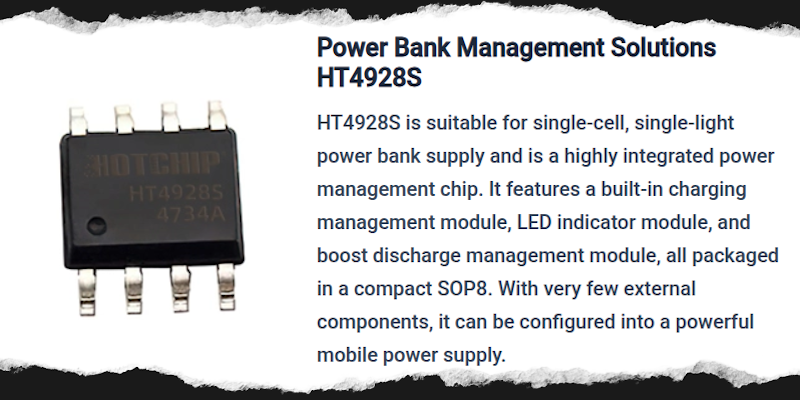
At first, I found this somewhat surprising. Given the unusual single-use nature of the ChargeTab, I had expected a more bespoke solution. But of course it makes perfect sense to use one of these power bank ICs. They can be had for pennies, and functionally, the device is pretty much a USB power bank anyway, it just doesn’t recharge.
Truth be told, the HT4928S seems like a pretty slick part to have around. It’s unusually hacker-friendly: the SOIC8 package is easy to work with, and compared to the venerable TP4056 you get integrated battery protection, not to mention 5 V boost. All for about $1 USD a piece in quantities of ~10. I plan on ordering a few to go into the parts bin for sure.
But wait…if this chip has a charge controller, why is the ChargeTab single-use? What about the design prevents the user from simply charging it up like any other USB power bank that uses the HT4928S?
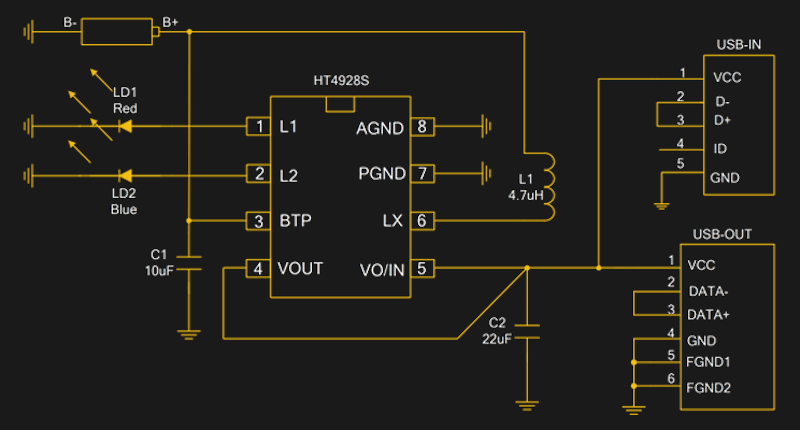
A look at the application diagram from the datasheet shows that the HT4928S uses the same pin for both power input and output. That is, the same pin that puts out the boosted 5 V from the battery will also charge said battery if you apply power to it. In the old days, the input would have been a female USB-A port, but in the era of USB-C you could simply have a female port that does double duty.
But the ChargeTab only has a male USB-C connector. Technically you could plug that into something that’s providing power, but the HT4928S doesn’t talk USB Power Delivery and the PCB doesn’t have the necessary resistors to enable legacy mode.
Security Through Obscurity
The only differences between the application circuit and the PCB in the ChargeTab is the missing LED and USB port. So unless they are using some custom modified version of the HT4928S, it stands to reason that injecting 5 V into the male USB-C connector should flip the chip over to charging mode.
As mentioned previously, it won’t work with proper USB-C devices and cables. But through the magic of Amazon Prime, you can have all manner of shady adapters delivered to your door in just a few hours. So if we combine a USB-A to USB-C cable with a female-female USB-C coupler, we can stick 5 V where the ChargeTab least expects it. According to the HT4928S datasheet, a blinking LED will indicate the charging process has started.
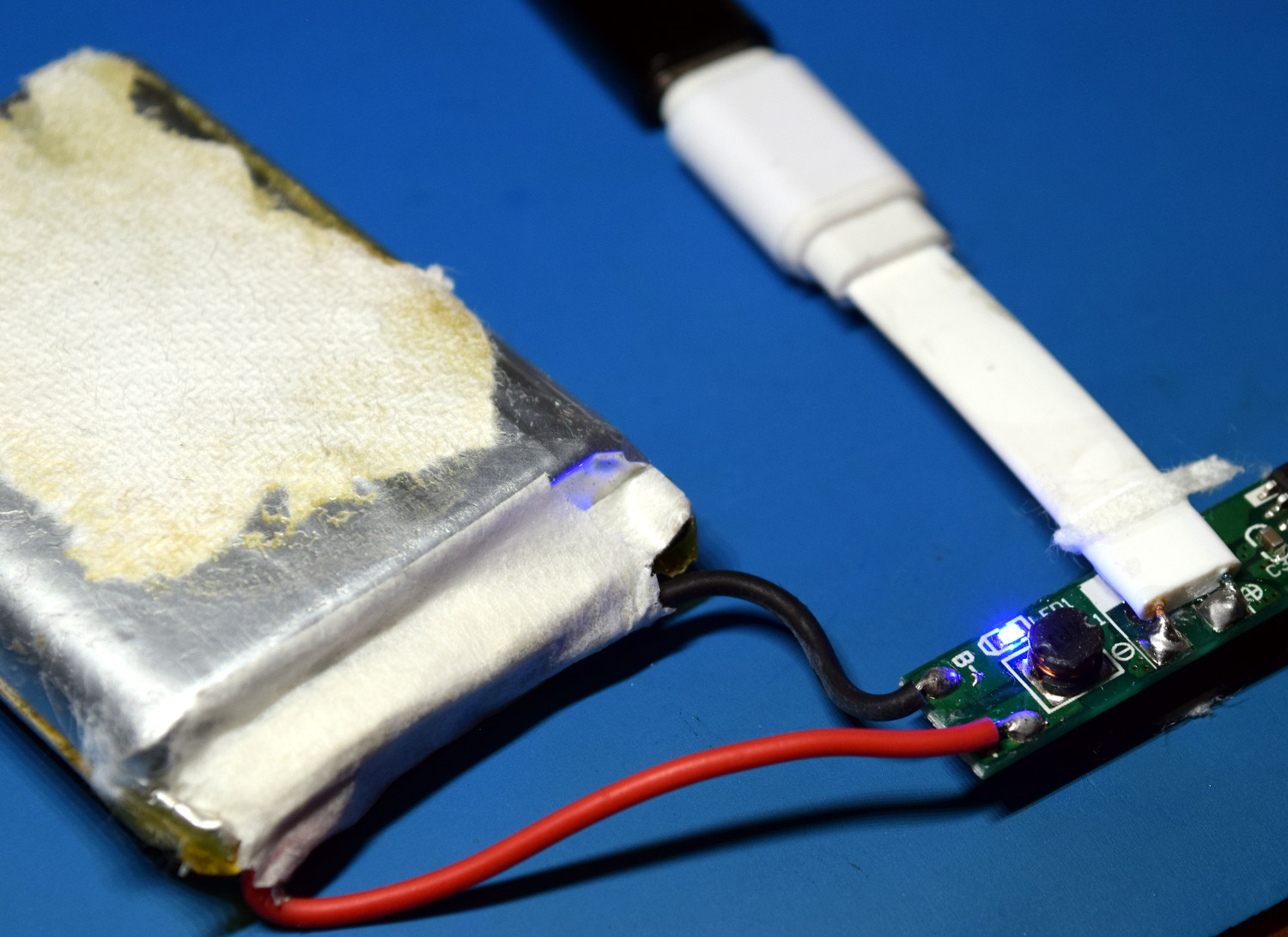
Well, so much for that whole single-use thing.
Charging as a Service
So in the end, the only thing that’s keeping you from reusing the ChargeTab is a cheap USB-C coupler and an old cable. No return label, no sending it off to the mothership to get “refurbished.” It’s quite simply a USB power bank in a paper enclosure and with intentionally obtuse connectivity.
A devil’s advocate might argue that the recycling program makes it more likely the batteries inside the ChargeTabs will actually stay out of the waste stream compared to normal power banks. Rather than dropping them off in some random battery recycling box and having them go who knows where, the returned ChargeTabs are guaranteed to be put back into use properly. (On the other hand, I fished these out of the trash.)
But let’s be clear, this isn’t some benevolent initiative — the company ends up selling the recycled ChargeTabs again at full price. So if you really think about it, they are essentially just renting them out to the consumer. Is that a service worth $10? Regardless of how we might feel about it personally, the fact that these things are being sold would seem to indicate a not insignificant number of people feel it is.
All I know is that if you end up seeing one of these in the trash, you should definitely take it home and charge it up yourself.













%2520SOURCE%2520Kat%2520Merck.jpg)






































You must be logged in to post a comment Login