

Crypto World
Clarity Act Moves Forward After 15-9 Committee Vote


TLDR
- The Senate Banking Committee advanced the Clarity Act in a 15-9 vote with two Democrats joining Republicans.
- The bill would split crypto oversight between the SEC and the CFTC and set rules for exchanges and brokers.
- Lawmakers rejected several Democratic amendments related to sanctions, ethics, and anti-money laundering measures.
- A DeFi safe harbor amendment passed 18-6 after support from a bloc of Democrats and Republicans.
- The Clarity Act will merge with the Agriculture Committee version before heading to the full Senate.
The Senate Banking Committee approved the Digital Asset Market Clarity Act in a 15-9 vote on Thursday. Sens. Ruben Gallego and Angela Alsobrooks joined 13 Republicans to move the bill forward. The measure now heads toward a merger with the Senate Agriculture Committee text before a floor vote.
Clarity Act Clears Committee With Bipartisan Support
Lawmakers advanced the Clarity Act after months of cross-party negotiations and revisions. Chair Tim Scott said the bill ends a “regulatory gray zone” for crypto firms. He added that the framework would protect consumers and keep innovation in the United States.
Sen. Cynthia Lummis called the proposal “the hardest piece of legislation” of her career. She said the bill fits new digital assets into an older regulatory system. The text splits oversight between the SEC and the CFTC and sets rules for exchanges, brokers, and custodians.
The committee rejected several Democratic amendments during the markup session. Sen. Elizabeth Warren opposed the bill and called it “a bill written by the crypto industry.” She argued that the draft weakens securities law protections that date to 1929.
Warren also warned that the bill allows banks to increase crypto exposure. She linked that risk to practices before the 2008 financial crisis. Republicans voted down her amendments in 11-13 votes.
Ethics, Sanctions, and DeFi Debates Shape Vote
Democrats raised concerns about illicit finance and stablecoins during the hearing. Sen. Jack Reed said Iranian actors use stablecoins to buy drone components. He sought authority for regulators to block foreign illicit stablecoin flows, but the amendment failed.
Sen. Chris Van Hollen cited estimates that over $150 billion moved through illicit wallets last year. He proposed penalties for releasing DeFi protocols designed for money laundering. Republicans rejected his measure and said current criminal laws already cover such conduct.
Ethics issues tied to President Donald Trump also shaped debate. Van Hollen proposed barring elected officials from crypto business ties. Sen. Bernie Moreno opposed the amendment and said it belonged in the Judiciary Committee, and the panel defeated it 11-13.
A key vote came on Lummis Amendment 122 regarding DeFi safe harbors. The committee adopted the amendment 18-6 after a technical revision. Warner, Cortez Masto, and Alsobrooks joined Republicans to support the compromise language.
Earlier, Chair Scott limited the number of amendments under committee rules. He later reinstated selected proposals to secure bipartisan backing. By the final vote, Gallego and Alsobrooks provided the Democratic support needed for the 15-9 outcome.


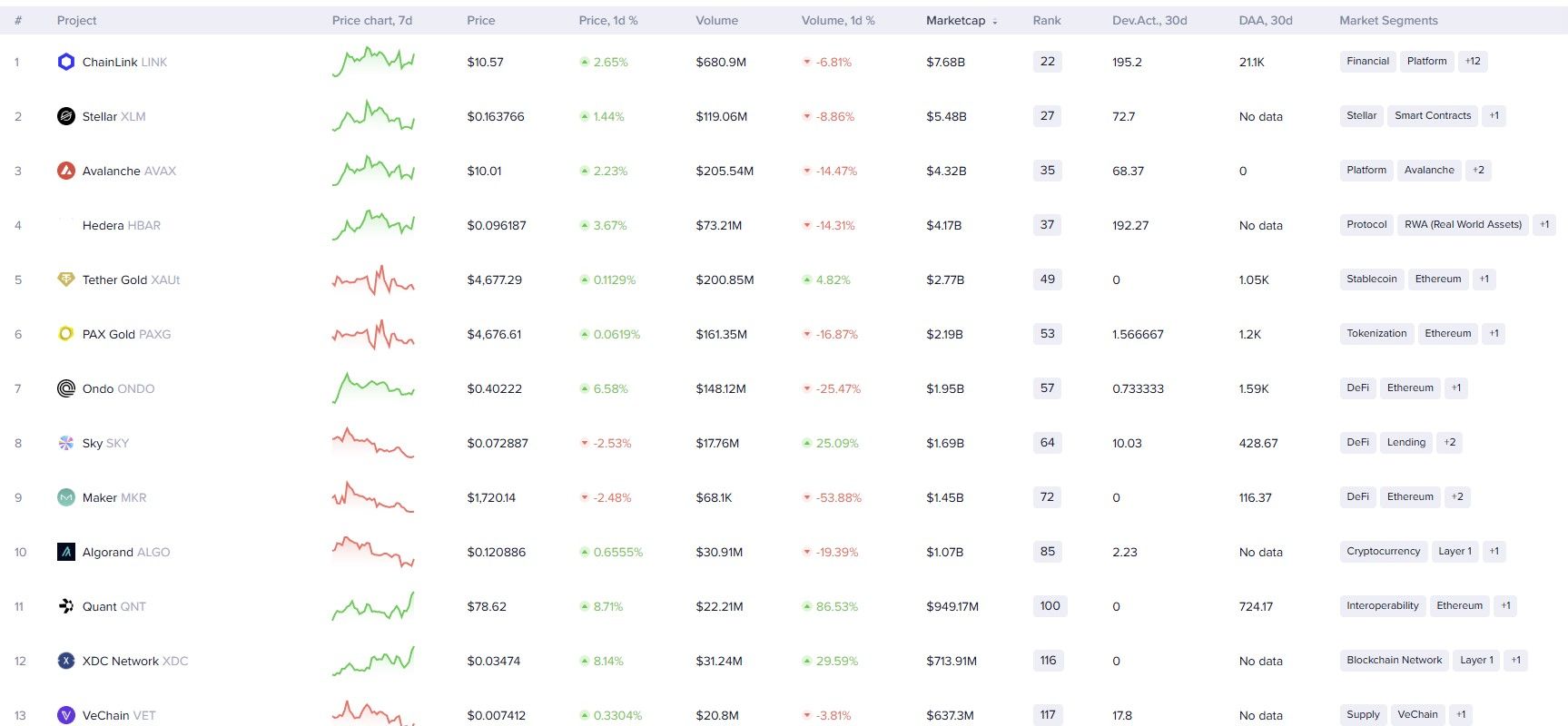
Chainlink (LINK) has secured the top spot in two major real-world asset (RWA) rankings, even as Figure Heloc holds the largest token market cap inside the sector.
The dual leadership arrives as the broader RWA tokenization market surpassed $12 billion in March 2026, while analysts flag a breakout setup pointing to over 170% upside for LINK.
Chainlink Dominates RWA Market Cap Rankings
Data from Santiment ranks Chainlink number one among RWA-tagged assets, with a market capitalization of $7.68 billion and 24-hour volume of $680.9 million.
Stellar (XLM) holds second at $5.48 billion, followed by Avalanche (AVAX) at $4.32 billion. Hedera (HBAR), Tether Gold (XAUt), and Ondo (ONDO) round out the upper tier.

CoinGecko tells a slightly different story. Figure Heloc (FIGR_HELOC), the tokenized home equity line of credit asset from Figure Markets, ranks first with a market cap of $18.36 billion. LINK takes second at $7.71 billion, while Stellar lands third.
Both rankings confirm that Chainlink retains a structural lead in tokenized-asset infrastructure. Fidelity International went live with its FILQ tokenized fund on Chainlink data rails this month, while DTCC has begun integrating Chainlink standards into its Collateral AppChain.

BNB Chain Tops RWA Holder Growth in 2026
A separate dataset from RR2capital charts the growth of RWA holders across major blockchains since the start of 2026. BNB Chain leads with a 567.4% increase, followed by Base at 84.5%, Solana at 73%, and Stellar at 66.7%. Ethereum and Arbitrum posted gains of 47.8% and 35.8%, respectively.
Polygon added 10.1%, and Avalanche grew 0.6%, while Plume and HyperEVM saw outflows of 5.1% and 9.8%. RWA distribution is clearly broadening beyond Ethereum.
X user Richard Seiler argued the narrative still has room to run.
“The narrative that is currently dwarfing all others is RWA and it’s only going to continue. We’ve spoken about the total accessible market for the sector and there is no limitation because almost everything can be tokenized.”

Chainlink Price Prediction Targets 174% Upside
LINK trades near $10.16, up 6.3% over the past 7 days, with a market capitalization of $7.4 billion. Trader WhaleFactor flagged a textbook breakout on the daily timeframe, where a multi-month descending resistance line has been cleared, and a retest is forming.
“Just look at $LINK. This is purely textbook technical analysis playing out… that brutal 1 day downtrend line that capped price action for months is finally broken. We have confirmation and a retest forming… The technical target at $24.87 represents over 170% upside. Don’t fade a breakout this clean on a major asset.”
The setup hinges on the $9 horizontal support holding through any pullback. If that level breaks, the $7.20 floor becomes the next defense before the bullish structure invalidates.

Whether LINK reaches that target depends on continued institutional flow into the RWA infrastructure. The coming weeks should show if Chainlink’s ranking lead converts into the price action analysts now expect.
The post Chainlink Emerges as RWA Leader Across Multiple Sector Rankings appeared first on BeInCrypto.


The Clarity Act cleared the Senate Banking Committee 15 to 9 on Thursday, sending Bitcoin above $82,000 for the first time in weeks.
Summary
- The Senate Banking Committee advanced the Clarity Act in a bipartisan 15 to 9 vote, with two Democrats crossing the aisle to back the bill.
- Bitcoin climbed above $82,000 following the committee vote before pulling back to around $81,500, up roughly 2.5% on the day.
- Unresolved ethics provisions and a 60-vote Senate floor threshold remain as the bill moves toward a full Senate vote ahead of May 21 recess.
The Clarity Act advanced out of the Senate Banking Committee on Thursday in a 15 to 9 bipartisan vote, clearing a critical legislative gate for the most significant crypto market structure bill in US history. Bitcoin (BTC) climbed above $82,000 following the vote before retreating slightly to around $81,500, up approximately 2.5% on the day.
Two Democratic senators crossed the aisle to back the bill alongside all 13 Republicans on the committee. Chairman Tim Scott had described securing all 13 Republican votes as “the red zone,” with Senator John Kennedy having withheld support in the days leading up to the session.
Cody Carbone, who heads the Digital Chamber, told reporters the unresolved ethics provision around lawmakers trading crypto tokens remains the most likely obstacle before a floor vote. “I imagine the deal will be completed before this goes to the floor, because they’ll want to only bring it to the floor if they feel confident they’ve got 60,” Carbone said.
What the Clarity Act does
The Digital Asset Market Clarity Act, which already passed the House 294 to 134 in July 2025, would draw a statutory line between the SEC and the CFTC. Digital commodities would fall under CFTC oversight and digital securities would remain under the SEC, ending years of regulatory uncertainty that has suppressed institutional flows into US crypto markets.
The bill still needs 60 votes on the Senate floor, reconciliation with the Senate Agriculture Committee version, and alignment with the House text before reaching the president’s desk. The full 309-page bill text is available at congress.gov. Senators Lummis and Moreno have both warned that missing the Memorial Day recess deadline on May 21 could push the next viable legislative window to 2030.
White House adviser Patrick Witt has indicated the administration will not accept ethics provisions targeting the president specifically, adding a further layer of negotiation before the floor vote can proceed. Democratic senators have linked their support to broader ethics language covering all lawmakers and officials.
Coinbase VP Kara Calvert said at Consensus 2026 that bipartisan backing is non-negotiable and the bill needs at least 60 votes to advance. For Bitcoin, now trading around $81,500, the committee vote functions primarily as a confidence signal.
The bill’s relevance to BTC is less about its own commodity classification and more about what a settled US digital asset framework does to institutional risk appetite across the broader market.
Crypto World
Bitcoin Price Prediction: BTC Risks Drop to $75K as Sellers Defend Critical $80K Resistance
Bitcoin has started showing early signs of weakness after its recent recovery rally toward the $80K resistance region. The market is now confronting a technically important supply zone where sellers have become increasingly active, raising the probability of a broader corrective phase in the short term.
Bitcoin Price Analysis: The Daily Chart
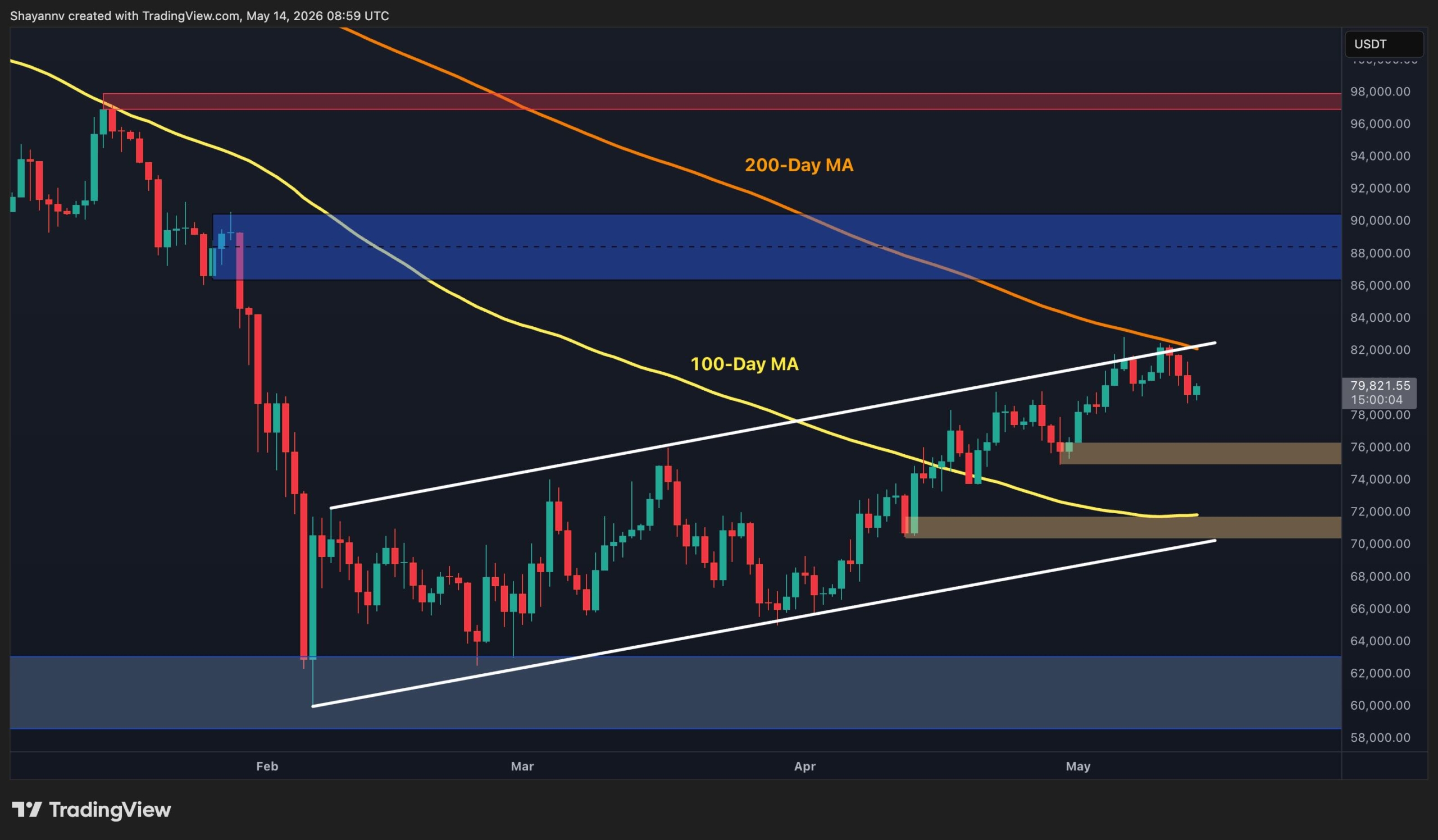
On the daily chart, BTC has recently shown several bearish signs as the price struggles to maintain bullish momentum around the crucial $80K resistance level. This area coincides with a strong confluence of supply, including the upper boundary of the broader ascending channel and the 200-day moving average near the $82K mark. The repeated inability to reclaim this region highlights the presence of aggressive sellers and growing distribution pressure in the market.
As a result, the probability of an expanded bearish retracement has increased notably. If sellers maintain control, Bitcoin could gradually decline toward lower support zones, with the $75K region acting as the first key demand area. A deeper correction could then expose the broader support zone around $70K-$71K, which previously acted as a significant accumulation range for buyers.
BTC/USDT 4-Hour Chart
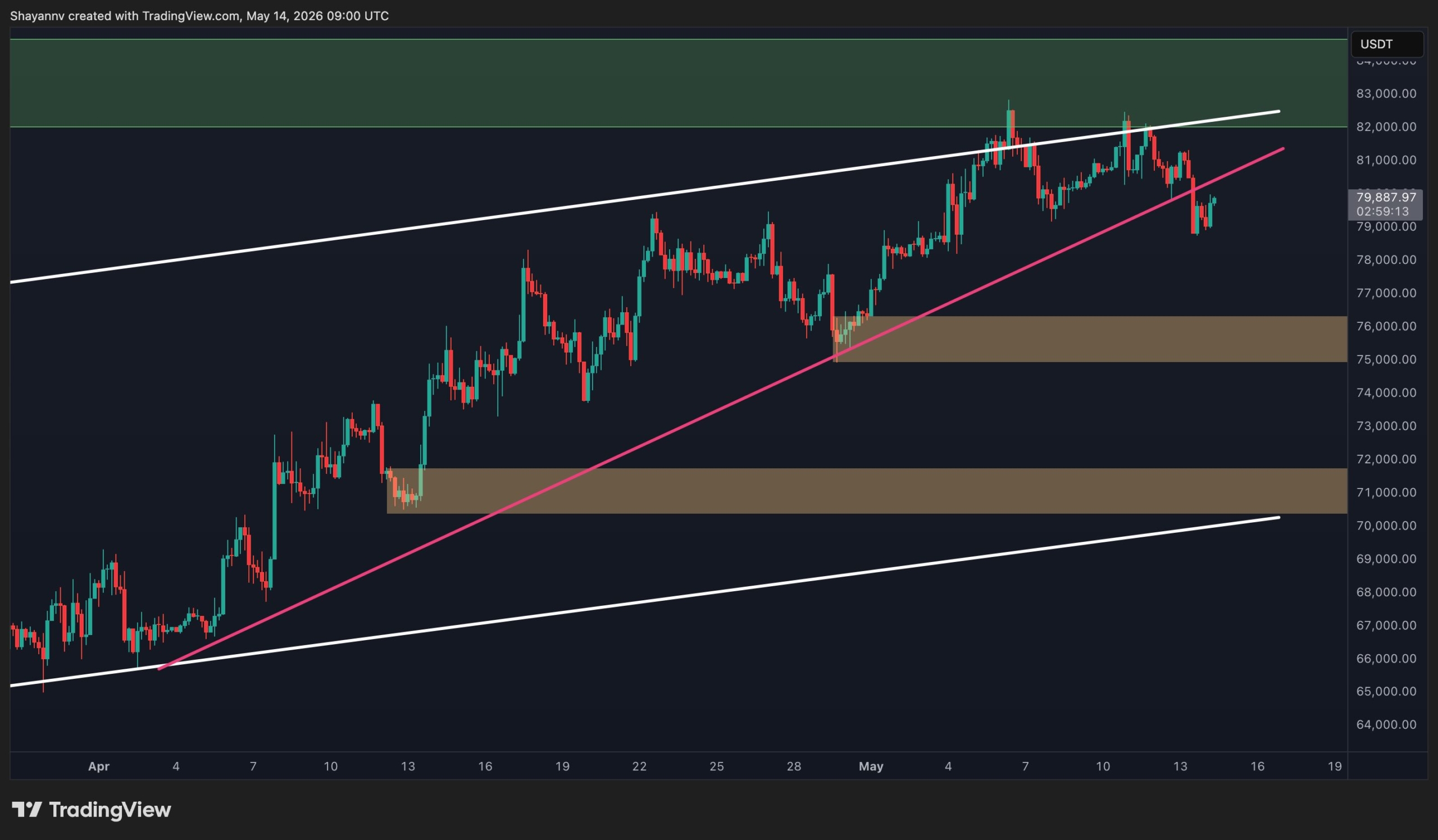
On the 4-hour timeframe, the market has recently broken below a key ascending trendline that had supported the latest bullish structure since the rebound from the $60K region. This bearish breakdown serves as an early warning sign that momentum is fading and sellers are gradually gaining dominance over the market.
Additionally, many participants who accumulated BTC during the recent capitulation toward the $60K support zone now appear to be securing profits and reducing exposure near resistance. This behavior has increased selling pressure around the $80K region and further supports the possibility of another corrective leg in the coming days. If bearish momentum accelerates, the price could continue its decline toward the highlighted demand zones at $76K and eventually the $71K region.
Onchain Analysis
From a liquidation perspective, the Binance BTC/USDT heatmap reveals a substantial concentration of liquidity resting beneath the current market price, particularly around the $77K region. Historically, the market tends to gravitate toward these high-liquidity zones, as they fuel larger directional moves through forced liquidations.
This growing liquidity cluster below the market further aligns with the current bearish technical structure observed across both higher and lower timeframes. As long as Bitcoin remains below the critical resistance confluence around $80K-$82K, the probability of a liquidity-driven decline toward the lower clusters remains elevated.

The post Bitcoin Price Prediction: BTC Risks Drop to $75K as Sellers Defend Critical $80K Resistance appeared first on CryptoPotato.
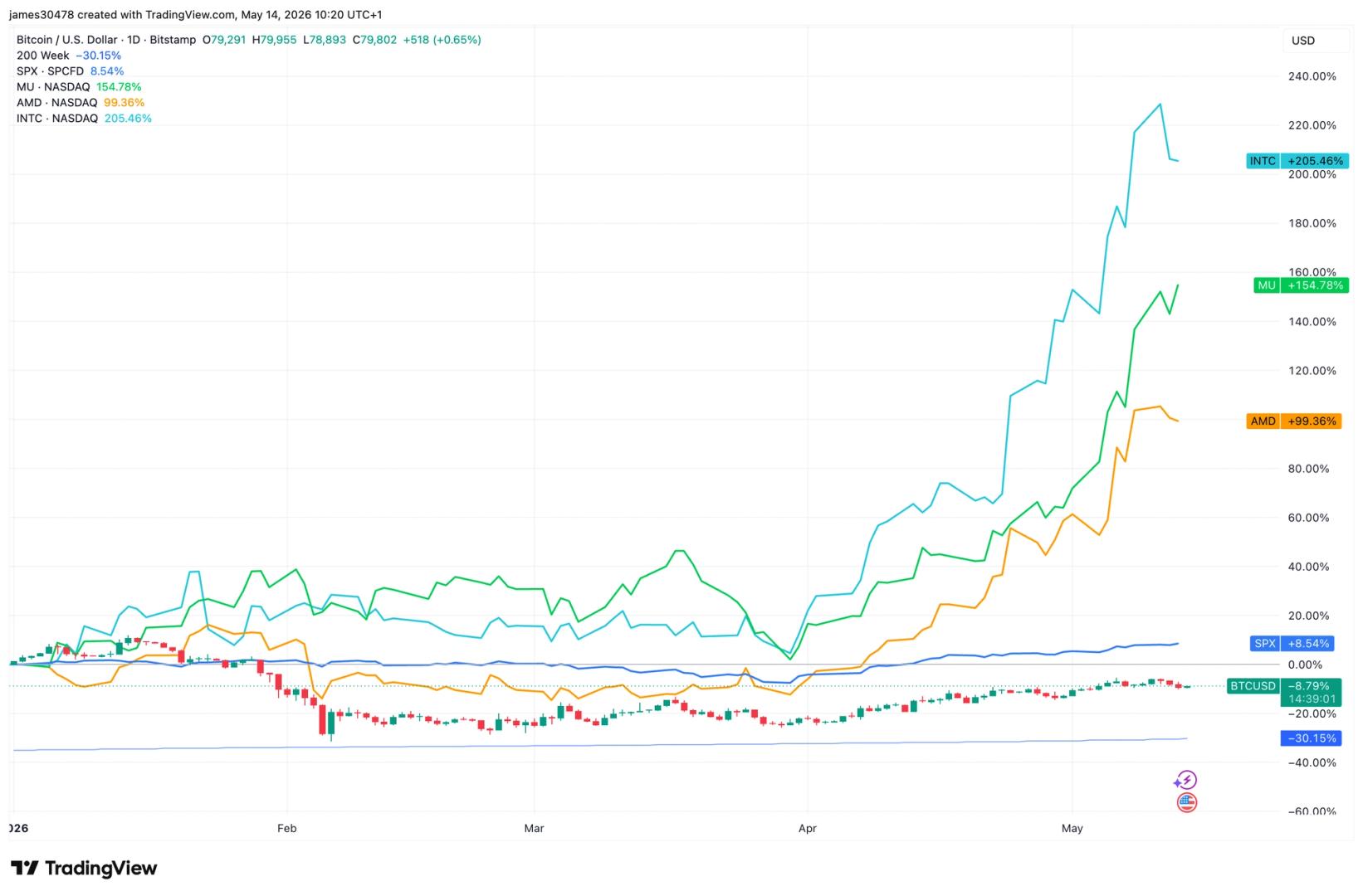
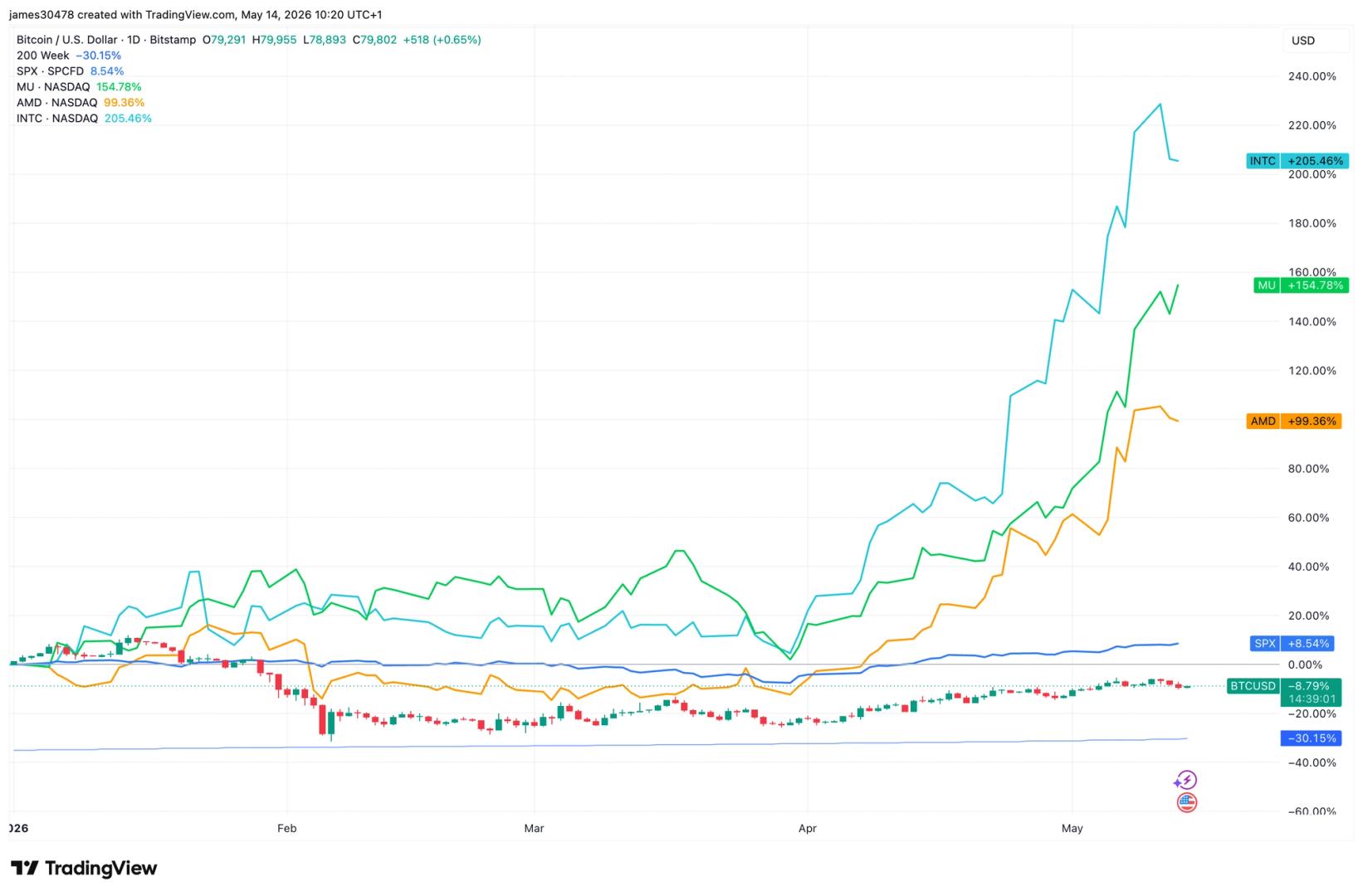
Cerebras Systems’ $5.5 billion IPO and soaring semiconductor stocks underscore how investor attention has shifted from bitcoin to artificial intelligence in 2026.


The Tether freeze coalition known as T3 FCU has surpassed $450 million in blocked illicit USDT since launching in 2024.
Summary
- T3 FCU, backed by Tether, TRON, and TRM Labs, intercepted 43.9% more illicit proceeds in 2025 than the year before, operating across 23 jurisdictions.
- The unit’s cases span drug trafficking, exchange hacks, North Korea-linked funds, terrorist financing, and kidnappings and extortion.
- FATF designated T3 FCU an invaluable law enforcement resource as TRM Labs estimated total illicit crypto flows reached a record $158 billion globally in 2025.
The T3 Financial Crime Unit, a joint initiative backed by Tether, TRON, and blockchain analytics firm TRM Labs, has crossed $450 million in frozen assets linked to suspected criminal activity. The milestone was announced by Tether on Thursday, less than two years after the unit launched in 2024.
T3 FCU focuses on USDT activity on the TRON blockchain, where Tether’s dominant stablecoin circulates at scale. The unit has executed asset freezes within 24 hours of requests from global authorities, including during active kidnapping and extortion emergencies.
T3 FCU reported intercepting 43.9% more illicit proceeds in 2025 than the previous year. It has worked with law enforcement across 23 jurisdictions, including the United States, Spain, Germany, the Netherlands, and Bulgaria.
“This $450 million milestone is just the beginning of what T3 is capable of, as its impact will only continue to grow in scale and importance,” Tether CEO Paolo Ardoino said.
What T3 FCU targets
The unit’s caseload spans drug trafficking, exchange hacks, North Korea-linked activity, terrorist financing, and violent “wrench attacks” including kidnappings. The Financial Action Task Force this year designated T3 FCU an invaluable resource for law enforcement agencies worldwide.
The $450 million figure sits within a wider enforcement picture. As crypto.news tracked, Tether blacklisted 371 wallets and froze over $515 million in USDT in a single 30-day window this year, with Tron accounting for the majority of that activity.
The unit passed the $300 million mark in October 2025 following its role in Brazil’s Operation Lusocoin and a $19 million seizure tied to North Korea’s involvement in the Bybit hack. The jump from $300 million to $450 million in under seven months signals a significant acceleration in operational tempo.
TRM Labs estimates total illicit crypto flows reached $158 billion in 2025, a record. T3 FCU’s expanding role has sharpened the debate over how far centralised stablecoin issuers should go in policing decentralised networks. TRON has described itself as an agnostic technology provider, with enforcement capability sitting with Tether, TRM Labs, and law enforcement rather than at the protocol level.
Unlike decentralised assets such as Bitcoin, USDT carries issuer-level controls that allow wallets to be frozen at any time. Whether that capability represents a necessary safeguard or an unacceptable concentration of private power remains one of the most contested questions in stablecoin policy.
TLDR:
- Bitwise’s $BHYP ETF offers 100% direct spot HYPE exposure using in-house staking, not third-party providers.
- Hyperliquid controls roughly 60% of global onchain perpetual DEX open interest as of May 13, 2026.
- The fund carries a 0.00% expense ratio for the first month, then shifts to 0.34% for investors thereafter.
- $BHYP is not registered under the 1940 Act, meaning it lacks standard mutual fund protections for investors
Bitwise Hyperliquid ETF, trading under the ticker $BHYP, has officially entered the market. It offers investors 100% direct exposure to spot HYPE.
Unlike similar products, $BHYP uses in-house staking instead of a third-party staking provider. The fund began trading on May 15, 2026.
Bitwise positions this ETF as a low-cost entry point into Hyperliquid, a platform the firm views as central to the future of onchain capital markets.
Hyperliquid’s Growing Role in Global On-Chain Trading
Bitwise took to X on May 14, 2026, to announce the ETF and explain its rationale. The firm wrote: “We believe Hyperliquid is one of the most important onchain trading platforms in the world.” That statement came alongside the fund’s launch announcement ahead of its first trading day.
Hyperliquid currently holds approximately 60% of all onchain perpetual DEX open interest globally, according to DeFi Llama data from May 13, 2026.
That figure alone places Hyperliquid well ahead of competing platforms in the sector. Bitwise cited this directly in its announcement as a core reason for the product launch.
The platform also processes up to 200,000 orders per second, as tracked by Chainspect on the same date. This capacity supports high-frequency activity without the bottlenecks common to other decentralized exchanges. That kind of throughput draws institutional attention for good reason.
Bitwise also pointed to a specific moment as evidence of Hyperliquid’s real-world importance. When geopolitical conflict erupted in the Middle East on a Sunday morning, traditional markets were closed. Institutions, however, did not wait for Monday. They turned to Hyperliquid to execute trades in real time.
What $BHYP Offers Investors and How the Fund Works
The Bitwise Hyperliquid ETF starts with a 0.00% expense ratio for its first month of trading. After that initial period, the expense ratio moves to 0.34%.
Bitwise has agreed to waive the full sponsor fee on the first $500 million of trust assets during the opening month.
The fund intends to distribute net investment income, including staking rewards net of expenses, to shareholders on a periodic basis.
Staking rewards, however, are not guaranteed. They are subject to change and should not be treated as a performance indicator.
Additional costs such as brokerage and commission fees may also apply beyond the stated expense ratio. Investors are advised to read the prospectus carefully before committing capital. The current prospectus is available at bhypetf.com/welcome.
It is also worth noting that $BHYP is not registered under the Investment Company Act of 1940. As a result, it does not carry the same protections as mutual funds or ETFs that fall under that framework. The fund carries a high degree of risk and the potential for complete loss of investment.


Will Warren is transitioning out of his co-CEO role at 0x, the DEX protocol powering billions in monthly trading volume across Coinbase, Robinhood, Phantom, and Kraken.


The crypto data platform laid off a quarter of its workforce this week while refocusing on AI-powered dashboards and institutional adoption of onchain assets.

A U.S. federal judge in Manhattan has handed down time served to Roni Cohen-Pavon, the former chief revenue officer of Celsius Network, after he pleaded guilty to manipulating the price of Celsius’s CEL token and committing fraud on the now-defunct platform. Judge John Koeltl ordered that Cohen-Pavon serve time already spent in custody, followed by one year of supervised release.
The sentencing marks another milestone in the criminal proceedings surrounding Celsius’s collapse in 2022, which left billions of dollars in losses for investors and users. Cohen-Pavon initially entered a not-guilty plea to four charges when he was arrested in September 2023, but he flipped to a guilty plea about a week later.
The former Celsius executive was indicted in July 2023 alongside Celsius founder Alex Mashinsky after the firm’s 2022 shutdown. At the time, Celsius’s sudden downfall sent shockwaves through the crypto ecosystem, underscoring the broader risk to retail investors in speculative lending platforms.
Cohen-Pavon, an Israeli citizen who had been outside the United States when prosecutors filed the indictment, later reentered to face charges. He posted a $500,000 bond in September 2023 and has remained free on travel restrictions.
As part of the broader Celsius saga, Mashinsky – who has already been sentenced to 12 years in prison after pleading guilty – faces a parallel set of penalties. In addition to his custodial term, Mashinsky was ordered to forfeit $48 million. Cohen-Pavon agreed to pay more than $1 million and was assessed a $40,000 fine. The sentencing proceedings and related agreements reflect the government’s continued focus on accountability for executives tied to failed crypto ventures.
Before his sentencing, Cohen-Pavon submitted a memorandum to the court in which he expressed remorse and a pledge to change. “Whatever sentence the Court imposes, the deeper obligation will remain the same,” he wrote. “I will have to spend the rest of my life becoming, through my conduct, the husband, father, and man my family had every right to expect from me all along.”
For readers tracking the Celsius case, the broader context includes ongoing actions against Celsius’s leadership and related civil or regulatory settlements. Earlier coverage highlighted that Mashinsky had reached a settlement with the Federal Trade Commission, including a $10 million payment as part of a broader resolution.
Related documents and filings cited in the case show the procedural path the court has followed as it winds down one of the most high-profile crypto company struggles of the era. See the court docket and sentencing materials for details.
Key takeaways
- Roni Cohen-Pavon received time served plus one year of supervised release in the Southern District of New York for CEL token price manipulation and platform fraud.
- He had originally pleaded not guilty, then changed to guilty about a week after his September 2023 arrest.
- Alex Mashinsky, Celsius’s founder, is already serving a 12-year sentence and faces a $48 million forfeiture; Cohen-Pavon agreed to pay over $1 million and a $40,000 fine.
- The Celsius case remains a benchmark for executive accountability in distressed crypto projects, with enforcement activity continuing on multiple fronts, including related regulatory settlements.
- A parallel case remains unresolved: Tornado Cash co-founder Roman Storm faces possible retrial in SDNY after a hung jury on money-laundering and sanctions-conspiracy charges.
The Celsius trajectory and what it signals for crypto enforcement
The Celsius unraveling in 2022 exposed how quickly a large crypto lending operation can deteriorate into a complex legal quagmire. With Cohen-Pavon’s sentence, the courtroom focus shifts from the mechanics of Celsius’s business to accountability for individuals who allegedly manipulated markets and misled users. The outcome aligns with a broader trend of prosecutors pursuing cases tied to crypto companies that failed to safeguard investors or comply with applicable laws, even as the industry pushes for clearer regulatory guidance.
In Mashinsky’s case, the combination of a lengthy prison term and substantial forfeiture underscores the government’s willingness to pursue substantial penalties where fraud and mismanagement are shown to have harmed a broad base of users. The additional settlements connected to Celsius’s executives, including the FTC action referenced in related reporting, illustrate that the legal process in crypto collapses often spans criminal and civil dimensions.
Roman Storm and the unresolved Tornado Cash questions
Beyond Celsius, the legal landscape for crypto infrastructure and anonymity tools remains unsettled. Roman Storm, the co-founder of the crypto mixing service Tornado Cash, faced a jury that did not reach a verdict on two counts related to money laundering and sanctions violations. Prosecutors have requested a retrial in October, while Storm remains free under a $2 million bail package restricting movements to certain states. Earlier this week, a federal judge granted him permission to attend his niece’s high school graduation in California, a narrow easing of travel restrictions as the case progresses.
The Tornado Cash matter highlights ongoing tensions between privacy-enhancing tools and enforcement priorities, including sanctions compliance and anti-money-laundering obligations. As prosecutors push for a retrial, observers will be watching how the SDNY handles future rulings on the balance between user anonymity and regulatory enforcement in crypto networks.
For readers, the evolving enforcement environment will continue to shape how projects plan governance, transparency, and compliance strategies. The Celsius and Tornado Cash cases could influence future corporate behavior, investor expectations, and the legal risk profile for executives operating in or around crypto markets.
What comes next remains uncertain: whether the Tornado Cash retrial proceeds in October as prosecutors have requested, and how additional settlements or rulings will influence crash-era narratives around Celsius. Investors and users will want to monitor any further court filings, regulatory actions, or settlements tied to these cases, as they could redefine acceptable risk and governance standards within the crypto sector.

Coinbase announced that it is expanding support for USDC on Hyperliquid by becoming the official treasury deployer of USDC under Hyperliquid’s Aligned Quote Asset (AQA) framework.
The company said the move aims to strengthen USDC’s position as the primary stablecoin used across on-chain capital markets.
USDC Strengthens Grip on Hyperliquid
In the latest press release, Coinbase stated that concentrating liquidity around USDC could improve market efficiency by allowing capital to move more freely across trading venues with fewer conversions. Users will continue to have access to USDC through Coinbase’s fiat on- and off-ramps and its wider global network.
The AQA framework was originally introduced by Native Markets as part of its efforts to build a stablecoin platform for Hyperliquid users. Coinbase said it will now assume the role of AQA deployer, while Native Markets has agreed to terms giving Coinbase the right to acquire the USDH brand assets.
According to the announcement, USDH markets will remain operational for now but will gradually be phased out over time. Coinbase also revealed that USDH remains fully backed and that users can continue converting USDH to USDC without fees or redeeming for fiat during the transition period.
Meanwhile, Native Markets will continue handling those conversions and redemptions.
“Since launch, Hyperliquid has seen rapid growth and quickly became a predominant onchain trading network. Coinbase has invested in supporting builders on HyperEVM by supporting stablecoin liquidity. We’re excited to further our support of the ecosystem and see USDC’s continued growth on Hyperliquid.”
Next Phase
In a separate post, Hyperliquid revealed that Circle will serve as the technical deployer overseeing Cross-Chain Transfer Protocol (CCTP) services and native cross-chain infrastructure, while both Circle and Coinbase have committed to staking HYPE tokens to support AQAv2 activation.
The announcement also noted that, as the treasury deployer, Coinbase is expected to share the majority of the reserve yield revenue with the protocol. Hyperliquid further indicated that a future network upgrade will transition canonical outcome markets under HIP-4 to using USDC as the quote asset.
Since its debut in November 2024, Hyperliquid has established itself as a major player in on-chain crypto trading, particularly in perpetual futures markets. The platform gained further institutional attention earlier this week when 21Shares launched the first ETF designed to provide exposure to its native token, HYPE.
The post Coinbase Becomes Official USDC Treasury Deployer on Hyperliquid appeared first on CryptoPotato.

Chainlink Emerges as RWA Leader Across Multiple Sector Rankings

A Dangerous First-Of-Its-Kind Bill

Motivated by champions-dinner slight, Martin Kaymer shares early PGA lead

Manchester United reach agreement with Casemiro over contract clause amid transfer speculation

US brings back mandatory military draft registration

Steven Gerrard disagrees with Gary Neville over ‘shock’ Chelsea and Arsenal claim | Football


-
 Crypto World7 days ago
HarrisX Poll Found 52% of Registered Voters Support the CLARITY Act
-

 Fashion6 days ago
Weekend Open Thread: Marianne Dress
-

 Fashion3 days ago
Coffee Break: Travel Steam Iron
-

 Fashion4 days ago
What to Know Before Buying a Curling Wand or Curling Iron
-

 Tech5 days ago
Auto Enthusiast Carves Functional Two-Stroke Engine from Solid Metal
-

 Politics3 days ago
What to expect when you’re expecting a budget
-
 Business5 days ago
Ignore market noise, India’s long-term story intact, say D-Street bulls Ramesh Damani and Sunil Singhania
-

 Politics6 days ago
Politics Home Article | Starmer Enters The Danger Zone
-

 Tech4 days ago
GM Agrees To Pay $12.75 Million To Settle California Lawsuit Over Misuse Of Customers’ Driving Data
-

 Crypto World5 days ago
PROS explodes 48% as Upbit and Bithumb listings ignite demand
-

 Crypto World5 days ago
CZ says US crypto rivals tried to block Trump pardon
-

 Sports7 days ago
Bayern Munich vs PSG UEFA Champions League SF2 live match time, streaming | Football News
-

 Entertainment6 days ago
YNW Melly Denied Bond Again Ahead Of Double Murder Retrial
-

 Tech3 days ago
GM agrees to $12.75M California settlement over sale of drivers’ data
-
Crypto World6 days ago
The Hantavirus Danger: Can a Potential Outbreak Spark a New Meme Coin Frenzy?
-
Tech7 days ago
The Most Exciting Apple Products In The Pipeline For 2026 And Beyond
-

 Politics7 days ago
David Attenborough ‘Overwhelmed’ By Love Shown Ahead Of 100th Birthday
-

 Sports6 days ago
After Waka Waka, Shakira now drops first teaser for FIFA WC 2026 song | FIFA World Cup 2022
-

 Crypto World6 days ago
Kraken Parent Seeks OCC Charter, Signaling Regulated Banking Access
-

 Crypto World7 days ago
Here’s Why Cristiano Ronaldo and Taylor Swift Lost Millions of Followers on Instagram
You must be logged in to post a comment Login