

Crypto World
Chainlink Emerges as RWA Leader Across Multiple Sector Rankings

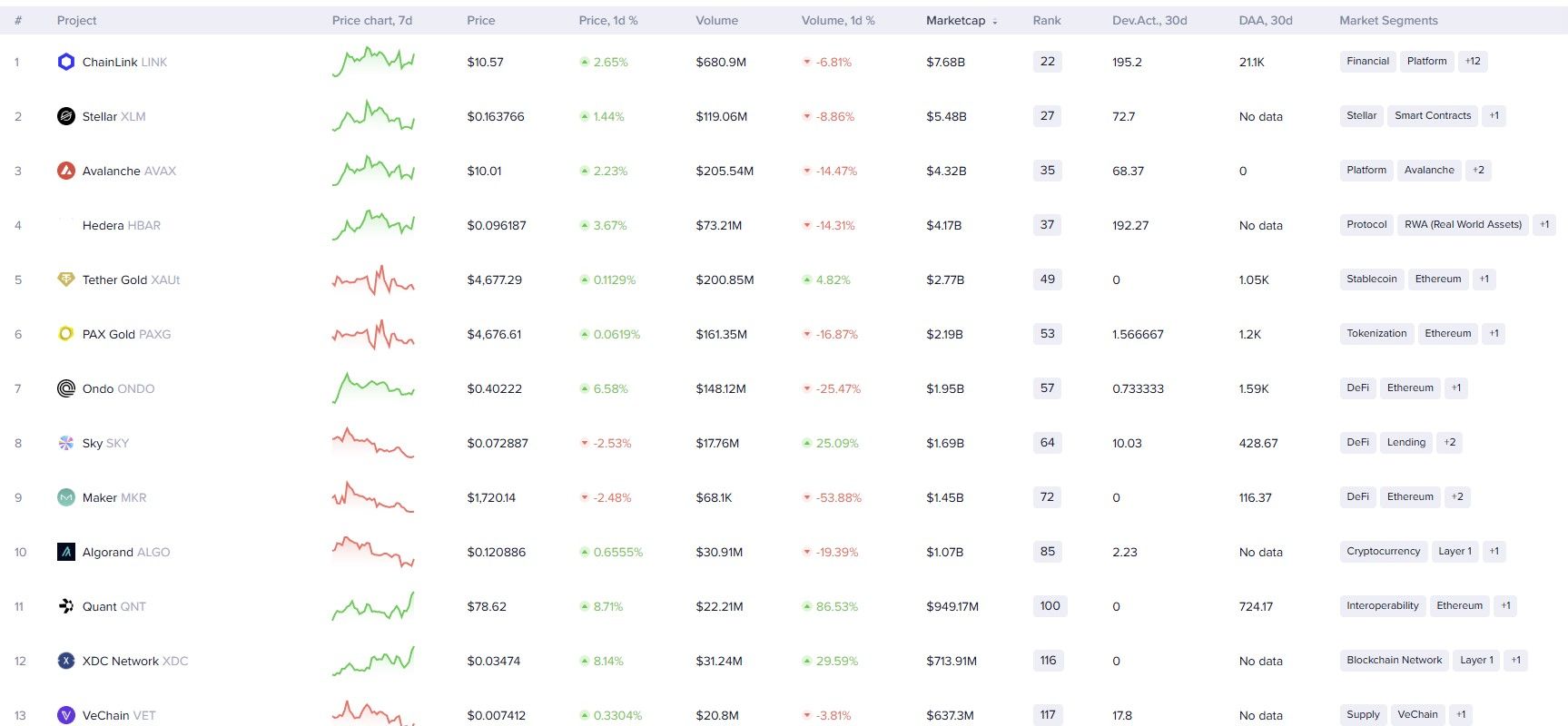
Chainlink (LINK) has secured the top spot in two major real-world asset (RWA) rankings, even as Figure Heloc holds the largest token market cap inside the sector.
The dual leadership arrives as the broader RWA tokenization market surpassed $12 billion in March 2026, while analysts flag a breakout setup pointing to over 170% upside for LINK.
Chainlink Dominates RWA Market Cap Rankings
Data from Santiment ranks Chainlink number one among RWA-tagged assets, with a market capitalization of $7.68 billion and 24-hour volume of $680.9 million.
Stellar (XLM) holds second at $5.48 billion, followed by Avalanche (AVAX) at $4.32 billion. Hedera (HBAR), Tether Gold (XAUt), and Ondo (ONDO) round out the upper tier.

CoinGecko tells a slightly different story. Figure Heloc (FIGR_HELOC), the tokenized home equity line of credit asset from Figure Markets, ranks first with a market cap of $18.36 billion. LINK takes second at $7.71 billion, while Stellar lands third.
Both rankings confirm that Chainlink retains a structural lead in tokenized-asset infrastructure. Fidelity International went live with its FILQ tokenized fund on Chainlink data rails this month, while DTCC has begun integrating Chainlink standards into its Collateral AppChain.

BNB Chain Tops RWA Holder Growth in 2026
A separate dataset from RR2capital charts the growth of RWA holders across major blockchains since the start of 2026. BNB Chain leads with a 567.4% increase, followed by Base at 84.5%, Solana at 73%, and Stellar at 66.7%. Ethereum and Arbitrum posted gains of 47.8% and 35.8%, respectively.
Polygon added 10.1%, and Avalanche grew 0.6%, while Plume and HyperEVM saw outflows of 5.1% and 9.8%. RWA distribution is clearly broadening beyond Ethereum.
X user Richard Seiler argued the narrative still has room to run.
“The narrative that is currently dwarfing all others is RWA and it’s only going to continue. We’ve spoken about the total accessible market for the sector and there is no limitation because almost everything can be tokenized.”

Chainlink Price Prediction Targets 174% Upside
LINK trades near $10.16, up 6.3% over the past 7 days, with a market capitalization of $7.4 billion. Trader WhaleFactor flagged a textbook breakout on the daily timeframe, where a multi-month descending resistance line has been cleared, and a retest is forming.
“Just look at $LINK. This is purely textbook technical analysis playing out… that brutal 1 day downtrend line that capped price action for months is finally broken. We have confirmation and a retest forming… The technical target at $24.87 represents over 170% upside. Don’t fade a breakout this clean on a major asset.”
The setup hinges on the $9 horizontal support holding through any pullback. If that level breaks, the $7.20 floor becomes the next defense before the bullish structure invalidates.

Whether LINK reaches that target depends on continued institutional flow into the RWA infrastructure. The coming weeks should show if Chainlink’s ranking lead converts into the price action analysts now expect.
The post Chainlink Emerges as RWA Leader Across Multiple Sector Rankings appeared first on BeInCrypto.

The $9 billion endowment of Ivy League university Dartmouth College reported new investments with exposure to cryptocurrencies, increasing the digital assets in its portfolio since January.
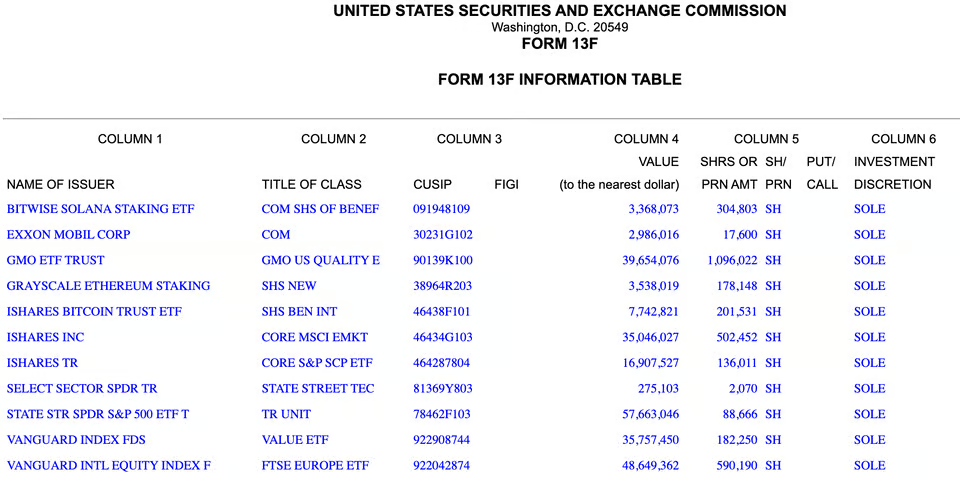
In a Thursday filing with the US Securities and Exchange Commission (SEC), the trustees of Dartmouth College reported that the university endowment held about $3.3 million worth of the Bitwise Solana staking exchange-traded fund (ETF).
The trustees also disclosed about $3.5 million worth of the Grayscale Ethereum staking ETF and about $7.7 million of BlackRock’s iShares Bitcoin ETF.
The investments changed the endowment’s crypto exposure compared to that reported in January, when the same number of shares of BlackRock’s Bitcoin ETF were worth more than $10 million and it held about $5 million in the Grayscale Ethereum Mini Trust ETF.

Source: SEC
Dartmouth’s initial crypto exposure, which it reported purchasing in 2025, marked another US university endowment moving closer to digital assets. Harvard, with a reported endowment of about $57 billion in 2025, reported holdings in BlackRock’s iShares Bitcoin Trust and Ethereum Trust in January.
Related: JPMorgan lifts Bitcoin ETF exposure in Q1, led by BlackRock’s IBIT
The SEC first approved listings of spot ETFs tied to Bitcoin in January 2024, including BlackRock’s iShares Bitcoin Trust and the Bitwise Bitcoin ETF. The regulator has since given the green light to ETFs tied to Ether, Solana, Dogecoin, XRP, and has other applications under consideration.
Bitcoin ETFs record largest daily outflow since January
The SEC filing came shortly after ETFs tied to Bitcoin recorded $635.2 million in daily outflows, marking the largest increase since January. On Jan. 29, the funds lost more than $800 million, led by losses in BlackRock’s iShares Bitcoin Trust.
The price of Bitcoin was $81,237 at the time of publication, having risen about 2% in the previous 24 hours, tapping the 200-day exponential moving average (EMA), a dynamic support level.
However, despite the rally, the price of BTC remains well below the 365-day EMA and the all-time high of about $126,000 reached in October 2025.
Magazine: eToro founder timed Bitcoin top perfectly due to belief in 4 year cycles

TLDR:
- Sonic’s VI model generated $13,000 in revenue, converting to 295,454.55 S in deflationary equivalent since March 1.
- Total fee-related burns reached only 59,786.728 S, putting VI impact at roughly 4.94 times the burn amount.
- Early VI revenue came solely from USSD and Metropolis vault activity, with the broader model yet to scale.
- Sonic Labs confirmed the full VI model has barely started, with more product revenue lines still ahead.
Sonic Labs has reported that its Vertical Integration model is generating measurable deflationary results just weeks after launch.
Since March 1, 2026, early VI revenue has produced roughly 400% more deflationary impact than fee-related burns over the same period.
The data comes from a narrow set of products, with the broader model yet to scale. These early numbers offer a concrete look at how the network plans to capture value beyond gas fees.
Early VI Numbers Show a Clear Lead Over Fee Burns
Sonic’s VI model generated $13,000 in revenue between March 1 and May 11, 2026. Using a TWAP price of $0.044, that converts to 295,454.55 S in deflationary equivalent.
Over the same window, total fee-related burns reached only 59,786.728 S. That figure includes 10,358.726 S from direct transaction fee burns and 49,428.002 S from FeeM-related returns that were burned.
Sonic Labs captured the early result on X, saying, “Sonic’s Vertical Integration is outperforming expectations right out of the gate. In the first 10 weeks, early VI revenue produced ~400% more deflationary impact than fee-related burns over the same window.”
The team also noted the scope of the current implementation, adding, “This is only from $USSD and @MetropolisDEX vault activity. The full VI model has barely started.”
No other revenue lines were contributing during this window, making the ratio more telling given how limited the setup remains.
Total transaction fees for the period were 207,174.525 S. The network splits fees as 90% to the FeeM Treasury, 5% to validators, and 5% to burn.
FeeM also returned 98,856.004 S, split evenly between rewards and burns during the same block range. The ratio puts VI impact at roughly 4.94 times the total fee-related burn amount.
The Case for Product Revenue Over Gas-Based Value Capture
High-throughput chains are built to keep execution costs low. As gas fees fall, fee-burn models produce less deflationary pressure on the native asset.
Sonic’s VI thesis addresses this by sourcing revenue from native financial products instead of relying on transaction pricing alone.
The network still burns a portion of transaction fees. However, the early data shows that product-level revenue can outpace that burn by a wide margin, even in a minimal setup. Users continue to benefit from cheap execution while aligned products contribute back to the network economy.
Sonic Labs described this as a proof of concept rather than a mature revenue base. The $13,000 figure is not presented as a major milestone but as early confirmation that the mechanism works as intended.
As the team stated, “If this is possible with a narrow implementation, the model becomes more interesting as more product surfaces begin contributing revenue.”
More product surfaces are expected to contribute revenue as the full VI model rolls out. The current result reflects only what a narrow, early version of the system can produce.
Additional revenue lines remain ahead, and the team views this first data point as a signal of the model’s direction.

Crypto World
Lido Finance Selects Chainlink CCIP as the Official Cross-Chain Infrastructure for wstETH Security
TLDR:
- Chainlink CCIP secures every wstETH bridge lane with 16 independent node operators by default.
- CCIP stayed fully operational during the October 2025 AWS outage, proving its infrastructure resilience.
- Per-chain-lane rate limits act as circuit breakers for wstETH during market stress or disruptions.
- Chainlink’s CCT standard preserves Lido DAO’s full sovereignty with no vendor lock-in over wstETH.
Chainlink CCIP has been named the official cross-chain infrastructure for Wrapped Staked Ether by Lido’s Network Expansion Committee.
The November 2025 decision came as bridge security concerns intensified across decentralized finance. Cross-chain exploits have cost the industry nearly $3 billion in total losses.
The Kelp/LayerZero exploit recently added urgency to reviewing bridge risks across DeFi. Lido contributors published a security analysis explaining the reasoning behind adopting Chainlink CCIP for wstETH.
Decentralized Node Architecture Anchors the CCIP Infrastructure
Following the Kelp/LayerZero incident, Lido addressed the community on X. The protocol stated that contributors were publishing “the security principles behind wstETH’s multi-chain strategy, and why Chainlink CCIP was selected as the official cross-chain solution.”
The post cited 16 independent node operators, native rate limiting, and no vendor lock-in as key factors. Most wstETH deployments had previously relied on canonical bridges, which required separate monitoring per chain and imposed seven-day withdrawal delays back to mainnet.
A core principle behind the selection was that CCIP “does not rely on a single verifier, machine, or infrastructure provider.”
Every bridge lane is secured by a minimum of 16 independent node operators achieving decentralized consensus. Infrastructure spans on-premise and multi-region cloud deployments for added resilience. Node operators include P2P, Stakefish, StakingFacilities, and Everstake.
During the October 20, 2025 AWS outage, CCIP remained fully operational. Other cross-chain providers experienced disruptions during that incident.
CCIP’s infrastructure diversity kept the protocol running without downtime. This resilience directly reinforced the NEC’s decision to select CCIP.
Chainlink CCIP is already active for wstETH transactions across Ethereum, MegaETH, and Monad. Additional chains will be onboarded in stages over the coming months.
CCIP also powers Lido’s Direct Staking rails for L2 networks. Users on Arbitrum, Base, and Optimism can stake ETH and receive wstETH directly.
Rate Limiting and Token Sovereignty Reduce Structural Risk
CCIP provides native rate-limiting support on a per-chain-lane basis for wstETH. Each lane carries a defined transaction capacity and a set replenishment rate.
These limits act as circuit breakers during extreme volatility or operational stress. Lane-specific configurations are publicly accessible on the CCIP Directory.
Siloed bridge deployments ensure each lane only connects Ethereum Mainnet to one destination chain. Any issue affecting one chain stays contained to that specific lane.
This differs from meshed bridge setups, where problems can spread across multiple connected chains. Siloed architecture reduces the contagion risk seen in past bridge exploits.
Lido contributors identified issuer sovereignty as non-negotiable, asking whether infrastructure “preserves issuer control, or does it introduce hidden, proprietary dependencies.”
Chainlink’s Cross-Chain Token standard directly addresses this concern by preserving full DAO sovereignty over all wstETH token contracts.
No CCIP-specific logic is required within those deployments. LayerZero’s OFT standard, by contrast, tightly couples token contracts to its own infrastructure.
Lido contributors are also working with Chainlink to add secondary confirmations for large wstETH transactions. An additional attestation will be required before such transactions are finalized.
Offchain monitoring systems detect abnormal blockchain activity in real time. These controls build a layered security framework for wstETH’s cross-chain expansion.
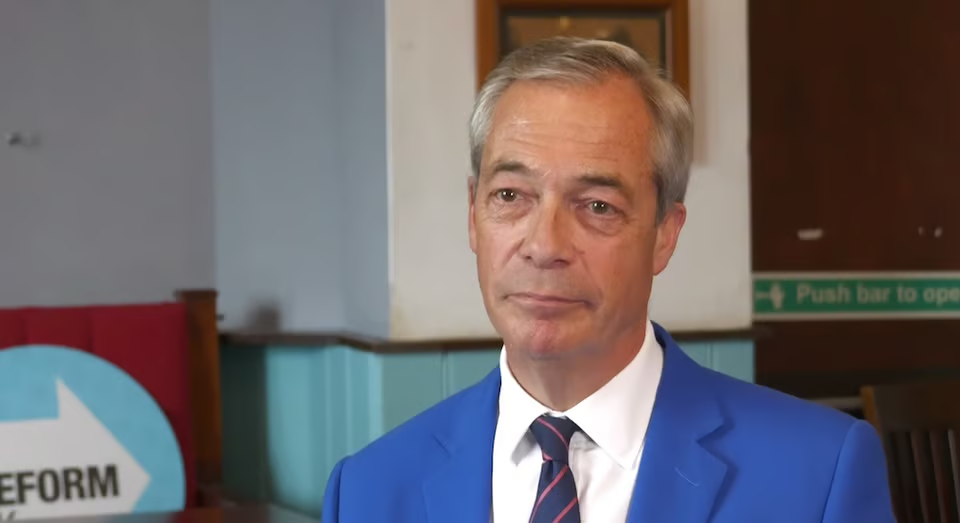
United Kingdom politician Nigel Farage, the leader of the Reform Party, purchased a property valued at 1.4 British pounds ($1.8 million) after receiving a 5 million pound ($6.7 million) “personal gift” from crypto billionaire Christopher Harborne.
The real estate deal closed in May 2024, several weeks before Farage announced that he was running for office in the general elections, according to Sky News.
Farage is now facing a UK parliamentary probe over the 5 million pound gift, which critics of the politician say should have been declared and registered after he took office.
The Reform Party and Farage maintain that no wrongdoing occurred. Farage said that because the gift was received before he entered office, it is not subject to the same reporting requirements.

Nigel Farage says the Reform Party will fight back against bans or temporary moratoriums on crypto political donations. Source: Sky News
The probe follows months of UK lawmakers and government officials urging a ban on crypto political donations over ethics concerns and growing regulatory scrutiny of political figures accepting crypto for campaign funds or personal gifts.
Related: UK Liberal Democrats call for Farage probe in $2.7M Stack BTC promotion
UK officials and lawmakers target crypto political donations
In February 2025, Matt Western, chair of the United Kingdom’s Joint Committee on the National Security Strategy, urged lawmakers to temporarily ban crypto donations sent to political parties and political figures.
Western cited concerns over foreign governments influencing UK elections and politics, with their donations as the primary reason for the ban.
“As the security environment worsens and the UK’s military role in Europe grows, the value of influencing the UK’s political positions, for example, on Ukraine, or US-EU relations, is likely to increase,” he said

The letter from the Joint Committee on the National Security Strategy urges a temporary ban on crypto donations. Source: UK Parliament
The UK government advanced a legislative proposal in March to temporarily ban political crypto donations, following the recommendations from Western and an independent inquiry into the threats posed by foreign political donations.
However, the legislation must still pass through both chambers of the UK parliament and receive approval from King Charles III before it is codified into law.
“We will act decisively to protect our democracy,” UK Prime Minister Keir Starmer said about the legislation to curb crypto political donations.
Magazine: The critical reason you should never ask ChatGPT for legal advice
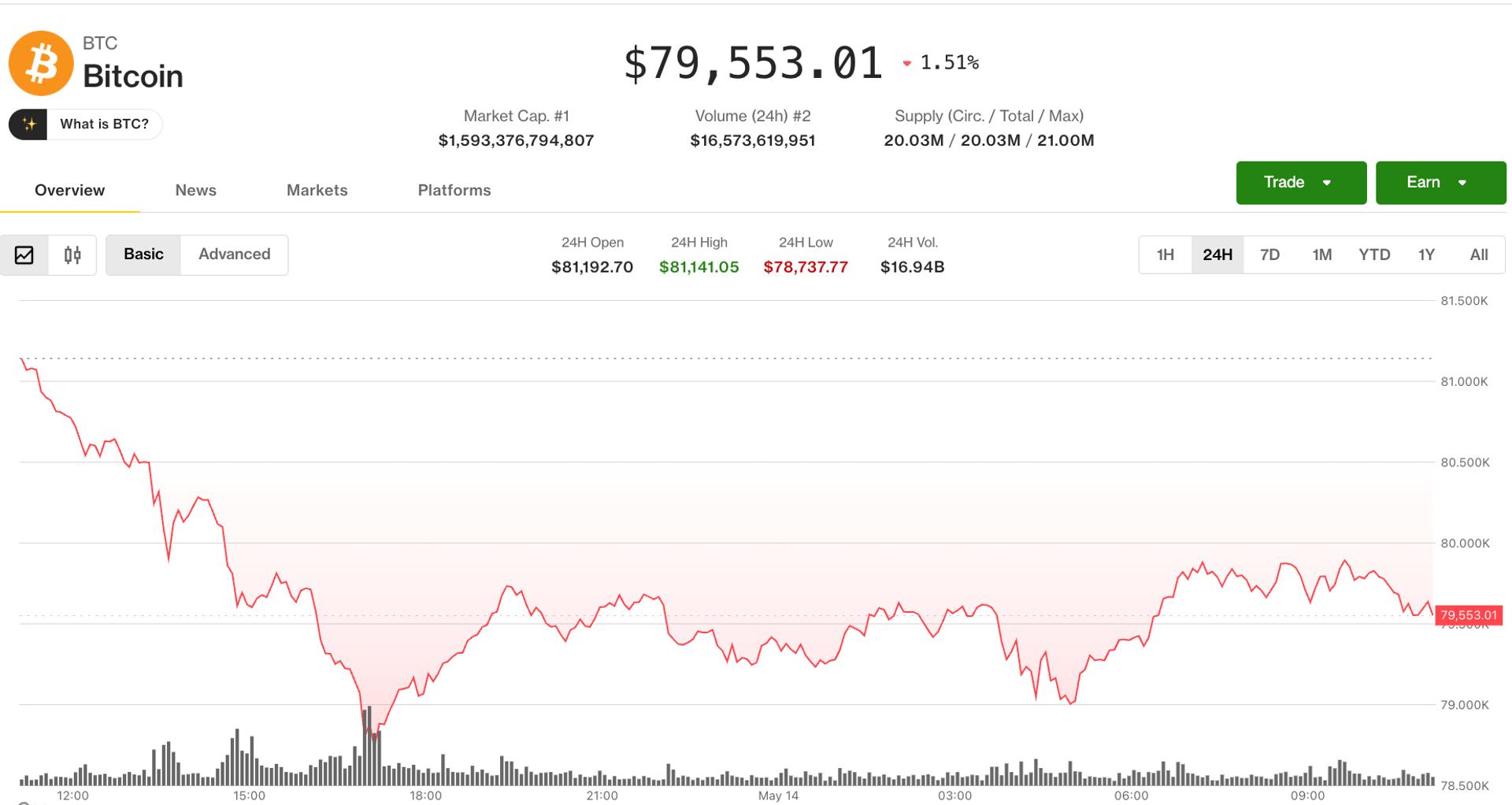
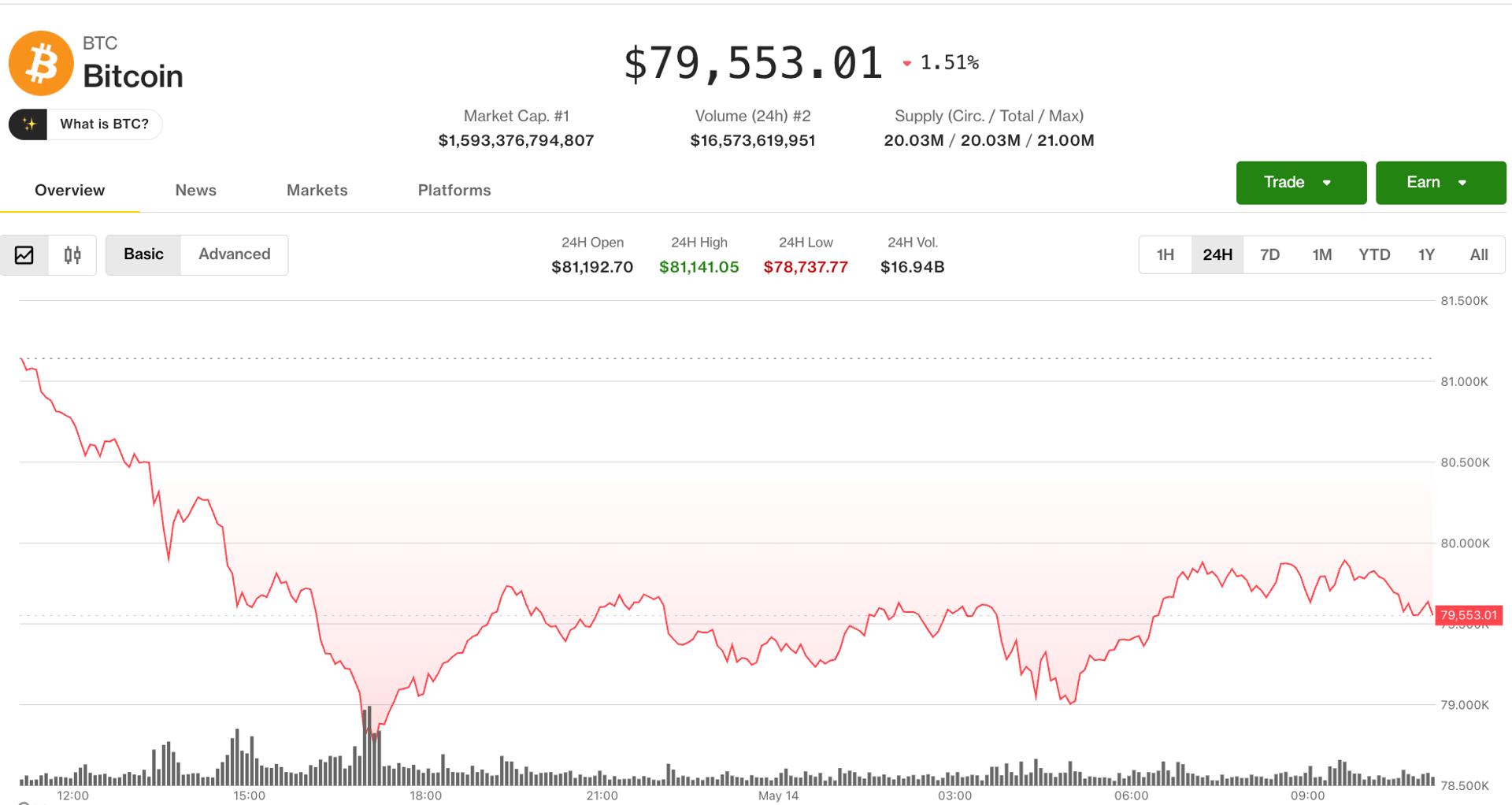
Crypto markets weakened as inflation fears hit risk assets, triggering long liquidations, negative derivatives flows and renewed pressure on altcoins.

Coinbase Deepens USDC Integration on Hyperliquid
Crypto exchange Coinbase expanded its partnership with Hyperliquid after securing a key treasury role for USDC deployment. The agreement also grants Coinbase rights to acquire the USDH brand assets from Native Markets. Meanwhile, Hyperliquid’s HYPE token gained momentum after the announcement, while Coinbase stock moved lower during market trading.
Today we’re expanding our support for @HyperliquidX by becoming the platform’s official treasury deployer of USDC.
Onchain markets operate 24/7 and require collateral that is always available, instantly transferable, and deeply liquid – USDC delivers exactly that.
Alongside… pic.twitter.com/ki7QmSJVdH
— Coinbase 🛡️ (@coinbase) May 14, 2026
Hyperliquid has relied heavily on USDC since launching in 2023, especially for leveraged trading activity and collateral management. Moreover, the exchange reported rapid growth in stablecoin usage across the platform during the past year. Coinbase stated that onchain markets require continuous liquidity and instant settlement capabilities.
HYPE Gains Momentum while COIN Shares Decline
The HYPE token recorded strong upward movement following confirmation of the expanded relationship between both companies. Besides, traders reacted positively to Coinbase increasing its staked HYPE allocation within the ecosystem. Market participants viewed the move as stronger institutional support for Hyperliquid’s infrastructure.
Trading activity reflected higher buying pressure across the HYPE market during the trading session. Consequently, the token maintained gains above key short-term support levels after the announcement. TradingView charts showed HYPE holding near recent highs during the latest market activity.
Meanwhile, Coinbase stock moved lower despite the strategic expansion into Hyperliquid’s ecosystem. TradingView data showed COIN trading near $197 during the market open, reflecting a decline exceeding 2%. However, the stock movement contrasted sharply with the positive response seen in the HYPE token market.
Coinbase Secures USDH Brand Rights as Stablecoin Winds Down
Coinbase also secured rights to purchase the USDH brand assets from Native Markets under the broader agreement. Native Markets launched the USDH stablecoin last year as Hyperliquid’s native dollar-pegged asset. However, the companies now plan to phase out USDH gradually over time.
The exchange confirmed that USDH markets remain operational throughout the transition process across supported platforms. In addition, users can still complete feeless conversions between USDH and USDC during the transition period. Fiat redemption services also remain available for holders while the wind-down continues.
The development highlights growing consolidation within the stablecoin sector as larger assets strengthen market dominance. USDC continues expanding its presence across decentralized finance platforms and derivatives ecosystems. Consequently, the transition may increase competition between USDC and rival stablecoins within perpetual trading markets.


Coinbase stock surged 8% after the Senate Banking Committee advanced the CLARITY Act in a 15 to 9 bipartisan vote.
Summary
- Bitcoin hit $82,000 following the committee vote before retreating to $81,500, up 2.5% on the day.
- Strategy climbed 7% and Bitmine advanced 5.6%, with broader crypto equity gains extending to Nasdaq and S&P 500 record highs.
- The bill still requires a full Senate vote with a 60-vote threshold and reconciliation with a House-passed version before it can reach the White House.
The Senate Banking Committee passed the Digital Asset Market Clarity Act on May 14 by 15 votes to 9, with support from two Democratic senators providing the bipartisan margin that moves the bill toward the full Senate.
Coinbase CEO Brian Armstrong had backed the current version of the bill ahead of the vote, calling it “closer than ever” to becoming law and describing the stablecoin yield compromise as a result “both sides left a little bit unhappy” with — a sign, he said, that negotiators found a genuine middle ground.
Coinbase (COIN) led gains among crypto-linked equities, surging 8% as investors priced in the possibility that clearer regulatory rules could accelerate institutional participation in digital assets.
Bitcoin rose to $82,000 shortly after the vote before retreating to approximately $81,500, up 2.5% over 24 hours. Strategy (MSTR) climbed 7%, while Ethereum-focused treasury firm Bitmine (BMNR) advanced 5.6%. The broader risk-on mood extended beyond crypto, with both the Nasdaq 100 and S&P 500 pushing to fresh record highs on the same day.
What comes next for the CLARITY Act
As crypto.news reported, the stablecoin yield compromise between Senators Thom Tillis and Angela Alsobrooks was the final major hurdle cleared before the committee vote.
The full text, published by the Senate Banking Committee, runs to 309 pages and still contains unresolved ethics language around government officials’ crypto holdings that Democrats demanded before supporting the bill at floor stage.
The CLARITY Act must still clear the full Senate with a 60-vote threshold, which requires additional Democratic support beyond the two senators who voted yes in committee.
It must then be reconciled with the version the House passed 294 to 134 in July 2025 before reaching the White House. Senator Bernie Moreno had warned that failure to advance the bill by end of May could shelve crypto market structure legislation for years.
The committee vote gives the bill its clearest legislative path since it stalled in January, when Coinbase temporarily withdrew support over the stablecoin yield provisions now resolved through the Tillis-Alsobrooks compromise.

A New York federal court has paused ruling on Aave’s emergency bid to unfreeze approximately $71 million in ETH tied to the Kelp DAO hack, delaying a decision until a June hearing while the court seeks additional information from both sides. The dispute centers on whether Arbitrum’s freeze of the funds should be lifted to support ongoing recovery efforts after one of DeFi’s most significant exploits this year.
Aave contends that unlocking the funds is necessary to prevent forced liquidations and potential destabilization of DeFi markets, while a restraining notice filed by Gerstein Harrow LLP asserts that its clients have a claim to the assets. The Southern District of New York case under Judge Margaret M. Garnett has drawn attention for how courts balance crypto asset freezes against creditor interests and user protection.
Documents filed in the court indicate that Judge Garnett found Aave’s prior briefing insufficient to show how continuing the restraining notice would cause “compounding losses” to user funds if kept in place, signaling the need for more detailed briefing before any ruling. The judge described the matter as complex and vulnerable to near-term harm to Aave LLC and Aave Protocol users, and ordered both sides to provide supplemental submissions ahead of a June 5 hearing.
Key takeaways
- The court postponed ruling and ordered supplemental briefing, citing the case’s complexity and potential near-term harm to users.
- Briefs are due by May 22, 2026, with a hearing scheduled for June 5, 2026.
- The court identified six information gaps for clarification, including whether the shelter principle applies under New York law, the distinction between fraud and theft and the hackers’ interest in stolen assets, which law governs creditor priority over frozen assets, the potential use of a constructive trust, and whether Aave or Arbitrum can identify individual victims to enable pro rata restitution.
- Recovery steps for Kelp DAO: rsETH backing is being restored and the burned tokens will be reconciled; about $278 million in lost tokens will be restored over roughly two weeks from the Aave Recovery Guardian multisignature wallet, pending contract reactivation.
- The case highlights regulatory and policy considerations for DeFi asset freezes, creditor rights, and cross-border enforcement in the evolving landscape of crypto oversight.
Judicial probes into the Aave restraining notice
The SDNY proceedings center on Aave’s motion to unfreeze the ETH tied to the Kelp DAO exploit. Judge Garnett acknowledged the challenge of applying traditional remedies to a decentralized finance scenario and requested detailed briefing to better map the legal framework. In particular, she asked the parties to address how a shelter principle under New York law could interact with the restraining notice, and how such freezes should be reconciled with the transnational nature of crypto assets.
Among the issues identified for clarification are the legal distinction between fraud and theft and the extent to which hackers retain any interest in stolen assets, which law governs creditor priority over frozen property, whether a constructive trust would be an appropriate remedy, and whether either Aave or Arbitrum can identify individual victims to enable pro rata reimbursement. The court’s questions underscore the delicate balance between protecting users and honoring creditor interests in DeFi contexts, and the need for precise legal framing in this rapidly evolving space.
As noted in court filings, the parties have until May 22 to submit supplemental briefs, with the June 5 hearing set to adjudicate unresolved questions. The outcome could influence how future DeFi-related freezes are treated under U.S. law and may shape institutional approaches to recovery, enforcement, and compliance for lenders, exchanges, and wallets operating in cross-border environments.
Regulatory and policy context for frozen DeFi assets
Industry observers view the case as a focal point for broader regulatory and enforcement considerations surrounding DeFi asset freezes. While protocols may implement automatic or voluntary freezes to facilitate recovery, courts must determine how these actions align with doctrines on priority of claims, constructive trusts, and user protections. The proceedings touch on how regimes like MiCA and U.S. agencies—such as the SEC, CFTC, and DOJ—may evaluate asset freezes, civil actions, and enforcement associated with DeFi exploits.
Analysts also weigh implications for cross-border operations and banking compatibility, especially for entities seeking to safeguard customer assets while remaining compliant with AML/KYC requirements. The June decision could influence how exchanges and liquidity venues structure recovery processes and how courts treat frozen funds in multi-party incidents.
Kelp DAO recovery steps and broader implications for DeFi asset recovery
Parallel to the court proceedings, Kelp DAO and Aave have outlined concrete steps toward restoring the compromised rsETH backing. The hacker’s rsETH on Arbitrum has been burned, while the tokens lost in the incident—valued at approximately $278 million—are expected to be restored over the next two weeks from the Aave Recovery Guardian multisignature wallet. Once the related smart contracts are reactivated, rsETH usage is anticipated to return to normal, stabilizing the ecosystem’s collateral and liquidity framework on the affected chain.
These recovery actions illustrate a growing practice of coordinated asset restitution within DeFi ecosystems, while raising questions about victim identification and proportional compensation in decentralized environments. The Kelp‑Aave updates emphasize resilience and post-incident recovery even as legal proceedings unfold in parallel.
Source: Kelp DAO status and related announcements, with corroboration from court filings and industry reporting.
Related coverage: DeFi can freeze stolen funds, but not everyone agrees it should.
Watching the June proceedings will be essential for compliance, risk management, and governance considerations across DeFi protocols and their banking and legal counterparts.


The Clarity Act cleared the Senate Banking Committee 15 to 9 on Thursday, sending Bitcoin above $82,000 for the first time in weeks.
Summary
- The Senate Banking Committee advanced the Clarity Act in a bipartisan 15 to 9 vote, with two Democrats crossing the aisle to back the bill.
- Bitcoin climbed above $82,000 following the committee vote before pulling back to around $81,500, up roughly 2.5% on the day.
- Unresolved ethics provisions and a 60-vote Senate floor threshold remain as the bill moves toward a full Senate vote ahead of May 21 recess.
The Clarity Act advanced out of the Senate Banking Committee on Thursday in a 15 to 9 bipartisan vote, clearing a critical legislative gate for the most significant crypto market structure bill in US history. Bitcoin (BTC) climbed above $82,000 following the vote before retreating slightly to around $81,500, up approximately 2.5% on the day.
Two Democratic senators crossed the aisle to back the bill alongside all 13 Republicans on the committee. Chairman Tim Scott had described securing all 13 Republican votes as “the red zone,” with Senator John Kennedy having withheld support in the days leading up to the session.
Cody Carbone, who heads the Digital Chamber, told reporters the unresolved ethics provision around lawmakers trading crypto tokens remains the most likely obstacle before a floor vote. “I imagine the deal will be completed before this goes to the floor, because they’ll want to only bring it to the floor if they feel confident they’ve got 60,” Carbone said.
What the Clarity Act does
The Digital Asset Market Clarity Act, which already passed the House 294 to 134 in July 2025, would draw a statutory line between the SEC and the CFTC. Digital commodities would fall under CFTC oversight and digital securities would remain under the SEC, ending years of regulatory uncertainty that has suppressed institutional flows into US crypto markets.
The bill still needs 60 votes on the Senate floor, reconciliation with the Senate Agriculture Committee version, and alignment with the House text before reaching the president’s desk. The full 309-page bill text is available at congress.gov. Senators Lummis and Moreno have both warned that missing the Memorial Day recess deadline on May 21 could push the next viable legislative window to 2030.
White House adviser Patrick Witt has indicated the administration will not accept ethics provisions targeting the president specifically, adding a further layer of negotiation before the floor vote can proceed. Democratic senators have linked their support to broader ethics language covering all lawmakers and officials.
Coinbase VP Kara Calvert said at Consensus 2026 that bipartisan backing is non-negotiable and the bill needs at least 60 votes to advance. For Bitcoin, now trading around $81,500, the committee vote functions primarily as a confidence signal.
The bill’s relevance to BTC is less about its own commodity classification and more about what a settled US digital asset framework does to institutional risk appetite across the broader market.
Crypto World
Bitcoin Price Prediction: BTC Risks Drop to $75K as Sellers Defend Critical $80K Resistance
Bitcoin has started showing early signs of weakness after its recent recovery rally toward the $80K resistance region. The market is now confronting a technically important supply zone where sellers have become increasingly active, raising the probability of a broader corrective phase in the short term.
Bitcoin Price Analysis: The Daily Chart
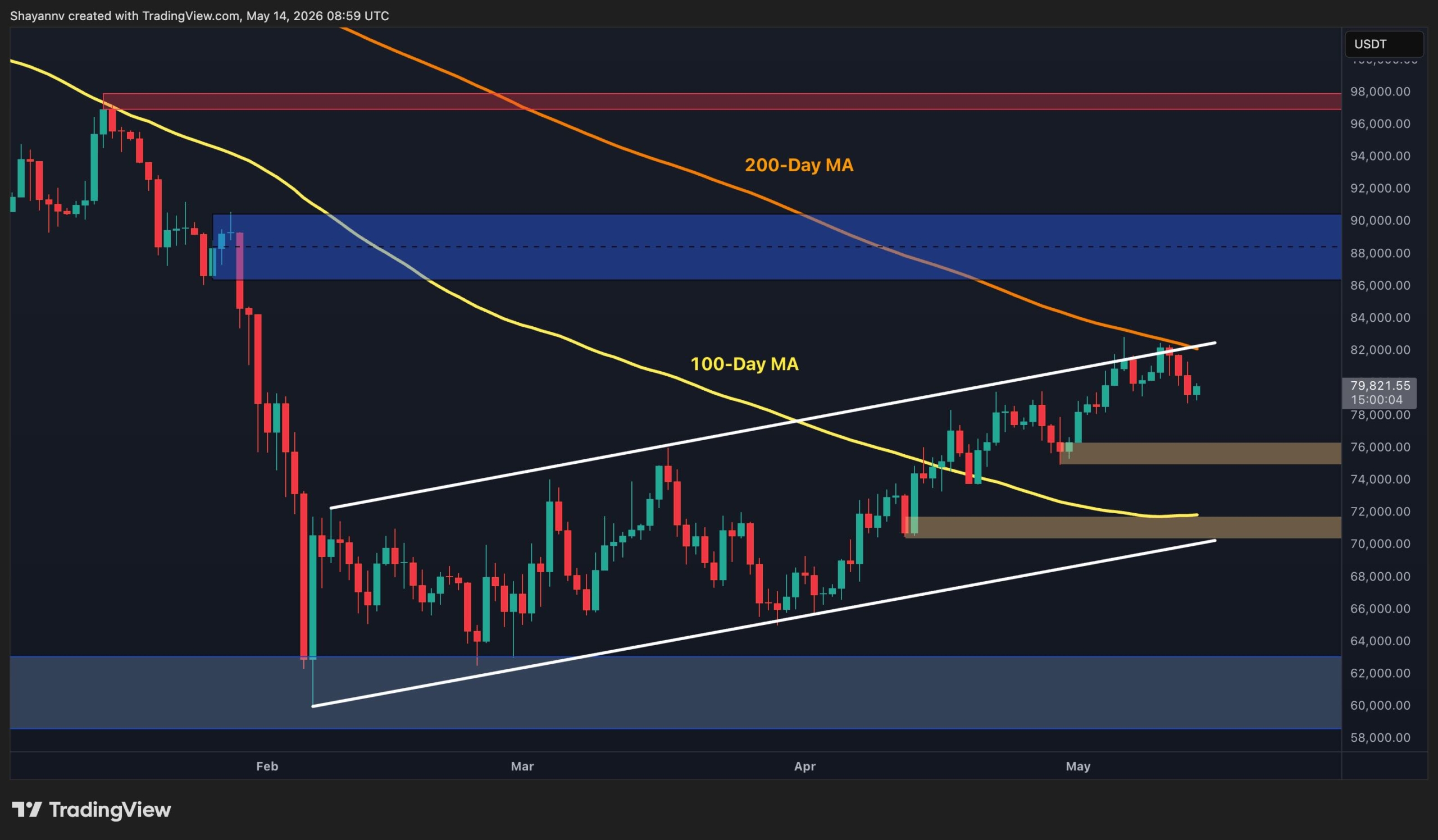
On the daily chart, BTC has recently shown several bearish signs as the price struggles to maintain bullish momentum around the crucial $80K resistance level. This area coincides with a strong confluence of supply, including the upper boundary of the broader ascending channel and the 200-day moving average near the $82K mark. The repeated inability to reclaim this region highlights the presence of aggressive sellers and growing distribution pressure in the market.
As a result, the probability of an expanded bearish retracement has increased notably. If sellers maintain control, Bitcoin could gradually decline toward lower support zones, with the $75K region acting as the first key demand area. A deeper correction could then expose the broader support zone around $70K-$71K, which previously acted as a significant accumulation range for buyers.
BTC/USDT 4-Hour Chart
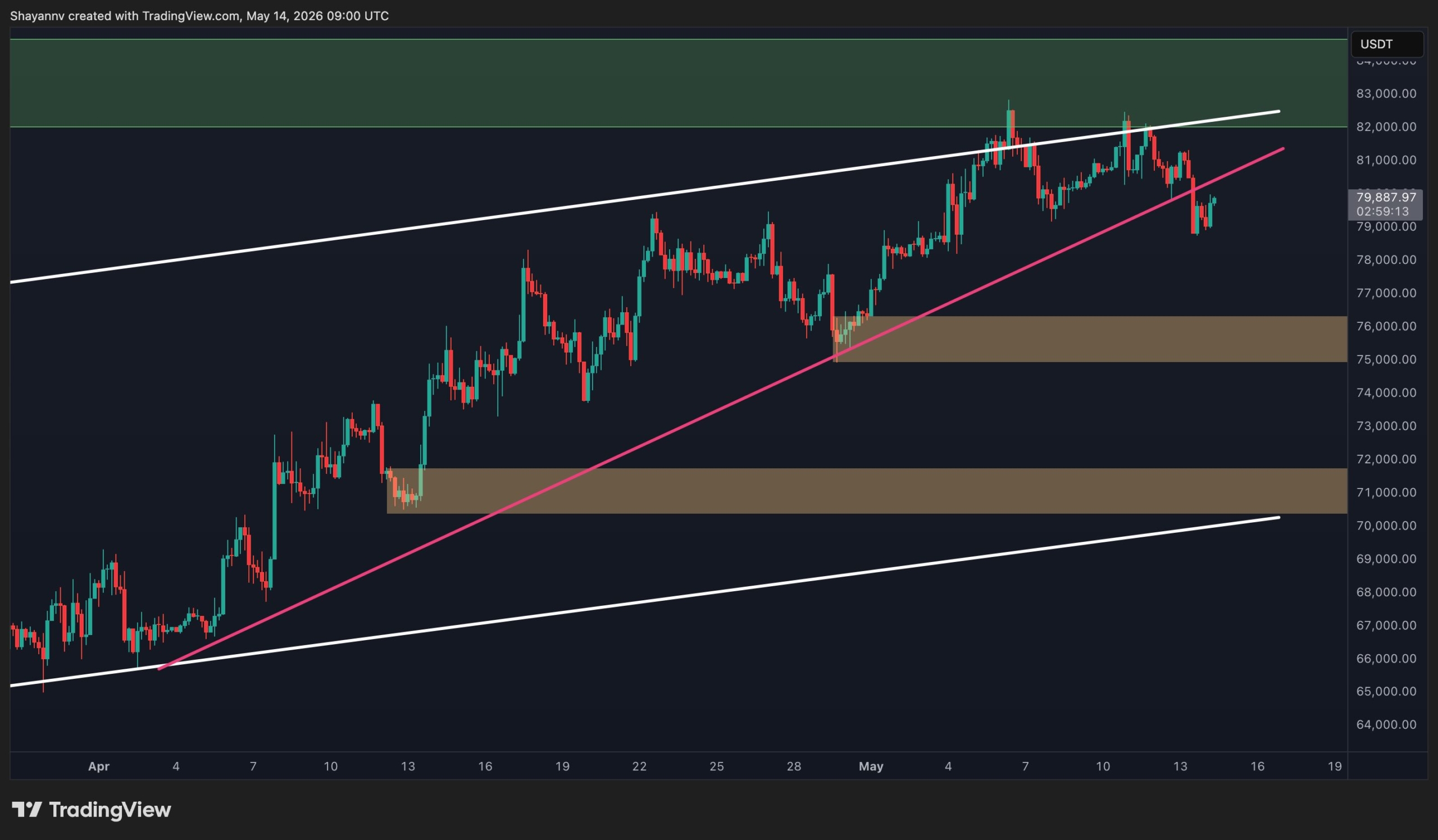
On the 4-hour timeframe, the market has recently broken below a key ascending trendline that had supported the latest bullish structure since the rebound from the $60K region. This bearish breakdown serves as an early warning sign that momentum is fading and sellers are gradually gaining dominance over the market.
Additionally, many participants who accumulated BTC during the recent capitulation toward the $60K support zone now appear to be securing profits and reducing exposure near resistance. This behavior has increased selling pressure around the $80K region and further supports the possibility of another corrective leg in the coming days. If bearish momentum accelerates, the price could continue its decline toward the highlighted demand zones at $76K and eventually the $71K region.
Onchain Analysis
From a liquidation perspective, the Binance BTC/USDT heatmap reveals a substantial concentration of liquidity resting beneath the current market price, particularly around the $77K region. Historically, the market tends to gravitate toward these high-liquidity zones, as they fuel larger directional moves through forced liquidations.
This growing liquidity cluster below the market further aligns with the current bearish technical structure observed across both higher and lower timeframes. As long as Bitcoin remains below the critical resistance confluence around $80K-$82K, the probability of a liquidity-driven decline toward the lower clusters remains elevated.

The post Bitcoin Price Prediction: BTC Risks Drop to $75K as Sellers Defend Critical $80K Resistance appeared first on CryptoPotato.

Beloved Star Wars Actor’s Return Could Fix The Stupidest Thing About The Rise Of Skywalker

How medical misogyny stole my life for 20 years

AI could put people off tech jobs and hurt the economy, warns Raspberry Pi boss

Manchester United reach agreement with Casemiro over contract clause amid transfer speculation

US brings back mandatory military draft registration

Steven Gerrard disagrees with Gary Neville over ‘shock’ Chelsea and Arsenal claim | Football


-
 Crypto World7 days ago
HarrisX Poll Found 52% of Registered Voters Support the CLARITY Act
-

 Fashion6 days ago
Weekend Open Thread: Marianne Dress
-

 Fashion3 days ago
Coffee Break: Travel Steam Iron
-

 Fashion4 days ago
What to Know Before Buying a Curling Wand or Curling Iron
-

 Tech5 days ago
Auto Enthusiast Carves Functional Two-Stroke Engine from Solid Metal
-

 Politics3 days ago
What to expect when you’re expecting a budget
-
 Business5 days ago
Ignore market noise, India’s long-term story intact, say D-Street bulls Ramesh Damani and Sunil Singhania
-

 Politics6 days ago
Politics Home Article | Starmer Enters The Danger Zone
-

 Tech4 days ago
GM Agrees To Pay $12.75 Million To Settle California Lawsuit Over Misuse Of Customers’ Driving Data
-

 Crypto World6 days ago
PROS explodes 48% as Upbit and Bithumb listings ignite demand
-

 Crypto World5 days ago
CZ says US crypto rivals tried to block Trump pardon
-

 Sports7 days ago
Bayern Munich vs PSG UEFA Champions League SF2 live match time, streaming | Football News
-

 Entertainment6 days ago
YNW Melly Denied Bond Again Ahead Of Double Murder Retrial
-

 Tech3 days ago
GM agrees to $12.75M California settlement over sale of drivers’ data
-

 Crypto World6 days ago
Kraken Parent Seeks OCC Charter, Signaling Regulated Banking Access
-
Crypto World6 days ago
The Hantavirus Danger: Can a Potential Outbreak Spark a New Meme Coin Frenzy?
-
Tech7 days ago
The Most Exciting Apple Products In The Pipeline For 2026 And Beyond
-

 Politics7 days ago
David Attenborough ‘Overwhelmed’ By Love Shown Ahead Of 100th Birthday
-

 Sports6 days ago
After Waka Waka, Shakira now drops first teaser for FIFA WC 2026 song | FIFA World Cup 2022
-

 Crypto World7 days ago
Here’s Why Cristiano Ronaldo and Taylor Swift Lost Millions of Followers on Instagram
You must be logged in to post a comment Login