

Crypto World
Nvidia (NVDA) Stock Expands CoreWeave (CRWV) Holdings by 95% in Strategic AI Play


Key Highlights
- Nvidia’s Q1 2026 SEC filing revealed a 47.2 million share position in CoreWeave (CRWV), marking a 94.5% expansion from the previous quarter.
- The chipmaker also disclosed ownership of 7.8 million shares in Coherent (COHR), a provider of materials for chips and optical components.
- Both positions reflect holdings recorded as of March 31, 2026, according to regulatory documents.
- Nvidia’s relationship with CoreWeave dates back to 2021, when the cloud provider was still an emerging GPU-focused startup.
- Wall Street analysts maintain a Strong Buy rating on NVDA stock with a consensus price target of $280.31, suggesting approximately 24% potential upside.
A recent SEC disclosure from Nvidia has drawn attention to two companies with strong ties to the artificial intelligence sector. The semiconductor giant revealed expanded stakes in both CoreWeave (CRWV) and Coherent (COHR) based on holdings dated March 31, 2026.
The filing shows Nvidia currently owns 47.2 million Class A shares of CoreWeave. This represents a substantial 94.5% jump from the 24.3 million shares it reported at the conclusion of Q4 2025. The expansion effectively doubles down on Nvidia’s commitment to one of the most rapidly expanding AI cloud infrastructure providers in the market.
CoreWeave, Inc. Class A Common Stock, CRWV
The foundation of CoreWeave’s infrastructure has been built predominantly on Nvidia’s GPU technology. Nvidia’s initial investment came in 2021 when CoreWeave was still operating as a relatively small cloud provider specializing in GPU resources, establishing a partnership that made this recent position increase a logical progression.
Since that early investment, CoreWeave has evolved into a significant player in the AI cloud services space with ambitious growth targets extending through 2026. The company’s platform supports large-scale artificial intelligence operations for corporate customers and has emerged as an important distribution channel for Nvidia’s GPU inventory.
Coherent Investment Highlights Supply Chain Strategy
Beyond the CoreWeave expansion, Nvidia’s filing also documented a 7.8 million share holding in Coherent (COHR). Coherent specializes in manufacturing materials essential for semiconductor production, laser systems, and optical technologies — all crucial elements supporting high-performance computing infrastructure and sophisticated chip assembly processes.
While Coherent may not attract the same media attention as prominent AI companies, it occupies a strategic position within a supply chain segment that offers limited alternatives. As AI systems become increasingly energy-intensive, the need for Coherent’s specialized materials has grown correspondingly.
Together, these two investment positions illustrate Nvidia’s broader approach to securing strategic touchpoints throughout the AI technology ecosystem extending beyond its primary semiconductor operations. Instead of limiting itself to hardware sales, Nvidia is establishing financial interests across cloud computing platforms and the fundamental materials that enable them.
Analyst Outlook on NVDA Remains Positive
Shares of Nvidia declined 4.42% on the trading day following the filing’s release. CoreWeave shares dropped 6.05% while Coherent experienced a 5.55% decline during the same period.
Notwithstanding these single-day declines, the investment community continues to express strong confidence in NVDA. The stock holds a Strong Buy consensus rating supported by 40 Buy recommendations, one Hold rating, and one Sell rating issued within the last three months.
Analysts have established an average price target of $280.31, which indicates potential appreciation of 24.4% from present trading levels.
The regulatory filing captures investment positions as they stood on March 31, 2026, providing a comparison against the holdings reported at year-end 2025. The significantly expanded CoreWeave stake represents the most notable portfolio adjustment during this period.
CoreWeave completed its public market debut earlier in 2026 and has rapidly become one of the most monitored AI infrastructure investments available to market participants. Nvidia’s decision to substantially increase its ownership adds another significant dimension to CoreWeave’s market narrative.



Key Takeaways
- Duquesne Family Office, managed by Stanley Druckenmiller, completely liquidated its 385,000-share Alphabet (GOOGL) stake during Q1 2026.
- TCI Fund Management, led by Christopher Hohn, established a fresh 2.46 million-share Alphabet Class A position and expanded Class C holdings to 8.85 million shares.
- TCI dramatically reduced its Microsoft exposure, cutting shares from 16.78 million down to 2.73 million.
- Third Point, managed by Daniel Loeb, launched new positions in Meta, Alphabet, bitcoin miner Hut 8, and SPDR Gold Shares ETF.
- Druckenmiller’s fund established fresh stakes in Broadcom, Caris Life Sciences, and Revolution Medicines while nearly eliminating its Amazon position.
Major hedge fund managers submitted their Q1 2026 13F reports late Friday evening, exposing significant portfolio adjustments across technology holdings. Alphabet emerged as a focal point, with prominent investors taking opposing positions on the tech giant.
Stanley Druckenmiller’s Duquesne Family Office led the exits. The investment firm completely liquidated its 385,000-share Alphabet Class A holding throughout the first quarter. This position had been substantially expanded during Q4 2025, when Duquesne boosted it from 102,000 shares. The firm has not issued public statements explaining the rationale behind this complete withdrawal.
Alphabet finished Friday’s trading session at $396.78, gaining 1% for the day. Year-to-date, the stock has climbed 27% in 2026. Notably, during the January through March period, shares declined 8%, indicating Druckenmiller’s exit occurred while the stock was underperforming.
Duquesne Establishes Broadcom Position, Nearly Eliminates Amazon
While divesting from Alphabet, Duquesne remained aggressive in other sectors. The fund launched a new Broadcom position comprising 195,955 shares. Additionally, it established a significant stake in Caris Life Sciences totaling 1.89 million shares and acquired 315,860 shares of Revolution Medicines.
The fund executed substantial reductions elsewhere in its portfolio. Its Amazon holdings were slashed dramatically, declining from 737,940 shares to merely 9,539 shares. Teva Pharmaceuticals was reduced from 5.87 million shares to 2.37 million, while Coupang saw its stake drop from 6.77 million shares to 2.67 million.
Duquesne completely exited several positions during the quarter, including State Street Financial Select Sector SPDR, Cogent Biosciences, Entegris, Delta Air Lines, and American Airlines.
TCI Expands Alphabet Holdings While Third Point Enters Crypto Exposure
Contrasting with Druckenmiller’s approach, Christopher Hohn’s TCI Fund Management aggressively accumulated Alphabet shares. The fund initiated a substantial 2.46 million-share Alphabet Class A position from scratch. Simultaneously, it expanded its Alphabet Class C holdings from 7.6 million to 8.85 million shares.
TCI strengthened other core holdings as well. Visa shares were increased to 30.47 million, while both S&P Global and Moody’s saw expanded positions. However, the fund executed a dramatic reduction in Microsoft, slashing its stake from 16.78 million shares to just 2.73 million.
Daniel Loeb’s Third Point pursued a distinct strategy. The fund initiated fresh positions across Meta, Alphabet, SPDR Gold Shares, and Hut 8, a bitcoin mining operation. These moves signal expansion into both established technology leaders and cryptocurrency-related investments. Third Point simultaneously exited Microsoft, PG&E, Brookfield Asset Management, Casey’s, and CoStar throughout Q1.
The contrasting approaches to Alphabet across elite hedge funds underscores the divergent perspectives on the stock during a quarter when shares traded below their year-start levels.
These portfolio changes were revealed through mandatory 13F regulatory filings, which capture positions held as of March 31, 2026. As of Friday’s market close, Alphabet shares have appreciated 27% year-to-date.

Key Takeaways
- Atlassian (TEAM) climbed 8.1% following a diplomatic summit between Trump and Xi that boosted technology sector confidence, with the S&P 500 reaching a new record exceeding 7,500.
- Trade relations between the US and China transitioned from hostile to moderately optimistic, alleviating concerns for software companies with global operations.
- Strong performance from Figma (46% revenue expansion) and ServiceNow’s AI collaboration with Experian bolstered confidence in enterprise AI revenue generation.
- Truist maintained its Buy recommendation with a $100 target price, highlighting Atlassian’s artificial intelligence approach and Rovo credit consumption framework.
- TEAM remains significantly depressed with a 44% decline year-to-date and sitting 60.8% beneath its 52-week peak of $220.89.
Shares of Atlassian (TEAM) advanced 8.1% on May 15, reaching $86.61, following a diplomatic meeting between Trump and Xi in Beijing that altered the trajectory of US-China trade discussions.
The summit delivered fewer tangible agreements than investors anticipated. However, the overall atmosphere evolved from adversarial to moderately positive — and for an industry as internationally integrated as enterprise software, that shift proved sufficient.
The S&P 500 achieved a milestone, surpassing 7,500 during the same trading session. Technology stocks experienced broad-based buying interest.
This upward movement wasn’t isolated. Two distinct developments from the broader enterprise software landscape reinforced the positive sentiment.
Figma disclosed 46% revenue expansion, demonstrating genuine progress in early AI monetisation efforts. ServiceNow unveiled a multiyear artificial intelligence collaboration with Experian. Both announcements conveyed a consistent message: enterprise software providers are successfully integrating AI capabilities into their offerings and generating revenue from these features.
This storyline holds significance for Atlassian. Earlier this year, apprehension that artificial intelligence would destabilize rather than strengthen enterprise software platforms had pressured the sector. These recent developments helped diminish those worries.
Analyst Perspectives
Truist Securities maintained its Buy stance and $100 price objective on TEAM, referencing the company’s artificial intelligence roadmap unveiled at its Team 26 conference.
The firm emphasized how Atlassian intends to generate revenue from AI through its Rovo credit framework, which encompasses both internal platform usage and external consumption. Truist views Atlassian as strategically positioned to function as a supplier of enterprise context for AI implementations.
Company leadership has highlighted adoption of the Teamwork Collection as proof that interest in its AI offerings is expanding. Truist anticipates the extended strategy involves adding proprietary context over tokens through a usage-based pricing structure.
Other Wall Street firms have shown less unanimous optimism but remain generally positive. Bernstein SocGen Group maintains a $295 price objective. Cantor Fitzgerald projects $107. BofA forecasts $100. Piper Sandler carries an Overweight designation with a $175 target. Macquarie holds a $130 estimate with an Outperform classification.
These projections reveal their own narrative — substantial divergence exists, with minimal consensus among the figures.
TEAM’s Broader Context
Atlassian’s third-quarter fiscal 2026 performance demonstrated strength. Cloud revenue exceeded analyst projections by 4.5% and expanded 29% year-over-year, accelerating from 26% in the previous quarter. Data center transitions and the DX acquisition fueled that expansion.
Free cash flow fell short of expectations due to severance costs, though cloud revenue and non-GAAP operating income surpassed analyst estimates.
The equity remains depressed by 44% year-to-date. It trades 60.8% under its 52-week maximum of $220.89, achieved in July 2025.
For perspective: a $1,000 position in Atlassian from five years ago currently holds a value of $407.94.
TEAM has experienced 33 movements exceeding 5% during the past year. Thursday’s 8.1% advance aligns with this volatility pattern — notable, yet not the type of movement that fundamentally alters the investment thesis independently.
The stock’s prior significant fluctuation was a 3.8% decline two trading days earlier, triggered by the April PPI data driving Treasury yields to 10-month peaks.

TLDR:
- BNB Chain processes around 40% of all global stablecoin transactions, with millions of monthly active users.
- Over 179,000 AI agents currently use BNB Chain as a financial layer, a major share of all onchain agents.
- The network holds roughly $4 billion in RWA assets and supports approximately 60,000 RWA holders onchain.
- BNB Chain plans to scale throughput from 6,000 to 20,000 TPS while launching a new dedicated Agentic SDK.
BNB Chain has outlined its priorities for 2026, with a sharp focus on stablecoins, real-world assets (RWAs), and AI agents.
The blockchain network is positioning itself as core infrastructure for the next wave of onchain activity. Nina Rong, the network’s Executive Director of Growth, shared these plans during a recent Binance Online session.
Her remarks covered infrastructure upgrades, developer tooling, and the growing role of AI in decentralized finance.
Stablecoins and RWAs Take Center Stage
BNB Chain now processes roughly 40% of all global stablecoin transaction activity. Millions of users conduct stablecoin transactions on the network each month.
The network is also pushing beyond USD-denominated stablecoins into local and cross-border payment use cases.
This expansion reflects a broader effort to bring everyday financial activity onchain. Rather than competing on narrative alone, BNB Chain is building the rails for real financial use. The goal is making stablecoin payments as routine as any traditional digital transaction.
On the RWA side, the ecosystem has grown quietly but steadily. BNB Chain now holds around $4 billion in tokenized real-world assets. The network also supports hundreds of live tokenized instruments and approximately 60,000 RWA holders.
The combination of stablecoin volume and RWA growth positions BNB Chain as a serious contender in institutional finance.
As more capital moves onchain, having both pieces in place becomes increasingly valuable for institutions exploring blockchain-based settlement.
AI Agents Emerge as a Financial Layer
One of the more striking disclosures from the session involved AI agents. Over 179,000 AI agents are currently using BNB Chain as a financial layer. This figure represents a large share of all active onchain agents across the crypto industry today.
Rong captured the shift in a single line during the livestream: “BNB Chain is serving not only humans but also non-humans.”
This reflects how automated systems are now interacting with onchain infrastructure at scale. The line between human and machine users is narrowing quickly.
To support this, BNB Chain is developing an Agentic SDK. The tool will allow AI agents to accept jobs, negotiate pricing, and interact with onchain services. Each agent will also be able to operate with its own onchain identity and financial rails.
This infrastructure layer is new territory for most blockchain networks. By building dedicated tooling for AI agents, BNB Chain is preparing for a future where automated systems handle a significant share of onchain activity.
Infrastructure Upgrades and Developer Support
BNB Chain is also investing heavily in performance improvements this year. The network plans to increase throughput from 6,000 transactions per second to 20,000 TPS. Alongside this, the team is working to reduce latency and improve transaction finality.
Rong described the broader user experience goal clearly: “BNB Chain should just be as easy as breathing air.” The intention is for users to interact onchain without needing to think about the underlying infrastructure. Speed and reliability should simply be expected.
For developers, the focus includes AI-focused infrastructure, onchain identity standards, and middleware for institutional use. New APIs and easier building blocks are also being introduced for teams launching onchain products.
Beyond tooling, BNB Chain is also expanding its builder support programs. Hackathons, incubator initiatives, and business development resources are all part of helping projects move from concept to live product more efficiently.


For protocol founders and security researchers, the incident reinforced a broader shift underway across crypto: DeFi is no longer primarily battling coding bugs. It’s battling complexity.
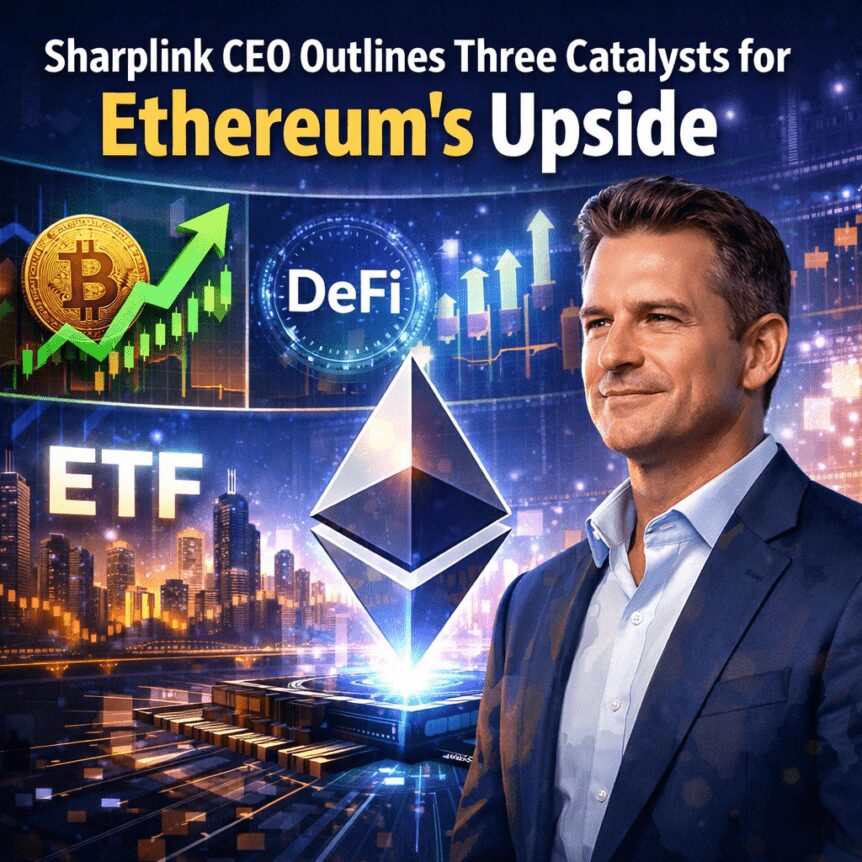
Ethereum’s next leg upward, according to Joseph Chalom, CEO of SharpLink Gaming, hinges on a trio of catalysts that could shift the macro and regulatory backdrop in its favor. In a Chain Reaction interview published this week, Chalom outlined the milestones he believes would align to rekindle momentum for the Ether market: regulatory clarity from Washington, a rebound in risk appetite, and a sustained push into real-world asset tokenization that he says could redefine Ethereum’s dominance in the space.
On the regulatory front, Chalom highlighted the Digital Asset Market Clarity Act (CLARITY) as a potential spark. He pointed to a development this week in which all 13 Republican members and two Democrats on the Senate Banking Committee voted to advance the CLARITY Act at a committee meeting. While framed as a U.S. policy effort, Chalom notes that the move resonates beyond American borders, signaling a broader shift toward clearer crypto guidelines that other jurisdictions are watching closely.
Key takeaways
- CLARITY Act progress: A bipartisan move in the U.S. Senate Banking Committee toward providing clear rules for digital assets could unlock renewed institutional engagement with Ethereum and related products.
- Global signal: The U.S. shift toward a more defined stance on crypto is seen as a global benchmark, with major markets in Asia watching the development as policymakers weigh their own regulatory paths.
- Risk appetite and macro backdrop: A return of risk tolerance, aided by easing geopolitical frictions and a cooling of AI-focused market frenzies, is viewed as a prerequisite for a broader crypto rally.
- Tokenization as a growth vector: Ethereum’s potential to dominate the tokenization of real-world assets (RWA) is cited as a long-horizon driver, supported by large-scale tokenization announcements and asset-manager interest.
US regulatory clarity as a potential price trigger
Chalom frames CLARITY not merely as a U.S. phenomenon but as a possible catalyst with global implications. He notes that the act’s advancement in the Senate Banking Committee signals a path toward clearer regulatory guardrails for tokens, wallets, and regulated products. The interview underscores a view that clearer rules could reduce uncertainty that has historically weighed on institutional participation in crypto markets. For investors, this suggests a potential re-rating of Ethereum-related exposure if the policy environment stabilizes and allows traditional players to transact and innovate with fewer legal ambiguities.
In the broader context, CLARITY’s progress arrives amid ongoing American debates about how to balance innovation with consumer protection and financial stability. While policy specifics remain to be worked out, the momentum is being read as a signal that the U.S. may reassert leadership in crypto finance in the coming years, which could encourage foreign ventures to align with American standards or to calibrate their own regulatory frameworks in response.
Global watchers, Asia’s cautious convergence on crypto leadership
Chalom emphasized that the ripples of the U.S. regulatory shift are being observed across major Asian centers. He has been traveling through Korea, Hong Kong, Tokyo, and Singapore, where officials and market participants are closely watching Washington’s trajectory. The concern is not merely about a regulatory victory for the U.S. side but about whether the global financial system can recalibrate around a disciplined, compliant framework for digital assets. In such a scenario, the U.S. could recast itself as a financing hub again, prompting capital to flow toward a regulated crypto ecosystem rather than away from it. For builders and traders, the implication is clear: regulatory clarity can reduce cross-border friction and enable more scalable use cases for Ethereum as a settlement layer and platform for tokenization.
Market mood, AI’s shadow, and the case for risk appetite
The second catalyst on Chalom’s list centers on macro sentiment. He argues that a sustained improvement in market risk appetite will largely hinge on two factors: de-escalation in geopolitical tensions and a cooling of the AI narrative that has driven much of the last year’s speculative fervor. “I think we’ll need some of that to go away in order to see crypto rise again,” he remarked. In other words, a calmer macro environment could reduce the headwinds that have pressured risk assets, including Ethereum, in recent months.
ETH’s price context provides a helpful backdrop for these considerations. Ether touched an all-time high of around $4,823 in August 2025 during a broad market upswing, but has since retraced about 55%, trading near $2,190 at the time of publication. The price trajectory underscores how a combination of policy clarity and macro stability could be required before a sustained rebound in Ethereum’s value materializes.
Tokenization: where Ethereum could dominate, now and ahead
The third catalyst centers on tokenization—the process of representing real-world assets on blockchain networks via digital tokens. Chalom argues that tokenization is the frontier where Ethereum could achieve meaningful dominance, noting that roughly $32 billion of real-world assets have been tokenized to date. He traces tokenization back to 2017, highlighting how progress has been uneven but is now accelerating with high-profile coordinations among asset managers and financial services firms.
Recent developments illustrate the momentum. JPMorgan filed to launch a tokenized money market fund on Ethereum, a vehicle designed to hold reserves backing stablecoins in a regulated, cash-like instrument while enabling yield. Separately, Franklin Templeton announced a collaboration with Ondo Finance to bring tokenized versions of its exchange-traded funds on-chain, expanding access to traditional investment products through crypto wallets. Taken together, these moves signal a shift from proof-of-concept pilots to scalable tokenized structures that can transit between traditional finance and Web3 rails.
Chalom’s forecast ranges from a plausible ramp to trillions of dollars in tokenized assets over time. “You could see a world where there’s not $30 billion in tokenized assets in a year from now. It could be $500 billion or a trillion,” he said, casting tokenization as a structural, long-run driver for Ethereum’s use cases and economic activity.
Even as tokenization accelerates, Ethereum’s role remains multifaceted. The broader narrative suggests that tokenized assets could anchor increased on-chain settlement demand, potentially boosting Ethereum’s utility as a settlement and back-end rails for financial products. In this framework, ETH would not just serve as a speculative asset but as an essential infrastructure layer for tokenized markets and regulated digital finance.
Notably, SharpLink Gaming itself sits at an interesting intersection in this ecosystem. The company is listed as the second-largest publicly traded Ethereum treasury holder, with approximately 861,251 ETH in its reserve, valued at about $1.89 billion at the time of publication, according to Ethereum Treasuries data. This positioning underscores how corporate treasuries have become a visible barometer of institutional exposure to Ethereum, even as tokenization and regulated product offerings evolve in parallel.
Beyond these developments, major players in traditional finance are signaling a broader appetite for on-chain integration. The JPMorgan and Templeton announcements illustrate a trend toward tokenized vehicles that can be traded or redeemed through crypto-native interfaces while benefiting from regulated oversight. If this trajectory continues, Ethereum’s ecosystem could attract new flows of capital and a wider variety of use cases—from tokenized funds to token-backed money-market instruments—strengthening the case for a longer-term structural upgrade in on-chain finance.
What to watch next
The confluence of regulatory clarity, a thaw in macro risk sentiment, and a tangible push into real-world asset tokenization could alter Ethereum’s trajectory in meaningful ways. Investors should monitor ongoing CLARITY Act developments and any subsequent regulatory guidance that clarifies custody, exchanges, and tokenized products. In parallel, watch for macro headlines that influence risk appetite and for more real-world asset tokenization deals and product approvals, which could bolster ETH utility beyond its role as a monetary asset.
For now, the market remains in a phase where structural catalysts—regulatory clarity, cross-border policy alignment, and asset-tokenization infrastructure—could unlock Ethereum’s next cycle. As Chalom and others flag, the outcome hinges on whether these elements cohere into a favorable environment for crypto—one that reduces friction for institutions, expands on-chain financial products, and anchors Ethereum as the backbone of tokenized asset markets.
Readers should stay attentive to the evolving CLARITY legislation, any broader international regulatory responses, and the pace of real-world asset tokenization announcements, as these signals will shape Ethereum’s near-term momentum and long-run potential.
The price stability experienced for the past few days from Pi Network’s native token came to an end today as it slumped by roughly 10% at one point to a multi-month low.
This comes despite the relatively small number of tokens scheduled to be unlocked in the next few weeks. However, some analysts believe the asset is primed for another correction since it just lost a crucial support.
PI Drops Again
The chart below will demonstrate PI’s inability to produce and maintain a healthy breakout for months. The asset marked an all-time low of $0.1312 on February 11 but went on a spectacular run in the following weeks that culminated a month later at $0.30. This became possible amid building hype for the token’s listing on the major US exchange, Kraken.
Once it actually went live for trading, though, the crash was even more profound as it dumped below $0.18 within 48 hours. It produced a couple of breakout attempts in the following two months, but it was stopped every time at the $0.20 resistance.
The past week or so was relatively boring (or stable, if you will), with PI trading sideways in a tight range between $0.17 and $0.18. However, it nosedived once again on a daily scale to a three-month low of $0.155 before it found some support and now sits around $0.16. It’s still over 6% down daily, and the most evident reason appears to be the state of the broader market.
As reported earlier, BTC and most altcoins dumped hard in the past 24 hours. The market leader plunged below $78,000, while some alts slipped by up to 10%, such as HYPE. PI is no exception now, but it has also fallen out of the top 50 alts by market cap as its own is below $1.7 billion on CG.

More Pain Ahead?
X commentator Crypto_Jobs warned that if PI fails to reclaim the $0.165 level soon and shift the trend, its trouble might just be starting. They outlined the next support levels that the token could dump to, including all the way down to $0.13, which would be a new ATL.
In contrast, if PI is to improve its positioning and gain some traction by surging past $0.165, it could aim at $0.18 or even $0.215. For now, though, the situation appears weak.
The unlocking schedule for the next month shows an average of 6.3 million tokens to be released, which is below the high numbers of over 8 million seen a couple of months ago. However, there are several days of over 15 million tokens to be unlocked, which could intensify the immediate selling pressure.

The post Why Did Pi Network’s (PI) Price Crash to a 3-Month Low Today? appeared first on CryptoPotato.

Caesars and DraftKings are two of the most recognised names in regulated US online gambling. Between them they cover sports betting, online casino, and loyalty programs that tap into decades of brand equity. For millions of American players they represent the default choice. But in 2026 a growing segment of players — particularly those operating in crypto — is looking beyond both of them. ZunaBet is the platform showing up in those conversations, and understanding why requires an honest look at what the established names offer and where they fall short.
Caesars: The Land-Based Giant That Went Digital
Caesars brings more history to online gambling than almost any other operator. The Caesars Palace name carries weight built over decades of land-based casino dominance, and that brand equity transferred meaningfully into the online space when the platform launched. Players who know Caesars from Las Vegas or Atlantic City arrive with a level of trust that most purely digital operators spend years trying to establish.
The sportsbook covers all major US sports with competitive odds and a clean interface. The casino product is substantial — slots, table games, and live dealer content delivered through a polished platform that reflects the premium positioning the Caesars name demands.
Where Caesars genuinely differentiates is through Caesars Rewards. The ability to earn online gambling activity that contributes to real-world benefits — hotel stays, dining, entertainment at Caesars properties — is a meaningful loyalty feature for players who engage with those properties. For a specific type of high-value player, the crossover between online and physical creates genuine value that purely digital operators cannot replicate.
The limitations are the same ones that define every licensed US operator. Fiat-only payments. Banking-dependent withdrawals. Geographic restrictions based on state licensing. Crypto is not part of the Caesars online product in any meaningful sense, and the broader loyalty program, while strong for resort guests, operates on the same opaque points model as most traditional operators for everyone else.
DraftKings: The Daily Fantasy Pioneer That Built a Full Platform
DraftKings took a route to online gambling similar to FanDuel — daily fantasy sports as the entry point, sportsbook and casino as the expansion. It executed that expansion well. The sportsbook is competitive with strong market coverage, useful same-game parlay functionality, and a mobile app that performs reliably for US sports bettors.
The casino product has grown steadily alongside it. Slots, live dealer tables, and RNG games are available in licensed states through an interface that maintains the sporty, high-energy aesthetic DraftKings has cultivated throughout its products.

DraftKings Rewards operates on a tiered points system — Silver, Gold, Platinum, Diamond, and Diamond+ — with benefits that include site credit, free bets, and access to higher-tier perks as activity increases. It’s a reasonably structured program that rewards regular players, but like most traditional loyalty schemes, the actual return percentage on play is not made explicit. Players accumulate without a clear picture of what they’re genuinely receiving back.
Payments run through standard US-regulated channels. Cards, bank transfers, PayPal, and similar methods cover deposits and withdrawals. Crypto is not a meaningful part of the DraftKings payment infrastructure. For players who want to move funds on-chain, the platform simply isn’t designed for that.
What Both Platforms Share — and Where the Gap Opens
Caesars and DraftKings are both well-built, well-regulated products operating in the licensed US market. Their shared limitations aren’t failures — they’re structural features of the regulatory environment they operate in. State-by-state licensing, fiat payment requirements, and KYC processes tied to traditional financial systems are the price of admission for regulated US gambling operators.
That framework serves the majority of their existing user base well. It does not serve the growing number of players who hold crypto, expect near-instant withdrawals, and want a loyalty program that gives them a clear, honest return on their activity. For that player, the Caesars and DraftKings conversation is happening on the wrong platform entirely.
The question for that player in 2026 isn’t which of these two to choose. It’s why ZunaBet has become the more relevant conversation.
ZunaBet: The 2026 Platform Built for the Next Generation of Players
ZunaBet launched in 2026, operated by Strathvale Group Ltd under an Anjouan gaming license, with a team carrying over 20 years of combined industry experience. The platform didn’t arrive as an experiment. It launched as a complete, fully built crypto-first gambling destination designed around a player that the traditional US operators were never going to serve.
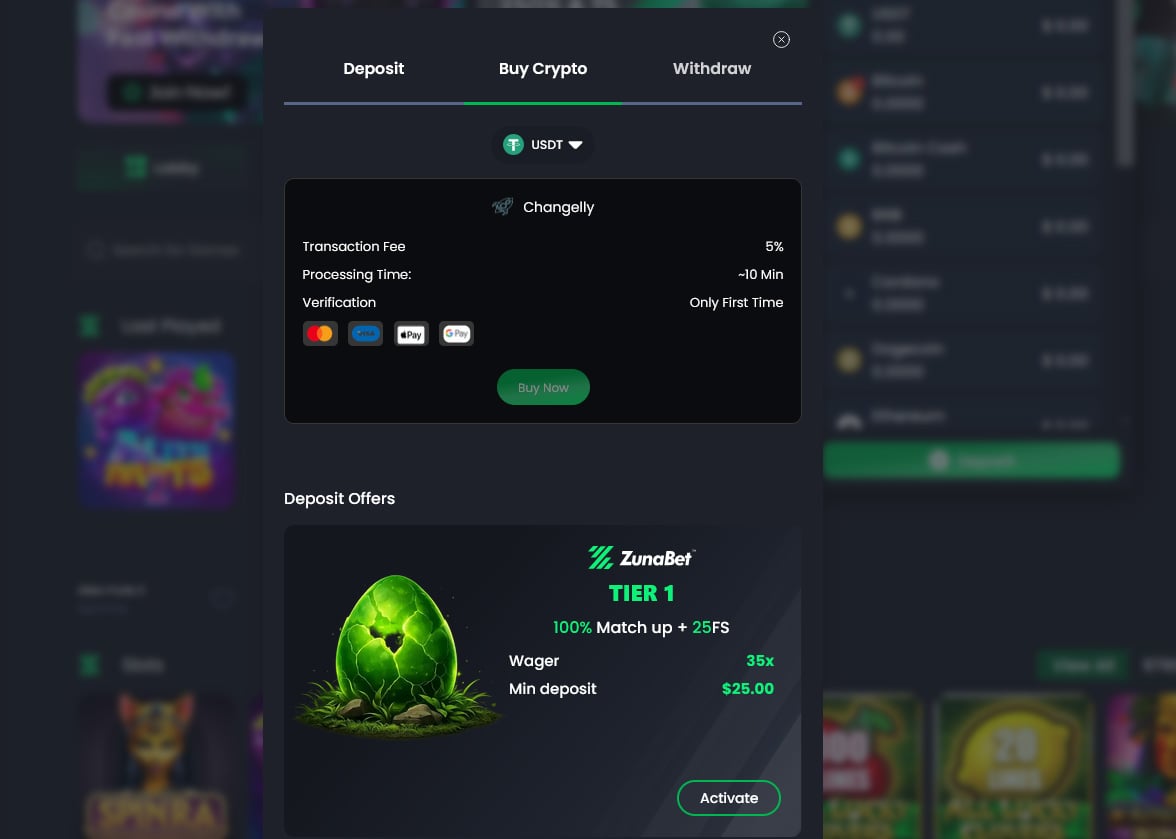
Crypto is the foundation, not the feature. Over 20 digital assets are supported — BTC, ETH, SOL, USDT across multiple chains, XRP, ADA, DOGE, and more. No platform processing fees. Withdrawals at network speed. The payment layer is built around digital assets as the primary method of transaction, not accommodated reluctantly for a niche audience. For players whose financial default is on-chain, ZunaBet connects to how they actually operate in a way that neither Caesars nor DraftKings ever will.
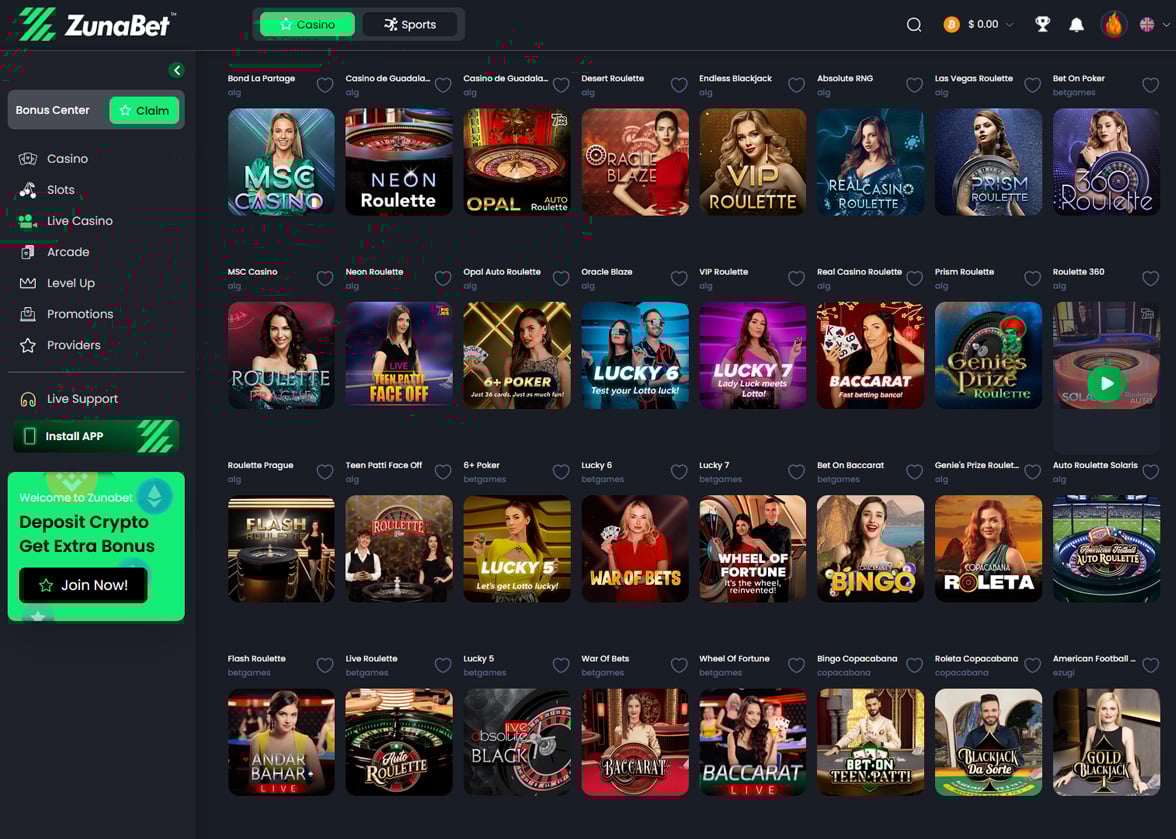
The game library is one of the most substantial in the crypto casino space — over 11,000 titles from more than 60 providers. Pragmatic Play, Evolution, Hacksaw Gaming, Yggdrasil, and BGaming are among the suppliers in a catalogue covering slots, live dealer content, and RNG table games at a scale that places ZunaBet among the larger libraries in the broader market, not just within the crypto category. For players who want genuine variety, this is a library built to deliver it.
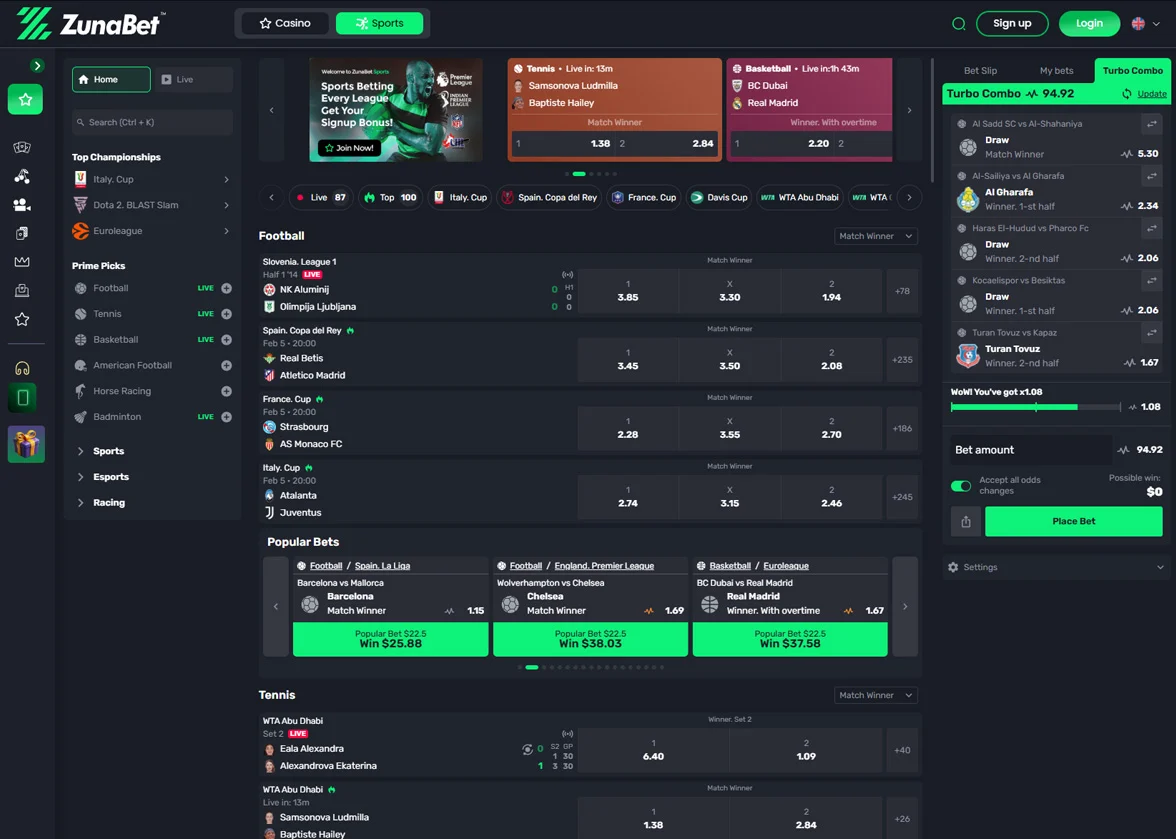
The sportsbook is fully integrated and properly built. Major global sports, US leagues, and a complete esports section covering CS2, Dota 2, League of Legends, and Valorant sit alongside virtual sports and combat sports markets. ZunaBet is a genuine hybrid platform — casino, sportsbook, and esports under one roof with crypto payments running throughout. That combination in a single crypto-native product is what makes it a credible alternative rather than just another option.
Welcome Bonus: $5,000 and 75 Free Spins Across Three Deposits
ZunaBet’s welcome package totals up to $5,000 plus 75 free spins across the first three deposits. The first deposit gets a 100% match up to $2,000 with 25 spins. The second gets 50% up to $1,500 with 25 spins. The third gets 100% up to $1,500 with the final 25 spins.
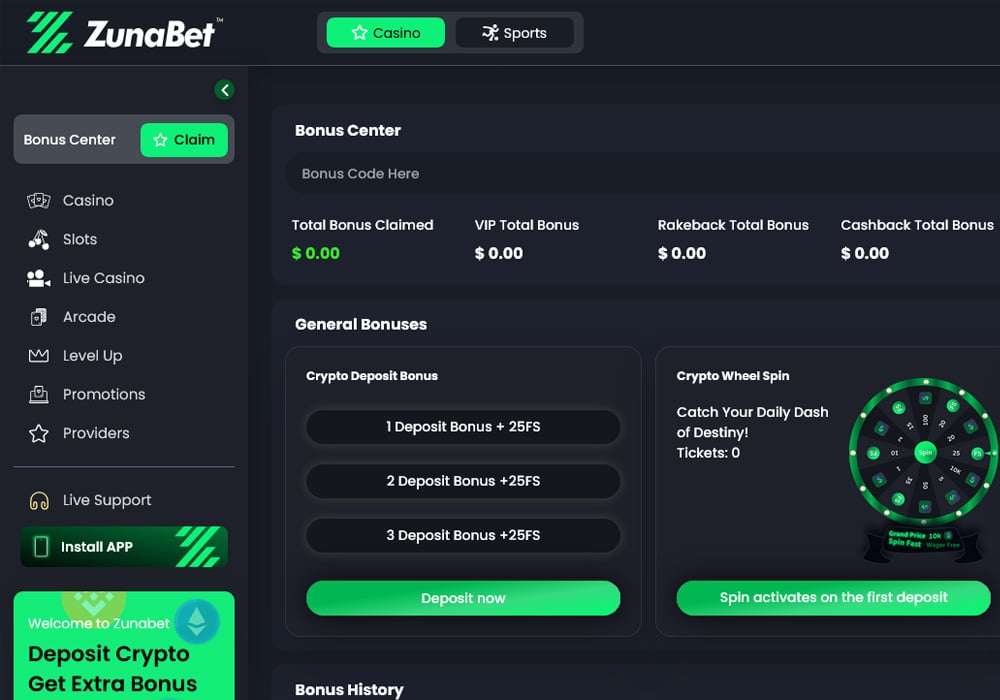
Spreading the offer across three deposits rather than front-loading a single large match is a considered structure. It extends genuine value over an onboarding period, suits players depositing incrementally in crypto, and rewards sustained engagement rather than a single large deposit made to capture a bonus before moving on. For regular players, it integrates naturally into how a platform gets used over time.
Loyalty: Rakeback vs Points — The Transparency Gap
Caesars Rewards has genuine value for resort customers. DraftKings Rewards operates a tiered points system with reasonable structure. Both follow the same fundamental model — points accumulate, the platform controls the conversion rate, and the actual return percentage is never clearly stated. Players earn without a precise picture of what they’re getting back.
ZunaBet’s Zuno loyalty program operates on rakeback with published rates at every tier. Six levels — Squire at 1%, Warden at 2%, Champion at 4%, Divine at 5%, Knight at 10%, and Ultimate at 20% — each carry a fixed, stated percentage return. No conversion table to decode. No ambiguity about what a player earns back as they move through the tiers. The number is there from the start.
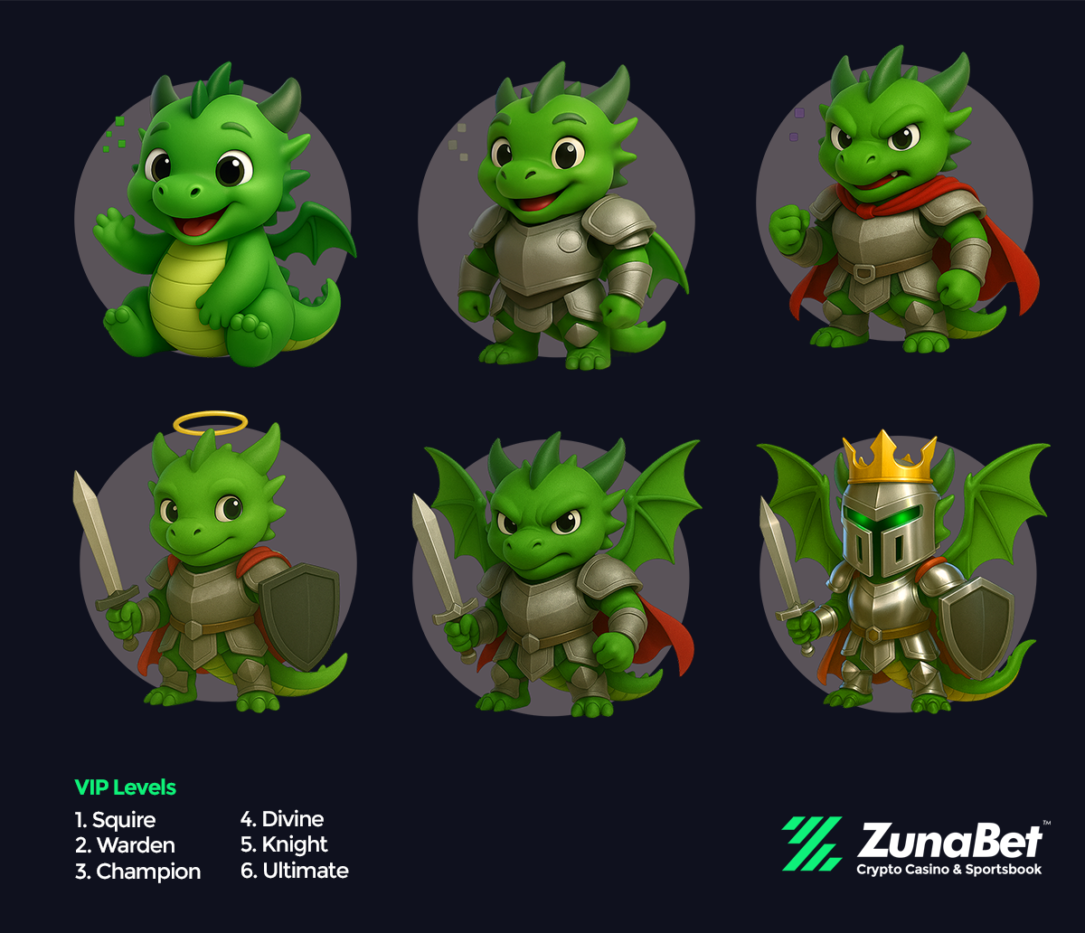
Beyond rakeback, tier progression unlocks up to 1,000 free spins, VIP club access, double wheel spins, and a gamified dragon evolution experience built around the platform mascot Zuno. The combination of complete transparency and genuine engagement mechanics produces a loyalty structure that rewards players financially and experientially in ways the traditional programs simply don’t attempt.
The Player Profile That’s Moving
The player leaving the Caesars and DraftKings conversation isn’t dissatisfied with those products necessarily. The products work for what they are. The shift is happening because a growing number of players no longer fit the profile those products were designed for.
They hold crypto as a default. They want withdrawal speeds that match network performance, not banking hours. They want to bet on esports alongside traditional sports. They want a loyalty program that states its return rate upfront. And they want a game library measured in thousands rather than hundreds. ZunaBet delivers all of that from a single platform. For that player, it represents what online gambling looks like when it’s built around their actual needs rather than the requirements of a legacy financial system.
The Bottom Line
Caesars is the right choice for players who value the land-based brand crossover and the resort loyalty benefits that come with it. DraftKings is the right choice for US players who want a competitive sportsbook with a clean casino product attached. Both are legitimate, well-regulated platforms for the audience they were built for.
ZunaBet launched in 2026 for a different audience entirely. Over 20 cryptocurrencies, 11,000+ games, a complete sportsbook with full esports coverage, a $5,000 multi-deposit welcome bonus, and a rakeback loyalty program reaching 20% at the top tier. For the new generation of players who live in crypto and expect more from a platform than the traditional names were ever designed to offer — ZunaBet is the platform that was built for them.
Disclaimer: This is a Press Release provided by a third party who is responsible for the content. Please conduct your own research before taking any action based on the content.


FIFA settled with China Media Group on a $60 million 2026 World Cup broadcast deal in mainland China. The figure sits far below its initial $250-$300 million ask.
FIFA and China Media Group signed the pact on May 15, just 27 days before the June 11 opener in North America. The deal also runs through the 2027, 2030, and 2031 tournaments.
How China Extracted the Discount
State broadcaster CCTV’s parent, China Media Group, holds a monopoly on major international sports rights inside mainland China.
That leverage lets it ignore FIFA’s opening number and hold an internal budget of $60 to $80 million.
The Global Times reported that FIFA reduced its ask to $120-$150 million before settling near the lower bound.
The Associated Press confirmed the deal covers free-to-air TV, streaming, and mobile platforms in 4K and 8K.
Two factors gutted FIFA’s pricing power. China’s men’s team failed to qualify, deflating domestic interest. Tournament evening slots in the United States, Canada, and Mexico land at 12 a.m. to 6 a.m. Beijing time.
“FIFA went to China demanding $300 million, CCTV told FIFA you scheduled nearly all the games from 12 AM to 6 AM East Asian time, why on earth would we pay that much? FIFA then came back around begging for $150 million. CCTV told them $60 million or bounce, GTFO. Excellent negotiation skills in practice. And also a sign on how excessive eurocentrism will lead you to having constant Ls in the modern era,” one user remarked.
Subscribe to our YouTube channel to watch leaders and journalists provide expert insights
What It Signals
The $60 million figure tracks what China paid for the smaller 2022 Qatar tournament. The expanded edition carries 50% more matches.
Notably, there were over 230 world-cup related markets open on Polymarket as of this writing, displaying different FIFA predictions and odds.
Polymarket, Kalshi, and similar venues now pace legacy sports media on live story breaks. Binance and other exchanges have built World Cup products around fan tokens.
FIFA itself runs an Avalanche-based blockchain for Web3 collectibles.
None of that solved the audience math in China. FIFA still has no broadcaster signed in India weeks from kickoff.
The post China Forces FIFA Into a Huge World Cup Discount appeared first on BeInCrypto.
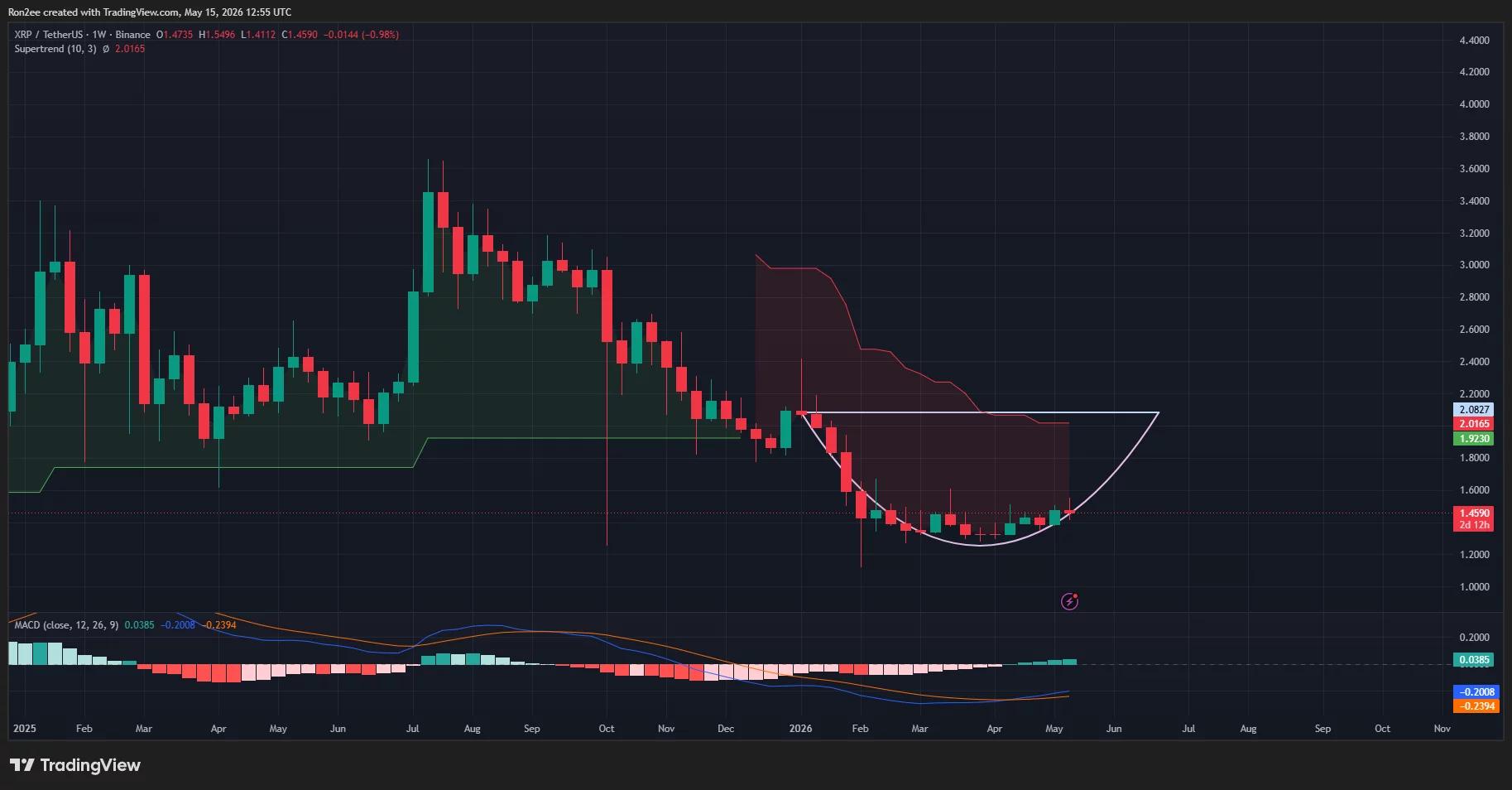
XRP price continued consolidating near a key breakout zone this week after forming several bullish reversal patterns on the weekly chart, while improving regulatory sentiment and tightening exchange supply strengthened the bullish outlook.
Summary
- XRP price reclaimed the $1.45 resistance level after the U.S. Senate Banking Committee advanced the CLARITY Act in a 15–9 vote.
- Whale wallets holding at least 10 million XRP reached an 8-year high, while exchange supply fell to a 7-year low near 1.7 billion tokens.
- XRP formed a bullish rounded bottom and cup-and-handle pattern on the weekly chart, with a breakout above $2 potentially opening the door toward the $2.80–$3 range.
According to data from crypto.news, XRP (XRP) price traded around $1.45 at press time on May 15 after briefly rallying toward the $1.50 region earlier in the week. The token has gradually recovered from its February lows near $1.20 as broader crypto market sentiment improved and traders positioned for potential regulatory clarity in the United States.
One of the biggest catalysts supporting XRP this week remains the legislative advancement of the Digital Asset Market Clarity Act, also known as the CLARITY Act.
On May 14, the U.S. Senate Banking Committee advanced the bipartisan bill in a 15–9 vote. If eventually passed into federal law, the legislation would formally classify XRP as a digital commodity, a move many investors believe could unlock larger institutional participation across the asset.
The market reaction has already started reflecting growing optimism surrounding the bill. XRP managed to reclaim the important $1.45 resistance level shortly after the vote, while traders now closely monitor the upcoming Senate floor vote ahead of the May 21 legislative deadline.
At the same time, on-chain metrics continue showing signs of aggressive accumulation among large holders. Whale wallets holding at least 10 million XRP have reportedly climbed to their highest level in roughly eight years and now control nearly 68.5% of the circulating supply.
Exchange balances have also continued falling sharply, with liquid XRP supply on centralized exchanges dropping toward a seven-year low near 1.7 billion tokens. Lower exchange reserves often reduce available sell-side liquidity and can amplify upside volatility when fresh demand enters the market.
On the weekly chart, XRP has now formed a large, rounded bottom pattern, also commonly referred to as a cup formation. The structure developed after several months of gradual accumulation following XRP’s sharp correction earlier this year.
The neckline resistance of the pattern sits near the $2 psychological level, which also aligns closely with the weekly Supertrend resistance visible on the chart.
Typically, a confirmed breakout above the neckline of a rounded bottom pattern signals a major bullish trend reversal and can lead to a sustained continuation rally. In XRP’s case, a decisive breakout above the $2 region could open the door for a larger move toward the $2.80–$3 area based on the depth of the formation.
Momentum indicators are also beginning to favor the bulls again. The weekly MACD is attempting a bullish crossover after remaining in bearish territory for several months, while the histogram has started printing strengthening green bars, signaling that downside momentum may be fading.
The recent recovery structure additionally resembles a smaller bullish cup-and-handle continuation setup forming near the lower boundary of the larger rounded bottom pattern, reinforcing the possibility of a gradual trend reversal if buyers maintain control above current levels.
However, XRP still faces a major resistance barrier near $2, where previous rallies have repeatedly stalled. The Supertrend indicator also remains bearish on the weekly timeframe, suggesting bulls may still need significantly stronger volume before confirming a larger breakout.
If buyers successfully reclaim the $2 resistance zone, XRP could attempt a stronger rally toward the $2.80 region over the coming weeks.
On the downside, failure to hold above the current $1.40–$1.45 support region could weaken the bullish structure and potentially expose XRP to another pullback toward the $1.25 area, where buyers previously stepped in during the March consolidation phase.
Disclosure: This article does not represent investment advice. The content and materials featured on this page are for educational purposes only.
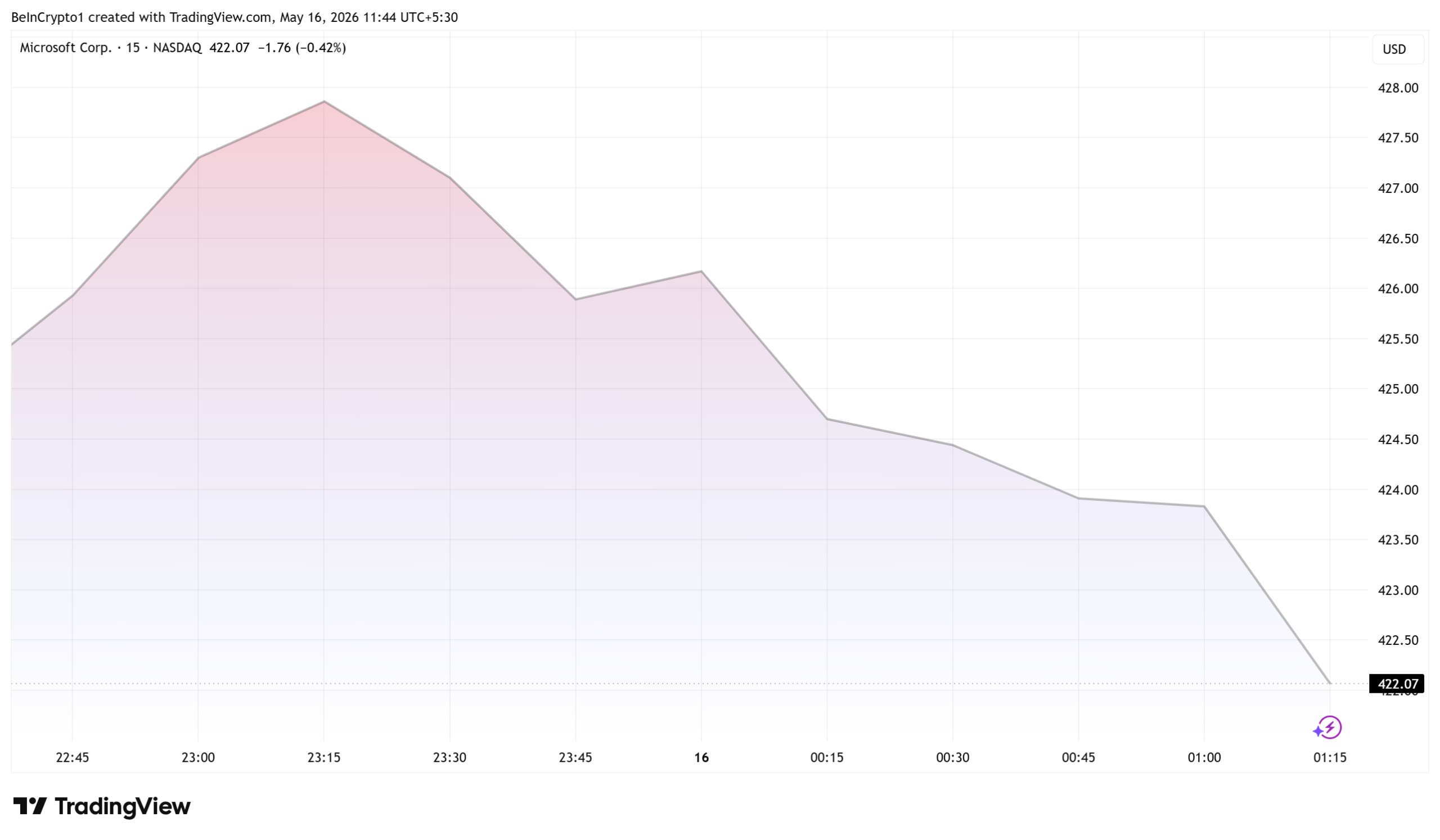
Microsoft (MSFT) stock slipped 0.42% to $422.07 on May 15. The slide followed news that the Bill & Melinda Gates Foundation Trust had sold its entire $3.2 billion MSFT stake.
The headline number masks a planned event. The Trust has held the position for nearly three years. The cash funds grantmaking and prepares the endowment for a 2045 close.
Why the Gates Foundation Sold Microsoft Stock
As of this writing, MSFT stock was trading at 422.07 amid bearish sentiment following the Gates Foundation’s disposal of the last of its Microsoft shares.

However, the sale is liquidity-driven, not a bearish call on Microsoft. The foundation has publicly committed to lifting annual grantmaking to $9 billion by 2026.
Bill Gates announced a plan to wind down the entire endowment by 2045. Selling concentrated MSFT stock is the most direct route to that cash schedule.
Microsoft has anchored the Trust’s portfolio for decades because Gates donated billions in personal shares. The position grew so large that any drawdown plan starts with trimming MSFT first.
“The Bill & Melinda Gates Foundation did not purchase its Microsoft shares on the open market. The entire position was built through direct donations of Microsoft stock from Bill Gates’ personal wealth over many years. As a foundation, they do pay a small tax, but it’s not the standard capital gains tax. The sale of their Microsoft shares is subject to a federal excise tax of 1.39% on the net capital gains,” one user noted.
Ackman Steps In, Sellers Still Win the Tape
Investor Bill Ackman used the same day’s filings to disclose a new 5.65 million share Microsoft stake. Pershing Square Capital Management values the position at nearly $2.3 billion.
“In our 13F which we will file later today, we will disclose a new position in Microsoft, a company we have followed for many years now offered at a highly compelling valuation.” Ackman shared in a post.
Ackman framed his buy as a valuation bet on Microsoft’s AI franchise after February’s OpenAI cloud shift hit shares. He pegged the cost basis at 21 times forward earnings, well below the stock’s recent average.
Pershing Square’s quarter-long accumulation of 5.65 million shares accounted for only part of the foundation’s 7.7 million-share exit. The net supply weighed on intraday trade despite the bullish counter-narrative.
Bigger Picture for Microsoft
MSFT remains a core driver of the broader S&P 500 rally. The separate $9.7 billion IREN deal anchors sentiment around AI data-center demand.
The London Stock Exchange’s partnership with Microsoft adds another revenue lane. Whether the recent dip marks a buying window or a warning shot is the open question for the next earnings cycle.
The post Microsoft Hit by $3.2 Billion Sell-Off From Bill Gates Foundation appeared first on BeInCrypto.

Randy Jackson Sparks Health Concerns After TV Appearance

$10 TRILLION for Crypto! BlackRock JUST WENT All In – Raoul Pal

Switzerland finally to open secret files on Nazis’ Auschwitz ‘Angel of Death’

Manchester United reach agreement with Casemiro over contract clause amid transfer speculation

US brings back mandatory military draft registration

Steven Gerrard disagrees with Gary Neville over ‘shock’ Chelsea and Arsenal claim | Football


-

 Fashion5 days ago
Coffee Break: Travel Steam Iron
-

 Crypto World12 hours ago
BloFin War of Whales 2026 Grand Prix opens registration for $5M trading championship
-

 Fashion19 hours ago
Weekend Open Thread: Theory – Corporette.com
-

 Politics5 days ago
What to expect when you’re expecting a budget
-

 Fashion5 days ago
What to Know Before Buying a Curling Wand or Curling Iron
-

 Tech6 days ago
Auto Enthusiast Carves Functional Two-Stroke Engine from Solid Metal
-

 Crypto World19 hours ago
E-Estate Announces 1 Year Live: Washington DC Summit as Real Estate Tokenization Enters Its Next Phase
-

 Tech5 days ago
GM Agrees To Pay $12.75 Million To Settle California Lawsuit Over Misuse Of Customers’ Driving Data
-

 Tech1 day ago
Tech Moves: Microsoft AI leader jumps to OpenAI; former AI2 exec joins Meta; and more
-

 Crypto World6 days ago
CZ says US crypto rivals tried to block Trump pardon
-

 Tech5 days ago
GM agrees to $12.75M California settlement over sale of drivers’ data
-
Crypto World3 days ago
Bitcoin Suisse expands with Digital Asset License and Investment Business Act Registration Approval in Bermuda
-

 Politics4 days ago
Pakistan to enter Chinese capital market as war inflation bites
-

 Crypto World2 days ago
Google’s Gemini AI Predicts Incredible Solana Price by the End of 2026
-

 Crypto World3 days ago
Bitcoin Suisse expands with Digital Asset License and Investment Business Act Registration Approval in Bermuda
-

 Politics6 days ago
Sky News Presenter Says Keir Starmer Is Not Waving But Drowning
-
Crypto World7 days ago
Hacker Drains $5.9M From Ethereum Liquidity Provider TrustedVolumes
-

 Fashion6 days ago
Amazon Sundays: Spring Glassware & Vases
-

 Business21 hours ago
H&R Real Estate Investment Trust (HR.UN:CA) Q1 2026 Earnings Call Transcript
-
 Entertainment6 days ago
Prime Video’s Forgotten but Brilliant 2-Part Horror Anthology Is a Perfect Binge
You must be logged in to post a comment Login