

Crypto World
Italy’s largest bank doubles crypto holdings to $235M in Q1


Intesa Sanpaolo, Italy’s largest bank, more than doubled its crypto exposure in the first quarter of 2026, climbing to about $235 million as of March 31, up from roughly $100 million at year-end 2025. The jump marks a significant step in the Italian lender’s ongoing foray into regulated digital assets, reflecting a broader European trend among traditional banks expanding their crypto footprints.
The uptick was driven primarily by Bitcoin positions. Intesa increased its holdings via both the Ark 21Shares Bitcoin ETF and BlackRock’s iShares Bitcoin Trust ETF. The bank also entered Ethereum exposure for the first time through BlackRock’s iShares Staked Ethereum Trust, and added a stake in Ripple’s XRP through the Grayscale XRP Trust ETF, valued at about $26 million, according to Criptovaluta.it.
In a first for the bank’s crypto program, Intesa opened a position in iShares Bitcoin Trust call options, marking its initial foray into crypto derivatives. Previously, the bank confirmed to Criptovaluta.it that its crypto holdings are held for proprietary trading purposes, though it has not disclosed whether any assets are used to hedge products offered to professional clients.
Meanwhile, not all positions followed the same trajectory. Solana exposure, which had been a notable feature of the prior quarter, was pared back sharply, with the Bitwise Solana Staking ETF stake collapsing from 266,320 shares to just 2,817—a near-total exit that underscores a cautious recalibration of non-Bitcoin bets.
Source: Criptovaluta.it
The reshaping of Intesa’s crypto holdings extended into the equities portion of its portfolio. The bank added 165,600 shares of BitGo for the first time, while exiting its Bitmine position. It also closed out put options on the Strategy vehicle and trimmed its stake in Cantor Equity Partners II, the vehicle linked to tokenization firm Securitize’s planned listing. Coinbase shares also moved higher, rising from 1,500 to 10,357.
The timing of these moves aligns with recent corporate developments in the crypto space. Notably, Ripple announced it would offer custody services to the Italian banking group, signaling deeper institutional alignment as banks seek regulated custody for digital assets.
Ripple custody discussions reflect growing institutional demand for trusted asset safekeeping as more banks explore regulated crypto service models.
Intesa Sanpaolo’s share price closed at €5.74 on a Friday session, down 1.56% for the day and about 3.1% lower year-to-date, according to Yahoo Finance data cited in the coverage. The bank’s evolving holdings illustrate how major European lenders are balancing risk, regulatory considerations, and strategic bets on a long horizon for digital assets.
Key takeaways
- Intesa Sanpaolo’s crypto exposure rose to roughly $235 million as of March 31, 2026, up from ~$100 million at year-end 2025, driven mainly by Bitcoin positions and new Ethereum exposure.
- The bank expanded Bitcoin via two regulated ETFs (ARK 21Shares BTC ETF and BlackRock’s iShares Bitcoin Trust) and entered Ethereum exposure through iShares Staked Ethereum Trust; it also added Ripple XRP exposure (~$26 million) via the Grayscale XRP Trust ETF.
- Intesa opened its first crypto derivatives position by buying iShares Bitcoin Trust call options, highlighting a shift toward sophisticated risk/return tools within its proprietary trading framework.
- Solana bets were dramatically reduced, with the Bitwise Solana Staking ETF position nearly wiped out, signaling a reweighting away from non-Bitcoin ecosystem plays.
- Equities holdings moved in tandem with ecosystem developments: BitGo added, Bitmine dumped, Coinbase shares increased, and Ripple custody ties emerged as a strategic inflection point for the bank’s digital asset program.
European banks expand crypto offerings and infrastructure
Intesa’s activity sits within a broader wave of European banks extending their crypto services to retail and institutional clients. Spain’s BBVA now offers 24/7 Bitcoin and Ether trading through its mobile app, while France’s BPCE has rolled out in-app crypto trading via its regulated subsidiary Hexarq, targeting millions of customers by 2026. Belgium’s KBC is also among institutions delivering crypto access to everyday users, signaling a broader consumer-facing shift in the region.
Beyond client services, a consortium of twelve major European banks—including BNP Paribas, ING, UniCredit and Deutsche Bank—formed Qivalis to issue a MiCA-compliant euro-backed stablecoin, aiming for a launch in the second half of 2026. The initiative underscores a collective push to establish regulated, cross-border digital currency rails in Europe, with MiCA-era governance in mind and a focus on interoperability across banking infrastructures.
The cross-border push comes as policymakers in Europe map out a clear regulatory framework for digital assets, a backdrop that lends credibility to banks’ willingness to deploy crypto services at scale. As institutions build out custody, trading, and settlement capabilities, the market is watching how these products perform in real-world use cases, including stablecoin settlement and tokenized asset workflows across traditional finance channels.
In related coverage, European crypto hubs and the evolving regulatory environment continue to be a focal point for institutional-grade adoption, with editorials and market commentary highlighting both opportunities and tensions as banks experiment with regulated digital asset offerings. For a broader discussion of how Europe’s treasury models are adapting to digital assets, see the ongoing discourse in regional coverage such as PBW’s 2026 outlook.
Source-linked reporting on Intesa and the European rollout of crypto services helps illustrate how a single bank’s strategy can mirror a wider continental pattern: institutions are recalibrating exposure, expanding custody capabilities, and pursuing regulated rails that could underpin broader adoption in the years ahead.
For readers seeking the underlying data, Criptovaluta.it summarized Intesa’s quarterly moves and the broader European expansion, while Ripple’s custody announcement underscores one of the pivotal partnerships shaping institutional engagement with digital assets in Europe.
As these developments unfold, investors and users should watch how MiCA-compliant stablecoins gain traction, how custody arrangements evolve, and whether more banks disclose detailed, auditable usage of crypto within their balance sheets and product offerings. The coming quarters will reveal whether these early forays translate into sustained capital allocation and real-world custody utilization across Europe’s banking sector.



Try selling ten million dollars of stock at once, watch the price crater before you fill half the order. Wealth moves differently past a certain size, and the tools that handle it (block trades, dark pools, algorithmic execution, and an OTC crypto trading desk for digital assets) rarely make headlines. Worth knowing how they work.
How High Net-Worth Individuals Execute Large Volume Trades?
Why Size Becomes a Problem?
Liquidity isn’t free, and it isn’t infinite. Public markets match lots of small orders, not a handful of enormous ones. When a $50 million sell order hits a stock’s order book, every algorithm watching that ticker notices. Front-running isn’t a conspiracy theory, it’s just math.
The Crypto Version of the Same Problem
Crypto amplifies this. Bitcoin’s daily volume looks massive in headlines, but a huge chunk is bot activity, not real depth. Push a $20 million market order through a standard exchange and the price slides five, ten percent against you. Avoidable, though, which is why an OTC Crypto Trading Desk exists. Someone matches your order privately, off the public book, often at one negotiated price. No slippage spiral, no audience watching you panic-sell.
Three broad tools cover most of this territory:
- Block trades: Large orders negotiated directly between two parties, reported after the fact
- Dark pools: Private venues where institutional orders meet without hitting public order books beforehand
- OTC desks: Bilateral deals, common in crypto, where price locks before execution
None of these are exotic. Just unfamiliar to anyone who’s never needed them.
Block Trades: Still the Workhorse
 Block trading isn’t new, Wall Street’s been doing it since the 1960s, when institutional money first started outgrowing the floor. The structure is simple enough to explain over coffee: a broker finds a counterparty (or several) willing to take the other side of a massive order, negotiates a price, and only then reports the trade. The New York Stock Exchange and Nasdaq both have specific rules for this, and most large banks run dedicated block-trading desks for exactly this purpose.
What makes it work is timing. Public disclosure happens after execution, not before. That gap, sometimes minutes, sometimes longer depending on jurisdiction, is what protects the seller from the market front-running their own trade.
Goldman Sachs, Morgan Stanley, JPMorgan, they all run desks built for nothing else. Family offices managing nine-figure portfolios lean on these relationships constantly, often without anyone outside their inner circle ever knowing a trade happened.
Does this always work perfectly? No. Block trades still move markets once disclosed, and counterparties sometimes demand a discount for taking on size risk. But compared to dumping the same order on the open market? Night and day.
Dark Pools: Invisible Until It’s Done
Dark pools get a bad reputation in financial media, vaguely sinister name, vaguely sinister coverage. Reality’s less dramatic. These are private exchanges, often run by major banks (Credit Suisse pioneered the model with CrossFinder back in 2004, and most major banks followed), where institutional buyers and sellers can post orders that nobody sees until after they’ve matched.
Why does this matter for someone with serious capital? Because visibility is the enemy of a good price. If every trader on Earth can see you’re trying to sell 200,000 shares, they’ll price that information into the stock before you’ve sold a single one. Dark pools strip that visibility away. Your order sits there, unseen, until a matching order shows up on the other side.
Regulators have tightened oversight here over the past decade, the SEC’s Regulation ATS requires these venues to register and report volume, even if individual trades stay anonymous. Worth noting if you’re researching this for yourself: dark pools aren’t loopholes. They’re regulated venues operating under different disclosure rules than public exchanges, not outside the rules entirely.
Where Crypto Fits the Pattern?
Crypto markets are younger, thinner, and far more fragmented than equities, which makes the liquidity problem worse, not better. A whale moving $30 million in ETH through Binance’s order book will see real price impact. Multiple exchanges, inconsistent depth, time-zone-driven volume swings, none of it adds up to a smooth execution environment for size.
That’s the gap an OTC crypto trading desk fills. The mechanics mirror traditional block trading: a desk, sometimes attached to an exchange, sometimes standalone, finds counterparties willing to take the other side of a large order, locks in a price, settles privately.
Inqud’s operates on this same logic, structuring large crypto transactions away from public order books so size doesn’t become a liability the moment someone tries to act on it.
Why has this grown so much? A few real reasons:
- Institutional crypto holdings have ballooned since the 2024 Bitcoin ETF approvals, BlackRock’s IBIT alone holds billions in assets under management
- Stablecoin settlement has made cross-border OTC deals faster and less dependent on banking-hour windows
- Family offices that once avoided digital assets entirely now treat them as a normal allocation, which means normal-sized problems with abnormal-sized money
None of this means crypto OTC desks are risk-free. Counterparty risk is real, you’re trusting a private entity to actually deliver what was promised, with far less regulatory backstop than a registered exchange. Due diligence on the desk itself matters enormously here. Sounds obvious, but it’s the step people skip when they’re moving fast.
Algorithmic Execution: Slicing the Order
 Not every large trade goes through a human negotiation. A lot of size gets moved by algorithms designed to break one giant order into hundreds or thousands of smaller pieces, fed into the market gradually so no single piece moves the price.
Two acronyms come up constantly here: VWAP (volume-weighted average price) and TWAP (time-weighted average price). Both are strategies, not products, instructions telling an algorithm how to slice and pace an order.
VWAP tries to match the trade’s average price to the day’s overall volume pattern. TWAP just spreads execution evenly across a set time window, ignoring volume entirely.
Quick comparison, since the differences matter more than they sound:
| Strategy | Best For | Main Risk |
| VWAP | Liquid markets with predictable volume patterns | Underperforms during unusual volume spikes |
| TWAP | Thin or unpredictable markets | Can execute poorly during low-liquidity windows |
| Block Trade | Very large single transactions | Requires finding willing counterparty |
| OTC Desk | Crypto and other less-liquid assets | Counterparty risk, less regulatory oversight |
Hedge funds and prop trading desks have run these strategies for two decades now. What’s changed is access — platforms once reserved for institutions have started trickling down to sophisticated individual investors, particularly through prime brokerage relationships.
The Human Layer Nobody Talks About
Here’s something the technical explanations miss: most of this still runs on relationships. A block trade happens because a desk head picked up the phone and called someone they’ve worked with for fifteen years. An OTC crypto deal closes because two parties trust each other enough to wire funds before the asset technically changes hands in some cases.
Technology has compressed timelines and expanded access, sure. But the trust layer underneath hasn’t disappeared, if anything, it matters more once the numbers get large enough that a mistake can’t be quietly absorbed.
Sounds almost old-fashioned for an industry obsessed with disruption, doesn’t it? Maybe that’s the point. When the stakes are this high, nobody wants to be the test case for a new system that hasn’t proven itself yet.
A Few Things Worth Remembering
Wealthy individuals don’t play by different rules, they use tools built for a scale problem regular markets weren’t designed to solve. Every method here carries its own risk: counterparty exposure, regulatory gaps, execution risk during volatile windows. None guarantees a better outcome, just different trade-offs.
This article is provided for general informational purposes only and does not constitute financial, investment, or legal advice. Consult a licensed professional familiar with your specific circumstances.
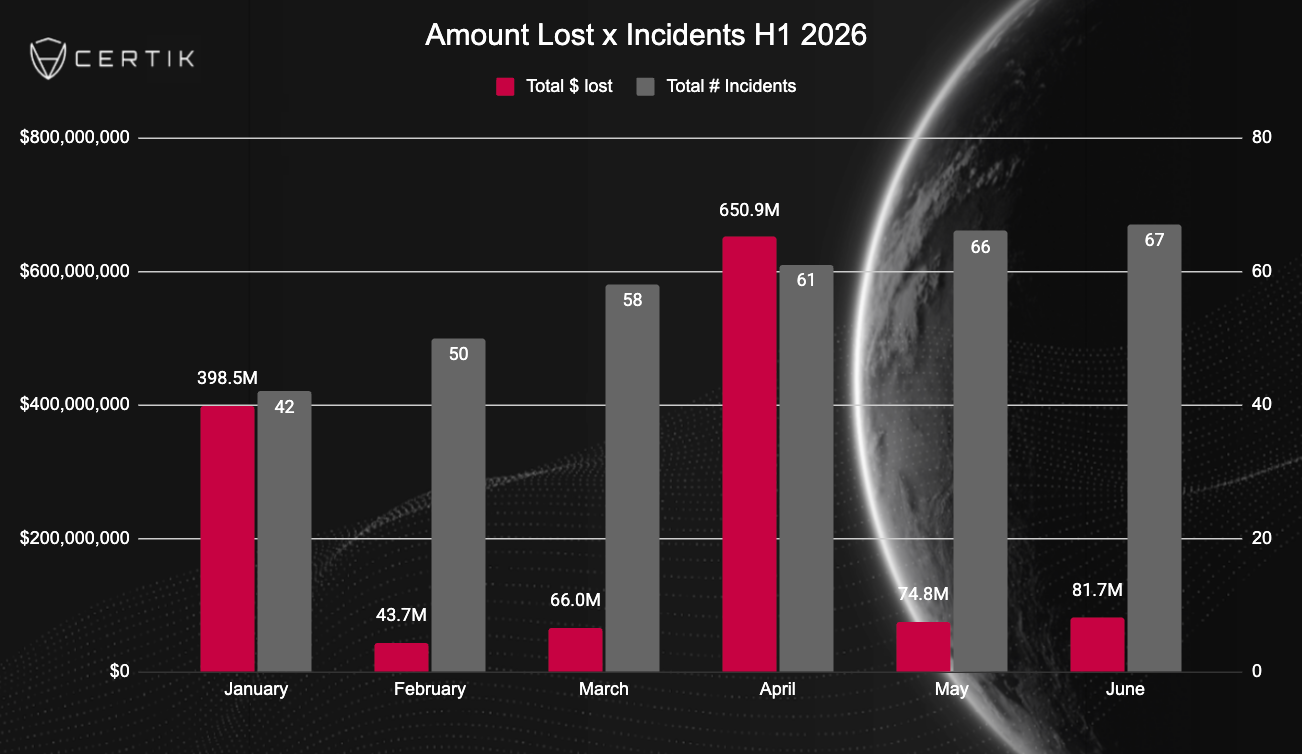
Crypto losses fell 46.8% year-on-year to $1.32 billion in the first half of 2026, but crypto security firm CertiK says the drop is misleading, warning that attackers are becoming more sophisticated and destructive.
Phishing drove the bulk of losses in the first quarter, totaling $508.2 million. Wallet compromises were the biggest attack vector in the second quarter, contributing to $807.5 million in losses, CertiK said in a report.
More than 70% of the losses in Q2 came from the KelpDAO and Drift Protocol hacks, which are believed to have been carried out by North Korean state-sponsored hackers.
“A headline reading of ‘losses down nearly 50%’ would suggest a meaningfully safer ecosystem. The data does not support that conclusion,” CertiK told Cointelegraph, explaining that the losses in the prior year period were skewed by the $1.4 billion Bybit hack — the largest crypto exploit in history.
The data shows that North Korean hackers continue to pose one of the biggest threats to the crypto industry, having stolen more than $6 billion worth of crypto since 2017, TRM Labs estimated in April.
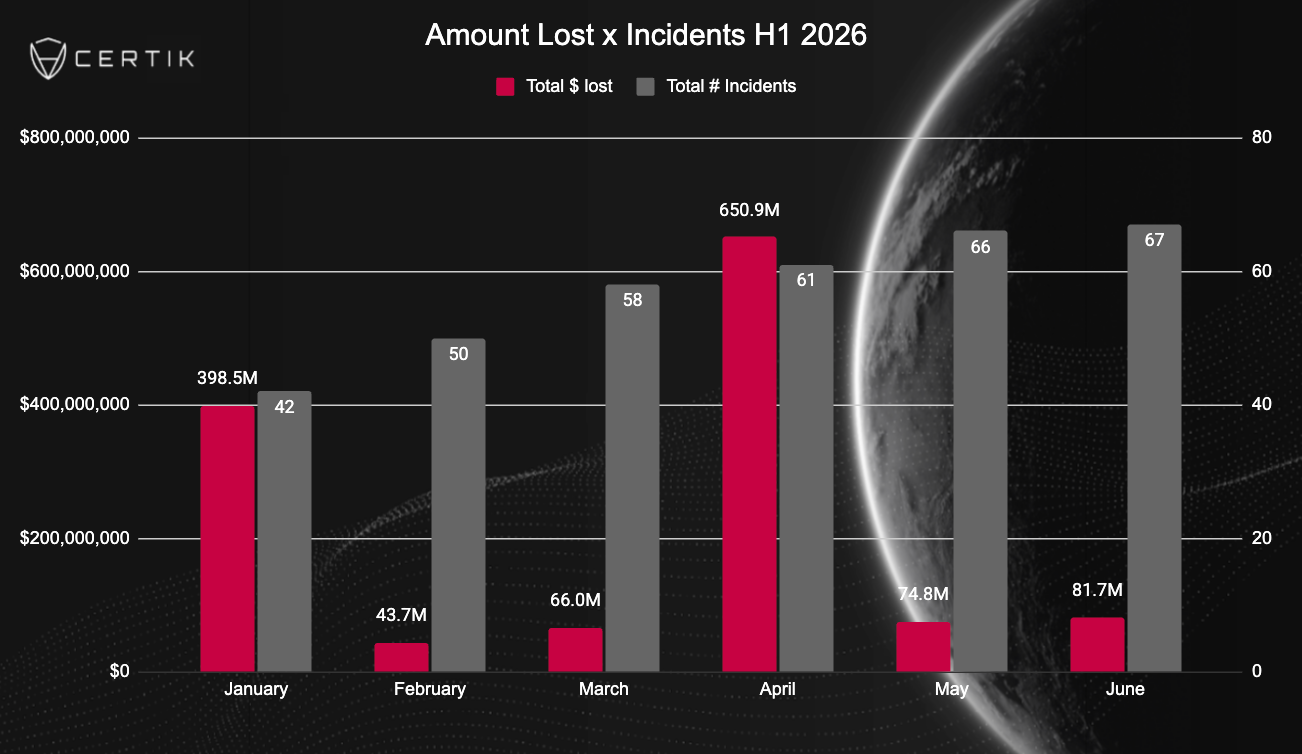
Monthly change in crypto exploit amounts and number of incidents across H1. Source: CertiK
North Korean state actors blamed for crypto attacks
The KelpDAO and Drift Protocol incidents even sparked a meeting between US, Japanese and South Korean authorities late last month over how the nations can mitigate North Korea’s malicious cyber activity and illicit revenue generation.
The state officials also acknowledged that North Korean IT workers are increasingly using AI to enhance their schemes — a development that some cybersecurity leaders believe has significantly increased the scale, speed and sophistication of protocol exploits.
CertiK cautioned that the “industry is absorbing a structurally higher rate of attack activity” than last year and that — excluding the Bybit incident — attacks are becoming “targeted and more financially destructive per event.”
TRM Labs reached a similar conclusion in its H1 2026 report on Wednesday, stating that the “decline in total dollars stolen should not be mistaken for a safer environment.”
“The lower total reflects the absence of another record setting theft, not a reduction in attacker capability.”
TRM’s analysis found that the number of incidents more than doubled from 83 to 207 in H1, the highest number TRM has recorded across a six-month period.
Smart contract exploits accounted for 125 or 60% of the incidents in H1, TRM added.
Protecting private keys
CertiK said private keys and multisignature wallet management remain the “most consequential security surface” for attackers to exploit.
Related: Crypto hack losses top $630M in April, highest since February 2025
CertiK urged crypto protocols and institutions holding significant onchain assets to harden every layer of private key management — from hardware security and multisignature governance to even geographically spreading out where signers are based.
This is an “area where security investment yields asymmetric returns,” CertiK said.
Crypto hardware wallet providers like Ledger have also long warned users to store seed phrases offline and never share them as a basic safeguard against phishing.
Magazine: The end of anonymity? AI could unmask crypto’s hidden identities


Onchain investigator ZachXBT says multiple meme coins were launched using his name and likeness without his approval. He sold every token sent to his donation wallet and gave the proceeds to charity.
The investigator donated $25,000 to GiveDirectly through The Giving Block to support victims of the June 24 earthquakes in Venezuela. The episode has revived debate over impersonation tokens.
ZachXBT Meme Coins Spread Across Chains Without His Blessing
Copycat tokens carrying the investigator’s name appeared on several chains in recent days. Traders flooded his replies asking whether he endorsed any of them.
ZachXBT has long kept meme coins at arm’s length. His publicly stated case criteria exclude meme coins and prediction markets entirely, alongside thefts below $250,000 per victim.
Impersonators often send tokens to public donation wallets to imply endorsement. The tactic borrows credibility from a known name without permission and leaves the target holding assets they never asked for.
He answered the speculation directly on X.
Such Scam Meme Coins Are Not New
Some accounts had accused the investigator of quietly profiting from the tokens. By selling everything and publishing the receipts, he moved to shut down manipulation claims before they spread further.
He also shared a transaction hash showing a 25,000 Tether (USDT) transfer, letting anyone verify the donation onchain. The investigator previously exposed 16 X accounts that shilled meme coins to followers.
The pattern is familiar. Tokens tied to famous names or franchises often pump on attention alone, as recent GTA 6 meme coins demonstrated in June.
Proceeds Head to Venezuela Earthquake Relief
The donation targets one of the region’s worst disasters in decades. Venezuela recorded 7.2 and 7.5 magnitude earthquakes on June 24, the strongest in the country since 1900, according to GiveDirectly. The charity’s campaign has raised more than $438,000 of a $1 million goal to send cash directly to affected families.
The crypto industry mobilized quickly after the quakes. Exchanges, humanitarian groups, and community campaigns opened Venezuela crypto donation channels within days, with stablecoins moving faster than traditional aid rails.
Impersonation tokens remain a stubborn problem, however. Even an FBI-created crypto token designed to catch criminals pumped 19x this year after gaining attention on X.
ZachXBT responded by converting an unwanted association into verified humanitarian aid. Whether the copycat tokens fade or keep trading on his name may show how much impersonation risk meme coin markets still tolerate.
The post ZachXBT Disowns Copycat Meme Coins, Donates $25,000 to Venezuela Relief appeared first on BeInCrypto.


The biggest fight in American finance right now is over a single clause: whether digital dollars can pay their holders interest. Banks say yield-bearing stablecoins would drain trillions in deposits and break the lending machine. Crypto says the banks are defending a monopoly on other people’s money. The CLARITY Act is hostage to the answer, and this week the standoff escalated on every front.
Summary
- A battle over whether stablecoins should pay interest has become the biggest obstacle to advancing the CLARITY Act in the US Senate.
- Banks warn that yield bearing stablecoins could pull trillions of dollars from deposits while the crypto industry argues savers should receive the returns generated by reserve assets.
- As lawmakers remain divided, banks are also preparing for a future with stablecoins by investing in digital dollar infrastructure and settlement networks.
The week of June 29, 2026, was supposed to move the CLARITY Act toward the Senate floor. Instead, Coinbase publicly pulled its support for the bill it had spent two years championing, Senate Banking Committee chairman Tim Scott postponed the markup, and President Trump posted that the banks lobbying against stablecoin yield were threatening and undermining his own signature crypto law. The proximate cause of all three events was the same unresolved question: can a stablecoin pay interest?
The question sounds technical. It is not. It is a fight over roughly $6 trillion, which is the amount of deposit money that Bank of America chief executive Brian Moynihan has warned could migrate out of the banking system if digital dollars are allowed to pass their reserve earnings to holders. Behind the number sits the basic architecture of American credit: banks fund loans with deposits that pay savers little, and anything that gives savers a better default option attacks the cheapest funding source in finance.
Both sides understand the stakes with total clarity, which is why neither will yield. The banks have the oldest lobby in Washington and a century of regulatory capture to draw on. Crypto has the GENIUS Act already signed, a president publicly on its side, and products that customers demonstrably want. Between them sits a Congress trying to pass a market structure bill that both industries claim to support and each is willing to kill over this clause.
This is the anatomy of the standoff: where the yield actually comes from, what each side’s studies really say, how the fight broke into the open at Davos, why the CLARITY Act is stalled, and what the banks are quietly building in case they lose.
Where stablecoin yield comes from
A dollar stablecoin is a bearer claim on a reserve. The issuer takes a customer dollar, parks it in Treasury bills and repo and cash equivalents, and gives back a token redeemable at par. At 2026 short-term rates, that reserve portfolio throws off meaningful income: roughly four cents per year on every dollar, paid by the United States government to the issuer.
Under the GENIUS Act, the stablecoin framework signed in 2025, issuers keep that income. The law prohibits payment stablecoins from paying interest or yield to holders, a clause the banking lobby fought for and won. The result is one of the stranger economic arrangements in modern finance: tens of millions of stablecoin holders collectively finance a float measured in hundreds of billions of dollars, and the entire risk-free return on that float accrues to issuers and their distribution partners.
Tether’s profits, Circle’s revenue-sharing arrangement with Coinbase, and the business case for every new entrant described in the consortium stablecoin model behind Open USD all rest on that captured spread.
Crypto’s position is that the arrangement is indefensible on its own terms. If the token holder supplies the dollar, the token holder should be able to receive the yield, the same way a money market fund passes through its portfolio income. Exchanges already approximate this with rewards programs that pay users for holding certain stablecoins, a workaround the banks call interest by another name and want closed.
The banks’ position is that the arrangement is the only thing standing between the deposit system and a slow-motion run. A stablecoin that pays four percent, holds only Treasuries, settles instantly, and lives in a phone app is not a payment instrument, in their telling. It is a narrow bank, the exact institution American regulators have refused to charter for a century, because a narrow bank collects deposits and funds nothing.
Both descriptions are accurate. That is what makes the fight so hard to resolve. A product can be, simultaneously, a long-overdue transfer of interest income to the people who supply the money and a structural threat to the funding model of every lender in the country. The legislative machinery now stuck in the Senate exists precisely because Congress must pick which description governs, and there is no compromise text that makes both true halves false.
The dueling studies: $6.6 trillion or $2.1 billion
In early 2026 the American Bankers Association put a number on the threat. Its analysis warned that permitting interest-bearing stablecoins could trigger as much as $6.6 trillion in deposit flight from the banking system, a figure that would represent a structural repricing of bank funding. Moynihan carried the message personally, telling audiences that 30 to 35 percent of transactional deposits could leave banks if yield-bearing digital dollars became legal, and putting the Bank of America estimate in the $6 trillion range.
The mechanism behind the number is credit contraction. Deposits fund loans. A dollar that leaves a checking account for a stablecoin backed by T-bills stops funding a mortgage or a small business line and starts funding the federal government. Multiply by trillions and the banks’ model produces higher loan rates, reduced credit availability, and concentrated stress on community banks whose entire funding base is retail deposits. The ABA’s framing is not that banks would earn less, though they would; it is that the economy would lend less.
The White House Council of Economic Advisers looked at the same question and produced a number three orders of magnitude smaller. Its assessment put plausible deposit displacement in the low billions, around $2.1 billion in the scenario most cited, arguing that stablecoin demand comes overwhelmingly from crypto trading, cross-border flows, and dollar demand abroad, none of which is money sitting in a Kansas checking account today. In the CEA’s telling, the banks are counting every deposit that could theoretically move as a deposit that would move, ignoring deposit insurance, banking relationships, and the fact that money market funds have offered better rates than checking accounts for fifty years without ending bank lending.
The three-orders-of-magnitude gap is not really an empirical dispute. The two studies answer different questions. The ABA models the ceiling of a mature, frictionless, fully legal yield-bearing stablecoin market; the CEA models the floor of the current one. The honest answer, that displacement would start small and compound as the products improved, satisfies neither side, because the banks need the threat to be immediate and crypto needs it to be imaginary.
Davos, and the fight goes personal
The clearest public glimpse of how raw the conflict has become came at Davos in January, in an exchange between the two most powerful executives on either side.
JPMorgan chief executive Jamie Dimon, discussing stablecoin yield with Coinbase chief executive Brian Armstrong on a panel, dismissed Armstrong’s framing of deposit competition with a phrase that escaped the room within minutes: he told him he was full of s—, a vulgarity from the most measured banker of his generation that did more to reveal the temperature of the fight than any comment letter.
Armstrong’s argument, the one that drew the response, is the consumer-surplus case. American savers hold trillions in accounts paying a fraction of a percent while banks earn multiples of that on the float. Stablecoin yield, in his telling, is simply technology forcing banks to pay depositors something closer to the market rate for their money, and the deposit-flight studies are incumbents pricing their own margin as a systemic necessity. Coinbase has the most direct commercial stake of anyone in the room: its revenue share on USDC reserves is one of its largest income lines, and a world of legal yield pass-through is a world where its stablecoin business attacks bank deposits head-on.
Dimon’s counter is that payments and banking are different businesses with different risk, and that crypto wants banking economics without banking obligations: no lending mandate, no Community Reinvestment Act, no branch network, no discount window responsibilities, just the float. JPMorgan has hedged its own position, running deposit tokens and blockchain settlement internally while its chief executive argues against the retail version, a posture crypto reads as monopoly defense and banks read as prudence.
Then the President entered. In a late June post, Trump accused the banks of threatening and undermining the GENIUS Act, his own signed legislation, by lobbying to extend the yield ban and hobble stablecoin competition. A Republican president publicly siding against the banking lobby on a financial regulation fight is a genuinely new configuration in Washington, and it reshuffled assumptions on both sides about who holds the political high ground.
How the yield clause took CLARITY hostage
The CLARITY Act is a market structure bill. It assigns jurisdiction between the SEC and CFTC, defines when a digital asset is a security or a commodity, and creates the registration framework the industry has demanded for a decade. It is not, on its face, a stablecoin bill; the complete stablecoin framework already passed in GENIUS. But Washington does not respect bill boundaries, and the yield war has annexed it.
The banking lobby’s ask is straightforward: use CLARITY to close the loopholes GENIUS left open. That means extending the interest prohibition from issuers to exchanges and affiliates, killing the rewards programs that pay stablecoin holders today, and blocking any structure that passes reserve income to users. Bank trade groups have made support conditional on those provisions, and enough senators from both parties bank with them, figuratively and literally, to make the demand real.
Crypto’s response arrived the last week of June, when Coinbase announced it could no longer support CLARITY in its current trajectory, precisely because the yield restrictions being negotiated into it would, in the company’s view, entrench the ban permanently. The industry’s most important lobbying force turning against the industry’s most important bill was the loudest possible signal that the yield clause now outweighs the rest of the legislation for the companies whose business models depend on it.
Chairman Scott’s postponement of the markup followed within days. The delay was procedural on its face and structural in substance: there is no current text that both the banks and the crypto industry will accept, and members have little appetite to vote on a bill that one of the two richest lobbies in the country has promised to remember.
The market structure everyone claims to want is now collateral in a fight over a clause most voters have never heard of.
The political calendar sharpens everything. The window before the midterm campaign consumes Congress is measured in weeks, and both lobbies know that a bill that slips past the summer likely slips past the election, into a Congress nobody can predict.
The Regulation Q rhyme
The yield war has a nearly perfect historical precedent, and both sides quote it selectively.
From 1933 until its final repeal in 2011, Regulation Q capped or prohibited the interest American banks could pay on various deposits, a Depression-era rule justified in language strikingly close to today’s: unrestrained competition for deposits would push banks into risky lending and destabilize the system. For four decades the cap was mostly invisible, because market rates sat near the ceiling. Then came the inflation of the 1970s. Market rates ran far above what banks were legally allowed to pay, and savers found themselves holding accounts that lost purchasing power by regulatory design.
The market’s answer was the money market mutual fund, an instrument that did precisely what yield-bearing stablecoins propose to do now: pool customer cash, buy short-term government paper, and pass the interest through. Money funds grew from nothing in 1971 to hundreds of billions by the early 1980s, deposit flight became a named phenomenon, disintermediation, and the banking industry warned in congressional testimony that the funds would destroy community banking and starve the economy of credit. Congress ultimately responded not by banning money funds but by deregulating deposits, phasing out the caps and letting banks compete for money at market rates.
Both sides of the 2026 fight live inside this story. Crypto cites it as proof that yield restrictions always fall, that savers eventually get paid, and that the catastrophic credit predictions never arrived; the banking system that emerged from deregulation was different, and more expensive to fund, but intact. The banks cite the sequel: the savings and loan industry, built entirely on cheap capped deposits, could not survive paying market rates for money, and its collapse consumed a decade and roughly $124 billion of public funds. Deposit competition did not end banking, but it did end the banks whose models required the subsidy.
The rhyme suggests the real question is not whether stablecoin yield eventually becomes legal in some form; the historical base rate says restrictions on paying savers erode. The question is which institutions are the savings and loans of this cycle, funded so completely by the interest-free float that they cannot survive its repricing, and whether they are banks, or the stablecoin issuers whose entire margin is the yield they currently keep.
The banks’ quiet hedge
While the trade associations fight the public war, the banks themselves are behaving like institutions that expect to lose it.
Barclays made the most explicit move, taking a stake in Ubyx, the stablecoin clearing network built to let banks and fintechs redeem stablecoins at par across issuers, the plumbing a bank needs on the day it decides to issue or distribute digital dollars itself. It was the first direct stablecoin infrastructure investment by a major bank since the yield fight broke into the open, and it was not framed as an experiment. Bank executives have begun saying the quiet part in public: if Congress makes yield-bearing digital dollars legal, the banks will go into that business, at scale, the day the ink dries.
The logic is the same one that has played out in every disruption cycle in finance. Banks did not want money market funds in 1975 or online brokerages in 1995, and once each became inevitable, banks became the largest providers of both. A legal yield-bearing stablecoin issued by a money center bank, with deposit-adjacent branding, existing customer relationships, and a balance sheet behind it, is a formidable product, and arguably a more dangerous one to Tether and Circle than to the banks themselves. Consortium efforts like Open USD, whose members built a shared issuance model precisely so no single firm owns the float, exist in part because everyone can see the banks coming.
The infrastructure is converging from the other direction too. Payment-first blockchains designed for regulated issuers, the category examined in the rise of dedicated stablechains, are being built with bank compliance requirements as first-order design constraints, not afterthoughts. The technical gap between a bank deposit and a stablecoin narrows every quarter; the yield clause is the last load-bearing wall between the two products.
That is the tell in this fight. Institutions do not invest in the rails of a product category they expect to strangle. The banks are lobbying to delay the future and provisioning to own it.
What each side gets wrong
The banks’ deposit-flight case has a real weakness at its center: it treats the current deposit franchise as an entitlement. The spread between what banks earn on customer money and what they pay for it is not a law of nature; it is a price maintained by friction, and every prior technology that reduced the friction, from money funds to high-yield online savings, transferred some of that spread to savers without collapsing credit. The system adapted, banks paid more for funding, lending got marginally more expensive, and the economy survived. Framing the next step in that fifty-year process as a $6.6 trillion cliff requires assuming, without much evidence, that this time adaptation is impossible.
Crypto’s consumer-surplus case has a mirror-image weakness: it waves away the run problem. Bank deposits are sticky in a crisis partly because they are insured and partly because moving them is slow. A yield-bearing stablecoin is uninsured and moves at the speed of a tap. In a March 2023-style panic, the same properties that make stablecoins efficient make them the fastest exit door in the system, and a world where a meaningful share of transactional money can flee to tokenized T-bills in an afternoon is a world with a new, untested amplifier under every banking stress. The honest crypto answer is that this risk is manageable with reserve rules and redemption gates; the marketing answer, that it does not exist, is the one that gets said out loud.
There is also a shared blind spot. Both sides model the fight as domestic, and the stablecoin market is not. The majority of dollar stablecoin demand originates outside the United States, from savers and businesses in weak-currency economies for whom the yield question is secondary to the dollar itself. Whatever Congress decides about interest, the offshore float will keep growing, and the deposits it drains first are not in Kansas; they are in Buenos Aires and Lagos and Istanbul. The American fight over yield is, in part, a fight over who gets to monetize a global phenomenon neither side created.
The endgame scenarios
Three broad resolutions are visible from here, and each has a coalition behind it.
The first is the status quo hardened: CLARITY passes with the extended yield ban, rewards programs die, and issuers keep the float. This is the banks’ victory condition. Its weakness is that it is probably temporary, an attempt to legislate against a spread that technology keeps making easier to deliver, enforced against an industry with a sitting president publicly on its side. Prohibitions that fight both technology and the White House have a poor record.
The second is the pass-through world: yield becomes legal, the banks execute their hedge, and within a few years the largest stablecoin issuers in America are the same institutions that spent 2026 warning about them. Deposits reprice, weaker banks consolidate, and the credit system adjusts to more expensive funding, the way it adjusted to money market funds. This is where the investment behavior of the banks themselves suggests the smart money already sits.
The third is stalemate: CLARITY dies this Congress, GENIUS remains the only law, and the yield question migrates to regulators and courts, fought product by product through rewards programs, tokenized money funds, and offshore issuers that Congress never manages to reach. This is the default outcome if the next few weeks produce no text, and default outcomes in a midterm year are heavy favorites.
The watch list for the next few weeks is short and concrete. First, whether Scott reschedules the markup before the August recess, because a markup date means a text exists that leadership believes can survive both lobbies, and no date means the third scenario is winning. Second, the behavior of the pro-crypto Senate bloc, which has to decide whether a CLARITY with a hardened yield ban is worth passing over the industry’s objection, or whether half the coalition walks. Third, the regulatory perimeter fights already underway: how the Treasury implements the GENIUS provisions on affiliates, whether the rewards programs survive their first supervisory challenges, and how aggressively tokenized money market funds, which pay yield legally because they are securities, get marketed as the stablecoin alternative the ban cannot touch. Every one of those is a proxy battle in the same war, and each can move independent of Congress.
It is also worth naming the quiet incentive nobody in the fight advertises: the federal government is a beneficiary of the stablecoin boom regardless of who keeps the yield, because every reserve dollar is demand for Treasury bills at the exact moment deficits need buyers. A Washington that quietly likes the float’s growth has reasons to resolve the fight in whatever way grows it fastest, and that logic, unspoken, may ultimately weigh more than either lobby’s studies.
The $6 trillion number that anchors the fight will keep being quoted whichever path unfolds, and it is worth remembering what it actually is: not a measurement, but a boundary claim, the banks’ estimate of everything they could lose in the world their opponents want. The real number will be discovered the way these numbers always are, one repriced deposit at a time. The only certainty is the direction. Money has spent fifty years migrating toward whoever pays for it, and no clause has ever held that line forever.
Disclaimer: This article is for informational purposes only and does not constitute investment advice. Digital asset markets are volatile and you can lose your entire investment. Always do your own research. Information current as of July 6, 2026.
Crypto World
The AI vs. Crypto Tug-of-War for Capital: Why Today’s Competition Will Become Tomorrow’s Partnership

For nearly a decade, venture capital has chased one transformative technology after another. From mobile apps to cloud computing, from blockchain to generative AI, investment dollars have always followed the next big narrative. Today, that narrative belongs overwhelmingly to artificial intelligence.
In 2025 and into 2026, AI startups have secured some of the largest funding rounds in technology history. Companies developing frontier AI models have attracted tens of billions of dollars in fresh capital, while enterprises racing to integrate AI have become venture capital’s highest priority. In contrast, the once-explosive Web3 funding environment has become quieter, more disciplined, and far more selective.
To many observers, this appears to signal a clear winner. AI is booming, while crypto has faded into the background.
But that conclusion misses the bigger picture.
Rather than signaling the decline of blockchain, today’s capital migration is forcing the crypto industry to evolve beyond speculation. More importantly, it is laying the foundation for a future where AI and blockchain become deeply interconnected technologies rather than competing ones.
The real story isn’t AI versus crypto.
It’s AI because of crypto—and eventually, AI powered by crypto.
The Great Migration of Venture Capital
Venture capital has always been driven by two powerful forces: limited capital and unlimited fear of missing out.
Whenever a new technology demonstrates explosive growth potential, investors naturally redirect capital toward the highest perceived returns. Over the past two years, AI has become that destination.
Large Language Models, autonomous agents, enterprise AI platforms, robotics, and AI infrastructure have collectively absorbed billions that might once have flowed into decentralized finance, NFT ecosystems, or Layer-1 blockchain projects.
This migration has dramatically changed the investment landscape.
Where crypto startups once raised enormous seed rounds based largely on future potential, today’s investors demand measurable adoption, sustainable revenue, and realistic business models. Meanwhile, nearly every startup pitch deck now includes an AI strategy because founders recognize that artificial intelligence has become almost mandatory for attracting early-stage investment.
Crypto has effectively lost its speculative premium.
Instead of existing as a separate asset class driven primarily by narrative, blockchain projects are increasingly evaluated like traditional technology companies.
While painful for many projects, this transition may ultimately be one of the healthiest developments the industry has experienced.
Why AI Is Winning the Short-Term Investment War
The reasons behind AI’s dominance are surprisingly straightforward.
Immediate Utility Beats Long-Term Infrastructure
Artificial intelligence delivers value almost instantly.
A developer can purchase access to an AI API and automate software development within minutes. Businesses can deploy customer service agents overnight. Marketing teams can generate content at unprecedented speed.
The productivity gains are visible immediately.
Blockchain, on the other hand, operates differently.
Its value proposition isn’t instant automation—it’s rebuilding the infrastructure of digital trust.
Creating decentralized financial systems, secure identity networks, tokenized assets, or censorship-resistant infrastructure requires years of engineering, regulatory clarity, and user adoption. These projects solve foundational problems, but they often lack the immediate “wow factor” that attracts short-term investors.
Simply put:
- AI delivers productivity today.
- Blockchain builds infrastructure for tomorrow.
For venture capital seeking rapid returns, today’s value often outweighs tomorrow’s architecture.
The Valuation Gap
AI has also created an increasingly uneven investment environment.
Many venture firms now treat AI integration as a baseline requirement rather than a competitive advantage.
As a result, pure-play Web3 startups frequently compete for a shrinking pool of specialized blockchain investors, while AI startups enjoy broader access to general technology funds.
This has effectively created a two-tier venture ecosystem:
Tier One: AI-native companies attracting premium valuations.
Tier Two: Blockchain companies face significantly higher scrutiny before receiving funding.
The imbalance is substantial—but it is unlikely to remain permanent.
Faster Exit Opportunities
Investors also prefer AI because commercialization appears more predictable.
Enterprise software companies regularly acquire AI startups.
Major cloud providers continuously expand their AI capabilities.
Corporate demand already exists.
Crypto investments follow a different path.
Returns often depend on token launches, network adoption, evolving regulations, and volatile market cycles.
For venture capital firms measured on fund performance, AI currently offers a shorter and more visible path toward liquidity.
Crypto’s Evolution: From Hype to High-Beta Technology
Ironically, losing speculative capital may be exactly what blockchain needed.
The crypto industry has spent years funding countless variations of decentralized exchanges, yield farms, Layer-2 networks, and meme-driven ecosystems.
That era is fading.
Today’s investors increasingly demand fundamentals.
Projects are expected to generate revenue.
Tokenomics must align with sustainable economic models.
Communities alone are no longer enough.
This shift has given rise to what many describe as Tokenomics 2.0.
Modern blockchain projects increasingly emphasize:
- Revenue-linked token value
- Fee-sharing mechanisms
- Token buyback programs
- Treasury sustainability
- Real protocol cash flows
Instead of rewarding speculation, markets are beginning to reward measurable utility.
Crypto is becoming less of an isolated financial experiment and more of a high-beta extension of the broader technology sector—still volatile, but increasingly tied to real economic activity.
The Turning Point: Where AI Meets Blockchain
The assumption that AI and crypto compete for the same future overlooks one fundamental reality:
Artificial intelligence cannot fully scale using traditional financial infrastructure.
As AI systems become autonomous, they begin encountering problems that existing payment systems were never designed to solve.
This is where blockchain re-enters the story.
The Machine-to-Machine Economy
Imagine an autonomous AI agent managing an international supply chain.
It needs to:
- Purchase satellite imagery.
- Rent cloud computing.
- Pay for API requests.
- Buy proprietary datasets.
- Hire another specialized AI agent.
Each transaction may cost fractions of a cent.
Traditional banking struggles with this model.
Credit cards require human identities.
Bank accounts require legal ownership.
International wire transfers take days.
Card networks charge fixed transaction fees that make micropayments economically impossible.
An AI agent cannot simply apply for a corporate credit card.
Nor should it.
Machines need a native digital payment infrastructure.
Blockchain as the Economic Rail for AI
Blockchain networks solve many of these challenges naturally.
Crypto wallets allow software agents to control digital assets independently through cryptographic signatures.
Stablecoins enable programmable global payments without relying on traditional banking hours.
Transactions settle within seconds.
Fees can be measured in fractions of a cent.
This creates entirely new possibilities.
An AI assistant reading premium research could instantly pay a publisher $0.001 for access.
A coding agent could purchase compute power by the second.
Autonomous robots could negotiate and pay one another for services without human intervention.
These tiny machine-to-machine payments are practically impossible using legacy financial systems.
On blockchain, they become routine.
Increasingly, blockchain ecosystems are building this infrastructure precisely through AI-focused development kits, agent frameworks, and stablecoin payment rails. As autonomous software becomes more common, decentralized networks may become the default settlement layer for machine commerce.
From “Vibes” to Value
Another important shift is occurring beneath the surface.
Global regulation is gradually pushing crypto beyond its speculative origins.
Frameworks such as Markets in Crypto-Assets Regulation are establishing clearer rules for digital asset markets, while regulators in the United States continue developing more standardized oversight for crypto businesses.
As legal uncertainty decreases, blockchain projects face increasing pressure to operate like mature financial infrastructure rather than experimental internet communities.
Ironically, AI’s dominance has accelerated this transition.
With speculative capital flowing elsewhere, blockchain builders have been forced to focus on products that solve real-world problems.
The industry has become leaner, more disciplined, and arguably stronger.
Is AI Becoming Overvalued?
History suggests that no investment narrative dominates forever.
Today’s AI market is attracting enormous amounts of capital, producing increasingly expensive funding rounds and premium valuations.
While artificial intelligence undoubtedly represents a transformative technology, concentrated investment can also create valuation risk.
If future funding becomes more selective or AI valuations begin normalizing, investors will naturally search for underpriced sectors with strong long-term fundamentals.
Blockchain infrastructure may become one of the most attractive destinations.
Especially projects enabling:
- AI payments
- Stablecoin infrastructure
- Decentralized identity
- Compute marketplaces
- Agent coordination
- Cross-chain settlement
Rather than competing with AI, these technologies enhance AI’s ability to operate autonomously.
The Future Is Convergence, Not Competition
The narrative that AI and crypto are enemies reflects a short-term investment mindset rather than a long-term technological reality.
Artificial intelligence may become the brain of tomorrow’s digital economy, making decisions, learning continuously, and performing increasingly sophisticated work.
But every brain requires a nervous system.
Blockchain provides that infrastructure.
It supplies programmable ownership, verifiable identity, decentralized coordination, and instant global settlement—the economic rails that autonomous machines will increasingly depend upon.
The future is unlikely to belong exclusively to AI or crypto.
It belongs to the intersection where intelligent agents transact securely, coordinate independently, and exchange value without friction.
Investors abandoning blockchain entirely in pursuit of AI’s latest megadeals may be overlooking the next major opportunity.
The smartest capital rarely chases yesterday’s headline.
It quietly positions itself where two transformative technologies begin to converge.
And that convergence—where autonomous AI meets decentralized economic infrastructure—could become the foundation of the next multi-trillion-dollar digital economy.
REQUEST AN ARTICLE

Key Highlights
-
Russia’s largest bank Sberbank will introduce cryptocurrency wallet services via its digital platforms.
-
New digital asset legislation in Russia may become active from September 1.
-
The bank intends to establish a digital depository for cryptocurrency custody by year-end.
-
Other major institutions including Moscow Exchange, VTB, and T-Bank are developing similar offerings.
-
Russia’s approach to digital assets is evolving from restriction toward licensed market participation.
Russia’s dominant banking institution Sberbank is preparing to enter the cryptocurrency sector with a digital wallet and custody solution as federal authorities advance comprehensive digital asset regulations. The financial giant intends to integrate licensed cryptocurrency functionality into its existing consumer-facing platforms. This strategic initiative represents a significant reversal in a market historically characterized by governmental constraints.
Banking Giant Develops Crypto Infrastructure Under Legislative Framework
The institution plans to roll out its cryptocurrency wallet functionality through both Sberbank Online and SberInvestments platforms following parliamentary approval of pending legislation. During remarks at the Bank of Russia Financial Congress, Kirill Tsarev, who serves as first deputy chairman at Sberbank, detailed the institution’s roadmap. He emphasized that consumer-facing services would be developed in alignment with evolving regulatory guidelines.
The legislative proposal, formally titled “On Digital Currency and Digital Rights,” is anticipated to enter into force on September 1. This implementation date was confirmed by Vladimir Chistyukhin, First Deputy Chairman at Russia’s central bank, according to RBC reporting. Sberbank awaits the publication of finalized legislative text to establish more precise operational timelines.
Beyond wallet services, Sberbank is developing comprehensive infrastructure to support cryptocurrency trading and digital asset record-keeping. The financial institution has set a December 1 target date for launching a digital depository designed to safeguard and track cryptocurrency holdings. Distribution through mobile app marketplaces could present challenges, particularly regarding platform-specific approval processes.
Federal Authorities Establish Licensed Digital Asset Ecosystem
The emerging regulatory structure will authorize licensed entities to provide various cryptocurrency-related financial services. These organizations may be permitted to facilitate trading operations, asset custody, fiat-to-crypto conversion, and international cryptocurrency settlement functions. Traditional banking institutions and established exchanges will gain market entry under direct oversight from financial authorities.
Sberbank is evaluating the possibility of serving as a domestic gateway for international cryptocurrency trading platforms. Such an arrangement would require compliance with Russian regulatory standards and acceptance of terms established by foreign exchanges. This intermediary model could enable Russian citizens to participate in global cryptocurrency markets through domestically approved channels.
Moscow Exchange has announced intentions to commence cryptocurrency trading operations before 2026 concludes. The exchange anticipates moving forward after legislative approval and subsequent regulatory guidance. Concurrently, VTB and T-Bank have disclosed plans to establish their respective digital custody solutions.
Russian Policy Evolves From Prohibition Toward Supervised Market Participation
For several years, Russian authorities maintained restrictive policies regarding cryptocurrency within the domestic financial ecosystem. The Bank of Russia advocated for extensive limitations in 2022, citing potential threats to financial system stability. The Finance Ministry, however, favored a regulatory approach rather than comprehensive prohibition.
President Vladimir Putin subsequently enacted regulations prohibiting cryptocurrency as a payment method for commercial transactions. Nevertheless, international sanctions created demand for alternative settlement mechanisms after Russian financial institutions encountered barriers in traditional payment networks. Consequently, Russia authorized cryptocurrency mining operations and pilot programs for cross-border crypto settlements during 2024.
The forthcoming regulatory framework will permit domestic cryptocurrency trading within experimental parameters and impose annual transaction limits for retail participants. Market participants will receive a transition window extending to July 1, 2027, to complete official registration procedures. Sberbank’s strategic initiative demonstrates how Russia’s leading financial institutions now anticipate the emergence of a supervised cryptocurrency marketplace.

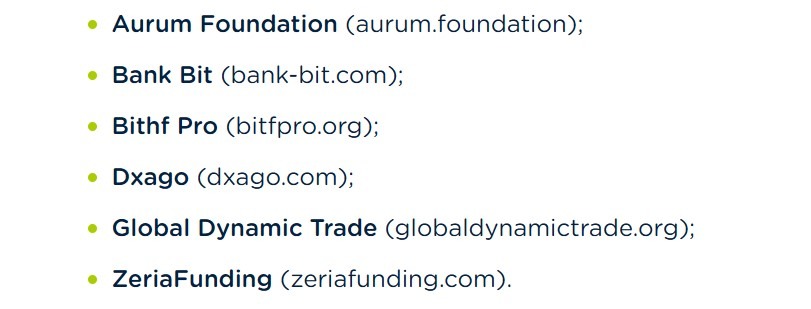
Belgium’s financial markets regulator warned consumers against six crypto-asset service providers (CASPs) it said were operating in the country without authorization, days after the European Union’s Markets in Crypto-Assets (MiCA) licensing deadline took effect.
On Monday, the Financial Services and Markets Authority (FSMA) identified several CASPs active in Belgium without authorization under MiCA regulation. FSMA named Aurum Foundation, Bank Bit, Bithf Pro, Dxago, Global Dynamic Trade and ZeriaFunding. The regulator said it had added these entities to its list of fraudulent CASPs.
The warning indicates that national regulators are beginning to apply the MiCA licensing perimeter following the EU’s transitional period, which ended on July 1.
The Brussels-based regulator strongly advised consumers not to accept offers from the named companies and told users to check whether a provider is listed in its official CASP register. The FSMA also warned that crypto assets can be volatile, may suffer from liquidity limitations and are not covered by a compensation scheme that could reimburse users for potential losses.
Cointelegraph contacted FSMA for more information but did not receive a response by the time of publication.
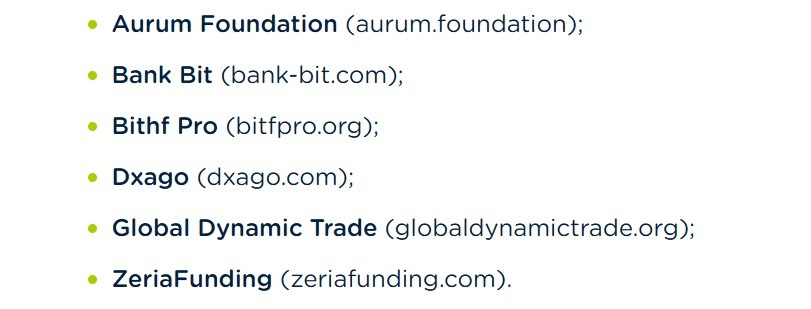
List of unregistered CASPs. Source: FSMA
MiCA deadline starts enforcement phase across Europe
MiCA entered into force at the end of 2024, creating a harmonized EU framework for CASPs and issuers. Under Belgium’s FSMA guidance, only authorized CASPs are permitted to offer crypto asset services like custody, trading platforms, crypto-to-fiat exchange, crypto-to-crypto exchange, order execution, transfer services, advice and portfolio management.
Belgium’s transitional regime expired on July 1, the same date by which existing providers across the EU generally had to obtain authorization or stop offering crypto-asset services.
Related: Germany leads MiCA crypto authorization race as Europe’s deadline looms
The deadline has been a major pressure point for crypto companies operating in the bloc. On June 24, crypto exchange Binance withdrew its MiCA application filed in Greece and planned to seek authorization in another EU jurisdiction just days before the July 1 deadline.
At the time, the exchange said it was “not leaving Europe” but acknowledged some users could be affected as it worked to comply with applicable requirements.
Magazine: Bitcoin slides to $58K, XRP hits $1 but onchain data promising: Market Moves

Key Takeaways
- Shares of Intel began Monday’s session at $120.35, helping drive a semiconductor sector recovery following two weeks of declines in the SOX benchmark.
- Information technology earnings projections have jumped 10% throughout Q2; Intel and Sandisk show the strongest estimate growth.
- Wall Street now forecasts Intel’s Q2 earnings per share at $0.21, a significant increase from the $0.08 projection on March 31.
- Several institutional players expanded their INTC holdings during Q2, with institutions and hedge funds controlling 64.53% of shares outstanding.
- HSBC maintains a Buy rating with a $200 price target, while Goldman Sachs assigned a neutral stance with a $150 objective.
Intel shares opened Monday’s trading at $120.35 as semiconductor stocks recovered from back-to-back weekly declines that pressured the PHLX Semiconductor Index (SOX).
Sandisk (SNDK) and Western Digital (WDC) also experienced approximately 4% gains after suffering significant losses during Thursday’s selloff.
The semiconductor recovery materialized as market participants shifted focus toward the approaching earnings reporting period, where technology sector expectations have been strengthening.
FactSet data reveals that information technology sector earnings forecasts have advanced 10% since the second quarter’s April 1 start date. This positions IT just behind the energy sector, which has witnessed a dramatic 50% surge in estimates during the identical timeframe.
Intel and Sandisk are spearheading the technology sector’s earnings-per-share estimate improvements on a percentage basis since the end of March. Sandisk also appears near the top when measured in absolute dollar terms, alongside Micron (MU), Nvidia (NVDA), and Apple.
Regarding Intel’s specific outlook, Wall Street analysts currently project Q2 EPS of $0.21, representing a substantial increase from the $0.08 forecast that existed at the quarter’s beginning. Intel’s management has issued Q2 guidance calling for $0.20 EPS.
Institutional Ownership Continues Growing
Numerous institutional investment firms expanded their Intel holdings during the second quarter. Walkner Condon Financial Advisors established a fresh position valued at approximately $224,000 through the purchase of 5,068 shares. Sivia Capital Partners expanded its Intel stake by 271.7%, bringing its total to 34,201 shares valued at $766,000. NewEdge Advisors increased its position by 29.6%, now holding 158,277 shares.
In total, hedge funds and institutional investors maintain ownership of 64.53% of Intel stock.
On the insider transaction front, Executive Vice President April Miller divested 40,256 shares on May 1 at an average price of $99.53 per share, generating proceeds exceeding $4 million. This transaction decreased her ownership percentage by 27.7%.
Street Price Targets Show Wide Dispersion
Analyst price objectives for Intel demonstrate considerable variance across Wall Street. HSBC elevated its target to $200 while maintaining a Buy recommendation, citing advancement in Intel’s foundry operations and possible collaborations with Apple, Nvidia, and Amazon.
Goldman Sachs launched coverage on June 25 with a neutral assessment and a $150 price objective. Mizuho established a $135 target on June 21. TD Cowen maintains a Hold rating with a $75 price goal. Rosenblatt carries a Sell rating alongside a $50 target.
The aggregate consensus among 49 Wall Street analysts establishes a “Hold” rating with an average price target of $96.69.
Intel’s latest quarterly results, disclosed on April 23, revealed Q1 EPS of $0.29, surpassing the $0.01 consensus estimate by $0.28. Revenue totaled $13.58 billion, exceeding the $12.32 billion projection and representing a 7.4% year-over-year increase.
The stock’s 52-week trading range spans from $18.97 to $142.35. Its 200-day moving average stands at $71.20, considerably below current trading levels. Intel maintains a market capitalization of $604.88 billion with a beta coefficient of 2.18.


Strategy (MSTR) sold 3,588 bitcoin for approximately $216 million last week, reducing its total holdings to 843,775 BTC, according to a Monday SEC filing.
The company said proceeds from the bitcoin sales will be used to fund distributions on its preferred stock and replenish the portion of its U.S. dollar reserve used for those payments. As of July 5, the USD reserve totaled $2.55 billion.
The latest sales were executed at an average price of roughly $60,000 per bitcoin and are dramatically higher than the 32 bitcoin sold by the company about one month ago, which sent crypto prices plunging. Strategy currently holds 843,775 BTC acquired for approximately $63.69 billion, or an average purchase price of $75,476 per bitcoin.
Strategy also said it did not sell any shares under its at-the-market equity program during the week ended July, and did not repurchase any shares under its buyback programs. The company added that the full $1.25 billion capacity under its recently announced BTC Monetization Program remains available.
Strategy shares are down 2% in pre-market trading and bitcoin has given up much of its weekend gain, trading down to $61,900 from $62,900 prior to the announcement.
TLDR
- Solana added 1.60 million new addresses in two weeks, showing stronger network participation.
- SOL held its short-term uptrend as buyers defended key support levels.
- Analysts identified $85.81, $88.79, and $93.95 as the next upside targets.
- The $86 to $94 zone remains the main resistance area for Solana’s breakout setup.
Solana price prediction remains positive after on-chain activity strengthened and technical support stayed intact. Network data showed 1.60 million new addresses joined within two weeks. Meanwhile, SOL continued holding higher lows while resistance near $94 remained the next focus.
Network activity strengthens Solana’s market outlook
Solana price prediction gained attention after fresh on-chain data highlighted steady network expansion. Ali Charts reported 1.60 million new addresses during the past two weeks. The figures reflected stronger participation across the broader Solana ecosystem.
The total address count increased from about 6.8 million to 8.6 million during the measured period. That increase suggested rising activity beyond short-term market movements. Consequently, stronger network participation supported improving market conditions.
Solana price prediction also received support because expanding addresses often reflect growing ecosystem usage. However, address growth alone cannot confirm a sustained price breakout. Even so, consistent participation strengthened the broader bullish structure.
Price structure keeps the bullish trend intact
Solana price prediction remained constructive because SOL preserved its short-term upward trend. More Crypto Online said, “there is still no clear sign that a local top has formed.” The Elliott Wave structure continued pointing toward higher resistance levels.
The analyst identified immediate support near $80.38 for the ongoing structure. Additional support rested near $78.22 and $76.52. Therefore, holding those levels would preserve the current higher-low pattern.
Solana price prediction continued favoring upside targets while buyers defended key support levels. The chart highlighted resistance near $85.81, $88.79, and $93.95. Those levels represented the next technical objectives if momentum continued.
Resistance near $94 remains the next target
Solana price prediction focused on the $86-$94 resistance area as buying pressure persisted. Market structure remained positive because price respected higher lows. Consequently, traders monitored resistance without disrupting the prevailing trend.
A deeper decline could return the $71.17-$64.68 region into focus. That move would weaken the current short-term technical picture. However, it would still fit a broader corrective structure.
Solana price prediction continued to rely on network growth and stable price action together. Strong address creation supported the technical outlook during recent sessions. Therefore, sustained participation and higher lows kept the $94 breakout scenario active.

Sheza Alibi’s return to Pakenham stable planned for 2024

Alibaba is banning its workers from using Claude Code as US v China AI battle heats up

Why This Money Advice Has EXPIRED


-

 Fashion3 days ago
Weekend Open Thread: High Hopes
-

 Politics3 days ago
The House | “Reframing the debate from a binary discussion of winners and losers”: Yuan Yang reviews ‘We Are Not Machines’
-

 Crypto World6 days ago
Strategy authorizes up to $1.25B in Bitcoin sales under new capital plan
-

 News Videos6 days ago
How to Build INSANE Live Financial Dashboards With Claude
-

 Tech6 days ago
Anonymous researcher drops 0-day ‘exploitarium’ repo
-

 Business6 days ago
Australia treasurer says alleged access of prime minister’s bank data ’incredibly concerning’
-
 NewsBeat1 day ago
Taylor Swift and Travis Kelce wedding staffer hilariously struggles to keep her cool while checking in megastars
-
Crypto World5 days ago
Airdrop Registration Becomes Key Focus For Remittix As RTX Launch Updates Approach
-

 Sports5 days ago
Broncos roster: OL Ben Powers (No. 74) entering final year of contract
-
 Business7 days ago
The AI boom won’t burst all at once. It will pop in ‘rolling bubbles’: Macquarie
-

 Crypto World4 days ago
Binance stock trading tops $1B in first month after launch
-

 NewsBeat6 days ago
Presenter Caroline Flack’s brother Paul Flack dies aged 55
-

 Crypto World4 days ago
Alibaba-affiliate Ant Group enters the humanoid robot market with 12 deals
-
 NewsBeat4 days ago
New exhibition reflects five decades of movement between island of Ireland and GB
-

 Crypto World23 hours ago
South Africa proposes crypto tax guidance under existing rules
-

 Crypto World3 days ago
Standard Chartered Secures MiCA License as ESMA Adds 37 New Crypto Firms
-

 Business5 days ago
Meta Platforms Stock Jumps 7% Today as Bloomberg Reports Company Plans to Enter the Cloud Business
-

 Tech1 day ago
Lenovo laptops are now shipping with YMTC SSDs, a sign of Chinese NAND entering the mainstream
-

 Business3 days ago
What a 10 Percent Drop Means for Buyers, Sellers and Renters
-

 Crypto World4 days ago
Binance Re-Enters Philippines As EU MiCA Rules Restrict Access
You must be logged in to post a comment Login