

Crypto World
HYPE pops 7%, beating bitcoin declines, as SpaceX pre-IPO lands on Hyperliquid



Hyperliquid’s HYPE token rallied 7% over 24 hours after Trade.xyz launched the first pre-IPO perpetual market on the platform, offering synthetic exposure to SpaceX at a reference valuation of $1.78 trillion.

The US Senate’s high-profile crypto market structure bill remains on a tight timetable, with insiders warning that passage could slip into August or even miss the midterm window entirely if lawmakers cannot align before November. Greg Cipolaro, head of research at NYDIG, cautioned that the realistic negotiating window may extend from June to early August, while an earlier target floated by White House crypto adviser Patrick Witt pointed to July 4 for a Senate markup and floor votes. The reality, said Cipolaro, is likely less rigid: “This may represent an aspirational benchmark rather than a fixed legislative deadline.”
The draft legislation is designed to establish a comprehensive framework for how US regulators would oversee crypto markets, a centerpiece among this year’s most consequential crypto policy measures. Yet progress has been slowed by contentious negotiations over stablecoins, enforcement approaches to decentralized finance, and the extent of government officials’ use of crypto, among other sticking points.
According to Cointelegraph, the bill cleared a long-delayed markup in the Senate Banking Committee on Thursday, advancing to the Senate floor where it would require 60 votes to proceed and avoid a protracted debate. The committee vote was largely along party lines, underscoring the partisan dynamics that could shape the bill’s fate as lawmakers return from recess.
Key takeaways
- The Senate Banking Committee moved the crypto market structure bill toward a full floor vote, setting up a 60-vote threshold to pass and avert extended debate.
- With the Senate’s current 53-seat Republican majority, securing at least seven Democratic votes would be needed for swift passage; several Democrats have expressed concerns that the proposal does not go far enough to curb crime or sanctions evasion.
- The timing remains uncertain: the realistic passage window spans June through early August, but a July–September recess and the looming midterms could complicate scheduling; a post-election lame-duck session remains a potential alternative path.
- Beyond timing, passage would deliver regulatory clarity that could boost institutional participation in crypto markets. In particular, the bill would classify Bitcoin as a commodity under the Commodity Futures Trading Commission and reduce remaining regulatory overhang for Bitcoin as an institutional asset.
- Even if enacted, the bill’s fate is contingent on broader political dynamics. A Democratic gain in the Senate could derail the current Republican-backed framework in the next Congress, given the different legislative environment after the midterms.
Legislative trajectory and timing
The core purpose of the bill is to prescribe how US watchdogs would regulate crypto markets, seeking to harmonize oversight across agencies and provide a clearer pathway for institutions operating in the space. Its resonance within the policy landscape is tied to the ongoing debate over stablecoins, anti-crime provisions, and how to integrate crypto activity within traditional financial law. The latest committee action marks a critical milestone, but substantial hurdles remain before a floor vote and eventual enactment.
Regulatory implications and market impact
Proponents argue that a formal framework would reduce legal uncertainty and enable more robust participation by banks and other large investors, which have frequently cited the lack of regulatory clarity as a constraint on capital deployment in crypto markets. A central feature described in policy discussions is the potential classification of Bitcoin as a commodity for CFTC oversight, addressing a longstanding question about its regulatory status and eliminating a major bit of ambiguity for market participants.
For exchanges, asset managers, and crypto firms, the bill’s passage would set a baseline of compliance expectations—particularly around disclosures, registration requirements, and enforcement mechanisms. In parallel, the proposed framework intersects with broader regulatory structures under consideration in other jurisdictions, and policymakers frequently reference cross-border alignment as a goal to facilitate legitimate global activity while deterring illicit finance.
Political dynamics, risk, and enforcement considerations
Political dynamics loom large. Republicans hold a 53-seat Senate majority, meaning cross-party support is essential for a timely enactment. Achieving consensus would require at least seven Democrats to back the measure for a rapid path to passage. Yet several Democrats have voiced concerns that the bill does not sufficiently deter crime or address sanctions evasion, raising questions about the balance between bipartisan cooperation and stringent safeguards.
As Cipolaro summarized in his briefing, congressional negotiators face a tradeoff: “Congressional negotiators face a tradeoff between accepting an imperfect bipartisan framework in 2026 versus risking a substantially different legislative environment after the midterms.” The statement underscores the high stakes of timing; a change in control after the midterms could reshape the legislative approach to crypto regulation, potentially altering or delaying the policy roadmap.
Beyond timing, there are substantive policy questions that could influence the bill’s durability after passage. Provisions related to decentralized finance, ethics rules, and enforcement authorities remain focal points of negotiation, and even if the bill advances, regulatory interpretation and practical implementation will require close coordination across agencies and in-depth compliance programs by market participants.
From a compliance perspective, the potential clarity offered by a enacted framework could align with existing AML/KYC expectations and licensing regimes, while also prompting banks and broker-dealers to reassess their crypto exposure, risk controls, and reporting obligations. The interplay with other regulatory initiatives—such as the broader financial services rulebook and cross-border policy efforts—will be critical to ensure coherence and avoid regulatory arbitrage.
Closing the loop on enforcement considerations, a finalized framework would still need to address how to supervise rapidly evolving technologies and products within the crypto ecosystem, particularly when it comes to DeFi platforms and new token structures. Market participants would benefit from well-defined standards, but the evolving nature of the asset class means that oversight will require ongoing monitoring and possible updates to policy to address emerging risks.
What happens next remains highly dependent on calendar and coalition-building. Analysts and compliance teams should monitor committee schedules, potential amendments targeting stablecoins, and the broader electoral context, as these factors will shape both the likelihood of passage and the regulatory architecture that would follow.
If enacted, the law would mark a significant milestone in US crypto policy, providing a clearer authorization framework for institutional participation and enabling regulators to articulate specific standards for market integrity and consumer protection. For now, market observers are balancing optimism about regulatory clarity with caution about political wagering and the complexity of crafting durable, cross-agency oversight that can withstand changing administrations and election outcomes.
Source note: Coverage reflects developments reported in contemporary policy and market briefs, with attribution to Cointelegraph where cited.
Looking ahead, stakeholders will want to watch for the final passage dynamics, the specific text of any amendments, and the timing of a floor vote. The course of the bill will illuminate how Congress intends to frame crypto in the regulated financial system and what that means for the trajectory of crypto markets, institutional adoption, and cross-border regulatory alignment.


The U.S. Senate’s crypto market structure bill has entered a narrow legislative window that could close by August if lawmakers fail to move the measure before the midterm election cycle intensifies, according to research firm NYDIG.
Summary
- NYDIG said the U.S. Senate crypto market structure bill could face major delays if lawmakers fail to pass it before the August recess.
- Republicans may need support from at least seven Democrats to move the bill through the Senate floor with a 60-vote threshold.
- According to NYDIG, failure to pass the legislation could leave the crypto industry operating under continued regulatory uncertainty in the U.S.
In a market note published Friday, NYDIG head of research Greg Cipolaro said the most realistic timeframe for the bill to clear Congress runs from June through early August, despite recent comments from White House crypto adviser Patrick Witt, who said earlier this month that the administration was targeting a July 4 passage timeline.
Witt had stated that enough time remained for a Senate markup, a floor vote, and final House approval. Cipolaro, however, described the July target as more of an “aspirational benchmark” than a firm deadline.
Thursday’s Senate Banking Committee vote moved the legislation one step closer to the Senate floor after months of delays tied to negotiations over stablecoin rules, ethics provisions, and the treatment of government officials involved with digital assets. The committee advanced the bill largely along party lines.
With Republicans holding 53 seats in the Senate, at least seven Democrats would likely need to support the measure to secure the 60 votes required to avoid prolonged debate and pass the chamber quickly. Several Democratic lawmakers have argued that the current draft does not adequately address concerns tied to illicit finance and sanctions evasion.
Election calendar could complicate crypto bill timeline
As Cipolaro noted in the NYDIG report, Congress is scheduled to recess from late July through early September before lawmakers return to a politically sensitive period leading into the November midterms.
Under that timeline, Senate leadership may avoid scheduling a contentious vote requiring bipartisan support once campaigning accelerates. Cipolaro wrote that if lawmakers fail to advance the bill before the recess period, the next viable opportunity could come during a post-election lame-duck session.
Even then, NYDIG said the path would depend heavily on Republicans retaining Senate control and Majority Leader John Thune deciding to prioritize crypto legislation alongside government funding negotiations.
Current election forecasts continue to show a closely contested Senate race. While some projections give Republicans a slight edge, other models classify several battleground seats as tossups that could hand Democrats control of the chamber next year.
According to Cipolaro, a Democratic-controlled Senate in the next Congress would likely reduce the chances of the current Republican-backed market structure proposal advancing after January.
Within the same note, NYDIG said lawmakers are effectively weighing whether to approve an imperfect bipartisan framework this year or risk reopening negotiations under a different political balance after the elections.
Regulatory clarity seen as key institutional catalyst
Cipolaro added that passage of the legislation could materially improve institutional confidence in crypto markets by establishing clearer oversight rules for digital assets in the U.S.
Among the bill’s most significant provisions, NYDIG said Bitcoin would formally fall under the jurisdiction of the Commodity Futures Trading Commission as a commodity, removing what the firm described as one of the last major regulatory uncertainties surrounding Bitcoin’s role as an institutional asset.
Failure to pass the legislation, however, could leave the crypto industry operating under continued jurisdictional uncertainty. NYDIG said unresolved disputes over decentralized finance enforcement provisions, ethics language, or procedural delays could still derail negotiations before the current congressional window closes.
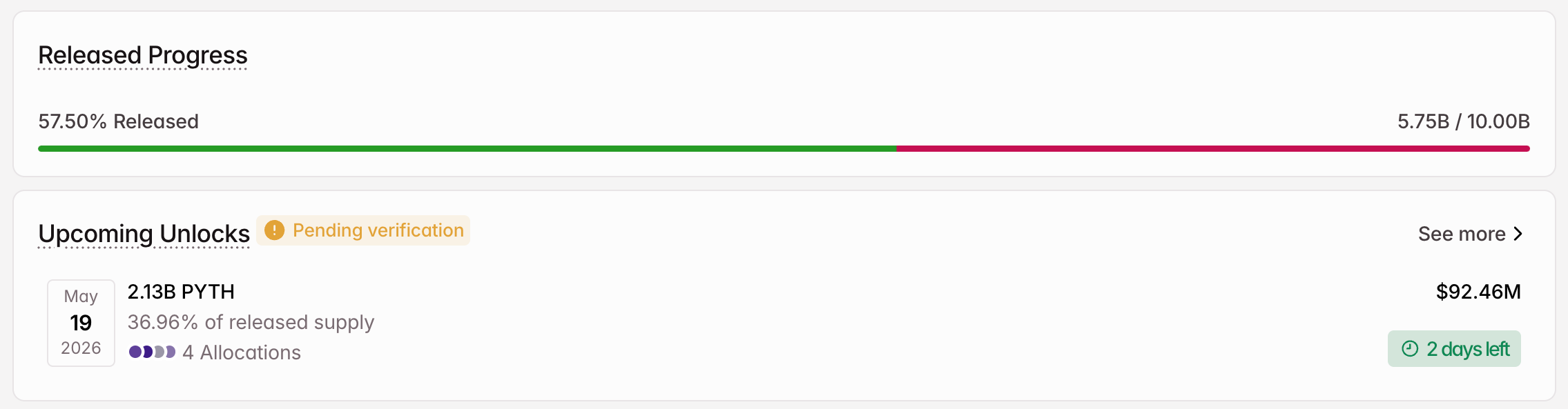
The crypto market will welcome tokens worth more than $770 million in the third week of May 2026. Major projects, including Pyth Network (PYTH), LayerZero (ZRO), and KAITO (KAITO), will release significant new token supplies.
These unlocks could introduce market volatility and influence short-term price movements. So, here’s a breakdown of what to watch.
1. Pyth Network (PYTH)
- Unlock Date: May 19
- Number of Tokens to be Unlocked: 2.13 billion PYTH
- Released Supply: 5.75 billion PYTH
- Total Supply: 10 billion PYTH
Pyth Network is a decentralized oracle protocol that delivers real-time financial market data directly to blockchain applications. It sources price feeds from over 120 first-party publishers, including major exchanges, market makers, and trading firms, covering crypto, equities, FX, and commodities.
On May 19, the team will release 2.13 billion tokens, worth approximately $92.46 million. The altcoins account for 36.96% of the current released supply.

The network will split the supply four ways. Pyth Network will allocate 1.13 billion tokens to ecosystem growth and 537.5 million tokens to publisher rewards.
In addition, the team will keep 250 million tokens for private sales. Lastly, Pyth will direct 212.5 million tokens toward protocol development.
2. LayerZero (ZRO)
- Unlock Date: May 20
- Number of Tokens to be Unlocked: 25.71 million ZRO
- Released Supply: 507.08 million ZRO
- Total Supply: 1 billion ZRO
LayerZero is an interoperability protocol that connects different blockchains. Its primary goal is to facilitate seamless cross-chain communication. Thus, it enables decentralized applications (dApps) to interact across multiple blockchains without relying on traditional bridging models.
The team will unlock 25.71 million tokens on May 20, representing 5.07% of the released supply. Moreover, the supply is worth approximately $32.65 million.

LayerZero will award 13.42 million altcoins to strategic partners. Core contributors will get 10.63 million ZRO. Lastly, 1.67 million ZRO are for tokens repurchased by the team.
3. Kaito (KAITO)
- Unlock Date: May 20
- Number of Tokens to be Unlocked: 17.6 million KAITO
- Released Supply: 374.28 million KAITO
- Total Supply: 1 billion KAITO
Kaito is an artificial intelligence (AI)-powered Web3 information platform that aggregates and analyzes cryptocurrency market data from diverse sources like social media, governance forums, news, and more. The KAITO token serves as a medium of exchange, governance tool, and incentive mechanism within the platform.
On May 20, the team will unlock 17.6 million tokens, representing 4.7% of the current released supply. The supply is worth approximately $8.58 million.

The foundation will receive 1.19 million tokens. Core contributions will get 6.94 million tokens. Furthermore, early backers will receive 2.31 million KAITO. Finally, the team will direct 7.16 million KAITO for ecosystem and network growth.
In addition to these, other prominent unlocks investors can look out for in the third week of May include MBG by Multibank Group (MBG), YZY (YZY), Soon (SOON), and more, which will contribute to the overall market-wide releases.
The post 3 Token Unlocks to Watch in the Third Week of May 2026 appeared first on BeInCrypto.


Bitcoin Depot, once the largest Bitcoin ATM operator in the US, filed for Chapter 11 bankruptcy protection on Monday and pulled its entire kiosk network offline.
The filing landed in the US Bankruptcy Court for the Southern District of Texas. Canadian entities will join the US proceedings, while other foreign units wind down under applicable foreign law.
Bitcoin Depot to Wind Down After Filing for Bankruptcy Protection in Texas
CEO Alex Holmes pointed to a regulatory shift that has turned hostile to Bitcoin ATM (BTM) operators. States have imposed transaction caps, tighter compliance rules, and outright bans in multiple jurisdictions.
“Operators have faced increasing litigation and regulatory enforcement. These developments have materially affected Bitcoin Depot’s business and financial position. Under these circumstances, the Company’s current business model is unsustainable,” he said.
Indiana became the first state to ban the kiosks in March, followed by Tennessee and Minnesota, according to AARP. Bitcoin Depot also faced lawsuits from attorneys general in Massachusetts and Iowa. Connecticut suspended its operating license in March.
Meanwhile, the Federal Bureau of Investigation (FBI) logged 13,460 crypto-kiosk fraud complaints in 2025, with reported losses of $389 million. That marked a 58% jump from the prior year.
Follow us on X to get the latest news as it happens
The bankruptcy filing follows the company’s recent disclosure that it could not submit its quarterly 10-Q report to regulators on time. Q1 2026 results came in dramatically weaker than the same period a year earlier.
Revenue fell $80.7 million, a 49.2% year-over-year decline, after transaction volumes shrank under the weight of regulatory impacts and the tightened compliance checks.
Gross profit collapsed 85.5% to $4.5 million from $31.2 million. Cash reserves fell from $65.6 million in December to $44.0 million by March, and the company accrued over $20 million in legal judgments during Q4 2025.
Bitcoin Depot’s collapse may indicate whether other major operators can survive similar pressures.
Subscribe to our YouTube channel to watch leaders and journalists provide expert insights
The post Bitcoin Depot Files for Bankruptcy as Pressure Mounts on Crypto ATM Sector appeared first on BeInCrypto.
The overall bearish trend that began following the rejection at $82,000 on Thursday evening worsened in the past 12 hours when another leg down drove BTC to a fresh multi-week low of $76,650 (on Bitstamp).
The most evident reason for this was the new set of threats from US President Donald Trump toward Iran. Even the reported deal between the US and China couldn’t save BTC.
New Threats
Although the ceasefire between the two sides was extended several weeks ago, there has been little to no progress on striking an actual and permanent peace deal. In fact, each proposal sent by Iran has been rejected by the Trump administration, with one of the latest deemed “totally unacceptable.”
He went further recently, indicating that the ceasefire is hanging by a thread, and returned his focus to the war after the trip to Beijing concluded. In a fresh post on Truth Social, Trump warned that Iran’s clock is ticking. He urged them to “better get moving, FAST, or there won’t be anything left of them,” before adding that “TIME IS OF THE ESSENCE.”
This message came hours after the Times of Israel reported that Trump had met with Israel’s Prime Minister Benjamin Netanyahu on Sunday to discuss the war developments.
As mentioned above, BTC slipped to just under $76,700 for the first time since the start of the month after a quiet Sunday. The liquidations rocketed to over $660 million on a 24-hour scale, while more than $610 million came in 1-2 hours when BTC and the rest of the market crashed after the aforementioned statement. Thus, the cryptocurrency is down by over $5,000 since the Thursday evening peak of $82,000.

US-China Deal
After Trump’s visit to Beijing concluded, the two sides published contradicting statements on whether they had reached any deals or not. The most recent, cited by The Kobeissi Letter, indicated that China had indeed agreed to several US demands, including an initial purchase of 200 American-made Boeing aircraft for local airlines, buying at least $17 billion per year of US agricultural products in 2026, 2027, and 2028, and more.
However, none of those managed to impact the crypto market positively, but more volatility is expected later this week due to these four factors.
BREAKING: The White House announces multiple US-China trade deals and developments following President Trump’s meeting with China’s President Xi.
Details include:
1. China will address US concerns regarding supply chain shortages related to rare earths and other critical…
— The Kobeissi Letter (@KobeissiLetter) May 18, 2026
The post $660M Liquidated as Bitcoin Crashes on Trump-Iran Escalation Fears appeared first on CryptoPotato.
The US Senate’s crypto market structure bill could take until August to pass and risks not advancing at all if lawmakers cannot pass it before the midterms, said Greg Cipolaro, head of research at financial services firm NYDIG.
Patrick Witt, a senior White House crypto adviser, said earlier this month that he was targeting July 4 for the Senate’s crypto bill to pass, saying there was enough time for a Senate markup, floor vote and House vote.
“This may represent an aspirational benchmark rather than a fixed legislative deadline,” Cipolaro said in a note on Friday. “The realistic window, however, is June through early August.”
The crypto market structure bill would outline how US watchdogs would regulate crypto and is seen as one of the most important pieces of crypto legislation this year. However, it has been marred by delays as lawmakers and lobbyists have sought to add or amend provisions around stablecoins and government officials’ use of crypto, among other issues.
The bill passed a long-delayed markup in the Senate Banking Committee on Thursday, which voted largely along party lines to advance it to the Senate floor, where it will need 60 votes to avoid prolonged debate and pass.
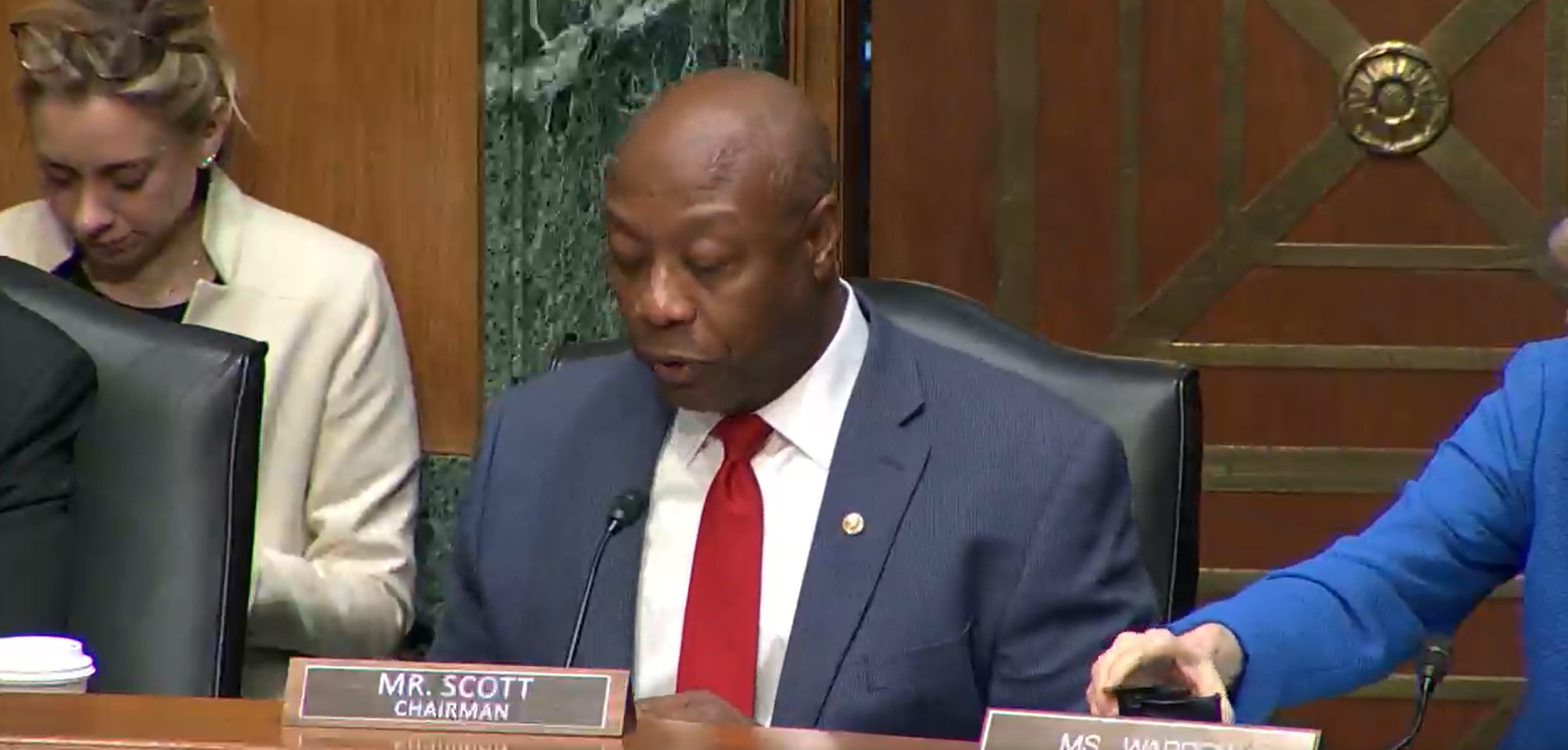
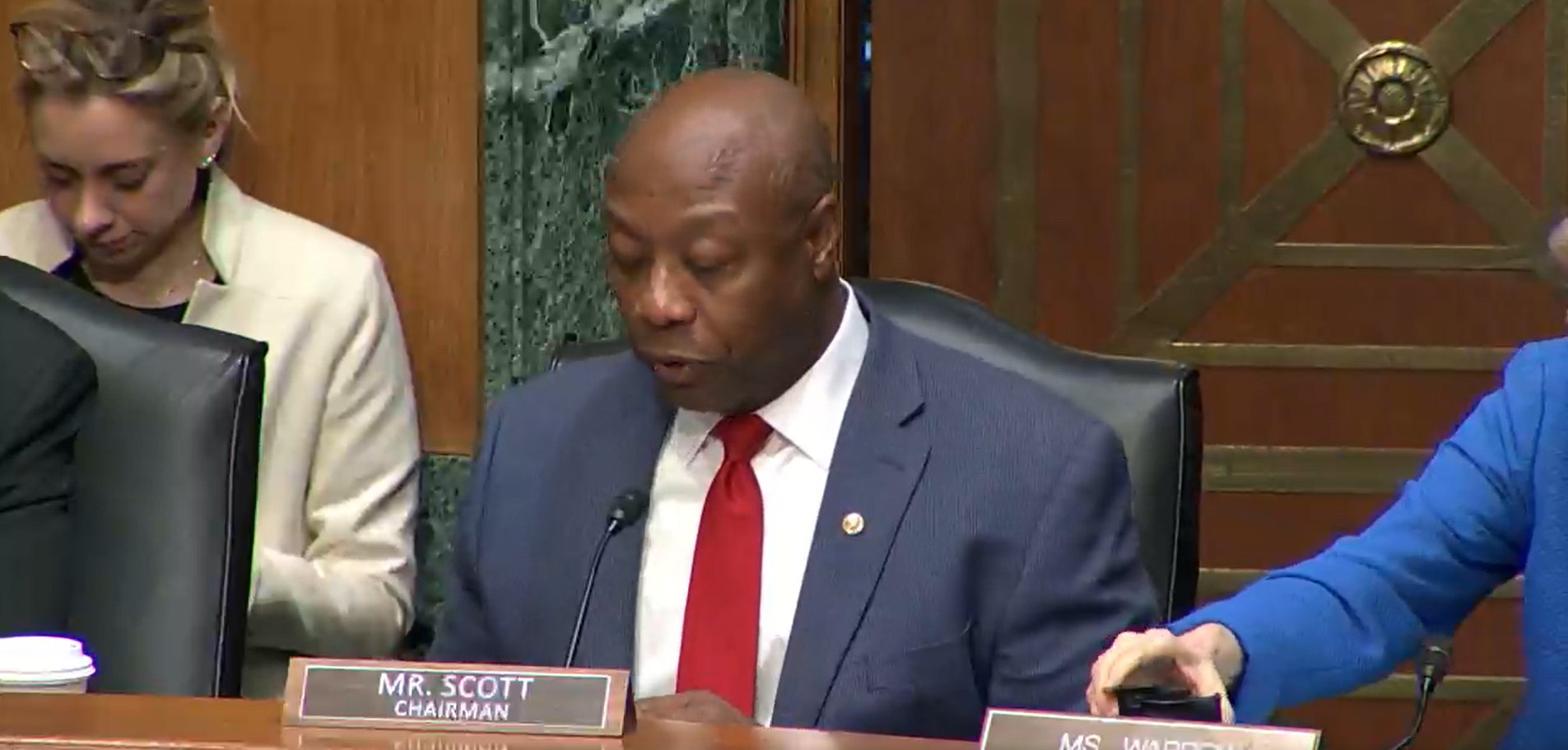
Senate Banking Chair Tim Scott, pictured at the markup. Source: US Senate
Republicans hold a 53-seat Senate majority and will need at least seven Democrats on board to pass the bill quickly, but some Democrats are concerned that the bill does not go far enough in preventing crime and sanctions evasion.
Cipolaro said Congress has a recess from late July to early September and will then return to a period ahead of the midterm elections in November, when Senate leadership “is unlikely to schedule a contested 60-vote floor fight.”
“If the bill misses that window, the highest-probability remaining pathway becomes a post-election lame-duck session, available only if Republicans hold the Senate and Majority Leader [John] Thune prioritizes it over government funding deadlines,” he added.
Current polling and predictions show a tight race for control of the Senate, with some forecasts showing Republicans with a slight edge, while others put key seats as tossups that could put Democrats in control of the chamber.
Cipolaro said that if Democrats gain control of the Senate, the current Republican-backed crypto market structure bill is unlikely to advance in the next Congress when it begins in January.
“Congressional negotiators face a tradeoff between accepting an imperfect bipartisan framework in 2026 versus risking a substantially different legislative environment after the midterms.”
Cipolaro said that if the bill is passed and signed into law, crypto markets would get a boost as major institutions would be confident enough to invest in the space because of the legal clarity.
It would also grant regulatory certainty to Bitcoin, classifying it as a commodity under the Commodity Futures Trading Commission and closing “the last significant regulatory overhang for Bitcoin as an institutional asset class,” he added.
However, Cipolaro said the bill could fail because of stalled negotiations over provisions regarding ethics or decentralized finance enforcement, or because of scheduling delays, which would mean the crypto industry would continue to operate under “permanent jurisdictional ambiguity.”
Magazine: Clarity Act risks repeat of Europe’s mistakes, crypto lawyer warns

Crypto markets are tanking and have wiped out almost three weeks of gains, with losses accelerating over the weekend.
The week ahead has some key consumer sentiment reports amid rising US inflation and a number of Federal Reserve speeches under new leadership. Meanwhile, the war in Iran will mark its 80th day on Tuesday, and signs of a deal are still not forthcoming.
Economic Events May 18 to 22
The economic data kicks off on Tuesday with pending US house sales reports, followed by the ADP employment weekly change. These two shed more light on the housing and labor markets, which are key to economic stability.
Wednesday will have the Federal Open Markets Committee meeting minutes detailing the central bank’s last meeting in April and potentially offering insight into future decisions regarding interest rates.
Thursday has more real estate market data, May’s Philly Manufacturing Index, and jobless claims. May’s Michigan Consumer Sentiment and Expectations reports are due out on Friday.
Key Events This Week:
1. April Pending Home Sales data – Tuesday
2. Fed Meeting Minutes – Wednesday
3. Nvidia, $NVDA, Reports Earnings – Wednesday
4. May Philly Fed Manufacturing Index – Thursday
5. May UMich Consumer Sentiment data – Friday
6. May UMich Consumer…
— The Kobeissi Letter (@KobeissiLetter) May 17, 2026
Macroeconomic data aside, all eyes are likely to be on Nvidia’s earnings report on Wednesday, which has become a bellwether for the entire AI industry.
CEO Jensen Huang doubled projections for the firm’s flagship chips, and company stock is up around 20% this year. TD Cowen analysts expect Nvidia to beat its quarterly revenue outlook by approximately $1 to $2 billion.
This could provide a boost for AI altcoins as the industry continues to expand. However, US President Trump told Iran on Sunday that the “clock is ticking” for making a deal, causing oil prices to spike to $108 a barrel and crypto markets to crash.
Crypto Market Outlook
Total capitalization has declined by around $130 billion over the weekend, falling to a three-week low of $2.64 trillion on Monday morning despite the Senate’s advancement of the Clarity Act last week.
Bitcoin led the losses, falling below $77,000 during Asian trading as it wiped out all gains made this month. The bigger picture shows that it is still consolidating and has been trading sideways since the beginning of February.
Ether prices shadowed big brother as usual, tanking 2.4% on the day and falling back to $2,100, its lowest level since April 7. Altcoin losses were relatively minor aside from Hyperliquid and Zcash, which continued to gain.
The post These 4 Factors Could Move Bitcoin and Crypto This Week appeared first on CryptoPotato.


Figure AI’s F.03 humanoid robot lost a live-streamed 10-hour package sorting contest to a human intern.
The intern, named Aime, finished 192 packages ahead of the company’s flagship machine.
Figure AI’s “Man vs. Machine” Results Are Out
Figure AI organized the “Man vs. Machine” challenge to see who would win between AI and a human. According to CEO Brett Adcock, the task required each side to detect a barcode, pick up a package, and place it barcode-down on a conveyor belt. Both ran the same routine continuously over the 10-hour window.
Aime received meal breaks and paid rest breaks under California labor law. Notably, the humanoid overtook the human around hour five after the competitor took a bathroom break.
Nonetheless, the human ultimately emerged victorious. Aime sorted 12,924 packages, while the F.03 logged 12,732.
Follow us on X to get the latest news as it happens
The intern finished at 2.79 seconds per package. The F.03 logged 2.83 seconds per package, a small per-package deficit. It’s worth noting that the contest was a single shift.
Aime reported blisters on his fingers and described his left forearm as feeling broken by the end. The F.03, by contrast, can run continuously across shifts, so a human lead over 10 hours may not extend to a full workweek.
Still, the results suggest blue-collar workers may still hold a slim edge in physical tasks. The picture for office workers looks more immediate.
Microsoft AI CEO Mustafa Suleyman forecasted that AI will automate most desk-based professional work within 12 to 18 months. He named lawyers, accountants, project managers, and marketers as vulnerable.
“White-collar work, where you’re sitting down at a computer, either being a lawyer or an accountant or a project manager or a marketing person — most of those tasks will be fully automated by an AI within the next 12 to 18 months,” he said.
The contrast is sharp. A humanoid robot still loses a four-hundredths-of-a-second race against a tired intern, while software agents are already chipping away at knowledge work.
Subscribe to our YouTube channel to watch leaders and journalists provide expert insights
The post Human Intern Beats Figure AI’s Humanoid Robot in 10-Hour Contest appeared first on BeInCrypto.


Aave has restored borrowing against wrapped Ether across affected markets as the decentralized lending protocol continues recovering from the fallout tied to Kelp DAO’s April exploit.
Summary
- Aave has restored wrapped Ether borrowing across affected markets as recovery efforts tied to the Kelp DAO exploit continue.
- Court approved transfers involving 30,765 ETH remain tied to an unresolved legal dispute linked to North Korean hacking allegations.
- Kelp DAO plans to discontinue rsETH bridging on several networks after June 15 while Aave liquidity conditions continue adjusting after the exploit.
In a post published Sunday, Stani Kulechov said Aave had reinstated loan-to-value ratios for wrapped Ether collateral on Aave V3 Ethereum Core, Ethereum Prime, Arbitrum, Base, Mantle, and Linea, allowing users to once again borrow against WETH and execute collateral or debt swaps.
According to Aave governance documents, the restrictions had been introduced as emergency safeguards after attackers exploited Kelp DAO’s LayerZero-powered bridge on April 18 and used unbacked rsETH as collateral on Aave V3 to borrow large amounts of wrapped Ether. Governance participants later approved a proposal to remove the WETH freeze after recovery efforts progressed without additional user risk.
Earlier stages of the recovery process included restoring backing for rsETH with Ether recovered after the exploit, reopening withdrawals, and coordinating token support from protocols participating in the DeFi United recovery initiative.
Court battle over frozen Ether still unresolved
At the same time, legal and governance procedures surrounding frozen Ether tied to the exploit are still ongoing.
A binding Arbitrum Improvement Proposal opened for voting on May 15 after affected parties sought approval to transfer 30,765 ETH, worth roughly $71 million at the time, from the Arbitrum Security Council wallet to an address controlled by Aave LLC. Court filings showed the funds had been frozen on April 21 after investigators linked the assets to wallets associated with the exploit.
Before the governance process moved ahead, Judge Margaret Garnett of the Manhattan federal court modified an earlier restraining notice on May 9, allowing the transfer to proceed while protecting governance voters and related participants from personal liability tied to the order.
Legal claims over the Ether remain active, however. Gerstein Harrow LLP, representing families pursuing unpaid terrorism judgments against North Korea, argued in court filings that the assets could constitute property linked to the Lazarus Group because blockchain analytics firms attributed the exploit to North Korean state-backed actors. No court has formally determined that attribution as a legal fact.
Responding to the dispute earlier this month, Kulechov stated that the recovered assets belonged to users affected by the exploit and should not be treated as property lawfully owned by attackers.
Lending activity and liquidity conditions change after exploit
Data from DefiLlama showed Aave’s total value locked fell by more than $8 billion after the incident. As of Monday, the protocol held roughly $14.8 billion in TVL compared with nearly $23.5 billion in March.
The exploit itself generated approximately $195 million in bad debt on Aave after attackers allegedly linked to North Korean hacking groups stole around 116,500 Kelp DAO Restaked Ether tokens and used them to drain wrapped Ether liquidity from the lending markets.
Meanwhile, recovery work at Kelp DAO is continuing on a separate track. On Sunday, the protocol announced plans to discontinue rsETH bridging support on Optimism, HyperEVM, Unichain, Avalanche, and MegaETH after June 15 as part of what it described as a network consolidation effort focused on security and integration activity.
Kelp DAO added that users seeking to recover funds after the deadline would face a 100 USDC fee per address. Earlier this month, the protocol also migrated rsETH to Chainlink’s oracle infrastructure while continuing to attribute the exploit to vulnerabilities tied to LayerZero’s cross-chain systems, its former provider.
Crypto World
Crypto traders betting on a rally lose $563 million in liquidations. Ether and bitcoin suffer the most


Ether and bitcoin led liquidations, as their prices dropped on macroeconomic concerns.

Senate Crypto Bill May Pass by August; NYDIG Faces Regulatory Impact

Shania Twain Hosts ACM Awards 2026 for the 1st Time

Crypto Gold Live Trading 17 MAY – stock_learners

Manchester United reach agreement with Casemiro over contract clause amid transfer speculation

US brings back mandatory military draft registration

Steven Gerrard disagrees with Gary Neville over ‘shock’ Chelsea and Arsenal claim | Football
Crypto Gold Live Trading 17 MAY – stock_learners

3 ALT Coins Update | Crypto Market Update | Bitcoin Breakout ? TRUMP Is Signing Clarity Act Bill

Remove Financial Blockages & Attract Abundance | Ganesha x Lakshmi x Vishnu | Mantra for Wealth Flow
-

 Crypto World2 days ago
BloFin War of Whales 2026 Grand Prix opens registration for $5M trading championship
-

 Fashion3 days ago
Weekend Open Thread: Theory – Corporette.com
-

 Crypto World2 days ago
E-Estate Announces 1 Year Live: Washington DC Summit as Real Estate Tokenization Enters Its Next Phase
-

 Fashion7 days ago
Coffee Break: Travel Steam Iron
-

 Politics6 days ago
What to expect when you’re expecting a budget
-

 Tech3 days ago
Tech Moves: Microsoft AI leader jumps to OpenAI; former AI2 exec joins Meta; and more
-
Crypto World5 days ago
Bitcoin Suisse expands with Digital Asset License and Investment Business Act Registration Approval in Bermuda
-

 Tech7 days ago
GM Agrees To Pay $12.75 Million To Settle California Lawsuit Over Misuse Of Customers’ Driving Data
-

 Tech6 days ago
GM agrees to $12.75M California settlement over sale of drivers’ data
-

 Politics5 days ago
Pakistan to enter Chinese capital market as war inflation bites
-

 Crypto World5 days ago
Bitcoin Suisse expands with Digital Asset License and Investment Business Act Registration Approval in Bermuda
-
 Crypto World4 days ago
Google’s Gemini AI Predicts Incredible Solana Price by the End of 2026
-

 Business3 days ago
H&R Real Estate Investment Trust (HR.UN:CA) Q1 2026 Earnings Call Transcript
-

 Tech2 days ago
Google reimburses Register sources who were victims of API fraud
-
 Tech7 days ago
Over-Engineered Cardboard PC Case Houses a Full Computer Without Compromising Style or Performance
-

 Sports2 days ago
Napoleonic enters 2026 Doomben 10,000 field via Abounding withdrawal
-

 Politics6 days ago
The geopolitics behind the UK’s South Atlantic hantavirus rescue mission
-

 Politics6 days ago
The Board of Deputies just smeared Polanski to suck up to Farage
-

 Fashion5 days ago
The Best-Kept Makeup Secret for a More Defined Face
-

 Entertainment7 days ago
Matt Damon And Ben Affleck Sued Over ‘The Rip’
You must be logged in to post a comment Login