

Crypto World
Goldman Sachs Dumps XRP and Solana, Cuts Ethereum Exposure by 70%

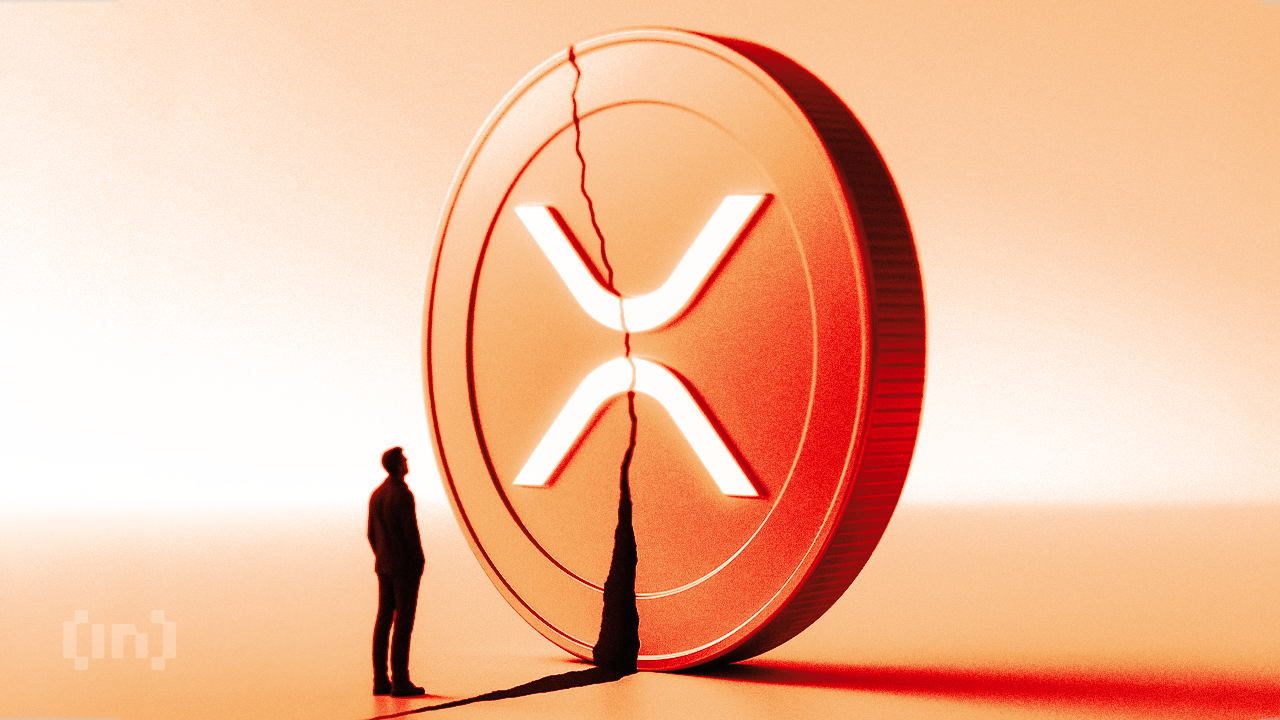
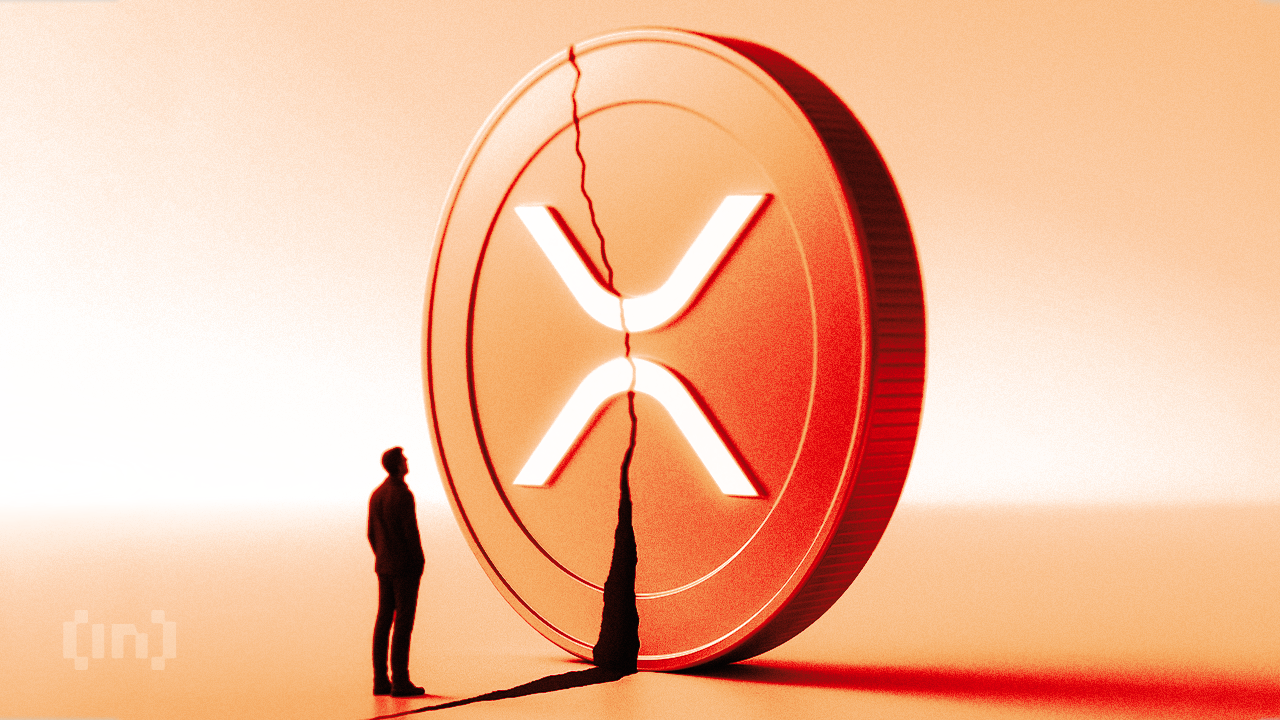
Goldman Sachs fully exited its XRP and Solana (SOL) spot ETF positions during the first quarter of 2026, ending a brief altcoin push that began just months earlier.
The bank’s latest 13F filing with the Securities and Exchange Commission (SEC) also shows Ethereum (ETH) ETF exposure trimmed by about 70% and Bitcoin (BTC) ETF stakes preserved near $700 million for the period ending March 31.
Goldman Sachs Makes A Strategic Altcoin Retreat
The disclosure marks a sharp reversal from late 2025, when Goldman first appeared as one of the largest institutional holders of spot XRP and Solana ETF products.
Earlier filings showed nearly $154 million spread across Bitwise, Franklin Templeton, Grayscale, and 21Shares XRP funds, plus a smaller Solana position concentrated in Bitwise’s staking ETF and Grayscale’s Solana Trust.
Both positions now sit at zero. Remaining iShares Ethereum Trust (ETHA) holdings stand near $114 million, well below the prior quarter.
The bank kept roughly $690 million in BlackRock’s iShares Bitcoin Trust (IBIT) and about $25 million in Fidelity Wise Origin Bitcoin Fund (FBTC), though both were trimmed by close to 10%.
Beyond ETFs, the firm increased exposure to crypto-linked equities including Circle, Galaxy Digital, and Coinbase. It also pared positions in mining and treasury names such as MicroStrategy, IREN, Bit Digital, and Riot Platforms.
The shift suggests Goldman is replacing direct token bets with infrastructure plays tied to stablecoin issuance, prime brokerage, and exchange flows.
Follow us on X to get the latest news as it happens
A Broader Institutional Pattern
Goldman is not the only major allocator rotating out of crypto funds.
Harvard University’s endowment cut its IBIT stake by roughly 43% to about $117 million. It also fully closed an $86.8 million Ethereum ETF position it had added only the prior quarter.
Trading firm Jane Street slashed its IBIT holdings by about 71% and FBTC by roughly 60%, then rotated into Ether ETFs.
Emory University exited its small IBIT position entirely, swapping into the Grayscale Bitcoin Mini Trust.
However, not every institution pulled back. Abu Dhabi’s Mubadala increased its IBIT holdings by about 16% to roughly $566 million, while Dartmouth’s endowment opened a small Bitwise Solana Staking ETF position.
Brown University held its IBIT exposure steady.
Quarterly 13F filings reflect end-of-quarter snapshots and often include market-making or client-driven inventory rather than directional bets.
Still, the volume of altcoin ETF exits tracks the sharp drawdons in XRP and Solana, both down more than 40% year-on-year.
The Q2 disclosures due in August will show whether the rotation continued or whether institutional appetite for altcoin funds returns.
The post Goldman Sachs Dumps XRP and Solana, Cuts Ethereum Exposure by 70% appeared first on BeInCrypto.

Crypto World
Dogecoin Wall Street Bet: Micron Veteran Jordi Visser Eyes DOGE as ETF Flows Stay on a Green Streak


Dogecoin is butchered as it’s down by more than 6% today, but Wall Street heavyweight is watching as its ETF keeps flowing green. In a conversation with Anthony Pompliano, Micron veteran Jordi Visser, who booked an eightfold return on MU before exiting all AI-sector positions, said DOGE’s chart is “on the verge of a breakout.”
His thesis revolves around negative real rates, sticky inflation, and the Fed’s $1.2 trillion in annual interest expense, which are forcing capital rotation into hard assets. According to him, Dogecoin is the clearest early-warning indicator of when retail joins the move.
Pompliano framed it sharply, noting that DOGE is “an alarm system” because it remains “the most pure play non-institutional asset that has size and liquidity in crypto.” Visser’s response was blunt: “I don’t even need to say anything else.”
Discover: The best crypto to diversify your portfolio with
Can Dogecoin Price Break and Reclaim Its 200-Day Moving Average?
DOGE sits at a genuine inflection point. Immediate resistance lies at $0.11, where the RSI reads 45 and 62, edging toward overbought on its open. A sustained daily close above that level, particularly if ETF inflows accelerate, is being flagged as the “concrete trigger” for the next leg higher.
The real test sits further up: the 200-day moving average at $0.125. Reclaiming and holding that pivot opens a path toward the $0.150 end-of-2026 target.
On the downside, the 100-day EMA at $0.10 serves as the primary support floor. A break below that level would invalidate the current breakout structure and likely reset the consolidation range.
Institutional demand is building at the margin, if not yet at scale. A $460,000 inflow into Grayscale’s GDOG ETF on April 30 was enough to snap a 72-day consolidation and push the price toward current levels.
Since launch, DOGE spot ETFs have logged net inflows on four of the last eight trading days, with $1.3 million entering in May alone. The 149 largest DOGE wallets now hold 108.52 billion DOGE, valued at $11.6 billion, with 739 transactions above $100,000 recorded in a single day in late last month.
DOGE just needs to close above $0.11 as ETF flows sustain, so Visser’s retail rotation thesis ignites a move toward $0.125.
Discover: The best pre-launch token sales
Maxi Doge Targets Early-Mover Upside as DOGE Tests Key Resistance
Dogecoin at above 10 cents is a different proposition than it was in 2021. The asymmetry has compressed. Traders who want exposure to the same retail-rotation thesis are looking one tier down.
Maxi Doge ($MAXI) is a meme token built on Ethereum that packages the high-conviction, maximum-leverage energy of the DOGE community into a presale-stage asset. The project has already raised more than $4.7 million at a current price of $0.0002819, with dynamic staking APY available to early holders.
The core concept is intentionally absurd, but the mechanics underneath are not. It offers holder-only trading competitions with leaderboard rewards, a Maxi Fund treasury for liquidity and partnerships, and a meme-first marketing engine designed to generate the viral retail attention Visser is watching.
Research Maxi Doge before the presale closes at the official presale page.
The post Dogecoin Wall Street Bet: Micron Veteran Jordi Visser Eyes DOGE as ETF Flows Stay on a Green Streak appeared first on Cryptonews.
Crypto World
Warren Buffett teased to CNBC a ‘tiny purchase’ in March. Berkshire filing may have revealed it

Warren Buffett speaks with CNBC during the Berkshire Hathaway Annual Shareholders Meeting in Omaha, NE on May 2, 2026.
David A. Grogan | CNBC
Billionaire investor Warren Buffett hinted in March that Berkshire Hathaway had made a small addition to its portfolio. A new regulatory filing may have just revealed what he was referring to.
When asked in March whether Berkshire was still putting money to work, Buffett said the conglomerate had made “one tiny purchase” but was still struggling to find attractive opportunities.
“Got one tiny purchase, but we aren’t finding things that — we weren’t finding them before,” Buffett said at the time in an interview with CNBC’s Becky Quick.
A regulatory filing released Friday showed Berkshire initiated a roughly $55 million position in Macy’s during the first quarter — a sliver of a portfolio valued at more than $300 billion and a size that would fit Buffett’s description of a “tiny” investment.
By contrast, Berkshire’s other newly disclosed position during the quarter was far larger: a roughly $2.6 billion stake in Delta Air Lines, making it an unlikely candidate for the modest purchase Buffett referenced in March.
Still, investors may not have the full picture. Berkshire’s quarterly equity filings only capture U.S.-listed positions that meet reporting requirements, leaving open the possibility that Buffett was referring to an international investment or another holding not reflected in Friday’s disclosure.
Buffett, who stepped down as Berkshire’s chief executive at the start of 2026 and handed the role to Greg Abel, said earlier this year that he remains deeply involved in overseeing investments and market activity.
The 95-year-old said he still comes into the office daily and works alongside colleagues on trading decisions. Buffett described regularly speaking with Berkshire’s director of financial assets, Mark Millard, before the opening bell to discuss market developments.
Millard, whose office Buffett said sits about 20 feet away from his own, executes trades based on those conversations, underscoring Buffett’s continued role in portfolio management despite the leadership transition.
“I won’t make any [investments] that Greg thinks are wrong. … Greg gets the sheet every day,” Buffett said.
In the first quarter, Berkshire also sold a slew of stocks including Mastercard and Visa in an effort to unwind positions tied to Todd Combs, the longtime investment manager and Geico chief who left for JPMorgan at the end of 2025. Ted Weschler, the other investment manager, continues to oversee about 6% of the holdings.
Ether (ETH) dropped sharply after rejection at $2,400 last week, dropping as low as $2,100 on Monday, indicating that bears are back “in control,” according to new analysis.
Key takeaways:
- Ether drops 12% after rejection at $2,400 as bears regain control.
- Binance sell pressure and ETF outflows signal weak ETH demand.
- Analysts warn ETH/USD could fall toward $1,700 if support at $2,000 breaks.
ETH bears selling aggressively
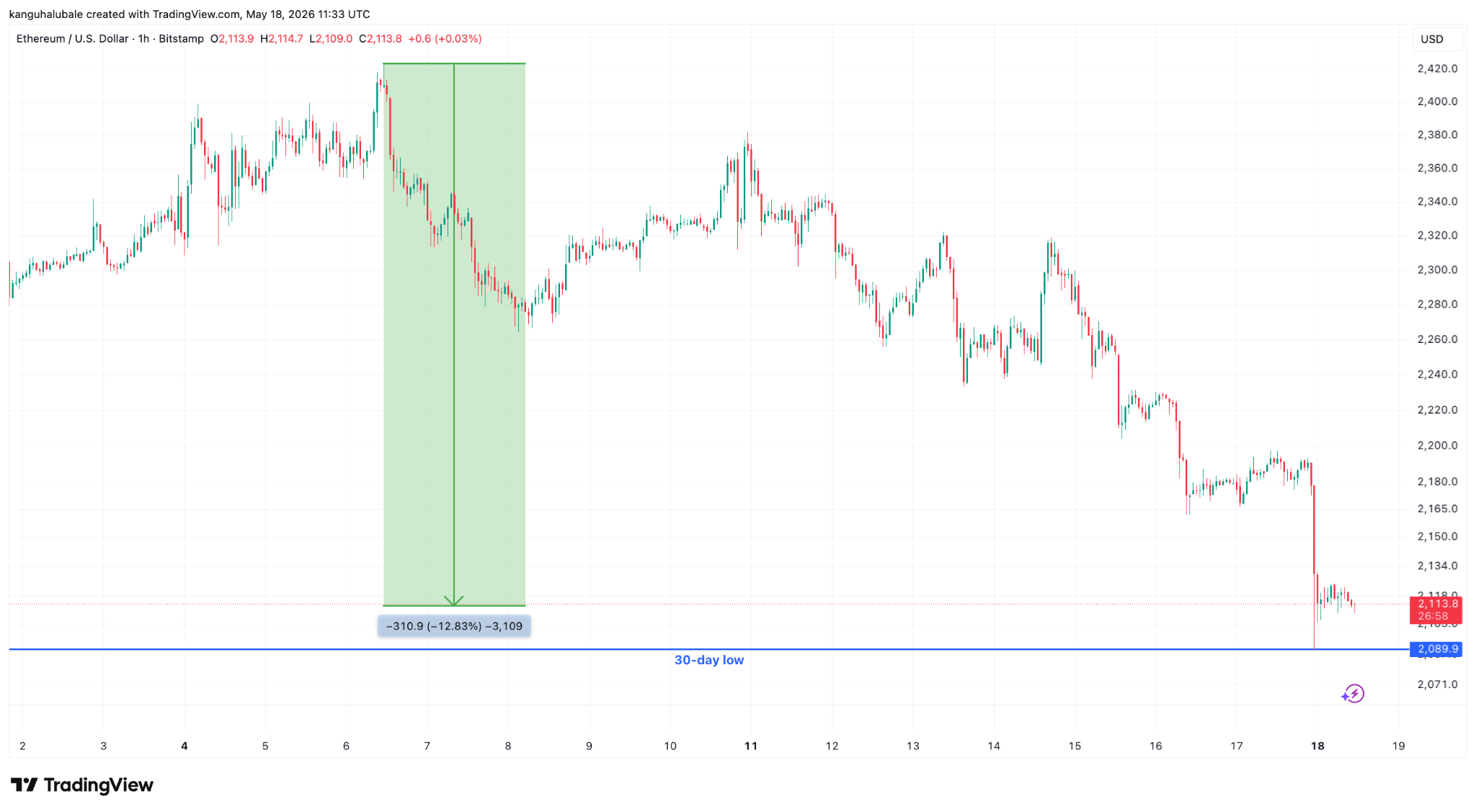
Data from TradingView shows ETH price trading at $2,100, down 12% below its local high of $2,420 reached on May 6. On Sunday, ETH/USD hit $2,090 on Bitstamp, its lowest level since April 17.
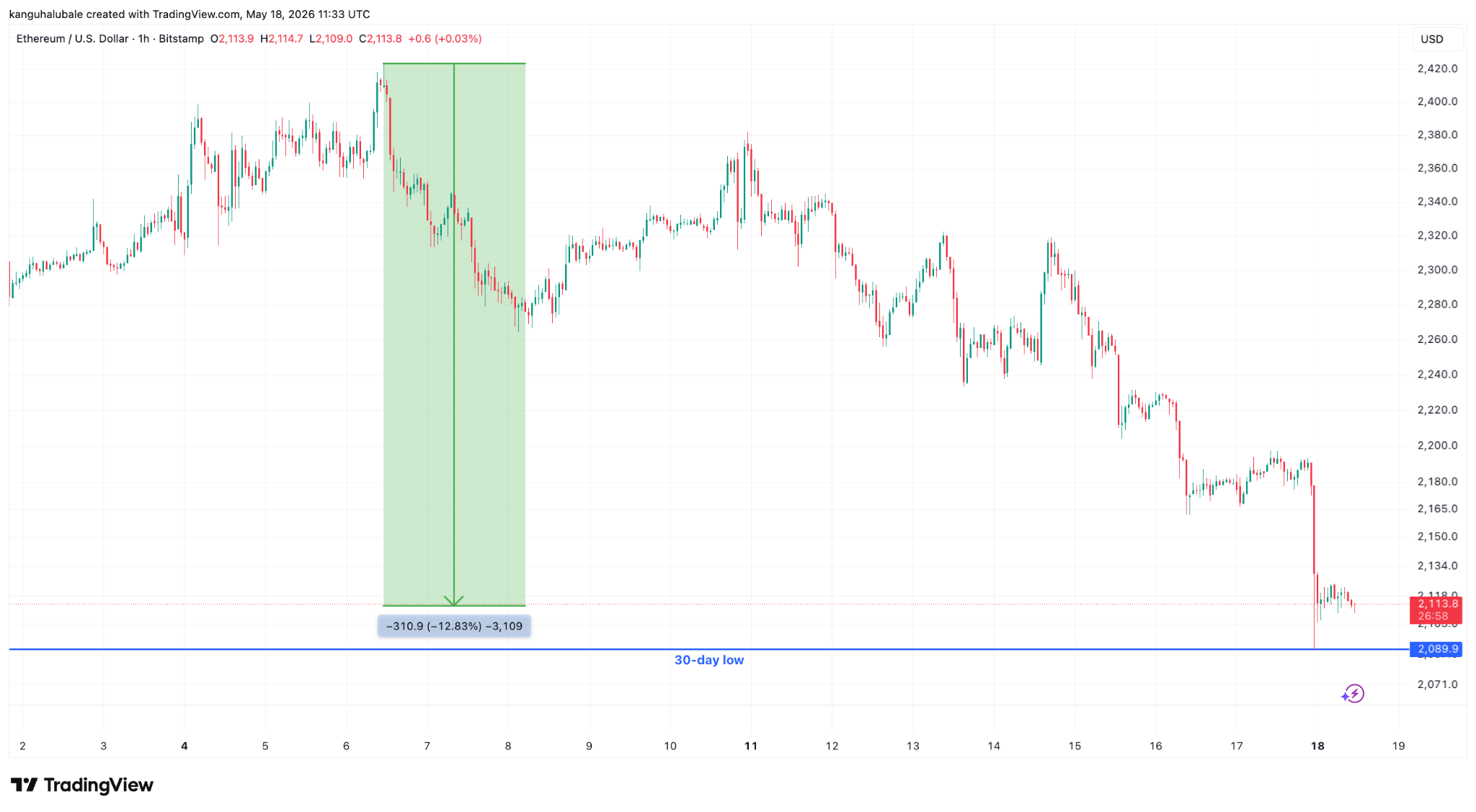
ETH/USD one-hour chart. Source: Cointelegraph/TradingView
The bearish sentiment could be returning to Ether’s market as a key metric from Binance, the largest crypto exchange by trading volume, shows that sellers are starting to dominate the platform’s volumes.
Related: Surging oil prices have been driving Ether selling pressure: Tom Lee
The Binance taker buy volume, which measures the total dollar amount of aggressive sell orders placed by traders on Binance futures, climbed above $1.1 billion within an hour on Sunday as ETH moved toward levels below $2,100.
When this metric spikes during price declines, it often points to forced de-risking or strong short-term bearish pressure from active market participants.
Ether saw “large aggressive sell-volume spikes on Binance while testing important downside levels,” CryptoQuant analyst Amr Taha said in a QuickTake note on Monday, adding:
“This does not necessarily confirm the start of a deeper downtrend. However, it shows that sellers were clearly in control during the move.”
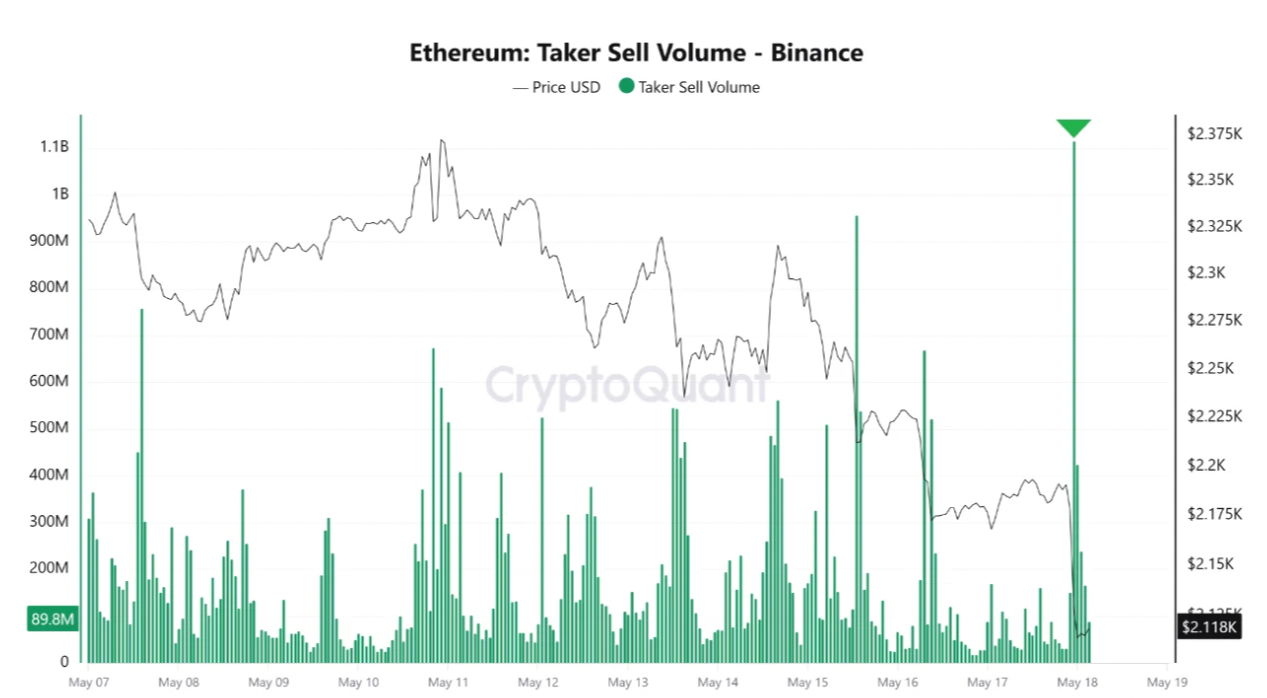
ETH taker sell volume on Binance. Source: CryptoQuant
Increasing outflows from ETH investment products added to the sell-side pressure.
Data from SoSoValue shows US-based spot Ethereum ETFs had net outflows for five consecutive days, totalling $255 million.
This suggests that “institutional momentum has hit a localized wall for Ethereum,” analyst Whale Factor said in a Sunday post, adding:
“This heavy sell-side distribution is keeping a tight lid on prices for now. ”
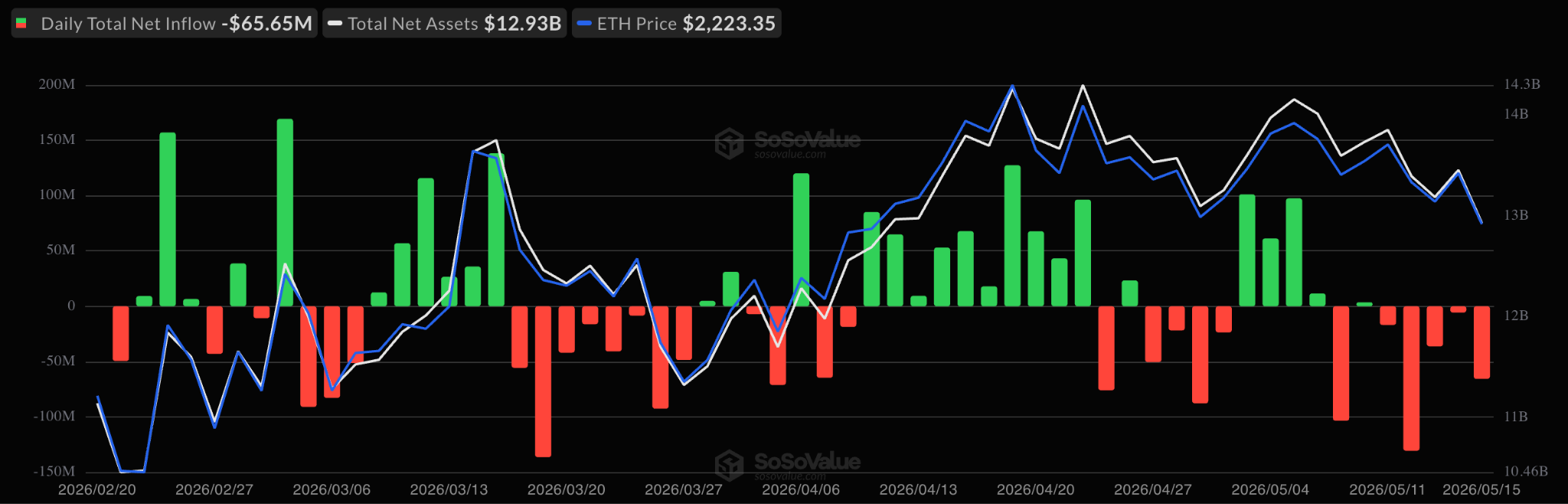
Spot ETH ETF flows chart. Source: SoSoValue
Global Ethereum investment products also saw $249 million in outflows during the week ending May 15, the largest since Jan. 30, data from CoinShares shows.
3.5 million ETH cluster at $2,000 could abate a sell-off
According to Ether’s cost-basis distribution data, investors hold approximately 3.85 million ETH at an average cost basis of $2,000-$2,100, creating a potential support zone. This concentration suggests many investors may add to their positions at break-even, potentially abating another ETH price breakdown.
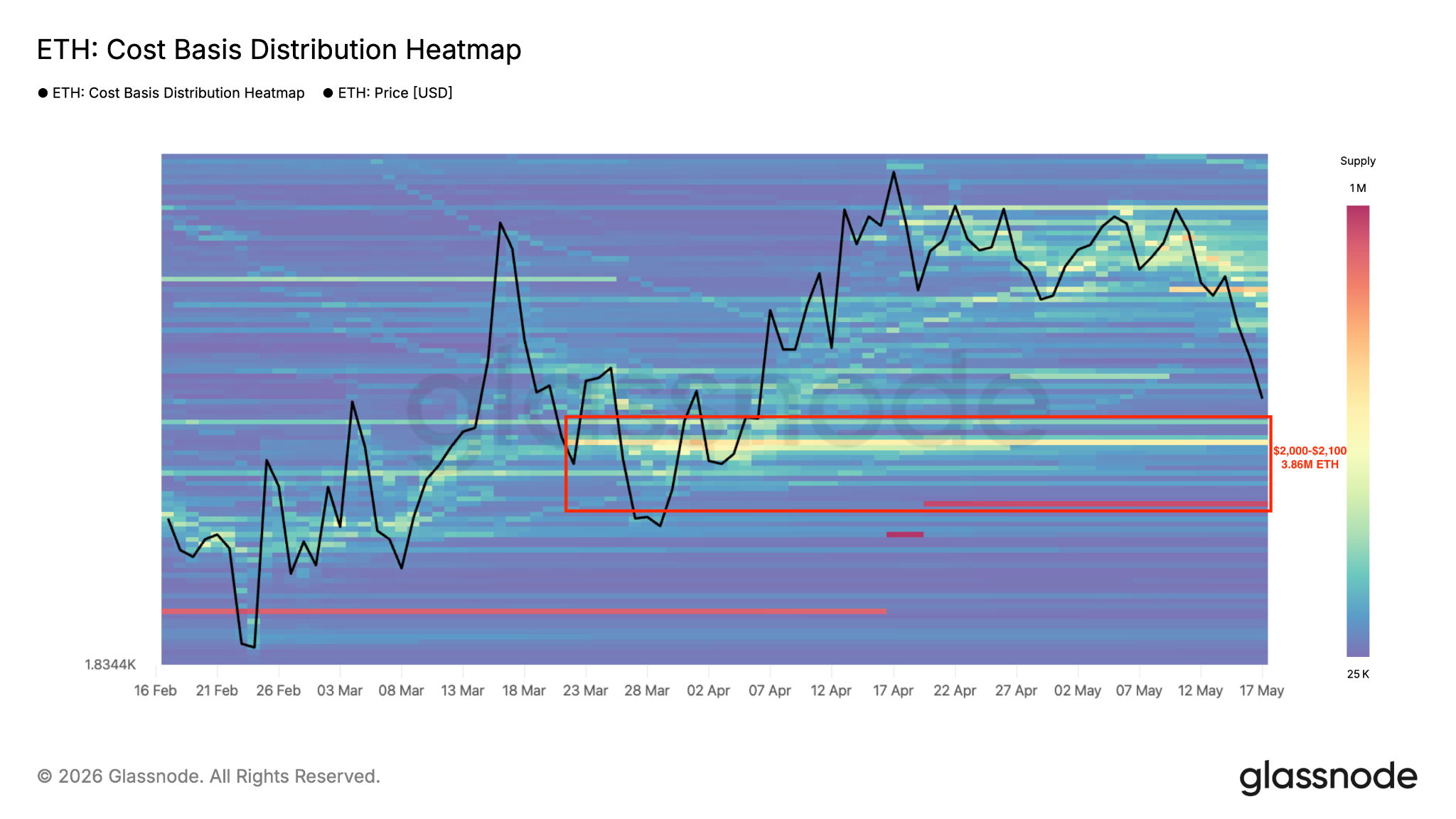
Ethereum cost basis distribution chart. Source: Glassnode
As Cointelegraph reported, the ETH price could potentially drop toward $1,700 after validating a rising wedge pattern on the daily time frame. Traders, however, say the bearish momentum could be stalled if ETH/USD holds above $2,000.
“$ETH dropped below $2,100 as it failed to hold the $2,150 support zone,” said crypto analyst Ted Pillows in an X post on Tuesday, adding:
“The next key support for Ethereum is the $2,050-$2,070 level, which could provide some bounce back.”
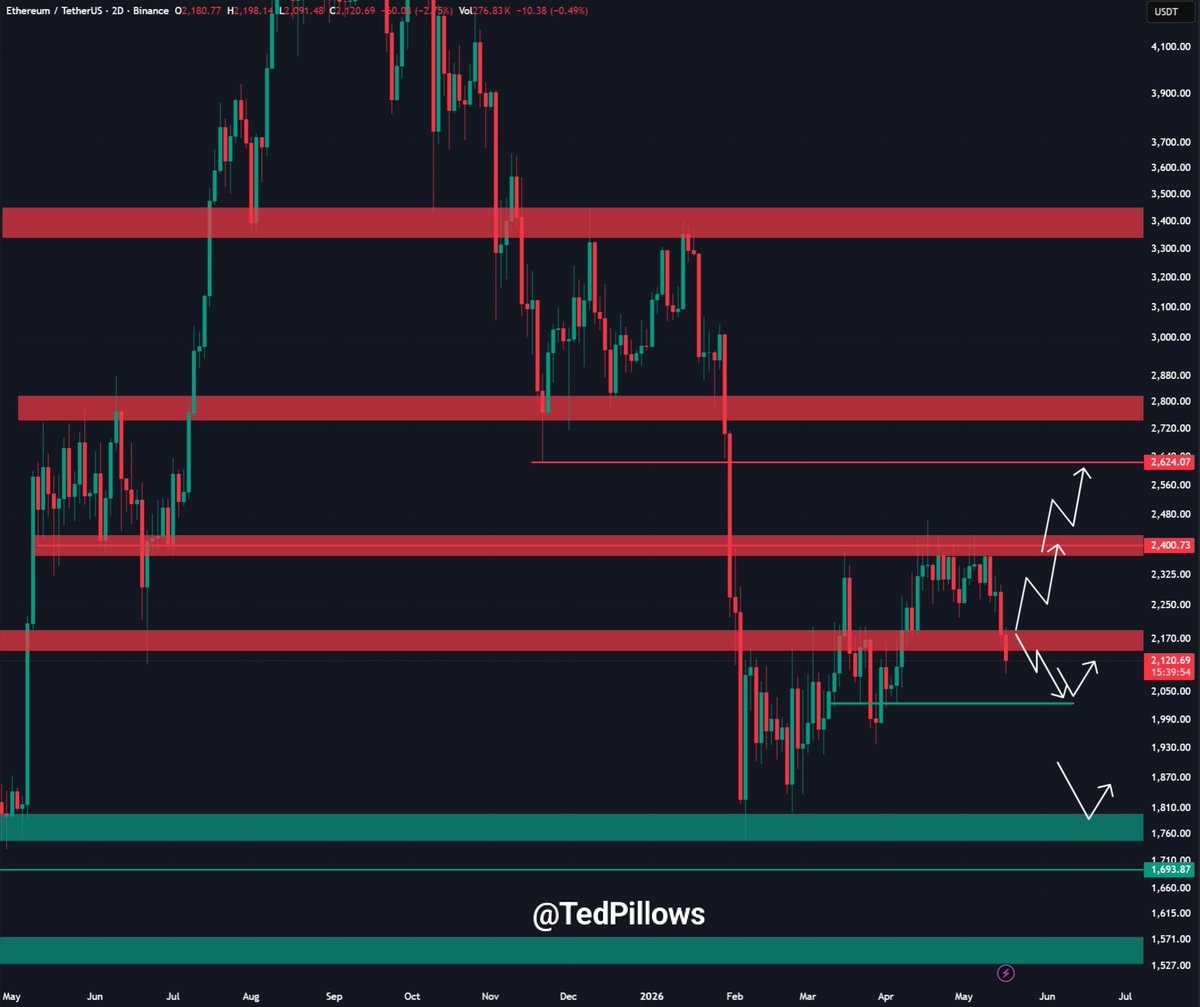
ETH/USD daily chart. Source: X/Ted Pillows
Technical analyst Donald Dean said ETH bulls need to defend the “lower volume shelf support near $2,100” to avoid a move below a rising channel on the daily chart.
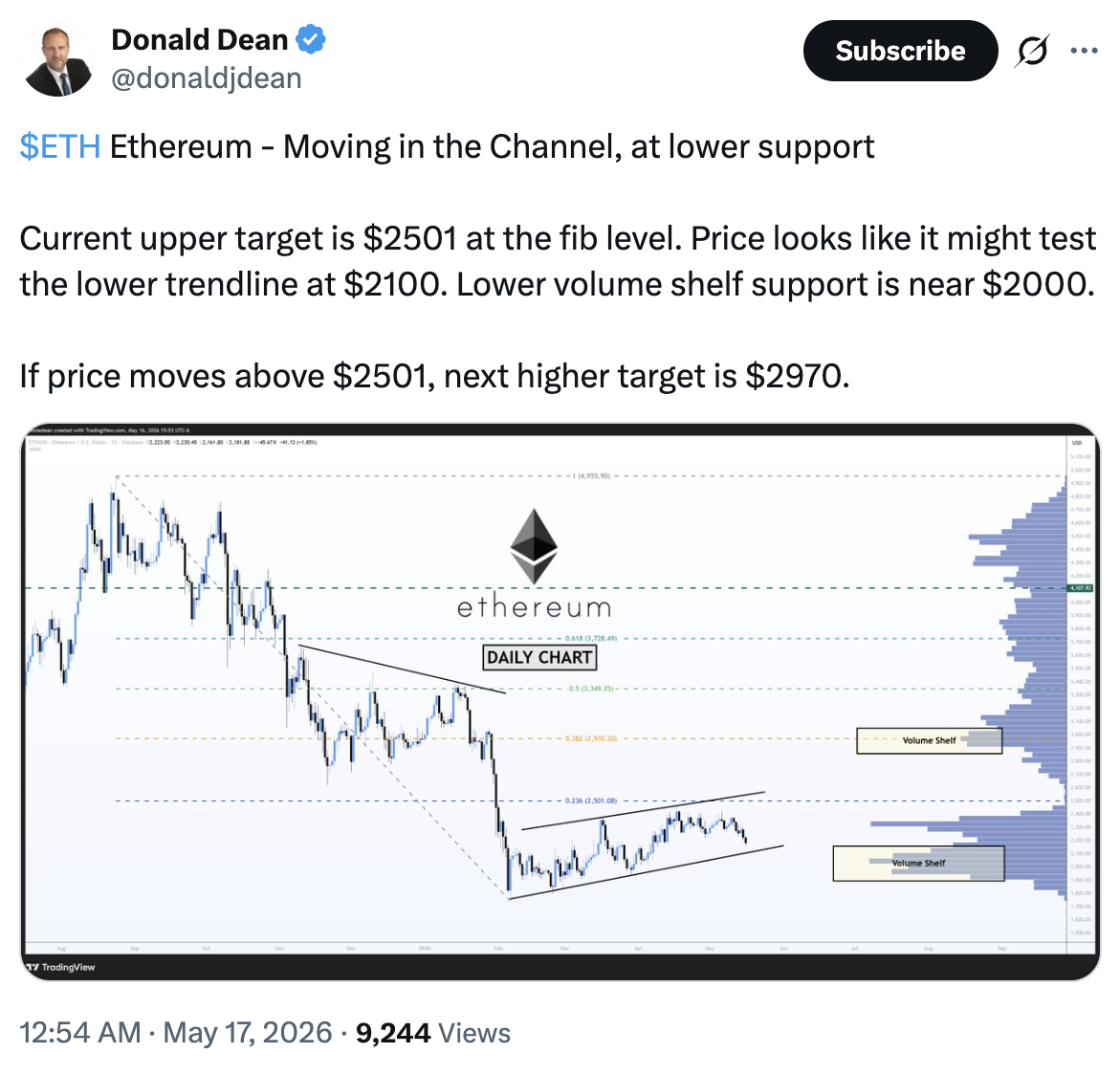
ETH/USD daily chart. Source: X/Donald Dean
Fellow analyst Cryptorphic said if the ETH/USD pair fails to “hold this area and consolidates below it, we could see a continuation toward lower support levels,” adding:
“The recent breakdown below the local support area shows that buyers are getting weaker in the short term.”
Meanwhile, Sharplink CEO pointed out three catalysts that the ETH price needs to surge higher, including the passage of the CLARITY Act in the US, a return of marketwide risk appetite, and growth in real-world asset tokenization on Ethereum.


The move brings onchain yield and lending to the payments-focused chain in a bid to offer full-stack onchain finance platform to companies building on it.

Key Highlights
-
Payward achieves $507M in Q1 revenue while market speculation grows around Kraken’s IPO delay.
-
Revenue climbs 3% year-over-year for Kraken’s parent despite challenging crypto market conditions.
-
EBITDA margins compress at Payward as Kraken invests heavily in acquisitions and product development.
-
Strategic expansion moves Kraken into equities trading, derivatives, payment solutions, and tokenized assets.
-
Public listing timeline for Payward draws scrutiny as valuation estimates decline throughout 2026.
Payward disclosed adjusted revenue of $507 million for the first quarter of 2026, maintaining momentum despite significant cryptocurrency market headwinds. The parent organization of Kraken achieved 3% revenue expansion year-over-year while industry-wide trading participation declined substantially. These financial results emerged alongside speculation regarding a potential postponement of the company’s initial public offering until 2027.
Kraken Parent Maintains Revenue Growth Despite Industry Slowdown
The exchange platform processed $357 billion in aggregate transaction volume throughout the three-month period. Cryptocurrency trading momentum decelerated as macroeconomic headwinds and international tensions dampened market sentiment. Bitcoin’s value declined 22%, while the overall digital asset market capitalization contracted 23% during this timeframe.
Despite challenging market conditions, Kraken captured increased market share in spot trading activities. The platform’s portion of spot volume expanded from approximately 3.5% in mid-2025 to reach 5.2% by March 2026. Additionally, Payward maintained 59% of its spot trading volume measured from the December 2024 high-water mark, demonstrating superior resilience compared to major competitors.
Adjusted EBITDA declined to $18 million from $168 million recorded in the prior-year quarter. Payward attributed this reduction to ongoing investments across product development, strategic acquisitions, regulatory compliance initiatives, and customer base expansion. While maintaining profitability, the organization prioritized long-term growth initiatives over immediate margin optimization.
Strategic Acquisitions Drive Platform Diversification Beyond Digital Assets
Through targeted acquisitions, Payward constructed a comprehensive multi-asset infrastructure platform. The Backed acquisition enables tokenized equity offerings, while Magna delivers token lifecycle management capabilities for issuers and blockchain protocols. Bitnomial enhances US-based derivatives operations, and the anticipated Reap closing adds payment processing and card infrastructure functionality.
Consumer product offerings expanded significantly during the opening quarter. The platform introduced US stock and ETF trading through Kraken Desktop while launching traditional finance futures for European Union customers. Additional rollouts included dual investment products, enhanced margin trading pairs, DeFi Earn capabilities, and Kraken CLI for command-line execution.
These product initiatives demonstrate Payward’s strategic pivot beyond cryptocurrency spot trading. NinjaTrader integration, Breakout features, and broadened futures access contributed to a 51% year-over-year increase in average daily futures revenue trades. Consequently, Payward diversified revenue generation away from direct cryptocurrency price correlation.
Public Offering Timeline Uncertainty Grows Amid Valuation Fluctuations
Following a November funding round at a $20 billion valuation, Payward submitted confidential IPO registration documents. Subsequent market reports indicated a reduced implied valuation after Deutsche Börse’s $200 million strategic investment. That transaction reportedly established Kraken’s fully diluted valuation near $13.3 billion.
The public listing schedule now faces intensified market examination following reports suggesting potential postponement into 2027. This timeline adjustment follows cryptocurrency price declines, diminished trading volumes, and downward pressure on exchange sector valuations. Payward reportedly reduced headcount by 150 positions last week as part of operational cost optimization efforts.
Since its 2011 inception, Kraken has established itself among the cryptocurrency industry’s most enduring exchange platforms. Its parent organization now positions itself as a diversified infrastructure provider spanning digital assets, equities, derivatives, payments, and tokenization services. The first-quarter financial disclosure reveals an organization sustaining revenue growth while navigating preparation for public market transparency requirements.

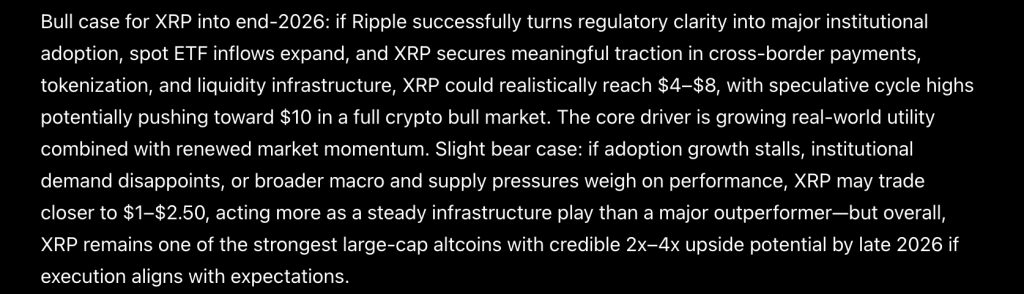
XRP holders have been staring at the same $1.20 to $1.60 range and price prediction for months, Sam Altman’s ChatGPT AI quietly ran the numbers and landed on a predicts that makes that range look like a launchpad.
$4 to $8 by end-2026, with a speculative cycle high potentially pushing toward $10.
ChatGPT’s framework is built around a single core thesis: real-world utility finally meeting institutional capital at the same moment.
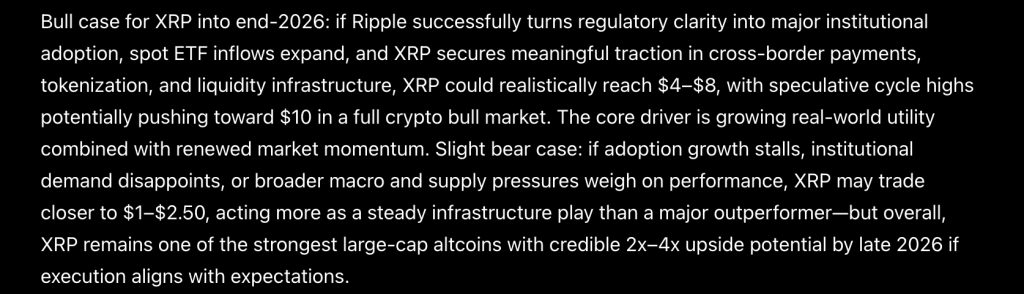
Regulatory clarity is no longer a future event; it is the present reality, and the AI argues that the market has not yet fully repriced what that means.
Spot ETF inflows are expanding the institutional demand channel in real time. XRP is securing meaningful traction in cross-border payments, tokenization infrastructure, and liquidity corridors simultaneously, which means the utility argument is no longer concentrated in 1 use case that can be disrupted.
The combination of all 3 moving together is what ChatGPT calls the core driver, and it frames the 2x to 4x upside as credible rather than speculative, given where Ripple’s enterprise pipeline sits today.

The bear case is honest and specific. If adoption growth stalls, institutional demand disappoints, or macro and supply pressures weigh on performance, ChatGPT sees XRP trading closer to $1 to $2.50, acting more as a steady infrastructure play than a major outperformer.
That is not a collapse scenario; it is a slow bleed scenario, which, for long-term holders, is arguably the more frustrating outcome.
The AI is clear that XRP remains one of the strongest large-cap altcoins in the market, but execution has to align with expectations for the upper targets to materialize.
XRP Price Prediction: Just Needs to Clear $1.60 and the Sequence of ChatGPT AI Predicts Begins
XRP price is trading at $1.3825 on the daily, and the chart has laid out exactly what the bull case looks like at each step.
4 levels are marked in sequence: support at $1.20, resistance at $1.60, then targets at $2.40, $3.10, and $3.64. Each one is a gate. None of them opens until the previous one closes behind it.
The immediate problem is that price has pulled back from the recent $1.50 push and is now sitting at $1.38, closer to support than resistance.
That gives the setup a different feel than it had 2 weeks ago. The $1.20 support zone marked in red is not far below current price, and with RSI cooling off, the next few daily closes matter more than usual.
Resistance remains $1.60, the level that has defined the ceiling of this entire recovery phase since February. Nothing above it is relevant until it breaks.
Above $1.60 the path the chart projects is a move to $2.40, consolidation, then continuation toward $3.10 and $3.64, which sits right inside ChatGPT’s $4 to $8 range as the first meaningful milestone.
ChatGPT’s $4 to $8 call needs the chart to hold $1.20 first. Right now, that floor is closer than the ceiling.
Discover: The best crypto to diversify your portfolio with
ChatGPT Says That Bitcoin Hyper Could Outperform XRP Next
Large-cap upside is getting harder to find. Bitcoin recovering to previous highs from here is a single-digit percentage move. That math pushes risk-tolerant capital toward earlier positioning.
Bitcoin Hyper is built for exactly that rotation. The project is building a Bitcoin Layer 2 using the Solana Virtual Machine, enabling developers to access smart contract functionality and near-zero fees without leaving Bitcoin’s security model behind. The gap it is targeting is real and has been sitting open for years. No other major blockchain has solved native high-speed programmability on top of Bitcoin.
The presale is at $0.013679 with over $32 million raised and staking incentives available for early participants.
The risk profile deserves honesty. Execution is unproven. Post-launch liquidity is unknown. Adoption does not follow automatically from good infrastructure. Every early-stage play comes with those question marks and this one is no different.
What is different is the entry point. The upside that institutional capital cannot access at Bitcoin’s current market cap is still fully available here. That is the tradeoff. Higher potential, higher risk, and a window that closes once the market catches up.
The post Sam Altman ChatGPT AI Predicts Shock XRP Price By End of 2026 appeared first on Cryptonews.
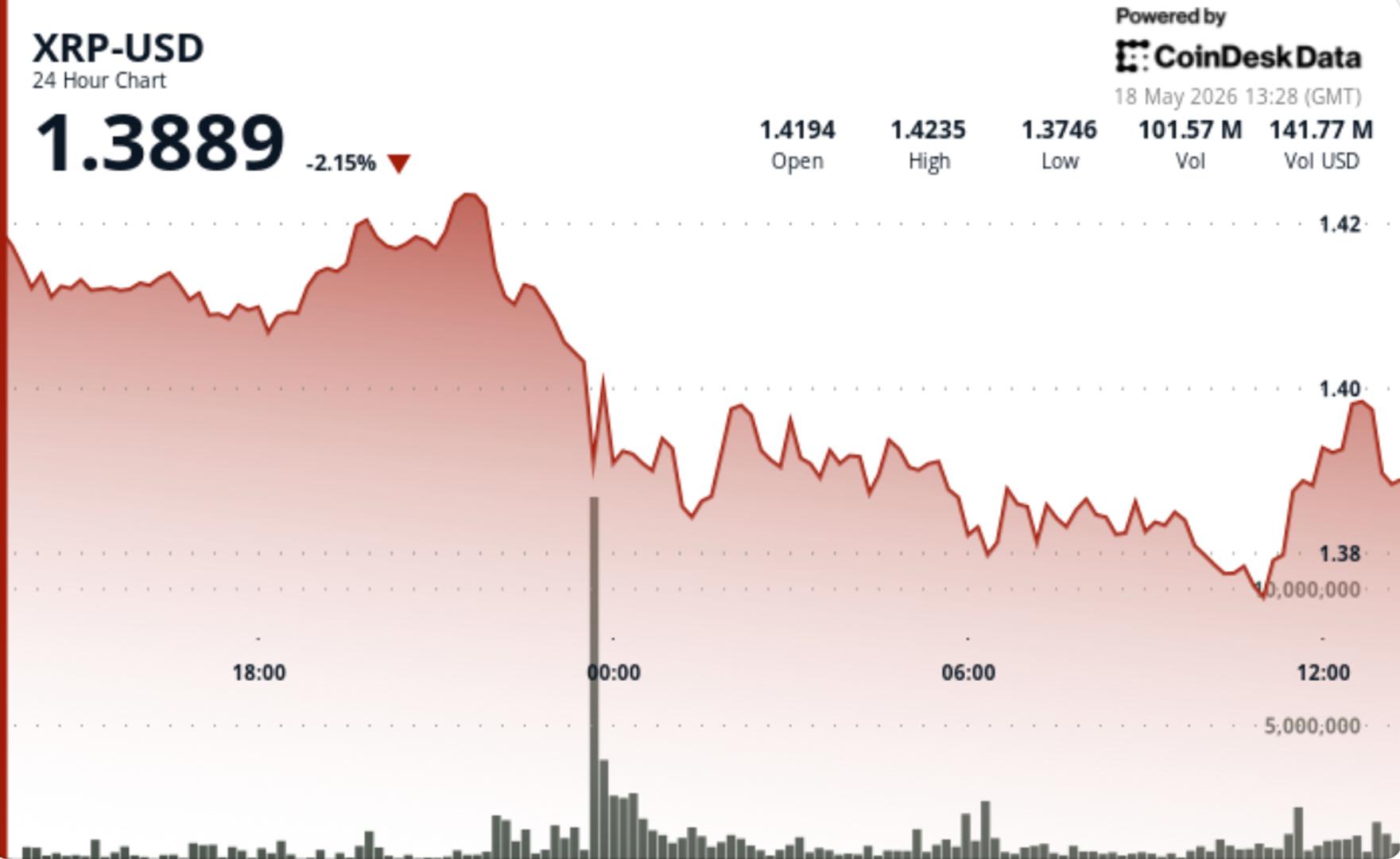
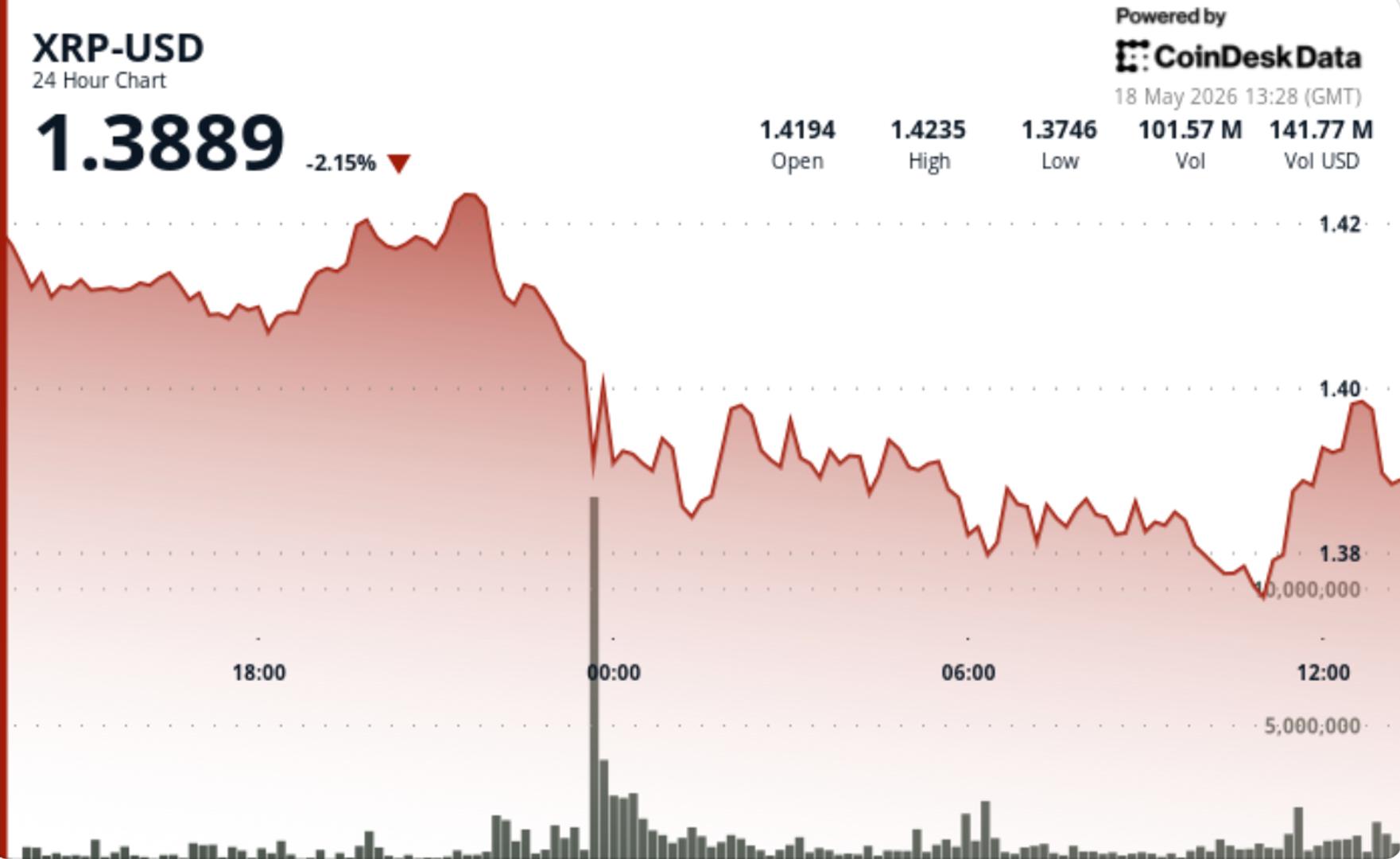
XRP gave back gains after a high-volume selloff erased the latest breakout attempt, though buyers stepped back in near support around $1.38.


The White House says it has achieved a legal and custody “breakthrough” for the US Strategic Bitcoin Reserve, finally giving Washington a compliant way to safeguard billions in seized BTC.
Summary
- White House Digital Assets Executive Director Patrick Witt confirmed legal and custody frameworks for the Strategic Bitcoin Reserve are now in place
- The announcement signals the administration has cleared key regulatory hurdles without requiring immediate congressional action
- Witt described the development as a “breakthrough” that allows proper safeguarding of government-held digital assets
The White House has confirmed a major operational breakthrough for the U.S. Strategic Bitcoin Reserve, with an announcement expected in the coming weeks. Patrick Witt, Executive Director of the President’s Council of Advisors for Digital Assets, revealed during an interview at Consensus 2026 that the administration has successfully established the legal compliance and asset custody structure required to protect government-held crypto assets.
“We’ll have an announcement…It’s a breakthrough as far as getting everything in place, legally sound, properly safeguarding the assets,” Witt said during the interview with Scott Melker. The statement marks the first official confirmation that the reserve framework has overcome regulatory obstacles that previously prevented the government from properly securing seized Bitcoin (BTC) holdings.
Legal framework in place
The breakthrough comes more than a year after President Donald Trump signed an executive order establishing the Strategic Bitcoin Reserve in March 2025. That order directed federal agencies to consolidate Bitcoin obtained through civil and criminal forfeiture into a single reserve account and prohibited the Treasury from selling the assets. Witt emphasized that while executive orders established the initial framework, legislative action remains necessary to ensure long-term protections and permanence.
The administration is working closely with Deputy Harry John and Stephen Miller’s policy team on interagency collaboration for the reserve, even as congressional attention focuses on the CLARITY Act. Witt warned that executive orders alone are vulnerable to reversal by future administrations, citing policy shifts between the Trump and Biden administrations as evidence that congressional codification through the BITCOIN Act and American Reserve Modernization Action Act is essential.
Strategic positioning
According to Wikipedia, the U.S. government is estimated to hold approximately 328,372 BTC as of February 2026, making it the largest known state holder of Bitcoin globally. With Bitcoin trading around $77,277 as of May 18, 2026, the government’s holdings represent approximately $25.4 billion in value. The reserve framework treats Bitcoin as a strategic asset comparable to gold or petroleum stockpiles, rather than a speculative investment.
Witt also highlighted custody failures, noting that losses by U.S. Marshals demonstrate gaps in the current system that require both the BITCOIN and ARMA Acts to properly protect executive orders. The official stressed that failing to establish clear regulatory leadership could force the United States to follow frameworks developed by other nations, potentially benefiting competitors like China in the digital asset race.

Iran is reportedly considering the introduction of a bitcoin (BTC)-based insurance policy for safe passage through the Strait of Hormuz that it believes will make the country $10 billion in revenue.
That’s according to state-backed news outlet Fars News, which reported on Saturday that the system has been in the works since April.
The proposed policy is called “Hormuz Safe,” and its website claims it will provide “Iranian shipping companies and cargo owners with fast, verifiable digital insurance — paid via BTC and settled at the speed of the blockchain.”
Fars News reports that Iran wants to legally control the Strait after the war’s conclusion and commercialise the route to boost its economy.

Read more: Crypto scams are now a threat in the Strait of Hormuz, report
The outlet reports that, “With this plan, various marine insurance policies and financial liability certificates can be issued, which could generate over $10 billion in revenue for the country.”
Iran has also reportedly created a new government body today to help manage the Strait, while peace talks with the US appear to have come to a standstill. Countries in Europe are also holding talks with Tehran over passage through the Strait.
Iran’s previous BTC toll exploited by scammers
Iran has already demanded that ship owners pay BTC tolls. At the time, officials wrongly implied that the crypto would be free from the restrictions of sanctions.
The US has also sanctioned Iran’s BTC wallets and other state-owned entities, so payments in BTC won’t alter these restrictions.
After the first set of tolls were announced, scammers attempted to exploit the news by sending ship masters phony emails pretending to be Iranian authorities and asking for payment.
One ship may have fallen victim to the scammers as the vessel’s crew, thinking they had paid the toll, was still fired upon by Iranian forces.
Got a tip? Send us an email securely via Protos Leaks. For more informed news and investigations, follow us on X, Bluesky, and Google News, or subscribe to our YouTube channel.


Co-CEO Arjun Sethi said the firm kept investing through market weakness, leaning on acquisitions and futures growth to offset softer spot trading.

XRP MAJOR WARNING!!!! WATCH BEFORE THURSDAY’S VOTE!!!! (CLARITY ACT)

Spring Autojumble Marks 30th Year With Booming Attendance

Plant-based sales in the US continue to slide

Manchester United reach agreement with Casemiro over contract clause amid transfer speculation

US brings back mandatory military draft registration

Steven Gerrard disagrees with Gary Neville over ‘shock’ Chelsea and Arsenal claim | Football


-

 Crypto World3 days ago
BloFin War of Whales 2026 Grand Prix opens registration for $5M trading championship
-

 Fashion3 days ago
Weekend Open Thread: Theory – Corporette.com
-

 Crypto World3 days ago
E-Estate Announces 1 Year Live: Washington DC Summit as Real Estate Tokenization Enters Its Next Phase
-

 Fashion7 days ago
Coffee Break: Travel Steam Iron
-

 Politics7 days ago
What to expect when you’re expecting a budget
-

 Tech3 days ago
Tech Moves: Microsoft AI leader jumps to OpenAI; former AI2 exec joins Meta; and more
-
Crypto World5 days ago
Bitcoin Suisse expands with Digital Asset License and Investment Business Act Registration Approval in Bermuda
-

 Tech7 days ago
GM agrees to $12.75M California settlement over sale of drivers’ data
-

 Politics6 days ago
Pakistan to enter Chinese capital market as war inflation bites
-

 Crypto World6 days ago
Bitcoin Suisse expands with Digital Asset License and Investment Business Act Registration Approval in Bermuda
-
 Crypto World4 days ago
Google’s Gemini AI Predicts Incredible Solana Price by the End of 2026
-

 Business3 days ago
H&R Real Estate Investment Trust (HR.UN:CA) Q1 2026 Earnings Call Transcript
-

 Tech3 days ago
Google reimburses Register sources who were victims of API fraud
-

 Sports3 days ago
Napoleonic enters 2026 Doomben 10,000 field via Abounding withdrawal
-

 Politics7 days ago
The geopolitics behind the UK’s South Atlantic hantavirus rescue mission
-

 NewsBeat6 days ago
Comment on Keir Starmer surviving the day as Prime Minister like a turd that wont flush
-

 Politics7 days ago
The Board of Deputies just smeared Polanski to suck up to Farage
-

 Fashion6 days ago
The Best-Kept Makeup Secret for a More Defined Face
-
 Entertainment4 days ago
Zara Larsson Has Blunt Response To Chris Brown Diss
-
 Tech5 days ago
Why AI is making typography a boardroom conversation
You must be logged in to post a comment Login