
Security teams log 54% of successful attacks and alert on just 14%. The rest move through your environment unseen.
The Picus whitepaper shows how breach and attack simulation tests your SIEM and EDR rules so threats stop slipping by detection.



Before cloud storage, people’s digital lives stayed confined to their devices. If you needed a file from your work computer while on vacation, you’d have to hope someone was around to email it. Forgetting to back up your smartphone before buying a new one often meant losing years of photos and videos. When services like Dropbox and eventually Google Drive, iCloud, and more arrived, that all changed. We can now keep files synced across devices, and precious memories don’t die when your phone does.
Although cloud storage is convenient, it comes at a cost. The difference between cloud and local storage is primarily one of ownership. You should never think of your cloud storage as belonging to you. It’s the digital equivalent of renting a storage unit: your belongings are hosted on someone else’s property. The owner may give you a key, but you’re trusting them not to change the locks on you, and you aren’t there to protect your belongings from break-ins and theft. In both cases, your peace of mind when you store things there depends on how trustworthy the owner is and how robust the company’s security protocols are.
You probably wouldn’t store anything at a storage rental that you couldn’t live without, and the same rule of thumb applies to cloud storage. From sensitive personal documents that could lead to identity theft and doxxing to large files that will wastefully eat up your allotted storage, there are many file types worth keeping off your cloud drive. Here are five files you should never upload to your cloud storage.
We’ve all done it. You need to get some paperwork to your accountant, lawyer, or doctor, so you snap a photo of the documents or scan them into a PDF and send them along. There are already inherent security risks in doing that, since you never know how careful the other person will be with those scans. But if your device automatically backs up photos to a service like iCloud or Google Photos, you could be creating even more risk. For that reason, you should refrain from uploading personal files –such as government IDs and passports, tax returns, medical or legal records — to the cloud.
Notably, there’s the risk of being hacked. While you can take steps to secure your cloud accounts, no digital fortress is impenetrable. Whether you fall victim to a phishing attack, leave your phone unlocked at a busy bar during a moment of distraction, or simply neglect to change a non-unique password after it was discovered in a breach from another platform, there are innumerable ways for malicious actors to gain access to your account. Any personal information an attacker finds could be used against you to commit identity theft, doxx you, blackmail you, and more.
You additionally risk data loss when uploading anything to the cloud. Google any storage provider along with the phrase, “deleted my files without asking me,” and you’re likely to see pages of results from disgruntled users who lost irreplaceable files. Some of these instances may be due to user error — some people simply don’t understand what a delete button does — but many are not. Cloud architecture is far from infallible, and mistakes do occur. If you decide that uploading personally identifiable files is worth the risk, back up the files to an external drive.
Revealing photographs of yourself, or those consensually obtained from an intimate partner, should not be uploaded to cloud storage for several reasons. First, as with other file types discussed here, you can never assume complete privacy when uploading media to a cloud service. The risk that your account could be hacked is always present, which could lead to such media being leaked online. Despite “take it down” laws allowing you to seek recourse when revealing photos are uploaded without your consent, that’s a nightmare situation you’re best off avoiding by keeping such media stored locally.
But there’s one more reason to avoid uploading revealing media to the cloud. AI scans of your photos can get your account banned by Google or other providers, even if the media flagged by the system is entirely legal. In fact, your media can be flagged even if it is not prurient. In one case reported by The New York Times, a father who took photos of a medical issue his child was experiencing in order to consult with the child’s doctor had his account banned when the photos were mistaken for child sexual abuse material (CSAM). His details were even forwarded to law enforcement, making him the target of a police investigation.
The New York Times reported on another case wherein a mother whose young child uploaded a video of himself innocently dancing naked found herself in a similar situation. While these tools have thankfully led to the prosecution of actual criminals, the risk of being caught in that dragnet for uploading completely legal material is severe enough that you should always err on the side of caution.
If you use the free tier of Dropbox, Google, iCloud, or any other cloud provider, you’ll start with very limited storage. On the generous end, Google gives unpaid users 15 gigabytes of free storage (though it includes emails in your Gmail account), but others are more tightfisted. Dropbox, for instance, only provides 2 gigabytes to users who don’t cough up for a subscription. Apple gives free iCloud users 5 gigabytes.
Many users can make a free cloud storage option work, as long as they don’t have too many large files uploaded. Emails, documents, and similar files take up relatively little space. Photos take up slightly more, but if you’re only shooting from your smartphone on its default settings, they’ll take up just a few megabytes.
However, if you’re uploading videos — especially at higher resolutions — things can quickly get out of hand. A one-minute 4K-resolution, 60 frames-per-second video shot on a Samsung Galaxy S25 Ultra in automatic camera mode takes up just about 400 to 500 megabytes of space. If you’re uploading to Dropbox’s free plan, you’ll hit your limit after just four or five minutes of video at that rate. If you’re an avid smartphone videographer using free cloud storage, be sure to disable automatic backups on Google Photos, Dropbox, and other services.
As an aside, this is why high-resolution videos are the first files you should tackle if your cloud storage warns you that it’s running out of space. Videos, especially those shot at 1080p or higher, are the most likely to take up multiple gigabytes of space, and deleting large videos is the easiest way to reclaim storage space both locally and in the cloud.
Many people don’t often consider how easy it is to end up in court. Sure, you might not be a hardened criminal, but that doesn’t mean you can’t be charged with a crime or have a suit filed against you. And if you do end up in front of a judge, the opposing party will be allowed to dig through your digital life for evidence relevant to the case in a process known as electronic discovery. Many cases are lost when a lack of digital hygiene meets the legal system, not to mention the personally harmful or embarrassing secrets that can be unearthed. And uploading files to the cloud can make it easier to argue for their discovery, including files that would otherwise have been off-limits thanks to attorney-client privilege.
The rise of AI has made this issue even more pressing. The U.S. District Court for the Southern District of New York ruled in 2026 that conversations held between a defendant and a publicly available AI chatbot regarding the legal defense strategy were not protected by attorney-client privilege, even though he had also shared those conversations with his lawyer. The FBI had seized the documents, and the judge cleared federal prosecutors to use them as evidence. Given that prominent cloud storage providers such as Google Drive can integrate with chatbots like Gemini, you may be waiving important privacy rights for any files that are scanned by a chatbot.
To be clear, this is not legal advice, and we are speaking in a personal context, not an enterprise one. But most people don’t hire a lawyer until they need one, and so it’s best to make their job as easy as possible before they even enter the picture.
If you’re anything like most people, you struggle to remember all your passwords. And since you should always enable 2-factor authentication on your accounts, you’ve likely got a bunch of 2FA backup codes meant for emergencies that you don’t know what to do with. It’s entirely understandable that many people may choose to upload passwords and backup codes to a cloud provider, but doing so is a mistake — and it could cost you dearly.
As with other types of files we’ve discussed, there’s always the possibility that your cloud storage could be breached by a hacker. If they then find your unencrypted text files filled with passwords and backup codes, they’ll be able to access the rest of your accounts, potentially hijacking your identity beyond the point of recovery and even committing crimes in your name. Encrypting those files before upload so that they cannot be accessed without a password can offer a layer of protection, but it’s best to use a dedicated password manager.
Additionally, with so many cloud storage providers now offering AI integrations, you’ll essentially be feeding all of your passwords directly into a chatbot. If the provider uses your files for training data, the LLM could regurgitate your passwords to other users. Even if it doesn’t, your private interactions could accidentally be made public. In June 2025, WIRED reported that one of Meta’s AI apps had added a feature allowing users to see conversations other users had with LLMs, and in July of that year, TechRadar reported that using a simple “site:chatgpt.com” search operator in Google can unearth OpenAI users’ chats depending on their sharing settings. Those relied on users not understanding privacy controls, but in late 2023, Google researchers were able to make ChatGPT output other people’s personal information.


An employee group filed a civil rights complaint against Amazon with the City of Seattle on Thursday on behalf of three engineers who allege that the company is wrongly investigating them for testifying before the Seattle City Council in favor of regulating data centers.
The complaint, filed by Amazon Employees for Climate Justice (AECJ), invokes an unusual Seattle law that bars employers from discriminating against workers based on political ideology.
Amazon acknowledged the investigations but characterized them differently, citing its policy against employees speaking publicly as representatives of the company without first going through specific procedures. A spokesperson described this as the focus of the internal inquiry, noting that employees are free to discuss working conditions in their individual capacity.
The three engineers — Patrick Schloesser, Darius Irani, and Liesl Wigand — testified June 3 before city council subcommittees in support of regulating data centers. Each opened by noting they were legally protected from retaliation for speaking out.
A week later, Amazon’s Employee Relations team called them into separate meetings and told them they were under a disciplinary investigation, according to the complaint, a copy of which was reviewed by GeekWire.
“After publicly affirming our right to speak freely, Amazon privately interrogated me, asking me the same questions over and over to try to get me to admit to doing something wrong and made me feel like I committed a crime,” Irani said in a statement released by the group.
The complaint says the engineers were told the investigation could lead to termination.
Amazon denied that it threatened to fire the engineers or told them they were at risk of termination, saying the reference came up in response to a direct question and was taken out of context in AECJ’s characterization of what happened.
After reviewing the testimony, “it became clear that they may have been speaking in their capacity as Amazonians and not as private citizens,” said Amazon spokesperson Margaret Callahan in a statement. “We believe it’s important to apply our policies consistently so, just as we would with anyone else, we’re investigating whether there was a violation of our policies and may or may not take action based on what we find.”
She added, “It’s important to note that we don’t tolerate retaliatory behavior.”
Under the city’s Fair Employment Practices Ordinance, the Seattle Office for Civil Rights will investigate the complaint and determine whether there is reasonable cause to support the allegations. Remedies can include reinstatement, back pay, and financial damages.
Following testimony by more than 50 people, including members of AECJ, the full Seattle City Council voted unanimously on June 9 to impose a one-year emergency moratorium on new large data centers inside the city limits.


ai and ml
San Francisco plays host to hosting company’s Localhost conference
On Thursday during a developer event held at San Francisco’s St. Regis Hotel, the marketing stack failed. Literally.
During an AI agent workflow demo on the fourth floor balcony, the wind toppled a tower of three cardboard promotional display cubes. One of these – maybe three or four feet per side – fell over the edge of the balcony and plummeted onto Minna Street below.
Concerned staff rushed to the edge of the parapet and peered over. Evidently satisfied that no one had been injured, they proceeded to dismantle the other stack of boxes, just to be safe – an uncommon level of caution in the context of AI-assisted software development.
Consider the incident a metaphor for the chaos created by the tech industry’s frantic rush to automate whatever can be automated with machine learning models and associated tools.
The event, Localhost, was put on by hosting biz Render as a confab for devs building software for the “AI-native web.” But many attendees expressed uncertainty about the rapid pace of change in the industry.
As one CTO attendee remarked, not realizing he was in earshot of a reporter, “How’re we going to do this? I don’t fucking know. That’s what I have to figure out.”
The CTO said he was looking for engineers to hire, the very thing major tech companies have been dumping to balance capex costs.
Rohan Chavan, who recently earned his master’s degree in computer engineering from Virginia Tech, shared a similar sentiment.
“Every other day,” he told The Register in an interview, “there’s some new term. A week or two ago, it was harness engineering. Now it’s loop engineering.”
Chavan said he found the current state of play both exciting and frustrating. He’s looking for a job in AI security and estimated that about 30 percent of his class of around 120 has been hired so far.
It’s very difficult, he said, to build deep knowledge when things are changing so fast and there’s so much to learn.
Localhost, the company’s first user conference in its eight years of existence, aims to help with that by evangelizing the company’s technical stack.
Some promotion might just be useful. As the aforementioned CTO confided to one of Render’s staff, enterprise customers expect to hear that services run on AWS, Azure, or maybe Google Cloud. “They don’t expect to hear Render,” he lamented.
Nonetheless, Render is doing rather well, according to founder and CEO Anurag Goel, who opened the afternoon’s presentations with the requisite recitation of metrics – 400,000 developers joining every month, 10 million live services, 200 billion monthly requests.
“All of these numbers are growing very rapidly,” he said. “But behind these numbers, we’re also seeing a big change in how applications are evolving to use infrastructure.”
Until a few years ago, he said, infrastructure was relatively static. You deployed an application and the various elements – databases, APIs, caches, and so on – stayed pretty much the same.
AI apps, he contends, are fundamentally different.
“They are dynamic applications that go beyond existing infrastructure patterns,” Goel explained. “Now, in addition to you defining your application statically, the applications themselves are provisioning their own infrastructure resources.”
As an example, he described how the resources required by a research agent can vary from question to question. One user query might require lightweight web scripting. Another might require a headless browser and 128 GB of RAM to process a dataset. And the duration of such tasks can also vary significantly.
“What we’re learning is that any request can trigger hundreds or thousands of different tasks in ways that your code can never really know in advance,” he said.
This doesn’t work on serverless platforms, Goel contends, because of platform limitations that cap execution time, memory, storage, and application size.
Render’s answer to this technical challenge is what Goel calls application-defined compute. It allows applications to run workloads without pre-provisioning.
“Instead of pre-defining the infrastructure for your application, you allow the application to define what it needs at runtime with the right guardrails,” he explained.
With any luck, Render’s guardrails will prevent a pummeling by promotional props better than those at the St. Regis. ®


A New York man faces cyberstalking charges after allegedly sharing AI-generated nude images and fabricated racist messages using fake social media profiles to harass a Georgia college student.
21-year-old Anthony Belford was arraigned June 10 after a federal grand jury returned an indictment charging him with one count of cyberstalking.
Belford and the victim had attended the same college during the 2023-2024 academic year. After the victim transferred to a Georgia college in August 2024, Belford allegedly knew of the move and began targeting the victim there.

According to court documents, between January and March 2025, the defendant created fake Instagram, LinkedIn, Reddit, X, Strava, and Yahoo accounts to impersonate the victim and distribute AI-generated nude images and spread false claims that the victim had made racist remarks about black students and anti-Muslim statements.
Belford allegedly created a fake LinkedIn profile using an AI-generated nude image of the victim as its profile picture, and also used a spoofed Yahoo email account to send an AI-generated nude image of the victim to the victim’s mother.
The defendant allegedly targeted the victim while attending the same college in the 2023-2024 academic year, but continued doing it even after the victim transferred to a Georgia college in August 2024.
“Belford allegedly waged a lengthy online campaign, hiding behind spoofed social media and email accounts to harass, intimidate, and cause substantial distress to his victim with racist messages and AI-generated nude images,” said U.S. Attorney Theodore S. Hertzberg.
“Cyberstalking and other forms of online abuse, just like physical violence, can ruin lives and disrupt communities. Victims of such crimes should not suffer in silence, and we will continue to work with our law enforcement partners to hold the perpetrators of these crimes accountable using all available tools.”
The Justice Department added that federal law prohibits sharing or threatening to share intimate images (including AI-generated ones) without consent and urged victims to report violations to the FBI and to alert the Federal Trade Commission if online platforms fail to remove such content within 48 hours of a removal request.
More information on how to protect yourself from cyberstalking attempts and stop the spread of images and videos shared online without consent is available on the FTC’s Take It Down platform.
In March, 22-year-old Jamarcus Mosley from Alabama also pleaded guilty to cyberstalking, extortion, and computer fraud charges after hacking into the social media accounts of hundreds of young women.
The same month, 26-year-old Kyle Svara from Illinois also pleaded guilty to hacking nearly 600 women’s Snapchat accounts to steal private nude photos that were later traded or sold online.

Security teams log 54% of successful attacks and alert on just 14%. The rest move through your environment unseen.
The Picus whitepaper shows how breach and attack simulation tests your SIEM and EDR rules so threats stop slipping by detection.


The bottleneck in the AI buildout is turning out to be a metal most people have never heard of. China has tightened its scrutiny of exports of indium phosphide, a compound essential to the high-speed optical chips that move data inside AI data centres, in a move that threatens to slow the very infrastructure the technology depends on.
Indium phosphide, or InP, is not a household material, but it is becoming a strategic one. As data-centre operators shift from pushing electrical signals through copper to sending light through optical fibres, a technique known as photonics, InP has become the core material with no ready substitute.
The faster the AI industry wants to move data between chips, the more it needs the compound, and China sits at the chokepoint.
That position is a matter of geology and processing. China produces around 70% of the world’s indium, and since export controls on InP took effect in early 2025, Beijing has been slow to approve the licences that let the material leave the country.
The delays, rather than an outright ban, are the lever: a permit that does not arrive is as effective as a prohibition, and harder to challenge.
The market has felt it. The price of a six-inch InP wafer has climbed from roughly $1,400 to about $5,000 since the controls began, an increase of around 250%, as buyers compete for constrained supply.
Nvidia-backed chipmaker Coherent warned of a shortage earlier this year, and AXT, the world’s second-largest InP substrate producer, has described the export permits as the most significant challenge it currently faces.
The episode fits a now-familiar pattern in the US-China technology contest. Where Washington has restricted China’s access to advanced chips and chipmaking tools, Beijing has answered by leveraging its dominance over critical materials, having already deployed controls on gallium, germanium, and rare earths.
InP is the same weapon pointed at a different part of the supply chain, the optical layer rather than the logic layer.
What makes InP potent is precisely that it targets infrastructure rather than end products. The compound goes into the transceivers and optical components that knit together the thousands of accelerators in a modern AI cluster, so a squeeze on it does not stop any single chip from working; it slows the rate at which whole data centres can be built and wired. The constraint shows up as delayed construction, not failed silicon.
It also lands as the AI industry’s appetite for compute is at its most acute, with operators racing to build capacity faster than the supply chain can support.
The same pressure visible in the scramble for chips and components now extends to a niche material that few outside the industry tracked a year ago. China’s leverage over it has turned a specialist input into a geopolitical instrument.
The deeper worry for the AI industry is precedent. If a delay in InP permits can slow data-centre construction, the same lever can be applied to any of the specialised inputs where China holds a commanding share, turning a diversified supply chain into a series of single points of failure.
That fragility is now a strategic planning problem for Western governments and operators alike, part of the wider contest over technology supremacy in which materials have become as decisive as the chips they enable.
Substitution offers little near-term relief. Building InP production capacity outside China is possible but slow, requiring years of investment in refining and wafer fabrication that the current shortage does nothing to accelerate.
In the meantime, buyers are left managing allocation, paying the higher prices, and lobbying through diplomatic channels for the permits to move, a position of dependence that the controls were designed to exploit.
The InP controls were also raised directly with Beijing; Coherent’s chief executive brought the licensing delays up during a US business delegation’s visit to China, a sign of how seriously the buyers take the threat.
Whether the permits start flowing again, and on what terms, is now part of the broader negotiation between the two governments over technology and trade. For the AI buildout, the answer determines how fast the lights can go on.


OFFBEAT
Tribunal rejects bid to strike blacklisting claims, with proceedings due to conclude shortly before GTA VI launches
Rockstar Games has suffered a legal setback in a dispute over alleged union busting, clearing the way for a final employment tribunal hearing shortly before Grand Theft Auto VI is due to launch.
The developer had sought to have “blacklisting” allegations struck from the case. The employment tribunal rejected the request, and the final hearing is scheduled to run from September 10 to October 15.
According to the Independent Workers’ Union of Great Britain (IWGB), which brought the case, blacklisting is a practice in which information about workers engaged in union activity is compiled to facilitate discrimination.
The Register asked the IWGB for more information, but the union did not respond. Rockstar declined to comment on ongoing legal matters.
The legal dispute stems from the sudden dismissal of 31 IWGB members in October 2025. According to the IWGB, the dismissed workers were part of a private trade union Discord channel where they discussed ways to improve the workplace.
An anonymous source told The Register that when management became aware of the channel, the staff were summarily fired.
At the time, a spokesperson for Rockstar’s holding company, Take-Two Interactive, said: “We strive to make the world’s best entertainment properties by giving our best-in-class creative teams positive work environments and ongoing career opportunities. Our culture is focused on teamwork, excellence, and kindness.
“Rockstar Games terminated a small number of individuals for gross misconduct, and for no other reason. As always, we fully support Rockstar’s ambitions and approach.”
This week, Ellie Dunstan, one of the workers fired last year, described the employment tribunal ruling as a “huge moment for us.”
“Rockstar thought they could control the narrative. They’re wrong, and we look forward to proving it. Our case will now be heard in full and put to the test as it should be. The world will get to see for itself the evidence as to what happened last October.
“We loved our work at Rockstar. Losing our passion, our colleagues, and our incomes in the blink of an eye was devastating, and the company management has treated us with disdain ever since.”
Tech companies are often quick to derail unionization where possible, while working conditions in game development have faced particular scrutiny over “crunch,” the practice of employees working extended hours in the run-up to a release. ®

According to Bloomberg, U.S. Commerce Secretary Howard Lutnick has, in a series of recent meetings, told senior ASML executives he’s concerned that one of the Dutch chipmaker’s extreme ultraviolet lithography machines — the EUV systems that are the only tools on Earth capable of printing the most advanced semiconductor patterns — may have ended up in China. That would be a major breach of export controls that have barred ASML from selling EUV to China since the first Trump administration.
It’s a serious claim. Senior administration officials told Bloomberg they have evidence that ASML shipped EUV-related components and transport equipment to China, though they’ve declined, repeatedly, to show it — to Bloomberg or, apparently, to ASML itself. The company says no such machine exists in China and has never existed there. The Commerce Department didn’t respond to Bloomberg’s questions about whether it has evidence of an actual EUV system on Chinese soil.
You might think this isn’t worth paying attention to if you’re outside the chip industry, but it is. ASML is a Dutch company most people have never heard of, but it is, by a wide margin, the most important company in the global AI buildout that isn’t named Nvidia or one of the hyperscalers. It makes the only machines on the planet capable of EUV lithography — the process of printing the microscopic circuit patterns that define the most advanced chips.
Every cutting-edge processor made by TSMC, the foundry behind Nvidia’s and Apple’s chips, depends on ASML tools that took the company roughly two decades and untold billions to develop. There is, at present, no second supplier. That monopoly has made ASML Europe’s most valuable public company, with a market capitalization that has been trading in the neighborhood of $700 billion as of this week, up sharply over the past year on the back of insatiable AI-driven chip demand.
That scale is exactly why the China question matters so much. If even one EUV machine made it into Chinese hands, it would represent one of the most consequential breaches of the export-control regime the U.S. has built over the past several years to keep advanced AI capability out of Beijing’s military and industrial base.
I sat down with ASML CEO Christophe Fouquet six weeks ago, well before this story broke, and asked him directly about the China question.
Fouquet told me ASML tracks every machine it has ever shipped — they’re either in active use with monitored customers or have been dismantled and returned to the company. He said the firm built an internal firewall years ago: employees who can access EUV technology, documentation, and training are walled off from those who can’t, and ASML’s China-based staff sit on the wrong side of that wall by design. He argued the only reason ASML could build an EUV machine at all was that 80% of it already existed from decades of prior knowledge, and that solving the one genuinely new problem — generating EUV light itself — took 20 years on its own. His broader point seemed to be that you can’t reverse-engineer a machine you’ve never had, and nobody in China has had one.
There’s also a simpler commercial logic that cuts against the idea that ASML would risk its export license to quietly arm a Chinese customer. ASML does sell older-generation deep ultraviolet tools to China — gear it first shipped a decade ago — but Fouquet framed that explicitly as a protective calculation, not a loophole. The idea, he suggested, is that it keeps enough of a generational gap that customers can still do business — but without manufacturing its own future competitor. ASML expects roughly 20% of its 2026 revenue to come from already-permitted sales to China. Risking the EUV ban entirely would put that revenue, and the company’s standing as the most valuable monopoly in European industry, on the line over a single illegal sale.
None of this proves the allegations are false. The government hasn’t yet made its evidence public, and it’s worth withholding judgment until it does.
The Commerce Department, under Lutnick’s leadership, agreed late last year to put up to $150 million of taxpayer money into xLight, a startup developing a next-generation light-source technology that’s been written about as a long-term challenge to the core of ASML’s EUV monopoly. xLight’s own CEO told me last year that the company sees itself as a future partner to ASML, not a rival, building hardware meant to plug into ASML’s machines rather than replace them. When I put that framing to Fouquet in May, he was polite about it but unconvinced; ASML, he made clear, doesn’t see itself as needing xLight’s technology to keep its lead.
Does that have anything to do with why Lutnick is suddenly pressing ASML on EUV? Nothing public connects the two. It could be entirely unrelated. But a federal official scrutinizing a monopoly while his own agency has money riding on a startup angling to improve that monopoly’s core technology is worth examining.
xLight isn’t the only outside bet on the future of lithography. Peter Thiel — who has his own long-running ties to Trump’s political orbit — has backed Substrate, a separate startup explicitly pursuing its own EUV-rival technology, with ambitions to compete with ASML more directly than xLight says it intends to.
As Bloomberg notes, a bipartisan bill moving through Congress would go much further than EUV — it calls for an effective ban on all of ASML’s deep ultraviolet (DUV) shipments to China, the less advanced lithography tools that account for roughly a fifth of the company’s expected 2026 revenue. The bill cleared a key committee in April, and the Trump administration hasn’t taken a formal position on it.
Pictured above: ASML CEO Christophe Fouquet
When you purchase through links in our articles, we may earn a small commission. This doesn’t affect our editorial independence.


The 3,300 buyers who managed to snag themselves a Dodge SRT Demon 170 got an awful lot for their money. Despite the car’s sub-$100,000 price tag, the Demon produces the kind of power that’s been reserved for ultra-exclusive hypercars until relatively recently. With the right fuel in the tank, it churns out 1,025 horsepower; even on regular pump gas, it’s good for 900 horsepower. At its launch in 2023, Dodge called it the most powerful muscle car in the world, and in the years since then, nothing else has come along to take its crown.
As impressive as it may be, it’s far from the first production car to boast a horsepower output in four-figure territory. For starters, by the time the Demon 170 was announced, Tesla’s Model X Plaid and Model S Plaid had already been on sale for 2 years, with both cars making 1,020 horsepower. To return to the time when the 1,000 horsepower barrier was first crossed in a production car, you’ll have to go back a decade and a half further.
However, the answer to which production car was indeed the first to feature over 1,000 horsepower isn’t as straightforward to answer as you might think. The initial candidate is the Bugatti Veyron, which launched in 2005 after years of anticipation and quickly established itself as a new benchmark in the hypercar world. Originally, it produced 1,001 PS (metric horsepower), which is roughly 987 hp (mechanical horsepower). The second candidate is a much less well-remembered car, the SSC Ultimate Aero TT.
If you’re measuring by mechanical horsepower rather than metric horsepower, the Bugatti Veyron officially falls slightly short of the 1,000 hp mark. However, there are no such caveats with its rival, the SSC Ultimate Aero TT.
SSC is a small American manufacturer founded by Jerod Shelby, who, despite their shared surname and interest in extremely fast cars, is not a relative of the legendary Carroll Shelby. The Ultimate Aero TT entered production in late 2006 and initially made 1,180 horsepower, according to the brand’s archived website. By the time SSC set a world speed record with the car in September 2007, that figure had been tweaked slightly to 1,183 horsepower.
The Veyron might have been designed and developed with the backing of VW Group, but its record as world’s fastest production car was nonetheless eclipsed by the upstart Ultimate Aero TT. During a two-way run, the SSC managed an average speed of 256 mph, just ahead of the Bugatti’s 253 mph average.
Both cars were designed to be the fastest in the world, but they were very different in most other aspects. The Bugatti had a W16 engine with four turbochargers, while the SSC was powered by a twin-turbo V8. The interiors of both cars were also worlds apart, with the Bugatti being luxurious and the SSC being bare-bones at best. In a 2007 feature for Classic Driver, one reviewer claimed that the SSC’s interior “falls way short, not just of other hypercars, but of almost all other cars currently on sale.”
As well as their engines and cabins, pricing was also a key differentiator between the two cars. The Bugatti retailed for around $1.2 million at the time of its launch, while SSC charged $550,000 for the Ultimate Aero TT. Today, the difference in value between the two is even more extreme. While the average Veyron sells for around $2 million, interested buyers can pick up an Ultimate Aero TT for under $500,000.
Unfortunately, anyone who’s interested in buying the example that actually beat the Bugatti’s speed record is out of luck. According to The Drive, the record-setting Ultimate Aero TT was crushed at a monster truck event in Washington in 2025, allegedly as a result of its owner being angry with SSC. Speaking to the outlet, Jerod Shelby said that the car had been non-functional for years and was previously in a museum, and added “I can’t imagine why anyone would want to destroy a vehicle of that stature.”
As both a former world speed record holder and the first production car to produce more than 1,000 mechanical horsepower, the Ultimate Aero TT is one of many American cars that arguably deserves a lot more recognition than it gets. Meanwhile, the Veyron remains in high demand with collectors, even if its oil changes alone cost as much as some used cars.


The consultancy giant will take a majority stake in Dragos, and full ownership of RunZero and NetRise.
Accenture is to partially or fully acquire three companies in the area of operational technology (OT) security for critical infrastructure and industrial operations for what it called a “combined enterprise value” of approximately $4.17bn.
The consultancy giant will take a majority stake in Dragos – which Accenture said offers “industry-leading OT threat detection” alongside a “trusted vendor-neutral platform and proprietary dataset” – and full ownership of RunZero and NetRise.
Under the deal, Dragos will continue to function as an independent business while overseeing RunZero, a cybersecurity platform that offers “comprehensive exposure assessment and attack-surface intelligence”, and NetRise, which analyses software supply chains for vulnerabilities.
According to Accenture, combining the three companies, which are based in two different US states, will allow it to advance a platform “to cover the extended environment that controls physical processes” – or ‘xOT’ – at greater scale for the protection of power grids, pipelines, manufacturing operations, distribution facilities and data centres.
“Combining Dragos with RunZero and NetRise will deliver a unified solution that enhances visibility, accelerates threat detection and response, and strengthens Dragos’s ability to scale adoption of its broadened platform,” Accenture said.
Accenture said it expects the three companies to generate, in total, approximately $208m in annual recurring revenue as of June 2026, and noted that its overall cybersecurity business has current revenues of around $10bn, having made a number of OT-focused acquisitions over the past decade.
“Our clients across industries and regions are asking us how to be more proactive and integrated in their approach to cybersecurity,” said Accenture’s CEO and chair Julie Sweet.
Taking on the three companies at a time when “AI-driven cyber threats and geopolitical risk are evolving at a rapid pace … fills this important need”, she added.
Under the deal, which is expected to close in August or September, three executives from the two fully acquired companies will become executives for Dragos, which will continue to be led by its co-founder and CEO Robert M Lee.
“Our energy and water systems, manufacturing plants, data centres and other operational environments need cybersecurity built from the ground up for xOT and designed to keep pace as threats evolve. The consequences of getting it wrong become societal threats,” said Lee.
“Organisations need solutions, not a patchwork of software and services. The addition of RunZero and NetRise will allow the Dragos platform to be a unique, end-to-end platform for global defence, and Accenture will bring its decades of trusted relationships and deep expertise to help us scale and secure more critical infrastructure and physical operations globally.”
Don’t miss out on the knowledge you need to succeed. Sign up for the Daily Brief, Silicon Republic’s digest of need-to-know sci-tech news.


Most people have sat in a go-kart at some point. The seat sits low, the steering feels direct, and the whole thing skitters around with a kind of playful urgency. Very few have ever climbed into one that still carries the shape and branding of a soda machine. A maker known as Mixed Bag set out to close that gap. He bought a used Pepsi vending machine for a hundred dollars on Facebook Marketplace, then spent four months turning it into something that could actually drive.
Initially, the goal was rather straightforward. He saw an advertisement for a local car show in the Dallas area and decided he’d want to enter something, even though a typical project was far out of his price range. The vending machine stood out as a potential contender, and it eventually became his project of choice. Removing all the extra weight the previous machine was lugging around was the first step, as it had a reinforced cabinet and all sorts of internal components that made it way too heavy for battery power and basic mobility. So he removed as much of that as he could, making the endeavor more attainable.
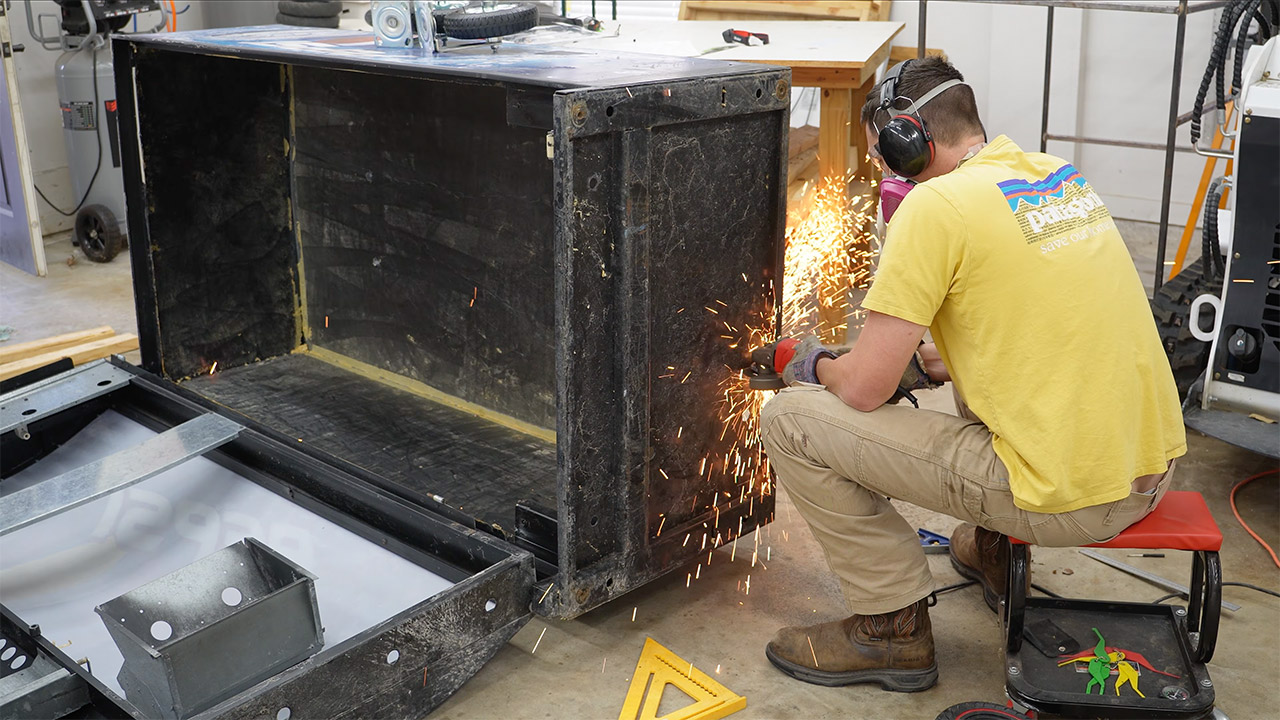
Then came the question of transforming the machine into something that could move. He created a go-kart-style frame that fit inside the cabinet and served as the structural backbone of the item. Battery-powered motors handled propulsion, with two of them driving the rear wheels and providing differential steering, allowing the machine to turn by adjusting speed or direction on either side. Some reused elements from a pair of Razor scooters were utilized for front steering; with the handlebars removed, the steering was joined together for good synchronized movement. Brakes were a must-have, so he installed them. It actually rolled on its own power, though its greatest speed was just about 5 mph. That suited us perfectly, considering the weight and our need to keep it under control during testing and public appearances.
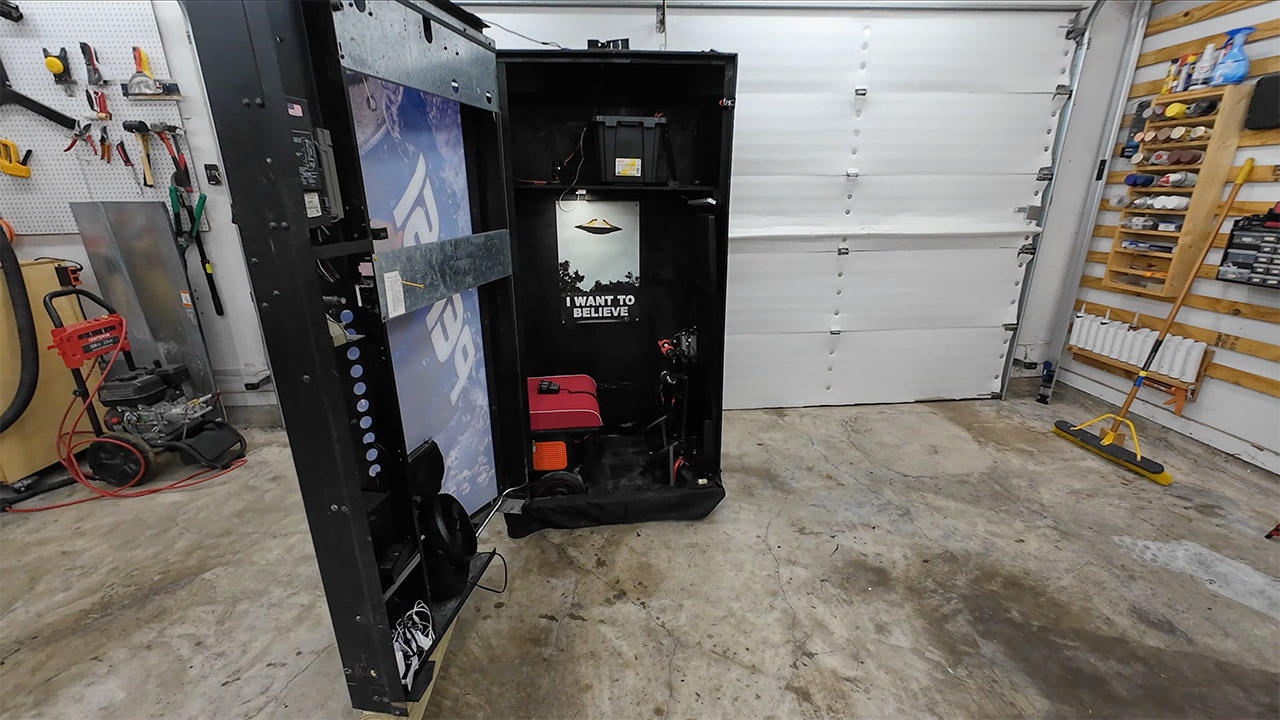
Inside the machine, he installed a real seat, a small AC unit to keep things cool during long runs, and a full set of live cameras on either side. A computer was responsible for monitoring the feeds. He also installed a PA system with an external speaker on the roof, allowing the driver to communicate with anyone close. All of the power came from a set of batteries, one large pack under the item and a few others elsewhere. Fresh Pepsi decals restored its luster, a “mystery flavor” slot at the bottom looked terrific, a rear access hole was cleaned up, and a fresh paint job completed the look.
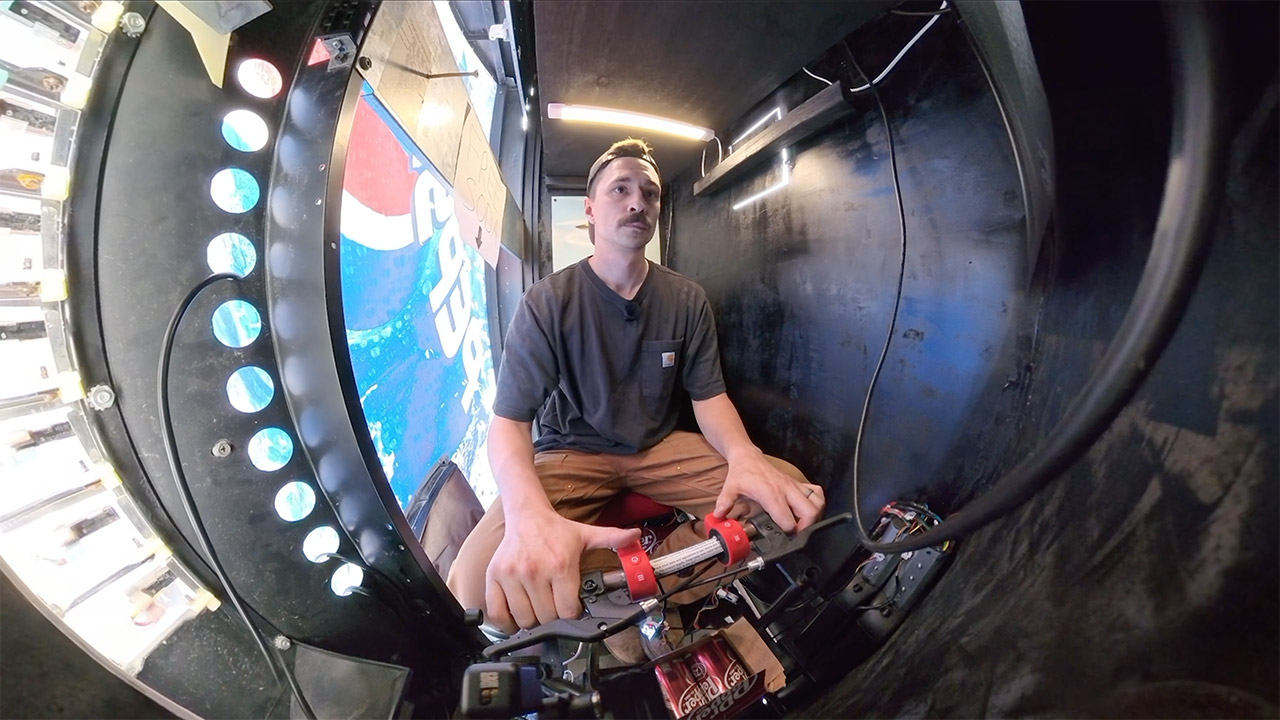
Testing took place in stages, beginning with night trips and casual cruises about the neighborhood to ensure reliability. It completed a couple of laps on a half-mile track with four bars remaining on the battery, which is equivalent to at least a mile of range on a single charge. Neighbors were more astonished and amused by the gadget than anything else, which was a positive thing because it meant the design seemed friendly rather than frightening. Of course, steering was more difficult on the sidewalk than on the roadway, but it held together relatively well with only a few small failures.

So the real test came at the Rowlett car show, when the organizers allowed it into the custom-built category (with the caveat that it was not street legal, of course). It was parked amid the historic vehicles, lifted trucks, supercars, and insane custom machines, in the ideal location. No trophy was brought home, since Best of Show went to a 1961 Porsche. Mixed Bag stated that the original trophy goal changed once the machine began making strangers laugh, making that outcome more fulfilling than hardware on a shelf.

The big picture: Apple is working on a new version of the iPhone Air due out early next year. Sources familiar with the matter say the new phone will address two complaints that consumers had with the first model: a single rear-facing camera and lackluster battery life.
The next Air will reportedly ship with an ultrawide rear camera alongside the primary unit, boosting its appeal to photo bugs that may have skipped the first-gen device due to its single-camera configuration. In an era where multiple cameras are the norm on most mainstream and premium models, the single-camera Air no doubt felt like a major compromise to some.
Sources tell Bloomberg that Apple is also going to improve the Air’s battery life, although it’s unclear exactly how that will be achieved. The obvious answer would be to simply stuff a higher-capacity pack into the phone but doing so would be counterintuitive to the Air’s thin nature.

Gains could also be made through software tweaks and the use of more efficient hardware like the processor. Speaking of, the second-gen Air will be powered by a version of Apple’s A20 Pro SoC, which will debut in new iPhones due out this fall.
The first-gen iPhone Air launched in the latter half of 2025 with a 6.5-inch display and a slim 5.6mm profile. Initial reports suggested a lackluster response from consumers although later analysis refuted those claims. Moving forward with a new model indicates, at the very least, that Apple isn’t ready to give up on the idea just yet.
Apple is expected to launch the second-gen Air in the spring of 2027 alongside the standard iPhone 18. The latter would normally arrive with Pro-grade handsets in the fall but Apple is expected to shake things up this year with the arrival of its first foldable iPhone in addition to the iPhone 18 Pro and Pro Max. A special edition iPhone is being planned for the fall of 2027 to celebrate the iPhone’s 20th anniversary, we’re told.






No Jackpot Winner as $257 Million Prize Rolls Over to $269 Million Monday Draw


Weekend Open Thread: Tuckernuck – Corporette.com

Zimbabwe Requires Crypto Businesses to Register Annually Under New FIU Regulations


Bitget enters Argentina’s regulated crypto market through PSAV registration


NanoClaw integrates JFrog registries to secure AI agent downloads


This Week In Security: Microsoft On Microsoft, Register Your Domains, Linux On ARM, And FreeBSD Joins The File Cache Club


FBI searches office of Ohio voter registration group

Matt Damon’s Viral Sci-Fi Thriller Has Taken Over HBO Max


Anthropic staff to meet White House officials next week, Axios reports


As AI companies race to go public, who else is along for the ride?

Bitcoin could crash to $48,000, if this historical pattern is triggered


“Israel’s” ban on ICRC visits ruled illegal, but Knesset moves to stop them permanently

Warning of disruption as Cardiff Crossrail works to start


Financial Accounting | Last Day Revision Strategy and Booster | CMA Inter – June 2026

Tributes to former deputy head teacher at Cambridge school among death and funeral notices


Deion Sanders Shares Powerful Post After Viral Advice To Deiondra

Market Preview: SpaceX (SPCX) IPO Record, Federal Reserve Meeting, and Iran Nuclear Agreement
what doctors are seeing in ebike crashes

Kate Middleton Glare Goes Viral After Kids Booed At Royal Event


Invesco Quality Income Fund Q1 2026 Commentary
You must be logged in to post a comment Login