Grafana Labs disclosed that hackers have downloaded its source code after breaching its GitHub environment using a stolen access token.
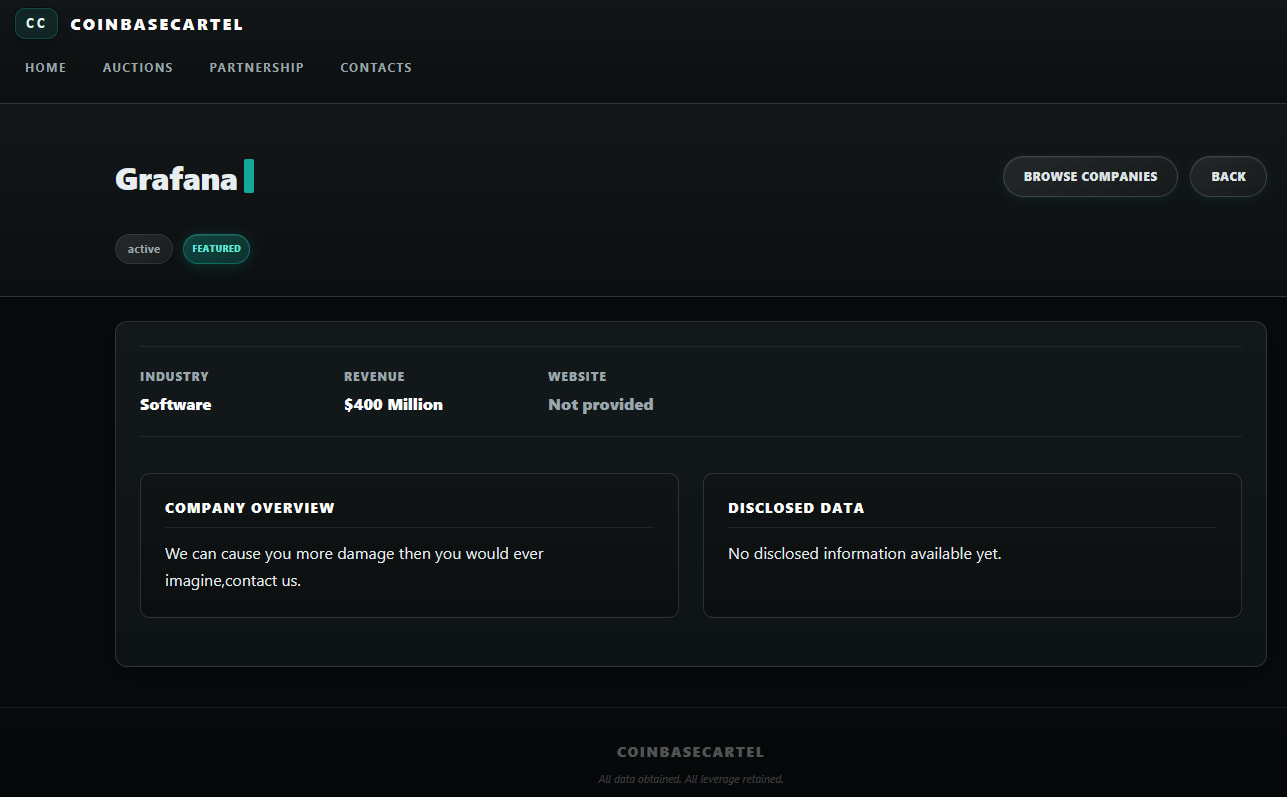
A relatively new extortion gang known as CoinbaseCartel has claimed the attack by adding Grafana to their data leak site (DLS), although no data has been leaked yet.
Grafana Labs is the company behind Grafana, the popular open-source platform for analytics, monitoring, and real-time data visualization.
Paying customers are primarily large enterprises, cloud providers, telecos, banks, governments, e-commerce platforms, and infrastructure operators. According to Grafana, more than 7,000 organizations use the product, including 70% of the Fortune 50 companies.
Advertisement
No payment for hackers
In an announcement over the weekend, Grafana Labs said that its investigation found no evidence that customer data or personal information was exposed during the incident. Furthermore, the company notes that customer systems remained unaffected.
The forensic analysis revealed the source of the leaked credentials. The company “invalidated the compromised credentials and implemented additional security measures” to prevent future unauthorized access.
The attacker attempted to extort the company, demanding payment in exchange for not publishing the stolen source code. However, Grafana said it chose to follow public guidance from the Federal Bureau of Investigation (FBI) and not pay the ransom, noting that doing so would only encourage other threat actors to pursue similar attacks.
“Based on our operational experience and the published stance of the FBI, which notes that paying a ransom doesn’t guarantee you or your organization will get any data back and only offers an incentive for others to get involved in this type of illegal activity, we’ve determined the appropriate path forward is not to pay the ransom,” Grafana stated.
Advertisement
The company said it would release more details about the attack after completing its post-incident investigation.
BleepingComputer has contacted Grafana with a request for additional details about the breach, but we have not received a response by publishing time.
CoinbaseCartel escalates activity
The CoinbaseCartel launched last September and has been quite active this year, announcing more than 100 victims on its data leak portal. The gang focuses on data theft and uses the DLS to pressure victims into paying a ransom.
CoinbaseCartel listing Grafana on its extortion portal Source: BleepingComputer
The gang announced on its site that they “are behind on many leaks,” indicating increased breaches that may have yet to reach the public space.
According to multiple researchers, CoinbaseCartel consists of ShinyHunters and Lapsus$ affiliates that gain access to target networks via social engineering, various forms of phishing, and compromised credentials.
Advertisement
Threat intelligence specialist Joe Shenouda claims that the gang also deploys an in-memory tool called “shinysp1d3r” to encrypt VMware ESXi targets and disable snapshots.
Last year, BleepingComputer analyzed a ShinySp1d3r Windows encryptor developed by the ShinyHunters extortion group. At the time, the threat actor said that they were working on finishing encryptor versions for Linux and ESXi.
After publishing this article, the ShinyHunters extortion gang told BleepingComputer that the CoinbaseCartel is not linked to their group or ransomware operation.
Automated pentesting tools deliver real value, but they were built to answer one question: can an attacker move through the network? They were not built to test whether your controls block threats, your detection rules fire, or your cloud configs hold.
This guide covers the 6 surfaces you actually need to validate.
After three weeks of testimony and not much deliberation, a jury has ruled against Elon Musk, finding that Sam Altman and Greg Brockman were not liable in the case. The jury found that the statute of limitations had already passed when Musk sued the two executives.
Musk filed his lawsuit in 2024, accusing them of “stealing a charity” following his departure from the AI lab in 2018. Though the jury in the case served only an “advisory” role, Judge Yvonne Gonzalez Rogers agreed with the jury’s ruling. Musk’s claims of “breach of charitable trust and unjust enrichment are dismissed as untimely,” she said according toCNBC. Though Musk could still appeal the ruling, Rogers told his lawyer she would dismiss an appeal “on the spot.”
At the center of the case was OpenAI’s reorganization that saw it convert from a nonprofit to a public benefit corporation. Musk has maintained that the move, along with Microsoft’s $13 billion investment in the firm, was a breach of OpenAI’s original contractual agreements. A major question of the trial, though, was when Musk became aware of OpenAI’s for-profit ambitions due to the three-year statute of limitations in the case.
“The facts and the timeline in this case have long been clear, and we welcome the jury’s decision to dismiss these claims as untimely,” a Microsoft spokesperson said in a statement. “We remain committed to our work with OpenAI to advance and scale AI for people and organizations around the world.”
Advertisement
In testimony, Musk’s lawyers tried to paint Altman as a dishonest, lying person, even going so far as to reference his recent unflattering New Yorker profile. Altman often struggled to answer the allegations against him. Asked if he thought himself to be an honest person, Altman said, “I believe so.” Musk’s legal team immediately jumped on that answer. “You believe so?” asked Steven Molo, the lead lawyer for the world’s richest man. “I will just amend my answer to yes,” Altman responded.
When he was later questioned about statements from past OpenAI employees, including former CTO Mira Murati, who described Altman as someone who would say “one thing to one person and completely the opposite to another person,” Altman repeatedly claimed he had not seen their testimony. “You’ve repeatedly been called deceptive and a liar by people with whom you’ve done business, right?,” Molo asked. “I have heard people say that,” Altman responded.
Where Altman came off as meek during his testimony, Musk was combative and testy. “Your questions are not simple. They are designed to trick me, essentially,” Musk told William Savitt, OpenAI’s lead counsel. As the trial inched forward to its conclusion, Musk was absent, despite an order from Judge Yvonne Gonzalez Rogers that he remain in case he was called to testify again. “Mr. Musk isn’t here today. My clients are,” Savitt told the jury during closing arguments. “Mr. Musk came to this court for exactly one witness: Elon Musk. Now he’s in parts unknown.” Parts unknown, in this case, turned out to be by Trump’s side for his diplomatic trip to China.
Even before the trial began, Musk faced longshot odds at securing the remedies he sought. The billionaire sought to undo OpenAI’s for-profit conversion and force the removal Altman and Brockman from their positions on top of the company. There might have been a point early in OpenAI’s negotiations with the Attorneys General of California and Delaware where Musk might have had a chance to get his way, but it was clear Judge Gonzales Rogers was deeply hesitant to undo the work of public officials. When Musk filed a request for a preliminary injunction to stop the conversion, the judge said the request was “extraordinary and rarely granted.”
The company is blaming this increase on “ongoing market conditions.”
Sony has raised prices of the PS Plus subscription service. A one-month subscription to the Essential tier now costs $11 per month, an increase of $1. Additionally, a three-month subscription just went up to $28, an increase of $3. It looks like annual subscribers are off the hook for now, and the wording of Sony’s post on X announcing the change makes it sound like the Extra and Premium tiers are also impacted. This only impacts new subscribers, except in Turkey and India.
The company is blaming this increase on “ongoing market conditions.” When a tech company says this in 2026, it’s typically referring to Trump-adjacent tariffs or AI-based memory crunch. However, PS Plus is a digital subscription service that provides a handful of monthly game titles to download. Members do get cloud save storage and online multiplayer access, both of which require servers that could be more expensive to operate nowadays. Maybe that’s it.
Advertisement
Starting May 20, PlayStation Plus prices for new customers will increase in select regions. Due to ongoing market conditions, prices will start at $10.99 USD / €9.99 EUR / £7.99 GBP for 1-month subscriptions and $27.99 USD / €27.99 EUR / £21.99 GBP for 3-month subscriptions….
We don’t know if annual plans will be getting a price increase in the near future, but the company only mentioned the one- and three-month plans in the announcement. Engadget has reached out to Sony and will update this post when we hear back. The company jacked up annual plans by as much as $40 back in 2023.
As for Sony, a monthly increase of $1 isn’t the biggest deal in the world. The same cannot be said of console price increases. A standard PS5 with a disc drive now costs a whopping $650. That’s a mighty big price of entry to even get started with PS Plus.
There are plenty of porous materials out there that we’re all readily familiar with. Fabrics and wood are great examples, allowing liquids or gases to pass through to a certain degree—a property which is useful or problematic depending on the application.
Metals, however, are not something we would readily consider to be porous. They are solid, unyielding, and impermeable. However, with the right techniques, it is possible to produce so-called “breathable” steel, which has particularly interesting applications in the molding industry.
Breathe Into Me And Make Me Real
Imagine you’re making tooling for an injection molding operation. You’re using steel, of course, because you need a hard, resilient material that can deal with the high temperatures and pressures involved. It’s tough, and readily able to be machined into the desired geometry for your application. Of course, it doesn’t let liquid or gas pass, since it’s a solid impermeable material. This means that when you inject your mold full of hot plastic, you need to find somewhere for the air inside to go. Otherwise, the gas in the mold will end up dissolved in the molten plastic, causing voids, surface imperfections, and other irregularities. Chasing away gas porosity defects in finished parts is one of the major jobs of casting engineers the world over, an endless battle against the forces of heat transfer and fluid mechanics.
Traditionally, this is deal by designing a mold with exhaust ports or vacuum hookups to allow the air to vent out as needed. This takes a great deal of work to get right, particularly when it comes to getting your defect rates as low as possible in mass production. If your gas can’t vent fast enough, or if there are areas where it gets trapped, you end up with defects, and you have to go back to the drawing board.
Advertisement
Breathable mold steel attempts to solve this problem by venting gas through the tooling itself. It allows the creation of a steel mold that is full of tiny little pores that allow air to pass through, while still acting largely impermeable to the molten plastic being molded.
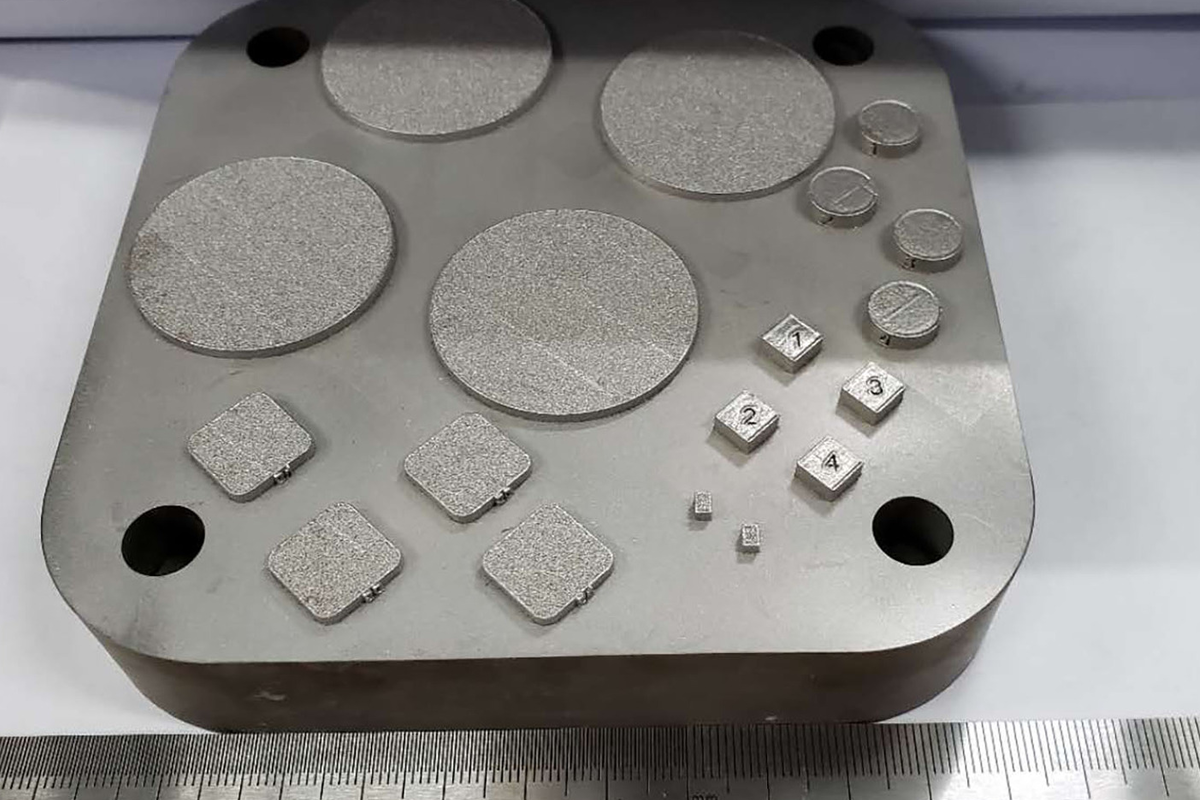
Breathable mold steel is quite something to behold, behaving quite unlike a normal steel part in this regard.
As you might imagine, it’s quite difficult to make a steel mold with complex geometry that also has lots of tiny contiguous holes that allow gases to pass through. It is possible, however, by using some tricky additive manufacturing techniques.
By mixing a foaming agent into powder metal for selective laser melting (SLM) printing, it’s possible to generate interconnected micrometer-scale pores in steel that allow it to ‘breathe’. The pores are generated by the gas released during the heat-based decomposition of the foaming agent. Credit: research paper
As outlined in one research paper, it’s possible to produce breathable steel via selective laser melting (SLM) 3D printing techniques. This involves using a high-powered laser to fuse metal powder together, layer by layer, to produce a final part. Combining a foaming agent with the metal powder enables the creation of 3D-printed metal parts with incredibly fine interconnected pores.
The pores need to be particularly small, on the order of 80 micrometers or less, such that they allow gas in the mold to pass freely while blocking the flow of the larger polymer molecules of the injected plastic.
Chromium nitride is one foaming agent typically used, for the fact that the Cr and N released during its decomposition both lend beneficial properties to the steel of the finished product. The foaming agent is mixed in with the steel powder, and melts along with it as the part is being produced. The breakdown of the foaming agent releases gas bubbles which creates pores in the steel part as it is produced in a relatively predictable manner.
Advertisement
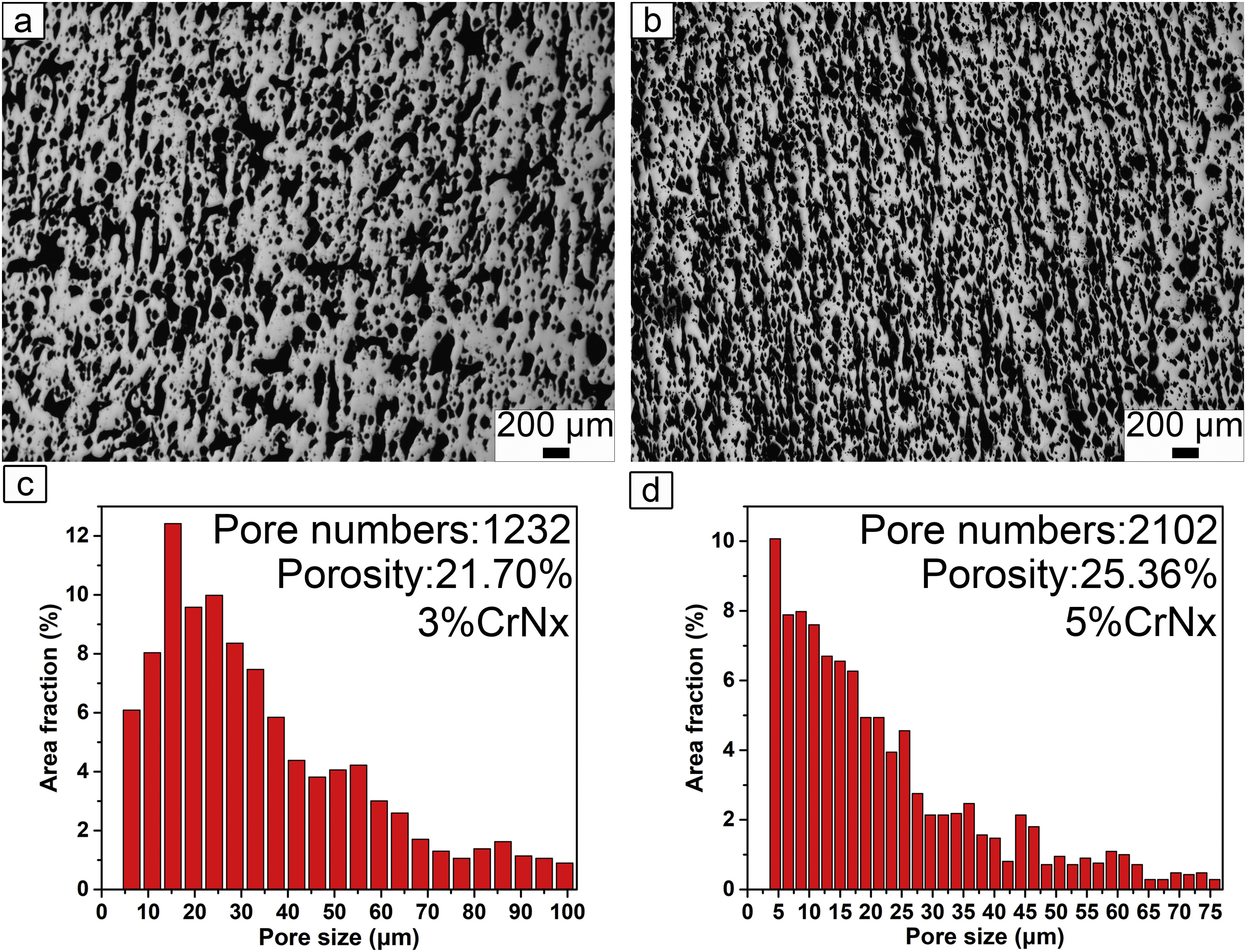
Microscope images of breathable steel samples produced with 3% CrNx and 5% CrNx foaming agent, respectively. Credit: research paper
The level of porosity can be controlled by the amount of foaming agent mixed in to the steel powder, as well as the laser settings. Lower melt pool temperatures caused by faster scanning speeds or lower laser powers tend to favor more porous structures, due to the fluid mechanics involved and how the cooler liquid steel flows into existing pores.
There have been earlier attempts to vent molds with special breathable steel inserts in the past. These consist of premade rectangular inserts or round bars which have been made with so-called “ventilated steel” like PM-35. This material is made by sintering steel powders together in such a way to create a porosity of 20-30%. However, this process isn’t always great for advanced geometry that one might find in a injection mold. Thus, the creation of breathable rods and bars that can be used as an insert in a larger mold, acting as a localized vent. It’s a useful technique, but comes with more constraints on mold and part geometry than being able to simply create the whole mold itself out of breathable steel.
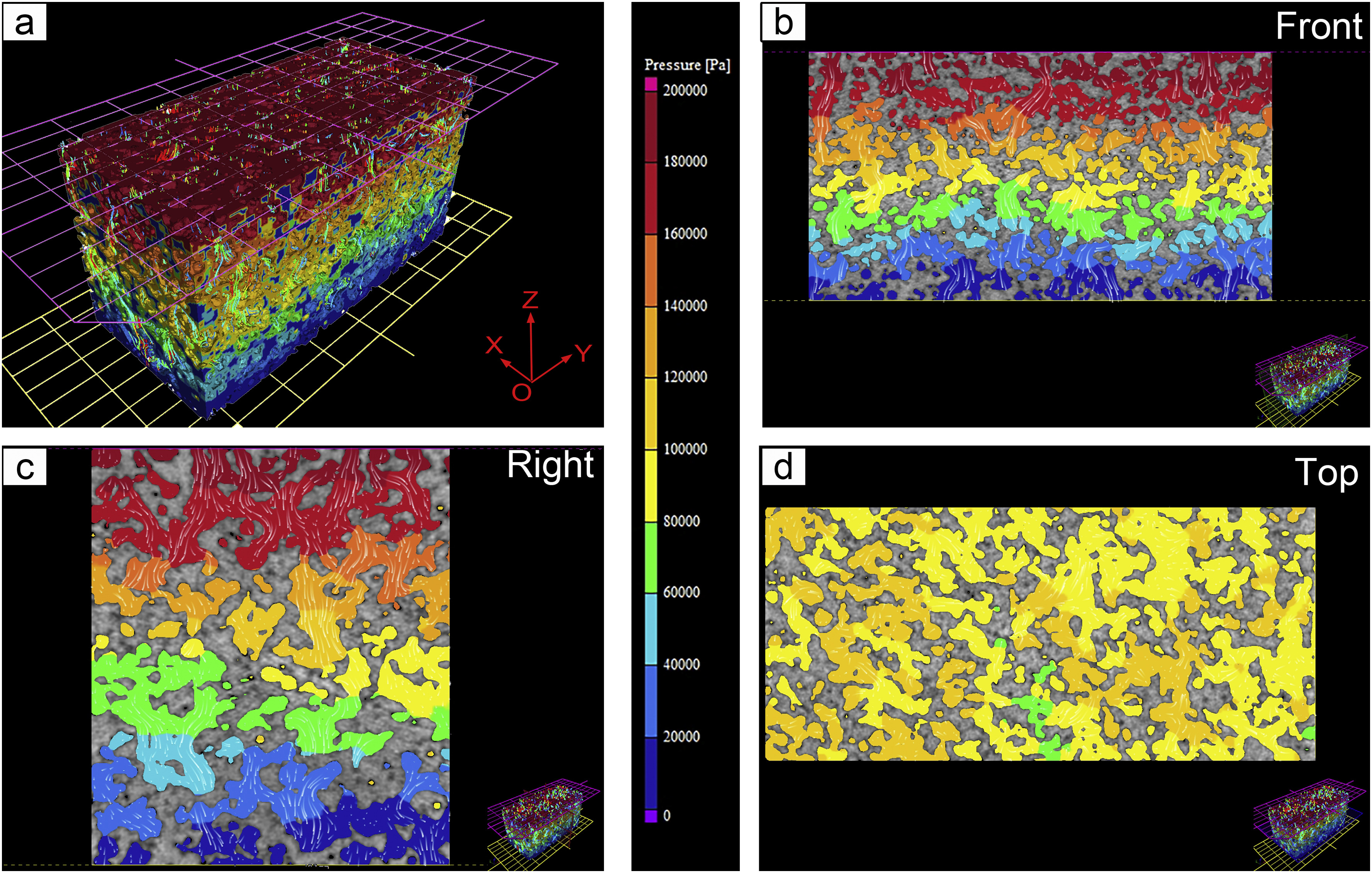
Micro-CT images of a breathable steel sample. Credit: research paper
There are other powder metal techniques that allow the production of more complex vented parts, but they can be expensive and difficult to execute well down to smaller pore sizes, especially compared to the simplicity of SLM printing with an additional foaming agent. The 3D-printing based process has also proven to have more admirable mechanical properties compared to products like PM-35 steel in some cases, with impressive compressive strength as well as hardness and corrosion resistance.
Breathable steel is probably not something you’ll come across in your everyday life unless you happen to work in particular manufacturing fields. Still, if you have the expensive 3D printing hardware on hand to work with metal powders, and you really want to make a complex metal part that’s also porous, this is a great way to go. You could probably use it to make some very weird magic tricks at the very least. Ultimately, it just goes to show that modern material processing techniques can upend everything we think we know about a common material like steel. It’s amazing what can be done!
That’s down from the previous 2,400 posts per day limit.
Thrive Studios ID/Shutterstock
X has introduced some more incentive to get users to pay for “verification” on its platform, but the new limitation may have angered some longtime users. As seen on X and Reddit, users are reporting that X has quietly restricted the amount of posts allowed for those without the blue checkmark. Now, the X Help Center page on limits reads that posts are limited to “50 original posts and 200 replies per day for unverified accounts.”
Compared to cached versions of the same Help Center page, the new limit is much lower than the previous “2,400 per day” rule. Interestingly, the updated page still references the 2,400 updates per day restriction. However, X will inform users of when they hit the new limits and which limit they reached with an error message.
This move could be a part of X’s campaign to cut down on spam and bot activity on the platform, as seen when it introduced the “about this account” feature in October that reveals where an account is based. However, those unhappy with this restriction said it could result in more users leaving the platform. For those who want to stick around and post to their heart’s content, X Premium’s most affordable option, its Basic tier, starts at $3 a month or $32 per year.
Consumers in 2026 are looking for better sound with fewer boxes, and that includes a lot of audiophile listeners. Not everyone wants a full rack of components, long cable runs, and large floorstanding loudspeakers in the den or living room. Some do not have the space, and others simply want a cleaner system that is easier to live with.
The $2,699 Andover Audio The One MK2 Turntable Music System is designed for that buyer. Building on the original Andover-One and the One E, the MK2 combines vinyl playback, factory preset calibration, end of record auto stop, and multi-room connectivity in one self contained system. It is not trying to replace every traditional hi-fi setup, but it does offer a more practical path for listeners who want records, streaming flexibility, and room to expand without building a stack of gear.
“We set out to redefine what’s possible in an all in one music system and that day at RMAF 2019 proved we did just that,” said Bob Hazelwood, Chief Engineer at Andover Audio. “It was a turning point, and we’re proud to bring the joy of true high fidelity listening into more homes to help people connect, unwind, and feel more at home through the power of music.”
What’s New With the Andover One MK2?
Easy Setup: Andover systems have always been designed for simple setup, but the One MK2 goes further with factory preset calibration. Tracking force, anti skate, and cartridge alignment are set before the system leaves the factory, allowing users to place the unit, plug it in, put a record on the platter, cue the tonearm, and start listening.
Advertisement
Audio Technica VM95E Cartridge: The One MK2 includes an Audio Technica VM95E dual moving magnet cartridge, a proven design known for solid channel separation, reliable tracking, and broad stylus upgrade support. Owners can move to other VM95 Series stylus options later without replacing the entire cartridge, giving the system a practical upgrade path.
Adjustable VTA: The One MK2 tonearm allows vertical tracking angle adjustment through a set screw at the tonearm pivot. That gives users more flexibility when changing cartridges or upgrading to more alignment sensitive styli, such as the Audio-Technica AT-VMN95ML or AT-VMN95SH, which benefit from more precise setup than standard conical or elliptical options.
Removable Headshell: The headshell attaches to the tonearm with a locking collar, making cartridge changes, upgrades, cleaning, and inspection easier. It also gives owners a more practical path for future cartridge or stylus maintenance without turning a simple system into a Saturday afternoon crime scene.
Intelligent Auto Stop: The One MK2 adds an optical sensor that stops the turntable motor shortly after the record side ends. The tonearm still needs to be lifted manually, but the auto stop feature helps reduce unnecessary stylus and record wear if the listener does not get to the turntable right away.
Advertisement
Quiet Spin: The One MK2 uses a split plinth design that helps isolate the turntable motor from the speaker enclosure. By reducing motor and enclosure vibration from reaching the stylus, the design is intended to lower noise and improve playback clarity.
Multi-Room Ready: The MK2 provides a Digital Optical Output that enables connection to a compatible external streamer. This includes connection to the Andover Audio Songbird HR Music Streamer or other multi-room capable systems to stream audio from the Mk2 to other rooms.
Key Features That Carry Over in the Andover One MK2
IsoGroove Technology: Andover’s IsoGroove Technology is designed to allow a turntable and speaker system to operate inside a single compact enclosure while reducing feedback, resonance, and vibration related noise. The system uses Andover’s proprietary speaker design, internal bracing, and DSP to help keep vinyl playback stable and clean.
Advertisement. Scroll to continue reading.
Advertisement
Bluetooth: The Andover One MK2 supports Bluetooth, allowing users to stream directly from smartphones, tablets, and other compatible devices.
USB Port: The USB port supports playback from a USB flash drive and can also be used to record vinyl playback to USB for use with other compatible devices.
Outputs: The One MK2 includes preamp outputs for connection to an external amplifier or powered speakers, along with subwoofer outputs for adding a powered subwoofer.
Intuitive Interface: The One MK2 features a front mounted graphic display with single knob control, along with an included RF remote. Users can select phono, Bluetooth, optical digital, and USB input/output, while also adjusting bass, treble, turntable speed, display brightness, and listening modes through the front panel rotary control or remote.
Advertisement
Class A Headphone Amplifier: The One MK2 includes a dedicated Class A headphone amplifier with a discrete output stage for private listening. Andover specifies compatibility with headphones from 16 ohms to 10k ohms, although real world performance with demanding headphones will depend on output power, gain, and voltage delivery. For most conventional dynamic and planar headphones, the built in amplifier should provide a useful private listening option without requiring a separate headphone amp.
Listening Modes
Stereo/Mono Mode: The One MK2 allows listeners to switch between stereo and mono playback. Stereo is the standard choice for most modern records and sources, while mono can be useful for older mono records or recordings that sound more focused when summed properly.
Panoramic Mode: Panoramic mode is designed to widen the perceived stereo image from the single chassis system, helping the One MK2 create a larger soundstage than its physical footprint might suggest.
EQ Settings: The One MK2 includes adjustable EQ settings through the menu system, allowing users to tailor the sound for the room, source material, or personal preference.
The Andover Audio One MK2 is not trying to replace a serious separates based system, but it does make a strong case for listeners who want real vinyl playback, fewer boxes, and a cleaner living room. The combination of a custom turntable, factory preset calibration, end of record auto stop, IsoGroove vibration control, Bluetooth, USB playback and recording, optical input, subwoofer outputs, and multi room expansion gives it more flexibility than most all-in-one turntable systems. The Audio-Technica VM95E cartridge, adjustable VTA, and removable headshell also give owners a practical upgrade path instead of locking them into a dead end design.
What is missing? Wi-Fi streaming support needs to be clearly defined, and serious headphone users will want more information from Andover about the Class A headphone amplifier’s output power, gain, and real world performance with demanding headphones.
The One MK2 is best for vinyl listeners, apartment dwellers, design conscious buyers, and even some audiophiles who want a compact system that does not require a rack, external amplifier, separate speakers, and a cable map worthy of NASA.
Andover-One MK2 Premier System adds Record Storage Upper Stand and Andover-One Subwoofer.
The Gates Foundation marked its 25th anniversary in May 2025 with a panel, from left: Emma Tucker, Wall Street Journal’s editor-in-chief; Mark Suzman, CEO of the Gates Foundation; and Bill Gates. (GeekWire screenshot from live stream)
The Gates Foundation trust no longer owns any shares of Microsoft, the company that made Bill Gates one of the world’s richest people and ultimately led him to launch the Seattle-based global health organization 26 years ago.
The sale was disclosed in a Securities and Exchange Commission filing on Friday, with 7.7 million shares sold for approximately $3.2 billion, as first reported by The Times of India.
The move doesn’t reflect any souring on the Redmond, Wash., tech giant but is the continuation of a Microsoft selloff that began in the last quarter of 2023. The assets that fund the foundation are independently managed by a separate entity, the Gates Foundation Trust.
The foundation’s trust was once heavily concentrated in Microsoft stock — at its 2022 peak, those shares represented 27% of its holdings, per International Business Times.
One year ago, the foundation announced that it would sunset in 2045, with Gates pledging to give away $200 billion — nearly all of his wealth — over the next two decades through the organization.
Advertisement
Cascade Asset Management Company, which manages the foundation’s trust, did not respond to a request for comment.
On the same day as the foundation’s selloff, hedge fund manager Bill Ackman and his firm Pershing Square Capital Management snapped up approximately 5.65 million shares of Microsoft worth about $2.09 billion. The purchase was funded by the sale of Pershing Square’s Alphabet holdings.
“Microsoft operates two of the most valuable franchises in enterprise technology, which account for approximately 70% of the company’s overall profits: M365 and Azure,” Ackman said on X.
Wall Street was less enthusiastic following Microsoft’s quarterly returns in April, sending the company’s stocks down 5% after the disclosure that its capital expenditures would hit roughly $190 billion this year.
Advertisement
The Gates Foundation is the world’s largest philanthropy and has disbursed more than $110 billion since its founding, supporting global vaccinations, educational programs, women’s health and other initiatives. The organization has been ramping up its grantmaking, issuing $8.5 billion last year, and committing to distributing $9 billion this year.
“There are too many urgent problems to solve for me to hold onto resources that could be used to help people. That is why I have decided to give my money back to society much faster than I had originally planned,” Gates wrote in announcing his philanthropic plans last May.
By the end of last year, the foundation’s endowment was worth $89 billion.
The CFTC says it is ramping up efforts to catch insider trading and market manipulation in prediction markets, using AI tools, blockchain tracing, and other surveillance systems to flag suspicious bets. It’s also monitoring activity by U.S. traders accessing offshore platforms like Polymarket through VPNs. Wired reports: [T]he Commodity Futures Trading Commission, which oversees prediction markets, wants you to know that it’s watching very, very closely. The agency is searching for suspicious behavior from traders within the United States who have been sneaking onto offshore markets, including Polymarket’s crypto platform — which is blocked stateside — by using virtual private networks. “We’re going to find them, and we’re going to bring actions,” agency chairman Michael Selig told WIRED this week, speaking from the CFTC’s headquarters in Washington, DC. Selig says the agency, which is especially lean right now, is staffing up. Like so many other AI-pilled workplaces, the CFTC is also leaning into automation to handle the growing workload, including tools that analyze trading patterns and flag potential manipulation. “You’ve got so much data,” Selig says. “When we feed it into AI, we get really great information. It can help us understand things, like where we might want to investigate, or when we might need to send a subpoena to a trader.”
In addition to proprietary surveillance systems developed in-house, the agency’s arsenal includes third-party blockchain tracing tools like Chainalysis for crypto platforms, and market abuse detection software including Nasdaq Smarts for centralized markets. (Beyond Nasdaq Smarts, the agency did not specify which AI tools it uses and declined to share more specific examples.) […] Selig recently told Congress that the company is pursuing “hundreds, if not thousands” of insider trading tips. Investigations are not limited to federally regulated exchanges. “We’re surveilling the markets on a global basis,” he tells WIRED.
Selig says that the agency will exert extraterritorial jurisdiction — its legal ability to enforce its laws beyond traditional boundaries — when it finds suspicious activity on offshore platforms like Polymarket, though he says it’s a case-by-case approach. “We use it in extreme circumstances,” he says, with an eye towards whether charges have a strong chance of sticking in court. “In any extraterritorial litigation, there’s going to be challenges to our authority, and that could also impair our ability to bring cases in the future.” According to Selig, the 2010 Dodd-Frank Act allows the CFTC more leeway to pursue this kind of enforcement action, by giving it more authority over foreign swap activities that impact the US. When appropriate, the agency works with regulators from other countries, too. “For cases where we’re not sure we’ll win, or it’s less in our wheelhouse and more of a foreign matter, we would relay it to a foreign regulator,” he says. “We’re constantly referring cases.” […] Selig is insistent that the CFTC is only just getting started. The agency will identify wrongdoers, he says — no matter “how large or how small.”
Married at First Sight US is marching into season 19 with a whole new aisle order — and fans are already bracing for a bouquet toss of chaos. The hit reality matchmaking circus aired on Peacock in the US last year – but we’ll show you how to watch MAFS USA season 19 for free.
Longtime love gurus Dr. Pepper Schwartz, Pastor Cal Roberson and Dr. Pia Holec are all exiting in a shock expert shake-up. To compete with the MAFS Australia, producers are promising fresh blood, hotter matches and fewer dull influencers. About time.
No spoilers, but MAFS season 19 will lean harder into “real relationships” — though MAFS veterans know the honeymoon phase = meltdowns in the first 24 hours (see: BBC exposé The Dark Side of Married at First Sight).
Advertisement
Set in Texas, MAFS fans can watch Married at First Sight USA online from anywhere – and potentially for free. Here’s a full breakdown…
How to watch Married at First Sight USA S19 for free
In the UK, viewers MAFS USA season 19 will air for FREE on E4 starting Monday, May 18, and will be available on Channel 4 streaming for free with ads.
US viewers, meanwhile, can binge ALL episodes right now on Peacock. All episodes are also available on StackTV free trial in Canada.
How to watch Married at First Sight US from anywhere
If you’re traveling abroad when Married at First SightUS season 19 airs, you can watch without regional restrictions using a VPN. .
Advertisement
Use a VPN to watch Married at First Sight USA 2026 from anywhere:
How to watch Married at First Sight USA in the US
Advertisement
How to watch Married at First Sight USA S19 in Canada
Episodes went out on Slice weekly at 9pm ET/PT on Tuesdays last October. You can stream episodes online with a subscription to StackTV (free trial) through Amazon Prime Video.
US viewer currently traveling in Canada?Download a VPN to connect to your streaming service back home and watch Married at First Sight USA.
Advertisement
Can I watch Married at First Sight US in Australia?
Yes – you can watch all season 19 episodes right now on Stan in Australia.
Episodes 6-8 — Honeymoons The couples head off on luxury trips while cracks already start appearing in some marriages.
Episodes 9-14 — Moving In Together Reality hits as finances, families, routines and intimacy become major pressure points.
Episodes 15-18 — Couples Retreats & Group Drama Expect explosive dinner parties, cheating accusations and emotional confrontations.
Episodes 19-20 — Homestays Couples meet relatives and face real-world compatibility tests.
Episodes 21-22 — Final Dates The marriages reach breaking point before Decision Day.
Episode 23 — Decision Day Each couple decides whether to stay married or get divorced.
Reunion Special (TBC)
You may also enjoy watching…
VPN services are evaluated and tested by us in view of legal recreational use. For example: a) Access to services from other countries, (subject to the terms and conditions of that service). b) Safeguarding your online security and making your online privacy more robust when abroad. Future plc does not support nor condone the illegal or malicious use of VPN services. We do not endorse nor approve of consuming pirated content that is paid-for.
Engineers at Boston Dynamics shared details today on a new training system for their Atlas humanoid robot. The approach focuses on building the kind of physical coordination needed for demanding factory or warehouse work. One video demonstration captures the result perfectly. Atlas rotates its upper body a full 180 degrees, squats down, grips a mini-fridge loaded with about 50 pounds, and walks it straight over to an engineer waiting nearby. The motion stays smooth even when the weight inside shifts.
The developers based the entire process on the concept of extensive practice, which was carried out entirely in a computer simulation. They begin by giving the robot a very rudimentary understanding of what it has to accomplish, which it learned from a person who had done it correctly, or even a brief animation of how to move. Then they establish specific targets for what needs to happen before they can call it a success. Points are granted for things like maintaining a tight grip on the object, remaining upright, and recovering from sudden tugs or slippery floors. The simulation then runs the robot through millions of different attempts, each with a tiny variation, such as whether the fridge is heavier or lighter, or you are traveling at a different angle. Each of these little adjustments forces the robot to work things out on its own.
Sleek & Durable Design: Standing at 132cm tall and weighing only approx. 35kg, the G1 is constructed with aerospace-grade aluminum alloy and carbon…
High Flexibility & Safe Movement: Boasting 23 joint degrees of freedom (6 per leg, 5 per arm), it offers an extensive range of motion. For safety, it…
Smart Interaction & Connectivity: Powered by an 8-core high-performance CPU and equipped with a depth camera and 3D LiDAR. It supports Wi-Fi 6 and…
When these virtual practice sessions are over, the team simply transfers what the robot learned to the real robot and gives it a spin. They see what went wrong, make some changes, and then re-run the simulation. This cycle occurs quickly, owing to the robot’s simplicity: its actuators are just two types, its limbs are symmetrical, and there are no trailing cables to obstruct the process. That makes it much easier to make the simulation match what happens in the lab, and as a result, behaviors that appear solid in simulation tend to work on the first few attempts in the real world.
One thing that sticks out is Atlas’ ability to carry objects by being aware of its surroundings. Rather than depending on constant camera images of the fridge, the robot mostly uses its internal knowledge of where its joints are and how hard items are pulling on them. That feeling of its entire body allows it to adapt to the exact shape of the object, its center of mass, or any unexpected wobbling without having to pause and look again. According to the engineers, switching from relying solely on your hands to a more full-body technique makes all the difference when lifting loads that weigh more than 100 pounds, far above the 50-to-70 pounds they were working on.
Advertisement
The same foundation allows Atlas to perform additional remarkable feats that showcase its balance and strength. In other films, you can see the robot performing handstands and backflips, which involve fine control over all limbs and swift recovery if you lose your footing. These gymnastics activities also serve as practice for how the robot would handle a hot industrial floor, where it must be able to continue moving even when it becomes heated. Each new skill builds on the previous one since the robot is learning to use its knees, shoulders, and forearms collectively rather than treating each arm separately.
The all-stock takeover, the largest power acquisition ever, gives NextEra the utility that runs Northern Virginia’s data-centre belt and consolidates the bidding power on the demand side of the AI-electricity trade.
NextEra Energy has agreed to acquire Dominion Energy for about $67bn in an all-stock deal, Bloomberg reported on Monday, in what would be the largest power-sector acquisition on record.
NextEra shareholders will own 74.5% of the combined company, Dominion shareholders 25.5%, with each Dominion share exchanged for roughly eight-tenths of a NextEra share.
The combined entity will trade under the NextEra name on the New York Stock Exchange and serve around 10 million utility customers across Florida, Virginia, North Carolina, and South Carolina.
Advertisement
The strategic logic is the one every utility-sector trade has been running on for 18 months. Dominion is the utility that powers Northern Virginia, which is the world’s largest data-centre market by a long margin and the regional grid most exposed to the AI-training and inference build-out.
The 💜 of EU tech
The latest rumblings from the EU tech scene, a story from our wise ol’ founder Boris, and some questionable AI art. It’s free, every week, in your inbox. Sign up now!
NextEra brings the largest US renewable-generation fleet, an existing nuclear position, and Florida Power & Light’s regulated customer base.
Advertisement
The combined company will, on the deal’s own claims, be the world leader in renewables and battery storage, the US leader in natural-gas generation, and the second-largest US nuclear operator.
The merged entity will be selling, in effect, every form of generation that an AI hyperscaler is now contracting for.
The macro thesis under the trade is a part of the AI infrastructure cycle that has become unavoidable. US utilities have, on the running aggregated capex guidance, committed roughly $1.4 trillion of electricity-infrastructure investment by 2030, almost all of it driven by AI data-centre load growth.
Northern Virginia is the densest concentration of that demand, and it is also the grid where the supply constraint has been most acute, with new data-centre interconnection queues running multiple years.
Advertisement
The cooling-driven AWS US-EAST-1 outage earlier this year was the most visible operational example of what happens when the load curve grows faster than the substations can absorb.
NextEra and Dominion combined become, by some distance, the single largest counterparty that hyperscalers will be negotiating new long-term power purchase agreements within the affected geographies.
NextEra chief executive John Ketchum will run the combined company; Dominion’s Robert Blue will run the regulated-utilities business and take a board seat. The combined dividend and rate-base footprint was not disclosed.
What is visible is that NextEra’s unregulated-generation arm and Dominion’s regulated-Virginia franchise are being put under one roof, the structural piece the AI-power thesis has been arguing for.
Advertisement
The deal also collapses a competitive dynamic that has shaped the past year of utility-sector valuations. Hyperscalers (Amazon, Microsoft, Google, and Meta most prominently) have been negotiating in parallel with multiple utilities across the same regional grids, playing demand-side bidders against each other for long-tenor contracts.
Consolidating two of the largest counterparts on the supply side narrows the negotiating field. Whether that translates into pricing power for the merged utility or into regulatory pushback from state commissions (Florida’s PSC, the Virginia State Corporation Commission, and the North Carolina Utilities Commission all have jurisdictional roles in the approval) is the question the next 18 months of regulatory-filing review will settle.
Antitrust exposure is the second question. Combining the largest US renewable-generation operator with the utility supplying the densest data-centre market is a profile FERC and the DOJ will both have to clear.
Pre-deal analyst commentary had flagged the regulatory path as the most material execution risk.
Advertisement
Amazon, Microsoft, Google, and Meta have committed combined power-procurement and self-build capacity into 2030 that requires roughly the entirety of new US utility-scale generation coming online over the same window.
A combined NextEra-Dominion is the natural single counterparty to coordinate those commitments across the Southeast US grid.
Bloomberg’s full-text coverage describes the deal as creating ‘a utility colossus’ calibrated against precisely that demand curve.
Completion timing has not been disclosed beyond a target close, subject to customary closing conditions, including regulatory approvals.
Advertisement
The merged dividend policy, the integration timeline for Dominion’s Virginia regulated franchise, and the disposition of overlapping renewable-development pipelines are the operational details that will determine whether the announced cost-synergy and growth assumptions hold.
The headline figure is the one that has been published. $67bn is the price tag on the largest power deal on record.








































































You must be logged in to post a comment Login